Category Archives: Uncategorized

Words and Drawn Swords

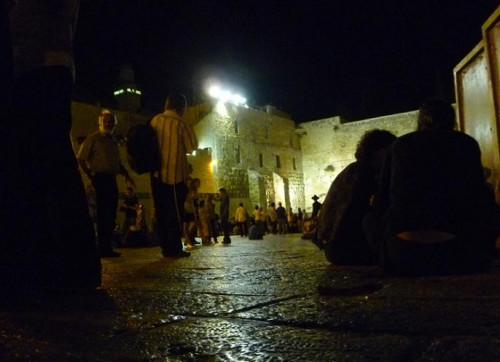
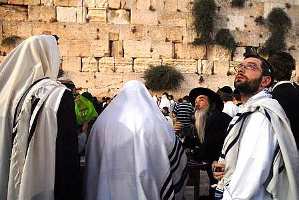
Tisha b'Av at the Kotel 2007Israeli Prime Minister Benjamin Netanyahu told President Barack Obama he’s willing to make some compromises to achieve peace in his nation, but that returning to Israel’s 1967 borders is not an option.

Netanyahu met with Obama in Washington, D.C., Friday, on the heels of the president’s public call to return Israel to the borders the state held before the 1967 Six Day War, as a concession for peace with the Palestinians.

CBN News Story
“Netanyahu Tells Obama 1967 Borders ‘Indefensible’
by Jennifer Wishon

My companion attacks his friends;
he violates his covenant.
His talk is smooth as butter,
yet war is in his heart;
his words are more soothing than oil,
yet they are drawn swords.
Psalm 55:20-21

On Tisha B’Av, five national calamities occurred:

  • During the time of Moses, Jews in the desert accepted the slanderous report of the 10 Spies, and the decree was issued forbidding them from entering the Land of Israel. (1312 BCE)
  • The First Temple was destroyed by the Babylonians, led by Nebuchadnezzar. 100,000 Jews were slaughtered and millions more exiled. (586 BCE)
  • The Second Temple was destroyed by the Romans, led by Titus. Some two million Jews died, and another one million were exiled. (70 CE)
  • The Bar Kochba revolt was crushed by Roman Emperor Hadrian. The city of Betar — the Jews’ last stand against the Romans — was captured and liquidated. Over 100,000 Jews were slaughtered. (135 CE)
  • The Temple area and its surroundings were plowed under by the Roman general Turnus Rufus. Jerusalem was rebuilt as a pagan city — renamed Aelia Capitolina — and access was forbidden to Jews.

-Rabbi Shraga Simmons
“Overview and laws of the Jewish national day of mourning”
Aish.com

I sometimes wonder what keeps the Jewish people going. I know, the “politically correct” answer is “God”, but think about it. You are Israel. You are surrounded by nations who have wanted to completely destroy you since the day you arrived in the modern world. Within your ancient and historic borders is a people group who demands that you give up more and more of your land and if you don’t, they’ll keep on killing your citizens. Even your biggest “ally”, the United States, for decades has continued to demand that you “give up land for peace”, even when you’ve already shown (think Gaza) that doing so only results in more terrorism; the opposite of peace.

Not only does the world hate Israel, the world hates Jews. Anti-Semitism is on the rise in Sweden, Anti-Semitism is on the rise in Canada, Anti-Semitism is on the rise all over the world.

If you’re a Jew, you’re not really safe anywhere. Sooner or later, someone is going to turn on you.

Why go on?

You can sort of see why assimilation has always been a forbidden but attractive alternative for Jews in the diaspora. Tisha b’Av is a reminder of just how much the world hates the Jews and how many times throughout history, everyone else has tried to kill the Jews; to wipe them out of existence.

Why go on? Why not either give in and let the world have their way, or assimilate and quietly disappear into the pages of history, as so many other ancient people groups have done (ever hear of a Canaanite, a Hittite, or an Edomite anymore)?

Why go on?

In the times of the First Temple lived very lofty souls. It was their thirst for spiritual ecstasy that led them to worship foreign gods.

Thousands of years later, the holy Ari taught, in the 500 years of forced conversions from the Crusades until the Spanish Expulsion, these souls returned so they could be repaired.

Many of the martyrs of that time were men of reason—and for a philosopher to give his life for the sanctity of G–d’s name is a very great test. Many did, and so they were healed.

When the Ari came, however, he revealed the secret wisdom and repaired the world so that all souls were healed and no repairs were left to be made. It follows that all the suffering of the Jewish people since the Ari are neither punishment nor repair. If so, what are they?

We do not know.

One thing we do know: That we do not know.

-Rabbi Tzvi Freeman
Based on letters and talks of the Rebbe, Rabbi M. M. Schneerson
“Beyond Punishment and Repair”
Chabad.org

Were you hoping for something more uplifting? So was I.

I’m not Jewish, so I lack any real understanding to be able to answer the question. The Hamasonly thing I know is that the Jews have endured and they continue to endure. Is it God’s will that the Jews should continue to exist and that they should also continue to suffer?

“I know, I know. We are Your chosen people. But, once in a while, can’t You choose someone else?” -Teyve from the film Fiddler on the Roof (1971)

There are times when individuals get so discouraged they want to give up. Some quit their jobs, some get divorced, some simply withdraw into themselves and we call that depression, and some do the ultimate “quitting” by committing suicide. In these cases, the people involved feel trapped and alone and hopeless. Whether it’s true or not, they feel like everyone is against them and that there’s no where to turn. They feel out of control of their environment and their lives and they want to make the pain stop.

They’re willing to do anything to make the pain stop because life doesn’t make any sense.

I know you’re reading this a day later, but I’m writing this on Tisha b’Av. I know that hope is supposed to be mixed in with mourning and loss, but mourning and loss are a vital and inescapable element on the 9th of Av. The hunger of fasting is a reminder of how empty the world is of justice and mercy:

“Blessed are the poor in spirit,
for theirs is the kingdom of heaven.
Blessed are those who mourn,
for they will be comforted.
Blessed are the meek,
for they will inherit the earth.
Blessed are those who hunger and thirst for righteousness,
for they will be filled.” –Matthew 5:3-6

Tisha b'Av at the Kotel 2011The Master might as well have been talking about Tisha b’Av…or about life.

Maybe the only answer is the one provided by the Rebbe as interpreted by Rabbi Freeman at Chabad.org:

We are imprisoned because we have exiled our G-d.

As long as we search for G-d by abandoning the world He has made, we can never truly find Him.

As long as we believe there is a place to escape, we cannot be liberated.

The ultimate liberation will be when we open our eyes
to see that everything is here, now.

If the Jews are in exile, if the Jews suffer and mourn, God suffers and mourns with them. They aren’t alone. Even in torment, they are never alone. However, based on the words of Jesus quoted above, does that also apply to the rest of us? In mourning, where is our promised comforter? In sorrow, where is our peace?

Remember my affliction and my wandering, the wormwood and bitterness.
Surely my soul remembers
And is bowed down within me.
Therefore I have hope.
The LORD’S lovingkindnesses indeed never cease,
For His compassions never fail.
They are new every morning;
Great is Your faithfulness.
“The LORD is my portion,” says my soul,
“Therefore I have hope in Him.”
The LORD is good to those who wait for Him,
To the person who seeks Him.
It is good that he waits silently
For the salvation of the LORD. –Lamentations 3:19-26 (NASB)

As it is said, every descent is for the sake of an ascent, and so we have this Kabbalistic interpretation of Tisha b’Av from Rabbi Yitzchak Ginsburgh:

The Seer of Lublin passed away, at the age of 70, on the 9th of Av 5575 (1815), a day of national mourning, but also, according to the sages, the birthday of the Mashiach. Long before his passing he hinted to his followers that he would pass away on the 9th of Av.

The passing of the Seer of Lublin joins together with the “passing” of the Divine Presence from the Holy Temple in Jerusalem on the 9th of Av (the day of the destruction of the Temple – only its physical body “died” but its soul ascended to heaven) to arouse God to bring the Mashiach (who will permeate reality with Divine revelation, bringing redemption, peace and goodness to all) – now!

Hope and Ashes

MourningI remember with perfect clarity the sensation of waking up on the morning of March 9, 1990. In those first few fuzzy moments of consciousness, I oriented myself to where I was — in the spare bedroom of my parents’ New Jersey apartment, and what day it was — two days after my father’s death. As soon as I realized that I had woken up into a world without my father, my heart plunged into a fathomless grief, like waking up into a nightmare that will never end.

The world without my father was not simply the same world minus one; it was a totally different world. This altered, diminished world lacked the stability and goodness that was my father. This world wobbled on its axis; its gravitational pull was heavier.

The ninth day of the Hebrew month of Av — called Tisha B’Av — is to the Jewish people what March 9 was to me. We misrepresent the tragedy of the day by describing it as the destruction of the two Holy Temples, as if the catastrophe is the loss of a building. The American people do not mourn on 9/11 because of the destruction of the Twin Towers; they mourn the thousands of lives lost in the conflagration. Contrast a person who mourns the absence of the majestic towers to the New York skyline with a person who mourns the loss of his/her parents caught on the 98th floor.

Tisha B’Av is more like a death than a destruction, because on that day the world changed irrevocably.

Sara Yoheved Rigler
“Waking Up to a World Without God’s Presence”
Aish.com.

When Jonah’s warning reached the king of Nineveh, he rose from his throne, took off his royal robes, covered himself with sackcloth and sat down in the dust. This is the proclamation he issued in Nineveh:

“By the decree of the king and his nobles:

Do not let people or animals, herds or flocks, taste anything; do not let them eat or drink. But let people and animals be covered with sackcloth. Let everyone call urgently on God. Let them give up their evil ways and their violence. Who knows? God may yet relent and with compassion turn from his fierce anger so that we will not perish.”

When God saw what they did and how they turned from their evil ways, he relented and did not bring on them the destruction he had threatened.Jonah 3:6-10

Sara Yoheved Rigler characterizes the mourning of Tisha b’Av not for the lengthy series of hardships that have been inflicted on the Jewish people and not even for the loss of the First and Second Temples, but for the loss of God in the world. She describes how her son was born into a world without her father, his grandfather, and that he “will never know how the room lit up when my father entered, how secure and supported dozens of people felt because of the bedrock that was my father”.

For the past 2,000 years, Jews have been born into a world without the Holy Temple in Jerusalem, City of David:

In the same way, we who were born into a world without the Divine Presence have never experienced the spiritual luminosity that radiated through the aperture of the Holy Temple. We live in a dimmer, coarser world, where physical reality seems like ultimate truth while spiritual reality seems like a vague phantasm. We navigate in the nightmare without even knowing we’re in it.

It is true that the world is not without God. God is manifest in our world all of the time through the acts of His people, through His answers to prayer, and through His providence in the lives of each and every human being on Earth. Yet, as Rigler points out, the Divine Presence, the unique projection of the infinite God into a finite world through the “humbling” of His essence has not existed in our mortal realm for 20 centuries.

If you’re Christian, I know what you’re thinking. What about Jesus? True. We could say that Jesus was a manifestation of the infinitely Divine in finite moral form. He was the Word made flesh and the Divine Presence in the shape of a man (I say was because he is also our High Priest in the Heavenly Court and he sits at the right hand of the infinite, unknowable, all powerful Ayn Sof; who Christians call “God the Father”).

Candle burning outYet, in the same way that Rigler mourns in a world without the Divine Presence, we Christians can and probably should mourn being born into a world without a living Jesus walking among us. True, God is only a prayer away and He is with us even when we are too weak or ashamed to pray, but something…someone is gone. The world is created but it is damaged. There are pieces missing. We live in a house with walls and part of the roof “deconstructed”. It’s like being born into a world without a loving grandfather…like Sara’s son. It’s also like this:

“And I will pour out on the house of David and the inhabitants of Jerusalem a spirit of grace and supplication. They will look on me, the one they have pierced, and they will mourn for him as one mourns for an only child, and grieve bitterly for him as one grieves for a firstborn son. On that day the weeping in Jerusalem will be as great as the weeping of Hadad Rimmon in the plain of Megiddo. The land will mourn, each clan by itself, with their wives by themselves: the clan of the house of David and their wives, the clan of the house of Nathan and their wives, the clan of the house of Levi and their wives, the clan of Shimei and their wives, and all the rest of the clans and their wives. –Zechariah 12:10-14

Some Christians view this verse as the means to accuse the Jews of “murdering Jesus” and that someday “they’ll be sorry”, but in truth, Jesus died for the sins of all of us. The collective church never really mourns the loss (except perhaps when watching the 2004 film The Passion of the Christ) but only celebrates the resurrection joy on Easter. Where is our sorrow over being the cause of his suffering and death? In claiming the resurrection and everlasting life for our own, where is the agony and sorrow over needing to be saved by his death because of our willful sins?

We were born into a world without the Divine Presence among us because of what we did wrong. Something absolutely perfect is missing from the world, and this side of paradise, we will never fully experience it. Paul said that “we see through a glass, darkly” (1 Corinthians 13:12 KJV) and thus, we were born into the world half-blind, only barely able to see the image of the perfect God in the reflection of the Master. Sin distances us from God and the One who man once walked with in the Garden, though still with us, seems so very distant.

I recently read a story on the Arutz Sheva news website about a group of Christian churches that will, on August 13 and 14, read portions of the Torah in solidarity with the Jews and with Israel. We can fast and mourn with the Jews on Tisha b’Av for this reason as well.

From sundown last night until sundown tonight, Jews all over the world mourn destruction but hope for redemption. As Christians, we know our redemption is in Jesus Christ, and yet he has not returned. There are many who still don’t know him. We who are saved often take that status for granted and continue to sin. We have much to grieve over.

Today, we can fast, dining on ashes, and still hope for the coming of God’s glory back into the world. Sara Yoheved Rigler says something very important in her article:

In one essential way Tisha B’Av differs from death: the catastrophe is reversible. As Rabbi Avraham Isaac Kook declared: “The Temple was destroyed because of causeless hatred [among Jews]; it can be rebuilt only by causeless love.”

It can sometimes be difficult to rise Phoenix-like to embrace a life of “causeless love” from the ashes of grief, sorrow, failure, and “wanton hate” (as expounded upon so well at the Lev Echad blog). Rabbi Tzvi Freeman says the following based on the wisdom of the Rebbe, Rabbi M. M. Schneerson:

Your soul is in captivity when you know what is right and you allow the world to stop you.

Captivity begins by believing that you are small and the world is big. Once you believe that, next you are likely to believe it will step on you, and your fear it.

And then you come to obey it, then to run after it. And then you are it’s slave, thirsting for water for the soul but not even able to remember where to look for it.

To fear the world is to deny the Oneness of the Creator.

Don’t take the world and its darkness so seriously – it is not as real as it feigns to be. The only thing real about it is its purpose of being – that you should purify it.

I struggle to see the hope beyond the loss and yet, today especially, I sit in the darkness and mourn in ashes.

The road

The road is long and often, we travel in the dark.
A Time to Dance

MourningIt used to be that the soul fought with the body, until one conquered the other with force. Then the Baal Shem Tov came and taught a new path: The body, too, could come to appreciate those things the soul desires.

In the place of self-torture and fasting, the Baal Shem Tov showed his students the way of meditation and joy. Every need of the body, he taught, could provide a channel to carry the soul.

Rabbi Tzvi Freeman
Based on letters and talks of the Rebbe, Rabbi M. M. Schneerson
“Working With the Body”
Chabad.org

They said to him, “John’s disciples often fast and pray, and so do the disciples of the Pharisees, but yours go on eating and drinking.” Jesus answered, “Can you make the friends of the bridegroom fast while he is with them? But the time will come when the bridegroom will be taken from them; in those days they will fast.”Luke 5:33-35

Judaism and Christianity in general see the connection between the soul and the body differently. In Christianity, the “desires of the flesh” are seen as always in opposition to the desires of the spirit (“the spirit is willing, but the flesh is weak” from Matthew 26:41). In order for a person to become closer to God, they must deny anything to do with the physical world and strive for the intangible realm of spiritual things. However for Jews, it’s a bit different.

There’s not much of a history of asceticism among Jews the way we see among the Christian saints (there are exceptions). The world was created by God which includes the pleasures of the world. This isn’t to say that a person is permitted to do anything he or she desires, but those things that Christians blush at enjoying, even within proper confines such as sex between a married couple, aren’t considered shameful, as long as such desires are disciplined and only are expressed as God wills. In fact, within Jewish thought, it is believed that for every sinful impulse, God created an acceptable moral equivalent.

I suppose this is an odd topic to bring up, since the fast of Tisha b’Av begins today at sundown. This is the culmination of the Three Weeks of Mourning between the 17th of Tammuz and the Tisha b’Av commemorating the times of great suffering the Jewish people have endured throughout history. Yet God intends for us to mourn, not as a lifestyle, but only in its proper time and season:

There is a time for everything,
and a season for every activity under the heavens:
a time to be born and a time to die,
a time to plant and a time to uproot,
a time to kill and a time to heal,
a time to tear down and a time to build,
a time to weep and a time to laugh,
a time to mourn and a time to dance… –Ecclesiastes 3:1-4

The words of Jesus as recorded by Luke echo this quite strongly. We live in a broken world but we were given life, not only to serve God’s purpose, but to appreciate. Pleasurable things aren’t to be avoided, only enjoyed within the type of lifestyle we were provided by God. For the past three weeks, Jews all over the world have mourned. Tonight, many will fast and weep. Maybe even a few Christians will fast in solidarity with their Jewish brothers and sisters, and in acknowledgement of the fact that God mourns too over the suffering of His people.

Simchat TorahWhile the world has trouble and there is a time to fast, to repent, to cry, and to grieve, there are also times to celebrate, to dance, to laugh, to sing, and to praise God for life and the fact that He wants us to live it.

While we may long for Heaven or the life of the world to come, God did not intend for us to ignore where we are at and what we are doing right now. Rabbi Freeman expresses the Rebbe’s wisdom on the matter this way:

There is no moment more vital than the one right now. There is no space more crucial than the one in which you stand.

For this is the moment and this is the place from which Moshiach may come.

Tonight and tomorrow, we fast and pray and mourn. The day after, we may sing and laugh. God gave us life. God is good. There is a time to mourn and a time to dance.

Clap your hands, all you nations;
shout to God with cries of joy.
For the LORD Most High is awesome,
the great King over all the earth. –Psalm 47:1-2 (NIV)

In fact, we mourn and fast today because, for every descent, there is an ascent.

It is obvious that when Moshiach comes there will be no need to commemorate the Temple’s destruction and thus no reason to perpetuate these fasts. But why will they be celebrated as “holy days and days of rejoicing”?

The answer is that the four fasts are not just commemorations of tragic dates in Jewish history, but contain a hidden good of such magnitude that we will only be able to discern it when Moshiach comes. In fact, the fasts represent four stages in the progression toward Moshiach. We would never be able to attain the revelation of Moshiach were it not for the destruction and the exile. The entire exile may therefore be termed a “descent for the purpose of ascent.”

-from Merkos on Campus

Less than a week after Tisha b’Av, there is a day of dancing, quoting from Jewish Virtual Library:

“There were no better days for the people of Israel than the Fifteenth of Av and Yom Kippur, since on these days the daughters of Jerusalem go out dressed in white and dance in the vineyards. What they were saying: Young man, consider who you choose (to be your wife).” (Taanit 4:8).

L’Chaim! To life!

Healing the Wounded

Snake swallowing tailWhen the Egyptians realized that they were being attacked by supernatural forces at the Red Sea, they said, “I must flee from the presence of Israel, for G-d [Havayah] is fighting for them against Egypt.” (Ex. 14:25)

As you know, Pharaoh derived sustenance entirely from immature divine consciousness [mochin d’katnut], which is alluded to by the word “End”.

The words usually translated as “Red Sea” [in Hebrew, “Yam Suf”] really mean “Reed Sea”, and can also be read as if they were vocalized “Yam Sof”, meaning “Sea of the End”. The “end” is the final sefira, malchut, which descends into the lower worlds, i.e. the lower levels of divine consciousness. Relative to its native environment, these lower levels of consciousness are “immature” or “constricted”.

This is the significance of [the fact that] the snake puts its tail in its mouth.

Pharaoh personified the Primordial Snake.

From the teachings of Rabbi Yitzchak Luria
adapted by Rabbi Moshe Yaakov Wisnefsky
“The Snake at the Sea’s End”
Chabad.org

This is Part 3 in a 3-part series. Before reading this, see Part 1: Overcoming Evil and Part 2: The Primordial Serpent.

The surprise appearance of Pharaoh, King of Egypt (yes, “that” Pharaoh, King of Egypt…the one that gave Moses so much trouble) in the role of the primordial serpent may take you a little off guard, but from the perspective of Kabbalah, many things look different. In Judaism, the serpent is less a specific being or entity (i.e. Satan) and more a representation of an idea or a force, in this case, the personification of the evil inclination. In this sense, you could have many evil people across history personifying the snake. Hitler could be a personification of the ancient serpent of Eden.

But there’s more:

This being the case, Pharaoh was both a head and a tail, in the idiom of the verse, “G-d will cut off from Israel both the head and the tail…on one day.”(Isaiah 9:14)

Pharaoh, here signifying the evil inclination in general, acts as the tail, the lowest consciousness of the Jew, and as the head, i.e. the tail elevated to and usurping the role of the head, proper divine consciousness.

This also alludes to the [Primordial] Snake. Originally, he was the tail and Adam was the head, but [because of the Primordial Sin] this was inverted and the snake became the head and Adam the tail.

Adam here personifies the Good Inclination, or divine consciousness. Sin consists of reversing the hierarchy between divine and material consciousness.

This is the mystical meaning of the verse “He will hit you on the head and you will bite him in the heel” (Gen. 3:15).

Man hits the snake on the head because the snake has usurped man’s role as the leader; the snake bites the heel because by sinning man has become the heel/tail instead of the head.

This is very interesting when your deconstruct the role of snake as Pharaoh back to the original appearance of the serpent in the Garden, and then re-visit the relationship between the snake and Adam (which I suppose we could project back up to the relationship between Pharaoh and Moses).

Adam is the heel (or tail) rather than the head because by sinning, he exchanged roles with the serpent. Instead of man ruling over Creation, now evil rules and man struggles to allow good to ascend while evil inhibits his efforts. The snake bites the heel but the heel will crush the snake.

In Christian thought, the heel of man is symbolized by Jesus crushing the evil of Satan, and Rabbi Wisnefsky, when recounting the wisdom of the Rebbe in his article Transforming the Primordial Snake, presents an interesting interpretation that seems to apply:

Since the snakes were deadly, anyone who had been bitten was for all intents and purposes already dead. Healing the bitten person was thus tantamount to resurrecting him.

Now, in order to resurrect a dead person, it is not enough to simply infuse his body with life, because the body has already lost its capacity to support life. First, the dead body had to be made capable once more of living. This can be done only by a force that transcends the laws of nature, including the dichotomy of life and death. Infusing this transcendent force into the dead body restores its capacity to support life, after which the person’s soul can re-enter it and he can live again.

This is why G-d also commanded Moses to heal the people using a snake. By using the image of the deadly, Primordial Snake to restore life, G-d indicated to them that resurrection requires eliciting a level of divinity that transcends the dichotomy of life and death. When people saw the snake, they understood that in order to elicit this transcendent divinity and be healed, they had to transform their own, inner “snake” – their evil inclination – into a force of good.

What was that? Resurrect the dead?

River of LifeLet’s weave Rabbi Wisnefsky’s commentary into more familiar language. When man fell in the Garden, he was “bitten” by a “poisonous” snake and that “poison”, the evil within us, has continued to sicken humanity down through the ages. Christianity considers a sinner as “spiritually dead”, unable to perceive God let alone to attempt to perform His will.

Jesus, by his death and resurrection, provides the means by which mankind can be healed of our poison and by which we can be brought back from the dead. The commentary above talks about the restoration of the soul and the resurrection of the body, both of which we see in the promise of Jesus Christ. The last paragraph of the Rabbi’s missive illustrates that we must see and be aware of our evil inclination, how it serves as the barrier preventing us from a holy life, and also shows us how we can conqueror that nature and bend it to our will and God’s will (Romans 8:37).

I’m sure that Rabbi Wisnefsky would say that I’m playing fast and loose with his interpretation of the Rebbe’s teachings, but there seems to be more than a casual similarity between the Rebbe’s lesson and what we know of the role of the Messiah relative to the subjugation of evil. Jesus came during the Second Temple period to provide for the repairing of our damaged souls, to reconcile us with God, and to prepare the way to eternal life. When he returns, he will finish the job and completely heal us and the world of the evil that plagues us and restore us to the state which we enjoyed with God in Eden.

All Israel has a share in the World to Come, as is stated: “And your people are all righteous; they shall inherit the land forever. They are the shoot of My planting, the work of My hands, in which I take pride.” –Sanhedrin, 11:1

Then the angel showed me the river of the water of life, as clear as crystal, flowing from the throne of God and of the Lamb down the middle of the great street of the city. On each side of the river stood the tree of life, bearing twelve crops of fruit, yielding its fruit every month. And the leaves of the tree are for the healing of the nations. No longer will there be any curse. The throne of God and of the Lamb will be in the city, and his servants will serve him. They will see his face, and his name will be on their foreheads. There will be no more night. They will not need the light of a lamp or the light of the sun, for the Lord God will give them light. And they will reign for ever and ever. –Revelation 22:1-5

We’re not there yet. We’re still in “exile”. However, God is here with us.

Perhaps, for you, this exile is not so bad. And you feel you are doing whatever you can about it, anyway.

But it is not just you. Abraham, Isaac and Jacob and all their children through all the generations, as well as all the heavenly hosts,
the entire Creation—all is unfulfilled, in exile and imprisoned.

Even the Creator, blessed be He, locks Himself into prison along with His Creation.

Until you get us out of here.

Rabbi Tzvi Freeman
Based on letters and talks of the Rebbe, Rabbi M. M. Schneerson
“Pity on the Cosmos”
Chabad.org

Devarim: One Man’s Story

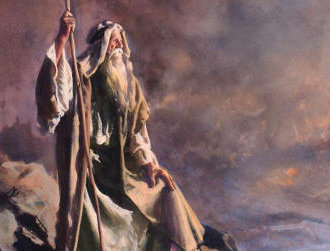
MosesThis week’s Torah reading begins: “These are the words that Moshe spoke to the entire Jewish people.” Noting the distinction between this book and the previous four, which are all “the word of G-d,” our Sages explain that Moshe recited the Book of Deuteronomy “on his own initiative.”

Rabbi Eli Touger
Commentary on Torah Portion Devarim
“A Mortal Mouth Speaking G-d’s Word”
Adapted from Likkutei Sichos, Vol. IV, p. 1087ff; Vol. XIX, p. 9ff
Chabad.org

For most Christians, who don’t have a conservative evangelical view like the one I had, these textual facts can be interesting, but there is nothing in them to challenge their faith, which is built on something other than having the very words that God inspired in the Bible. And I certainly never intended to lead anyone away from the Christian faith; critics who have suggested that I myself stopped being a Christian once I realized there were differences among our manuscripts are simply wrong and being ridiculous.

Author and New Testament Scholar
Bart D. Ehrman in his book
Jesus, Interrupted

Today’s “extra” meditation and my commentary on this week’s Torah Portion Devarim.

Occasionally people ask why most of the book of Deuteronomy (in Hebrew, “Devarim”) even exists. It seems to do little more than repeat and summarize the events in the first four books of the Torah. The answer can be a little disturbing to some Christians and even to some Jews. Our understanding is that the first four books of the Bible were the words of God as dictated to Moses and Deuteronomy is in Moses’ own words.

Does that mean Deuteronomy is completely human in origin and without the influence of God? Let’s return to Rabbi Touger’s commentary:

This does not…mean that the Book of Deuteronomy is merely a mortal invention. Our Rabbis immediately clarify that Moshe delivered his words “inspired by the Holy Spirit.” Similarly, when the Rambam defines the category of “those who deny the Torah,” he includes: “a person who says that the Torah even one verse or one word does not emanate from G-d. If one would say, ‘Moshe made these statements independently,’ he is denying the Torah.”

Not a single commentator maintains that there is a difference in this regard between the Book of Deuteronomy and the four preceding books.

For the Book of Deuteronomy are merely Moshe’s words. Moshe’s identification with G-dliness was so great that when he states: “I will grant the rain of your land in its season,” he speaks in the first person although the pronoun “I” clearly refers to G-d. “The Divine Presence spoke from his mouth.”

The origin of the Bible and exactly how it was written and codified is complex and more than a little mysterious. The simple belief among many Christians is that each author wrote under the influence and guidance of the Holy Spirit and what they wrote originally is exactly what we have in our Bibles today (translated into the language we prefer to read). I included the quote from Bart Ehrman’s book to illustrate that even among modern Bible scholars, there is some doubt as to whether or not we can read the Bible as if it were a history book, newspaper, and court reporter’s record all rolled into one. In fact, we can’t.

The Bible is as much a human document as a document of the Divine. It’s a series of “stories” that illustrate something about God and His interactions with humanity. That it contains internal inconsistencies and historic flaws in no way disqualifies its moral and mystic significance among the community of faith. The stories tell us what we need to know, not as a history lesson, but as a guide to righteous living and as a doorway into domains that leave our mortal plane and allow us to glimpse the Throne of God.

In referring to Midrash Tehillim to 90:4; Bereishis Rabbah 8:2, we see that the Sages believe that “The Torah preceded the world” and when we read John 1:1, we see that “In the beginning was the Word, and the Word was with God, and the Word was God”. From this, we understand that only part of the Bible’s function is to act as a record and a document. Beyond the scroll in the Ark or the book on our hand, it exists in transition between our world and the next.

Rabbi Touger continues:

Here, the concept of precedence is not chronological, for time like space is a creation, relevant only after G-d brought existence into being. Rather the intent is that the Torah is on a level of spiritual truth which transcends our material frame of reference. Although the Torah “descends” and “enclothes itself” in our world, speaking of seemingly ordinary matters such as agricultural laws, codes for fair business practice, and the proper structure for marriage and family relations, this is not its essence. The essence of the Torah is “G-d’s will and His wisdom,” united with Him in perfect unity (see Tanya, ch. 4).

The Amazon.com product description for Ehrman’s book states that “the New Testament is riddled with contradictory views about who Jesus was and the significance of his life”, yet from a mystic point of view, this doesn’t present a problem.

The Ba'al Shem TovWhen I was reading The Hasidic Tale by Gedaliah Nigal, I wrote several commentaries about what I gained from the text including The Messianic Tale and Stories are Miracles. From these, we see that the stories of the Chasidim are less a series of historical facts and more a collection of mystic and allegorical tales designed to reveal something about ourselves, about holiness, and about God. How much of each story is factually accurate isn’t particularly relevant, because one does not approach the tales of the Chasidim that way. What we are looking for is something that will peel away the covers from the world of the supernatural and give us a peek at what lies around the next bend on our path of faith.

We can apply that commentary back to the Bible thus.

Jorge Quinonez, in his book “Paul Philip Levertoff: Pioneering Hebrew-Christian Scholar and Leader” Mishkan 37 (2002): 21-34 (quoted in Love and the Messianic Age) describes Levertoff, a Chasidic Jew and devoted disciple of Jesus, this way:

He read the Gospels in German. Then he obtained a Hebrew version and reread them. Though he was in the midst of a Gentile, Christian city where Jesus was worshiped in churches and honored in every home, Feivel felt the Gospels belonged more to him and the Chasidic world than they did to the Gentiles who revered them. He found the Gospels to be thoroughly Jewish and conceptually similar to Chasidic Judaism. He wondered how Gentile Christians could hope to comprehend Yeshua (Jesus) and His words without the benefit of a classical Jewish education or experience with the esoteric works of the Chasidim.

This perhaps, is what scholars like Bart Ehrman miss when they study and criticize the Bible for not reading like a story posted at CNN. Divinity and humanity collide, meld, mesh, and blend within the pages of the Bible and we are not always meant to be able to tell where one leaves off and the other begins…or if that division is even possible.

Rabbi Touger states:

But why is the Book of Deuteronomy necessary? Enclothing the Torah in human intellect seemingly does nothing but lower its spiritual content. What purpose is served?

Nevertheless, this is G-d’s intent in giving the Torah: that it permeate mortal thought and thus elevate man’s understanding. Whenever a person studies Torah, regardless of his spiritual level, he is making its infinite truth part of his personal nature.

Were there to have been only four books in the Torah, it would have been impossible for our powers of understanding to unite completely with the Torah. It was only by having the Book of Deuteronomy pass through Moshe’s intellect that this goal accomplished. Moreover, Moshe’s review of the Torah in he Book of Deuteronomy gives us the capacity to understand the previous four books in a similar fashion.

Enclothing the Torah in mortal intellect does not merely grant man the opportunity for advancement, it also introduces a higher quality to the Torah itself, as it were. For clothing limitless spirituality in the confines of mortal intellect represents a fusion of opposites that is possible only through the influence of G-d’s essence. Because His essence transcends both finiteness and infinity, it can weld the two together, bringing the spiritual truth of the Torah within the grasp of mortals.

TranscendentWho we are and who God is in us requires that we leave behind some of our attachment to what we call “reality” and allow ourselves to stand transcendent at the uncomfortable and mystic threshold between Heaven and Earth. We don’t have to rely on the Bible to be a book of facts but rather a book of truth.

Consider this:

These are the words which Moses spoke to the children of Israel, across the Jordan, in the desert, in the plain, opposite Suf, between Paran and Tofel, Lavan, Chatzeiroth, and Di-Zahav –Devarim 1:1

All these “places” are allusions to sins committed by the Jewish people during their forty years of wandering in the Sinai Desert. Moses rebuked them only by insinuation so as not to embarrass them.

-Rashi’s commentary

Rabbi Menachem Mendel of Lubavitch once delivered a scathing critique of a certain type of outlook and behavior. Later, one of those present complained to him: “Rebbe, why did you rebuke me in public? Could you not have privately made me aware of my negative traits, without embarrassing me in front of everyone?”

Replied Rabbi Menachem Mendel: “Did I mean you? Obviously, I did. You see, I am a hat-maker. The hat-maker fashions a hat and places it in his window. People come in and try it on, until someone finds that it suits his head perfectly. Whom did he have in mind when he made this hat? Why, he made it precisely for the very customer who finds that it fits him!”

-Rabbi Yanki Tauber
Commentary of Torah Portion Devarim
“The Discreet Hatter”
Chabad.org

The Bible serves many purposes in our lives, not the least of which is to reveal the nature of who we are, for good or for ill. It is a book that condemns but also encourages. It shows us the goodness of God and where we fall short of that goodness (Romans 3:10). Let the Bible be what God intended it to be and let God be who He is. Listen to the words of Moses and his “Chasidic” tale of the wanderings of the Children of Israel, of his own journey with God, of the approach to the end of his life, and in listening to him, learn something about yourself.

Good Shabbos.

The Primordial Serpent

SerpentWhen people saw the snake, they understood that in order to elicit this transcendent divinity and be healed, they had to transform their own, inner “snake” – their evil inclination – into a force of good…The evil inclination impels us to sin for comfort, pleasure, or excitement. When we convince it that the truest comfort, pleasure, and excitement lie in holiness, it plunges headlong into fulfilling G-d’s purpose on earth, endowing our drive toward divinity with much greater power than it could have had otherwise. Thus, the initially evil inclination becomes the source of merit and goodness. The snake is transformed from the source of death to the agent of life.

From the teachings of the Lubavitcher Rebbe;
adapted by Rabbi Moshe Yaakov Wisnefsky
“Transforming the Primordial Snake”
[Based on Likutei Sichot vol. 13, pp. 75-77]
Kabbalah Online

This also alludes to the [Primordial] Snake. Originally, he was the tail and Adam was the head, but [because of the Primordial Sin] this was inverted and the snake became the head and Adam the tail.

From the teachings of Rabbi Yitzchak Luria
adapted by Rabbi Moshe Yaakov Wisnefsky
“The Snake at the Sea’s End”
Chabad.org

This is Part 2 in a 3-part series. Before reading this, see Part 1: Overcoming Evil.

The serpent of Eden isn’t quite what you expect him to be when you encounter him in Judaism, and particularly within the realm of Kabbalah. While not an entirely pleasant fellow, he doesn’t seem to be quite as bad as Christianity paints him. The “Transforming the Primordial Snake” article quoted above tells us that the serpent; the evil inclination within us, “impels us to sin for comfort, pleasure, or excitement”. The commentary goes on to explain that we can “convince” the evil inclination that the best way to meet its goal is to meet our goal of a life of holiness. Once the “serpent” is sold on this idea, the “snake is transformed from the source of death to the agent of life”.

Makes the snake sound almost reasonable, doesn’t it? However, the teachings of Rabbi Yitzchak Luria paint a darker portrait:

In the Zohar, the imagery of the snake putting its tail in its mouth is used to illustrate the sin of “the evil tongue”, i.e. slander, a gross misuse of the power of speech. (Zohar III:205b) People commit this sin when material consciousness gets the better of them. As is explained in the Tanya (ch. 32), those who give their bodies preeminence over their souls see only the outer shell of their fellow man, which differentiates between people, and are oblivious to the inner souls. They thus fall into the sin of hatred, which leads to slander.

Rabbi Luria makes slander sound awful, but how bad can it be? I mean, it’s not as bad as say, murder, is it?

“You have heard that it was said to the people long ago, ‘You shall not murder, and anyone who murders will be subject to judgment.’ But I tell you that anyone who is angry with a brother or sister will be subject to judgment. Again, anyone who says to a brother or sister, ‘Raca,’ is answerable to the court. And anyone who says, ‘You fool!’ will be in danger of the fire of gehinnom. –Matthew 5:21-22

I guess it is that bad.

But who is the serpent? Is it some sort of talking animal, like Balaam’s donkey or is this Satan, the Adversary, in disguise? Let’s cut to the chase and look at him from a traditional Jewish perspective:

Satan in Judaism is a very different beast than satan in popular culture (pun intended)

The snake in the garden of Eden is identified as the personification of the “Yetzerh Harah” (Bad/evil will/desires/inclination) by the midrashim.

The Talmud also states that the Yetzer Harah, Satan, and the angel of death are one. (Some might understand this to mean that they are ‘bad things’ which really are good, and necessary.

In Judaism, the Satan is an angel commanded by Gd to accuse human beings of wrong things. In modern terms, you might call satan the heavenly prosecutor, who seeks to bring all people to court.

-from the Jewish Life and Learning discussion board

Eve and the SerpentThat would seem to mesh somewhat with the Christian interpretation, however, the person who made this post offered a follow up:

A strict reading of the bible would tell you just a snake, and nothing else. An interpreted reading of the bible based on Jewish sources would tell you its the Evil Inclination. An interpreted reading of the interpretation based on Jewish sources would tell you that the snake represents three things. (Which, could be seen as a reason for only the serpent to be mentioned in the first place)

This is consistent with other Jewish sources which state that Adam personified the Good Inclination while the serpent was the embodiment of the Evil Inclination. In Kabbalistic thought, the serpent wasn’t so much a personality as a force of nature, or at least a representation of other forces. The serpent was the external manifestation of the evil inclination which, once Adam and Eve sinned, became man’s internal inclination for evil.

However, as I’ve heard it said just recently, “let Scripture interpret Scripture”:

The great dragon was hurled down – that ancient serpent called the devil, or Satan, who leads the whole world astray. He was hurled to the earth, and his angels with him. –Revelation 12:9

And I saw an angel coming down out of heaven, having the key to the Abyss and holding in his hand a great chain. He seized the dragon, that ancient serpent, who is the devil, or Satan, and bound him for a thousand years. –Revelation 20:1-2

Now we have to assume that the “ancient serpent” being referred to in these verses is the same one we see tempting Eve in the Garden, but that’s an assumption Christianity takes for granted. It’s not one that Judaism would make for obvious reasons.

A recent CNN news story, which was critical of the ability of many Christians to read and remember the Bible correctly (that part seems sadly true) suggested that the serpent was just a serpent (albeit an intelligent and talking one) and that the Adversary (HaSatan) was never mentioned. While it is true, Genesis doesn’t go out of its way to say, “Hey! The snake is the devil!”, the passages from Revelation seem to be a “smoking gun”.

Judah Himango started a conversation about this topic on his Kineti L’Tziyon blog the other day, and from his point of view, the matter is settled. Still, looking at the serpent through the lens of Jewish mysticism, there’s more to his story than meets the eye. Part 3 of this series, Healing the Wounded, will cover that tale in the next “morning meditation”.