Category Archives: Uncategorized

Will Our Children Have Faith?

It may seem strange to consider Judaism a missionary religion. Yet the Pharisees are described as “compass[ing] sea and land to make one proselyte.” (Matthew 23:15) Rabbinic Judaism, the product of these Pharisees, saw in Abraham and Sarah the models for those who converted non-Jews to Judaism, speaking of them as “making souls.” (Cf. Gen. 12:5)

The proselyte was viewed with special favor. Unlike the Israelites at Sinai the proselyte had come under the wings of the Divine Presence without the impetus of thunder and lightning. Conversionary activity, however, diminished as Christianity gained power and proscribed conversion to Judaism. Even so, there were notable conversions to Judaism in the medieval period.

In the modern period with the advent of “Outreach” in the Reform Jewish community, there is renewed interest in presenting Judaism as an attractive option to those outside of Judaism who might be interested.

-Leonard Kravitz and Kerry M. Olitzky
“Judaism as a Missionary Religion,” p.14
Chapter One: At Sinai Moses Received the Torah
Pirke Avot: A Modern Commentary on Jewish Ethics

This isn’t the only time in the first fourteen pages of this book that the authors quoted from the Apostolic Scriptures (favorably), which is something of a surprise in a (non-Messianic) Jewish publication. I’ve also read similar commentaries in the past on the historic and arguably modern interpretation of Judaism as “missionary.”

Of course, it’s well-known that the Chabad have a very active and even aggressive outreach process, but this is usually directed at non-observant or minimally observant Jews. They aren’t actively trying to convert Gentiles to Judaism although, on occasion, they will encourage non-Jews to observe the seven Noahide Laws.

I’ve been thinking about Messianic Judaism across multiple generations, especially as applied to non-Jewish members or adherents otherwise known as “Messianic Gentiles.” I’ve read a couple of blog posts over the past few days, both written by “Hebrew Roots Gentiles,” discussing the desire to pass their beliefs on to the next generation.

This is really difficult to do.

Even in modern Judaism and Christianity, there is no guarantee that your children will follow in your footsteps. Sure, it’s more likely in Orthodox Judaism for your children to continue in an Orthodox lifestyle, but in Reform Judaism, it’s not such a big step from there to becoming completely secular and even assimilated. There are also plenty of Christians whose children leave the faith. It can be truly said that God has no grandchildren. We each negotiate our own relationship with our Creator, regardless of who our parents are or what they believe and practice.

OK, that’s not exactly true for Jewish people. Even a secular and assimilated Jew is still a Jew. Jewish people are the only population to ever exist who are born into a covenant relationship with God, whether they want to be or not. I believe at the end of the age, each Jew who chose not to respond to the covenants will have to give an accounting to God.

Yes, the rest of us will too will have to give an account, but it won’t be the same since no non-Jew is born automatically having a specific set of obligations to God based on a set of covenants made thousands of years ago.

And in Messianic and Hebrew Roots communities, the problem is compounded.

A few years back I attended the First Fruits of Zion Shavuot Conference at Beth Immanuel in Hudson, Wisconsin. There were a number of families there, both Jewish and Gentile, who were discussing matchmaking. That is, they were concerned about who their children were going to marry.

This wasn’t idle chatter. Some of the younger generation present at the event were approaching or already at marriageable age. There were even suggestions being made as to which two young people to match up (much to the discomfort of the young people present who were being discussed).

There are just tons and tons of Christian churches and Jewish synagogues of various denominations and branches available almost everywhere on Earth. A Christian desiring to marry a Christian companion might not have any more difficult a time at finding an appropriate mate than any given atheist. For Jews it is probably the same, given access to a sufficiently large Jewish population (here in Idaho, it would definitely be more of a chore).

learning hebrewBut what about Messianic Jews and Gentiles? At least in the U.S. and Canada, there aren’t that many communities to choose a proper companion from. Do you marry a Christian and call it good? Do you marry a (non-Messianic) Jew and give up your faith in Yeshua (Jesus)?

I’ve known more than a few young adults, Jewish and Gentile, who are Messianic and who either took many years to finally find a good match or who are still waiting for him or her to come along.

Messianic Judaism is a missionary religion but with a twist. It’s main focus is or should be to spread the good news of Messiah to other Jews.

For instance, on the main page of the Tikvat Israel website, it states:

Where Jewish people and their families & friends can experience a Jewish service & community while believing Yeshua (Jesus) is Messiah.

Gentiles are hardly excluded but the outreach and call to faith is definitely directed “to the Jew first,” so to speak.

I think many “Messianic Gentiles” self-select our way of life. I’ve heard endless stories from people who used to go to church saying that what they were being taught from the pulpit just wasn’t satisfying and didn’t seem to match up with what the Bible actually says. I think we’re all attracted to a more Jewish interpretation of the scriptures for a variety of reasons. Many of us are intermarried with Jewish spouses and so are exposed to religious and cultural Judaism as a matter of course. And many “Hebrew Christians” have returned to the Torah by way of Messianic Judaism and brought their non-Jewish family members with them into the movement.

But while children don’t have much say about which church or synagogue their parents take them to, as these young people grow into adulthood, they have plenty of say over their lives.

I know in my own experience, as soon as I was old enough to tell my parents I wasn’t going to church anymore, I did, and I didn’t see the inside of a church as a worshiper for decades.

My own children went through a series of religious “encounters” starting with church, then a Hebrew Roots group, and then the local Reform/Conservative shul. They all eventually exited out of Yeshua-belief and then just about anything that resembles Jewish observance. Except for some approach to keeping Biblically (but not halachically) kosher and ethnically identifying as Jewish, they have no relationship with God as Jews.

I don’t doubt that Gentile and Jewish believers will continue to be drawn from their churches to Messianic Judaism and/or Hebrew Roots. Thus generation after generation of adults will enter these movements and learn something about some “Hebraic” method of interpreting scripture, gaining a more Jewish apprehension of the Messiah, the Gospel message, and the function of the New Covenant. But what about our children?

I don’t have a solution, but I do have a joke:

Three rabbis were talking over regular Sunday morning breakfast get-together.

Rabbi Ginsberg says, “Oy! We have such a problem with mice at our schul. The shammos set out all kinds of baited traps but them keep coming back. Do either of you learned men know how I can get rid of these vermin?”.

The second rabbi, Rabbi Cohen replied, “We have the same problem at our synagogue, we’ve spent all kinds of gelt on exterminators but the problem still persists. Any suggestions?”.

The third rabbi, Rabbi Slosberg looked at Rabbi Ginsberg and Rabbi Cohen and told the following story. “Rabbis’, we had the same problem with mice at our synagogue, we tried traps, exterminators, even prayers; nothing worked.”

three rabbis“Then one Shabbos after services were over a brilliant idea came into my mind. The next shabbos I went to the synagogue about and hour before services started. I brought big wheel of yellow cheese and placed in the center of the bima. Well, soon tens of mice appeared on the bima and headed for the cheese. While they were feasting on the cheese I Bar-mitzvahed all of them.

I never saw them in Schul again!
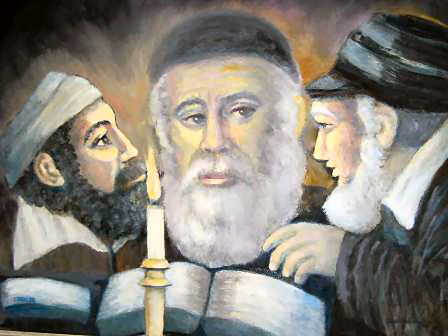
The reason that’s funny is because it’s tragically true. As much as you as parents try to teach your values to your children, someday, they have to make a decision as adults whether to make your values their values. Sometimes they decide “yes,” but they can also say “no” and choose their own path. The only way a person is truly drawn to God is by God.

Chanukah and the Light of Love

“Rav Avraham Pam (former Rosh Yeshiva of Yeshiva Torah Vodaas) teaches us that we see this special love of God for the whole Jewish people even though many had defected to Hellenism and then returned to Torah observance with the triumph of the Macabees. When a couple reconciles after a separation, the relationship often becomes one of peaceful coexistence, but the quality of love that they initially had for each other is rarely restored.

“Not so when Jews do teshuvah (repentance — returning to the Almighty and to ways of the Torah). Rambam says that although a sinful person distances himself from God, once he does teshuvah he is near, beloved and dear to God. It is not that God “tolerates” the baal teshuvah (returnee), but rather that He loves him as He would the greatest tzaddik (righteous person). As the prophet says, “I will remember for you the loving-kindness of your youth, when you followed Me into the desert, into a barren land” (Jeremiah 2:2). The love of yore is fully restored.

“This is the significance of the miracle of the oil. It teaches us that with proper teshuvah our relationship with God is restored, as if we had never sinned.

“This is also the message of Joseph and his brothers. Joseph did not simply forgive them and suppress his resentment for their abuse of him. Rather, he loved them and cared for them as if nothing had happened, telling them that he feels toward them as he does to Benjamin, who was not involved in his kidnapping (Rashi, Genesis 45:12).

“The celebration of Chanukah is, therefore, more than the commemoration of a miracle. We are to emulate the Divine attributes (Talmud, Shabbos 133b). Just as when God forgives, His love for us is completely restored — so must we be able to restore the love for one another when we mend our differences.

“As we watch the Chanukah candles, let us think about the light they represent: the bright light of a love that is completely restored!”

-Rabbi Kalman Packouz
from Shabbat Shalom Weekly for
Torah Portion Mikeitz
Aish.com

I apologize for the rather lengthy quote from Rabbi Packouz’s article, but it very much speaks to my continuing theme of sin, repentance, and return and also happens to be appropriate as a missive for this third day of Chanukah (as you read this).

One of the great difficulties in making lasting teshuvah (repentance or return to God) is the feeling of being “damaged goods”. Assuming everything R. Packouz wrote in the above-quoted passage is true about God, we still have to face, on a human level, how other people often find it difficult to receive the repentant sinner as if he or she had never sinned. Also, you or I can still feel “dirty” in our sins as we sincerely strive to repent, even though, according to the prophet, our “…sins are as scarlet, They will be as white as snow; Though they are red like crimson, They will be like wool” (Isaiah 1:18 NASB).

Yes, the good Rabbi is talking about Jewish repentance in his write-up, but by the merit of our Rav, Messiah Yeshua, we also are allowed to repent, turn away from our sins, and return to our God. In this I believe we too will be treated as if we had never sinned. Otherwise, we have no hope.

love-in-lightsAlthough Chanukah commemorates a specific event and miracle exclusive to the Jewish people, it has applications for the rest of us. If the lights of the Chanukah candles can represent “the bright light of a love that is completely restored” between a Jew and his God, it can have the same meaning for all of the non-Jewish disciples of the Master.

The Apostle Paul was quite clear that repentance, atonement, and forgiveness were accessible to Jew and Gentile alike through trust in the accomplished works of Messiah.

Concerning Paul’s declaration of the blessings of Messiah at the synagogue in Pisidian Antioch:

When the Gentiles heard this, they began rejoicing and glorifying the word of the Lord; and as many as had been appointed to eternal life believed. And the word of the Lord was being spread through the whole region.

Acts 13:48-49

And our Master himself said:

“I say to you that many will come from east and west, and recline at the table with Abraham, Isaac and Jacob in the kingdom of heaven.”

Matthew 8:11

My family lights the Chanukah menorah for eight nights in our home because my wife and children are Jewish. But if, Heaven forbid, something should happen and I found myself living alone, I could certainly see a continued application in my kindling the Chanukah lights for the sake of the Light of the World (John 8:12).

Chag Sameach Chanukah.

Christmas is Coming! Don’t Panic!

This is the awkward time of year for Messianic believers. Many of us have opted out of Christmas, something our families and friends do not understand. It is inconceivable that anyone who professes faith in Messiah Yeshua (Jesus Christ) would not celebrate Christmas. It is inconceivable even though December 25th is most definitely not the day of Yeshua’s birth, and even though the customs observed in churches and homes have their origins in decidedly un-Christian pagan celebrations.

-from “Jesus Without Christmas”
published at The Barking Fox
Reblogged at natsab

And so it begins. The annual expression of angst at the approach of perhaps the world’s most well-known religious and secular holiday: Christmas.

I really didn’t think I was going to write about Christmas this year. Frankly, I’ve got too much else going on right now to really care and I have come to a certain peace about it all and no longer feel I have to contend with Christmas, let alone have a panic attack over it.

Yes, back when I was going to church, I’d avoid attending the Sunday services nearest to Christmas as well as all of the other Christmas programming, but that’s not because I felt I’d be tainted with “pagan influences”. After all, there’s no direct Biblical reference to Chanukah, and yet, along with many or most Jewish households, there’s a small but dedicated group of non-Jewish Christians, Messianic Gentiles, and Hebrew Roots believers who light the menorah (also not commanded in the Bible) for eight evenings in commemoration of the defeat of the Greek oppressors by the Maccabees and the rededication of the Temple, as well as to honor the “light of the world” (John 8:12).

It is true that my house is the only one on my block that is mostly dark every evening, surrounded by the more festive lights of our Christmas observing neighbors. But then again, my wife is Jewish and my feelings on the matter aside, it’s perfectly expected that the only special light visible from within our home for the next week or so (as I write this) should be that of the Chanukah candles on our menorah.

But Christmas is less evil than it is a tradition. It’s a terrifically lucrative tradition for retail outlets as events such as Black Friday and Cyber Monday indicate. If I have a major objection to Christmas, it is because the holiday has become a symbol of both personal and corporate greed and gluttony, not because I think putting lights on a natural or artificial pine tree is “pagan.”

Most Christians I know are quite aware that Jesus wasn’t born anywhere near December 25th and accept that the date they celebrate the birth of Christ was established by tradition rather than empirical fact. Nevertheless, if Christians choose to become more Christ-like, more generous, giving to the poor, kinder to their neighbor, at this time of year, who am I to complain?

I mean no disrespect to the sensitivities of the author at “The Barking Fox” or Pete at “natsab,” but I really feel the traditional response of Hebrew Roots Gentiles to the advent of Christmas (pun intended) is overblown. Sure, it took my parents a few years to adjust after my wife and I announced we were no longer celebrating Christmas, but they are now perfectly content to send Chanukah cards to us and the kids. I do have some relatives, my brother for instance, who still send Christmas cards, but no one in my family (as far as I know) complains because we don’t reciprocate.

brace yourselfI’m reminded of Toby Janicki’s blog post of four years ago called The Scoop on What About Paganism, a topic he expanded upon greatly in his lecture series “What About Paganism” (available on Audio CD and in MP3 format). Toby coined the term “paganoia” in his lectures, and I think the term is fitting.

The Jewish people I know don’t really have that much of a problem with Christmas beyond having to explain to certain people that Chanukah is not the “Jewish Christmas”. In fact, in cities with a sufficiently large Jewish population, it’s something of a tradition for Jews to go out to Chinese dinner on Christmas Day. This is based on Buddhism being the primary religious expression for many Chinese immigrants which means they aren’t celebrating on December 25th either. I wish I lived in a city that had enough Jewish and Chinese people to make observing this particular tradition practical. It sounds delicious.

Christmas is a tradition. So is Chanukah. They both have their basis in events that took place around two-thousand years ago in another country. They have both been integrated into the Christian and Jewish faiths respectively. Some small number of “Messianic Gentiles” (however you want to define the term) consider themselves caught in the middle, but we aren’t really. There’s nothing wrong with traditions. They are what we make of them.

I’ll be traveling with my parents on Christmas Day, not because it’s Christmas per se, but just because it worked out that way (long story) and Christmas is a great day to be on the road. Not many people going anywhere on December 25th because most of them are already at their destination.

The uptake on all this? Christmas is coming. Don’t panic.

Oh, and my Chanukah related blog post will publish tomorrow morning.

Addendum: I just found a reposting of last year’s blog article Let’s Not Get Strange About Christmas, Shall We? by Rabbi Stuart Dauermann and thought I should add a link to it here. He does a much better job at explaining the “paganoia” around Christmas.

Render to Israel

The Joseph story is several things at once — things in addition to being an account of something that happened way back in the days of the patriarchs. It is probably a story comforting to Israelites during or after the exile in Babylon. It is a story with foreshadowings of Israel’s later tribal relationships. But the thing that interests me the most is how the Joseph story is an example of God’s covenant blessing through Israel to the nations, who in turn bless Israel, and how this blessing becomes a mutual thing. Soulen called it “mutual blessing.” It is a pattern not only for Israel and the nations, but is a way of life that repairs the world. “Bless and curse not . . . do not return evil for evil.”

-Derek Leman
“The Meaning of the Joseph Story”
Messianic Jewish Musings

When I read the above-quoted paragraph, it struck me as an excellent summary of the relationship between Israel and the nations of the world, particularly the people of the nations who are called by His Name (Amos 9:12). It’s the relationship between Israel and the people of the nations who have come to faith in God through the merit of trusting in the accomplished works of Moshiach ben David, Yeshua (Jesus).

Last Spring, I wrote a multi-part review of D. Thomas Lancaster’s sermon series What About the New Covenant beginning with Part One here. Starting over two years ago, I initiated my own personal investigation into the New Covenant which extended into the following Spring. The upshot of all this was the discovery that only Jewish Israel is the object of the New Covenant and that it takes some work to figure out how anyone who isn’t Jewish can be blessed.

I’ve already posted enough links for the interested reader to follow my investigation and my reviews of this material, so I won’t repeat myself here. Suffice it to say that it’s not easy to find the linkage between the New Covenant and the people of the nations. It’s there, but it’s elusive.

But Derek’s wee article about the story of Joseph captured a key part of understanding how the nations benefit from Israel and conversely, how Israel benefits (or should benefit) from us.

In one of my numerous reviews of the Rudolph and Willits book Introduction to Messianic Judaism, it was also well documented by more than one contributor that Jews and Gentiles in Messianic Judaism are mutually dependent. In spite of my stated support for exclusive Messianic Jewish communities, it becomes impossible to fully isolate all Messianic Jews from all Messianic Gentiles or the non-Jewish believers in Jesus. While the covenant and community distinctions remain, we are two populations united within one body or ekklesia through Messiah. After all, God’s Temple is to be a house of prayer for all people (Isaiah 56:7) and not the Jewish people only.

But look at how the blessings flow as described in Derek’s paragraph. The blessings from Israel to the nations come first and only afterward do we bless Israel. Israel was always meant to be a light to the nations, to attract the nations to the God of Israel by being a special, set apart people.

So keep and do them, for that is your wisdom and your understanding in the sight of the peoples who will hear all these statutes and say, ‘Surely this great nation is a wise and understanding people.’ For what great nation is there that has a god so near to it as is the Lord our God whenever we call on Him? Or what great nation is there that has statutes and judgments as righteous as this whole law which I am setting before you today?

Deuteronomy 4:6-8 (NASB)

He says, “It is too small a thing that You should be My Servant
To raise up the tribes of Jacob and to restore the preserved ones of Israel; I will also make You a light of the nations
So that My salvation may reach to the end of the earth.”

Isaiah 49:6

lightThis isn’t to say that the nations in coming to God would co-opt Israel and her unique relationship with God through the covenants and the mitzvot, but it is not a mistake to believe that God has always intended to bring all the nations to Him, as it is written, “every knee will bow” (Isaiah 45:23, Romans 14:11, Philippians 2:10).

But the relationship is complementary. Consider marriage as we understand it from the Bible. While a man and a woman become “one flesh” (Genesis 2:24, Mark 10:8, Ephesians 5:31), it obviously doesn’t mean that all physical and behavioral distinctions between a man and a woman vanish on their wedding day. The man remains male and the woman remains female. They enter into a single “body” or “assembly” if you will, by accepting upon themselves a mutually beneficial and complementary set of roles in relation to one another. So too it is with Jews and Gentiles in the ekklesia of Messiah.

There is neither Jew nor Greek, there is neither slave nor free man, there is neither male nor female; for you are all one in Christ Jesus.

Galatians 3:28

Such an understanding makes the above-quoted verse from Paul’s letter to the Galatians a bit more comprehensible. Being “one in Christ Jesus” is like being “one flesh” within the context of marriage. It doesn’t mean a total fusing of identity and physical characteristics. It means that even though we have different and distinct roles and identities, we all receive the blessings and benefits of abiding within the Messiah’s assembly.

In the story of Joseph, Joseph, representing Israel (and literally Israel’s son), blesses the nations of the world by saving the world, starting with Egypt, from starvation during a terrible seven-year famine. The ultimate consequence of Israel blessing the nations is that Egypt returns the favor by taking in Jacob and his entire family (representing national Israel), and giving them Goshen, the choicest portion of Egypt, as their own.

Of course, this foreshadows more sinister events, but if we stop the story right here, we have a good example of how Messianic Jews and Gentiles should relate to one another. It is through Israel that we Gentiles even have an awareness of the true nature of the Messiah and how our faith in him attaches us to God and allows us to benefit from many blessings of the New Covenant without actually being named as covenant members. We become equal co-participants in the ekklesia of Messiah, breaking bread, so to speak, alongside our Jewish brothers and sisters at the same table.

There are many Gentiles (such as me) who do not have local access to a Messianic community of Jews or even Messianic Gentiles, and yet, we are a part of a larger assembly, standing alongside each other in our mutual faith and trust in Hashem through devotion to Messiah. In that sense, we are never alone, though we may not, for months or even years, meet with another person who shares our conceptualization of the workings of the New Covenant and the continued validity of the mitzvot for the Jewish people as their obedience to covenant and King.

I recently read a blog post asking “How do you KNOW the will of God” for your life? In Judaism, one studies Torah not for the sake of knowledge, but in order to do Torah, that is, to perform and fulfill the mitzvot. This is somewhat different if you’re not Jewish and, for example, the wearing of tzitzit and laying of tefillin are not practical indicators of a Gentile’s righteousness.

ForgivenessI’ve written quite a lot lately on the topics of repentance, atonement, and forgiveness, and from my point of view, this is a full-time obligation to God for all of us. Beyond that, obedience to God is not a matter of selling your house and moving to some far away land to become a missionary to an isolated people, at least not for most of us. Obedience to God permeates every aspect of our lives and is involved in each decision and act we take in our every waking moment, regardless of who we are and what sort of work we do. Do we treat others with respect and fairness? Do we talk about people behind their backs? Do we take every opportunity to act with kindness, showing compassion, offering friendship?

It’s the answers to these questions that tell us if we are obeying God, not whether or not we put on particular “religious” clothing.

One should study Torah and do mitzvos even if not for their own sake, for doing so will eventually result in study and performance for their own sake.

-Pesachim 50b

This Talmudic statement has given rise to questions by the commentaries. Why is the Talmud condoning study of Torah for ulterior motives? What happens to the emphasis on sincerity in observance of Torah and mitzvos?

Acting “as if” can be constructive. If a person who suffers from a headache goes on with his or her activities “as if” the headache did not exist, that headache is more likely to disappear than if he or she interrupts activities to nurse the headache. “Rewarding” the headache by taking a break only prolongs it.

Study of Torah and performance of mitzvos require effort, may be restrictive, and may interfere with other things one would rather do. Under such circumstances, there may not be great enthusiasm for Torah and mitzvos. However, if one nevertheless engages in Torah and mitzvos “as if” one really wanted to, the resistance is likely to dissipate. The reasoning is that since one is determined to do so anyway, there is no gain in being reluctant, and true enthusiasm may then develop. On other hand, if one were to delay engaging in Torah and mitzvos until one had the “true spirit,” that spirit might never appear.

It is not only permissible but also desirable to develop constructive habits by doing things “as if” one really wanted to.

Today I shall…

…try to practice good habits, and do those things that I know to be right even though I may not like doing them.

-Rabbi Abraham J. Twerski
Growing Each Day for Kislev 23
Aish.com

While Rabbi Twerski is writing for a Jewish audience, I think the rest of us can take something away from his message as well. It’s not like the majority of the mitzvot don’t affect us in some way. Feeding the hungry is the same for a Gentile as a Jew. So is visiting a sick friend in the hospital, respecting your parents, honoring your spouse, teaching your children about God.

These are the blessings we receive from Israel, the knowledge that there is the One, Unique God of Heaven who made us all, and that He is personally involved in the lives of each and every one of His human creations.

JerusalemOur response needs to be both to God and to Israel, offering devotion to the Almighty and honoring Israel in her special and unique relationship with God. Paul asked his Gentile disciples to take up a collection for the poor of Jerusalem and that’s one way we can pay back Israel for her blessings to us. Another particularly important way we can bless Israel is to recognize her covenant relationship with God as belonging exclusively to the Jewish people and as established at Sinai. We need to realize and acknowledge that all of the covenants we read about in the Bible are between Israel and God including the New Covenant. It is only through Israel and the grace of God that we are saved and redeemed (John 4:22).

Jesus said “Render unto Caesar what is Caesar’s and to God what is God’s” (Mark 12:17), but I say, render unto Israel what is Israel’s and thereby bless those who have blessed us.

Bitachon and Hishtadlus for the Rest of Us

How does one balance these two seemingly contradictory ideas? It all depends on the person’s spiritual level. The closer a person is to perfection in his belief in Hashem, the more he is expected to rely on Hashem, and his level of hishtadlus (effort) must drop accordingly. Until a person reaches that level he may — and must — work, to achieve whatever he needs to function and sustain himself and his family. As his belief and trust in Hashem grow — and he must work on this mitzvah constantly, to reach ever higher levels of bitachon (trust) — he must adjust his level of hishtadlus and rely more on Hashem.

-from Torah Thought for the Day, p.56
Commentary for Parashas Mikeitz for Sunday
A Daily Dose of Torah

As I mentioned yesterday, for a person to trust God for his every need and be content in every circumstance as was the Apostle Paul (Philippians 4:10-13), that person would already have to be operating at a very high level spiritually. For the rest of us…well, we worry sometimes.

But I don’t entirely agree with the Rabbinic statement I quoted above. It seems that it could be abused by some people who state that they have achieved so high a spiritual level that they don’t (or shouldn’t) have to work to support themselves and their families at all, and instead, should be allowed to study Torah uninterrupted almost every waking moment. We can see such an example in the Ultra-Orthodox Jewish population of Israel who refuse mandatory military service and many who choose not to work and have the Israeli government providing them with support.

I suppose any principle can be taken too far. The Bible is replete with examples of very holy men who were close to God and who nevertheless also labored to support themselves.

workI do agree with the principle of hishtadus, which is that we are to work to support ourselves and not to rely on God’s miracles for our “daily bread,” so to speak. But I don’t think that necessarily changes as we learn to believe and trust in God to greater degrees over our lifetimes. Sure, God could cause us to win the lottery by a miracle, but don’t count on it.

As I’ve also previously mentioned, we know that at the end of last week’s Torah portion, we saw that Joseph is in prison. After giving the Chamberlain of the Cupbearers a favorable interpretation of his dream, Joseph asked that the Chamberlain put in a good word for him to Pharaoh, King of Egypt (Genesis 40:14-15). But according to midrash, this was a mistake (although what mistake Joseph actually made is debated by the Rabbis) and as a result, Joseph spent two more years in prison.

The plain text of the scripture doesn’t seem to indicate this and it seems more likely that once the Chamberlain of the Cupbearers had regained his freedom, he simply didn’t bother himself with the request of one insignificant Hebrew slave.

But we do see in this example the delicate balance between trust in God and the necessity of our own efforts. Technically, there was nothing wrong with Joseph asking for help and indeed, God may have arranged this very situation. After all, we find that two years later, the Chamberlain does remember Joseph, but only because Pharaoh has a dream that no one can interpret (Genesis 41:1-13). If the Chamberlain had spoken to Pharaoh two years previously, Pharaoh could either have denied the request or in granting it, possibly make Joseph unavailable when he was needed to interpret Pharaoh’s most important dream.

Sometimes bitachon or trust in God isn’t a matter of asking or not asking a person’s help in a tough situation. Sometimes and perhaps quite often, it’s a matter of asking and then waiting.

The true description of bitachon is the belief that there is no coincidence in this world, and that everything that transpires occurs with Hashem’s approval and instruction.

When a person finds himself in a situation which appears dangerous according to the natural way of the world, and he is powerless to help himself, he must overcome his fear by realizing that the One Who controls everything in this world can cause a positive outcome just as easily as a negative one. This is called bitachon.

-from A Mussar Thought for the Day, p.60
Commentary for Parashas Mikeitz for Sunday
A Daily Dose of Torah

Sometimes we know that saying something will make a situation worse. We can tell ourselves to, “Just keep silent.” If we feel tempted to speak negatively about someone, we can strengthen our resolve not to say it by telling ourselves, “Just keep silent.”

The more difficult it is to keep silent, the greater the resulting spiritual elevation. When you tell yourself, “Just keep silent,” your silence isn’t just a passive state of being. Rather, it is an act of remaining silent.

In Tehillim (Psalms 34), King David tells us: “Who is the person who wants life and loves days that he may see good? Guard your tongue from evil and your lips from speaking deceit.” Remaining silent instead of speaking against others enhances and lengthens life.

(from Rabbi Zelig Pliskin’s book: “Conversations With Yourself”, p.145) [Artscroll.com])

-from Just Keep Silent
Daily Lift #194
Aish.com

SilenceThat last quote is more directed at a person who wants to say something to another person, usually something insulting, but who choses for the sake of Heaven to refrain, but I think it fits in our current discussion as well. Sometimes we can only say and do so much, and when we reach the limit of our ability to positively affect our situation, then all we can do is rely on God’s mercy.

The issue though is that even a complete trust in God is no guarantee that the outcome will always be good. True bitachon enables a person to realize that good or bad, everything comes from the hand of God.

And that is a very difficult middah, yet there is hope, at least according to the Sages:

Chazon Ish states that just as there are levels in other middos, such as mercy, humility, etc., there are many levels of bitachon. As long as one possesses even a small trace of bitachon, he is not excluded from the group of believers, and will merit ultimate redemption.

-from A Mussar Thought for the Day, p.60

Sacrificing Serenity for Spirituality

And Yaakov sat…

Braishis (Genesis) 37:1

Rashi cites the Sages who say that Yaakov wanted to live in peace and serenity. But this was not to be, and the troubles of his son Yosef began. The Almighty said, “Is it not sufficient for the righteous that they receive their reward in the world to come? Why do they need to live in serenity in this world?”

The question arises: why is it wrong to want to live in serenity? Yaakov desired serenity not so that he could devote his time to personal pleasures, but rather to be able to engage in spiritual pursuits.

-Rabbi Zelig Pliskin
“Keep your focus on growth, not serenity,” p.102
Commentary on Torah Portion Vayeishev
Growth Through Torah

When I’m stressed, when things aren’t working out right, when relationships are strained, more than anything, I want peace and serenity. I want to relax. I sometimes want everyone just to get along, and at other times, I just want to be alone to follow both personal and spiritual pursuits without interruption and distraction.

So midrash aside, I can very much empathize with Jacob’s desire for peace and serenity.

But I think Rashi, as interpreted by Rabbi Pliskin, has a point. We weren’t put here by God to seek peace and serenity, we were put here to serve Him. Serving God is rarely very peaceful. Just look at lives such as Abraham’s, Jacob’s, Joseph’s, Moshe’s, David’s, Jeremiah’s, and of course, our Master Yeshua’s (Jesus’) life. Also consider the apostles, particularly Paul. Was their service in spreading the good news of the Moshiach to the Jews and to the nations particularly peaceful? Most of the time, it was ultimately fatal in a violent and premature sense.

May God not wish me to serve him in such a manner for I know my faith and trust pale in comparison to even the least of the Biblical tzaddikim (righteous ones or “saints”).

But R. Pliskin said “growth, not serenity,” which I take to mean that rather than seeking peace, we should be seeking to experience our lives as the platform upon which we strive to grow spiritually, to grow closer to God.

This, said Rav Yeruchem, is an attitude we should all internalize. Every occurrence in this world can make you a better person. When you have this awareness your attitude towards everything that happens to you in life will be very positive. Before, during, and after every incident that occurs reflect on your behavior and reactions. Ask yourself, “What type of person am I after this happened? How did I do on this test? Did I pass it in an elevated manner?” (Daas Torah: Barishis, pp.222-3)

-ibid

The Jewish PaulThis means that regardless of our circumstances, good or bad, we should approach the experience in the same manner, as a test or a “training session” designed to assist us in becoming more spiritually elevated. Of course, to be in a position to look at everything from ecstasy to agony in this way probably requires that we be in a fairly elevated state already. I don’t think I’m there yet, but maybe being aware that it’s possible will give me something to shoot for.

But I rejoiced in the Lord greatly, that now at last you have revived your concern for me; indeed, you were concerned before, but you lacked opportunity. Not that I speak from want, for I have learned to be content in whatever circumstances I am. I know how to get along with humble means, and I also know how to live in prosperity; in any and every circumstance I have learned the secret of being filled and going hungry, both of having abundance and suffering need. I can do all things through Him who strengthens me.

Philippians 4:10-13 (NASB)

If the ancient and modern Rabbinic sages can apply this principle to Jacob, I think it’s reasonable to apply it to Paul as well. This gives it a more universal usage which means it comes right back to my front door, so to speak. The goal of trust and faith in God and living a holy life then, is not to find peace in our circumstances, but regardless of what is happening to us, to find peace in God as Paul did.

“And Yosef was brought down to Egypt.”

Braishis (Genesis) 39:1

Anyone viewing the scene of Yosef being brought down to Egypt as a slave would have considered it a major tragedy. His brothers sold him into slavery and he was being taken far away from his father and his homeland. But the reality was that this was the first step towards his being appointed the second in command of Egypt. He would eventually be in charge of the national economy of Egypt and would be the mastermind behind the complex program to prepare for the years of famine during the years of plenty.

-Rav Pliskin
“Realize that you can never tell how events will actually turn out in the end,” p.110

Being limited, temporal beings, our major focus is what is happening to us right now or what has just recently occurred. If it’s something unpleasant, then we tend to believe that it is also undesirable. Joseph probably felt that way when he was being sold into Potipher’s household and certainly would have that experience upon being sent to prison.

If only you would think of me with yourself when he benefits you, and you will do me a kindness, if you please, and mention me to Pharaoh, then you would get me out of this building. For indeed I was kidnapped from the land of the Hebrews, and even here I have done nothing for them to have put me in the pit.

Genesis 40:14-15 (Stone Edition Chumash)

After two years in prison, Joseph’s words give us no indication that he was viewing his continued incarceration as anything but a miscarriage of justice, and an unfair and unpleasant circumstance. He had not “learned to be content in whatever circumstances” he found himself in. With great respect to the Rabbis, I don’t think midrash sufficiently describes Joseph’s personality or spirituality. While he did indeed have great faith and trust in God, he really wanted to get out of prison and he was willing to ask for help from a potentially influential person, a bit of quid pro quo, as it were.

Joseph in prisonPerhaps Joseph realized what God had done in retrospect, but it doesn’t seem that he realized it when he was still locked up. Nevertheless, we shouldn’t lose sight of the fact that Joseph acted with utmost integrity and morality, both as a slave and as a prisoner. If he had given up hope and surrendered to despair, engaging in the baser behaviors of a prison inmate, then he certainly would not have been in position to take the next step in God’s plan.

The take away from this is that regardless of circumstances, even if you (or I) can’t possibly see how they can be beneficial at the time they’re happening, we must continue to behave (or start behaving) in a moral and upright manner for who knows how you can affect what happens next by what you decide to do now? And if you (or I) fail in this, there’s still time to repent, but that time is not limitless:

He took up a parable and said: A certain man had a fig tree planted in his vineyard. He came to seek fruit from it, but he did not find any. He said to the vinedresser, “Look, for three years I have come to seek fruit in the fig tree, but I have not found any. Cut it down; why should it waste the ground?” He answered and said to him, “My master, leave it alone for another year, until I have dug around it and given it some manure. Perhaps it will produce fruit. If it does not produce, then cut it down the following year.”

Luke 13:6-9 (Delitzsch Hebrew Gospels)