Category Archives: Uncategorized

Review of “What About the New Covenant,” Part 5

Session Five: From Glory to Glory

“Behold, days are coming,” declares the Lord, “when I will make a new covenant with the house of Israel and with the house of Judah, not like the covenant which I made with their fathers in the day I took them by the hand to bring them out of the land of Egypt, My covenant which they broke, although I was a husband to them,” declares the Lord.

Jeremiah 31:31-32 (NASB)

This is the fifth and final lecture in the series What About the New Covenant presented by D. Thomas Lancaster and produced by First Fruits of Zion (FFOZ). This sermon is the one that wraps everything up, at least hopefully. We’ve gone through the other four lectures and I’ve offered my thoughts and opinions. Let’s see how everything ends.

Lancaster says the above-quoted text from the New Covenant language in Jeremiah reminds him of the incident with the Golden Calf (Exodus 32). Moses smashed the first set of tablets, symbolizing how Israel broke the covenant, rebuked the people, then went back up the mountain to make atonement. He came back down with another set of tablets, symbolizing the renewal of the covenant.

It came about when Moses was coming down from Mount Sinai (and the two tablets of the testimony were in Moses’ hand as he was coming down from the mountain), that Moses did not know that the skin of his face shone because of his speaking with Him. So when Aaron and all the sons of Israel saw Moses, behold, the skin of his face shone, and they were afraid to come near him. Then Moses called to them, and Aaron and all the rulers in the congregation returned to him; and Moses spoke to them. Afterward all the sons of Israel came near, and he commanded them to do everything that the Lord had spoken to him on Mount Sinai. When Moses had finished speaking with them, he put a veil over his face. But whenever Moses went in before the Lord to speak with Him, he would take off the veil until he came out; and whenever he came out and spoke to the sons of Israel what he had been commanded, the sons of Israel would see the face of Moses, that the skin of Moses’ face shone. So Moses would replace the veil over his face until he went in to speak with Him.

Exodus 34:29-35 (NASB)

There’s a lot going on in this paragraph in the Torah. The only time I’ve heard this passage explained before was on Christian radio, and the Pastor doing the teaching (I can’t recall who it was) used it as some sort of evidence to how bad the law was. I can’t remember his arguments, but it seemed more than a little allegorical and was yet another shot by the Church from its Replacement Theology arsenal. Lancaster gives this portion of scripture a fresh look.

When Moses was in the presence of God, his face took on the “radiance of the Divine Presence” but it eventually faded. The people were initially afraid of seeing the light of God’s Glory shining on Moses’ face but he called them back to him. When he was around people, he veiled his face, maybe to keep from scaring people, but maybe to keep them from realizing that the light eventually faded. Only when he was with God did he unveil his face and the shining glory returned to him. almost like Moses was being “recharged.”

This will all become important shortly as we get into Lancaster’s commentary on Paul’s midrash:

For we are not like many, peddling the word of God, but as from sincerity, but as from God, we speak in Christ in the sight of God.

2 Corinthians 2:17 (NASB)

Lancaster and the rest of the FFOZ staff typically default to the ESV Bible when writing or teaching, but this time Lancaster switched to the NASB, explaining that the ESV Bible does a poor job at translating the verses he’s going to teach from. This matches what Pastor Randy told me one time, saying that he found the ESV Bible in general to give a certain amount of support to Replacement Theology by how it translates the original languages.
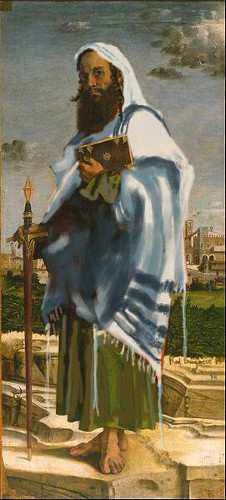
The Jewish PaulWe start with Paul defending himself from allegations that he is not really an apostle because he was not commissioned as were the other apostles, by Yeshua (Jesus) during the Messiah’s “earthly ministry.” Paul explains that he did not come “peddling the word of God,” that is, asking for money, but he worked to support himself. He also said “we speak Christ in the sight of God,” explaining that he and his companions were commissioned by God as it were.

Then Paul got a little sarcastic (an attitude New Testament scholar Mark Nanos called “an ironic rebuke” in his book The Irony of Galatians: Paul’s Letter in First-Century Context).

Are we beginning to commend ourselves again? Or do we need, as some, letters of commendation to you or from you? You are our letter, written in our hearts, known and read by all men; being manifested that you are a letter of Christ, cared for by us, written not with ink but with the Spirit of the living God, not on tablets of stone but on tablets of human hearts.

2 Corinthians 3:1-3 (NASB)

Without stealing Lancaster’s thunder by explaining everything, he describes Paul as sarcastically asking if his Master or the Council of Apostles in Jerusalem, should have sent him out with a letter or recommendation, sort of like asking, “Should I have brought a note from my Mother?”

But he also says something interesting. He says “you,” his audience, “are our letter of recommendation,” indicating that their behavior, their lives changed by the knowledge of and faith in Messiah, are what establishes Paul’s “cred” as an apostle. But a letter written on hearts by the Spirit of God? Where have we heard that before?

And I will give them one heart, and put a new spirit within them. And I will take the heart of stone out of their flesh and give them a heart of flesh, that they may walk in My statutes and keep My ordinances and do them. Then they will be My people, and I shall be their God.

Ezekiel 11:19-20 (NASB)

“But this is the covenant which I will make with the house of Israel after those days,” declares the Lord, “I will put My law within them and on their heart I will write it; and I will be their God, and they shall be My people.

Jeremiah 31:33 (NASB)

TorahLancaster says that Paul took those two passages, both of which end with the same declaration of Israel being His people and He being Israel’s God in New Covenant language, and leveraged them in this 2 Corinthians 3:1-3 commentary. Paul is continuing to establish himself as an apostle and emissary of the New Covenant, contrasting the Old Covenant and New Covenant, not that the conditions are different, because the Torah as the conditions, are the same between one covenant to the other, but that those conditions, written on stone tablets in the Old Covenant, are written on hearts by the Spirit of God in the New Covenant.

Such confidence we have through Christ toward God. Not that we are adequate in ourselves to consider anything as coming from ourselves, but our adequacy is from God, who also made us adequate as servants of a new covenant, not of the letter but of the Spirit; for the letter kills, but the Spirit gives life.

But if the ministry of death, in letters engraved on stones, came with glory, so that the sons of Israel could not look intently at the face of Moses because of the glory of his face, fading as it was, how will the ministry of the Spirit fail to be even more with glory? For if the ministry of condemnation has glory, much more does the ministry of righteousness abound in glory. For indeed what had glory, in this case has no glory because of the glory that surpasses it. For if that which fades away was with glory, much more that which remains is in glory.

2 Corinthians 3:4-11 (NASB)

Especially starting at verse 7, these scriptures are used by many Christian teachers and Pastors to substantiate the allegation that the Torah was “bad” and killed, and that it was replaced by the grace of Jesus which is “good” and gave life. I have to admit, if you had no context for interpreting Paul’s meaning, then “the ministry of death, in letters engraved on stones” sounds pretty grim. The Torah brings death, the ministry of Moses was (and is) deadly, he seems to say. But look at the full message from the point of view of a val chomer or from lighter to heavier argument. I’ll paraphrase somewhat:

But if the ministry of death, in letters engraved on stones, came with glory, so that the sons of Israel could not look intently at the face of Moses because of the glory of his face, fading as it was, how will the ministry of the Spirit fail to be even more with glory?

I guess this “ministry of death” thing needs some explanation. What brings death, obeying the Torah? That hardly seems likely since God gave Israel the Torah as the conditions of the Old Covenant at Sinai and, as we’ve seen these past several weeks, the Torah represents the conditions of the New Covenant as well. So how can the Old Covenant and the Torah be a “ministry of death?” What’s the difference between the Old and New Covenants?

Under the Old Covenant, if you disobey the conditions, thereby disobeying God, the consequences were exile and death. The wages of sin is death (Romans 6:23). It’s not the Torah that brings death, and it is not fidelity to the Torah and to God that brings death, the ministry of death is disobedience and sin, the consequences for which, under the Old Covenant, bring death.

gloryBut as we’ve previously seen, under the New Covenant, the Torah or the conditions don’t change, it’s the people who change. It becomes possible for people to not sin at all thanks to what God does in the New Covenant, writing the Torah on people’s hearts so obedience to God becomes part of human nature. It is the ministry of righteousness because the people become righteous.

Paul is saying something like:

If you thought the Old Covenant came in tremendous glory, just you wait. The New Covenant comes with even much more glory, so much in fact that, by comparison, the shining of the New Covenant will make the light and glory of the Old Covenant seem like a dim night-light!

Paul isn’t saying that the Old Covenant had no glory, only that by comparison, the New Covenant, because it makes it basically impossible for people to sin, will seem so much more glorious. In a val chomer argument, the second condition cannot be true unless the first condition is true, so if the New Covenant has tremendous glory, the Old Covenant is glorious as well (present tense), just not quite so much.

Like the glow on Moses’ face, it was brilliant in its illumination, but it had a tendency to fade and needed to be renewed. Something like the pattern of Israel under the glorious Old Covenant. Israel’s faith tended to fade and they sinned, requiring repeated renewal efforts. Christianity has a similar problem but then, we’re still living in Old Covenant times, too. We do however have a pledge of the coming New Covenant, just as all believers do, Jew and Gentile alike.

Lancaster previously talked about a Heavenly Torah that, in order to be understood and accessed by man, had to be “clothed” so to speak, to “translate” from Heaven to Earth. The Torah of the Lord is perfect, restoring the soul (Psalm 19:7), but since it exists in our world, it is also temporal. Basically, it’s glory “fades.” The Torah of Messiah in the New Covenant is the Supernal Torah and will never fade but instead, Messiah will reveal what is now concealed in the Torah, removing the veil, as it were, from the Torah and from in front of our eyes, so we can see the full glory, just as Moses saw God’s glory on the mountain.

Do not think that I came to abolish the Law or the Prophets; I did not come to abolish but to fulfill. For truly I say to you, until heaven and earth pass away, not the smallest letter or stroke shall pass from the Law until all is accomplished.

Matthew 5:17-18 (NASB)

heaven and earthThe Old Covenant does not change at all while Heaven and Earth are still here, but eventually, we get a New Heaven and New Earth, so the Old Covenant will eventually cease. Actually I had a problem with this example of Lancaster’s because what I see Yeshua (Jesus) saying is that the Torah, the conditions of the Old and New Covenants, don’t change as long as Heaven and Earth exist, so it seems that the conditions of even the New Covenant will change once we get a New Heaven and a New Earth. Of course, until then, we are living in Old Covenant times, holding only a pledge of the New Covenant through receiving the Holy Spirit, so the conditions are still with us under the Old Covenant and the emerging New Covenant.

When He said, “A new covenant,” He has made the first obsolete. But whatever is becoming obsolete and growing old is ready to disappear.

Hebrews 8:13 (NASB)

Sure, the Old Covenant is becoming obsolete, but that’s a long, drawn out process, and it won’t disappear until Messiah returns bringing the fully realized New Covenant with him.

Let’s finish up with chapter three of 2 Corinthians:

Therefore having such a hope, we use great boldness in our speech, and are not like Moses, who used to put a veil over his face so that the sons of Israel would not look intently at the end of what was fading away. But their minds were hardened; for until this very day at the reading of the old covenant the same veil remains unlifted, because it is removed in Christ. But to this day whenever Moses is read, a veil lies over their heart; but whenever a person turns to the Lord, the veil is taken away. Now the Lord is the Spirit, and where the Spirit of the Lord is, there is liberty. But we all, with unveiled face, beholding as in a mirror the glory of the Lord, are being transformed into the same image from glory to glory, just as from the Lord, the Spirit.

2 Corinthians 3:12-18 (NASB)

Lancaster goes through this line by line, but what I found important was how his interpretation of Paul redeemed Paul from the criticism of many Jewish people or for that matter, the mistaken understanding of many Christians, who saw Paul as anti-Torah and Law-free, and was teaching Jews and Gentiles to also forsake Torah and to believe the Torah was a “ministry of death”.

Lancaster describes why the Jewish people couldn’t simply obey the Torah as they had always done and have that be enough. It’s why there aren’t two paths to salvation, Moses for the Jews and Jesus for the Gentiles. Hear me out. I think this explanation makes sense.

Under the Old Covenant, as hard as a Jewish person might strive, being only human, sooner or later he would sin and require atonement under the conditions of that Covenant, that is, the Torah. When Israel sinned greatly and did not repent, the conditions of the Old Covenant required exile and death. Nothing in that Covenant made Jewish people “sin proof,” so to speak.

Look at Israel’s history. It’s glorious but it’s also terrible. How many exiles have there been? How many times has Jerusalem been destroyed? How many times has God (temporarily) withdrawn His presence from among Israel due to their “hearts of stone?”

tallit_templeBut under the New Covenant, God makes it possible for Israel not to sin at all and further, God promises to forgive all of Israel’s sins past and present. Apprehending the first fruits of the New Covenant through faithfulness to Yeshua HaMashiach, the conditions of the Old Covenant and New Covenant, that is, the Torah, don’t change, so Jews are still required to perform the mitzvot, but God starts writing on their hearts, starts softening hearts, begins to lead His people Israel into the better promises of the New Covenant.

The veil is lifted and the concealed Torah is revealed. Israel is liberated, not from the Torah but liberated from sin.

What does from glory to glory mean?

From the glory of the Old Covenant, which was and is glorious indeed, but to the greater glory of the New Covenant, which will be eternal and in which all men will know God face to face, the way Moses knows God, not dimly through a mirror, as we know God now.

The glory of the Old Covenant forgives sin but does not make people sinless. The glorious New Covenant forgives all sins past and present, and then makes it possible for people to naturally obey God so that we will never again sin. The Old Covenant was and is good, but the New Covenant really is the better deal. It’s incredibly fabulous.

I’m kind of sad to see this study end. I was really enjoying it. Of course, I’ve got about a year’s worth of Lancaster’s Epistle to the Hebrews study to still work through, so it’s not like I’m out of material to review.

I deliberately left out quite a bit of detail from my reviews, so if these “meditations” have piqued your interest, I’d recommend you order the full five-disc set of audio CDs What About the New Covenant. May you be as illuminated as I have been.

Sermon Review of the Holy Epistle to the Hebrews: The Messiah Psalm

Psalm 110 is the most frequently quoted text in the New Testament. Why? And what did Yeshua mean when he quoted it to challenge the concept of a Davidic Messiah?

Listen to a study of Hebrews 4:14-5:6 which unwraps Psalm 110 and introduces the priesthood of Messiah. “The Messiah Psalm” offers discussion about the Messianic interpretation of Psalm 110 as it appears in the teaching of Yeshua (Mark 12) and the Epistle of Hebrews.

-D. Thomas Lancaster
Sermon Thirteen: The Messiah Psalm
Originally presented on April 13, 2013
from the Holy Epistle to the Hebrews sermon series

Therefore, since we have a great high priest who has passed through the heavens, Jesus the Son of God, let us hold fast our confession. For we do not have a high priest who cannot sympathize with our weaknesses, but One who has been tempted in all things as we are, yet without sin. Therefore let us draw near with confidence to the throne of grace, so that we may receive mercy and find grace to help in time of need.

For every high priest taken from among men is appointed on behalf of men in things pertaining to God, in order to offer both gifts and sacrifices for sins; he can deal gently with the ignorant and misguided, since he himself also is beset with weakness; and because of it he is obligated to offer sacrifices for sins, as for the people, so also for himself. And no one takes the honor to himself, but receives it when he is called by God, even as Aaron was.

So also Christ did not glorify Himself so as to become a high priest, but He who said to Him,

“You are My Son,
Today I have begotten You”;
just as He says also in another passage,

“You are a priest forever
According to the order of Melchizedek.”

Hebrews 4:14-5:6 (NASB)

Lancaster teaches some really interesting things in this session, but we have to get there first.

As he often does, Lancaster begins by recapping his previous sermon, in this case by reminding us that we need a priest to approach God, to approach paradise, because we have big angels and a flaming sword keeping us out.

Lancaster also reminds us of who the original readership of the writer of the Hebrews epistle was, and it sure wasn’t us, that is, twenty-first century (Gentile) Christians. The original audience, from Lancaster’s point of view, were first century Hellenistic Jews living in Judea. They had just suffered the martyrdom of James the Just, brother of the Master, the head of the Apostolic Council, along with other important leaders, and they had either just been denied access to the Temple and Priesthood or they were about to be denied. The Sadducees, who controlled access to the Temple, never got along with the Master Yeshua (Jesus) because they deny the resurrection and the existence of the divine soul, both of which the Master taught.

PriestsFrom a Christian’s point of view, it’s very important to realize that the Jewish disciples of the Master did not have a problem with the Temple or the Priesthood at all. They only had a problem with the corruption of the Sadducees who at that point in history controlled access to the Priesthood and the Temple sacrifices. Most Christians read Hebrews as the anti-Levitical Priesthood and anti-Temple book in the Bible, so it’s important to point out these distinctions.

In the next part of the sermon, Lancaster takes us on a small but important detour away from Hebrews and into the Gospel of Mark:

They came again to Jerusalem. And as He was walking in the temple, the chief priests and the scribes and the elders came to Him, and began saying to Him, “By what authority are You doing these things, or who gave You this authority to do these things?”

Mark 11:27-28 (NASB)

Lancaster says that Yeshua evaded the question for about a chapter and then got down to the heart of the matter.

By chapter 12, verse 34, Jesus had so deftly responded to all of his challengers that no one dared to ask him anymore questions. Then Jesus had a question of his own:

And Jesus began to say, as He taught in the temple, “How is it that the scribes say that the Christ [Messiah] is the son of David?”

Mark 12:35 (NASB)

This is one of those questions that if we don’t consider the context of what was going on and we don’t apprehend the query in the manner of a first-century Jew, we’ll completely miss the meaning. Asking if the Messiah is the Son of David is like asking if the Pope is Catholic. Of course, he is! It’s incredibly obvious. So why did Jesus ask this question?

David himself said in the Holy Spirit,

‘The Lord said to my Lord,
“Sit at My right hand,
Until I put Your enemies beneath Your feet.”’

David himself calls Him ‘Lord’; so in what sense is He his son?” And the large crowd enjoyed listening to Him.

Mark 12:36-37 (NASB)

Jesus quotes from Psalm 110. It was common for him to refer to older scriptures, so on the surface, this doesn’t seem unusual. It was common for Paul and the other apostles to quote from previous scriptures, so again, it doesn’t seem to be an unusual event.

King DavidBut of all the Old Testament scriptures quoted in the New Testament, Psalm 110 is the one quoted most often, being cited a total of fifteen times, with nine of those mentions in the Epistle to the Hebrews. The apostles related to Psalm 110 as one of these most noteworthy Messianic prophesies (with Psalm 2 being the other). What was Jesus, and later the writer to the Hebrews, trying to say that we miss, especially in English?

Lancaster tells us that English language Bibles render Psalm 110 poorly because they generally translate the words “my Master” and “Hashem” both as “Lord”. This gives the impression that God is talking to Himself.

Lancaster reads the ESV translation of Psalm 110 but with some slight differences that render it more comprehensible. I’ll reproduce it here with those differences formatted in bold and underlined text.

Hashem says to my Master:
“Sit at my right hand,
until I make your enemies your footstool.”
Hashem sends forth from Zion
your mighty scepter.
Rule in the midst of your enemies!
Your people will offer themselves freely
on the day of your power,
in holy garments;
from the womb of the morning,
the dew of your youth will be yours.
Hashem has sworn
and will not change his mind,
“You are a priest forever
after the order of Melchizedek.”
The Master is at your right hand;
he will shatter kings on the day of his wrath.
He will execute judgment among the nations,
filling them with corpses;
he will shatter chiefs
over the wide earth.
He will drink from the brook by the way;
therefore he will lift up his head.

Psalm 110

The craziness of this Psalm is that David, under inspiration from the Holy Spirit, referred to his descendent, his “son” as it were, as his “Master.” No son is Master of his father. This was Yeshua’s point. The Messiah was surely the Son of David but Psalm 110 also understands that Messiah is more than the Son of David. If Messiah was only the Son of David, he would be seated at David’s right hand.

Licht senderSince Messiah is seated at God’s right hand, whose son does that make him (hint, hint)?

Lancaster read from a collection of traditional Jewish midrash which incredibly, has Abraham also asking why Messiah, Son of David, Son of Abraham ultimately, is seated at God’s right hand.

The Even Zohar, Rabbi Yeshiel Tzvi Lichtenstein in his commentary on Mark 12:25 states that Messiah was indeed the Son of David in the flesh and the Son of God in the Spirit.

Yeshua was confirming that he was the Messiah, Son of David and Son of God. Lancaster says it was Yeshua’s interpretation of Psalm 110 that resulted in his execution.

Again the high priest was questioning Him, and saying to Him, “Are You the Christ [Messiah], the Son of the Blessed One?” And Jesus said, “I am; and you shall see the Son of Man sitting at the right hand of Power, and coming with the clouds of heaven.” Tearing his clothes, the high priest said, “What further need do we have of witnesses? You have heard the blasphemy; how does it seem to you?” And they all condemned Him to be deserving of death.

Mark 14:61-64 (NASB)

If the high priest had just asked “are you the Messiah” and Jesus had said “yes,” maybe he could have been wrong but it wouldn’t be blasphemy. But the high priest asked if Jesus was Messiah and Son of God, and Jesus answered yes. That’s what caused the high priest to condemn Jesus to death.

Now back to Hebrews 4 and our need for a high priest.

Lancaster spent a fair amount of time stating that Jesus had to be fully a human being, not just God or an angel masquerading as a human being. When Jesus was tempted, it had to be completely possible for him to give in to temptation and sin. It’s not temptation if there isn’t a real risk of sinning and if it was actually impossible for Jesus to sin, then he wasn’t really tempted, and therefore, he wasn’t really human. It had to be very possible for Jesus to sin, just like the rest of us. The only difference is that unlike the rest of us, Jesus passed every test and never, ever sinned.

This is where I got stuck last week, since it seems like someone who passed every test still wouldn’t be able to empathize with all of humanity because only he passed all the tests. The rest of us fail.

The High PriestBut in his sermon, as Lancaster entered Hebrews 5, he said this was a very important point. When the writer of Hebrews describes the high priest in verses 1 and 2, he’s not thinking of the then corrupt Sadduceeian high priest, but the ideal among high priests, Aaron. Ironically, one of Aaron’s highest qualifications, according to Lancaster, for the high priesthood was his sin in the incident of the Golden Calf (Exodus 32). It was because Aaron sinned that he could empathize with the weakness of the Israelites and have compassion as he atoned for their sins.

But this presents a problem, at least in an eternal sense.

…he can deal gently with the ignorant and misguided, since he himself also is beset with weakness; and because of it he is obligated to offer sacrifices for sins, as for the people, so also for himself.

Hebrews 5:2-3 (NASB)

Aaron, or the idealized high priest, could “deal gently with the ignorant and misguided” but on the other hand, he still had to offer sacrifices for himself because he too sinned.

While Aaron was the greatest and most noble of the high priests, there was still one who had better qualifications, one who could also empathize and “deal gently with the ignorant and misguided” but ”One who has been tempted in all things as we are, yet without sin” (Hebrews 4:15).

Verse 5 quotes from Psalm 110 and verse 6 is the writer’s proof text:

“You are a priest forever
According to the order of Melchizedek.”

Lancaster leaves us hanging at the meaning of “priest forever according to the order of Melchizedek,” so I suppose we’ll have to wait until next week to get into what all that’s about.

What Did I Learn?

I liked the “straightening out” of Psalm 110 so that it becomes easier to tell “who’s who” in the text. Also, I found the emphasis of Lancaster (and the writer of Hebrews) on the humanity of Jesus compelling. I’ve heard Christians refer to Jesus again and again as a “man-god,” which makes him sound like something out of a science fiction or fantasy novel rather than who he was and is. It’s fascinating to consider Jesus, our high priest in the Heavenly Court, as fully a human being and out of that sinless humanity, he is able to empathize with flawed and failing people in his being the atonement for our sins. I still struggle with how one who has never failed, as Aaron failed, could ever really feel empathy and completely understand, not only real temptation and the risk of failure, which Jesus did experience, but also how we actually, miserably fail, which Jesus never experienced.

The Death of the MasterIf Jesus had failed, he’d understand us better, but if he failed, he would have been disqualified and never would have ascended to be seated at Hashem’s right hand as our Master.

I can imagine this interpretation presenting some difficulties for many Christians relative to the traditional understanding of the “Godhead” and Trinitarian doctrine. I don’t think Lancaster is challenging this necessarily, but he is forcing us (me, anyway) to view the nature and character of Messiah differently. He was, and arguably still is, fully and completely human and the Son of David according to the flesh, but also fully and completely the Son of God according to the Spirit. How this works, I don’t know. I’m not sure anyone really knows, although there are plenty of opinions to go around, including the denial of the Master’s divine nature completely.

I can only imagine that Lancaster in his analysis of the Book of Hebrews, may have taken this one on as his sermon series progressed. Right now, at the end of sermon thirteen, we’re hanging at the priesthood of Melchizedek. Next week, Hashem be willing, we’ll learn more.

No “Christian Seders,” Please!

I don’t think I’ve ever reblogged another’s material before, but after seeing this reblogged at the Rosh Pina Project, I was compelled to read the original. Having read the original, I found myself greatly impressed by this thoughtful woman’s insights and sensitivity and thought it important to share.

Addendum: I think this news story is the flip side to the plea for “no Christian seders:” Passover: The Jewish Holiday for Gentiles.

sicutlocutusest's avatarSicut Locutus Est

155 NOTE: In March 2013, I posted a series of Facebook Notes about so-called “Christian Seders” and the special obligation Christians have in Lent and Holy Week especially to be vigilant about the way our observances may have an impact on Jews, Christian understandings of Judaism, and related matters. I have been asked by several colleagues to re-post these reflections this year. I am happy to do so. I need to make it clear, however, that I am not an expert on these matters. What I say below is my take on controverted questions, born mostly of my own reading and of my interfaith relationships. Please take them as such.

No “Christian Seders,” Please!

With Holy Week on the horizon,  many Christian congregations have started announcing Seder dinners to observe Maundy Thursday. People of good will recognize this as a devout and well-intentioned attempt to honor the Jewishness of Jesus, and…

View original post 3,002 more words

For Redemption is Not Yet Complete

But I have been persuaded by Professor Edward Greenstein to read this story existentially rather than critically. The death of Aaron’s sons was not the result of a miscue in the prescribed choreography of the Tabernacle. Their fate conveys the far deeper and more unsettling truth that no amount of elaborate, awesome, and precisely executed ritual should ever leave us with the illusion that we have brought God under human control. The very moment the Tabernacle comes into service, Israel is taught the sober lesson that God’s will remains free and inscrutable, God’s wisdom unfathomable. The religion of the Torah is not a set of magical techniques to get God to do our bidding, but rather a quest to invest our lives with meaning. To rein in the erratic and destructive passions of the earth’s most intelligent animal, that is the Torah’s desperate mission.

-Ismar Schorsch
“Enduring Life’s Setbacks,” pg 411
Commentary on Torah Commentary Aharei Mot
Canon Without Closure: Torah Commentaries

So it came about in the course of time that Cain brought an offering to the Lord of the fruit of the ground. Abel, on his part also brought of the firstlings of his flock and of their fat portions. And the Lord had regard for Abel and for his offering; but for Cain and for his offering He had no regard.

Genesis 4:3-5 (NASB)

I’ve read a couple of different commentaries on the death of Aaron’s sons Nadab and Abihu (Leviticus 10:1-3) recently. Both said that the “strange” or “alien fire” they offered was fire of their own making. These commentaries said that when God first ignited the fire upon the altar, only that fire was to be used in making offerings to God. A rather simple explanation for a question that has stumped scholars for thousands of years.

No, we can’t make a sacrifice to God of any sort that somehow brings Him under our control or provides Him with something He lacks. Nothing we make, say, or do will manipulate God into behaving or performing in a manner differently than is His intention.

Like prayer, we don’t turn to God with anything that will change Him. The purpose of the sacrifices, the mitzvot, and prayer is to change us.

Likewise the cup that was given to the world’s greatest tzaddik.

And He withdrew from them about a stone’s throw, and He knelt down and began to pray, saying, “Father, if You are willing, remove this cup from Me; yet not My will, but Yours be done.”

Luke 22:41-42 (NASB)

It was now about the sixth hour, and darkness fell over the whole land until the ninth hour, because the sun was obscured; and the veil of the temple was torn in two. And Jesus, crying out with a loud voice, said, “Father, into Your hands I commit My spirit.” Having said this, He breathed His last.

Luke 23:44-46 (NASB)

As I write this, I just read a commentary about Passover and atonement which said in part:

“Suffering and pain may be imposed on a tzaddik (righteous person) as an atonement for his entire generation. This tzaddik must then accept this suffering with love for the benefit of his generation, just as he accepts the suffering imposed upon him for his own sake. In doing so, he benefits his generation by atoning for it, and at the same time is himself elevated to a very great degree. Such suffering also includes cases where a tzaddik suffers because his entire generation deserves great punishments, bordering on annihilation, but is spared via the tzaddik’s suffering. In atoning for his generation through his suffering, this tzaddik saves these people in this world and also greatly benefits them in the World-to-Come. In addition, there is a special higher type of suffering that comes to a tzaddik who is even greater and more highly perfected than the ones discussed above. This suffering comes to provide the help necessary to bring about the chain of events leading to the ultimate perfection of mankind as a whole. … Beyond that, the merit and power of these tzaddikim is also increased because of such suffering, and this gives them even greater ability to rectify the damage of others. They can therefore not only rectify their own generation, but can also correct all the spiritual damage done FROM THE BEGINNING, FROM THE TIME OF THE VERY FIRST SINNERS.” (emphasis mine) .. (Derech Hashem, Rabbi Moshe Chaim Luzzatto, translation by Aryeh Kaplan Feldheim Publishers, Jerusalem, 1977, pp 123-125)

If you are a Christian and unfamiliar with Jewish texts, this may seem strange or even startling to you. If you are Jewish and not a believer, this will seem like a gross misappropriation of the writings of the sages, bent in an unintended direction for a mistaken purpose.

The Death of the MasterI’ve written about just such an interpretation before, both in The Death of the Tzaddik and The Sacrifice at Golgotha. God is not pleased by unauthorized offerings, strange fires, and certainly not by human sacrifice, which we Christians sometimes are mistakenly accused of condoning.

And yet, sometimes God does ask that we put our soul on the altar so to speak, not because human struggle and suffering is His desire, but because we need to learn that as servants of the Most High God, our lives are subject to Him, not to what we want. By offering sacrifices, whether it be a lamb, a prayer, or our time and energy in performing deeds of kindness and charity, we aren’t giving to God something that changes Him, but we are doing what changes us in the manner God desires us to change.

And even that desire of God’s is not for His sake but for our own.

At the last second, God terminated the Akedah or the Binding of Isaac (Genesis 22) to spare the life of Isaac and to spare Abraham the death of his only son, the son of inheritance, the son who would carry forward all of the promises God made to Abraham, so they might be sent into the future with Isaac’s son Jacob, with Jacob’s twelve sons, with the tribes they would found, and with all of Israel, today’s Jewish people.

And because God wasn’t asking Abraham for a human sacrifice on the altar by killing his son, He was changing Abraham and changing Isaac, and the result of those changes reverberate down through history in both Judaism and Christianity.

To rein in the erratic and destructive passions of the earth’s most intelligent animal, that is the Torah’s desperate mission.

-Ismar Schorsch

I might have worded that sentence a little differently, but it’s a sound statement. The Word of God exists to change us, mold us, refine us (like a precious metal in fire if necessary) so that we might become a more spiritually pure product over time.

Rabbi Kalman Packouz in his Passover commentary said the following:

The Midrash tells us that the Jewish people had the same problem in Egypt. Only 1/5 of the Jewish people were on a high enough spiritual level to leave Egypt — and they were on the 49th level of Tuma, spiritual degradation — and were within a hair’s breadth of being destroyed.

Yet, what is amazing is that in the next 49 days they raised themselves to the spiritual level to receive the Torah at Mt. Sinai! Each day we climbed one step higher in spirituality and holiness. Many people study one of the “48 Ways to Wisdom” (Ethics of the Fathers, 6:6 — found in the back of most siddurim, Jewish prayer books) each day in the Sephirat HaOmer period between Pesach and Shavuot — which will be explained below — as a means to personal and spiritual growth. This is a propitious time for perfecting one’s character!

PrayerSome of those terms may seem a little odd to some of you but the principle behind them should be clear. We want to change. We want to be a little better tomorrow than we were yesterday. But even as believers and devout disciples of the Master, that’s easier said than done, at least for me (especially for me). Rabbi Packouz suggests Rabbi Noah Weinberg’s series 48 Ways to Wisdom, working through one “way” each day between the start of Passover and the arrival of Shavuot.

Jesus didn’t die just to be a human sacrifice since God abhors the desecration of human life. But if a great tzaddik can atone for the sins of his generation, how much more does the death of the greatest of all tzaddikim atone for the sins of the world, across the vast panorama of human existence?

But there’s nothing we can offer God that changes God. Every sacrifice, every lamb, every bull, every prayer, every mitzvah, and the death of the tzaddik, the Master, exists to change each of us and to bring us a little closer to God. Empty sacrifices are less than useless however. What we do is important but why we do it is crucial. Simply giving a can of soup to a hungry person feeds that hungry person, which is good, and it may temporarily elevate ourselves, at least in our own eyes, which may not be bad either. But if the act doesn’t reveal a little bit more about God to us, and if we don’t become just a little more dedicated and compassionate as God’s servants because of it, then all we’ve done was given one small meal to one single person.

And they’ll be hungry again in a few hours. So much for our “sacrifice.”

It only really, really matters on a vast and even cosmic scale, if it brings us to a greater realization of who is above us:

“Consider three things and you will not come to sin: Know what is above you: an eye that sees and an ear that hears, and all your deeds are recorded in the Book.”

-Pirkei Avot 2:1

Jesus will have died for nothing if we don’t follow him as a result, if we aren’t changed by the crucifixion and resurrection, if his act of inaugurating the era of the New Covenant did not begin to turn our heart of stone into a heart of flesh.

Run to do good. Shun evil. Pray for God to soften you, to change you, to refine you.

Examine me, O Lord, and try me; test my mind and my heart.
For Your lovingkindness is before my eyes, And I have walked in Your truth.

Psalm 26:2-3 (NASB)

Be on guard for yourselves and for all the flock, among which the Holy Spirit has made you overseers, to shepherd the church of God which He purchased with His own blood.

Acts 20:28 (NASB)

Looking upPlease don’t think me vain if I start by praying for myself. It has been all too easy for me to rest for an extended period of time on a spiritual plateau and it’s all too difficult for me to overcome inertia and begin moving again. Going up means I have to overcome gravity, but going down is not the direction I want to take. Like a boat without oars in a river, standing still is just another way of going backward.

Our love of God is not to collapse even when our soul is shattered.

-Ismar Schorsch, pg 412

For redemption is not yet complete.

A Passover Haggadah, Ed. Herbert Bronstein, pg 34

The King is coming, but there’s still time for each of us, you and me.

“Life gets mighty precious when there’s less of it to waste.”

-Bonne Raitt

Passover for Gentiles in the Diaspora, Not Jerusalem

But if a stranger sojourns with you, and celebrates the Passover to the LORD, let all his males be circumcised, and then let him come near to celebrate it; and he shall be like a native of the land. But no uncircumcised person may eat of it.

Exodus 12:48

Gentiles are welcome at the Passover table. The rituals of the Passover seder and the Feast of Unleavened Bread are designed to inspire curiosity. The children at the table, observing the unusual rites and foods, are supposed to be inspired to ask, “Why is this night different from all other nights?” The purpose of Passover is to transmit faith to the next generation, to the Jew first, but equally also to the Gentile.

from “No Uncircumcised Person”
Commentary on Torah Portion Bo
First Fruits of Zion (FFOZ)

I read this commentary the morning of New Year’s Eve 2013 and it makes sense as far as it goes, but it doesn’t go far enough.

Wait. Let me explain.

There may be some believing non-Jewish people who want to or who have attended a Passover seder. I attended my first seder decades ago, long before I became a believer. I worked with a young Jewish woman and we became friends. She invited me to the seder at her home one year, saying it was a mitzvah to invite Gentiles.

It’s a mitzvah for a Jew to invite a Gentile to eat at a Passover seder? Not according to Adath Shalom:

There is a well-established halachic ruling which forbids inviting a non-Jewish person to festival meals prescribed by the Torah, as opposed to those of Shabbat, where this is permitted. [Shulchan Aruch, Orach Chaim, 512.] The reason for the prohibition is that the law authorizing cooking in these days (in contrast to Shabbat) applies only for those who observe the laws of the festival, which is, of course, is not the case with non-Jews. This is not the place to detail the relevant sources. But we maintain that as long as certain precautions are taken, such as cooking for all of the guests together (and not in separated utensils) – one would not transgress the basic law.

That looks authoritative, but I’d never heard of Adath Shalom before, so I kept looking. Chabad.org seemed to have a somewhat different opinion.

What addressing the myth that “One may not have a Gentile at their Pesach Seder,” Rabbi Aryeh Citron writes:

Fact:

One may not invite a non-Jew to a Yom Tov meal unless Shabbat coincides with that Yom Tov. The reason for this is that one may inadvertently cook for the non-Jew on Yom Tov, which is forbidden. On Shabbat when one may not cook in any case, it is permitted to invite a non-Jew. (Orach Chaim 612:1, Shulchan Aruch HaRav ibid, 2.) If the non-Jew comes without being invited, one may feed him on a regular Yom Tov as well but may not cook or heat up food for him. There is no distinction between the Pesach Seder and other Yom Tov days in this regard.

Possible source of myth:

A gentile may not participate in eating the Paschal lamb in the era of the Holy Temple. (Exodus 12:43)

In addition, to commemorate the Paschal lamb, it is not considered proper to share the matzah from the Seder plate with a non-Jew. (Kaf HaChaim, 558:19 citing the Shelah)

That’s a little better, but the net result is that it would be better or at least easier for Jewish people to not invite Gentiles to their Passover seder.

I still wasn’t satisfied. My friend from long ago must have had a reason for saying that inviting me, a Goy, to her seder was a mitzvah. I know she was deeply rooted in her Jewish identity but she wasn’t always observant, so I don’t believe an Orthodox opinion is where she was coming from.

At Jewish Values Online I found the following question answered by an Orthodox Rabbi, a Conservative Rabbi, and a Reform Rabbi:

I invited a dear non-Jewish friend to my Pesach dinner for the second night. She wrote back stating that her other Jewish friends told her it would be inappropriate for her to attend. As a new Jew I find this off-putting. Were we not strangers in Egypt?

passover-bitter-herbs-sederIf you click the link I provided above, you can see the answers each Rabbi provided. In short, only the Orthodox Rabbi said “I would generally not encourage inviting non-Jewish friends to the seder.”

Both the Conservative and Reform Rabbis considered it permissible and even desirable to invite a non-Jew to a seder as a way to show kindness to strangers, “for you were strangers in the land of Egypt” (Ex. 22:21, Lev. 19:34, Deut. 10:19) and as an educational experience for the non-Jewish attendees.

But what about the FFOZ commentary? Every authority I’ve cited thus far is traditionally Jewish in the sense that they do not consider Yeshua (Jesus) as the Messiah, and therefore, would have no especially close association with Christians (in some cases, quite the reverse) or any other non-Jew. FFOZ is a Messianic Jewish educational ministry and on the matter of non-Jewish believers and the festivals, their viewpoint should be a lot different:

When we speak of Passover, we generally mean the entire Feast of Unleavened Bread. In the Torah, the term Passover (pesach, פםח) applies only to the sacrifice of the Passover lamb and its consumption. Exodus 12:48 prohibits an uncircumcised person from making a Passover sacrifice and eating a Passover lamb. The New American Standard version makes it sound like an uncircumcised person is prohibited from celebrating Passover in general, but the Hebrew makes it clear that such a person is only prohibited from sacrificing the lamb. This law applies to both Jews and Gentiles:

The same law shall apply to the native as to the stranger who sojourns among you. (Exodus 12:49)

An uncircumcised Jew and an uncircumcised Gentile are both forbidden from sacrificing or eating a Passover lamb. The Torah does not forbid them from keeping the Feast of Unleavened Bread, though. The law leaves them free to participate in the seder meal and keep the seven days of Unleavened Bread.

The matter, as was alluded to earlier in this blog post, isn’t the status of Gentile or Jew as such, but whether or not a non-circumcised person can make the paschal offering at the Temple. In most cases, it’s a foregone conclusion that Jewish males with any attachment to the Temple rituals in ancient times would be circumcised, so by definition, a Jew would be permitted to make the offering and then eat of it.

levites-aaronic-blessingGentiles, on the other hand, even those who were disciples of the Master in the late Second Temple period, would have been forbidden to make the Passover offering or eat of it. It even seems unlikely that they would be permitted to attend a seder in Jerusalem because the offering would be present at the table of the Jewish host and the Gentile would be forbidden to partake of it. Also, in most cases, Jewish tradition at that time made it extremely unlikely for any Jewish family to invite a Gentile to a seder fearing the non-Jew’s presence would make the entire meal unclean (see my review of the FFOZ TV episode All Foods Clean for details).

But in the diaspora, there was no access to the Temple because of the distance and Jewish families, particularly those who had come to faith in Messiah Yeshua, could invite believing Gentile friends to their Passover table, as there would be no sacrificed lamb.

According to the FFOZ commentary, that is all the more true today because the Temple currently does not exist. Passover can be a time of interfaith and cross-cultural fellowship between Jews and non-Jews. In the community of Messianic believers, in addition to what I just wrote, the Passover seder has greater meaning in the body of Yeshua, our Passover lamb, and this celebration offers a bond between Jew and Gentile in His Name, a reminder not only of Jewish redemption from Egypt, but of humanity’s redemption from sin.

But I mentioned that the FFOZ commentary didn’t go far enough. According to My Jewish Learning:

That Gentiles as well as Jews brought sacrifices to the Temple is implied in the prayer of Solomon when he dedicated the Temple (I Kings 8:41-3) and in the declaration by the prophet that the Temple will be a house of prayer for all peoples (Isaiah 56:7).

The Rabbis say (Hullin 13b): ‘Sacrifices are to be accepted from Gentiles as they are from Jews,’ although this saying dates from after the destruction of the Temple.

Even Orthodox Jews believe that Gentiles will have a role in offering sacrifices at the future Third Temple, according to AskNoah.org:

Gentiles were welcomed to the First and Second Temples in Jerusalem, and they will participate even more at the Third Temple – especially during the festival of Sukkot (Zech. 14:16). In his commentary on the Torah section beginning with Gen. 12:1, Ramban (Nachmanides) wrote:

“Even in the time of Joshua, … the Gentiles knew that this place was the most august of all, that it was at the center of the inhabited world; and Tradition had taught them that it corresponds in this world to the celestial Temple where Divine Majesty, called (righteousness), resides.”

When the First Temple was inaugurated by King Solomon, he beseeched G-d with an eloquent prayer that included the following words (Kings I, 8:41-43) (which show that in the past, Gentiles were welcomed to the First and Second Temples, and that they will participate even more in the Third Temple)…

So to bring this around full circle, we have an ancient prohibition against an uncircumcised person (Jew or Gentile) making and eating the Passover lamb offering, but it is permissible for an uncircumcised person (which in all likelihood, is a Gentile) to eat the seder meal when the Paschal lamb is not present, either because the seder is being held in the diaspora and/or because the Temple is not currently in existence.

We see that in ancient days, when the Temple did exist, the sacrifices of Gentiles were accepted and it is believed in Judaism that in the future Third Temple, the Gentiles may also make sacrifices and even have a greater role than in the past.

But what about making or even just eating the Passover lamb? In my opinion, even if a Gentile was circumcised (typically as a newborn for hygienic reasons), that is not sufficient for him to even eat of the sacrificed lamb much less make the offering. In Judaism, circumcision is the sign of the covenant and in the eyes of God, uniquely identifies Jewish males eight days of age and older. The requirement of only a circumcised man being allowed to make the sacrifice means that an ethnic Jew or one who has converted is permitted to make the sacrifice, and only born or converted Jews are allowed to eat of it.

The Sacrifice - detailI know there will be Christians who say the Third Temple will never be built because Christ is our Temple. And even if the Temple is built, I know there will be Christians who say that there will be no sacrifices because Christ is our sacrifice, the final sacrifice, the Passover Lamb of God, who takes away the sins of the world.

I believe, based on the article “Did Jesus Offer Sin Offerings – Part 1” written by David Matthews at AncientBible.net, that there is scholarly evidence to support Jesus having made sacrifices, perhaps even sin offerings (read the article for the details) in the Second Temple.

Also, Ezekiel 45:13-17 speaks of “the prince,” who very well may be the Messiah (although this is contested), making a number of offerings, so even in the age to come, we have some idea that there will be a Third Temple and possibly the Messiah will offer sacrifices on the altar in Jerusalem.

I know I’m stringing together a lot of “maybes” but I think these are “maybes” that can be supported by Biblical evidence, so don’t disregard out of hand what I’m suggesting.

I personally think there will be a Third Temple in the Messianic Era and in traditional Judaism, it is believed that one of the signs of the Messiah is that he will rebuild that Temple.

If the Temple is restored and sacrifices are made there as in days of old, then there’s no reason to believe that the Pesach offering will be overlooked or absent. That means, unless God decides to change His laws and to modify His decrees, that although Gentiles and Jews will be allowed to sit and eat at the same seder table in the diaspora on Pesach (but will there be any Jews living outside of Israel in those days?), this will not be so in the Land of Israel and in Jerusalem, City of David, as each Jewish family reclines at their table, opens the haggadah, and enters the mystery of why this night is different from all other nights.

It’s something that God has preserved for His Holy people, the Jewish people.

At the end of the Passover seder each year, we say, “Next year in Jerusalem.” I’ve never been to Jerusalem at Pesach or any other time. It is my heartfelt desire to visit the Holy City one day, either in this life or the one to come, Hashem be willing. But if next year Messiah returns and builds the Temple, and next year my Jewish family goes up to make the Pesach sacrifice in obedience to the Law of Moses, then I can’t possibly eat of it with them or even recline at the table with them (apart from the Mechilta commentary on Exodus 12:44 regarding non-Jewish slaves), unless one of you theologians out there has another understanding of all this.

Passover this year begins the evening of Monday, April 14th and concludes the evening of Tuesday, April 22. Chag Sameach Pesach.

Learn more about circumcision and the Passover Seder by reading Why is Elijah the Prophet Invited to the Seder?

Addendum: Since writing this, I wrote another Passover related blog post which received this knowledgeable response from reader ProclaimLiberty:

In that future Pesa’h scenario you pictured, you should certainly refrain from eating the lamb from the sacrifice, but if you have passed through a mikveh of cleansing you should not have to worry about rendering anything tamei by your presence at the table where there should be lots more to eat. This would be the sort of scenario that worried Kefa in Antioch when some visitors from Yakov’s orthodox MJ congregation in Jerusalem showed up. He wasn’t confident that he could convince them that these non-Jews had become purified per HaShem’s instructions and that it was OK to eat kosher meals with them. The notion of purifying non-Jews was still new and unfamiliar at that time. However, by the time of this future event in the messianic era, there should exist some familiarity already with non-Jews coming up to the Temple for festivals like Sukkot, so it shouldn’t be misunderstood if at least some who are properly prepared attend seders.

PassoverPerhaps my original assessment of the commandments around Pesach were a little too severe. If I’m going to make a mistake, I tend to err on the conservative side as far as Biblical requirements are concerned. If indeed, PL’s assessment is correct, then we intermarried Gentile believers will indeed be able to become purified and sit at the table with our families, partaking of the meal but not the Paschal offering in accordance with the commandments. That will require the proper frame of mind on the part of people like me, to celebrate the relationship between God and Israel as a member of the nations who is called by His name, honoring the specialness of the Jewish people by appreciating the imagery of them partaking of the Lamb as we support and defend the miracle of death passing over the Jews, as we, like the mixed ethnicities who originally joined with the Israelites in leaving Egypt, saw God through the lens of who He is to Israel.

Passover, Messianic Judaism, and Mutual Inclusiveness

Jewish wealth is not houses and gold. The everlasting Jewish wealth is: Being Jews who keep Torah and Mitzvot, and bringing into the world children and grandchildren who keep Torah and Mitzvot.

-from “Today’s Day” for Nissan 9 5703
Compiled and arranged by the Lubavitcher Rebbe, Rabbi Menachem Mendel Schneerson, of righteous memory, in 5703 (1943) from the talks and letters of the sixth Chabad Rebbe, Rabbi Yosef Yitzchak Schneersohn, of righteous memory.
Chabad.org

“The older I get, the more I realize how different it is to be a Jew in a Jewish place as opposed to a Jew in a non-Jewish place. It’s definitely a different feeling in terms of how freely you can be yourself and celebrate your culture and religion.”

-Natalie Portman

I have tried to pull back from my formerly self-imposed obligation of writing and posting a “morning meditation” each day (except for Shabbos). I typically plan to write only one or two blog posts each week. But I realize that, perhaps below the level of conscious thought, I’m actually leaving room in my schedule for those things I write spontaneously when I come across a compelling topic…

…like Jewish identity.

Jewish identity and the approach of Pesach (Passover). What do they have in common besides the obvious?

Our Sages assert that the Israelites in Egypt were on the lowest level of spiritual impurity. They worshipped idols. They were debauched and dissolute. So how did they merit the grand and miraculous redemption?

They had only three things going for them: They kept their Hebrew names, their Hebrew language, and their distinctive Hebrew dress. In other words, they retained their Jewish identity.

Wait a second! Didn’t you cringe when you found out that the biggest Ponzi scheme in history had been perpetuated by someone with a distinctly Jewish name? Wouldn’t we have preferred that instead of retaining his Jewish identity he had changed his name to Christopher Johnson?

What is the redemptive value of Jewish identity?

-Sara Yoheved Rigler
“Jewish Identity: Are You In or Out?”
Aish.com

In Christianity, one is redeemed by God due to faith in Jesus Christ. It’s not who we are, for Christ accepts everyone, regardless of heritage, background, nationality, language, walk of life, and so on. You aren’t saved by who you are but by what you believe, almost regardless of what you do about it (though to be fair, I know Christians who expect believers to live a transformed life in response to their faith).

But what Sara Yoheved Rigler is suggesting, is that Jews are redeemed by who they are, particularly in their outward appearance. What redeemed the ancient Israelites (according to the Sages) is that, regardless of worshiping idols and being enslaved, they retained an obvious Jewish identity.

Seems crazy, huh?

But according to Ms. Rigler, this isn’t just an issue for the Jews of antiquity, but it is a critical question for modern Judaism.

The question assumes particular importance in our generation. Indeed, the rates of adultery, domestic violence, addiction to drugs and porn, and murder for reasons as trifling as being cut off in traffic have skyrocketed in this generation. An objective look at our moral standing would produce a grim assessment.

Judaism promulgates a teleological worldview – that history is moving toward a specific goal, namely, the Redemption, or the Messianic era. So how can a generation as dissolute as ours be redeemed?

jewish-davening-by-waterI’ve written before about the necessity of a Jewish community for Messianic Jews and that one of the critical purposes of Jewish community for Jews in Messiah is to prevent them from being cut off from the world-wide community of Jews. But no matter how much or how well I think I’ve made my point, it’s one that is difficult for many others, including some Messianic Jews, to accept.

What many people read and hear is that I’m replacing Messiah with Judaism, as if Messiah and Judaism are mutually exclusive terms. Certainly the Chabad don’t think that, although they’d certainly disagree with me about the identity, function, and to a degree, purpose of the Messiah. On the other hand, they certainly expect him to arrive and don’t consider the desire for the coming of Messiah to eliminate their Jewish identity.

So where do we get the idea that Jews must stop being Jewish and stop having community with other Jews when they come to faith in Yeshua of Nazareth as Messiah?

From Christianity and Judaism, historically.

For nearly two-thousand years, any Jew who has realized that Jesus (Yeshua) is indeed the Messiah and desired to worship him and honor him has been required, by the Church (in its many and various forms) to renounce Jewish identity and Jewish practices and convert to (Gentile) Christianity. In its darkest days, the Church has resorted to various sanctions, torture, and even the threat of death to “convert” Jews to Christians. For Christianity, being Jewish and being a Christian are mutually exclusive terms.

To be fair, this is also considered true by most Jewish people. I’ve heard stories that in Orthodox Judaism, a friend or family member is mourned as if they died if they should become a Christian (I don’t know how true this is but I can see the point). Messianic Jews, that is, halachically Jewish people who come to faith in Yeshua as Messiah and yet retain their Jewish identity, continue to perform the mitzvot, and in all other ways, live a completely consistent Jewish life are still thought of as “Jews for Jesus” and tend to be shunned by secular and religious Jews alike.

In the Fall 2013 issue of Messiah Journal, Rabbi Stuart Dauermann wrote an impassioned plea that all Jews in Messiah must consider the Jewish people as Us, not Them, meaning that faith in Messiah should not and must not stand in between a Jew and all other Jews.

And many centuries ago, another Jew made a similar plea:

I am telling the truth in Christ, I am not lying, my conscience testifies with me in the Holy Spirit, that I have great sorrow and unceasing grief in my heart. For I could wish that I myself were accursed, separated from Christ for the sake of my brethren, my kinsmen according to the flesh, who are Israelites, to whom belongs the adoption as sons, and the glory and the covenants and the giving of the Law and the temple service and the promises, whose are the fathers, and from whom is the Christ according to the flesh, who is over all, God blessed forever. Amen.

Romans 9:1-5 (NASB)

The Jewish PaulIn his faith in Messiah, Paul did not see himself as separated from the larger Jewish world or from other religious streams of Judaism. In fact, his love for his fellow (unbelieving) Jews was so great that he would have willingly become accursed and separated from the Messiah for the sake of other Jewish people, that they might see and accept Messiah as Paul did.

For Paul, the Jewish people, all of them, were “us” not “them.” Jewish identity and faith in Messiah were never at odds for Paul. Faith in Messiah was the natural extension of his being a ”Hebrew of Hebrews; as to the Law, a Pharisee…as to the righteousness which is in the Law, found blameless” (Philippians 3:5-6). It’s thought by many Christians that Paul was talking about his past, before “conversion,” since he mentioned his persecuting the church, yet he was speaking in the present tense when he said:

I am a Jew, born in Tarsus of Cilicia, but brought up in this city, educated under Gamaliel, strictly according to the law of our fathers, being zealous for God just as you all are today.

Acts 22:3 (NASB)

”Being zealous for God just as you all are today.” Paul was talking to a crowd of Jewish people. True, they were calling for his death, but that wasn’t because Paul surrendered his Jewish identity and was encouraging other Jews to do likewise, as the false allegations suggested. He remained a devout and faithful Jew and zealous for the Torah. His only “crime” was his fervent desire to also include Gentiles among the community of the redeemed.

Maimonides, in his code of Jewish Law, makes a startling pronouncement. He writes that a Jew who lives in isolation from the Jewish community, even if he keeps all the commandments, is considered a kofer b’ikar, a heretic. The implication is that identifying with the Jewish community is a basic value that underlies all the commandments.

Living among so many Gentiles for so much of his life must have taken a toll on Paul. I don’t know if the concept of kofer b’ikar existed in first century Judaism, but if it did, it may have been another reason the Jewish crowds in Acts 21-22 were so angry at Paul. He was a Jew who, because of his unique mission as an emissary to the Gentiles, didn’t spend a great deal of time in Jewish community. Yes, he went first to the Jew and then also to the Greek, but by the end of his third missionary journey, many Jewish communities in the diaspora were incensed with Paul because of the issue of the Gentiles.

This is a huge issue in Messianic Judaism today. This is one of the vital reasons why Messianic Jews must consider themselves as part of a larger Jewish community, not just a Messianic Jewish synagogue, but the overarching world of Jewry and affiliation and allegiance to national Israel. Even if a Messianic Jew is scrupulous in observing the Torah and faultless in performance of the mitzvot, outside of Jewish community, or more to the point, buried neck-deep in a community of Gentile believers, whether Messianic Gentiles or Evangelical Christians, the very real threat of kofer b’ikar and kareth exists.

Sara Yocheved Rigler

I’m not suggesting that all Messianic Jews abandon their relationship with non-Jewish believers or stop associating with non-Jews in Messianic Jewish religious spaces, but first and foremost, a Messianic Jew must continually grasp tightly to the fact that he or she is a Jew and part of the Jewish people, all of them, everywhere.

In her article, Ms. Rigler goes on to describe the different critical points in history when Jews could and often did renounce their Jewish identity through forced or voluntary conversion to Christianity or to blend in with American culture when emigrating to this country.

That’s why alarm bells rang a couple years ago when a study revealed that 50% of American Jews under the age of 35 would not consider it “a personal tragedy if the State of Israel ceased to exist.” Two months ago an American Congresswoman declared that the Jews of America had sold out Israel in their support of Obama’s diplomatic surrender to Iran’s nuclear program.

Today, the community of Jews in the diaspora and particularly in western nations, could easily be extinguished through assimilation. I don’t believe that’s what God wants but I do believe it’s what most Christians want as long as said-assimilated Jews assimilated into the Church.

But unlike why I, or rather Ms. Rigler said above, it’s not just about appearing Jewish:

Let’s be clear here. God wants the maximum from us Jews: love your neighbor as yourself; keep Shabbos; don’t speak lashon hara; keep kosher – the whole nine yards. But the minimum requirement to be redeemed is to identify as a Jew.

Jewish identity is where you start, not where you finish. Particularly for Jews in Messiah, it must be abundantly clear to all other Jews as well as to everyone else, that the Jewish person in Messiah is Jewish. That’s why it’s (in my opinion) not optional for a Jew in Messiah to observe the mitzvot. While the minimum requirement to identify as a Jew is good, it is much better to go the whole nine yards, so to speak, and to live a life indistinguishable from other religious Jews, regardless if the standard of observance is Orthodox, Conservative, or Reform.

Jewish identity is what prompted Kirk Douglas to fast every Yom Kippur. As he proudly stated, “I might be making a film, but I fasted.”

Jewish identity is what prompted Supreme Court Justice Ruth Bader Ginsburg to post a large silver mezuzah on the doorpost of her Supreme Court chambers.

Jewish identity is what prompted movie star Scarlet Johansson to stand up for Israel at the cost of her prestige as an Oxfam ambassador.

schiffman
R. Michael Schiffman

This morning, Rabbi Michael Schiffman, who grew up in Jericho, NY in a traditional Jewish family, wrote a simple and heartwarming blog post called Finding Yeshua. No, being a Jewish believer and living a life consistent with Judaism, Jewish identity, and affiliation with Jewish community does not replace or reduce Messiah. It simply puts everything in perspective.

Ms. Rigler ends her article this way:

The Passover Seder speaks about four sons. Only one of them is cast as “wicked.” As the Hagaddah states: “The wicked son, what does he say? ‘What is this service to you?’ ‘To you,’ but not to him. Because he excludes himself from the community, he is a heretic. … Say to him, ‘Because of what God did for me when I went out of Egypt.’ For me, but not for him, because if he would have been there, he would not have been redeemed.”

The first Passover marked the birth of the Jewish nation. Every Passover since poses the challenge to every Jew: Are you in or are you out?

If you are Jewish and you are a believer, how do you answer this question? Since I’m not Jewish, it’s not a question directed at me, but as a Messianic Gentile, I believe it is my duty to encourage believing Jews to answer “in.”