Growing Up Playing on the Railroad Tracks

I realized that it’s been nearly two weeks since I’ve written anything on this blog. There are a few reasons for this. The first, as I chronicled here, is that for the past week, I’ve been sick as a dog. Actually, the whole family has, thanks to some nasty bug my poor granddaughter (who now is thankfully on the mend) picked up at the Germ Factory Day Care Center.

Oh, it’s not like I haven’t been blogging at all. In addition to the aforementioned Old Man’s Gym blog post, I’ve been attempting to generate some traction on my newest blogspot, Powered by Robots, including a discussion on how I’m developing my forthcoming science fiction novel, promoting my latest textbook (yes, I write those, too), and reviewing a scifi short story available for Kindle.

But that’s not the whole reason I haven’t been writing here.

aloneI haven’t been writing “Morning Meditations” because I haven’t been inspired to do so. I suppose that should be disturbing since, given my life situation, this is pretty much the only spiritual outlet (or intake) I’ve got.

I’ve seen a meme on Facebook that says something like, “If you’ve given up on God because your church has failed you, then it wasn’t God you had faith in.”

I’ve been thinking a lot about that meme lately.

It seems kind of trite and not exactly true, though. When I walked out of my little church the better part of two years ago, a lot of people tried to find me an alternative. They seemed to think without belonging to a community, that my faith would wane, and that I would eventually stop having faith at all.

It hasn’t been easy.

But it does go to show that when you have problems with community, for whatever reasons, it is generally believed that you cannot go it alone, just you and God.

So the meme isn’t exactly correct.

On the other hand, it’s not entirely incorrect, either.

I’m writing all this because I’ve seen various messages in social media lately saying stuff like “just returned from such and thus spiritual event and had a wonderful time with old and new friends.” I won’t name names, because that’s one way I get into trouble with “the powers that be”.

But I am reminded of the great times I had in community, both regular, weekly get-togethers and special events and conferences. Those doors are closed to me now, precisely because I closed them (and I had good reasons to do so).

gratitudeThis morning (couldn’t sleep, coughing and return of the evil nose bleed), I came across something at Aish.com, a quote from Rabbi Zelig Pliskin’s book Thank You, Gratitude: Formulas, stories, and insights.

A few years ago a person who would be considered successful by most people’s standards shared with me, “Looking back at my childhood, a pattern that I remembered having is, ‘He has more than me.’ ‘His birthday present was better than mine.’ ‘He gets to travel to more interesting places.’ ‘He is luckier than I am.’ ‘He has more friends.’ ‘He lives in a nicer house.’

“On my fortieth birthday I made a mental accounting of my life. I thought about various traits and patterns that I had. The most distressful part of this mental accounting was that I noticed I wasn’t very happy in my life. When I asked myself why, and thought about it, I realized that I kept feeling that I had less than others. I was told to look back at my childhood for this pattern, and that’s when I realized how often this theme came up. There were many ways that others had it better than I did. And my mind was full of thoughts of not only having less, but of being less.

“I realized that if I wanted to live the rest of my life joyfully, I needed to do one of two things. Either I could make it my goal to be so successful in every way that is important to me that I would be far ahead of everyone I knew. Then I would find it easier to be grateful for my accomplishments, successes, and possessions. Or I could learn to gain greater mastery over my thoughts. I would choose to think thoughts of gratitude as my automatic way of thinking. The first choice would take so much time, effort, and energy that I would be in a constant frustrating race with others. I might never reach my goal and even if I did reach it, it was certainly not going to last. Eventually someone would pass me by. This way of thinking would give me many years of stress and frustration and there really wasn’t a way that this would give me gratitude and happiness. It was obvious that the wiser approach would be to be grateful for what I had. Choosing this pattern of thought was one of the best choices I have made in my life.”

So if I feel “deprived” or feel “less” in any way, particularly in the area of spiritual company, I either have to work so hard that I outshine anyone I may be envious of, or I change the way I think about what I do have in my life and be grateful to God for that.

Kind of a no-brainer once you put it that way. Oh, and there’s this:

Ben Zoma says: Who is rich? The one who is appreciates what he has…

-Talmud—Avot 4:1

Talmudic RabbisI saw another “meme” (not really a meme, but it read that way to me) that said something like “Torah without Rabbinics” or “Judaism without Rabbinics”. Yeah. Good luck with that.

Actually, I’ve heard this one before, and more than once. The first time I can remember was when I was in graduate school. One of my instructors described his childhood and how he would literally play on the railroad tracks behind where he lived because his family didn’t live near a more appropriate venue such as a park.

Now you may think that was terrible, and looking back, a lot of people might tell themselves they had a bad childhood because they were poor, but he said at the time, he was having a blast. When you esteem what you have, it’s hard to focus on what you lack (or what others may think you lack).

Over every single blade of grass, there is a heavenly force that whispers to it and commands, “Grow!”

-Bereishis Rabbah 10:7

OK, there is that. It’s easy, without external prompts, to simply tread water in your own little pool, and I have plenty of experience doing that.

In his commentary on the above-quoted Bereishis Rabbah, Rabbi Abraham J. Twerski says in part:

Every living thing in the world has potential, and it is the Divine will that everything achieve its maximum potential. We think of humans as the only beings that have a yetzer hara which causes them to resist growth. Certainly animals and plants, which do not have a yetzer hara, should achieve their maximum potential quite easily.

Not so, says the Midrash. Even plants, and in fact all living matter, have an inherent “laziness,” a tendency towards inertia. Even the lowly blade of grass needs to be stimulated and urged to grow.

We can see from here that a human being thus has two inhibiting forces to overcome in order to achieve growth: (1) the yetzer hara, which is unique to us, and (2) the force of inertia, which is common to all matter.

plant growing through concrete
Image: xellow.com

So while Heaven prompts us to grow, our yetzer hara and plain old inertia counters that. However, if a single blade of grass can push its way up into the air through solid concrete, and if drops of water can slowly wear down a stone, then it possible for a human being, namely me, to pick away at the barriers between me and a more spiritual life, a tiny bit at a time.

Conversions in Madagascar: A Cautionary Tale

Yeah, I know. Two blog posts in one day. I was inspired.

A nascent Jewish community was officially born in Madagascar last month when 121 men, women and children underwent Orthodox conversions on the remote Indian Ocean island nation better known for lemurs, chameleons, dense rain forests and vanilla.

The conversions, which took place over a 10-day period, were the climax of a process that arose organically five to six years ago when followers of various messianic Christian sects became disillusioned with their churches and began to study Torah.

-Deborah Josefson, June 5, 2016
“In remote Madagascar, a new community chooses to be Jewish”
Arutz Sheva

mikvahTo me, the news here isn’t that 121 people in Madagascar chose to participate in a mass conversion to Judaism, it’s that they (if I’m reading this right) converted after becoming disillusioned with their various messianic Christian sects.”

The article doesn’t provide the details about the former churches involved, but it does say:

While many Malagasies were brought to Judaism through study of the Old Testament and a sincere effort to get closer to God, some see the practice of Judaism as a return to their roots and an overthrowing of the last vestiges of colonialism.

“I was a victim of the colonizers, as you know we had the French here, and then the communists and then the socialists … so I didn’t have any roots anymore,” said Mija Rasolo, an actor who hosts his own late night talk show on Madagascar TV and took the Hebrew name David Mazal.

There are two things here. The first is more applicable to “Messianic Gentiles” and Messianic Jewish congregations in general.

As I’ve said numerous times before, the majority of people I know involved in either Messianic Judaism or Hebrew Roots became disillusioned with their churches and with normative Christianity in general and sought out an alternative. They too studied the scriptures and particularly the interconnectedness of the Old and New Testaments.

One of the things that comes along with such study is an introduction to the “Jewish stuff,” the materials and praxis associated with Jewish theology, worship, and lifestyle.

And that’s where the problem lies.

It’s easy to get caught up in the beauty of the Jewish traditions, the celebrations, the Festivals. It’s easy to get confused between the “Jewish stuff” and the meaning and role of non-Jews within a Jewish-oriented understanding of the Tanakh and the Apostolic scriptures.

Sometimes people zig when they should have zagged. Sometimes people think the only way to worship God is the Jewish way, and you can only do that by converting to Judaism (the Apostle Paul had a lot to say about that in his Epistle to the Galatians and in Acts 15).

Lacking a proper understanding of the Apostolic scriptures and especially the Apostle Paul (called Rav Shaul in some circles), it’s easy to see that Judaism makes so much sense but Christianity, not so much (although I’m sure I have some Christian readers who would be confused by that statement).

That’s one of the big reasons (but not the only one) why I’ve dispensed with Jewish praxis, although I adhere to a Jewish-oriented interpretation of the Bible, one that favors the centrality of national Israel, the New Covenant promises of God to the Jews, and the subordinate role of the nations to Israel’s Messiah King.

Of course, having a Jewish wife, one who is not the least bit “Messianic,” and one who calls me a Christian, also has a lot to do with me keeping my head above water.

However, the Arutz Sheva article also mentioned an indigenous person’s faith in Jesus being part of colonialism.

ChristianI belong to a closed Facebook group for indigenous people (no, I’m not indigenous). I was added some years ago due to my association with a native artist I’ve exchanged emails (and one phone call) with. One of the recurring themes I see in this group is a disdain for Christianity, not for theological purposes as such, but because conversion to Christianity was historically used as a tool of colonialism to destroy the language, customs, and practices of the first nations. For them, the theft of their land and their culture by Europe and forced conversion to Christianity was the same injury.

Jews should be all too sensitive to such sentiments, having been the victim of forced conversations and assimilation for centuries. We see evidence of that heritage being lived out in Israel and elsewhere today. The Arutz Sheva article celebrates the conversion of 121 Malagasies during a single event as a victory. For many of them, conversion to Judaism was a return to their roots.

For them, maybe it was, but it was also something else.

If you are a disciple of Rav Yeshua (Jesus Christ) and you are firm in your faith, particularly from a pro-Israel, pro-Judaism viewpoint, you realize one does not have to lose that perspective in order to maintain steadfast faith in our Rav. For the people in this article, they traded one for the other.

More’s the pity. Consider this a cautionary tale.

Shavuot and the Christian Revisited

Torah is the life blood of the Jewish people. Our enemies have always known that when we Jews stop learning Torah, our assimilation is inevitable. Without knowledge there is no commitment. One cannot love what he does not know. A person cannot do or understand what he has never learned.

-Rabbi Kalman Packouz
“Shabbat Shalom Weekly for Shavuot”
Aish.com

tongues of fireIn the past, I’ve written quite a bit on the Festival of Shavuot such as Bamidbar and Shavuot: Souls in the Desert and What Should Shavuot Mean to Me. This holiday commemorates the giving of the Torah to the Children of Israel at Sinai. Shavuot is also closely associated with the Pentecost event as recorded in Acts 2:1-13.

Of late, I have distanced myself from more formal expressions of Messianic Judaism, and so I decided to revisit the question “What should Shavuot mean to me?” I reviewed my previous comments on the matter. Things have changed even more since then.

In his commentary, Rabbi Packouz continued:

A Jew is commanded to learn Torah day and night and to teach it to his children. If a Jew wants his family to be Jewish and his children to marry other Jews, then he must integrate a Torah study program into his life and implement the teachings into his home and his being. One can tell his children anything, but only if they see their parents learning and doing mitzvot, will they inherit the love for being Jewish. Remember: a parent only owes his child three things — example, example, example.

Well, that’s for a Jew. The Torah wasn’t given to the nations at Sinai and we didn’t inherit it either at Acts 2 or Acts 15. We have, by inference, received the promise of the Holy Spirit and Acts 10 does record non-Jews receiving such a Spirit, so the Pentecost event should have some significance for us.

But there’s a disconnect between people of the nations receiving the Spirit and other of the New Covenant blessings solely by the grace and mercy of God, and the Children of Israel receiving the Torah as the conditions of the Sinai Covenant.

So we non-Jewish disciples of our Rav should be cautious as to how much of Shavuot we claim, since it doesn’t belong to us. While I enjoy reading Rabbi Packouz and the other Aish rabbis, I’m distinctly aware that they are writing solely for a Jewish audience. It’s just that they can’t block any non-Jew who happens to visit their site.

As I was reading R. Packouz, a pop-up appeared inviting me to chat with an Aish.com Rabbi. I don’t know what I’d say and I’m sure he’d be in the same bind, hence I minimized the window.

I did come across another Aish article written by Rabbi Moshe Greene called The Yiddish Speaking Latino Cop. I won’t quote from it, but I encourage you to read it, as the article describes how a non-Jewish retired police officer named Donny became so close to a great chassidic leader, that he “picked up” Yiddish, and perhaps much more.

Tikkum OlamUltimately, the story is about encouraging Jewish unity, not the role of a non-Jew in that process. That said, it was Donny who asked Rabbi Greene a pointed question that resulted in his writing about the encounter for Shavuot.

But unlike Donny, we might not find ourselves in a unique position to have those insights and experiences that might actually cause a Rabbi to think in a new direction. However, as R. Greene mentioned (though regarding only Jews), we all can participate in the process of Tikkun Olam, or making the world a better place.

Perhaps for the Gentile, Shavuot is less about the Torah, the Sinai Covenant, the Festival, and the traditions, than it is a reminder that as possessors of the Spirit of God and in the name of our Rav, we too can do our part to make the world just a little bit better.

In that, there are no limits.

Enmity Between Neighbors

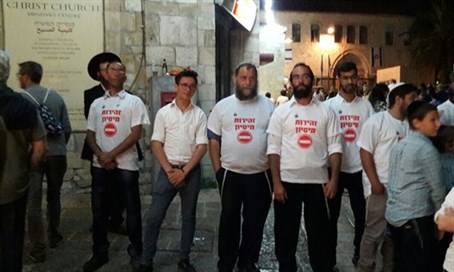
Bentzi Gopshtain and members of his anti-assimilation organization Lehava protested at the entry to Immanuel Church, located adjacent to Jaffa Gate in Jerusalem’s Old City, which was opened to the public this week at the peak of the Jerusalem Light Festival.

Gopshtain told Arutz Sheva that the opening of the church to the wider public was meant to lead Jews astray and into the trap of the missionaries, as he termed it.

-by Benny Tocker, June 3, 2016
“Jerusalem Light Festival hijacked by missionaries?”
Arutz Sheva

Given the rather disquieting historical relationship between Christians and Jews, I can appreciate that there are Jewish organizations who seek to minimize the threat of Jewish assimilation and conversion to a religion they see as false.

gopshtain
Gopshtain and Lehava activists protest missionary event – Photo: Arutz Sheva

But are Jewish people so gullible that if they accidentally walk into a church that they’ll suddenly abandon all of their beliefs and their heritage?

Of course, to the best of my understanding, the majority of Jews in Israel are secular and have no affiliation to religious Judaism, but even still, why is it a foregone conclusion that if a Jew, secular or otherwise, is exposed to the inside of the church or speak to missionaries for a few minutes that they’ll automatically convert to Christianity?

There is another side to the story. One person commented below the news article:

I’m a religious Jew who has gone to the festival year after year. There is ALWAYS a light show on the side of the church because it IS part of the festival. Been there. Seen that. I don’t walk inside the church; nor have I ever seen anyone unintentionally walk inside the church. Is Gopshtain simply uninformed or is it intentional?

I have no idea. I have no yardstick by which to measure Gopshtain.

One possible explanation is that according to multiple sources including Rabbi Naftali Brewer at The Jewish Chronicle, it is forbidden for a Jew to go into a church for any reason whatsoever:

Your rabbi is correct. The rabbinic consensus, based on the Talmud (Avodah Zara 17a,) is that it is forbidden to enter a church, even if just to admire the architecture or artwork. This body of opinion spans the generations and comprises leading medieval Sephardic and Ashkenazi rabbis such as Maimonides, Rashba (Rabbi Solomon ben Aderet), Ritba (Rabbi Yom Tov ibn Asevilli) and Rosh (Rabbi Asher ben Yechiel), as well as contemporary halachists including Rabbis Moshe Feinstien, Ovadia Yosef and Eliezer Waldenberg.

But again, not all Jews are religious, so even though it is Rabbinically forbidden, secular Jews may not acknowledge that authority over their lives.

I should say that the same site also gave the opinion of Reform Rabbi Jonathan Romain who states in part:

A key question is: why are you going into a church? Entering does not mean worshipping. It could be for a variety of other valid reasons: to admire the architecture, to attend the funeral of a non-Jewish friend or to learn about Christianity for the sake of dialogue.

There is a small possibility that a Jew may be so impressed by what he finds that he decides to convert – but such instances are extraordinarily rare. It also displays an insecurity about Jewish loyalties that is very unattractive. Why are we so afraid?

So I see two issues here.

The first is whether or not the church in question was trying to trick gullible Jews into entering their house of worship so they could fall into the clutches of missionaries?

The second is whether or not the majority of Jewish people are so vulnerable to conversion and assimilation that one visit to a church would put them at significant risk?

missionaries in israel
Image: yadlachim.org

I can only imagine that churches operating in Israel would be well aware of how Jews feel about being proselytized. While, again to the best of my knowledge, it’s not actually illegal for Christians to proselytize in the Holy Land, I believe it is highly discouraged by the authorities, both civil and religious.

If some Christian groups are engaged in “bait and switch” tactics all for the sake of “saving Jewish souls,” then in my opinion, they are violating the integrity of their calling. If you believe you should share the “good news of Jesus Christ” to Jewish people, be honest about what you’re doing and why.

If some Jewish groups are “stretching the truth,” or downright being disingenuous about the tactics and intent of Christian groups in their midst, then, for whatever reason, they’re painting a false portrait of those groups, depicting them as “wolves in sheep’s clothing.”

I am well aware of the Church’s historical hostile and dishonest behavior toward Jewish communities, but it doesn’t mean that each and every Christian on the planet is de facto the vicious enemy of the Jewish people.

Maybe there should be a little balance exercised here.

Maybe It’s A Relief Not To Be Jewish

The title of today’s little missive will probably rub at least some people the wrong way, but hear me out.

Living with a Jewish wife, a non-Messianic Jewish wife, one who shares absolutely no common theology with me, is sometimes quite illuminating. Last week, the oldest son of the local Chabad Rabbi and Rabbitzen had his Bar Mitzvah. Apparently, I’m quite ignorant about all this, since I thought it would be on Shabbos.

Not so (although there was another related event on Shabbos). It was on Thursday. There were a ton of Jews from Crown Heights (Brooklyn) who came for the affair. My wife helped cook tons and tons of kosher meals since Boise is hardly the center of a thriving Jewish community, thus Kosher is hard to come by.

Jewish Man PrayingMy wife is very protective of her Judaism and her Jewish community. The occasional “Messianic” (Jew or Gentile, it doesn’t really matter to her) who shows up at Chabad kind of rubs her the wrong way. Fortunately, the Bar Mitzvah was by invitation only, so it was unlikely to attract the casually curious or the Messianic who wanted to dive a tad deeper into actual Jewish life.

By the way, one of the people she’s protecting the local Jewish community from is me. I’m never quite sure if my asking something like, “How did the Bar Mitzvah go” will be perceived as genuine interest or as an intrusion (fortunately the former in this case).

Processing all this over the past several days, and doing a lot of detailed lawn work while the missus was at Shabbos services (all day in this case, there was a lot of “hobnobbing” to do), I realized that maybe it’s a good thing I’m not Jewish.

Really, I can’t stand being stuck in a crowd, particularly made up of (mostly) people I don’t know, for a long period of time. If, for some strange reason, my wife had asked me to attend with her, I’d feel like the proverbial fish out of water. I’ve read some books on the Rebbe and the Chabad, but I’m sure I’d fit in at a Chabad Bar Mitzvah about as much as a Pepperoni and Canadian Bacon pizza.

The missus is about as much of an introvert as I am, so when she finally came home from Shabbos services and the subsequent activities around 5 p.m., she was wiped out. I don’t blame her.

Jewish in JerusalemI don’t blame her for not including me in her Jewish life, either. The more I’ve disconnected myself from any formal association with Messianic Jewish groups, the more I have begun to realize that maybe I never belonged in the first place. Of course, I belong in a church about as much as a nudist in a nunnery, so I’m not saying that traditional Christianity is an option for me either.

I am saying that a Gentile (well, me anyway) attempting to adopt Jewish practices is kind of like putting a cat in a doghouse. One of these things is not like the other.

My wife showed me a photo of the Bar Mitzvah boy. Wow, what a young face. He was also wearing one of those black fedoras and a black jacket, which seemed strange on a kid that age. But then again, I’m not Chabad or even Jewish. Even if I discovered some long-lost family secret that my mother was Jewish, while halachically, that might make me Jewish, at almost 62 years of age, I would still lack a lifetime of Jewish experience.

In other words, I’d still think and feel like a Goy.

I think it’s OK for me and people like me to not pretend to be someone and something we’re not. It’s OK not to engage in what I’ve heard called “Evangelical Jewish Cosplay”.

I don’t think I have a Jewish soul, and I don’t think I’ve got long, lost Jewish ancestors, and I don’t think I’m a descendent of one of the lost tribes or any of that stuff.

I hang onto my current understanding of the Bible because it’s the one that makes the most sense. That’s why I’m about as welcome in a Christian Bible study group as a quart of Vodka at an AA meeting. Sooner or later, I’m going to say something that will be perceived as a threat.

Just showing up in a traditional Jewish venue would be enough to be looked at askance since I’m a Christian (what my wife calls me, not necessarily how I see myself).

Like I said, it’s easier and better to avoid trying to be something you’re not, especially since you’ll (I’ll) stick out like a clown at a funeral. Oh, for a time I can “blend into” a Church setting, but only until I open my mouth.

If religious community is important to you, then I hope you’ve got one where you are accepted for the person you are. I hope you fit in.

For those of you who don’t, welcome. That’s my world. That’s the world of a lot of us who hold to an alternate view of the Bible’s overarching message, particularly the actual meaning of the New Covenant. Some of you have found enough fellow “oddballs” within driving distance that you have formed your own groups. That’s good.

But we’re pretty strange ducks, and sometimes there isn’t a significant number of like-minded oddballs around to get together with.

Besides, within our own little sub-group, there are numerous sub-sub-groups who are just different enough to where we’re not going to get along for one reason or another.

generic white guy
Image: Cafepress.com

And then, there are those folks who are just plain “out there”.

So, if you have ever gotten that feeling that you don’t fit in, no matter how hard you try, maybe you’re trying too hard to belong in the wrong place. Instead of having that make you feel disenfranchised, maybe you should feel grateful.

Thank you God for making me who I am, even if that sort of person isn’t very common, and even if that person isn’t always easy for others to understand. The downside is you don’t have a small Bible study group to go to every Wednesday night (at least not without starting a theological “knife fight”). The upside is you don’t have to pretend to be someone you’re not. All you have to do is be the person you are.

If God created you (and me), then He understands.

More Than Two Chances

What does being “contaminated by death,” and a traveling on a “distant road” have to do with us?

These terms point to deeper concepts. A state of disconnection from God is a type of death. A distant road is place where we are far away from who we really are supposed to be. This is something most of us can identify with.

-Kareb Wolfers Rapaport
“Pesach Sheni: The Holiday of Second Chances”
Aish.com

Second chances.

Any person of faith who believes Hashem grants us only two chances in life is sadly delusional. As far as my life goes, I can’t count the number of “chances” God has given me (and is still giving me) to pull my head out of that hole in the ground and get back into the game.

I don’t know about you, but I sometimes find it disheartening to blog in the religious space, particularly in the realm Messianic Judaism and Hebrew Roots.

While I’ve been told repeatedly that my blog speaks for a certain number of people out there, people like me, non-Jews who have discovered that a particularly Jewish interpretation of the scriptures, of the New Covenant, of God’s intent for not only Israel but the rest of humanity, of the meaning and purpose of Messiah, is the best and most accurate way to understand all of that and who we are because of it, what I write doesn’t speak for a much, much larger segment of both Christianity and Judaism.

I’ve received criticisms and complaints, both on my blog and via email, from mainstream religious Jews, from Messianic Jews, from Messianic Gentiles, from mainstream Christians, and just about anyone and everyone who identifies with what we call Hebrew Roots.

Some of these folks are Internet trolls, but many of them are good, kind, well-meaning people who I’ve managed to inadvertently offend in one way or another.

I’ve stopped going to church, in part, because what I believe and who I am is fundamentally incompatible with traditional Christian theology and doctrine (and not being one who tends to keep his mouth shut when asked for an opinion, I became quite a pain in the neck).

I don’t deliberately stick my nose into online and actual mainstream Jewish venues, already knowing what they would think of someone like me (apart from quoting sources such as Aish).

I have increasingly separated myself from a number of Messianic Jewish organizations for similar reasons.

Only God is silent about what I write. I suspect He’s waiting for me to make up my mind about what I’m supposed to be doing.

So you see, I believe that if people were only given two chances, me included, the vast majority of us would already be toast.

According to Karen Wolfers Rapaport’s article:

Pesach Sheni, the holiday of second chances, reminds us that we can always change our steps and return home.

The question for someone like me is where exactly is “home,” at least in the material sense?

Of course Pesach Sheni has little or nothing to do with me since I’m not Jewish. In any event, its applicability in the current Jewish world is stifled by the absence of the Temple and the Priesthood.

The holiday only tangentially speaks to the non-Jewish world that God offers such “second chances” to us, too, and it begs the question, what do I do with the chance I hold in my hands now? What are you going to do with yours?

"When you awake in the morning, learn something to inspire you and mediate upon it, then plunge forward full of light with which to illuminate the darkness." -Rabbi Tzvi Freeman