Building and Rebuilding the Tabernacle

Ever watch a child learning to walk? While strolling along confidently, albeit a bit wobbly, he’ll suddenly drop to the floor. With admirable persistence, he’ll usually pick himself right back up on his feet and continue on as if nothing had happened.

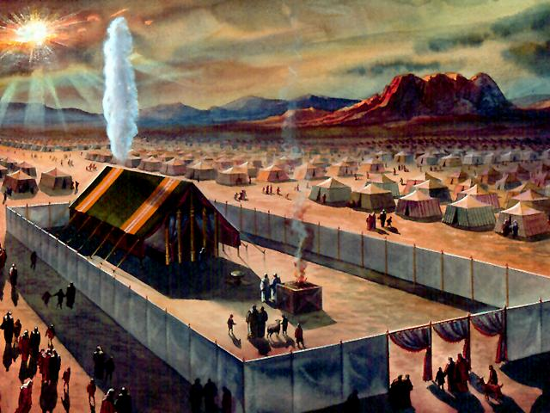
The Midrash (Tanchuma 11) says that throughout the seven inaugural days of the Holy Tabernacle, the portable dwelling place built for G-d’s Holy Presence, Moses would construct and disassemble it two or three times each day. The Tabernacle, of course, was a large and extremely heavy structure. Many of its parts were solid wood and gold, and it was tens of feet high. To build and dismantle the entire structure 14 times, or more, in one week must have been incredibly taxing to Moses! Why didn’t he just assemble it the first day, and then leave it standing until the next time G-d instructed the nation to travel?

There was a deeper meaning, however, to the construction of the Tabernacle, corresponding to the efforts of a person committed to spiritual growth. That person drafts a model of holiness, an ideal setting for rising above material and selfish pursuits, insuring the appropriate goals and safeguards are set. As he takes his first few steps of growth, he feels a sense of pride and serenity, assuring himself that he’s on the proper course. But soon, it all crumbles. The habits of the past return, and his best-laid plans for the future appear unattainable.

The continuous building and dismantling of the Tabernacle throughout the inauguration tells us that holy structures are designed to be built and rebuilt before they are completed. The nature of spiritual growth is to move forward and fall back, repeatedly, akin to the toddler’s efforts to walk. Although a toddler first falls immediately, after just a few steps, his strength, balance, and ability improve exponentially. Don’t be afraid when experiencing setbacks on the road to spiritual growth, because we are promised that the results will come — if we get right back up and keep trying!

-Rabbi Mordechai Dixler
Program Director, Project Genesis – Torah.org
“Pick Yourself Up, Brush Yourself Off”
Commentary on Torah Portion VayakhelPekudei
Based on Nesivos Shalom, Pikudei, 279
ProjectGenesis.org

In keeping with my previous blog posts based on Rabbi Tzvi Freeman’s A Multimedia Guide to Jewish Prayer series, I read the next installment in sequence, Climbing Jacob’s Ladder prior to writing this “morning meditation”. Unfortunately, the “Jacob’s Ladder” piece just didn’t inspire me as I had hoped. However, Rabbi Dixler’s commentary did.

Here I am, still sitting at the bottom of the dark, dusty abyss, looking at the ladder that has been placed before me by God, as an invitation to a dance, so to speak. As Rabbi Freeman commented in his Jacob’s Ladder article, What was that ladder? According to the Zohar, it’s the ladder of prayer. That’s what I thought when I wrote another of my morning mediations as well. But then how do I climb?

That reminds me of an old joke:

A tourist from an Iowa farm decides to visit New York City. He’s having fun seeing the sights, visiting the Statue of Liberty, stopping off at Times Square and such, but he’s bought a ticket for a Broadway play and it starts in an hour. Trouble is, he doesn’t know how to find where the play is going to be performed.

He stops a person who appears to be a local and asks, “How do I get to Broadway.”

The gruff New Yorker replies, “Practice.”

How do you climb the ladder of prayer? The answer is the same. Practice.

I know I’ve said something like this before but it can use repeating, which is also part of practicing.

Look at Rabbi Dixler’s story again. In a way, Moses needed the “practice” in putting up and taking down “holiness.” Chances are, the story isn’t literally true, but it is a metaphor that communicates something important to me. In fact, here’s the part that especially speaks to me.

There was a deeper meaning, however, to the construction of the Tabernacle, corresponding to the efforts of a person committed to spiritual growth. That person drafts a model of holiness, an ideal setting for rising above material and selfish pursuits, insuring the appropriate goals and safeguards are set. As he takes his first few steps of growth, he feels a sense of pride and serenity, assuring himself that he’s on the proper course. But soon, it all crumbles. The habits of the past return, and his best-laid plans for the future appear unattainable.

I have better days and worse days, probably just like everyone else. I have better days and worse days in relation to God, too. Sometimes reading the Bible is very uplifting and other times, the messages I read carry nothing but discouragement. The trick for me, in having fallen down again, is figuring out a way to keep discouragement from having the last word.

The nature of spiritual growth is to move forward and fall back, repeatedly, akin to the toddler’s efforts to walk. Although a toddler first falls immediately, after just a few steps, his strength, balance, and ability improve exponentially. Don’t be afraid when experiencing setbacks on the road to spiritual growth, because we are promised that the results will come — if we get right back up and keep trying!

Why does a toddler, who falls down more times than we can count, continue getting back up? Why does the child, who falls, and falls, and falls, keep trying to walk again? Why doesn’t he get to the point of saying, “I’ll never be able to walk,” and then just keep on crawling as a means of locomotion?

I don’t know.

I suppose there’s something built into every child, a sort of developmental “map,” that drives the boy or girl to keep on trying to walk, keep on building blocks, keep on learning their ABCs, keep on trying to read, to write, to count, to dress themselves, to reach a little higher, then a little higher, then a little higher…

You get the idea. If little kids gave up anytime something was difficult, they’d never develop, become bigger, more sophisticated kids, then teens, and finally adults. They’d always be stuck at being toddlers.

Somewhere along the line, we learn that it’s possible to give up. For most of us, that doesn’t prevent us from hitting all of the usual developmental milestones. Most of us keep on trying and today, we’re able to walk, talk, write, read, count, get dressed, feed ourselves, even drive, get a job, have friends, get married, and raise children of our own. But we also learn we can give up on things and sometimes we do. Some of us learn that we can have a relationship with God and other people give up without even trying, “reasoning” that God doesn’t exist.

I think we have a “developmental need” to seek out God, even as we have developmental needs to learn to walk, feed ourselves, and read. All of those developmental milestones I listed require enormous amounts of practice and the more we practice, the better we get at mastering those skills. The more you read (usually), the better reader you become. The same goes for driving a car, fixing a leaky faucet, or playing a musical instrument (it should be noted though, that some people can practice certain skills forever and still not get very good at them).

But while most of us won’t become world-famous classical guitarists, unless we have a significant disability, we will all learn how to walk, talk, read, count, eat, and get dressed, because (unlike playing a musical instrument or performing heart surgery) they are all basic human skills. But they still all take lots of practice. Is having a relationship with God a basic (rather than an advanced) human skill?

I think so. But it’s one that we are able to abandon even before we ever learn it. Even after learning the basic steps of that relationship, we can still lose skills through lack of practice or lack of confidence. We may at one point have climbed the ladder well and then later, for whatever reason, find we are even afraid of trying. Maybe we fell off the ladder and got hurt. Maybe we failed at some other related skill and we don’t have the nerve to face the ladder again.

So here I sit at the bottom of the well, looking at the first rung of the ladder. Perhaps I fell off the ladder or maybe I never started to climb in the first place. Regardless, here I am, like a toddler who tried to walk and landed on his butt. According to Rabbi Dixler, I need to stand and fall and stand and fall, like Moses building and unbuilding the Mishkan, hour after hour, day after day, until I can stand a little longer, walk a little further, and climb the first rung of the ladder.

Don’t be afraid when experiencing setbacks on the road to spiritual growth, because we are promised that the results will come.

PrayingThe mystical aspects of Jewish prayer are enormously complex and well beyond my limited comprehension and abilities. I’m still trying to climb onto the first rung of the ladder and not become discouraged when I fall back off. But just like a toddler learning how to walk, it’s not something someone else can teach me or even help me with. You can’t walk for someone else, they have to learn it on their own.

But after everything I just said about being able to pray and to forge a relationship with God being a “basic human skill” that anyone can learn, why do I still doubt that I’m ever going to be any good at it? Maybe I’ve just been “plain old me” for too long, sitting here staring at the ladder. It goes up awfully high…and you know what happened to Icarus.

Getting to where you need to be is an important step. But nothing is as important as getting out of where you’re at right now.

-Rabbi Tzvi Freeman
“Hit the Road”
Based on letters and talks of the Rebbe
Rabbi M. M. Schneerson
Chabad.org

He erected the Courtyard all around the Tabernacle and the Altar, and he emplaced the curtain of the gate of the Courtyard. So Moses completed the work.

The cloud covered the Tent of Meeting, and the glory of Hashem filled the Tabernacle. –Exodus 40:33-34 (Stone Edition Chumash)

May it ever be so for you…and for me.

Vayakhel-Pekudei: The Missing Kahal

The Hebrew language does not lack synonyms, and there are several other verbs which could have been chosen to begin the verse: “And Moshe gathered together the children of Israel.” The word employed, vayakhel, is significant, for it implies the fusion of the people into a kahal or communal entity, far more than a collection of individuals.

A group which gathers together can also move apart, and even while together, the union is not complete. A kahal, by contrast, represents an eternal entity that unites individuals in a new framework, highlighting the fundamental bond that joins them.

-Rabbi Eli Touger
“More than Gathering Together”
Commentary on Vayakhel; Exodus 35:1-38:20
Adapted from
Likkutei Sichos, Vol. XXI, p. 250ff;
Sefer HaSichos 5749, p. 292ff;
Sichos Shabbos Parshas Vayakhel, 5752
Chabad.org

This commentary should speak to those people who believe that the Jewish people no longer are a people before God. It should speak to those who believe that God divorced Israel and married the Christian church. It should speak to those who believe that God abandoned His people Israel and transferred His eternal covenants to the church as the “new Israel.” It probably won’t, but it should. Look at what Rabbi Touger is saying. He’s saying that the Jewish people are uniquely a people, a unity, a kahal. They were at Sinai and they remain so today.

But what about the church?

I’m sure I’ve written about this before (but the problem with writing so many “meditations” is that I can’t be sure when or where), but is Christianity “a people?” In the strictest sense of the term, the answer is “no.” One is only a Jew if you have a Jewish mother (though having two Jewish parents would be really great) or if you converted to Judaism using a formalized process in a recognized branch of Judaism (this last part is problematic, since Orthodox Jews don’t recognize converts who went through Conservative or Reform synagogues). On the other hand, anyone can be a Christian. All you have to do is profess faith in Jesus Christ. You can come from any language, nation, or tongue, and God will not withhold the grace of Christ from you. You will belong (actually, I’m still working on that “belong” part).

But will you be a “kahal?” Will you be an “eternal entity that unites individuals in a new framework, highlighting the fundamental bond that joins them?”

How many Christian denominations exist today? I can’t find any one statistic that is authoritative or definitive, but it seems to be in the tens of thousands. Tens of thousands of individual and unique Christian denominations.

That’s a lot. Are they all a unity together; an eternal entity together?

That’s hard to say.

I’m not just commenting on this week’s torah portion (which is a double portion that includes Vayakhel and Pekudei). I’m performing a minor comparison of Judaism and Christianity. This is extremely oversimplified and open to tons of criticism, but hear me out.

My friend Gene Shlomovich has written a couple of blog posts recently. One is 50 signs you may subscribe to Replacement Theology which, as you might imagine, highlights a series of factors that contribute to elevating the Christian church at the expense of Jews, both in society and supposedly in the eyes of God. The more recent blog that caught my attention though is Test of a true convert to Judaism. The test is an easy one. If you want to convert to Judaism but you find out that the next Holocaust is just around the corner, would you still convert?

This is one of the reasons that Jews do not evangelize and are very hesitant to accept converts. When the going gets tough, the converts may not see themselves as integrated with the Jewish kahal. If you are born a Jew, it doesn’t matter how you see yourself. Hitler’s Nazis took all Jews to the camps, religious or secular. It didn’t matter if they saw themselves as part of the kahal of Israel, they still suffered and died. A Jew is bound the the community body and soul.

But is a Christian?

I admit, the church probably has to work harder at it, since we come from such a diverse set of backgrounds, but it’s not impossible to become a unified entity under Christ. The problem is how we see the rest of the world. Unlike Judaism, Christianity has a mandate to speak to the rest of the world. We are directed by Christ to make converts of all nations (see Matthew 28:18-20). No man must be our enemy because he has the potential to be our brother in the Messiah, regardless of his former life.

I had a discussion on another Christian blog recently regarding the Coexist Bumper Sticker phenomenon. The writer of that blog (no, I won’t provide links) was generally against the bumper sticker campaign as he felt it was directing Christians to simply get along with those of different faiths or or no faith at all, denying our mandate to evangelize to those groups. He also felt the coexist bumper stickers denied this:

Jesus said to him, “I am the way, and the truth, and the life. No one comes to the Father except through me. –John 14:6 (ESV)

The blog writer separated the world into two camps…us and them. Those who are not part of us (Christianity) are against us. But if that’s true in an absolute sense, how will we ever be able to share the “good news” to people we hold in disdain? To be fair, he wasn’t really rejecting secular humanity, just resisting the “dumbing down” of Christian convictions for the sake of political correctness. But it reminded me of how many other churches erect extremely rigid barriers against the “unsaved,” and those of us who came to Christ late in life and with “a past.”

I’ve always been bothered by the arrogance and even apparent cruelty of these type of churches. This is particularly poignant for me, as I’ve mentioned, since I didn’t become a believer until my early 40s. If any of these folks had encountered me in those days, what would they have thought of me? Would they have thought I against them? Would they have thought I was their enemy? But weren’t we all enemies of Christ at one time?

For if while we were enemies we were reconciled to God by the death of his Son, much more, now that we are reconciled, shall we be saved by his life. –Romans 5:10 (ESV)

No one is born God’s “friend.” As we grow and develop and become aware of God, we each negotiate our relationship with Him. It may be different from a Jewish point of view, I don’t know. I suspect that although God has promised that all of Israel will be saved (Romans 11:26), that doesn’t give each and every individual Jew a free pass to ignore God or the Torah without certain consequences.

I don’t have all the answers, so don’t ask me to provide them.

But I do know that we, as Christians, cannot simply dismiss the Jewish people or Judaism just because it suits our “superiority” theology, and we certainly can’t spit on those who have not accepted Christ as Lord and Savior because we can only feel better about our salvation in comparison to other people’s state of being without God. There are plenty of people I don’t really like and maybe a few really bad people I’m absolutely against, but how can I be an enemy to someone who was once just like me? How can I refuse to speak to anyone who desires to hear the good news just because they aren’t already just like me?

For me, coexisting isn’t surrendering my convictions in order to get along with the political correctness of the world. It’s the willingness to walk and talk and live in the world around me in all of its diversity, to illustrate that a life lived as a disciple of the Master is not one lived in vain (no matter how many secular and religious people tell me otherwise). How can anyone come to a knowledge of the Messiah if we refuse to share that knowledge, in love and forbearance, with others?

Returning to Rabbi Touger’s commentary, we can’t forget that what God has promised His people Israel was long ago said and done, and we in the church (though I attend no church) cannot undo the will of God toward His kahal.

The most complete expression of this oneness will come in the Era of the Redemption, when “a great congregation (kahal gadol) will return there.”Jews from all over the world will stream together to Eretz Yisrael. This ingathering will be more than geographic in nature. G-d will “bring us together from the four corners of the earth.”But more importantly, there will be unity and harmony among us, and this unity will embrace all existence. “The world will be filled with the knowledge of G-d as the waters cover the ocean bed.”

These are not merely promises for the future, but potentials that can be anticipated today. The massive waves of immigration that have reached Eretz Yisrael in recent years are obvious harbingers of the ultimate ingathering of our nation. And even as the physical reality of the Redemption is coming to pass, so too we can have a foretaste of its spiritual elements. We have the potential to establish a new harmony within ourselves, and to spread that harmony among others. And by these efforts to anticipate the Redemption, we will help make it a reality.

We cannot live in arrogance, taking the place of the groom at the wedding feast (Luke 14:7-11) when we have been commanded to sit down at the lowest place. Not if we expect to be a part of the harmony of which Rabbi Touger speaks. If God wants to honor us, He will move us to a more distinguished seat. It is not up to us to automatically occupy the head of the table.

If Christianity wants to be a kahal of God, unified under our Master and Savior, we must emulate him in being loving to others, as he was to the woman at the well (John 4:7-26). He was not dishonest with her, nor did he “soft pedal” his message to her, but he did not send her summarily away, either.

AbyssI tried to explain my point of view on the aforementioned blog, but the blog owner and I continued to talk at cross purposes (forgive the small pun). Eventually, I was inspired to write today’s Torah commentary, such as it is, not speaking to the blog writer as such, but to all Christians in the hope that someone will listen with a softened heart.

Lately, I’ve been writing about my own spiritual journey, which admittedly has become interrupted “at the bottom of a well.” I’m focusing on prayer as the means by which to respond to being “stalled in traffic” so to speak. I understand that a great many things I object to today, I’ll eventually have to accept and let them be. One of them is the idea that I can always have fellowship with other Christians. I want not to be hostile or anxious or upset with those people who are different than I am. Unfortunately, if the church, or some of its members, are circling the wagons and defending themselves against anyone who is even slightly different, then what fellowship do I have with them?

I should say at this point that we are all doing our best to understand and obey God, so I can’t really be upset or angry at the blog writer I’ve been referencing. I know he’s sincere and really does want to help others, but where he may see enemies such as Stalin, Haman, Hu Jintao and Ahmedinijad, I see my next door neighbor, my co-workers, and my family.

I may have to accept that the church is not my kahal and that such a unity will never exist for me. My closeness and unity to God may be found, not within the walls of a church or synagogue, but in the slender pages of the Bible and in solitary prayer. But then, not every Christian blog has the same response to the “coexist” bumper stickers, so who knows what the future may bring?

Good Shabbos.

My Thirsty Soul

alone-desertA psalm by David, when he was in the wilderness of Judah. O God: You are my God, I seek You. My soul thirsts for You, my flesh longs for You; in a parched and thirsty land with no water. Thus to have beheld You in the Sanctuary, to see Your might and Your glory. For Your kindness is better than life, my lips shall praise You. Thus shall I bless You all my life; in Your Name I shall lift my hands. It is as if my desire is sated with fat and abundance, when my mouth gives praise with joyous language. When I remember You upon my couch, in night watches I meditate upon You. For You have been a help for me; in the shelter of your wings I joyously sing. My soul cleaves after you; Your right arm has supported me. But they seek my soul for destruction; may they come to the depths of the earth. [The enemies] shall drag each one by the sword, the portion of foxes shall they be. The king shall rejoice in God; glorified will be everyone who swears by Him, when the mouth of the liars will be stopped.

Psalm 63 (Stone Edition Tanakh)

For G-d, the union He is seeking happens in three forms: through Torah, through a mitzvah, and through prayer. It’s much like a love affair.

When we perform a mitzvah, the One Above and the Shechinah (played by us) are united in a kinetic activity within the material world. Think of an embrace uniting two bodies.

When we study Torah, the words of the Shechinah (spoken through our lips) are the words of the One Above. Think of a kiss, uniting two mouths.

And when we pray to Him, the Shechinah and the One Above are in intimate union in the deepest recesses of the spirit, sharing their very souls with one another. Think of mental and soulful communion with another, uniting two spirits.

-Rabbi Tzvi Freeman
“Making Sense of It All”
From the “A Multimedia Guide to Jewish Prayer” series
Chabad.org

You’ll have to read the entire article by Rabbi Freeman to get all of the background associated with this message, but as I tried to explain in my previous entry in this series of “meditations,” a relationship with God through prayer has almost “romantic” implications in terms of the level of intimacy involved. When reading David’s psalm as I’ve quoted it above, I can certainly see how David describes his longing for God as a man longs for a lover who is far away.

And I realized something else:

When I remember You upon my couch, in night watches I meditate upon You.

This relationship isn’t necessarily forged by God but by David. David was consumed with God, day and night. He prayed to God, wrote and sang songs to God, told others of God’s glory, praised the might and splendor of God. As I read this Psalm this morning, I realized that, while reading it, I felt closer to God. I realized that God is accessible, as long as I remain accessible to Him. Strange as it may sound, I, a lowly mortal being, can either let God into my life, or shut Him out. Seems odd that a mere person can have such control over whether or not to have God present or absent, doesn’t it?

In the wider context of Rabbi Freeman’s commentary on prayer for today, he talks about God being both outside and above and within and below. He is both transcendent of the Universe and intimately involved in it. It is God’s desire not to be “just” the grand and overarching Sovereign of all existence, but to be completely interwoven within its very fabric, including within the fabric of each and every one of us. In some way, He already is, because we all are created in His fabulous image; we each contain his “breath” or Divine essence.

That aspect of G-d is what we call the Divine Presence — Shechinah in Hebrew. That’s a very important word when discussing prayer. The Shechinah is sometimes described as the feminine aspect of G-d, and all of tefillah is about the Shechinah bonding with the One Above, reuniting the last two letters of G-d’s name, vav and hei, with the first two letters.

There is no place where the Shechinah is not found, although there are places where the Shechinah shines with greater intensity than in others. There are places, we say, where the Shechinah must be — as a sort of self-imposed exile. And there are places where She is because that is where She wants to be. Obviously She is those places much more openly.

The pre-eminent manifestation of the Shechinah in this world is within the human consciousness. G-d made a being “in His image” —i.e. a self-conscious, ego-laden being — and breathed His own consciousness into it.

This reminds me of something I read on Derek Lemen’s blog this morning when he was trying to describe the “Mystic Messiah.”

But God is not only transcendent. He is also immanent, present, with us, in the song as well as being the singer. Even now he communes with us in the hills. All the more so he will commune with us in the world to come, when brokenness is healed…

So Messiah is the divine man, one like a man, a Son of Man, but not a mere man. He transcends humanity while also being human. Divinity took on humanity in what had to be an inevitable event. How could God, who made humanity in his image, not take up humanity himself to redeem humanity? The logic of a low view of Messiah is simply rationalism (making our intellect and sensory experience the end-all of knowledge) while the logic of a high view of Messiah is mysticism (an openness to the mystery that we intuit and experience in the world). I choose mysticism.

I suppose this is why I am attracted to Chassidism and Kabbalah to some degree, because it’s the only way I can begin to make sense of a “Divine” Messiah and Lord, both human and more than human. No, I don’t understand it all and frankly, I don’t believe anyone else really understands it all either (in spite of what others may say to the contrary).

But in reading about prayer and the Messiah and God and His “glory” (Shechinah), I see over and over again that God is trying very hard to reach out to us and to reach us as human beings.

In reading Rabbi Eli Touger’s commentary on this week’s Torah Portion, he speaks of something we tend to forget about the Jewish people:

The Hebrew language does not lack synonyms, and there are several other verbs which could have been chosen to begin the verse: (Exodus 35:1) “And Moshe gathered together the children of Israel.” The word employed, vayakhel, is significant, for it implies the fusion of the people into a kahal or communal entity, far more than a collection of individuals. (See Tzafnas Paneach, Klalei HaTorah VehaMitzvos, entry tzibbur.)

A group which gathers together can also move apart, and even while together, the union is not complete. A kahal, by contrast, represents an eternal (For “a collective can never die” [Temurah 15b].) entity that unites individuals in a new framework, highlighting the fundamental bond that joins them.

Extending the metaphor just a bit, we can say that God relates to His people Israel as if they were a single person…as if God were the bridegroom and Israel was his bride, adorned in holiness and loveliness. I’m not quite sure how to extend this into the realm of Christianity. Classic Judaism would say this is not only impossible, but on some level, offensive to Jews. However, if we consider that the “church” (which I have to believe includes we non-Jewish disciples of the Messiah) is “the bride of Christ,” then we too may be considered so incredibly loved by God that we have an intimate and precious relationship with Him.

Christians don’t have a “peoplehood” together in the same manner or fashion as the Jewish people, but we can still be adopted by God and united with Him through the blood, love, and grace of Jesus Christ. But in describing the “peoplehood” of the Jews and the unity of Christians under God, I am not denying that each of us as individuals also enjoy a love relationship with God. I’m not trying to be overly “mushy” or sentimental, and I think that the awesome majesty of God is often watered down by the church, who sees God as some sort of cuddly, cute, cosmic teddy bear. Nevertheless, I cannot deny that ever since the expulsion of Adam and Eve from Eden, God has been making efforts to reconnect and “rebond” with human beings; to restore to our world what was lost in antiquity.

While that level of closeness with God is yet to come, we can still…I can still enjoy a closeness and “personalness” with God, as long as we…as I make the effort to spend time with Him, pondering, searching, reading, studying, and praying.

Now pick up a Jewish prayer book — whichever version you want — and make a quick survey. What is the most common word in these prayers? No, it’s not G-d. Neither is it please. Or sorry. Look again: It’s You — with a capital Y. If your prayer book uses thou, I give you permission to change all such instances to You. Because all of Jewish prayer is about one thing alone: i commune with You.

If that is the only mental focus you have throughout your prayers, you’re doing fine. If it’s missing, the whole essence of prayer is missing. Prayer is a union of these two consciousnesses, that which you feel within you, and that which you feel transcends you.

Once that has occurred, once that union is made, everything is transformed. That is why, unlike studying Torah or performing mitzvahs, prayer has the power to actually change the material world — to heal the sick, to cause rain to fall, to alter the flow of commerce. It is because the union of prayer is so deep, so intimate, of such an essence-level, that it elicits radical, unprecedented change.

An Invitation From God?

We were created in G-d’s image. The image of His vision.

From a point before and beyond all things, G-d looked upon a moment in time to be, and saw there a soul, distant from Him in a turbulent world, yet yearning to return to Him and His oneness. And He saw the pleasure He would have from this union.

So He invested His infinite light into that finite image, and became one with that image, and in that image He created each one of us.

As for that moment He saw, that was the moment now.

-Rabbi Tzvi Freeman
“G-d’s Image”
Based on letters and talks of the Rebbe
Rabbi M. M. Schneerson
Chabad.org

G-d looked upon a moment in time to be, and saw there a soul, distant from Him in a turbulent world, yet yearning to return to Him and His oneness.

To employ a small joke, I resemble that remark. To be fair, a lot of other people within the community of faith also “resemble that remark,” whether they’re willing to admit it or not. In fact, there are times when I wonder how anyone can feel close to God because, after all, He is the Creator of the universe and the Master of all worlds. How can one, small, insignificant human being really matter to compared to all that?

When I look at your heavens, the work of your fingers,
the moon and the stars, which you have set in place,
what is man that you are mindful of him,
and the son of man that you care for him?
Yet you have made him a little lower than the heavenly beings
and crowned him with glory and honor. –Psalm 8:3-5 (ESV)

Are not two sparrows sold for a penny? And not one of them will fall to the ground apart from your Father. But even the hairs of your head are all numbered. Fear not, therefore; you are of more value than many sparrows. –Matthew 10:29-31 (SEV)

I know, I know. It’s hard to say I’m irrelevant to God in an absolute sense when we have these verses to turn to. The Bible contains all of these little bits and pieces suggesting that human beings have God’s attention but it is nevertheless possible to feel as if you are utterly alone.

Rabbi Freeman, in one of his commentaries on prayer called The View From Within, mentions this.

So here we are, at rock bottom, suffering from all our circumstances because we can’t figure out how on earth any of this could be good. We’re helpless – this is an inherent deficiency in our design and vantage point.

I’m taking this way out of context (the full article can be found at the link I posted above), but it does paint a good picture of where I am right now. Remember from yesterday’s morning meditation that I’m picturing myself as sitting at the bottom of a well. God has just lowered a ladder and it is implied that by praying, I can begin to climb. Today, Rabbi Freeman is saying that even what we pray for is a matter of perspective, as well as how we understand our life circumstances. To illustrate this point, he tells a story:

When the Baal Shem Tov was leader of the chassidim, whenever troubles befell them, he would pray and avert the harsh decrees from heaven. When the Baal Shem Tov passed on and his disciple, the great kabbalist, Rabbi Dov Ber, the Magid of Mezritch, took over the leadership, he would similarly avert these decrees. When the Magid passed on, the most difficult persecutions of their leadership and of their cause began.

The students of the Magid, all of them great, enlightened masters, beseeched him to respond to them from his place in the world beyond. They pleaded, “As long as you were here, you interceded successfully on our behalf. Certainly, from your place in the next world you have yet greater power to intercede!”

The Magid responded to his disciples, “When I was below, I saw these things as harsh and cruel. But from my station up here, I only see the good in all of this. As Rabbi Akiva taught, all that the All-Merciful does is for the good. How could I pray to avert something I see as true goodness?”

His disciples then asked, “If so, our master, what about us? Should we also desist from praying that these decrees be averted?”

“No,” the Magid responded. “Since in your world these appear to be evil, you must do everything in your power to avert them and alter the heavenly decree!”

-Rabbi S.Y. Zevin, Sipurei Chassidim

In real life, we hardly ever hear from people who have ascended into the Heavenly realm (if we do at all) and so we do not, in actuality, have any idea of their perspective. We remain locked into our own, like an ant trying to move a pebble in the dirt. We human beings can look down on that ant with a completely different viewpoint and realize a world the ant has no ability to imagine, let alone experience. But we are unable to impart to that ant how much more there is in the universe around it, even though we see a vast panorama beyond that one small ant pushing a pebble in the dirt.

This is how we are in comparison to God.

But we didn’t create the ant’s universe, nor did we create the ant. The vast majority of us don’t care all that much for ants, and if they get into our homes, we’ll exterminate them without hardly a thought about their deaths. This, we hope and pray, is not how God sees us, and in fact, we hope and pray that God sees us with love and compassion, rather than as insects infesting His world.

But all we have is an ant’s point of view. Unlike the ant, we have the imagination to envision something much more; something we cannot directly experience, but there’s a difference between imagination and knowledge. There’s even a difference between faith and belief and knowledge.

If I were to take Rabbi Freeman’s lesson at face value, I would have to accept that however I currently imagine my experience, it is not at all the same as seen from God’s perspective. What I experience as feelings of emptiness, He may see as something else entirely. But unlike the Magid to his students, God does not speak to we, His creations, to tell us that what we see as evil, God only sees as good.

Or does He?

So here we are, at rock bottom, suffering from all our circumstances because we can’t figure out how on earth any of this could be good. We’re helpless — this is an inherent deficiency in our design and vantage point. And the Mastermind of All Worlds turns to us from His penthouse panorama with banks of video monitors on every creature in the universe, and yells down into your pit, “So how’s the weather down there? Any complaints?”

And this is mitzvah of tefillah! To “petition for all your needs with requests and supplications” three times a day!

It must be, then—because this is the only way out of our conundrum—that for whatever reason (or just out of pure desire), the Creator of this reality is interested in the experience from within, and not just from above. And He wants to bring the two into perfect union.

Tefillah, then, means a union of two worlds, two perspectives, two forms of consciousness: The view from Above unites with the view from within. And we are the matchmakers.

This again, is an interpretation and an imagination as related by Rabbi Freeman’s commentary on prayer. He is telling us that prayer does matter because, in part, it is the joining of our experience with God’s experience and that God desires we share our experience with Him. Of course, Rabbi Freeman is saying all of this from a Jewish perspective and relating it to a Jewish audience, but given the comments on prayer I made yesterday, I don’t think it’s terribly unreasonable for me to apply his lesson to an individual Christian sitting at the bottom of the abyss.

But as I imagine prayer as the means by which I may start climbing out of the pit, Rabbi Freeman has other ideas.

This is vital for us to know before we go any further into the spiritual ascent of prayer, mystic union and higher consciousness: The goal is not a jailbreak out of the dungeon of material existence. The goal is a marriage of two worlds—ours and His. Heaven on earth. Tefillah is where the two kiss.

Sounds very “romantic,” but then in Judaism, God is called “the lover of our souls.” I don’t know if the exact same relationship can be said of God and me relative to Judaism, but perhaps filtered through John 3:16, it might apply because of the Messiah. Because of Jesus, God may also love the Christian soul.

So if prayer isn’t a ladder designed for the human to ascend out of the pit of the world and into the heavens, is it instead an invitation to dance? If so, I’ll have to learn to stand first, and then to walk. Right now, I’m like the wallflower at the high school prom, staring in disbelief at a hand being offered, beckoning me to rise. I hope this isn’t just wishful thinking. We’ll see.

The road

The road is long and often, we travel in the dark.

Expecting Something Wonderful

To help reduce this tension which seems to dominate our people everywhere, you can start by reducing your own pace. To do that you will need to slow down, quiet down. Do not fume. Do not fret. Practice being peaceful. Practice “the peace of God which passeth all understanding.” (Philippians 4:7) Then note the quiet power sense that wells up within you.

-Norman Vincent Peale
“Chapter 6: Stop Fuming and Fretting”
The Power of Positive Thinking

Up until Peale mentioned “quiet power sense,” he was actually saying just about the first thing that made any sort of sense to me in this entire book thus far.

Peace is a difficult concept to apply universally across a person’s life, mine or anyone else’s. We all want some sort of “peace” but we can’t be totally relaxed and at ease twenty-four hours a day. Frankly, there are times when we really need to be focused, or excited, or agitated, or even angry. But as I was reading this chapter over my lunch hour, I realized that I don’t allow myself a great deal of peace, even when I’m supposedly relaxing. More to the point, I don’t really allow myself the time and the luxury of being at peace in the presence of God.

However, as much as I can argue about the various circumstances in my life and the relative amount of control I do or don’t have over them, I do have some sort of control over finding the time and the place to be alone and uninterrupted with God so I can have a “peaceful” conversation with Him (I say this with the caveat that, living with other people doesn’t mean I can always guarantee I will be uninterrupted).

But I can try. I’ve said in previous blogs that I didn’t find Peale the sort of writer who matches my “style” or “metaphors,” but I’ve been trying to find ways of translating some of his more hokey stories and comments into a language I can relate to. He actually told a story (I don’t know if it’s about an actual, factual event or not) that I found brilliant.

Peale relates the tale of a baseball team who just couldn’t seem to do anything right. Although they were originally the favorites to carry the season, the team ended up losing 17 of their first 20 games. Naturally, team morale was at a low ebb and they weren’t expecting to score significantly and they absolutely didn’t expect to win any of their future games.

And they almost didn’t.

It so happened that a preacher named Schlater was popular in that neighborhood at that time. He claimed to be a faith healer and apparently was getting some astounding results. Throngs crowded to hear him and most everybody had confidence in him. Perhaps the fact that they did believe in his power enabled Schlater to achieve results.

O’Reilly (the team owner) asked each player to lend him his two best bats. Then he asked the members of the team to stay in the clubhouse until he returned. He put the bats in a wheelbarrow and went off with them. He was gone for an hour. He returned jubilantly to tell the players that Schlater, the preacher, had blessed the bats and that these bats now contained a power that could not be overcome. The players were astounded and delighted.

The next day they overwhelmed Dallas, getting 37 base hits and 20 runs. They hammered their way through the league to a championship, and Hugh Fullerton (a famous sports writer when Peale was a youth, according to the book) said that for years in the Southwest, a player would pay a large sum for a “Schlater bat.”

Actually, it’s O’Reilly who was brilliant for what he pulled off. Peale was only brilliant for relating the tale (unless he made the whole thing up, then Peale really was brilliant). The “faith healing powers” of Schlater were irrelevant. The team didn’t even have to meet him. All they knew is what O’Reilly told them…that Schlater blessed the bats with a special power. As long as the team believed the bats were powerful, then they would behave out of that belief. Nothing else had to change.

I know what you’re thinking and you’re right.

All I (or anyone) have to do is believe in my relationship with God and my own worth in God’s eyes and my own. Nothing else has to change in order for me to start rising up out of the bottom of the well. All I have to do is to believe that I don’t require a faith community in order to be free of the emotional requirement. The whole point of books like Peale’s is to convince their audience to believe in some sort of special power. That’s why Peale presents various passages from the Bible as he does. If his primary audience believes in Jesus or God, and they don’t mind taking Bible verses woefully out of context, then the book will have the desired effect.

Many years ago, I heard a teaching counselor use the phrase “the trickster healer.” It sounds a little suspicious, since you want people who are healers (doctors, psychologists, etc…) to be forthright and honest, but as we see in the story about O’Reilly and the “Schlater bats,” just telling someone what their problem is doesn’t always work. Sometimes you have to “convince” them in other ways that don’t require them to make a conscious, rational decision. Sometimes they just have to believe.

Unfortunately, knowing about the “trick” robs it of its power, so in being aware of the “trick” and writing about it, I can’t also “con” myself into believing in the personal equivalent of a “Schlater bat.”

But I can try to believe in God.

I realize that, based on most of what I’ve said so far, it is practically beside the point whether or not God even exists as long as I believe He exists. This is probably why Peale’s book works even with atheists if they choose to believe in some other internal or external source of “power” instead of God.

I am convinced of the existence of the God of the Bible, however the presence of God isn’t always enough. If God didn’t require my cooperation or involvement in solving my little dilemma, He could just invoke some supernatural power and *poof* my perspective would be different and my paradigm would be shifted. End of story.

But it doesn’t work that way.

Maybe God doesn’t answer the majority of prayers using supernatural means. Maybe, most of the time, He just allows our faith and our trust in Him do most of the work. I’ll talk more about my journey in prayer while sitting at the bottom of my well in tomorrow’s “morning meditation.” In the meantime, the first lesson I’ll need to continue to learn is to be at peace right where I am, expecting nothing, before I can learn to believe and then expect something.

Heywood Floyd: What? What’s going to happen?
Dave Bowman: Something wonderful.

-from the film 2010 (1984)

Fixing a Broken Connection

How will you repair a soul?

Blind yourself to the shell of mud. Dig deeply and deeper yet, sift through the darkened embers, search for a spark that still shines. Fan that spark until a flame appears, fall in love with the flame and despise the evil that encrusts it. Until all is consumed in the warmth of that flame.

For empathy is the redeemer of love and the liberator of deeds that shine.

-Rabbi Tzvi Freeman
“Soul Repair”
Based on letters and talks of the Rebbe
Rabbi M. M. Schneerson
Chabad.org

This is part of my Finding My Metaphor project which I guess started when I wrote Learning Acceptance. I didn’t realize how difficult this would all be or rather, I didn’t realize when I started this line of questioning, that it would lead in such a difficult direction. Certainly starting to openly question whether or not I trust God is a difficult direction. So where do you go from the bottom of the well?

Actually, even before writing Acceptance, I wrote Waiting in a Minefield, which presents an image of trying to proceed on a spiritual journey but being afraid to move. Then I wrote Waiting for Hope in the Abyss, which is where I return to when I get stuck. If I just sit down at the bottom of the well, I can’t fall any further, can I?

So what now? I can just sit here and hope nothing falls on me, or hope that the bottom of the well doesn’t give way. Or I can try to get up and risk the walls of the well collapsing on top of me, burying me even deeper…or maybe actually getting out of here, but that’s a long shot. Actually, I kind of like it here in the dark. It’s quiet and peaceful and it’s easy on the eyes and nerves. I can just take deep, slow breaths and watch the dust swirling around in the air, caught in the beam of light filtering down from the top of the well.

But I can’t wait down here forever, can I?

Rabbi Freeman wrote in the introduction to A Multimedia guide to Jewish Prayer:

A mitzvah is an opportunity to act out your inner soul. A thought of Torah is an opportunity to hear it speaking. But when do you have an opportunity to experience that soul? When, other than at prayer?

To pray comes as naturally to the human being as breathing—where there is an openness to something greater, something beyond, naturally we cry out to it from within. Nevertheless, there is a ladder, a set of skills and techniques that can be learned. With knowledge, with practice and with persistence, we can all learn to excel at the art of dialogue between that breath of the divine within us and her Beloved Above.

So I’m sitting at the bottom of my well, and then I realize there is a ladder down here with me that leads to the “art of dialogue between that breath of the divine within us and her Beloved Above.” What have I got to lose?

Is prayer normal?

Anybody who has watched the standard morning minyan knows that Jewish prayer is not normal. It is not normal to wrap yourself in a white woolen sheet, strap leather boxes containing ancient scrolls on your arm and head, sway back and forth with your cohorts chanting Hebrew incantations and reading from a parchment scroll. It is not normal to stand before a wall and appear to be speaking to it. It is not normal in this day and age and may never have been normal in any era.

“Normal” is whatever you’re used to in your day-to-day life and, not being Jewish and certainly having never prayed in a minyan, the type of prayer Rabbi Freeman describes above is not “normal” for me. But I did say a few days ago that I would have to restructure the metaphors I feel closest to in order to derive a meaning that makes sense to me.

Even Rabbi Freeman admits that prayer is somewhat “absurd” in acknowledging that we believe God is Omniscient, Omnipotent and Beneficent. After all, God doesn’t need us to tell Him who and what He is. The classic answer to why we pray when God doesn’t need our prayers is because we need to pray. Prayer changes us, not God. God is God. He is immutable, unchangeable, eternal.

We’re not. I’m certainly not.

I mentioned previously that Freeman tells us the word “tefillah,” which we translate into English as “prayer,” “is etymologically related to the root word tofel—meaning reconnect or bond.” When Jews pray three times a day to God, they are reconnecting or “sticking” themselves back to their (our?) Original Source above. In this sense, “prayer” doesn’t mean beseeching, imploring, or appealing to God for something, but instead, it means reconnecting, reattaching, rebonding to the source of our lives and souls.

A fairly inaccurate but still apt analogy would be plugging your dead cell phone into the recharger to restore electricity to its drained battery…sort of.

But we don’t really do that when we pray, do we?

We do not suffice with standing there and acknowledging, “Yes, you are the Omnipotent King and we owe everything to you.” We continue by petitioning, pleading and begging that He change the situation. We repeat again and again, “Let it be Your will…”—directly implying that what we are requesting is not currently His will and we are out to change that.

We are quite frankly creating a revolution: Those at the bottom are dictating to the One Above. Our prayers are definitively not passive—we are taking a real nudnik, back-seat driver role.

And this is a mitzvah—He told us to do this!

The ideal is to reconnect to our source and to restore the Divine spark within us, but in any practical, real-life manner, we ask and plead and beg and implore God to help, help, help us with the mess of our lives.

And in Judaism, this is a mitzvah? Is it a “mitzvah”, an obedient act of righteousness and charity, if a Christian does this?

Judaism interprets the commandment, “You shall serve the LORD your God” (Exodus 23:25, Deuteronomy 6:13) as a positive commandment to pray daily. According to Maimonides:

…this commandment obligates each person to offer supplication and prayer every day and utter praises of the Holy One, blessed be He; then petition for all his needs with requests and supplications; and finally, give praise and thanks to God for the goodness that He has bestowed upon him; each one according to his own ability. (Mishneh Torah, Laws of Prayer, 1:1)

The Apostolic Scriptures also frame prayer as a positive commandment, making it accessible to the Christian as well as to the Jew:

Continue steadfastly in prayer, being watchful in it with thanksgiving. At the same time, pray also for us, that God may open to us a door for the word, to declare the mystery of Christ, on account of which I am in prison – that I may make it clear, which is how I ought to speak. –Colossians 4:2-4

Rejoice always, pray without ceasing, give thanks in all circumstances; for this is the will of God in Christ Jesus for you. –1 Thessalonians 5:16-18

That’s hardly a comprehensive list, but you get the idea. Continue praying. Pray without ceasing. Pray for others. Pray that the word declaring the “mystery of Christ” continues to be preached. Give thanks in all circumstances…even when sitting at the bottom of the well, because praying is “the will of God in Christ Jesus.”

When Paul writes, “for you” at the end of verse 18, I have to assume he’s referring to the non-Jewish believers, so that God’s will for me personally is to pray as I’ve described above.

Paul makes prayer sound so noble and selfless, but that’s hardly how most people pray. We pray asking for what we think we need and want. We pray when we’re upset or in pain. We pray with life isn’t going our way. And we have the audacity to ask God to change things around to the way we want them to be. Rabbi Freeman puts it this way:

The question returns: Why would the Ultimate Driver of the Universe want a nudnik, back seat driver?

So, when I pray, am I a pest? How is this repairing my soul? How does this help me relate to God?

Until after the final redeemer arrives, there is no person on earth without some fault. Where this person fails on one count, another fails elsewhere.

We don’t appreciate someone else prying into our faults and underlining each one with a red pencil. So we know it is not right to emphasize and magnify the faults of another.

This is the way all people should relate to one another.

-Rabbi Tzvi Freeman
“Ignoring Faults”
Based on letters and talks of the Rebbe
Rabbi M. M. Schneerson
Chabad.org

“To avoid criticism do nothing, say nothing, be nothing.”

-Elbert Hubbard
American writer, artist and philosopher

I’m far from perfect God, but I want to trust you. Should I put my foot on the first rung of the ladder?

"When you awake in the morning, learn something to inspire you and mediate upon it, then plunge forward full of light with which to illuminate the darkness." -Rabbi Tzvi Freeman