Kosher Jesus: The Undivine Savior

It’s important to acknowledge the obvious. I have called into question the veracity of much that is contained in the holy Gospels. I’ve cast doubt on some of the essential elements of the story of Jesus as they have been handed down by generations of Christians. Obviously, my Christian readers are going to feel somewhat confused or, worse still, offended – which is, of course, not my intention.

-Rabbi Shmuley Boteach
Chapter 19: Jesus, Lover of Israel (pp 136-7)
Part III: What Christians Have to Learn from the Jewish Jesus
Kosher Jesus

That’s an understatement. OK, to be fair, I’m hardly surprised or dismayed at Rabbi Boteach’s illustration of Jesus, Paul, the early church, and Christianity in general. And while I will be writing a full review of this book right after I finish it, I wanted to address this particular aspect of the Rabbi’s writing right now, since it’s been pretty much what I’ve been thinking about for the last 150 pages or so.

I’ve been thinking about what would happen if a Christian actually took everything in this book at face value. I’ve been thinking about what would happen if a Christian reading Kosher Jesus were to get to this point and say to himself, “Oh wow, he’s right.” If Rabbi Boteach wants Christians to “learn from the Jewish Jesus,” what exactly does he expect them (us) to learn?

Paul’s claims about who Jesus was and what he preached are made more tenuous by the sheer scope of his deviations from the lessons of Jesus’ own followers. The leaders of the Jerusalem Church, Peter and James, insisted that Jesus’ message was for the Jews and was dedicated to preserving Jewish law and observance. Paul transformed that message completely.

Paul claimed to know better what Jesus intended than the disciples whom Jesus taught directly – even though Paul never even met Jesus. He said that Jesus meant to abolish Jewish law, that faith is more important than works, and that the sole criteria for salvation is faith in Christ. Not only that, Paul added that Jesus was not mortal, and his claim to be the messiah meant that he was the divine son of God. Finally, Paul, a self-declared Roman citizen, shifts the developing faith of Jesus, Christianity, to be pro-Roman and anti-Jewish. Paul attacks Judaism as antiquated and obsolete, and to cap it all off, he accuses the Jews of killing Jesus, also claiming they attacked him personally on many occasions.

-Boteach, pg 121

Interestingly enough, most Christians reading the paragraph I just quoted, would probably nod their heads in agreement to all of those statements saying that indeed, Jesus really did all of those things…except Rabbi Boteach says they are all patently false. He says that while Jesus may have honestly believed he was the Messiah and desired to free his people from Roman tyranny, he could not have believed he was also God or intended for anyone to worship him, least of all Gentiles. While Boteach paints a picture of Peter as a coward and a hypocrite, the real “villain” of his piece is Paul, who may not even have been a born Jew, and who took the teachings of an innocent Rabbi and would-be revolutionary Messiah, and turned them into the basis for a Gentile religion that was bent on placating idolatrous Rome while “demonizing” Judaism and the Jewish people.

In order to make his points regarding the Jewish identity of Jesus credible, Rabbi Boteach has to deconstruct every single major tenet of the Christian church. Jesus was a man and not God incarnate. He thought he was the Messiah (which is not a crime in Judaism) but obviously he wasn’t since he died rather than successfully establishing Israel’s self-rule. He was not born of a virgin, he did not speak against the Law, he lead a lifestyle that was completely Jewish and totally consistent with the Law of the Jews, and he didn’t want to have anything to do with the non-Jewish peoples. He hated Rome and he loved his people and wanted to free them from their cruel oppressors. Period.

While I agree there is much to learn by rediscovering the Jewish Jesus, I’m not sure what Rabbi Boteach wants his Christian readers to do about it. If a Christian were to read all of this and take every word at face value, questioning nothing, he’d have to conclude that his Christian faith is a sham. He’d have to conclude that everything he had been taught by the church about Jesus and faith and salvation was at best, an elaborate fantasy, and at worst, the most heinous of lies.

I really don’t think most Christians will be taking this part of the book to such extremes. Yes, they may be confused. Yes, they may certainly feel offended. But since Rabbi Boteach says it is not his intent to confuse or offend his Christian readers, how does he expect them to reconcile their faith with his book short of tossing it into the trash can?

In reading this book, I ask my Christian readers not to discard but to expand their existing ideas about who Jesus really was. But what is the impact in doing so? Does this mean we can’t trust the New Testament? Does this mean we’re tinkering with a divine document? Again the answer is no. The writers of the New Testament indeed may have drawn from divine inspiration.

-Boteach, pg 144

If Rabbi Boteach really believes that it’s possible the content of the New Testament was divinely inspired, I can understand why a good many Orthodox Jewish Rabbis are upset with him right now. Also, if he really believes that statement, how can he use the New Testament content to acknowledge his viewpoint of Jesus the Rabbi and political dissident while denying Jesus the Messiah, Prophet, and Savior from God? He can’t have it both ways, or can he?

I believe the Lucan editors made their changes for the reasons enumerated and to hide the subversive details of the revolutionary nature of Jesus. But the changes they made were not total. They didn’t erase the entire original meanings; messages may actually have been intentionally encoded into the Gospels…

This isn’t without precedent. There are plenty of examples of this phenomenon in the Hebrew Bible. In order to comprehend God’s true meaning, we sort through four levels of interpretation…peshat, remez, drush, and sod: peshat being the simple, straightforward meaning; remez, the alluded to meaning of the text; drush, the homiletic meaning of the text; and finally sod, the esoteric meaning of the text.

Beyond the simplest reading of the New Testament, just as in the Hebrew Bible, there remain layers and layers hidden from view.

-Boteach, pg 145

broken-crossIt sounds like, in order to encourage his Christian readers to not “discard but to expand their existing ideas about who Jesus really was,” Rabbi Boteach is encouraging them (us) to still consider the New Testament text as divinely inspired and containing hidden messages, just as the Tanakh (Old Testament; Hebrew Bible) does, from a Jewish point of view.

In making this statement (and I have to be really careful here), Rabbi Boteach does not sound unlike some of those Jews who really do believe Jesus was the Messiah King and who accept that the New Testament has as much validity as a holy book of the Jews as does the Tanakh.

No, I don’t think Rabbi Boteach is some sort of “crypto-Messianic Jew,” but some of what he writes intersects with what the ethnically, culturally, and religiously Jewish people who have faith in Jesus as Messiah and Savior believe.

Rabbi Boteach walks a very fine line here. He must communicate that he, as a Jew, does not believe for a split second that Jesus was of divine origin or any of the supernatural claims about him that are typically made in Christianity, but at the same time, he must convince his Christian readers that he does not think they are a bunch of fools or lunatics for believing everything the church believes about Christ.

I don’t think that’s possible or at least, I don’t think that Rabbi Boteach actually pulled it off. Either Jesus is the Christ as the church says he is, divine in origin, having a place of extremely high merit in the Heavenly court, and is much more than just one of the myriad tzadikim in Jewish history…or he was a great Rabbi, a passionate leader of his people, a revolutionary who desired to free Israel from Rome…and he was a man who died fighting for a worthy cause. It may be possible to overlap those roles and to distill out of them, a portrait of the Jewish Jesus who was Messiah, Prophet, miracle worker; who died and was resurrected but never ever abandoned his people or taught against the Law, but you can’t delete so much of the Christian faith from the Jewish Jesus and have him remain the resurrected King who will return on the clouds to free not only Israel, but the world.

Either Christians, mistaken though they may be in not recognizing the true Jewishness of Jesus, can have faith in their Savior or they can’t. Rabbi Boteach may intrigue his Christian readers, and he may get some of them to consider a somewhat more Jewish perspective on the heretofore Gentile Jesus, but he will never sell the Christians that Jesus had no power to save their souls, and never even wanted to. Any Christian who would choose to completely embrace Rabbi Boteach’s reconstruction of Jesus would be a person completely broken in their faith; crushed under the burden of a salvation lost and a King who never cared about all the Gentiles in need of a Savior.


Another Chance

The Ishbitzer Rebbe, zt”l, explains the deeper meaning of yovel and why houses within cities walled since the time of Yehoshua bin Nun do not return during yovel. “Yovel teaches that everything has a time. God doesn’t remain angry at anyone forever. Even if someone’s sins force him to sell his portion or to be sold as a slave, this cannot be forever. Eventually he will be redeemed and his inherited field will return to him. But batei arei chomah are an exception. This alludes to the two chomos, the two barriers—teeth of bone and lips of flesh—that God gave us to rein in what we say, as discussed on Arachin 15…Indulging one’s arrogance by failing to hold back one’s anger at his friend is no simple matter. If the victim remained silent in the face of his rage, the sinner’s merits are transferred to the recipient of his anger.

“Unlike sins between man and his Creator, sins between man and his fellow do not have an automatic limit. These misdemeanors remain until his friend forgives him. One has only limited time to beg his friend’s forgiveness. Failure to do so causes his merits to remain with his friend. His inability to accept his wrongdoing and make it up to his friend causes him losses he would never have imagined.”

But the rebbe concluded with words of chizzuk. “Nevertheless, we find that kohanim and leviim can always sell and always redeem. This teaches that even if one has sinned, if he begins to serve God in earnest, he can always redeem what he has lost. Through the dynamic change he gains through his avodah he always has another chance!”

Daf Yomi Digest
Stories Off the Daf
“The Walled Cities”
Arachin 31

What is being said here? We learn from the construction or organization of the Ten Commandments brought down from Sinai that there are two general classifications of sin: sin between man and God and sin between man and man. Of the first, God will forgive by His own grace and mercy and not necessarily because of the merit of the sinner. We rely on God to give us something we could not possibly earn. However of the second, we will not be forgiven until (or unless) we ask for forgiveness from our fellow. In this, we must take a much more active role, otherwise forgiveness will never occur. We also learn that if we stubbornly refuse to admit our wrongdoing against our fellow, this affects our relationship with God as well, so we have in some sense, doubly sinned.

The commentary concludes that, “even if one has sinned, if he begins to serve God in earnest, he can always redeem what he has lost.” But how can this be? If you sin against a person, ignore your responsibility for that sin, and go on to seemingly “serve God in earnest,” are you really serving God while remaining unrepentant? The answer is in the last sentence of the teaching: “the dynamic change he gains through his avodah he always has another chance!”

I suppose this could be read as saying that by serving God, even though you have not sought forgiveness of the person you sinned against, your service to the Almighty somehow compensates. I don’t think that’s what is being said here, though, since the sin against your friend remains. I think it is much more likely that, by honestly and truly serving God, it will become necessary for your soul to turn to Him and in order to do so, you will have to see the stains on your own character. Once you do, and with your desire to serve God earnestly still intact, as part of that service, you must go back to the one you offended and beg forgiveness. Only then, can you return to God and have your response to Him gain real meaning.

So if you are offering your gift at the altar and there remember that your brother has something against you, leave your gift there before the altar and go. First be reconciled to your brother, and then come and offer your gift. –Matthew 5:23-24

We see that the Master is in agreement with the Ishbitzer Rebbe. Living a life in this world does not detract from living a life of holiness, as long as we keep our perspective.

It is not business, not money, nor career, nor human relationships that tears our souls from us and us from our G-d.

There is as much beauty in any of those as there is in any flower from the Garden of Eden. As much G-dliness as in any temple.

It is the way we lock ourselves inside each one, begging it to take us as its slave, refusing to watch from above, to preserve our dignity as human beings.

As you enter each thing, stay above it.

Rabbi Tzvi Freeman
“Unslavery”
Based on letters and talks of the Rebbe
Rabbi M. M. Schneerson
Chabad.org

As much as we fail and allow ourselves to become slaves of the world around us or even our own emotions and pride, God provides every opportunity for us to make amends and to succeed in serving God and serving our fellow. If we do not surrender to anger, frustration, and despair, and continue to seek Him, we will always have another chance.

The Uncertain Gospel

The editing done to purge the crimes of the Romans and to delete references to Jesus’ rebellion against them was an intricate and difficult job. Part of it was left incomplete. Remember, thousands of manuscripts were circulating around. Not all could be completely purged. Flashes of accuracy remain. “We have found this man subverting our nation. He opposes payment of taxes to Caesar and claims to be the Messiah, a king.” (Luke 23:2 NIV) This statement in Luke indicates that corrupt priests delivered Jesus to his oppressors, the Roman administration, because he was a rebel against Roman rule pure and simple. Because it is so different from other statements throughout the rest of the Gospels, which take great pains to make Jesus non-political, it is an obvious piece of real history that slipped through, contrary to the intent of editors publishing Paul’s concept of a strictly spiritual Jesus.

-Rabbi Shmuley Boteach
“Chapter 8: Jesus Never Claimed to Be Divine” pg 51
Kosher Jesus

This is bound to be a part of Rabbi Boteach’s book that will be a major problem with most Christians. Boteach insists that the Gospels were heavily edited to remove any (or most) traces of not only the “Jewishness” of Jesus, but the “fact” that he was executed by the Romans for being a rebel and attempting to lead the Jewish people in a revolt against their Roman occupiers. The portions of the Gospel that seem to support Boteach’s position, he declares as “real history,” while anything that denies his perspective is considered to have been significantly changed by later editors to make the New Testament more palatable to Rome.

You might easily conclude, as a Christian, that Boteach is writing to support a strictly Orthodox Jewish viewpoint of Jesus and “to heck” with the inerrancy of the Gospels. However, he’s not the only one to suggest that the Bible we have today is not completely consistent with the actual, original texts. Amazing? Unheard of? Consider this:

It was dated by one of the world’s leading paleographers. He said he was ‘certain’ that it was from the first century. If this is true, it would be the oldest fragment of the New Testament known to exist. Up until now, no one has discovered any first-century manuscripts of the New Testament. The oldest manuscript of the New Testament has been P52, a small fragment from John’s Gospel, dated to the first half of the second century. It was discovered in 1934.

How do these manuscripts change what we believe the original New Testament to say? We will have to wait until they are published next year, but for now we can most likely say this: As with all the previously published New Testament papyri (127 of them, published in the last 116 years), not a single new reading has commended itself as authentic. Instead, the papyri function to confirm what New Testament scholars have already thought was the original wording or, in some cases, to confirm an alternate reading—but one that is already found in the manuscripts. As an illustration: Suppose a papyrus had the word “the Lord” in one verse while all other manuscripts had the word “Jesus.” New Testament scholars would not adopt, and have not adopted, such a reading as authentic, precisely because we have such abundant evidence for the original wording in other manuscripts. But if an early papyrus had in another place “Simon” instead of “Peter,” and “Simon” was also found in other early and reliable manuscripts, it might persuade scholars that “Simon” is the authentic reading. In other words, the papyri have confirmed various readings as authentic in the past 116 years, but have not introduced new authentic readings. The original New Testament text is found somewhere in the manuscripts that have been known for quite some time.

Daniel B. Wallace
“Dr. Wallace: Earliest Manuscript of the New Testament Discovered?”
February 9, 2012
DTS.edu

Many Christians don’t realize that there is an ongoing debate over just how accurate our Gospels really happen to be. Do the Gospels you read in your Bible every day tell you the true story of Jesus of Nazareth? Do they accurately capture his teachings to the Apostles and to us? If we could find and read an actual first century manuscript of the Gospel of Mark, for example, would we be shocked and dismayed at how different (assuming we could translate it from the ancient Greek) the Jesus chronicled on the recently discovered 2,000 year old papyri, is from the person we’ve come to know in our 21st century Bibles?

Dr. Wallace seems confident that not only are these papyri valid documents, but that they will confirm to a high degree of fidelity, that the Gospels of today are the Gospels of yesteryear. However, Jeffrey García in his blog post More the First Century Gospel of Mark isn’t so sure.

In a previous post I mentioned that Dr. Daniel Wallace referred to a hitherto unknown first century manuscript (now fragment) of Mark in a debate with Dr. Bart Ehrman. As I noted before, the blogosphere sparked with suspicions regarding the Wallace’s claim. We are currently lacking any announcement as to its discovery, the so-called world renown paleographer who has dated the fragment remains anonymous, and the Brill publication is still, according to Wallace, about a year away. Unfortunately, Wallace’s new post on this has not alleviated any of these concerns. Texts that remain “hidden” texts are regarded with a significant degree of hesitation, especially when the information is disseminated through one person (a bit gnostic if you ask me). If the long history of the Dead Sea Scroll publications is any indication, when texts remain privately held and controlled for so long, some crazy things begin to leak out or are simply invented. Hopefully, the identification of this text is not based on the conjugation “kai” a la initial claims of the some scholars who thought gospel manuscripts were found in the caves. In any event, see the post quoted below (again, hopefully this text will be released shortly for other scholars to chime in)”

García is primarily dubious regarding the validity of this find, rather than whether or not it will substantiate our current understanding of the Gospel of Mark, but New Testament scholars such as Bart D. Ehrman aren’t convinced that our Gospels tell us an accurate story about Jesus. In his book Jesus, Interrupted: Revealing the Hidden Contradictions in the Bible (and many other of his works), he contends that there are numerous internal inconsistencies contained within the New Testament and that it is no where near a seamless, flawless record of the life of Jesus and the origins of the first century church.

One of the criticisms against Ehrman is that he was a Christian who lost his faith, not based on his studies of the New Testament, but over his inability to understand why there is such terrible suffering in the world created by a loving God. I’ve written several blog posts including Faith and the Book of Bart as a response to Jesus, Interrupted, and find Ehrman to be a gifted scholar and (like the rest of us) a flawed human being. That the Bible or life doesn’t line up with our preconceived expectations or our personal desires, doesn’t mean that Jesus isn’t the Messiah and that God is a fantasy. It more likely means that we suffer from our own human misconceptions and probably are victims of centuries old teachings and interpretations that are at best mistaken, and at worse, deliberately falsified to satisfy an agenda.

This is something I’ve just recently discussed and perhaps may even be part of God’s intricate plan for how history is supposed to unfold between the first and second appearance of the Messiah. I know, it seems cruel. How can God make us struggle, not only in our day-to-day lives, but in our attempts to understand a Bible that is not guaranteed to be completely, totally, and supernaturally accurate?

I’m no Bible scholar, so I can’t comment with any sort of authority on this matter, but I do find it fascinating that within the realm of Christian scholarship, there are questions being investigated that the majority of the people in our churches never, ever hear about. Matters of scholastic contention and mystery are presented as absolute fact from the pulpit, which I suppose is the way most people like it, since dancing on the head of uncertainty is no way to become comfortable with your faith. When I first encountered these sorts of questions, I wondered how my faith could possibly endure, and yet God made it possible. The Bible doesn’t have to be perfect to be inspired. The Bible translations I read from don’t have to represent an absolute fidelity to the original texts in order to mean that the Messiah exists and that faith in God is not in vain.

If I admit to a certain “fallibility” in our current Bible translations, am I then living a fantasy and pretending the object of my faith is real? Not at all, although I can certainly see how an atheist or a person weak in the faith might perceive it that way. God works with human beings using supernatural methods, but it doesn’t mean that the Bible you can purchase in any book store in this country is supernaturally accurate and describes, word for word, every single detail of the life of Jesus with no errors or mistakes whatsoever.

Like so many of my other “meditations,” I’m not writing this to give you answers but to make you ask questions. If faith cannot tolerate a few really hard questions, then its foundation must be sand and not rock (Matthew 7:24-27). No, I’m not being critical of anyone, because when I first met this challenge, I was thrown for a loop, too (which is an understatement). But if we don’t ask these questions, how will we ever know if we can endure the answers, if they exist, or the uncertainty if they don’t? How will we ever know if we really have faith?

The Return of the Jewish King

PrayingAside from the vast numbers of Jews murdered during the Holocaust, the scars that the experience left on survivors was unimaginable. One of the champions of the survivors was the Beis Yisrael of Gur, zt”l. He himself had plenty to cry about—he could remember his one hundred thousand chassidim in Europe before the war, virtually all of them murdered, including many of his close relatives—yet he was a beacon of hope to survivors. He always found exactly the right approach to pull downtrodden survivors out of their despair and give them new hope.

“In Arachin 29 we find that a Jew may not be sold as a slave during times when there is no Yovel. This teaches a powerful concept. An eved ivri cannot be sold into slavery unless there is a clearly defined end to his indenture. We see that a Jew is not forced to endure a load of tests that are harder than he can bear. Even when his hardships are decreed, they must have a set end, a clear-cut time when he will be delivered from the adversity. This is the meaning of the principle that God creates the medicine before allowing the blow to fall. There is always a way for every Jew to emerge from despair and begin again, to learn how to live a positive life despite the horrors and trauma he may have experienced. Every exile must have an end!”

Daf Yomi Digest
Stories Off the Daf
“Every Exile Must Have an End”
Arachin 29

The hardships and loss suffered by the Jewish people across the long span of history is just appalling. One can hardly think of this topic and not immediately have images of the horrors of the Holocaust spring forth in our memories. The past 2,000 years of the chronicles of Judaism particularly read like a tragedy worthy of the greatest classical poets and playwrights. And yet that suffering is real. The loss of life, property, and dignity are terribly real. But because of God’s promises to the Jewish people and His graciousness and mercy, the Jews yet survive, against all odds, as a people and a faith, and continue to honor the God who created both the tormented and the tormentors.

Christianity has been hard at work taking from the Jews what does not belong to us.

To be perfectly blunt, I must say the Christians have robbed the Jews! And perhaps what is worse is that this thievery has been encouraged by theologians, pastors, and even Sunday School teachers, where small children are taught to sing the song, “Every promise in the book is mine, every chapter, every verse, every line.”

Every promise in Scripture in some way benefits Christians, but it is not all promised to Christians. Sometimes the thievery has been inadvertent and unintentional. It’s like thinking that the raincoat hanging in the office closet is yours for wearing home because of unexpected showers. Hopefully, you will discover the raincoat belongs to a fellow worker and you will restore it. It is not as if Christians do not have the greatest promise of God, which is I John 2:25: “And this is the promise that He hath promised us, even eternal life.”

-Moishe Rosen
from the Foreward to Pastor Barry Horner’s book
Future Israel: Why Christian Anti-Judaism Must Be Challenged

The irony is that we Christians have not only robbed the Jews, we have robbed ourselves. What was the Christianity taught by Paul, Peter, and the rest of the Jewish Apostles to the non-Jewish disciples of the Jewish Jesus? We don’t really know. We don’t have access to the unedited and unfiltered teachings that underlie the New Testament text we read in our Bibles today. It’s not just the words in the Bible, but what almost 2,000 years of Christian theology and doctrine has taught us what that text is supposed to mean. We take it as a foregone conclusion that “every promise in the book is mine” but we don’t really know. We are taught to believe, so that whenever our assumptions and our standard Christian traditions are challenged, we really think that what we believe is actually fact instead of interpretation.

If circumstances had been different and there hadn’t been a savage separation between Jewish Messianism and Gentile Christianity in the early, formative centuries of the church, what would things be like today? Would there be a thriving Messianic Judaism that stands alongside Reform, Conservative, and Orthodox Judaism? Would Gentile Christianity still seek to find its truth from within a Jewish interpretive context? Would we all still cease our toil on Shabbat, and would Christians along with religious Jews, pray at set times to the Maker of Heaven and Earth?

There’s no way to know, of course, and I’m forced to believe that the Christian/Jewish schism is all part of God’s plan and that the “time of the Gentiles” has to become “full” before the Jews are able to recognize the face and identity of the Moshiach. Paul lamented the suffering of his own people in Romans 11 and registered deep regret that some Jews would be temporarily separated from the Messiah for the sake of we Gentiles. I have to believe this “disconnect” was somehow necessary, and yet like so many other parts of God’s plan for humanity, I must confess a gross lack of understanding for almost everything that is going on around me in my world of faith.

And yet faith and trust are the only tools I have to sustain me and without them, I am lost, along with a disbelieving world. Where is God? Why is there such suffering? Why hasn’t Jesus returned yet? Where is the Moshiach? What is he waiting for? If not now, when?

Today is Sunday as I write these words and Christians in churches all over the world smile and sing and pat themselves on the back that they are saved by Grace and not from works. They congratulate each other over being inheritors of all of the promises in the Bible and it never occurs to them that they have missed so much.

At this point, I must stop in my “rant” and recognize the enormous good that has been done in the name of Christ throughout the world and across church history. Many have been fed and clothed. Many have heard the “good news” of salvation for the sake of Christ and the unsaved. Many churches have been built, many homes have been built, many children have received medical care, many grieving hearts have been comforted. There have always been those in the church who have learned the core lessons of the Master and performed them with unswerving love and devotion. There have always been those who have labored and suffered in anonymity, without titles, recognition, or receiving any honors, who give glory to God and not to themselves. For all of the faults in the church, there are many who, though they do not recognize the “Jewishness” of Jesus, carry on the mitzvot he commanded to always do good to others, to pick up their burdens, and to follow Christ where ever he leads them. Praise be to God for their faithfulness and trust.

And yet, the early “church fathers” took it upon themselves to reinvent history and the Bible in the image of the nations, removing any and every trace of Judaism. In spite of their efforts, the faithful in Christ have continued to work as the Master taught in the Gospels. But sadly, we have toiled under many a false teaching as we struggle to live a life, not by man’s doctrine, but in obedience to Jesus. By God’s miracles, many Christians were not blinded by the man-made theology of supersessionism. But we still see the Bible through “Christian-tinted glasses” and absolutely don’t realize that we’re wearing them, imagining instead that our vision is crystal clear and not “through a glass darkly.” (1 Corinthians 13:12) And yet, as long as a single Christian feeds even one hungry mother and heals the wounds of one injured child, there is hope.

The irony for many, is that when Jesus returns, he will not be here to inaugurate an age of Christian domination over the earth, but to restore Israel to her rightful place before the nations and before God. Only then will we all, Israel and the disciples of the nations alike, be able to have the peace that has been prophesied.

…but they shall sit every man under his vine and under his fig tree, and no one shall make them afraid, for the mouth of the LORD of hosts has spoken. –Micah 4:4

Only then will we all, Jew and Gentile alike, sit with each other in peace at the table of the patriarchs.

I tell you, many will come from east and west and recline at table with Abraham, Isaac, and Jacob in the kingdom of heaven… –Matthew 8:11

May Jesus the Messiah come soon and in our day, and may we truly be prepared to welcome him, not as we imagine him to be, but as he truly is: Yeshua HaMoshiach, the King of the Jews. Then the “exile” of both the Jew and the Gentile from the presence of our Master will come to an end.

Slaves of Grace

On today’s amud we find that one should enter and leave shul in a manner that demonstrates that he cherishes his time there.

Once there was an extremely wealthy man who lived quite close to his synagogue. Although he could have easily walked the short distance, he would choose to ride on his very expensive mount to the Beit Knesset, since he felt it befitted his distinguished stature. Someone pointed out to this man that it may be preferable to walk the distance. The wealthy man enjoyed riding to synagogue but he wanted to go the best way according to halachah, so he consulted with the Ben Ish Chai, zt”l.

“It is better to go on foot,” the Ben Ish Chai ruled. “We see this in Sotah 22. The gemara there recounts that a certain widow used to pray in Rav Yochanan’s beis medrash even though she lived closer to a different beis medrash. When Rav Yochanan asked her why she went out of her way to come to her shul, she replied, ‘I come here to receive reward for each step!’ This implies that the reward for going out of one’s way is only if one troubles himself to walk on his own two feet, not if one rides!

The Ben Ish Chai continued, “We see this in Chagigah as well. A small child is not obligated to be olah l’regel because he can’t walk to the Beis Hamikdash himself. Beis Hillel rule that a child is not obligated until he is old enough to hold his father’s hand and walk on his own two feet from Yerushalayim to Har Habayis. Although those who were very distant from Yerushalayim would surely ride, clearly one should walk as much as possible, as implied on Chagigah 3… For the above reasons, you should walk to synagogue on your own two feet, regardless of your honor and status!”

Mishna Berura Yomi Digest
Stories to Share
“Reward for Every Step”
Shulcham Aruch Siman 151 Seif 5

Although the vast majority of Christians worship on Sunday, it isn’t really a “Sabbath” in the Jewish sense of the term. We don’t really rest because of the “freedom of Christ.” Grace not only allows us to mow the lawn, shop for groceries, pay the bills, and watch the news on Sunday, it fairly demands that we do, in order to “prove” that we’re not “under the Law.” Saturday, for most Christians, has nothing to do with God. Neither does Friday night. There is no candle lighting just before sundown. There are no hymns or prayers sung to welcome God into our homes on this special, holy day. We do not allow ourselves to rest from the mundane chores of life while partaking of an extra portion of the holiness in the Almighty. The church acts as one body for maybe a couple of hours on Sunday morning, but that’s about it for most of us. Then it’s business as usual.

But we’re free, unlike those poor Jewish people who can’t do hardly anything from Friday night until Saturday night. Poor people who are under the Law.

I say all of this with a sense of irony of course, because I believe it’s not the Jews who should be pitied in this instance, but the Christians. We have allowed ourselves to be robbed of one day of peace out of seven, where we can actually permit ourselves to stop in our wild pursuit of the “rat race,” crawl out of our mazes, and actually enjoy the freedom of worshiping God, not only in church, but in our homes, on our streets, in our parks, anywhere we are. But we don’t do that because we are “free.” We don’t do that because only those people who are “enslaved” to the Torah allow themselves to be confined with God within the walls of His holiness for a full 24+ hours.

Oh how awful for them.

I’m sure you see where I’m going with this. According to the sages, a non-Jew is forbidden from observing the Shabbat in the manner of the Jews. Part of this has to do with something I read just last Shabbat.

Remember the sabbath day and keep it holy. Six days you shall labor and do all your work, but the seventh day is a sabbath of the Lord your God: you shall not do any work — you, your son or daughter, your male or female slave, or your cattle, or the stranger who is within your settlements. For in six days the Lord made heaven and earth and sea, and all that is in them, and He rested on the seventh day; therefore the Lord blessed the sabbath day and hallowed it. –Exodus 20:8-11 (JPS Tanakh)

The Shabbat is considered a special commemoration of the deliverance of the Children of Israel from slavery in Egypt…something we non-Jews did not experience. It’s a special part of the Sinai covenant relationship between God and the Jews, even to this day. Yet, I “miss” it, not that I have ever fully been able to rest on the Shabbat. Even at my very best, there was always a number of ways I could have rested better. I rationalized my behavior saying that I had to drive to my place of worship, heat my coffee in the morning, edit the lesson I was going to teach, check my email in case someone needed some help with something right before services. It’s the diaspora, not Israel.

But then, I’m not Jewish, so maybe it doesn’t matter.

But I wonder. If resting and honoring God for a full day is good for Jews, why isn’t it good for Christians? If we are forbidden by the Rabbis from remembering and observing the Shabbat in a traditionally Jewish manner (not that most Christians acknowledge any authority of the Rabbinic sages over the life of a believer), can we not choose to still offer our rest and our worship in some manner or fashion? The Shabbat not only commemorates the freedom Jews enjoy from the bondage of Egypt, it acknowledges that God is Creator over all.

On the seventh day God finished the work that He had been doing, and He ceased on the seventh day from all the work that He had done. And God blessed the seventh day and declared it holy, because on it God ceased from all the work of creation that He had done. –Genesis 2:2-3 (JPS Tanakh)

It is said that a Jew who does not observe the Shabbat is denying God’s sovereign claim over Creation. But Creation exists for the Gentile and the Jew. The sun shines as much on us as it does them. The rain waters our fields as well as a Jew’s fields. The breeze cools both Jew and Gentile in the summer, and we both  experience heat, and cold, and wind, and all the manifestations of Creation. The stars look just as beautiful to us, and the moon rises and sets for us, too. Can the Gentile not acknowledge Creator and Creation along with the Jew? Should not the Gentile also acknowledge Creator and Creation along with the Jew?

Shabbat candlesI’m not suggesting that Christians everywhere should suddenly start donning kippot and singing in Hebrew every Friday night as they light Shabbos candles, but I am suggesting that some sort of observance wouldn’t be out of line, either. Why were we in the church taught that it’s a bad thing to give honor to God because He created the Universe? I know the answer, of course. But the answer isn’t a valid one. In separating ourselves from Judaism early in the history of the church, we didn’t just hurt our Jewish mentors, ignore the Jewish Apostles, and dishonor our Jewish Jesus, we hurt and dishonored ourselves. The Jews rest on Shabbat and are free to honor God. We work, both on the Christian “Shabbat” and on the Jewish Shabbos and we call ourselves free. Then we work Monday through Friday as well. So who’s free and who’s a slave?

We’ve come to expect instant results. Perhaps the speed of today’s latest “on demand” technology or the abundance of resources in our global community have trained us to feel this way, but it’s become natural to assume that most problems will be solved within 24 hours or less. This expectation obviously leads to disappointments, and we’re forced to learn the art of patience even when the answers seem but a click away.

One of the laws in the construction of the Holy Temple’s altar is that the ascent to the top must be upon a ramp and not a staircase “so that your nakedness will not be revealed on it” (Exodus 20:23). Unlike a staircase, a ramp’s incline is small and gradual, forcing a more gentle ascent for the Temple priest.

Personal growth follows the same pattern. When we’re inspired to change, we might expect a decision to change to be instantly transformational. Taking leaps and bounds towards the new behavior, we seem like new men. Then the “nakedness” is “revealed,” the surprising reality that change is not overnight, and we’re often discouraged and revert to the old habits. Often the result is that we become more deeply entrenched in our destructive patterns.

Inspiration to grow, to ascend the altar, is what starts the engine, but when going forward — beware of your speed limit!

Rabbi Mordechai Dixler
“Watch Your Speed Limit”
ProjectGenesis.org

Would it be such a bad thing for a Christian to slow down once a week and learn to really appreciate what God has done for us?

The Torah of Fellowship and Peace

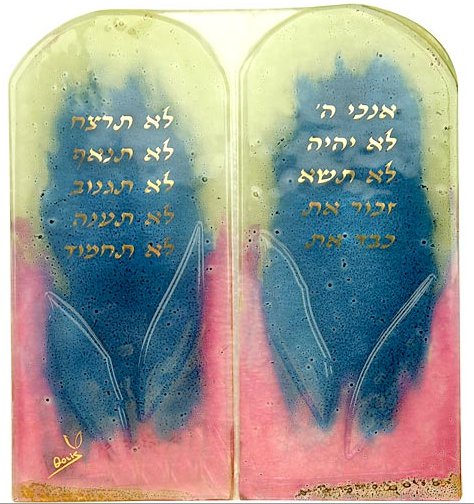
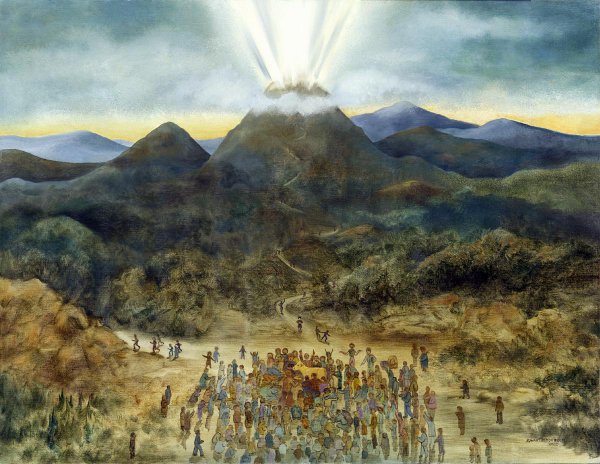
The Ten Commandments (Shemos 22:2-17, Devarim 5:6-21) as spoken by G-d to the Jewish nation at Sinai were engraved upon the Shnei Luchos Habris, Two Tablets of the Covenant. The first Five Commandments belong to the category of laws between “man and his Creator” while the remaining Five Commandments are precepts between “man and man”.

The Ten Commandments engraved upon the tablets of stone and brought down by Moshe from G-d to the Jewish people are accorded a special distinction over all the other 613 precepts.

The Ten Commandments written upon the Two Tablets are comparable to the Kesubah, “marriage contract” drawn up as the essential contractual terms under which a Jewish man and woman enter into Jewish matrimony. Herein the parties pledge their allegiance and the principle obligations to each other thereafter. (The Avos deRabbi Nosson 2:3 fascinatingly explains this is why Moshe smashed the Two Tablets, tearing up the marriage contract, when the Children of Israel were disloyal by worshipping the Golden Calf and had to provide a substitute upon their national repentance).

The Ten Commandments forge this eternal relationship.

The covenant struck between “two” parties, affirming the relationship between G-d as the “Source” and Israel as the “product”, is mirrored in the Ten Commandments inscribed upon the Shnei Luchos HaBris, “Two” Tablets of the “Covenant”. The emphasis is on how this relates to the eternal bris, “covenant” of Torah that unites man and his Creator.

How this bond is intrinsic to the national Jewish psyche is magnificently captured in the Ten Commandments engraved through the thickness of the Tablets – such that the letters and stone were inseparably one.

Herein is included the symmetrical record of the laws pertaining both to man’s relationship to “G-d” and to “man”. The first grouping, those of “man-G-d laws”, relate to G-d the “Source” while the second grouping, those of “interpersonal laws”, relates to man, the “product”.

Side-by-side, the Ten Commandments are the microcosm to all 613 Commandments (See Bamidbar Rabbah 13:15). They embrace the acceptance of G- d’s Sovereignty at Sinai as the essential platform for strict adherence to all the other 613 laws in the Torah, which serve to polish and perfect man to become more G-dly.

Through its symbolism of the “eternal covenant” between man and G-d, of two parties inextricably bound in their mutual relationship…

-Rabbi Osher Chaim Levene
from his commentary on Torah Portion Yitro
“Two Tablets: Prescription for Jewish Observance”
Torah.org

When the Prushim heard that he had shut the mouth of the Tzaddukim, they conferred together. A certain sage among them asked him a question to test him, saying, “Rabbi, which is the greatest mitzvah in the Torah?” Yeshua said to him,

“Love HaShem your God with all of your heart, with all of your soul, and with all of your knowledge.” This is the greatest and first mitzvah. But the second is similar to it: “Love your fellow as yourself.” The entire Torah and the Prophets hang on these two mitzvot.Matthew 22:34-40 (DHE Gospels)

In one of my recent morning meditations, I commented how the Torah functioned as a ketubah or “wedding contract” between God, the groom, and national Israel, the bride. For Christianity, this is a puzzle (unless you wholly substitute “the Church” for “Israel” in this event), since how can God be eternally married to the Jewish people, the inheritors of the Mosaic covenant, and at the same time, have the Christian church be “the bride of Christ? I asked this question on the aforementioned “meditation,” but no one was willing or able to respond to my query.

In studying the Torah portion for last Shabbat, I noticed an interesting parallel between the Rabbinic commentary and the teachings of the Master:

Side-by-side, the Ten Commandments are the microcosm to all 613 Commandments… -Rabbi Levene

The entire Torah and the Prophets hang on these two mitzvot. –Matthew 22:40 (DHE Gospels)

Traditional Judaism, at least as Rabbi Levene describes it, compresses the entire 613 commandments into the ten mitzvot we see on the two tablets that Moses brought down from his personal encounter with God, while Jesus tells us that they are represented, along with all of the writings of the Prophets, by the two greatest commandments, which he cites from Deuteronomy 6:5 and Leviticus 19:18. Neither source is saying that all we need are only the ten commandments or the two greatest commandments, but they are the foundation and representation upon which we formally base our obedience to God, for Jew and Christian.

Am I saying that both Jews and Christians have identical responsibilities to God relative to the Torah? Absolutely not. There have been plenty of debates, both among scholars and on the various religious blogospheres on this topic, and my personal opinion is that we non-Jewish disciples of the Master are not obligated to take upon ourselves the full yoke of Sinai. The Master himself tells us that “my yoke is easy, and my burden is light” (Matthew 11:30) while we find Peter, who walked with the Master, saying, “why are you putting God to the test by placing a yoke on the neck of the disciples that neither our fathers nor we have been able to bear? (Acts 15:10), referring to the non-Jewish disciples (and a comparison of these two verses is a study all its own).

So are we to say that God has two brides, that there are two paths to salvation, and that there are two laws? Is this the veil of separation that I’m rebuilding between Jew and Gentile that was supposedly torn down? (Ephesians 2:14)

Heaven forbid.

Yet, if I am not describing two brides separated by a veil, must I say that the only resolution to this conflict is to adopt a supersessionist viewpoint and to declare that the Church has replaced Judaism in all of the covenant promises, creating a new “spiritual Israel” out of the non-Jewish Christians? Must I say that the Jews become “one new man” with the Church only be renouncing their Judaism in totality and converting mind, body, and soul into Gentile Christians, trading in the Jewish Messiah for the “Greek” Jesus?

No, I’m not saying that, either.

According to Rabbi Dr. Stuart Dauermann in his blog post Inconvenient Truths: The One New Man:

Rather than superseding the Jewish people, the Church from among the nations joins with them as part of the Commonwealth of Israel. Only in this way can the “dividing wall of hostility” – which supersessionism maintains – be removed. Gentiles are no longer categorically outsiders to the community of God’s people, but neither do they supplant Israel. However if Gentiles were required to obey Torah and live as Jews, one would be perpetuating their categorical exclusion as Gentiles. And it is a major component of the good news as proclaimed by Paul that this former categorical exclusion is over and done with through the work of Messiah!

The balance of unity and diversity in the One New Man is further highlighted in Ephesians 3:6, where Paul says “Gentiles are fellow heirs and fellow members of the body, and fellow partakers of the promise in Christ Jesus through the gospel.” The terms “fellow heirs, fellow members, and fellow partakers” require another communal reality with whom the Gentiles are joined, and that other partner is the community of Messianic Jews living in solidarity with wider Israel. It is only as Messianic Jews embrace this calling that their communities become the communal joining point whereby the Church from among the nations is joined to the Commonwealth of Israel.

Admittedly, this is a set of points that most traditional Christians and Jews will find difficult to absorb into their current understanding of how God relates to each of our religious groups. This also gives us something new to think about in terms of how Jews and Christians are supposed to relate to each other. But in giving the Torah at Sinai and the blood of the Son at Calvary, God provided the means by which the Jews could become a special, unique and “peculiar people” to God in a way no other people or nation had ever or has ever become to Him, and has also opened the door for the rest of the world, through the Messianic covenant, to allow the larger body of humanity to draw close to God, alongside the descendants of Jacob.

This isn’t a realization that all Jews and all non-Jews have, even though this open door is available to everyone. Secular Jews are just as much a part of Sinai as their religious brothers, whether they choose to acknowledge that fact or not. Every non-Jewish person on earth is equally invited to stand before the throne of the King by the mercy of God who sent the Messiah to both Jewish and Gentile humanity, if only we will accept that gracious offer. Jesus presents the Jews with the continual and perpetual fulfillment of the prophesy of the Messiah and a life lived in obedience to Torah as God intended from the beginning, and brings close a “grafted in” humanity together with the Jews in one Kingdom as we too respond to the Torah as proceeds from Jerusalem and as it is meant for us to comprehend and obey.

There is one Torah but two intents. Torah is the ketubah of Sinai for the Jews and at the same time, it is a light unto the nations. How Jews are forever “married” to God and we Christians are the “bride” of Messiah, I do not know, but of all the different mitzvot among the 613, many are selected to identify Jews as Jews forever, and other portions are indeed universal truths applied to all, for no man made in the image of the Creator should murder his fellow, or steal from him, or covet his property, or blaspheme the name of God or worship idols of stone or wood or paper.

Jew and Gentile, where do we start? Where do we start establishing a relationship with God and an understanding of each other? We start with studying the mitzvot of the tablets and the commandments of the Messiah. Most of all, we start with this one, new commandment that I believe Moshiach gave to each and every one of us, if only we have ears to hear.

I am giving you a new mitzvah: that you love one another. As I have loved you, so you must love one another. –John 13:34 (DHE Gospels)

and many peoples shall come, and say:
“Come, let us go up to the mountain of the LORD,
to the house of the God of Jacob,
that he may teach us his ways
and that we may walk in his paths.”
For out of Zion shall go the law,
and the word of the LORD from Jerusalem. –Isaiah 2:3

The Torah has gone forth from Zion, carried on the teachings of Jesus and the Apostles, and we among the nations have heard the words of the Messiah and the “Word made flesh”. If we who are Christians can learn those lessons and the Jewish people can turn their hearts toward the Torah given by Moses and Jesus, then we will someday truly love one another in obedience to that Torah, and sit and eat together at the table of Abraham, Isaac, and Jacob (Matthew 8:11) in fellowship and peace.

The Torah of Hashem is perfect, restoring the soul; the testimony of Hashem is trustworthy, making the simple one wise; the orders of Hashem are upright, gladdening the heart; the command of Hashem is clear, enlightening the eyes; the fear of Hashem is pure, enduring forever; the judgments of Hashem are true, altogether righteous. They are more desirable than gold, than even much fine gold; and sweeter than honey, and the drippings from its combs. –Psalm 19:8-11 (Stone Edition Tanakh)

"When you awake in the morning, learn something to inspire you and mediate upon it, then plunge forward full of light with which to illuminate the darkness." -Rabbi Tzvi Freeman