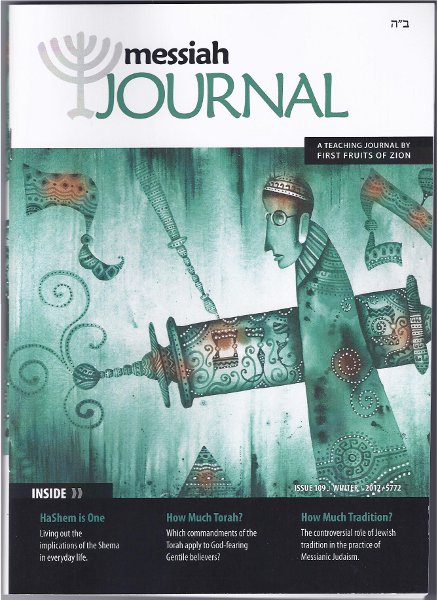
Review of “Halachic Authority in the Life of the Messianic Community”

This leads me to conclude that the Jewish religion has preserved the Jewish people in their long wanderings in the desert of the Gentiles. Some will say that it is not Judaism which has preserved the Jewish people, but God’s grace. They should rest assured. God has indeed preserved the Jewish people, and he has done so by securing them in this “ark” that is called the Jewish religion. The Jewish religion therefore constitutes a revelation of God’s grace towards the Jewish people. This religion, which arose from the smoky ruins of the Temple and which people so love to hate, is the primary instrument through which God has preserved the Jewish people. Because of it, there are Jews in the world today.

-Tsvi Sadan
“Halachic Authority in the Life of the Messianic Community”
Messiah Journal
Issue 109/Winter 2012, pp 16-17

When I saw the title, I thought the topic would be more related to the specific differences between halacha in traditional, Orthodox Judaism and a halacha that could be applied to Jewish, and perhaps in some sense, to non-Jewish disciples of the Master in a Messianic framework. However, Sadan’s excellent article, which was originally delivered as a lecture in Israel on September 5, 2008, addresses something else almost entirely: the religion of the Jews who follow the Messiah.

Let me explain.

There is an impression that the Jews, and especially the Jews who were born, raised, and educated within a traditional religious and cultural Jewish framework, who are part of Messianic Judaism and who are disciples of Yeshua (Jesus), “the Maggid of Nataret,” belong to a different sort of “Judaism” than their brothers in what we refer to as “Rabbinic Judaism.” In fact, many Jews and non-Jews in other branches of the “Messianic” movement, as well as those attached to Hebrew Roots groups, tend to view Rabbinic Judaism, what we consider the Reform, Conservative, and especially Orthodox branches of Judaism, to be separate, distinct, and “lesser” forms of “true” Judaism. They seem to believe that the only fully realized Judaism is represented by a Messianic Judaism that follows Jesus while removing any aspect of halacha and tradition that exceeds the “written Torah.” This form of Messianic Judaism, actually rejects Rabbinic Judaism in the vast majority of its content (except for using the model of the modern synagogue service and the use of tallitot, siddurim, and so forth) especially and including Mishnah, Talmud, and Gemara: the so called leaven of the Pharisees and the Sadducees” (see Matthew 16:6 and Mark 8:15).

According to Tsvi Sadan, they are dead wrong. Forgive me. What follows is necessarily lengthy.

To understand the meaning of this “leaven,” which scares the daylights out of some people here, I will take just one verse from an abundance of new Testament verses quoted in those inflammatory letters. In Matthew 16 (the word “hypocrites” does not appear in the standard Greek text used today), Yeshua twice calls his disciples to beware of the “leaven of the Pharisees and the Sadducees” (vv. 6, 11). These two admonitions follow the miracles and wonders which he had just performed in the sight of thousands of people. When the Pharisees and the Sadducees approach him to test him (v. 1), Yeshua correctly sees this as impudence of the highest order, and responds accordingly: “[Hypocrites,] do you know how to discern the appearance of the sky but cannot discern the sign of the times?” (v. 3). This means that Yeshua is labeling his opponents hypocrites because of their pretense to see one more sign while in fact all they wanted to do is accuse him.

-Sadan, pg 15

He goes on to say point blank that the “leaven of the Pharisees and the Sadducees” is hypocrisy, not the specifics of Second Temple era halacha and tradition. Sadan confirms that there is no dissonance between Messianic Judaism and Rabbinic Judaism or for that matter, the religious concept of Judaism in any form and Rabbinic Judaism. More plainly put, Rabbinic Judaism is the only Judaism, according to Sadan.

So where does that leave the non-Jews who, in some manner or fashion, are attached to the Messianic and Hebrew Roots worlds? Moreover, where does that leave Christians in relation to their Jewish brothers who also honor Yeshua as Messiah and Lord?

Finally, let me make one point with respect to the Christians living in our midst, because probably there is someone who will distort things and claim that the position I have proposed here leads to hated of the Gentiles. Let me say here that I warmly welcome every Christian – on the condition that he or she does not attempt to impose his or her religion on me. I regard very seriously the behavior of some Christians living in Israel who have the gall to malign the Jews living in the state of Israel merely because they refuse to be evangelicals, Lutherans, or Baptists. God-fearers from all nations are welcome to participate in the Jewish service of God as long as they do not speak against Israel, Torah, and Judaism. I do not agree with the attitude that says that in order to achieve unity with our Gentile brethren, we should remain Jews but reject Judaism. I consider this assertion as nothing less than complete and utter foolishness.

-Sadan pp. 24-25

Laying TefillinSadan continues to strongly make his point for another page and a half, and most assuredly all of it, as I imagine these brief quotes have done, will certainly bring forth the ire of many non-Jews and some Jews in the aforementioned “Messianic” and Hebrew Roots movements, who indeed believe that the Jews who worship the Messiah must abandon Judaism in order to be “completed Jews” (as if a Jew who worships in the manner of his fathers is somehow incomplete).

Sadan’s article does bring up one very interesting point: do Messianic Jews and Gentile Christians belong to two separate and unrelated religions? I have no idea what Sadan thinks, but as far as I can gather from his article, the response seems to be “yes and no.”

It’s “yes” in the sense that everything that Judaism is, including the 613 commandments of the Torah and the entire body of Talmudic judgments, rulings, and traditions, apply only to a Jewish population. Judaism’s ethnic and cultural aspects are completely intertwined with Judaism as a “religion,” so you cannot remove the traditions, without removing what it is that defines a Jew. I’ve said all this before and Sadan’s article does nothing to change my mind.

It’s “no” in the sense that, in spite of the differences in our covenant obligations to God, we share One God and One Messiah, and we are all His creations. We are different branches, but grafted into the same tree. We are Jew and Gentile, but we have equal access to God. We are co-citizens in the Kingdom of Heaven and we all inherit a life in the world to come. And we will all sit at the same table at the feast of Abraham, Isaac, and Jacob (Matthew 8:11).

I do want to take exception to one statement in the article where it appears Sadan refers to we Christians as “God-fearers”.

God-fearers from all nations are welcome to participate in the Jewish service of God as long as they do not speak against Israel, Torah, and Judaism.

I don’t believe that Christians who have accepted the Messianic covenant upon themselves (as it applies to the nations) are equivalent to the ancient God-fearers or the modern Noahides. God-fearers were non-Jews who came out of pagan worship to recognize the God of Abraham, Isaac, and Jacob as the One, true, and unique God of the Universe. They quietly worshiped among the Jews in their synagogues and I imagine the God-fearers humbly populating the Court of the Gentiles in Herod’s Temple, listening with awe to the songs of the Priests, and urgently desiring to bring their own sacrifices before the King.

But they had no covenant relationship with God at all. There was adoration and worship, but no access (unless they chose to convert to Judaism). Jesus, the Messiah, appeared in the world and changed all that. He allowed the nations to come close to God, to be adopted, and to be called sons and daughters of the Most High, through the blood of “the Lamb of God who takes away the sin of the world,” (John 1:29). I certainly hope that Sadan hasn’t chosen to “demote” those of us who come along side him as co-members of the Messianic covenant.

If you’re not familiar with some of the related concepts Mark Kinzer describes in his book Postmissionary Messianic Judaism: Redefining Christian Engagement with the Jewish People, you may find Sadan’s article shocking and even completely alien to how you’ve imagined Jews being attached to Jesus as their own Messiah. If you are familiar with Kinzer’s book, some of you may still be outraged at what Sadan writes and vehemently disagree with his propositions and his ardent passion in defending his own Judaism.

This issue of Messiah Journal couldn’t have come at a better time for me. Last night, I was having a conversation with Judah Gabriel Himango on his Facebook page about the Shabbat and what the coming of Jesus changed in the Jewish and non-Jewish worlds. Judah suggested that because of Jesus, Jews should abandon the traditional Jewish synagogue model of worship and adopt a Shabbat service more along the lines of what’s recorded in 1 Corinthians 14:26-40. Here are some of his comments:

Messiah’s arrival was of such great impact, such that the way we live our lives and the way our congregations are modeled must be in light of his coming. Lives and religious services modeled on the understanding that Messiah hasn’t come would be to live as if he never arrived in the first place. The Messianic movement, including the Messianic Judaism subset, should not merely be emulators of Judaism.

How about the stuff in Corinthians 14 for starters? Shouldn’t those things be in Messianic services?

And how about the Psalms, where music and instruments are used to praise the Lord? Shouldn’t those things be in services, both Jewish and Messianic?

I believe people — Jews and gentiles — should change their lives around to what Messiah commanded and what his disciples taught in the Scriptures.

If our lives and our services look exactly like those before Messiah, it’s as if his arrival never happened.

Needless to say, I disagreed.
The RabbiLet me make clear that I like Judah and I’m not angry or upset with him. I’m not picking on him or singling Judah out, but rather, I’m using his words to illustrate what many other disciples of Jesus believe and want to see actually occur. I must disagree with his desire to replace Jewish worship with how he interprets one small portion of the New Testament, as well as with the general suggestion among Christians, that Messianic Jews should remain (somehow) Jews but flush Judaism down the nearest toilet, tossing Rabbis and Talmud under a speeding bus. While I have questions about how Sadan sees Christians vs. God-fearers, I agree with him in most if not all of the rest of his points. I can’t see the Gentiles in the church and in “Messianism” and Hebrew Roots as having any right whatsoever to re-define Judaism in their own image. Of course, they say that it’s not they who are doing the re-defining, but Jesus instead, but I disagree. We’ve seen that there are an abundant number of paths one can take to interpret the New Testament, including doing away with the Law (and the Jews) and replacing it with the Grace of Christ (and the Gentile Christians), and I disagree with that as well (see my article in MJ 109 “Origins of Supersessionism in the Church” for more).

In previous blog posts and blog comments, I’ve tried to make arguments that present many of the same ideas as expressed in Tsvi Sadan’s “Halachic Authority in the Life of the Messianic Community,” but I lack his insights and perspectives as a Jew and frankly, his wonderful talent in writing. Whether you end up agreeing with him or not, I believe that reading this illuminating work will open your eyes to a new and different way of seeing the Jew in relationship to his Messiah within the time-honored and God-granted context of Judaism.

The Lord’s Sabbath

ShabbatQuestion: According to Jewish Law and tradition, is it acceptable, discouraged or totally unacceptable for a Gentile to keep the Sabbath according to the regulations spelled out in the Torah and the Talmud and expounded upon by the Rabbis?

Answer: A non Jew is not allowed to keep Shabbos. Those that are in the process of converting make sure to do at least one thing on Shabbos that would normally not be allowed. For example they might carry something in their pocket.

The quotes above are part of a discussion group thread at judaism.stackexchange.com (and thanks to Judah Himango of the Kineti L’Tziyon blogspot for posting the link on his Facebook page). As you can see if you follow the conversation, it is generally discouraged for a non-Jew, Christian or otherwise, to attempt to observe the Shabbat in the same manner (if at all) as a Jew. The observations are apparently from the perspective of Orthodox Judaism, so Conservative and Reform Jews may have a somewhat more lenient viewpoint, nevertheless, the Shabbat is generally reserved for the Jewish people.

This doesn’t really upset most Christians since the Saturday Sabbath, as with most other aspects of “the Law,” was deemed done away with. While Christians generally worship on Sunday, it’s not really considered a “Sabbath” in the church, based on Pauls’ statement in Romans 14:5-6:

One person considers one day more sacred than another; another considers every day alike. Each of them should be fully convinced in their own mind. Whoever regards one day as special does so to the Lord.

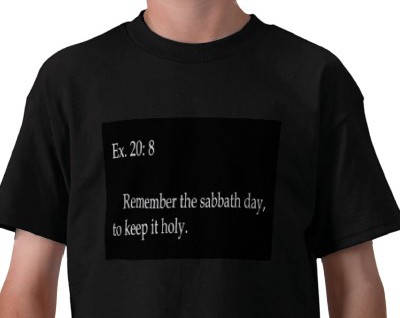
This effectively obliterates the fourth commandment to “Remember the Sabbath day by keeping it holy” for Ten Commandments believing Christians, but apparently, that can’t be helped. The result is that the vast majority of both Christians and Jews believe that Shabbat observance cannot and should not be applied to Gentiles and that is that.

Almost.

There is actually a lot of conversation going on in various circles about Gentles and the Shabbat, even as we’ve seen at judaism.stackexchange.com. In actuality, it doesn’t seem totally forbidden for a non-Jew to keep the Shabbat, they just can’t keep it in a way that is consistent with religious Judaism. AskNoah.org, a site created within an Orthdox Jewish context and dedicated to serving Noahides (righteous Gentiles), has this to say.

Question: I’ve been told that a Noahide must “mark” the Sabbath in some way. Could you give me examples of ways to mark Sabbath in the manner of a Noahide?

Answer: A Noahide is allowed to mark the seventh-day Sabbath in some types of ways. But there must not be a belief or conviction that he or she has – or is allowed to take on as a Gentile – any religious obligation to rest from all productive activity on the Seventh Day, or on any other day. (Although indeed, there must be an intellectual recognition that G-d assigns a special quality to the Seventh Day, since that is part of the Torah of Truth).

The answer continues by providing a number of suggestions for the Noahide as far as “marking” the Shabbat, but such marking must be done without making a vow of any kind in relation with the Shabbat, and with the understanding that “marking” the Shabbat is totally voluntary.

The world of Messianic Judaism, as seen from the point of view of Jews who accept discipleship under Jesus (Yeshua) as the Jewish Messiah, take a similar point of view. We can see one such illustration in a recent comment Derek Leman made in response to something I said on one of his blog posts at Messianic Jewish Musings:

So, I think a Divine Invitation exists for non-Jews. I don’t think (and the apostles didn’t think) it is a Divine Obligation.

My advice for non-Jews keeping Shabbat: learn the traditional prayers and songs. Make some modifications in parts where the wording is about God’s special relationship with Israel. Someone ought to make a Shabbat Seder (the Friday night prayers) for non-Jews which respects the wording of special relationship between God and Israel and pictures non-Jews coming into the sign between God and Israel as co-participants (not replacements, see Exod 31:13).

Shabbat candlesI’ve often said that I believe non-Jews who wish to honor God as sovereign Creator may do so based on Genesis 2:3, but AskNoah.org has a response for that as well:

Although it says in Genesis 2:1-3 that G-d designated the Seventh Day as holy and sanctified, don’t forget the basic principle that G-d did not limit Torah to always be a *chronological* account of events. In fact, G-d first dictated the book of Genesis to Moses shortly after the Israelites arrived at Mount Sinai. The first time there was any commandment about a special observance of a “Sabbath” was after the Israelites passed through the sea on dry land. When they ran out of the matzah they took out of Egypt, G-d provided them with mannah as food from Heaven. But no mannah fell on the Seventh Day. G-d instead provided a miraculous double portion on Friday afternoon, and He commanded the Israelites to remain in their camp on the Seventh Day. Moses explained to them that they were, from that time on, commanded to observe the Seventh Day as a day of rest and a holy Sabbath (Exodus 16:23). Thus, at the first mention of the Seventh Day in the text of Genesis, G-d told Moses to insert the information that He had blessed the Seventh Day (referring to the double portion of mannah that fell on Friday afternoon for the Israelites), and He made it holy (when He prohibited the Israelites from leaving their camp on that day).

It is true that in Judaism, the chronology of the writing and the order of events of and in the Torah aren’t considered to be strictly literal, so the authority answering the question about Genesis 2:1-3 may have a point. On the other hand, if we assume that there is a chronology to God’s creating the earth and that He actually “blessed the seventh day and made it holy,” relatively “soon” after He created the globe upon which we live, then the holiness of the Shabbat could precede the Sinai event by many hundreds or even thousands of years (or more).

Then we have another scripture which provides some illumination.

“And the foreigners who join themselves to the LORD,
to minister to him, to love the name of the LORD,
and to be his servants,
everyone who keeps the Sabbath and does not profane it,
and holds fast my covenant—
these I will bring to my holy mountain,
and make them joyful in my house of prayer;
their burnt offerings and their sacrifices
will be accepted on my altar;
for my house shall be called a house of prayer
for all peoples.”
The Lord GOD,
who gathers the outcasts of Israel, declares,
“I will gather yet others to him
besides those already gathered.” –Isaiah 56:6-8 (ESV)

This is very difficult to get around. While not a commandment, it certainly suggests that “foreigners” (non-Hebrews) not only may observe the Shabbat, but will derive some direct benefit for doing so, namely being brought to God’s “holy mountain”, which is probably the Holy Temple in Jerusalem, and having our offerings accepted by God in the Temple (and AskNoah.org does state that Gentiles will be able to worship at the Third Temple). Even the Master quotes the prophet Isaiah when he cries out that “‘My house will be called a house of prayer,’ but you are making it ‘a den of robbers” (Matthew 21:13).

I suppose Christians could say that the words of the prophet Isaiah were annulled when the Law was “nailed to the cross with Jesus”, but that hardly explains why Christ would quote prophetic words that would soon lose their power. Such a view also suggests that God’s Word is not eternal, so we have another puzzle when considering a traditionally Christian interpretation of scripture.

But if “Jewish” Shabbat observance is considered both by Christianity and by Judaism to be a dead issue for the Gentiles, why should the few of us who are not Jewish but who are drawn to the Shabbat care? Well, because we’re drawn and for whatever reason, God has written upon our hearts a desire to hold the seventh day as sacred.

As I’ve mentioned elsewhere, I don’t think Judaism has much to worry about as far as Christian or “Messianic Gentile” Shabbat observance goes. I’ve never met a person who was not Jewish who kept the Shabbat with anywhere near the level of sanctity and detail as an Orthodox Jew, so it can be truly said that we “mark” the Shabbat without ever actually “keeping it holy,” at least to the measure of accepted Jewish halachah.

But what does God think of the disciples of Jesus keeping the Shabbat? Even if we are not commanded, are we allowed and is our rest pleasing to Him? Or was that last question moot?

Then he said to them, “The Sabbath was made for man, not man for the Sabbath. So the Son of Man is Lord even of the Sabbath.” –Mark 2:27-28

If the Savior and Messiah is Lord of the Shabbat, what does that mean for we non-Jews who are his disciples?

Messiah Journal: Excerpt from “Origins of Supersessionism in the Church”

Yeshua not only defined himself as the gateway to salvation, but commanded his Jewish disciples to do something that had never been done before. Yeshua commanded his Jewish disciples to make non-Jewish people disciples in a Jewish sect that followed the Messiah and worshiped the God of Israel. Yeshua identifies his Jewish disciple Peter as the rock upon which he will build the Messianic community (Matthew 16:18). Acts 4 shows us that thousands of Jews came to faith in the Messiah well before the time when Paul began to actively seek non-Jewish disciples. We also see in Acts 15 that the Jewish Jerusalem council exercised authority over the Gentile assembly of the Messiah. With the foundation of the early Messianic community being so thoroughly Jewish, how did a concept like supersessionism even come into being? Actually, the seeds of this rather ugly plant began to sprout early.

Excerpt from the article
“Origins of Supersessionism in the Church”
by James Pyles
Messiah Journal
Issue 109/Winter 2012

I just received my advance copy of the latest edition of Messiah Journal (MJ) and of course, as it contains my first article published in religious literature, I’m more than thrilled. I showed my wife and she said that she will have to read it, which is even more intriguing (as surprising as it may sound, she doesn’t often read my material). I hate to admit this, but like many authors, I really enjoy seeing my work in print. I suppose it is the same feeling a painter has when he or she sees their work on display in an art gallery.

But I shouldn’t forget everything else this issue of MJ has to offer. I haven’t had the opportunity to read it yet (so I can’t review its contents), but I’ve looked through this issue and there are definitely some submissions I’m anxious to dig into.

There’s an article written by Tsvi Sadan called “Halachic Authority in the Life of the Messianic Community”. Apparently, it was delivered as a lecture to Messianic leaders in Israel in September of 2008 as the “final chord of a debate between those Messianic Jews who teach to live according to Jewish tradition and those who view this tradition as ‘the leaven of the Pharisees and Sadducees.'” This discussion has taken place in the Messianic blogosphere fairly recently, such as in Judah Himango’s blog post Kosher Jell-O, and whether Messiah’s disciples need our own ruling body, as well as on my own blog in the write up Tradition! (and as always, some of the most interesting parts are in the comments sections).

I must admit, I will probably dive into Sadan’s article first, but I also want to read Russ Resnik’s “Shema: Living the Great Commmandment” (Part 1). I’m also very interested in Toby Janicki’s article “The Gentile Believer’s Obligation to the Torah of Moses”, which is also a topic of great interest among non-Jews who are attracted to Jewish religious lifestyle and worship. I believe MJ has had similar articles in the past and want to find out if this is just a reworking of material with which I’m already familiar or something entirely new. I know I’ve been challenged on this topic by comments made on my own blog very recently, both in Defining Judaism: A Simple Commentary and The Focus and the Lens, so I’m hoping for some “re-enforcement” to augment my own knowledge in this area.

For tomorrow’s “morning meditation,” I’m posting a blog on Gentiles and the Shabbat, and Aaron Eby has an article in the current issue of MJ called “Fire by Night: Lighting the Shabbat Candles” which (you should pardon the pun) should prove illuminating. That’s not all of the contents of issue 109 of MJ but those are the highlights. Of course, if you find all of that tantalizing, don’t forget my own article on the origins of supersessionism in the church, how the seeds were first planted, who the major players were, and how the history points to modern times.

If you don’t already regularly receive issues of Messiah Journal, go to the First Fruits of Zion (FFOZ) website and order issue 109 today. I’m really looking forward to reading it myself.

The Embarrassing Murder

On today’s amud we find a decree was instituted to avoid publicly embarrassing a fellow Jew.

Many are unaware that Rav Chaim Kaplan, zt”l, was the son-in-law of the famous mashgiach, Rav Yeruchem Levovitz, zt”l. As can well be imagined, Rav Kaplan was a baal mussar in the full sense of the word.

One time, Rav Kaplan’s student, Rav Waxman, saw him crying his eyes out, obviously absolutely devastated. This was a very shocking sight since it was a regular day in the beis medrash and the young man had not heard that any tragedy had occurred. The student approached Rav Kaplan and asked him what was bothering him, but the latter was so heartbroken that it was a while before he could answer. When the student inquired a second time, the rav tearfully asked him to bring a gemara Bava Metzia.

When the young man brought it from the shelf, the rav opened to the sugya in Hazahav that discusses the seriousness of embarrassing a fellow Jew in public. He concluded with the statement on daf 59 that one should throw himself into fiery furnace instead of publicly embarrassing another, which we learn from Tamar.

“We see from here that embarrassing another is compared to murder,” Rav Kaplan said sadly. “Imagine you were here in this beis midrash in the middle of seder when one young man pulled out a gun in front of everyone and shot his fellow student in the heart. Surely, anyone with a drop of human feeling would be unable to hold back from crying bitter tears after witnessing such a tragedy! After I witness one young man approach a fellow student and publicly shame him, is it any wonder that I cry? It is a wonder how a person could fail to cry!?”

Mishna Berura Yomi Digest
Stories to Share
“A Tragedy in the Beis Medrash”
Siman 139, Seif 1-3

I periodically receive a little criticism for suggesting that the Talmud and various Rabbinic commentaries are appropriate lenses by which to view the teachings of Christ and my faith in Jesus. For example, we see above that for one Jew to embarrass another in public is compared with the act of murder. In this tale’s rather dramatic telling, Rav Kaplan is seen to be crying uncontrollably, as if he had witnessed a horrible act of violence, after seeing one student in the beis midrash publicly shame another. Whether this event actually took place or not, can we really say that embarrassing someone in public is the same as pulling out a gun and shooting them? Can we find anything that Jesus taught that can even approach this?

“If your brother sins against you, go and tell him his fault, between you and him alone. If he listens to you, you have gained your brother. But if he does not listen, take one or two others along with you, that every charge may be established by the evidence of two or three witnesses. If he refuses to listen to them, tell it to the congregation. And if he refuses to listen even to the congregation, let him be to you as a pagan and a tax collector. –Matthew 18:15-17

You’ve probably heard this before, but the reason you have to go through such a lengthy set of steps in confronting the brother who has sinned against you, is to avoid embarrassing him. You approach him alone first, so the nature of his sin and the confrontation is just between the two of you. If he repents, then no one else is the wiser and no one has to be embarrassed. If that’s not effective, then you next approach your brother with just two or three witnesses. Again, the information is contained and only a few people have to become aware of the incident. Only if the sinner doesn’t repent are you compelled to bring the matter before the entire congregation, thus causing your brother embarrassment which, at this point, is probably unavoidable.

While Jesus doesn’t say embarrassing your fellow is like killing him, he obviously felt that embarrassing someone was a serious matter and should not be taken lightly. Jesus also said this:

“You have heard that it was said, ‘You shall not commit adultery.’ But I say to you that everyone who looks at a woman with lustful intent has already committed adultery with her in his heart. –Matthew 5:27-29

Now is looking at a woman and having lustful thoughts about her really the exact same thing as actually having sexual relations with her? After all, the former is not a physical act, it’s just a thought and perhaps a feeling. Maybe you fantasize about what it would be like to have “relations”, but nothing actually happens. The latter requires that you arrange to enter into a relationship with her, at least enough of one to be able to get together with her alone and have actual, physical sex.

And yet Jesus said they were the same. So can’t publicly embarrassing someone be the same as actually killing the person, in the eyes of God?

I don’t have God’s point of view, so I can’t say that He equates embarrassment to death (although many human beings have felt so embarrassed that they wanted to crawl under a rock and die, euphemistically speaking), but if we take Christ’s teaching to heart and reflect back upon the tale of Rav Kaplan, perhaps we should act as if it’s that important a matter.

Could it hurt?

The Focus and the Lens

The Sichos HaRan, zt”l, explains how fortunate we are to have received the Torah. “Non-Jews who did not receive the Torah have no idea how to act. A non-Jew who wants to discover the meaning of life must search for the truth and has very little chance of finding it. Jews are very fortunate, since God gave us the Torah which reveals exactly how we should act in any given situation. We can focus all of our energies on fulfilling the Torah instead of squandering them in an attempt to determine what to do.”

Daf Yomi Digest
Stories Off the Daf
“God’s Charity”
Arachin 8

I have a difficult time understanding how the Sichos HaRan, zt”l can make such a statement and yet still call God charitable. After all, is God not the God of the Jew and the non-Jew alike? He makes it sound as if God left the Gentile people of the nations “hanging out to dry,” so to speak. In fact, even from a traditional Jewish point of view, it’s not that way at all.

Most religious Jews believe that God gave “the rest of us” the Seven Noahide Commandments which guide us along a path of Godly living. Of course, when you compare a mere seven laws to the 613 commandments that Jews believe comprise the Torah, it’s easy to believe that the Gentiles got the short end of the stick. After all, as the “story off the daf” points out, the level of detail in the Torah commandments, describe for the Jew “exactly how we should act in any given situation.” That’s not literally true of the written portion of the Torah, but once you factor in the Mishnah, Talmud, and Gemara, an astounding and even overwhelming amount of information is provided about every conceivable situation in which a Jew may find himself.

Even if you believe that the seven Noahide laws can be expanded out to 80 or 90 more detailed commentaries, it still seems like we don’t have nearly the same amount of Heavenly direction given to us as the Jewish people enjoy. If you’re an atheist, you probably couldn’t care less, and enjoy the type of freedom a secular world view provides. If you’re a traditional Christian, this only confirms what you’ve been taught about the freedom that the grace of Jesus Christ offers, and how the “chains” of the Law can no longer hold you (not that they ever applied to you in the first place).

Yet, as I have been reminded recently, for a number of Christians, the “grace of Christ” doesn’t seem to be enough. There’s a sort of “emptiness” some people feel in the church, as if a man starving for meat and potatoes is given only a can of soda pop for lunch. Lots of “fizz” but no substance. For these Christians, the substance seems to be found in Judaism and among some of these folks, Judaism becomes the focus, leaving God and faith in the Messiah in the dust.

I’m a Christian who, as you know if you’ve been following this blog for very long, chooses to view my faith in Christ through a Jewish lens (if such a thing is possible). However, it took me years to be able to distinguish the lens from the focus of the lens. The lens is the means by which I look at the Messiah and gaze at the image of God. The focus is the Messiah who leads me on the path of righteousness to the God of Abraham, Isaac, and Jacob. It’s important not to confuse the two.

I sometimes think even people in the traditional church suffer from this confusion. The theology, the music, the church programs, and even grace, all seem to substitute for the substance of God. Maybe that’s why people leave Christianity and either apostate completely or seek some aspect of Judaism onto which they can attach. However, since this type of confusion can strike at the Christian either in the church or in the synagogue, it’s not the religion that’s the problem, it’s the people. More specifically, it’s how people understand what they have faith in. Do you have faith in Christianity or in God? Do you have faith in Judaism or in God? Who or what do you worship and why? Do you even know if you are worshiping a thing rather than the Creator of the universe?

I’ve seen non-Jews in “Messianic” or Hebrew Roots groups who became totally enamoured with wearing a tallit gadol and kippah, praying with a siddur, and learning Hebrew. Nothing is necessarily wrong with using holy objects in the practice of your faith, but there is something terribly wrong if you wake up one morning and realize that its the objects you’re really worshiping. It’s even worse if you are worshiping the objects and never actually realize it.

There are non-Jews including some Christians, who convert to Judaism for various reasons and I am not here to question those decisions. However, I am concerned with those Christians who, in seeking the Jewish Jesus in the synagogue, lose sight of him completely, and convert because they have started worshiping Jewishness.

Any Christian who is worshiping and studying in a Jewish venue needs to periodically take one giant step backward and examine what they are doing and why. If you know your eyes need to be on the Messiah at all times but his “image” is becoming increasingly fuzzy, you may have allowed something to get in between you and him. If your lens has become your focus, stop everything, take a break, and get some fresh air. A life of study contains many details and a great deal of information, but at its core, a life of holiness is not complicated. It’s a simple as praying and can easily begin with the words, “Our Father Who is in Heaven…”

Never forget who you are and who He is to you.

Defining Judaism: A Simple Commentary

Talmud StudyWe find on today’s amud that one who is called up to the Torah has to have heard at least three verses—two if three is impractical—for his aliyah to count.

Someone once presented Rav Moshe Feinstein with a very common concern. He asked, “What if someone failed to hear some words of the Torah reading? Did he discharge his obligation if he missed a few? Many great scholars and tzaddikim were very careful and would make up any word missed by joining another minyan during their reading. But perhaps such stories are not because of any halachic obligation. Maybe they are merely a stringency?”

Rav Moshe ruled decisively, “It is obvious that one should not skip even one word of the reading if it is at all possible. Post facto, if one skipped and it was a day where we lain three verses, on the surface it would appear as though one does discharge his obligation. It is not permitted to read less than three verses. Since the person in question did not hear the minimum, he did not discharge his obligation. This is no different than the case of one who was called up to the Torah and they did not lain three verses—he also did not discharge his obligation if he did not hear the minimum number of verses.

Rav Moshe concluded, “If the reading contains more than three verses and he heard three he discharges his obligation with this aliyah, and if he heard another two aliyos he has fulfilled his obligation. Of course, on Shabbos and Yom Tov one has the problem that if he missed a part of the reading he will not merit to finish the public reading of the Torah for that year. However, in such a case one often has no recourse since he cannot have them repeat the reading only for him!”

Mishna Berura Yomi Digest
Stories to Share
“The Minimum”
Siman 137, Seif 5-6

Recently Dan Benzvi on his blog Fellow Heirs challenged me to discuss the relationship between the Torah, Oral Law, and the Talmud in his blog post The oral Torah. Authority of God or man. I’m not sure we “solved” anything, but at least we got the opportunity to (again) air our different perspectives on the matter.

Dan really does bring up some good questions, though. Can we believe that everything in the Mishnah and all of the rulings in the Talmud are indeed directly tied to the oral Laws God gave Moses at Sinai (assuming you believe that event actually took place) and that a Jew must obey all of the relevant Rabbinic rulings?

Take a look at the example I posted above from Mishna Berura Yomi Digest. There’s nothing in our written Bible that lends itself to describing the traditional Jewish Torah readings in anywhere near this level of detail. Can we believe that God gave these specific details to Moses? If so, why is there a question here? If not, then where did these questions and answers come from and why are they considered binding in Judaism?

If you’re a (non-Jewish) Christian, this entire discussion is moot. People who aren’t Jewish aren’t considered bound by any of the Rabbinic judgments under any circumstances, so we don’t have to give all this a second thought. But what about if you’re Jewish, and especially if you’re a believer (i.e. a “Christian” or a “Messianic Jew”)? If it’s not in the written Bible we have with us today but rather, in the extended Jewish documented wisdom, does it really matter?

Indeed, the Mishnah contains not a hint about what its authors conceive their work to be. Is it a law code? Is it a schoolbook? Since it makes statements describing what people should and should not do, or rather, do and do not do, we might suppose it is a law code. Since, as we shall see in a moment, it covers topics of both practical and theoretical interest, we might suppose it is a schoolbook. But the Mishnah never expresses a hint about the authors’ intent. The reason is that the authors do what they must to efface all traces not only of individuality but also of their own participation in the formation of the document. So it is not only a letter from utopia to whom it may concern. It also is a letter written by no one person – nor by a committee, either. Nor should we fail to notice, even at the outset, that while the Mishnah clearly addresses Israel, the Jewish people, it is remarkably indifferent to the Hebrew Scriptures.

The Mishnah makes no effort at imitating the Hebrew of the Hebrew Bible, as do the writers of the Dead Sea Scrolls. The Mishnah does not attribute its sayings to biblical heroes, prophets or holymen, as do the writings of the pseudepigraphs of the Hebrew Scriptures. The Mishnah does not claim to emerge from a fresh encounter with God through revelation, as is not uncommon in Israelite writings of the preceding four hundred years; the Holy Spirit is not alleged to speak here. So all the devices by which other Israelite writers gain credence for their messages are ignored. Perhaps the authority of the Mishnah was self-evident to its authors. But, self-evident or not, the authors in no way take the trouble to explain their document’s audience why people should conform to the descriptive statements contained in their holy book.

from the introduction to
The Mishnah: A New Translation
by Jacob Neusner

Talmud Study by LamplightThat description of the Mishnah is fairly similar to others I’ve read from various sources such as The Cambridge Companion to the Talmud and Rabbinic Literature, edited by Charlotte Fonrobert and Martin Jaffee. But given all of that, what can we say about Mishnah, Talmud, and Gemara?

I’m not particularly qualified to respond, not being a scholar in Jewish studies or anything related, but from what I gather, it’s extremely important to Judaism that these texts, opinions, commentaries, and judgments do exist. Here’s why.

After the destruction of the Second Temple in 70 C.E. and the subsequent eviction of most of the Jews from the Holy Land, what existed to define Judaism? Prior to this point, it was always the Holy Temple in Jerusalem. Even in the times between the Temples of Solomon and Herod, it was the ideal of the Temple and the Torah that, more than anything else, defined Jewish identity in exile. The longing for the Jewish people was always the return to Israel, both as nation and paradigm, and to worship again “as in days of old and as in previous years” (Malachi 3:4).

With the Second Temple reduced to scorched and shattered rubble, and the vast majority of the Jewish people exiled to the diaspora, what was to prevent the eventual assimilation of the Jews into the nations surrounding them and outnumbering them?

Judaism was always about being distinctive, as the scripture says, “and you shall be to me a kingdom of priests and a holy nation” (Exodus 19:8 [ESV]). All of the laws we see given to the Israelites in the Torah were designed to impact every area of their lives, serving as national constitution, penal and civil law, business ethics, social mores, and even personal and behavioral guides. In virtually every way, the nation of Israel was to stand out and stand apart from the nations of the world, primarily to lead its inhabitants to a holy life with God, but also to be a “light to the nations” (Isaiah 49:6, Isaiah 51:4), leading the world to God by example.

But a huge amount of the Torah laws apply only if you have a Temple, a functional priesthood, a system of courts including the Sanhedrin, and live within the geographic boundaries of the Land God gave in perpetuity to the Jewish people.

The Romans took all of that away, and then subsequent conquerors kept the Land and national self-rule from the Jews for the next 2,000 years.

Why didn’t the Jewish people assimilate and disappear into the pages of history? Many, many other people groups and religious traditions from that time have utterly vanished from our view. Why did the Jews, though extremely small in number, remain a people vitally alive with purpose and function; with faith and identity?

What do you think of when you think of a religious Jew?

The stereotypes some people have are guys in black hats and coats, wearing some sort of string off of their waistline, having large, bushy beards, and bowing over and over again when they pray. Some people think of “Jewish prayer shawls and prayer books” while others think of events such as Passover or Chanukah. Whatever religious stereotypes seem to identify the Jews, the activities are almost always different than any other people group in the world. Jews worship in different places than anyone else, pray differently, pray in a different language than anyone else, wear different clothes (at least sometimes), have different holidays, eat differently, sing differently and…well, you get the idea.

I can hardly say that the Mishnah and Talmud are direct representations of the “Oral Law” that goes back over 3,500 years to Moses and God on Sinai, especially given the description (or lack thereof) of the origins of the Mishnah. What I can say, is that what the Jews have as “people of the book”, are a set of laws and rulings that set them apart from any other nation and group on earth, and that has defined them and kept them and preserved them when everyone else was doing their best to completely annihilate the Jewish people.

No, I’m not denying God’s involvement in the preservation of Judaism and in fact, I’m counting on it. As God went down into Egypt with Jacob (Genesis 46:3-4), so too did He go into the death camps with the Jews during the Holocaust. So too did he go with the Jews into the newly created state of Israel and He is there with them now.

But in a very great way, one of the primary mechanisms that has maintained Judaism as Judaism for the past twenty centuries has been the Talmud. It has now taken on the status of “Holy” among the Jews, especially the Orthodox, and it has many critics, including within more liberal religious and secular Judaism. But without it, would there be a man or woman alive today that we could point to and know he or she is a Jew?

You can love the Talmud or you can hate it, but if you are a Jew, no matter who you are, you cannot dismiss its existence or its role in preserving your existence.

As an afterword, I want to apologize to all of the Jewish people reading this. I’m not trying to pass myself off as some sort of expert (I’m anything but an expert on Judaism) or to co-opt anything belonging to Judaism. I am just presenting the perspective of one Christian writer on why I think the Talmud is not just important, but historically vital for the existence of the Jewish people. Please keep that in mind when or if you decide to comment.

"When you awake in the morning, learn something to inspire you and mediate upon it, then plunge forward full of light with which to illuminate the darkness." -Rabbi Tzvi Freeman