The Tannaitic Rabbi

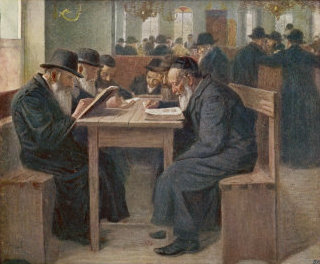
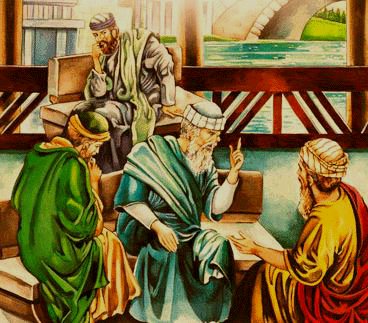
tannaim1Rabbinic schools of tannaitic times are more accurately characterized as “disciple circles” than academies. There were no school buildings, hierarchies of positions, administrative bureaucracies, curricula, or requirements. Because study was oral, there was no need for books or libraries either. A few disciples gathered around a rabbinic master and learned traditions from him in his home or in some other private dwelling that could serve as a school. But such formal instruction in the memorization and interpretation of texts constituted only part of the educational experience.

It was supplemented on a daily basis as students served their master as apprentices, observing his daily conduct and emulating his religious practice as he passed through the market, journeyed to various villages, performed his personal hygiene, or ate his meals. After years of learning, having reached a certain level of proficiency and perhaps (though not always formal) “ordination” from their master, disciples might leave their master and strike out independently, attempting to gather their own circles of disciples. If their master died, they would have to seek a new master elsewhere as there was no institutional framework to provide continuity or replacement. As opposed to an academy, the disciple circle was not an institution in that there was no ongoing life or continuity of the group beyond the individual teacher. The “school” was essentially the master himself.

-Jeffrey L. Rubenstein
“Social and Institutional Settings of Rabbinic Literature”
from The Cambridge Companion to the Talmud and Rabbinic Literature (p. 59)

But blessed are your eyes because they see, and your ears because they hear. For truly I tell you, many prophets and righteous people longed to see what you see but did not see it, and to hear what you hear but did not hear it.

“Listen then to what the parable of the sower means: When anyone hears the message about the kingdom and does not understand it, the evil one comes and snatches away what was sown in their heart. This is the seed sown along the path. The seed falling on rocky ground refers to someone who hears the word and at once receives it with joy. But since they have no root, they last only a short time. When trouble or persecution comes because of the word, they quickly fall away. The seed falling among the thorns refers to someone who hears the word, but the worries of this life and the deceitfulness of wealth choke the word, making it unfruitful. But the seed falling on good soil refers to someone who hears the word and understands it. This is the one who produces a crop, yielding a hundred, sixty or thirty times what was sown.”Matthew 13:16-23

I admit that I’m stretching things a bit. The Tannaitic period of Jewish learning didn’t formally begin until the destruction of the Second Temple in 70 C.E. (and extended to about 220 C.E.) but if you look at Rubenstein’s description, read the “sample teaching” from the Master, and recall other examples of how Jesus interacted with his disciples, you’ll see a lot of similarities. Although the Talmud talks about the “House of Shammai” and the “House of Hillel” (see Pirkei Avot), these ancient sages didn’t teach in formal institutions named after them but rather, in their own homes, or in rooms provided by wealthy patrons (and it should be noted that both Shammai and Hillel also taught during the Second Temple period and preceded Jesus by a generation or more).

Why am I telling you all of this?

I want to paint you a picture. It will be a portrait, actually. The portrait is of someone you believe you know very well, if you’re a Christian. The portrait will be that of Jesus Christ. There’s only one problem. When you actually see the portrait, it will look nothing like you expect. It will look like a middle-eastern man of Semitic heritage in his early thirties, the oldest son of a rural carpenter living in a tiny nation occupied by a vast foreign power. Don’t expect a picture of Jesus that you can buy in any Christian book store or the image of some non-Jewish actor with blue eyes and fair complexion you may be familiar with from the movies or television.

I want to put Jesus..uh, Yeshu or Yeshua, back where he belongs. I want to put him back in the early first century of the common era in what the Romans would one day call “Palestine” (to mock the Jews). He looks and sounds and moves and teaches like an itinerant Rabbi who has gathered a small group of men for disciples and who teaches in the same manner as the Tannaitic Rabbis would a few decades later.

Recall the example from Matthew I previously quoted. Jesus was teaching a group of “lay people” in a public area but later provided a more detailed interpretation privately to his inner group. This also is described by Rubenstein (pp. 67-8)

Rabbis and their students also interacted with non-rabbis in a teaching forum that the Bavli called a pirka. This seems to have been a sermon or lecture delivered by a sage to a lay audience: Several such descriptions being “Rabbi So-and-so expounded (darash) at the pirka”.. Some sources draw a distinction between that which should be taught at the pirka and that which should be made known only to sages.. Despite teaching his students in private that the law follows the lenient view, Rav taught the stricter position at the pirka due to his concern that non-rabbis in attendance might not behave scrupulously and violate the law.
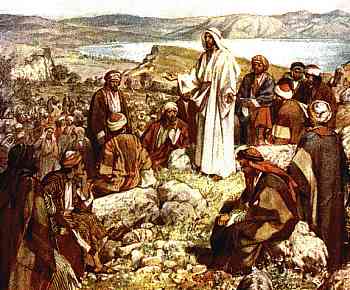
the-teacherWhile the specific content of each of these two examples doesn’t match absolutely, the teaching dynamic of the Tannaitic rabbis and Jesus fits hand and glove. The master teaches one, less detailed and more conservative lesson to the public and provides the inner, more intricate details to his disciples. As you switch back and forth between your New Testament view of Jesus and the portrait of a Tannaitic period teacher, can you see the similarity between the two? If you can, does that mean the “inner portrait” of Jesus you carry around with you is beginning to change just a bit? Is he not quite the same man you first met in a church sanctuary or in a Sunday school class?

All I’m saying is that, to understand Jesus, we need to see him in action in his “native element”. We need to see him doing what he did, teaching his disciples as a Jewish master wherever he happened to be. His students followed him everywhere, watching his every move, listening to his vocal inflections, seeing how he treated others, imitating him in every way possible…just like students of a Tannaitic period Rabbi.

With one possible difference.

If their master died, they would have to seek a new master elsewhere as there was no institutional framework to provide continuity or replacement.

When Jesus died, his disciples did not seek a replacement. To be fair, only three days passed before he rose, so there really wasn’t any time, but I still doubt they could have cast the Master aside so easily. But after he rose, they still did not go elsewhere in search of a new teacher, but then again, he was no ordinary Rabbi.

Simon Peter answered, “You are the Moshiach, the Son of the living God.” –Matthew 16:16

Rubenstein wrote: “After years of learning, having reached a certain level of proficiency and perhaps (though not always formal) “ordination” from their master, disciples might leave their master and strike out independently, attempting to gather their own circles of disciples”, which the disciples did do. In fact, they were commanded to do so.

And Jesus came up and spoke to them, saying, “All authority has been given to Me in heaven and on earth. Go therefore and make disciples of all the nations, baptizing them in the name of the Father and the Son and the Holy Spirit, teaching them to observe all that I commanded you; and lo, I am with you always, even to the end of the age.” –Matthew 28:18-20 (NASB)

the-teacher2Without realizing it, we are all struggling to become disciples, not just of the “Christian” Jesus Christ, but of a sort of “proto-Tannaitic” period Master. We are all in search of the true face and voice of Jesus. We long to sit at his feet under a fig tree listening to a parable, to walk along a hot and dusty road watching him heal the sick, to rest with him as guests in the home of a sinner and tax collector who amazes us by turning from his corrupt life to the God of his fathers. We want to be with him as he really was, and as he really is.

2,000 years removed, we have to work on it. We have to remove the mask that has been placed over his face. We have to get past the surprise at how different he looks; how “Jewish” he looks. But he is our Master, our guide, and our shepherd. If we are his, we already know his voice.


God, Bad, and Imperfect

joseph-and-pharaohOn today’s daf we find that when Rabbi Akiva heard a compelling argument, he changed his opinion and began to teach in accordance with Rabbi Yehudah’s view.

The Alter of Kelm, zt”l, explains the great importance of admitting one’s errors. “We find in Maseches Avos that there are seven attributes of the wise, one which is to admit the truth. Who was more evil than Pharaoh? Yet when he heard Yosef’s interpretation of his dreams, he was amazed…The Ramban explains that Pharaoh was very wise and could discern broad inferences from minor hints. From this one episode, he understood the great wisdom of Yosef and nullified his own understanding to that of Yosef. He saw that Yosef was the fittest person to rule the land, not him.

“We see that the nature of a true chacham is to admit to the truth. Nothing held him back from treating Yosef as was fitting…despite the Egyptian law that one who had been a prisoner was forbidden to rule. He didn’t even check why Yosef had been placed in prison. Instead, he understood what so few with his vested interests would have grasped: that Yosef is exceedingly wise. And that it would be fitting to learn from him as a young child learns from his father. It was clear to Pharaoh that Yosef deserved to rule.”

The Alter concluded: “I have written just a little of what is in my heart on this matter, but it is enough for a wise man to understand that failure to admit the truth reveals a lack of understanding.”

Daf Yomi Digest
Stories Off the Daf
“There is None as Wise as You”
Chullin 128

They were not perfect men. Abraham twice called Sarah his sister rather than rely on God for protection. He married Hagar rather than wait for God’s promise through Sarah. Isaac proved his fallibility by turning a blind eye to the wickedness of Esau. Jacob is remembered for his cunning and trickery. The consistent story of Scripture is not one of exceptional men, but an exceptional God. The Torah tells us their stories so honestly that we are convinced. We feel we know these men personally. We learn that even the greatest men of faith were human. We may take comfort in that, but we must not forget the unique, spiritual greatness of the Fathers.

-from “The Greatness of Our Fathers”
Torah Portion Lech Lecha commentary
FFOZ.org

No one is perfect. We all make mistakes. If we are truly wise, when we discover that we’re wrong, we’ll admit it and turn to what is right.

If you’ve been reading this blog for any length of time, you know that a recurring theme here is the relationship between Christianity and Judaism. Sometimes I lament of our inability to get along with each other, and sometimes I marvel at how amazingly similar the message of the Rabbinic sages is to that very special “Sage from Netzeret”. You really can’t understand Jesus unless you have some idea about Judaism, even post-Biblical Judaism.

However, there are a few pitfalls involved in “combining” Christianity and Judaism and they lead in opposite directions. Some non-Jews become so enamored with the beauty of Jewish prayer and worship, that they in effect, start worshiping Jews and Judaism rather than the God of Israel. The extreme opposite happens, too. Sometimes even intelligent and otherwise well-meaning people feel threatened by the “choseness” of the Jews and develop and deep and abiding “dislike”…OK, hatred for anything Jewish. I’m going to focus on this latter group today.

I was on Amazon a little earlier looking at a book written by Pastor Barry Horner called Future Israel: Why Christian Anti-Judaism Must Be Challenged. Here’s a bit of what the book is about:

Author Barry E. Horner writes to persuade readers concerning the divine validity of the Jew today (based on Romans 11:28), as well as the nation of Israel and the land of Palestine, in the midst of this much debated issue within Christendom at various levels. He examines the Bible’s consistent pro-Judaic direction, namely a Judeo-centric eschatology that is a unifying feature throughout Scripture.

I noticed that the book received some excellent reviews, but I also saw a significant number of rather “bad” reviews. I’m always curious when what otherwise seems like an excellent book is panned by some folks, so I took a look at the various “1-star” comments. Here’s a sample (I’ve represented the names of each reviewer with initials):

I want to be saved and how better to do that than by swearing my allegiance to the state of Israel, say shalom! While I’m at it I also promise to say nasty things about God’s natural enemies, those A-Rabs (obviously). Kudos to the author and also shout outs to Sharon, Dershowitz et al! At last I can be secure in my Christianity. –SR

Just another attempt to put together a piece of work that defends Christian Zionism. God has never been finished with Israel (His Church), no where in scripture does it speak of two different plans for the Jew and Gentiles, Christ died once for all, Jew and Gentile alike and the Church consist of both. Jesus Christ also has one bride, not two! He is married to His church, not to the physical land of Israel. Jesus Christ is the Head of the Church which is the Body of believers all throughout history which are Jew and Gentile alike. –SMP

The following reviewer seems the most “intense”:

This is another wicked deception which the Judeo-Churchian system puts out in favor of the saved-by-race thesis of the Talmud of the Pharisees as reflected in Churchianity.

It is most unfortunate that John MacArthur endorsed this propaganda, but in dealing with this please keep in mind the words of Scripture and be at peace: “The coming of the lawless one is by the activity of Satan with all power and false signs and wonders, and with all wicked deception for those who are perishing, because they refused to love the truth and so be saved. Therefore God sends them a strong delusion, so that they may believe what is false, in order that all may be condemned who did not believe the truth but had pleasure in unrighteousness.” 2 Thessalonians 2: 9-12.

If you refuse to love the truth, and if you take pleasure in unrighteousness, “Future Israel” is the book for you.

Jew-worship is poisonous to Judaics as well as everyone else. They are saved only through faith in Jesus Christ. Their supposed racial patrimony availeth them not, especially in light of recent scholarship which shows that the vast majority of contemporary so-called “Jews” are not descended of Abraham, Isaac and Jacob, but of the Khazars (cf. Prof. Shlomo Sand of Tel Aviv University, “The Invention of the Jewish People,” and Paul Wexler’s “The Ashkenazic Jews”). Hence, the concept of salvation through supposed sacred status as carnal Israel is a double dead-end and a form of Jew-hate since it gives false hope to those who fantasize that they are Jews, but are not (Rev. 2:9; 3:9). –MH

Oh my!

WalkingIt’s one thing to disagree with the position Horner takes but it’s another thing entirely to make it “personal” and to engage in sarcasm and blatant hostility. However, there has always been a lot of passion involved in the classic Christian vs. Jewish interplay across history. Although we like to think that, post-Holocaust, the church has been mending the damage and hurt in the relationship, we see that at least some individuals are continuing to nurse a heart-felt anger against Jews and Judaism, and continuing to use the New Testament as a blunt instrument in beating down the Jewish people.

Small wonder many Jews feel threatened by Christianity and, worst case scenario, see Christian outreach to the Jews as merely a disguised extension of “the final solution”. I can only hope and pray these “reviewers” don’t represent the majority of believers. They’re another reason why attending a church isn’t exactly appealing to me. I’m afraid I might actually run into one of them.

I commented on one of my recent blog posts that “Christians and Jews may be different relative to their covenant relationship with God but there are no second-class citizens in the Kingdom”, but that doesn’t mean some people can’t feel alienated or even oppressed by Jewish “choseness”. Yesterday, Derek Leman blogged on Gentile response to Jewish people based on such a sense of alienation, and while this feeling doesn’t always manifest as active hostility, it can breed an attitude of “theoretical” love for Israel while harboring suspicion and distrust of actual Jewish individuals.

It probably doesn’t help that Christians and Jews conceive of God and their duty to Him in fundamentally different ways. I’ve been reading The Cambridge Companion to the Talmud and Rabbinic Literature, which is a collection of scholarly essays on the “historical-interpretive and culture-critical issues” relative to the rabbinic texts. I can assure you that the spiritual and intellectual foundation for a Jew’s understanding of God and the mitzvot is dramatically different from anything a Christian will learn about in Sunday school.

We tend to be suspicious of, or even fear, what we don’t understand. Christians sometimes imagine that Jews are just like Christians, except they don’t believe in Jesus (yet). They become confused and disappointed when they discover that Jews actually think about things from a different direction than Christians, at least when it comes to God, the Bible, and particularly, the Messiah. When Christians enter into what we think of as “Messianic Judaism”, they can encounter a wide variety of experiences, ranging from a group of “Christians with Kippahs”, hardly distinguishable from any church, to (in some instances) a congregation that differs little from an Orthodox shul (and admittedly, this end of the spectrum is extremely rare).

If we could distill a “perfect” environment for believing Jews who were born, raised, and educated in a traditionally ethnic Jewish world and construct a religious and worship context where they could give honor to Yeshua (Jesus) as the Messiah; the “Maggid” who presented as a fully Jewish, Second Temple period, Rabbinic teacher, that environment would look very, very different from anything the church has ever offered Christian worshipers. It might, in some small sense, be reminiscent of a synagogue experience Paul or Peter may have had in worshiping with fellow disciples of the Master. Most Christians, if they could go back in time, walk into such a synagogue, and pray alongside Paul, Peter, and even James, would be rather put off. It would be “too Jewish”. It would “feel” wrong”. The modern Gentile Christians in a truly “Messianic” synagogue might even say that they don’t experience the “presence of the Spirit” among the Jewish worshipers.

So what do we do? Does the church continue to hammer away at the synagogue because they’re “too Jewish” and refuse to accept Jesus? Do Christians continue to reject even those Jews who are disciples of the “Netzeret Maggid” because they won’t toss “the Law” in the nearest trash can and live like “good Christians?”

Or do we take a good, hard look at what we’re doing and compare it to who Jesus really was and is, who Paul really was and is (God is a God of the living, not the dead), and realize that by disdaining and reviling the Jew, we are doing the same to Jesus Christ.

“Then he will say to those on his left, ‘Depart from me, you who are cursed, into the eternal fire prepared for the devil and his angels. For I was hungry and you gave me nothing to eat, I was thirsty and you gave me nothing to drink, I was a stranger and you did not invite me in, I needed clothes and you did not clothe me, I was sick and in prison and you did not look after me.’

“They also will answer, ‘Lord, when did we see you hungry or thirsty or a stranger or needing clothes or sick or in prison, and did not help you?’

“He will reply, ‘Truly I tell you, whatever you did not do for one of the least of these, you did not do for me.

“Then they will go away to eternal punishment, but the righteous to eternal life.” –Matthew 25:41-46

You may say that my quote does not fit the context but I think it does. If an Orthodox Jew, fully versed in the intricacies of the Talmud, and who had not the slightest desire to love Jesus as Messiah or God were sick or hungry or naked, would you visit him, feed him, or clothe him? If you are indeed a Christian, then you probably would. On the other hand, if you had a choice to feed a “good Christian” or a “good Jew”, then what would you do? Would you choose the starving atheist over the starving Jew because the non-Jewish atheist would be more likely to hear your witness about Christ?

Perhaps I’m being overly dramatic but I am trying to get a point across. We cannot judge modern Judaism on the basis of modern Christianity. Sure, Christianity was born out of First Century Judaism, but a lot has changed since then. Both religions have undergone a significant evolution over the past 2,000 years and trying to trace all of the various theological “morphings” would cross just about anybody’s eyes. I can’t keep up with it all.

judgingAs I was trying to say at the start of this morning’s blog, the people of God aren’t perfect. There are no perfect Jews and there are no perfect Christians. We all have our blind spots, our flaws, our personality quirks. We need to first acknowledge this in ourselves (Matthew 7:3) so we can stop being arrogant (Romans 11:22-24). Both Judaism and Islam have a proverb that says “before criticizing a man, you should walk a mile in his shoes.” This is something we don’t do nearly enough, mostly because the shoes don’t always fit and walking in them is uncomfortable.

I read a quote today that is attributed to Albert Einstein. Given the amount of misinformation available on the web, I don’t know if this is true or not, but I like the quote:

Everyone is a genius. But if you judge a fish on its ability to climb a tree, it will live its whole life believing it is stupid.

We cannot judge a person, Jew or Christian, on who they are not, but only on who they are. The problem is, we need to understand who they are before we can render an intelligent opinion and especially before we can offer a compassionate response.

For every power for good in your soul, a counter-force crouches within to oppose it.

There is only one place that stands beyond assault, as it also stands beyond reason or need. It is the simple power to choose good and not bad, and it is the place where the soul meets G-d and there they are one.

In that place, where that resolute decision is made, the counterforce dissolves and dissipates. Indeed, it was created from that place, with the purpose of returning you to there.

And you have returned.

-Rabbi Tzvi Freeman
“Force and Counter-Force”
Based on letters and talks of the Rebbe
Rabbi M. M. Schneerson
Chabad.org

The Conundrum Religion

conundrumNo matter how much you distrust your own sincerity or question your motives, there is no trace of doubt that at your core lives a G-dly soul, pure and sincere.

You provide the actions and the deed—just do what is good.

She needs no more than a pinhole through which to break out and fill those deeds with divine power.

-Rabbi Tzvi Freeman
“The Promise Inside”
Based on letters and talks of the Rebbe
Rabbi M. M. Schneerson
Chabad.org

Would that it was so simple. I guess it should be that simple to serve God. Really, I outlined the basic core of it a few days ago in my blog post Being Heaven on Earth. More than anything, if we want to serve God, we have a duty to serve other people in whatever way we can, great or small. It’s a very simple concept. No wonder people get it messed up all of the time.

I sometimes contribute to the confusion. In yesterday’s morning meditation I introduced a discussion of the relationship between the laws of Noah as chronicled in Genesis 9 and how they interact with the Mosaic and Messianic covenants (Sinai and the Cross respectively). While, as my friend Derek Leman pointed out to me, the concept of being a Noahide is post-New Testament, I still think the “theme” of a non-Jew, non-Israelite, non-Hebrew being able to have a covenant relationship with God in the post-diluvian world says much about God’s compassion for humanity.

Of course, I could be wrong.

Then again, there are still those in the Christian/Messianic world who insist that Christians are grafted into Israel to the degree that they become Israel. That is, they become Jewish in all but name only and are obligated to perform the identical 613 commandments as the Jewish people. This very much takes a long stick and stirs up the muddy, murky waters of “Judeo-Christian” (I use the term in quotes because it doesn’t exist in reality) religion.

It all seems so much easier when you look at it as just dedicating your life to performing 1000 mitzvot or feeding and caring for (video) people who can’t do these things for themselves.

We make religion out to be quite a mess when it doesn’t have to be.

I recently read a review of Talya Fishman’s book Becoming the People of the Talmud: Oral Torah as Written Tradition in Medieval Jewish Cultures which describes how the Talmud became a completely integrated element in the religious life of every observant Jew. It seems that integration wasn’t as seamless as I originally thought, nor is its acceptance completely uniform across all different populations of Jews (not to mention what non-Jews think of the Talmud). However, if you look at Judaism from a fundamentally Jewish perspective, you can’t really have Jewish religion without the Talmud.

But it contains all of these mind-bending puzzles, conundrums, and debates!

Christianity doesn’t have anything to compare to the Talmud so it would seem that Christianity, if you want a “simple” religion, would be the way to go, but that’s somewhat deceptive. At least in the west, Christianity is a religion of individuals. I’m oversimplifying here to make a point, but it’s as if becoming a Christian and developing your faith is as easy as declaring Christ as Lord and Savior, praying to God to give you discernment through the Holy Spirit, and then reading the NIV Bible while “allowing the Spirit” to tell you what it all means.

I was puzzling through something about the Seven Noahide Laws when I realized that Judaism conceptualizes these requirements for non-Jews in exactly the same way as it views the Torah for Jews. The view is that the requirements are imposed on a people rather than on individuals. To be sure, a Jew responds individually to commandments such as praying with tefillin and a tallit (although praying with a minyan requires 10 Jews), giving to charity, visiting the sick, and so forth, but it is obedience to the mitzvot that identifies the individual as belonging the the Jewish people (there’s debate here since there are a lot of secular Jews who feel no attachment to the Torah, but I digress).

Gentiles in the western nations don’t identify in the same way in terms of religion. We see religion as a personal responsibility only and we just happen to be loosely associated with a church where we agree on the theology being taught. This doesn’t make sense when a Jew looks at a Gentile. Here’s an example.

One of the Noahide commandments requires establishing courts of law. An individual doesn’t do this. I can’t personally obey this commandment. Only cities, counties, states, and nations establish courts. Political entities establish courts, not individual human beings. That means being a “righteous Gentile” to some degree, requires that you belong to a nation that establishes courts. That’s the personal part of the decision, but you still have to belong to “a people” or “nation” that obeys this directive to be said to have obeyed it yourself.

But it seems so involved and so much of the governmental establishment of justice is out of our control. This may be a fallacy in the Jewish application of the Noahide concept on Gentiles. We are not a people of God the way the Jews are a people of God. The Israelites (and an assorted group of non-Israelite freed slaves) stood at Sinai “as a single man” and accepted the Law of God He had designed and established for them. While the cross of Christ stands for anyone who accepts Jesus as Lord and Savior, there is no ” nation of Christians”. Thus, in respect to the concept of “peoplehood”, Jews and Christians are fundamentally different “things”.

studying-talmudI’m getting a headache.

What was I saying again? Oh yeah. Why is worshiping God so complicated. Why are there so many disagreements? What is the problem?

Theologians and philosophers have been debating those questions since man’s first awareness of God but the easiest answer I can come up with is that people are gumming up the works. Sure, God is hard to understand, the Bible isn’t exactly like a first grade reading text, and the Talmud doesn’t add up as easily as “two plus two”, at least not to me.

While I enjoy a good challenge and I delight in digging “deeper into the text” so to speak, it is too easy to lose myself in the complexities of religion while forgetting why I am here in the first place. It should be as simple as Adam and Eve standing in the Garden.

Anxieties, worries, feelings of inadequacy and failure — all these smother and cripple the soul from doing its job. You need to find the appropriate time to deal with them. But don’t carry them around the whole day.

During the day, you are Adam or Eve before they tasted the fruit of good and evil.

-Rabbi Tzvi Freeman
“Out From Under the Blanket”
Based on letters and talks of the Rebbe
Rabbi M. M. Schneerson
Chabad.org

We may argue and fuss with each other until the coming of the Moshiach and we may never see eye to eye on many issues but at the end of the day, if you managed to feed one hungry person, visit one sick person in the hospital, or even smile at a stranger you pass on the sidewalk, you’ve made the world a better place. God said it all here:

And what does the LORD require of you But to do justice, to love kindness, And to walk humbly with your God? –Micah 6:8

“The rest is just commentary, go and study.” -Hillel

The Gift of the Postdiluvian King

This week’s reading tells the story of Noah, the father of all humanity. We learn that G-d spoke to him and his children, directing them to follow seven laws for just and moral lives. Most religions say that they offer an exclusive path, but our Talmud teaches that “the righteous of all nations have a share in the World to Come.” Maimonides says that this applies to anyone who accepts upon him or herself to observe the Seven Commandments given to Noah.

-Rabbi Yaakov Menken
Director, Project Genesis – Torah.org

“But flesh, when its soul is with its blood, you shall not eat it… He who spills the blood of man, by man shall his blood be spilled, for in the Image of G-d did He create man.”Genesis 8:4,6

Where was God when the descendants of Noah needed salvation? Christians believe we are saved through the blood of Jesus Christ and Jews believe they merit a place in the world to come by obeying the 613 mitzvot (OK, it’s more complicated than that, but that’s “salvation” in a nutshell). But what about the time before the birth of Christ and before Moses at Sinai? We know that people were aware of God. Certainly Noah was a “righteous man; he was blameless in his age” and he “walked with God” (Genesis 6:9) and certainly God spoke to Abraham when He said, “Go forth from your native land and from your father’s house to the land that I will show you” (Genesis 12:1), but what allowed a person to have a relationship with God, particularly in Postdiluvial times?

We see hints that the people in those days were aware of “Torah” requirements. Even Noah was commanded of “every clean animal you shall take seven pairs, males and their mates, and of every animal that is not clean, two, a male and its mate”, telling us that well before Sinai, clean and unclean animals were an understood concept. We don’t see God going through an extensive set of explanations telling Noah the difference between these two general types of creatures, so he must have already known about this. We even know that when Abel offered his sacrifice to God (Genesis 4:3-4), it was a clean animal appropriate for sacrifice.

The commentaries in the Stone Edition of the Chumash make significant reference to the kosher vs. non-kosher animals such as in this example:

Genesis 6:19 “Two of each.” As the following verse explains, these animals were to be one male and one female, so that the species could be replenished after the Flood. In the case of the kosher species that could be used for offerings, Noah was later commanded to bring seven pairs (7:2), so that he could bring offerings of gratitude and commitment after returning to dry land.

The Chumash commentary for Genesis 8:20-21 even refers the reader to Leviticus for details on the sacrificial offerings, their names, and terminology, again suggesting that Noah would have had to possess some of this information in order to give a proper sacrifice to God after the Flood. Yet man, at that time, was not to divide animals into kosher and non-kosher for eating, as illustrated in Genesis 9:3:

Every creature that lives shall be yours to eat; as with the green grasses, I give you all these.

We see that certain parts of the “Torah knowledge” available to both the antediluvian and postdiluvian peoples was later applied specifically to the Children of Israel as part of the Torah, but what about the rest of humanity? Ten generations followed Noah before the birth of Abram (Abraham). The Bible glosses over the details of the lives of these people, but we presume at least some of them continued their worship of and devotion to Hashem. Also, during the lives of Abraham, Isaac, and Jacob, there were members of their households who were not Hebrews yet who learned of the God of Noah and turned their hearts to Him. What about the Egyptian members of Joseph’s house when he was a viceroy of Pharaoh, King of Egypt (see Torah Portions Miketz and Vayiggash)? Perhaps Joseph taught some of them about the God of his father Jacob. Most assuredly, he taught his Egyptian wife and sons.

Unlike most other religions, Judaism does not declare that they are the only path to righteousness, well not exactly anyway. Rabbi Yaakov Menken has this to say.

Unlike the other religions of the world, Judaism does not believe that everyone must become a Jew in order to approach G-d or earn a place in the World to Come. When King Solomon built the Holy Temple in Jerusalem, he asked of G-d that He hear the prayers of all who pray towards that Temple: “Also a gentile who is not of your people Israel, but will come from a distant land for Your Name’s sake… and will come and pray toward this Temple, may You hear in Heaven Your dwelling-place, and do according to all that gentile calls out to You…” [I Kings 8:41-43]

MosesIt is the subject of much debate as to whether or not there were “Noahides” or Ger Toshav among the Hebrew people between the days of Noah and Moses, but it is more than possible that they existed. Abraham sent his most trusted (non-Hebrew) servant to find a wife for his son Isaac (Genesis 24:1-9) and Rabbinic commentary identifies this man as a Noahide. If this servant had not been righteous before God, how could he have risen to such a high position in Abraham’s household and why would Abraham have trusted him to find a suitable wife for Isaac? We even see the Bible’s first recorded personal prayer uttered by this man.

He made the camels kneel down by the well outside the city, at evening time, the time when women come out to draw water. And he said, “O Lord, God of my master Abraham, grant me good fortune this day, and deal graciously with my master Abraham: Here I stand by the spring as the daughters of the townsmen come out to draw water; let the maiden to whom I say, ‘Please, lower your jar that I may drink,’ and who replies, ‘Drink, and I will also water your camels’-let her be the one whom You have decreed for Your servant Isaac. Thereby shall I know that You have dealt graciously with my master.” –Genesis 24:11-14

From a Christian point of view, there are apparent “gaps” in God’s plan of salvation for mankind. Discussions of hypothetical situations occasionally occur in Bible studies, such as what would have happened to a person before the birth of Christ who otherwise was “good” but had no way to confess Jesus as Lord and Savior? Perhaps God answered that question when He spoke to Moses in Genesis 9:1-17, which is the basis for today’s Noahide Laws.

I recently investigated the concept of the Ger Toshav as a possible “interface” between Christians and Jews but only hit a brick wall. Observant Jews do not consider Christians to be “righteous Gentiles” if, for no other reason, than they believe we worship a man as a God and indeed, worship three Gods rather than the One. However, the Ger Toshav may have enjoyed a life of righteousness that included a relationship with the God of Adam and Noah, perhaps into the time of Jesus, Peter, and Paul.

The centurion replied, “Lord, I do not deserve to have you come under my roof. But just say the word, and my servant will be healed. For I myself am a man under authority, with soldiers under me. I tell this one, ‘Go,’ and he goes; and that one, ‘Come,’ and he comes. I say to my servant, ‘Do this,’ and he does it.”

When Jesus heard this, he was amazed and said to those following him, “Truly I tell you, I have not found anyone in Israel with such great faith. I say to you that many will come from the east and the west, and will take their places at the feast with Abraham, Isaac and Jacob in the kingdom of heaven. –Matthew 8:8-11

At Caesarea there was a man named Cornelius, a centurion in what was known as the Italian Regiment. He and all his family were devout and God-fearing; he gave generously to those in need and prayed to God regularly. –Acts 10:1-2

As soon as it was night, the believers sent Paul and Silas away to Berea. On arriving there, they went to the Jewish synagogue. Now the Berean Jews were of more noble character than those in Thessalonica, for they received the message with great eagerness and examined the Scriptures every day to see if what Paul said was true. As a result, many of them believed, as did also a number of prominent Greek women and many Greek men. –Acts 17:10-12

The covenant of Christ allows we who are not Jewish to enter into a deep and abiding relationship with the God of all Creation that, in its holiness, is on par with the people of the Mosaic covenant (Galatians 3:26-29) so we non-Jews can go beyond the boundaries of the Noahide. Yet, the Acts 15 letter issued by the Jerusalem council, in some ways, mirrors the laws of Noah. Becoming disciples of the Master does not remove the obligation of a Christian to shun worship of idols, murder, theft, blasphemy, and sexual immorality. The Noahide prohibition to not eat the limb of a living animal may seem strange, but we also would find such as act abhorrent. Creating a court system is an act of establishing justice and as Christians, being just and merciful should not seem odd.

Shofar as sunriseIf the Messianic covenant has not removed or replaced the Noahide covenant but instead, has enhanced it and greatly expanded our access to God, how can we say that the covenant of the Messiah has replaced the Mosaic covenant for the Jews? The Noahide covenant paints a rainbow-colored portrait of God’s love of and provision for all of humanity from the days of the Flood up until the current age. He never abandoned the vast throng of mankind from Noah to Jesus but gave them a gift of Himself, even into the times of Abraham, Moses, and David. For the past 2,000 years, we have had Jesus to turn to for an even greater relationship with God.

But as I just said, if we can learn one lesson for the Gentiles in the story of Noah, including that there is no conflict between Noahide and Messianic covenants, then perhaps we can also learn that no conflict exists between the Mosaic laws and the teachings of the Messiah. Moses and Jesus are not enemies and in fact, for a Jew, what they illuminate goes hand in hand, just as the teachings of Noah and Jesus do for the Gentile.

In Search of the Jewish Voice of Jesus

Kohen GadolThe Maharal, zt”l, explains the mechanics of idolatry. “Our sages teach that a Jew who gives charity on condition that his son recover from illness is a complete tzaddik. Conversely, charity given by a non-Jew on condition is meaningless. The gemara explains that even if the child does not recover, the Jew will not want his money back, but the non-Jew will want a refund. To understand why, we must delve into the reason why people worshiped idolatry. They desired to excel in something, be it war, love, or the like. Idolatry meant only acting in a way that they held strengthened their goal. It is no wonder that an average idolater who gave money on this condition would demand a refund if the child did not recover. He only gave charity as a fee in the hopes that his son will heal. If this didn’t provide excellent results, it was a waste of money from his perspective.”

Daf Yomi Digest
Stories Off the Daf
“The Dust of the Remains”
Chullin 125

By God’s divine providence, I “accidentally” took in my hand a New Testament, which for many long years I had left unnoticed in a hidden corner – a book which I had, in vexation, taken from a Jewish teacher thirty-three years before, in order that he might not read it.

I began to turn over its leaves and to read.

-Rabbi Ignatz (Isaac) Lichtenstein (1824-1909)
District Rabbi of Tapioszele, Hungry
As quoted in Messiah Journal, Issue 108/Fall 2011
“A Christian’s Guide to the DHE”

Let’s say you are a Christian who has an interest in Judaism, as it is the source of your faith. Strange, I know, but let’s pretend. Let’s say that, out of your interest and curiosity, you have taken to reading the traditional weekly Torah Portions which are recited each Shabbat in every Jewish synagogue in the world. You may even read some of the Jewish commentaries on these readings and, as time passes, you may discover yourself picking up on the rhythm of Jewish thinking and start seeing the “Old Testament” through new and illuminated eyes.

Then you return to reading the New Testament. By now, you are very familiar with the teachings of Jesus and the letters of Paul. Strangely, they seem a little stale to you. This is not because Christ is stale and not even because your faith is beginning to become a little tired, but because you cannot detect what most assuredly was a Jewish voice coming from the “Son of Man”, the offspring of Miriam (Mary), a late Second Temple period Jewish virgin who had an extraordinary encounter with an angel one day (Luke 1:26-38). When you read the Gospels and the Epistles, you hear the voice of your Gentile Christian Sunday school teacher and your Gentile Christian church Pastor. These are very good and kind men and you value their service to the faith very much.

But something is missing.

In the sixth month, God sent the angel Gavri’el to the Galil, to a certain town named Netzeret, to a virgin who was betrothed to a man named Yosef from the house of David. The virgin’s name was Miryam. The angel entered the room and said to her, ‘Shalom to you, gracious woman! HaShem is with you! {You are blessed among women.}” {When she saw him,} she was alarmed by his statement and said in her heart, “What is this brachah?” The angel said,

Do not fear, Miryam, because you have found favor before God. You will conceive and give birth to a son, and you shall name him Yeshua. He will be great, and he will be called the son of the Highest. HaShem, God, will give him the throne of his father David. He will reign over the house of Ya’akov forever. There will be no end to his kingdom.

Miryam said to the angel, “How can this be? I have not known a man.” The angel answered and said to her,

The Holy Spirit will come upon you, and the power of the Highest will overshadow you. Therefore, the one that is born will be called holy – the son of God. Look! Your relative Elisheva, whom people have called barren, is also pregnant and will bear a son in her old age. This is her sixth month. For nothing is perplexing to God.

Miryam said, “I am the maidservant of HaShem. Let it be for me according to your word.” And the angel left her. –Luke 1:26-38 (DHE Gospels)

Is that more like it? No, it’s not an English Bible with a couple of “Hebrewisms” thrown in to make it sound “Jewish”. It’s much more than that.

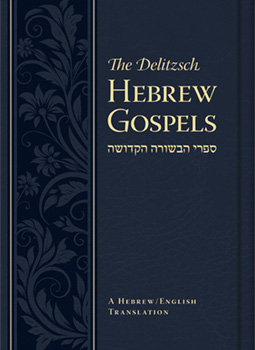
In 1873 the British and Foreign Bible Society commissioned Franz Delitzsch to prepare a translation of the New Testament into Hebrew. Delitzsch agreed and set to work utilizing his extensive knowledge of mishnaic Hebrew and first century Judaism to create a translation and reconstruction of the Greek text back into an original Hebrew voice. His reconstructing translation was completed in 1877. After the first edition, it went through extensive review and revision for the next 13 years. The final edition was published in 1890 under the care and supervision of Gustav Dalman. Sixty thousand copies were distributed for free throughout Europe resulting in tens of thousands of Jewish people coming to know Yeshua as the Messiah of Israel.

Those Jewish believers and their influences are the very embers that have ignited this modern day hope and revival.

Since that time the Delitzsch NT has continued its good work through a series of reprints by various missions to the Jews. It is our honor to work alongside this great man of God and bring all of his wisdom, scholarship and vision to today’s people of God in a fresh and relevant way. We pray that it will allow even more Jewish people to engage in the life giving words of Yeshua.

From the introduction to the Delitzsch Hebrew Gospels
by Vine of David

This Bible, which has been faithfully reproduced by Vine of David and enhanced with many new features isn’t meant to be the perfect English translation of the Gospels. Originally, it was the testamony of the writers of the Gospels, reconstructed back into its original Hebrew “voice” so that the words of Jesus (Yeshua) could be more clearly perceived by 19th (and now 21st) century Jews. This isn’t an easy task because, as you read in the prior quote from Daf Yomi Digest, matters related to non-Jewish worship are not considered to operate on the same level as observant Jewish piety. On the other hand, you also read words from the heart of a 19th century Rabbi who, accessing no special edition of the New Testament, nevertheless found the Jewish Messiah. To continue reading from Rabbi Lichtenstein:

An accomplished lady who was conversing with me exclaimed, when her arguments had all been met, “He is everything great, everything noble, if only he were not called Jesus Christ.”

Ironically, the name revered by Christians across 2,000 years is, for good reason, feared and reviled throughout Judaism and it is that name, not who he is or what he teaches, that separates the great “Maggid of Netzeret” from the vast majority of his people, the Jews, in today’s modern world. Rabbi Lichtenstein describes his own perceptions in this area:

As impressions of early life take a deep hold, and as in my riper years I still had no cause to modify these impressions, it is no wonder that I came to think that Christ himself was the plague and curse of the Jews, the origin and promoter of our sorrows and persecutions. In this conviction, I grew to years of manhood, and still cherishing it, I became old. I knew no difference between true and merely nominal Christianity. Of the fountainhead of Christianity itself, I knew nothing.

Most Jews come to know Christianity not from Christ but from his followers, both those in the here and now, and those who have cursed, harrassed, persecuted, and killed the Jewish people for hundreds upon hundreds of years. It is a miracle of God that even a single Jew in all that time, and to this very day, has ever come to faith in Jesus and called himself a disciple of the Master. Certainly Rabbi Ignatz Lichtenstein was the beneficiary of one such miracle in 1884 when he become enthralled with the New Testament and devoted his life to being a disciple of Yeshua.

But what about you, “hypothetical” Christian, who longs to also hear the Jewish voice of Jesus? If now there exists an edition of the Gospels that will allow you to hear Jesus as less evangelical Christian and more Jewish Rabbi, why should you desire to hear words that were written for a Jew? The article “A Christian’s Guide to the DHE” in Messiah Journal addresses your concerns.

Reading the DHE is important for Christians because it places the Gospels back in their proper context. The Messiah came as a Jewish man to the Jewish people in the land of Israel. This was no accident. Rather, this was the setting that the Father specifically chose to reveal his truth and his plan of salvation.

The implication is rather startling. If God chose to provide His plan for the salvation of the non-Jewish people of the earth in the form of a First Century itinerent Jewish Rabbi, born of working-class parents in a small rural town in a Roman occupied nation, are you going to be able to completely understand the message of that plan and hear the entire intent of God by reading a traditional English translation of the Bible? Yes, you can buy a Chumash and a Tanakh to immerse yourself in the pool of Jewish learning in the Torah, Prophets, and the Writings, but you are missing an important, some might even say “crucial” element in reconstructing the ancient Jewish presence of the Word of God.

The Death of the MasterJewish men like Rabbi Lichtenstein and Paul Philip Levertoff encountered Jesus at great risk and yet accepted that risk, which included being rejected by family, friends, and the entire Jewish community, in order to connect to the tzadik God made most great in all the world, who is revealed not only a Rabbi and Prophet, but as “the Prophet” and the Moshiach. You, as a Christian, may end up taking a bit of criticism from your Sunday school teacher, your Pastor, even your parents and spouse, because you are called to hear a voice few of them will ever perceive. But having once heard that voice, how can you ignore it? No, you can’t. He’s calling to you.

You are not alone. You are not without directions in which to turn. There are others who walk the same path as you. The DHE Gospels can let you hear the Jewish voice of Jesus. Messiah Journal is a publication written for the Christian and the Jew who desires to meet the Jewish Messiah. You can go beyond where you are now in understanding the author of the faith in your heart. The subtle nuances and the “hidden” message in the words of Jesus and the Gospel writers do not have to go unnoticed. You can find them. Hopefully this review has helped you know where to look.

Leaving the House of God

broken-crossSo what is it like to leave? Some quietly slip out of their religious beliefs without much fuss. There are many though, who were previously strongly convinced that their religion is utter reality. It is highly revealing to listen to those who have had experience into and out of Christianity and are in a position to know and authoritatively evaluate and relate their actual experiences. Deconversion for such people, although sometimes initially very emotional or traumatic, comes as a revelation far more spiritually enriching than conversions into religion. In the stories scattered over the Internet and in books ex-Christians have repeatedly said this enrichment of life is the case.

Leaving Christianity

One of Israel’s most celebrated writers, Yoram Kaniuk, has resigned from the Jewish religion. He won his case in court to have the word “Jewish” removed from his identity at the Population Registry, and from now on he will be listed as “without religion”.

He is not alone. Apparently, hundreds of Israelis are lining up to follow his example.

-Rabbi Gideon Sylvester
“Resigning from Judaism”
Haaretz.com

I’ve said before that one of the fundamental differences between Judaism and Christianity is that although you can stop being Christian, you can never stop being a Jew. I guess I was wrong. Israeli Yoram Kaniuk has legally stopped being a Jew and apparently, he has good reasons for doing so.

As an Orthodox Rabbi, I am troubled by their actions, however, I understand the frustration that drives them.

Many Jewish traditions such as the Passover seder, the lighting of Chanukah candles and our lifecycle events are popular, beautiful, and inspiring to religious and secular Jews alike.

Unfortunately, this beauty has been overshadowed by the religious leadership’s coercive tactics. Our religion demands precision, but when the legalistic minutiae of ritual become the raison d’etre of Judaism drowning out the beautiful ethical messages of our tradition, people feel cheated out of the outstanding beauty of their heritage.

Of course, everything Rabbi Sylvester says to describe why Kaniuk and many others have decided to abandon their peoplehood and their faith can be distilled down to a single sentence:

Religious coercion is the enemy of true religion.

What does this bode for Christianity? No one is born a Christian. Even if you are born to Christian parents and are raised in the church, you still must make an independent decision to the cause of Christ and accept Jesus as Lord and Savior over your life and over the world. Plenty of kids have been raised in warm, loving, Christian homes only to leave the church when they were old enough to make their decision stick (i.e. refuse to go to church with the family and/or leave home).

A new survey by LifeWay Christian Resources indicates that most Millenials are not religious and are leaving churches, although many consider themselves to be spiritual.

Youth are walking away from Christianity and the Christian church, opting instead for spirituality.

Millenials are defined as those born from 1980 to 1991. They are aged between 18-29 years old.

Of the total surveyed, 65 percent said they are Christian; 14 percent atheist or agnostic; 14 percent do not favor any religion; and 8 percent mentioned affiliations with other religions. Seventy-two percent said they are more spiritual than religious, the Christian Post reported.

“Survey shows trend of young people leaving Christianity, church”
Posted 30 April 2010
The Underground

Why do Christians leave the church? One answer is that they were never really “Christians” to begin with, that is, they never fully gave their hearts and lives to Jesus and were never completely dedicated to the faith. On the other hand, perhaps many have left for the same reason that Yoram Kaniuk left Judaism.

Unfortunately, if ones closest friends and relatives are very religious then not being a Christian can cause problems in the family and amongst peers. We often hear how Christians claim high standards for “family values” and yet, especially amongst more fundamentalist Christians, ex-Christian family members who “come out” are not only shunned but are even told that they will go to hell. Belief in the justice of unrelenting torture for your family is not a way to bring family unity. Also Christians seldom do justice to the possibility of what we have read, thought and discovered, merely claiming we can’t have been “true Christians” or asking “where did you go wrong?”

It is a common misapprehension to claim that those who leave Christianity never understood what Christianity was “really about.” The full range of Christian types leave Christianity, from all denominations, doctrines, and persuasions. From the most liberal to the most fundamentalist. The philosophical liberal, the conservative orthodox, the born-again and the hyper-charismatic fundie.

Despite the fact that there are plenty of “liberal” churches to go around, Christianity can seem very heavy-handed, judgmental, and cruel at times. I know the church doesn’t see itself that way, but the worst examples seem not to try to reach out and help Jesus save the world, but to condemn it and want to watch everyone, including every single Jew on the planet, burn. This seems “OK” to the church as long as the “true believers” are “raptured” safely to Heaven and the elect get to sit at the right hand of God. Judah Gabriel Himango has recently posted yet another example of how Christianity seems to want to delete Judaism from the face of the earth by letting Jesus replace Israel. There’s a spirited debate going on in the comments section of the blog over the intent of Pastors John Piper and Jonathan Parnell, and wondering if perhaps their recent messages were not ones of supersessionism. However, replacement theology, as I commented on Judah’s blog, is a:

…deeply woven thread in the tapestry of the church. Most Christians don’t consider themselves doing wrong by adopting a supersessionist viewpoint, they just think that’s what the Bible says. Unfortunately a subtle kind of arrogance has crept into the church.

Many years ago, admittedly after only a few years as a Christian, I left the traditional church (in my case, a large Nazerine church in Southwest Idaho) to join what I thought of as the “Messianic movement”, a religious tradition that attempts to preserve the Jewish foundation of the Christian faith (the actual definition of “Messianic” is much more involved than I’m stating here). While I have met and maintain friendships with many Messianics, I realize that a “grafted in” non-Jew is not meant to imitate Judaism for the sake of the Jewish Jesus and that Jews have always been and remain God’s chosen “treasured splendorous people”. We, who have been granted a covenant closeness with God by Jesus cling to the robes of the Master and worship alongside the Jew…but we don’t become Jewish nor do we replace them.

magen-davidIt’s the “religious coercion” of Christianity, the “arrogance” of believing that only the Gentile church has a direct pipeline to God and the undercurrent of disdain for Jews, and even antisemitism that keeps me from entering the sanctuary on any Sunday. If Yoram Kaniuk can remove himself from the Jewish life stream because of rigidly frozen Rabbinic religious dictates, then by comparison, leaving the church should be a walk in the park.

Of course, by choice, I still self-identify as Christian and I do not abandon my faith. I simply await what I pray will be God’s instructions for how best to express my worship while remaining unified with my Jewish wife. For Kaniuk’s part, though he voluntarily walks away from Judaism, it is still impossible for Judaism to walk away from him.

Rabbis have not taken him seriously either, because Jewish law makes it clear that however much a Jew tries to escape their origins, they remain Jewish (Sanhedrin 44a).

But even if the act has no halachic significance, it should still concern all who care about Judaism in Israel.

If the Nazis were to return tomorrow, they would still come for Kaniuk and herd him with the rest of the Jews into cattle cars across the long, slow miles to the camps and the march of death into the ovens. Still, the fact that he can take such a bold step is a little terrifying. It takes another Jew out of the world, though Kaniuk still lives. It is also a Jew’s personal indictment of the present state of religious Judaism in the land of Israel. Have the extremely Orthodox elements of the Israeli Rabbinic system, the stated guardians of all that it means to be a Jew, committed a “Chillul Hashem” – a desecration of God’s name?

The villains represent only a tiny minority of observant Jews, most of whom are good, law abiding citizens, but their actions tarnish all of us. Seeing their behavior, we can understand why many of the most idealistic people feel alienated from their religion.

Even a minority, whether they be ultra-orthodox Jews in Israel or extreme fundamentalist churches in the United States, can take a tremendous toll on the larger people of faith, by driving them completely out of that faith.

If any Rabbis and Pastors are reading this (probably not, but I can never tell), please consider the following story Rabbi Sylvester relates.

Many years ago, when zealots in Petah Tikva tried to prevent Sabbath desecration by calling for the closure of cinemas on Shabbat, my teacher Rabbi Riskin rejected their coercive techniques. “Let every cinema remain open”, he told us, “but let them be empty, because every Jew has been invited to a traditional Shabbat meal with their friends, neighbors and family”.

When I challenged him on the need to protest religious transgression, his answer was straightforward and wise; “No one appointed you God’s policeman!” he said.

Even when we commit heinous acts “for the sake of Heaven”, they are still heinous acts. I’m sure, at this point, some critic of religion could chime in and say the Bible is full of heinous acts of genocide that were commanded by God, but I’m speaking of those commanded by well-meaning but misguided men. There will be another time to discuss and debate those acts of God with which we struggle with as Jacob wrestled the angel. The blog Failed Messiah reports that:

Nehorai is Mea Shearim’s mob lawyer, defending haredi gangsters and thugs. His favorite tactic is to claim that his clients should get preferential treatment from the court because his clients’ intent in beating, attacking, robbing, destroying and vandalizing the bodies and property of other Jews, often haredim, is for the sake of heaven.

While this blog consistently presents a critical picture of Haredi Jews (as you can tell by the language used), it also paints a portrait of how religion can go out of control and any act can be justified if it is committed in God’s name; “for the sake of heaven”. Christianity has its extremes as well, the most blatant and outrageous being the Westboro Baptist Church, a group made up mostly of the members of a single family, who are devoted to performing any act that will fail to promote the love of Christ and who tout their hateful self-righteous causes above all others.

The extremists are easy to see and dodge and we do not have to let them drive us out of our churches and out of our synagogues simply because they’ve got a loose wire burning in their brain pans. However, it’s the subtle acts of arrogance and self-servitude that are much harder to avoid. Those are the congregations and the people that compel men like Yoram Kaniuk to have their Jewish identity legally erased and who are emptying the church of almost anyone under the age of 30.

god-will-lift-you-upIt doesn’t have to be this way. This isn’t faith. This isn’t service to God. That we believe only a remnant will remain in the end doesn’t mean we must ensure this by deliberately chasing away the majority from the houses of worship. Small wonder the Master lamented, “However, when the Son of Man comes, will He find faith on the earth?” (Luke 18:8). Our faith is not based on how others define it. The “ark” that lifts us above the waters was not made by men. Our words and prayers come not from hate, but from the heart and God in His Heavens.

There is a raging storm at sea. There are hellish waves that crash and pound at the shore, carrying all away, leaving desolation behind.

The sea is the world of making a living. The waves are the stress and anxiety of indecision, not knowing which way to turn, on what to rely. Up and down, hot and cold—constantly churning back and forth.

Do as Noah did, and build an ark. “An ark” in Hebrew is teivah—which means also “a word.” Your ark shall be the words of meditation and of prayer. Enter into your ark, and let the waters lift you up, rather than drown you with everything else.

-Rabbi Tzvi Freeman
“The Ark”
Based on letters and talks of the Rebbe
Rabbi M. M. Schneerson
Chabad.org

"When you awake in the morning, learn something to inspire you and mediate upon it, then plunge forward full of light with which to illuminate the darkness." -Rabbi Tzvi Freeman