As I’ve been reminded, the tone of this blog has shifted considerably of late. It’s been a reflection of my mood and where my attention has been drawn, and that’s not a good thing.
I’d become stuck in the tawdry details of our world, politics, social trends, movies, television, everything there is to complain about. As the saying goes, it’s hard to soar with the eagles when you’re stuck in the dirt with the turkeys.
Last March, I got a big wake up call when my doctor discovered that my blood sugar was the thing that was soaring. These days, the epidemic of diabetes is almost always linked to lifestyle choices. My choices hadn’t been good.
I made the decision to cut out all the junk food, start consuming a lot more fruits and veggies, and to exercise. So far, exercise has consisted mainly of walking, which works pretty well. In the past four months, I’ve lost 22 pounds and my latest lab work says my blood chemistry is great. I’ve had to take on board a few medications, but once I get to a more reasonable weight (I’m hoping by December), I can try getting off of them.
I also started reading the Bible every morning again.
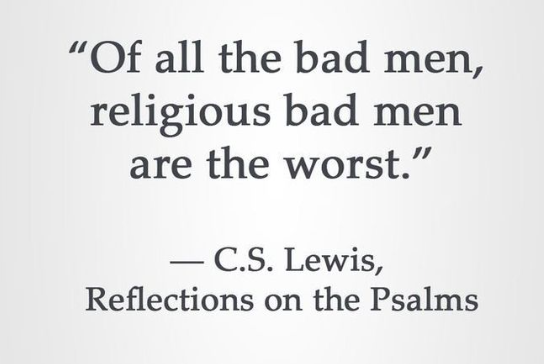
Quote from “Reflections on the Psalms” by C.S. Lewis
After publishing Part Five: Who are Men of God?, I received a comment from someone which, on the surface, seemed innocent enough. As the “conversation” progressed, it became obvious (although they denied it) that the person had ulterior motives. Perhaps a Christian man or men in a church hurt them in some way, or they have bought into the idea that Christian men are in general bad.
I decided not to tolerate such an attitude, but in retrospect, I realized that not all Christian (or Jewish or Muslim or any man of faith) men are good. Some do hide behind certain scriptures to justify their gad and ungodly behavior, so there is that. Also, as Christians, if we have done someone harm, we need to seek out their forgiveness.
A Man praying holding a Holy Bible. DUNCAN ANDISON/ADOBE STOCK
So far in this series, I’ve been addressing how to define a man, his purpose (from part four) and the struggles of men from mostly a secular viewpoint. I’ve also been leaning heavily on feminism because, in spite of what fourth stage feminism and general progressivism says, it’s very hard to bring one group up without tearing another group down.
Certainly, there has been a great need in some areas to support women but as I’ve previously said, any effort to “dismantle the patriarchy” ends up dismantling men as individuals and a group as well. One example is changing the Boy Scouts of America from a boys/men only group aimed at building and nurturing the next generation of men to an equity for all poster child, including girls/women because anything “all male” is always deemed “non-inclusive,” “patriarchy,” and “misogynistic.”
In other words, many of the goals of feminism are resulting in creating the toxic masculinity they are trying to exterminate.
By now I’m sure you have all heard of, if not seen (perhaps multiple times) the Barbie (2023) movie starring (and produced by) Margot Robbie and Ryan Gosling. Depending on who you talk to, it’s either “the most subversive blockbuster of the 21st century” (Rolling Stone magazine) or “Just a doll movie” (Whoopi Goldberg).
Women are often accused of being ‘overly’ sensitive. We’re told we need to stop taking things so seriously. May I direct your attention to the men getting unreasonably upset at Greta Gerwig’s film Barbie?
I’ve never seen the movie, and unless my eight-year-old granddaughter begs me to view it with her, I have no motivation to go. After all, I’m nearly seventy and a guy. Why would I want to see it?
Getty Images / found at cnn.com/2013/10/31/us/u-s-constitution-fast-facts/index.html
‘Now when you reap the harvest of your land, you shall not reap to the very edges of your field, nor shall you gather the gleanings of your harvest. And you shall not glean your vineyard, nor shall you gather the fallen grapes of your vineyard; you shall leave them for the needy and for the stranger. I am the Lord your God.
‘You shall not steal, nor deal falsely, nor lie to one another. And you shall not swear falsely by My name, so as to profane the name of your God; I am the Lord.
‘You shall not oppress your neighbor, nor rob him. The wages of a hired worker are not to remain with you all night until morning. You shall not curse a person who is deaf, nor put a stumbling block before a person who is blind, but you shall revere your God; I am the Lord.
‘You shall not do injustice in judgment; you shall not show partiality to the poor nor give preference to the great, but you are to judge your neighbor fairly. You shall not go about as a slanderer among your people; and you are not to jeopardize the life of your neighbor. I am the Lord.
‘You shall not hate your fellow countryman in your heart; you may certainly rebuke your neighbor, but you are not to incur sin because of him. You shall not take vengeance, nor hold any grudge against the sons of your people, but you shall love your neighbor as yourself; I am the Lord.
–Leviticus 19:9-18 (NASB)
Believe it or not, the Pastor at the little Lutheran church I take my elderly Mom to actually preached on this one today. He did compare Leviticus to a road in the desert, not being particularly interesting or worthwhile, which I didn’t appreciate, but then Christian Pastors don’t really study Torah.
Imagine hearing this announcement when you start off each day: “Welcome to your own broadcasting show. We’re on the air today and every day. We run from this moment on, for the rest of your life. You can’t shut off the show, but you can choose what to hear. We advise you to choose wisely. Don’t be upset with yourself if the show is not proceeding the way you wish. Instead, thank your mind for working. Be nice and friendly to it. And kindly and respectfully ask your mind to give you a truly great show today. Have a fantastic day, today and every day.”
If the above represents what you would like to hear on your own mental show, then you can choose it. If you would like to run a different show, just choose what you would like to hear.
Your mental broadcast can have any guest you want. What do you want your inner mental guests to say to you? What do you want them to speak about? Choose the subject that you would like your self-talk to be about, for as long as you’d like. You might want to hear a great interview with yourself and your ideals and values. You might want to hear a certain song or many songs that uplift you and help you feel good. You might want to hear a well-known story over again. This could be a story with a lesson that you really need to hear right now. It could be an inspiring story. It could even be an entertaining or a funny story.
If you find yourself broadcasting distressful ideas and thoughts, you can switch to uplifting and joyous ones. You can give yourself messages of hope right now and at any time you choose.
When you listen to recordings of speakers or speeches you like, you can be grateful for the opportunity to add their messages to your own mental library. Once those recordings are stored in your brain, you can access them as often as you like.
Be grateful to the Creator of your mind and your life for giving you your own broadcasting show. The quality of your life depends on the quality of your inner broadcasting show. Keep raising the quality of what you say to yourself, and you will live a happier life, full of self-development and self-empowerment.
-from Rabbi Zelig Pliskin’s book: “Conversations With Yourself”, pp.185
Sorry for the long quote, but I think once again that Rabbi Pliskin makes an excellent point.
I’ve been thinking a lot about this quote lately as it relates to the tremendous amount of negativity we experience, not only from broadcasts on news and social media, but from life experiences as well.
Recently in my small little corner of southwestern Idaho, we had a tragedy were a person from Los Angeles living in a local apartment complex, targeted a child’s birthday party and stabbed nine people, six of them being children. The little girl who had been celebrating her third birthday died a few days after the assault.
But I can’t be like that. I mean, if you have faith in God, if you try, however badly, to follow in the footsteps of Rav Yeshua (Jesus Christ), then you can’t just give up.
Believe me, I do have my days, though.
I’m a white, straight, “cisgender” (I still balk at that one for some reason), old, religious, conservative (relative to Idaho, I’m probably a moderate, but relative to hyper-liberal Seattle or San Francisco, I’m likely considered a fascist), married, Dad, Grandpa, male. In other words, for the pundits on twitter and Facebook, I’m public enemy number one, no questions asked.
Really, it’s like I’m not even a person anymore, just a “type.” In fact, it seems caring has stopped being about human beings, and is only conferred if those people belong to certain demographics.
Well, the little murdered girl I mentioned above was an immigrant from the middle east, and relative to the more liberal people who follow my doings on social media, when I posted about my outrage over her death, the only response I got was “crickets.”
I’m reminded of a quote from the original Star Trek series episode “The Immunity Syndrome (1968):
Spock (Leonard Nimoy): I’ve noticed that about your people, Doctor. You find it easier to understand the death of one than the death of a million. You speak about the objective hardness of the Vulcan heart, yet how little room there seems to be in yours.
But let’s turn that around. Are we only to care about the suffering of large groups, but never individuals? Are we only to care about someone because they belong to a disadvantaged group, or can we still care because they’re human. Can’t we care because a single child needlessly lost her life? Why do onlychildren separated from their parents at our southern border matter (and I’m not saying they don’t)?
A 3-year-old girl died on Monday after suffering a fatal injury during her birthday party outside her family’s Boise apartment complex. (Idaho GOP/Twitter)
I think Picard (Patrick Stewart) once said something about the value of mourning the loss of a single life, but I can’t find the quote after a quick Google search.
Negative messages come in unabated from the news, from social media, and from all around us.
It’s overwhelming, and yes, it engenders a sense of hopelessness.
That’s why I’ve been thinking about the good Rabbi’s quote. I’m not forced to plug the internet into my head. I don’t have to read or listen to or watch negative, hateful, spiteful messages from the world around me. I’m responsible for my own programming and my own self-definition.
So are you.
You may have noticed that people of faith are an easy target for those who feel they hold the moral high ground and are on the “right side of history.” You also don’t have to listen to them. Unless they live with you or are otherwise unavoidable, you can just unplug them.
I don’t recommend doing that permanently. I think it’s important to listen to and understand opposing opinions (unlike those folks who are living in their “save space” or believe that all opposing opinions must immediately be shouted down as “violence” or “hate speech”).
I think we all know that a large part of our self-programming is reading and studying the Bible, and yet, the Bible isn’t as easily and quickly accessed as social media. Given the choice, most of us will choose “the quick and easy path,” to quote Yoda when he discussed the Dark Side of the Force with Luke.
While we can’t ignore the world around us, we can take breaks from it. We can turn off the television, our computers, our smartphones, and otherwise turn off all of the negative, disheartening voices that are ever eager to attempt to overwrite us with their version of justice and morality.
In other words, if you are a negative voice in my life, I can turn you off and restore my peace of mind and spirit.
Human beings who feel like they are the final source for all morality, righteousness, mercy, and justice are terrifying, because believing that, they’re capable of any act, no matter how unjust and cruel, in their name of their own ego, or worse, the ego and highly flexible morals and values of the human race.
I know we religious people are accused of doing the same thing in the name of God, but as an Aish HaTorah Rabbi reminds us, religion is sometimes misused by selfish, greedy people, just as attacks on our faith are also a misuse and misapplication of the true nature of scripture and God.
If we continue to strive to become better disciples of our Rav, whatever part of us that may be guilty of what we are sometimes accused of must fall away. We can remake ourselves through our faith and allow the Spirit to remake us so that we more resemble our Rav in thoughts and deeds.
True, we will still be accused of all manner of crimes simply because of who we are or because someone once did something bad and claimed God told him or her to do it, but that’s not us. It’s not who we are.
We cannot communicate the sense of peace we achieve through our faith and the merit of our Rav if we allow outside influences to throw us into chaos. We can only communicate peace by being peaceful, and here’s the rub:
When people are in emotional pain, they tend to speak and act in ways that sound angry and aggressive. And if you, too, are in emotional pain, you are likely to speak to the other person in ways that he will perceive as angry and aggressive. Each person adds to the emotional pain of the other, and the distress of everyone involved keeps increasing.
When you are calm, it’s easier to see the emotional pain of others. That is when you can build up your attribute of compassion. The goal is to have so much compassion that even when you personally are experiencing emotional pain, you are able to be sensitive to the emotional pain of the person with whom you are interacting.
Coming from a place of compassion you will be able to address the thoughts and feelings of the other person in a way that alleviates his distress. Then he is more likely to speak and act more sensibly and reasonably towards you.
-from Rabbi Zelig Pliskin’s book: Harmony with Others, p.130
When people are angry at us for whatever reason, and we feel pain because if their behavior, we must understand they are in pain, too. Being in pain doesn’t justify unkind, cruel, and unjust responses, and we don’t have to let ourselves be mischaracterized, but it might be a good idea to get past the other person’s anger and discover their pain. Then we’ll have a much better platform on which to build communication.
Take care of yourself. Associate with like-minded believers so that you can support each other. Try (and this is difficult) not to reflexively react when someone in person or (more likely) in social media insults you, either individually or because you belong to some “type” they don’t like, don’t understand, or have been conditioned to despise.
We’re here to help make the world a better place, but if we let the world tear us down, we will have failed.
It starts with being grounded in the Word and in our Rav. His peace can be ours. It just takes a lot of practice.
Try unplugging sometime. I think it will help. It does me.
"When you awake in the morning, learn something to inspire you and mediate upon it, then plunge forward full of light with which to illuminate the darkness." -Rabbi Tzvi Freeman








 Morning Meditations