Tag Archives: Bible

Lancaster’s Galatians: Sermon Four, Wind and Sail

wind-sky-spirit-ruachAll Scripture is breathed out by God and profitable for teaching, for reproof, for correction, and for training in righteousness…

2 Timothy 3:16 (ESV)

Is given by inspiration of God – All this is expressed in the original by one word – Θεόπνευστος Theopneustos. This word occurs nowhere else in the New Testament. It properly means, God-inspired – from Θεός Theos, “God,” and πνέω pneō, “to breathe, to breathe out.” The idea of “breathing upon, or breathing into the soul,” is that which the word naturally conveys. Thus, God breathed into the nostrils of Adam the breath of life Genesis 2:7, and thus the Saviour breathed on his disciples, and said, “receive ye the Holy Ghost;” John 20:22. The idea seems to have been, that the life was in the breath, and that an intelligent spirit was communicated with the breath. The expression was used among the Greeks, and a similar one was employed by the Romans. Plutarch ed. R. 9:p. 583. 9. τοὺς ὀνείρους τοὺς θεοπνεύστους tous oneirous tous theopneustous. Phocylid. 121. τῆς δὲ θεοπνεύστου σοφίης λόγος ἐστὶν ἄριστος tēs de theopnoustou sophiēs logos estin aristos.

Barnes’ Notes on the Bible for
2 Timothy 3:16

You may be wondering how this connects to my ongoing discussion with Pastor Randy about D. Thomas Lancaster’s book The Holy Epistle to the Galatians. The answer is, “not much.” Frankly, we started our discussion last night with trying to clarify his thoughts on Divine Election (Pastor has a paper he wants to loan me that describes all of the various positions), but then moved to how we can understand the Bible (Pastor has some reservations relative to how Lancaster derives certain conclusions in his book from the Galatians text). We addressed Sermon Four of the book eventually, but it didn’t occupy the significant portion of our time together, nor was it the most compelling topic upon which we touched.

Going back to “God-breathed,” Pastor said that the Greek word used has the implication of wind filling a sail and pushing the boat along (Correction, according to Pastor Randy’s comment below, “the phrase about ‘the wind filling a sail’ has to do with the II Peter 1:21 passage and the meaning of men being ‘carried along by the Holy Spirit’.” See the following quote). He told me he believes that as God gave His inspiration to the human writers of the Bible, the authors did not say anything, at least as originally given in their manuscripts, that contradicted what God intended.

And we have the prophetic word more fully confirmed, to which you will do well to pay attention as to a lamp shining in a dark place, until the day dawns and the morning star rises in your hearts, knowing this first of all, that no prophecy of Scripture comes from someone’s own interpretation. For no prophecy was ever produced by the will of man, but men spoke from God as they were carried along by the Holy Spirit.

2 Peter 1:19-21 (ESV)

People, that is, prophets and those people who have written the Word of God we have in our Bible, did not hear something from God and then interpret what it meant through their own intellect and emotions. God used their personalities, their vocabulary, their style of writing, their perceptions to craft His message, but the message was and is His message, not the prophets’, and the message “carried them along” as it was first given and recorded in the original documents, and the message was and is exactly what God meant to say and meant to carry us along as well.

But then we have a problem.

We don’t have the original documents…any of them.

Also, Bible reading and translation is an enormously complex task.

According to Pastor Randy, and I agree with him, we have to start with what the text literally says. We also have to apply the immediate context of the scripture, not taking it out and making it stand on its own. Beyond that, we have to consider the history, the culture, and the circumstances in which the scripture was written. On top of that, we have to connect the scripture to the larger context of the entire Bible, including other times when similar circumstances were mentioned and similar or identical wording was used. If, for instance, in describing the two greatest commandments (see Matthew 22:37-40), Jesus references Deuteronomy 6:5 and Leviticus 19:18, in understanding the Matthew 22 passage, we must also take into consideration the context, history, culture, and circumstances in which Deuteronomy 6 and Leviticus 19 take place, including the author and his personality, vocabulary, style of writing, and personal experiences. We cannot separate what Jesus was trying to say from what Moses was trying to say, however Jesus and all that was in play when he was talking may modify the original meaning, giving it a somewhat different shape, color, and texture.
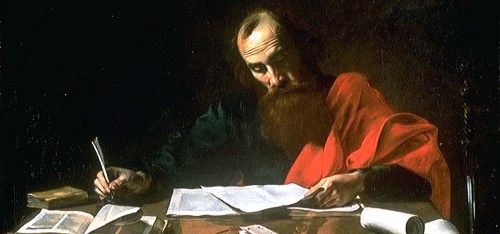
paul-editedOh, and let’s not forget the intended audience. Moses may not have been aware that what he was writing was ultimately intended for the entire world, but we realize that God has a greater scope. Jesus may well have understood that his words would eventually be consumed by all of humanity across time, but his immediate audience, like Moses’ was the Jewish people or more specifically in Jesus’ case, the Pharisee he was addressing at that particular moment.

We must take all that into consideration when reading the Bible and seriously attempting to understand its message.

And we must constantly remind ourselves that it is all God-breathed.

Pastor Randy and I spent most of our time together exploring how to understand the Bible, with the promises and pitfalls built into such an effort. We discussed how we don’t necessarily have to “reinvent the wheel,” since many people have read and observed the literal meaning of the text from a variety of perspectives, and it would be irresponsible of us to disregard their work and rely only on our own. Pastor described how he approaches understanding texts looking at those who came before him. He reads a variety of expert analyses and takes into consideration what the scholars they did and didn’t take into consideration.

For instance, a particular writer may have a good grasp of the original language but not sufficiently address the history involved, or another writer may have a good handle on the historical context, but not the cultural context. Pastor said he looks at the various scholarly opinions in that manner and ultimately settles on which one he…wait for it…

…which one he likes best.

What?

Pastor Randy is a literalist, an educator, a scholar, a linguist, and is very serious about pursuing as accurate an understanding of the Bible as he can achieve, but after much discussion we agreed that even under the best of circumstances and intentions, there will always be this little, fuzzy, grey, area in the middle of our understanding where we fill in the blanks with our own personalities.

Geordi La Forge (played by Levar Burton): I don’t know, Data, my gut tells me we ought to be listening to what this guy’s trying to tell us.
Data (played by Brent Spiner): Your gut?
Geordi: It’s just a… a feeling, you know, an instinct. Intuition.
Data: But those qualities would interfere with rational judgment, would they not?
Geordi: You’re right, sometimes they do.
Data: Then… why not rely strictly on the facts?
Geordi: Because you just can’t rely on the plain and simple facts. Sometimes they lie.

-from the Star Trek: the Next Generation Episode
The Defector (original air date 30 Dec. 1989)

In the scene from which I just quoted, Data concludes that in any meaningful analysis, the observer must fill in whatever blanks there are in the facts and other available information with their personality. In Data’s case, he was in a bind because effectively, he had no personality. All he had were the facts. By the way, it turns out Geordi’s “gut” was wrong. The defector in question had been fed disinformation by his superiors to mislead the Enterprise and ultimately to provoke a war. Fortunately, Picard’s “gut” proved to be more accurate and the ruse was exposed.

All this doesn’t mean that we can never understand the Bible or that we should always equivocate on its meaning, but we should be a little less than one-hundred percent certain that we always know what everything in the Bible means all of the time.

It also means that when we realize we’ve made a mistake based on subsequent study and analysis, we should admit it.

Pastor Randy says that’s one thing he admires about Boaz Michael, President and Founder of First Fruits of Zion (FFOZ). When Boaz and the organization came to the conclusion, several years ago, that they had made a significant error in understanding what the Bible said in relation to Jewish and Gentile covenant responsibilities to God, after much prayer and soul-searching, he announced that FFOZ was making a major shift in its theological and doctrinal position. Boaz knew it would cost FFOZ much of its income and might even result in the organization collapsing completely. Thank Hashem that the latter did not occur, but many sacrifices had to be made. Sadly, to this day, Boaz and his group continue to be severely criticized and harangued by their detractors as a consequence.

That’s the price of integrity and following God where He calls you to go. That’s also part of the ongoing struggle of understanding God through His Word and maturing as people of Spirit and of faith.

ancient-sail-boatI tried to get Pastor Randy to say that you can have a room full of people with equal intelligence, equal qualifications, all people of good character, and they could still disagree with each other on what parts of the Bible mean, but he wouldn’t go for it. He said that we’re all human and we’re all capable, not just of making mistakes, but of following our own human desires. We all can and do sin.

Does that mean there is only one right person (or close-knit group of people) who understands the Bible correctly and it is because he or she is the best person morally and ethically that their understanding is right? Does that mean all of this person’s critics are liars and haters who purposely want to bring the “right” person down in order to elevate their own agendas?

I don’t think it’s that simple. I think that you can gather a group of people together who are of good will and intent who will disagree. Sure, some of the people in that room will be liars and haters, but they should be easily spotted by their lack of integrity and good character (their fruits) in how they treat others and how they walk with God. Even the best of us can allow our personal, pet theories and biases affect our judgment. We all want to be right and to be admired and respected.

But at the end of the day, the best of us (and I’m hardly saying I’m among the best) will put all that aside, suck it up, and make the hard call, even if it costs them, because that’s just what God’s true servants do. Once we realize that the evidence is solid about some piece of scripture, even if it’s not what we want it to mean, we’ll go forward and accept it and embrace it, because that’s part of who we are if we are disciples of our Master. We’ll also continue to study, to learn, and to mature, because God continually breathes in us.

For a ninety minute conversation, last night’s talk with Pastor Randy inspired a lot in me that I could write about…and maybe I will, but I won’t try to cram it all into a single “meditation” today.

But I do want to be a sail. And I do want to be available to the wind. And I do want to let my sail conform to the wind, to the shape it causes me to manifest, to the direction it drives me, toward the destination to which it guides me.

I don’t know yet what distant and alien shore God has planned for my future, but I can feel His hand on me. Do I have the integrity and courage to let Him take me where He wants me to go? I hope so. I pray to possess those qualities that I may serve Him…even in something as “simple” as reading the Bible.

Pastor will be out of the country for the rest of April so naturally, we won’t be meeting each Wednesday evening for the next several weeks. We’ll revisit Lancaster’s Galatians next month and reformulate our study plan for the book…I promise.

In the meantime, I’ll try to continue writing in the spirit of what my Pastor, and ultimately God, provokes in my mind and heart, and move forward with integrity and purpose. Unfurling my sail and setting my course for uncharted seas as the wind sends me forth.

Moral vs. Legal Imperatives and Marriage Equality

same-sex-marriage2Supreme Court justices seemed skeptical of creating a new federal right to same-sex marriage as they grilled lawyers this morning in a potentially landmark case over California’s ban on gay marriages.

As the politics change by the day, the court heard a case — Proposition 8 — that could drastically change how states and the federal government approach one of the touchiest social issues of the past decade.

The justices today challenged lawyers on both sides on common points of contention that arise whenever gay marriage is debated.

-Chris Good, Terry Moran, Ariane DeVogue, and Sarah Parnass
“Supreme Court Justices Struggle with Federal Right to Gay Marriage”
ABC News

I shouldn’t do this. I shouldn’t write one single word about this subject. I’m going to get in trouble with just about everyone when they read this. My Pastor reads my blog. My Mother reads my blog. Boy, am I in for it.

Then why I’m I writing this? I’m tempted to write it because the news media is just plain shoving it down everyone’s throat today. I can’t get away from it. Even other religious blogs are demanding Christians support same-sex marriage. But then, this is really is big news, regardless of which side of the fence you’re on. It will affect not only the state of “marriage equality” in California as related to Prop. 8, but potentially the “rights” of same-sex couples to become married in all fifty states (I put “rights” in quotes because of the question, can something be a “right” that hasn’t been established as such yet? But I digress).

But that’s not the reason I’m writing this. I’m a Christian. I’m kind of unconventional, but my general stance on homosexuality is that the Bible doesn’t support it. However, like most Christians, I can’t always immediately point to my source data in the Bible. So I guess I’d better go looking for it.

Thanks to Google, the search is brief, if not particularly focused. I land on a site called ChristianBibleReference.org and an article called, “What Does the Bible say about Homosexuality?”

I won’t quote everything, but they provide a handy bullet point list for reference:

  • 2 refer to rape (Genesis 19:5, Judges 19:22)
  • 5 refer to cult prostitution (Deuteronomy 23:17-18, 1 Kings 14:23-24, 15:12-13, 22:46, 2 Kings 23:6-8)
  • 1 refers to prostitution and pederasty (1 Corinthians 6:9-10)
  • 4 are nonspecific (Leviticus 18:21-22, Leviticus 20:13, Romans 1:26-27, 1 Timothy 1:8-10)

OK, let’s consider a few things. Any references in the Torah or the entire Tanakh (Old Testament) that specifically prohibit homosexual behavior are within the context of the laws and statutes that apply to the Children of Israel. While God may or may not disdain homosexual behavior for all human beings in general, the Tanakh prohibitions don’t apply to all human beings in general. They apply (there may be exceptions, but for the most part) to the Jewish people; the inheritors of the Sinai covenant.

So if you’re not part of that covenant by birth or conversion, then those laws don’t apply to you.

Stay with me. I’m just getting started.

What about the New Testament?

Therefore God gave them up in the lusts of their hearts to impurity, to the dishonoring of their bodies among themselves, because they exchanged the truth about God for a lie and worshiped and served the creature rather than the Creator, who is blessed forever! Amen.

For this reason God gave them up to dishonorable passions. For their women exchanged natural relations for those that are contrary to nature; and the men likewise gave up natural relations with women and were consumed with passion for one another, men committing shameless acts with men and receiving in themselves the due penalty for their error.

Romans 1:24-27

Now we know that the law is good, if one uses it lawfully, understanding this, that the law is not laid down for the just but for the lawless and disobedient, for the ungodly and sinners, for the unholy and profane, for those who strike their fathers and mothers, for murderers, the sexually immoral, men who practice homosexuality, enslavers, liars, perjurers, and whatever else is contrary to sound doctrine,

1 Timothy 1:8-10

Christian-Campus-GayThere are other scriptures that address sexual immorality (which in some cases may or may not be specific to homosexuality) in the New Testament, but these are two of the most “damning.”

But in my brief Google search, I did find a blogger who wrote an article called Why The Bible DOES NOT Forbid Homosexuality. He provided a defense based on Romans 1 and basically ignored 1 Timothy 1 or many other NT scriptures, relying on statements citing other sources such as the following:

Homosexuality, like heterosexuality, is a sexual orientation. Sexual orientation deals with a person’s sexual attraction to another person’s sexual organs.

In first century, Roman imperial culture, homosexual sex was a fairly common practice but only as a specific, social function.

The blog author tried to link the latter quote with the “neither male nor female” portion of Galatians 3:28 but bottom line, I wasn’t convinced. He was heavy on history and social commentary but light on providing a clear illustration of how the Bible was either neutral on the topic or even “pro-gay.” The blog post is almost a year old and has 67 responding comments, all of which I have not read. I’m not interested in joining that particular debate (which ended last November with the last comment) and it’s certainly not the point of what I’m writing today.

The general moral and ethical structure of Christianity is taken largely from Judaism. How can it not, since Christianity has grown and evolved from the first century Jewish sect known as “the Way?” Therefore, I wouldn’t expect Jesus, Paul, or the rest of the apostles to teach moral and ethical principles that differed significantly from their “source material,” the Torah. Therefore, it’s unlikely that Jesus and his followers would have taught a social/sexual practice that was different and specifically not one that reversed something that appears quite plain in the Torah. Why would they?

Of course, many people are quick to point out that Christianity doesn’t follow the kosher laws either and that Jacob had twelve wives, and Solomon had more wives and concubines than you could shake a proverbial stick at, so can Christianity reasonably reach back into the Torah for its binding principles?

It gets complicated in the explanation, but Jesus was specific in saying the following:

And Pharisees came up to him and tested him by asking, “Is it lawful to divorce one’s wife for any cause?” He answered, “Have you not read that he who created them from the beginning made them male and female, and said, ‘Therefore a man shall leave his father and his mother and hold fast to his wife, and the two shall become one flesh’? So they are no longer two but one flesh. What therefore God has joined together, let not man separate.”

Matthew 19:3-6

So Jesus is defining marriage specifically between a man and woman and not allowing any “wiggle room” for two men or two women. Yes, he was talking to a Jewish audience, but this is one principle that has been extended to the non-Jewish disciples of the Master (i.e. Christians). I know there are Christians and Jews who hold religious beliefs that accept homosexual behavior and include support of “marriage equality,” but we need to be careful not to mix and match principles of faith with political correctness or even secular law.

Which brings me to a couple of points, one of which I mentioned above. If the Torah forbids homosexual behavior, it does so within the context of the covenants that apply to the Jewish people, specifically the Sinai covenant. If you are not Jewish, then the Torah doesn’t apply to you since you’re not a covenant member. End of story.

abraham-covenant-starsChristianity has a covenant relationship with God based on a portion of the Abrahamic Covenant (Genesis 12:1-3) which was extended by the New Covenant (Jeremiah 31 and Ezekiel 36) and then applied by the Messiah in the Gospels (see Luke 22:17-20 for instance). Unlike Jews, Christians are not born into a covenant relationship with God. We must choose to become Christians. Once we do, then we are bound by the covenant and all that it contains, which traditionally includes a prohibition against homosexual behavior.

But if you aren’t Jewish and you aren’t a Christian, you aren’t a covenant member and therefore, the “rules” don’t apply to you. It’s arguable that the Noahide Laws, which at least Orthodox Judaism considers binding on literally everyone, prohibits homosexuality as one of the forbidden relationships, but that definition is set by religious Judaism and if you don’t buy into that, you aren’t going to feel too “bound” just because you’re a human being.

(In the end, God has the right to judge everyone, covenant member or not, but that’s not the point of today’s missive.)

What I’m getting at is that if a person isn’t a recognized member of a covenant relationship with God, can you as a religious Jew or a Christian actually make them responsible for upholding moral and ethical behaviors defined by your beliefs? If you consider homosexual behavior a sin and there are secular gay people in the world, how are they any better or worse than say, a secular bank robber or (heterosexual) adulterer?

I suppose gay readers or readers who support gay rights might be chafing at this point in my narrative, but I’m speaking to a religious audience from within that context. I understand you do not equate a man loving another man with a man robbing a bank or a man cheating on his wife.

Now to my other point.

Whatever the Supreme Court does or doesn’t do has nothing to do with your faith.

A number of important laws in our country, and in most countries, more or less mirror what we read in the Bible. The Bible has a commandment against murder. Generally, murder is illegal in this country. The Bible is against stealing. We have laws against stealing. But we also have a lot of laws that range from morally ambiguous to just plain crazy from a Biblical point of view. What do you do about laws permitting marijuana use in some states but not others? What do you do about the legality of heterosexual marriage in general when the first man and woman in Genesis presumably weren’t married? How the U.S. Supreme Court interprets the Constitution today would probably have driven the Founding Fathers insane, so how can we reconcile the Bible to laws in the United States of America in the 21st century?

Religious Jews and Christians historically have lived in nations where the penal and civil laws did not completely (or sometimes in any sense) match up with the religious “laws” of Jews and Christians. Where do we get the idea that the Supreme Court has to interpret the Constitution in a way that makes us feel comfortable and is consistent with our definition of marriage?

My personal opinion is that it is only a matter of time until our nation permits homosexual marriage in all fifty states (whether individual states want to permit it or not). As an American citizen, I have feelings about that, but as a Christian, can I impose my morality on the law of the land? Yes, the law of the land imposes itself on me because I’m an American citizen, but if the law permits a man and a woman to live together and have a sexual relationship, and that is also against my religious beliefs, why am I not protesting or complaining about that?

I know someone is going to mention abortion which is A) legal, and B) generally against Christian moral principles, but if you believe life is sacred and you believe life begins at conception or at some point before 10 or 20 weeks gestation, then you also believe that aborting an unborn child is killing a baby.

Another “unpopular” subject to be sure but it is a subject for another time.

same-sex-marriage4If the Supreme Court rules that it is unconstitutional for the State of California (and this decision will affect all other states ultimately) to pass a law forbidding same-sex couples from marrying, what am I as a Christian supposed to do about it? Can I hold the world around me to the same moral standards to which I hold myself?

I know I’ve probably upset everyone who has managed to make it through this lengthy article. It was not my intent and I didn’t write this just to be a pest. I’m trying to process this information within myself (which is why I write most of my blogs) and I’m trying to present an alternate point of view, one that doesn’t say “all gays are good” or “all gays are bad” either because that’s how I may feel on a visceral level or because I believe that’s what the Bible is saying to me.

I have a responsibility to God to live my life in a manner consistent with my faith and my beliefs. If my brother or sister in faith appears to be stumbling, I believe I have a responsibility to gently point out that they may have a problem and to offer to help them.

But if someone outside the faith appears to be having a moral problem, what is my responsibility (however, if I see, for instance, a secular man beating his child, the state of his faith is irrelevant and I do have a responsibility to protect the innocent)? If my nation is passing laws that appear to have a moral problem but otherwise aren’t the equivalent of making it legal for adults to beat children, what is my responsibility?

I’m not an attorney, but I have racked my brain trying to look at the marriage equality issue from a strictly legal perspective, temporarily putting aside both my faith and my visceral response.

I can’t find a legal reason to forbid such unions, regardless of my moral stance. So now what do I do?

Let the “hate mail” begin.

God in the Dark Wasteland

desert-at-dusk“If you want to truly understand something, try to change it.”

-Kurt Lewin, German-American psychologist

The Hebrew word “midrash” literally means “research” or “investigation,” but through rabbinic usage the term has come to mean “the investigation of scripture.” A commentary on scripture, a piece of scriptural exegesis, a veiled allusion to a scriptural passage, a retelling of scriptural material – all these are called midrash (in plural, midrashim). The term has become so popular in recent years that in modern parlance it is virtually synonymous with “exegesis,” and any textual interpretation that is not absolutely true to its source is dubbed “midrash.” (And since – according to modern literary critics – no textual interpretation can be absolutely true to its source, all textual interpretation is midrash.)

-Shaye J.D. Cohen
Chapter 6: “Canonization and Its Implication: Scriptural Interpretation”
From the Maccabees to the Mishnah, Second Edition (Kindle Edition)

Midrash is one of those forms of Biblical interpretation where Judaism and Christianity seem to part company. From some extreme perspectives existing outside of Judaism, midrash seems equivalent to “flights of fancy” or even “creative fiction.” On the other hand, according to Cohen, the word “midrash” occurs twice in the Tanakh (Old Testament): “the midrash of Iddo the prophet” in 2 Chron. 13:22 and “the midrash of the book of kings” in 2 Chron. 24:27. Both of these works are lost and Cohen states that these ancient “midrashim” should be considered closer to “stories” or “histories”  rather than the later use of the term as exegesis.

The Greek word “historia” has the same literal meaning as “midrash,” but is more commonly used to describe a “research” or “investigation” into history or the past rather than into scripture.

When used in its verb form “darash,” it refers to people seeking or inquiring of God, but where in Biblical times, the Hebrews sought God directly, once Torah and the Prophets had been canonized in the Second Temple period and into the common era, it meant Jews seeking God through Torah.

Believe it or not, everything I’ve said so far can be applied to Christianity (and not just Catholicism, either) and if you’ll be patient, I’ll explain.

One of the most “objectionable” uses of the midrashic process from the church’s point of view (including the variants that exist under the general category of “Hebrew Roots”) is how the Rabbinic sages seem to shift the meaning and application of the Torah commandments over time.

Perhaps the most radical function of scriptural exegesis was that it allowed Jews to affirm undying loyalty to a text written centuries earlier for a very different society living under very different conditions.

A living culture cannot live in accordance with the dictates of an immovable text. Either a way must be found to introduce flexibility into the text, or the text sooner or later will have to be rejected. In the United States, the interpretations of the Supreme Court allow the government to function in accordance with a document written by a group of eighteenth-century politicians. The Supreme Court interprets the Constitution, but, of course, routinely interprets it in a manner that would have amazed the Founding Fathers. No matter. Historians must try to determine what the Constitution meant in its eighteenth-century context, but the Supreme Court must determine what it means for contemporary society. Rather than write a new constitution every few generations, the United States authorizes the Supreme Court to misinterpret the Constitution for the common good. Similarly, the Jews of antiquity routinely misinterpreted (the usual euphemism is “reinterpreted”) scripture to remove laws and ideas they found objectionable, and to introduce laws and ideas that answered their own needs.

-Cohen, ibid

rabbis-talmud-debateMy, but doesn’t that sound incredibly cynical. But what if it’s true? I know that in many forms of religious Judaism, it is commonly accepted that God gave humanity (specifically through the Rabbis) the ability to interpret Torah for each generation so that the commandments could be applied in a manner that was relevant to the lives of the Jews of that generation. I suppose, depending on your point of view, this process could also justify more than a little “social engineering” within certain sects of Judaism, just as the Supreme Court in the current day seems to be interpreting the Constitution in accordance with the social and political needs of the prevailing “politically correct” perspective (I promise I won’t get “political” except in passing).

As I said before, Christians, especially those who subscribe to a sola scriptura viewpoint on Biblical interpretation, tend to take a dim view of all this “creative exegesis” of the Bible. But on the other hand, it’s not like Christianity has completely clean hands, either.

The identification of biblical laws and heroes with philosophical principles and moral qualities is known as “allegory.” This type of exegesis found a secure home in Christianity, and became one of the favored ways for explaining why Christians do not obey the laws of the Old Testament. Since Christians obey the allegorical meaning of the laws…they need not obey the literal meaning…In fact, some Christian polemicists in the second century argued that the laws were never even intended to be followed literally.

The early Christians believed that the messianic prophecies of Isaiah were “fulfilled” through Jesus, but most other Jews did not agree.

-ibid

In that last statement, Cohen, in referring to “early Christians,” is talking about the Jews in the Messianic sect of Judaism known as “the Way,” and he is applying a fairly traditional interpretation of what the “Jewish Christians” believed based on popular Christian theology (the Law was “nailed to the cross” and so on).

But as far as agreement and disagreement goes, Cohen brings up a good point.

All Jews who affirmed the validity of scripture had to engage in exegesis. They did not always agree – the Sadducees rejected the traditions of the Pharisees – but all were involved in the same activity.

Guess where we are today?

Although allegory isn’t the only wrench in the Christian toolbox anymore, we still employ more than a little “creative interpretation” in our theology/theologies. If we didn’t and if we didn’t have a long, long history of doing so, “Christianity” would probably still look a lot more “first-century Jewish” than it does today (which is to say, it doesn’t look Jewish at all anymore).

new-testament-allegoryOf course, if we remove the “allegory” wrench from the second-century Christian toolbox, does that mean the non-Jewish Christians (Cohen is assuming that all “Christians,” Jewish and otherwise, set the Law aside, but I’ve presented enough evidence on my blog, including comments by New Testament scholar Larry Hurtado, showing that Paul had no problem with Jews in Messiah leading a completely consistent Torah life…he only had a problem with forcing the Gentile disciples to Torah obligation) should be obeying “the Law” today?

For lots and lots of reasons, which I’ve chronicled at length in my Return to Jerusalem series, I don’t believe so. I do believe that the non-Jewish disciples of the mid to late first-century and into the second most likely “kept” a lot more Torah than most Christians believe or could tolerate, but that they weren’t obligated in the same manner as the Jews. Many of them no doubt observed the Shabbat in some manner, kept kosher or at least attempted to, prayed at the set times of prayer, read and studied the Torah and the Prophets, and when they could, read Paul’s letters or if he was present, listened to his spoken paradosis on the teachings of Jesus.

But the schism that began even in the days of Paul, and that widened dramatically in the following several centuries, finally sent Judaism and Christianity off on two separate trajectories across history. Derek Leman believes that “actual communities of Messianic Jews between about 500 and 1735 CE are very rare, approaching negligible,” but I suspect they didn’t exist at all, leaving a multi-century gap in history when no Jewish person kept a faith of any sort in Jesus as the true Messiah King.

Christians see “Rabbinic Jews” as being hip-deep in midrash, commentary, rulings, laws, judgments, and legal minutiae that would “cross a Rabbi’s eyes,” but the church has the same “problem.” We just hide it better. More to the point, we fail to consciously acknowledge that when we interpret the Bible, we are doing it looking through rose-colored glasses or rather “Church-colored glasses.”

I’m not saying this to be mean, but rather to be accurate. Human beings don’t have unfiltered access to the Bible. Most of us don’t read Biblical Hebrew and Greek and even if we did, we don’t have the original, original texts at our disposal. And even if we did, we would still have to work our way through layers and layers of social programming, theological history, and personal bias before we could access not only the text as it is (or was) but the context in which it was written, including the social programming, theological history, and personal bias of the people who wrote the Bible.

Oh yeah, the Holy Spirit. No, I didn’t forget. But my personal theory (here’s my own bias) is that the Spirit just didn’t dictate the Bible into the ears of the Bible writers, but through some fashion, “partnered” with them to create a collaborative effort, which is why we have the different books of the Bible written in different styles, perspectives, genres, and so on.

Thus, I’m disinclined to give the “Rabbinic Jews” and “Jewish midrash” too much of a hard time for manipulating and “misinterpreting” the scriptures so they’ll fit each generation when, as far as I can tell, Christianity…all of Christianity, is guilty of the same thing to one degree or another.

I know there are a few churches out there that make claim to “absolute truth.” I know a few of them believe they exist in a direct, unbroken line from the first apostles until the present day without change, and are the only “true church.” My personal opinion of that perspective is a semi-polite “baloney.” It think each and every one of us and the religious institutions to which we belong are blindly searching for God while locked in a room that is completely blacked out. We’re crawling on our hands and knees trying to feel for the key that will get us out of there, or are running our palms along the walls hoping we’ll stumble across the light switch.

My advice to anyone who believes that Jews are hopelessly mired in midrash or that Christians are trapped in the web of useless allegory is to dial down the claims to absolute truth you’re making and consider your own position. It might be on your hands and knees in a room with no lights.

silhouette-of-woman-in-sunset-partNo, it’s not that hopeless, otherwise I’d never be able to find faith and hope in my own dark room. If we can’t find the illumination we need and frankly should be emitting, I think we can still find a tiny spark or the nearly infinitesimal flicking flame from our last candle. Or is it really the glare from a blinding searchlight and we’re just too blind to see God’s light for what it really is? Maybe that’s what theology, bias, prejudice, and social programming has done to us. Walled us in and shut God out. Or is it the other way around?

It doesn’t matter. Abraham was justified by faith and maybe that’s what we’ve forgotten. Faith works under any circumstance. It works in the darkest night and in the brightest day. It works up high and down deep. It works when we’re experiencing glorious joy and when we’ve sunk into the unending abyss of despair and loneliness. It works when we offend people and when we feel negligible and insignificant.

Someday we’ll know but until then, while we may be doing quite a bit of guessing, we can still cry and bleed and pray to God that He will allow us a brief encounter with Him. We can hope that the encounter will be gentle and not mind-rippingly overwhelming. We can trust that He’ll have pity on us…poor, blind, naked, stupid human beings who think we’re a whole lot more cool and smart than we really are.

Your religion and mine aren’t the point. What we know and whether or not we can “prove” we’re smarter than the other guy and his religion isn’t the point. At the end of the day, we are each of us one person alone, naked, standing in the desert, watching the last glow of the sun rapidly diminish below the sandy, wind-swept horizon. It gets very dark and cold in the desert at night. There are scary things out there. How can we ever hope to survive even for a single hour…unless we expect to encounter God by faith while standing in the dark wasteland of our lives?

Today I shall…

…try to recognize my self-worth, while being aware that my strengths are a Divine gift. I am no better than any of God’s creatures, and I should not allow barriers to develop between myself and them.

Rabbi Abraham J. Twerski

Searching for the Writer of Life

writer-of-lifeThe Jews recognized that God no longer spoke to them in the same way as in the past. The prophets who persisted in seeing heavenly visions and hearing heavenly voices saw and heard in a manner very different from those of earlier times. As a consequence (cause?) of the cessation or permutation of prophecy, the Jews began to seek the word of the Lord not from people but from texts. The sacred traditions of the past were compiled and redacted, and the Torah was created. The words of the great prophets of the past were similarly compiled and redacted. This process, whose ultimate result was the formation of the Bible, raised two important questions. First, which books were to be considered canonical? Second, how were the canonical books to be interpreted, and who was authorized to interpret them?

-Shaye J.D. Cohen
Chapter 5: Sectarian and Normative, pg 126
From the Maccabees to the Mishnah, 2nd Ed

It is one of the oldest puzzles in the world. Investigators have been wrestling with it practically since the Bible was completed. As it happens, it did not start as an investigation into the authorship of the Bible. It simply began with individuals raising questions about problems that they observed in the biblical text itself. It proceeded like a detective story spread across centuries, with investigators uncovering clues to the Bible’s origin one by one.

It began with questions about the first five books of the Bible: Genesis, Exodus, Leviticus, Numbers, and Deuteronomy. These books are known as the Pentateuch (from Greek, meaning “five scrolls”) or the Torah (from Hebrew, meaning “instruction”). They are also known as the Five Books of Moses. Moses is the major figure through most of these books, and early Jewish and Christian tradition held that Moses himself wrote them, though nowhere in the Five Books of Moses themselves does the text say that he was the author. But the tradition that one person, Moses, alone, wrote these books presented problems.

-Richard Elliott Friedman
Introduction: Who Wrote the Bible? pp 15, 16-17
Who Wrote the Bible?

Yes, this is a continuation of yesterday’s morning meditation. I was prompted by the mention of Friedman’s book on Derek Leman’s blog post to check and see if my local public library had a copy available. It did and so I checked it out over my lunch hour (I work about a ten minute walk from the Boise Public Library’s main branch).

Depending on your thoughts and feelings about the origins of the Bible we have today, this could be dangerous stuff. In fact, questioning the traditions we have about the Bible has historically been very dangerous stuff.

At the first stage, investigators still accepted the tradition that Moses wrote the Five Books, but they suggested that a few lines were added here or there. In the eleventh century, Isaac ibn Yashush, a Jewish court physician of a ruler in Muslim Spain, pointed out that a list of Edomite kings that appears in Genesis 36 named kings who lived long after Moses was dead. Ibn Yashush suggested that the list was written by someone who lived after Moses. The response to his conclusion was that he was called “Isaac the blunderer.”

-Friedman, pp 18-19

But that’s not the half of it.

He (Bonfils) still thought that the passages in question were written by “one of the later prophets.” He was only concluding that they were not written by Moses. Still, three and a half centuries later, his work was reprinted with the references to this subject deleted.

Van Maes suggested that a later editor inserted phrases or changed the name of a place to its more current name so that readers would understand it better. Van Maes’ book was placed on the Catholic Index of Prohibited Books.

De la Peyrere’s book was banned and burned. He was arrested and informed that in order to be released he would have to become Catholic and recant his views to the Pope. He did.

Spinoza had been excommunicated from Judaism. Now his work was condemned by Catholics and Protestants as well. His book was placed on the Catholic Index, within six years thirty-seven edits were issued against it, and an attempt was made on his life.

Simon was attacked by other Catholic clergy and expelled from his order. His books were placed on the Index. Forty refutations of his work were written by Protestants. Of the thirteen hundred copies printed of his book, all but six were burned.

-Friedman, pp 18-21

jewish-traditionAt least up to the 17th century, it was worth your life to suggest that Moses didn’t literally write every single word that appears in the first five books of the Bible. Jewish, Catholic, and Protestant tradition vehemently defended this viewpoint and if you were a scholar who studied such matters, it was better to keep any opinions that deviated from tradition strictly to yourself.

But what about now? Are we as a body of believers more tolerant of serious, scholarly study of the Bible?

The answer is probably yes and no. I don’t believe that anyone in the modern era has ever been put in prison or (gulp) executed for having non-traditional beliefs about the Bible, but you rarely hear controvertial views on scripture spoken of in a Sunday morning sermon. For that matter, how much controversy about the Bible makes its way into the Rabbi’s discussion of the Torah portion on Shabbat?

In addition to the written scriptures we have an “Oral Torah,” a tradition explaining what the above scriptures mean and how to interpret them and apply the Laws. Orthodox Jews believe G-d taught the Oral Torah to Moses, and he taught it to others, down to the present day. This tradition was maintained only in oral form until about the 2nd century C.E., when the oral law was compiled and written down in a document called the Mishnah.

-from “Torah: Oral Torah, the Talmud”
Judaism 101

Within these four methods of understanding Torah, there exist countless possible avenues of understanding. For example: There are many different ways to understand the Torah according to Peshat. That’s why there are many Torah commentators who concentrate on Peshat — Rashi, Ibn Ezra, Rashbam and many more – and they will very often (it seems, more often than not…) disagree on the literal meaning of a verse. In fact, according to Kabbalastic teachings there are 600,000 ways to understand Peshat, 600,000 ways to understand Remez, 600,000 ways to understand Drush, and 600,000 ways to understand Sod!

Any insight in Torah is acceptable as long as it (makes sense and) does not contradict any of our fundamental beliefs.

-Rabbi Naftali Silberberg
“How is the Torah Interpreted?”
Chabad.org

My wife tells me that in Judaism, one does not interpret Torah outside of tradition, so at least from an Orthodox point of view (her perspective was likely learned from the local Chabad Rabbi), it would be unacceptable practice to consider interpreting Torah from any viewpoint other than established Jewish halachah.

But what about Christianity?

The Bible is God’s Word. But some of the interpretations derived from it are not. There are many cults and Christian groups that use the Bible, claiming their interpretations are correct. Too often, however, the interpretations not only differ dramatically but are clearly contradictory. This does not mean that the Bible is a confusing document. Rather, the problem lies in those who interpret and the methods they use.

We need, as best as can be had, the guidance of the Holy Spirit in interpreting God’s Word.

Because we are sinners, we are incapable of interpreting God’s word perfectly all of the time. The body, mind, will, and emotions are affected by sin and make 100% interpretive accuracy impossible. This does not mean that accurate understanding of God’s Word is impossible. But it does mean that we need to approach His word with care, humility, and reason. Additionally, we need, as best as can be had, the guidance of the Holy Spirit in interpreting God’s Word. After all, the Bible is inspired by God and is addressed to His people. The Holy Spirit helps us to understand what God’s word means and how to apply it.

On the human level, to lessen the errors that come in our interpretations, we need to look at some basic biblical interpretive methods. I’ll list some of the principles in the form of questions and then apply them one at a time to a passage of Scripture.

-Matt Slick
“How to Interpret the Bible”
Christian Apologetics and Research Ministry

You can click on the link I provided to read Mr. Slick’s ten principles for interpreting the Bible and everything else he has to say. I selected this resource basically because it was at the top of the Google search results for the “how do christians interpret the bible” search string. However, Mr. Slick and the carm.org web site don’t address the role of tradition in interpreting the Bible (except unintentionally by mentioning more than once that in Christian tradition, the Holy Spirit is required and considered always available to interpret the Bible).

How the Bible is translated from its ancient languages to English, for example, is driven by theology and tradition. Consider how Christian and Jewish translators address the text of the “Old Testament” let alone how they interpret its meaning. Sure, for the most part, reading a Christian Old Testament and a Jewish Tanakh will produce a similar experience, but it won’t be identical. Also consider, for example, how the text of Isaiah 56 is interpreted between Christians and Jews. Christianity largely believes that the Messiah, that is, the Christ, is being described, while its traditional in Judaism to say that Israel itself is the “suffering servant.”

Sofer-Sefer-TorahNot only is the origin of the Bible understood by various traditions, but what the text is supposed to mean is also interpreted in that manner, at least for the most part. I don’t doubt that there are certain individuals who are willing to take a wider look and a less dogmatic approach to the Bible, and certainly there are numerous scholars who will broach the subject of the authorship of the Bible, but how many of us, the “rank and file” of the church (or synagogue) are willing to take such a risk?

I say “risk” because if we aren’t able to detach our traditions from our faith, at least temporarily, in the study of the Bible, then we are likely to find ourselves approaching the edge of a very steep precipice and risk falling into the abyss of crisis. For some people, faith hangs in the balance.

But so does enlightenment. Frankly, if your faith can’t stand being shaken up a time or two, it probably isn’t very strong. Also, no one grows spiritually by playing it safe. Sure, it’s comfortable, and nice, and warm, and cozy inside the cocoon of tradition and pre-programmed belief systems, but who we are as disciples of the Master requires a modicum of courage at a minimum. Paul commended the Bereans (Acts 17:11) for examining the scriptures daily in order to verify what Paul was teaching. Can we do any less when addressing the scriptures themselves, including their sometimes mysterious authors?

Some people who do this, exit faith completely, unable to reconcile their relationship with God with the dissonance about the Bible. Some people abandon critical examination of the Bible and retreat into their former comfort zone, manufacturing some explanation about why such an examination is in error if not heretical. But some people actually grow.

I’m finding that Cohen’s and Friedman’s books seem to work well when read in parallel. However, it is important (to me, anyway) to stay grounded in the world of faith and not to stray too far into the area of objectification of the Bible. I still “just plain read” the Bible every day and more recently, I go to church every week. Every other week, I meet with a friend who has been a Christian for forty years. All this acts as an anchor on the shore as I also choose to explore deep (well, deep for me) waters.

In his book (Chapter 5), Cohen writes:

Judaism is a relativistic construct of human beings, and no variety of Judaism is any more correct or authentic than any other. This is the perspective of the historian.

Judaism is a body of absolute truths revealed by God and/or sanctioned by tradition, and those interpretations of Judaism that are more nearly approximate these absolute truths are truer and more authentic than those that do not. This is the perspective of the believer.

Following those definitions, of himself, Cohen writes:

In this book, I write as a historian.

I can see how the above definitions can be applied to how we view Christianity as well as Judaism, so it is possible to look at the Bible and its origins from either the historian’s or the believer’s point of view. I’m a believer but it is my opinion that my life as a believer can be enhanced by also looking at the Bible as a historian (with the aid or real historians and scholars such as Cohen and Friedman). It’s an adventure and as such, it presents a set of challenges and dangers.

If that doesn’t scare you off, I invite you to participate in the adventure along with me as I continue to read and comment upon Cohen and Friedman and their revelations about the Bible, tradition, history, and faith. May we all learn together and may we all draw closer to the One who is the Author of our lives and the Lover of our souls.

Missing Author

empty-bibleWho wrote the Torah? Most people you ask — depending on your circle of friends — will answer, “A group of very wise men got together and wrote it.” For the past 3,300 years the Jewish people have lived with the consciousness that the Almighty dictated the Torah to Moses who wrote it down word for word, letter by letter. Every Torah-educated Orthodox Jew believes that. Are they fools, fantasizers, misguided religious fanatics?

It will surprise some people to know that for the past 3,300 the Jewish people have taught their children the evidence for the belief that there is a God and that He dictated the Torah to Moses. Actually, I am sure that for the first hundred or two hundred years after the giving of the Torah at Mt. Sinai the authorship of the Torah was not even a question. For generations all a Jewish child had to do was to ask his father if he was at Mt. Sinai or if his father or grandfather was there. Even Moses himself tells all generations to “Go and ask … has a people ever heard the voice of God speaking … as you have heard and survived?” (Deuteronomy 4:32-35).

-Rabbi Kalman Packouz
“Shabbat Shalom Weekly”
Commentary on Torah Portion Vaeira
Aish.com

This post may trouble some readers. It really shouldn’t. Religious leaders in some circles have sought to suppress the overwhelming evidence that something like the Documentary Hypothesis is true. Attacks against this idea usually claim that those who believe this theory simply disbelieve God. Such attacks also tend to refer to Julius Wellhausen and his views, which actually do not represent what is essential about the Documentary Hypothesis. The Documentary Hypothesis (DH) has many forms and is better known as JEDP. In my opinion, the best developed understanding of the DH is found in Richard Friedman’s work, including the very readable Who Wrote the Bible? (which was a bestseller).

-Derek Leman
“Exodus 6:2-3 and the Documentary Hypothesis”
Messianic Jewish Musings

I haven’t revisited this topic in a long time and even after I read Derek’s blog post, I was determined not to regurgitate it again from the murky depths so that it could come back up into the cold light of day. Then I read Rabbi Packouz and I was reminded that there is a fair distance between the stories we tell ourselves about the Bible and the story that the Bible tells us about itself (I know these gentlemen are specifically discussing the Torah, the Five Books of Moses, but I’m choosing to expand the discussion to the Bible as a whole).

I don’t mean the story the Bible tells in the actual text, but the history and evolution of the creation of the Bible as we have it today. I’m no scholar, but even I’ve read enough to realize that the Bible has lots and lots of warts, bruises, wrinkles, and other imperfections. No reliable and trustworthy Bible scholar would suggest that God literally dictated the Bible word-for-word to its various human authors.

So where is God in the Bible? No I don’t mean where is God mentioned, but is there anything of God in the actual composition of the Bible? Or is the Bible just the stories we tell ourselves about it? Frankly, we have told ourselves some pretty interesting stories about the Bible.

One way to establish and support an acceptance of Talmudic interpretation and judgment relative to Torah for post-Second Temple Judaism is to project the values and even the “reality” of Talmud (and later, Kabbalah) not only forward in time but backward. Peering at the Patriarchs through this lens, we can indeed “see” Abraham, Isaac, and Jacob studying Torah and Talmud in the study house of Shem when by historical knowledge and a plain reading of the Torah, such events seem very unlikely to have actually taken place.

-from my blog post:
The Rabbinization of Abraham

study-in-the-darkI periodically wrestle with this issue. Back on my previous blog, I wrote such articles as Reading the Bible in the Dark, The Bible is a Mystery Novel, and Who to Believe. I manage to “tame” the questions and conundrums by reading the Bible as if it were a series of Chassidic, or in my case, Messianic Tales. Maybe that’s the only way to make sense of the Bible, and especially the Gospels.

He read the Gospels in German. Then he obtained a Hebrew version and reread them. Though he was in the midst of a Gentile, Christian city where Jesus was worshiped in churches and honored in every home, Feivel felt the Gospels belonged more to him and the Chasidic world than they did to the Gentiles who revered them. He found the Gospels to be thoroughly Jewish and conceptually similar to Chasidic Judaism. He wondered how Gentile Christians could hope to comprehend Yeshua (Jesus) and His words without the benefit of a classical Jewish education or experience with the esoteric works of the Chasidim.

Taken from Jorge Quinonez:
“Paul Philip Levertoff: Pioneering Hebrew-Christian Scholar and Leader”
Mishkan 37 (2002): 21-34
as quoted from Love and the Messianic Age

But this presents a problem. During last Sunday’s sermon, Pastor said (I don’t have my notes with me, so what I’m about to write isn’t an entirely accurate quote) that the only way to show an unbeliever how to encounter God and come to faith in the Father through Jesus Christ is by reading and using scripture.

Um…whoa. Waitaminute.

Given everything I’ve said above, plus Derek’s commentary, plus just a boatload of Biblical scholars , scripture is not and cannot be the literally dictated words of the God of Heaven as whispered into the little, shell-like ears of the prophets and other writers of the books of the Bible.

In fact, I’m hard-pressed to tell you what the Bible is and who actually wrote it. Even portions of the New Testament weren’t in all likelihood, written by the people whose names are attached to them. Not all of the epistles written by Paul? Probably not. Did the Apostle John who (supposedly) wrote the Gospel of John also write Revelation?

Once you stop taking the Bible for granted, a lot of new territory opens up in front of you…in front of me.

In defense of the Bible (the Torah actually), Rabbi Packouz has this to say:

Perhaps the most powerful example is Shmitah (the Sabbatical year for the land). Modern agriculture science has taught us the value of letting the land rest and replenish itself. A sensible law would be to divide the Land of Israel into 7 regions and each year let one region lie fallow while people eat from the crops of the other 6 regions. However, that’s not the law of the Torah! The Torah writes, “For six years you may plant your fields … but the seventh year is the Sabbath of the land in which you may not plant your fields nor prune your vineyards (Leviticus 25:36).

The WHOLE land is to rest all at the same time! What happens to an agrarian society that stops farming for one year? Starvation! And how long does a religion last that advocates letting the whole land rest in the 7th year? My guess … about 6 years!

Perhaps they could avoid starvation by buying food from surrounding countries? A good idea and a reasonable idea … but the Torah has other plans. The Almighty says, “I have commanded My blessing to you in the sixth year and you will have produce for three years” (Leviticus 25:20-22).

Either one has to be God to have the “audacity” to make a law for the whole land to rest and then to promise a bounty crop 3 times as large as usual in the sixth year — or a stark raving mad lunatic!

Yet, the Jewish people neither starved nor abandoned the Torah! 3,300 years later a sizable portion of our people still adhere to the laws of Torah and still trust in the promises of the Almighty!

How could any human being promise in writing something that requires powers totally beyond his control?

And furthermore, why would anyone be willing to risk his own credibility and the legitimacy of his religion, when it would be easier to present a more rational solution and avoid the credibility issues.

Going to GodCan we accept that somewhere in the pages of the Bible we might actually be able to encounter the Divine? If so, where and how (apart from Shmitah)? If we can’t take the Bible as literally, page-by-page, the Word of God, then what do we consider it? If God is in there somewhere, then is it an intellectual and scholarly race to discover the secret location of the well of God’s Spirit?

Derek Leman seems to think that it’s possible to have a very questioning view of the Bible and yet still have faith:

People get from their religious background the idea that “Moses wrote all” or “Moses wrote almost all” of the Torah. For example, people will say “Moses wrote Genesis.”

This is complicated by things like Yeshua referring to “Moses and the prophets.” People take this to mean that Yeshua, who they suppose was omniscient during his earthly sojourn (but he was not) affirmed that Moses wrote all of Gen-Deut. He did not. His references to Moses actually writing all concern commandments, not narratives. With Moses as the originator of the commandments (or original vessel through whom they were revealed), all the five books are called “of Moses” but this need not mean authorship.

Anyway, because some of the earliest people to doubt Moses as the final author of Torah were skeptics, it is common for people to think anyone with a more complicated view than “Moses wrote it” are doing so because of a small faith or a lack of faith or a dislike of faith.

But I’ve never heard a satisfactory explanation of how other people do it. I only have how I do it and my “method” requires usually suspending disbelief for the sake of faith. I have encountered God before, so in an extraordinarily subjective way, I know He is real, He is alive, and He is God. I’m not going through the crisis of faith I had when I first faced this particular realization, but I do allow myself to periodically become aware of just how fragile a knowledge of God is if based solely on the Bible. On the other hand (and I’ve alluded to this already), basing knowledge of God solely on our experiences with the Holy Spirit can be just as hazardous, because most human beings have very little ability to tell the difference between an emotional experience and a spiritual one (barring the occasional saint or tzaddik).

I may not be able to take everything I read in the Bible and everything that Christianity and Judaism says about those events as actual, factual events (though some of them probably are), but I can still take what I read and what I study and try to apply them so that I can learn to live a better life.

The Patriarch Abraham was tested (by God) ten times and withstood them all. This proves Abraham’s great love for God.

-Ethics of the Fathers 5:3

Abraham was tested with ten trials of progressively increasing severity, ultimately culminating in the test of sacrificing his beloved son Isaac if God so willed.

Abraham successfully passed all the tests. Still, while he did demonstrate his intense loyalty and devotion to God, how did it prove his love for God?

In yesterday’s message we learned that God does not challenge people beyond their capacities. It follows, then, that as they advance in spiritual growth and strength, they actually render themselves vulnerable to trials of greater intensity. In the course of his many trials, Abraham detected this pattern. He could have logically decided to avoid any further spiritual progression, because it might subject him to even greater ordeals than those he had already sustained.

Abraham decided otherwise. He desired so much to come closer to God that he was willing to pay any price. Thus, when he was put to the ultimate task – to sacrifice Isaac – Abraham was not taken aback. He had fully anticipated such an eventuality.

We are not of the mettle of Abraham, and we pray every day, “Do not put us to test.” While we indeed wish to advance spiritually, we ask to be spared the distress of trial. Yet, should we experience adversity in life, we would do well to realize that this may be a testimony to our spiritual strength.

looking-upToday I shall…

try to advance myself spiritually. Although I pray to be spared from distress, I will try not to recoil if adversity does occur.

-Rabbi Abraham J. Twerski
“Growing Each Day, Tevet 26”
Aish.com

Thomas Gray once penned the famous words, “Where ignorance is bliss, ’tis folly to be wise” (in the poem “Ode on a Distant Prospect of Eton College,” 1742). I suppose many “Bible-believing Christians” feel very blissful as long as they don’t consider the rather troubling questions I’m bringing up this morning. On the other hand, once the “bliss bubble” is popped, then we can only face the painful trial of reality, if not the wisdom, of whatever we have left.

Chances are, Abraham never faced the ten challenges, at least as we see chronicled in Pirkei Avot (but not the Bible). Chances are Abraham, Isaac, and Jacob never studied Torah in the academies of Shem and Eber as we learn from the Talmud. Maybe the only place we really encounter God is in our prayers. Or maybe we encounter God everyday, as long as we continue to seek Him.

According to Gedaliah Nigal’s book The Hasidic Tale, some of the goals of the hasidic story are to “rouse its hearers into action for the service of God” and to win “adherents, among them some outstanding individuals, to hasidim.” In relation to this, I’ve said:

The “Chasidim” of Jesus also made sure the stories of their Master were passed on from generation to generation, eventually being recorded and passed on to the future…to us.

Paul Philip Levertoff thought that the teachings of Jesus read like a collection of Chasdic tales. Perhaps as Gentile Christians reading tales of the Chasidim, we can also find a connection to the Messiah, the Prophet, and the greatest Tzadik, whose own death atoned for not just a few, but for all.

Having gone through all this again, I feel reassured.

Chayei Sarah: Oil for the Lamp

“Now Avraham was zaken / old, well on in days, and Hashem had blessed Avraham bakol / with everything.”

Genesis 24:1

Why does our verse say that Avraham was “well on in days” rather than “well on in years”? R’ Yaakov Yosef Hakohen z”l (1710-1784; foremost disciple of the Ba’al Shem Tov z”l; known by chassidim as “the Toldos” after one of his works) explains:

The Gemara (Shabbat 153a) teaches: Rabbi Eliezer said, “Repent one day before you die. But, since no one knows when he will die, repent every day.” King Shlomo likewise said (Kohelet 9:8), “At all times, let your clothes be white.” Rabbi Yochanan ben Zakkai said: “This may be likened to a king who announced that he would hold a feast, but did not announce the time. The intelligent ones among his entourage dressed-up so as to be ready on a moment’s notice, while the fools did not prepare.” [Until here from the Gemara]

-Rabbi Shlomo Katz
“Beginnings and Endings”
Hamaayan, Volume 26, No. 5
Commentary for Torah Portion Chayei Sarah
Torah.org

“Then the kingdom of heaven will be like ten virgins who took their lamps and went to meet the bridegroom. Five of them were foolish, and five were wise. For when the foolish took their lamps, they took no oil with them, but the wise took flasks of oil with their lamps. As the bridegroom was delayed, they all became drowsy and slept. But at midnight there was a cry, ‘Here is the bridegroom! Come out to meet him.’ Then all those virgins rose and trimmed their lamps. And the foolish said to the wise, ‘Give us some of your oil, for our lamps are going out.’ But the wise answered, saying, ‘Since there will not be enough for us and for you, go rather to the dealers and buy for yourselves.’ And while they were going to buy, the bridegroom came, and those who were ready went in with him to the marriage feast, and the door was shut. Afterward the other virgins came also, saying, ‘Lord, lord, open to us.’ But he answered, ‘Truly, I say to you, I do not know you.’ Watch therefore, for you know neither the day nor the hour.

Matthew 25:1-13 (ESV)

Ben Zoma says: Who is wise? The one who learns from every person…

-Pirkei Avot 4:1

Who is wise? The motto for the Boy Scouts is “Be prepared,” so, given the lessons we see above, it would seem that we would be wise if we learned from the sages who provided those teachings. We can learn from every person, but it is better to learn from those who have something useful and edifying to say.

And yet, how often do we ignore wise teachings until it is too late? How often do you put off changing the batteries in the smoke detectors in your home? How often do you let the needle on your car’s gas gauge get down to “E” before looking for a gas station? And while it’s impossible to predict an earthquake, if you knew a hurricane was coming, how long would you wait before trying to leave for a safer location or stocking up on food and water for yourself, and batteries for your radio, and then shuttering your windows against the coming storm?

No, I’m not taking a cheap shot at the victims of hurricane Sandy, but rather, I’m saying something about we Christians. How often do we take “being saved” for granted, even when we know that a “storm” is coming? How often do we take our relationship with God for granted and think we know everything we need to know about Him?

I saw this yesterday on Facebook:

Going to be a very interesting year ahead. I started going to a Bible study with a friend of mine, yesterday was our first class and let me just say complete shock. They are studying B’RESHEET (Genesis) and in the new members class the leader was telling us how she has been a Christian for over 40 years, joined this Bible study 5 years ago and it was the first time she ever read the ‘Old Testament’. Many of the other women commented that they too had not read anything other than the Psalms and had no idea where this thought of ‘twelve’ tribes came from. How very ,very sad.

Isn’t that a little like waiting until the last minute before getting oil for your lamps, and then getting locked out of the “marriage feast?”

OK, a lot of Christians don’t really consider the Old Testament to be that important. A lot of churches bill themselves as “New Testament” churches and that’s pretty much all they feel they need. However, since all of Christ’s “source material” from Scripture was before the Gospel of Matthew, it might be wise to study what he must have studied (We sort of assume that Jesus just “knew” the Bible forward and backward, but as a child and young adult, no doubt like other Jews, he attended synagogue on Shabbos, heard the sacred texts being read, and studied as would be expected of a young Jewish lad from a humble family in the Galilee).

We do know that he knew a few things and learned a few things growing up.

After three days they found him in the temple, sitting among the teachers, listening to them and asking them questions. And all who heard him were amazed at his understanding and his answers. And when his parents saw him, they were astonished.

Luke 2:46-48 (ESV)

It is true that studying does not automatically assure that a person will grow wise, but lack of study will almost certainly result in a person being ignorant. Christianity and Judaism have one core document that provides us with a connection to those who established our faith and who can tell us the story of man and God: the Bible (“Bible” has different definitions depending on whether you’re Christian or Jewish).

But it’s not that simple.

To define sola scriptura without academic terminology might sound something like this: The Bible is the only authority in the believer’s life; it is never wrong about anything; it touches on every aspect of life; it needs no outside help to be correctly interpreted; it never disagrees with itself; it can be understood by anyone of average intelligence; and it applies to everyone in every situation.

-Jacob Fronczak
“The Five Solas: Sola Scriptura”
Messiah Journal, Issue 111 (pg 47)

That sounds good as far as it goes, but let’s see what else Pastor Fronczak has to say.

I only use the example of translations to illustrate the fact that in a very practical sense, the Scriptures in their original languages are, for most Christians, not enough – tools such as translations, concordances, the Masoretic vowel points, and commentaries are required in order to understand the text. Of course, the goal is to understand the original text, which in itself is not an objection to the doctrine of sola scriptura – until one realizes that every translation, every commentary, and even the textual tradition itself are all based on traditions along with the divine written revelation. It is simply impossible to get away from these traditions and study the Bible in isolation. (Fronczak, pg 52)

It seems that studying the scriptures to acquire wisdom is getting harder or at least more complicated all the time.

I’ll probably write another “meditation” sometime soon expanding on other points in Fronczak’s article, but essentially, he is saying that we cannot study the Bible in any useful manner without employing (hold on to your hats) the “traditions of the (Christian) elders.”

“The traditions of the elders” has received a lot of “bad press” in Christianity because of the perception that both ancient and modern Jews allow “the traditions of men” to have authority equal to or even greater than the Bible. The Christian response, particularly among Protestants, is to say, “let scripture interpret scripture,” which is the short definition of sola scriptura. That means, “no traditions are allowed,” just the Bible itself. However, Fronczak’s article makes it abundantly clear that the early church fathers employed a great deal of tradition in even canonizing the books of the New Testament, and Catholicism, even to this day, states that the Bible can only be understood through its traditions.

Imagine the shock of realizing that the same is true among all modern-day Protestant churches as well. We just don’t choose to say it in those words.

Remember that quote from Pirkei Avot about a person being wise if they learn from everyone?

And what about the commentary on Abraham and its apparent companion lesson about the ten virgins? How can we learn from everyone and how can we be prepared to learn what we need to learn in order to comprehend what the Master is teaching us, and thus draw closer to God?

You must unlearn what you have learned.

-Yoda (Frank Oz – voice)
The Empire Strikes Back (1980)

In some sense, learning what’s important and what takes us on the path toward wisdom means “unlearning” concepts and doctrines that we discover aren’t useful in our lives. That isn’t always easy when such information is directly attached to words like “sacred” and “holy” and “divine revelation.” It would be like a person who learned as a child that God was a giant, old man with a long white beard who sits on a huge golden throne on a cloud in the sky. Now imagine that child is Jewish and then he grows up and learns that according to Rambam’s thirteen principles of faith, God doesn’t even have a body and is not to be considered a corporeal being? If the fellow was still young enough, that might come as quite a jolt.

Now imagine being a woman of middle age who has been a Christian for forty years reading from the book of Genesis for the first time. Taking it a step further, imagine the same woman in a group of women studying the Old Testament, accessing the classic interpretations for Genesis to try to understand anything at all about who Abraham was, where he came from, why God made a covenant with him, and what that covenant means to both Jews and Christians today.

If we are to take the lesson from Avot at face value, then our class of women might want to “unlearn” a few things about the Old Testament and learn, not only from extra-Biblical Christian commentaries about Genesis, but from a few Jewish ones as well.

Certainly Jesus understood Abraham from a completely Jewish context and framework. If we want to understand Jesus, we must understand what he understood.

Do not seek to follow in the footsteps of the wise. Seek what they sought.

-Matsuo Basho

So we unlearn what is not useful to us and then start learning from a wide variety of sources, seeking to understand God (as best we can) and who we are in Him. How do we know when we’re “prepared enough?” Five of the ten virgins kept “flasks of oil” with them for their lamps so that when the bridegroom came, they were ready to light them, even if it was at midnight. How do we know when we’ve studied enough so that we have “flasks of oil” at hand?

Let’s look at it another way. Studying, learning, understanding, are all active processes. You can’t bottle the stuff and put it on a shelf for a rainy day. It’s like continually replenishing the oil in lamps that continually must be burning. This makes sense when compared to another parable of the Master about we Christians being the light of the world (see Matthew 5:14-16) and how our light must be placed where everyone can see it burning all the time.

Our “lamps” will never be filled to 100% capacity where we can then stop tending to them. We are prepared when we’re always preparing; when we’re always studying, and learning, and discussing, and pondering, and repenting, and praying, and…you get the idea.

In each journey of your life you must be where you are. You may only be passing through on your way to somewhere else seemingly more important—nevertheless, there is purpose in where you are right now.

-Rabbi Tzvi Freeman
“Be There”
Based on letters and talks of the Rebbe
Rabbi M. M. Schneerson
Chabad.org

Or in the words of my generation, “Wherever you go there you are.” We should all consider ourselves “a work on progress.” We’ll never be complete. We’ll never be “finished” or “done” or “perfect.” As long as we live, we must move forward. As long as we’re breathing, there’s someplace else to go, something else to learn, another person we need to meet.

And God will always be with us, as long as we continually seek him, and walk by the light of our lamp.

Good Shabbos.