Tag Archives: Bible

Loving God

Burning BushWhen God appeared to our Teacher Moses, and commanded him to address the people and to bring them the message, Moses replied that he might first be asked to prove the existence of God in the Universe, and that only after doing so he would be able to announce to them that God had sent him. For all men, with few exceptions, were ignorant of the existence of God; their highest thoughts did not extend beyond the heavenly sphere, its forms or its influences. They could not yet emancipate themselves from sensation, and had not yet attained to any intellectual perfection. Then God taught Moses how to teach them, and how to establish amongst them the belief in the existence of Himself…

Ehyeh asher Ehyeh, a name derived from the verb hayah in the sense of “existing,” for the verb hayah denotes “to be,” and in Hebrew no difference is made between the verbs “to be” and “to exist.” …This is, therefore, the expression of the idea that God exists, but not in the ordinary sense of the term; or, in other words, He is “the existing Being which is the existing Being,” that is to say, the Being whose existence is absolute.

from The Guide for the Perplexed
by Moses Maimonides
translated by M. Friedlander (1903)

This blog continues my series based on the JLI course book for Toward a Meaningful Life. If you haven’t done so yet, please review the previous blog, A Knock on the Door, and then return here and keep reading.

I don’t doubt the actual existence of God and haven’t for quite some time. Too much has happened to me that can’t be explained any other way but that God, the God of the Bible, must exist and be active in the world. It’s comprehending God and particularly, what He wants from a relationship with me that has me “perplexed”. Understanding God is no small matter and I don’t believe it’s possible for any human being to comprehend God, though that hasn’t stopped me from trying to grasp Him on some miniscule scale.

A few days ago, I wrote a blog saying, in part, that God is the only being who truly stands alone and without peer. God is a unique and radical One and there is no other like Him.

G-d replied that His name is “Ehyeh Asher Ehyeh.” That is to say: the Being Whose existence depends on nothing but Himself…. “I exist because I exist, not because of another existence. Unlike other beings, My existence and power is not dependent on anything.”

This name does not apply to any other being. They cannot say, “I exist because I exist.” They are only able to say…”I exist because another being exists,” that is, the First Cause upon which all beings depend.

But G-d depends on Himself, not on any other cause….Therefore, His existence is a true existence because He does not need any other being.

Rabbi Yosef Albo
Sefer Ha’ikarim 2:27

This, as much as anything, is what makes God so incomprehensible. As people, we like to think we’re self-sufficient and independent, but even on a human scale, we must admit that our existence is dependent on our parents. On a cosmic scale, all that lives and all that exists depends on God for our very being and purpose. That is a daunting and humbling thought, and if you are a secular humanist, you will reject the concept out of hand. People don’t like to think that we aren’t in control our lives. In fact, we do control what we do with our lives, we just don’t determine why we were created in the first place, and we often don’t have a clue as to which “destiny” or purpose we are best suited. That is up to God, not a blind and random meeting between your father’s and mother’s genetic material, and not by any other set of arbitrary probabilities.

We are dependent on so much. Only God is alone.

Rabbi Albo also wrote, in Sefer Ha’ikarim 2:30:

It is impossible for anyone outside of G-d to grasp His essence. Like the answer given by the wise man upon being asked if he knows the essence of G-d – “If I knew Him I would be Him.” In other words, there is no one who can grasp G-d’s essence except God….The ultimate we can grasp about G-d is that we cannot grasp Him. As the wise man said, “The ultimate knowing of You is knowing that I cannot know You.”

Woman prayingAdmitting all of that, where does that leave humans in relation to God? We can’t know Him, at least not in the sense of His most complete essence. And yet, we are commanded to “love the Lord, your G-d, with all your heart and with all your soul, and with all your means.” (Deuteronomy 6:5). Jesus taught these very words (Matthew 22:37) so I feel confident that they apply to Jews and to everyone else. We are also taught to fear God (Deuteronomy 6:13) with (my interpretation) a fearful awesomeness. But how do we connect to God when He is so infinite and we are so…not?

An article written by Rabbi Aaron Moss is included in the JLI course material for Toward a Meaningful Life and is crafted in the form of an “Ask the Rabbi” column:

Question: Rabbi, I am uninspired, I used to pray to G-d and study Torah, but I’ve lost the spark. I feel flat and empty and I haven’t done anything spiritual in ages. What should I do to find my soul again?

I won’t attempt to replicate the Rabbi’s rather lengthy answer, but at the core, he says that if you wait for a feeling to inspire you to start praying, studying and rekindling your relationship with God, you’ll wait forever. It’s like an out-of-shape person saying that they can’t go to the gym to get back in shape until they start getting more strength and stamina. They are too out-of-shape to be able to work out in order to get back into shape. I’m sure you can see the “Catch-22” involved here.

Stephen Covey, in his bestselling book 7 Habits of Highly Effective People, relates an encounter he had with a fellow after a speaking engagement. The man told Covey that he hadn’t loved his wife for many years and no matter what he tried, he couldn’t resurrect his emotional connection with her. He pleaded with Covey to give him some advice or insight as to how he could start loving his wife again.

Covey’s only answer was, “Just love her”.

If you wait for a feeling before you start treating someone as if you love them, you’ll be waiting forever. This is as true of a relationship with God as with a spouse. To love God, don’t wait for a feeling. Start praying. Start reading the Bible. Start allowing God to just be with you. By the by, you will start “feeling” the love returning.

Rabbi Adin Steinsaltz in his article Each of Us Has a Personal Relationship with God says in part:

I also believe that God supervises the smallest details and every single individual….Thus, God has a plan for each and every human being and every single creature. But I cannot know what His plan is for me. Every now and then I ask Him (and sometimes receive an answer…). What am I supposed to do now according to the plan? Have I done what You wanted me to do, or have I erred and misunderstood you?

SproutI’m sure I’ve asked those questions of God before. Rabbi Steinsaltz goes on:

That is why prayer, no matter the form, is so important. Prayer is always a conversation with God. It is the way we relate feelings, fears or aspirations, or make requests…Human beings have the right (perhaps also the duty) to converse with God, to ask things from Him and also to complain to Him…

Probably the capstone of today’s missive was written by Rabbi Jonathan Sacks in his article When People Lose Faith in God, They Lose Faith in Humanity Also:

We are small but capable of greatness, selfish but often selfless, dust of the earth but also the image of god. When I have faith in God I find that I recover my faith in humanity as well.

Expressing faith through prayer and study, even when the heart seems empty is like coaxing a small, tender shoot to begin to bud in the desert. With persistence, care, and patience, it can grow into a forest.

“But words and music can never
touch the beauty that I’ve seen
looking into you
and that’s true”

-Jackson Browne
from his song “Looking Into You”

This series of blogs based on the JLI course Toward a Meaningful Life will conclude on Sunday’s “morning meditation” when I look at whether or not its reasonable or fair to apply a series of lessons written specifically for a Jewish audience to Christians and the world at large.

Later today, I’ll post my commentary for this week’s Torah Portion, Re’eh: When Did We Feed You?

A Knock on the Door

Open doorIt should have said “And I will dwell in its midst”; instead it says, “And I will dwell in their midst.” This is because every person is obligated to make a sanctuary [for G-d]. And this [element of the mitzvah] can always be fulfilled, [even during the era when there is no temple].

Rabbi Yeshayah HaLevi Horowitz
Shenei Luchot Haberit
Masechat Ta’anit 28

When a person reflects on this, his soul will burn with love. He will say to himself, “Am I worthy that G-d Who cannot be contained by the upper heavens shall yet desire to dwell with me – a mere mortal being, but dust and ashes, carved from clay? Who am I that the King should come dwell in my home? It is therefore fitting that I make a beautiful dwelling place for Him to dwell with me.”

Rabbi Eliyahu ben Moshe Vidas
Reishit Chochmah
Sha’ar Ha’ahavah 6:19

This blog continues my series based on the JLI course book for Toward a Meaningful Life. If you haven’t done so yet, please review the previous blog, Time is the Fire, and then return here and keep reading.

How amazing that God would want to dwell among mortal humanity, not only as a collection of beings but as individuals, which is what both of these esteemed Rabbis is suggesting. This is a direct extension of my previous blog post Who Are We to God where I explored why God would want to “marry” the nation of Israel or why Christ would want “the church” as his “bride”. I still find it a stunning image and rather mind-boggling to entertain the thought, but I can’t deny that God does desire this.

God wants to dwell among His creation, among human beings. We see this in Eden when God walks in the Garden and speaks to Adam (Genesis 3:8-9). We see this at the end of all the things (Revelation 21:22-27) when people from every nation and tongue will enter into the Holy City of God and of the Lamb. We also see some sense of it here:

The Word became flesh and made his dwelling among us. We have seen his glory, the glory of the one and only Son, who came from the Father, full of grace and truth. –John 1:14

We see that God, His glory, His Divine Presence, did dwell among His people Israel in ancient times:

And they shall make Me a sanctuary and I will dwell in their midst. –Exodus 25:8

Then the cloud covered the tent of meeting, and the glory of the LORD filled the tabernacle. Moses could not enter the tent of meeting because the cloud had settled on it, and the glory of the LORD filled the tabernacle. –Exodus 40:34-35

I surely have built You a house to dwell in; a settled place for You to dwell in forever….But will G-d indeed dwell on the earth? Behold the heaven and the highest heaven cannot contain You; much less this temple that I have erected. –I Kings 8:13-27

Though it seems more than a little crazy and even impossible from a totally human perspective, God not only wants to enter into a close, intimate relationship with corporate and individual humanity, but He wants to live with us, both as a group (looking at the examples of the Tabernacle and the Temple when He dwelt among Israel) and within our individual homes and lives.

The church readily accepts the concept of God; the Holy Spirit actually, dwelling in our hearts and that people, individual Christians, are “spiritual Temples”, effectively replacing the Holy Temple in Jerusalem (and sadly from a supersessionist point of view, permanently replacing the Temple), so the idea of God living with us as individuals doesn’t come as too big a shock. However, if Christianity took this imagery more seriously and literally, would individual believers try to amend their behavior (since God is with you, right next to you and dwelling inside of you, even when you think you’re alone)?

But is the heart of man God’s “home” so to speak, or are there times when He is more “with” us than others? For that matter, what is a home (as opposed to a house)?

Shabbat candlesThe JLI course material for Toward a Meaningful Life has an extensive set of definitions comparing a home and a house. A home is a “shelter” for who we are spiritually and emotionally. A place where it is safe to nurture our families with the values we have received from God. It is a place where we can fully welcome God into our lives without the distractions of the outside world, where we can embrace Him completely and open ourselves to Him. A house is just wood and plaster, a roof and walls, but we transform it into a home, as the Tabernacle in the desert was transformed, from its raw materials into a structure, and into a place that incredibly could contain the Presence of the living God, even though the Universe itself cannot encompass Him.

But how do we welcome God into our home? Is He just “there”? Do we take him (God forbid) for granted, like the kitchen table or our old, worn out sofa?

If a person does not have enough money to purchase both Shabbat candles and Chanukah candles, or if a person doesn’t have enough money to purchase both Shabbat candles and wine for Shabbat kidush, the Shabbat candles take precedence because [they bring] peace to his home…Peace is so great that the entire Torah was given to bring peace to the world, as it says (Proverbs 3:17), “Its ways are ways of pleasantness, and all its paths are peace.”

-Maimonides, Mishnah Torah
Laws of the Megilah and Chanukah 4:14

Relative to how a Jew makes a house a home, this is especially important. Christianity doesn’t have an analogous process for welcoming God’s peace into the home and I believe that’s our loss. The “feeling” that God is with us is one thing, but people so often ignore what they “feel” and pay attention to the concrete. I think that’s why God mandated so many visual and physical “reminders” for the Jewish people. Part of the JLI lesson book contains a list of what a Jew can do to help welcome God into the home:

  • Place mezuzot on the doors to remind all that this is a G-dly home.
  • Fill your home with Torah books to inspire and set the tone of the home.
  • Place a charity box in each room of the house to create an atmosphere of giving.
  • Light Shabbat candles to create an environment permeated with peace and love.
  • Invite guests into your home to share the warmth with others.
  • Use your home to host meaningful classes and charitable functions.

The list goes on, but this gives you a general idea that a home with God in-dwelling is one that is actively used for His purposes and one in which everyone feels His Presence.

One of the commandments observed by religious Jews is to cling to God. In order to fulfill the commandment, a Jew must attach himself or herself to a tzadik or Torah scholar, since they are considered closer to God due to their studies and status. Often, this means inviting such groups of scholars and teachers into your home, creating a welcoming atmosphere for them and in doing this, God is also present.

For where two or three come together in my name, there am I with them.” –Matthew 18:20

Small plantI’m nurturing a little bud of hope taking root within me. Maybe God isn’t so impossibly distant after all. Perhaps He really does want to be close to people and has taken incredible steps to make Himself available to us, ashes and dust though we are. This is why I love to watch my wife lighting the Shabbat candles and anticipate God dwelling among us in a particularly close and special way as the first two or three stars appear in the Friday night sky.

Here I am! I stand at the door and knock. If anyone hears my voice and opens the door, I will come in and eat with that person, and they with me. –Revelation 3:20

Is it really as simple as answering a knock at the door? So it would seem.

The Delitzsch Hebrew Gospels: A Review

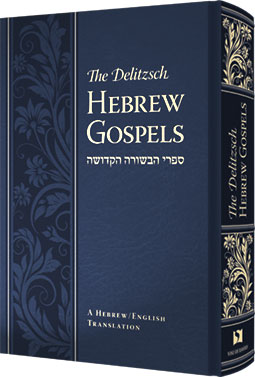
DHEIn 1873 the British and Foreign Bible Society commissioned Franz Delitzsch to prepare a translation of the New Testament into Hebrew. Delitzsch agreed and set to work utilizing his extensive knowledge of mishnaic Hebrew and first century Judaism to create a translation and reconstruction of the Greek text back into an original Hebrew voice. His reconstructing translation was completed in 1877. After the first edition, it went through extensive review and revision for the next 13 years. The final edition was published in 1890 under the care and supervision of Gustav Dalman. Sixty thousand copies were distributed for free throughout Europe resulting in tens of thousands of Jewish people coming to know Yeshua as the Messiah of Israel.

Those Jewish believers and their influences are the very embers that have ignited this modern-day hope and revival.

This is the introduction on the Vine of David website to the Levy Hirsch Memorial Edition of the Delitzsch Hebrew Gospels. Over a century has passed since the last edition of this critical and faithful publication has been produced and Vine of David, the ministry arm of First Fruits of Zion (FFOZ) that specializes in early Messianic Judaism and the development of Messianic liturgical resources, has taken up the mission of publishing this Gospel and distributing it for free to any Jewish person, allowing Jews to explore the teachings of the Master, both in Hebrew and in English.

The Delitzsch Gospels is an elegant Bible and holding it, is like holding a bridge between Jewish believers in Yeshua (Jesus) from the 19th century to those carrying the Messianic banner today. While there are other New Testaments written in Hebrew and other Semitic languages, Delitzsch’s translation uses sources and interpretations that are the most well-known.

Although the Delitzsch Hebrew Gospels are specifically reaching out to the Jewish people, as a non-Jewish Christian, I find the resources this publication offers to be compelling. From the Translator’s Preface and Introduction to the abundance of reference materials, including maps and charts, this version of the Gospels provides history and context, not only of the Franz Delitzsch and the 19th century believing Jews, but a hint of the true Jewish origins of the Gospels and of the 1st century Gospel writers.

The heart of the Delitzsch Gospels are the Gospels themselves. Reading them reminds me  of the experience of reading the Chumash or the Tanach. Opening the Gospel to Mattei (Matthew) 1:1, the genealogy of Jesus is presented in English on the left page and in Hebrew on the right. Even with Hebrew skills far less than fluent, I can still imagine going through the opening words of the first Gospel alongside both Christian and Jewish believers, and perhaps get a small sense of what the author was thinking in his own language as he began recording his understanding of the life of the Master.

Beyond the value the Delitzsch Gospels present to Jewish believers, this modern edition also offers a unique gift to Gentile Christians who have little or no understanding of the “Jewish Jesus”. It presents those in the church with a taste of “original” Jesus, the Jewish Rabbi who walked the streets of 1st century Jerusalem and who taught his disciples in the hills of Galilee. In reading and studying from the Delitzsch Hebrew Gospels, we all can attain a clearer vision of who Jesus was and is among his people, the Jews, and his mission to save the lost sheep of Israel.

Who is Jesus of Nazareth, Son of the living God, called the Christ and the Moshiach? You may think you know. But the images invoked by reading his words and his life from the pages of Vine of David’s Delitzsch Hebrew Gospels may well introduce you to the Jewish Messiah and the Israelite Carpenter, Teacher, and King of Kings for the very first time.

To learn more, please visit the Vine of David. The blessings will be yours.

When We Were Five

The Rebbe and the ChildIf you want to see the face of the Moshiach, just look at the children!

At Sinai, all men, women and children had to be present. All received the same truth, all at once.

In a simple commentary written for a five year old, great secrets of the Torah can be found. But only once you understand the simple commentary as a five year old does.

From the wisdom of the Rebbe
Menachem M. Schneerson
as compiled by Rabbi Tzvi Freeman in his book
Bringing Heaven Down to Earth

Perhaps in the Rebbe’s words, we find the keys to unlock this 2,000 year old mystery:

At that time the disciples came to Jesus and asked, “Who, then, is the greatest in the kingdom of heaven?” He called a little child to him, and placed the child among them. And he said: “Truly I tell you, unless you change and become like little children, you will never enter the kingdom of heaven. Therefore, whoever takes the lowly position of this child is the greatest in the kingdom of heaven. And whoever welcomes one such child in my name welcomes me. –Matthew 18:1-5

We sometimes make the mistake of imposing our assumptions when we read this teaching from Jesus. The first thing we imagine when we think of a small child is that, compared to an adult, he or she doesn’t know very much about the world. Children have an extremely simple understanding of how things work. They can see the moon in the sky, but not know what it is. They can play with their favorite stuffed toy and believe it is as alive as they are. They are easily convinced of the most outrageous suggestions and accept them as utter truth. How else could we get a child to believe that there is a fat guy who rides in a sled pulled by flying reindeer, and who delivers presents to every child on Earth in a single night?

Translating all of that back into the words of Christ, we imagine he means that we don’t need to know very much about the Bible, the history of the church, the wisdom of the great Sages, or most anything else in order to be saved and have a right relationship with God. It means that studying the Bible is a waste of time, because it doesn’t change the status of being saved. It means that Bible commentaries, the Talmud, and everyone who reads and tries to comprehend them, are just making your relationship with God too complicated. After all, once you are saved in Christ, the deal is sealed and nothing else matters at all. If you’re a Christian it’s only about you and Jesus.

Right?

That tends to illustrate one of the qualities of small children; the tendency toward being self-absorbed and the difficulty in seeing a world outside of our own small sphere. Being saved and becoming a disciple of the Master is the first step in our journey, not the last.

So what does Jesus mean? What does the Rebbe mean? How are great secrets possessed by little, uncomprehending children that elude perhaps some of the greatest scholars who have ever lived? Is Bible study; Torah study a waste of time? Here’s Rabbi Freeman’s response:

The Rebbe often repeated that through the study of Torah you could conquer the world. And from the way the Rebbe discussed Torah you could see he was doing just that: Every thought, every teaching was a new understanding of the entire universe. A simple story..became in his hands an insight to the workings of time and space.

Rabbi Freeman, who describes the Rebbe as one of the foremost Torah scholars of his age, also tells this story about him:

The child he (the Rebbe) saw as a lucid, glistening crystal vessel in which to find G-d. More than once the Rebbe pointed out how his own thoughts strove to attain the simplicity of those of a child. In that simplicity, he taught, can be found the simplicity of the Infinite.

The Rebbe formed a club for Jewish children called “Tzivos Hashem”. He told the children that with verses of Torah and good deeds they would fight the forces of darkness in the world and bring Moshiach.

The Children began to stand close to the Rebbe at public gatherings. Some went under the table near his feet. Legend has it that occasionally a small band would rise up from under the table to snatch a piece of the Rebbe’s cake.

For me, this really clarifies why Bible study and immersion in the Torah are vital to achieving and retaining the perspective of a small child who is contemplating God.

Remember what I said about how adults can cause a child to have an unswerving belief in the existence of Santa Claus? It’s not the child’s fault that he or she believes in a fantasy, it’s the adults who taught them. Children are open to those they trust and they believe their parents (in most cases) mean them nothing but good. Sure, they get mad at us temporarily when we discipline them for some misdeed, but they know with complete trust that we are the source of all good in their lives. This is how we saw the world when we were five.

We fail them when we don’t tell them the truth and prove unworthy of their trust.

TrustBut now let’s bump that concept up the ladder a bit. We, as adults, can question whether or not something is the truth. We no longer believe in Santa Claus and we can (most of the time) recognize the difference between fantasy and reality. We have a Father in Heaven who is the source of all good in our lives. He wants nothing but the best for us and He does not tell us tales of Santa Claus or the Easter Bunny, which we later find out are quaint lies. God tells us the truth. In essence, we are like children standing close to the Rebbe and sitting at his feet under the table. Now here’s where the “child” part comes in.

If we choose to believe and to trust God as completely as small children trust their parents, whatever God tells us, we will believe. Whatever He wants us to do, we will do, without questioning why. When we “snatch a piece of cake” (so to speak) from His table, He won’t mind, because He knows we’re going to do it and He put the cake there to share with us. If we want to know how to accept God in the manner He desires to be accepted, trusted, and loved, all we have to do is to look at the relationship between little children and their parents.

For me, one of the lessons I must learn about the little children is what the Rebbe says here:

With Torah, you don’t get all the answers all at once.

Why does the moon only come out at night? Why is the sky blue? How can a fish breathe underwater? How old is God? Have you ever tried to answer these questions? It’s hard to do. Even if you know why the sky is blue or how fish breathe underwater, you can’t always communicate the answer in a way a child will understand. It’s that way for me. I want to know so much. It seems as if there’s so little time. And yet I wait. You don’t get all the answers all at once. Sometimes you have to get older first before you can understand.

In the meantime, you trust and believe, because that’s what small children do best.

Now to finish the story about the children snatching the Rebbe’s cake:

Finally, one of the adults became fed up with this lack of decorum and attempted to escort some children away. The Rebbe turned to him and exclaimed, “You are only a civilian and they are soldiers – and you want to remove them?

As the Rebbe also said, “Wealth is not a mansion filled with silver and gold. Wealth is children and grandchildren growing up on the right path.”

May we all “grow up” on the right path, too.

Devarim: One Man’s Story

MosesThis week’s Torah reading begins: “These are the words that Moshe spoke to the entire Jewish people.” Noting the distinction between this book and the previous four, which are all “the word of G-d,” our Sages explain that Moshe recited the Book of Deuteronomy “on his own initiative.”

Rabbi Eli Touger
Commentary on Torah Portion Devarim
“A Mortal Mouth Speaking G-d’s Word”
Adapted from Likkutei Sichos, Vol. IV, p. 1087ff; Vol. XIX, p. 9ff
Chabad.org

For most Christians, who don’t have a conservative evangelical view like the one I had, these textual facts can be interesting, but there is nothing in them to challenge their faith, which is built on something other than having the very words that God inspired in the Bible. And I certainly never intended to lead anyone away from the Christian faith; critics who have suggested that I myself stopped being a Christian once I realized there were differences among our manuscripts are simply wrong and being ridiculous.

Author and New Testament Scholar
Bart D. Ehrman in his book
Jesus, Interrupted

Today’s “extra” meditation and my commentary on this week’s Torah Portion Devarim.

Occasionally people ask why most of the book of Deuteronomy (in Hebrew, “Devarim”) even exists. It seems to do little more than repeat and summarize the events in the first four books of the Torah. The answer can be a little disturbing to some Christians and even to some Jews. Our understanding is that the first four books of the Bible were the words of God as dictated to Moses and Deuteronomy is in Moses’ own words.

Does that mean Deuteronomy is completely human in origin and without the influence of God? Let’s return to Rabbi Touger’s commentary:

This does not…mean that the Book of Deuteronomy is merely a mortal invention. Our Rabbis immediately clarify that Moshe delivered his words “inspired by the Holy Spirit.” Similarly, when the Rambam defines the category of “those who deny the Torah,” he includes: “a person who says that the Torah even one verse or one word does not emanate from G-d. If one would say, ‘Moshe made these statements independently,’ he is denying the Torah.”

Not a single commentator maintains that there is a difference in this regard between the Book of Deuteronomy and the four preceding books.

For the Book of Deuteronomy are merely Moshe’s words. Moshe’s identification with G-dliness was so great that when he states: “I will grant the rain of your land in its season,” he speaks in the first person although the pronoun “I” clearly refers to G-d. “The Divine Presence spoke from his mouth.”

The origin of the Bible and exactly how it was written and codified is complex and more than a little mysterious. The simple belief among many Christians is that each author wrote under the influence and guidance of the Holy Spirit and what they wrote originally is exactly what we have in our Bibles today (translated into the language we prefer to read). I included the quote from Bart Ehrman’s book to illustrate that even among modern Bible scholars, there is some doubt as to whether or not we can read the Bible as if it were a history book, newspaper, and court reporter’s record all rolled into one. In fact, we can’t.

The Bible is as much a human document as a document of the Divine. It’s a series of “stories” that illustrate something about God and His interactions with humanity. That it contains internal inconsistencies and historic flaws in no way disqualifies its moral and mystic significance among the community of faith. The stories tell us what we need to know, not as a history lesson, but as a guide to righteous living and as a doorway into domains that leave our mortal plane and allow us to glimpse the Throne of God.

In referring to Midrash Tehillim to 90:4; Bereishis Rabbah 8:2, we see that the Sages believe that “The Torah preceded the world” and when we read John 1:1, we see that “In the beginning was the Word, and the Word was with God, and the Word was God”. From this, we understand that only part of the Bible’s function is to act as a record and a document. Beyond the scroll in the Ark or the book on our hand, it exists in transition between our world and the next.

Rabbi Touger continues:

Here, the concept of precedence is not chronological, for time like space is a creation, relevant only after G-d brought existence into being. Rather the intent is that the Torah is on a level of spiritual truth which transcends our material frame of reference. Although the Torah “descends” and “enclothes itself” in our world, speaking of seemingly ordinary matters such as agricultural laws, codes for fair business practice, and the proper structure for marriage and family relations, this is not its essence. The essence of the Torah is “G-d’s will and His wisdom,” united with Him in perfect unity (see Tanya, ch. 4).

The Amazon.com product description for Ehrman’s book states that “the New Testament is riddled with contradictory views about who Jesus was and the significance of his life”, yet from a mystic point of view, this doesn’t present a problem.

The Ba'al Shem TovWhen I was reading The Hasidic Tale by Gedaliah Nigal, I wrote several commentaries about what I gained from the text including The Messianic Tale and Stories are Miracles. From these, we see that the stories of the Chasidim are less a series of historical facts and more a collection of mystic and allegorical tales designed to reveal something about ourselves, about holiness, and about God. How much of each story is factually accurate isn’t particularly relevant, because one does not approach the tales of the Chasidim that way. What we are looking for is something that will peel away the covers from the world of the supernatural and give us a peek at what lies around the next bend on our path of faith.

We can apply that commentary back to the Bible thus.

Jorge Quinonez, in his book “Paul Philip Levertoff: Pioneering Hebrew-Christian Scholar and Leader” Mishkan 37 (2002): 21-34 (quoted in Love and the Messianic Age) describes Levertoff, a Chasidic Jew and devoted disciple of Jesus, this way:

He read the Gospels in German. Then he obtained a Hebrew version and reread them. Though he was in the midst of a Gentile, Christian city where Jesus was worshiped in churches and honored in every home, Feivel felt the Gospels belonged more to him and the Chasidic world than they did to the Gentiles who revered them. He found the Gospels to be thoroughly Jewish and conceptually similar to Chasidic Judaism. He wondered how Gentile Christians could hope to comprehend Yeshua (Jesus) and His words without the benefit of a classical Jewish education or experience with the esoteric works of the Chasidim.

This perhaps, is what scholars like Bart Ehrman miss when they study and criticize the Bible for not reading like a story posted at CNN. Divinity and humanity collide, meld, mesh, and blend within the pages of the Bible and we are not always meant to be able to tell where one leaves off and the other begins…or if that division is even possible.

Rabbi Touger states:

But why is the Book of Deuteronomy necessary? Enclothing the Torah in human intellect seemingly does nothing but lower its spiritual content. What purpose is served?

Nevertheless, this is G-d’s intent in giving the Torah: that it permeate mortal thought and thus elevate man’s understanding. Whenever a person studies Torah, regardless of his spiritual level, he is making its infinite truth part of his personal nature.

Were there to have been only four books in the Torah, it would have been impossible for our powers of understanding to unite completely with the Torah. It was only by having the Book of Deuteronomy pass through Moshe’s intellect that this goal accomplished. Moreover, Moshe’s review of the Torah in he Book of Deuteronomy gives us the capacity to understand the previous four books in a similar fashion.

Enclothing the Torah in mortal intellect does not merely grant man the opportunity for advancement, it also introduces a higher quality to the Torah itself, as it were. For clothing limitless spirituality in the confines of mortal intellect represents a fusion of opposites that is possible only through the influence of G-d’s essence. Because His essence transcends both finiteness and infinity, it can weld the two together, bringing the spiritual truth of the Torah within the grasp of mortals.

TranscendentWho we are and who God is in us requires that we leave behind some of our attachment to what we call “reality” and allow ourselves to stand transcendent at the uncomfortable and mystic threshold between Heaven and Earth. We don’t have to rely on the Bible to be a book of facts but rather a book of truth.

Consider this:

These are the words which Moses spoke to the children of Israel, across the Jordan, in the desert, in the plain, opposite Suf, between Paran and Tofel, Lavan, Chatzeiroth, and Di-Zahav –Devarim 1:1

All these “places” are allusions to sins committed by the Jewish people during their forty years of wandering in the Sinai Desert. Moses rebuked them only by insinuation so as not to embarrass them.

-Rashi’s commentary

Rabbi Menachem Mendel of Lubavitch once delivered a scathing critique of a certain type of outlook and behavior. Later, one of those present complained to him: “Rebbe, why did you rebuke me in public? Could you not have privately made me aware of my negative traits, without embarrassing me in front of everyone?”

Replied Rabbi Menachem Mendel: “Did I mean you? Obviously, I did. You see, I am a hat-maker. The hat-maker fashions a hat and places it in his window. People come in and try it on, until someone finds that it suits his head perfectly. Whom did he have in mind when he made this hat? Why, he made it precisely for the very customer who finds that it fits him!”

-Rabbi Yanki Tauber
Commentary of Torah Portion Devarim
“The Discreet Hatter”
Chabad.org

The Bible serves many purposes in our lives, not the least of which is to reveal the nature of who we are, for good or for ill. It is a book that condemns but also encourages. It shows us the goodness of God and where we fall short of that goodness (Romans 3:10). Let the Bible be what God intended it to be and let God be who He is. Listen to the words of Moses and his “Chasidic” tale of the wanderings of the Children of Israel, of his own journey with God, of the approach to the end of his life, and in listening to him, learn something about yourself.

Good Shabbos.

The Primordial Serpent

SerpentWhen people saw the snake, they understood that in order to elicit this transcendent divinity and be healed, they had to transform their own, inner “snake” – their evil inclination – into a force of good…The evil inclination impels us to sin for comfort, pleasure, or excitement. When we convince it that the truest comfort, pleasure, and excitement lie in holiness, it plunges headlong into fulfilling G-d’s purpose on earth, endowing our drive toward divinity with much greater power than it could have had otherwise. Thus, the initially evil inclination becomes the source of merit and goodness. The snake is transformed from the source of death to the agent of life.

From the teachings of the Lubavitcher Rebbe;
adapted by Rabbi Moshe Yaakov Wisnefsky
“Transforming the Primordial Snake”
[Based on Likutei Sichot vol. 13, pp. 75-77]
Kabbalah Online

This also alludes to the [Primordial] Snake. Originally, he was the tail and Adam was the head, but [because of the Primordial Sin] this was inverted and the snake became the head and Adam the tail.

From the teachings of Rabbi Yitzchak Luria
adapted by Rabbi Moshe Yaakov Wisnefsky
“The Snake at the Sea’s End”
Chabad.org

This is Part 2 in a 3-part series. Before reading this, see Part 1: Overcoming Evil.

The serpent of Eden isn’t quite what you expect him to be when you encounter him in Judaism, and particularly within the realm of Kabbalah. While not an entirely pleasant fellow, he doesn’t seem to be quite as bad as Christianity paints him. The “Transforming the Primordial Snake” article quoted above tells us that the serpent; the evil inclination within us, “impels us to sin for comfort, pleasure, or excitement”. The commentary goes on to explain that we can “convince” the evil inclination that the best way to meet its goal is to meet our goal of a life of holiness. Once the “serpent” is sold on this idea, the “snake is transformed from the source of death to the agent of life”.

Makes the snake sound almost reasonable, doesn’t it? However, the teachings of Rabbi Yitzchak Luria paint a darker portrait:

In the Zohar, the imagery of the snake putting its tail in its mouth is used to illustrate the sin of “the evil tongue”, i.e. slander, a gross misuse of the power of speech. (Zohar III:205b) People commit this sin when material consciousness gets the better of them. As is explained in the Tanya (ch. 32), those who give their bodies preeminence over their souls see only the outer shell of their fellow man, which differentiates between people, and are oblivious to the inner souls. They thus fall into the sin of hatred, which leads to slander.

Rabbi Luria makes slander sound awful, but how bad can it be? I mean, it’s not as bad as say, murder, is it?

“You have heard that it was said to the people long ago, ‘You shall not murder, and anyone who murders will be subject to judgment.’ But I tell you that anyone who is angry with a brother or sister will be subject to judgment. Again, anyone who says to a brother or sister, ‘Raca,’ is answerable to the court. And anyone who says, ‘You fool!’ will be in danger of the fire of gehinnom. –Matthew 5:21-22

I guess it is that bad.

But who is the serpent? Is it some sort of talking animal, like Balaam’s donkey or is this Satan, the Adversary, in disguise? Let’s cut to the chase and look at him from a traditional Jewish perspective:

Satan in Judaism is a very different beast than satan in popular culture (pun intended)

The snake in the garden of Eden is identified as the personification of the “Yetzerh Harah” (Bad/evil will/desires/inclination) by the midrashim.

The Talmud also states that the Yetzer Harah, Satan, and the angel of death are one. (Some might understand this to mean that they are ‘bad things’ which really are good, and necessary.

In Judaism, the Satan is an angel commanded by Gd to accuse human beings of wrong things. In modern terms, you might call satan the heavenly prosecutor, who seeks to bring all people to court.

-from the Jewish Life and Learning discussion board

Eve and the SerpentThat would seem to mesh somewhat with the Christian interpretation, however, the person who made this post offered a follow up:

A strict reading of the bible would tell you just a snake, and nothing else. An interpreted reading of the bible based on Jewish sources would tell you its the Evil Inclination. An interpreted reading of the interpretation based on Jewish sources would tell you that the snake represents three things. (Which, could be seen as a reason for only the serpent to be mentioned in the first place)

This is consistent with other Jewish sources which state that Adam personified the Good Inclination while the serpent was the embodiment of the Evil Inclination. In Kabbalistic thought, the serpent wasn’t so much a personality as a force of nature, or at least a representation of other forces. The serpent was the external manifestation of the evil inclination which, once Adam and Eve sinned, became man’s internal inclination for evil.

However, as I’ve heard it said just recently, “let Scripture interpret Scripture”:

The great dragon was hurled down – that ancient serpent called the devil, or Satan, who leads the whole world astray. He was hurled to the earth, and his angels with him. –Revelation 12:9

And I saw an angel coming down out of heaven, having the key to the Abyss and holding in his hand a great chain. He seized the dragon, that ancient serpent, who is the devil, or Satan, and bound him for a thousand years. –Revelation 20:1-2

Now we have to assume that the “ancient serpent” being referred to in these verses is the same one we see tempting Eve in the Garden, but that’s an assumption Christianity takes for granted. It’s not one that Judaism would make for obvious reasons.

A recent CNN news story, which was critical of the ability of many Christians to read and remember the Bible correctly (that part seems sadly true) suggested that the serpent was just a serpent (albeit an intelligent and talking one) and that the Adversary (HaSatan) was never mentioned. While it is true, Genesis doesn’t go out of its way to say, “Hey! The snake is the devil!”, the passages from Revelation seem to be a “smoking gun”.

Judah Himango started a conversation about this topic on his Kineti L’Tziyon blog the other day, and from his point of view, the matter is settled. Still, looking at the serpent through the lens of Jewish mysticism, there’s more to his story than meets the eye. Part 3 of this series, Healing the Wounded, will cover that tale in the next “morning meditation”.