Tag Archives: Bible

Not in Heaven

HeavenThe Torah is not in heaven [i.e. though the Torah is of heavenly origin, it was given to human beings to interpret and apply].

from The Hasidic Tale
by Gedalyah Nigal
pp 148-9

This small snippet from Nigal’s book touches on something I’ve been pondering for quite some time. It’s a concept that’s common in Judaism but almost completely escapes Christianity, including many of the Jewish and non-Jewish believers of Jesus as the Jewish Messiah commonly referred to as “Messianic”. Here’s another example with more detail:

As a result of testimony by R’ Yehoshua b. Zeiruz, Rebbe ruled that fruits and vegetables which grow in Beis Shan were exempt from terumah and ma’aser gifts. Rebbe’s extended family members rose up against his ruling, and they wondered how he could release the obligation for tithing from items grown in Beis Shan, an area which his ancestors had deemed to be obligated in these halachos. Rebbe responded and said that this was an area of halacha which his ancestors had left for Rebbe to rule and to thereby be credited with this decision. Rebbe illustrated that a similar scenario is recorded in Tanach, where we are told that King Chizkiyahu ground up the copper snake made by Moshe Rabeinu to alleviate a devastating plague that threatened the nation. Later, this copper image was abused by the people, as they began to offer incense to it for idolatrous purposes. This is why Chizkiyahu had it destroyed. The Gemara notes that it is wonderous to think that this image which was being used for idolatrous purposes was not destroyed much earlier. Why would Assa and Yehoshafat, both righteous kings, not have destroyed this statue earlier? Rather, it must be that they left it intact in order for Chizkiyahu to take care of the matter.

Daf Yomi Digest
Distinctive Insight
“Leaving room for later generations to make their mark”
Chullin 7

There are a couple of things going on here. One is that the tzadikim (righteous people) and the sages in each age were given authority to make rulings about the Torah commandments and that these rulings were and are binding. The other thing is that rulings on the same Torah laws could be applied differently based on the demands of each generation.

Most Christians believe in “the Word” (i.e. the Bible) as the only authority (and certainly the absolute authority) over the believer’s life and consider the rulings of the Jewish sages to be “merely” the opinions of men and thus, they have no authority over a person’s day to day existence. The following is considered something of a “proof text” of this opinion in the church:

The Pharisees and some of the teachers of the law who had come from Jerusalem gathered around Jesus and saw some of his disciples eating food with hands that were defiled, that is, unwashed. (The Pharisees and all the Jews do not eat unless they give their hands a ceremonial washing, holding to the tradition of the elders. When they come from the marketplace they do not eat unless they wash. And they observe many other traditions, such as the washing of cups, pitchers and kettles.)

So the Pharisees and teachers of the law asked Jesus, “Why don’t your disciples live according to the tradition of the elders instead of eating their food with defiled hands?”

He replied, “Isaiah was right when he prophesied about you hypocrites; as it is written:

“‘These people honor me with their lips,
but their hearts are far from me.
They worship me in vain;
their teachings are merely human rules.’

You have let go of the commands of God and are holding on to human traditions.” –Mark 7:1-8

Jesus was most likely referring to Netilat Yadayim or the ritual of hand washing, which is performed by observant Jews even today. This practice is considered to be a method of purifying the person after awakening and before eating and re-dedicating his or her life to the service of God.

It’s unlikely Jesus was speaking against the practice as such in Mark (see the full text of Mark 7 for the details) but rather, he was criticizing the Pharisees for focusing on what might be considered a matter of “lesser” priority and ignoring the more “important” duty (kaloh vs. chamurah or minor vs. major mitzvos) of caring for impoverished and elderly parents (and one of these days, I’d love to research how Jesus probably did practice the halacha of his day).

For the vast majority of Christians, what I’m saying now probably seems like so much nonsense. Christianity tends to put a great deal of value on being “Spirit-led” when trying to understand the Word and the Will of God in their lives and will only rely on local authorities (for the most part) such as a trusted Pastor or teacher to help interpret the Bible. In other words, the Bible is understood on an almost exclusively individual level, though most Christians in the same church or denomination probably share many of the same opinions about what the Bible says. Interpretation for the person though, remains primarily part of the relationship between the individual and the Spirit of God (though this has rather obvious potential pitfalls).

By contrast, Judaism has a vast repository of knowledge commonly referred to as the Talmud, that contains the discussions, arguments, and rulings of a long list of sages stretching back across the centuries to before the time of Jesus. Christianity, with the exception of branches such as Catholicism, has no such tradition. The dictates of the Church fathers and the commentaries of renowned teachers and spiritual leaders, both historical figures and modern men and women, while highly valued, are not considered perpetually binding legal rulings over the lives of the devout of Christ. Rulings, authorities, and judgments in Judaism, particularly among the Orthodox, are much more defined and delineated.

Even for those parts of Christian theology that are considered binding (belief in the Trinity, belief in the resurrection of Christ, belief that people who are “saved” go to Heaven when they die, and so on), it’s hard for the collective church to imagine that “legal rulings” could continue to be issued across the passage of time and into the modern era. What new interpretation of the Bible would be necessary today that didn’t already exist in the time of Jesus and the Apostles (and I know I might be unfair in saying this since “progressive revelation” is part of the Christian belief structure)?

Consider the following:

Do not light a fire in any of your dwellings on the Sabbath day. –Exodus 35:3

Based on this commandment in the Torah, observant Jews, to one degree or another, do not light a flame on the Shabbat. Back in the days of the Exodus, this was understood in a particular way. No candle lighting, no lighting a fire in a home or at a camp, and so on.

Netilat YadayimBut no one ever thought of things like the invention of the automobile, the electric light bulb, and the microwave oven. How does the commandment to not light a flame apply to these technologies? Can an electric spark be considered “igniting” something? Once the question comes up, who gets to answer the question and decide how it is applied and to whom? After all, if you’re a devout Jew who doesn’t want to violate the Shabbat, you’ll need to know if you can start your car, warm up a cup of coffee in the microwave, or pop on a reading lamp when it gets dark on the Shabbat (and as it turns out, the ruling is that an observant Jew can do none of these things without violating the commandment).

In religious Judaism, your life is orchestrated in a beautiful but somewhat complicated dance as you progress through the days and months and years. The Torah is both instruction book and part of the mystic presence of God in your life, but who can understand the Torah and all that it instructs? The average Jew may not have the time, the mental discipline, or the necessary intellectual capacity to study the Torah and the sages in depth and thus understand his or her responsibilities to God in all matters of living. Yet there is halacha and tradition upon which a Jew can count to guide his or her steps in this dance with God and with life. These traditions, rulings, and judgments have provided continuity and consistency in Jewish communities all over the world for thousands of years. Perhaps the Torah and the Talmud have been the instrument by which God has preserved the Children of Israel, when many other people groups from the days of Moses and before have simply ceased to exist.

The Torah may be from heaven but it is not in heaven. God gave it to the Children of Israel from the hands of angels to Moses, not because God wants to control the actions of each individual Jew, but because God loves his Chosen People and wants to take care of them. And while the Mosaic covenant and thus much of the Torah is not applied to the “grafted in” Christian, the Torah was always intended to “go forth from Zion” (Isaiah 2:1-4) and to be a guide and a protector, not only of the Jewish people, but for all the people of the Earth, if they will only turn to and walk with God in faith and trust.

Why am I saying all this? Why should you care?

Perhaps, as a Christian, you don’t care and you don’t think it matters and you believe that the Torah and the Talmud is best left to the Jews. If you happen to be Jewish, you may not care about the potential applications of Torah and Talmud to Christianity. For my part, as a Christian married to a Jew, I can see great value in studying not only the Bible, but the judgments, rulings, and insights of the sages, from Hillel and Shammai to Rambam and Rashi. Unless we understand how Jewish Rabbis and learned scholars read and understand the Torah and God, how can be begin to comprehend the Jewish sage and apostle Paul and what he wrote and taught? Indeed, how can we begin to comprehend the mind, the teachings, and the actions of the Jewish Messiah, the Christ…Jesus, as he was on Earth and as he is in heaven?

Without this understanding, while we may think we understand the sacred writings of the New Testament as they are “in plain English”, we eventually must face the reality that when we Christians read the Gospels, the Epistles, and the Apocalyptic writings, we are reading a deep mystery with very few clues, and peering into a wine-dark glass, seeing only dim shapes of what God is trying to illuminate on the other side. The Talmudic scholars can be our guides into ways of seeing God and His Word that would otherwise be missing hues in our color palettes. What might we perceive if we only chose to open our eyes and look?

A true master of life never leaves this world
—he transcends it, but he is still within it.

He is still there to assist those who are bonded with him with blessing and advice, just as before, and even more so.

Even those who did not know him in his corporeal lifetime can still create with him an essential bond.

The only difference is in us:
Now we must work harder to connect.

-Rabbi Tzvi Freeman
“Connecting”
Chabad.org

Their Father’s Magic Carpet

The City of New OrleansAnd the sons of pullman porters
And the sons of engineers
Ride their father’s magic carpets
made of steel.
Mothers with their babes asleep,
Are rockin’ to the gentle beat
And the rhythm of the rails is all they feel.

-from The City of New Orleans
by Steve Goodman and Michael McCurdy

If you’ve spent much time driving on the freeway, traveling for business or vacation, sooner or later, in those expanses between city and town, you’ve seen a train or two traveling along the tracks parallel to the road. This past weekend, my niece was married at Cannon Beach, Oregon, so to attend, I left Boise on Friday morning to join my family for the event.

I was driving alone (my wife and daughter went ahead a few days before), so I had a lot of time while driving to listen to music and to think. I have a vague memory of loving trains as a boy but I’m too far away from my childhood to clearly recall any event associated with that feeling. I do remember once, many years ago, when my sons were quite young, traveling across the midwest with the family during the summer. We had stopped at a campground somewhere in Nebraska for the evening. A railroad track ran near the campground and there was a railroad museum nearby. I remember standing by the track with my boys as a train very slowly, very stately, moved down the line. We waved at the engineer and I could see a sense of wonder in the eyes of my sons as they watched something so amazingly large travel past them. From the eyes of two four-year olds, the engineer must have seemed almost like God; controlling such vast power from so lofty a height.

Then it was gone.

Once, the railroad system was the backbone of American transportation and, since the days of the Old West, it was the artery that transferred life blood from one end of our nation to another. Then, in pursuit of faster ways to travel, faster connections, faster lifestyles, and faster Internet speeds, we pulled away from the past and have hardly looked back at what we left behind. I know the refrain of “the good ol’ days” also hides some of the uglier times in our country’s history, but with the bad, and with our need to become more “progressive”, we’ve also abandoned those things that were good.

Not too long ago, I wrote a blog article about how what we know about the Bible is advancing with new literary studies and archeological finds, adding to and correcting our understanding and our database about the Word of God and what it means in our lives. While all that is certainly valid, the past and the knowledge it holds, once we leave it, doesn’t have to fade away, nor should it. If you’ve been reading this blog for any length of time, you know I quote frequently from the ancient Jewish sages and I find their wisdom as alive and fresh today as it was when their thoughts and insights were first recorded and preserved.

Steve Goodman’s lyrics (sung famously by Arlo Guthrie, son of the renowned folk singer, Woody Guthrie) relate a tale of the fading glory of the railroad, like a species from another era, once mighty, once dominating, now slowly going extinct and being replaced by something much less grand. When the “sons of pullman porters and the sons of engineers ride their father’s magic carpets made of steel”, they begin to realize that the time of the railroad is coming to an end. They will never experience what their fathers’ did; a sense of the endlessness of an epoch of romance, adventure, and tradition that seemed to stretch into infinity, as if looking at the tracks extending ahead to the edge of the horizon and beyond.

Too much of our lives get left behind for the sake of expediency and to make room for other priorities. Our faith, our religion, how and when (or if) we approach the Bible, all suffer in the same way. When we first “discover God” we are filled with a child-like wonder at the thrill of seeing the “engineer” in the cab of this massive, diesel machine, slowly crossing in front of us, allowing us just a taste of the power and rumbling majesty He controls.

Then we get older, more experienced, more used to seeing trains, more used to ignoring them, until we hardly notice when they start to fade away, maybe not as an overall presence, but in their sense of importance. Once the shine and luster begins to fade, it takes a lot of effort to get it back. Sometimes it never returns and all we have are half-memories that are more like vague feelings than the recall of what we actually said or did.

Who is God to us then?

I know. Odd thoughts for a person just having returned home from a wedding and three days of celebrating with family. But after visiting family in Portland and Cannon Beach and visiting relatives at their home outside of Washougal, Washington, I find myself thinking more of what has been lost than anything that’s been gained. I don’t know why I started hearing Arlo Guthrie singing “The City of New Orleans” in my head. He just started as I was driving home this morning, while I was leaving the Columbia Gorge behind, and I started writing this blog in my imagination as I listened to the lyrics.

And all the towns and people seem
To fade into a bad dream
And the steel rails still ain’t heard the news.
The conductor sings his song again,
The passengers will please refrain
This train’s got the disappearing railroad blues.

Good night, America, how are you?
Don’t you know me I’m your native son,
I’m the train they call The City of New Orleans,
I’ll be gone five hundred miles when the day is done.

Beyond Reason

Out of the darknessA mind directed entirely by its own reasoning will never be sure of anything.

As good as the mind is at finding solutions and answers, it is even better at finding questions and doubts.

The path of Torah is to ponder its truths, so that your mind and heart will resonate with those truths, until all your deeds are guided by a voice that has no second thoughts.

-Rabbi Tzvi Freeman
“Certainty”
Chabad.org

How many of us ever take the time to stop and think about our theology, our deeply cherished and hard fought over arguments? Recently a popular blogger I know expressed a concern about even entertaining opposing arguments lest one lose one’s faith as a result of sown doubts – to him it wasn’t a good idea to engage the opposition in a non-polemic way, that is in a way that actually allows that other peoples arguments may, by some odd chance, hold water. And then I came across the following poignant remark that puts all this into better focus.

Gene Shlomovich
Ever thought you may be wrong about your cherished theology?
Daily Minyan blog

Questioning your own faith is a horrible thing. I know. I’ve been there. I spent an entire year, actually two, questioning the assumptions of my faith in virtually every detail. Eventually, I came to a crisis and fortunately passed through it with my faith in God intact. I recall the day I discovered what this person has just mentioned at Christian Forums:

wow, I never considered that 2 Peter was not written by Peter. Some say it was, some say it wasn’t. Hmff. Is there like a guarunteed listing of who wrote what or who didn’t write what?

Actually, most New Testament scholars acknowledge that not all of the Gospels and Epistles were written by the people to whom they are attributed. I discovered this reading Bart D. Ehrman’s Jesus, Interrupted (a challenging book which I highly recommend). Once I got past this, and the fact that there actually are inconsistencies in the Bible (compare the different Gospel versions of the day Jesus died and then try to figure out which day it was…the accounts conflict), I recovered my balance a bit. Then I realized that I didn’t have to depend on the Bible reading like a history book or a court deposition in order to gain wisdom and understanding from the stories the Bible tells us.

Questioning our assumptions isn’t a disaster and in my case, it resulted not only in a “course correction”, but in a greater zeal in returning to the Bible and seeing God in the writings of the Jewish prophets, apostles, and sages. However, in Judaism, the Torah isn’t simply a document or a way to try to grasp the essence of God through study. It is so much more and to understand this, we must step outside of what we consider a “rational reality”, for God doesn’t manifest in only the material world:

The answer depends on insight into the nature of the Torah. The Torah is one with G-d, an expression of His essential will. Therefore, just as His will is above intellectual comprehension, so too is the Torah. Nevertheless, G-d gave the Torah to mortals, not because He desires their obedience, but because He is concerned for their welfare. He wants man to develop a connection with Him, and for that connection to be internalized within man’s understanding, so that G-dly wisdom becomes part of his makeup. And with that intent, He enclothed the Torah in an intellectual framework.

This intellectual dimension is, however, merely an extension of the Torah. The Torah’s essence remains transcendent G-dliness, and cannot be contained within any limits even the limits of intellect. To relate to this essence, man must approach the Torah with a commitment that transcends wisdom or logic.

-Rabbi Eli Touger
“Beyond the Ken of Knowledge”
Parshas Chukas; Numbers 19:1-25:9
Adapted from
Likkutei Sichos, Vol. XVIII, p. 229ff

Christianity doesn’t even imagine the Bible being more than the Bible; a book written under the Divine inspiration of the Holy Spirit and recorded by many different people across thousands of years. It’s hard for me to imagine that the church misses this, since it’s stated quite plainly here:

In the beginning was the Word, and the Word was with God, and the Word was God. He was with God in the beginning. Through him all things were made; without him nothing was made that has been made. In him was life, and that life was the light of all mankind. The light shines in the darkness, and the darkness has not overcome it. –John 1:1-5

Path of TorahCertainly “the Word” is not just “the word” printed on a page in a book and in fact, this particular Word “became flesh and made his dwelling among us” (John 1:14). Of the four Gospels, John’s is considered the most “mystic” and it reads more like a chasidic story, which was a large part of what attracted a young Chasidic Jew named Feivel Levertoff at the end of the 19th century, to become a Chasid (a “devoted disciple”) of the “Maggid of Nazeret”, Jesus of Nazareth.

There’s a special depth in how Jews look at the Torah and find not only information about God but actually find God inhabiting the pages that are not just pages. There, they also find devotion and longing for the coming of the Moshiach (Messiah):

Yad HaChazakah is a book of laws, not a history book. What difference does it make from the perspective of Jewish law how many Parah Adumos were offered in previous generations? Moreover, why does the Rambam go on to add a prayer for the coming of Moshiach?

With regard to the obligation to believe in the coming of Moshiach, the Rambam states: “Whoever does not believe in him, or does not await his coming, denies not only [the statements of] the other prophets, but also [those of] the Torah and of Moshe, our teacher.” In other words, mere belief in Moshiach’s coming does not suffice, we are also obligated to hope for and await his arrival.

Moreover, this anticipation is to be in accordance with our thrice-daily recitation of the Amidah prayers: “Speedily cause the scion of David Your servant to flourish. for we hope for Your salvation all day.”

-Based on the teachings of the Lubavitcher Rebbe, Rabbi Menachem M. Schneerson
A Commentary on Torah Portion Chukas

For those of us who have faith and trust in Jesus as the Moshiach, who came once and will come again, we should take even greater comfort and meaning in the insights the Rambam and Rabbi Schneerson share with us. If we depend on “knowing God” through a Bible that must be completely internally consistent and absolutely a record of historical fact, we will become confused and disappointed or we will be forced to “bend reality” and make the text to fit our needs and preconceptions. As Rabbi Freeman says, the purpose of Torah (and the Bible as a whole) is so that we can “ponder truths” (not facts), not the least of which is the truth of the Messiah in our lives, allowing God’s Word to become intertwined into the fabric of who we are and letting all our deeds become “guided by a voice that has no second thoughts”

Good Shabbos.

Arise

The burning bushNow Moses, tending the flock of his father-in-law Jethro, the priest of Midian, drove the flock into the wilderness, and came to Horeb, the mountain of God. An angel of the Lord appeared to him in a blazing fire out of a bush. He gazed, and there was a bush all aflame, yet the bush was not consumed. Moses said, “I must turn aside to look at this marvelous sight; why doesn’t the bush burn up?” When the Lord saw that he had turned aside to look, God called to him out of the bush: “Moses! Moses!” He answered, “Here I am.” And He said, “Do not come closer. Remove your sandals from your feet, for the place on which you stand is holy ground. I am,” He said, “the God of your father, the God of Abraham, the God of Isaac, and the God of Jacob.” And Moses hid his face, for he was afraid to look at God.Exodus 3:1-6 (JPS Tanakh)

A spark of G-d slumbers within, as a flame hushed within the embers.

Will she awaken from ideas? They are only more dreams to sleep by.

Will she awaken from deep thoughts? Their depth will not reach her.

She will awaken when she sees her Beloved, the Essence of All Things with which she is one.

And where will she see Him? Not in ideas, not in deep thoughts, but in a G-dly deed that she will do, in an act of infinite beauty.

Then her flame will burn bright.

-Rabbi Tzvi Freeman
“Waking Up G-d”
Chabad.org

Arise, shine, for your light has come, and the glory of the LORD rises upon you.Isaiah 60:1

In Christianity, faith is largely a matter of contemplation; the private and internal consideration of God and a person’s prayers in the name of Jesus. In Judaism, faith is not a matter of thought but of action. Yes, Judaism places a very high value on Torah study, but the study, in and of itself, isn’t meaningful unless put into action.

What was happening with Moses, the shepherd of his father-in-law’s flocks in Midian? Probably not much during those forty years. There’s no indication that he considered the plight of his parents, his brother, and sister, and the other Israelites in their Egyptian captivity. There is certainly nothing recorded in Exodus saying Moses was planning to do anything about the slavery of his people. Yet, as Rabbi Freemen tells us, there’s a fire sleeping inside.

In the case of Moses, the “fire” literally appeared before him and the voice of God called out, commanding Moses into action. What about the fire and voice inside of you…or me?

No matter how much you distrust your own sincerity or question your motives, there is no trace of doubt that at your core lives a G-dly soul, pure and sincere.

You provide the actions and the deed. She needs no more than a pinhole through which to break out and fill those deeds with Divine power.

-Rabbi Tzvi Freeman
“The Promise Inside”
Chabad.org

What good is it, my brothers and sisters, if someone claims to have faith but has no deeds? Can such faith save them? Suppose a brother or a sister is without clothes and daily food. If one of you says to them, “Go in peace; keep warm and well fed,” but does nothing about their physical needs, what good is it? In the same way, faith by itself, if it is not accompanied by action, is dead. –James 2:14-17

Both Rabbi Freeman and James, the brother of the Master, remind us that concealing our faith and devotion to God inside is not faith or devotion at all. The Master himself reminds us that hiding our faith from the world illuminates no one (Matthew 5:14-16), probably not even ourselves. Nothing about who we are as disciples of our Master and children of God matters unless we shine our light into the world and extend our faith into the realm of deeds and actions. We are known by our fruit, not by the root that no one can see.

Dawn“Light” can take many forms. We can donate to worthy causes, volunteer our time feeding the hungry, visit the sick in the hospital, sing inspirational songs, speak of the Bible to our children and our children’s children, even write blogs, articles, and books spreading the good news of the Christ and the glory of God. Light under a bowl does not pierce the darkness and salt that loses its flavor gets thrown away. Living a meaningful life means that you have to actively live in the world, letting the fire inside yield its heat and light to everyone around you.

By acknowledging that within your body is a G-dly soul, a soul that can give your life purpose and lift it above the mundane pursuits of everyday life, you begin to put the pieces of your fragmented life in order.

from Toward a Meaningful Life: The Wisdom of the Rebbe
by Simon Jacobson
based on the teachings of the Lubavitcher Rebbe, of righteous memory.

In a previous blog post, I quoted from a commentary on Menachos 89 which says:

Mishnah Berurah writes that according to Kabbalists the primary time for Torah study is from chatzos until the onset of the morning. Shulchan Aruch HaRav writes that at the very least one should arise before morning to learn for some period of time at the end of the night.

The intent of my “morning meditations” is to offer something for you and for me that we can contemplate and then put into action as we start our day. I sometimes write my meditations before going to bed and study them right when I wake up. In the summer, the light of dawn is only slowly changing the horizon from black to grey as my thoughts and my spirit take in the words of the Master, the prophets, the apostles, and the sages.

The Gemara cites the verse in Tehillim (134:1) that mentions those who stand in Hashem’s house at night and R’ Yochanan explains that the verse refers to Torah scholars who engage in Torah study at night and the verse considers it as if they were involved in service of the Beis HaMikdash. The Gemara then cites a verse from Divrei HaYamim (II 2:2-3) and R’ Yochanan explains that this verse also refers to Torah scholars who study the halachos of service of the Beis HaMikdash and the verse considers it as though the Beis HaMikdash was rebuilt in their days. Sefer HoEshkol cites Rav Hai Gaon who notes that the two teachings of R’ Yochanan are juxtaposed to one another to teach that Torah scholars are obligated to study Torah at night and specifically the topic of korbanos. The implication of this teaching is that one who engages in the study of korbanos at night is considered as though the Beis HaMikdash was rebuilt in his days and he offered korbanos there.

Daf Yomi Digest
Halacha Highlight
“Reading korbanos at night”
Menachos 110

By the time the sun is hot and bright in the morning sky, I pray that the fire of God is burning even brighter in your heart and in mine.

Wake up.

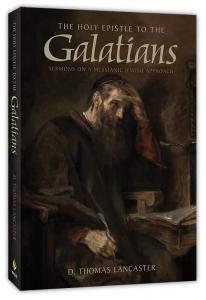
Book Review: The Holy Epistle to the Galatians

Galatians by D.T. LancasterThe passage contrasts two types of proselytes: the legal proselyte and the spiritual proselyte. The one becomes part of Abraham’s family by conventional conversion, the other through faith in Messiah, the promised seed of Abraham, in whom all nations find blessing. The passage does not contrast the Old Testament against the New Testament or the Old Covenant with the New Covenant. It does not equate Judaism and Torah with slavery, nor does it pit Christians against Jews.

It means that if you are a Jewish believer , you should be proud of being Jewish because you are a child of Abraham, legally, physically, and spiritually. It means that if you are a Gentile believer, you, too, are part of the people, a spiritual son of Abraham, and that is remarkable – miraculous even. You are a child of the promise that God made to Abraham so long ago.

-D. Thomas Lancaster
The Holy Epistle to the Galatians
“Sermon Twenty-Two: Sarah, Hagar, Isaac, and Ishmael (Galatians 4:21-31)”
pp 227-8

This is just a sample of how Lancaster’s view of Paul’s epistle to the Galatians presents a fresh and startlingly different understanding of the apostle’s message to the Gentile believers. This book takes Paul’s letter, virtually line-by-line, and re-interprets it from what most Christians would see as a radically different perspective. The book’s subtitle, “Sermons on a Messianic Jewish Approach” reveals the specific lens by which Lancaster views the letter and the stance from which he presents his argument: that Paul was supporting the unique covenant identity for the Jewish believer and at the same time, was instructing the non-Jewish disciples that they could have the same access to God, though the Messiah, without converting to Judaism.

But let me back up a minute.

Lancaster’s book is based on a series of 26 lectures or sermons he delivered in 2008 to Beth Immanuel, his community of faith, in Hudson, Wisconsin. It’s not unusual for Lancaster, a long-time contributor of books and other educational text to First Fruits of Zion (FFOZ), to “mine” his previous works for the sake of a new publication (for instance, Toby Janicki’s book Tefillin used some of Lancaster’s previous writing as a basis). Since each chapter represents one sermon in a series, I got an “episodic” feel as I moved from chapter to chapter, particularly in the first part of the book. I was also pleased that Lancaster’s ability to create the illusion that the reader is in the situation being described, was present in his current book. As I read through the chapters, I felt as if I were listening to Paul in one of the churches of Galatia, struggling with the issues he was trying to communicate, and experiencing the conflict between his teaching and the “influencers”.

As I mentioned before, this isn’t your typical Christian commentary on the Book of Galatians. Lancaster, using his knowledge of the Greek language, history, and accessing authoritative scholarly sources, “refactors” Paul’s letter into an almost completely different form, reflecting the Messianic Jewish viewpoint on Paul in general as well as FFOZ’s perspective in particular. There were a number of times when Lancaster would present the traditional Christian interpretation of a set of verses and then say something like, “this interpretation isn’t acceptable in Messianic Judaism”. I kind of wish he didn’t say it that way.

Sure, the focus of this book is to illustrate how Messianic Judaism views Paul’s letter in a dramatically different way, through its own “looking glass”, in order to understand his message in a way that makes more sense to both Jewish and non-Jewish disciples of the Jewish Messiah, but unfortunately, it could also be seen by a Christian reader as Lancaster just making the text say what he wants it to say to match his theology. The real value that I find in this book, (and many of FFOZ’s other materials) is in how it peels away almost twenty centuries of unchanging, set-in-stone, Christian theology and lets the reader see credible (and even very likely) alternatives to what Paul could have been saying. Questioning assumptions and courageously challenging dogma is not a property exclusively possessed by Messianic Judaism, Christianity, or any other religious movement. These qualities should be used by all people of honesty and faith when reading and studying our holy writings. These qualities should transcend denomination, movement, and sect, and be embraced by anyone who truly is a disciple of the Master and who seeks the truth of God and human existence.

The revelations Lancaster presents are too numerous to mention in this simple review (and I don’t want to give away too many “surprises”), but in reading this book, you will be introduced to a Paul and a Galatians letter that are completely new to you. This book offers a way of looking at Galatians, not as Paul’s anti-Jewish, anti-Torah rant, but as his answer to a complex dilemma facing the non-Jewish believers in the various churches in Galatia: does a “goy” have to convert to Judaism in order to be “saved”? The 21st century church would say emphatically “no” and in fact, would present the counter-argument that a Jewish believer would have to abandon Judaism and convert to Gentile Christianity in order to be a disciple of the Jewish Messiah. Conversely, Paul, at least as Lancaster understands him, would be appalled to hear that his letter had been so misappropriated by the modern church.

The book isn’t perfect. In general (and I agree with him), Lancaster uses various portions of Galatians to support his argument that Jewish believers (and non-Messianic Jews for that matter) were expected to obey the commands of God that He gave to the Children of Israel through Moses at Sinai, while at the same time, saying that the standard of non-Jewish “Torah” obedience to God was different…not non-existent, just different (see Galatians 5:13-26 for Paul’s interpretation of Gentile “Torah”). Unfortunately, there are any number of points in the book that, taken out of context, could be used to support the “One Law” argument (the position that states when a Gentile is “grafted in” to the Jewish root, they take on obligations to God absolutely identical to Jewish obligations). Other parts of the book make Lancaster’s position clearer, but I tended to stumble a few times when I encountered these ambiguous paragraphs.

Laying TefillinTo be fair, Lancaster is providing a detailed, in-depth analysis to a very difficult and wholly misunderstood piece of writing. Paul wasn’t easy to understand and trying to get into his head and into the culture and language in which he lived in the 1st century of the common era, let alone write an entire book about it, is a major undertaking. While I think the book succeeds overall, the reader is going to have to exercise a certain amount of patience and not jump to conclusions. Getting the entire message of Galatians means reading all of Lancaster’s book (I had to take copious notes) before coming to any sort of conclusion. Bringing an open mind as well as a notepad is also essential.

I don’t doubt that many of the people who read this book will either try to ignore it or start an argument about what it says. Lancaster completely disassembles the traditional Christian understanding of the letter and rebuilds it an atom at a time. That doesn’t make for comfortable reading if you’ve been taught for most of your life that the Torah is slavery for the Jews and grace is freedom for the Christians. For the One Law supporters in MJ, the book will also challenge many of their assumptions and at a few points, Lancaster even directly confronts the OL assumptions. Lancaster makes it clear in many of his comments that Paul never intended for the Gentile disciples to take on the entire “yoke of Torah” and that the “Torah” for the Gentiles was the “Torah of the Messiah”.

If you consider all that “the bad news”, I’ve also got “the good news”. The good news is that, if you set aside your preconceptions of what you think Galatians says, and by inference, many of the assumptions you have about what it means to be a Christian or to be “Messianic”, you’ll be able to read Lancaster’s book as an adventure in learning and an exploration of what it must have been like to be among the first Gentiles, having recently come out of pagan idolatry, entering a world and a relationship with God that had only previously been accessible to the Jewish people.

Who is Paul? Where did he get his “gospel”? Who did he see as his Master, Jesus or the Jerusalem Council? Who were the “influencers” who were disturbing the Gentile believers in Galatia? How did Paul see his fellow Jews and Jewish converts? What was Paul’s unique solution to the puzzle of integrating the people of the nations into the community of faith in the God of Israel?

The answers to those questions can be found in D. Thomas Lancaster’s new book, The Holy Epistle to the Galatians. Click the link to find out more. You may not believe it now, but there are answers in this book that you need to hear.

Besides the review you’ve just read, I’ve commented on different portions of Lancaster’s book in other recent blogs. They include Building Fellowship, Knowing, Intermediaries, and The Tefillin and the Shoemaker. These blog posts include mentions of Lancaster’s book within the context of other topics and resources, but taken together, I think this material provides a rich understanding of not only what the book says, but how it applies to a life of faith and to the wider contexts of Christianity and Judaism.

Enjoy.

The Tefillin and the Shoemaker

Praying with TefillinAnd they (Korach and his following) converged upon Moses and Aaron and said to them: “Enough! Every one of the congregation is holy, and G-d is amongst them. Why do you raise yourself above the congregation of G-d?”Numbers 16:3

There are those who maintain that they have no need of a mentor to guide them through life. They claim, as did Korach, that each and every individual can forge his relationship with G-d unaided. They argue that since the Jewish faith rejects the concept of an intermediary between man and G-d, they have no use for a rebbe or master.

They fail to understand that the entire Jewish people are a single entity, that every individual soul is, in truth, but a limb or organ of the soul of Israel. Just as each limb and organ of the human body has its function at which it excels, so, too, every soul has its role and mission, as well as its limitations. The ‘loftiest’ of souls is dependent upon the ‘lowliest’ for the attainment of the single, unified goal. And were any limb to strike out on its own, detaching itself from the ‘head’ which provides the entire body with vitality and direction – the results are self-understood.

Said Rabbi Yosef Yitzchok of Lubavitch: “When an individual adapts the attitude that he can do it all on his own, he reminds me of the story told about the peasant and the tefillin. Once, a Jew noticed a pair of tefillin in the house of a gentile peasant. Upon seeing a holy object in such a place he began to inquire about the tefillin, wishing to purchase them from the goy. The peasant, who had looted the tefillin in a recent pogrom, grew agitated and defensive. “What do you mean, where did I get them?” he blurted out. “Why, I made them myself! I myself am a shoemaker!”

-Rabbi Yanki Tauber
Once Upon a Chasid
“Jack of all Trades”
Chabad.org commentary on Torah Portion Korach

Paul explained that he received the gospel through a revelation of Yeshua the Messiah (Jesus Christ). He claimed that the gospel message he preached to the Galatians was not man’s gospel. It was not the normal gospel message. He received a different gospel. This is an important point – a critical point – for understanding Paul. The message of the gospel that Paul proclaimed was not precisely the same message of the gospel that the rest of the apostolic community proclaimed. In other places, Paul specifically refers to this unique gospel as “my gospel” (see Romans 2:15-16, Romans 16:25, and 2 Timothy 2:8-9).

-D. Thomas Lancaster
The Holy Epistle to the Galatians
“Sermon Three: Paul’s Gospel (Galatians 1:11-24)”
pp 35-6

But even if we, or an angel from heaven, should preach to you a gospel contrary to what we have preached to you, he is to be accursed!Galatians 1:8 (NASB)

Reading Rabbi Tauber’s commentary on the previous week’s Torah Portion Korach, I saw an inevitable collision with the above-quoted portion of Lancaster’s “Galatians” book. Although Korach and his co-conspirators claimed authority because all of Israel was holy to God, while Paul claimed authority based on his personal revelation from Jesus (see Acts 9:1-19 and Acts 26:15-18), they both set themselves (apparently) in opposition to the established authority representing God, Moses in the case of Korach, and the Jerusalem Council, in the case of Paul.

We know that Korach, Dathan, Abiram, and the 250 who were with them came to a bad end (Numbers 16:28-35) and their story is sometimes told in congregations as a cautionary tale not to go against the established leadership, but what about Paul? Does Paul’s receiving a personal revelation and mission from Jesus exempt him from respecting and obeying properly established authority? Lancaster says, “no”:

Despite the dismissive air, Paul submitted to their authority. He had already conceded that, if they had rejected his gospel of Gentile inclusion, he would have been running his race in vain. They had the power to utterly discredit the gospel message he had been presenting. Therefore, he certainly did respect their authority. But he seems less than reverently respectful in Galatians 2:5.

-D. Thomas Lancaster
The Holy Epistle to the Galatians
“Sermon Seven: Remember the Pour (Galatians 2:6-10)”
pg 71

While Paul could be opinionated and “outspoken”, he nevertheless realized that he was a man under not only the Master’s authority, but under the authorities established by God in Jerusalem, which included James, Peter, and John. But he had to approach these “pillars”, present his position based on the Master’s revelation to him, and hope they’d see things his way. Fortunately for Paul (and the Gentiles), they did. Otherwise Christianity, as we understand it, probably wouldn’t exist today. In that case, any person not born a Jew who wanted to enter into a full covenant relationship with God would have to convert to Judaism (for the sake of this blog, I will define Gentile Noahides -in contrast to Christians – as meriting a place in the world to come but not enjoying a full covenant relationship with God on par with the Jews).

The example of Paul presents a problem, though. His experience was entirely subjective. No one else saw or heard the details of his visions and so no one could verify independently, that he was telling the truth. In theory, he could have made the whole thing up in order to further some personal agenda he had in relation to Gentiles becoming “Messianic” disciples. If we accept the Biblical record on faith as well as reason, we accept that his visions were real and his authority was real.

But what about “authorities” today?

Most mainstream churches and synagogues are lead by a Pastor or Rabbi (respectively) who has received the education required to be ordained by their branch of faith and they have been appointed to a specific congregation upon the approval of that congregation’s board of directors. The board, and its various committees, have the authority to set the specific duties of the clergy, approve and renew their contractual relationship, and even fire the clergyperson if necessary. While the Pastor or Rabbi is the “face” and “voice” of the congregation in many ways, he or she can hardly act with total autonomy or impunity and are held accountable to the standards and authority of the congregation and their overseeing denomination or sect.

Sadly, not all religious groups and leaders operate on this principle. Paul’s “example” of receiving a personal revelation can be and has been terribly misused and misappropriated by many so-called “leaders” and “prophets” to set themselves up as the sole and individual authority over their congregations. If anyone complains about the “leader” and his or her lack of accountability to others, Paul’s example is cited and then the dissenters are accused of being like Korach and his band (implying that the dissenters will suffer a similar fate if they don’t withdraw their objections).

I know such a ploy may sound improbable and even silly to some of you reading this blog post, but the power of cult leaders over large groups of “believers” can be formidable to those who have made a commitment and who believe their “leader” is the “real meal deal”; the one and only person anointed by God to spread a special “message” to the “remnant” of the faithful.

I’m sure you are thinking about some of the infamous and extreme examples of what I’m describing, such as Jim Jones, David Koresh, and Marshall Applewhite, but there are probably thousands of other religious groups out there that operate below our radar, so to speak. Certainly a number of groups loosely affiliated with the Messianic Jewish (MJ) movement, function under the sole authority of the “Rabbi” in charge, acknowledging only his (in the vast majority of these cases, the leader is male) “right” to make decisions and pronouncements for the congregation, based on the leader’s self-described “anointing” from God.

(I want to make it clear at this point, that there are many MJ congregations that do operate on a board of directors model and that do receive authority from a central, overseeing organization which does provide a series of checks and balances for congregational leadership – I’m not painting “Messianic Judaism” as such with a single, broad brush – however, because “the movement” is largely unregulated, some people -usually not Jewish- just put on a kippah and a tallit, declare themselves a “Messianic Rabbi”, and proceed to gather a “flock”. Then they go about sharpening whatever theological ax they have to grind, which much of the time, has only a faint resemblance to anything Jewish).

Everything I’ve said up to this point certainly could make you doubtful or concerned if you find yourself in a “one-man show” type of congregation or even one where you might suspect (correctly or not) that the the congregation’s board is pretty much “rubber-stamping” the clergy’s decisions. On the other hand, we are taught to respect authority:

Rabbi Ishmael would say: Be yielding to a leader, affable to the black-haired, and receive every man with joy. -Pirkei Avot 3:12

It’s confusing. However, anyone, leader or otherwise, should recall this:

Rabbi Akavia the son of Mahalalel would say: Reflect upon three things and you will not come to the hands of transgression. Know from where you came, where you are going, and before whom you are destined to give a judgment and accounting. -Pirkei Avot 3:1

There is a Heavenly authority who holds us all accountable for what we say and do. Examples like Paul’s vision are extremely rare. They were extremely rare in Paul’s day and perhaps they may not even occur in the common era. Judaism has a long tradition of centralized authority but generally, that authority is not held by a single individual. The great sages often disagreed and it was through those debates and dialogues that justice and mercy was distilled throughout the centuries and applied to the devout in response to the unique needs of their communities and the time in which they lived.

Some respond to religious leadership concerns by refusing to affiliate with any faith group, but we all come under some sort of authority, including our employers, and local and national governments. Meeting with our congregations is how we prevent ourselves from entering into individual error (though I’m hardly one to talk at this point):

Rabbi Shimon would say: Three who eat at one table and do not speak words of Torah, it is as if they have eaten from the slaughter of the dead, as is stated, “Indeed, all tables are filled with vomit and filth, devoid of the Omnipresent.” But three who eat at one table and speak words of Torah, it is as if they have eaten at G-d’s table, as is stated, “And he said to me: `This is the table that is before G-d.’ ”

Rabbi Chanina the son of Chachina’i would say: One who stays awake at night, or travels alone on the road, and turns his heart to idleness, has forfeited his life. -Pirkei Avot 3:3-4

We are charged to test the validity of a leader as the Bereans tested the validity of Paul’s teachings (see Acts 17:10-12). We also know that valid and righteous leaders are established by God for the good of the world:

It was for this reason that actual peace in the world was brought about through Aharon, who descended to all creatures and elevated them to Torah.

-From the teachings of the Lubavitcher Rebbe, Rabbi Menachem M. Schneerson
Based on Likkutei Sichos, Vol. VIII, pp. 103-107

The LORD gives strength to his people; the LORD blesses his people with peace. –Psalm 29:11

Faith and history have established the relative authority of Korach and Paul and God’s justice and mercy was enacted in both lives in accordance with the actions of these men. Our lives are the same. We serve the same God. We all benefit from His providence. We are all accountable to His justice and we all rely on His mercy. We should not take the Name of God or His authority lightly. In the end, God prevails:

If you play for your own glory and not God’s you have no place here. -a Maggid

Rabbi Akivah would say: Beloved is man, for he was created in the image [of G-d]; it is a sign of even greater love that it has been made known to him that he was created in the image, as it is says, `”For in the image of G-d, He made man.” -Pirkei Avot 3:14

A man’s soul is the light of God. –Proverbs 20:27