Tag Archives: book review

Review of Loving God When You Don’t Love the Church, Part Seven (The Final Review)

When He made the world, He made two ways to repair each thing: With harshness or with compassion. With a slap or with a caress. With darkness or with light.

“And G‑d looked at the light and saw that it was good.” Darkness and harsh words may be necessary. But He never called them good.

Even if you could correct another person with harsh words, the One Above receives no pleasure from it. When He sees his creatures heal one another with caring and with kindness, that is when He shines His smile upon us.

—cited from Kedushas Levi on Shabbos Vayechi, 5751
-Rabbi Tzvi Freeman
Based on the Letters and Talks of the Rebbe, Rabbi M.M. Schneerson
Chabad.org

Continued from Part Six of this review.

Since the overall theme of Pastor Chris Jackson’s book (not to mention one of Boaz Michael’s books) is healing, I thought the above-quoted statement of Rabbi Freeman’s was an appropriate way to start out this final review.

Beginning with Chapter 18: The 21st Century Christian, Pastor Jackson writes:

Do what the occasion requires! This statement comes from the Bible, from the passage when the prophet Samuel gave this command to the newly anointed King Saul (see 1 Samuel 10:7).

The occasion of the 21st century requires a specific response. It requires a specific breed of Christians. The day and age in which we live requires a specific type of church.

The good news is that God has known all along what the specific challenges of each era would be, and He has strategically placed believers in those eras to respond to them.

Jackson also briefly cited Esther 4:14 and other sources, all to say that each of us, you and me, were born and live in this time for a very specific purpose.

That purpose, Jackson says, is to summon revival, which he discussed in a previous chapter. Quoting Romans 8:19-22, Jackson says creation is longing and groaning as if in childbirth.

Of course he means all this starts with the American church and ripples outward, which is Biblically unsustainable. However, it’s his “hook” to engage his reader, to engage us (or them). What he misses (and how would he ever see it?) is that our purpose as believing Gentiles is to encourage Jewish return to Torah observance, to making Aliyah, all in preparation for the return of Messiah and the rise of Israel to the head of the nations.

We can’t simply coexist with the ideologies of our day. We can’t peacefully allow our nation to be overrun and destroyed by demonic strategies.

See what I mean? Oh, I’m not saying that we shouldn’t pray for our country. We are encouraged to do so in the Bible. But America is not the center of all things. We haven’t replaced Israel. New York, Los Angeles, or Seattle haven’t replaced Jerusalem as the city where the Almighty has placed His Name.

But then Jackson asks an interesting question:

What are some of the specific messages that you were meant to carry?

The response I have in my notes is You have no idea.
The other question, which comes at the end of this chapter is:

Do you believe that God has strategically placed you in this hour of church history?

church-and-crossI don’t know that I’m even part of “church history” or “the Church,” at least as Jackson defines those terms. We search all our lives in an attempt to find purpose and meaning in the world and in God’s plan of redemption. Who is to say for what reason you or I exist at this moment in time?

Moving on to Chapter 19: The 21st Century Church, Jackson continues:

I would like to include a chapter here that slightly detours from specifically discussing you and me as individual believers and instead focuses briefly on the bigger picture of the Church. As we move past the hurts we received in church and resolve to take our place again in God’s plan for His Body, it’s important to recognize what that plan is so we can identify what our role in it might be.

Staying with his focus on the American church, Jackson believes that Christianity has a highly critical role in the history of America right now. Quoting Pastor Jack Hayford of The Church On The Way in Van Nuys, California, Jackson writes:

I perceive “an hour” has arrived. It is an hour of citywide impacting that is beginning to occur in New Testament ways, because New Testament vitality and spiritual penetration is taking place.

I have no idea what that’s supposed to mean, even in the larger context of the original quote. Sometimes, Christian Pastors word things rather oddly, at least from my point of view.

Somehow to Jackson, it means “The church is not irrelevant!” I suppose a lot of atheists would disagree with him, especially given certain events that have saturated mainstream media lately.

In order to describe the church the 21st century needs, he goes through a list of churches we read about in the Apostolic Scriptures, such as those congregations as Ephesus, Colossae, Thessalonica, and Antioch. He also mentioned “other New Testament churches, like the one at Jerusalem.” Really, I was astonished (and so would be James and the Council of Apostles and Elders) that he conceives of the faithful first century Jewish disciples in the Holy City as “a church.” Many of the original communities Paul established in the galut were more synagogues, particularly the ekklesia in Antioch, but modern Christians can’t help revising history to make them “churches.”

I was just as surprised that he cited Numbers 23 and Balaam’s words “How shall I curse whom God has not cursed,” applying them to the Church when clearly Balaam was describing Israel. Has Jackson replaced Israel with the Church? It would seem so.

I know he’s trying to build up his Christian readers and building up the Christian Church in order to convince his audience that it is an institution of destiny and that to be part of that destiny, they must return to their congregations, but in order to do so, he has to bend the meaning of scripture beyond any reasonable bounds.

Throughout the rest of the chapter, Jackson reinvents the “Church” at Antioch to look more like a 21st century Evangelical church. This serves his own perspective and probably the majority of his readers, but I don’t think it serves the Bible or God’s true intent in his redemptive plan for Israel and then the world.

Moving on to Chapter 20: The Life of a Puzzle Piece, we read:

Did you know that you and I are living inside a puzzle box?

jigsaw puzzle boxYes, I’ve always suspected as much. Actually, Jackson means a jigsaw puzzle box, with each of us representing one of the pieces. We all have to fit together (he cites 1 Corinthians 1:10 here) in order to see the big picture.

Jackson relates what he calls “The Parable of the Puzzle Piece” to get his point across. From the point of view of the individual puzzle piece, we can’t see the big picture. The puzzle is actually the body of Christ or the unified Christian Church. If we aren’t part of the entire puzzle, then life has no meaning and makes no sense.

Well, that’s not entirely true, since plenty of atheists find meaning, purpose, and direction in life, and there are Christians who aren’t actively part of a local church that have other means of fellowship, and of course, as Jackson says, rely on their relationship with Jesus to help make sense of their lives.

However, returning to the puzzle piece metaphor, he states that although an individual piece can’t see the big picture, it is absolutely essential in order to complete the big picture. If you’ve ever assembled a jigsaw puzzle only to discover that one or more pieces are missing, it can really be annoying.

This is Jackson’s way of saying that each and every individual Christian is important and matters to God. Just like he said earlier that each Christian should be considered God’s favorite.

But each piece only contains a fraction of the whole and will never “fulfill its destiny” if it isn’t correctly put together with the rest of the pieces.

It’s pretty obvious where Jackson is going with all this, but at one point he adds:

Sometimes it takes several attempts for the piece to find its fit.

In other words, if your first church experience doesn’t work out, try, try again. Cute.

Oh, and a puzzle piece usually fits only in one single spot. Trying to fit a puzzle piece in a gap where it doesn’t fit won’t work out well and the piece will end of being mangled if forced.

Be patient, he says. Your place might not become available until other puzzle pieces are put together.

Although he doesn’t quote 1 Corinthians 12, he does say “Don’t get jealous of any other pieces–we’re all equally important.” Equally important but not identical. Each piece is uniquely shaped and will only fit in one location within the puzzle. This might be a message describing the differing roles of Jews and Gentiles in the Messianic movement.

One of his end of chapter questions is:

Do you know that you are crucial for God’s big picture plan?

Even accepting this, as Jackson said before, the individual puzzle piece can’t see the big picture and therefore is unlikely to know where it fits or what it contributes.

Chapter 21: Old People starts out:

Recently, a number of young adults in our church hosted a very special banquet to honor the senior citizens in our congregation. We wanted to treat them to a night of honor and esteem that would send a clear message that we loved and needed them in our church.

This reminded me of the following commandment from the Torah:

‘You shall rise up before the grayheaded and honor the aged, and you shall revere your God; I am the Lord.’

Leviticus 19:32 (NASB)

older jewish man prayingBut Jackson was simply leveraging the concept of “the wisdom of the aged” to what he imagines an older might say to a younger one. Advice like “I’m not better than you” and “It’s all about relationship” (his favorite theme). The advice is largely just restating points he made earlier in his book about being transparent, Christianity’s evangelical mission, and “God will come through.”

Chapter 22: The Abundant Life begins:

I think the book of Ecclesiastes is probably one of the most overlooked and underrated books of the Bible…

Well, in the traditional church, that’s probably true.

On the other hand, Jackson also says:

…and then moving on to something easier, like the book of Psalms or the gospel of John…

The Gospel of John may seem deceptively easy, but being that it’s the most mystic of the four gospels, I’d have to say that anyone thinking it’s “easy” hasn’t read it in sufficient depth.

Going back to Ecclesiastes, Jackson attempts to distill some Christian principles from Solomon’s wisdom such as “The perspective that this life is only a pilgrimage–a journey toward eternity” and “Enjoyment of life’s simple pleasures.”

The bottom line of this next-to-the-last-chapter of Jackson’s book is in one of his end of chapter questions:

Do you ever consider the fact that this life here on earth is merely the dress rehearsal for your eternal life in heaven with Jesus? How does this change your attitude and perspective?

I assume this is meant to put a life in church community into some sort of positive context with the realization that our earthly life is a test. How we perform on the test determines how or if we share a life “in heaven with Jesus.”

I tend to prefer a more Jewish interpretation of being alive, that what we do is important, not primarily because we will merit a place in the world to come, but because what we do summons or inhibits the return of Messiah. Tikkun Olam (Repairing the World) matters because the world matters to God. In fact, it’s to our world that Messiah will return, and it is here, not in Heaven, where we will reside in the Messianic Kingdom.

Last chapter, Chapter 23: Sleeping With Bathsheba…Again.

So, now what? We’ve looked at the good, the bad, and the ugly of church life, and we’ve recognized that, for all of its very human shortcomings, the Church is still the Bride and the Body of Christ. He is still committed as ever to building it into a force that will overthrow hell in every region of society.

Jackson might almost be writing in a foreign language as far as I’m concerned. No, I understand what he’s saying, but it’s just such a different point of view on the purpose and glory of Messiah from the one I hold.

Jackson goes on to say that “we are the Church” and as such, we can’t remove ourselves from church, anymore than we could remove our heart or our lungs and remain alive. In this case, he means spiritual life, of course.

I’m like you-I’m finished with religion that helps only the ultra-disciplined but offers no life for hurting, desperate people.

I know he’s speaking to his target audience, but this is just another slam against ancient and modern Judaism…”religion but no life”. Jackson believes, based on the current “cultural maelstrom,” that we’re “entering the age of the Church,” that the Church is God’s instrument to bring a fallen world back from the brink of disaster. that there will be a great revival in this country (U.S.A), and that we all can be a part of it if we’re a part of the Church (meaning a part of a local church).

leaving churchJackson actually brings up a point (you probably know what it is based on the chapter’s title) that I sometimes think about. After David’s sin with Bathsheba, David remains married to her and indeed, she becomes the mother of Solomon, the heir to the Davidic throne and ancestor of Messiah.

If those events were to happen today, let’s say with a President instead of a King, most of us would be appalled and call for this President’s immediate impeachment and imprisonment.

But in this case, Jackson is talking about second chances:

Perhaps there’s a Bathsheba waiting for you. Perhaps there are relationships in your church that ended in pain, and you’ve vowed never to return to them.

In other words, reconsider your decision.

And that’s it. The end of the book. Since this is a pretty long blog post, I’ll save my final conclusions for another time.


Review of Loving God When You Don’t Love the Church, Part Six

Do you think of yourself as a leader?

-Pastor Chris Jackson
from Chapter 13: A Leader Who Lost His Cutting Edge
Loving God When You Don’t Love the Church: Opening the Door to Healing

Continued from Part Five of my review series.

I need to find a way to accelerate this review process or it’ll take as many blog posts to finish as Jackson’s book has chapters. Okay, here goes.

According to Pastor Jackson, we are all leaders in the sense that anyone with the indwelling of the Holy Spirit will “rise to the top,” so to speak. That said, rising to the top in our homes, our jobs, and our relationships, as he says, is easier said than done. It’s possible for anyone to lose their “spiritual edge,” as Jackson puts it, including Pastors.

The cure for “spiritual dullness” (and I can relate) is to remember that “the Christian journey is not a sprint, it’s a marathon.” True enough. Any of us can temporarily pull ourselves up by our bootstraps, but for the long haul, we need the faithfulness of God to see us through.

Like most Christians, Jackson says we need to believe in God, but he also says we must experience Him. This goes back to advice I’ve been given in the past about not focusing so much on Judaism or Christianity, but pursuing the presence of God. Jews do that through prayer and the mitzvot and there are Christian equivalents, though Christianity considers itself more of a “relationship” than a “doing” religion.

Jackson asks a telling question:

When was the last time you took the day off of work just to be with Jesus?

If this Pastor had a Jewish appreciation of the Shabbat, he wouldn’t have to ask that question, at least not in that way. He might ask instead, “When was the last time you truly observed Shabbos?” With Easter behind us and now in the midst of the Week of Unleavened Bread, special days of Holiness should be on everyone’s mind, and hopefully, in everyone’s experience.

End of Chapter questions included “Have you lost the edge in any area of your life” and “Are you convinced that you can get it back?”

Good questions.

Moving on to Chapter 14: Mimicking God, Jackson spoke of a small-group meeting he had recently attended where the meeting began:

He opened his Bible to Ephesians 5:1 and read, “Be imitators of God.” After that, he closed his Bible, looked everyone in the room in the eye and said three words: “Now…let’s wrestle.”

Jackson continued, “Some truths must be wrestled with.” I agree, and in fact, I believe that many more truths must be wrestled with than most religious people are willing to engage, particularly in the Church.

While Jackson describes Ephesians 5:1 as a “wrestling verse,” he states that wrestling ends in verse 2: “and walk in love.”

The word “walk” is a great word with a profound meaning. In the Bible it means ” to regulate one’s lifestyle.”

WalkingAgain, Judaism anticipated his response with the concept and application of halachah. Jackson’s “halachah,” if you will, is summarized with the word love. That’s true as far as it goes, but it’s out of this love for God and our neighbor (see Matthew 22:36-40) that we must respond behaviorally. Walking in love isn’t metaphorical, feel-good language, it’s a call to action.

I’m convinced that the primary search of mankind is not for doctrine, religious truth or strategies for successful living; it is for love. It is for acceptance. It is for belonging…

Then why are these things so difficult to find in religious community?

When people in the world see Christians who bear one another’s burdens, who are quick to forgive, who fail to judge and criticize, who are quick to repent and ask forgiveness and who reach out with accepting arms of love, they will feel like they’ve come home. They will realize that they have truly encountered Jesus in our churches.

While I can see his point that living out the teachings of the Master is the best way to communicate the truth of his faithfulness, Jackson seems to have moved from attempting to heal the wounded Christian who is estranged from the Church, to matters of what Christians call “The Great Commission” (Matthew 28:18-20). What’s the connection?

Or is Jackson speaking to the person who not only left the church but left the faith?

The Lord not only wants to heal you from your hurtful experiences in church, but He wants to make you one of his saints.

I’m never really sure what being a “saint” means in this context. Is it equivalent to the Jewish concept of a tzadik, a holy, righteous person who is close to God?

From here, Jackson encourages his readers to consider how children relate to God with that innocent faith that never questions anything. We should be more transparent than performance-oriented, don’t worry so much about “coloring inside the lines” (rules), and instead, becoming “prayer warriors”. We should also consider ourselves God’s “favorite,” as if the world were created only for our sakes individually (and that last part is actually a very Jewish concept).

The chapter seemed to focus on how much God loves each of us as a way of healing our hurts and getting us to reunite with church. By realizing that we are loved by God, we should reflect that love, both to people outside the Church and to other Christians.

Jackson continues with this theme in Chapter 15: Becoming Someone’s Angel. I’ve sometimes said that we should be the answer to someone’s prayer. Instead of waiting for God to intervene supernaturally in some situation, if we see a need and we have the ability to fill it, we should fill it. I think Jackson would agree with this.

Jackson seems filled with his own boundless enthusiasm for the work of the Church, so much so that he said:

I believe the United States is due for a third Great Awakening and that the other nations of the earth can also be transformed by a visitation from Him.

Church splitI believe no such thing, and in fact, based on the ethical and moral nosedive that many churches and all of secular western culture is in right now, I believe that in the end, except for a small remnant, the nations in general and most churches in particular, will turn against Jewish people, Judaism, and national Israel. The churches may call that “a Great Awakening” but based on how I read the Bible, it will actually be rebellion against God.

Like many American Christians, Jackson sees America as the central nation in God’s field of vision. But the Bible says that the centrality of Israel is the lynchpin in God’s redemptive plan for the rest of the world. If Jackson doesn’t see this as well, he’s in for a big surprise when the Messiah returns.

Jackson does rightly say that “most answered prayers come in the form of other people,” but he misses the big, big picture.

He did go on to say something to which I can relate:

One Sunday morning I was so discouraged that I didn’t think I could cut it as a pastor. I didn’t even want to be in church.

I used to have quite a number of Sunday mornings in church where I felt exactly like that, not that I had to worry about being a Pastor, of course. My answer was to stop going to church. My Sundays seem more productive and liberating now.

Jackson then told a story that I think illustrates some of my points well. He mentioned how he had visited a church friend, and older woman who was laid up with an injury, to pray with her. As they were praying, he heard a noise from the bathroom and discovered another woman cleaning the toilet. As it turns out, this other church friend had been coming over pretty much every day cooking and cleaning, as well as praying with the injured woman and keeping her company.

I suddenly felt a little sheepish and realized that this young lady’s cooking, cleaning and other practical help was far more a demonstration of the heart of God than any quick prayer.

I completely agree. I think it’s examples like this young woman, this living, breathing answer to prayer, that trump all of the “religious arguments” we have in the blogosphere, from the pulpit, or anywhere else. Churches and synagogues that preach this sort of message and follow it up with continued action are better than all of the theological and doctrinal pontifications we stack up against each other.

Then in Chapter 16: Ten Times Better, Jackson says:

One of the most significant problems with Christians–with me–is that we so frequently surrender the image of God in us. Rather than living in our glory as the Creator’s image-bearers, we live from our lover, natural selves.

And living like that, Jackson wonders if non-believers ask:

Is that what it means to be a Christian?

alone at churchI’m sure many people who surf into our blogs and read the comments sections ask that same question about Christians, Messianics, and Hebrew Roots people as well.

Jackson makes another good point:

…a major reason that people are leaving the Church today by the thousands is that there is frequently no real discernible difference between Christians and the world.

So many churches, in an attempt to “fit in” with the current culture, “adjust” their Biblical morals and ethics to fit the larger, politically correct and progressive mindset of the world around us. How can the Church be imitators of God if it’s too busy taking its cues from CNN and MSNBC?

For the Church as well as the individual believer, how we live out our faith is a matter of choice. Who are we trying to please, people or God?

None of this is why I left church, but I can agree with a lot of what Jackson is saying. True, he’s speaking from his own Hashkafah, but it’s not as if I can’t relate at all with his worldview, at least the broad strokes of it.

It goes back to what I said before. Don’t seek Judaism and don’t seek Christianity, but seek an experience with God. I might add, then walk on the path He sets before you, even if it leads to some pretty uncomfortable places.

I still don’t think that means back into church, or at least not the church I left. My problem is that I can only see a few steps ahead at a time, so beyond that, I proceed forward trusting that God won’t lead me over a cliff.

Moving on to Chapter 17: Christianity Doesn’t Make Sense Without It, Jackson says:

The Christian religion is a lifelong quest to know our loving Creator and become more and more like Him.

In that, it is indistinguishable from my understanding of Judaism, although exactly how that task is accomplished can look quite a bit different between the two religions. For instance, Jackson asked:

How can I know God more? How can I be more like Him? How can I prosper financially and thus bless my family?

That last question seems distinctly Christian. In Pirkei Avot 4:1, we learn:

Who is rich? He who is satisfied with his lot

That doesn’t preclude ambition and achievement, only that we need not constantly feel that we must have more just because somebody else has or become some television commercial says so. I sincerely hope Pastor Jackson doesn’t subscribe to any form of Prosperity Theology, which seems like a total scam.

Jackson wants to “experience the abundant life” he says Jesus promised him? Really? Does that really mean financial abundance? Is that what the Master meant in John 10:10?

Gateway to EdenJackson goes on to compare Genesis 1:1 with John 1:1 and says “John 1:1 details the real beginning of the story.”

I’m sure from his point of view, that probably seems true, but most Christians read the Bible from the Gospels or from Paul backward rather than from Genesis forward. That unfortunately leads to the false conclusion that “the Church” is the center of God’s plan rather than Israel. And focusing on John 1:1, Jackson says:

If any project, process or expedition gets too far away from its original design, it is destined to fail.

Unfortunately, from my perspective, that describes the Christian Church and the divergent path it has taken across history since the days when the Apostle Paul was sent to be an emissary of the Messiah to the Gentiles.

Jackson goes on to state how Matthew 28:19 “set the course of the Church throughout the ages” based on good, solid principles.”

He compares this with:

Jesus said of the Pharisees that they searched the Scriptures in pursuit of life, but they couldn’t find it. They could not find true life because their religion had become divorced from mission.

In other words, he presents a traditionally Christian discounting of the Pharisees and by extension, all of post-Biblical Judaism. From Jackson’s point of view, 100% of the Church’s mission is evangelizing:

On days when I share my faith with an unsaved person, I’m on top of the world.

And…

I exist to manifest the glory of God.

What about the young woman who was manifesting the glory of God by cooking for a disabled woman and cleaning her toilet?

…and I think I blessed the people who were in attendance. Of course, they were just like me…

I think this is the book’s central message about community, whether Jackson intended it to be or not. Particularly in the church, but most likely in any other human community, we thrive if we are in a group made up of people just like us.

But I’m not just like them.

Life makes no sense…until we return to the sanctuary of God. Christianity makes no sense…until we return to the place of mission.

Up to JerusalemAssuming Jackson isn’t being metaphorical, it seems he’s replaced the Holy Temple in Jerusalem with the Great Commission. This isn’t far-fetched from the Church’s point of view if he believes that the body of Christ is the Temple and that we are all stones that together make up the Temple. He won’t be able to see that we can metaphorically and spiritually be a “temple” and yet there can also be a Heavenly Temple as well as a future Temple on Earth in the coming Messianic Age.

These chapters continue to convince me that, as I said above, I’m not like them.

And further, as I quoted Boaz Michael saying in my previous blog post:

Most religious arguments involve bitter clashes over “what we believe” (theology) and “what we do” (praxis). If we do not share the same hashkafah informing our theology and praxis, this type of debate will be pointless and irresolvable.

And…

For example, many Christians operate under the hashkafah which assumes that the authority of the New Testament has replaced the authority of the Old Testament. This paradigm holds it as self-evident that any conditions established in the Old Testament remain operative only if restated in the New Testament. So long as that paradigm remains firmly in place, there is no point in arguing…

I made it through five chapters today. Only six more to go.

I’ll continue my review in a bit.

Review of Loving God When You Don’t Love the Church, Part Five

“They didn’t want to talk about it.”

“They said there’s really no point in meeting to discuss it.”

“I guess it’s best if we just move on.”

-Pastor Chris Jackson
from Chapter 9: Your Pastor
Loving God When You Don’t Love the Church: Opening the Door to Healing (Kindle Edition)

Continued from Part Four of this review.

Pastor Jackson attributes the above quoted statements to “hurting church members who failed in their attempts to discuss their grievances with the church’s leadership.” Jackson further states that people typically don’t experience conflict with other church members but “with the leadership of the church.”

I suppose that’s what happened to me. My relationship with the church’s head Pastor reached a tipping point when, in a sermon, he discounted the foundations of my understanding of the Bible, calling it a “misuse of the Law.” He also laid that at the feet of more normative Judaism as well as Seventh Day Adventists, so it wasn’t solely aimed at me.

As far as airing my grievances, I did that. I made the mistake of doing so on my blog instead of phoning or meeting with the Pastor, and that just made a difficult situation even worse. I left the church not because I had been kicked out, and not because I was so offended, I left in a huff, but because I was incompatible with church and particularly with the church leadership. I don’t think anyone was sorry to see me go.

The next highlight I have in this chapter is Jackson citing the film adaptation of C.S. Lewis’s The Lion, the Witch and the Wardrobe in which the fox says of Aslan:

“He’s everything we hoped he would be.”

Jackson continues:

Unfortunately, the opposite of this sentiment is sometimes true in church.

We all have expectations of those around us. If people were truly unpredictable, our lives would be chaos. We couldn’t make plans with anyone. We have to have some sort of grasp of how our families and friends and the leaders and people in our houses of worship will react under certain circumstances.

I think a Pastor and church leadership have a certain expectation of what a person believes and stands for if they voluntarily attend their church week after week. If we choose a church or other sort of congregation, we probably do so because we expect that the leaders and members of the church think, believe, teach, and act in a certain way. It would be tough to drop a Messianic Gentile like me in the midst of a Fundamentalist Baptist church in Southwestern Idaho.

Oops.

But since this is a chapter on Pastors, let me be quick to say that none of my leaving church was the leadership’s fault. They were behaving and teaching as was expected by the vast majority of the people attending that church. I was the square peg vainly attempting to fit into a round hole, or conversely, trying to convince the round pegs to at least consider the benefits of thinking and studying like square pegs.

Ah, this next point is important:

What do good spiritual leaders look like? Spiritual leaders are very important for our spiritual growth and maturity so it’s important for us to know what to look for in one. I’m very selective and protective about the people I let speak to my wife…

wolf in sheep's clothingWhat I’m about to say wasn’t exactly Jackson’s point, but it relates. One of a Pastor’s jobs is to protect the flock from wolves. In spite of the fact that Randy spent nearly two years meeting with me individually and attempting to convince me of the correctness of his “sound doctrine,” in the end, I was a rogue wolf in the fold.

After a number of discussions with a young man in the Sunday school class we attended, I suggested he borrow my audio CDs of D. Thomas Lancaster’s sermon series What About the New Covenant. He did. He listened to them. He seemed at least confused if not shocked. He asked to keep them a while longer so he could listen to the lessons again.

And when the Pastor found out about it, he was pretty unhappy with me. Based on our reading and discussing Lancaster’s book The Holy Epistle to the Galatians together, Pastor came to the realization that he disagreed with Lancaster on just about everything. So my lending one of his flock CDs containing Lancaster’s teachings (even though Pastor had never listened to those sermons) exposed that particular “sheep” to “danger.”

As much as I disagree with his opinions on Lancaster, Pastor’s doing his job. He’s protecting the flock.

Jackson, in describing the ideal Pastor says, “First of all, he loves you.” Yes, the Pastor loves his flock and out of that love (just as Jackson loves his wife), he’s protective and will defend them.

Jackson’s point in mentioning this love is that it’s healing. A hurting believer having the Pastor notice and love them will help heal that hurt. But going back to what I said earlier, the basic theology and doctrine of Pastor and church goer must be what the other expects and desires.

Jackson also describes the ideal Pastor as transparent. He must be approachable and human rather than someone who dwells on high in an ivory tower dispensing holy decrees. Yes, Pastor was approachable and probably as transparent as a human being can be and still have healthy boundaries. I wouldn’t say he was nonjudgmental, as Jackson would have us believe of ideal Pastors. Not that he beat people over the head with his Bible, but he definitely had a firm sense of right and wrong doctrine, and he stuck to his guns.

An ideal Pastor, according to Jackson, “sees the greatness in you.” I think Pastor saw potential in me, but doing anything about it was contingent upon being convinced of his “sound doctrine” so that I’d be safe within the fold. So although Jackson says the ideal Pastor is not controlling, it’s tough to exercise your role as protective shepherd without maintaining control of who has access to them and under what conditions.

This next statement I thought was a bit over the top:

When he speaks, it is as if God Himself was speaking to you.

I think Jackson means the ideal Pastor is “Christ-like” in his love, compassion, and understanding of the people in his flock, not that he’s all-seeing, all-knowing, and commands one hundred percent of everyone’s respect and obedience.

That said:

…there is no human leader who can fully provide all that we need as growing disciples of Jesus. We need Him.

“Him,” in this context, is God.

John MacArthur
Rev. John MacArthur

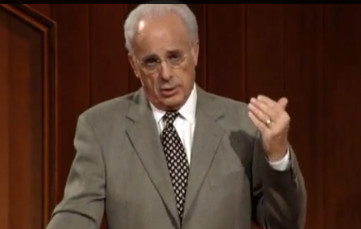
And so Jackson urges his readers to realize that Pastors are also human, what he calls “tools of destiny,” and he wants us to know that someday, some of us may be in church leadership, which will further help us understand the responsibilities faced by our Pastors. Jackson also said that, given this, he urges reconciliation with church leaders when there’s a problem, and outlines the steps for his readers. Ultimately, it’s a call to forgive leaders who may have hurt us. Just for giggles, I included a photo of John MacArthur because to me, he exemplifies the sort of Pastor who generates a lot of “hurt” among people. But that’s just my opinion. What do you do when a well-known and influential Pastor has the ability to potentially hurt thousands?

The only end of chapter question I have highlighted is:

Are you looking for them (church leaders) to provide something that can only come from Jesus?

At this stage in the game, I don’t think I’m looking for a church Pastor to provide anything at all. How can they when my presence in almost any church (at least if I opened my mouth) would be a monkey wrench in the machinery?

In Chapter 11: The Cup of Misunderstanding (sounds like a little-known additional cup at a Passover seder), Jackson speaks of this metaphorical cup containing something that tastes bitter, tastes like injustice, and “those who drink it must do so alone.” He also says that this cup is usually received by “innocent people,” and is particularly harsh when “delivered to you by a brother or sister in Christ.”

Jackson compares being misunderstood and judged by someone in the church to the pain of betrayal suffered by Christ at the crucifixion.

I felt the comparison was a bit much. After all, human misunderstandings aren’t confined to the church, they happen in every human corporate venue, from the family to the workplace.

Jackson says this pain is intensified if the person you are trying to reconcile with makes it abundantly clear they have no intention of mending fences.

Someone once said, “You must embrace the cross if you would carry it with dignity.” The same is true of this cup.

I think what Jackson is saying is that being misunderstood, judged, and cut loose requires the Christian to be “Christ-like,” to bear the burden and the pain as Jesus did on the cross. Sounds pretty dramatic, but then, human conflict can elicit a lot of drama.

One of the end of chapter questions is:

Do you have a friend who can stand with you in your struggle?

In spite of my friend’s concerns about me and the issues Jackson addresses in his book, I don’t know that I’m really struggling, at least in relation to community or my lack thereof.

Jackson asks: “Are you passing the test? As you do, you’ll begin to look more like Him.” If the test is forgiving the Pastor, first of all, I doubt he thinks he needs my forgiveness. Nevertheless, I have forgiven him. After all, he’s only doing what he believes is right, and within his church’s context, it is the right thing to do.

In Chapter 12: Death by Religion, Jackson discusses watching an infomercial for Chuck Norris’s Total Gym product. The bottom line is that in spite of the seemingly fantastic claims made in the marketing of this all-in-one piece of exercise equipment, Jackson says if used as indicated, and if you eat a proper diet, the claims are all true.

Please forgive this sacrilegious comment, but I’ve noticed that in some ways, the Church is a lot like that infomercial–we’re touting a product that really works.

And by that he means:

A life devoted to His service is the only way to ensure our eternal salvation and to experience the life we were created to live.

norris and brinkleyBut while a very fit Chuck Norris and Christie Brinkley sell their product on TV, Jackson says, by comparison, those Christians promoting a better life through Jesus are more like “a flabby, middle-aged guy who thinks he looks good in spandex.”

In other words, many believers promoting a better life through Christ don’t look or act like they’re participating in that life. They look like they’re participating in a marathon dining session at McDonald’s.

We’re selling relationship, but what they see is religion…and religion is killing our sales pitch.

I’ve mentioned this artificial split between these concepts in a previous blog post. It’s really the traditional Christian rant against their misconception of Judaism:

Religion breeds death because it is limited to man’s ability to comply with its codes and regulations.

If Jackson had my understanding of the New Covenant, he’d (hopefully) understand why his opinion is completely out of the ball park.

But I don’t have time or space to go into all that again in this rather lengthy series of book reviews.

Religion is easier to control than a relationship.

You may have noticed that Jackson has shifted his emphasis from the individual’s relationship with other Christians in church or their relationship with the Pastor and church leadership, and is now focusing on the person’s relationship with Christ.

…after all, we’re all under grace and God doesn’t get ticked if we skip a day of devotions.

I’m not sure what God does or doesn’t think about an individual being hit and miss on living a life of holiness, not that any one of us is perfect at it.

Jackson then proceeds to bash the Pharisees, even though (he probably doesn’t see this) Jesus lived a life consistent with the basic tenets of Pharisaism, and as a matter of fact, so did Paul.

In describing “religious systems,” he says they operate like “spiritual frat houses”. They have their secret handshakes, inside jokes, matching jackets, and the like. Yes, I’ve experienced cliques in church. People who were ‘in’ and people who were ‘out’, though to be fair, I didn’t experience them at the last church I attended (at least for the most part).

However, Jackson could have been describing how some people experience certain individuals and congregations involved in the Hebrew Roots and the Messianic Jewish movements.

I’ve mentioned before Derek Leman’s blog post Gentiles Who Feel Left Out which addresses this matter. If you feel you are “in”, then being in contributes to your sense of identity, according to Jackson. You may, again, as Jackson says, experience a sense of being among the elite by being in.

This next point is important:

Spiritual fraternities do not welcome different opinions or viewpoints.

I’ve experienced that in spades, but I think that a lot of religious communities are like this, based on a mutually accepted sense of “rightness” of their doctrine. Anything that contradicts their doctrine is automatically wrong. These congregations state, using Jackson’s words:

We want your input and opinions–as long as they agree with ours.

This goes back to what I said before about expectations within the group. Jackson also says such “frat houses” are full of cliques, difficult to fit into (again, I know what that’s like), and Jackson says the only way to combat this is to “make sure that our hearts are free from religion.”

And yet, I could probably speak to Jackson for less than an hour and elicit a very protective and “religious” (as he defines it) response from him, just by disagreeing with how he interprets the Bible’s message of the good news. Actually, all he’d have to do is read my reviews of his book.

Only two of the end of chapter questions seemed relevant:

Are you managing a religion or living in a relationship?

Has your religious experience become a duty or a delight?

passover-artConvincing Jackson of the beauty of the mitzvot, particularly with Passover and the family seder coming up in a few days, all the preparations, all of the ceremony, and the retelling of the Exodus, would be a lost cause if I were to make the attempt. I suspect all he’d see is “religion,” missing how the seder brings a Jewish family closer to God.

Of course, I wonder how he’s managing the “relationship” of the upcoming Easter Sunday service at his church, which usually involves a multi-media presentation and tons and tons of preparation and ceremony?

So far, having reviewed about half of Jackson’s book in a fair amount detail, I have two preliminary conclusions. The first is that I don’t think he’s speaking to my situation. The second is that my opinion of my being incompatible with “church” is being re-enforced. I find it impossible to review his book as related to my current status of being apart from “community” without being critical of his theology and doctrine.

I just can’t seem to put our obvious differences aside and simply listen to what he has to say on a human level. This is my fault. I have a friend who tells me I need to be more patient and to speak out less.

Probably true.

One last story.

I had coffee with my friend last Sunday. On the drive home, he mentioned that his congregation had a guest speaker from Africa on the previous Shabbat. Among other things, this speaker talked about lions and how they hunt only the sick, the weak, the old, and those who wander off and are alone.

Not-so-subtle point received, my friend. *grin*

Review of Loving God When You Don’t Love the Church, Part Two

Why is it that people who have been wounded in church will still be talking about their wounds years later? Why can people forgive a betraying friend or experience a business meltdown and move on with their life, but if it is a church that fails them, it is nearly impossible to let it go? Have you ever seen this dynamic in others? Have you ever lived it yourself?

-Pastor Chris Jackson
from Chapter 3: Church Wounds
Loving God When You Don’t Love the Church: Opening the Door to Healing (Kindle Edition)

Reviewing Pastor Jackson’s book (Here’s the link to Part One) is my way of attempting to respond to what I am calling a pesky challenge to find fellowship and community (or something) with like-minded believers. I’m not sure such a thing is possible for reasons I outlined yesterday, but since a friend asked me to consider it, I suppose I should.

A couple of days ago, Derek Leman wrote the blog post Gentiles Who Feel Left Out which sort of addresses my current situation but not really.

But first things first. To answer Pastor Jackson’s question, a great many Christians who have left the Church and affiliated with Messianic Judaism and/or the Hebrew Roots movements have lived out the dynamic he describes above. And seemingly in response, Leman wrote in the aforementioned blog post:

I also say to disenfranchised non-Jews not to give up on churches. Many have not tried really looking. Some came from churches with certain labels and assume they can only return to those places. Be more open minded. There are churches, often outside of evangelicalism, whose clergy are better educated (evangelicalism is heir to revivalist Christianity and tends to squash intellectual growth).

That may well be true for some Christians and some churches. After all, I’ve read that First Fruits of Zion‘s (FFOZ) HaYesod and Torah Club materials are being taught in churches. I’ve heard that episodes of FFOZ’s television program A Promise of What is to Come are viewed and then discussed in Sunday School classes in some churches. So it’s apparent that there are some Christian churches that are open to this perspective and to “Messianic Gentile” worshipers.

But I’m reviewing Pastor Jackson’s book through the lens of my own experience, so finding “the right church” and fitting in isn’t the entire solution. In fact, it really isn’t a solution at all.

I feel like I’m participating in Pastor Jackson’s statement of talking about my “hurt” months and even years later, but again, I’m only revisiting all this because I was asked. Also, everything has been resolved between me and the church I used to attend to the extent possible. That doesn’t mean there’s going to be reconciliation and return and, relative to my home life, even if I did return, it wouldn’t be helpful.

unworthyPastor Jackson, answering his own question, says “We don’t expect to get hurt in church.” That’s true. At least in an ideal sense, we expect “church” to be a safe place, maybe the safest of places, given how many Christians see secular society as unfriendly or even dangerous to religious people.

I only perceive church as “hazardous” to the degree that, at least in my own recent experience, what I believe is incompatible with how they define “sound doctrine.” Granted, it was only one church, but I do live in a pretty conservative part of the country and religious views in many local churches are also “fundamental”.

Pastor Jackson says one of the problems is that those hurt in churches are never heard. That is, they never get the opportunity to express their side of the story. That’s not the case with me. I had abundant opportunities to be heard by the Head Pastor and he listened to me at length. Jackson asked how there can be healing without closure. I have closure. I made a very definite decision on what to do in leaving church and why I was doing it. The door is closed. It’s over.

The end of chapter questions have to do with being accepting of differences, carrying around anger, and coming to the realization that some of your hurts may be your own doing.

I don’t think I understand the last question:

Do you know that God believes you can make it?

I’m not sure if Jackson means “make it” in life or “make it” in church.

In Chapter 4: The Other Life, Jackson makes an interesting statement:

Religion has left me parched and dry and wondering if it was really what God intended for me when He drew me into the other life.

By “other life,” Jackson means a life of faith and a personal journey with Christ. I find myself closer to God when I’m reading and studying the Bible (or writing this blog), so my “other life” is lived, for the most part, outside of any immediate fellowship. Although I don’t observe a proper Shabbat, I’m usually able to carve out a few hours to study the weekly Torah portion which often is the most rewarding part of my day and week. It’s the closest I come to the “other life”.

I read this next statement of Jackson’s and realized we conceptualize prayer in different ways:

A few weeks ago, I felt like the Lord spoke to me in one of my morning prayer times. I was journaling my thoughts to the Lord and then recording what I felt He was speaking to me in response.

Is that normal? Oh, I get the part about writing my thoughts down. I do that all the time. But writing down what I imagine God is saying back to me? Isn’t that substituting my personality for God?

prayerI’ve never heard audible voices from Heaven but on those occasions when I thought God was trying to tell me something, it was usually through an unusual set of circumstances. That’s what led me to attend that little Baptist church a few miles from my house for two years. I won’t go into the story, but an unlikely set of events occurred that led me to call the Pastor of that church, set up a meeting, and then decide to go to Sunday services. It was so unusual, I just couldn’t chalk it up to coincidence. I felt as if God wanted me to go to that church as a sort of Tent of David experience.

Either I was wrong and God didn’t want me to go to that church or God did want me to go and I blew it. But I’ll never know which one it was.

The Chapter 4 end of chapter questions address hearing the “other life” speaking to you and what it said, whether or not religious life stifled or accentuated that voice, and taking the road less traveled. Nothing that really connected to my experience.

In Chapter 5: Troubled Waters, Jackson says:

A great feeling of personal satisfaction ensures when we are fulfilling the commands of God.

Jackson surely doesn’t realize what a loaded statement that is in Messianic and Hebrew Roots circles when applied to a Christian. He did connect that to “serving our fellow man” which I felt was encouraging, because much of the Biblical message has to do with loving God by serving people. Tikkun Olam or “repairing the world” after all is the Jewish mission and the Church has inherited some of that whether they realize it or not.

Jackson was raised in a Christian home and has fond memories of church:

I know it helped me. I can’t imagine what my life would be like or what temptations I might have fallen into had I not been raised in a Christian home. Church has always been the backdrop of my earliest memories.

I periodically encounter a “life long Christian,” someone who came to faith early in life and who was raised in a Christian home. When I tell them I didn’t come to faith until I was about 40 years old or so, they are almost always astonished. From their point of view, it is inconceivable that someone could live the first half of their life as a “sinner” and then come to faith. It’s funny that Yeshua and Paul never seemed to have an age limit on repentance.

One of my earliest memories was of my parents being water baptized in a swimming pool.

Just thought I’d toss that quote in there.

Jackson includes a number of other pleasant childhood memories about church involvement. He calls it “a flowing current of life that overwhelms us.”

But a few pages later he says:

It’s happening every day, you know. People are leaving the church by the thousands. They’ve tasted what church has to offer and, still dissatisfied, they are abandoning organized Christianity in droves.

quitting churchJackson attributes this mass exodus away from local churches to people being mistreated, misunderstood, or just plain bored. He wisely states:

They’re not searching for a different gospel or a different God–they just want more of Him.

“Get to know Jesus better.” That phrase was used to promote the Torah Club a few years back. I think Jackson is right. I think a lot of Christians are reading the Bible for themselves and realizing that the Bible doesn’t say what they’ve been taught it says from the pulpit or in Sunday School.

In that sense, people may not all be leaving church because they’re hurt but because they’re “hungry”. Jackson says, “Jesus didn’t come to earth to institute a religion–He came to reveal God.” True. Jesus didn’t invent Christianity, he practiced a normative Judaism of his day, specifically Pharisaism (I know a lot of Christians who would be really upset at that statement). The invention of Christianity only came later, much later.

Jesus did come as Prophet and Messiah to reveal God, first to the Jews but ultimately, to the rest of the world.

Jackson doesn’t want that message to be contingent upon what the local church does or fails to do. But he also says:

God created us to be part of a community, and from the beginning He determined that it wasn’t good for man to be alone. We need the Church!

Well, that “not good for man to be alone” addressed Adam and having a suitable “helpmate”, not religious community as such. Also, I believe in Messianic Days the Church as most Christians conceptualize it, will cease to exist and be replaced by Messiah’s ekklesia (which does not translate into “Church” in English). Messiah will define the correct sort of community/communities for his Jewish and Gentile subjects.

At the end of this chapter, Jackson asked four questions, but only the last is relevant:

Do you think this is what Jesus wanted?

If he means the Church as it exists today, I’d have to say “yes and no”. I think he wanted communities of disciples who would obey his commandments to love God and to love others, doing good, feeding the hungry, giving hope to the hopeless, visiting the lonely, making peace in the home, which many churches do, but there’s a lot that has happened in the history of the Church he definitely didn’t and doesn’t want.

He absolutely didn’t want all of the crimes Christianity has committed against the Jewish people and Judaism. How could he? The Bible speaks of the Messiah coming (returning) to defeat Israel’s enemies and to judge those who have harmed his beloved Jewish people. Imagine Jesus judging all of the resurrected Christians across the ages who were taught to hate the Jews, who were taught that the Jews killed Jesus, who participated in burning volumes of Talmud, burning Torah scrolls, burning down synagogues, who tortured, maimed, and murdered countless Jewish people whose only crime was to faithfully cleave to the God of their fathers, and who died in pain while singing the Shema.

No, that isn’t want Jesus wanted, and in the resurrection, there are going to be a lot of shocked and dismayed Christians.

MessiahI realize this wasn’t what Pastor Jackson meant but his focus and mine are different. He’s talking to Christians who have been hurt by other Christians and who have chosen to respond by leaving community. But when you ask me what Jesus wanted out of “the Church,” I have an entirely different viewpoint.

At the end of Chapter 5, I’m still not finding much of what Jackson is writing that speaks to my own experience. If anything, as good a guy as I think Jackson is, what he has recorded in his book simply emphasizes for me how differently he and I understand God, Messiah, and the Bible.

I’ll continue my review in a few days.

Review of Loving God When You Don’t Love the Church, Part One

Where is the Church that Jesus said He would build? Where can I find the abundant life that He talked about? Where can I fit in and find real, unforced relationships? Where is the living water that my soul so desperately craves? And, possibly most important of all, why do church wounds go so deep and take so long to heal?

Pastor Chris Jackson
from Chapter One: Have You Ever Been Hurt in the Church?
Loving God When You Don’t Love the Church: Opening the Door to Healing (Kindle Edition)

As I mentioned yesterday, I’m going to review Pastor Jackson’s book in stages, mainly because I haven’t finished reading it yet. Since I’m reading it on my Kindle Fire, I’m simply going to address the parts of the book I’ve highlighted, such as the quoted text above.

I rarely read Christian oriented books anymore. I tend to be drawn more to Jewish publications in book, blog, and website formats. To read Jackson’s book, I have to push past a lot of what I call “Christianese” and past a lot of traditional Church doctrine. I’m attempting to set aside the temptation to review this Pastor’s theology, and instead to focus on what he has to say about loving God but not “the Church”. I don’t think I’ve been entirely successful.

For instance, in the quote above, I have to push past the fact that Jesus (Yeshua) never talked about a Church, but instead, he spoke of an ekklesia, a grouping or community, a Kehilla (Heb. “congregation”) of disciples.

Where is his Kehilla today? Pastor Jackson asked a more profound question than I think he could have realized.

But he asked another very important question. “Where can I fit in?” This is something Derek Leman blogged about just yesterday. For me, that’s one of the $64,000 questions, and I’ve been looking for an answer. In my case, in any immediate and practical sense, the answer is probably “nowhere” or at least nowhere within driving distance.

But what about the “church wounds” he mentions? Am I “wounded” by the church? Is that why I’m avoiding going “church hunting” like a pack or rabid pit bulls?

Not exactly. Oh, I admit, it wasn’t any fun having the Pastor of the church I used to attend devote an entire sermon to refuting every single thing I understand about the Bible from the pulpit. I think I’ve made my peace with that and him, but it also convinced me that I would be an antithetical element in just about any Christian church in my area (as far as I know). In that sense, I have been left rather “gun shy”.

churchOf course, as I’ve already mentioned, even if I found a church that would accept me into community and one that wouldn’t drive me crazy, I still have my long-suffering Jewish wife to consider. My attending church every week was like hammering nails into her temples each Sunday morning (not that she’s ever complained nor has she ever discouraged me from going to church).

How can I do that to her again?

Pastor Jackson also encourages his readers to separate God from the Church, or at least any pain caused by people in the local church:

He loves you. He’s longing for you. You are the Church. You are the apple of His eye, and He is pursuing you with the passion of a desperate lover. He is not the church that hurt you!

-ibid

Strange how “apple of His eye” and “lover of your soul” are terms from the Torah and Siddur that specifically describe God’s relationship to Israel, the Jewish people. But then, Derek also recently blogged about how Christians typically read all of the Bible as if it were addressed to Gentile believers rather than the Jewish people.

But I digress (again).

Yes, losing faith in the Church (or a local church) does not mean you must lose faith in God, but how long can faith be nurtured without community to support it? I don’t think I’m avoiding community because I feel hurt. I’m avoiding community because I’m incompatible with community and even if I weren’t, my being in community would have a profound impact on my home life. Solve that, Pastor Jackson.

At the end of the first chapter, just like the subsequent chapters, Pastor Jackson added some study and application questions:

  1. What are the primary hurts you are carrying from church?
  2. Are you willing to embrace a path that leads to healing?

I think I’ve answered the first question and the answer to the second is complex. Healing, even if I’m hurt or damaged in some sense, doesn’t necessarily mean reconciliation. It doesn’t mean returning to the church I left nor attending another, if for no other reason than my Christianity is a wound my Jewish wife must bear.

chris jackson
Pastor Chris Jackson

In Chapter 2, Pastor Jackson tells story about returning to his hometown and getting together with a friend. Jackson innocently asks about a mutual acquaintance and the conversation turns tense. Apparently this mutual friend did something unforgivable, he became a “covenant breaker” and was teaching his children to become the same thing.

My friend was silent for a moment as he considered the best way to break the terrible news to me. “No,” he said slowly. “He left the church. He disagreed with the leadership about somethings and decided to move on. Now his children are being taught that it’s okay to break covenant and bail out when things don’t go their way.”

-ibid, Chapter 2: The Left Behind

Break covenant? What covenant? That is, where in the Bible does it say that we non-Jewish believers are part of a covenant that specifically requires regular church attendance? Jackson doesn’t address the answer, so the concept of Christians having a covenant to attend church must be understood by him. Too bad that I don’t. There are still many parts of Christianity that seem so mysterious to me.

But the implication is that at least some Christians would consider me a “covenant breaker” for also not going to church. After all, I disagreed with the Head Pastor of the church I used to attend on a pretty regular basis, which led to some lively conversations in his office. We kept things friendly, but we really did (and still do) conceptualize the message of the Gospel in fundamentally different ways.

Though I’d probably disagree with Pastor Jackson in many areas as well, he tends to ask good questions:

I wondered why it is that we Christians can be so quick to write people off when they make decisions with which we disagree.

-ibid

leaving churchTouché, Pastor Jackson.

I’m just as guilty of writing off the Church as some people are of writing me off.

Jackson said he wishes “that every guest who visited my church would fall in love with us and never want to leave. I wish they would experience God, make lifelong friendships, receive training in the area of their giftedness and make an impact with us for the Kingdom of God.”

There’s a lot I could address in that brief statement, but the most relevant words he wrote were “experience God.” Theological and doctrinal differences aside, that’s at the center of our faith, experiencing God and then living out that experience day by day, helping others to experience Him, too.

Another good question:

What happens after people get left behind? Where do they go? Where are they now?

-ibid

I suppose that Jackson would see me as being “left behind” by the Church. So where do the disaffected and the disenfranchised go and what do we do?

According to Jackson’s research, some just go to a different church, others, like me, stop going to any church and do something else with their Sundays. And some “are experiencing more fellowship in the local pub than they ever experienced in the local church.”

Jackson said that “the devil” didn’t take these people out, they were gunned down by “friendly fire” from within their churches.

They weren’t just interpersonal relationships that involved me — they were much bigger than me. They involved church-philosophy issues and relationships between spiritual leaders that disintegrated and, in the fallout, damaged hundreds of lives.

-ibid

That part doesn’t particularly map to my experience since the only people who were affected by my leaving church were the Pastor and me (well, and my wife indirectly). I doubt anyone else at church particularly noticed, or if they did, any concerns passed quickly. I’d become kind of a pest with my odd questions and observations in Sunday school (although occasionally someone said they appreciated something I’d said). I certainly wasn’t part of anything like the disaster Jackson described in the above-quoted block of text.

At the end of Chapter 2, his questions were:

  1. Do you still have hurts from areas where you were never heard?
  2. If so, do you need to process those hurts with someone who can help?
  3. Even if you currently feel like the wounded man in Jesus’ story, are you willing to be the Good Samaritan for someone else who has been wounded like you?

Good SamaritanPastor Jackson has a habit of taking scripture and using it allegorically to describe an unrelated situation. The Parable of the Good Samaritan (Luke 10:25-37) was Yeshua’s metaphorical story to answer a scribe’s question about who his “neighbor” was. The neighbor was the one who showed mercy to the man attacked by robbers and left for dead. Yeshua told the scribe to “go and do likewise,” that is, go and show mercy to those who need mercy.

This answers the third of the study questions. Even if we feel wounded by past church associations, we should show mercy to the wounded we encounter rather than, to extend the metaphor, pour salt into open wounds.

I don’t relate to the first question. I was heard, at least by Pastor. I just wasn’t believed. I was the elephant in a roomful of gazelles. I didn’t fit in and I refused to turn into a gazelle. I make a better elephant than a gazelle.

I did process all this with a friend who accurately predicted how it was all going to end. And as you all know, I process a great many things here on this blog.

Who can help?

I don’t know. I’m not even sure what needs help or what help would look like.

Just like my participation in church, my situation and Jackson’s book are an imperfect fit. I may find, as I continue through his book, that it’s no fit at all, again, like me and church. I guess I’ll have to wait and see.

I’m going to stop here, even though I’m much further along in the book than the first two chapters. I’d like to keep this blog post from becoming unmanageably long. I’ll have more to say next time.

A Gentile’s Book Review of “First Steps in Messianic Jewish Prayer”

It is appropriate for Gentile disciples of Yeshua to participate in Jewish prayer. After all, the Temple in Jerusalem is to be called “a house of prayer for all peoples” (Isaiah 56:7). Yeshua did not come to create a separate religion for Gentiles with different prayers.

-Aaron Eby
“Prayer in Jewish Space,” p.33
First Steps in Messianic Jewish Prayer

I’ve quoted from Aaron’s book twice before, the first time in Messianic Jewish Shabbat Observance and the Gentile and just yesterday in Discovering Myself by the Light of Torah. I suppose it’s appropriate for me to do a more proper book review, and I’m writing it from the expected perspective: that of a non-Jew.

You see, for the most part, Messianic Jewish Prayer is Jewish Prayer. Aaron’s book can be thought of as a “Jewish Prayer 101” class complete with a minimalist siddur at the end of the book. It’s unique in that it has a specific focus on Yeshua HaMoshiach, but a focus on Messiah is not considered unusual according to Aaron:

The traditional Jewish prayers are constantly focused on the Messiah. Although they do not identify Yeshua by name, they do identify the Messiah by character and title.

Some people might object that the traditional Jewish prayers do not say anything about Yeshua since they do not mention him by name. The same is true of the Hebrew scriptures, yet we know that they say a great deal about Yeshua.

-Eby
“Prayer in Jewish Space,” p.29

Aaron starts out in Part One by describing “Prayer in Messianic Judaism” as distinct from the other Judaisms and Christianity. Although describing Jewish Prayer, as I said above, the specific focus is always on Messiah. In essence then, this is an instruction manual about prayer in Messianic Judaism which first and foremost should speak to Jewish people. Granted, devout Jewish people raised in religious households are raised in Jewish prayer, but many of the Jews attracted to Messianic Judaism have not had a traditional Jewish education. Still, the emphasis on Judaism must be recognized. The portions of his book that specifically address Gentiles in Jewish Prayer and in Jewish Space are called out and those are the parts I spent most of my time in.

In fact, the section of Part One called “Prayer in Jewish Space” seems to be a primer on how Jewish Prayer is conducted “procedurally” as well as in terms of “kavanah” (intent). I quoted from this chapter previously when addressing “Gentiles and Jewish Prayer.”

For example, one line in the traditional after-meal blessing offers thanks to God “for the covenant that [he] sealed in our flesh.” It seems problematic for a Messianic Gentile to say this. But should someone who is not Jewish then say “for the covenant that you have written on our hearts?” To do so would imply that Messianic Jews have only a fleshly covenant, whereas the new covenant that is written on hearts belongs only to Messianic Gentiles, God forbid.

-ibid, p.36

First Steps in Messianic Jewish Prayer

For the uninitiated Gentile or for those who are sensitive in one way or another to the distinctions made between Jews and Gentiles in Messianic Jewish space, parts of this book may be a little confusing or disorienting and even seem kind of annoying. At best, it will take some work for Gentiles, even those familiar with Jewish Prayer on some level, to get used to the flow of prayer outlined in the book during a synagogue service or even a Shabbat dinner. At worst, some Gentiles will feel put out not to be considered “Israel” and thus directed to pray the prayers in not exactly the same manner as their Jewish counterparts.

However, this book is designed to not only teach Messianic Jewish Prayer, but to continue to establish the distinctive roles Jews and Gentiles play in Messianic Judaism, with the understanding (from my point of view, anyway) that those roles are not firmly anchored or agreed upon at present.

That said, I was surprised when Aaron didn’t make much in the way of Jewish/Gentile distinctions relative to the standard prayers, particularly the Shema. But let me back up a step:

Gentiles who devote themselves to Yeshua of Nazareth are not only disciples; they are his subjects, and he is their King. In that sense they relate to the nation of Israel and the Jewish people in the same way that a conquered and annexed people is subordinated to a conquering king. These Gentiles are no longer separated from the Messiah or “alienated from the commonwealth of Israel and strangers to the covenants of promise” (Ephesians 2:12). Instead, they share in the inheritance and the destiny of the whole nation. In keeping with this identity, the God-fearing Messianic Gentile should not hesitate to join the Jewish people in formal prayer.

-ibid
“Declaration of Intent for Messianic Gentiles,” p.47

As a non-Jew in Messianic Jewish territory, you could choose to take this one of two ways. The first is that you could rejoice in your (our) unique role in the Kingdom of Messiah as grafted in Gentiles who had no hope and no belonging until our faith in Messiah brought us alongside Israel in devotion to God and sharers in the blessings of the New Covenant promises. The second is that you could feel pushed away, slighted, or “sent to the back of the bus,” so to speak, as if, as a Gentile, you aren’t worthy of sitting in the front of the synagogue with the Jews. By definition, if the nations of the Gentiles are to be considered vassal, then they serve Israel as well as Israel’s King. The wording Aaron uses could be spun in either direction:

As Messianic Gentiles engage in these prayers, they must not lose sight of their own important and esteemed position as the crowning jewels of the nations. A Messianic Gentile who participates in the prayers and petitions of Israel should thus consciously acknowledge that since he is not legally Jewish, his connection to Israel comes only through King Messiah.

-ibid

That’s where the “declaration of intent” comes in. Aaron has a difficult job as the author of this book in balancing the invitation of Gentiles into Jewish prayer and, at the same time, containing and protecting Jewish identity in Jewish space including in (Messianic) Jewish prayer. It’s our faith in Messiah that binds us and it’s difficult, particularly in egalitarian America, to accept the status of a subordinate or vassal citizen in the Kingdom of Messiah, with Jewish Israel being “large and in charge” of the rest of the world (that means the rest of us).

If you can accept that role as many Messianic Gentiles have done, then the only difficulty you may encounter is adapting your prayer life to the structure and language this book presents (depending on your experience in Jewish prayer up to this point). If you can’t, then you’re going to have a difficult time stumbling over the presuppositions Aaron makes about Jewish and Gentile roles in the Messianic Jewish synagogue.

shabbaton
Aaron Eby

Although I’ve attended Shavuot services and had a Shabbat meal or two at Beth Immanuel Sabbath Fellowship, which offers Jewish services and includes Jewish prayer, I’ve not had the pleasure of attending any of First Fruits of Zion’s (FFOZ) Shabbaton events. This would have given me a more personal look at how to use The Sabbath Table prayer book (which, as you read this, I’ll be using tonight for the first time), and thus experience Jewish prayer in the manner Aaron describes.

Although I’ve used a number of siddurs before, including Artscroll’s Sefard Siddur, this coming Shabbat will be a unique experience. I’m somewhat used to making the mental and linguistic adjustments Aaron’s book recommends for Gentiles since the language in traditional siddurs assumes the perspective of a Jewish man, but it’s refreshing to come across material that can be specifically adapted to me as a Messianic Gentile. I still expect to be challenged by the flow of Erev Shabbat prayers, especially since there won’t be anyone else present to emulate.

Aaron’s book devotes a lot of attention to the Shema and Amidah, which you’d expect, and as I mentioned before, I was surprised that these pages weren’t covered with caveats and alternate language for Gentiles, since this is the heart of Jewish prayer. Aaron continues to write for the reader, Jewish or Gentile, who knows little or nothing about Jewish prayer. Standard siddurs, although they contain many notes on a variety of topics, assume a certain amount of prior knowledge by the user. Aaron’s book opens the box, so to speak, and lets the reader look inside the prayers, what they mean, and how they were written.

But while there are few mentions of Jewish/Gentile distinction, they can be found:

Tefillin are a distinct marker of Jewish identity. It is not forbidden for a Messianic Gentile to wear them; however there are some communities in which it would be confusing or even offensive for a non-Jew to do so. It is important that Messianic Gentiles who wear tefillin are sensitive to the message that it communicates and that they conform to community standards; it may be advisable for Messianic Gentiles to avoid wearing them in public venues.

-ibid, p.65

And again…

Tzitziyot serve as a marker of Jewish identity. It is not forbidden for Messianic Gentiles to wear them; however, doing so may cause confusion and offense. It is advisable for Messianic Gentiles who choose to wear them to do so with utter discretion.

-ibid, p.69

Several years ago, for a variety of reasons, I put my tefillin and tallit in a box and shoved the box onto a shelf in the back of my closet. One of the reasons I did so was I became convinced that the part of Aaron’s statement about distinctiveness and Jewish identity is correct. This was filtered through the knowledge and experience of being married to a Jewish wife who had come to the conclusion that having a Gentile/Christian husband dressing up as a Jew was a pretty odd thing to do.

israel_prayingNo, she never mentioned it, but after being married for over thirty years, you pick up a few things about how your wife thinks. To honor her as much as for any other reason, I stopped doing pretty much anything that might appear “Jewish”.

I know Messianic Gentiles, including those within FFOZ and at Beth Immanuel, who wear tzitzit and kippot, and within their personal or community contexts, given Aaron’s words above, that would seem to make sense. In fact, since giving up the practice of wearing a kippah, tallit, and laying tefillin, even in private, I’ve been concerned about some potential “blowback,” even if it’s left unsaid, from some Messianic Gentiles and Jews concerning my non-use of Jewish “particulars”. Identity confusion goes both ways, and I can see how I might seem a little too “light” or “insubstantial” for actually not donning a tallit when I pray.

I wonder if someone like me would be considered offensive in a Messianic synagogue that more or less expected most Gentiles to wear a kippah and tallit, especially since Aaron presents the Shema as acceptable for Gentiles to recite, and especially because one of the customs during the Shema is to grasp the tzitzit together in the left hand?

I think the bottom line as Aaron suggested, is for the Messianic Gentile to adapt their practice based on the standards of their local worship community. Being “community-less” at the moment allows me to do more or less anything based on personal standards, but I’ve still got good reasons for not getting that box out of the closet and opening it up.

But that suggests another option. Many Hebrew Roots individuals and groups not only consider wearing a tallit to be an available option, but even an obligation and their right as grafted-in Gentiles. While I disagree with that opinion, since these people operate within their own communities and those communities have set standards permitting and even commanding Gentile men to wear tallitot, then technically, this part of Aaron’s book is adaptable to their needs.

I also started wondering (and I guess this is a community standard thing) if Gentiles could be considered as part of a minyan in Messianic Jewish synagogues. Aaron didn’t address that topic at all, and yet certain prayers, including Birkat HaMazon (Grace After Meals) require a minyan.

As I said, much of the book was taken up with a detailed description of the Shema and Amidah prayers, but then on page 103, starts an analysis of what most Christians call “The Lord’s Prayer.” Aaron refers to it as “Our Father”.

The Didache contains this prayer in a version that is quite similar to that of Matthew, and it instructs believers to recite it three times a day. From the earliest available records, Christians have used this prayer as part of liturgical worship. Like a majority of traditional Jewish prayers, the first-person pronouns of “Our Father” are plural (“us,” “our”). This suggests that the prayer was intended for corporate liturgical use.

-ibid, p.104

While some scholars have suggested that “Our Father” (the Lord’s Prayer) was meant to take the place of the traditional Jewish prayer service and even contains all of the basic elements of said-service, Aaron believes that it was meant to be included at the end of the Amidah for Messianic Jewish and Gentile believers, particularly because the Didache instructs Gentile disciples to recite it three times a day.

The Didache was a sort of “training manual” for how to teach a non-Jew to become a disciple of the Jewish Messiah. It’s thought to have been originally composed by the Apostles or those close to them. The earliest version may have been in the form of oral instructions that accompanied the well-known Acts 15 “Jerusalem Letter.” This all seems to say that the very earliest Gentile disciples of Messiah practiced Jewish prayer alongside their Jewish teachers and mentors, perhaps well beyond the First Century CE.

The final portion of the book is a sort of “mini-siddur” containing the text, in English and Hebrew, for:

  • I Hereby join
  • Declaration of Intent for Messianic Gentiles
  • Shema
  • Amidah
  • Our Father
  • Prayer for the Restoration of Zion

Aaron even put in a “Suggested Readings” list at the back of the book for those who want to go beyond the “Jewish Prayer 101” level.

Shabbat candlesI know many of us in the Messianic Jewish and Hebrew Roots movements have struggled at one time or another about how to use a siddur, how to adapt it to our faith in Messiah, and how to adapt it for a mixed Jewish/Gentile worship service. Over a decade ago, I regularly worshiped in our local Reform/Conservative synagogue during the time when my children were in Hebrew school, and I had no guide for this sort of thing. I felt pretty awkward.

That sort of dynamic is built-in to a Messianic shul and I think Aaron’s book is at least part of the answer to integrating Jews and Gentiles in a Messianic Jewish prayer service, at least enough to get a lot of people and communities started along the right path.

As I said, it’s not for everyone. If you, as a Gentile, think of yourself as part of “Israel” or a “spiritual Jews” or even espouse a “two-house” theology, then several parts of what Aaron wrote won’t suit you at all. Interestingly enough though, I’d still recommend First Steps in Messianic Jewish Prayer to just about anyone interested in the topic, because the research and level of description that has gone into the book illuminates the origin, purpose, and meaning of the prayers.

Shabbat Shalom.