Tag Archives: Chabad

Masei: In the Desert

The Sinai DesertThe Torah portion Masei begins by stating: “These are the journeys of the Children of Israel who left Egypt..” (Numbers 33:1) The Torah then goes on to recount all the places where the Jews resided during their 40-year trek from Egypt to the Promised Land.

Our Sages (in Alshich ibid. See also Klei Yakar and Orach Chayim ibid.) ask: By recounting the places where the Jewish people camped rather than the journeys themselves, the Torah is indicating that the resting places are more important than the journeys. This being so, the verse should have stated: “These are the encampments .,” rather than “These are the journeys .” Especially so, since the Jews spent the majority of these 40 years in their encampments, and not in travel.

The ultimate purpose of both the Jews’ travels and encampments was, of course, to enter Eretz Yisrael. The encampments were therefore also termed “journeys,” for they served no purpose in and of themselves.

-Based on the teachings of the Lubavitcher Rebbe,
Rabbi Menachem M. Schneerson for Torah Portion Masei

These concepts are reflected in this week’s Torah reading, Parshas Masei. Masei means “journeys,” and the reading enumerates the 42 different stages in the journey of the newborn Jewish nation from the land of Egypt until its entry into Eretz Yisrael. The Baal Shem Tov explains (As quoted in Degel Machaneh Ephraim, Parshas Masei) that these 42 stages in our people’s journey are mirrored in the life of every individual as he proceeds from birth his personal “exodus from Egypt” until his entry into “the Land of Life” the spiritual counterpart of Eretz Yisrael.

This entire journey through the wilderness (and through life) is intended to reflect continual spiritual growth. Even those stages which are associated with negative events have a positive impetus at their source.

-from a Commentary by Rabbi Eli Touger
Adapted from
Likkutei Sichos, Vol. II, p. 348;
Vol. VI, p. 111ff, 235ff; Vol. XXIII, p. 224

About twelve years ago, I found myself “between careers” and the only job I could find was a temporary position with the Postal Service. I worked from 11 p.m. until sometimes 11 a.m. at a big, mail processing plant, doing just about any kind of manual labor that anyone required of me. I barely saw my family. I only saw the sun as I was driving home after work to go to sleep. I didn’t make very much of an income…but thank Hashem that He provided me with the means to continue to support my family during a difficult period.

Back then, it was easy to complain to myself and to God about my work situation and conditions, but one of the supervisors at “the plant”, who was a Christian, told me this was my “wilderness period”. He turned out to be right.

I learned a great deal doing different kinds of jobs as a “casual” for the Postal Service during the several years I was with them. I don’t mean just the technical aspects of the different assignments I was given, but I learned a lot about patience, humility, respect, tolerance, and graciousness. I performed tasks that I didn’t think I was physically capable of and learned organizational skills I’d never needed before.

All the while, I prayed and prayed and prayed for God to deliver me from the wilderness…and eventually He did. But before that, He took away my ability to rest on the Shabbat (because of the necessity for me to work Saturdays) so I would appreciate the Shabbat. He taught me to cherish every day I had a day off because I could enjoy the light of day and the companionship of my wife and children. And He actually got me into really good physical shape.

The Baal Shem Tov characterizes our life, our experiences between birth and death as “the wilderness”, but within that great desert expanse, I believe we have more definite “wanderings”, challenges, and “dry parts” of our life that God provides so that we will learn something we desperately need in order to draw closer to Him and to be a better servant and child of the Father.

Now look again that the two quotes I inserted at the top of this blog post. It’s the 40 years of traveling and the 42 individual encampments that God used to hone and shape the vessel that was the Children of Israel so when the time came, they would be ready to enter into and possess the Land of Canaan. We saw that the generation which came out of Egypt was not ready (with a few exceptions) and they were not able to make the transition from a people enslaved to a free nation. It took 40 years and the next generation to take that crucial step.

Night RoadAs the Baal Shem Tov states, the journey of Bnei Yisrael can also be thought of as the journey we take as individuals along our path of faith. We wander. Our path isn’t linear. Sometimes we backtrack and revisit old haunts and habits. Every step, every “encampment” along the way, we learn something we need to know; we have an experience that gives us a vital skill, even if we don’t realize it at the time. The Children of Israel knew they would be wandering for 40 years, but we don’t usually know how long it will be for us. As I said, within the “desert” of our lifetimes, we encounter paths that are more rocky and desolate. Often the length of time we wander depends on whether we learn quickly and dilgently the lessons God has provided, or whether we resist and cling stubbornly to our past, our sins, our frustrations, our sorrows, and our “slavery”.

If we are obedient, we finally arrive, but that’s only the beginning. Once they crossed the Jordan, the Children of Israel went on to conquer a nation. Once we are finished wandering, we must conquer the greater desert of ourselves and more.

No, in all these things we are more than conquerors through him who loved us. For I am convinced that neither death nor life, neither angels nor demons, neither the present nor the future, nor any powers, neither height nor depth, nor anything else in all creation, will be able to separate us from the love of God that is in Christ Jesus our Lord. –Romans 8:37-39

For though we live in the world, we do not wage war as the world does. The weapons we fight with are not the weapons of the world. On the contrary, they have divine power to demolish strongholds. We demolish arguments and every pretension that sets itself up against the knowledge of God, and we take captive every thought to make it obedient to Christ. And we will be ready to punish every act of disobedience, once your obedience is complete. –2 Corinthians 10:3-6

“On the move” means there is no comparison between a person’s former state and his present one – the individual has totally departed from his previous level.

The verse therefore emphasizes “the journeys ,” indicating that a Jew should never be satisfied with moving from one level to a comparable one. Rather, he must constantly “journey” in a manner whereby his next stage is infinitely higher than his current one.

This latter manner of “travel” contains two elements: departing from the previous level and attaining the infinitely higher one. As long as there has not been a complete departure from the former level, the higher level cannot be attained.

This, then, is the meaning of “These are the journeys of the Children of Israel who left Egypt ..” Why was it necessary for there to be many “journeys” in order to leave Egypt; it would seem that with the first journey the Jewish people already departed Egypt?

Egypt is symbolic of spiritual limitations. Thus, the “encampments” – the spiritual achievements en route – did not constitute complete redemption from “Egypt.” In order to arrive at the Promised Land, there had to be a total departure from previous “encampments,” for each stopping – no matter how lofty the waystation – itself represented a lingering within the state of “Egypt.”

-Based on Likkutei Sichos Vol. XXIII, pp. 224-227.

Let us finally leave “Egypt” and may the God of Abraham, Isaac, and Jacob grant us a swift and safe journey to our own “Promised Land”, a place within us where we find His glory and peace.

Amen.

Light in the Darkness

Man in the DarknessAs impossible as it sounds, as absurd as it may seem: The mandate of darkness is to become light; the mandate of a busy, messy world is to find oneness.

We have proof: for the greater the darkness becomes and the greater the confusion of life, the deeper our souls reach inward to discover their own essence-core.

How could it be that darkness leads us to find a deeper light? That confusion leads us to find a deeper truth?

Only because the very act of existence was set from its beginning to know its own Author.

As it says, “In the beginning . . . G-d said, ‘It shall become light!’”

Rabbi Tzvi Freeman
From the wisdom of the Lubavitcher Rebbe, of righteous memory
“Mandate Unmasked”
Chabad.org

When God began to create heaven and earth – the earth being unformed and void, with darkness over the surface of the deep and a wind from God sweeping over the water — God said, “Let there be light”; and there was light. God saw that the light was good, and God separated the light from the darkness.Genesis 1:1-5 (JPS Tanakh)

When Jesus spoke again to the people, he said, “I am the light of the world. Whoever follows me will never walk in darkness, but will have the light of life.” John 8:12

Yesterday’s morning meditation borrowed from the daf for Chullin 29 in describing a person who has fallen far from the light of God. Yesterday, I also quoted from Rabbi Freeman’s interpretation of the Rebbe’s wisdom in which he says, among other things, that we “only fall down in order to bounce back even higher”. It is said that every descent we must make is for the sake of an ascent. Every fall brings us to the point where we will rise. Drop a heavy chunk of ice into a swimming pool. First, it will sink under the surface, but then it will rise back up.

The words of Rabbi Freeman quoted above are taken from a collection called Meditations on Moshiach (Messiah). Both Christians and Jews long for the coming (or return) of the Messiah and the day when he will heal our injured, bleeding world and us along with it. Put another way, lock anyone in utter and complete darkness and they will search, perhaps in vain, for even the tiniest glimmer of light.

That’s what we’re doing. We are people in the dark, straining our eyes and our spirits, seeking to glimpse a spark of the Moshiach and a sign of his Kingdom come.

Whenever things got worse, Jews would say, “This is a sign! Moshiach is coming!”

But in those days, a messianic era would have meant a radical change in the natural order of things.

Today, though the human soul sleeps a deep slumber of materialism, the material world itself is prepared.

Rabbi Freeman’s Good Signs commentary reminds me of many in the church or even some self-styled “Messianics”. There seems to be an obsession about the “end times” and “end time prophesy”, as if people are looking for secrets and conspiracies worthy of some sort of “spiritual X-Files”. Every earthquake, every flood, every war is “a sign” that vaguely and tenuously points to some scripture confirming that the Messiah’s coming is just around the corner. However, as we see from history, our world is replete with signs and with would-be Messiahs, and yet the world is still here and we’re still waiting in the dark.

Rabbi Freeman’s interpretations of the Rebbe continue:

The final war is not fought on battlefields, nor at sea, nor in the skies above. Neither is it a war between kings or nations. It is fought in the heart of each human being, with the armies of his or her deeds in this world.

Holding onto the lightIndeed, the final battle or in my point of view, our “daily battle”, is not one of great wars, terrible disasters, or supernatural and miraculous events taking place in the larger world or in cosmic realms, but rather, it is fought moment-by-moment, hour-by-hour, in the heart and soul of each individual who professes trust and faith in God.

We are still in the dark, but it is a mistake to look to the future or to the outside, or to mystic prophecies of epic, panoramic events to see the Messiah. To find him, we must look to the light within and be mindful of where we are and what we are doing at this very moment:

At that time if anyone says to you, ‘Look, here is the Messiah!’ or, ‘There he is!’ do not believe it. For false messiahs and false prophets will appear and perform great signs and wonders to deceive, if possible, even the elect. See, I have told you ahead of time. –Matthew 24:23-25

While Christians sit passively, seeking signs of his coming in the world outside or in arcane interpretations of scripture, Jews understand that people, all people, have an active part in bringing the Messiah. Not that we can control the day or hour of his coming, but we can prepare the way, by ordering our lives, turning more fully to God, and helping to repair the world, fixing one small, broken piece at a time. The Rebbe knew this when he said:

There is no need to tell a Jew what he or she must do to bring Moshiach. Our job is only to wake them up. Once awake, every Jew knows what he or she must do.

If it is not evil, we must use it for good.
If it can be raised higher, we cannot leave it in the dirt.
For everything He made, He made for His glory.

Do not leave yourself in the dirt, pining for what may be coming outside of your senses. Stand up now. Act in God’s Name to make the world a better place, no matter how small or seemingly insignificant your efforts. Who knows? Even the most humble prayer of a sincere and righteous disciple could make the difference. Your actions may be modest, but the cause you join is magnificent:

When journeying upon the path of wisdom, do not seek to follow in the footsteps of the wise. Seek what they sought. –Matsuo Basho

A Jew never gives up. We’re here to bring Mashiach, we will settle for nothing less. –Harav Yitzchak Ginsburgh

Broken

Broken FaithA certain man was profoundly depressed. He perceived his many flaws and failings and they pained him, but he did not feel confident that he could atone for them. How could he possibly rectify such serious wrongs?

When Rav Yissachar Dov of Belz, zt”l, was asked what someone in this state of mind should do, he offered powerful words of encouragement. “You must understand that God never rejects the Jewish community, as we find in Chullin 29. The halachah is that if an individual is defiled within the community, he can bring his korban Pesach along with them. His personal sacrifice is not rejected because he is part of the community.

“By the same token, someone who takes stock of himself and finds himself riddled with faults should not give up. Although his feelings of inadequacy push him to abandon his efforts to serve God altogether, God forbid, he must take heart and do what he can. It is true that he is defiled, but if he becomes one with the Jewish community, God will enable him to rectify his many transgressions.”

The Ohr HaChaim HaKadosh, zt”l, offered different advice to help fight feelings of spiritual inadequacy, however. “A person may contemplate the many mitzvos in the Torah and say, ‘How can I possibly fulfill them as required?’ Similarly, someone who has transgressed many sins should beware of what his yetzer haram (evil inclination) will surely claim: ‘How can you rectify so many evil deeds?’

“It is for this person that Moshe warns us, ‘And you should know today.’ He was alluding to Shabbos, regarding which the verse states, ‘Today is Shabbos.’ Moshe was telling us to how to answer such discouraging claims. We must say in our hearts: ‘Our sages explain that keeping Shabbos is likened to fulfilling the entire Torah. Through learning the laws of Shabbos and keeping them carefully, week after week, God will help me rectify my spiritual failings.’”

Daf Yomi Digest
Stories Off the Daf
“Joining the Community”
Chullin 29

If you’re a Christian, you may find several things about this commentary that trouble you. For one, it’s addressed to the Jewish people, so how can it apply to you? It also talks about a Jewish person’s difficulty in fulfilling all of the Torah commandments, which doubtlessly, you believe don’t apply to you. Also, the vast majority of Christians either don’t see the relevance of keeping the Shabbat as Jews do, or they believe that going to church on Sunday and then doing “whatever” afterward, fulfills this requirement.

Take a closer look.

While I agree that the commentary was written specifically to apply to Jews and that the 613 commandments Jews believe they are obligated to fulfill do not apply to non-Jewish Christians (or the vast majority of them, anyway), there is a lesson to be learned here. Despite being “saved” by Jesus Christ, a Christian still can feel as if he or she is spiritually deficient. It’s not like it’s impossible for a Christian to sin or even impossible for a Christian to suffer under multiple, habitual sins. It’s hardly impossible or a Christian to feel terrible guilt over having committed many sins and to experience a profound distance from God.

Some Christians in this situation simply give up their faith and surrender to their sins and the values of a fallen world.

The message of the esteemed Ravs we see quoted above is a message of hope that we Christians can look to as well. We are grafted in to the “cultivated olive tree” and “if the root is holy, so are the branches” (Romans 11:16). But while Rav Yissachar Dov suggests that a Jew can draw strength from the larger Jewish community, and the Ohr HaChaim HaKadosh states that when a Jew observes the mitzvot applying to the Shabbat, it’s as if he fulfilled all of the Torah commandments, where does that leave us? How can a Christian overcome a profound sense of guilt over committing not just a few, but many sins across a long time period while professing faith in Christ?

The answer really isn’t that different. One of the reasons we gather in groups and worship communally is to gather strength and encouragement from each other:

Therefore encourage one another and build each other up, just as in fact you are doing. –1 Thessalonians 5:11

But encourage one another daily, as long as it is called Today, so that none of you may be hardened by sin’s deceitfulness. –Hebrews 3:13

SorrowYou may not want to open up and expose the full truth of your being to your entire congregation or Sunday school class, but you can find someone on the Pastoral staff whom you feel you can trust, a compassionate Bible teacher, or a close Christian friend, and ask them for help. Yes, turn to God in prayer, repent in the name of Jesus, ask for forgiveness and the strength to stand tall under temptation, but don’t forget the kindness, grace, and support you can receive from a believing neighbor or friend. God provides us human comforters for a reason.

The other point also applies, though it may be more difficult to see.

In yesterday’s morning meditation, I suggested that it is appropriate and even beneficial for Christians to observe and keep the Shabbat in a manner similar to the Jewish people. That is, to keep an entire 24-hour period of time devoted to drawing nearer to God and to separating from the routine and stress of day-to-day life. Christians tend to see keeping a Sabbath in this manner as a list of what they can’t do (can’t go shopping, can’t go out to lunch, can’t mow the lawn), but it’s more about freedom than about restriction. It’s the freedom to put down the load you carry the other six-days of the week and to spend time focusing who you are; putting all of your attention on God, on prayer, on Bible study, on discussing the teachings of Jesus with others.

Christianity doesn’t have a tradition that says fulfilling one set of holy acts somehow fulfills all of them, but we don’t generally look at things that way. We know that Jesus atoned for our sins, so we don’t concern ourselves with all of the separate actions we would have to take to atone for all of the different sins we committed. We aren’t responsible for making the atonement ourselves, only for accepting the fact that Jesus is our atonement.

Still, as Christians, we can be overwhelmed by the amount and the depth of our sins and how we can ever manage to break the cycle of our disobedience. How can we remove all of the darkness from our souls and know that we are clean after leading sinful lives for months or even years? Wouldn’t a lifetime of sin and hypocrisy as a Christian take a lifetime to undo? How can we be forgiven if we still sin? Rather than trying to see the end result, we can take the “a journey of a thousand miles” point of view on the matter. We can start by focusing on just the first step.

Here’s the deal. Your life is a mess. You’ve really screwed up and you’ve been screwing up for a long time. Maybe your married life is worse than Arnold Schwarzenegger’s or you’ve severely “abused” Google’s image search feature on your computer to view women “inappropriately”. Perhaps your business dealings have been less than “open and above board” or you’ve been putting your hand in the boss’s till rather than helping your employer earn a profit.

Maybe you’ve been calling yourself a “Christian” and going to church on Sunday, but behaving no differently than the atheists and agnostics that populate your community, your workplace, and your neighborhood.

There’s hope. There’s always hope. You can turn it around. It won’t be easy and it won’t be quick. I know you’d like it to be. I know it might seem easier to just give up, but that only puts more distance between you and God and trust me, you’ll regret it in the long run. God said, “”Turn to me and be saved, all you ends of the earth; for I am God, and there is no other” (Isaiah 45:22) and please notice that He is addressing “all you ends of the earth” and not the Children of Israel exclusively.

Faith and belief in Jesus isn’t enough to help you. Knowing God exists and leaving it at that isn’t the answer. James, the brother of the Master, said that we must have faith and deeds (James 2:14-24). We must trust that when we turn from sin to God and desire return, that God will be there with open arms waiting for us, like the Father of the prodigal son (Luke 15:11-32). We must not only believe God will accept our repentance, we must actually take the “risk” of returning and abandoning the sins that keep us from Him.

The only mistake you can make that is absolutely fatal is to walk away from God and never look back. Short of that, while you’re alive, you have hope. The world may be broken, but God can heal your brokenness.

There’s no such thing as defeat. There’s always another chance. To believe in defeat is to believe that there is something, a certain point in time that did not come from Above.

Know that G-d doesn’t have failures. If things appear to worsen, it is only as part of them getting better. We only fall down in order to bounce back even higher.

From the wisdom of the Rebbe
Menachem M. Schneerson
as compiled by Rabbi Tzvi Freeman in his book
Bringing Heaven Down to Earth

Finding Freedom

CaptureTell me, you who want to be under the law, are you not aware of what the law says? For it is written that Abraham had two sons, one by the slave woman and the other by the free woman. His son by the slave woman was born according to the flesh, but his son by the free woman was born as the result of a divine promise.

These things are being taken figuratively: The women represent two covenants. One covenant is from Mount Sinai and bears children who are to be slaves: This is Hagar. Now Hagar stands for Mount Sinai in Arabia and corresponds to the present city of Jerusalem, because she is in slavery with her children. But the Jerusalem that is above is free, and she is our mother.Galatians 4:21-26

Speak and act as those who are going to be judged by the law that gives freedom, because judgment without mercy will be shown to anyone who has not been merciful. Mercy triumphs over judgment.James 2:12-13

So what is it? Does the Law take away freedom or does the law give freedom? Are we even talking about the same Law; the Torah?

I’ve often suspected that Paul and James didn’t see eye-to-eye on many issues. Paul was operating for years at a time in the diaspora, bringing the Gentiles to faith in the Jewish Messiah and teaching them his ways and how to trust in God. There wasn’t a lot of oversight going on from the Jerusalem Counsel, so Paul could have gotten away with re-writing the Gospel message in his own image, diluting or even eliminating the law and replacing it a type of “grace” that is the antithesis of the law (though in reality, they are not mutually exclusive). It’s clear that James wouldn’t have agreed with that message.

However, if you read D. Thomas Lancaster’s new book The Holy Epistle to the Galatians, you’ll see that Paul and James were more alike than unalike (though I still suspect that they had their individual perspectives). For one thing, despite the common Christian tradition of interpreting Galatians 4:21-26 as “anti-Law” (and in the plain English text, it certainly seems that’s what Paul’s saying), the issues are more complex. Lancaster interprets them this way:

The passage contrasts two types of proselytes: the legal proselyte and the spiritual proselyte. The one becomes part of Abraham’s family by conventional conversion, the other through faith in Messiah, the promised seed of Abraham, in whom all nations find blessing. The passage does not contrast the Old Testament against the New Testament or the Old Covenant with the New Covenant. It does not equate Judaism and Torah with slavery, nor does it pit Christians against Jews.

It means that if you are a Jewish believer , you should be proud of being Jewish because you are a child of Abraham, legally, physically, and spiritually. It means that if you are a Gentile believer, you, too, are part of the people, a spiritual son of Abraham, and that is remarkable – miraculous even. You are a child of the promise that God made to Abraham so long ago.

I’ve already written a review of Lancaster’s book and I’m not going to “reinvent the wheel”, so to speak, but I’m presenting this “extra meditation” this afternoon, in response to the following:

No one can say he is free today because yesterday he was granted freedom.

Freedom is a source of endless energy.
Freedom is the power behind this entire universe.
Freedom is the force that brings existence out of the void.

You are free when you take part in that endlessness. When you never stand still. When you are forever escaping the confines of today to create a freer tomorrow.

Rabbi Tzvi Freeman
“Perpetual Freedom”
Chabad.org

As an Orthodox Jew, Rabbi Freeman isn’t considering that the Torah is somehow slavery or bondage, even for a single moment. So how are Christians to interpret his words of freedom as well as the apparent conflict between Paul and James, both observant and devout Jews, on how they view the Torah?

It is said that the world was created for the sake of Torah and that, without the Torah, the world could not have been made. The analogous teaching we have in Christianity is this:

In the beginning was the Word, and the Word was with God, and the Word was God. He was with God in the beginning. Through him all things were made; without him nothing was made that has been made. –John 1:1-3

TeshuvahHere, we see a sort of “fusion” or co-identity, in some mystic sense, between the Torah and the Messiah, Son of the living God. Christians know that Jesus gives us freedom from the slavery of sin and Jews know that the Torah is the gateway to God’s endless energy, the power behind the universe, and the limitless, eternal source that creates existence out of nothingness. Through Torah, God does not enslave, but provides the means by which men may know God and understand our relationship to Him. If the same can be said of Jesus, then we can all understand from where our freedom comes.

While non-Jewish disciples of the Jewish Messiah are not obligated to the same “yoke of Torah” as the Jewish people (see Acts 15), we nonetheless are grafted into the root of the Tree of Life and like branches on the vine, we draw our nourishment and the ability to live a life of holiness from an identical source; God.

To do so requires more than just believing and more than just learning; we must do, we must behave, we must live out the values we understand from the Torah and how they were taught to us by the “living Torah”, the Moshiach, Jesus Christ. Part of that living is understanding where we came from, who we are, and our need to separate from sin and embrace holiness and peace. To gain freedom from sin, we must recognize the depth and despair of sin, which is what the Torah aptly defines, and only upon achieving that understanding, can we truly turn away from that sin and turn toward the God of Abraham, Isaac, and Jacob:

The Ohr Hachaim HaKadosh, zt”l, writes that one can only do teshuvah if he first recognizes the gravity of his sin.

A certain person committed a sin. When Rav Mordechai Aryeh Halevi Horowitz, zt”l, gently nudged him to repent the sinner displayed his relaxed attitude towards teshuvah. “Why repent now? Soon enough it will be Elul, the season when the shofar is sounded to remind us to do teshuvah. Can’t my teshuvah wait until then?”

Rav Horowitz rejected this attitude out of hand. “As is well known, the main element in teshuvah is havdalah, separating between what is proper and what is not. It is only by determining which actions lead to darkness and which generate light that we act as is fitting. Even if a person with understanding falls to sin chas v’shalom, he knows to repent and change his ways. But many people wait until Elul to do teshuvah. After all, isn’t that when we are aroused to repentance by the shofar as the Rambam writes?

“We find in the Mishnah in Chulin 26 that whenever the Shofar is sounded we do not say havdalah. Conversely, whenever we say havdalah we do not sound the shofar. Although on a simple level this is a sign for when they would blow the shofar to signify the onset of Shabbos or Yom Tov, this statement also teaches a lesson about teshuvah. When one feels justified waiting to do teshuvah until the shofar is sounded during Elul, this shows he lacks understanding. He does not comprehend the gravity of sins since this leads to havdalah, healthy separation between what is right and what is wrong. One who has fitting discrimination between good and bad doesn’t wait to hear the shofar to repent!”

Dam Yomi Digest
Stories off the Daf
“Time for Repentance”
Chullin 26

If we claim to be without sin, we deceive ourselves and the truth is not in us. If we confess our sins, he is faithful and just and will forgive us our sins and purify us from all unrighteousness. –1 John 1:8-9

Good Shabbos

The Side of Merit

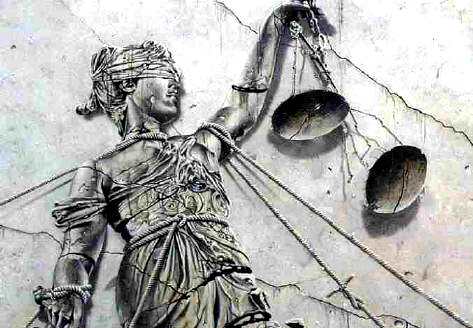
Judge NotJudge every man to the side of merit.

Ethics of our Fathers 1:6

On the most elementary level, this means that if you discern a negative trait in your fellow or you see him commit a negative act, do not judge him guilty in your heart. “Do not judge your fellow until you are in his place,” warns another of the Ethics’ sayings, and his place is one place where you will never be. You have no way of truly appreciating the manner in which his inborn nature, his background or the circumstances that hold sway over his life have influenced his character and behavior.

However, this only explains why you should not judge your fellow guilty. Yet our Mishnah goes further than this, enjoining us to “judge every man to the side of merit.” This implies that we should see our fellow’s deficiencies in a positive light. But what positive element is implied by a person’s shortcomings and misdeeds?

Commentary on Ethics of Our Fathers
“Double Standard”
Tammuz 18, 5771 * July 20, 2011
Chabad.org

The character traits of strength and firmness evoke mixed responses. On one hand, everyone admires personal fortitude, and respects an individual who has the courage to persevere in his convictions despite challenges. And yet a strong person can also be thought of as rigid and insensitive, clinging stubbornly to his own views without bending in consideration of others. Counseling against this tendency, our Sages commented, (Taanis 20a) “A person should always be pliant like a reed, and not hard like a cedar.”

Commentary on Torah Portion Matot
“True Strength”
-Rabbi Eli Touger

The world of religion is terribly judgmental. To be fair, this is a human trait and not just one seen among people of faith. While secular people tend to blame religion for all the world’s ills (war, racism, poverty, and so forth) is it rather our human nature and our tendency toward selfishness and evil that lets us corrupt the values of God into something that harms people.

In Christianity we are taught, “Judge not, that ye be not judged” (Matthew 7:1 [KJV]), but that certainly hasn’t stopped many in the church from judging others, both within the congregation and in the non-believing world. Is this any way to show the world the love of Jesus Christ?

Despite what I’ve quoted above, Judaism is also populated by human beings and thus, Jewish people aren’t perfect. They have a capacity equal to any Christian to judge others and to assign unfair blame and ridicule. Asher at the Lev Echad blog is on something of a mission to try and turn the hearts of Jews toward each other and to heal the differences between them. Recently, he published a plea asking Jews to not judge each other for their differences in religious practices and lifestyle but rather to guide “others into a life of serving God and His children in a way that best matches their individual personality”.

Asher’s words can easily be applied to the rest of us, both in their practicality and in their need.

Returning to the example of the Ethics of Our Fathers from which I quoted above, we see in the commentary that we must not only treat our fellows fairly and as we want to be treated, but we should extend ourselves to give others the benefit of the doubt, while at the same time, looking at our own deeds without compromise:

So judge every man to the side of merit—every man, that is, except yourself. For the attitude detailed above, while appropriate to adopt towards other human beings, would be nothing less than disastrous if applied to oneself.

“True, I have done nothing with my life,” the potential-looking individual will argue. “But look at what I am capable of! Look at the quality of my mind, the sensitivity of my feelings, the tremendous talents I possess. It’s all there within me, regardless of the fact that I have never bothered to realize any of it. This is the real me. The extent to which I actualize it is only of secondary importance.”

In our judgement of human life and achievement, we must adapt a double standard. Our assessment of a fellow human being must always look beyond the actual to the potential reality within. On the other hand, we must measure our own worth in terms of our real and concrete achievements, and view the potential in ourselves as merely the means to this end.

FriendsChristianity has parallel teachings to these Talmudic gems:

“Why do you look at the speck of sawdust in your brother’s eye and pay no attention to the plank in your own eye? How can you say to your brother, ‘Let me take the speck out of your eye,’ when all the time there is a plank in your own eye? You hypocrite, first take the plank out of your own eye, and then you will see clearly to remove the speck from your brother’s eye. –Matthew 7:3-5

Then Peter came to Jesus and asked, “Lord, how many times shall I forgive my brother or sister who sins against me? Up to seven times?” Jesus answered, “I tell you, not seven times, but seventy-seven times. –Matthew 18:21-22

At the core of all these lessons is the Torah itself and the Master’s commentary on the “Torah” that both Jews and Christians can embrace:

One of the teachers of the law came and heard them debating. Noticing that Jesus had given them a good answer, he asked him, “Of all the commandments, which is the most important?”

“The most important one,” answered Jesus, “is this: ‘Hear, O Israel: The Lord our God, the Lord is one. Love the Lord your God with all your heart and with all your soul and with all your mind and with all your strength.’ The second is this: ‘Love your neighbor as yourself.’ There is no commandment greater than these.” –Mark 12:28-31

I specifically say this is a “Torah”, because Jesus is quoting from both Deuteronomy 6:4-5 and Leviticus 19:18, so the heart of Christianity was born in Judaism and if we are wise, we will not separate the branches from the vine (see John 15:5 and Romans 11:11-24).

Rabbi Touger’s commentary on Matos describes two symbols of leadership over the twelve tribes of Israel. The authority of a tribal head is symbolized by both a staff and a rod. They sound the same but are wholly different from one another:

What is the difference between these two terms? A rod is supple, able to be bent, while a staff is firm and unyielding. For a rod is freshly cut or still connected to the tree from which it grew and is therefore pliant. A staff, by contrast, has been detached from its tree long ago, and over time has become dry, hard, and firm.

Both terms serve as analogies for different levels in the expression of our souls’ potential. (See Sefer Maamarei Admur HaZakein 5562, Vol. I, p. 237ff.) The term “rod” refers to the soul as it exists in the spiritual realms, where its connection to G-dliness is palpably appreciated. It shares an active bond with the lifegiving, spiritual nurture it receives. “Staff,” by contrast, refers to the soul as it exists in our material world, enclothed in a physical body. On the conscious level, it has been severed from its spiritual source, and its connection to G-dliness is no longer felt.

In this setting, there is the possibility for both the positive and the negative types of strength and hardness. There is a tendency towards spiritual insensitivity, a brittle lack of responsiveness to the G-dliness invested within creation.

Tree of LifeTying this back to the analysis of Pirkei Avot 1:6, we see that we should be a “rod” when dealing with others but a “staff” when judging ourselves.

A rod and a staff have a common source and the difference is how long each one has been separated from the tree. It is said that the Torah is a “tree of life for those who hold fast to her” (Ethics of Our Fathers 6:7). Given the Torah source of both Jewish and Christian commentaries on compassion toward others, not the least of which is the teaching of the Master, how can we not take hold of that tree and cling fast to her in our relationships with others and with God?

Rabbi Chananiah the son of Akashiah would say: G-d desired to merit the people of Israel; therefore, He gave them Torah and mitzvot in abundance. As is stated, “G-d desired, for sake of his righteousness, that Torah be magnified and made glorious.” –Makot, 3:16

Awaiting Dawn

Waiting for DawnPeople ask, “But how could you see so much good in the future when so much evil predominates now —-and it grows day by day?”

But such is the order of things: Darkness was only placed in the world to challenge light. As the light intensifies, the darkness thickens to defy it.

-Rabbi Tzvi Freeman
“Defiant Darkness”
Chabad.org

Kletzky’s parents marked the end of their seven-day grieving period Wednesday morning with a religious tradition of walking outside their Brooklyn home. Nachman and Esty Kletzky, surrounded by relatives, walked around their block at 15th Ave. in Borough Park at about 6 a.m. “It’s a sign that your escorting the soul to its resting place,” said Jack Meyer, of Misaskim, an organization that provides services to grieving families.

Story from NYDailyNews.com

“In the midst of cruelty and horror, human beings can respond in such a warm and caring way it restores our faith in the world and mankind. That is the atmosphere I feel here right now,” said Rabbi Alvin Kass, describing public support for the Kletzy family.

Story from CBS New York News

This is the third “morning mediation” that has been prompted by the death of 8-year old Leiby Kletzky. Perhaps I’ve got this matter too much on my mind, but when something so horrible happens in the world, we should not disregard it after it has been discussed for only a week or so. Certainly Leiby’s parents will not be free of their mourning in so short a time, if at all. Yet the questions I pose here must also be at the forefront of their thoughts and feelings, only with far greater intensity and sharpness. I continue to search for answers within their own context and from the Rebbe, who knew their Brooklyn community and every soul in it so well.

They say the most profound darkness comes just before the dawn. The harshest oppression of our forefathers in Egypt came just before their liberation.

That was a coarse darkness of slavery of the body. Today it is a darkness of the soul, a deep slumber of the spirit of Man. There are sparks of light, glimmerings of a sun that never shone before —-but the darkness of night overwhelms all.

Prepare for dawn.

I woke up much earlier than I expected to this morning. It was still dark outside with no hint of dawn on the horizon. When you are the only one awake in your household, it can feel especially empty, no matter how many people are asleep in their beds. The first subtle bands of light in the east may be only minutes away, but they might as well be on the other side of midnight. Yet we wait for the light, not just out of expectation, but with enduring faith.

“Arise, shine, for your light has come,
and the glory of the LORD rises upon you.
See, darkness covers the earth
and thick darkness is over the peoples,
but the LORD rises upon you
and his glory appears over you.
Nations will come to your light,
and kings to the brightness of your dawn. –Isaiah 60:1-3

Tree of LifeThe Jewish people today exist in an unbroken line between the present and the ancient days when the words of the Prophet Isaiah were first spoken, so it is no surprise that in their darkest hours, they would turn to the light. Through Jesus Christ, the rest of the world can become attached; grafted in to these words and promises and become sharers of the light and indeed, disciples of the light of the world, who we all long to see come.

After 33 centuries, all that’s needed has been done. The table is set, the feast of Moshiach is being served with the Ancient Wine, the Leviathan and the Wild Ox —-and we are sitting at it. All that’s left is to open our eyes and see.

[Adapter’s Note: These words I write, but I do not understand. But then, if I understood them, I suppose I would not need to be told to open my eyes.] -Rabbi Tzvi Freeman

I say to you that many will come from the east and the west, and will take their places at the feast with Abraham, Isaac and Jacob in the kingdom of heaven. –Matthew 8:11

Rabbi Freeman quotes from a letter written by the Rebbe:

Before I had even started school, a picture of liberation was already forming in my mind.
Such a liberation, and in such a way, that it would truly make sense of all the suffering, all the oppression and persecution we have undergone.

It is not that there will be no more darkness, no more suffering, that those things shall cease to exist.
It will be such an essence-light that darkness itself will become light
—even the darkness and suffering of the past.

While the Rebbe wouldn’t have considered the following, we who are the disciples of the Master cannot help but recall these words of prophecy and hope as we continue to wait for him to come:

And I heard a loud voice from the throne saying, “Look! God’s dwelling place is now among the people, and he will dwell with them. They will be his people, and God himself will be with them and be their God. ‘He will wipe every tear from their eyes. There will be no more death’ or mourning or crying or pain, for the old order of things has passed away. –Revelation 21:3-4

In the midst of pain, all we can do is cry and call out, “Abba! Father!”, endure the suffering, and look forward to the days when there indeed will be no more tears, pain, and death. When sorrow will be abolished from the earth and the King will reign in justice, mercy, and bringing joy and peace to the subjects of the Kingdom. May the Moshiach come soon and in our days. Amen.

“They (Mr. and Mrs. Kletzky) have had thousands of people who came to show them moral support,” he said. “Now the trying time starts. They’re all alone. … Now they’ve got to cope with it on their own.” -Jack Meyer of Misaskim

Everyone will sit under their own vine
and under their own fig tree,
and no one will make them afraid,
for the LORD Almighty has spoken.
All the nations may walk
in the name of their gods,
but we will walk in the name of the LORD
our God for ever and ever. –Micah 4:4-5