Tag Archives: Christianity

Zetterholm, Nanos, Ancient Antioch, and Some Implications

…and the disciples were first called Christians in Antioch.

Acts 11:26 (NASB)

I mentioned in my previous blog post, Zetterholm, Ancient Antioch, and “Honey, I Want a Divorce”, that I wanted to discuss the implications of the final chapter in Magnus Zetterholm’s book The Formation of Christianity in Antioch on a number of different religious communities.

Obviously, there are implications for the modern Church, but also I see how ancient and modern Judaism is significantly impacted, as are the Messianic Jewish and Hebrew Roots movements. I’ll take each one in turn.

Christianity

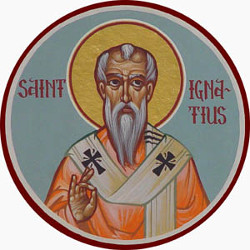
Based on what Zetterholm concluded regarding the forced separation of Gentiles and Jews in the Jesus-believing communities which resulted in Gentiles forming their (our) own brand new religion called “Christianity,” we can see that we weren’t kicked out of Jesus-believing Judaism. We rebelled like a petulant teenager and walked out the door. Certainly if Saint Ignatius of Antioch can make a statement such as, “[i]t is monstrous to talk of Jesus Christ and to practise Judaism” (Magn. 10:3 quoted by Zetterholm on pg 203), we aren’t talking about a “no-fault divorce.” The “Church Fathers” went out of their way to “demonize” Judaism and separate any “valid” worship of Jesus Christ from anything related at all to the Jews.

We noted above that Ignatius in Phld. 6:2 connected Judaism with the activities of “the prince of this world,” and that he in Magn. 8:1 probably used popular prejudice against the Jews in describing Judaism as being based on myths and fables.

It is well known that, in the decades after the death of Ignatius, Christian literature abounds in developing anti-Semitic themes.

-Zetterholm, pg 210

It is likely, as Schoedel states, that the identification of Christ as the word from silence refers to the supposed inability of the Jews to understand their own religious tradition: the appearance of Christ from silence brings the divine hidden purpose to light. The radical “Christianization” of the prophets is one indication of how profound this inability is, and how extensive the hostility is between Judaism and Christianity.

-ibid, pg 220

I know I’ve quoted these passages from Zetterholm’s book previously, but they’re important for context. As the history of the Church attests, these attitudes weren’t isolated to the first few centuries of the Common Era, they’ve echoed down the corridors of time from Ignatius of Antioch to the modern Christian Church with predictable results on Jews and Judaism. True, we no longer torture Jewish people in order to force them to convert or exile them from our nations, but we aren’t always “safe,” either.

Sarah (not her real name) is a young Jewish woman, an academic, raised in Orthodox Jewish life, who came to believe in Yeshua in a remarkable manner some years ago. Having been greatly sheltered in her upbringing, and knowing nothing about either Protestants or Messianic Jews, she wanted to serve Yeshua in an academic setting. She therefore joined the Dominicans, a teaching order of the Roman Catholic Church. She reasoned that they would allow her to teach freely in her field. In this she was right: as an excellent teacher, she was allowed to freely teach. She also assumed, on the basis of her limited knowledge of the early Yeshua movement, that she would be allowed to live as a Jew while she served Yeshua amongst the Dominicans. In this, she was wrong. Her superiors were at first amused at her adherence to Jewish life, then annoyed, and then intolerant. She was thrown out for her unacceptable adherence to Jewish life. This is a true story, and really, nothing new. It should not have surprised Sarah, but it did. And it shouldn’t surprise the rest of us either.

-Rabbi Dr. Stuart Dauerrman
“Signals: The Interfaithfulness Newsletter”
from May 12, 2014

St. dominic
Saint Dominic

I know Evangelicals are going to point out that Dominicans (Roman Catholics) were responsible for rejecting Sarah’s Jewish observance, but imagine how a Jewish believer would be received in a Protestant church if she were to continue significant Jewish observance such as kashut and Shabbat.

You might not think it would be an issue, but consider. Should “Sarah” show up at your church for a communal meal, how would you feel if she passed up the ham and took a salad instead? What if she kept an even more strict form of kosher and wouldn’t eat unless the meal had been prepared in a kosher kitchen (which church kitchens and Christian homes would not possess)? How would you feel if “Sarah” visited your home for a Bible study on Friday afternoon but after sunset, chose to walk back to her home and even refused a ride from you because it was Shabbat? You might be amused for a while but I suspect, like the Dominicans in the tale above, amusement would give way to annoyance and finally, intolerance. We haven’t come so far from the writings and attributes of Ignatius after all.

The Church has much to repent of.

Note: For those who feel I’m being overly hard on the Christian Church, especially the modern community of Christ, please continue to read. I’ll address this matter further at the end of today’s blog post.

Judaism

It is likely, as Schoedel states, that the identification of Christ as the word from silence refers to the supposed inability of the Jews to understand their own religious tradition: the appearance of Christ from silence brings the divine hidden purpose to light. The radical “Christianization” of the prophets is one indication of how profound this inability is, and how extensive the hostility is between Judaism and Christianity.

-Zetterholm, pg 220

Dovetailing on my previous statement, the modern Church still gives religious and even secular Jews reason to question their (our) motivation for any form of approach to them. My experience tells me that most often, Jews are politely cautious when a Christian enters Jewish religious or social space or conversely, invites them into our space. We speak of “interfaith relationships” or “interfaith events” but there really is no such thing as a “Judeo-Christian” shared experience. The minute those two concepts entered the world, they existed in opposition to one another.

Why should Jews trust Christians? Why shouldn’t organizations such as Jews for Judaism believe there is a (perceived) threat represented by the Christian Church, including organizations like Jews for Jesus?  I’m not saying Jews for Jesus is a bad organization and that the Church is necessarily an active threat against Jewish faith and practice, but the best predictor of future behavior is past behavior. If you want to know how the Church is going to act toward Jews in the future, look at Church history.

I’m saying that Jewish people have a reason to be dubious about Christianity and that all began nearly two-thousand years ago. Sadly, Jews and Christians really do have a shared history but it’s not a positive one.

The Church has much to repent of.

Note: This doesn’t mean that Judaism in all its expressions is perfect or hasn’t made it’s mistakes, but rarely is Judaism in a position as an extreme minority in our world to “throw its weight around,” so to speak. Through the vast majority of the history of the Jewish people, they’ve been much too busy just trying to survive.

Hebrew Roots

This is an “umbrella category” designed to cover just about any Gentile Christian organization, small group, or fellowship that specifically identifies itself as seeking the “Hebrew roots” of the Christian faith and who adopt an altered theology, doctrine, and practice based on some sort of “Hebraic” perspective on the Bible.

It’s probably unfair of me to treat Hebrew Roots as a single entity given what I’ve just said, since it is comprised of so many divergent groups and attitudes, but then, that’s pretty much true of Christianity and Judaism as well.

Praying with tefillinOne of the (more or less) commonalities within Hebrew Roots is the belief that Hebrew/Jewish practices are also incumbent upon any Gentile who is a believer in Jesus. This usually includes some sort of practice based on modern synagogue worship including praying with a siddur, donning of a tallit gadol (for men, usually), wearing a kippah (again, usually for men), and other acts that superficially create the impression that these Hebrew Roots practitioners may be Jewish.

We saw in Zetterholm’s book that Gentiles participating in the ancient Jewish synagogue of “the Way,” were sometimes mistaken as Jews due to their association with Jews and likely many of their practices and lifestyle behaviors, so it’s possible to extrapolate that situation into modern Hebrew Roots. But there’s a problem. In ancient times, Gentiles adopted some Jewish practices and behaviors because they were operating within a Jewish religious and social context and were being mentored by Jewish teachers and synagogue leaders. Hebrew Roots operates in total separation from Jewish community and often is denigrating of much of Rabbinic Judaism.

Hebrew Roots tends to believe they practice a form of “Biblical Judaism” as opposed to “Rabbinic Judaism,” and as a result, they reject many of the practices and conceptualizations that are associated with modern or historic Judaism. In this, they somewhat mirror the original Church Fathers who separated their own practice from Jewish authority and community, creating a self-sustaining entity that by necessity, operated in opposition to the normative Judaisms of its day.

Like many Evangelicals, many Hebrew Roots groups have sort of “love/hate” relationship with modern Judaism, mainly because of Rabbinic Judaism’s insistence that they have the right to make internally binding rulings and the ability to govern their own communities.

Note: Hebrew Roots has a lot of different expressions, some of which are truly serving God, helping others, and teaching the good news of Messiah. I worshipped with one such group for many years and my companions were Godly and humble people. But Hebrew Roots is kind of like the “wild west,” where anything can happen and where anyone with a kippah and a theological ax to grind can dub themselves a “Messianic Rabbi” and draw a following. Be cautious.

Messianic Judaism

Like the other groups I’ve discussed above, there is no single, monolithic organization called “Messianic Judaism”. All Messianic Jewish groups have certain things in common, but the details of their theology, doctrine, and practice are variable.

One thing all Messianic Jewish groups (at least in the U.S.) have in common is the majority of their members are not Jewish. The ancient Antiochian Synagogue of the Way, while “owned and operated” by a Jewish leadership and Jewish teachers, was also inclusive of Gentiles, though there’s no way to determine the ratio of Jews to Gentiles in their midst.

Messianic Judaism, for this reason, faces some or even most of the same challenges as did the apostle Paul’s mixed Jewish/Gentile Jesus-believing communities, principally the issue of integration. As my previous blog posts on Antioch, Zetterholm, and Nanos attest, the issue of integration was of paramount importance and at the same time, hotly contested (see Galatians 2 for example).

That the Gentile Jesus-believers were included in the New Covenant blessings and part of the soteriological system of Judaism was not in question, especially to Paul, but the nature of their role and participation in a Jewish community and religious stream was still problematic. The Acts 15 ruling aside, we don’t really know how day-to-day life in the Messianic synagogue among Jewish and Gentile co-participants was negotiated.

That’s a question Messianic Judaism is trying to answer today as well.

We see from Zetterholm that, given the right social and political pressures, this could all blow up in their (our) faces (again). It’s one of the arguments in support of a concept Rabbi Mark Kinzer introduced called Bilateral Ecclesiology. Zetterholm seems to believe that James the Just, the brother of Messiah and leader of the Council of Apostles and Elders in Jerusalem supported an ancient version of Bilateral Ecclesiology, the establishment and maintenance of separate communities of Jews and Gentiles in Messiah.

Ironically, that’s exactly what happened historically, but with disastrous results.
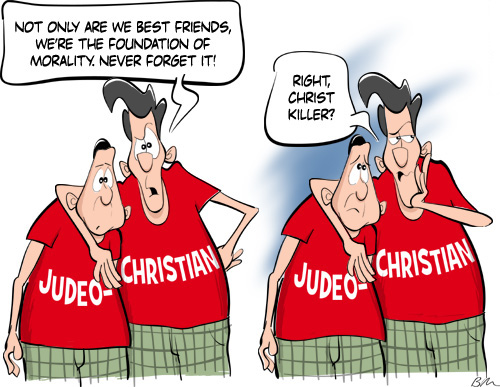
judeo-christianBut that’s unfair and untrue. That’s not exactly what happened. Kinzer’s Bilateral Ecclesiology (and presumably James’) assumes that the separate Jewish and Gentile communities exist in a complementary fashion, sharing a common theology and doctrine (but not identical practice), maintaining a cordial but distant relationship with one another, while supporting the right of each group to maintain their own identity within an exclusive space. History has shown that the relationship between ancient Christianity and Messianic Judaism was anything but complementary and cordial, although distance was created, maintained, and expanded, usually due to animosity.

We noted above that Ignatius in Phld. 6:2 connected Judaism with the activities of “the prince of this world,” and that he in Magn. 8:1 probably used popular prejudice against the Jews in describing Judaism as being based on myths and fables.

It is well known that, in the decades after the death of Ignatius, Christian literature abounds in developing anti-Semitic themes.

-Zetterholm, pg 210

Zetterholm believes Paul opposed James’ view on separate Jewish and Gentile space in Messiah and that he believed in a shared community of Jewish and Gentile Jesus-believers. That said, shared space and social community doesn’t equal shared identity, role, and responsibility and that’s the rub. Did Paul have a clear vision of exactly how Jews and Gentiles were to exist in community with each other in all the details?

The Didache might be one possible answer to that question since one suggested origin for this teaching is with the apostles or those close to the apostles. The Didache may have started out as an oral teaching that accompanied the spread of the “Jerusalem letter” (Acts 15) among the diaspora Gentiles in community with Jesus-believing Jews.

Note: As I’ve mentioned above, Messianic Judaism includes a variety of different approaches to how a Jew may be a disciple of the Jewish Messiah and continue to be an observant Jew. In the days of Peter and Paul, this was a given. No one wondered how this was possible, it was simply understood. The problem was how to integrate Gentiles. That’s the problem today as well, and responses run the gamut from Jews-only Messianic groups to full social inclusion of Jews and Gentiles in the synagogue. I think of Messianic Judaism as a work in progress. Also, keep in mind that many Hebrew Roots groups call themselves “Messianic Judaism,” however once in, the distinction is obvious.

Conclusion

So here we are. The Church, if possessing any belief that it somehow has replaced the Jewish people and national Israel in the covenant promises, continues to have much to answer (to God) for. The Church has much to answer for if it continues to oppose Jews who have faith in Messiah and continue to observe the mitzvot of the Torah of Moses. Thankfully, an increasing number of churches are accepting Jesus-believing Jews who are Torah observant Jews, but we have a long way to go.

Hebrew Roots, while a noble effort to attempt to recapture what Jesus-believing Gentiles lost with the ascension of Gentile Christianity and the (ultimate) collapse of Jewish Jesus-faith, often chooses to throw the baby out with the bath water, so to speak. In trying to recapture and apprehend ancient Hebraic practices and implement them in the modern era, they many times utilize modern Rabbinic worship practices while rejecting historic and modern Rabbinic Jewish rulings and even fail to acknowledge the Jewish community’s right to self-govern and self-define. Gentile Christians seeking the Hebrew Roots of the faith might find a better model in those who have become known as Messianic Gentiles, but there are still many challenges involved when traveling that path, as I can personally attest.

Messianic Judaism continues to struggle forward toward not only its own identity, but the identity of the Gentiles in its midst and as the Apostolic record and Zetterholm’s research indicates, Messianic Judaism is characterized, in part, by the communal inclusion of the Gentiles. Perhaps they would have eventually developed a “bilateralness” in relationship with each other, but that doesn’t seem to have been what Paul was trying to create.

I offer no solutions to any of this, but if you think you have any, I invite you to comment. We may never know what would have happened if Paul’s vision of the mixed Jewish/Gentile ekklesia had been realized, but given our current situation, we’re obligated to take the next step forward, whatever that might be.

Notes on the Church
ChurchI know I’ve laid the lion share of the responsibility for the Jewish/Gentile split within the body of Jesus-believers at the feet of the then new religion called “Christianity.” Further, I continue to assign responsibility to the modern Church for its long history of abuses against Jewish people and Judaism. Am I being unfair? I suppose you could say so.

And yet, next Sunday at the church I attend, the Bible class being held after services will be teaching on Acts 21:15-26 and the class study notes pay special attention to the following verse:

You see, brother, how many thousands there are among the Jews of those who have believed, and they are all zealous for the Law… (emph. mine)

Acts 21:20 (NASB)

To me, this speaks of the thousands of Jesus-believing Jews in Jerusalem who all gave glory to God and were zealous for the Torah of Moses. But my teacher quotes John MacArthur in saying:

“Nowhere in the New Testament are the Jewish believers condemned for observing them (the so-called “ceremonial” aspects of the law). Paul nowhere taught Jewish Christians to abandon their Jewish heritage. God Himself was tolerant during this period of transition, knowing how difficult it was for them to break with their past.”

It never occurs to MacArthur, or to any of the Evangelical church Pastors or their lay staff, or to the congregations of all those churches, that the reason they don’t see God being critical of Jewish Jesus-believers performing the Torah mitzvot wasn’t “tolerance.” It was because God expected Jewish Torah observance as a matter of covenant obedience. It wasn’t an aberration or some quaint set of customs that Jewish people had a tough time letting go of, it was their very lifeblood, the linkage between God and the Jewish people, more so than ever with the realization that the Messiah was the inauguration of the living fulfillment of all of God’s promises to Israel.

Even in the most Israel-friendly, Jewish people loving churches, this attitude still remains, in spite of a great deal of scholarly evidence to the contrary. This is what the Church yet has to repent of and so far, they don’t even see the problem.

More’s the pity.

If “Sarah” were to show up in my Bible class next Sunday and give her interpretation of Acts 21:20, how would she be received? I don’t know how far to push in class over the troubling interpretation of this single bit of scripture (and it’s wider implications), but how can I remain silent in the face of everything I’ve just written?

Addendum: And then there are rather disturbing current trends in Christianity, such as the one presented at the Rosh Pina Project about who is expected to speak at Bristol Baptist College.

Zetterholm, Ancient Antioch, and “Honey, I Want a Divorce”

This chapter will present a suggestion as to how the theologically motivated social division between Jesus-believing Jews and Jesus-believing Gentiles, combined with socio-political circumstances, brought about a separation between the communities. It will be argued that this process, which eventually resulted in the emanation of a new religion, was the result of a conscious strategy that can be compared to other expressions of collective action, such as tax rebellions, political uprisings, revolutions or, in short, social movements.

-Magnus Zetterholm
Chapter 5: “Politics and Persecution,” pg 178
The Formation of Christianity in Antioch: A Social-Scientific Approach to the Separation between Judaism and Christianity

This is the fourth but not quite the last installment in my investigation (see my ending comment below) of the schism between (Messianic) Judaism and Gentile Christianity based on the “Antioch Incident” (Galatians 2:11-21) and the general development of the “Synagogue of the Way,” which was characterized by a mixed Jewish/Gentile population of equal co-participants, in mid-first century CE Syrian Antioch.

See my three prior blog posts, Zetterholm, Ancient Antioch and Today’s Messianic Judaism, Zetterholm, Ancient Antioch, and the Problem of the Gentiles, and Nanos, Ancient Antioch, and the Problem with Peter for details.

The title of my (almost) final missive in this series seems whimsical and on one level, that’s intentional, but it also reflects the intensity of the relationship between Jewish and Gentile Jesus-believers in the Antiochian synagogue, both in intimate fidelity and in the excruciating agony of separation. Anyone who has experienced a “difficult” divorce or who has seen another couple go through one realizes that as much as the couple loved each other in the beginning, that is the same level of anger and even hate they experience at the end of their marriage.

But why the “divorce?”

Evangelical Christianity (and most likely all forms of the Christian faith) assume that Christianity naturally, intentionally evolved from (Messianic) Judaism. Popular Evangelical Preachers such as John MacArthur believe that Judaism as a religious practice was intended by God to be temporary and to be replaced by the Christian Church. Any indication that Paul or the other Jewish apostles and disciples continued in any of the Jewish practices is considered to represent a “transitional period,” where the last generation of Jewish Jesus-believers in Judaism gave way to the following generation of Jewish and Gentile Christians, all liberated from “the Law” and basking in the free gift of salvation by the grace of Jesus Christ.

Zetterholm approaches the issue from a completely different direction, one that takes into account socio-political motivations, more like the Boston Tea Party objecting to “taxation without representation” than a Divinely planned shift in theology that “jumps the track” from Judaism to Christianity.

Can we treat the relationship between the early Jesus-believing Jews and Gentiles as a human and social dynamic and conflict and still retain the involvement of God in human history? On the one hand, it seems almost “sacrilegious” to do so. On the other hand, none of the people in the Bible are mere pawns of God used in a game to illustrate grand principles and theologies so much as they are living human beings struggling to understand who they are in relation to each other and God. I think we can afford Paul, Peter, James and everyone else involved in Antioch the dignity of being treated as real people instead of “Bible characters.”

What we are considering is what sort of conflicts would have naturally led to such a Jewish/Gentile split in the Messianic community in Antioch and the other diaspora communities of the Way. One such conflict suggested by Zetterholm (pp 178-9) is legal. While Judaism was considered a legal religion in the Roman empire, did the empire consider Gentile involvement in Judaism, not as proselytes or even God-fearers, but as Gentile co-participants who were required to remain Gentile as a valid association?

Another issue to consider is that, as Judaism became less favorable in the eyes of the Empire and began to encounter persecution, what was the impact of Gentiles being swept along in the anti-Jewish fervor as were the Jews, or conversely, treated differently and maybe more positively than the Jews within the same Jewish space?

The war against Rome ended in catastrophe and with the fall of the temple in 70 CE it was essentially over.

The end of the war had, of course, drastic and immediate political consequences. The most important for the present analysis was the institution of the poll tax fiscus Judaicus, which was founded shortly after the end of the war by Vaspasian.

-Zetterholm, pg 185

Temple TaxIn some ways, this tax very much identified one as a Jew since it was only imposed on Jewish populations. On the other hand, can we say the tax was also imposed on those who were Gentiles in the synagogue or those who “appeared”  to be Jews due to their practices and affiliation with Jewish community, or were the Gentiles in the Jesus-believing synagogue (and Gentile God-fearers in all synagogues) spared because they were not ethnically Jewish?

Either way, and we can’t be certain which one was more likely to have occurred, we can see the potential for conflict. Should the former be true, the Gentiles might well resent it since after all, they not only aren’t Jewish but based on Paul’s letter the Galatians, they are at least highly discouraged if not absolutely forbidden to formally convert to Judaism via the proselyte rite. Why should they pay a tax if they weren’t ethnically Jewish?

On the other hand, if the Gentiles in Jewish community were not taxed because they were Gentiles (which only seems fair), would the Jews in the same synagogue resent them for their lack of solidarity with their teachers and mentors, the very people of which Jesus said “salvation comes from the Jews” (John 4:22)?

Zetterholm states (pp 188-9) that this period (and lots of subsequent historical periods) saw a general rise in anti-Semitism which likely spilled over onto the Gentiles who, by virtue of their association in the synagogue community, looked like Jews. This would have included Gentile God-fearers in the various diaspora synagogues and God-fearers, as previously stated, were thought to be polytheistic and continued to participate in the various pagan cults in Greek society for social and business (and perhaps personal) purposes. What of the recent “converts” of Gentiles from paganism to Jesus-faith? Could a surge in anti-Jewish sentiments result in them falling away or “cheating” by continuing to or reverting to pagan practices to “take the heat off” them?

M. Goodman, however, has argued that, in the period before the fiscus Judaicus was imposed, there existed a certain confusion about who was Jewish and who was Gentile, and that the fiscus Judacus promoted the development of a more stringent Jewish identity.

-ibid, pg 192

However…

…there was every reason to assume that the Jewish community knew exactly who was Jewish and who was not.

-ibid

So from an outsider’s point of view (Roman/Greek), it might be hard to tell sometimes who was Jewish and who wasn’t within the Jewish community, but of course, inside the community itself, everyone knew. The community of Messiah knew that they had a responsibility to separate itself from pagan society for the sake of God, but within that community, barriers were growing. In my previous missive on this topic, I presented the point of view of Nanos that Paul considered the Gentile Jesus-believers as equal co-participants in synagogue life, even to the level of community meals, as well as those who also received the covenant blessings of atonement and redemption in the same matter as the Jews.

And God, who knows the heart, testified to them giving them the Holy Spirit, just as He also did to us; and He made no distinction between us and them, cleansing their hearts by faith.

Acts 15:8-9 (NASB)

However, thanks to outside pressure being brought to bear against all diaspora Jewish communities, that seems to have changed, at least potentially.

As a member of the Pauline Jewish community in Antioch, a Gentile was part of the soteriological system of Judaism to a degree never experienced before. Through Christ, Gentiles were incorporated into a covenantal system that provided salvation without prior conversion to Judaism. Non-conversion to Judaism was a necessary condition.

-ibid, pg 194

Magnus Zetterholm
Magnus Zetterholm

While that seems like terrifically good news, it comes with a cost. According to Zetterholm, the halachah regarding Gentile involvement in the Jesus-believing synagogue was likely more strict upon the Gentiles than it was on Gentile God-fearers in other synagogues. While strict Torah observance in the manner of the Jews was not imposed, the Acts 15 legal edict applied to the Jesus-believing Gentiles went above and beyond the Noahide requirements observed by God-fearing Gentiles, so Gentiles in Messiah would be forbidden to participate in any other societal religious obligation by worshiping in the pagan temples.

Gentile Jesus-believers weren’t an island. Although the requirements of the Messianic community were to separate from the pagan nations (mirroring the “chosenness” of all Jewish communities vis a vis the nations of the world), they still would have had pagan family members, friends, business partners and associates, and so forth, who would or could be making life difficult for them.

There is also the issue of Gentile status within the Jesus-believing Jewish religious stream. As previously pointed out, there may have been a strong disagreement between Paul and James regarding the equality or inequality of Gentiles in the Way, with James representing the extreme opposite position of Paul by advocating for separate religious/social communities for Jews and Gentiles. Also, Zetterholm believes it was possible that, subsequent to the Antioch incident and Peter’s pulling away from the Gentiles, the non-Jews may have been “demoted” in terms of social status (but not necessarily ultimate soteriological destiny) to that of God-fearers.

Citing Nanos (The Mystery of Romans, 289-336)…

…that Romans 13:1-7 refers to the subordination of the Jesus-believing Gentiles to the synagogue authorities and not, as usually assumed, to the civic Roman authorities. If he is correct, this was certainly motivated by theological considerations, but at the same time, Paul shows here awareness of the religious/political implications of theology that prevents Gentiles from participation in the official cult.

-ibid, pg 195

Also…

The Jesus-believing Gentiles were certainly considered to be embraced by the final salvation, through Christ, as Gentiles, but outside the covenant. This led not only to a theological distinction, but also to a social separation between Jesus-believing Jews and Jesus-believing Gentiles. The Jesus-believing Gentiles became reduced to the status of Jesus-believing God-fearers.

-ibid

The actual comprehension of the status of Jesus-believing Gentiles in Jewish community and in terms of “final salvation” is contingent upon a correct understanding of how Gentiles were (and are) involved and included in the blessings of the New Covenant, and coming to a correct understanding isn’t easy to do. Those details are beyond the scope of the current discussion, (See D.T. Lancaster’s What About the New Covenant lecture series, produced by First Fruits of Zion [FFOZ]).

I don’t necessarily believe that the Gentiles were reduced to a lesser status in the Messianic synagogue in Antioch or the diaspora based on the Galatians 2 encounter. Paul vehemently opposed Peter’s action and the other Jews who sided with his hypocrisy, and since the vast majority of diaspora Jesus-believing communities were established by and (presumably) answerable to Paul, it would seem like Paul’s authority and perspective would be “calling the shots.”

Mark Nanos
Mark Nanos

That said, if Nanos is indeed correct, then Paul’s perspective supported Gentile subordination to Jewish synagogue authority. Of course any member of a synagogue, Jewish or Gentile, would be expected to submit to the authority of the synagogue leaders, but the implication is that Gentiles may have had a “one down” role in terms of their Jesus-believing Jewish counterparts. Also, Nanos believes that the Roman synagogue(s) hosting Jesus-believing Gentiles contained Jews who were Jesus-believers and those who were not, adding additional pressure and a feeling of dissonance. It’s one thing to submit to Jesus-believing Jewish authorities, but why defer to authorities who denied the Lordship of Messiah Yeshua?

Thus, while Paul supported the Gentiles as equal co-participants in synagogue social interactions as well as the final salvation based on receiving New Covenant blessings, with Gentiles not having full membership in the Old or New Covenants as made by God with “the house of Isarel and the house of Judah” (Jeremiah 31:27), he likely considered it part of their “normal” legal status (see Acts 15) to subordinate in some sense, to Jewish authority in the Jewish community and religious setting, or as George Orwell famously wrote in his novel Animal Farm, “All animals are equal, but some animals are more equal than others.”

Jesus-believing Jews never imagined questioning their own relationship with God through the covenants and their participation socially, religiously, and in every other way in community and final salvation was assumed. Jesus-faith was simply the logical, natural extension of everything that had come before. Of course with the death and resurrection of Messiah, the New Covenant promises were inaugurated and though not yet fully realized, this was the good news the Jewish people and the nation of Israel was waiting for.

Gentiles, on the other hand, while also assumed to be included, both due to the revelations given Paul by Messiah and by the testimony of the Prophets of old, the mechanism by which this was to be accomplished wasn’t entirely clear (see all of the incidents of Jewish opposition to Paul’s message in the New Testament) and the exact role and status of Jesus-believing Gentiles in Jewish community always seems somewhat “up in the air.”

So on the one hand, Gentile involvement in Jewish community made Gentiles vulnerable to Greek and Roman anti-Semitism which could include financial burdens as well as physical violence because they were either mistaken for Jews or were seen as “collaborators” with the Jewish “enemy.” On the other hand, Gentiles in Jewish community, if they felt at all devalued or of a lesser social or even covenant status than the Jesus-believing Jews, could have felt resentment against their Jewish mentors and even against Jews in general. Either way (or both), the Gentiles may have increasingly felt as if they were stuck in the middle with no way out, unless they apostasized and left Jesus-faith. The opposite act of fully converting to Judaism was, as I said above, strongly discouraged if not forbidden, at least by Paul.

…if one embraced a theology that made Gentile identity a necessary condition for salvation, but at the same time required a Jewish definition in order for it to be maintained…

-ibid, pg 201

Zetterholm puts all this together and draws the conclusion that the Jesus-believing Gentiles, seeking a “rational” resolution to this increasing tension, decided they would…

…have to disassociate themselves from Jesus-believing Jewish community in order to acknowledge their true Gentile identity…

-ibid, pg 202

And from this follows…

that the parting of the ways in Antioch was primarily a separation — not between “Judaism” and “Christianity” — but between Jewish and Gentile adherents to the Jesus movement.

-ibid

This gives rise to the thought that in the late first century to the early second century, there were wholly separate communities of Gentiles and Jews who were both Jesus-believing, but each community possessed a very different theology and dogma relative to their belief and practice, positions that would be opposed to one another, setting each community ultimately against each other. That’s about as “bilateral” as you can get.

Ignatius of Antioch is one of the first authors within the Jesus movement who writes from a perspective clearly outside Judaism. In Ignatius’ world, the separation between Judaism and Christianity had to some extent already taken place. This is not to say that the separation process was completed, but, in the symbolic world of the bishop in Antioch, Christianity was, or at least should be, a non-Jewish movement.

-ibid, pg 202

Ignatius of AntiochIt’s generally believed that Ignatius lived from 35 CE to 107 CE (See “Ignatius” in The Westminster Dictionary of Church History, ed. Jerald Brauer [Philadelphia: Westminster, 1971]) and that he was a disciple of the Apostle John (See “The Martyrdom of Ignatius” and “Synaxarium: The Martyrdom of St. Ignatius, Patriarch of Antioch”), which is a shocking revelation. How could a disciple of Christ’s beloved John turn his back on everything he had been taught, virtually spitting in his Master’s face? It would be like Titus or Timothy betraying Paul or Peter betraying Jesus (oh, wait). How sharper than a serpent’s tooth (see Shakespeare’s “King Lear”).

A mere eighty or ninety years after the death and resurrection of Christ, we see Ignatius all but throwing stones at the empty tomb and mocking the Messiah’s devotion to Israel, the Temple, and his dear “lost sheep of Israel,” the Jews.

Zetterholm quotes Ignatius (pg 203) from Magn. 10:3 stating that:

“[i]t is monstrous to talk of Jesus Christ and to practise Judaism.”

This created quite a problem among the Jesus-believing Gentiles (pg 205) according to Zetterholm, with some (many) defecting from Jewish to Gentile Jesus-believing communities while others remaining within Jewish community. For their own protection, both from the newly minted Gentile Christians and from participation in the official pagan cult, the Gentiles in Jewish community actively pretended to be Jewish and took on behavioral roles as Jews, donning a Jewish “disguise” as it were, with…

…no intention of leaving messianic Judaism for a Gentile religion stripped of almost every Jewish influence except the idea of Messiah and the Holy Scriptures of the Jews.

ibid, pp 205-6

Zetterholm identifies two major sources of conflict at this point in history (pg 207):

  1. One in connection with separation from Jesus-believing Jewish community.
  2. The other connected to the role of being a challenger and the efforts to get back into the polity, but on equal terms with the other members of the polity.

At the heart of the conflict was:

…the Gentile adherents’ frustration at being reduced to Gentile god-fearers and being trapped in the religious/political system without any possibility of expressing their true religious identity, that is, as covenantal partners, triggered the social movement of separation.

-ibid

This is where the “Honey, I want a divorce” part comes to full bloom. The Jesus-believing Gentiles not only separated from Jesus-believing Jewish community to form their (our) own communities, but they actively turned on their former hosts and benefactors, “demonizing” the Jewish people and Judaism, giving birth to the ugly “twins” of Christian supersessionism and Christian anti-Semitism that we continue to see in some churches today.

We noted above that Ignatius in Phld. 6:2 connected Judaism with the activities of “the prince of this world,” and that he in Magn. 8:1 probably used popular prejudice against the Jews in describing Judaism as being based on myths and fables.

It is well known that, in the decades after the death of Ignatius, Christian literature abounds in developing anti-Semitic themes.

-ibid, pg 210

Zetterholm provides evidence (pp 211-224) that Ignatius either used a proto-Mattean document or the actual gospel of Matthew against the Jesus-believing Jews and Jews in general, citing Matthew’s clear in group/out group” perspective (pg 212) as we find in Matthew 7:21-23 and 13:47-52, also leveraging the (apparent) disdain Jesus had with the Pharisees to magnify Gentile Christian rejection of all Jews (Jesus-believing and non-believing Jews alike).

One theme that is specially developed in much Christian Adversus Iudaeos literature is that the Jews had misunderstood their own Holy Scriptures and as a result, had lost the right to them.

-ibid 220

And if that isn’t enough to make your blood boil…

It is likely, as Schoedel states, that the identification of Christ as the word from silence refers to the supposed inability of the Jews to understand their own religious tradition: the appearance of Christ from silence brings the divine hidden purpose to light. The radical “Christianization” of the prophets is one indication of how profound this inability is, and how extensive the hostility is between Judaism and Christianity.

-ibid

This is where we get the astounding departure in interpretation between normative Judaism and Christianity in our world today, based, as I’ve said, on a two-thousand year old mistake, except Zetterholm says it wasn’t a mistake and it wasn’t a misunderstanding. The schism was a calculated and deliberate set of acts designed to manufacture a new religion for the Jesus-believing Gentiles called “Christianity.” This new religion, by absolute necessity, was to be all but completely detached from its mother faith of Judaism and further, must establish itself as the “true Israel” of God, forcing an abandonment of the Jewish people, Judaism, and Israel by her own Creator in favor of the “Law-free” Gentiles.

Christian and JewishAs I said above, for a time, you would have had a world where separate Jesus-believing Christian Gentile and Jesus-believing Jewish communities would have operated in the same historical and geographical space. While Zetterholm feels some Hellenized Jews may have chosen to defect to Gentile Christianity, these would have been the Jews who, as were mentioned previously would have left ethnic and religious Judaism anyway.

There were likely Gentiles who hung on in the Jewish communities but as the decades passed, subsequent generations would have left Jewish community for either Gentile paganism or Gentile Christianity. Finally, the community of Jewish believers in Messiah would have dissolved as well if, for no other reason, than to avoid even the faintest association with the Gentile Christians who now actively disdained, despised, and “demonized” all Jews everywhere.

Since this blog post is exceptionally long, I’ll save the conclusion and implications of Zetterholm’s book on the modern Christian Church as well as the Messianic Judaism and Hebrew Roots movements for a later time.

Repentance and Resolution

The Torah teaches us that it is never too late to change.

Changing for the better is called doing teshuva. The Hebrew word teshuva, which is often translated as repentance, actually means to “return.” Return to God. Return to our pure self.

How do people become interested in self-improvement?

People have faults. The faults they have cause them to suffer in some way or another. This suffering limits an individual’s freedom and is often painful. Hence, people want to change… to improve. To be free once again.

How does one change for the better? How does one do teshuva?

There are four steps of teshuva.

-Rabbi Mordechai Rottman
“Four Steps to Change”
Aish.com

Resolution for the Future

There isn’t much to Rabbi Rottman’s last step in making teshuva, but I think it’s deceptively simple:

Make a firm decision not to repeat the negative behavior.
This step can be compared to stepping on the gas! Once you make this resolution, you’re really starting to move! Every minute that passes puts miles behind you and the negativity.

You’re on your way to becoming the “new you!”

After all of the regret, the struggle with negativity from yourself and others around you, and your agonizing confession to God and perhaps even to the people you have hurt, you come to this. You’ve gotten past the tough parts. You’re standing at the trailhead. The new journey is about to start, and it takes you in a different direction than you have previously traveled. The adventure begins.

But the spectre of sin is always following behind, perhaps at a great distance, perhaps right behind your shoulder.

I mean, it’s not like you’re never going to sin again, right?

We’ve been talking about teshuva or repenting of a single, habitual sin. This is something that’s been going on for years and that has consumed your life, made you a slave, and completely disrupted your relationship with God and with other people.

Now you’ve gone through three out of four steps of making teshuva and you stand at the threshold of that fourth step into freedom. Resolve not to return to the sins you have left behind.

walkingAlthough I’m a linear person (most guys are), I can still see or rather hear the echoes of the other steps, especially the negative self-talk. It may not be very strong at this stage, but I can’t say it’s completely absent, either. What if you move forward only to stumble again? What if you backslide? What if you make a mistake? What does that make you? If you screw this up after all you’ve gone through, does that mean all your work was for nothing?

Remember, we’re looking at sin and repentance from a fundamentally Jewish perspective.

Worse yet, biblical translation promotes misconceptions. For example, you’ll read a translation and come across the word “sin.” Uh-oh. Sin, evil, punishment. But the Hebrew word Chet does not mean sin at all. Chet appears in the Bible in reference to an arrow which missed the target. There is nothing inherently “bad” about the arrow (or the archer). Rather, a mistake was made – due to a lack of focus, concentration or skill.

From here we learn that human beings are essentially good. Nobody wants to sin. We may occasionally make a mistake, lose focus, and miss the target. But in essence we want to do good. This is a great lesson in self-esteem. Simply adjust your aim and try again!

-Rabbi Noah Weinberg
Written Instructions for Living
from the 48 Ways to Wisdom series

This certainly flies in the face of what we believe in Christianity; that human beings are essentially evil. But Rabbi Weinberg follows up with this statement:

In translation, the message is lost. In fact, entire religions have arose based on mistranslations. So get it straight. Learn Hebrew.

From a Jewish point of view, Christianity’s understanding of sin and evil is based on a misunderstanding of Hebrew.

In Christianity, guilt and sin define your identity before repentance. This is who you are. You are dead in your sins, lost, hopelessly separated from God.

And you were dead in your trespasses and sins, in which you formerly walked according to the course of this world, according to the prince of the power of the air, of the spirit that is now working in the sons of disobedience. Among them we too all formerly lived in the lusts of our flesh, indulging the desires of the flesh and of the mind, and were by nature children of wrath, even as the rest.

Ephesians 2:1-3 (NASB)

This is Paul’s description of pagan Gentiles before they became disciples of the Jewish Messiah and began to worship the God of Israel. Once they (we) make the transition, though:

But now in Christ Jesus you who formerly were far off have been brought near by the blood of Christ.

So then you are no longer strangers and aliens, but you are fellow citizens with the saints, and are of God’s household, having been built on the foundation of the apostles and prophets, Christ Jesus Himself being the corner stone, in whom the whole building, being fitted together, is growing into a holy temple in the Lord, in whom you also are being built together into a dwelling of God in the Spirit.

Ephesians 2:13, 19-22 (NASB)

newI’m deliberately leaving out the “one new man” language and the text that is commonly misinterpreted as Paul’s commentary on the Law being “nailed to the cross with Jesus” because it is not relevant here (and I’ll deal with those misunderstandings another time).

I’m quoting these verses to show that non-Jews can be grafted in and access the blessings of the covenants made between God and Israel, though of course, this doesn’t make us Israel. Paul was describing what we were before and who we are now.

But the writer of the Epistle to the Hebrews delivers a dire warning.

For in the case of those who have once been enlightened and have tasted of the heavenly gift and have been made partakers of the Holy Spirit, and have tasted the good word of God and the powers of the age to come, and then have fallen away, it is impossible to renew them again to repentance, since they again crucify to themselves the Son of God and put Him to open shame. For ground that drinks the rain which often falls on it and brings forth vegetation useful to those for whose sake it is also tilled, receives a blessing from God; but if it yields thorns and thistles, it is worthless and close to being cursed, and it ends up being burned.

Hebrews 6:4-8 (NASB)

You should recognize this if you’ve read my most recent review of D. Thomas Lancaster’s Hebrews sermon series Things that Belong to Salvation. If you haven’t read it, I highly recommend that you do, because Lancaster explains that this passage of scripture, while a critical warning against apostasy, is not an automatic “go to jail (hell) forever” card.

What happens when we come to faith as a Christian and continue to sin? If your faith hasn’t transformed your life at all, then it’s time to question whether you have any faith in God. If your life has changed for the better spiritually and morally, but you still struggle with sin, welcome to the club. I don’t know a single disciple of the Master, no matter how spiritually elevated, who has completely conquered sin.

In fact, we will continue to struggle between our old and new natures all of our human lives, until the Messiah comes, until the resurrection, until the Spirit is poured out on all flesh (Joel 2:28, Acts 2:17). The Acts 2 (for Jews) and Acts 10 (for Gentiles) events were only a down-payment, a guarantee that the promises of the future Messianic Age and that the coming of the Kingdom of God will indeed arrive.

WrestlingUntil then, we struggle with our humanity. Sin is what we do, not who we are. Sin is the influence of the world around us and of the spiritual world. Sin is a disturbance in our relationship with God, like a pool of water can be disturbed by dropping a stone into it.

Make no mistake. Disobedience and willfully defying God comes with horrible consequences. But God isn’t standing over us ready to drop the hammer at the first sign of a mistake. He wants us to succeed. He wants us to draw close to Him. He is our ultimate supporter, He’s always in our corner, cheering us on, calling us to run just a little harder, just a little faster, so we can get to the finish line and receive the trophies He has waiting.

For many of us, life is a very long and difficult road. We can let the hardships defeat us and permanently separate us from God, or we can expect to fall down periodically, so that we can learn to pick ourselves up. Don’t worry. Whether you realize it or not, God is there to lend a supportive hand and help us get back on our feet.

Some falls are worse than others. Sometimes the injuries are severe and leave scars and a limp. But God will not allow you or me to be completely broken and unable to continue the journey. That’s something only you can do to yourself by denying Him and failing to ask for His help.

The first sentence a Jewish child is taught is “Torah tziva lanu Moshe, morasha kehilat Yaakov” – “Torah was commanded to us through Moses and is the inheritance of every Jew.” Torah was meant for everybody. It is not the exclusive domain of some priestly class. Rather, it is a living, breathing document – the lifeblood of our Jewish nation. We are required at all times to involve ourselves in its study and practice. As it says, “You shall think about it day and night” (Joshua 1:8).

-Rabbi Noah Weinberg
Written Instructions for Living
from the 48 Ways to Wisdom series

Although the Torah in its fullness is the inheritance of every Jew, Rabbi Weinberg said it is also meant for everybody (not every Jewish person). I’ve said before that all believers, including Gentiles, have an obligation to the Torah of Moses as part of being a disciples of Jesus (Yeshua), and I’ve even revisited this opinion.

visualize successFor believers, not only is the Torah the written instructions for living, but so are all the scriptures, including the apostolic writings. The Torah is called a tree of life. Don’t just study the Bible, integrate its lessons into your entire lived experience. It’s never too late to begin studying the Bible, just as it’s never too late to make teshuva and return to God.

Visualize Your Success. Then Go And Do It.

-Arnold Schwarzenegger

Resolving not to return to sin is resolving to move toward God. Repent daily. Walk the path daily. Seek an encounter with God daily. Rabbi Zelig Pliskin has said that ”Whatever you focus your attention on, you increase.” Concentrate on the Spirit of God within yourself, focus on the Word of God, and God will increase within you and expand into the world around you.

Gifted souls enter this world and shine. All that surround them bathe in their light and their beauty. And when they are gone, their light is missed.

Challenged souls enter, stumble and fall. They pick themselves up and fall again. Eventually, they climb to a higher tier, where more stumbling blocks await them. Their accomplishments often go unnoticed—although their stumbling is obvious to all.

But by the time they leave, new paths have been forged, obstacles leveled, and life itself has gained a new clarity for all those yet to enter.

Both are pure souls, G‑dly in essence. But while the gifted shine their light from Above, the challenged meet the enemy on its own ground. Any real change in this world is only on their account.

-Rabbi Tzvi Freeman
“Gifted and Challenged”
Based on the letters and talks of the Rebbe, Rabbi M. M. Schneerson
Chabad.org

Blessings.

Premeditated Acts of Kindness

One winter Friday evening after services, I happened to walk home in the company of a talkative Seminary student. As we made our way down Broadway, we passed a weary and emaciated man whispering for some spare change. On Shabbat I pay less heed to such heartrending pleas because I don’t have any money with me. Neither did my young companion. Yet he politely interrupted our animated conversation and asked the man whether he would like a sandwich. When he responded with evident joy that he would, the student pulled out a neatly wrapped sandwich from his plastic bag and gave it to him. Obviously, unlike me, the student did not allow Shabbat to prevent him from aiding the homeless who crowd the sidewalks of Broadway in the midst of the academic acropolis known as Morningside Heights. Though we met no more homeless before we parted company, for all I knew my companion still had another sandwich or two left in his bag to feed the hungry. His unobtrusive display of forethought and compassion stirred me deeply, as it filled me with pride.

-Ismar Schorsch
“A Stitch in Time” (pg 441, May 20, 1995)
Commentary on Torah Portion Behar
Canon Without Closure: Torah Commentaries

I read Schorsch’s commentaries on the weekly Parashat as a matter of devotion each Shabbat morning, but this time I was almost startled at the parallel between the incident he reported and the Gospel reading for Behar as recommended by First Fruits of Zion (FFOZ) (Each year near the beginning of the Torah cycle, FFOZ provides a list of the parashat readings for the coming year on PDF for anyone who cares to download it).

Here’s what I had read just minutes before:

On that day of Shabbat, he was teaching in a certain synagogue. A woman in whom there was a spirit of disease for eighteen years was bent over and unable to stand with a straight posture. Yeshua saw and called to her. He said to her, “Woman, be freed from your disease.” He placed his hands upon her, and instantly she arose and stood upright and praised God. The leader of the synagogue became upset that Yeshua had healed her on Shabbat, so he responded and said to the people, “There are six days on which you may do labor. Come and be healed on them, but not on the day of Shabbat!”

The Master answered and said to him, “Hypocrite! Will not any one of you untie his ox or donkey from the stable on Shabbat and lead him to get a drink? But here we have a daughter of Avraham whom the satan has bound for these eighteen years. Will she not be released from what binds her on the day of Shabbat?

When he said these words, all who were standing against him were ashamed, and all of the people rejoiced about all of the wonders there were performed by him.

Luke 13:10-17 (DHE Gospels)

I suppose you can’t compare the supernatural miracle of healing a woman who had suffered an affliction for eighteen years with simply giving a starving, homeless man a sandwich you are carrying with you, but they both speak of a willingness not only to feel compassion but to actively express it for the benefit of another, even (apparently) flying in the face of devoted Shabbat observance.

Teaching of the TzadikimYeshua (Jesus) was accused by the local synagogue leader of violating the prohibition of working on the Shabbat by healing the disabled woman. From the point of view of the leader of the synagogue, his interpretation of the laws of Shabbos was correct and obviously, based on the reaction of the rest of the people present, that opinion was the majority viewpoint in that stream (and probably all streams) of Judaism in that day.

Even today, while it is permissible in Orthodox Judaism to render medical treatment in the cause of saving a life, routine medical matters (this woman had survived her ailment for eighteen years, so Yeshua could have waited another day before healing her) are attended to on the other six days of the week.

For many Bible readers, this distinction may be too obscure, but if missed, the reader also misses the message of all the Sabbath stories in the Gospels. The essential message is not that Jesus has cancelled the Sabbath or that the rabbinic interpretation of Sabbath is illegitimate. The Sabbath-conflict stories instead communicate that acts of compassion and mercy performed to alleviate human suffering take precedence over the ritual taboo. The miraculous power by which Jesus performs the healings only serves to add God’s endorsement to Jesus’ halachic, legal rationale.

Did Jesus’ disciples break the Sabbath in the grain fields? Yes. But they were justified in doing so because their need took precedence over the Temple service, and the Temple service took precedence over the Sabbath. Therefore Jesus declared them guiltless and told the Pharisees, “If you had known what this means, ‘I desire mercy, and not sacrifice,’ you would not have condemned the guiltless” (Matthew 12:7).

Did the Master break the Sabbath when he healed on the Sabbath day? Yes. Would fixing a car break the Sabbath? Of course it would, and by the same standard so does fixing a human body. Nevertheless, the Master justified doing so because compassion for his fellow man took precedence over the Sabbath.

-D. Thomas Lancaster
“Chapter Seven: At Dinner with the Sages,” pg 61
The Sabbath Breaker: Jesus of Nazareth and The Gospels’ Sabbath Conflicts

It is Lancaster’s opinion that Yeshua did indeed “break the Shabbat” as it is literally understood, and performed one of the types of work or melachah (plural: “melachot”) that is forbidden to do on the Sabbath. But Lancaster believes that the needs and dignity of human beings who are created in the image of God have a higher priority than mechanically performing a list of “dos” and “don’ts”.

I don’t mean to cast Shabbat observance or any performance of the other mitzvot in a negative light, far from it. I do want to point out something about human nature, though.

Ismar SchorschIsmar Schorsch, whose writings I greatly admire and who was the sixth Chancellor of the Jewish Theological Seminary (JTS) for nineteen years (he retired on June 30, 2006), wrote, on “Shabbat I pay less heed to such heartrending pleas because I don’t have any money with me.” It wasn’t that Schorsch lacked compassion or didn’t care about the dire needs of other people, but the traditional practice on Shabbat is not to handle any form of currency or to engage in any type of commerce. Naturally, he didn’t have any money on him, and neither did his sandwich-carrying companion.

But get this:

The Mishnah divides the landscape into “domains”: the private domains of individual houses, the public domains of streets and markets, and shared areas like alleys and courtyards that are not quite public and not quite private. The prohibition of carrying is violated when one removes an object from one domain to another [M. Shabbat 1:1, 2:1; M. Eruvin passim]. The Mishnah goes even further in eliminating the notion of “burden” from this prohibition. It declares that the prohibition is violated only if the object that has been carried is an object that people in general, or at least its carrier, value or use or keep; if it has no value or if it is too small to be used or if it is not worth keeping, then it does not qualify as an “object” for the purposes of this prohibition. A Torah-fearing Jew would not remove even such a nonobject from one domain to another on Sabbath, but incurs no liability for having done so [M. Shabbat 7:3-8:6, 9:5-10:1].

-Shaye J.D. Cohen
“Chapter 6: Judaean Legal Tradition and Halakhah of the Mishnah,” pg 136
The Cambridge Companion to the Talmud and Rabbinic Literature
Edited by Charlotte E. Fonrobert and Martin S. Jaffee

Since it appears a sandwich has value (especially to a hungry man) and is definitely big enough to use (eat), Schorsch’s companion could not be excused for carrying food items from one domain (presumably he made this sandwich before Shabbat and at his home, which is a different domain than the street) to another. Of course, the Mishnah may be more strictly observed by Orthodox Jews than Conservative Jews (Schorsch is affiliated with Conservative Judaism and presumably so are the students at the Jewish Theological Seminary, including the student in question), but I have to wonder.

shabbat walkI have to wonder if both Schorsch and the Seminary student were aware of the prohibition of “carrying,” which was another reason that they both had no money in their possession, since money obviously has value, but they saw a higher value requiring attention. The statement made by Schorsch from which I quoted above, indicates that it was quite common on Broadway to encounter homeless people who would typically ask for spare change or some other form of charity, even on Friday evening. Schorsch saw no way to assist them while observing the Shabbat but the student didn’t let that stop him.

Did the student violate Shabbat by carrying sandwiches from one domain to the next, even for the purpose of committing “a premeditated act of kindness” (Schorsch, pg 443)? Schorsch’s own reaction of pride, not even questioning the apparent violation of performing “work”, seems to answer from his point of view.

We can compare this to the reaction of the synagogue leader and the others attending Shabbat services after hearing Yeshua’s response to their criticism of his healing a non-life threatening disability on Shabbat:

When he said these words, all who were standing against him were ashamed…

Luke 13:17

The people who had initially criticized Yeshua’s act of kindness and compassion on Shabbat felt ashamed when they understood that it is common and permitted to relieve the suffering of another living being on Shabbat, whether a thirsty farm animal or a woman under a debilitating disability. Schorsch felt pride at recalling his student’s “unobtrusive display of forethought and compassion.”

I don’t believe that either Yeshua or the anonymous student violated the Shabbat. I believe they acted in the highest principle of Sabbath observance, even if it seems they “broke” the observance of the literal meaning of the melechot involved in each incident.

“The Sabbath does not ‘do away’ with sadness and sorrow,” writes Pinchas H. Peli in The Jewish Sabbath, “it merely requires that all sadness be ‘tabled’ for one day so that we may not forget that there is also joy and happiness in the world and acquire a more balanced and hopeful picture of life.”

-from “Keeping Sabbath – Ways to Practice”
Practicing Our Faith

“Oneg,” or the traditional meal eaten at the end of Shabbat services at synagogue, literally means “joy”. Regardless of the trials and difficulties we may encounter during the rest of the week, or no matter what else may be troubling us, Shabbat is a time to set all that aside and to live as if the Kingdom of God had already arrived, as if Messiah were already enthroned in Jerusalem, and as if he already reigns over a world filled with peace and the glory of God.

So to alleviate the suffering of even one person or any other living thing is to assist them in some small manner in entering Shabbat and a foretaste of the Kingdom.

MessiahIn any way we think we are obeying the will of God, let’s not forget that there is a higher principle involved that summons the future Messianic Age. What we say, think, and do now, on one level, is temporary and will not last, so we sometimes tend to dismiss this life in anticipating the next. But we must never forget for a single instant, and especially on Shabbat, that kindness, compassion, charity, and raising the level of the dignity of another person, even for a moment, are eternal principles and the loftier and weightier matters of Torah, and they speak more of loving God and loving others (for the two are inseparable) than the matter of committing a “forbidden” act of melachah here or there as the situation arises.

Yeshua rejects all those who do not give food to the hungry, give drink to the thirsty, and clothe the naked of even “the least” of his “brothers,” but welcomes those who are “blessed of his Father.”

Then the king will say to those standing on his right, “Come, those who are blessed of my Father, and possess the kingdom prepared for you from the foundation of the world. For I was hungry, and you fed me. I was thirsty, and you gave me a drink. I was traveling, and you took me in; naked, and you covered me; sick, and you visited me. I was in prison, and you came to me.”

The righteous will answer and say, “Our master, when did we see you hungry and sustain you, or thirsty and give you drink? When did we see you traveling and take you in, or naked and cover you? When did we see you sick or in prison and come to you?”

Then the king will answer and say to them, “Amen, I say to you, what you have done for one of these young brothers of mine, you have done for me.”

Matthew 25:34-40

Sermon Review of the Holy Epistle to the Hebrews: Things that Belong to Salvation

Eternal Security or Eternal Insecurity?

The “things that belong to salvation” include the gift of the Spirit, the goodness of the word of God, and the power of the age to come. This sermon deals with the difficult and controversial material in Hebrews 6:4-12.

-D. Thomas Lancaster
Sermon Sixteen: Things that Belong to Salvation
Originally presented on May 4, 2013
from the Holy Epistle to the Hebrews sermon series

For in the case of those who have once been enlightened and have tasted of the heavenly gift and have been made partakers of the Holy Spirit, and have tasted the good word of God and the powers of the age to come, and then have fallen away, it is impossible to renew them again to repentance, since they again crucify to themselves the Son of God and put Him to open shame. For ground that drinks the rain which often falls on it and brings forth vegetation useful to those for whose sake it is also tilled, receives a blessing from God; but if it yields thorns and thistles, it is worthless and close to being cursed, and it ends up being burned.

But, beloved, we are convinced of better things concerning you, and things that accompany salvation, though we are speaking in this way. For God is not unjust so as to forget your work and the love which you have shown toward His name, in having ministered and in still ministering to the saints. And we desire that each one of you show the same diligence so as to realize the full assurance of hope until the end, so that you will not be sluggish, but imitators of those who through faith and patience inherit the promises.

Hebrews 6:4-12 (NASB)

The Unplanned Detour

Lancaster went through a brief review of last week’s lesson and then, like the writer of Hebrews, intended not to cover any more material based on the six foundations since the Hebrews writer categorized those foundations as “milk” and not “solid food.”

But during the week, Lancaster received many requests from people, both face-to-face and by email to go into more details on the “milk”. It seems as if what the writer of the epistle to the Hebrews considered the ground floor basics of the faith are very difficult for modern Christians to grasp.

Lancaster wanted to make this detour back into the basics, but his lesson plan wasn’t written around it and a week wasn’t enough time to prepare. He wanted to get into chapters 7, 8, and 9 of Hebrews, but today, he’ll stay in chapter 6 and tell his audience what I consider something important (but I haven’t really found anything unimportant in what Lancaster has presented as yet). We’ll be back to learning how to drink milk by the by.

The Point of No Return

…and then have fallen away, it is impossible to renew them again to repentance, since they again crucify to themselves the Son of God and put Him to open shame.

Hebrews 6:7 (NASB)

This is actually terrifying on a personal level. I have family members who once came to faith in Yeshua who have since fallen away from him. I have friends in the same condition. This sounds like once you apostasize from faith in Jesus you will never, ever be able to come back, no matter what. That’s what a Bible literalist would conclude.

Does that means the people I love who have fallen away are doomed to burn forever? Is their no way to reach out to them and save them?

Lancaster’s opinion is not that of a Bible literalist. He does say that questions like these almost resulted in the Book of Hebrews not being canonized.

Think of it as the difference between the Western Church and the Eastern Church. For nearly a century (2nd to 3rd centuries CE) the Western Church thought that your sins were only forgiven up to your baptism. After that, if you sinned as a believer, you were condemned to hell. The Eastern Church wasn’t even concerned with the issue. It’s the difference between linear Greek thought (Western Church) and global Hebraic thought (Eastern Church).

For a Greek thinking Church, everything is on or off, black or white, left of right, there are no ambiguities in the text. Hebraic thinking, global as opposed to linear thinking can contain a lot more dynamic tension and even apparent contradictions in the Word. It’s the difference between believing one has to be either a Calvinist or an Arminianist, vs. believing that God is completely, perfectly, absolutely sovereign and man can also have free will to choose or reject God.

Eternal Security of Insecurity

But make no mistake, Lancaster does believe the writer to the Hebrews is delivering a dire and potentially fatal warning about the dangers of falling away from faith in Messiah. After falling away, it will be extremely difficult, and may be impossible to return to faith.

The focus of the letter so far has generally been one of warning and support of a population of Hellenized Jews in the area of Jerusalem who were in danger of or who had already lost access to the Temple. They were heartbroken and desperate to obey the commandments of the sacrifices. Who would be their priest? They were in grave danger of falling away from the Master in order to return to the Temple.

the letterSo yes, this is a letter of warning. But it isn’t a sudden detour into the theology of soteriology, the theology about how salvation works. That’s how most Christians read it, badly parsing the text into bite-sized but otherwise unrelated chunks. When you write a letter, unless you are a bad writer, you write with an overall theme in mind, not by tossing in an unassociated theological smorgasbord of ideas and concepts.

Lancaster says he tends to be more of a Hebraic thinker. He doesn’t believe salvation can be reduced to a series of talking points or some sort of bulleted list. He does believe it’s possible to lose one’s salvation, but he also believes that God’s grace covers a multitude of sins. Without grace, we would never survive, even as believers.

What You Have to Lose

What distinguishes a Messianic believer?

For in the case of those who have once been enlightened and have tasted of the heavenly gift and have been made partakers of the Holy Spirit, and have tasted the good word of God and the powers of the age to come…

Hebrews 6:4-5 (NASB)

Lancaster breaks this down into a list (I just got done saying salvation can’t be reduced into a list, but this isn’t a recipe to the plan of salvation):

  1. Enlightened
  2. Tasted the Heavenly gift of the Holy Spirit
  3. Tasted the Good Word of God
  4. Tasted the power of the Age to Come

This is what you have to lose and, as a believer, what you possess right now.

We are enlightened, that is, we have received the revelation of God, the awareness of the spiritual world, and the knowledge of salvation through faith in Messiah by grace.

We have received the Holy Spirit, God’s gift of a foretaste of the Heavenly Kingdom.

We have tasted the beautiful flavor of the Word of God, the Bible.

We have tasted the power of the age to come.

I think enlightenment, the Holy Spirit, and the Bible are all more or less understood, but what is the power of the age to come? Resurrection. We know Christ was resurrected from the dead and in that promise, so will we upon his return. The dead will be raised in him.

Lancaster drew a parallel between the approach of the weekly Shabbat and the Messianic Age. In Orthodox practice, all meals must be cooked before the arrival of Shabbat at sundown on Friday. Anyone who’s done any cooking knows you sometimes taste the dish before it’s finished to see how it’s coming along. Lancaster says that tasting the soup, so to speak, before the arrival of Shabbat is like tasting a preview of the Shabbat.

Bubbe's soupTasting the revelation of God, receiving the Holy Spirit, apprehending the Word of God, and the knowledge of the resurrection are all the foretaste, the preview of the future Messianic Age, the Kingdom of God on Earth.

That’s what we have to lose.

Lancaster tells us a midrash which I’ve heard before and one that I’ll repeat here because I think it’s important.

It is said that when humanity is resurrected, everyone will still have the physical defects they possessed when they died. If a man died without a left arm, he will be resurrected without a left arm.

Only after the resurrection will he be healed.

Why?

But Thomas, one of the twelve, called Didymus, was not with them when Jesus came. So the other disciples were saying to him, “We have seen the Lord!” But he said to them, “Unless I see in His hands the imprint of the nails, and put my finger into the place of the nails, and put my hand into His side, I will not believe.”

After eight days His disciples were again inside, and Thomas with them. Jesus came, the doors having been shut, and stood in their midst and said, “Peace be with you.” Then He said to Thomas, “Reach here with your finger, and see My hands; and reach here your hand and put it into My side; and do not be unbelieving, but believing.” Thomas answered and said to Him, “My Lord and my God!” Jesus said to him, “Because you have seen Me, have you believed? Blessed are they who did not see, and yet believed.”

John 20-24-29 (NASB)

The midrash states that if a person were resurrected in a totally healed state, he would be unrecognizable and many might doubt that the same man who died was the one resurrected. The example of Jesus and Thomas gives much credence to the midrash. Certainly Jesus appeared very, very different to John in Revelation 1:12-16 than he did, even within the first few weeks after the resurrection.

This is the power of the promise of the resurrection. And this is what we risk losing if we deny Yeshua.

Crucifying Jesus All Over Again

…and then have fallen away, it is impossible to renew them again to repentance, since they again crucify to themselves the Son of God and put Him to open shame.

Hebrews 6:6 (NASB)

Lancaster interprets this rather troublesome verse thus:

One who walks away from his faith in the Master can be compared to one who would crucify the Messiah again, bringing him to shame. May God have mercy on that person.

The Death of the MasterIt isn’t some mystical or literal re-crucifixion, but a metaphorical comparison. Apostasy is a dreadful, disgraceful act, according to Lancaster, and the path back from falling away, should that person repent, is as if the Master needs to be crucified again. But by God’s grace and mercy it is still possible to return!

Apostasy is a very, very hard place to come back from, but it’s not an absolute hopeless place of no return.

Thanks be to God.

For ground that drinks the rain which often falls on it and brings forth vegetation useful to those for whose sake it is also tilled, receives a blessing from God; but if it yields thorns and thistles, it is worthless and close to being cursed, and it ends up being burned.

Hebrews 6:7-8 (NASB)

Let’s first cover one part of verse 8 before moving on:

it is worthless and close to being cursed (emph. mine)

It is in grave danger of being burned and destroyed, it is very close to that end, but that final destruction, while imminent, is not absolutely a foregone conclusion.

In other words, if you let this happen you to, you are on the brink of falling into an endless pit of fire and darkness but it is still (marginally) possible for you to come back.

Lancaster spent some time comparing the Hebrews writer’s audience to the Master’s parable of the Sower (Matthew 13:3-23) as well as the parable of the Tares (weeds) among the Wheat (Matthew 13:24-30). These are all warnings of the level of our faith and whether we are even aware of the level (deep or shallow) of our faith (He says a lot more than what I’m including in this review, so you’ll want to listen to the entire recording for the details).

In a field of wheat and tares, it is impossible at first to tell the difference. When you go to church on Sunday or synagogue on Saturday, looking around the sanctuary, can you visually tell the difference between believers and false converts? Are people who raised their hand at a revival meeting or who once answered an altar call automatically saved and their “fire insurance” fully and permanently paid?

wheat and taresMany “weeds” are absolutely sure they are “wheat” even though they live like weeds. Lancaster told a story about a church youth group where almost all of the teens were sexually active and yet, they all (or most) believed they were saved and living Christian lives.

Then Lancaster made a confession. He said he was a weed and shallow dirt. But the difference is that he is deeply concerned about his being a weed. Even Paul admitted he was a weed:

I find then the principle that evil is present in me, the one who wants to do good. For I joyfully concur with the law of God in the inner man, but I see a different law in the members of my body, waging war against the law of my mind and making me a prisoner of the law of sin which is in my members. Wretched man that I am! Who will set me free from the body of this death? Thanks be to God through Jesus Christ our Lord! So then, on the one hand I myself with my mind am serving the law of God, but on the other, with my flesh the law of sin.

Romans 7:21-25 (NASB)

Even the best among us (and that certainly isn’t me) struggles between our two natures. Paul called himself a “wretched man” and so are we all wretched people in this struggle, desiring to obey the Master and continually failing. My review of the four steps in making teshuvah speaks a great deal about the continual struggle we have in repentance.

Saving Grace

The danger of falling away is great and the consequences are (potentially) terrible, but there is a “saving grace.”

But, beloved, we are convinced of better things concerning you, and things that accompany salvation, though we are speaking in this way. For God is not unjust so as to forget your work and the love which you have shown toward His name, in having ministered and in still ministering to the saints. And we desire that each one of you show the same diligence so as to realize the full assurance of hope until the end, so that you will not be sluggish, but imitators of those who through faith and patience inherit the promises.

Hebrews 6:9-12 (NASB)

Amid the cries of warning there’s also hope and encouragement. We haven’t fallen over the edge of the cliff yet, though we (or rather, the Hebrews reading the letter) are (were) still dangerously close. If you’re worried about whether or not you’re a weed, even if you’re a weed, you can still come back and be wheat. Be honest about the state of your heart and your need for a Savior and you can still repent and be saved.

What Did I Learn?

If you’ve been reading my Teshuvah series, you should realize that this exploration isn’t just for the sake of teaching but also for the sake of learning. Seeking God’s grace and repenting of sins isn’t the simple little task many of us were taught to rely upon. Since sin still lives in our hearts, our repentance should be active and continual. It’s still possible to fall off the wagon and while climbing back on isn’t impossible, it isn’t easy, either. In fact, once fallen, it may seem impossible to return, and so most people usually either give up or tell themselves a story that falling off was the right thing to do.

More’s the pity.

FallingThis isn’t just about me. It’s about people I love. It’s about people who have fallen and fallen hard, and yet they don’t see the problem. In fact, they think that apostasy from faith in the Master was the best thing that could ever have happened to them. Some still follow a religious tradition and while their faith is important and contains many good things, by definition (seemingly), it requires denying Yeshua.

Most Christians, including Hebrew Roots people, have long since written off my loved ones as already, permanently, irredeemably condemned to be thrown into the fire and perpetually burned.

May it never be!

I was scared to death when I read Hebrews 6:6. I was immeasurably grateful when Lancaster didn’t insert a “hard stop” at the end of that verse and also write off my loved ones.

If you’re an Evangelical and/or a Bible literalist, I believe I know what you’re thinking. You’re thinking I’m choosing to believe Lancaster and that I’ve chosen a Messianic Jewish perspective for self-serving reasons. You believe that I want there to be hope for my fallen loved ones and my chosen belief allows me to still continuously pray for their salvation and restoration.

Yes, of course I still hope and pray. Wouldn’t you?

But that’s not the only reason I believe what I believe. Something inside of me keeps telling me this is the right way to view things and the right way to go. I believe one of the “crimes” of the Church, at least historically, is that they (we) have been too literal in all the wrong places, and we’ve chosen a hard-line instead of God’s selection, grace and mercy.

Then the Lord passed by in front of him and proclaimed, “The Lord, the Lord God, compassionate and gracious, slow to anger, and abounding in lovingkindness and truth; who keeps lovingkindness for thousands, who forgives iniquity, transgression and sin; yet He will by no means leave the guilty unpunished, visiting the iniquity of fathers on the children and on the grandchildren to the third and fourth generations.” Moses made haste to bow low toward the earth and worship. He said, “If now I have found favor in Your sight, O Lord, I pray, let the Lord go along in our midst, even though the people are so obstinate, and pardon our iniquity and our sin, and take us as Your own possession.”

Exodus 34:6-9 (NASB)

It’s ironic in a sense, that I turn to the Torah, the Law, which Christianity disdains, in order to illustrate God’s grace and mercy in which we Christians have always depended upon so greatly. Most of us still believe grace and mercy only came to Earth with the birth of Jesus Christ. And yet the Jewish people have relied upon God’s thirteen attributes of mercy for must longer than two-thousand years.

I depend on God’s mercy. I depend on God’s mercy and grace not only for my flawed and damaged self but for everyone I love, who are also flawed and damaged. As I once heard said, if faith is a crutch, who isn’t limping? I’ve got a terrible limp. So does everyone I’ve ever met.

Man alone in a caveWe are all at risk of falling. We are all in danger of going “ker-splat” on the hard, cold ground. Once down there, getting back up isn’t easy, and for some, it seems impossible.

And for some, it seems like falling down put them in a better place, the better place. If not for God’s mercy, not only would it be impossible for them to get up, but God would just let them lie there.

If you ever find yourself at the bottom of a pit or deep in some dark, damp cave, look up. If there isn’t enough light for that, feel around. God provides a rope or a ladder, even for the apostate. All you have to do is find it and then to start climbing.

Zetterholm, Ancient Antioch, and the Problem of the Gentiles

In spite of this disheartening picture of the relations between Jews and Gentiles in Antioch there is, rather surprisingly, evidence of Gentiles who felt drawn to Judaism.

More relevant for the present discussion is whether there was a group of Gentiles with a clear interest in Judaism who may even have adopted several Jewish customs and who participated in the activities in the synagogue without having converted to Judaism.

-Magnus Zetterholm
Chapter 4: “Evidence of Interaction,” pp 121-2
The Formation of Christianity in Antioch: A Social-Scientific Approach to the Separation between Judaism and Christianity

This is both what Judaism has to offer and teach our confused and self-indulgent age. In the words of the psalmist, “Blessed are they who dwell in Your house.” (Psalm 145:1) The circuitous path away from the constricted focus on the self through the expansive world of the other. When we find renewal in the synagogue, we will have gained access to Judaism’s greatest boon: this-worldly salvation.

-Ismar Schorsch
“Holiness is a Communal Experience,” pp 431-2 (May 17, 1997)
Commentary on Torah Portion Emor
Canon Without Closure: Torah Commentaries

[This is a long “meditation.” Pour yourself a cup of coffee and give yourself the time to take it all in.]

This is something of a counterpoint to my previous blog post Zetterholm, Ancient Antioch, and Today’s Messianic Judaism. The prior write up was a look at the Judaisms operating in Antioch, including the “synagogue of the Way,” as they existed in the first century CE, through the lens of Zetterholm’s book and research. Today, we use the same lens to see how Gentiles were brought into this wholly Jewish religious stream, what the Jewish disciples understood about the social role of Gentiles, and how unconverted (to Judaism) Gentiles could participate in the New Covenant blessings.

It seems (and I’ve said this before) it wasn’t all that clear how to bring Gentile disciples into fellowship, and even among the Jews in the Way, opinions differed.

I’m going to focus on only part of this chapter, which is Zetterholm addressing “the Antioch incident” (Galatians 2:11-21) because the thirty some odd pages this author spends interpreting the conflict between Paul and Peter contains a great deal of commentary on the struggle to understand how Gentiles could be co-participants socially and benefit from Jewish covenant blessings without undergoing the proselyte rite and without being considered mere God-fearers (though God-fearers could not apprehend the covenant blessings).

Citing New Testament scholar J.D.G Dunn in his article The Incident at Antioch (Gal. 2:11-18), Zetterholm wrote:

Having evaluate[d] different exegetical alternatives, Dunn suggested that table-fellowship in Antioch involved observance of at least the basic dietary laws, since the Jesus-believing Gentiles were originally god-fearers. The men from James, shocked at what they regarded as too casual an attitude, demanded a higher degree of observance, especially with regard to ritual purity and tithing. According to Dunn, they referred to the earlier agreement made in Jerusalem (Gal. 2:1-10), where Paul’s mission to the Gentiles was agreed upon but where the specific issue of table-fellowship was never considered.

Zetterholm, pp 130-1

You’ll notice here that Dunn (apparently) believes in a “common Judaism” (see my previous article on Zetterholm) shared by all Jewish factions but variability in how to observe the mitzvot or at least to what degree to observe ritual purity customs within different synagogues of the Way. Zetterholm referencing Dunn states that it is likely the Jerusalem contingent, the home of James the Just, brother of the Master, and the core group of apostles and elders, held to a more strict observance of ritual purity than the Jews of the Way in Antioch.

Peter, as one of the original apostles of Jesus (Yeshua), may have originally held to the Jerusalem point of view, but his experiences with the household of Cornelius (Acts 10:28-29) modified that opinion. However, confronted with the more strictly observant emissaries from James, Peter gave in to peer pressure.

Notice, this doesn’t mean that Jews were eating non-kosher food, so the issue was about the competing halachot of the two Jewish communities relative to eating with Gentiles:

Dunn argued that this agreement in no way changed the obligation to torah observance for the Jesus-believing Jew.

According to Dunn, the reason why Peter suddenly withdrew from the table-fellowship was that “[h]e could not deny the logic of Jerusalem’s demand, that a Jew live like a Jew.” Continued table-fellowship could therefore lead to a severe loss of authority in relation to Jewish-Christian communities of Palestine.

-ibid, pg 131

J.D.G Dunn
J.D.G Dunn

I don’t know if I completely agree with Dunn’s and Zetterholm’s conclusion here regarding the compromise of authority, and it seems that Paul certainly didn’t think his halachah of table-fellowship with Gentiles was a problem based on his criticism of Peter. I do think this brings into sharp relief the potential differences between Paul and James, especially prior to the Acts 15 halachic ruling regarding the legal status of Gentiles in (Messianic) Judaism.

Of course Dunn isn’t the only New Testament (NT) scholar to have an opinion on this “incident.” P.F. Esler, according to Zetterholm, didn’t think it was a matter of the degree of observance but an outright halachic ban across the board on Jews eating with Gentiles, with perhaps only a few exceptions. From Esler’s perspective, this was a matter of the preservation of Jewish identity, which could only be maintained by a strict separation of Gentile and Jew with no table-fellowship between the two groups, period.

E.P. Sanders didn’t agree with either Dunn or Esler, and Zetterholm tends to favor Sanders’ viewpoint most of the time. Sanders didn’t think the issue had anything to do with ritual impurity, since most Jews are in a state of impurity (which has nothing to do with sin) most of the time, and must only be pure when participating in a Temple ritual. He also didn’t think it had much to do with social interactions, particularly in Antioch which, like other diaspora communities, required fairly free transactions between Jewish and Gentile inhabitants.

Sanders really did think it was the food, not that the Gentiles were insisting on eating ham, but the Gentile origin of the food itself was an issue. How could the Jews be sure that at least some of the meat hadn’t been sacrificed to idols?

I tend to think Dunn may have the most accurate perspective on the matter, especially given B. Holmberg’s opinion:

Holmberg suggested that James demanded a higher degree of observance not on the part of the Jesus-believing Gentiles but on that of the Jesus-believing Jews, and furthermore, a virtual separation of the Christian community into two commensary groups.

-ibid, pg 134

According to Holmberg, both Paul and James believed that the Gentiles benefited from the covenant blessings that issued from being grafted into the Jewish root, but their perspectives were different. While Paul advocated for Jewish and Gentile interaction and fellowship within the community of Messiah, James advocated for separate communities of Gentiles and Jews operating side-by-side rather than intermingled. This was to preserve the integrity of Jewish identity. Paul (according to Holmberg) disagreed.

To James and Peter, the Jerusalem agreement made no difference in how the Jesus-believing Jews related to torah, while Paul requested that the demands of a Jewish identity should cede to those necessary for maintaining a common Christian identity.

-ibid

This isn’t to say that Paul was advocating for a Torah-free practice for the Jewish believers, but rather for a more lenient halchah relative to Jewish/Gentile fellowship and co-participation in worship and social interactions.

Rabbi Mark Kinzer
Rabbi Mark Kinzer

It’s interesting that Holmberg’s perspective on James, Peter, and the Jerusalem community maps at least somewhat to that of modern Messianic Jewish author and scholar, Rabbi Dr. Mark Kinzer who wrote the rather controversial book Postmissionary Messianic Judaism: Redefining Christian Engagement with the Jewish People.  R. Kinzer advocates for a position called “bilateral ecclesiology,” which essentially establishes two communities within the body of Messiah, one for Jews and the other for Gentiles.

While many in the Church and in Gentile Hebrew Roots feel R. Kinzer’s position is a recent development, we see now that at least one NT scholar, Holmberg, suggests that it (or something very much like it) existed within the early Jerusalem Messianic ekklesia at the highest levels of leadership. What would this have said for Yeshua’s perspective on the matter?

We can’t know the answer to that one with any certainty, but it’s a compelling question. Yeshua rarely had dealings with Gentiles and stressed that he came “for the lost sheep of Israel” (Matthew 15:24). He only issued the directive to “make disciples of all nations” (Matthew 28-19-20) after the resurrection and (shortly) before the ascension.

Just to summarize, the explanation behind the “Antioch incident” was the degree of ritual observance for Dunn, food for Sanders, social intercourse for Esler, and Jewish vs. Gentile identity (related to observance issues) for Holmberg. Depending on your theological preferences, you can choose the scholar that fits your perspective. I think we all tend to do that and I’m just as guilty of the practice as the next person. Hopefully, I can cut through some of that and present a reasonable case for my conclusions, such as they are.

Zetterholm said that the problem is…

…that the text contains several gaps that must be filled in through an act of interpretation. The fact that scholars put forward different and sometimes even contradicting suggestions to solve a given historical problem often emanates from the character of the text: what we want to know is simply not in the text but must be supplemented from outside the text world.

-ibid

Not a very comforting thought, especially if you are a proponent of Biblical sufficiency.

I presented, in my previous blog post on Zetterholm, the nature of Jewish communities in Antioch and their implications for modern Judaism including Messianic Judaism. Now, I’m trying to solve the puzzle of how or if Gentiles could have been reasonably integrated into a Jewish community without compromising the Jewish nature and identity of that community. I think it’s clear Paul was convinced this was possible, but as history shows, it didn’t work out so well. I can only believe all this has profound implications for modern Messianic Judaism and the role of Messianic Gentiles within that Jewish context.

The issue for Paul in his letter to the Galatians was the Gentiles and encouraging them to maintain a Gentile identity within the Jewish Messianic movement, which did not require them to undergo the proselyte rite, become circumcised (males), and take on the full yoke of Torah observance. This is the same issue (Gentile role and status) within the Antioch synagogue (Acts 15:1), which most Christians would call “Paul’s home church.”

The challenge though, wasn’t just how to smooth over the wrinkles added by including Gentiles in a Jewish religious and social space, but how to understand the covenantal relationship (if any) Gentiles apprehended when they became disciples of the Master. I know in my own studies of the covenants, it is very clear how Jewish people and Judaism are in covenant with God, but Genesis 9 and Noah aside, when a Gentile comes into relationship with God through Messiah, just how does it work? There’s no clear and easy path in the text explaining it.

D. Thomas Lancaster
D. Thomas Lancaster

I came to my own peace with Gentile inclusion in the New Covenant about a year ago and more recently, in my multi-part review of D. Thomas Lancaster’s What About the New Covenant lecture series, I affirmed some of my convictions and discovered new information.

But what did this look like to the various groups inside of the Jewish Messianic movement in first century Antioch, or for that matter, from the perspective of James and the Council of Apostles and Elders in Jerusalem?

Based on various scriptures in the Tanakh (Old Testament) you could conclude that either Gentiles were cursed and would ultimately be wiped from the face of the Earth (for instance, Micah 5:9-15, Zephaniah 2:4-15), or that Gentiles had an eschatological future wherein at least some members of the nations and perhaps all nations would come into relationship with God and worship Him and Him alone (Isaiah 19, Isaiah 56:7, Zechariah 14:16).

From my point of view, I reconcile the opposing viewpoints in these texts by believing any nation (or any Gentile individual or group) which goes against Israel will ultimately be defeated by God and be cursed for cursing Israel, and any nation (or any Gentile individual or group) that joins with Israel in supporting her and her precious, chosen people, the Jewish people, will one day be called up to Jerusalem along with the returning Jewish exiles to worship God and to pay homage to the Jewish King.

You’ve probably heard the phrase “on the wrong side of history” in the news or social media recently, but applied to the Gentile nations and their relationship with Israel (for or against), those words take on a whole new meaning.

Believe it or not, I’m still talking about the Antioch incident, since how the Jews in the Way saw the Gentiles in relationship to the Jews, including socially and in the nature of their eschatology, was at the heart of the conflict.

If, however, we assume that he (Jesus) confirmed that Gentiles were to be embraced by the final salvation, it is not strange that within the early Jesus movement different concepts developed of how to relate to Gentiles and of how the actions of the god of Israel, through Christ, would also relate to the nations of the world.

-ibid, pg 140

Zetterholm, citing Sanders, said that the Jewish believers had no issue with Israel’s relationship with God since the Torah provides the means of atonement and…

…everyone living within the boundaries of the covenant and remaining in the covenant through obedience and atonement will be saved.

-ibid

But…

The soteriological system was, of course, for Jews only. Exactly how the Gentiles would be saved is less clear.

-ibid

The Church today takes its status of being saved rather for granted, although I doubt most Christians have ever seriously studied the New Covenant and encountered the challenge of finding themselves anywhere in the text. If they did, they might have some small idea of what the Jewish believers were facing when trying to insert Gentiles into the Jewish community, short of formal conversion to Judaism.

Magnus Zetterholm
Magnus Zetterholm

Zetterholm is convinced, citing T.L Donaldson and others, that what was not required ultimately, was the need to circumcise Gentiles and have them brought under the Torah in the manner of the Jews. But since circumcision was tied directly into the covenant relationship, it remained a mystery (apparently) to the first Jesus-believing Jews, exactly what status and role uncircumcised Gentiles played in Judaism and in covenant (if any). Salvation comes from the Jews, but how?

The Acts 15 decision was designed to settle all of this and render “halakhic clarification”, since, as Zetterholm says (pg 144) it was believed that the end of the present age was at hand and Gentile status had to be settled quickly before the Messianic Era arrived.

Zetterholm puts Luke’s Acts and Paul’s epistles in tension with each other, believing that Luke may have represented Paul differently than Paul actually saw himself. Zetterholm believes that Paul’s epistles are a more valid representation of Paul and how he saw Gentiles in covenant with God, but that view, given the complexity of Paul’s letters, isn’t all that clear.

We do know that Paul did support the continuation of Torah observance for Jesus-believing Jews as a given while at the same time, did not impose said-Torah observance along with circumcision upon the Jesus-believing Gentiles.

It is clear that under no circumstances would Paul accept that the torah be imposed on the Jesus-believing Gentiles.

If Paul accepted the apostolic decree (Acts 15) was applicable to Jesus-believing Gentiles, this would not mean that he imposed torah on them, since, strictly speaking, the halakhah for righteous Gentiles or god-fearers was not the torah but something to be observed by Gentiles not having been blessed with the gift of the torah.

-ibid, pg 148

This doesn’t answer the question of how Gentiles are included in the covenant blessings, but makes clear that Paul, as Zetterholm understands him and agreeing with Mark Nanos, believed the Sinai covenant and its conditions outlined in the Torah, was not the covenant operating that provides salvation for the Gentiles and brings them into relationship with God.

I do want to say that Zetterholm seems to more strongly relate the Noahide Covenant (which Zetterholm says was fully documented in the Tannaitic period [10-220 CE]) with the status of Jesus-believing Gentiles than I would. The Noahide covenant defines a very basic relationship between God and all humanity (all flesh, really) but if that were it, then Gentiles wouldn’t need an additional covenantal connection to God that required faith in the Messiah. The New Covenant, though made only with Israel and Judah, I believe is also apprehended by Gentiles who are Jesus-believers (see Lancaster’s New Covenant lecture series for details).

Finally, through his very long and winding narrative, Zetterholm came to the same place where I have also arrived.

The inclusion of the Gentiles meant for Paul the inclusion in the covenant, since it was the covenant that provided the ultimate means of salvation. By connecting the inclusion of the Gentiles with the promise given to Abraham in Galatians 3:7-29, Paul interprets the salvation of the Gentiles in covenantal terms, since the promise given to Abraham is a covenantaly promise as stated in Genesis 15:18: “[o]n that day the Lord made a covenant with Abram.”

-ibid, pg 157

Mark Nanos
Mark Nanos

This allowed Gentiles to remain Gentiles, remain uncircumcised, and to be accountable to a different set of conditions of covenant than the Torah (or conditions with some overlap), and yet be able to enjoy the blessings of a covenantal relationship with God. It was and is that Abrahamic faith in Messiah that opens the door to our drawing near to God in a way denied to the ancient God-fearers and the modern Noahides.

Zetterholm concludes that both James and Paul agreed the Gentiles enjoyed covenant blessings, but James…

…demanded a separation of the community into two commensality groups, one for Jews and the other for Gentiles, since too close social intercourse would have confused the boundaries between Jews and Gentiles.

-ibid, pg 166

Paul, on the other hand, declared:

There is neither Jew nor Greek, there is neither slave nor free man, there is neither male nor female; for you are all one in Christ Jesus.

Galatians 3:28 (NASB)

Zetterholm explains:

Paul, however, stressed that, “in Christ,” all distinctions between men become, on one level, superfluous. But here comes the paradox: this unity “in Christ” is arrived at only when the social distinction between Jew and Gentile is maintained. It is as “Jew” and “Gentile” that mankind becomes “one in Christ,” since the god of Israel is the god not only of the Jews, but of all humanity.

-ibid, pg 164

How does this speak to the relationship between Messianic Jews and Messianic Gentiles in community today?

If it seems like there’s been a lot of bickering, confusion, and debate over the status of non-Jews in the Jewish religious space called Messianic Judaism, but this is actually revisiting very old territory. It is, in some sense, a replay of what Paul went through in advocating for a Gentile presence as co-participants in Jewish community and fellowship, and in the covenant blessings of God. That the Gentiles are included in the New Covenant blessings, as difficult as that can be to trace down in the scriptures, isn’t the big problem, though.

The big problem is how to integrate Jews and Gentiles in Messiah in a religious, social, and halachic context. What role does the Messianic Gentile play in Messianic Jewish space? What are our obligations relative to Jewish obligations (which are far more clearly spelled out)? What does table-fellowship look like? Was James right in demanding social segregation between Jews and Gentiles, or is it more likely Paul, as Messiah’s special emissary to the nations, was correct in stating halachah should be constructed to allow closer social interaction and intermingling while still maintaining identity distinctions between the two groups?

Answering the ancient questions, if such a thing is possible, would also help answer our modern questions.

But while Paul was convinced within himself as to the intentions of God toward the nations in relationship with both God and Israel, others in the Way may not have been convinced. Zetterholm’s view of the Paul – James conflict is an educated opinion. At the level of the Christian sitting in a pew on Sunday morning, we all want to believe that the apostles were in complete unity with one another and that early “Christianity” presented a complete and undifferentiated whole within itself, only opposing the other Judaisms and pagan idol worship.

But what if Paul, Peter, James, and the rest were human after all? What if they disagreed, especially on such an emotionally hot-button topic as Gentiles within Judaism?

DaveningIf all that is true, it means we can look to the New Testament to help us understand what the problems are that we’re experiencing today, but no final solutions may be coming our way this side of the Messiah.

But as my quotes of Zetterholm and Schorsch at the very beginning of this missive testify, there is something about being in community that transcends all of the petty bickering. As a Gentile, I’m envious (I guiltily confess this) of Jews in a minyan, the reciting of the morning prayers, the special connectedness of synagogue life. Maybe it’s because I never quite feel integrated in the church. Maybe, like my first quotes above attest, I am one of those Gentiles who sees holiness in Jewish community, since that’s where we come from and I believe that’s where we’ll be returning to in the Messianic Kingdom.

For more on this and related topics, see my commentary on Shaye J.D. Cohen’s book From the Maccabees to the Mishnah, Second Edition.