Tag Archives: church

64 Days and 41,000 Paths to Follow

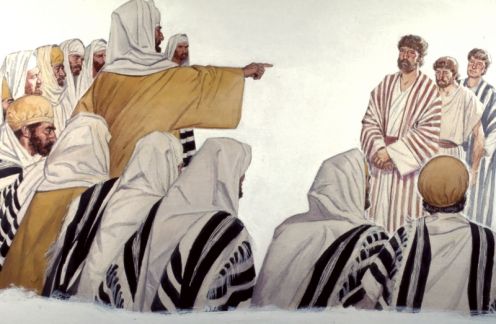
Now when they saw the boldness of Peter and John, and perceived that they were uneducated, common men, they were astonished. And they recognized that they had been with Jesus. But seeing the man who was healed standing beside them, they had nothing to say in opposition. But when they had commanded them to leave the council, they conferred with one another, saying, “What shall we do with these men? For that a notable sign has been performed through them is evident to all the inhabitants of Jerusalem, and we cannot deny it. But in order that it may spread no further among the people, let us warn them to speak no more to anyone in this name.” So they called them and charged them not to speak or teach at all in the name of Jesus. But Peter and John answered them, “Whether it is right in the sight of God to listen to you rather than to God, you must judge, for we cannot but speak of what we have seen and heard.”

Acts 4:13-20 (ESV)

Solemnly charged not to speak in Yeshua’s (Jesus’s) name, the apostles replied, “Whether it is right in the sight of God to give heed to you rather than to God, you be the judge; for we cannot stop speaking about what we have seen and heard.”

The Sanhedrin could argue that they were God’s ordained authority on earth, therefore disobedience to them was disobedience to God. It was a difficult contradiction, and one faced by others in Jewish history. Decisions the legislators adopted by majority consensus were also adopted as the ruling in heaven. (see b.Bava Meitza 59a-b)

What does one do when God-ordained institutional authority rules in contradiction with the will of God? The Master had already prepared his disciples for just such a circumstance. He had foreseen the way things would go and had assured His disciples that they would possess “the keys to the kingdom of heaven” and the right to make legal determinations of binding and loosing. (Matthew 16:19) As apostles of Yeshua, the twelve disciples represented the authority of the throne of David. That important legal power gave Simon Peter and the Twelve the right to overrule the Sanhedrin if necessary.

-from Torah Club, , Volume 6: Chronicles of the Apostles
Torah Portion Lech Lecha (“Go Forth”) (pg 78)
Commentary on Acts 2:42-4:31
Produced by First Fruits of Zion (FFOZ)

It’s all fine and well for Jesus to assure “His disciples that they would possess ‘the keys to the kingdom of heaven’ and the right to make legal determinations of binding and loosing,” but what about us? The apostles represented a direct link to the Messiah, since they had been taught by him and the giving of the Holy Spirit to them, in a very public visible and physical demonstration, was only days or weeks old. While the Sanhedrin could attempt to refute and even defy their “Messianic authority,” a good many witnesses in Jerusalem were more than convinced, and correctly so. Not only that, but there could have been no doubt in the minds of Peter, John, and the rest of the apostles, that they were in the right. Thus they had not only the authority, but the confidence and certainty of mind to be able to stand up in defiance of an order of Israel’s authentic and authoritative legal court system.

But how does D. Thomas Lancaster’s commentary on the legal authority of the apostles to defy the legal authority of the Sanhedrin affect us? That is, who holds “the keys to the kingdom of heaven” today?

You might say, “the church,” but which one? How many denominations of the Christian church currently exist?

According to the Center for the Study of Global Christianity (CSGC) at Gordon-Conwell Theological Seminary, there are approximately 41,000 Christian denominations and organizations in the world. This statistic takes into consideration cultural distinctions of denominations in different countries, so there is overlapping of many denominations.

-quoted from “Christianity Today – General Statistics and Facts of Christianity”
christianity.about.com

Oh my!

That’s a lot of denominations, and they don’t take into account a lot of the more fringy or cult-like groups who also claim some sort of authority to interpret scripture over their flocks in a legal manner.

And then there’s the Internet. As we’ve seen in a seemingly endless stream of religious blogs and their associated comments, there is a plethora of groups and individuals who claim to collectively or personally possess “the keys to the kingdom of heaven” and the right to defy the more established Christian authorities.

I suppose we could split the difference 41,000 (legitimate) ways within the body of Christianity and say that each church possesses a set of keys as applied to their own communities, and that their authority, as it were, is limited to the confines of said-communities, but that’s not really satisfactory. There are not 41,000 Gods and there are not 41,000 Christs, and there are not 41,000 Holy Spirits. God is One. While I believe, to a certain degree, that how the Bible principles are applied may vary and even evolve over the centuries in order to serve the needs of each generation, there is still an objective God; a God unto Himself, the One God with One Mind, and One Spirit, who cannot be subdivided in any manner, even though we may want and even need Him to do so for the sake of our own priorities.

So who inherited the “keys of the kingdom of heaven” or were they simply lost over the course of time?

That’s the problem we are having today. Look at the struggles the “early church” had in Jerusalem. They never became a major power in the Jewish hierarchy. They remained a small Jewish sect operating within the larger collection of valid Judaisms of the late Second Temple period and to some small degree, beyond the destruction of the Temple (but not very much farther). If there was one authentic Messianic (Christian) Jewish authority with the living apostles of Christ among the many Judaisms, when the Jews either surrendered Christianity to the nations or were “kicked out” of the assembly of the Messiah by the Gentiles, what happened to that authentic authority? Was it divided and subdivided, and subdivided again, endlessly across history, like a single-celled organism replicating, evolving, developing to form some vast living mass that is associated but not particularly unified? Is that authority shared among 41,000 living “cells” in what is (loosely) collective Christianity today?

Who currently has the right to make legal decisions that are binding both on earth and in Heaven and to defy all of the others who claim authority over the “Christian church?”

Oh, it gets worse.

It has been taught: On that day R. Eliezer brought forward every imaginable argument, (Lit., ‘all the arguments in the world’) but they did not accept them. Said he to them: ‘If the halachah agrees with me, let this carob-tree prove it!’ Thereupon the carob-tree was torn a hundred cubits out of its place — others affirm, four hundred cubits. ‘No proof can be brought from a carob-tree,’ they retorted. Again he said to them: ‘If the halachah agrees with me, let the stream of water prove it!’ Whereupon the stream of water flowed backwards — ‘No proof can be brought from a stream of water,’ they rejoined. Again he urged: ‘If the halachah agrees with me, let the walls of the schoolhouse prove it,’ whereupon the walls inclined to fall. But R. Joshua rebuked them, saying: ‘When scholars are engaged in a halachic dispute, what have ye to interfere?’ Hence they did not fall, in honour of R. Joshua, nor did they resume the upright, in honour of R. Eliezer; and they are still standing thus inclined. Again he said to them: ‘If the halachah agrees with me, let it be proved from Heaven!’ Whereupon a Heavenly Voice cried out: ‘Why do ye dispute with R. Eliezer, seeing that in all matters the halachah agrees with him!’ But R. Joshua arose and exclaimed: ‘It is not in heaven.’ (Deut. 30:12) What did he mean by this? — Said R. Jeremiah: That the Torah had already been given at Mount Sinai; we pay no attention to a Heavenly Voice, because Thou hast long since written in the Torah at Mount Sinai, After the majority must one incline. (Ex. 23:2 though the story is told in a legendary form, this is a remarkable assertion of the independence of human reasoning)

R. Nathan met Elijah (It was believed that Elijah, who had never died, often appeared to the Rabbis) and asked him: What did the Holy One, Blessed be He, do in that hour? — He laughed [with joy], he replied, saying, ‘My sons have defeated Me, My sons have defeated Me.’

Baba Mezi’a 59b

The Torah Club commentary, from which I quoted above, refers to this Talmudic story, and it is believed in observant Judaism, that the right of the Rabbis to interpret and apply halakhah in an authoritative manner derives from this passage as attached to Deuteronomy 30:12 (Stone Edition Chumash):

It is not in heaven, [for you] to say, “Who can ascend to the heaven for us and take it for us, so that we can listen to it and perform it?”

My Christian reading audience is probably asking why any of this matters, since the Jews do not have authority to interpret scriptures for Christians, and especially not to establish halakhah for us. That’s a good question and you’re right. We don’t expect any of the Talmudic rulings to have any sort of impact, let alone authority, over any of the 41,000 Christian denominations (and their variants, spin-offs, or edge case adaptations) today.

But what about Jews who profess Jesus Christ as the Jewish Messiah King, not as members of a Christian church, but as disciples of Yeshuah HaMashiach (Jesus the Christ) within a wholly Jewish ethnic, cultural, and halakhic religious and lifestyle context? What about Messianic Judaism?

When G-d intrusted Israel with the Torah, He commanded them to appoint leaders to interpret the Torah and to judge whether or not the people had broken the Torah. Inherent in this process is the development of case law, history, tradition of the Jewish people which establishes the precedence that fleshes out the full meaning and implications of each of the commandments. This body of tradition was created by the Jewish people at the commandment of G-d…The Torah invests the divine authority in the spiritual leaders of the Jewish people (this is in the Deuteronomy ch. 17), where their rulings are called…”a word of Torah”. Any Israelite presumptuous enough to reject the rulings of the judges of Israel was cut off from his people, the same punishment as for someone who rejected the written Torah. How much more presumptuous is it for a gentile to cast off entire body of Jewish tradition and claim the right to act as the judge and definer of the Torah?

-Boaz Michael
President and Founder of First Fruits of Zion (FFOZ)
Speaking at the Union of Messianic Jewish Congregations (UMJC) July 2012 conference in Baltimore, Maryland
as quoted by Gene Shlomovich on his blog
Daily Minyan

We see that in some corners of Messianic Judaism (as I define it), there is a serious devotion to the authority of the Jewish people to define themselves as Jews and to determine halakhah for themselves based on the authority of the sages. This rather flies in the face of we non-Jewish Christians but is a particular “thorn in the side” of some of those non-Jews who have either directly (by attending authentic Messianic Jewish congregations) or tangentially (through an affiliation with some form of the Hebrew Roots movement) attached themselves to a (more or less) “Jewish” viewpoint on the New Testament scriptures, Jesus as the Jewish Messiah, and God as the God of Israel.

I’ll tell you right now that I don’t know what all this means and that I don’t have the answers to the questions I’m asking. Because of this, some people accuse me of not knowing if I’m coming or going, and I suppose that is a valid concern from an outside observer’s point of view. On the other hand, there are others who feel exactly the same way about the impact and the consequences of a real, authentic, and transparent life of faith and trust in God as we attempt to grasp the meaning of the Bible across the history of the Jewish people and the world.

The Messianic Jewish Rabbinical Council (UJRC) has established a written Standards of Observance (PDF) document that is intended to guide its member synagogues in the appropriate halakhic rulings as adapted for Messianic Jews, but it is only one body and cannot possibly represent all Jews who profess Yeshua as Messiah everywhere. It also, by necessity, defines a varying level of halakhic response for the non-Jewish disciples who come under the MJRC’s authority, but again, the scope if such authority is limited. These standards do not solve the problem or answer the questions I’ve been posing in today’s meditation however, but only because, like the multitude of Christian churches that exist today, it can’t, at least not outside its own community. We don’t have a universal legal and theological interpretation of scripture where “one size fits all.”

We long for the coming of Messiah. Christians desperately await the return of the King in all his glory. We have many reasons for doing so but one of the reasons I seek him and his presence is to help me understand who indeed on earth holds the “keys to the kingdom,” if anyone. Many claim to hold them or at least know the path on which to travel to find them. Many would-be “Messiahs,” religious leaders, pundits, and self-taught scholars of one stripe or another, profess to know “the truth.” But who are we to believe except God Himself, but how we understand God through the Bible and even through the Spirit, is split at least 41,000 ways, from a Christian perspective.

How am I to choose among 41,000 paths, and probably more if I factor in my own fascination with Judaism, as applied to my Christian faith? I can’t. I can only choose one of the myriad ways as they stand before me and start walking, trusting that God will not allow me to travel the wrong path, nor select a guide made out of my ego, my biases (at least not too severely), or my weaknesses, but only His Son, and the lamp of the throne of David.

May he and I walk together discovering the truth of his existence and my own. May God grant you this gift as well, for this may be all we can do until Messiah returns to rule in Jerusalem, and reveals clearly the One God and the One Way from His Temple.

Blessed is Hashem from Zion, He Who dwells in Jerusalem. Halleluyah!

Psalm 135:21 (Stone Edition Tanakh)

For from Zion shall go forth the Torah, and the word of Hashem from Jerusalem.

Micah 4:2 (Stone Edition Tanakh)

64 days from now, on my path, chosen from among 41,000 paths, (and probably more) where will I find myself?


 

A Walk to Redemption

WalkingThe chassidic community in Poland was in a state of shock. The great chassidic master Rabbi Moshe of Lelov had decided to ascend to the Holy Land and settle there. How could they possibly go on without his leadership?

To his closest disciples the rebbe revealed that when he was a small boy, his father, Rabbi David of Lelov, had said to him: “I did not merit to see the Holy Land, but you must go there. Through your divine service which you will perform there, you will succeed in bringing Moshiach sooner, and hastening the Redemption.”

-Rabbi Yerachmiel Tilles
“The Shattered Goblet”
Chabad.org

Last spring, after Shavuot, I wrote a two-part meditation called “Redeeming the Heart of Israel,” Part 1 and Part 2. I received a certain amount of criticism because I was perceived as somehow elevating Israel and the Jewish people above the non-Jewish believer in the Messiah. While the church is slowly moving away from its stance of supersessionism (I know, I used that word, again) and anti-Israel/anti-Jewish beliefs, it is still difficult for many Christians to take Paul at his word and believe that “all Israel will be saved.” (Romans 11:26)

Part of the problem is understanding what redemption means. From a traditional Christian point of view, individuals are redeemed; we are saved by our faith in Jesus Christ, which generally means, when we die, we go to Heaven. All seems so nice and simple and reassuring. But that’s generally not how Jews see the concept of redemption and the coming of Messiah. As we see from Rabbi Tilles’ story, it is clear that the coming of the Messiah is closely coupled with the redemption of national Israel, not necessarily focused on each individual’s redemption (although this too is important). However, the Jewish point of view is often criticized by Christians as extra-Biblical and thus invalid.

But is this actually true or did Christ’s own disciples believe he was supposed to accomplish Israel’s national redemption?

So when they had come together, they asked him, “Lord, will you at this time restore the kingdom to Israel?” He said to them, “It is not for you to know times or seasons that the Father has fixed by his own authority. But you will receive power when the Holy Spirit has come upon you, and you will be my witnesses in Jerusalem and in all Judea and Samaria, and to the end of the earth.”

Acts 1:6-8 (ESV)

I’ve mentioned all this before, but I don’t know if anyone is taking the message seriously. I’m not trying to “undo” or contradict the doctrine of personal salvation through Jesus Christ, but to illustrate that one of the things he will do upon his return, that was expected the first time he was here but not accomplished, is to restore Israel as a nation to a state of rule over the earth, and return the Jewish people to their Land and heritage in glory and honor.

That’s the part some Christians, including some of those in the Hebrew Roots movement, have a problem with. The “inequality” among the body of believers in the form of salvation coming from the Jews. (John 4:22) Traditional Christianity has historically taught (and thankfully, this is changing) that the church has replaced the Jews in all of the covenant promises, and that Jesus killed the Torah in the process. Hebrew Roots maintains that the Torah still lives, but that the distinctions between Jew and (Christian) Gentile have been totally eliminated and there is only one new identity before God, the “Messianic” identity, despite the fact that God has promised to be a God to the Jewish people forever, to return them to their Land, and to establish Israel as the head of all the nations (i.e. the rest of us).

If you read all of Rabbi Tilles’ tale, you’ll see that sadly, Rabbi Moshe of Lelov never accomplished his mission to reach the Kotel and summon the Moshiach. It is believed that this occurred because the time for the Moshiach’s arrival had not yet come. While Christianity doesn’t believe we can do anything to hasten the return of Jesus, Jews believe by performing acts of tikkun olam or “repairing the world,” that we all, Jews and Gentiles alike, can take part in bringing the time of his coming (or return) just a little bit closer.

In the face of everything I’ve just said, we Christians have a couple of choices. We can accept that the Bible is telling us that we are dependent on the Jews for our salvation through the Jewish Messiah and our covenant relationship with the God of Israel, or we can ignore those parts of the Bible that present this information and focus on either the traditional church doctrine of supersession, or one of the variants being created in minority movements within larger Christianity (which includes Hebrew Roots in general and it’s subgroups such as One Law, which indeed is a Christianity and not a “Judaism”).

Probably the most lively debate on this topic currently happening (though it seems to be winding down) in the blogosphere is on Gene Shlomovich’s blog. I’m actually learning a great deal from a few of the individuals posting (and I may mine some of those comments and pull them together for a future “meditation”), mixed in with the more expected objections to Jewish “choseness” within the Messianic body. But I struggle to remember a lesson that I very recently wrote discouraging the acceptance of someone else’s “gift” of their own anger and hostility, which is not an easy task on the web, but one that is absolutely necessary if we are to truly call ourselves disciples of our Master.

We see in the early chapters of Acts that the community of disciples of Jesus Christ were all Jewish and that, upon accepting the Spirit and declaring their discipleship, the Jews did not deviate in any way from being Jewish. In fact, in the Torah Club commentary I’m reading this week, the early Jewish disciples are referred to as “The Temple Sect.”

Contrary to popular assumptions, the disciples did not teach against the Temple or the Levitical worship system. If the gospel did cancel the Torah and the Levitical worship system, the apostolic community in Jerusalem seems to have been ignorant about the change. They continued to revere the Temple and participate in its services throughout their lives.

The disciples of Yeshua revered the Temple because their Master revered it. He regarded the Temple as his “Father’s house.” As a boy, Yeshua was reluctant to leave the Temple courts. As an adult, He was found in the Temple teaching and attending the festival services. He spent the last days of His life, prior to his crucifixion, in the Temple. He prophesied its coming destruction only with sorrow and weeping…

After the ascension, his disciples “were continually in the temple praising God” (Luke 24:53). They were likely in the Temple when the Holy Spirit was poured out upon them on the day of Pentecost. Aftr that, they remained day by day in the Temple together.

As I continue my study of the book of Acts in the First Fruits of Zion (FFOZ) Torah Club, I hope to find that my perceptions are becoming clearer on these points, including what redemption truly means for Israel and the nations, and where we all stand, Jews and non-Jews, as brothers and sisters in the Messiah.

In my Days series, I’ve been recording my plans to return to more traditional Christian fellowship, in part to reconcile on some level with the larger body of Gentile believers. I don’t know how successful I will be, but I’ve been challenged to trust God more than I have in the past. Hopefully, the ground will remain firm rather than falling out from under me.

Walter Donovan (Julian Glover): As you can now see, Dr. Jones, we are on the verge of completing a quest that began almost two thousand years ago. We’re just one step away.

Indiana Jones (Harrison Ford): That’s usually when the ground falls out from underneath your feet.

from the film
Indiana Jones and the Last Crusade (1989)

Hopefully and with God’s grace, my journey toward reconciliation and redemption will also have a “happy ending.”

71 Days: Wrestling with Trust

The realization that our own strength may be inadequate should never cause us to sink back into inertia. Never refrain from a good endeavor because the difficulties involved seem insurmountable. Keep in mind that we have a mighty Helper in the Almighty in all our good endeavors. Let us do our share; the Almighty will do the rest.

-Rabbi Zelig Pliskin
“Today’s Daily Lift #612”
Aish.com

May these words that I have prayed before God be close to God day and night, that He may do justice for His servant and for His people Israel, the needs of each day on that day.

-Siddur

When people lift heavy loads, they are likely to develop severe back pain. When they realize that they are overtaxing their bodies, they discontinue this practice and from then on will lift only as much as their bodies can safely bear.

While we can easily determine our body’s stress capacity, our psychological and emotional stress tolerance is not so readily measurable. Yet, if we exceed that stress level, symptoms of discomfort and dysfunction are just as apt to occur as when the body’s level is exceeded. How is one to determine one’s safe emotional and psychological stress level?

What could be simpler than following the instruction book provided by the Manufacturer?

During the Israelites’ sojourn in the desert, the manna was provided in portions just sufficient for one day, and any excess rotted away.

As for what they would eat the next day, the Israelites had been assured that there would be fresh manna the following day. Our appropriate stress tolerance is to be concerned for just one day – twenty-four hours. If we take on more than that, we may be overburdening the system. In our economy, lacking the miraculous manna and having the ability to save for the future, there may be justification for putting something aside for a rainy day. However, we often take on worries far in advance, about things that we are powerless to alter or to prepare for today. Such futile worry is harmful to a person.

Today I shall…

try to concentrate on my present needs and avoid worrying about things that are not within my capacity to change.

-Rabbi Abraham J. Twerski
“Growing Each Day, Cheshvan 4”
Aish.com

Just in case you ever wonder why I favor Jewish religious and spiritual sources over traditional Christian books and articles, what you’ve just read from Rabbis Pliskin and Twersky should be exceptionally familiar to anyone who calls themselves a follower of Jesus, and certainly to even the most casual reader of the Gospels.

And he said to his disciples, “Therefore I tell you, do not be anxious about your life, what you will eat, nor about your body, what you will put on. For life is more than food, and the body more than clothing. Consider the ravens: they neither sow nor reap, they have neither storehouse nor barn, and yet God feeds them. Of how much more value are you than the birds! And which of you by being anxious can add a single hour to his span of life? If then you are not able to do as small a thing as that, why are you anxious about the rest? Consider the lilies, how they grow: they neither toil nor spin, yet I tell you, even Solomon in all his glory was not arrayed like one of these. But if God so clothes the grass, which is alive in the field today, and tomorrow is thrown into the oven, how much more will he clothe you, O you of little faith! And do not seek what you are to eat and what you are to drink, nor be worried. For all the nations of the world seek after these things, and your Father knows that you need them. Instead, seek his kingdom, and these things will be added to you.

“Fear not, little flock, for it is your Father’s good pleasure to give you the kingdom. Sell your possessions, and give to the needy. Provide yourselves with moneybags that do not grow old, with a treasure in the heavens that does not fail, where no thief approaches and no moth destroys. For where your treasure is, there will your heart be also.

Luke 12:22-34 (ESV)

But knowing is easier than doing, in my case because I was recently reminded how scary some churches and some Pastors can be.

I can just “feel” Jesus admonishing me every time I write one of these “meditations,” particularly in the “Days” series. “Kvetch, kvetch, kvetch,” he might say if he chose to use the yiddish term. “All you do is kvetch. When are you going to do?”

Good question.

But according to my previous “day” (73 Days, to be exact), I may already be “doing” something. Of course that could also be an excuse, “blaming” being intermarried for the fact that I don’t have a congregational affiliation. Even my wife, who only goes to shul once in a blue moon anymore, has an “affiliation” with both the Chabad and the Reform-Conservative synagogues in town. My only affiliation with them, as it were, is in paying for the annual memberships (yes, my name is on them along with my wife’s).

While a life of faith may contain many mysteries, it is primarily supposed to be a relationship of joy and wonder, not puzzlement and conundrum.

Bereishit is a cheerful sedra, even though its ending is not all that pleasant. Noach has the Flood, but the week ends on a happy note with the birth of our father Avraham. The really joyous week is that of parshat Lech L’cha. We live every day of the week with Avraham, the first to dedicate his very life to spreading G-dliness in the world. And Avraham bequeathed his self-sacrifice as an inheritance to all Jews. (See Tanya Ch. 18; Elul 21.)

“Today’s Day”
Monday, Cheshvan 3, 5704
Compiled by the Lubavitcher Rebbe
Translated by Yitschak Meir Kagan
Chabad.org

See what I mean?

On the other hand, putting the whole “church thing” to one side for the moment, there’s also this:

Torah-study every day is crucial to life itself. This applies not only to the soul of the one studying but also to the souls of his family. For then (through Torah-study), the atmosphere of the home becomes an atmosphere of Torah and piety.

“Today’s Day”
Tuesday, Cheshvan 4, 5704
Compiled by the Lubavitcher Rebbe
Translated by Yitschak Meir Kagan
Chabad.org

On Thursday afternoon, volume 6 of the Torah Club (which you’ll recall, I discussed quite recently) arrived at my home:

“Chronicles of the Apostles” takes students on a year-long study of the book of Acts with Messianic commentary and Jewish insights into the Epistles.

Follow the lives and adventures of the apostles beyond the book of Acts and into the lost chapter of church history. Study Jewish sources, Church fathers, and Christian history to reveal the untold story of the disciples into the second century.

This all new Torah Club Volume Six (2011–12) goes beyond the book Acts and opens the lost chapter of Messianic Jewish and Christian history.

In a Bible study that reads like an epic novel, Chronicles of the Apostles harmonizes Josephus, rabbinic lore, and apostolic legends to tell the story of the martyrdom of Peter, the work of Thomas, the flight to Pella, the fall of Jerusalem, John’s exile on Patmos, the Roman persecutions, the second generation of disciples, the transitions from Sabbath to Sunday and from apostolic Judaism to Christianity. Rewind your religion and discover the truth about our Jewish roots.

Since both Genesis and Noah have already been read, I’ll need to do a bit of catch up work in my “Torah Club” reading and audio “assignments,” but I’m anticipating a fresh influx of information and (hopefully) insights to share in my “morning meditations.” Perhaps (and this is also my hope), I’ll also experience fresh insights and spirituality within me as well.

But, as the quotes from the beginning of this little write-up suggest, no amount or type of study material will give you, me, or anyone else what we truly need: the ability to respond to God with faith and trust, and to follow His lead up into His heights, even when we find heights scary.

73 Days: The Higher Road Less Travelled

The number of Americans who say they have no religious affiliation has hit an all-time high — about one in five American adults — according to a new study released Tuesday (Oct. 9) by the Pew Forum on Religion & Public Life.

Labeled “nones” because they claim either no religious preference or no religion at all, their ranks have hit 46 million people. Much of the growth is among young people — one in three U.S. adults under 30 are now considered nones.

The report also found that the number of self-described atheists and agnostics has hit a peak — 13 million people, or 6 percent of the U.S. population. That’s a rise of 2 percentage points over five years.

Still, claiming no religious identity does not mean an absence of religious beliefs, the report found.

The majority of “nones” — 68 percent, including some who say they are atheists — say they believe in God or some form of higher being. Half say they feel “a deep connection with nature,” and 20 percent say they pray every day.

-Kimberly Winston
“Losing our religion: One in five Americans are now ‘nones'”
Religion News Service story

Those who intermarry face barriers to religious affiliation. Interfaith families who want to educate their children in two religions often cannot affiliate with religious institutions. Many religious institutions discourage or even forbid families from belonging to more than one religious community, or enrolling their children in more than one religious education program. These families may turn for support and religious education to independent interfaith communities such as the ones in New York, Chicago, and Washington DC. Or they end up religiously homeschooling their children in both religions. Either way, they may become part of the “religious but not religiously affiliated” demographic documented in the study.

-Susan Katz Miller
“Interfaith Marriage and the Rise of the Religious ‘Nones'”
On Being Both blog

This is the other road I could take and in fact, it’s probably, to some degree, the road I’ve been walking lately. Although I do have a “religious affiliation,” it is self-declared and unsupported by any larger group or community, at least in the face-to-face world. I’m a Christian, but one who doesn’t go to church or interact with other Christians in any manner except online. Even then, most of the Christians I interact with are otherwise identified as “Messianics” and a significant number of my online peers are Jewish.

Yeah, I’m one strange Christian.

Until I read the Susan Katz Miller article, I had no idea to what extent my situation was rooted in being intermarried. Here’s more of what she wrote:

I am grateful to Pew for drilling down into data on the “nones” and discovering some of the rich complexity of religiously-unaffiliated spiritual life. In an interesting parallel, many of the early studies on interfaith families conflated “doing nothing” with “doing both.” Just because a family does not affiliate with a church or a temple does not mean they are doing nothing. On the other hand, families may claim to be doing both, or attempt to do both, but cannot always follow through successfully without the support of clergy, family, or like-minded interfaith families. It will be important in future studies to examine the full range of practices, beliefs and experiences of unaffiliated interfaith families.

I encourage you to read Susan’s entire blog post to get the full context of what she’s saying about being intermarried and being “religiously unaffiliated.” In some sense, it’s rather empowering to think that there are many more people like me who, rather than “splitting the difference” so to speak, and having husband and wife exist in different religious worlds, choose instead to live “outside of official religious institutions.”

But that puts me into a state of flux again. Should I start attending a church, or some activity held at a church, and thus associate with other Christians? If I don’t and instead, continue on my current path, does that qualify me as a “none” and a “nobody?”

In the beginning, G‑d created everything out of nothing. He could have decided to make everything out of something, but He knew that nothing is better material than something. Because something is already whatever something is, but nothing can become anything.

That’s why, at least as far as this universe is concerned, the only way to become a real somebody is by being a nobody first.

Many of us today are nobodies. That’s okay. The moon must disappear before it becomes full again. The seed must rot away before it becomes a great oak.

-Rabbi Tzvi Freeman
“How Nobody Became Somebody”
Chabad.org

Rabbi Freeman tells an entire story between the second and third paragraphs of the quote just above, so you’ll have to click the link to find the full details. But the core of the message is just what I posted: there is a required relationship between being “nobody” and “somebody;” there is a necessary process involved in being emptied so you can become filled.

I started this “days” series at 78 Days, giving myself that amount of time (my time expires on New Year’s Day, 2013) to either figure out where I belong in the online and face-to-face community of God, or give it up, the blog, and maybe even my faith (outwardly, anyway) and just let the world of vitriolic attack dogs and nudniks (pests) toddle along on the web without me. That has nothing to do with being intermarried, but a lot to do with my patience running out for so-called “Christians” who completely miss the point of the one commandment of Jesus that we should all obey. Tragically, it’s the one commandment of the Jewish Messiah that is most often ignored. More’s the pity.

But while the visigoths may be pounding at the (metaphorical) gate of my so-called “peace of mind,” ready to invade and visit wide-spread destruction on everything in their path, though I could escape simply by withdrawing from the web, I can’t withdraw from the world. I know I’m supposed to do something, but I continue to vacillate between my options. I know that God has placed me here for a reason, and that unpleasant experiences (and unpleasant people) are also here for a reason. I’m not supposed to give up on even the nudniks, (although I finally had to on one) so I guess that means I can’t give up on myself.

I’m still not sure of what the process is where I’m supposed to be emptied now and filled later, but in trying to live out that process in writing and in person, I prefer to think of myself as taking “the higher road less traveled” (and I’m indebted to Lrw in her comment on one of my blog posts for suggesting the title of today’s “extra” missive). Whether I ultimately choose to contact a church, to attend church-sponsored activities up to and including Sunday services, and whether I maintain a long-term relationship with a church or not, (and I’m discovering that I’m not the only Christian who is afraid of church) I do trust that I am walking with God on that “higher road less traveled,” and that one of the reasons I have so few “traveling companions” is that my situation as an intermarried spouse really is unique.

“You block your dream when you allow your fear to grow bigger than your faith.”

-Mary Manin Morrissey

There’s got to be a reason for this mess and for “messy” people. I just need to keep walking on my higher road, and may I uncover the sparks I’m supposed to find, and then release them to Heaven, returning them, and you, and me, to the God who made us all.

“Not all those who wander are lost.”

-J.R.R. Tolkien, British writer

Noah: Dreading Significance

The Maggid of Mezritch interpreted our Sages’ statement: (Avos 2:1) “Know what is above you,” as: “Know that everything ‘above’ all that transpires in the spiritual realms is ‘from you,’ dependent on your conduct. Each of us has the potential to influence even the most elevated spiritual realms.”

The Torah alludes to this potential in the opening verse of our reading: (Genesis 10:9) “These are the chronicles of Noach. Noach was a righteous man.”

The word noach refers to satisfaction and repose. By repeating the word, the Torah implies that Noach and by extension, every one of his descendants can sow these qualities in two different fields, both among his fellow men, and in the spiritual worlds above.

Every person affects his environment. Our thoughts, words and deeds can inspire peace and tranquillity in our fellow men, helping create meaningful pleasure. And by establishing such conditions in our world, we accentuate similar qualities in the worlds above. To highlight our obligation to spread these virtues, this week’s Torah portion is called Noach.

-Rabbi Eli Touger
“Genuine Satisfaction; Noach’s Legacy”
from the “In the Garden of the Torah” series
Adapted from
Likkutei Sichos, Vol. XX, p. 285ff;
Vol. XXV, p. 23ff
Commentary on Torah Portion Noah
Chabad.org

The higher something is, the lower it falls. So too, the loftiest revelations are to be found in the lowest places.

Therefore, if you find yourself in a place seemingly devoid of anything spiritual—don’t despair. The lower you are, the higher you can reach.

-Rabbi Tzvi Freeman
“Higher Lower”
Based on letters and talks of the Rebbe
Rabbi M. M. Schneerson
Chabad.org

In checking my commentary on this Torah Portion for last year, I noticed that I quoted the same content from Rabbi Touger then as I have just now. But it speaks to me from another direction one year later. I realize (I realized this a year ago, too) that whatever we do in the world has consequences that extend far beyond our world and into the spiritual realms. That means everything we do matters in some mysterious, cosmic sense. It also means that everyone of us matters in ways we can’t even begin to imagine.

That’s almost a shame in my case, because I’m at a point where I would much rather hide from significance than embrace it. I know most people strive all their lives to achieve significance. We want to be significant to our families, we want to be significant to our employers, to our friends, to the community. Some people want and need to be significant to large audiences, spanning the nation or even the globe, though I would imagine those types of people are somewhat rare.

But being significant means taking on responsibilities, and there’s a difference between being noteworthy and doing what it takes to support being noteworthy.

I am aware of the principle in both Christianity and Judaism that directs the member of the community to be in community with their fellows. For a Christian, that generally means going to church, and for most Christians, that’s not a problem. I have known some Christians who have gone to congregation without their spouses, sometimes taking the kids to services, because the spouse is a non-believer. Previously, I regularly attended a congregation of believers without my spouse (though she used to attend) because she stopped being a believer in Christ when she adopted a more traditional identity as a Jew.

I stopped going to that congregation for a lot of very valid reasons (though they are wonderful people and have done nothing wrong), not the least of which was that I abhorred worshiping without my wife at my side. If I couldn’t convince her to join my world, I was (and still am) willing to worship in her’s (though my faith in Jesus remains intact).

That was the plan nearly a year and a half ago and it didn’t happen. It will never happen. The question is, do I keep the peace by not attending any congregation, or do I follow the advice I’ve been receiving from a few people and “trust God” by attending a church?

Enter Noah and this week’s commentary on the Parashah. I’m still contemplating jumping and that first step looks like a doozy.

If I’m going to make a decision, it should be soon. Perhaps I can still become, in some sense, associated with a Christian community and still find an excuse to avoid the “Christmas rush” of programs, plays, and musicals that will occur in December. Waiting too much longer then that will put me into Easter season, and how would I avoid the invitations to the various “ham fests?”

Too cynical or just too nervous?

But like I said, enter this week’s commentary on Noah and the significance all human beings have in every decision we make or fail to make. Do I really dare to imagine that whether or not I go to church has cosmic ramifications? Is that ego or avoiding God?

But you can’t avoid God.

Where shall I go from your Spirit?
Or where shall I flee from your presence?
If I ascend to heaven, you are there!
If I make my bed in Sheol, you are there!
If I take the wings of the morning
and dwell in the uttermost parts of the sea,
even there your hand shall lead me,
and your right hand shall hold me.
If I say, “Surely the darkness shall cover me,
and the light about me be night,”
even the darkness is not dark to you;
the night is bright as the day,
for darkness is as light with you.

Psalm 139:7-12 (ESV)

I sometimes admire (even though I think some of them are misguided) people who state with such assuredness that God has told them “such-and-thus,” as if God were sitting with them at their kitchen table this morning, chatting with them over a cup of coffee or tea. I once had a blog discussion with a Christian fellow who styled himself a “prophet,” and he told me point-blank that was exactly how his conversations with Jesus occurred. I immediately stopped following his blog because, even though he seemed really nice and all, I thought only an ego the size of Montana could imagine the Son of God casually schmoozing with him in his kitchen, with each of them sipping a cuppa.

But who knows? Certainly not me.

I don’t have supernatural revelations telling me to go to the corner of 5th and Main and then await further instructions from the local Angel.

I know, cynical again, right?

Heck, Christians struggle with these questions all the time, right?

Recently I quoted Rabbi Abraham J. Twerski when he said:

The Hebrew word for ark, teivah, has two meanings: it can mean “an ark,” and it can also mean “a word.” In the above verse, the latter meaning tells us that God instructed Noah to “enter into the word.” Rabbi Moshe of Kobrin expounded on this theme, explaining that when we pray, we should “enter into the words,” i.e. totally immerse ourselves into each word of prayer, as though the word is encompassing us.

I can’t avoid God. I can’t avoid my conscience. I can’t avoid the idea that I might have a purpose and a reason beyond pressing a bunch of keys on a keyboard to produce blog posts day after day. I can only choose to attend to God and my conscience or ignore them.

Snakes. Why did it have to be snakes?

-Indiana Jones (Harrison Ford)
from the film Raiders of the Lost Ark (1981)

I know it’s a terrible thing to say, but that’s exactly how I feel. Oh well, maybe I’ll start by emailing the Pastor. Maybe he has some ideas. This is terrible. I’m not looking forward to this at all.

HAL-9000 (voice, Douglas Rain): What is going to happen?
Dave (Keir Dullea): Something wonderful.
HAL-9000: I’m afraid.
Dave: Don’t be. We’ll be together.
HAL-9000: Where will we be?
Dave: Where I am now.

from the film 2010 (1984)

Yeah, well…there’s always hope.

“A rare experience of a moment at daybreak, when something in nature seems to reveal all consciousness, cannot be explained at noon. Yet it is part of the day’s unity.”

–Charles Ives

Good Shabbos.

75 Days: A Little Help, Please

All over people are fighting. Religious fighting, national fighting, family fighting. Some are even ready to die because they think they’re right. How are we ever going to put this world back together?

Way #11 is dik’duk chaveirim – literally “cut if fine with friends.” See the importance of sitting down, of reasoning together. Don’t assume your viewpoint is correct. Open yourself to the ideas of others. “You don’t have to kill me. If you persuade me that you’re right, then I’ll join you.”

We need real friends – someone you can trust, to discuss plans, feelings, ambitions. With a friend, you don’t worry about scoring points or winning ego contests. A good friend will listen to the pros and cons and give you straight, honest feedback.

This is especially important with decisions like: Should I marry so-and-so? Should I accept this job offer? Should I move into this neighborhood? Everyone has different insights. Amongst many people you’ll find many solutions.

Some roads can be traveled alone, but the road of life shouldn’t be one of them. Go with a friend.

-Rabbi Noah Weinberg
“Way #11: Work It Through With Friends”
From the “48 Ways To Wisdom” series
Aish.com

So James, have you thought in terms that you’re robbing people of your fellowship? You have something that is vitally needed to be heard by the Christian community. Not to mention your sweet and gracious nature that is a great example.

I will also respectfully say you’re limiting God. I find that if I trust Him enough to obey and not focus on all the reasons I can’t, shouldn’t, it’s too hard too, then He is faithful to work out the details that I have no control over (the heart condition of others). After all, he doesn’t ask me to control others, only to obey Him.

-Lrw in a recent comment on my blog

What do I do when my love is away
Does it worry you to be alone?
How do I feel by the end of the day
Are you sad because you’re on your own

No, I get by with a little help from my friends
Mm, I get high with a little help from my friends
Mm, gonna try with a little help from my friends

-Lennon and McCartney
With a Little Help from My Friends

I suppose that’s how we all get through things…with a little help from friends. As you can see, it’s been suggested to me that not only might I benefit from fellowship with like-minded believers, but that they might benefit from fellowship with me. Sounds egotistical of me to say it like that, but I think I know what Lrw is saying. This is especially true when, as I’ve been describing in this series, there seems to be so much fighting and feuding and jockeying for position in the religious blogosphere and particularly within the Hebrew Roots movement.

But I must say that religious fighting and religious “haters” aren’t limited to the small corner of cyberspace I happen to occupy. Here’s two examples. First, from the Jewish side of things:

Question: I recently stumbled on an anti-Semitic website and they had a whole list of Talmud sayings that sound very non-PC. One example was: “It is permitted to marry a 3-year-old girl,” which they said means that Judaism condones sexual abuse of a young child. Another example was: “The best of the Gentiles, kill.” Does the Talmud really say this stuff?

The Aish Rabbi Replies: Misquoting Talmudic texts or taking them out of context is an age-old method used to incite anti-Semitism.

In the example that you cite, that a Jew may marry a 3-year-old girl, it simply means that under the age of 3, a “marriage” contract has no validity. Beyond that, any “marriage arrangement” made at above the age of 3 must be accepted and validated by the girl herself at such time that she attains maturity. The Talmud is discussing a technical legal point, not condoning abhorrent sexual activities.

As for: “The best of the gentiles, kill,” the context here is very crucial. The question was raised, how could there be any horses chasing after the Jews with chariots (in Exodus 14:7), when they were all killed in the plague of hail (Exodus 9:19). The Midrash (Tanchuma – Beshalach 8) answers that the horses were owned by those who heeded God’s warnings and locked his animals indoors (Exodus 9:20).

The Midrash concludes that these God-fearing Egyptians — the best Egyptians — turned out to be the ones that gave their horses to chase the Jewish people. In other words, in this particular instance, even the best Egyptians turned out to be oppressors, too. Yet even they – “the best of the gentiles” – were deserving of death.

The Torah states unequivocally that ALL men were created in the image of God (Genesis chapter 1). In fact, the Talmud emphasizes that Adam was created from the dust of all four corners of the earth (so to speak), so that no one nation could claim superiority. And of course, it is forbidden for a Jew to kill a Gentile. (source: Talmud Sanhedrin 57a; “Taz” Y.D. 158:1).

So you see, one can change the meaning of anything by taking it out of context. And better not to waste time refuting these points one by one. God’s Torah is morally perfect, and if something ever sounds otherwise, it is because it is not understood properly.

“Misquoting the Talmud”
from the “Ask the Rabbi” series
Aish.com

Christianity in general has an issue with the Talmud and how it is used in Judaism, believing that it is of no value and that it is the “wisdom of the elders” being placed higher than the Word of God. The Hebrew Roots movement also tends to disdain the Talmud and thus, the last 2,000 years or so of Jewish culture and philosophy as well as Jewish art, literature, lifestyle, and just about anything else Jewish that isn’t, strictly speaking, “Biblical.” And yet, it’s impossible in virtually any sense, for anyone, Jew or Gentile alike, to observe the Torah mitzvot without referencing Talmud and granting the ancient Jewish sages the right and ability to render authoritative halakah. In fact, the very structure of the books, chapters, and verses in the Tanakh (Old Testament) was created by those self-same sages. Try to avoid that if you can.

However, this isn’t just a problem on the Jewish side of the equation:

If you want to see a good example of what be-devils any scholarly analysis of practically anything to do with Jesus and early Christianity, have a read of the postings of the Canadian TV self-promoter, Simcha Jacobovici here.

Jacobovici (who styles himself “the naked archaeologist” on his self-produced TV programmes, and offers no competence in anything relevant to the analysis of the fragment) notes that various scholars (particularly Coptologists and specialists in ancient Greek palaeography) have raised questions about the authenticity of the fragment (announced to the scholarly world in Prof. Karen King’s paper presented at a conference in Rome several weeks ago), and simply trashes all the scholars and queries as “sleeper agents of Christian orthodoxy”.

He claims that they give no basis for their hesitations, which is patently incorrect and misleading. The several scholarly analyses that I’ve seen all in fact present in considerable detail reasons for wondering about this fragment. I’ve seen none, not a one of the scholarly analyses in question, that raises any issue about “Christian orthodoxy”.

-Larry Hurtado
from “The ‘Jesus’ Wife’ Fragment: Self-Promoting Personal Attacks”
Larry Hurtado’s Blog

I suppose I was being rather self-centered or myopic in believing this problem was confined to the wee online community in which I participate. As you can see (and I have discovered), these sorts of problems exist elsewhere and probably everywhere. The only way to avoid them is to be completely disengaged from community, even online community which is as easy to take or lose as opening and closing a web browser.

On the one hand, the thought of facing such vitriolic commentary either online or face-to-face isn’t appealing in the slightest. On the other hand, I have to remember that there are some “religious people” who don’t use God like a blunt instrument with which to beat others repeatedly about the head and shoulders:

Rav Levi Yitzchok of Berditchev was known for his love and good will toward his fellow Jews always trying to assess the good in people rather than expose the bad.

Once on the Fast of Tish’a B’av he saw a Jew eating in a non-kosher restaurant. He tapped lightly on the window of the establishment and summoned the man outside.

“Perhaps you forgot that today is a fast day?” Rav Levi Yitzchok queried.

“No, Rebbe,” the man replied.

“Then perhaps you did not realize that this restaurant in not kosher.”

“No, Rebbe, I know it is a traife (non-kosher) eatery.”

Rav Levi Yitzchok softly placed his hands on the man’s shoulders and looked heavenward. “Ribbono Shel Olam, Master of the Universe,” he exclaimed. “Look at how wonderful your children are. They may be eating on a fast day. In a non-kosher restaurant to boot. Yet they refuse to emit a falsehood from their lips!”

-Rabbi M. Kamenetzky
“Eve of Life”
Commentary on Torah Portion Beresheet
Torah.org

As much as I lament the few rather vocal and hostile nudniks (pests) on the web, there are a lot more people who represent the spirit demonstrated by Rav Levi Yitzchok who continue to be an encouragement to me.

However, the next step, if I understand what is being asked of me correctly, will be a lot harder.