Tag Archives: church

Who Am I Now?

At the event I took the opportunity to ask Rabbi Boteach a question having to do with historical context. I challenged him over his claim that Christians seeing the Jewish Jesus would lead to a more human understanding of Jesus, which in turn would lead to a more tolerant Christianity. My problem with such a claim is that we have ample historical precedent from the history of Jewish-Christian relations that an emphasis on the humanity of Jesus does not necessarily lead to greater tolerance of Jews. On the contrary, it can lead to anti-Semitism by focusing attention on the cause of Jesus’ suffering. This was the case during the high Middle-Ages. Christians “discovered” the humanity of Jesus. This led to a plethora of artwork showing Mary with baby Jesus actually drawn with baby features and gave us the Christmas creche we have today. This also led to an emphasis on Jesus’ physical suffering on the cross. The divine Jesus could never possibly feel pain; only the human Jesus could suffer. Rabbi Boteach response was that the Jews were not responsible for the death of Jesus, the Roman were. This is in fact a major point of his book. While this answers the question whether Christian readers will take Rabbi Boteach’s arguments to anti-Semitic conclusions, it does not answer the question I was asking of why we should be willing to draw a straight line between a human Jesus and a tolerant Christianity when historically this has not necessarily been the case.

“Kosher Jesus’ Lack of Historical Context”
Book review of Rabbi Shmuley Boteach’s Kosher Jesus
from Izgad

This isn’t a review of Boteach’s book Kosher Jesus from a Christian point of view, but reading it did make me start to think about the “Christian point of view” and whether or not I actually have one. I don’t. I realized in reading this blog post that I haven’t the faintest idea how “traditional Christians” see the world, at least from an actual “lived” experience, even though I call myself a Christian.

So why do I call myself a “Christian?”

Frankly, for lack of any other way to describe myself as a person of faith. My wife, who is Jewish, considers me a Christian. Everyone who I know who is Jewish considers me a Christian. Ironically, many of the Christians I know call me a “Messianic Jew.” I find this last part rather surprising (and uncomfortable) since, not being Jewish, I can’t be any sort of “Jew,” Messianic or otherwise. According to many Messianic Jews I know, I can’t be “Messianic” either, since being “Messianic” is considered a Jewish designation. Technically, as far as it’s been explained to me, the Gentiles cannot have a “Messiah” as such. We can have a Savior, or Lord, or Prince of Peace, but the Messiah came for “the lost sheep of Israel.”

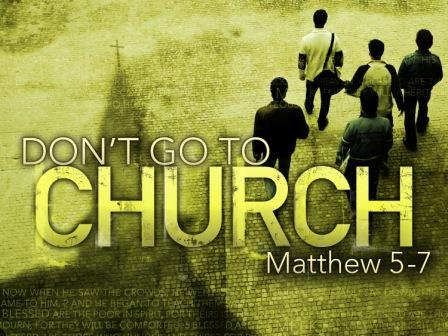
I call myself a “Christian” to try and avoid any confusion about who I am. I am not a Jew so calling me a “Messianic Jew” is completely inappropriate. Calling myself a Christian announces that I am a Gentile who believes in Jesus Christ, just as millions and millions of Gentiles have been Christian across the vast expanse of history. Since I”m also vehemently non-supersessionist, I am also at odds with some and perhaps many other Christians, which is one of the reasons why I don’t go to church.
Even though some Jewish people consider me “Judaically-oriented” or having a heart and mind for Judaism, it has occurred to me lately (and again, referring back to the Izgad review of Kosher Jesus), that I might not fit all that well into a Jewish setting, either. It’s one thing to read and study Jewish commentary and studious texts and another thing entirely to be part of a community. It occurs to me that when my wife says the Rabbis at the local Reform and Chabad synagogues “tolerate” the presence of Christians in their midst (as long as they don’t try and proselytize the Jews at shul), that “tolerate” may be in the sense of tolerating a splinter under your fingernail or the discomfort caused by a repetative motion injury. You can handle it being around, but it’s not exactly enjoyable…and it would be a relief when the thing you are “tolerating” is finally gone.

That’s my projection, of course, but I think it’s reasonable. In reading Jacob Fronczak’s blog post Why I Go to Church, part of what he is saying is that he must “tolerate” some aspects of church communal life. It’s not perfect and it’s not going to be. That would be true for me as well if I were to attend a church (though I suppose they’d have to learn to “tolerate” me if I ever chose to actually open my mouth and say what I was thinking). To emphasize my “differentness” from how “regular” Christians think, I have to say I’ve received my first criticism on my recent article Origins of Supersessionism in the Church. My critic, a Christian, and a person I have no reason to believe is anything but honest, sincere, and well-grounded in the faith, states that many of the historical wounds between Messianic Judaism and the church are well on their way to healing at this point in our relationship, but the tone and attitude of my article, has resulted in ripping open some of the scars and pouring salt into the reopened injuries. I don’t seem to be doing “Christian” very well.

So if I’m a Christian, it’s because the label is the closest and most accurate approximation that represents my faith, but I’m a Christian who would not easily fit into either a church or synagogue setting. I’m nearly nine months into my current “experiment,” the primary goal of which was to join with my wife and, as a married couple, worship together within a Jewish context. It hasn’t worked out well thus far. With just a little more than three months left before I decide to continue toward my goal or to pull the plug for good on my hopes, it has become increasingly unlikely that I will achieve anything I started out aiming for.

I don’t actually have to confront the “where do I go from here” question until the end of May or perhaps early June (and keep in mind these time frames are completely arbitrary and self-assigned), but it’s not too early to start thinking about the question. If I had to frame an answer today, I would have to say that there are no options for community that meet my requirements. Facing that would mean facing the consequence of having no tangible faith community for the long term and possibly for the rest of my life.

I don’t fit in. Even if I did find a community where I personally fit in, chances are very high that my wife wouldn’t, and one of the primary requirements for achieving my goal is to worship with my wife. If someone were to offer me a practical option for community that fit me personally “hand in glove,” it would still be lacking if it didn’t fit my spouse as well.

So, who am I? I’m a Christian who doesn’t think very much like a Christian but to be honest, I don’t think very much like a Jew either. I’m the fish in the game Marco Polo who is always “out of water”. If I can’t say that I’m a “freak of nature” I have to say that I’m probably a “freak of faith.” I’m not trying to sound pathetic, but this blog is centered on my “experiment” so it represents, among other things, a chronicle of my progress or lack thereof.

Oh, interesting thing about the reviews of the Boteach book. I’ve found numerous Jewish and Messianic Jewish book reviews, but I have yet to find even one single review written by a Christian. If Rabbi Boteach had hoped to reach not only the Jewish community, but the church with his book, he doesn’t seem to have achieved his goal either, at least up until now.


Why I Don’t Go To Church

This dialogue can happen over the Internet. God forbid that I should disparage the Internet as a means of communication; the irony would be a bit sickening. But realistically, all the activity out here is nothing – nothing! – compared to what is going on in real churches, with real people talking face to face. Real, honest dialogue with other people who bear God’s image and are trying just as hard as we are to understand and interpret the Bible.

I have seen so much good come out of the church I am in. Depending on how far you want to stretch the idiom, I have seen “the blind see, the lame walk, the lepers are cured, the deaf hear, the dead are raised to life, and the Good News is being preached to the poor.”

Have people left? Yes. Have people gotten hurt? Yes. Welcome to communal life…

-Jacob Fronczak
“Why I Go to Church”
Hope Abbey blog

For God did not appoint us to suffer wrath but to receive salvation through our Lord Jesus Christ. He died for us so that, whether we are awake or asleep, we may live together with him. Therefore encourage one another and build each other up, just as in fact you are doing.1 Thessalonians 5:9-11 (ESV)

I read Jacob’s latest blog post this morning before I went to work and responded to him that I’d probably have to write a “counter-point” blog from my perspective. I don’t write this to disagree with or to oppose Jacob. In fact, I have the greatest admiration for his writing and the message he has created for today. He’s one of the few people who blog, especially about religion, who consistently presents an attitude that is sane and calm. I always hope that I present myself as sane when I blog, but anyone who has followed my “morning meditations” for any length of time knows that I am not always calm.

Jacob makes some very good points about why a person who is aligned with the “Hebrew Roots” movement can still attend and even thrive in a traditional church setting. I’ve said this in the past and I have also said that a great deal of good is done by the church in pursuing the commandments of Jesus to feed the hungry, visit the sick, and to provide comfort to the widow. In fact, I experience that sort of lovingkindness more from the church and the traditional Jewish synagogue than I do from many of those groups who call themselves “Hebrew Roots” or “Messianic,” usually because those groups are more focused on establishing and maintaining their “rightness” than in actually doing “rightness” to others in the Messiah’s name.

On the other hand, I have reasons for not attending church. None of this is new and I’ve spread “my story” over many different blog posts and various comments in the blagonet, but after reading Jacob’s message this morning, I felt I should collect all of that here today. This also, by coincidence (if I can even believe in coincidence in a created universe), dovetails nicely into today’s morning meditation where I spend several paragraphs summarizing my “witness” or my history in the world of faith.

Up until last May, I was regularly attending and teaching at what you would call a “One Law/Messianic” congregation. I left after much prayer, study, and investigation of the assumptions that had originally attracted me to that movement because of two basic reasons: I no longer felt the One Law proposition, which states that both Jews and non-Jewish Christians are obligated to the full 613 commandment in the Torah (minus Jewish halacha and Talmudic judgments and rulings) was Biblically valid. Also, I didn’t want to worship in a religious venue in which my wife, by her very nature as a (non-Messianic) Jew, would be unable to attend, and which would prevent me, due to my “reputation” as “Messianic,” from fellowship with her communities in Reform and Chabad Judaism.

So for the past nine months, I have been unaffiliated with any specific house of worship or formal denomination or sect, and for nine months, I have not engaged in any form of communal prayer or worship.

I kind of miss it.

The idea was to join with my wife at some point, in her communal religious life, but she doesn’t really have one at this point. She very occasionally attends shul, usually for a bar or bat mitzvah, or to help in some event held at one synagogue or the other, but not for Shabbat services and not to go to any of the classes being offered. I’ve suggested that perhaps we could do something together at one of the synagogues, and after a number of conversations on the matter, she said, “we’ll see.”

So why don’t I attend a church in the meantime? One of the reasons I left “One Law” is that the Rabbis at both synagogues in town are generally “OK” with Christians visiting for worship and classes, but they have an extremely difficult time even tolerating the presence of “Messianics”. Certainly, if I attended a church, even regularly, I would be no more or less offensive to them than any other Christian who walked through their doors, and certainly there are other intermarried couples who attend both synagogues, so how out of place could I be? Church attendance shouldn’t be a barrier to synagogue worship as such.

Traffic ConesThe other reason I left “One Law” was because I didn’t want to worship alone. I don’t mean without fellowship, which I had in abundance, but without my wife. She would no more step one foot inside a church than she would inside a “Messianic” congregation and for pretty much the same reasons. I would be just as “isolated” from my wife in a church service as I ever was in a “Messianic” service. I might eventually gain fellowship with other Christians, but it would still be completely hollow without my wife.

I know what some Christians out there are probably thinking right now.

“Do not think that I have come to bring peace to the earth. I have not come to bring peace, but a sword. For I have come to set a man against his father, and a daughter against her mother, and a daughter-in-law against her mother-in-law. And a person’s enemies will be those of his own household. Whoever loves father or mother more than me is not worthy of me, and whoever loves son or daughter more than me is not worthy of me. And whoever does not take his cross and follow me is not worthy of me. Whoever finds his life will lose it, and whoever loses his life for my sake will find it. –Matthew 10:34-39 (ESV)

You could reduce that down to, “the heck with your family, Jesus is more important” or words to that effect. You could even attach my desire to attend synagogue services with my wife to what the Master said in Matthew 10:33 (ESV): but whoever denies me before men, I also will deny before my Father who is in heaven. So much for loving my wife, eh guys? But what about this?

…and said, ‘Therefore a man shall leave his father and his mother and hold fast to his wife, and the two shall become one flesh’? So they are no longer two but one flesh. What therefore God has joined together, let not man separate.” –Matthew 19:5-6 (ESV)

It’s not so easy now to simply dispense with my “other half,” even for the sake of my faith in Jesus, unless you can come up with some handy way to reconcile the dissonance created by juxtaposing those two teachings of the Master (and I’m aware that theology has come up with some rather creative ways of making discordant verses “fit” for the sake of “smoothing over” theology when rationally, they otherwise shouldn’t reconcile).

And then there’s supersessionism in the church.

I recently wrote an article for Messiah Journal called Origins of Supersessionism in the Church, which is the first of a four-part series on this topic. While I generally oppose this theology, my writing and research has made me particularly sensitive to the extraordinary harm this teaching of the church (not teaching of Jesus and Paul) has done to the Jewish people and to the worship of the Messiah within the framework of Judaism over the past 2,000 years or so. I admit to living with a certain amount of apprehension that if I ever started attending a church again, someone, a Pastor or Bible Teacher or just one of the parishioners, would spout off something about the church replacing Jews. Then I’d feel my blood pressure rise along with my temper, and I’d either just walk out, or I tell that person what I thought of their ill-considered “theology” (and then walk out or be thrown out).

Not that it would really be their fault. After all, the church has been teaching supersessionism as Biblical “fact” ever since the days of the early Gentile “church fathers.” That still doesn’t make it right nor does it mean I have to tolerate a way of understanding the New Testament that requires Judaism and every living, breathing Jew (including my wife and three children) to be deleted from religious, spiritual, and historical significance, not to mention permanently removing them from God’s love and, in at least a historical sense, removing the Jews from their very lives.

I told you I was sensitive to this stuff just now.

So that’s why I don’t go to church.

I understand what Jacob is saying and he’s right. Internet relationships are something of an illusion. I have managed to turn one or two into “real” friendships, but it always involves meeting in real life and doing stuff together. Pretty difficult for most web connections, particularly when those contacts span the globe.

Jacob ended his blog post with an invitation to those of us who are disaffected in relation to the Christian church:

If you believe in Jesus, you’re a Christian. We’re all brothers. We can be distinctive without being destructive. We can worship together. We can live together. We have to.

And maybe, just maybe, you could drop in at church sometime. We’d love to have you.

Thanks, Jacob (where ever you live…which according to his About page, is thousands of miles away from me). I’m not sure how that would ever work out, but I guess we’ll see what God has in mind.

Mistreating People

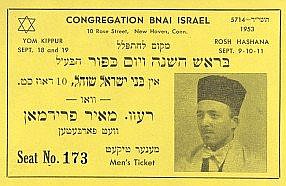
A few years ago, in a hilarious episode of “Curb Your Enthusiasm,” the comedian Larry David bought scalpers’ tickets to his congregation’s High Holy Day services, and was kicked out when his subterfuge was discovered. Nothing that dramatic happened to a friend of mine who wished to attend services last year, but he also had an unpleasant experience with a large congregation.

My friend, who moved to Westchester several years ago, is not a regular shul-goer, but had always gone to High Holy Day services in the city. In his first year in the suburbs, he called a large local Conservative congregation — his denominational preference — and was told that he could have tickets that year at a nominal fee, but if he wished to attend the following year he would have to join the congregation. He was out of the country the following year, so when he returned the year after that, he phoned to ask if he might pay a more substantial fee for his seats this time but not yet become a congregation member. He had not made up his mind about membership. The response he received was a snappish, “You cannot come here again without joining,” and a loud click of the receiver. One or two other large synagogues in his area also informed him in no uncertain terms that he had to be a member to get tickets.

-Francine Klagsbrun
Special to the Jewish Week
“Synagogues Should Be More Welcoming”
The Jewish Week

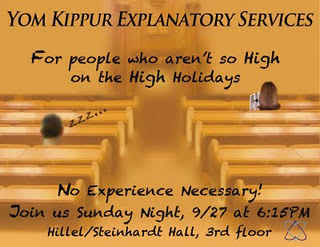
That sounds terrible. In fact, the whole process of buying tickets to the High Holy Days services probably seems strange and alien to most Christians. After all, it’s not like we have to buy tickets to get seats at Christmas or Easter services in a church (although I must admit, I haven’t commemorated either event or worshiped in a church setting for many years). And yet, the synagogue model raises funds in a very different manner than the church and purchasing an annual membership to a synagogue as well as buying tickets for special events like Passover or the High Holy Days is perfectly normal and reasonable.

But what about the situation described by Klagsbrun? Is this what God really intended? Is this how a synagogue welcomes a Jew into its midst for worship and to honor God? If the person in question had held a membership to the synagogue, it wouldn’t be a problem. But just as some Christians only attend church on Easter, some Jews only go to shul for the High Holidays. No one bars the door to the “annual Christian” but why should a “three day a year Jew” not be able to worship because of lack of “membership?”

Of course, there are always options.

Put off by those responses he called the local Chabad office, ordinarily a sect foreign to his liberal religious and social outlooks. The rabbi who answered the phone greeted him cordially and invited him to attend all the holiday services with no payment. When he did, he received a warm welcome from the rabbi and his assistant. And when he became ill and did not show up for Yom Kippur, the rabbi later called his home to inquire after him. Although my friend missed the more intellectual atmosphere of a Conservative synagogue, he enjoyed the enthusiasm and inclusiveness of the Chabad service. Needlessly to say, he sent an unsolicited check to Chabad after the holidays. It was the money he had offered to pay for tickets to the large suburban synagogue.

No, this isn’t my advertisement for the Chabad and that also was not Klagbrun’s intent when writing her article. For many Reform and Conservative Jews, entering the world of the Chabad is about as comfortable as a visit to the surface of the Moon without the benefit of a spacesuit. A large number of Jews consider the Chabad “cult-like, with its mysticism, messianism, and adulation of the Rebbe” (so if you as a Christian have issues with the Chabad, you’re not alone). But they are doing one thing right. They are welcoming the so-called “three days a year” Jew into their midst the way (forgive me if this next part offends you) that a church would welcome an errant Christian, seeker, or wandering atheist through their doors.

Klagsbrun suggests that it is time for “synagogues to rethink some of their policies, add flexibility, reach out to the unaffiliated, and then take more pride than ever in what a religious New Year really means.” I don’t often go out of my way to be critical of Judaism, but I am also aware that no people group and no religious faith is perfect or has the corner market on righteousness. To my way of thinking, the “welcomeness” of the church (whatever faults it may possess) is generally more aligned with the will and wisdom of God and the spirit of the Messiah than the examples of the synagogue Klagsbrun brings forth. And yet, even during some of Judaism’s darkest hours, God’s response to His “straying sheep” is not condemnation, but compassion.

By the time Moses returned to the scene, his people had hit an all-time low. They worshipped idols, spoke slanderously of each other, and had wandered very far from the path of their forefathers. Perhaps he should have told them off, saying, “Repent, sinners, lest you perish altogether!”

But he didn’t. Instead, he told them how G-d cared for them and felt their suffering, how He would bring about miracles, freedom and a wondrous future out of His love for them.

As for rebuke, Moses saved that for G-d. “Why have you mistreated your people?!” he demanded.

If you don’t like the other guy’s lifestyle, do him a favor, lend him a hand. Once you’ve brought a few miracles into his life, then you can urge him to chuck his bad habits.

-Rabbi Tzvi Freeman
“Rebuke”
Based on letters and talks of the Rebbe
Rabbi M. M. Schneerson
Chabad.org

I am sometimes treated to a view of our local Reform and Chabad synagogues, their members, and their Rabbis, as seen through my wife’s eyes and experiences. No one is perfect. Everyone has flaws. Some of the events that occur within the Chabad are less than attractive or appealing. And yet to read words of wisdom and beauty that are inspired by the Rebbe are a joy that reminds me of the grace of Jesus. As I mentioned in yesterday’s “morning meditation”, God is writing on all our hearts and there is something of the Divine in each of us. Rather than rebuking our neighbor for his shortcomings, we should show our love and grace, even as God has shown love, grace, and mercy to us.

“For God so loved the world, that he gave his only Son, that whoever believes in him should not perish but have eternal life. –John 3:16 (ESV)

God, Bad, and Imperfect

joseph-and-pharaohOn today’s daf we find that when Rabbi Akiva heard a compelling argument, he changed his opinion and began to teach in accordance with Rabbi Yehudah’s view.

The Alter of Kelm, zt”l, explains the great importance of admitting one’s errors. “We find in Maseches Avos that there are seven attributes of the wise, one which is to admit the truth. Who was more evil than Pharaoh? Yet when he heard Yosef’s interpretation of his dreams, he was amazed…The Ramban explains that Pharaoh was very wise and could discern broad inferences from minor hints. From this one episode, he understood the great wisdom of Yosef and nullified his own understanding to that of Yosef. He saw that Yosef was the fittest person to rule the land, not him.

“We see that the nature of a true chacham is to admit to the truth. Nothing held him back from treating Yosef as was fitting…despite the Egyptian law that one who had been a prisoner was forbidden to rule. He didn’t even check why Yosef had been placed in prison. Instead, he understood what so few with his vested interests would have grasped: that Yosef is exceedingly wise. And that it would be fitting to learn from him as a young child learns from his father. It was clear to Pharaoh that Yosef deserved to rule.”

The Alter concluded: “I have written just a little of what is in my heart on this matter, but it is enough for a wise man to understand that failure to admit the truth reveals a lack of understanding.”

Daf Yomi Digest
Stories Off the Daf
“There is None as Wise as You”
Chullin 128

They were not perfect men. Abraham twice called Sarah his sister rather than rely on God for protection. He married Hagar rather than wait for God’s promise through Sarah. Isaac proved his fallibility by turning a blind eye to the wickedness of Esau. Jacob is remembered for his cunning and trickery. The consistent story of Scripture is not one of exceptional men, but an exceptional God. The Torah tells us their stories so honestly that we are convinced. We feel we know these men personally. We learn that even the greatest men of faith were human. We may take comfort in that, but we must not forget the unique, spiritual greatness of the Fathers.

-from “The Greatness of Our Fathers”
Torah Portion Lech Lecha commentary
FFOZ.org

No one is perfect. We all make mistakes. If we are truly wise, when we discover that we’re wrong, we’ll admit it and turn to what is right.

If you’ve been reading this blog for any length of time, you know that a recurring theme here is the relationship between Christianity and Judaism. Sometimes I lament of our inability to get along with each other, and sometimes I marvel at how amazingly similar the message of the Rabbinic sages is to that very special “Sage from Netzeret”. You really can’t understand Jesus unless you have some idea about Judaism, even post-Biblical Judaism.

However, there are a few pitfalls involved in “combining” Christianity and Judaism and they lead in opposite directions. Some non-Jews become so enamored with the beauty of Jewish prayer and worship, that they in effect, start worshiping Jews and Judaism rather than the God of Israel. The extreme opposite happens, too. Sometimes even intelligent and otherwise well-meaning people feel threatened by the “choseness” of the Jews and develop and deep and abiding “dislike”…OK, hatred for anything Jewish. I’m going to focus on this latter group today.

I was on Amazon a little earlier looking at a book written by Pastor Barry Horner called Future Israel: Why Christian Anti-Judaism Must Be Challenged. Here’s a bit of what the book is about:

Author Barry E. Horner writes to persuade readers concerning the divine validity of the Jew today (based on Romans 11:28), as well as the nation of Israel and the land of Palestine, in the midst of this much debated issue within Christendom at various levels. He examines the Bible’s consistent pro-Judaic direction, namely a Judeo-centric eschatology that is a unifying feature throughout Scripture.

I noticed that the book received some excellent reviews, but I also saw a significant number of rather “bad” reviews. I’m always curious when what otherwise seems like an excellent book is panned by some folks, so I took a look at the various “1-star” comments. Here’s a sample (I’ve represented the names of each reviewer with initials):

I want to be saved and how better to do that than by swearing my allegiance to the state of Israel, say shalom! While I’m at it I also promise to say nasty things about God’s natural enemies, those A-Rabs (obviously). Kudos to the author and also shout outs to Sharon, Dershowitz et al! At last I can be secure in my Christianity. –SR

Just another attempt to put together a piece of work that defends Christian Zionism. God has never been finished with Israel (His Church), no where in scripture does it speak of two different plans for the Jew and Gentiles, Christ died once for all, Jew and Gentile alike and the Church consist of both. Jesus Christ also has one bride, not two! He is married to His church, not to the physical land of Israel. Jesus Christ is the Head of the Church which is the Body of believers all throughout history which are Jew and Gentile alike. –SMP

The following reviewer seems the most “intense”:

This is another wicked deception which the Judeo-Churchian system puts out in favor of the saved-by-race thesis of the Talmud of the Pharisees as reflected in Churchianity.

It is most unfortunate that John MacArthur endorsed this propaganda, but in dealing with this please keep in mind the words of Scripture and be at peace: “The coming of the lawless one is by the activity of Satan with all power and false signs and wonders, and with all wicked deception for those who are perishing, because they refused to love the truth and so be saved. Therefore God sends them a strong delusion, so that they may believe what is false, in order that all may be condemned who did not believe the truth but had pleasure in unrighteousness.” 2 Thessalonians 2: 9-12.

If you refuse to love the truth, and if you take pleasure in unrighteousness, “Future Israel” is the book for you.

Jew-worship is poisonous to Judaics as well as everyone else. They are saved only through faith in Jesus Christ. Their supposed racial patrimony availeth them not, especially in light of recent scholarship which shows that the vast majority of contemporary so-called “Jews” are not descended of Abraham, Isaac and Jacob, but of the Khazars (cf. Prof. Shlomo Sand of Tel Aviv University, “The Invention of the Jewish People,” and Paul Wexler’s “The Ashkenazic Jews”). Hence, the concept of salvation through supposed sacred status as carnal Israel is a double dead-end and a form of Jew-hate since it gives false hope to those who fantasize that they are Jews, but are not (Rev. 2:9; 3:9). –MH

Oh my!

WalkingIt’s one thing to disagree with the position Horner takes but it’s another thing entirely to make it “personal” and to engage in sarcasm and blatant hostility. However, there has always been a lot of passion involved in the classic Christian vs. Jewish interplay across history. Although we like to think that, post-Holocaust, the church has been mending the damage and hurt in the relationship, we see that at least some individuals are continuing to nurse a heart-felt anger against Jews and Judaism, and continuing to use the New Testament as a blunt instrument in beating down the Jewish people.

Small wonder many Jews feel threatened by Christianity and, worst case scenario, see Christian outreach to the Jews as merely a disguised extension of “the final solution”. I can only hope and pray these “reviewers” don’t represent the majority of believers. They’re another reason why attending a church isn’t exactly appealing to me. I’m afraid I might actually run into one of them.

I commented on one of my recent blog posts that “Christians and Jews may be different relative to their covenant relationship with God but there are no second-class citizens in the Kingdom”, but that doesn’t mean some people can’t feel alienated or even oppressed by Jewish “choseness”. Yesterday, Derek Leman blogged on Gentile response to Jewish people based on such a sense of alienation, and while this feeling doesn’t always manifest as active hostility, it can breed an attitude of “theoretical” love for Israel while harboring suspicion and distrust of actual Jewish individuals.

It probably doesn’t help that Christians and Jews conceive of God and their duty to Him in fundamentally different ways. I’ve been reading The Cambridge Companion to the Talmud and Rabbinic Literature, which is a collection of scholarly essays on the “historical-interpretive and culture-critical issues” relative to the rabbinic texts. I can assure you that the spiritual and intellectual foundation for a Jew’s understanding of God and the mitzvot is dramatically different from anything a Christian will learn about in Sunday school.

We tend to be suspicious of, or even fear, what we don’t understand. Christians sometimes imagine that Jews are just like Christians, except they don’t believe in Jesus (yet). They become confused and disappointed when they discover that Jews actually think about things from a different direction than Christians, at least when it comes to God, the Bible, and particularly, the Messiah. When Christians enter into what we think of as “Messianic Judaism”, they can encounter a wide variety of experiences, ranging from a group of “Christians with Kippahs”, hardly distinguishable from any church, to (in some instances) a congregation that differs little from an Orthodox shul (and admittedly, this end of the spectrum is extremely rare).

If we could distill a “perfect” environment for believing Jews who were born, raised, and educated in a traditionally ethnic Jewish world and construct a religious and worship context where they could give honor to Yeshua (Jesus) as the Messiah; the “Maggid” who presented as a fully Jewish, Second Temple period, Rabbinic teacher, that environment would look very, very different from anything the church has ever offered Christian worshipers. It might, in some small sense, be reminiscent of a synagogue experience Paul or Peter may have had in worshiping with fellow disciples of the Master. Most Christians, if they could go back in time, walk into such a synagogue, and pray alongside Paul, Peter, and even James, would be rather put off. It would be “too Jewish”. It would “feel” wrong”. The modern Gentile Christians in a truly “Messianic” synagogue might even say that they don’t experience the “presence of the Spirit” among the Jewish worshipers.

So what do we do? Does the church continue to hammer away at the synagogue because they’re “too Jewish” and refuse to accept Jesus? Do Christians continue to reject even those Jews who are disciples of the “Netzeret Maggid” because they won’t toss “the Law” in the nearest trash can and live like “good Christians?”

Or do we take a good, hard look at what we’re doing and compare it to who Jesus really was and is, who Paul really was and is (God is a God of the living, not the dead), and realize that by disdaining and reviling the Jew, we are doing the same to Jesus Christ.

“Then he will say to those on his left, ‘Depart from me, you who are cursed, into the eternal fire prepared for the devil and his angels. For I was hungry and you gave me nothing to eat, I was thirsty and you gave me nothing to drink, I was a stranger and you did not invite me in, I needed clothes and you did not clothe me, I was sick and in prison and you did not look after me.’

“They also will answer, ‘Lord, when did we see you hungry or thirsty or a stranger or needing clothes or sick or in prison, and did not help you?’

“He will reply, ‘Truly I tell you, whatever you did not do for one of the least of these, you did not do for me.

“Then they will go away to eternal punishment, but the righteous to eternal life.” –Matthew 25:41-46

You may say that my quote does not fit the context but I think it does. If an Orthodox Jew, fully versed in the intricacies of the Talmud, and who had not the slightest desire to love Jesus as Messiah or God were sick or hungry or naked, would you visit him, feed him, or clothe him? If you are indeed a Christian, then you probably would. On the other hand, if you had a choice to feed a “good Christian” or a “good Jew”, then what would you do? Would you choose the starving atheist over the starving Jew because the non-Jewish atheist would be more likely to hear your witness about Christ?

Perhaps I’m being overly dramatic but I am trying to get a point across. We cannot judge modern Judaism on the basis of modern Christianity. Sure, Christianity was born out of First Century Judaism, but a lot has changed since then. Both religions have undergone a significant evolution over the past 2,000 years and trying to trace all of the various theological “morphings” would cross just about anybody’s eyes. I can’t keep up with it all.

judgingAs I was trying to say at the start of this morning’s blog, the people of God aren’t perfect. There are no perfect Jews and there are no perfect Christians. We all have our blind spots, our flaws, our personality quirks. We need to first acknowledge this in ourselves (Matthew 7:3) so we can stop being arrogant (Romans 11:22-24). Both Judaism and Islam have a proverb that says “before criticizing a man, you should walk a mile in his shoes.” This is something we don’t do nearly enough, mostly because the shoes don’t always fit and walking in them is uncomfortable.

I read a quote today that is attributed to Albert Einstein. Given the amount of misinformation available on the web, I don’t know if this is true or not, but I like the quote:

Everyone is a genius. But if you judge a fish on its ability to climb a tree, it will live its whole life believing it is stupid.

We cannot judge a person, Jew or Christian, on who they are not, but only on who they are. The problem is, we need to understand who they are before we can render an intelligent opinion and especially before we can offer a compassionate response.

For every power for good in your soul, a counter-force crouches within to oppose it.

There is only one place that stands beyond assault, as it also stands beyond reason or need. It is the simple power to choose good and not bad, and it is the place where the soul meets G-d and there they are one.

In that place, where that resolute decision is made, the counterforce dissolves and dissipates. Indeed, it was created from that place, with the purpose of returning you to there.

And you have returned.

-Rabbi Tzvi Freeman
“Force and Counter-Force”
Based on letters and talks of the Rebbe
Rabbi M. M. Schneerson
Chabad.org