Tag Archives: church

The Consequences of Disagreeing

Learn to disagree without creating an unpleasant argument.

A mature disagreement is when two people both listen carefully to the other’s position in order to understand the position and why the person feels that way.

The Torah obligates us to treat each person with respect – even if you disagree.

(For a series of probing questions on this topic, see Rabbi Pliskin’s “Gateway to Self Knowledge,” pp.125-7)

-Rabbi Zelig Pliskin
“Disagree Respectfully”
from “Today’s Daily Lift”
Aish.com

When I read this, I couldn’t help but think of my most recent What I Learned in Church Today blog post including Pastor Randy’s rebuttal to my comments. Though he may not believe this, I’ve been deeply concerned about how what I’ve written affects him and others. I was trying to communicate that in the aforementioned article but I’m not sure I was successful.

My problem is just how far to go in expressing my opinion, either in church itself or on my blog. I guess I could split the difference, since “church” doesn’t belong to me in the sense that I “own” the social and communal space, while I do “own” the communication conduit of my blog. I could keep mum at church and spew all of my thoughts and feelings out into the blogosphere (and I do the latter on a regular basis).

But I don’t exactly keep quiet in church, at least not in Sunday school. Granted, I don’t attempt to start a riot, and I do consciously limit the amount of interaction I allow myself to what I hope is a tolerable degree. I know I’m not always successful in this, however.

But as the quote from Rabbi Pliskin above suggests, the issue isn’t so much disagreement but whether or not respect is maintained. I don’t know if I’ve been doing this very well. When researching R. Pliskin’s write-ups on this topic, a few other entries came up in my search:

People can have diverse opinions. They can have different personalities. They can have different goals and objectives. Even so, they can choose to interact in peaceful ways, and discuss their differences with mutual respect. At times they will work out solutions to their mutual satisfaction, and at times they will not. Nevertheless, they can be calm, and think clearly about the wisest course to take.

(Growth Through Tehillim: Exploring Psalms for Life Transforming Thoughts, p. 92)

Disagree Respectfully

When it comes to being assertive, the ideal is to be able to speak up whenever appropriate and to do so respectfully.

Think of some situations in the past when you were not as assertive as you wish you were. Imagine yourself being able to say anything to anyone (as long as it is appropriate). Then take action to assert yourself in a way that you have not done so before.

(For a series of probing questions on this topic, see Rabbi Pliskin’s “Gateway to Self Knowledge,”pp.131-3)

Be Respectfully Assertive

SilenceAh, the words “When it comes to being assertive, the ideal is to be able to speak up whenever appropriate,” accuse me. Is it always appropriate to speak up? Isn’t “silence golden?” Shouldn’t I “go along to get along?”

I think people would be a lot more comfortable around me at church if I really did keep my mouth shut, and I can only imagine I’d cause Pastor Randy fewer headaches and gray hairs if I kept his sermons out of my blog. It’s going to come to that. Given the tone of the comments on the blog post in question, I don’t see any other reasonable choice on my part, especially if “respectfulness” is to be maintained rather than me just being “assertive” all the time. I’ve already taken it too far.

In exploring whether or not my pontificating about church is a sign of my personal arrogance, I consulted Rabbi Noah Weinberg’s series 48 Ways to Wisdom and specifically Way #29: Subtle Traps of Arrogance. Am I really all that smart or well-educated in theological knowledge that I always know better than trained and educated Pastors and Bible teachers? Am I infallible? Certainly not. Then where does this drive to learn more and express what I believe come from? You’d think I’d be smart enough to shut up, listen and learn.

Who is wise? He who learns from all people.

-Pirkei Avot 4:1

On the other hand, self-expression, particularly in writing, is how I process information and make sense out of it (which is what I’m doing right now). Until then, it’s just a bunch of thought fragments floating around in the global context of my mind or at best, scrawled and scribbled notes on torn and frayed pieces of paper. Dressing them up, so to speak, by blogging creates a framework within which I can organize that information and even respond to it in some fashion. It has the added (if sometimes dubious) benefit of eliciting responses from interested readers on the web.

R. Weinberg’s article ended with a bullet point summary:

  • If you’re busy patting yourself on the back for what you’ve achieved, you won’t make an effort to do more.
  • If you’re constantly defending your opinions, you’ll never be open to hearing new ideas.
  • If you are arrogant about your ideas, then you are limiting yourself.
  • If you’re grateful, you will grow.
  • If you experience pleasure in doing the right thing, then look for more pleasure.

I suppose the point stating “If you’re constantly defending your opinions, you’ll never be open to hearing new ideas” is the most applicable one since by the very definition of my “mediations”, I’m expressing opinions that are in need of defending, at least at the moment when someone disagrees. I guess turning it around, I’m the one disagreeing with traditional Church doctrine, and that has resulted in Pastor Randy having to comment on my blog to defend his position, something he wouldn’t have had to do if I’d have kept my hands off the keyboard and my opinions of his sermon to myself.

I suppose it also comes down to whether or not I’m limiting myself by being arrogant about my ideas.

study-in-the-darkBut these aren’t ideas I’ve cooked up out of “ham fat,” so to speak, but out of hours and hours of reading, listening to lectures and sermons online, and writing, and pondering, not in order to puff myself up, but to authentically read and understand the Bible as a single, unified document containing the single, unswerving intent and plan of God to redeem Israel and thus redeem all of Creation. For me, Christian theology and doctrine doesn’t provide the solution. No matter how I slice it, Christian doctrine forces the plan of God to “jump the tracks” at least once in the Bible, in order to take the plain meaning of Torah and the prophecies in the Tanakh (Old Testament) and make them fit traditional Christian beliefs as they have evolved in the centuries of the “post-Nicene Church”.

If the Bible is as Evangelical Christianity says it is, then both God and the Bible don’t make sense and further, they (in my opinion) pull a major bait-and-switch on Israel and the Jewish people.

I just want the Bible to make sense and from my current perspective, I believe it does.

But back to the question of what to do about this?

In general, writing little theological essays from my amateur’s point of view probably does little if any harm. According to one estimate, as of November 2013, there were over 152 million blogs in the Internet, and a new blog is being created somewhere in the world every half a second.

That’s a lot of blogs.

Among all of that, my one little blog is completely insignificant. Of course, I occupy a rather rarefied space in the blogosphere, not only as a religious blogger (plenty of those around), but one who specifically comments on non-Jewish participation in Messianic Judaism (or maybe it should be expressed as “Messianic Gentilism” or something like that).

Of course, the second I comment on a specific individual, such as a Pastor, or on the teachings of a particular church, things narrow down considerably in terms of the “influence” or at least the “impact” I can have on people’s lives.

I really don’t think I’m being arrogant in the sense that I’m always right and people had better see things my way or else, but that isn’t to say I couldn’t have done things better or have been more considerate. Where’s the fine line between being respectfully assertive and being arrogant? Where’s the line in the sand separating humble respect from passivity or censorship (even if self-imposed)?

The only solution that avoids hurting others in relation to church is to not talk at or write about church. Oh, I guess I can say “Hi, how are you,” but expressing a theological opinion in Sunday school will have to be a “no-no,” and certainly writing any commentary on sermons or Sunday school lessons must be taken off the table completely.

the-crossThat’s probably like closing the barn door after the horses have escaped but it’s better than continuing to hammer away at a nail that’s already been beaten flat (if you’ll pardon the mixed metaphor).

Better late than never.

What do I do from here? I have a pretty good idea about that but will let it cook for a day or two (or more — or less) longer just to make sure. Given a good enough reason, I can go off half-cocked but I’d like to avoid it if at all possible. I spent a long time praying and pondering before returning to church. I’ve made a nearly two-year investment in Christian community. In the aftermath of what I’ve done, I have to see just what is left…if anything.

What I Learned in Church Today: Christians and Deuteronomy 5

When I go to Jerusalem, I still get goosebumps.

-Pastor Randy

That was the good news in church today (as I write this). Pastor was talking about how God put His Name in Jerusalem making it the most unique place on Earth. God never removed His promises from Israel and so He is still with them today.

Last week, Pastor started his sermon on Exodus 19:1-25 but he only got to verse 9 before time ran out. He started at verse 10 today and finished the sermon he meant to finish last week.

But since my Sunday school class teaches on each week’s sermon and since the class did get through that portion of Exodus last week, we moved ahead of Pastor and the teacher gave the lesson for Deuteronomy 5:1-5; 22-33.

It was kind of painful.

What do the following say about a “mediator” of the old (first) and new covenants?

  • Galatians 3:16-19
  • Hebrews 8:6-13
  • Hebrews 12:24 and 1 Timothy 2:5-6

-from the Sunday school class notes for Sept. 7th.

If you’re familiar with those verses, you can guess where teacher was going, which is the traditional teaching that the New Covenant replaced the Old Covenant which was “fulfilled” at the crucifixion of Jesus.

Believe it or not, I didn’t breathe a word in this part of the lesson, mainly because it would have taken too long to explain why I disagreed with the entire line of thought associated with this version of replacement theology (New Covenant replacing the Old in the sense that the Torah is replaced by grace for the Jewish people).

The other part is that even though the New Covenant has only just begun to enter our world, teacher acted like it was a done deal. I was sitting with two or three guys and mentioned to one of them (who is currently listening to Lancaster’s audio CD series What About the New Covenant) that the Word (Torah, actually) has yet to be written on our hearts and we won’t all “know God” until the resurrection (and never mind how the New Covenant was only made with Judah and Israel and the complicated explanation attached to how we Gentiles even fit in).

My young friend who is listening to the aforementioned CDs has heard four out of five lectures so far and says he’d like to listen to them all a second time. I’ve been pursuing this line of reasoning for years now and it’s finally just beginning to gel for me. I can only imagine what it’s like for someone really unfamiliar with this way of understanding covenants to be abruptly thrown into it, kind of like learning to swim by being dropped by helicopter into the middle of the Pacific Ocean without so much as water wings.

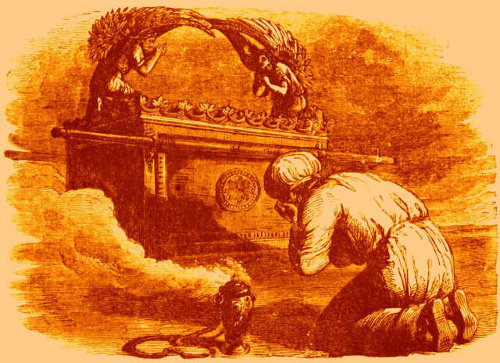
Kohen GadolAnother thing in class, and it’s come up before, is how teacher acts like we Gentile Christians were once “under the Law” (meaning Torah). He was talking about that part of Hebrews where we find Jesus entering the Heavenly Holy of Holies once and for all and presenting his own blood as the final atonement for sin. Teacher was saying what a relief that we (Christians) don’t have to go into the Temple once a year and kill an animal.

I did speak up on this one and said that we never had to do that. The Sinai Covenant doesn’t apply to us. We are grafted in under the blessings of the New Covenant which doesn’t require that we offer animal sacrifices for the atonement of our sins (and anyway, only the High Priest enters the Holy of Holies on Yom Kippur, not anyone else, least of all Gentiles).

A couple of times, someone mentioned how when Jesus died and the veil separating the Holy Place from the Holy of Holies was torn top to bottom (Matthew 27:51), that means all Christians can boldly approach the Throne of God without fear.

All the people perceived the thunder and the lightning flashes and the sound of the trumpet and the mountain smoking; and when the people saw it, they trembled and stood at a distance. Then they said to Moses, “Speak to us yourself and we will listen; but let not God speak to us, or we will die.” Moses said to the people, “Do not be afraid; for God has come in order to test you, and in order that the fear of Him may remain with you, so that you may not sin.” So the people stood at a distance, while Moses approached the thick cloud where God was.

Exodus 20:18-21 (NASB)

Apparently the torn veil means we Christians are better or better off than the ancient Israelites because we don’t have to be afraid of God the way they were.

For you have not come to a mountain that can be touched and to a blazing fire, and to darkness and gloom and whirlwind, and to the blast of a trumpet and the sound of words which sound was such that those who heard begged that no further word be spoken to them. For they could not bear the command, “If even a beast touches the mountain, it will be stoned.” And so terrible was the sight, that Moses said, “I am full of fear and trembling.” But you have come to Mount Zion and to the city of the living God, the heavenly Jerusalem, and to myriads of angels, to the general assembly and church of the firstborn who are enrolled in heaven, and to God, the Judge of all, and to the spirits of the righteous made perfect, and to Jesus, the mediator of a new covenant, and to the sprinkled blood, which speaks better than the blood of Abel.

Hebrews 12:18-24

At one point, I thought I’d successfully communicated that Christians often treat God too casually, as if He were a big, cosmic teddy bear. Several people seemed to agree but when it came right down to it, the teacher said that we can approach God, go up and touch Him, and crawl into His lap like He was our big, old, friendly grandfather. Oy.

And the whole point of the torn veil, which I’ll explain in more detail in Wednesday’s review of Lancaster’s sermon on The Holy Epistle to the Hebrews, is that it allowed Messiah as our High Priest to enter the Heavenly Holy of Holies with the blood he had just shed, not that it lets just any ol’ Christian into the Divine Presence in the most sacred place in the Heavenly Court.

To be fair, I just figured that out while listening to Lancaster’s recorded sermon last week, but it makes a terrific amount of sense now, especially with the realization that the New Covenant has been inaugurated but is yet to arrive in its fullness until the resurrection and the second coming of Messiah. We’re still living in Old Covenant times and until the resurrection and we are perfected, no, we can’t enter into the place where our High Priest is. Only he can go because only he has been resurrected.

On the other hand…

As I urged you upon my departure for Macedonia, remain on at Ephesus so that you may instruct certain men not to teach strange doctrines, nor to pay attention to myths and endless genealogies, which give rise to mere speculation rather than furthering the administration of God which is by faith. But the goal of our instruction is love from a pure heart and a good conscience and a sincere faith. For some men, straying from these things, have turned aside to fruitless discussion, wanting to be teachers of the Law, even though they do not understand either what they are saying or the matters about which they make confident assertions.

1 Timothy 1:3-7

The Torah at SinaiMaybe I’m pushing too hard and fretting too much over nothing. After all, they’re going to believe what they were taught. It’s a lot to expect that everyone should listen to my interpretation as if I’m always right or something. I’ve learned plenty in church and it’s their church, not mine. All I can and probably should do is put in my two cents worth and let it go at that. Fruitless discussion indeed.

I keep wanting to say that I disagree but I know it would take to long to explain why. And like I said, there really wouldn’t be much point in introducing one controversial interpretation after another.

Next week. Pastor will be going over Deuteronomy 1-5; 22-33 while Sunday school will be one week ahead of Pastor and will teach on Deuteronomy 9. Today, Pastor said that we can’t miss the next two weeks because he has to explain some points he brought up in today’s sermon. One of them was law vs. grace and he said it’s not as simple as there was once law and now there’s grace. I can’t wait to see how he treats this topic.

What I Learned in Church Today: Christians Approaching Sinai

In the third month after the sons of Israel had gone out of the land of Egypt, on that very day they came into the wilderness of Sinai. When they set out from Rephidim, they came to the wilderness of Sinai and camped in the wilderness; and there Israel camped in front of the mountain. Moses went up to God, and the Lord called to him from the mountain, saying, “Thus you shall say to the house of Jacob and tell the sons of Israel: ‘You yourselves have seen what I did to the Egyptians, and how I bore you on eagles’ wings, and brought you to Myself. Now then, if you will indeed obey My voice and keep My covenant, then you shall be My own possession among all the peoples, for all the earth is Mine; and you shall be to Me a kingdom of priests and a holy nation.’ These are the words that you shall speak to the sons of Israel.”

Exodus 19:1-6 (NASB)

I probably talked a little too much (or a lot too much) in Sunday school class today. I may have even gotten on a few nerves. It was difficult not to. The sermon was on Exodus 19:1-25 which is Pastor Randy’s introduction to a sermon series on the Ten Commandments and how they apply to the Church today.

Before even getting to the Ten Commandments, he’s going to spend separate sermons on Deuteronomy 5:1-5; 22-23, 1 Timothy 1:8-11, and Galatians 3:1-14. After that, he’ll spend one sermon on each of the Ten Words (Aseret ha-Dibrot).

I had the opportunity to speak with Pastor before service began. He knew I’d be particularly interested in these sermons and also knows the points where I’m likely to disagree. That’s OK since there are other areas where I do agree, one of which is that most Christians really need to hear more about “the Law” and how not only was it valuable in ancient days, but that it is valuable and relevant for not only present day Jews, but all modern believers in Jesus Christ.

I won’t spend a lot of time on his sermon, but he did reference a Christian children’s song that goes Every promise in the book is mine, every chapter, every verse, every line. Happily he said that these lyrics are not true and that the Bible must be studied carefully to determine which of the promises can be applied to the Gentile Christian. He also said “we (the Church) are not Israel,” to which I wholeheartedly agree.

I actually ran out of room on the sheet of paper given out before services to take notes on the sermon. What Randy explained was worth a lot of ink to preserve his thoughts. Pastor got into such detail that he ran out of time, only getting to verse nine out of twenty-five, so we’ll pick it up starting with verse ten next Sunday.

I told Randy that I didn’t feel sorry for him (in the sense that we don’t always see eye-to-eye) since he is a careful, honest, and thorough researcher and instructor. My Sunday school teacher on the other hand, I do feel sorry for.

I didn’t get a chance to talk with teacher before class began but given the topic and the fact that he knows my areas of emphasis, he should have expected my “active participation.” It didn’t help that not a lot of other people in class were speaking up much. Again, like last week, we had new people in class, so I also felt a little sorry for them since I’m not a typical Sunday school student.

In his notes, teacher quoted from one of Walt Kaiser’s books:

The “sign” given to Moses in Ex. 3:12 is fulfilled here: he has returned to the “mountain of God.” The presence of the “if” in Ex. 19:5 did not pave the way for Israel’s decline from grace into the law.

“Decline from grace into the law?” Since when did the two become mutually exclusive?

Torah at Sinai

I’m not sure that’s what Kaiser was saying and teacher did try hard to emphasize that the grace shown Abraham (Genesis 15) ran parallel to the giving of the Law at Sinai.

I tried hard to demonstrate the relationship between the Abrahamic, Mosaic (Sinai), and New Covenants bit by bit as I responded to questions in the teacher’s notes, but had to disagree with Pastor and teacher that all of the laws of the Torah constitute the Sinai Covenant. Actually, the Covenant is stated in just two verses:

Now then, if you will indeed obey My voice and keep My covenant, then you shall be My own possession among all the peoples, for all the earth is Mine; and you shall be to Me a kingdom of priests and a holy nation.’

Exodus 19:5-6 (NASB)

That’s the Covenant. The Torah, all of the commandments, statues, and ordinances, are the conditions of the Covenant, the things the Israelites agreed to obey to uphold their end of the Covenant.

But both Pastor and teacher introduced an interesting parallel:

But you are a chosen race, a royal priesthood, a holy nation, a people for his own possession, that you may proclaim the excellencies of him who called you out of darkness into his marvelous light. Once you were not a people, but now you are God’s people; once you had not received mercy, but now you have received mercy.

1 Peter 2:9-10 (NASB)

These are just about the same words we see in Exodus 19 where God describes who the Children of Israel are to Him in the Covenant, but Peter is addressing a non-Jewish audience. Pastor said that in the body of Christ, it is not the peoples but the people of God, singular. But since he also said that the Church is not Israel and recognizes Jews in the Church (presumably) as “Israel,” then there are distinctions, though I recognize more distinctiveness between believing Jews and Gentiles than he does.

And yet, it is the ekklesia (assembly) who are “chosen,” “a royal priesthood,” “a holy nation,” a possession” (Am Segulah — a treasured, splendorous people) according to Peter. Israel became a people and a nation before God at Sinai (and according to Jeremiah 31:35-37 they will never stop being a people before God) and when the people of the nations become disciples of the Jewish Messiah through faith, we too become “chosen” and “treasured” as grafted into the root.

Teacher filtered the Exodus 19 experience through Romans 7, 8, and Galatians 3. I used some of the information from my Reflections on Romans series to head off the idea that the Torah in any sense could be “bad” or cause sin. This was surprisingly acceptable to teacher but I have no idea what anyone else was thinking. Pastor Bill was in class, so if I’d said something too far out of line, you’d think he’d have brought it up.

Like I said last week, it’s like they’re shooting all round the target and are just short of a bullseye as far as “getting it” in regards to the continuation of the Torah in Jewish lives.

Teacher even mentioned Psalm 19 which is one of David’s strongest endorsements of the beauty of the Torah. And yet in past classes, teacher has also said how relieved he was that we Christians aren’t under the law, so some dissonance is happening somewhere.

I brought way more notes to class than I needed (or had time for), but one I did bring up, though I didn’t have time to quote it, is this:

“For this commandment that I command you today is not too hard for you, neither is it far off. It is not in heaven, that you should say, ‘Who will ascend to heaven for us and bring it to us, that we may hear it and do it?’ Neither is it beyond the sea, that you should say, ‘Who will go over the sea for us and bring it to us, that we may hear it and do it?’ But the word is very near you. It is in your mouth and in your heart, so that you can do it.

Deuteronomy 30:11-14 (NASB)

Obviously God expected that when Israel said “All that you have said we will do,” they would and actually could do it. The Torah is a delight. It always has been. Only human weakness and frailty make it difficult if not impossible for the Jewish people to be able to fulfill their vow before God. But while perfection in the performance of the mitzvot isn’t something that can reasonably be achieved, God’s plan of redemption through the New Covenant (Jeremiah 31, Ezekiel 36) will make it possible.

Since we people of the nations, through a portion of the Abrahamic Covenant (Abraham 12:1-3, Galatians 3:15-16) solve the mystery of the Gospel (Ephesians 3:1-13) on how Gentiles can receive New Covenant blessings and yet not be of the House of Judah and the House of Israel, we also benefit from that redemptive plan. But if not for Israel and God’s promises to her, there would be no hope for us.

I managed to get all that out in class but I don’t know if it made the impact I wanted it to. I think Pastor’s goal and mine for his sermon series are pretty much alike. I think we both want the people at church to see the Bible as one, big, unified book, and not a document that describes a “before” and “after” picture, or a bunch of different plans God had, trying out one after the other until he found one that would work.

Rolling the Torah ScrollPastor’s going to teach a class this Fall called “God’s Big Picture” where he presents the Bible as the single, overarching Word of God. I’d attend but I’ve spent over a year having almost weekly private conversations with him about these topics, so we both know where the other stands. I’d just serve as a speed bump to the other people who want to listen to Randy, but then again, maybe that’s what I’m doing in Sunday school, too.

I came away from class feeling pretty flat and regretting that I spoke up so much. I was still holding myself back but there was so much I felt needed to be said. I realized that when I was responding to questions, I wasn’t really answering them, but then, I think that was because I didn’t agree with how the teacher organized his entire lesson. His “vision” of how to teach the material and mine are more than a little different.

I guess I’ll have more than one shot at this, so next week when we delve into Deuteronomy, I’ll try again. Hopefully, God will help me become a more effective participant unless He doesn’t want me to speak up at all. But then again, what would be the point of going if I couldn’t participate because, and I’m sorry to put it this way, I believe I have a better handle on topics related to the Torah than my Sunday school teacher.

Yeah, that sounds incredibly arrogant, even to me. So much for the month of Elul.

Addendum: Monday, September 1st: If you read the comments below, you’ll see that several people pointed out my mistake regarding 1 Peter 2. The intended audience of the epistle is not a non-Jewish but rather a Jewish audience, thus we Gentile disciples of the Master cannot consider ourselves “a chosen race, a royal priesthood, a holy nation, a people for God’s own possession.” In retrospect, this actually strengthens my prior statements that the people of the nations called by our Master’s name cannot be Israel, since only they are referred to by the language from the Sinai Covenant.

What I Learned in Church Today: The “Lost” in the Church

When they had set a day for Paul, they came to him at his lodging in large numbers; and he was explaining to them by solemnly testifying about the kingdom of God and trying to persuade them concerning Jesus, from both the Law of Moses and from the Prophets, from morning until evening. Some were being persuaded by the things spoken, but others would not believe.

Acts 28:23-24 (NASB)

Today’s (as I write this) sermon and Sunday school lesson at church was on Acts 28:17-31, the end of the Book of the Acts of the Apostles. Pastor Randy has spent more than three years and given seventy-two sermons on the Book of Acts and next week, he launches into a sermon series on, no, not Romans, though I was looking forward to it, but on the Ten Commandments starting out in Exodus 19. That promises to be full of interesting information and my Sunday school teacher, who was not exactly thrilled with the idea initially, is going to have his hands full with me.

But I digress.

At one point early in his sermon, Pastor said that God keeps all His promises, including His promise to return the Jewish exiles to the Land of Israel, His promise to raise Israel as the head of the nations, and His promise to rebuild the Temple. Pastor said if we can’t trust God to keep His promises to the Jewish people, we can’t trust that He will keep His promises to us.

Brethren, my heart’s desire and my prayer to God for them is for their salvation. For I testify about them that they have a zeal for God, but not in accordance with knowledge. For not knowing about God’s righteousness and seeking to establish their own, they did not subject themselves to the righteousness of God. For Christ is the end of the law for righteousness to everyone who believes.

Romans 10:1-4 (NASB)

And then he said that the Jewish people chose to follow Rabbinic Judaism rather than the plain meaning of the Biblical text. Pastor had such a great start, too.

It would be difficult to convince most people at church that what we call Rabbinic Judaism (is there any other kind of religious Judaism?) today is an extension of Pharisaism and that the first century Jewish religious stream of “the Way” is simply Pharisaism with a “Messianic twist” and an unusually liberal policy about admitting Gentiles. It would be almost impossible to convince them that God may well have imbued the sages with the authority to make binding halachah for their communities, and thus that God continues to be involved positively with Jews practicing Judaism in the present age. I guess that’s yet to come.

One of the things that was driving me nuts, both in the sermon and in Sunday school, was the constant mention of Christianity. Christianity didn’t exist in Paul’s lifetime. It was a variant religious discipline within larger Judaism, just as was practiced by the Pharisees, Sadducees, Essenes, and the Qumran Community. They all shared a common core Judaism but outside of that, had widely differing beliefs and to a degree, practices.

In Pastor Randy’s notes, he had one of the three main themes of the Book of Acts as “the hostility of the world towards Christianity.” I rewrote it in my copy of the notes to say “hostility toward God” since “the world,” and by that I assume Pastor meant the pagan Greek and Roman world, wouldn’t have noticed a difference between “the Way” and any other form of Judaism.

One other good thing Pastor said was regarding the quote from Romans 10:4:

For Christ is the end of the law…

The word translated in English as “end” is the Greek word “telos” which Randy translated as “goal” or “purpose” and which can be expressed as “the reason for,” thus we could say:

“For Messiah is the purpose of the Torah for righteousness to everyone who believes.”

MessiahMessiah is the purpose for, the goal, the reason for the Torah, the target, the focus that gives Jewish observance of the mitzvot its clearest meaning as the conditions of obedience to the Sinai and New Covenant and the lived experience of Jewish devotion to God.

I know how I understand what all that means, but I wonder what Pastor understands since in our previous conversations, he seemed to indicate that the Torah was passing away in this “transitional period” of Jewish and “Christian” history and was soon to be extinguished?

I wonder what the people in the sanctuary were thinking as they listened to him? Nothing radical if Sunday school class, which studies the sermon material, is any indication. I suspect (hope) that Pastor’s sermon series on the Ten Commandments will expand on this topic, but here too, I know Pastor’s perspective. He believes that the Ten Commandments can be generally applied to Christianity but not the entire set of Torah commandments (which are organized into 613 commandments in modern Judaism based on the teachings of 12th century sage Rabbi Moshe ben Maimon, also known as Maimonides or the Rambam). Further, he believes the Torah commandments no longer are an obligation for the Jewish people, particularly Jewish believers in Christ.

However, I agreed with Pastor when in his sermon he said how we Gentiles are grafted into the root through the faith of Abraham, which connects nicely with how I see what bridges the gap between Gentiles and the New Covenant blessings.

And when they did not agree with one another, they began leaving after Paul had spoken one parting word, “The Holy Spirit rightly spoke through Isaiah the prophet to your fathers, saying,

‘Go to this people and say,
“You will keep on hearing, but will not understand;
And you will keep on seeing, but will not perceive;

For the heart of this people has become dull,
And with their ears they scarcely hear,
And they have closed their eyes;
Otherwise they might see with their eyes,
And hear with their ears,
And understand with their heart and return,
And I would heal them.”’

Therefore let it be known to you that this salvation of God has been sent to the Gentiles; they will also listen.”

Acts 28:25-28 (NASB)

We find after listening to Paul’s evidence from the Torah and the Prophets establishing Yeshua is Messiah, that some of the Jewish leaders in Rome were convinced and came to faith and others did not. Since they didn’t all agree, Paul quoted from Isaiah 6:9-10 which one person in Sunday school class pointed out was the statement God made to Isaiah after commissioning him as a prophet to Israel to bring them to repentance. Isaiah was to speak of repentance but God told him point-blank in advance that no one was going to listen.

So apparently it was the same in Paul’s day as well, except that some did repent. I wonder if some individual Jews repented in the days of Isaiah but that it was not enough to save the nation from God’s wrath?

But what does that say of the Jews in Paul’s day let alone in ours?

What then? What Israel is seeking, it has not obtained, but those who were chosen obtained it, and the rest were hardened; just as it is written,

“God gave them a spirit of stupor,
Eyes to see not and ears to hear not,
Down to this very day.”

And David says,
“Let their table become a snare and a trap,
And a stumbling block and a retribution to them.

“Let their eyes be darkened to see not,
And bend their backs forever.”

I say then, they did not stumble so as to fall, did they?

Romans 11:7-11 (NASB)

working handsThis seems to say that some Jewish people were chosen to accept Messiah but the rest were hardened against such acceptance quoting Deuteronomy 29:4; Isaiah 29:10, and Psalm 69:22,23

Verse 11 continues:

May it never be! But by their transgression salvation has come to the Gentiles, to make them jealous.

I won’t get into the whole “provoking jealousness” or “zealousness” thing right now since I’ve written about it before, but I want to compare two conditions:

Therefore let it be known to you that this salvation of God has been sent to the Gentiles; they will also listen.”

Acts 28:28 (NASB)

For I do not want you, brethren, to be uninformed of this mystery—so that you will not be wise in your own estimation—that a partial hardening has happened to Israel until the fullness of the Gentiles has come in; and so all Israel will be saved; just as it is written,

“The Deliverer will come from Zion,
He will remove ungodliness from Jacob.”

“This is My covenant with them,
When I take away their sins.”

Romans 11:25-27 [see Isaiah 59:20,21; 27:9 (see Septuagint); Jer. 31:33,34] (NASB)

So on the one hand, the Jewish people, most of them anyway, were temporarily hardened against coming to faith in Messiah, and on the other hand, a time will come when all Israel will be saved.

In Isaiah 6:10, God states that if Israel would turn (make Teshuvah), God would heal them, but I’ve read a paper by Dr. Mark D. Nanos titled ‘Callused,’ Not ‘Hardened’: Paul’s Revelation of Temporary Protection Until All Israel Can Be Healed (PDF) in which he states this “hardening” can be compared to calluses on the hands, which are a temporary protection after injury (I lift free weights regularly at a local gym so I know about calluses on my hands) and which can be softened and eventually healed.

Paul was pulling from Jeremiah 31 which famously contains some of the New Covenant language:

They will not teach again, each man his neighbor and each man his brother, saying, ‘Know the Lord,’ for they will all know Me, from the least of them to the greatest of them,” declares the Lord, “for I will forgive their iniquity, and their sin I will remember no more.”

Jeremiah 31:34 (NASB)

It all comes back to the New Covenant and how we can understand it applying to Israel and the nations.

And just for emphasis, lest anyone be mistaken:

Thus says the Lord,
Who gives the sun for light by day
And the fixed order of the moon and the stars for light by night,
Who stirs up the sea so that its waves roar;
The Lord of hosts is His name:

“If this fixed order departs
From before Me,” declares the Lord,
“Then the offspring of Israel also will cease
From being a nation before Me forever.”

Thus says the Lord,

“If the heavens above can be measured
And the foundations of the earth searched out below,
Then I will also cast off all the offspring of Israel
For all that they have done,” declares the Lord.

Jeremiah 31:35-37 (NASB)

Cutting through the metaphorical language, God is saying that one of the blessings of the New Covenant for Israel,  all the Jewish people, is that they will always be a people and a nation before Him and He will never cast them off or reject them.

It doesn’t get much plainer than that.

MitzvahIn his sermon, Pastor said that Acts 28:17-21 was just the latest in Paul’s declarations of innocence that he had said or done nothing against the Torah of Moses, the Jewish customs, and the Temple (See Acts 13, 22, and 23). In other words, he never, ever taught the Jews in the diaspora not to circumcise their sons and to not observe the mitzvot in the manner of the their fathers. Paul also kept the commandments in obedience to the Covenant Israel made with God, and in spite of what men like John MacArthur have said, there is no concrete evidence that this was some sort of “transitional period” in the Bible between Jewish observance of the Torah commandments and being “Law free”. We have every indication that Paul never saw any sort of change in a Jew’s duty to God based on the New Covenant, and a careful reading of all of the New Covenant language in the Prophets indicates that the conditions of the New Covenant are identical to the conditions of the Sinai Covenant, that is, the mitzvot of Moses.

One of the questions in the Sunday school teacher’s notes is:

How is God bringing His good out of the blindness of the Jewish nation? Has He forsaken them? Have you or I? (Rom. 11:1 & 25-29, Zech. 12:9-31:1)

I asked the teacher if he was talking about the Jews in Paul’s time or in ours and he said “ours”. My response was that I was aware of a number of Jewish people who had come to faith in Messiah within their own context.

I’m sure everyone in class missed the “within their own context” part or at least no one mentioned it or asked what I meant by that. What I meant by that, in case you can’t guess, is that I’m aware of Jews who are disciples of the Master who live fully realized Jewish lives, observant to the mitzvot and the customs of their fathers and zealous for the Torah of Moses, given its full meaning through faith in Moshiach.

“You see, brother, how many (tens of) thousands there are among the Jews of those who have believed, and they are all zealous for the Law…”

Acts 21:20 (NASB)

As it was then, may it be so now.

The message is so close and so nearly apparent to the Christians I study with at church that I still can’t believe people aren’t tripping over it, but somehow they still can’t quite see it. They still feel all this means that in the end, the Jewish remnant is going to convert to Christianity and that they will still be a Jewish people and national Israel (as such), but there will be no practice and lived experience of Judaism, the traditions, the mitzvot, the Torah as a continuation of a Jew’s duty and obligation to the God of their fathers and in obedience to the Sinai and New Covenants.

I try to steer the class a little bit closer to the realization of a continuation of lived Jewish experience among Jewish disciples of Messiah each week, but in order to put it right under their noses (so to speak), I’d have to hijack the class, and that’s not going to happen. More realistically, I’d have to teach a class, because the answer to all this can’t be properly expressed in response to the questions asked by another teacher in a lesson that is less than sixty minutes long.

Acts 28:23-25 describes a day-long “sermon” if you will, given by Paul to the leading Jewish people in Rome. He cites both the Torah and the Prophets to prove his case, convincingly enough to bring some to faith. What did he say? I don’t know, but in class, I said I wished Luke had written it all down, just as I wish he had written down all the Master said during that fateful journey on the road to Emmaus (Luke 24:13-35).

The answers are there if we just knew where to look and especially, if we knew how to interpret from the perspective of the Master, Paul, and their Jewish audiences. I said out loud in class (and there were a couple of guests visiting the church who were passing through from South Carolina on their way to California to see their kids, so it was kind of “cheeky” of me) that I study the Bible and Christianity through a Jewish (I didn’t say Messianic Jewish) lens because it’s impossible to understand Jesus without understanding the Old Testament from a Jewish perspective.

Abraham and the starsOf course, it’s more complicated than that, but basically, I’m trying to tell these folks that they can study the Bible using standard Christian theology and doctrine all day long and still hit a wall in their ability to learn and comprehend based on the limitations contained in Christian tradition.

I don’t know if they’ll ever have an “ah ha” moment when the light bulb goes off over their collective heads and they actually “get” what I’m saying. If they ever do, they’ll either become highly curious and want to know more or (and this is probably more likely), they’ll figure I’m a heretic, an apostate, or a cult member, and boot me out of the church.

Pastor Randy said that the mistake the Jews of Paul’s day made was to pursue Rabbinic Judaism and not the plain meaning of the Biblical text, but in reading Jeremiah 31, Ezekiel 36 and the other prophets who speak of the New Covenant, this is the plain meaning of the text!

The last question in the Sunday school teacher’s notes is:

Do you and I allow rejection to affect our ministry or love for others?

Pastor asked something similar at the end of his notes about how it is the responsibility of every believer to proclaim the Gospel and what are we actually doing about it?

What am I doing about it? Certainly, I’m blogging incessantly but that’s not enough since by and large, I’m reaching an audience that already has a conceptualization of the Bible similar to my own. One of the responses to his question the Pastor gave was to direct us to ask God to give us a “burden for the lost.”

But what about the “lost” in the Church? What about all those Christians in all those churches who read a truncated Gospel or worse, those who don’t read the Bible at all and just depend on their Pastor or their teachers to tell them what the Bible is saying? Even under the best of circumstances (and at the church I attend, the perspectives on the Bible, Jewish people, and Israel are pretty good), they still will get only part of the story. They’ll never understand why Paul went to the Jew first and only afterward to the Gentile. They’ll never understand that the Good News of Moshiach is even better news for Jewish Israel than it is for the Gentile nations. They’ll never get that the “better promises” (Hebrews 8) are better for Israel and that it is only through God’s redemptive plan for Israel that we people of the nations have any hope at all.

Paul said he was in chains in Rome for the “hope of Israel”. We are here because of that hope, too. But the Church will never know the full extent of what that hope means unless they open their eyes. To that degree, Isaiah 6:10 could have been talking about the “lost of the Church” as well as Israel.

Only by grasping the meaning of the New Covenant blessings for Israel and then what they mean to a grafted in Gentile humanity will our hearts become sensitive, our ears learn to hear, and our eyes begin to see, and when we return to the Jewish King, God will heal us too, after He heals His people Israel.

If you love something…

If you want something very, very badly, let it go free. If it comes back to you, it’s yours forever. If it doesn’t, it was never yours to begin with.

attributed to Jess Lair (1969)

I can identify with the sense of need for a coherent and authoritative model, especially in these times when so much controversy surrounds these issues. If I were in your shoes, I would be looking for a model, too. Or a congregation that is healthy and embodies the practices and values I believe in so strongly.(Good luck with that – I haven’t found one in my area, either.)

(BTW, over the years I”ve spoken to far to many Messianic Jews who feel disenfranchised in their own formerly Jewish congregations.So both Jew and Gentile are suffering.)

I don’t see any way around the truth that a Jewish community must be built and sustained by Jews.. (This is not an ideological statement: I’d say that same for any other type of community.space.) The catch-22 is that if that community welcomes Gentiles who are looking for Jewish space, it will end up experiencing the same loss of Jewish identity seen elsewhere in the Messianic movement.What do you have then? A community made up mostly of Gentiles who wanted to live in Jewish space.

I don’t see any bad people in this scenario, just some Jews and Gentiles who come face to face with demographic reality: most Jewish believers are in the Church and all it take is a minuscule percentage of Gentile believers to dramatically change the make-up of a Messianic Jewish congregation.

So at this point in time, I don’t see any viable way to build clearly Jewish Messianic communities (which I believe are essential to God’s purposes) that maintain an open door policy for all comers.

-Rabbi Dr. Carl Kinbar
from a blog comment on Morning Meditations

Especially given the dialogs happening on Part 1 and Part 2 of my review of J.K. McKee’s book One Law for All: From the Mosaic Texts to the Work of the Holy Spirit, Rabbi Kinbar’s comments re-opened a lot of old issues for me that I thought I’d settled.

I’ve gone on record advocating for the absolute necessity of Messianic Jewish community created by Jews and for Jews. But while such communities do exist in Israel, they are rare or even non-existent in the U.S. and other western nations. Even the most “Messianic Jewish” synagogue in the United States is still populated mostly by non-Jews.

I suspect that Dr. Mark Nanos would consider those Gentiles to be acting jewishly but not Jewish, however that is small consolation to people like R. Kinbar who greatly desires to daven in a minyan with other Jews like him in a setting that is both wholly Jewish and wholly Messianic.

Whenever I advocate for that position, someone usually “pushes back” and tells me that other streams of Judaism aren’t nearly so “threatened” by the presence of Gentiles, even self-professed “Messianics”. But in those other synagogues, no one ever questions whether or not it is a Jewish community. Identity issues are secure. For Messianic Jews, the long shadow of Jewish conversion to Christianity (voluntary and otherwise) and being ostracized from Jewish community and family life always looms like the spectre of death. The very presence of a majority (or perhaps even a minority) Gentile population in supposed Messianic Jewish space renders it, if not tumah, then at least much closer to Christian and that much farther away from anything truly Jewish.

I know a lot of (Gentile) people are going to complain because they see such a desire on the part of Messianic Jews as being “exclusive,” “cliquish,” and “exclusionary,” but then again, these critics are viewing the situation based on their own personal and corporate needs and wants rather than the needs of the Jews in community with Messiah.

I’ve always considered the song Me and Jesus to be kind of self-centered, but we Gentiles have been brought up in Christianity (at least in America) to think of our own needs first, rather than what we’d sacrifice for the sake of someone else, especially the needs of the Jewish people. It’s all about “me and Jesus.”

lost-in-the-fogOK, that was pretty unkind, but try for a few minutes to look at things from Carl’s point of view.

All that said, I admit that the first thing I felt in reading Carl’s words was a sense of loss and even a tinge of rejection, though that certainly wasn’t his intent. What anchors me in my church attendance and participation is my ability to communicate with the other side of the aisle, so to speak, to be able to access and consume Jewish and Messianic Jewish resources including relationships with Messianic Jewish (and Gentile) people. But that becomes more difficult if one of your personal ideals is not to interfere with Messianic Jewish community.

My response to Carl was this:

Well, in my particular case, I’m attending a small Baptist church and even if there were an appropriate (Messianic) Jewish congregation in my area that welcomed non-Jews, I would choose not to attend for personal (marital) reasons. Given my current situation, if for some reason, my relationships at church should fall apart, rather than going through the grisly task of “church shopping” all over again, I’d probably just bag it and do my own thing. The religious blogosphere is enough of a minefield without having to experience “live fire” from face-to-face interactions as well. God was gracious in directing me to a church that at least tolerates my “oddness” but I always feel like I’m on the edge of falling out of favor, even though I restrict my personal opinions most of the time.

I guess that means I don’t know how to build Messianic Jewish communities except to stay out of the way.

But staying out of the way sounds particularly lonely and even pathetic.

It also sounds like this query supposedly directed at J.K. McKee and recorded at Frequently Asked Questions: 1 Corinthians 7:17-24 (link courtesy of Kineti L’Tziyon):

I am a non-Jewish Messianic Believer, and have been told that my calling as a “Messianic Gentile” is to go back to a church, and not become Torah observant. I am told that I must follow “Paul’s rule,” and that seeking to live more like Yeshua and His Apostles would violate both it and my distinct “calling,” and likely nullify God’s special calling on the Jewish people. I should instead simply help Christians in church, not too interested in their Hebrew Roots, be more favorable to Israel and Jewish issues. Can you please help me?

This is the lead-in for a twenty page paper authored by McKee analyzing the 1 Corinthians 7:17-24 passage in a manner that differs from how it is apparently used by other theologians.

But if you look at R. Kinbar’s comments, my own angst when I feel the loss of relationships with the congregation of Jews in Messiah (or that little portion with whom I’m acquainted), and the cry for help from the supposed questioner at the top of McKee’s paper, there is a common theme: community.

Actually the theme is more “the community I want and need.”

I can’t speak for Carl and I can’t speak for the person posing the question in McKee’s paper, but I can speak for me. I couldn’t sleep the other night and allowed myself to turn the whole issue of community this way and that, upside down and inside out, and for me, the answer is so simple. Worse, it’s an answer I already know, so why was I complaining?

“One who romanticizes over Judaism and loses focus of the kingdom of Heaven can be compared to a carpenter who is infatuated with the hammer, rather than the house it was meant to build.”

-Troy Mitchell

“Don’t seek Christianity and don’t seek Judaism. Seek an encounter with God.”

-Tom

I found Pastor Jeff Weddle’s blog through one of The Onesimus Files blog posts.

Pastor Weddle opened his blog post with:

If a Holy Spirit indwelt person were stranded on a desert island with nothing but the Bible for ten years, would he come off that island with sound doctrine?

I believe he would.

Church tradition, although a helpful thing at times, is not necessary for sound doctrine.

waitThe gist of his message is all you need for sound doctrine and a relationship with God is the Holy Spirit and your Bible. I imagined myself on the stereotypical deserted tropical island you see in so many comic strips. It’s just a small piece of sand in the middle of a vast ocean. There’s only a single tree in the middle, but somehow I’ve got sufficient food and water and amazingly, a laptop and satellite link to the Internet.

Oh, I’ve also got the Holy Spirit and a Bible.

What would it be like to smash the laptop into a thousand pieces and to completely destroy the satellite link hardware, making it impossible for me to have contact with the rest of the world? It really would be me, the Holy Spirit, and the Bible.

That’s how I felt when Carl suggested effectively making sure Gentiles did not enter Messianic Jewish community space in order to preserve Messianic Jewish community space as Jewish. I felt cut off. I felt isolated. And in spite of what Rabbi Dr. Stuart Dauermann wrote recently, I really did feel “second class”.

It’s funny what your emotions can do to you in spite of your best efforts to maintain an internal balance.

If one of my highly esteemed ideals is to preserve Messianic Jewish community and my presence in said-community inhibits achieving that ideal, then logically my recourse is to remove myself from that community and have nothing to do with it. That doesn’t mean I can’t study on my own, and I suppose (hopefully) it doesn’t mean I can’t have Messianic Jewish friends (although I can understand when some Messianic Jews don’t want to have close association with me), but it does mean there are communities that I must not intrude upon for the sake of Hashem’s plan for His people Israel…

…even if that doesn’t make sense to you.

Some of us are so enamored with Judaism that we violate the principle spoken in the above quoted phrase uttered by Troy. And I’ve been guilty of violating Tom’s maxim:

“Don’t seek Christianity and don’t seek Judaism. Seek an encounter with God.”

What is my goal? To seek a type of faith community that serves my every need? Did God say this journey of faith was about serving my every need? Did He say it was about serving any of my needs at all?

Look at the life of the Apostle Paul. Did God first and foremost serve Paul’s needs and then Paul got around to serving God and his fellow human beings? Heck no! Paul almost died on numerous occasions and I don’t think anyone would characterize his life after becoming an emissary of Messiah as comfortable. If it were up to Paul, I imagine he’d have stayed in the synagogue studying with the other learned men, praying at the Temple with the other disciples, discussing matters of halachah with the sages, and living the life of an intelligent, contemplative Jew.

But God had other plans for Paul, none of which served Paul’s wants, needs, and desires.

So where do I come off whining that God isn’t serving my needs? God owes me nothing at all and my friends, He owes you nothing as well.

This isn’t to say that God is not gracious and compassionate. This isn’t to say that God does not meet our needs and even our wants. It is to say that He doesn’t have to, and even when He does, He doesn’t have to meet us on our own terms.

“When you are invited by someone to a wedding feast, do not take the place of honor, for someone more distinguished than you may have been invited by him, and he who invited you both will come and say to you, ‘Give your place to this man,’ and then in disgrace you proceed to occupy the last place. But when you are invited, go and recline at the last place, so that when the one who has invited you comes, he may say to you, ‘Friend, move up higher’; then you will have honor in the sight of all who are at the table with you. For everyone who exalts himself will be humbled, and he who humbles himself will be exalted.”

Luke 14:8-11 (NASB)

It’s funny when people like me start complaining about our wants, our needs, and even our rights, we don’t quote from this passage of scripture. I wonder how Mr. McKee would analyze it in light of the person who was questioning him about where he should or wants to have community.

Where do we encounter God, only in places where we feel comfortable? Do we only encounter God when our needs are met? Does God only meet with us when we are allowed to worship whenever we want, wherever we want, and however we want? Does that sound even remotely Biblical or even sane?

encounterWithout a computer and an Internet connection on my mythical deserted island, I would still have food, water, my Bible, and God. Nothing prevents my encounter with God at all and in fact sometimes it’s the Internet that I let get in the way.

Because that’s the goal…to encounter God. He is our greatest need and He should be our greatest want, regardless of our circumstances. Sure, it’s good when we have community with others like us and people we can learn from, and I think community is important, but God places us where He wills. Even Jesus facing the hideous death on the cross in just a few hours, after begging God to take that cup from him said, “Not my will but by yours,” (Luke 22:42).

Who am I to fail to follow my Master’s voice? Not by my will, but yours be done, Father.

If you want something very, very badly, let it go free. If it comes back to you, it’s yours forever. If it doesn’t, it was never yours to begin with.

Thanks Carl for reminding me of something I should already know so well. May God open His hand and satisfy your every desire as He does all living things.

I can do all things through Him who strengthens me.

Philippians 4:13 (NASB)

For if you remain silent at this time, relief and deliverance will arise for the Jews from another place and you and your father’s house will perish. And who knows whether you have not attained royalty for such a time as this?”

Esther 4:14 (NASB)

Addendum: This commentary continues in What Brings Us Near to the Kingdom of God.

What I Learned In Church Today: The Devil Made Me Do It

I know the title is pretty inflammatory and I’m deliberately exaggerating this part of what was taught in Sunday school today because it’s one of those things about the Church that really bugs me.

Here’s what started it all off:

Give some ways Satan supplies us with reasons and circumstances to justify ignoring God’s counsel?

-from Sunday School class notes
for August 10th

The context of this teaching is Pastor Randy’s sermon on Acts 27:13-44 and particularly the circumstances leading up to the fateful shipwreck of Paul and his traveling companions on the island of Malta. Dean, the Sunday school teacher, is focusing on Acts 27:13-15 and the moment when everyone on board ship realized that they should have listened to Paul’s advice and not tried to push on from Fair Haven to Phoenix (Crete).

Coincidentally (or not), on Saturday I was reading Ismar Schorsch’s commentary on Torah Portion Vaethanan from his book Canon Without Closure: Torah Commentaries called “The Locus of Evil in Judaism.”

Schorsch wrote his small article in July 1996 and recorded two tragic events that had recently happened. The first one is:

On the first anniversary of the bomb blast that erased 168 lives in the Federal Building in Oklahoma City on April 19, 1995, the New York Times ran a front-page photograph of Jannie Coverdale, who had lost two grandsons. She posed between twin beds, each covered with stuffed animals, holding a portrait picture of each boy toward the camera. Beneath the photograph, the Times quoted her as saying: “A year ago this week, Satan drove up Fifth Street in a Ryder truck. He blew my babies up. He may have looked like a normal man, but he was Satan.”

-Schorsch, pg 592

And the second one is:

When Susan Smith in South Carolina sent her two small boys to their watery death strapped into the child safety seats inside her Mazda, her minister, Reverend Mark Long, speculated that she was witness to two presentations that night: “God made her a presentation and Satan made her a beautiful presentation.” After weighing them in her distraught mind, she opted for Satan’s.

-ibid

I don’t know about you, but when I read this, the “red alert” alarm started going off in the back of my head, but maybe not for the reason you think.

In moments of numbness, I envy the clarity and conviction of these statements. The explicit dualism seems able to account for the ubiquity of evil, that tragic aspect of human experience that defies comprehension — as in the words of the young Augustine before his conversion, “I sought whence evil comes and there was no solution.”

-ibid

I was caught somewhat off guard in Schorsch’s apparent agreement with such Christian sentiments, however understandable they may be, but then he added:

Yet this view is also thoroughly un-Jewish.

Christianity and Judaism have fundamentally different perspectives on the nature of the origin of good and evil, and Judaism does not embrace what Christians call “Original Sin” or “the Fall” in any aspect. I won’t try to present a detailed analysis here, but I do want to offer the part of Schorsch’s commentary I presented in class:

The Torah never speaks of Satan, for that would compromise its austere monotheism as affirmed by the Shema, but only of a heart that is hardened or uncircumcised. The culprit lies within.

-ibid, pg 594

The class became momentarily confused after I stopped talking but quickly reoriented around Dean’s original question and started describing all the bad things Satan has done to them. I even added the following for good measure but it didn’t help:

But each one is tempted when he is carried away and enticed by his own lust. Then when lust has conceived, it gives birth to sin; and when sin is accomplished, it brings forth death.

James 1:14-15 (NASB)

Eve and the SerpentWhile other parts of the Apostolic Scriptures refer to the Adversary, here James (Jacob), the brother of the Master says “when he is carried away and enticed by his own lust, not by Satan or some evil external force that enticed him.

This was the only item in the Sunday school notes I intended on addressing and seeing how my point fell flat on its face, I decided to remain silent for the rest of the class time. But when discussing Acts 27:27-32, one of the questions was:

What proper role do our efforts play in God’s will for us?

Fortunately, people were able to articulate that we actually do have a role, we have things to do, we have stuff we must achieve, even though God doesn’t need our help. We are responsible.

That’s what I was trying to say. One of the fellows in class referred back to my comment when discussing “our efforts” and I was grateful. Someone got it.

It’s just that the Adversary gets a lot of credit, too much in my opinion, when things foul up in the life of a Christian.

I know this is a ridiculous example, but it appeared in my local newspaper and I think deserves a mention:

Last December, Alexander Gonzalez Garcia blamed Satan for causing him to molest a 12-year-old girl in a storage room at the Nampa Seventh-Day Adventist Church where he served as a deacon.

from “With church response: Ex-deacon in Nampa sentenced to prison for molesting girl”
The Idaho Statesman

No, I don’t think anyone at the church I attend would fail to hold this person responsible for his acts of sexual abuse and go directly to Satan, but I don’t doubt they’d see Satan as involved.

But whatever happened to personal responsibility? Whatever happened to being accountable for your own sins. Whether you are tempted by an evil supernatural entity or your own human character flaws are getting in the way, the result is the same. You have a choice to make. You either choose God’s will or your will.

Pastor Bill was in Sunday school class and when I mentioned looking at the guy in the mirror rather than pointing the finger at Satan when life turns to doggie doo, he looked momentarily startled and said we had three enemies: Satan, the world, and our sin nature. I popped right back that it was our own nature that’s our first and worst enemy. I think he nodded “yes,” but I’m not sure. Christianity pays a lot of attention to an entity we’re supposed to stay as far away from as possible. Maybe we’re giving him more credit (and along with it, more “glory”) than we ought to.

Instead of focusing on the author of evil in our lives, how about we cleave to the author of all that is good.

Blessed is a man who perseveres under trial; for once he has been approved, he will receive the crown of life which the Lord has promised to those who love Him.

James 1:12 (NASB)

Hear, O Israel! The Lord is our God, the Lord alone. You shall love the Lord your God with all your heart and with all your soul and with all your might. Take to heart these instructions with which I charge you this day.

Deuteronomy 6:4-6 (JPS Tanakh)

…but also the appearance of the Shema in this week’s parashah. I wish to draw your attention to but a single phrase — al levav’kha, “upon your heart” — at the end of verse 7 in chapter 6.

The function of the verse is to speak of the heart as the locus of our unbounded love for God. More concretely, we are instructed to articulate that love by embracing God’s commandments. Our lifelong challenge is to internalize a set of beliefs, values, and actions that is not self-generated, to take what feels alien and unnatural for us and make it our own. The words “upon your heart” identify the scene of battle. It is within the hidden confines of the human heart that our impulses frustrate our ideals. The blood-stained pages of history are but a mirror of our conflicted hearts. To quote Jeremiah, “Most devious is the heart; it is perverse — who can fathom it?” (Jeremiah 17:9)

-Schorsch, pg 593

I regret that it is not appropriate for me to recite the Shema daily or even on Shabbat because Schorch is describing a human battle, not just a Jewish battle. But God has promised the House of Judah and the House of Israel that one day it will be possible for them to win that battle.

“But this is the covenant which I will make with the house of Israel after those days,” declares the Lord, “I will put My law within them and on their heart I will write it; and I will be their God, and they shall be My people.

Jeremiah 31:33 (NASB)

heart in the sandThrough a rather long and not easily understood process, I have learned that the New Covenant God will make with Israel, that is, the Jewish people, will also apply its blessings to the people of the nations who cleave to the God of Israel through faith in the Messiah who Paul called “rich root of the olive tree.” (Romans 11:17)

I look forward to that day when my heart will be circumcised and His Word will be written on it. I grow so very tired of having to deal with myself every day as the person I am. The battle is hard, and it’s been going on far too long, and I only have myself to blame.