Gather together and I will tell you what will befall you at the end of days.
–Genesis 49:1
Prior to his death, the Patriarch Jacob wished to disclose to his children the future of the Jewish nation. We know only too well what those prophecies were, and Jacob knew that revealing the enormous suffering that the Jews were destined to experience would be devastating to his children. The only way they could hear these things was if they “gathered together” and, by virtue of their unity, could share their strengths.
What was true for our ancestors holds true for us. Our strength and our ability to withstand the repeated onslaughts that mark our history lie in our joining together.
Jacob knew this lesson well. The Torah tells us that “Jacob remained alone, and a man wrestled with him” (Genesis 32:25). Jacob discovered that he was vulnerable only when he remained alone.
-Rabbi Abraham J. Twerski
from the “Growing Each Day” column Aish.com
Someone recently commented in one of my blog posts wondering why I said that “Messianic Gentiles” had no active spiritual life.
I replied that it wasn’t that we didn’t have an active spiritual life, but that our praxis is ill-defined when in relation to Jewish community.
I’d actually read Rabbi Twerski’s commentary before the blog comment, but once I read and responded to the comment, my thoughts turned back to R. Twerski’s statements about Jewish community. Here’s some more about what he said from the same source (see the link above):
Some people feel that they must be completely independent. They see reliance on someone else, be it others or God, as an indication of weakness. This destructive pride emanates from an unhealthy ego. In my book Let Us Make Man (CIS 1987), I address the apparent paradox that a humble person is one who is actually aware of his strengths, and that feelings of inadequacy give rise to egocentricity and false pride.
Not only are we all mutually interdependent, the Torah further states that when we join together, our strengths are not only additive, but increase exponentially (Rashi, Leviticus 26:8). Together, we can overcome formidable challenges.
Of course, R. Twerski is writing to Jews about Jews, but I don’t think it’s much of a stretch to say that the principles he is highlighting apply to the rest of us as well.
However, the “rest of us,” or at least that subset who identify as “Messianic Gentiles,” “Talmidei Yeshua,” or something similar, are really only who we are in relation to (Messianic) Jewish community, or at least (Messianic) Jewish religious thought and teaching. Otherwise, who are we?
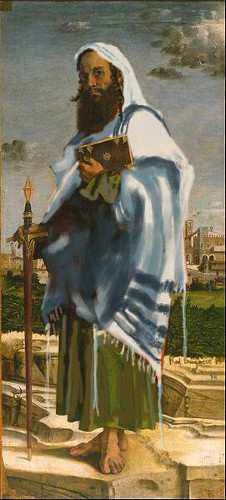
We are non-Jews who have chosen to understand and explore our faith by returning said-faith back (as best we can) to its original Jewish context rather than accept the Christian refactoring of the teachings of Rav Yeshua (Jesus) and his emissary to the Gentiles, Rav Shaul (the Apostle Paul), or for that matter, just about anything else in the Bible.
Granted, some writers and teachers within the Messianic Jewish religious and educational space are non-Jews, and they are very helpful in assisting us in understanding ourselves. However, by definition, we Gentiles cannot set aside the “Jewishness” of the context that defines us (although that definition isn’t clearly understood). That context is a large portion of who we are.
And that’s part of the problem.
Another part is that because we are so few in number, it’s pretty hard for a bunch of us to get together and “hobnob,” at least on a regular basis.
Every other Sunday afternoon, I get together with a friend of mine for several hours of coffee and conversation, however not everything we talk about has to specifically do with our common understanding of our faith and praxis.
Yet another part of the “community” difficulty is that although we all may share certain things in common, we are also divided by what we don’t have in common. I’ve probably met or at least know of most or all of the “Messianic Gentiles” in the greater southwestern Idaho area, and in the past, I would meet with a few of them periodically, but we weren’t and aren’t the same, and that lack of “sameness” (and sometimes a radical “differentness”) makes our “community” highly fragmented.
While Rabbi Twerski can reasonably expect to regularly gather with a large or at least significant number of Jews to worship with, study with, and to be in community with (not just religious community, but social, cultural, and national community), the same cannot be said of “Messianic Gentiles”.
It’s one of the things we have in common with Noahides, since there aren’t to many of them around either, and even if they can gather in community with other “righteous Gentiles,” they don’t always live near a significant number of Jews.
I’ve been reminded that Messianic Jews have the same problem, often swimming in a vast sea of secular and religious Gentiles, but without another Jew in sight.
One day, we will all find unity and “ekkelsia” in the Messianic Kingdom, but that day has yet to arrive.
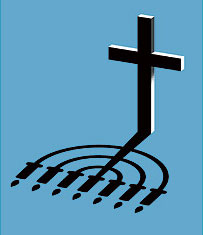
Until then, we must focus on the hub that unites us all through the spokes of the wheel, so to speak, that is, Rav Yeshua. If we have no immediate community, although geographically (and often theologically) apart, we are spiritually united. Although our traditions and doctrine may not always line up with each other, the Messiah has one mind and one heart and after all, God is One.
We may not always see Him or each other in the same way, but He is One and when our Rav returns, our King will correct all of our misunderstandings about Messiah, God, ourselves, and each other.
Faith and trust means being patient, even in isolation, and holding onto the fact that this current world is not forever. The Bible states that all the Jewish people will be returned to their Land, national Israel. It’s one of the tasks of Messiah, and one in which the people of the nations will take part.
Those Jews who find themselves apart from their people and their Land will have unity as the covenant people of Hashem.
We Gentiles, though we live in many different lands and in Messianic Days we will continue to live in our nations, will have one King and one God, and we will also be brought to a place of unity and peace.
Rabbi Twerski ended his column by stating:
Today I shall…
…try to join with others in strengthening Judaism and in resisting those forces that threaten spirituality.
We should try to do the same thing in relation to our faith in God and in trusting our Rav, and if we can’t join with others in this mission, then at least we can do this within ourselves.
We are vulnerable when alone, but if we don’t have a body with which we can join, then as long as we turn to God, we can never be alone, and in Spirit, we are also with each other.
It is imperative that every Jew know that he is an emissary of the Master of all, charged with the mission – wherever he may be of bringing into reality G‑d’s will and intention in creating the universe, namely, to illuminate the world with the light of Torah and avoda. This is done through performing practical mitzvot and implanting in oneself fine character traits.
Hayom Yom: 7 Adar I
Compiled by the Lubavitcher Rebbe; free translation by Yitschak Meir Kagan Chabad.org
According to the great medieval Jewish philosopher and legal authority Moses Maimonides, teaching non-Jews to follow the Noahide laws is incumbent on all Jews, a commandment in and of itself. However, most rabbinic authorities rejected Maimonides’ view, and the dominant halakhic (Jewish law) attitude had been that Jews are not required to spread Noahide teachings to non-Jews.
This blog post was born out of my reading of another “My Jewish Learning” article called The Do’s and Don’ts of Talking to Converts written by Aliza Hausman. I started thinking that if there are “guidelines” for born Jews relating to “Jews by choice,” maybe there are also “guidelines” for Jews relating to Noahides (how that relates to my primary audience will become apparent, so keep reading).
The only reason I’m pursuing this is that there could be some application to the body of (Messianic) Jews relating to (Messianic) Gentiles within their midst.
I put “Messianic” in brackets in the paragraph above because I think the matter has more to do with Jewish and Gentile relationships in general than the peculiarities of that relationship within a Messianic context.
But before I get to that, I want to quote from the Hausman article. Oh, but before even that…
Aliza Hausman is a Latina Orthodox Jewish convert, freelance writer, blogger and educator. Currently working on a memoir, she lives in New York with her husband.
Now to the quote:
There are things I still can’t believe people have said to me. Fresh out of the mikvah, I heard, “But you’re not really Jewish. I mean I’m still more Jewish than you, right?” Oy vey. In the end, all converts want to be accepted as good Jews. We want to fit in. Possibly the reason Jewish tradition goes out of its way to tell you to be kind to us is that there are so many ways you can make us feel left out.
If a non-Jew converts to Judaism, one mechanism to helping them “fit in” is for them to follow Jewish halachah, just like the other Jews in their community. But for Gentiles in Jewish community, it isn’t that simple…
…or is it?
Meet Jim Long. A documentary filmmaker with striking blue eyes, Long recites blessings in Hebrew before eating, peppers his conversation with Hebrew phrases–a “b’ezrat Hashem” (with God’s help) here, a “baruch Hashem” (praise God) there–and keeps a household that is, to the untrained eye, traditionally Orthodox. Only Long is not actually Jewish, nor does he have any plans to convert.
Oh, there’s more:
To Noahides, these seven laws are but a starting point, the foundation on which they’ve built a lifestyle of obligations and voluntary observances. The result is a life every bit as rigorous and all-encompassing as Orthodox Judaism, which guides and structures all aspects of their existence. While others drawn so intensely to Judaism would likely convert, these non-Jews have chosen to remain outside the fold, believing that life as a Noahide is an end in itself, a way to be partners–if not quite equals to the Chosen People–in the divine plan for the world.
Did you catch the key phrase? Let me quote it again.
…these seven laws are but a starting point, the foundation on which they’ve built a lifestyle of obligations and voluntary observances. The result is a life every bit as rigorous and all-encompassing as Orthodox Judaism, which guides and structures all aspects of their existence.
That sounds like it’s saying that it can be acceptable within Jewish community for Noahides to go above and beyond the seven Noahide laws and voluntarily add various observances to their day-to-day existence, resulting in “a life every bit as rigorous and all-encompassing as Orthodox Judaism.”
That’s saying quite a bit, and I don’t think a lot of Jews within Messianic Judaism would feel comfortable if their non-Jewish counterparts started living a life “as rigorous and all-encompassing as” an Orthodox Jew.
Kress echoes other articles I’ve referenced saying that many or most Noahides come from Christianity. He also mentioned that the Rebbe, Rabbi Menachem Mendel Schneerson, believed it was incumbent upon every Jew to spread the word about the seven Noahide laws or “Sheva Mitzvot” to the non-Jewish world. He thought what would hasten the coming of Messiah was having both Jews and non-Jews doing God’s will.
He may have been alone in that thought as it remains controversial and, to the best of my knowledge, most branches of Judaism adhere to the halachah that Jews have no such obligation to non-Jews.
Of course, that hasn’t stopped the small but growing population of Noahides, but there is one glaring problem:
Despite the passion of committed Noahides, embracing seven laws of basic morality does not a lifestyle make. In some key ways, the Noahide movement is defined more by what it’s not than what it is: Not Jewish, not Christian, without a central organization, and with no clear consensus even on what the faith entails. Even the laws themselves–six out of the seven–are prohibitions. There’s little or no active spiritual life, no prescribed ritual and liturgical life for Noahides. There is, to borrow a phrase, “no there there.”
For many committed Noahides, that’s the biggest challenge the movement faces. Once they’ve given up their prior religious lives, immersed themselves in Jewish learning, perhaps even succeeded in hooking up with a local Jewish community, many Noahides speak of a lingering hole, the lack of an active and defined spiritual and ritual life.
This is exactly my point.
This is exactly the point for any “Messianic Gentile” or “Talmid Yeshua”. Like the Noahide, we do not have a lifestyle that is inherent to our faith. Like the Noahide, we’re not Jewish but we also aren’t traditionally Christian either, though we retain our devotion to Rav Yeshua (Jesus).
Like the Noahide, we have “little or no active spiritual life, no prescribed ritual and liturgical life,” unless we borrow it from Jewish praxis, but that comes with a lot of trap doors.
This is probably why so many in the Hebrew Roots movement are adamant that they are “obligated” to the 613 mitzvot of the Jewish people. They desperately want something that defines them relative to their faith, and they see those of us who believe the “one Law fits all” view is Biblically unsustainable as at least being in error if not actually hostile to the Torah.
I don’t think this is a new problem. In the Nanos and Zetterholm volume Paul within Judaism: Restoring the First-Century Context to the Apostle, one or more of the articles it contains stated that the late First Century CE non-Jewish disciples of Rav Yeshua likely suffered from a similar lack of definition.
If that’s correct, then one of the possible motivations for later groups of these ancient non-Jewish Yeshua disciples to split from the Yeshua-believing Jewish movement and manufacture the brand new Gentile-driven religion of Christianity, was the strong desire to be defined by their faith. They had no place in Judaism, so they created a place in a different religion.
Unfortunately, this was maladaptive and ended up being a total disaster as far as Jewish/Gentile relations are concerned. Worse, the Gentiles kicked the Jews out of their own party, so to speak, by radically redefining the Jewish Messiah as the Gentile Christian Savior, and astonishingly requiring Jews to stop being Jewish in order to become devotees of their own King.
Returning to the present, how do modern Noahides solve this dilemma? I quoted part of the answer above.
To fill the void–to transform this notion of Noahide law from a formless set of vague moral guidelines to a spiritually fulfilling lifestyle–Noahides have taken on themselves a host of what are known as “positive commandments,” the rituals and religious activities that infuse traditional Jews’ lives with structure, meaning, and spiritual foundation. These are not an inherent part of the Seven Mitzvot, but rather are voluntary observances to give their lives added spiritual meaning.
As a result, a committed Noahide lives a life of intense study of Jewish texts, not only on the Seven Laws themselves but also on all other aspects of a Jewish lifestyle, to discern which rituals a non-Jew may and may not perform. Theirs also is a life of prayer, which usually includes reading Psalms, composing original prayers, and reciting traditional Jewish liturgy, altered to remove or adapt all mentions of commandedness and chosenness, to make clear that it is only Jews, and not the Noahides, to whom those concepts apply.
They do just what has been suggested. They borrow from Jewish praxis, adapting ritual and custom for their own needs. There are two basic differences involved however. The first is that the practice is adapted from Jewish praxis rather than mirroring it identically. The second is the acknowledgment that said-observance is voluntary rather than obligatory.
Some hang a mezuzah on their doors, others don’t feel it’s appropriate. Ditto with tzitzit, the fringed undergarment worn by traditionally observant men. Shabbat looms large in the life of any traditional Jew, but all Noahides agree that they should not observe the Sabbath in the same strict way as Jews.
Since “observance” is voluntary, it makes sense that there would be variability of practice from one Noahide family to the next. Some might “keep” a form of Shabbos while others don’t. The same thing for mezuzah.
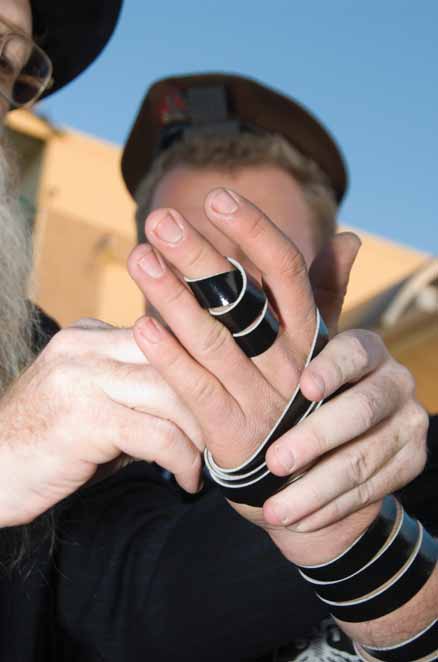
I was more than surprised to find a mention of tzitzit since I was unaware that any Noahide would elect to don a tallit katan.
I can see why some groups of Messianic Gentiles draw a comparison between themselves and Noahides. Not only are our struggles remarkably similar, but Noahides seem to have a leg up on how to successfully address said-struggles:
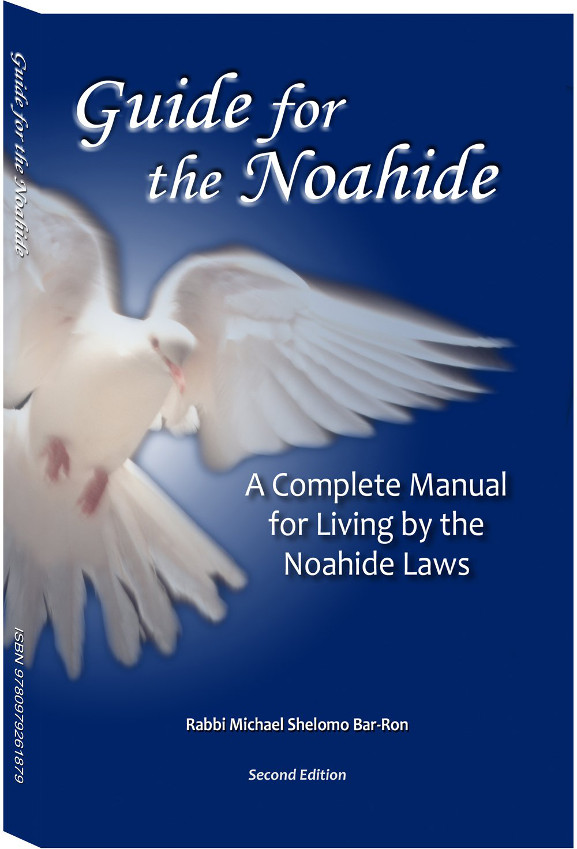
Many people are working to give structure and clarity to Noahide life. In other words, to give the movement its “there.” Chabad and other rabbis, together with Noahides, are creating a Noahide siddur (prayer book) to standardize prayers, and a liturgy of lifecycle rituals, such as funerals and baby-naming ceremonies. Also in the works is a Noahide Shulhan Arukh, a comprehensive book of law pertaining to non-Jews, which will spell out specifically how Noahides should live, which mitzvot are acceptable for them, and which aren’t. There are also numerous Noahide organizations popping up, aimed at uniting Noahides, providing support, and spreading their teachings.
I couldn’t help but notice that one such project to develop a Noahide Shulchan Aruch didn’t do so well. Perhaps Chabad will be more successful.
We Messianic Gentiles, Talmidei Yeshua, or whatever you want to call us, could probably use the same siddurim and other supportive materials utilized by Noahides, with some adaptation to include our faith in Rav Yeshua who will return as King Messiah, but there’s something missing. I’ll pull it out of the paragraph I just quoted above:
There are also numerous Noahide organizations popping up, aimed at uniting Noahides, providing support, and spreading their teachings.
For Messianic Gentiles, not so much. They/we are too fragmented, our theology, doctrine, and praxis are too variable. Unlike Noahides who, at least in an ideal sense, have Chabad as a Jewish authority upon which to depend, Messianic Gentiles have no central Jewish organization that can help to unite us under a single standard collection of resources.
I suppose this could be a good reason why some Messianic Gentiles leave their faith and either join the ranks of Noahides or convert to Judaism.
Frankly, although people are free to make their own decisions, I don’t think either option is advisable and certainly not necessary. Neither is co-opting the Torah for Gentile use without so much as a by your leave to the Jewish people.
…the Jewish vision for the idealized, messianic future does not call for a world full of Jewish converts…
There are numerous mentions in both the Tanakh and Apostolic Scriptures saying the Messianic future will contain both Israel, that is, the Jewish people within their nation, and the people of the nations of the world, that is, the rest of us.
For prophesy to be fulfilled, there has to be “the rest of us,” there has to be a body of non-Jews who worship Hashem, the God of Israel, and who are devoted to Rav Yeshua as the coming King.
It’s incredibly easy for non-Jews to get lost in the world of Judaism and mistake it for the focus of our faith. I periodically quote my friend Tom who said, Don’t seek Christianity and Don’t seek Judaism, but rather, seek an encounter with the living God.” Although ritual and custom help to define our lifestyle as Talmidei Yeshua, they are just the means by which we practice our faith, they are not the target. God is.
But like converts to Judaism and like Noahides, we just want to fit in and be accepted by our “parent” Jewish community (those of you who have one). However, the way to do that isn’t clearly understood, either by Jews or non-Jews in Messiah-faith. That means there is no one defined reality for our lived experience, at least in the realm of ritual and tradition.
I have a question that has bothered me/intrigued me for years. What was Jesus’ true name? What was the name his mother called him? His disciples? The name that he told them that you can do all things “in my name.” I thought ya’ll may have something in your archives that would point to an answer.
I was a little surprised to read such an article at My Jewish Learning, but I guess I shouldn’t be, since the “About Us” page for this site states:
MyJewishLearning.com is the leading transdenominational website of Jewish information and education. Offering articles and resources on all aspects of Judaism and Jewish life, the site is geared toward adults of all ages and backgrounds, from the casual reader looking for interesting insights, to non-Jews searching for a better understanding of Jewish culture, to experienced learners wishing to delve deeper into specific topic areas.
The word “transdenominational” suggests a somewhat more liberal perspective relative to Judaism and perhaps other religious streams. But it wasn’t just that Rabbi Bregman considered the question, but the answer she gave that interested me. Here’s part of it:
This is from a real email I received.
I am a rabbi in a small city on the coast of Georgia; as the only rabbi in a 75-or-so-mile radius, I get many emails and phone calls with all kinds of questions from folks in the Christian community. This one is a favorite for several reasons.
First of all, there is a place where Judaism and Christianity intersect, and that place is Jesus. I love how the writer is looking to me, the local go-to expert on all things Jewish, to help him navigate that intersection. For his sake and for ours, I wish there was an archive of Jewish stuff , where we could look there to not only help our Christian, Muslim and other-faith friends understand their religions better but to also gain deep insight into our own. I mean, a great way to understand the tensions around Jewish religious practice at the time of the Second Temple is to read the Gospels.
By the way, Bregman never gets around to attaching a Hebrew name to Jesus, but she did end her brief blog post with this:
I don’t know any other names for Jesus, or for Allah or Buddha or Brahman, or for God. But what I learned from this man’s email is that many of us are seeking that name, and by sharing the search with one another we enhance the journey for us all.
Rachael Bregman – Photo: jacksonville.com
I think what I was impressed with the most was that Bregman seemed completely unthreatened by the question and didn’t mind taking a stab at the answer that wasn’t in some way dismissive of the Christian questioner. Even in my own home, bringing up certain subjects with my Jewish wife (the Apostle Paul being one of them) is likely to be met with a rather icy response.
So I decided to find out what I could about Bregman.
Rachael Bregman knows she doesn’t fit most people’s concepts of a rabbi, at least as seen on TV.
“They’re always old men with earlocks. They’re called peyas,’’ she said of the strands of uncut hair in front of the ears. “That’s spelled p-e-y-a-s … maybe. I know how to spell it in Hebrew.”
Bregman is a 36-year-old divorcee who left Atlanta three weeks ago with her rambunctious 8-month-old dog Safi, a pit bull-ridgeback-Lab mix, at least those are the breeds Bregman thinks she has identified.
Bregman knows big-city life, having grown up in Boston and lived in Atlanta, but she was drawn to Brunswick by the size of Temple Beth Tefilloh, a Union of Reform Judaism congregation chartered 127 years ago.
-Terry Dickson, July 24, 2013
“Woman is Temple Beth Tefilloh’s first rabbi in 50 years” jacksonville.com
She also has a Facebook page that’s pretty accessible as long as you’re logged in to Facebook.
I know some people, both Jewish and otherwise, who have issues with female Rabbis (or with female authority in general), Reform Judaism, and liberal political and social viewpoints, but at least she seems approachable, even if asking a Rabbi about Jesus’s name might be somewhat awkward.
Daniel C: I’ve been following MJL for quite awhile and this is the first I’ve seen posted on the matter. If they now have Messianic Jewish leanings then they’ve become a Christian organ and I will no longer be following them.
Carol C: Agreed. Jesus has nothing to do with Judaism. We do not study him or ever mention him in our learning. But since the inception of Christianity his followers have used his name to persecute and murder us. Can’t deny that.
D.E: My Jewish Learning is not a JEWISH resource but a trans-denominational collaboration of mostly misinformed christians and URJ adherents. That it exists does not make it authoritative.
Lori F: Has this become a “jews for jesus” site now?
And the beat goes on. Actually, these responses are pretty predictable, although nothing I read in the original article seemed to support the idea of a Jew having any sort of “approach” to Jesus.
A number of Christians and “Messianic” folks also commented in a more direct attempt to answer the question, but that didn’t go over well. One Jewish fellow even called “Messianic Judaism” an “oxymoron,” but I can’t locate the specific entry anymore.
I certainly don’t blame any Jew for experiencing some sense of threat at the idea of a Christian “incursion” into Jewish historical, social, and religious space, but from my particular point of view, it is occasionally frustrating. However, even my highly unusual theological and doctrinal viewpoint won’t earn me any points within normative Judaism anymore than it does with my long-suffering wife.
Still, as a Gentile, once you’ve accepted a certain “Judaicly-aware” consciousness regarding the central message of the Bible, particularly the New Covenant, and how the nations of the world even have a place in a wholly Jewish document, it’s difficult to not want to build some sort of “interface.”
But there are limits, sometimes rather severe ones. Having acknowledged to the Jewish people, including those within Messianic Judaism that what’s yours is yours, whether within Jewish community or standing outside of it, we non-Jewish yet “Judaicly-aware” Talmidei Yeshua struggle to find a place where we belong.
I sometimes suspect that’s why many/most/all of the non-Jews associated with the ancient Jewish community of Yeshua followers in the early decades and centuries of the common era finally broke away from their mentors and teachers in what I’ve previously termed a rather ugly divorce, in order to create a brand new religious entity (Christianity) where the Gentile might feel more at home.
That “solution” has worked out, albeit in a very uneasy (gross understatement) manner, for nearly twenty centuries now, but for a few of us on the fringes of both Christianity and Judaism, that’s not good enough anymore.
Of course, normative Judaism’s response to someone like me is to give up Christianity in any form and become a Noahide or “righteous Gentile”. Judaism maintains that the rest of the world doesn’t need to convert in order to be “saved,” so it doesn’t actively seek converts. In fact, it tends to discourage conversion for a variety of reasons.
Maybe it’s the centuries of living under Christian and Muslim rule. Maybe it’s the history of forced conversion. Maybe it’s that there’s no religion requirement for the Jewish afterlife.
Whatever the reasons, Jews have traditionally been uncomfortable proselytizing.
But a Maryland foundation is flouting the taboo by funding outreach programs to non-Jews in an effort to bring them into the fold.
I read an article years or even a decade or so ago (so I can’t remember the source) suggesting that Jews attempt to convert Gentiles to Judaism as a matter of Jewish survival, since except among Orthodox Jewish communities, Jewish families are in a decline.
But again, this effort is not without its Jewish critics:
Eli W: If these people weren’t so ignorant of Jewish law they would realize that soliciting converts if prohibited and that the conversion process they’re advocating wouldn’t result in valid conversions anyway.
Of course if these people weren’t so ignorant of Jewish law the attrition rate from their movements wouldn’t be so shockingly high and there would be no need for conversions to replenish dwindling numbers.
So maybe a proper Jewish education for Jews might be a better idea than trying to recruit non-Jews?
Mark J: when was it ruled that soliciting converts is prohibited? Before or after Moshe Rabenyu married his shiksa? The ban on soliciting conversions was made under duress as was the end of polygamy and I am sure many other rulings by ersatz rabbis who ruled out of fear of gentiles…
Eli W: Did you ever hear of work called the Shulchan Aruch? That and predecessor works like the Tur and Maimonides Mishna Torah have defined normative Jewish law for centuries. They preceded the crackpot websites that seem to be your source for Jewish law.
Photo: OU.org
Dave M: Eli, you are very right on may of your comments. Except, my friend, many many groups are doing kiruv work eg. Chabad, Aish etc. but still the total result has been sadly very little. I am not sayng to stop. I am just saying let’s just ALSO put the information out there on the internet ie. information about Judaism in terms a non-Jew who knows nothing about Judaism can understand. Let’s spread the light of Torah around the world by talking about Judaism not by hiding it under a bushel basket.
There are voices that potentially could be involved in this debate that I’ve left out, mainly because I didn’t stumble across any convenient articles about them. Certainly Evangelical Christianity would have an opinion about Jews proselytizing Christians. Imagine an individual Jew or Jewish family going door to door in a largely Gentile/Christian neighborhood passing out booklets citing the social and spiritual advantages of becoming a Jews.
I don’t see that happening and I do believe that the Church would probably push back pretty hard if it ever did (also keep in mind that occasionally, converts to Judaism become vulnerable to abuse within Jewish community).
Then, of course, there’s what people in the Messianic Jewish and Hebrew Roots movements would have to say about it. Periodically, non-Jews involved in either movement decide to shoot out the other side and convert to (usually Orthodox) Judaism, mistaking becoming a Jew as the primary means of having a relationship with God.
In many ways, it would be so much easier to accept that Jews are Jews and Christians are Christians and that they are separate communities with nothing in common. If Christians would just mind their/our own business and keep their/our noses out of Jewish community, everyone would be happy.
So being “Judaicly-aware” and a self-described “Talmid Yeshua” is a somewhat risky venture. Many non-Jews have felt the necessity to convert to (non-Messianic) Judaism because of such an awareness, remain Gentile and claim the Torah as belonging to them anyway, or gone the two-house, “I’m a member of a lost tribe” route, essentially saying that they’re already Jewish and thus the Torah is theirs, too.
I have another solution. How about learning to be comfortable in your own skin?
That doesn’t mean you, as a Gentile, have to learn to be comfortable in a church. I tried that for a couple of years and it didn’t work out.
So, you either live near enough to a religious community that is accepting of Jews and non-Jews who are “Talmidei Yeshua,” or you just admit to yourself that you are who you are and that you don’t fit into someone’s pre-conceived identity category.
That has the disadvantage of meaning that you, more often than not, will have no community to which you relate, unless you can find one online. However, it has the advantage of meaning you don’t have to constantly argue with people, since you aren’t claiming anything that belongs to any other person or group.
The double-edged sword is building an identity for yourself that’s consistent with what the Bible says about righteous people of the nations who become disciples of Rav Yeshua. If you’ve been reading this blog for any length of time, you know that’s not such an easy thing to do. On the other hand, at least you have the freedom to create yourself.
If you are a Talmid Yeshua and are in a church (and you’re open with your opinions and beliefs), you are liable to butt heads with clergy and worshippers. The same if you are in a normative synagogue. So you either keep your mouth shut (easier for some people more than others), find a more compatible community, or believe that God accepts you as you are, even if most people don’t.
From Judaism’s point of view, anytime a non-Jew expresses an interest in Judaism the question is, “What do we do with these Gentiles?” Certainly the Apostle Paul (Rav Shaul) faced that question on many occasions. It’s the whole point of the events Luke recorded in Acts 15 relative to the legal proceeding establishing Gentile status in ancient Jewish community, and the resultant “Jerusalem letter.”
As you’ve read above, these aren’t issues contained only within Messianic Judaism and Hebrew Roots. They’re spilling over into many other Jewish venues as well. They probably always have. And normative Judaism doesn’t seem to have any better answer to this question than the rest of us do, and we have the rather gruesome history of how the Church has treated the Jewish people and Judaism to thank for it.
I know that there are all kinds of religious pundits in a wide variety of camps who think they have the definitive answer. I think it’s much more interesting to explore the question and to keep creating a better “me,” whoever that happens to be and whatever that means to God.
I periodically “lurk” in a private Facebook group for “Messianic Gentiles.” I was actually surprised to have access to this group, but discovered that a friend of mine, who was already a member, added me as a member as well (I guess ordinary group members can add anyone they want without having to go through a moderator).
Anyway, I peek in every now and then to see what people are talking about. As it turns out, there are a lot of comparisons being made there between these Messianic Gentiles and Noahides. Some of the recent references have been posts originating at the Noahide World Center, specifically a free e-book download of a Siddur for Noachides as well as the same siddur as an app for Android.
I too have wondered in the past if there’s a favorable connection between being a non-Jewish disciple of the Jewish Messiah King and being a Noahide, at least relative to a non-Jews’s status and role in Jewish religious and communal space.
To that end, I began to peruse the AskNoah.org forums and even, at one point, exchanged messages with a Rabbi.
That didn’t end well and I concluded that my journey into considering myself a “Ger Toshav” with an unusual Messianic twist had hit a brick wall.
I took another look at their forums just now but can’t quote anything because each one displays the disclaimer:
All material posted to this forum becomes the exclusive copyright property of Ask Noah International Inc., and may not be published or re-used elsewhere without the express permission of Ask Noah International Inc.
OK. I’ll respect that.
So let’s go to the source:
Then God spoke to Noah and to his sons with him, saying, “Now behold, I Myself do establish My covenant with you, and with your descendants after you; and with every living creature that is with you, the birds, the cattle, and every beast of the earth with you; of all that comes out of the ark, even every beast of the earth. I establish My covenant with you; and all flesh shall never again be cut off by the water of the flood, neither shall there again be a flood to destroy the earth.” God said, “This is the sign of the covenant which I am making between Me and you and every living creature that is with you, for all successive generations; I set My bow in the cloud, and it shall be for a sign of a covenant between Me and the earth. It shall come about, when I bring a cloud over the earth, that the bow will be seen in the cloud, and I will remember My covenant, which is between Me and you and every living creature of all flesh; and never again shall the water become a flood to destroy all flesh. When the bow is in the cloud, then I will look upon it, to remember the everlasting covenant between God and every living creature of all flesh that is on the earth.” And God said to Noah, “This is the sign of the covenant which I have established between Me and all flesh that is on the earth.”
–Genesis 9:8-17 (NASB)
According to numerous sources including Jewish Virtual Library, the seven general laws for all of humanity derived from this portion of Genesis 9 are:
Do Not Deny God
Do Not Blaspheme God
Do Not Murder
Do Not Engage in Incestuous, Adulterous or Homosexual Relationships.
Do Not Steal
Do Not Eat of a Live Animal
Establish Courts/Legal System to Ensure Law Obedience
Whether or not God holds the entire human race to these standards in the final judgment we’ll just have to wait and see. However, is this applicable to the non-Jewish disciple of Rav Yeshua (Jesus)? Does our devotion to our Rav not distinguish us at all from a non-believing world of secular atheists?
Granted, a non-Jew who becomes a self-declared Noahide is not an atheist, since he or she is professing faith in the God of Israel, but then again, the seven basic standards a Noahide adopts are also the standards that the rest of humanity will be judged by. No difference in expectation, except the Noahide voluntarily acknowledges those expectations while the non-Noahide either couldn’t care less or has some other moral/ethical/religious orientation that may or may not embrace some or all of the Noahide laws.
To be fair, I don’t think the private Facebook group I mentioned above sees non-Jewish Messianic disciples as wholly equivalent to Noahides in all respects. I think it’s a model for attempting to construct a relationship between (Messianic) Gentiles and Jews in (Messianic) Jewish religious and communal space.
It may also be an attempt to equip said-Gentiles with a set of tools and resources that are at once consistent with (Messianic) Judaism and also specifically crafted for the Judaicly-oriented non-Jew (hence the siddur for Noahides).
However, I think we need to be exceptionally clear that we take on board more as disciples of Yeshua than what the Noahide receives. While we non-Jews are not named participants in the New Covenant (see Jeremiah 31:27), through Hashem’s great grace and mercy, we non-Jewish devotees of our Rav are granted access to many of the blessings of the New Covenant, which includes the indwelling of the Spirit, the forgiveness of sins, and the resurrection into the world to come.
These are blessings identical to what the named participants of the New Covenant, that is, the Jewish people…Israel, will receive in Messianic Days. God made the covenant with them, but He also is “not wishing for any to perish but for all to come to repentance” (2 Peter 3:9).
The plain text of Genesis 9 really only promises that God won’t destroy all life by flooding again. It’s not even made exclusively with human beings, but with every living species. There’s no mention of attaining a spiritual knowledge of Hashem through His Spirit dwelling within us. Nor does this covenant speak of forgiveness of sins, and certainly not of everlasting life in the Kingdom of Messiah.
However, these blessings are all well documented in the New Covenant language we find in Jeremiah 31, Ezekiel 36 and elsewhere in the Tanakh (what Christians call the “Old Testament”).
I prefer to think that being a disciple of our Rav gives us a different role and status than the Noahide, although there certainly can be some overlap.
I’ve been approached online, both in the comments section of this blog and privately by email, to “come over to the Noahide side, we have cookies.” Both Jews and Noahides have attempted to induce me to abandon Rav Yeshua, and while I don’t doubt their motives are sincere, I have asked them to respect my wishes and my faith and desist.
I know there are non-Jews who consider themselves Noahides in the two synagogues in my local community. More power to them. We don’t interact, mainly because I don’t have a connection to local (or remote for that matter) Jewish community.
But even in isolation, once we have declared our devotion as disciples of our Rav, we have an obligation to stay the course, regardless of the personal difficulties involved. Who said a life of faith was easy? Who said you’d be accepted by everyone or anyone?
If I were a “standard” Christian, going to church each week and being in Christian community would serve my needs (but not my family’s needs), however those of us who view God, Messiah, and the Bible through a more “Jewish-focused lens,” are really neither fish nor fowl. We don’t fit in the Church and it would be disingenuous of us to attempt to enter Jewish community in the guise of a Noahide.
The aforementioned Facebook group is an attempt to offer the “Messianic Gentile” some sort of interface into Jewish community on their own grounds and using their own resources to define their roles, both among Jews and among themselves. That’s probably a good thing, though no one group can meet the needs of everyone who may identify as one of them (or something similar).
However, at the end of the day, you need to know who you are in relation to God and what that means (and doesn’t mean) for your life. Assimilating into a church as a Christian might be the easy way out, but it’s not who we are. Assimilating into a synagogue (Messianic or otherwise) as a Noahide might be the easy way out, but it’s not who we are (and forget about converting to Judaism, Orthodox or otherwise…the people of the nations are to have a role in the Kingdom).
Whether the rest of the Christian and Jewish world likes it or not, we were granted a unique place and role in relation to God and his plan of redemption, first for Israel, and then for the rest of us. Our particular perspective takes into account the primacy of Israel, the Jewish people and nation, in God’s plans, but it also acknowledges the special and specific place Rav Yeshua has as the mediator of the New Covenant and what that means to both Israel and the nations.
Traditional Christianity does (somewhat) the latter but not the former, while Noahides in Jewish community do the former but not the latter.
Messiah’s community is a single community expressed in diverse forms within the Jewish community and among the nations. All are called to a dedicated life of worship, neighborly service, and public testimony to Yeshua. Unity and love throughout the entire community confirm Yeshua’s role, as the One sent by the Father, and God’s purpose in Messiah for Israel and the Nations. (John 17:20-21; Acts 21:20; Gal. 2:7-8)
I came across this link somewhat at random, and it reminded me of a question I wanted to ask the Internet.
Typically non-Jewish believers in Rav Yeshua (i.e. Christians) become aware of movements such as Messianic Judaism or Hebrew Roots through a sense of dissatisfaction with the Church, the feeling that something is missing. I remember having that sense early on in my “Christian walk”. My wife, who is Jewish, also felt something was lacking in our church experience, and when we encountered a local Hebrew Roots group (this was many years ago), she was immediately “hooked”.
It took me longer to get onboard, but eventually, as I started learning more, I began to realize that what the Bible actually said about the Jewish people, Judaism, and Israel wasn’t what was being preached and taught in most churches.
My wife and I have since journeyed on separate trajectories relative to our faith and I respect her decision. She’s Jewish and she needs to be in Jewish community and to embrace Jewish identity.
My identity is less traditional and I’ve gone through a sometimes convoluted developmental process, finally arriving where I am today (though I don’t think God is finished with me yet).
Someone recently said (Don’t make me regret posting this link, Peter) that “Judaism is a communal faith and not designed to be practiced in isolation.” So is Christianity. The ideal is to find a like-minded community of fellow believers and to “fellowship” with them.
Over the years, I’ve transitioned between numerous communities, starting with a Nazarene church, then a Hebrew Roots/One Law congregation, then to a Bible study/home fellowship, then (eventually) back to Hebrew Roots, and most recently, I attended a Baptist Church for two years (and have since left). There were times in that history when our family was just alone in our faith, and times, including the present, when I am alone as an individual.
No, I’m not revisiting the idea of community for myself. As nearly as I can tell, that door is closed for more reasons than I can list in this brief blog post. However, it did occur to me that there are very few paths to community for someone, particularly a non-Jew, who generally believes in the tenets of faith as described by the UMJC (no, I’m not affiliated with them, and no I’m not specifically advocating for them — they just happen to be a handy example).
Even if there were a Messianic Jewish community in my area, and even if I felt I’d be welcome there, I probably wouldn’t attend out of respect for my wife’s sensitivities on the matter.
But what about other non-Jews who have my point of view?
There are plenty of Gentile-only Hebrew Roots One Law/One Torah congregations out there of various sizes and configurations. Some have a few Jewish worshipers, but they almost always were not raised in a Jewish home nor had the benefit of growing up in Jewish social and religious community. Those Hebrew Roots groups are also almost always run by non-Jews, although their leaders may wear a tallit and kippah and even call themselves “Rabbi”.
But there are also a number of non-Jews who have a more “Messianic Jewish-like” perspective on the Bible, the centrality of Israel, the primacy of the Jewish Messiah King, and how all that relates to the people of the nations. A view I advocate here on my blog.
If they don’t live within reasonable distance of a Messianic Jewish congregation established and operated by Jews as a Jewish community which graciously also admits non-Jews, where do they go?
It would be like being a traditional Noahide and not having a nearby Jewish synagogue to attend. I know of intermarried couples who attend both our local Chabad and the Conservative/Reform group here in my area, and the non-Jewish spouses are Noahides in Jewish community, not unlike how I think of non-Jews in Messianic Jewish community.
But what if there were a group of Noahides who lived nowhere near a synagogue? What if they weren’t intermarried to Jewish spouses, but through some other process, came to the realization that being a Noahide was what the Bible required of them in order to worship Hashem?
Apply those questions to those of us who are “Judaicly-aware” non-Jewish disciples of Rav Yeshua. Where would such a group of Gentiles go to find worship and community? Could a group of Gentiles band together to practice something analogous to “Messianic Judaism?” What would you call it, “Messianic Gentilism?”
I was wondering if those organizations that generally call themselves “Messianic Judaism” (such as the aforementioned UMJC) have established any guidelines for non-Jews who want to come alongside them but who geographically are too far away from a Messianic Jewish congregation to attend. For that matter, that group of Gentiles may not even have a skilled teacher or leader among them. They probably could use a lot of assistance and guidance.
Although the community in ancient Antioch (Acts 13:1; 15:1-2), to the best of my understanding, had both Jewish and non-Jewish members, the Apostle Paul (Rav Sh’aul) also founded many Gentile-only communities, the one described in his epistle to the Galatians being the one that immediately comes to mind. Paul “kept tabs” on these various groups, when he couldn’t visit them, through his correspondence, but the vast majority of the time, for day-to-day operations, they were run by the local members.
What did a Gentile-only “Messianic” community look like in those days? We don’t really know. Probably they looked at least somewhat “Jewish,” if for no other reason than because that was the only communal model available to them.
But this is nearly two-thousand years later and a lot has changed. Yes, ultimately the Gentiles broke away from their Jewish base and invented Gentile-only (unless a Jew wanted to leave Judaism and convert) Christianity, which almost completely rewrote how the Bible was to be understood.
Judaism too has gone through a great deal of development, and what we think of as Rabbinic Judaism today (which, in my opinion, includes at least some Messianic Jewish groups) is not the same as the Judaism(s) practiced during the late Second Temple period.
So theoretically, if a collection of “Noahide” Judaicly-aware non-Jews wanted to pursue a community consistent with how we think of Gentiles coming alongside their Messianic Jewish counterparts, is there anything or anyone they could contact to help them? What resources should they consult so they wouldn’t just be “shooting from the hip?”
And no, I’m not thinking of starting such a community here, but I’m thinking that this is an area where others like me in the world are underserved and, left on their own, are perhaps forming groups and fellowships that might be less than optimal. I think they could use some help. I’m just wondering if such help exists and if it is even possible to create viable, sustainable congregations of Gentiles who worship and live consistently with how Messianic Judaism envisions Gentiles in Messiah.
I just read a blog post written by Dr. Larry Hurtado called Early Christian Diversity as well as a brief commentary by Rabbi Abraham J. Twerski on Pirkei Avot 1:14. Interestingly enough, I think they both speak to me personally as well as to the wider body of modern Yeshua (Jesus) believers.
Part of what Rabbi Twerski wrote was:
What Hillel really meant can be better understood with a statement by the Rabbi of Kotzk, who said, “If I am I because I am I, and you are you because you are you, then I am and you are. But if I am I because you are you, and you are you because I am I, then I am not and you are not.”
William Shakespeare said the same thing with the words “To thine own self be true,” and I think that’s what I’m attempting in creating my own definition of a life of holiness (not that it’s so easy to follow such a definition).
Larry Hurtado
In reading Dr. Hurtado’s blog post, I am once again reminded that what I’m going through, what we are all going through, is not new at all:
But it isn’t as though we didn’t know that before Bauer wrote. From our earliest Christian texts (e.g., Paul’s letters and other writings) we have candid references to diversity in the young Jesus-movement, even sharp conflicts and mutual condemnation. Maybe Eusebius could convince himself that everything was sweet agreement initially and that diversity and division only came later, but that’s not what the earliest sources actually show.
This early Christian diversity, however, was not a number of totally separate communities or forms (hence, my dissatisfaction with “early Christianities”). As I contend in a recent article, the diverse expressions of early Christianity seem to have been in vibrant contact with one another, sometimes conflicting, at other times seeming to agree to overlook differences, at other times seeking to persuade others of their own views/emphases…
I’ve tended to think of the differences between “early Christian” communities as being divided largely across the lines of Gentile believers and Jewish disciples of Rav Yeshua, but I believe Dr. Hurtado is making finer distinctions. There may have been numerous branches of “Christianity” in the latter part of the first century and into the second that had other points of separation or distinction. In fact, there was likely no real effort to “form a broadly connected and cooperative trans-local religious movement” until Eusebius or Constantine, according to Dr. Hurtado.
That makes me wonder what the Apostle Paul was up to if not attempting to create unified and uniform communities of Yeshua followers among the Gentiles (certainly Jewish praxis and community was already well established for Jewish disciples of the Rav).
Now let’s look at the Christian and Jewish religious landscapes today. There’s a wide variety of denominations and branches in both faith movements. There are thousands of separate or overlapping Christian denominations, and a number of different branches to Judaism including various subsets.
We could spend a lot of time debating who is right and who is wrong, but that’s not why I’m writing this blog post. Each early “Christianity” (I keep writing that word in quotes because until the Gentiles forcefully separated themselves from their Jewish mentors and teachers and reinterpreted the Bible as a Gentile religious document which excluded Jews, there was no such thing as “Christianity” … it was just another Jewish sect, albeit with an unusually liberal policy about admitting Gentiles) was the result of a separate understanding of the teachings of Rav Yeshua, sometimes interpreted by Paul, sometimes interpreted by other Jewish or Gentile teachers.
In modern times too, we are separate by differences in theology and doctrine, but I believe some of these separations are also the result of efforts to define identity. This is a key issue for Messianic Judaism certainly, but I believe we “Judaicly aware” non-Jewish disciples of the Rav are also worshipers in search of an identity.
Some are comfortable identifying as “Messianic Gentiles” and operating within the confines of a Messianic Jewish community (or primarily Messianic Gentile community in some cases), while others, though appreciating the Jewish perspective on the Bible, feel a need to not necessarily emulate Jewish praxis, even to a minor degree.
In a number of ways, I think that Gentile involvement in Messianic Judaism, while it works for some, can lead other non-Jews to attempt to ingrain Jewish practice and Jewish identity into themselves, either via the “one law” theology promoted in areas of the Hebrew Roots movement, or in extreme cases, by these Gentiles abandoning Yeshua altogether and converting to (usually Orthodox) Judaism.
For some of these non-Jews, there is a justification for conversion, either to the aforementioned Orthodox Judaism (or some other traditional branch) or even within certain streams of Messianic Judaism.
However, there are a plethora of Biblical prophesies stating that both Israel and the people of the nations of the world will acknowledge God and bow to the King in Messianic Days. For that to happen, there have to be some Gentiles around. We can’t all convert to Judaism.
And we can’t all practice Judaism as such. There have to be people around who are devoted to God who nonetheless are recognizably Gentile.
And there are tons of us, but we are mostly in Christian churches of one sort or another. Lots of diversity even within “the Church”. And then there are outliers like me who don’t really fit anyone’s mold, system, or structure, who are seeking an identity that fits our personalities, educations, perceptions, and circumstances.
Rabbi Twerski summed up his small missive with:
Today I shall…
…try to achieve my own identity. Whereas I will listen to the advice of those who are wiser than me, I will nonetheless never hold others responsible for what I do.
Of course, he is describing his personal identity. His identity as a Jew in Jewish community is well-defined largely by the community. Anyone who belongs to any community is, in some fashion, defined by the norms of that community.
And for those of us who don’t belong, we struggle to define ourselves or at least, search the Bible for a way to understand how God defines us.
One mistake we often make is to take offense at how an individual defines themselves relative to the Bible, Rav Yeshua, and God. In writing Isaiah 56 and the Gentile, I started a bit of a “conversation” that was the result of my self-definition spilling over onto how other non-Jews define themselves.
Really, I’m hardly in a position to tell other people who they are and how to live when I’m struggling with those very issues myself. I believe I have a self-identity that’s fairly well-formed but a life of faith remains vital only when it is constantly under scrutiny.
Dr. Hurtado wrote of an early Christianity that was highly diverse as well as interconnected, finding different local and ethnic expressions. Rabbi Twerski spoke of consulting other individuals and the community and ultimately allowing self-identity to emerge from the “self”.
Whoever we are as human beings and people of faith, in community or not, the final responsibility to grasp an understanding of who we are, who God made us to be, and how God defines our identity, remains with each of us.
No one can threaten that unless you let them.
"When you awake in the morning, learn something to inspire you and mediate upon it, then plunge forward full of light with which to illuminate the darkness." -Rabbi Tzvi Freeman


 Someone recently commented in one of my blog posts wondering why I said that “Messianic Gentiles” had no active spiritual life.
 We are non-Jews who have chosen to understand and explore our faith by returning said-faith back (as best we can) to its original Jewish context rather than accept the Christian refactoring of the teachings of Rav Yeshua (Jesus) and his emissary to the Gentiles, Rav Shaul (the Apostle Paul), or for that matter, just about anything else in the Bible.
 One day, we will all find unity and “ekkelsia” in the Messianic Kingdom, but that day has yet to arrive.
 Rabbi Twerski ended his column by stating:










 Morning Meditations