Tag Archives: creation

Seeking Out a Greater Imagination

“Do not seek to follow in the footsteps of the wise. Seek what they sought.”

-Matsuo Basho

Rabbi Sholom Ber of Lubavitch used to say that if the hedonists would know the ecstasy of mystic union, they would instantly drop all their worldly pleasures and chase after it.

It is not just pleasure. It is the source of all pleasures.

-Rabbi Tzvi Freeman
“Paradise”
Based on letters and talks of the Rebbe
Rabbi M. M. Schneerson
Chabad.org

I recently had a discussion with an (apparent) atheist in the comments section of one of my blog posts. As with many other Christian/Atheist discussions on the web, he found Christianity wanting due to its lack of morality. That generally means “lack of morality” as progressive secular humanism defines the term (and the definition tends to shift over time). But is the sole reason for someone to become a person of faith or a person of faithlessness to gain a sense of morality and ethics?

Probably not. At its core, I think a person selects one system of philosophy or theology over another in an attempt to seek a reason for existence. Rabbi David Hartman in his book A Living Covenant: The Innovative Spirit in Traditional Judaism (chapter 9) says it this way:

As history has shown, the human being is not only a fact-seeking animal, but equally and possibly more so, a value-hungry individual seeking direction and significance in life. We hunger for a frame of reference that orders and orients everyday existence into some meaningful pattern. In spite of the extreme importance of facts, their range does not exhaust the sources from which one constructs a vision of life that gives meaning and direction to existence.

Beyond the quest to determine the moral relativity of right and wrong, and even beyond the desire to understand the nature of the universe, its origins and its development, is the overwhelming desire of human beings to seek out and discover themselves. This is perhaps the greatest mystery within our awareness, greater than the origin of life and greater than the scope of the cosmos.

Who are we? Why are we here? Is this all there is? Is there something more?

I was recently watching the first part of a two-part episode of Star Trek: Voyager called “Scorpion”. The starship Voyager was about to enter an area of space dominated by the Borg, which is a highly malevolent cybernetic race and mortal enemies of the Federation. It is the only path Voyager can take to make it back to the Alpha Quadrant and home.

The Borg are under attack by an equally malevolent race of beings from a realm outside our universe who are referred to only as “species 8472.” The destruction caused by the war between the Borg and species 8472 is vast and multiple star systems have been destroyed in its wake. If Captain Kathryn Janeway (played by Kate Mulgrew) orders Voyager to go forward, the ship and everyone on board will be annihilated. If she turns the ship around to ensure everyone’s safety, she must admit that she will never get her crew home. She’s trapped in an endless loop of guilt and remorse, because it was her decision to save an alien race that stranded the Voyager crew over 70,000 light years away from home nearly four years ago.

As a diversion, Janeway had previously programmed a holodeck simulation of Leonardo da Vinci (played by the acclaimed British actor John Rhys-Davies) and his workshop environment. Janeway takes on the role of Master da Vinci’s student in order to relax, work on various art projects, and be inspired by a holographic replica of one of history’s most innovative creators. In the throes of despair, as Voyager is poised to either move forward to destruction or turn back in defeat, Janeway makes a midnight visit to the Master’s studio seeking a solution she cannot find within the limits of her own resources.

She finds da Vinci sitting in his darkened studio, softly illuminated by dozens of candles, staring at light and shadow as they play upon a blank wall. Janeway sits with him and asks him what he sees. da Vinci (Rhys-Davies) responds:

A flock of starlings; the leaves of an oak; a horse’s tail; a thief, with a noose around his neck… Uh… And a wall, with the candlelight reflecting on it. There are times, Katarina, when I find myself transfixed by a shadow on the wall, or the splashing of water against a stone. I stare at it, the hours pass, the world around me drops away, replaced by worlds being created and destroyed by my imagination. A way to focus the mind.

Out of desperation, with all other options exhausted, Janeway turns to this computer generated simulation of one of the world’s finest minds and imaginations and opens her soul to him.

There’s a path before me – the only way home. And on either side, mortal enemies bent on destroying each other. If I attempt to pass through them, I’ll be destroyed as well. But if I turn around – that would end all hope of ever getting home. And no matter how much I try to focus my mind, I can’t see an alternative.

Then da Vinci replies in a way I found absolutely fascinating, especially since Janeway has always been played as a pragmatic atheist (and after all, she programmed da Vinci).

When one’s imagination cannot provide an answer, one must seek out a greater imagination. There are times when even I find myself kneeling in prayer.

I’m sorry to take you through a mini-tour of one of my favorite Voyager stories (especially if you’re not a Star Trek fan) but this is the point I was building up to. This is what we as human beings are seeking; a greater imagination. I don’t mean one that we can possess, but something beyond ourselves and our reality. Janeway and Voyager are exploring the galaxy, or a non-trivial part of it, as they attempt to travel 70,000 light years from the Delta Quadrant back to the Alpha Quadrant and Earth, but the real journey; the human journey is far more wondrous and vast.

The human journey is the attempt to travel beyond the limits of observation, science, and the very conceptualization of a physical and temporal reality and to find what lies beyond, which must surely be a greater creative imagination than ours and the One who is responsible for everything we now experience.

On a website called The God Debates, a discussion on a cause for the universe’s existence is going on (as I write this). I seriously doubt that the matter will be resolved to everyone’s satisfaction, but the need to have this discussion is completely human and shows us how much we need to seek out “a greater imagination.” An even more unusual example of this is a story at Jewish Ideas Daily called Disturbing the Universe. This is Kabbalah scholar Daniel Matt’s review of cosmologist Lawrence M. Krauss’s new book, A Universe from Nothing: why There Is Something Rather Than Nothing. In the same article, Matt reviews Alan Lightman’s new novel Mr g: A Novel About the Creation. An article where a Kabbalah scholar reviews both a very serious book on cosmology and a seemingly light-hearted but compelling work of fiction on God and Creation? Definitely worth a read.

However, why does one person seek the limits of the universe in a microscope, a telescope, in a chemistry class, in an archaeological dig, or using the cutting-edge tools of physicists? Why does another person seek to escape the limits of the universe entirely and encounter the infinite wonder that lies beyond the scope of the mechanisms mankind feebly constructs with flesh and blood hands?

Maybe sub-atomic particles and a vast, expanding universe are the only wonders that exist, but I certainly hope not. If it is true that this is all there is and there is nothing more, then everything mysterious, wonderful, and astounding about our existence is potentially within man’s grasp and one day, there will be no more mysteries. The universe will be “solved” and man will reach the end of his own adventure and become his own “god” (if he hasn’t already).

But in seeking God, man longs to go beyond the possible and to engage a mystery that can never be solved. But that’s the greatness of spiritual man: the need, the desire, and drive to seek out the impossible and to experience even the briefest glimpse of the unseeable, the untouchable, the unknowable.

In seeking God, man approaches the real purpose of his being. This is what pushes us past the barriers of despair, loneliness, hardship, and torture. This is why man endures. This is why man achieves. Without the search for God, man’s labors are no more significant than an ant pushing a bread crumb across a dirt lot, regardless of the illusion of “greatness” we bestow upon ourselves.

Some abandon the covenant after the death of a single loved one, but others retain belief in God’s love for and commitment to themselves despite having lost their whole family in the Holocaust. One human being leaves Auschwitz an atheist and another as a person whose belief has grown stronger.

-Hartman

I suppose there are many cynical explanations for why a person who has suffered incredible horrors would retain a faith in God and even increase that faith in the shadow of Auschwitz, or a dying child, or a body shattered in war. Some more “enlightened” individuals accuse us of needing a “crutch” as if atheism is far more courageous and noble. But I don’t think it’s a matter of courage and nobility, and I can’t really say what it is that causes one person to deny God and another to seek him out, even sometimes at the cost of his own life.

The best I can see is that, like John Rhys-Davies’s version of Leonardo da Vinci, even when it seems to defy the person we think we are, we absolutely need to seek out a greater imagination than our own. We find ourselves seeking it and Him by kneeling in prayer.

It is only God who makes it possible for a human being to search for that which exists in a place no man can reach or touch or see. But that’s where we will find Him…and us.


The One Side of the Coin

As a matter of fact, at the level of his cosmic confrontation with God, man is faced with an exasperating paradox. On the one hand, he beholds God in every nook and corner of creation, in the flowering plant, in the rushing of the tide, and in the movement of his own muscle, as if God were at hand, close to and beside man, engaging him in a friendly dialogue. And yet the very moment man turns his face to God, he finds Him remote, un-approachable, enveloped in transcendence and mystery. Did not Isaiah behold God, exalted and enthroned above creation, and at the same time, the train of his skirts filling the Temple, the great universe, from the flying nebulae to one’s most intimate heartbeat? Did not the angels sing holy, holy, holy, transcendent, transcendent, transcendent, yet He is the Lord of hosts, who resides in every infinitesimal particle of creation and the whole universe is replete with His glory?

-Rabbi Joseph B. Soloveitchik
from Chapter VI of his book
The Lonely Man of Faith

Fusing the existential acuity of Kierkegaard with the wisdom of the Old Testament, Boston Orthodox rabbi Soloveitchik has produced a timeless spiritual guide for men and women of all religions. In this soaring, eloquent essay, first published in Tradition magazine in 1965, “The Rav,” as he is known to his followers worldwide, investigates the essential aloneness of the person of faith, whom he deems a misfit in our narcissistic, technologically oriented, utilitarian society. Using the story of Adam and Eve as a springboard, Soloveitchik explains prayer as “the harbinger of moral reformation” and probes the despair and exasperation of individuals who seek to redeem existence through direct knowledge of a God who seems remote and unapproachable. Although the faithful may become members of a “convenantal community,” their true home, he writes, is “the abode of loneliness” as they shuttle between the transcendent and the mundane. Sudden shafts of illumination confront the reader at every turn in this inspirational personal testament.

-from Publishers Weekly, 1992

Rabbi Soloveitchik uses the two descriptions of the creation of man from the first two chapters of Genesis to illustrate the two natures of humanity: the physical nature and the spiritual nature. I’m being very simplistic in this explanation, but as I read Soloveitchik, the basic conflict of any person of faith is in the dichotomy of the natural and supernatural human being. The first seeks significance and even triumph in domination over the created world, while the second sees transcendence beyond the world, to peek, as it were, under the hood, and to touch the very garment of the Creator.

Christianity’s response to this dilemma is to completely separate the physical and the spiritual, giving the latter ascendance and (ideally) priority over the former (it doesn’t often work out this way). This creates a barrier between the “two Adams” who, living in one flesh, travel in two apparently opposite directions. However, maybe Judaism has another approach:

Yula is an enlightened being. He spends his life in the wilderness, far from humanity, focusing his mind on the higher realms.

Harriet Goldberg is a schoolteacher. She spends her life cultivating small minds, hoping to give them a sense of wonder for the world they live in.

Who is closer to G-d?

That depends. Where is G-d?

If G‑d emanated a world spontaneously, dispassionately—just as the sun provides us light and warmth without any investment on its part—then G-d is found beyond this world, and Yula is closer.

But if G-d created a world deliberately, because that is what He desires and cares for, and so He invested Himself within that creation, so that His very essence and being can be found here, then Harriet is closer.

You choose.

-Rabbi Tzvi Freeman
“How to be Spiritual”
Based on letters and talks of the Rebbe
Rabbi M. M. Schneerson
Chabad.org

Then again, maybe not. But do we really have to make a choice between Yula and Harriet? Why must one be closer to God than the other? Isn’t there room in God’s throne room or His heart for both?

Rabbi Yosef Yitzchok of Lubavitch wrote:

When my grandmother, the Rebbetzin Rivkah, was eighteen years old she fell ill and the doctor ordered that she eat immediately upon waking. But grandmother, who did not wish to eat before prayer, would pray at an early hour and only afterwards eat her breakfast.

When her father-in-law, Rabbi Menachem Mendel of Lubavitch, heard of this, he said to her: “A Jew must be healthy and strong. Concerning the precepts of the Torah it is written “live in them”- one is to infuse life into the mitzvos; and in order to infuse life into the mitzvos, one must be fit and joyful.”

Concluded Rabbi Menachem Mendel: “Better to eat in order to pray, than to pray in order to eat.”

-Rabbi Yanki Tauber
Commentary on Torah Portion Acharei
Leviticus 21:1-24:23
Chabad.org

Here we see that the physical is ascendant over the spiritual, but only so the former can serve the latter’s purpose. However, Rabbi Freeman has another way of looking at the human condition:

There are crossroads where you choose not only your future, but your past as well.

Take one path, and your past becomes but a silly, useless dream that might as well never have happened.

Take another road, and your past becomes a magnificent frame for a glorious moment of life. The moment now. The moment for which your soul was formed.

—Padah B’shalom, 5738

Future and past, humanity and Divinity, secular and spiritual, each human being, perhaps even those who refuse to acknowledge the possibility of God, stands at the center of a room with two doors, each leading into two directions that are impossible to fuse into a single path.

But each of us is only a single being. While Rabbi Soloveitchik uses the two different descriptions of the creation of Adam to illustrate these separate paths, in fact, Adam was one man who was created into two worlds. He was commanded to dominate and rule over a physical Creation, but he was also directed to transcendently guard Creation for the sake of Heaven. When man fell, it did not destroy the “second Adam,” it just made it harder for the two paths to unite into a single journey.

Since the day when Adam and Eve were rejected by Eden, we have been trying to walk both east and west in search of God. Where might He be found; in the Heavens above, or in the earth below?

Ironically, we find Him at once in both, which is just plain confusing to most people. To solve the confusion, some men turn only to Heaven while others choose to observe Him only in how He manifests in nature. One extreme imprisons God in the realm of spirituality while the other traps Him on earth or worse, leads man to worship only the observable.

At the end of the book of Exodus, God dwelt among His people in the “form” of the Shekhinah, which indeed seemed to possess a heaviness and “substance” within the material world. But God did not cease to exist as the infinite and unknowable Ein Sof in His highest Heavens.

Is God found in the human heart and in the unattainable mystic domains beyond man’s ability to conceive? Most certainly. But where does that leave man? How can we find God when He exists in two impossibly incompatible realms?

I don’t know. I only know that the reason both “Adams” are lonely is not just because of their great difficulty in attaching to God, but because of the near impossibility in talking to each other. Two essences are trapped in one flesh, the first being completely at home there and the second being a complete foreigner.

But we can’t live, one without the other. The material man without the spiritual man, is just a machine who perceives only the world around him and is unable, by default, to understand anything else. God is lost to him or man himself becomes his own “god.” The spiritual man without the material man is at best, indifferent to the physical world and obsessed with ephemeral mysticism. At worst, he is just plain dead. In this extreme, if we refuse to eat and drink in order to “better” pray to God, we starve our bodies and deny our lives.

But God made us as both and for the length of our earthly existence, this is who we are. Man struggles to make his peace with God but in reality, we cannot be at peace with our Creator until we find peace within ourselves. The Adams must learn to live with each other and to appreciate and embrace both sets of priorities, not as incompatible opposites, but as two fused sides to a single coin.

God cannot be anything but the unique and radical One. We human beings, created in His image, are two, but as two we are incomplete. We must also be One, as He is One. That is the destination to which we are striving all our lives to attain.

Perhaps that’s the answer to how we must be holy as God is holy and how we must be perfect as our Father in Heaven is perfect. We must be One, as God is One.

In the end, the coin will only have one side.


Slaves of Grace

On today’s amud we find that one should enter and leave shul in a manner that demonstrates that he cherishes his time there.

Once there was an extremely wealthy man who lived quite close to his synagogue. Although he could have easily walked the short distance, he would choose to ride on his very expensive mount to the Beit Knesset, since he felt it befitted his distinguished stature. Someone pointed out to this man that it may be preferable to walk the distance. The wealthy man enjoyed riding to synagogue but he wanted to go the best way according to halachah, so he consulted with the Ben Ish Chai, zt”l.

“It is better to go on foot,” the Ben Ish Chai ruled. “We see this in Sotah 22. The gemara there recounts that a certain widow used to pray in Rav Yochanan’s beis medrash even though she lived closer to a different beis medrash. When Rav Yochanan asked her why she went out of her way to come to her shul, she replied, ‘I come here to receive reward for each step!’ This implies that the reward for going out of one’s way is only if one troubles himself to walk on his own two feet, not if one rides!

The Ben Ish Chai continued, “We see this in Chagigah as well. A small child is not obligated to be olah l’regel because he can’t walk to the Beis Hamikdash himself. Beis Hillel rule that a child is not obligated until he is old enough to hold his father’s hand and walk on his own two feet from Yerushalayim to Har Habayis. Although those who were very distant from Yerushalayim would surely ride, clearly one should walk as much as possible, as implied on Chagigah 3… For the above reasons, you should walk to synagogue on your own two feet, regardless of your honor and status!”

Mishna Berura Yomi Digest
Stories to Share
“Reward for Every Step”
Shulcham Aruch Siman 151 Seif 5

Although the vast majority of Christians worship on Sunday, it isn’t really a “Sabbath” in the Jewish sense of the term. We don’t really rest because of the “freedom of Christ.” Grace not only allows us to mow the lawn, shop for groceries, pay the bills, and watch the news on Sunday, it fairly demands that we do, in order to “prove” that we’re not “under the Law.” Saturday, for most Christians, has nothing to do with God. Neither does Friday night. There is no candle lighting just before sundown. There are no hymns or prayers sung to welcome God into our homes on this special, holy day. We do not allow ourselves to rest from the mundane chores of life while partaking of an extra portion of the holiness in the Almighty. The church acts as one body for maybe a couple of hours on Sunday morning, but that’s about it for most of us. Then it’s business as usual.

But we’re free, unlike those poor Jewish people who can’t do hardly anything from Friday night until Saturday night. Poor people who are under the Law.

I say all of this with a sense of irony of course, because I believe it’s not the Jews who should be pitied in this instance, but the Christians. We have allowed ourselves to be robbed of one day of peace out of seven, where we can actually permit ourselves to stop in our wild pursuit of the “rat race,” crawl out of our mazes, and actually enjoy the freedom of worshiping God, not only in church, but in our homes, on our streets, in our parks, anywhere we are. But we don’t do that because we are “free.” We don’t do that because only those people who are “enslaved” to the Torah allow themselves to be confined with God within the walls of His holiness for a full 24+ hours.

Oh how awful for them.

I’m sure you see where I’m going with this. According to the sages, a non-Jew is forbidden from observing the Shabbat in the manner of the Jews. Part of this has to do with something I read just last Shabbat.

Remember the sabbath day and keep it holy. Six days you shall labor and do all your work, but the seventh day is a sabbath of the Lord your God: you shall not do any work — you, your son or daughter, your male or female slave, or your cattle, or the stranger who is within your settlements. For in six days the Lord made heaven and earth and sea, and all that is in them, and He rested on the seventh day; therefore the Lord blessed the sabbath day and hallowed it. –Exodus 20:8-11 (JPS Tanakh)

The Shabbat is considered a special commemoration of the deliverance of the Children of Israel from slavery in Egypt…something we non-Jews did not experience. It’s a special part of the Sinai covenant relationship between God and the Jews, even to this day. Yet, I “miss” it, not that I have ever fully been able to rest on the Shabbat. Even at my very best, there was always a number of ways I could have rested better. I rationalized my behavior saying that I had to drive to my place of worship, heat my coffee in the morning, edit the lesson I was going to teach, check my email in case someone needed some help with something right before services. It’s the diaspora, not Israel.

But then, I’m not Jewish, so maybe it doesn’t matter.

But I wonder. If resting and honoring God for a full day is good for Jews, why isn’t it good for Christians? If we are forbidden by the Rabbis from remembering and observing the Shabbat in a traditionally Jewish manner (not that most Christians acknowledge any authority of the Rabbinic sages over the life of a believer), can we not choose to still offer our rest and our worship in some manner or fashion? The Shabbat not only commemorates the freedom Jews enjoy from the bondage of Egypt, it acknowledges that God is Creator over all.

On the seventh day God finished the work that He had been doing, and He ceased on the seventh day from all the work that He had done. And God blessed the seventh day and declared it holy, because on it God ceased from all the work of creation that He had done. –Genesis 2:2-3 (JPS Tanakh)

It is said that a Jew who does not observe the Shabbat is denying God’s sovereign claim over Creation. But Creation exists for the Gentile and the Jew. The sun shines as much on us as it does them. The rain waters our fields as well as a Jew’s fields. The breeze cools both Jew and Gentile in the summer, and we both  experience heat, and cold, and wind, and all the manifestations of Creation. The stars look just as beautiful to us, and the moon rises and sets for us, too. Can the Gentile not acknowledge Creator and Creation along with the Jew? Should not the Gentile also acknowledge Creator and Creation along with the Jew?

Shabbat candlesI’m not suggesting that Christians everywhere should suddenly start donning kippot and singing in Hebrew every Friday night as they light Shabbos candles, but I am suggesting that some sort of observance wouldn’t be out of line, either. Why were we in the church taught that it’s a bad thing to give honor to God because He created the Universe? I know the answer, of course. But the answer isn’t a valid one. In separating ourselves from Judaism early in the history of the church, we didn’t just hurt our Jewish mentors, ignore the Jewish Apostles, and dishonor our Jewish Jesus, we hurt and dishonored ourselves. The Jews rest on Shabbat and are free to honor God. We work, both on the Christian “Shabbat” and on the Jewish Shabbos and we call ourselves free. Then we work Monday through Friday as well. So who’s free and who’s a slave?

We’ve come to expect instant results. Perhaps the speed of today’s latest “on demand” technology or the abundance of resources in our global community have trained us to feel this way, but it’s become natural to assume that most problems will be solved within 24 hours or less. This expectation obviously leads to disappointments, and we’re forced to learn the art of patience even when the answers seem but a click away.

One of the laws in the construction of the Holy Temple’s altar is that the ascent to the top must be upon a ramp and not a staircase “so that your nakedness will not be revealed on it” (Exodus 20:23). Unlike a staircase, a ramp’s incline is small and gradual, forcing a more gentle ascent for the Temple priest.

Personal growth follows the same pattern. When we’re inspired to change, we might expect a decision to change to be instantly transformational. Taking leaps and bounds towards the new behavior, we seem like new men. Then the “nakedness” is “revealed,” the surprising reality that change is not overnight, and we’re often discouraged and revert to the old habits. Often the result is that we become more deeply entrenched in our destructive patterns.

Inspiration to grow, to ascend the altar, is what starts the engine, but when going forward — beware of your speed limit!

Rabbi Mordechai Dixler
“Watch Your Speed Limit”
ProjectGenesis.org

Would it be such a bad thing for a Christian to slow down once a week and learn to really appreciate what God has done for us?

Invitation to a Point of Peace

From the time you begin to breathe, a war rages within.

From the time you attain citizenship of this world, you must struggle with your own frailties to stand upright, as a human being was meant to stand.

From the time you yearn to reach higher, you must engage the animal that comes dressed within this meat and bones, to carry it up with you. You must play its own game on its own turf, speak to it in its own language, meditate upon those matters that can inspire it, bear with it until you can bring it to the side of peace.

You must descend to a place of chaos and madness to redeem yourself from there.

And so this battle plays out not only in the spiritual arena of meditation and prayer, but also in the very human world of eating your meal, of raising a family, of worldly pursuits, infiltrating that world so as to conquer it, to rip away its veil and reveal the G-dly sparks it contains, as Jacob dressed in the clothes of Esau, wrestling with his angel on the cold, sodden earth of a night to which he does not belong.

Yet at all times and in every situation you retain access to a point of perfect oneness within, a place where there is no opposition to fight, no choices that could be made, no existence at all, nothing other than “the Creator of all things to whom I am bound as one.”

It is not the battle that defines you, nor the role in which you must invest yourself, nor the opponent with whom you fight. You are none of these. You are that point of peace within.

And so, even your battle is in peace.

—based on the Rebbe’s discourse on the verse “He has rescued my soul in peace,” 5739

-Rabbi Tzvi Freeman
“War and Peace”
Based on letters and talks of the Rebbe
Rabbi M. M. Schneerson
Chabad.org

The struggle with chaos and madness is very much how I see “the human condition” and particularly my own role in humanity, both in the world outside and the one inside of me. Over the past several days, I’ve engaged in a series of “battles” in this “meditation” venue with the various “religious wars” that spike during the month of December. It’s not pleasant to confront other people who have the same basic viewpoint on life and God as you do and to realize that you and they are still light years apart. It’s also dismaying to see people who claim to be speaking for God or at least of God, and to read words, not of encouragement, but of disdain and criticism disguised as “truth”.

But let me change the subject.

Some part of me likes science, particularly astronomy and physics. Alas, I don’t have a brain that likes math, and so a career in these fields was never an option for me, but I still like following news on these subjects. You probably have heard of the Large Hadron Collider (LHC) and particularly of its use in the recent search for the Higgs Boson particle (sometimes referred to as the “God” particle) which current science says must exist in order for anything to have mass. I found the following quote from the New Scientist article very interesting.

If our ideas about the Higgs boson turn out to be correct, then everything we see is a kind of window dressing based on an underlying fabric of reality in which we shouldn’t exist. The particles that make us up – which bind together to form protons, neutrons, nuclei and ultimately atoms – have mass. Without the Higgs, these particles would be massless, like photons.

Let’s take a closer look at part of that quote:

…then everything we see is a kind of window dressing based on an underlying fabric of reality in which we shouldn’t exist.

A reality in which we shouldn’t exist. Interesting. Now take a moment to notice your physical existence. Look in the mirror. Yep, you’re still there. Snap your fingers. Do a few jumping jacks. Still feel like you exist? Good. But if we discover that Higgs isn’t real, then we shouldn’t exist at all, at least if how we currently conceptualize the universe is in any way accurate.

Go back and revisit the quote from Rabbi Freeman and then re-read the New Scientist quote again. Existence, both physically and spiritually seems so complicated, confusing, and messy. There are all of these details we keep running up against that don’t quite fit together in our puzzle when we try to build what we think Creation looks and acts like. It’s like the Biosphere2 experiment in Arizona where people tried to create a completely self-contained biosphere, isolated from our actual environment, that would be totally self-sustaining. In essense, we tried to build a little Earth inside of a bubble that would work just like the big Earth that God created.

God holds the worldIt failed miserably. In fact, back in the early 1990s, Bioshpere2 was involved in a huge scandal where the project managers secretly bled out CO2 from inside the dome because the “natural processes” inside weren’t getting rid of the stuff (kind of like how climate scientists today describe the global warming process). We just don’t know enough about how Earth’s biosphere works to be able to recreate it in an enclosed environment. We just don’t know enough about long-term weather and climate patterns and systems to be able to accurately predict whether or not it will rain next week or next month or next year, let alone how to make effective and beneficial changes in Earth’s climate over the next several decades. We don’t know why things have mass and what really happened in the first few thousandths of a millisecond after the Big Bang when physics were really haywire.

I’m not saying we shouldn’t pursue the answers. God gave us a universe that runs by a system of rules and laws (which we don’t always understand) and I think that system is observable and understandable in the long haul, at least for the most part.

But…

What if we allow ourselves to turn all that stuff off just once and awhile. I think it’s why God sanctified the Seventh Day back in Genesis 2 and I think it’s why the Jewish people (and arguably the rest of the world) should observe the Shabbat. It’s a time when we can turn it all off, all the machines, all of the head-scratching puzzles, all of the mysteries and mazes, and just accept God’s invitation to join Him and to be at a point of peace.

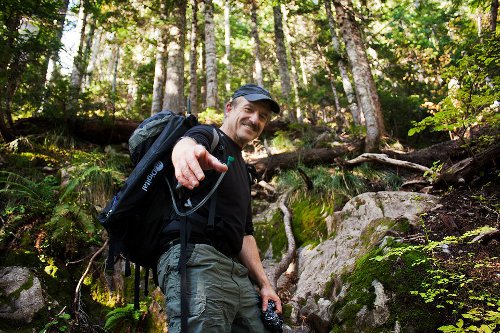
The friendly looking guy offering his hand to you in the photo at the top of today’s “meditation” is a friend of mine who, in spite of the amazing challenges he and his wife face, continues to pursue God’s peace. His name is Joe Hendricks and both he and his wife Heidi are actively undergoing cancer treatment. God has given both of them the personalities and the spirits to be encouraging and to approach life with a zeal for living when people like you or I would want to just hide under our beds and curl up into a ball. Peace isn’t just emotional state.

I am not saying this because I am in need, for I have learned to be content whatever the circumstances. I know what it is to be in need, and I know what it is to have plenty. I have learned the secret of being content in any and every situation, whether well fed or hungry, whether living in plenty or in want. I can do all this through him who gives me strength. –Philippians 4:11-13

Peace is a way of life, like pursuing the Spirit, like pursuing God. We find what we look for and we are looking all our lives.

To our God and Father be glory for ever and ever. Amen. –Philippians 4:20

nightsky1

Genesis: Rerolling the Torah Scroll

IRolling the Torah Scrollf G-d is “perfect,” as Judaism says, what prompted Him to create the universe? What void was He seeking to fill?

The answer provided in Jewish Mysticism is that G-d desired marriage. Marriage necessitates the existence of someone distinct from yourself with whom to share your life, a union of husband and wife. G-d chose humanity as His bride. According to the Kabbalah, the High Holiday season is the annual experience of the cosmic matrimony between G-d and humanity.

-Rabbi Yosef Y. Jacobson
“Souls in the Rain”
Commentary on Sukkot and Simchat Torah
Chabad.org

It is impossible to decide whether in Judaism supremacy belongs to halacha or to agada, to the lawgiver or to the Psalmist. The Rabbis may have sensed the problem. Rab said: The world was created for the sake of David, so that he might sing hymns and psalms to God. Samuel said: The world was created for the sake of Moses, so that he might receive the Torah (Sanhedrin 98b). (p.340)

-Abraham Joshua Heschel
God in Search of Man : A Philosophy of Judaism

Genesis. The very familiar and very confusing Biblical rendition of God’s creation of the universe, our planet, and man and woman. Why did He create all of this and us? In a previous blog post, I took a rather dim view of creation, given how things have turned out so far, and if I were standing at some sort of cosmic reset point, where God were about to create time and space all over again for the first time, I might say to Him, “Do you really want to do this? You know how it turns out.”

Indeed, we do know. God gives man and woman exactly one thing to do and they blow it. Put another way, long before God gives Moses the Torah, with its 613 mitzvot for the Children of Israel, He gave only one to Adam. If a mitzvah contained the same intrinsic meaning for man in the first days of the Garden as it does for a Jew today, then this one task, to refrain from partaking of the fruit of the tree of the knowledge of good and evil, was not simply a matter of obeying (or disobeying) God, but something that Adam and Eve actively participated in with God as part of a cooperative effort. God, speaking from a Jewish perspective, is just as “bound” to the mitzvot as man.

Heschel (p. 361) illustrates the importance of a mitzvot to a Jew this way:

Just as salvation is the central concept in Christian piety, so does mitsvah serve as a focus fo Jewish religious consciousness.

That sentence, more than any other in Heschel’s book, should send shivers down a Christian’s spine. Any believer knows just how much they value their salvation through the blood of Jesus Christ. But Christian, whether you understand it or not, a mitzvah to a Jew is every bit as important to him as your salvation is to you. The difference is that, once you accept Jesus as Lord and Savior, your job is done. Accepting salvation upon yourself is a passive act. God does it all by grace. By contrast, a Jew is always in motion with the mitzvot, acting upon the world and working with God to make it a better place. It’s not as if failing a mitzvah puts the Jew’s soul at risk or that grace isn’t in operation every single moment (to put it in Christian terms), but performing the mitzvah is the active ingredient in any Jew’s faith and life.

In fact, it is said “Without mitsvot one is naked” (Genesis Rabba 3,7). It is thought that one does not perform a mitzvah so much as one “acquires” it. A Jew might say “Adorn thyself with mitsvot before Him” (Sanhedrin 17a) as if the mitzvot were clothing. That is how Heschel (pp. 362-3) can come to this statement:

The supreme dignity of mitsvah is of such spiritual power that it gained a position of primacy over its antonym, namely, sin or averah. Even the sin of Adam was described as loss of mitsvah. After the forbidden fruit, we are told, their eyes were unclosed and “they knew that they were naked” (Genesis 3:7). “One mitsvah was entrusted to them, and they had stripped themselves of it.” (Genesis Rabba 19,17).

Knowing all of this, why did God create the world? Why did he create man? For marriage? For the supreme union between man and God? My, how we made a mess of things early on in the relationship and continue to do so. As Rabbi Yonah writes on the Jewlicious blog:

Jewish tradition teaches that God created the world to infuse it with goodness. However, this stands in contrast to the world we see. Even with the rose-colored glasses of privilege and faith in humankind, we have to admit that the world is full of misery and suffering. Finding God in this mess becomes difficult, if not impossible, for many of us.

failurePerhaps this terrible condition of the world is the only environment where humanity could exist for any length of time. We were going to fall. It was a matter of God deciding whether or not we should be given life, not whether we would fail in that life or not. Perhaps God’s boundless love would never have been understood or appreciated unless we were still loved by Him after we completely failed.

As we learned recently from Yom Kippur, God made time in such a way that it can be rolled back to the beginning. All wrongs can be made right. All hurts can be healed. We can be as we were “in the beginning”. The intensity and whirlwind of activities that mark the Days of Awe are about to collapse in on themselves and suddenly, time will be rolled back to Genesis even as Torah scrolls are rolled back to the beginning.

I haven’t experienced the joyous highs that most people have who celebrate this time of year, but my experience is unique and my situation has a limited context. Although I am a Christian, I am not a typical cog in that machine, nor do I fit into the Jewish world because of my faith. I have read through many Torah cycles, but this year, going back to the beginning is like making a fresh descent into the abyss of man’s failure without being able to see his future.

How did Abraham arrive at his certainty that there is a God who is concerned with the world? Said Rabbi Isaac: Abraham may be “compared to a man who was traveling from place to place when he saw a palace in flames. Is it possible that there is no one who cares for the palace? he wondered. Until the owner of the palace looked at him and said, ‘I am the owner of the palace.’ Similarly, Abraham our father wondered, ‘Is it conceivable that the world is without a guide?’ The Holy One, blessed be He, looked out and said, ‘I am the Guide, the Sovereign of the world.’ ” (Genesis Rabba 39) The world is in flames, consumed by evil. Is it possible that there is no one who cares? -Heschel p.367

There’s a well-known idiom in Hebrew that says, “Yeridah Letzorech Aliyah” meaning “descent for the sake of ascent”. I am descending into Genesis and will once again watch man fail God. Each day that I live, I live the life of a man who has failed God. But as the days and weeks progress and the Torah scroll is rolled further into Genesis, I pray that this will also be an ascent for the sake of my descent. Man has failed God and yet is still loved by God. However tenuous it may seem to me just now, that means there must be hope.

As a father has compassion on his children,
so the LORD has compassion on those who fear him;
for he knows how we are formed,
he remembers that we are dust. –Psalm 103:13-14

Good Shabbos.

Falling

FallingIt does seem frightfully unfair that one man’s single transgression should consign all humanity to death. But it is equally unfair that one man’s righteousness also offers all of humanity the reward of righteousness: “the right to the tree of life.” (Revelation 22:14)

From: “The Life-giving Spirit”
Parasha B’reisheet commentary
First Fruits of Zion (FFOZ)

After man ate from the Tree of Knowledge, however, he acquired the intimate knowledge of and desire for evil. The evil inclination was no longer an external force, represented by the Serpent. It was within. Our physical flesh was now a confused mixture of good and evil. Death was introduced into the world: human flesh, separated from the spirit, was a creature of the finite, physical realm — one which must ultimately decay and die. Man would now face a much greater challenge than before. He would no longer battle a Serpent from without. He would have to battle his own sluggish yet desirous flesh within.

Rabbi Dovid Rosenfeld
The Primordial Sin, Part II
Pirkei Avos Chapter 6, Mishna 5(b)
Torah.org

This coming Saturday, we begin a completely new Torah cycle with Parasha B’reisheet and once again, we start by reading the first chapters of Genesis. Adam is coming, and I’m a little nervous. I know this may seem strange, since we are in the middle of Sukkot, a time of great joy, but it’s as if I am sitting in my sukkah, somehow looking at Creation from several moments before God said “Let there be light” (Genesis 1:3). Yet in that point of suspended time, I know everything that is going to happen after God speaks these words. It’s as if God has not yet created the universe and some part of me wants to stop Him. How can He create the Earth, Adam, Eve, the tree of the knowledge of good and evil, even the serpent, knowing what I know; knowing about the fall? How can He create the universe knowing about all of the pain, anguish, and suffering that is going to happen as a result?

What?

Do you doubt that God knew about what would happen once He started everything in motion? Don’t you realize that to be God, He must have known that Adam would disobey, give into temptation, and lead all of humanity down a dark and sinister road to the abyss?

God must have known, but He created us anyway. Still, waiting for next Shabbat to come is like waiting for it happen all over again, from moments before God brought all into being with His powerful Word, to forming the first man out of clay, breathing life into Him, splitting the man and making woman, placing them in the Garden, and then…and then…

I often despair at the state of the world. All I have to do is go online and start reading the news. I recently read a story on CNN about a toddler in China who was the victim of a hit-and-run accident. As bad as this is, what makes the story all the more horrible is that she was hit twice by two separate vehicles and neither driver stopped. Worse, numerous pedestrians walked right past her and did nothing. Finally, a “58-year-old scavenger named Chen Xianmei” stopped and pulled her out of the street. The CNN story states that the “grainy footage of the accidents went viral on Chinese Internet within minutes of posting”, and only then did anyone express “outrage”.

According to Rabbi Rosenfeld, as a result of what Christians call “the fall”, humanity is now is a state of confusion, trying desperately to tell the difference between good and evil and to understand what we are supposed to be doing about it. The Prophet Isaiah, in warning Israel, could also have been warning us:

Woe to those who call evil good
and good evil,
who put darkness for light
and light for darkness,
who put bitter for sweet
and sweet for bitter. –Isaiah 5:20

God holds the worldIt seems as if everything that God tells us is evil and wrong is touted by the world around us as right, positive, and desirable. In that sense, I feel very much a stranger in a strange land, an alien among humanity, a pariah standing against everything the world says is the right thing to do and being called cruel and bigoted because of it.

That’s why I want to stop God from creating the world. Because it will just start all over again and we’ll end up right back here, facing the same day, the same problems, the same moral confusion where right and wrong are literally turned inside out.

Do not repay anyone evil for evil. Be careful to do what is right in the eyes of everyone. If it is possible, as far as it depends on you, live at peace with everyone. Do not take revenge, my dear friends, but leave room for God’s wrath, for it is written: “It is mine to avenge; I will repay,” says the Lord. On the contrary:

“If your enemy is hungry, feed him;
if he is thirsty, give him something to drink.
In doing this, you will heap burning coals on his head.”

Do not be overcome by evil, but overcome evil with good. –Romans 12:17-21

…so Christ also, having been offered once to bear the sins of many, will appear a second time for salvation without reference to sin, to those who eagerly await Him. –Hebrews 9:28

I know, I know…he’s coming, too. Jesus, I mean.

The world is broken but not beyond repair. The principle of Tikkun Olam tells us that we are junior partners with God in the act of repairing the world. Of course, we all await the Messiah to come back and bring the job to its finale, restoring us to who and what we were before the serpent entered the Garden and in fact, restoring the Garden itself. I know. We will once again walk with God as Adam did and “each man will sit under his vine and under his fig tree, and none will make him afraid” (Micah 4:4).

Sukkah in the rainI just wish we didn’t have to fall in the first place, because it’s so hard to get back up.

Maybe that’s why Sukkot is happening right now. In an imperfect world, where our shelters don’t have solid walls and the roof leaks, we are like people living in a sukkah depending on God to keep us fed, warm, dry, and safe.

Adam is coming and he’s about to fall. But Jesus is coming to help pick him back up. I’m trembling in fear as it’s about to happen all over again. I’m watching, I’m waiting. I’m praying.

Having discovered all your faults, you are depressed.

Imagine you have just found a doctor with a diagnosis that explains all your afflictions over the past many years. And he’s written a prescription directing you on a sure path to good health.

Shouldn’t you jump with joy and relief?

-Rabbi Tzvi Freeman
“Joyful Prognostics”
Based on letters and talks of the Rebbe
Rabbi M. M. Schneerson
Chabad.org

A few months back, I wrote a three-part series on the lessons we are about to learn once more in Genesis. This might be a good time to read them again: Part I: Overcoming Evil, Part II: The Primordial Serpent, and Part III: Healing the Wounded.