Tag Archives: creation

New Genesis

New WorldOn Rosh Hashanah, G-d takes Himself to court. He looks down from above at this world and, as I’m sure you may realize, it doesn’t always look so good.

G-d is within this world as well. He is found in every atom of this world. It may sound strange, but this is what is happening: He as He is above takes Himself, as He is present within this world, to trial.

Only the soul of Man can argue on His behalf. So we do that, as lawyers for the defense. All that is required is to awaken the G-dliness within our own souls.

The spark of G-d within us below connects with the Infinite Light of G-d above. The circuit is complete and the universe is rebooted with a fresh flow of energy for an entire year.

-Rabbi Tzvi Freeman
“G-d’s Lawyers”
Based on letters and talks of the Rebbe
Rabbi M. M. Schneerson
Chabad.org

This is a very strange Rosh Hashanah meditation but then, Rosh Hashanah is a very strange time. I suppose you can look upon the quote from Rabbi Freeman as midrash, mysticism, or metaphor, depending on which one best fits your personality, but just how can God judge Himself? Isn’t He supposed to judge us?

Then I saw a great white throne and him who was seated on it. The earth and the heavens fled from his presence, and there was no place for them. And I saw the dead, great and small, standing before the throne, and books were opened. Another book was opened, which is the book of life. The dead were judged according to what they had done as recorded in the books. –Revelation 20:11-12

This image is very reminiscent of how Judaism pictures God during the High Holidays. According to the Talmud, the Book of Life is opened on Rosh Hashanah and closed again at the end of Yom Kippur. This event repeats on an annual basis. According to Christianity, the Book of Life is opened only once, as we see in the above-quoted passage from Revelation. While it may be difficult to imagine, I think that Christianity’s and Judaism’s different visions can be reconciled. I’ll get to that part in a minute. Back to my previous question.

How can God judge Himself? Isn’t He supposed to judge us?

When it was the sixth hour, there was darkness over all the land until the ninth hour. And during the ninth hour, Yeshua (Jesus) cried out with a loud voice, “Elahi, elahi, lemah shevaktani?” which is interpreted, “My God, my God, why have you abandoned me?”

Some of the men standing there heard and said, “Look! He is calling to Eliyahu!”

One of them ran and filled a sponge with vinegar. He placed it on a cane, gave it to him to drink and said, “Leave him alone, and let us see if Eliyahu will come to take him down!”

But Yeshua gave a loud cry and breathed out his life. –Mark 15:33-37 (DHE Gospels)

Here, perhaps we see God judging both Himself and us. If Jesus was meant to bear the sins of all mankind and to take the punishment that was upon us, this then is our judgment. That the judgment falls upon the King of Kings, the Son of God, he who is mortal and sent by the Divine, then in this, we can say that God judges “Himself”. That we are all created in God’s image and that the Divine spark resides in each of us can also be thought of as God “judging Himself”.

But didn’t all this happen only once? If so, why bother (at least from a Christian perspective) observing an annual Rosh Hashanah and Yom Kippur?

Time is not a train of cars hitched one to another, one year dragged along by the year preceding, the present hitched tightly to the past, the future enslaved to the present. Rather, every year arrives fresh from its Creator, a year that never was before and could never have been known before its arrival.

That is why we call Rosh Hashanah “the birthday of the world” in our prayers. The past has returned to its place, never to return. With the blowing of the shofar, the entirety of Creation is renewed. From this point on, even the past exists only by virtue of the present.

-Rabbi Tzvi Freeman
“Reboot”
Based on letters and talks of the Rebbe
Rabbi M. M. Schneerson
Chabad.org

Midrash, mysticism, or metaphor…take your pick. From the Lubavitcher Rebbe’s point of view, the Universe is recreated every year at Rosh Hashanah. The “reboot” opportunity for our lives isn’t just poetic imagery, it’s a metaphysical reality. Are you having trouble believing that? Then what about this?

For as high as the heavens are above the earth,
so great is his love for those who fear him;
as far as the east is from the west,
so far has he removed our transgressions from us. –Psalm 103:11-12

Then he adds:

“Their sins and lawless acts
I will remember no more.”

And where these have been forgiven, sacrifice for sin is no longer necessary. –Hebrews 10:17-18

Reboot t-shirtOnce redeemed, God not only forgives our sins, it’s as if our sins never existed in the first place. It’s as if our very lives have been “rebooted”, as if the person we were had died and in our redemption, we have become brand new (2 Corinthians 5:17). The Bible allows for a metaphysical reboot in the lives of human beings. Why not in the “life” of the Universe as well? Does the Universe have a “soul”? Rabbi Freeman seems to think so, along with an existence in space and time.

The universe has a soul. All that exists in the soul exists in space and in time.

In the cosmic soul there is a mind, a consciousness from which all conscious life extends.

In space, there is the Land of Israel, a space from where all space is nurtured.

In time, there is Rosh Hashanah, a time from which all time is renewed.

Rosh Hashanah, meaning Head of the Year. Not just a starting point, but a head. For whatever will transpire in the coming year is first conceived in these two days.

Midrash, mysticism, or metaphor…take your pick. From the Lubavitcher Rebbe’s point of view, Creation itself has a distinct and unique existence, not only as a physical reality, but as a mystic and metaphysical presence, expressed as a soul within a specific time and place. Existence is reset and a new life is begun at Rosh Hashanah and given a new heartbeat emanating from Israel and circulating its “blood” throughout the rest of the world. It’s as if Creation were a pool of water. Each year at Rosh Hashanah, God drops a pebble into the pool. The water is so disturbed that the ripples completely wipe away what had existed upon and within the water and everything becomes brand new again. A new universe, a new chance, a new life for each of us. A new relationship with God is offered if we want it. It’s as if salvation were given to us on Rosh Hashanah. For a Christian, it’s like being “saved” all over again.

Do we need to be saved each year? Maybe. I’m not saying salvation expires every year, but consider this, Christian. At some point in your life, you accepted the Lordship of Jesus over your entire being. Chances are, you had no idea what was going to happen next and how much you would have to change who you were and what you were doing. It was exciting at the time but, like your wedding day and the days afterward, what was once exciting and new can become an old, tired routine.

Rosh Hashanah is an opening of the door to the moment of salvation again. We can make a decision not to live within apathy or to settle for a second-best relationship with our Creator. We don’t even have to settle for a renewal of what once was. We can have it brand new, shining and perfect again.

God suspending the worldRosh Hashanah can be many things. When you are in a relationship with the One, Unique, Creative God, that relationship is not limited by physical and temporal boundaries. It exists on levels beyond which any human can experience. Nevertheless, those levels exist. We may not be acutely aware of them, but we can still take advantage of those places in time and space that man has not touched. God is there and God can do wonders. We can be His partner in those wonders and participate in recreating the Universe and recreating us. We can be new again, and the voices of God and man can echo back and forth between the Heavens and God’s footstool, upon which we dwell, as if reverberating between mirrors.

The words we say are spoken in the heavens. And yet higher. For they are His words, bouncing back to Him.

On Rosh Hashanah, we say His words from His Torah recalling His affection for our world; He speaks them too, turning His attention back towards our earthly plane.

We cry out with all our essence in the sound of the shofar; He echos back, throwing all His essence inward towards His creation.

Together, man and G-d rebuild creation.

Judgment is rendered and suspended. God and man together speak the Word in a shofar’s blast, and the Universe is again is new.

Rosh Hashanah begins at sundown on Wednesday, September 28th.

L’shanah tovah tikatev v’taihatem. May you be inscribed and sealed for a good year.

Wonder

WonderWonder or radical amazement is the chief characteristic of the religious man’s attitude toward history and nature. One attitude is alien to his spirit: taking things for granted, regarding events as a natural course of things. To find an approximate cause of a phenomenon is no answer to his ultimate wonder. He knows that there are laws that regulate the course of natural processes; he is aware of the regularity and pattern of things. However, such knowledge fails to mitigate his sense of perpetual surprise at the fact that there are facts at all. Looking at the world he would say, “This is the Lord’s doing, it is marvelous in our eyes” (Psalms 118:23).

Abraham Joshua Heschel
God in Search of Man : A Philosophy of Judaism
pg 45

Astronomers have combined two decades of Hubble observations to make unprecedented movies revealing never-before-seen details of the birth pangs of new stars. This sheds new light on how stars like the Sun form…The movies reveal the motion of the speedy outflows as they tear through the interstellar environments. Never-before-seen details in the jets’ structure include knots of gas brightening and dimming and collisions between fast-moving and slow-moving material, creating glowing arrowhead features. These phenomena are providing clues about the final stages of a star’s birth, offering a peek at how the Sun behaved 4.5 billion years ago.

“Hubble movies provide unprecedented view of supersonic jets from young stars”
Physorg.com

How do you combine these two quotes together? Can you see the hand of God in “energetic jets of glowing gas traveling at supersonic speeds in opposite directions through space?” I can. It’s not always easy, though. Building somewhat on yesterday’s morning meditation, we live in a world that strives to explain everything in terms of naturally occurring events. Nothing is amazing or astounding anymore, it’s just stuff that can be explained by science. But according to Heschel, just because you can explain something takes nothing away from the wonder of it being a creation of God.

Religious people and particularly “fundamentalist” Christians tend to take the opposite approach. They find wonder in all of God’s creation but see science as the enemy of God. Any scientific analysis of observable phenomenon is considered a denial of God’s existence. It’s only a miracle if it remains unexplained in terms of it’s physical, chemical, or electrical properties. Of course, by that thinking, we wouldn’t have the study of medicine which saves so many lives. We wouldn’t have the existence of the Internet which gives us virtually instantaneous access to information that would otherwise take weeks or months for us to locate. We would probably still think the Sun circled the earth and that God made the world as flat as a pizza.

Science is a tool and like any tool, it can be used and misused. In the post-modern era, scientific inquiry is often used as a tool to “prove” that everything in existence has a “natural” origin and that the universe doesn’t require a supernatural agent to explain its formation (and never mind that no scientific inquiry can adequately explain how the universe came into being in the first place). Yet science as a method of investigation, is amoral. It’s neither good nor bad. It simply is (at its most basic level) a set of steps that tells us how to look at something with as much objectivity as possible so we can learn what it is without tainting the conclusions with our own intervention and personality.

That’s of course, if it’s used correctly and with its original intent. Human beings have a tendency to abuse tools in order to acquire the results they believe fits their best interests, the truth not withstanding.

Even if used correctly though, scientific inquiry can have an unintended side effect. It can dull wonder, as Heschel states (pg 46):

As civilization advances, the sense of wonder declines. Such decline is an alarming symptom of our state of mind. Mankind will not perish for want of information; but only for want of appreciation. The beginning of our happiness lies in the understanding that life without wonder is not worth living. What we lack is not a will to believe but a will to wonder.

What a hideous way to exist. Nothing is amazing. Nothing is fantastic. No event leads us into the presence of sheer awe at the glory of God’s works. That is such a sad and sorry way to live.

OceanThere are atheists who are proud to call themselves by that name and who marvel at mankind’s genius as it progresses toward a higher and enlightened scientific and social order. As the last gene becomes identified and mapped and the last star in the galaxy becomes classified and planets made of diamonds are cataloged, it all is taken in stride and in self-satisfaction. But it’s all so empty without God, for whose glory creation exists.

Heschel wonders why a “scientific theory, once it is announced and accepted, does not have to be repeated” but observant Jews continue to pray the Shema twice daily saying “He is One”. The reason this is done is because the “insights of wonder must be constantly kept alive. Since there is a need for daily wonder, there is a need for daily worship.”

Heschel continues (page 49):

The sense for the “miracles that are daily with us,” the sense for the “continual marvels,” is the source of prayer. There is no worship, no music, no love, if we take for granted the blessings or defeats of living…Even on performing a physiological function we say “Blessed be Thou…who healest all flesh and doest wonders.”

Where is your sense of wonder? Perhaps it is doing well each day but if not, there is a way to inspire yourself. You don’t have to wait. Just start “doing” wonder. It’s like praying twice daily. Even if you don’t “feel” like it, the feeling doesn’t have to come before the doing:

People are not changed by arguments, nor by philosophy. People change by doing.

Introduce a new habit into your life, and your entire perspective of the world changes.

First do, then learn about what you are already doing.

Rabbi Tzvi Freeman
“Change by Doing”
Based on letters and talks of the Rebbe
Rabbi M. M. Schneerson
Chabad.org

Do you need help? It’s available, in fact, no one can develop a true sense of God alone because God didn’t create us to be in the world alone. As Rabbi Freeman writes:

Each of us has deficiencies, but as a whole we are complete. Each one is perfected by his fellow, until we make a perfect whole.

What we have, we were given by God. The environment around us, our intelligence, our sense of wonder, others among us to complete us and encourage us. We need only take advantage of God’s gifts including the gift of prayer. We need never lose our sense of wonder in the universe or our awe in God. I suppose it’s why Jesus said this, for who but a child has the greatest sense of wonder at the world and beyond?

Truly, I say to you, unless you turn and become like children, you will never enter the kingdom of heaven. –Matthew 18:3 (ESV)

Later today, I’ll post my commentary on this week’s Torah Portion Shoftim. Stay tuned.

Shattered Fragments

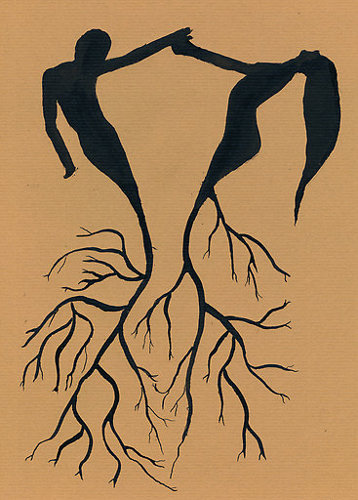
Descending SoulsWhen G-d sends the souls forth into the world, they include a male and female joined together…When they descend to the world…they are separated from each other. Sometimes one soul precedes the other in descending and entering a body of a human being. When their time to be married arrives, G-d, Who knows these souls, joins them as they were before [they descended to this world]…When they are joined together, they become one body and one soul.Zohar 1:91b

Some Pharisees came to him to test him. They asked, “Is it lawful for a man to divorce his wife for any and every reason?” “Haven’t you read,” he replied, “that at the beginning the Creator ‘made them male and female,’ and said, ‘For this reason a man will leave his father and mother and be united to his wife, and the two will become one flesh’? So they are no longer two, but one flesh. Therefore what God has joined together, let no one separate.”Matthew 19:4-6

This is a continuation of my commentary on the JLI course Toward the Meaning of Life. See The Prophet and the Shade Plant for the previous commentary and links to earlier lessons.

As Christians, we are generally taught that we have no pre-existence prior to conception and birth. Somehow, our individual souls are all part of that process and we exist in isolation within the womb, physically and spiritually. We do not realize the joining of two souls as one until marriage so that we become “one flesh” (Genesis 2:24), but Kabbalah suggests another interpretation. We also see this viewpoint in the Chasidic writings as related by Rabbi Tzvi Freeman’s rendition of the Rebbe’s teaching on man and woman:

It is a mistake to consider man and woman two separate beings. They are no more than two halves of a single form, two converse hemispheres that fit tightly together to make a perfect whole. They are heaven and earth encapsulated in flesh and blood.

It is only that on its way to enter this world, this sphere was shattered apart. What was once the infinity of a perfect globe became two finite surfaces. What was once a duet of sublime harmony became two bizarre solos of unfinished motions, of unresolved discord.

So much so, that each one hears in itself only half a melody, and so too it hears in the other. Each sees the other and says, “That is broken.” Feigning wholeness, the two halves wander aimlessly in space alone.

Until each fragment allows itself to surrender, to admit that it too is broken. Only then can it search for the warmth it is missing. For the depth of its own self that was ripped away. For the harmony that will make sense of its song.

And in perfect union, two finite beings find in one another infinite beauty.

While there is a beauty in this interpretation; a poetic and romantic image that calls to anyone who has found their “soulmate” in their spouse or who is ernestly seeking their bashert, couldn’t all this just be considered some non-Biblical fantasy? After all, Adam, a man, was created first and then Eve was created from his rib. This is how we understand it in Christianity. They are two separate beings who were joined together by God spiritually. The only “unity” they shared originally is that Eve was made out of one of Adam’s body parts.

But is that how it really was? Genesis 2:18 says, “And the Lord God said, it is not good for the man (ha-adam) to be alone; I will make a fitting helper for him.” Let’s have closer look at some of the Hebrew words and concepts. Rabbi Pinchas Stolper in his article, “The Man-Woman Dynamic of Ha-Adam: A Jewish Paradigm of Marriage provides some important insights into Genesis that we miss when we read the English text:

Who is ha-adam? It is neither man (ish) nor the first man (adam). To identify ha-adam, we turn to Genesis 1:27. “And God created ha-adam in His image, in the image of God He created him (oto); make and female, He created them (otam).” The first part of the verse clearly indicates that ha-adam is a single being. The second half indicates that this single being, at the conclusion of the creation process, becomes “otam (them),” two individuals.

The key to decoding this mystery is to be found in Rashi, the Biblical commentator par excellence, who generally anchors the Biblical text in its plain meaning. Rashi explains: “They were created shenai partzufim [of two faces, androgynous] in the original creation; and only later did God divide them.” In other words, ha-adam, the first human being is a unique creation; both male and female simultaneously (see Ketuvot 8a).

This is an amazing revelation of the first human beings and has startling implications on what it is to be created in the “image of God” (since God is without gender) and on Paul’s teaching, “neither male nor female” (Galatians 3:28), but can we accept the interpretation of a 12th century Jewish sage over the actual Biblical text? If ha-adam was not the actual first “man” in Creation, where did the separate entities of Adam and Eve come from? Rabbi Stolper provides an answer:

Later, the Torah records that “the Lord God put ha-adam into a tardema (deep sleep) and took one of his tzela’ot.” Rashi indicates that “tzela’otav” does not mean “one of his ribs” but, “one of his sides,” as it is taught, “the side of the Tabernacle.” This follows the meaning of the Talmud “that they were created with two faces.” Ha-adam was originally a unified individual with two “sides,” two faces, two aspects, two sexes, subsequently divided into two.

A footnote on this commentary states:

Rabbi Samson Raphael Hirsch, notes (Genesis 2:21) that “tzela does not occur elsewhere in the Tanakh (OT) as a ‘rib’, but always as a ‘side,’ which is also why tzalua means to be inclined towards one side, to limp.”

One SoulBased on the actual Hebrew of the Genesis creation story, the common interpretation of Eve being “Adam’s rib” doesn’t hold an ounce of water. Man and woman were originally united as a single, unified entity that God deliberately separated into different and equal parts designed to perform different functions in the created world. However, like any single thing that is put into two parts, neither one is complete until they are joined back together. In fact, the Hebrew for “cling to” that we find in Genesis 2:24 is the Hebrew word “vedavak” which carries the sense that a man must “leave his father and his mother, and shall glue himself to his wife: and they shall be one flesh.”

But why didn’t God just let ha-adam stay as a single entity? I’m sure most married couples, who have had their fair share of marital disagreements must be asking the same question. You’d think that having an “unsplit” ha-adam would have avoided thousands of years of stormy marital discord and the proverbial “battle of the sexes”.

Interestingly enough, in Genesis 2:18, when God says, “It is not good (lo tov) for man to be alone (levado)”, the implication of the Hebrew is that “it is not yet good”. The ultimate “good” could not be achieved unless their were two of them. Animals were already created “male and female” without going through the “splitting” process described for ha-adam and thus only human beings are able to be joined together as a spiritual “one”. No other living beings in creation are capable of this level of total unity of essense, and it requires that the two must specifically be “male” and “female”, man and woman.

But that doesn’t answer the question.

Rabbi Stolper’s article quotes Rabbi Shlomo Wolbe and Rabbi Yeruchem Lovivitz on the matter and the answer in part states:

“It is clearly demonstrated to you that the Lord alone, levado, is God; there is none beside Him.” God is on the level of levado (citing Deut. 4:35).

Only God is One, a unique and radical unity (Deuteronomy 6:4) and there is no other “oneness” like God. In the Garden, part of the serpent’s temptation of Eve was that “when you eat of it, your eyes will be opened, and you will be like God…” (Genesis 3:5). This was the only sin possible for Adam and Eve to commit in Eden; to attempt to be like God. We are meant to be much more than the other creatures of Creation, but we were created to be “a little lower than the angels” (Psalm 8:5; Hebrews 2:7). Only God is One, levado; alone. Humans are unique in creation but we are still meant to be two, man and woman, and to become “one flesh”.

There’s an obvious problem with the Chasidic interpretation of God always joining the “split souls” of man and woman together again in marriage when you consider Jewish/Gentile intermarried couples such as me and my wife. When asked “Can a Jewish woman’s berheret (soul-mate) be a non-Jew”, Rabbi Shraga Simmons
replies in part:

The Talmud says that 40 days before the formation of a fetus, it is decreed in heaven which boy will marry which girl. Since God has forbidden a Jew from marrying a non- Jew (Deut. 7:3), it is obvious that the beshert is a Jew. There is of course the possibility that one’s beshert will be a convert, though this again would only apply to someone who converted in accordance with God’s laws.

Yet here we are, man and woman, married to each other, presumably by God’s decree and (though Rabbi Simmons wouldn’t consider this a factor) commanded by Jesus that “what God has joined together, let no one separate.”

I don’t know how it works or how it’s supposed to work. I only know that things are what they are and that God is here with us, helping us to try to do our best, just the way He made us, to repair our little bit of the broken world and prepare for the coming of the Moshiach. Our two halves don’t always make an agreeable whole and like any married person, I sometimes wonder why. The only answer I can find is in how Rabbi Freeman interprets the Rebbe on the topic of getting along:

When we can’t get along with someone, we like to blame it on that person’s faults: stupidity, incompetence, outrageous actions, aggression or some other evil.

The real reason is none of these. It is that the world is broken, and we are the shattered fragments.

And all that stops us from coming back together is that we each imagine ourselves to be whole.

We are shattered fragments trying to become whole again. We contain Divine sparks within us that are constantly striving to break free and return to the One Source of all things. We are prisoners, imaging ourselves as individuals sitting isolated in a jail cell of our own making, but we’re sitting on the keys.

The next part of this series, and a continuation of the discussion about marriage, is in the “morning meditation” Who Are We to God?.

Healing the Wounded

Snake swallowing tailWhen the Egyptians realized that they were being attacked by supernatural forces at the Red Sea, they said, “I must flee from the presence of Israel, for G-d [Havayah] is fighting for them against Egypt.” (Ex. 14:25)

As you know, Pharaoh derived sustenance entirely from immature divine consciousness [mochin d’katnut], which is alluded to by the word “End”.

The words usually translated as “Red Sea” [in Hebrew, “Yam Suf”] really mean “Reed Sea”, and can also be read as if they were vocalized “Yam Sof”, meaning “Sea of the End”. The “end” is the final sefira, malchut, which descends into the lower worlds, i.e. the lower levels of divine consciousness. Relative to its native environment, these lower levels of consciousness are “immature” or “constricted”.

This is the significance of [the fact that] the snake puts its tail in its mouth.

Pharaoh personified the Primordial Snake.

From the teachings of Rabbi Yitzchak Luria
adapted by Rabbi Moshe Yaakov Wisnefsky
“The Snake at the Sea’s End”
Chabad.org

This is Part 3 in a 3-part series. Before reading this, see Part 1: Overcoming Evil and Part 2: The Primordial Serpent.

The surprise appearance of Pharaoh, King of Egypt (yes, “that” Pharaoh, King of Egypt…the one that gave Moses so much trouble) in the role of the primordial serpent may take you a little off guard, but from the perspective of Kabbalah, many things look different. In Judaism, the serpent is less a specific being or entity (i.e. Satan) and more a representation of an idea or a force, in this case, the personification of the evil inclination. In this sense, you could have many evil people across history personifying the snake. Hitler could be a personification of the ancient serpent of Eden.

But there’s more:

This being the case, Pharaoh was both a head and a tail, in the idiom of the verse, “G-d will cut off from Israel both the head and the tail…on one day.”(Isaiah 9:14)

Pharaoh, here signifying the evil inclination in general, acts as the tail, the lowest consciousness of the Jew, and as the head, i.e. the tail elevated to and usurping the role of the head, proper divine consciousness.

This also alludes to the [Primordial] Snake. Originally, he was the tail and Adam was the head, but [because of the Primordial Sin] this was inverted and the snake became the head and Adam the tail.

Adam here personifies the Good Inclination, or divine consciousness. Sin consists of reversing the hierarchy between divine and material consciousness.

This is the mystical meaning of the verse “He will hit you on the head and you will bite him in the heel” (Gen. 3:15).

Man hits the snake on the head because the snake has usurped man’s role as the leader; the snake bites the heel because by sinning man has become the heel/tail instead of the head.

This is very interesting when your deconstruct the role of snake as Pharaoh back to the original appearance of the serpent in the Garden, and then re-visit the relationship between the snake and Adam (which I suppose we could project back up to the relationship between Pharaoh and Moses).

Adam is the heel (or tail) rather than the head because by sinning, he exchanged roles with the serpent. Instead of man ruling over Creation, now evil rules and man struggles to allow good to ascend while evil inhibits his efforts. The snake bites the heel but the heel will crush the snake.

In Christian thought, the heel of man is symbolized by Jesus crushing the evil of Satan, and Rabbi Wisnefsky, when recounting the wisdom of the Rebbe in his article Transforming the Primordial Snake, presents an interesting interpretation that seems to apply:

Since the snakes were deadly, anyone who had been bitten was for all intents and purposes already dead. Healing the bitten person was thus tantamount to resurrecting him.

Now, in order to resurrect a dead person, it is not enough to simply infuse his body with life, because the body has already lost its capacity to support life. First, the dead body had to be made capable once more of living. This can be done only by a force that transcends the laws of nature, including the dichotomy of life and death. Infusing this transcendent force into the dead body restores its capacity to support life, after which the person’s soul can re-enter it and he can live again.

This is why G-d also commanded Moses to heal the people using a snake. By using the image of the deadly, Primordial Snake to restore life, G-d indicated to them that resurrection requires eliciting a level of divinity that transcends the dichotomy of life and death. When people saw the snake, they understood that in order to elicit this transcendent divinity and be healed, they had to transform their own, inner “snake” – their evil inclination – into a force of good.

What was that? Resurrect the dead?

River of LifeLet’s weave Rabbi Wisnefsky’s commentary into more familiar language. When man fell in the Garden, he was “bitten” by a “poisonous” snake and that “poison”, the evil within us, has continued to sicken humanity down through the ages. Christianity considers a sinner as “spiritually dead”, unable to perceive God let alone to attempt to perform His will.

Jesus, by his death and resurrection, provides the means by which mankind can be healed of our poison and by which we can be brought back from the dead. The commentary above talks about the restoration of the soul and the resurrection of the body, both of which we see in the promise of Jesus Christ. The last paragraph of the Rabbi’s missive illustrates that we must see and be aware of our evil inclination, how it serves as the barrier preventing us from a holy life, and also shows us how we can conqueror that nature and bend it to our will and God’s will (Romans 8:37).

I’m sure that Rabbi Wisnefsky would say that I’m playing fast and loose with his interpretation of the Rebbe’s teachings, but there seems to be more than a casual similarity between the Rebbe’s lesson and what we know of the role of the Messiah relative to the subjugation of evil. Jesus came during the Second Temple period to provide for the repairing of our damaged souls, to reconcile us with God, and to prepare the way to eternal life. When he returns, he will finish the job and completely heal us and the world of the evil that plagues us and restore us to the state which we enjoyed with God in Eden.

All Israel has a share in the World to Come, as is stated: “And your people are all righteous; they shall inherit the land forever. They are the shoot of My planting, the work of My hands, in which I take pride.” –Sanhedrin, 11:1

Then the angel showed me the river of the water of life, as clear as crystal, flowing from the throne of God and of the Lamb down the middle of the great street of the city. On each side of the river stood the tree of life, bearing twelve crops of fruit, yielding its fruit every month. And the leaves of the tree are for the healing of the nations. No longer will there be any curse. The throne of God and of the Lamb will be in the city, and his servants will serve him. They will see his face, and his name will be on their foreheads. There will be no more night. They will not need the light of a lamp or the light of the sun, for the Lord God will give them light. And they will reign for ever and ever. –Revelation 22:1-5

We’re not there yet. We’re still in “exile”. However, God is here with us.

Perhaps, for you, this exile is not so bad. And you feel you are doing whatever you can about it, anyway.

But it is not just you. Abraham, Isaac and Jacob and all their children through all the generations, as well as all the heavenly hosts,
the entire Creation—all is unfulfilled, in exile and imprisoned.

Even the Creator, blessed be He, locks Himself into prison along with His Creation.

Until you get us out of here.

Rabbi Tzvi Freeman
Based on letters and talks of the Rebbe, Rabbi M. M. Schneerson
“Pity on the Cosmos”
Chabad.org

Overcoming Evil

Primordial SnakeThe vilna gaon, rabbi Eliyahu Kramer of Vilna, 1720-1797, one of the most influential Rabbinic figures since the Middle Ages, wrote on this topic in Even Shelaima. In commenting about how it was possible for Adam and Eve to sin if the evil inclination hadn’t fully be incorporated within humankind, he insists that indeed they did have an evil inclination. However, since they were fashioned from the “Hand of God,” their God-consciousness was so strong that it was axiomatic they would do the correct thing. As long as their inner-voice and spiritual essence radiated, it subdued any outside influences that may challenge this level of connection.

The primordial snake turned out to be just the agent to stimulate the notion of rebellion, ignite a spark of doubt in the divine command to refrain from eating of the Tree of Knowledge, and from the moment they imbibed in that forbidden fruit, their “eyes were opened.” From now on the possibility for allowing external stimuli to penetrate their inner-core of the soul’s sanctity and disturb their cleaving to God was activated. Humankind is constantly being tested with how much light their souls (inner essence) can muster to dispel the darkness associated with the myriad temptations of the world, which every moment attempts to suppress the sublime luster of that soul.

-Rav Aaron Perry
found at VirtualJerusalem.com

Despite everything, I believe that people are really good at heart.Anne Frank

Although I didn’t intend it this way, this “morning meditation” is Part 1 in a 3-Part series. See the bottom of this article for information on Part 2.

Given Anne Frank’s brief and tragic life, I’ve always wondered how she could say that. Living in the shadow of Nazi oppression and the horror of the Holocaust, I would imagine she’d see people as anything except “good at heart”.

Christianity teaches that created man was initially good and obedient to God but, thanks to the temptation of the serpent and Eve and Adam subsequently giving in to temptation, the fundamental nature of all human beings throughout time became evil. In other words, all people are inherently evil beings and only through the saving grace of Jesus Christ can we overcome our evil nature (“more than conquerors” as in Romans 8:37) and do good. According to the church, Anne Frank is wrong.

Actually, looking at the bloody and cruel history of humanity, it is easy to agree with Christianity’s viewpoint of man’s grim nature, and to conclude that Ms. Frank was a good but rather naive person. Yet Judaism has a very different take on the “primordial sin” of Adam and Eve.

Depending on who you talk to, Judaism believes that man was essentially operating under a “good inclination” (that’s just like it sounds, man was inclined to do good which in this case means obeying God) internally. Evil existed in the world in the form of the serpent (and at no time in this early Genesis narrative is the serpent equated with Satan) but as an external influence. According to this view, man had an internally good nature but could be impacted by external evil forces.

Rabbi Perry gives us a slightly different view of this, saying that man possessed an internal good and evil inclination. Referencing the Vilna Gaon, he states that, “…indeed they did have an evil inclination. However, since they were fashioned from the “Hand of God,” their God-consciousness was so strong that it was axiomatic they would do the correct thing. As long as their inner-voice and spiritual essence radiated, it subdued any outside influences that may challenge this level of connection.”

In other words, it was possible, but highly unlikely for man to give in to his evil inclination, because his “God-consciousness” overwhelmed the evil within him and generally dampened external evil influences. Once man sinned against God, the barriers inhibiting man from sinning were breached and now, humanity struggles between the two internalized inclinations for good and evil.

BurningDoes that mean, from a Jewish point of view, that Anne Frank is right? Are we really “good at heart” but with our goodness inhibited by our inclination for evil? If so, why is human history so dismal and corrupt? Why don’t we see a more “balanced” expression of human motivations, illustrating whole people groups who were essentially good and righteous vs. others who were dark and monstrous?

I’ve already addressed the issue of the “primordial sin” once before in my blog post Gateway to Eden and suggested that the way we can return to intimacy with God, at least to some degree and for a brief time, was to embrace Shabbat keeping. However, I didn’t try to directly confront the nature of humanity, although I did find this helpful quote:

After man ate from the Tree of Knowledge, however, he acquired the intimate knowledge of and desire for evil. The evil inclination was no longer an external force, represented by the Serpent. It was within. Our physical flesh was now a confused mixture of good and evil. Death was introduced into the world: human flesh, separated from the spirit, was a creature of the finite, physical realm — one which must ultimately decay and die. Man would now face a much greater challenge than before. He would no longer battle a Serpent from without. He would have to battle his own sluggish yet desirous flesh within.

Rabbi Dovid Rosenfeld
The Primordial Sin, Part II
Pirkei Avos Chapter 6, Mishna 5(b)
Torah.org

There is a drive among people, particularly people of faith, to rise above the mud and slime of thousands of years of war, crime, and misery, and to reach out for the heavens and the Throne of God. The Divine spark within us seeks out its Source and cannot be buried, no matter how depraved a people we become. God once chose to destroy all but a tiny handful of human beings and flooded the Earth because we had become so totally immersed in evil, but every time we see a rainbow, we can recall the promise that God will not repeat this action.

God gave the Children of Israel the Torah to establish a nation of mercy and justice and with the intent of sending the Torah from Zion and into the nations. God sent his “only begotten Son” so that everyone could be saved and none should perish for lacking the ability to have a relationship with the Creator.

We’ve previously encountered the question of how man could do evil if he was essentially good. Now we must ask ourselves, if man is essentially evil, why would he even desire to do good? Why would man seek God? For it seems “…man is born for trouble, As sparks fly upward” (Job 5:7 NASB).

Bending the verse just a little bit, I rather prefer, “For man is born to trouble but our sparks fly upward.” None of the translations available present the verse in such a way, but I think my version paints a truer picture of humanity…we battle between the inclinations of good and evil within us, but always present is the image of God in which we were created, and the slender, illuminated thread that inexorably attaches us to Him and leads us upward and back toward home.

All we have to do is resist the evil and seek the good within ourselves.

Do not repay anyone evil for evil. Be careful to do what is right in the eyes of everyone. If it is possible, as far as it depends on you, live at peace with everyone. Do not take revenge, my dear friends, but leave room for God’s wrath, for it is written: “It is mine to avenge; I will repay,” says the Lord. On the contrary:

“If your enemy is hungry, feed him;
if he is thirsty, give him something to drink.
In doing this, you will heap burning coals on his head.”

Do not be overcome by evil, but overcome evil with good. –Romans 12:17-21 (Deut. 32:35 Prov. 25:21-22)

It is not so much that we need to be taken out of exile. It is that the exile must be taken out of us.

-Rabbi Tzvi Freeman
“Inner Exile”
Based on letters and talks of the Rebbe, Rabbi M. M. Schneerson
Chabad.org

We are in the last nine days of the three weeks of mourning between 17 Tammuz and 9 Av, which commemorates the destruction of the First and Second Temples. It is believed that the Second Temple was destroyed and the Jewish people were sent into a 2,000 year exile due to their display of “wanton hatred” among each other. Right now, Jews all over the world are observing a period of intense mourning and prayer as they seek to put aside the desires of the evil inclination and turn to the God of their Fathers.

May we all pray for the courage and strength to do the same.

Part 2 of this series will be published in tomorrow’s morning meditation: The Primordial Serpent.

Gateway to Eden

Gateway to EdenNow the serpent was more crafty than any of the wild animals the LORD God had made. He said to the woman, “Did God really say, ‘You must not eat from any tree in the garden’?”

The woman said to the serpent, “We may eat fruit from the trees in the garden, but God did say, ‘You must not eat fruit from the tree that is in the middle of the garden, and you must not touch it, or you will die.’”

“You will not certainly die,” the serpent said to the woman. “For God knows that when you eat from it your eyes will be opened, and you will be like God, knowing good and evil.”Genesis 3:1-4

We are all familiar with the story of Adam and Eve and their sin with the fruit of the Tree of Knowledge (Genesis 3). As the story goes, the Serpent, most “cunning” of all the animals, comes along and tempts Eve to taste of the fruit, promising that it would open the eyes of man, making her and Adam “as gods knowing good and evil” (v. 5). Eve decides that the Tree is tempting to behold and both eats of the fruit and gives her husband to eat.

This, however, presents a difficultly. If Adam and Eve themselves had no evil inclination, how could they have *wanted* to sin? How could they — entirely spiritual beings — desire anything other than goodness and closeness to G-d? Where could a desire to rebel against G-d stem from?

-Rabbi Dovid Rosenfeld
The Primordial Sin, Part I (2006)
Torah.org

Christianity and Judaism see “the Fall of Man” event in Genesis very differently, but there are obvious parallels. “In the beginning”, Adam and Eve are sinless beings, created by God and knowing an incredible intimacy with the Source as completely spiritual yet physical beings. In Judaism, people originally had no internal inclination toward evil but upon disobeying the one commandment given by God, the external temptation, represented by the Serpent, became internalized. Man separated himself from God and the nature of the world became broken.

Rabbi Rosenfeld goes on in Part III of the series to ask some difficult questions:

To this we explained that man sinned in order to make life more challenging. Before the Sin, man had only a single mitzvah (commandment) — not to partake of the fruit of the Tree. There was, it seemed, very little for him to accomplish. Now, as a physical being desiring evil, life would be so much more challenging. There would be so much more potential growth in store for man. Eventually mankind would require the rigorous and demanding 613 Commandments to curb the animal within and redirect him G-dward. Thus, man — *spiritual* man — *desired* the greater challenge that would now be in store for mankind.

This, however, still does not suffice. Why would man desire a greater challenge? So that he would have more opportunities for spiritual growth? But isn’t he basically just backing up in order to reach the same goal? The ultimate goal of life — self-evident to the spiritual person — is closeness to G-d. If man was created close to G-d, why not *stay* there — perform his single mitzvah and perfect himself? What was so enticing about making life more difficult?

From Christianity’s point of view, there was no justifiable reason for Adam and Eve to sin; to disobey God. It was a terrible, ghastly mistake that sent both humanity and the nature of Creation down a dark and dismal path, away from God and into the arms of darkness, requiring that God give “His one and only Son, that whoever believes in him shall not perish but have eternal life” (John 3:16).

Judaism says that, amidst what Christians can only view as a total spiritual disaster, there is something salvageable and even perhaps desirable to be gleaned:

The deepest, most profound desire a human soul has is to feel it exists — to feel it is not just a passive entity, acted upon and taken care of by others. A person needs to feel he is an independent being — what the Serpent called a “god” (and our mishna calls a “king”) — who can accomplish, grow and make a difference in the world. There is nothing more painful — *spiritually* painful — than feeling that one’s life makes no difference to anyone or anything, that he exists only as a person acted upon by others or by natural forces, and that he has done nothing to express his own existence.

This was man’s dilemma in the Garden of Eden. Man at first, as lofty as he was, was an almost entirely passive, “created” being. He was given existence by G-d. He was placed in the Garden of Eden with all his wants and needs satisfied and with only a single mitzvah to perform. Man wanted to feel he truly existed — that he was not just a plaything of the Almighty. He wanted to be a god himself. How could he do it? By forcing upon himself greater challenges. Adam and Eve would no longer be passive beings, practically created in G-d’s presence. They would now have to earn it. Spirituality would come only through the greatest of efforts — *their* efforts. It would be the challenge they would have to face to achieve their purpose — and in order to exist.

From what Rabbi Rosenfeld presents, man faced two options: live life close to God, obeying the single commandment provided by the Almighty, but never having the opportunity to truly carve out his own path and the ability to rise spiritually, or deliberately distancing himself from God, lowering his spiritual status, and then struggling back up the ladder, rung by rung, to drive himself ever closer to God and Eden.

I suppose a challenge like that would tempt the spiritual Sir Edmund Hillarys of the world, but for the rest of us, we see the “downside” to such a decision in terms of the pain, suffering, and anguished death of billions upon billions of human beings across the long march of millennia between the dawn of man and the current age.

And yet, here we are. “Our physical flesh (is) now a confused mixture of good and evil. We know the passing of the seasons as we age, and we know decay and death. We are separated from the infinite Spirit. The struggle against evil and the abyss is no longer an external enemy, but rather, it is part of who we are inside. Judaism longs for the coming of the Messiah and Tikkun Olam. Christianity looks to the day when Jesus will return and mankind will be redeemed from a fallen world.

But what if we don’t have to wait? Rabbi Yitzchak Ginsburgh says that we don’t:

After the primordial sin, Adam and Eve heard “the voice of God” walking through the garden. They heard God, He spoke to them, and they answered. This is the consciousness of “hearing,” the height of our consciousness of Godliness (God and His Divine Providence) is our lives subsequent to the primordial sin, the consciousness of the weekdays, the workdays (“By the sweat of your brow…”).

But on Shabbat we return to the pristine state of consciousness of God as it was prior to the primordial sin (and as it will be universally in the future). In the terminology of Kabbalah, during the weekdays our consciousness is at the level of understanding (“hearing” in Hebrew means also “understanding”) whereas on Shabbat our consciousness rises to the level of wisdom (direct insight into the mysteries of creation hidden within reality, and into the “mystery of mysteries,” the Creator of reality, the true and absolute Reality).

Throughout the week everything that happens around us, all that we see and hear, “tells” us about God and His Providence. On Shabbat we don’t have to be told about God, we experience Him directly.

ShabbatOne of the mistakes of the early (non-Jewish) Christian church was to casually discard the commandment, “Remember the Sabbath day by keeping it holy” (Exodus 20:8). The church alternately says that Jesus did away with Sabbath observance with the rest of the Law or that the “Sabbath” was mysteriously moved over one day, to coincide with the “Day of the Lord” and the resurrection of the Master. I personally think that the 2nd and 3rd century church found it necessary to separate themselves from anything “too Jewish” and simply shifted the “Holy Day” over by 24 hours to achieve this, and then used specific points of Scripture to justify the decision.

Today, Christians miss out on an opportunity, however limited, to return to Eden. For contained in the Shabbat isn’t just a day to go to church or synagogue, but in fact, we discover an opportunity to remove oneself from the other six days of the week, of the toil, of the work, of the worries, of the laboring, and to totally devote ourselves as spiritual and physical beings to the God of the Universe and the King of Righteousness, as in days of old.

Six days you shall labor and do all your work, but the seventh day is a sabbath to the LORD your God. On it you shall not do any work, neither you, nor your son or daughter, nor your male or female servant, nor your animals, nor any foreigner residing in your towns. For in six days the LORD made the heavens and the earth, the sea, and all that is in them, but he rested on the seventh day. Therefore the LORD blessed the Sabbath day and made it holy. –Exodus 20:9-11

Both Christians and Jews are going to disagree with me here, particularly since this mitzvot was directed at the Children of Israel, but I believe we Christians cheat ourselves terribly out of the experience to turn one-seventh of our lives into a time to walk personally with God. I think Rabbi Ginsburgh has a point to make, not only to Jews, but to Christians as well. But more gateways to Eden exist:

There are two exceptions to the above distinction between Shabbat and the weekdays, two times that we rise to the consciousness of Shabbat during the otherwise mundane time of the week. The Arizal teaches that our consciousness in the times of prayer, every day of the week three times a day, is at the level of Shabbat. The times of prayer, when we turn to God and address Him directly, are the Shabbat as its light shines into and permeates the week.

Also, a true Torah scholar is referred to in the Zohar as Shabbat. Continuously in communion with God through the means of His Torah (which ultimately in one with Himself) he experiences Shabbat-consciousness the entire week.

Whenever we immerse ourselves in the things of God, we are drawing closer. It happens when we pray, when we give to charity, when we help our neighbor with his yard work, when we hold a small child’s hand to cross the street, when we study the Bible, when we turn away from sin and turn, in obedience, to God.

While the mystic aspects of this process may be confusing or even a little frightening, it is clear that we are separated from God by the nature of humanity and the nature of the world, but we don’t have to be that way always. While waiting for the King of Kings to come to us, we do not have to wait helplessly. We can choose, whether commanded to or not, to observe a Shabbat where we are completely devoted to God. We can take one day of our week and separate it from the rest, separate it from the office, from phone calls, from the Internet, from worry, from work, from care. We can pray, study, speak of God and the Bible with others as we break bread together.

We can create isolated pockets of Eden in the Sabbath and even during the week when we pray and beg to come close to the Throne of Heaven. We can be like “little Messiahs”, helping to fix a broken world one dent and crack at a time by performing even one single act of kindness and humility.

Sin happened. Humanity fell. The world is a broken top spinning hopelessly off the table of existence. We can’t go back to fix it but we can choose to go forward toward God. We can choose to visit Eden on Shabbat. We can cross the threshold of the gates of Paradise every day, every time we pray. We can walk with God in the Garden every time we love our neighbor more than we love ourselves.

However you want to interpret these words, observe Shabbat, return to Eden, walk with God. You can never be lost as long as you are seeking God. You can never be lost as long as God wants you to find Him.

“Do not seek greatness for yourself and do not crave honor. Do more than you have studied and do not desire the ‘table’ of kings. For your table is greater than their table, and your crown is greater than their crown. And your Employer can be trusted to pay you the reward for your efforts.”
Pirkei Avot
Chapter 6, Mishna 5(a)