Tag Archives: D Thomas Lancaster

Sermon Review of the Holy Epistle to the Hebrews: The Evangelical Gospel

Introduction to the Six Elementary Teachings of Messiah with a look at Evangelicalism and the Evangelical Gospel, citing Scot McKnight’s book The King Jesus Gospel.

-D. Thomas Lancaster
Sermon Seventeen: The Evangelical Gospel
Originally presented on May 25, 2013
from the Holy Epistle to the Hebrews sermon series

Therefore let us leave the elementary doctrine of Christ and go on to maturity, not laying again a foundation of repentance from dead works and of faith toward God, and of instruction about washings, the laying on of hands, the resurrection of the dead, and eternal judgment. And this we will do if God permits.

Hebrews 6:1-3

As Lancaster began talking about Shavuot, about Pentecost, about what the Evangelical Church calls “the birthday of the Church,” I wondered where his lectures on the Book of Hebrews went. I knew that he was going to spend some time on the six basic foundations of the faith, but I didn’t know this would entail exiting the Epistle to the Hebrews altogether.

He did quote the following Psalm, which is a Psalm about Shavuot, however:

The Lord announces the word, and the women who proclaim it are a mighty throng…

Psalm 68:11 (NIV)

No, that doesn’t seem to have anything to do with Hebrews either, but we’ll get to that.

Lancaster spent a lot of time talking about, really reviewing Scot McKnight’s book The King Jesus Gospel. This sermon was given right after First Fruits of Zion’s 2013 Shavuot conference (although that link takes you to info about this year’s conference). It’s always held at Lancaster’s home congregation, Beth Immanuel Sabbath Fellowship.

I attended the conference in 2013 and also went the previous year. I didn’t spend a lot of “face time” with Lancaster, usually because he’s pretty busy and in demand, but last year we talked for a bit and he recommended McKnight’s book. I formally reviewed the book as well as mentioned it elsewhere, and found it reassuring if not illuminating.

Like Lancaster, I didn’t agree with everything McKnight said, but it was refreshing to read an Evangelical teacher and author saying that Evangelical Christianity is serving up a hopelessly truncated gospel message.

I’ll skip over Lancaster’s history of the Evangelical Church but I will mention that Lancaster started out his ministry as an Evangelical Pastor and he’s the son of an Evangelical Pastor.

But as a teenager, Lancaster said he got so frustrated with trying to find the Evangelical Gospel message spoken by Jesus in the scriptures, that he threw his Bible across the room.

Here’s a summary of the Gospel message according to, not Matthew, Mark, Luke, or John, but according to Evangelicalism.

Imagine Jesus saying this:

Believe in me for the forgiveness of your sins so you can go to Heaven when you die.
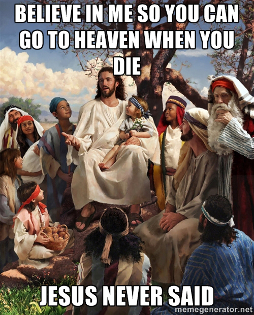
Jesus never saidThat’s the Evangelical message of the Gospel in a nutshell but Jesus never said it…ever. For that matter, neither did Paul, Peter, James, or any of the other apostles.

In fact, Jesus rarely spoke of personal salvation and when he did, the teenage Lancaster thought it sounded…legalistic:

And someone came to Him and said, “Teacher, what good thing shall I do that I may obtain eternal life?” And He said to him, “Why are you asking Me about what is good? There is only One who is good; but if you wish to enter into life, keep the commandments.” Then he said to Him, “Which ones?” And Jesus said, “You shall not commit murder; You shall not commit adultery; You shall not steal; You shall not bear false witness; Honor your father and mother; and You shall love your neighbor as yourself.” The young man said to Him, “All these things I have kept; what am I still lacking?” Jesus said to him, “If you wish to be complete, go and sell your possessions and give to the poor, and you will have treasure in heaven; and come, follow Me.” But when the young man heard this statement, he went away grieving; for he was one who owned much property.

Matthew 19:16-22 (NASB)

The traditional Evangelical interpretation is that Jesus was playing a little game with this fellow to help him realize that he needed to leave his wealth behind and learn to trust Jesus, but I don’t see how the fellow in question could come to that conclusion when Jesus was speaking of the commandments and merit, a very Jewish message.

But the Evangelical message of the plan of salvation, although it’s some part of the Gospel message, is not only a small part of that overall good news, it’s terrifically misleading. It only teaches that you have to confess Jesus as Savior and believe in him. That’s it. In fact, Lancaster says Evangelicals shouldn’t really be called Evangelicals but rather “Salvationists” because of the narrow focus of their message.

They’re not even replacement theologists but rather displacement theologists, because the plan of personal salvation, as the length, breadth, and depth of their doctrine, displaces all of the Old Testament, the resurrection, a literal Israel, and the establishment of the Kingdom of Messiah on Earth. Why would you need an Earthly Kingdom if you go to Heaven when you die to be with Jesus?

What was the central message of the Messiah?

From that time Jesus began to preach and say, “Repent, for the kingdom of heaven is at hand.”

Matthew 4:17 (NASB)

Gates of HeavenThe NIV and other translations use the word “near” rather than “at hand.” The Kingdom of God is near. How near is it? Lancaster says it’s so near that the Messiah has even been named. He’s Jesus of Nazareth. He’s teaching repent of your sins, return to God, be immersed in the name of Messiah for the forgiveness of sins (after you fully repent), then you will participate in the building of the Kingdom, the restoration of national Israel, the return of the Jewish exiles to their Land, the raising of Israel as the head of all the nations.

Lancaster spoke too quickly for me to capture all of his points, but at the end, he said Peter’s message in Acts 2:37-42 is a much better representation of the actual Biblical Gospel message than what Evangelicals preach.

And at the culmination of the Kingdom, all of humanity, each and every individual, will stand before the throne of judgment. The Evangelical message of salvation is only included in bits and pieces of the total Gospel, and it’s still an anti-Jewish people and anti-Judaism message if only because it wholly denies the centrality of Israel and the Jewish people in its own salvational plan.

It gets worse. Jesus preached:

And someone said to Him, “Lord, are there just a few who are being saved?” And He said to them, “Strive to enter through the narrow door; for many, I tell you, will seek to enter and will not be able.

Luke 13:23-24 (NASB)

This is not what Evangelicals preach about salvation. For example, how can you “strive to enter the narrow door,” when there’s nothing you can do to merit salvation? Evangelicals say to “accept” and “make a decision for Christ” which are quite passive. Striving is active and implies you must do something to enter the narrow gate. Also, how can the gate be so narrow if whole stadiums and auditoriums of people are “getting saved” by some big name evangelist preacher at a huge revival?

milkThat last part is a little tongue-in-cheek, but you get the idea. Jesus didn’t teach that the Gospel message or even the salvational part of it was “believe in me and be saved.” He taught, “repent, have faith, become a disciple, for there will be a resurrection of the dead, and the living and the resurrected will participate in final redemption.” Lancaster says the actual Gospel message isn’t news to Messianic Judaism but it must be quite a shock to most of the world’s 100 million Evangelical believers. Most Evangelicals don’t even know about the “milk” being taught in the Bible, let alone the “meat,” and this is where we re-engage the Book of Hebrews.

Therefore leaving the elementary teaching about the Christ, let us press on to maturity…

Hebrews 6:1 (NASB)

Lancaster ended here a few weeks ago and this is the place where we have come to again. This is also the heart of Lancaster’s new book Elementary Principles: Six Foundational Principles of Early Jewish Christianity, which is available as a special promotion (sorry to sound like a commercial, but it’s a pretty good deal) until June 3rd.

Lancaster wound down his sermon with another summary of the six foundations of the faith and said starting next week, he’s going into each of them in detail, with repentance being the very first step.

What Did I Learn?

As I mentioned, I’ve read and reviewed McKnight’s book last year, so this was more like a review than a revelation. I’ve also been going through my own study of repentance or teshuvah, so his comments on repentance operated in parallel to my own thoughts.

I don’t think that all Evangelicals have quite such a narrow view of the message of the Gospel, but I agree that even the most enlightened Evangelical is missing at least part of the picture. I know Evangelical Christians who strongly preach repentance of sins and who even lament there are many people in the pews on Sunday, who in all probability, are not saved because all they know is to passively believe.

I don’t doubt that some and hopefully many Evangelicals are indeed saved and are faithfully serving God, but it’s not my place to say who is and who isn’t. It’s my place first and foremost to care for my own relationship with God, for without love of God how can I love my fellow human being in the manner my Master commands?
Elementary PrinciplesLancaster doesn’t recommend McKnight’s book to his congregation, probably because he believes they are more tuned in to the actual message of the Gospel because of their involvement in Messianic Judaism (and being consumers of Lancaster’s prolific teachings and writings). I do recommend McKnight’s book to Evangelical Christians as a means of understanding that what Lancaster is teaching isn’t “Evangelical bashing,” but rather a startling wake up call.

Do you really want to know what Jesus taught as the good news of Christ? You may not get the full message from your Pastor’s sermons or from popular books by Christian authors. You probably won’t even get it in Sunday school or at a Wednesday night Bible study. If you read McKnight’s book, please open your mind and heart and be prepared for a shock. If you survive the book intact and want to learn more, continue with Lancaster’s book and see where that takes you.

Sermon Review of the Holy Epistle to the Hebrews: Things that Belong to Salvation

Eternal Security or Eternal Insecurity?

The “things that belong to salvation” include the gift of the Spirit, the goodness of the word of God, and the power of the age to come. This sermon deals with the difficult and controversial material in Hebrews 6:4-12.

-D. Thomas Lancaster
Sermon Sixteen: Things that Belong to Salvation
Originally presented on May 4, 2013
from the Holy Epistle to the Hebrews sermon series

For in the case of those who have once been enlightened and have tasted of the heavenly gift and have been made partakers of the Holy Spirit, and have tasted the good word of God and the powers of the age to come, and then have fallen away, it is impossible to renew them again to repentance, since they again crucify to themselves the Son of God and put Him to open shame. For ground that drinks the rain which often falls on it and brings forth vegetation useful to those for whose sake it is also tilled, receives a blessing from God; but if it yields thorns and thistles, it is worthless and close to being cursed, and it ends up being burned.

But, beloved, we are convinced of better things concerning you, and things that accompany salvation, though we are speaking in this way. For God is not unjust so as to forget your work and the love which you have shown toward His name, in having ministered and in still ministering to the saints. And we desire that each one of you show the same diligence so as to realize the full assurance of hope until the end, so that you will not be sluggish, but imitators of those who through faith and patience inherit the promises.

Hebrews 6:4-12 (NASB)

The Unplanned Detour

Lancaster went through a brief review of last week’s lesson and then, like the writer of Hebrews, intended not to cover any more material based on the six foundations since the Hebrews writer categorized those foundations as “milk” and not “solid food.”

But during the week, Lancaster received many requests from people, both face-to-face and by email to go into more details on the “milk”. It seems as if what the writer of the epistle to the Hebrews considered the ground floor basics of the faith are very difficult for modern Christians to grasp.

Lancaster wanted to make this detour back into the basics, but his lesson plan wasn’t written around it and a week wasn’t enough time to prepare. He wanted to get into chapters 7, 8, and 9 of Hebrews, but today, he’ll stay in chapter 6 and tell his audience what I consider something important (but I haven’t really found anything unimportant in what Lancaster has presented as yet). We’ll be back to learning how to drink milk by the by.

The Point of No Return

…and then have fallen away, it is impossible to renew them again to repentance, since they again crucify to themselves the Son of God and put Him to open shame.

Hebrews 6:7 (NASB)

This is actually terrifying on a personal level. I have family members who once came to faith in Yeshua who have since fallen away from him. I have friends in the same condition. This sounds like once you apostasize from faith in Jesus you will never, ever be able to come back, no matter what. That’s what a Bible literalist would conclude.

Does that means the people I love who have fallen away are doomed to burn forever? Is their no way to reach out to them and save them?

Lancaster’s opinion is not that of a Bible literalist. He does say that questions like these almost resulted in the Book of Hebrews not being canonized.

Think of it as the difference between the Western Church and the Eastern Church. For nearly a century (2nd to 3rd centuries CE) the Western Church thought that your sins were only forgiven up to your baptism. After that, if you sinned as a believer, you were condemned to hell. The Eastern Church wasn’t even concerned with the issue. It’s the difference between linear Greek thought (Western Church) and global Hebraic thought (Eastern Church).

For a Greek thinking Church, everything is on or off, black or white, left of right, there are no ambiguities in the text. Hebraic thinking, global as opposed to linear thinking can contain a lot more dynamic tension and even apparent contradictions in the Word. It’s the difference between believing one has to be either a Calvinist or an Arminianist, vs. believing that God is completely, perfectly, absolutely sovereign and man can also have free will to choose or reject God.

Eternal Security of Insecurity

But make no mistake, Lancaster does believe the writer to the Hebrews is delivering a dire and potentially fatal warning about the dangers of falling away from faith in Messiah. After falling away, it will be extremely difficult, and may be impossible to return to faith.

The focus of the letter so far has generally been one of warning and support of a population of Hellenized Jews in the area of Jerusalem who were in danger of or who had already lost access to the Temple. They were heartbroken and desperate to obey the commandments of the sacrifices. Who would be their priest? They were in grave danger of falling away from the Master in order to return to the Temple.

the letterSo yes, this is a letter of warning. But it isn’t a sudden detour into the theology of soteriology, the theology about how salvation works. That’s how most Christians read it, badly parsing the text into bite-sized but otherwise unrelated chunks. When you write a letter, unless you are a bad writer, you write with an overall theme in mind, not by tossing in an unassociated theological smorgasbord of ideas and concepts.

Lancaster says he tends to be more of a Hebraic thinker. He doesn’t believe salvation can be reduced to a series of talking points or some sort of bulleted list. He does believe it’s possible to lose one’s salvation, but he also believes that God’s grace covers a multitude of sins. Without grace, we would never survive, even as believers.

What You Have to Lose

What distinguishes a Messianic believer?

For in the case of those who have once been enlightened and have tasted of the heavenly gift and have been made partakers of the Holy Spirit, and have tasted the good word of God and the powers of the age to come…

Hebrews 6:4-5 (NASB)

Lancaster breaks this down into a list (I just got done saying salvation can’t be reduced into a list, but this isn’t a recipe to the plan of salvation):

  1. Enlightened
  2. Tasted the Heavenly gift of the Holy Spirit
  3. Tasted the Good Word of God
  4. Tasted the power of the Age to Come

This is what you have to lose and, as a believer, what you possess right now.

We are enlightened, that is, we have received the revelation of God, the awareness of the spiritual world, and the knowledge of salvation through faith in Messiah by grace.

We have received the Holy Spirit, God’s gift of a foretaste of the Heavenly Kingdom.

We have tasted the beautiful flavor of the Word of God, the Bible.

We have tasted the power of the age to come.

I think enlightenment, the Holy Spirit, and the Bible are all more or less understood, but what is the power of the age to come? Resurrection. We know Christ was resurrected from the dead and in that promise, so will we upon his return. The dead will be raised in him.

Lancaster drew a parallel between the approach of the weekly Shabbat and the Messianic Age. In Orthodox practice, all meals must be cooked before the arrival of Shabbat at sundown on Friday. Anyone who’s done any cooking knows you sometimes taste the dish before it’s finished to see how it’s coming along. Lancaster says that tasting the soup, so to speak, before the arrival of Shabbat is like tasting a preview of the Shabbat.

Bubbe's soupTasting the revelation of God, receiving the Holy Spirit, apprehending the Word of God, and the knowledge of the resurrection are all the foretaste, the preview of the future Messianic Age, the Kingdom of God on Earth.

That’s what we have to lose.

Lancaster tells us a midrash which I’ve heard before and one that I’ll repeat here because I think it’s important.

It is said that when humanity is resurrected, everyone will still have the physical defects they possessed when they died. If a man died without a left arm, he will be resurrected without a left arm.

Only after the resurrection will he be healed.

Why?

But Thomas, one of the twelve, called Didymus, was not with them when Jesus came. So the other disciples were saying to him, “We have seen the Lord!” But he said to them, “Unless I see in His hands the imprint of the nails, and put my finger into the place of the nails, and put my hand into His side, I will not believe.”

After eight days His disciples were again inside, and Thomas with them. Jesus came, the doors having been shut, and stood in their midst and said, “Peace be with you.” Then He said to Thomas, “Reach here with your finger, and see My hands; and reach here your hand and put it into My side; and do not be unbelieving, but believing.” Thomas answered and said to Him, “My Lord and my God!” Jesus said to him, “Because you have seen Me, have you believed? Blessed are they who did not see, and yet believed.”

John 20-24-29 (NASB)

The midrash states that if a person were resurrected in a totally healed state, he would be unrecognizable and many might doubt that the same man who died was the one resurrected. The example of Jesus and Thomas gives much credence to the midrash. Certainly Jesus appeared very, very different to John in Revelation 1:12-16 than he did, even within the first few weeks after the resurrection.

This is the power of the promise of the resurrection. And this is what we risk losing if we deny Yeshua.

Crucifying Jesus All Over Again

…and then have fallen away, it is impossible to renew them again to repentance, since they again crucify to themselves the Son of God and put Him to open shame.

Hebrews 6:6 (NASB)

Lancaster interprets this rather troublesome verse thus:

One who walks away from his faith in the Master can be compared to one who would crucify the Messiah again, bringing him to shame. May God have mercy on that person.

The Death of the MasterIt isn’t some mystical or literal re-crucifixion, but a metaphorical comparison. Apostasy is a dreadful, disgraceful act, according to Lancaster, and the path back from falling away, should that person repent, is as if the Master needs to be crucified again. But by God’s grace and mercy it is still possible to return!

Apostasy is a very, very hard place to come back from, but it’s not an absolute hopeless place of no return.

Thanks be to God.

For ground that drinks the rain which often falls on it and brings forth vegetation useful to those for whose sake it is also tilled, receives a blessing from God; but if it yields thorns and thistles, it is worthless and close to being cursed, and it ends up being burned.

Hebrews 6:7-8 (NASB)

Let’s first cover one part of verse 8 before moving on:

it is worthless and close to being cursed (emph. mine)

It is in grave danger of being burned and destroyed, it is very close to that end, but that final destruction, while imminent, is not absolutely a foregone conclusion.

In other words, if you let this happen you to, you are on the brink of falling into an endless pit of fire and darkness but it is still (marginally) possible for you to come back.

Lancaster spent some time comparing the Hebrews writer’s audience to the Master’s parable of the Sower (Matthew 13:3-23) as well as the parable of the Tares (weeds) among the Wheat (Matthew 13:24-30). These are all warnings of the level of our faith and whether we are even aware of the level (deep or shallow) of our faith (He says a lot more than what I’m including in this review, so you’ll want to listen to the entire recording for the details).

In a field of wheat and tares, it is impossible at first to tell the difference. When you go to church on Sunday or synagogue on Saturday, looking around the sanctuary, can you visually tell the difference between believers and false converts? Are people who raised their hand at a revival meeting or who once answered an altar call automatically saved and their “fire insurance” fully and permanently paid?

wheat and taresMany “weeds” are absolutely sure they are “wheat” even though they live like weeds. Lancaster told a story about a church youth group where almost all of the teens were sexually active and yet, they all (or most) believed they were saved and living Christian lives.

Then Lancaster made a confession. He said he was a weed and shallow dirt. But the difference is that he is deeply concerned about his being a weed. Even Paul admitted he was a weed:

I find then the principle that evil is present in me, the one who wants to do good. For I joyfully concur with the law of God in the inner man, but I see a different law in the members of my body, waging war against the law of my mind and making me a prisoner of the law of sin which is in my members. Wretched man that I am! Who will set me free from the body of this death? Thanks be to God through Jesus Christ our Lord! So then, on the one hand I myself with my mind am serving the law of God, but on the other, with my flesh the law of sin.

Romans 7:21-25 (NASB)

Even the best among us (and that certainly isn’t me) struggles between our two natures. Paul called himself a “wretched man” and so are we all wretched people in this struggle, desiring to obey the Master and continually failing. My review of the four steps in making teshuvah speaks a great deal about the continual struggle we have in repentance.

Saving Grace

The danger of falling away is great and the consequences are (potentially) terrible, but there is a “saving grace.”

But, beloved, we are convinced of better things concerning you, and things that accompany salvation, though we are speaking in this way. For God is not unjust so as to forget your work and the love which you have shown toward His name, in having ministered and in still ministering to the saints. And we desire that each one of you show the same diligence so as to realize the full assurance of hope until the end, so that you will not be sluggish, but imitators of those who through faith and patience inherit the promises.

Hebrews 6:9-12 (NASB)

Amid the cries of warning there’s also hope and encouragement. We haven’t fallen over the edge of the cliff yet, though we (or rather, the Hebrews reading the letter) are (were) still dangerously close. If you’re worried about whether or not you’re a weed, even if you’re a weed, you can still come back and be wheat. Be honest about the state of your heart and your need for a Savior and you can still repent and be saved.

What Did I Learn?

If you’ve been reading my Teshuvah series, you should realize that this exploration isn’t just for the sake of teaching but also for the sake of learning. Seeking God’s grace and repenting of sins isn’t the simple little task many of us were taught to rely upon. Since sin still lives in our hearts, our repentance should be active and continual. It’s still possible to fall off the wagon and while climbing back on isn’t impossible, it isn’t easy, either. In fact, once fallen, it may seem impossible to return, and so most people usually either give up or tell themselves a story that falling off was the right thing to do.

More’s the pity.

FallingThis isn’t just about me. It’s about people I love. It’s about people who have fallen and fallen hard, and yet they don’t see the problem. In fact, they think that apostasy from faith in the Master was the best thing that could ever have happened to them. Some still follow a religious tradition and while their faith is important and contains many good things, by definition (seemingly), it requires denying Yeshua.

Most Christians, including Hebrew Roots people, have long since written off my loved ones as already, permanently, irredeemably condemned to be thrown into the fire and perpetually burned.

May it never be!

I was scared to death when I read Hebrews 6:6. I was immeasurably grateful when Lancaster didn’t insert a “hard stop” at the end of that verse and also write off my loved ones.

If you’re an Evangelical and/or a Bible literalist, I believe I know what you’re thinking. You’re thinking I’m choosing to believe Lancaster and that I’ve chosen a Messianic Jewish perspective for self-serving reasons. You believe that I want there to be hope for my fallen loved ones and my chosen belief allows me to still continuously pray for their salvation and restoration.

Yes, of course I still hope and pray. Wouldn’t you?

But that’s not the only reason I believe what I believe. Something inside of me keeps telling me this is the right way to view things and the right way to go. I believe one of the “crimes” of the Church, at least historically, is that they (we) have been too literal in all the wrong places, and we’ve chosen a hard-line instead of God’s selection, grace and mercy.

Then the Lord passed by in front of him and proclaimed, “The Lord, the Lord God, compassionate and gracious, slow to anger, and abounding in lovingkindness and truth; who keeps lovingkindness for thousands, who forgives iniquity, transgression and sin; yet He will by no means leave the guilty unpunished, visiting the iniquity of fathers on the children and on the grandchildren to the third and fourth generations.” Moses made haste to bow low toward the earth and worship. He said, “If now I have found favor in Your sight, O Lord, I pray, let the Lord go along in our midst, even though the people are so obstinate, and pardon our iniquity and our sin, and take us as Your own possession.”

Exodus 34:6-9 (NASB)

It’s ironic in a sense, that I turn to the Torah, the Law, which Christianity disdains, in order to illustrate God’s grace and mercy in which we Christians have always depended upon so greatly. Most of us still believe grace and mercy only came to Earth with the birth of Jesus Christ. And yet the Jewish people have relied upon God’s thirteen attributes of mercy for must longer than two-thousand years.

I depend on God’s mercy. I depend on God’s mercy and grace not only for my flawed and damaged self but for everyone I love, who are also flawed and damaged. As I once heard said, if faith is a crutch, who isn’t limping? I’ve got a terrible limp. So does everyone I’ve ever met.

Man alone in a caveWe are all at risk of falling. We are all in danger of going “ker-splat” on the hard, cold ground. Once down there, getting back up isn’t easy, and for some, it seems impossible.

And for some, it seems like falling down put them in a better place, the better place. If not for God’s mercy, not only would it be impossible for them to get up, but God would just let them lie there.

If you ever find yourself at the bottom of a pit or deep in some dark, damp cave, look up. If there isn’t enough light for that, feel around. God provides a rope or a ladder, even for the apostate. All you have to do is find it and then to start climbing.

Sermon Review of the Holy Epistle to the Hebrews: Six Foundations

What are the fundamentals?

Discover the six basic teachings of Messianic faith from Hebrews 5:11-6:3. This sermon presents and introduction and overview of repentance from dead works and of faith toward God, and of instruction about washings, the laying on of hands, the resurrection of the dead, and eternal judgment. (Hebrews 6:1-2).

-D. Thomas Lancaster
Sermon Fifteen: Six Foundations
Originally presented on April 27, 2013
from the Holy Epistle to the Hebrews sermon series

Concerning him we have much to say, and it is hard to explain, since you have become dull of hearing. For though by this time you ought to be teachers, you have need again for someone to teach you the elementary principles of the oracles of God, and you have come to need milk and not solid food. For everyone who partakes only of milk is not accustomed to the word of righteousness, for he is an infant. But solid food is for the mature, who because of practice have their senses trained to discern good and evil.

Therefore leaving the elementary teaching about the Christ, let us press on to maturity, not laying again a foundation of repentance from dead works and of faith toward God, of instruction about washings and laying on of hands, and the resurrection of the dead and eternal judgment. And this we will do, if God permits.

Hebrews 5:11-6:3 (NASB)

As someone commented recently on another of these reviews, in this sermon, Lancaster takes a break in teaching about Messiah as high priest according to the order of Melchizedek, but frankly, so does the writer of Hebrews. Lancaster says the writer of the Epistle to the Hebrews became frustrated with his readers. Why? Because he wanted to get into the deep mysteries of the priesthood of Melchizedek but he felt his audience wasn’t up to the challenge. They were still struggling with the very basics, the fundamentals of faith in Messiah. They were still consuming milk when they should have been dining on t-bone steaks by now.

Lancaster pauses to say something I don’t think many Christians, including Christian teachers and Pastors, are going to like.

If you’ve been reading this review series regularly and (hopefully) been listening to the previous recordings of these lectures, you know that within the first five chapters of Hebrews, we discover a multi-layered storehouse of meaning that is not evident on a surface reading, especially in English. The level of knowledge and education required to get this far exceeds, in Lancaster’s opinion, what is being taught in most (or all) Christian seminaries today.

In my opinion, all the various expressions of the Christian Church are so married to the static doctrine of their faith, that they can’t allow themselves to seriously examine the perspectives necessary to plunge into the hidden depths this Epistle possesses.

milkThe Hebrews writer considered the readers of his letter to be infants needing milk, unable to consume solid food, much as Paul addressed his own readership in 1 Corinthians 3. But if the original readers could follow the first five chapters of Hebrews and understand the deeper meanings are considered babies (since the writer to the Hebrews must have assumed he was being understood by his readers), then what does that make us in the Church today? Less than infants? Tiny, newborns? Undeveloped babies still in the womb? That’s hardly flattering at all. But what if it’s true?

Moving back to the text, Lancaster says this part of Hebrews outlines the basic foundations of Christianity or, in this case, Messianic Judaism as it was understood, taught, and practiced in the first century. He teases out a list of six items:

  1. Repentance from dead works
  2. Faith toward God
  3. Instructions about washings
  4. Laying on of hands
  5. Resurrection of the dead
  6. Eternal judgment

Even the summary Lancaster presents in today’s sermon is dense with information, and yet, these were the very, ground floor, teachings of what we think of as early Christianity among the Jewish believers. However, as you’ll see, every one of these fundamentals of the faith are completely Jewish teachings and were endorsed by the Pharisees.

And Lancaster says that even these fundamentals are almost completely beyond the comprehension of Christians today.

Repentance from Dead Works

When most Christians, including Pastors and teachers, read “repentance from dead works,” they believe, almost by reflex, that this is talking about repenting from works of the Law, that is, repenting from performing the Torah mitzvot.

Lancaster used some pretty strong language here and says the Protestant interpretation of “dead works” is dead wrong and in fact, the exact opposite of what the letter’s writer was trying to say.

For the wages of sin is death…

Romans 6:23 (NASB)

TorahWe covered a lot of this last week. Obedience to God doesn’t bring death. Sin brings death. These were Jews the letter writer was addressing. It would have been insane to tell a bunch of Jews longing to return to bring offerings at the Temple that observing the Torah was “dead works”. Dead works equals sin, according to how Lancaster reads this. He not only called the current Church interpretation of “dead works” wrong, he said the teaching was satanic. This is the first time I’ve ever heard Lancaster go this far in “calling out” a traditional Church teaching.

What was the basic teaching of Jesus? Did he say, “believe in me and you’ll go to Heaven when you die?”

“Repent, for the kingdom of heaven is at hand.”

Matthew 4:17 (NASB)

Jesus taught repentance of sins, not repentance of Torah obedience. He taught teshuvah. He taught turning away from sins and turning back to God. In Lancaster’s teaching about the New Covenant, he says over and over that Covenant is all about having a relationship with God by obedience to the mitzvot, which is what the Jewish people, including the believers, were doing. The first mitzvah is repentance, and it’s a mitzvah we must perform daily, lest we slowly, subtly fall away from the teachings of the Master and thus, fall away from God. Remember, Lancaster believes the letter’s readers were in grave danger of losing faith in Messiah and apostatizing.

Faith Toward God

You’d think this was a no brainer for the readers of the letter and for us, but faith is a lot more than just believing God exists. True, we must believe God exists before we can do anything else, but belief isn’t the goal, it’s just the starting line in the race.

In James 2:19 we learn that even the demons believe and they tremble, but we certainly can’t say that their belief somehow equals faith in God. Nearly two-and-a-half years ago, I wrote a commentary about the difference between faith and trust based on a rabbinic midrash, and I think it carries Lancaster’s meaning well.

We must trust in God’s sovereignty, that He is in control, and that He rewards obedience and punishes sin, both in this life and in the life to come. That means what we do matters. Our actions aren’t worthless or, as Derek Leman once put it, our deeds are not filthy rags. A transformed life in Messiah reflects that transformation in what we do.

Having faith equals having a relationship with God and, as Lancaster states in the aforementioned “New Covenant” lectures, covenant is all about establishing relationship, in this case, between man and man and between God and man. Lancaster said it’s a false teaching that all we have to do is “believe” intellectually or emotionally and do nothing else and that we are saved. If we don’t lead a life that shows fruit, our belief means nada.

As it turns out, Judaism at its core, is not a “religion of dead works,” but instead, its a covenant of intimate relationship between Israel and God.

Instruction About Washing

Washing? What? Is this about the various ritual washings such as Netilat Yadayim?

Some English translations of the Greek “baptismo” render the word “baptism,” but the problem is the word in Greek is plural. If this is supposed to be about multiple water and spirit baptisms, then it becomes a theological problem, since we are baptized in water and receive the Spirit only once. How can immersion be “immersions?”

Remember, this is a Jewish audience, an audience that would immerse on any number of occasions in the mikvah in order to render themselves ritualistically pure. They’d immerse daily before going up to the Temple. They’d immerse before getting married, women would immerse once a month, and the Torah prescribed many other circumstances that required immersion by Jewish men and women.

So what about the immersion of John the Baptist? Didn’t that replace all of the others? Lancaster calls John’s immersion the “Immersion of Repentance” which is also immersion into the Name of Yeshua. We see the first Gentile immersed in Messiah’s name in Acts 10.

But why would a group of Jewish believers need instruction about the mikvah as a fundamental teaching Messiah? They would have already been well versed in mikvah instructions from Torah. The way that the Greek expresses it, “baptismo didacus,” Lancaster believes that these were the instructions a new disciple would be given about the teachings of Messiah before being admitted into fellowship and immersed. We may even have those instructions preserved for us in the Didache, the set of teachings provided to new Gentile disciples of the Master, probably within or soon after the Apostolic era.

Do we have this today? So many churches, according to Lancaster, are focused on getting as many people saved as possible, but the Bible doesn’t say to make converts, but to make disciples (see this book review, and this short video for more). Is discipleship a lost practice in today’s Church? For many churches, the answer is “yes,” especially when compared to the process of discipleship as it existed in the various first century Judaisms. What we may be creating instead is a body of false converts where only a small minority of people in church pews every Sunday are actual disciples who are leading transformed lives in Messiah. The rest are merely those who said “Christ is Lord” and “believe” but otherwise are unchanged human beings.

The Laying On of Hands

laying on of handsBesides in Pentecostalism, the Church isn’t into laying on of hands anymore. In the Bible, people were cured of illness through laying on of hands, but the practice is much older and in fact, based on the Torah and sacrificial system. The first step in offering a sacrifice at the Temple was for the person making the offering to lay hands upon it, transferring identity, if you will, so that in the case of a sin offering, the sacrifice would be made in place of the person.

Moses laid hands on Joshua to transfer authority over the tribes of Israel to him. Lancaster believes that after the mikvah, the last step in admitting a disciple into the fellowship of faith was to lay hands on the person, even as it was for the conferring of authority to a new elder in the community.

Do not neglect the spiritual gift within you, which was bestowed on you through prophetic utterance with the laying on of hands by the presbytery.

1 Timothy 4:14 (NASB)

Presbytery is also translated as “board of elders.”

So the basic steps of training and inducting a new disciples would be:

  1. Education in the teachings of Yeshua
  2. Acceptance into the community
  3. Immersion of repentance and into the name of Messiah
  4. Laying on of hands by the board of elders or the head teacher

All basic stuff, according to the Epistle’s writer. Fundamentals of the faith, first century Pharisaic Judaism style.

Resurrection of the Dead

Now this you’d think the Church would have down cold. I’m writing this on Easter Sunday so I’m sure Churches all over the world are preaching about the resurrection today. But according to Lancaster, many churches avoid talking about a literal, physical, bodily resurrection and instead, preach going to Heaven as a bunch of spirits. That’s eternal death (of the body) not eternal life.

The Kingdom of Heaven isn’t Heaven and it isn’t sitting on a cloud, strumming a harp forever and ever. It’s the Kingdom of God established on earth populated by a people who have been raised physically from the dead, which is why we call Yeshua our “first fruits from the dead.” It is his resurrection that is proof that we too will one day be resurrected in the faith through grace. Then we live here under the reign of King Messiah as living, breathing human beings under the New Covenant, with the Torah written on our hearts…and we will know God.

Eternal Judgment

This too should be well understood in the Church, the fact that there will be a final judgment for all humanity, when we will have to give an account for every word and deed we’ve committed in this life. Like the Master said, “Repent for the Kingdom of Heaven is at hand.” It was “at hand” or “imminent” because Messiah had entered the world and his death and resurrection flipped the “on” switch to start up the New Covenant. It’s on the edge of coming and is entering our world even now. And yet it will not have arrived until the Messiah returns.

repentanceWe have time, but who knows how much. Repent now. Don’t wait. Repent and obey. Lead a transformed life. Exert every effort so that when the books are opened, your name will be written in the Book of Life and not in the Book of Death.

Basic teaching. Milk.

And each and every one of these six fundamentals is what the Pharisees taught and these teachings were despised by the Sadducees. But the Sadducees had control of the Temple and the Priesthood and had no reason at all to allow the Jewish Pharisaic believers in Messiah access to the sacrificial system. So who would be their priest?

What Did I Learn?

I’d never separated out six fundamentals of faith in Messiah during the Apostolic period from Hebrews before. But what made the biggest impression was how, if we are to believe Lancaster, the vast, vast majority of the people we call Christians today are misreading not only this Epistle, but misunderstanding the fundamentals of their (our) own faith that is taught by the Bible.

I’ve written about Christian Fundamentalism before, which can trace its origins in Church history back about a century, but it doesn’t look like what Lancaster taught today. In fact, if you click the link I just provided, it too presents six fundamentals of the faith. They are just six points that don’t resemble those points we read in Hebrews 6:1-2

I felt Lancaster was a little hard on the Church, a little too critical of their mistakes and errors. After all, Lancaster was raised in the Church and his father was a Pastor. How long did Lancaster have to study and how many of his previously cherished attitudes and beliefs did he have to painfully surrender before he got to the point where he could teach this interpretation of Hebrews at Beth Immanuel?

This may sound strange, but I have the good fortune of not having spent my entire life in the Church. I had much less to “unlearn” and not too many attitudes and emotional attachments to Church tradition to give up. I have had quite a long and interesting time of putting together the Hebraic viewpoints on the Scriptures in a way that actually makes sense relative to the entire Biblical record, and I freely admit that Lancaster’s teaching, both at Beth Immanuel and through First Fruits of Zion, have been highly instrumental in that unlearning and retraining process.

But successfully transmitting that information to long-term and life-long Gentile believers is the challenge. Even getting a Christian to the point of considering that teachings like this one have value seems all but impossible. Many believers are so cemented into their theology and doctrine, that it would take dynamite to blow them out of their viewpoint and move them to a perspective where the Bible looks like and teaches something that, in my opinion, is much more consistent across the board. Many Christians don’t even believe there is more than one perspective on the Bible, and for those who do, they see those alternate perspectives are representing error, cultish belief, and even heresy.

But the end result is still the same. We enter the fellowship of Messiah through faith by grace and undergo a transformation into a new being who we are now and who we are in the process of becoming, little by little, until Messiah returns and the New Covenant is completely enacted.

followWe just need to be willing to take the risk of listening to teachings like this one critically but with an open mind. Once we learn to accept that what we’ve been taught about the Bible isn’t what the Bible actually says, we are faced with the daunting task of changing the Church from within to be more consistent with what the revealed Word of God turns out to be.

Some will follow. Others will continue to resist, clinging to the doctrines they’ve come to love, regardless of how they misconstrue God’s intent, especially toward Israel.

“Sometimes you have to move on without certain people. If they’re meant to be in your life, they’ll catch up.”

-Mandy Hale

To learn more about the six foundational principles of ancient Jewish Christianity, consider D. Thomas Lancaster’s new book Elementary Principles which is being offered by First Fruits of Zion (FFOZ) for free between now and June 3rd.

Sermon Review of the Holy Epistle to the Hebrews: The Source of Eternal Salvation

Follow the apostolic logic and discover the relationship between Psalm 2 and Psalm 110 and how the writer of the book of Hebrews derived the priesthood of Messiah. This teaching comes with a stern call to discipleship.

-D. Thomas Lancaster
Sermon Fourteen: The Source of Eternal Salvation
Originally presented on April 20, 2013
from the Holy Epistle to the Hebrews sermon series

So also Christ did not glorify Himself so as to become a high priest, but He who said to Him,

“You are My Son,
Today I have begotten You”;
just as He says also in another passage,

“You are a priest forever
According to the order of Melchizedek.”

In the days of His flesh, He offered up both prayers and supplications with loud crying and tears to the One able to save Him from death, and He was heard because of His piety. Although He was a Son, He learned obedience from the things which He suffered. And having been made perfect, He became to all those who obey Him the source of eternal salvation, being designated by God as a high priest according to the order of Melchizedek.

Hebrews 5:5-10 (NASB)

In today’s sermon, Lancaster starts out with a bit of review of earlier in this chapter of Hebrews and ends it by “getting Evangelical.”

We return to the concept of the High Priest, who Lancaster called “the Holiest man in the world.”

Now when these things have been so prepared, the priests are continually entering the outer tabernacle performing the divine worship, but into the second, only the high priest enters once a year, not without taking blood, which he offers for himself and for the sins of the people committed in ignorance.

Hebrews 9:6-7 (NASB)

The High Priest was the hope of the nation. Only he could enter the Holy of Holies on Yom Kippur and offer atonement for all of Israel. Every Jewish heart turned in repentance toward the Temple, the Most Holy Place, and the High Priest that their sins would be forgiven and atoned for, and they might be justified before God.

But as you might recall from previous reviews in this series, Lancaster believes the readers of the letter to the Hebrews were Hellenistic Messianic Jews who had been denied access to the Temple, the Priesthood, and the sacrifices, by the Sadducees who administered the Temple in those days. How heartbroken and anguished must these Jewish disciples of the Master have been, believing the High Priest on Yom Kippur was not atoning for their sins among the people of Israel.

James the Just and other apostolic figures had been martyred. The Messianic disciples were cut off from the Temple, their faith in the Master was wavering. And this epistle was sent to them as consolation and exhortation, and even as prophesy of a life when the Temple would be no more and all the Jewish people would suffer exile.

They needed a priest. But where did the writer of Hebrews get the idea that Yeshua (Jesus) of the tribe of Judah and the house of David was a High Priest? Wasn’t that only for the sons of Aaron?

And no one takes the honor to himself, but receives it when he is called by God, even as Aaron was.

Hebrews 5:4 (NASB)

In Judaism, no one chooses to be High Priest. Not even King David himself could perform the duties of the High Priest. Only the son’s of Aaron.

Hillel and ShammaiLancaster recalled a story from the Talmud, specifically Shabbos 31, about three converts, three pagan Gentiles who wanted to become proselytes, one on the condition that he could become the High Priest. I found a summary at the Saratoga Chabad website if you’d like to review the material.

The point is, no one, not even the anointed one of God, King Messiah, can demand to become High Priest.

However, in another priestly line, we find another High Priest of a different order, Melchizedek, King of Salem, who Abraham encounters in Genesis 14:18-20

But what does he have to do with Jesus?

Lancaster reads Psalm 2 and Psalm 110 and says that they are both Psalms about Messiah, depict God establishing Messiah as ruler in Zion, show God speaking directly to Messiah, declaring Messiah as both Son and Priest:

I will tell of the decree: Hashem said to me, “You are my Son; today I have begotten you.

Psalm 2:7

Hashem has sworn and will not change his mind, “You are a priest forever after the order of Melchizedek.”

Psalm 110:4

If you go to the web page for this lesson, you’ll find a PDF with the translations Lancaster uses for these two Psalms.

In short, it’s Lancaster’s opinion that the writer of the Book of Hebrews uses Psalm 2 as the foundation for Psalm 110 and that these are his proof texts establishing Yeshua as a High Priest who is able to make atonement for us.

But when did this happen?

In the days of His flesh, He offered up both prayers and supplications with loud crying and tears to the One able to save Him from death, and He was heard because of His piety. Although He was a Son, He learned obedience from the things which He suffered. And having been made perfect, He became to all those who obey Him the source of eternal salvation, being designated by God as a high priest according to the order of Melchizedek.

Hebrews 5:7-10 (NASB)

Messiah”In the days of His flesh.” In other words, in Christ’s earthly ministry he was established as a High Priest. How? Why?

Lancaster cites these verses as a wonderful, apostolic eyewitness about how the Master prayed. He prayed very loudly, with great supplications, with crying and tears, to God, the one able to save from death. Lancaster believes this tells of the night Jesus prayed at Gethsemane (Matthew 26:36-56, Luke 22:39-46).

And even though Jesus was a Son, he obeyed God, even as Isaac obeyed Abraham at the Akedah by allowing himself to be bound as the sacrifice, but in this case, no angel saved the son of promise from becoming the Lamb of God on the altar.

He suffered and was made perfect. Wasn’t he perfect before? What perfected him? The refiner’s fire? He was perfected as we shall be, by the resurrection. And having been made perfect, Jesus then became the one who is the source of eternal salvation for all who obey him.”

This is the part where Lancaster “gets Evangelical.” This is the part when he reminded me of the Head Pastor at the church I attend.

For the most part, we learn in the church that if we believe in Jesus, we will be saved from our sins, but the writer of Hebrews says Jesus is ”the source of eternal salvation for all who obey him.”

Obey Jesus by doing what?

“Repent, for the kingdom of heaven is at hand.”

Matthew 4:17 (NASB)

First Fruits of Zion’s television series A Promise of What is to Come has a number of episodes describing what “the Kingdom of Heaven” or “the Kingdom of God” means and you can take a look at those for the details. But Jesus is calling all who hear him to repentance.

“If anyone wishes to come after Me, he must deny himself, and take up his cross daily and follow Me. (emph. mine)

Luke 9:34 (NASB)

Nevertheless, the firm foundation of God stands, having this seal, “The Lord knows those who are His,” and, “Everyone who names the name of the Lord is to abstain from wickedness.” (emph. mine)

2 Timothy 2:19 (NASB)

Repentance isn’t a one time event and it’s not mere intellectual or even emotional ascension that “Jesus is Lord”. It’s one thing to call Jesus “Master” and quite another thing entirely for him to be your Master (or my Master) by a conscious act of our (my) will, allowing him to truly rule your (my) life.

Lancaster pleaded with his audience to examine themselves and to determine if they have truly repented, if they repent daily, if they really, continually do subjugate themselves to the Master’s will, if he really is King of their (our) lives. Lancaster isn’t selling cheap grace. Lives hang in the balance. Like the writer of the Epistle to the Hebrews, Lancaster is exhorting his flock to keep to the faith, not unsaved sinners somewhere outside the body, but living human beings and devotees of the Master within the ekklesia, the body of Messiah.

What Did I Learn?

I listened to this sermon the same day I wrote For Redemption is Not Yet Complete, a dedication to repentance, turning away from sin,  and back to God.

According to Aish.com, there are four steps to repentance or teshuvah:

  1. Regret. To regret what we have done wrong.
  2. Leaving the negativity behind. To stop dwelling on the transgression in thought and action.
  3. Verbalization. To verbally state the transgression.
  4. Resolution for the future. To be determined not to let the transgression happen again.

waitRepentance, true repentance must be humanly possible, otherwise, why would God call for repentance so much in the Bible? In my studies of the New Covenant, thanks to Lancaster’s What About the New Covenant lectures, I know that we are currently in the Old Covenant times, which means we don’t yet have the ability to automatically, naturally, easily obey the voice of our Master. And yet, as believers, we are also called to listen to the voice of our shepherd as if we were already in New Covenant times.

The Master gives us all a sober warning (Matthew 25:31-46) that we can be counted as sheep or goats, and many believe they truly have turned to our shepherd but in fact, they never really repented. And in their sins, even while calling Jesus “Master,” they were rejected (or will be rejected) and sent away.

Take care, brethren, that there not be in any one of you an evil, unbelieving heart that falls away from the living God. But encourage one another day after day, as long as it is still called “Today,” so that none of you will be hardened by the deceitfulness of sin. For we have become partakers of Christ, if we hold fast the beginning of our assurance firm until the end…

Hebrews 3:12-14 (NASB)

All shepherds cry out to their sheep, not to wander away, not to be foolish, not to fool ourselves that we are somehow “once saved, always saved,” that our “fire insurance” is all paid up.

The Bible is replete with warnings against human failure and exhortations and encouragement to maintain our faith, even in severe adversity, as did Paul, as did James, even to the death, for the sake of our lives, for the sake of the Master, for the sake of the Kingdom.

If we can do nothing else, cling to him, cleave to the shepherd, grasp the holy garments of the High Priest, repent with tears and anguish, and beg for him to provide your atonement, that you might be reconciled to God and enter His Kingdom.

Chol HaMo’ed Pesach: Writing on Flesh

When Moses descended, he carried the Word of God—not the Word made flesh, but the word made stone upon the two tablets of the covenant.

“The Word from Heaven Was Broken”
Commentary on Chol HaMo’ed Pesach
First Fruits of Zion (FFOZ)

The obvious image those words should invoke is this:

And the Word became flesh, and dwelt among us, and we saw His glory, glory as of the only begotten from the Father, full of grace and truth.

John1:14 (NASB)

The Old Covenant was established with the Children of Israel at Mount Sinai and the conditions of that covenant, the Torah, were given on stone tablets.

The mediator of the New Covenant entered our world as “the Word made flesh” and the conditions of that covenant were in every spoken word and action of that “Word,” in the person of Yeshua (Jesus) of Nazareth, HaMaschiach (the Messiah). But of course, the conditions previously established didn’t change, and everything taught by the Rav from Nazareth was Torah.

“Do not think that I came to abolish the Law or the Prophets; I did not come to abolish but to fulfill. For truly I say to you, until heaven and earth pass away, not the smallest letter or stroke shall pass from the Law until all is accomplished.”

Matthew 5:17-18 (NASB)

The conditions of the Old Covenant were written on stone tablets. Exodus 32:16 says the finger of God wrote on the first set of tablets before the sin of the Golden Calf, before Moses broke them.

The FFOZ commentary tells us that according to midrash, the tablets that descended from Mount Sinai can be compared to a human body, and when Moses broke that “body,” because of the sin of Israel, the letters on the tablets flew off the stone and returned to their Source in Heaven.

When Messiah Yeshua’s body was broken due to the sin of Israel, his spirit left him and returned to its Source.

letters-on-stoneAfter the sin of the Golden Calf, Moses returned to the mountain and to God to plead for Israel and to renew the covenant (Exodus 34). This began a long and cyclical pattern of sin and repentance for Israel.

After the death of the Master, he was resurrected three days later and thus was completed the inauguration or the very starting of the New Covenant, a process that will not reach fruition until the Master’s return, for he ascended to Heaven and sits on the right hand of the Father, our High Priest in the Heavenly Court, who makes final atonement for the sins of humanity, who is the mediator of better promises. But get this:

“Moreover, I will give you a new heart and put a new spirit within you; and I will remove the heart of stone from your flesh and give you a heart of flesh. I will put My Spirit within you and cause you to walk in My statutes, and you will be careful to observe My ordinances.” (emph. mine)

Ezekiel 36:26-27 (NASB)

“But this is the covenant which I will make with the house of Israel after those days,” declares the Lord, “I will put My law within them and on their heart I will write it; and I will be their God, and they shall be My people. They will not teach again, each man his neighbor and each man his brother, saying, ‘Know the Lord,’ for they will all know Me, from the least of them to the greatest of them,” declares the Lord, “for I will forgive their iniquity, and their sin I will remember no more.” (emph. mine)

Jeremiah 31:33-34 (NASB)

The conditions of the Old Covenant were written on stone tablets and on scrolls, objects that are inanimate and external to human beings. If we want to know about God and if we want to “know God,” we must study and practice, and yet Biblical and human history is all too clear that even the best of us fail, no matter how great our desire to serve God.

praying_at_masadaYeshua came as the “Word made flesh,” the living embodiment of the Torah, the walking, talking, flesh and blood, human expression of the will and wonder of God, all contained within a human body. He was the perfect image of what we strive for, the Word written on flesh.

There’s a difference. John’s Gospel says that Yeshua was the Word made flesh, while we get from Ezekiel and Jeremiah that the Word will be written on our fleshy hearts. We don’t literally become the Word as a human being, we “merely” have it wholly integrated into our being.

But here’s the result.

Amen, I say to you, none among those born of a woman has arisen greater than Yochanan the Immerser; yet the smallest in the kingdom of Heaven will be greater than he.

Matthew 11:11 (DHE Gospels)

I mentioned above the concepts of knowing about God vs. knowing God. I don’t doubt that there are people today, great tzaddikim or saints who know God, at least to the current extent of human ability, but the Bible records that Moses spoke with God “face to face” (Exodus 33:11). That’s pretty hard for me to imagine, especially since God is considered Spirit and without physical form (the third of the Rambam’s Thirteen Principles of Faith).

But the Master prophesied that when the New Covenant is fully enacted, then the finger of God will have finished writing His Word on our hearts of flesh and, like Moses and the Prophets of Old, including John the Baptizer, we will all know God, God’s Spirit will be poured out on all flesh (Joel 2:28, Acts 2:17), and everyone, from the least to the greatest, will have a full knowledge and intimate relationship with God. We won’t just know about Him, we will know Him.

Jesus, when the Spirit was poured out on him at his immersion (Matthew 3:16) became the forerunner, the first fruits of New Covenant human beings. He was still fully human, but with the Spirit poured out on him as it will be someday in the Messianic Era, a human being who could be tempted but still not sin. He’s the living promise that we will be perfected even as he was perfected.

It’s exciting to watch God’s plan open up in the pages of the Bible. The progression from the tablets and scrolls to the first fruits of the New Covenant, Messiah, coming as the “Word made flesh,” and then anticipating the day when that Word will be written on our flesh as well.

Right now, we experience just the leading edge of that New Covenant as we continue to live in the Old Covenant era, the Spirit was given as a pledge and a promise of what is yet to come (2 Corinthians 1:22). We aren’t there yet, but God has given His Spirit to us as His bond that what He has promised will indeed occur.

But there’s a catch.

For I am already being poured out as a drink offering, and the time of my departure has come. I have fought the good fight, I have finished the course, I have kept the faith; in the future there is laid up for me the crown of righteousness, which the Lord, the righteous Judge, will award to me on that day; and not only to me, but also to all who have loved His appearing.

2 Timothy 4:6-8 (NASB)

PrayingThis doesn’t just happen.

Yes, God promised it and it will happen, but it won’t just happen to us without an effort on our part. It isn’t just an intellectual and emotional acceptance we make that Jesus is Lord and then suddenly we’re in. As we see from Paul’s example, we only get to the finish line after running the race, after exerting ourselves, after keeping the faith and holding fast to our confession (Hebrews 4:11, 14).

Recently, I wrote of some of this as applied to me personally in For Redemption is Not Yet Complete and next week’s review of D. Thomas Lancaster’s Epistle to the Hebrews sermon The Source of Eternal Salvation will speak strongly to who we are in Messiah and our role in the process of repentance and salvation.

Each day, we struggle to reaffirm our faith. Each day we must repent anew, plead for the forgiveness of our sins, and turn to Yeshua as our atonement. The finger of God is moving and writing, but only if we are willing participants in allowing our stony heart to be transformed, only if we surrender ourselves as the material upon which (upon whom) God may write His Torah.

And we do that only by recognizing the one who came from God and who returned to God and who will come again. The one who arrived as a flesh and blood man and who was (and is) also the Word. For only through him can we find the Word within us as we are within Him.

Review of “What About the New Covenant,” Part 5

Session Five: From Glory to Glory

“Behold, days are coming,” declares the Lord, “when I will make a new covenant with the house of Israel and with the house of Judah, not like the covenant which I made with their fathers in the day I took them by the hand to bring them out of the land of Egypt, My covenant which they broke, although I was a husband to them,” declares the Lord.

Jeremiah 31:31-32 (NASB)

This is the fifth and final lecture in the series What About the New Covenant presented by D. Thomas Lancaster and produced by First Fruits of Zion (FFOZ). This sermon is the one that wraps everything up, at least hopefully. We’ve gone through the other four lectures and I’ve offered my thoughts and opinions. Let’s see how everything ends.

Lancaster says the above-quoted text from the New Covenant language in Jeremiah reminds him of the incident with the Golden Calf (Exodus 32). Moses smashed the first set of tablets, symbolizing how Israel broke the covenant, rebuked the people, then went back up the mountain to make atonement. He came back down with another set of tablets, symbolizing the renewal of the covenant.

It came about when Moses was coming down from Mount Sinai (and the two tablets of the testimony were in Moses’ hand as he was coming down from the mountain), that Moses did not know that the skin of his face shone because of his speaking with Him. So when Aaron and all the sons of Israel saw Moses, behold, the skin of his face shone, and they were afraid to come near him. Then Moses called to them, and Aaron and all the rulers in the congregation returned to him; and Moses spoke to them. Afterward all the sons of Israel came near, and he commanded them to do everything that the Lord had spoken to him on Mount Sinai. When Moses had finished speaking with them, he put a veil over his face. But whenever Moses went in before the Lord to speak with Him, he would take off the veil until he came out; and whenever he came out and spoke to the sons of Israel what he had been commanded, the sons of Israel would see the face of Moses, that the skin of Moses’ face shone. So Moses would replace the veil over his face until he went in to speak with Him.

Exodus 34:29-35 (NASB)

There’s a lot going on in this paragraph in the Torah. The only time I’ve heard this passage explained before was on Christian radio, and the Pastor doing the teaching (I can’t recall who it was) used it as some sort of evidence to how bad the law was. I can’t remember his arguments, but it seemed more than a little allegorical and was yet another shot by the Church from its Replacement Theology arsenal. Lancaster gives this portion of scripture a fresh look.

When Moses was in the presence of God, his face took on the “radiance of the Divine Presence” but it eventually faded. The people were initially afraid of seeing the light of God’s Glory shining on Moses’ face but he called them back to him. When he was around people, he veiled his face, maybe to keep from scaring people, but maybe to keep them from realizing that the light eventually faded. Only when he was with God did he unveil his face and the shining glory returned to him. almost like Moses was being “recharged.”

This will all become important shortly as we get into Lancaster’s commentary on Paul’s midrash:

For we are not like many, peddling the word of God, but as from sincerity, but as from God, we speak in Christ in the sight of God.

2 Corinthians 2:17 (NASB)

Lancaster and the rest of the FFOZ staff typically default to the ESV Bible when writing or teaching, but this time Lancaster switched to the NASB, explaining that the ESV Bible does a poor job at translating the verses he’s going to teach from. This matches what Pastor Randy told me one time, saying that he found the ESV Bible in general to give a certain amount of support to Replacement Theology by how it translates the original languages.

The Jewish PaulWe start with Paul defending himself from allegations that he is not really an apostle because he was not commissioned as were the other apostles, by Yeshua (Jesus) during the Messiah’s “earthly ministry.” Paul explains that he did not come “peddling the word of God,” that is, asking for money, but he worked to support himself. He also said “we speak Christ in the sight of God,” explaining that he and his companions were commissioned by God as it were.

Then Paul got a little sarcastic (an attitude New Testament scholar Mark Nanos called “an ironic rebuke” in his book The Irony of Galatians: Paul’s Letter in First-Century Context).

Are we beginning to commend ourselves again? Or do we need, as some, letters of commendation to you or from you? You are our letter, written in our hearts, known and read by all men; being manifested that you are a letter of Christ, cared for by us, written not with ink but with the Spirit of the living God, not on tablets of stone but on tablets of human hearts.

2 Corinthians 3:1-3 (NASB)

Without stealing Lancaster’s thunder by explaining everything, he describes Paul as sarcastically asking if his Master or the Council of Apostles in Jerusalem, should have sent him out with a letter or recommendation, sort of like asking, “Should I have brought a note from my Mother?”

But he also says something interesting. He says “you,” his audience, “are our letter of recommendation,” indicating that their behavior, their lives changed by the knowledge of and faith in Messiah, are what establishes Paul’s “cred” as an apostle. But a letter written on hearts by the Spirit of God? Where have we heard that before?

And I will give them one heart, and put a new spirit within them. And I will take the heart of stone out of their flesh and give them a heart of flesh, that they may walk in My statutes and keep My ordinances and do them. Then they will be My people, and I shall be their God.

Ezekiel 11:19-20 (NASB)

“But this is the covenant which I will make with the house of Israel after those days,” declares the Lord, “I will put My law within them and on their heart I will write it; and I will be their God, and they shall be My people.

Jeremiah 31:33 (NASB)

TorahLancaster says that Paul took those two passages, both of which end with the same declaration of Israel being His people and He being Israel’s God in New Covenant language, and leveraged them in this 2 Corinthians 3:1-3 commentary. Paul is continuing to establish himself as an apostle and emissary of the New Covenant, contrasting the Old Covenant and New Covenant, not that the conditions are different, because the Torah as the conditions, are the same between one covenant to the other, but that those conditions, written on stone tablets in the Old Covenant, are written on hearts by the Spirit of God in the New Covenant.

Such confidence we have through Christ toward God. Not that we are adequate in ourselves to consider anything as coming from ourselves, but our adequacy is from God, who also made us adequate as servants of a new covenant, not of the letter but of the Spirit; for the letter kills, but the Spirit gives life.

But if the ministry of death, in letters engraved on stones, came with glory, so that the sons of Israel could not look intently at the face of Moses because of the glory of his face, fading as it was, how will the ministry of the Spirit fail to be even more with glory? For if the ministry of condemnation has glory, much more does the ministry of righteousness abound in glory. For indeed what had glory, in this case has no glory because of the glory that surpasses it. For if that which fades away was with glory, much more that which remains is in glory.

2 Corinthians 3:4-11 (NASB)

Especially starting at verse 7, these scriptures are used by many Christian teachers and Pastors to substantiate the allegation that the Torah was “bad” and killed, and that it was replaced by the grace of Jesus which is “good” and gave life. I have to admit, if you had no context for interpreting Paul’s meaning, then “the ministry of death, in letters engraved on stones” sounds pretty grim. The Torah brings death, the ministry of Moses was (and is) deadly, he seems to say. But look at the full message from the point of view of a val chomer or from lighter to heavier argument. I’ll paraphrase somewhat:

But if the ministry of death, in letters engraved on stones, came with glory, so that the sons of Israel could not look intently at the face of Moses because of the glory of his face, fading as it was, how will the ministry of the Spirit fail to be even more with glory?

I guess this “ministry of death” thing needs some explanation. What brings death, obeying the Torah? That hardly seems likely since God gave Israel the Torah as the conditions of the Old Covenant at Sinai and, as we’ve seen these past several weeks, the Torah represents the conditions of the New Covenant as well. So how can the Old Covenant and the Torah be a “ministry of death?” What’s the difference between the Old and New Covenants?

Under the Old Covenant, if you disobey the conditions, thereby disobeying God, the consequences were exile and death. The wages of sin is death (Romans 6:23). It’s not the Torah that brings death, and it is not fidelity to the Torah and to God that brings death, the ministry of death is disobedience and sin, the consequences for which, under the Old Covenant, bring death.

gloryBut as we’ve previously seen, under the New Covenant, the Torah or the conditions don’t change, it’s the people who change. It becomes possible for people to not sin at all thanks to what God does in the New Covenant, writing the Torah on people’s hearts so obedience to God becomes part of human nature. It is the ministry of righteousness because the people become righteous.

Paul is saying something like:

If you thought the Old Covenant came in tremendous glory, just you wait. The New Covenant comes with even much more glory, so much in fact that, by comparison, the shining of the New Covenant will make the light and glory of the Old Covenant seem like a dim night-light!

Paul isn’t saying that the Old Covenant had no glory, only that by comparison, the New Covenant, because it makes it basically impossible for people to sin, will seem so much more glorious. In a val chomer argument, the second condition cannot be true unless the first condition is true, so if the New Covenant has tremendous glory, the Old Covenant is glorious as well (present tense), just not quite so much.

Like the glow on Moses’ face, it was brilliant in its illumination, but it had a tendency to fade and needed to be renewed. Something like the pattern of Israel under the glorious Old Covenant. Israel’s faith tended to fade and they sinned, requiring repeated renewal efforts. Christianity has a similar problem but then, we’re still living in Old Covenant times, too. We do however have a pledge of the coming New Covenant, just as all believers do, Jew and Gentile alike.

Lancaster previously talked about a Heavenly Torah that, in order to be understood and accessed by man, had to be “clothed” so to speak, to “translate” from Heaven to Earth. The Torah of the Lord is perfect, restoring the soul (Psalm 19:7), but since it exists in our world, it is also temporal. Basically, it’s glory “fades.” The Torah of Messiah in the New Covenant is the Supernal Torah and will never fade but instead, Messiah will reveal what is now concealed in the Torah, removing the veil, as it were, from the Torah and from in front of our eyes, so we can see the full glory, just as Moses saw God’s glory on the mountain.

Do not think that I came to abolish the Law or the Prophets; I did not come to abolish but to fulfill. For truly I say to you, until heaven and earth pass away, not the smallest letter or stroke shall pass from the Law until all is accomplished.

Matthew 5:17-18 (NASB)

heaven and earthThe Old Covenant does not change at all while Heaven and Earth are still here, but eventually, we get a New Heaven and New Earth, so the Old Covenant will eventually cease. Actually I had a problem with this example of Lancaster’s because what I see Yeshua (Jesus) saying is that the Torah, the conditions of the Old and New Covenants, don’t change as long as Heaven and Earth exist, so it seems that the conditions of even the New Covenant will change once we get a New Heaven and a New Earth. Of course, until then, we are living in Old Covenant times, holding only a pledge of the New Covenant through receiving the Holy Spirit, so the conditions are still with us under the Old Covenant and the emerging New Covenant.

When He said, “A new covenant,” He has made the first obsolete. But whatever is becoming obsolete and growing old is ready to disappear.

Hebrews 8:13 (NASB)

Sure, the Old Covenant is becoming obsolete, but that’s a long, drawn out process, and it won’t disappear until Messiah returns bringing the fully realized New Covenant with him.

Let’s finish up with chapter three of 2 Corinthians:

Therefore having such a hope, we use great boldness in our speech, and are not like Moses, who used to put a veil over his face so that the sons of Israel would not look intently at the end of what was fading away. But their minds were hardened; for until this very day at the reading of the old covenant the same veil remains unlifted, because it is removed in Christ. But to this day whenever Moses is read, a veil lies over their heart; but whenever a person turns to the Lord, the veil is taken away. Now the Lord is the Spirit, and where the Spirit of the Lord is, there is liberty. But we all, with unveiled face, beholding as in a mirror the glory of the Lord, are being transformed into the same image from glory to glory, just as from the Lord, the Spirit.

2 Corinthians 3:12-18 (NASB)

Lancaster goes through this line by line, but what I found important was how his interpretation of Paul redeemed Paul from the criticism of many Jewish people or for that matter, the mistaken understanding of many Christians, who saw Paul as anti-Torah and Law-free, and was teaching Jews and Gentiles to also forsake Torah and to believe the Torah was a “ministry of death”.

Lancaster describes why the Jewish people couldn’t simply obey the Torah as they had always done and have that be enough. It’s why there aren’t two paths to salvation, Moses for the Jews and Jesus for the Gentiles. Hear me out. I think this explanation makes sense.

Under the Old Covenant, as hard as a Jewish person might strive, being only human, sooner or later he would sin and require atonement under the conditions of that Covenant, that is, the Torah. When Israel sinned greatly and did not repent, the conditions of the Old Covenant required exile and death. Nothing in that Covenant made Jewish people “sin proof,” so to speak.

Look at Israel’s history. It’s glorious but it’s also terrible. How many exiles have there been? How many times has Jerusalem been destroyed? How many times has God (temporarily) withdrawn His presence from among Israel due to their “hearts of stone?”

tallit_templeBut under the New Covenant, God makes it possible for Israel not to sin at all and further, God promises to forgive all of Israel’s sins past and present. Apprehending the first fruits of the New Covenant through faithfulness to Yeshua HaMashiach, the conditions of the Old Covenant and New Covenant, that is, the Torah, don’t change, so Jews are still required to perform the mitzvot, but God starts writing on their hearts, starts softening hearts, begins to lead His people Israel into the better promises of the New Covenant.

The veil is lifted and the concealed Torah is revealed. Israel is liberated, not from the Torah but liberated from sin.

What does from glory to glory mean?

From the glory of the Old Covenant, which was and is glorious indeed, but to the greater glory of the New Covenant, which will be eternal and in which all men will know God face to face, the way Moses knows God, not dimly through a mirror, as we know God now.

The glory of the Old Covenant forgives sin but does not make people sinless. The glorious New Covenant forgives all sins past and present, and then makes it possible for people to naturally obey God so that we will never again sin. The Old Covenant was and is good, but the New Covenant really is the better deal. It’s incredibly fabulous.

I’m kind of sad to see this study end. I was really enjoying it. Of course, I’ve got about a year’s worth of Lancaster’s Epistle to the Hebrews study to still work through, so it’s not like I’m out of material to review.

I deliberately left out quite a bit of detail from my reviews, so if these “meditations” have piqued your interest, I’d recommend you order the full five-disc set of audio CDs What About the New Covenant. May you be as illuminated as I have been.