 For I would have you know, brothers, that the gospel that was preached by me is not man’s gospel. For I did not receive it from any man, nor was I taught it, but I received it through a revelation of Jesus Christ.
–Galatians 1:11-12
What did Paul mean by “man’s gospel”? He did not mean a false gospel, or a corrupt gospel, or something fleshly and worldly. He meant to differentiate the way that he became a believer from the way that people ordinarily became believers in that day, and he wanted to differentiate between his gospel message and the one the other believers ordinarily proclaimed in his day.
-D. Thomas Lancaster
“Sermon Three: Paul’s Gospel (Galatians 1:11-24)” pg 33
The Holy Epistle to the Galatians
I’m depressed. I’m hitting walls I didn’t know were there, probably because I don’t have much of a formal education in theology or Bible studies.
But let’s go back to the beginning.
Last night was my scheduled Wednesday night conversation with Pastor Randy. I arrived at his office as he was finishing his dinner salad for our discussion on Chapter Three of Lancaster’s book. We ended up talking about topics that didn’t directly relate but were nonetheless interesting (Revelation and the rapture, and the age of the universe, but those are topics for a different time).
As I said in my previous blog post, we’ve been searching for some common ground on the definition of “Torah,” and that does figure heavily into last night’s conversation and this missive.
We focused on Paul’s “my gospel.” Pastor Randy and I agreed that Paul literally wasn’t preaching a separate gospel from the one taught by the other apostles or the one that we have with us today. The differentiation, as we both understood it, was how Paul received the gospel vs. just about everybody else. Paul didn’t take lessons from James and Peter, he received his information, at least initially, directly from Jesus through supernatural means.
“As I was on my way and drew near to Damascus, about noon a great light from heaven suddenly shone around me. And I fell to the ground and heard a voice saying to me, ‘Saul, Saul, why are you persecuting me?’ And I answered, ‘Who are you, Lord?’ And he said to me, ‘I am Jesus of Nazareth, whom you are persecuting.’ Now those who were with me saw the light but did not understand the voice of the one who was speaking to me. And I said, ‘What shall I do, Lord?’ And the Lord said to me, ‘Rise, and go into Damascus, and there you will be told all that is appointed for you to do.’ And since I could not see because of the brightness of that light, I was led by the hand by those who were with me, and came into Damascus.
“When I had returned to Jerusalem and was praying in the temple, I fell into a trance and saw him saying to me, ‘Make haste and get out of Jerusalem quickly, because they will not accept your testimony about me.’ And I said, ‘Lord, they themselves know that in one synagogue after another I imprisoned and beat those who believed in you. And when the blood of Stephen your witness was being shed, I myself was standing by and approving and watching over the garments of those who killed him.’ And he said to me, ‘Go, for I will send you far away to the Gentiles.’”
–Acts 22:6-11, 17-21
According to Lancaster (pg 36), the difference between man’s gospel and Paul’s gospel is that Paul’s gospel teaches:
- Gentiles can inherit eternal life.
- Gentiles can become part of the Kingdom of Heaven.
- Gentiles can experience resurrection from the dead.
- Gentiles have standing among the people of God (i.e., Israel) without becoming Jewish.
It certainly seems to me that Paul “pioneered” the idea that Gentiles could become full covenant members of “the Way” without having to convert to Judaism, but did Paul write his letter before or after Peter’s encounter with Cornelius in Acts 10? Assuming it was after, did Paul know about that encounter? And how do we know that Jesus gave Paul specific instructions relative to the Gentiles that no one else had, particularly by the time he was writing his Galatians letter?
I’m not saying it’s impossible, but Paul still had to come under the authority of the Jerusalem Council, so he couldn’t “shoot from the hip” as far as his ministry to the Gentiles was concerned. The whole point of Acts 15 was putting the status of Gentiles in the Way to the test to determine if they had to convert to Judaism or not. Even if Paul’s authority came directly from Messiah, he still had to respond to James and the Council of Apostles as the Master’s primary representatives in our world.
 But that’s not what worries me.
Pastor and I got around to talking about what Jesus did for the Jewish believers (what he did for the rest of us should be obvious…but apparently it isn’t). I said that he fulfilled the Messianic promises and gave hope for redemption, not only for individual Jews but for the redemption of national Israel. So what did the Jews do for salvation before Jesus? Did the sacrifices in the Temple and earlier, in the Tabernacle save?
No, of course not. Faith is what saves. That goes all the way back to Abraham. It wasn’t the sacrifices as such, but due to their faith, the Jews were saved and they fulfilled the requirement of the sacrifices out of obedience. It’s always been about faith in God, otherwise millions upon millions of Jews who had lived before the birth of Christ would have been set up for failure.
Pastor Randy agreed.
But…
And when the Gentiles heard this, they began rejoicing and glorifying the word of the Lord, and as many as were appointed to eternal life believed.
–Acts 13:48
I added the emphasis above to make a point.
I’ve probably heard of the Christian Doctrine of Election before, but never in any real detail. According to Paul (Ephesians 2:8), “for by grace you have been saved through faith. And this is not your own doing; it is the gift of God.” OK, I get that. There’s nothing I can do to earn salvation. No matter how many good deeds I commit, that doesn’t add any “bonus points” to my “salvation score.” Only by the grace of God am I saved.
But what’s my part in the deal? It’s not like I just sit around watching television and God comes over and randomly “zaps” me with salvation. Don’t I do something? Well, Paul did say, “saved through faith.” That is, I have to choose to have faith in God through Christ in order to be saved.
But Pastor Randy asked if even the act of choosing to have faith a “work.” That seemed kind of a stretch to me. In order to be a part of anything, it really helps if you contribute something, even just a tiny bit, so as to have a sense of “ownership” in the process, including salvation.
Long discussion short, Pastor Randy says that God preselects individuals to have faith. Thanks to Adam and Eve, we are all born into a state of sin as our basic nature. We can’t help it. We have no say in the matter. But here’s the kicker. Supposedly, we also have no say in the matter in regard to being saved. By nature, we all would reject Christ if given a choice, because of that nature. Only God implants faith in a human being and only those human beings who God has “programmed” to be capable of faith will ever be saved.
The rest of humanity, not so much. Fires of hell for them, no matter how many times they hear the words of the gospel.
One of my favorite sections of the Bible is the sequence that describes Jacob wrestling with the Angel. From a Jewish point of view, this gives human beings a broad license to “wrestle” with God on ethical and moral issues. We can actually debate God if we think He’s advocating for a position that is unfair or unjust. After all, Abraham did it in the matter of Sodom and Gomorrah. God doesn’t seem to mind.
But am I wrestling with God or with a specific Christian doctrine? I’m definitely wrestling with Pastor Randy. It was one of those times when I was acutely aware that his education in religious matters far, far outstripped my own, and I was absolutely fighting under my weight. It was like I was Justin Bieber trying to go a couple of rounds in the boxing ring with Mike Tyson.
I was going to get slaughtered.
Saying, “Hey, that’s unfair” or “That’s not right” doesn’t cut it if I can’t support my position from the Bible. God doesn’t have to be fair. He told Job that after all the arguing had stopped. He who makes the universe makes the rules. Fairness doesn’t come into play.
But in the aforementioned debate between Abraham and God, Abraham invoked God’s attribute of justice. If God is just, can He perform an unjust act?
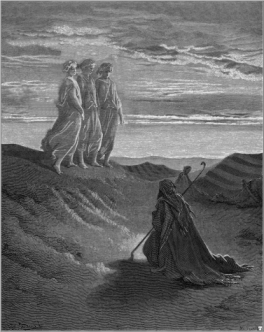 If God is just, is it right for him to automatically condemn some and probably most of the entire human race across all of history to eternal damnation and horrible, flaming agony, while preserving only a remnant…and absolutely none of those human beings have a choice in the matter?
Think about it. It’s all Adam’s and Eve’s fault. They are the only ones who ever had a choice. According to “Divine Election,” if you’re saved, it wasn’t your choice, you just got lucky. If you’re not saved, same deal. You just have really crummy luck.
This is why atheists say Christians are crazy and even cruel. I mean, it’s one thing if Jesus offers me the free gift of eternal salvation and I throw it back in his face. Then I can see how I’d deserve condemnation. But to never even have a shot at it?
Pastor Randy, at one point, shared how incredibly grateful he is to God for choosing him for salvation. That’s good for him and maybe good for me, but what about the poor, dumb, characters out there who are among the unchosen and don’t even realize what they’re facing…and if they did, there is absolutely nothing they can do about it. No amount of repenting of sins, turning to God, professing faith in Christ will save them.
Of course, according to Pastor Randy, they wouldn’t desire to do any of that anyway, but no one is born with that desire if we are all born in original sin. What’s the difference between Pastor Randy, who came to faith early in life, and me who came to faith after the age of forty? Was my program from God somehow slightly defective that it waited so long to start to run? I’d heard about Jesus for decades before I came to faith. How come my program didn’t kick in before it did?
However, there are other perspectives. According to Richard Land in his article at ChristianPost.com:
First, we must understand that the Bible reveals two different kinds of election, and much confusion has resulted from failing to see this distinction. Abrahamic Election is substantially different from Salvation Election. Abrahamic Election (Gen. 12:1-3) explains how God chose the Jews to be His chosen people. Salvation Election pertains to God’s elective purpose in how He brings about the eternal salvation of individual human beings, both Jew and Gentile, in both the Old and New Testaments.
Abrahamic Election is corporate, is to special people status, and is not related to anything. Salvation Election is individual and is to eternal salvation. In God’s providence, He has chosen to reveal His dealings with His people more fully in the New Testament. In doing so, a third difference between Abrahamic (corporate) and Salvation (individual) Election is underscored. God revealed in the New Testament that Salvation Election is somehow intertwined with, and connected to foreknowledge in a significant way (Rom. 8:29-30; 11:2; I Pet. 1:2).
“There is no question here of predestination to Heaven or reprobation to hell; …. we are not told here, nor anywhere else, that before children are born it is God’s purpose to send one to heaven and one to hell….The passage has entirely to do with privilege here on earth.” (Ironside, Lectures on the Epistle to the Romans, p. 116)
What if the Bible is telling us in the concept of “foreknowledge” that God does not just know all things that have, or ever will happen, as if they were the present moment to Him, but that He has, and always has had, the “experience” of all things, events, and people as a punctiliar present moment?
That makes a bit more sense and satisfies my personal value of justice. We all have free choice and can choose to accept or reject Jesus. God just knows what choice we’ll make because, while history and our lives seem like a movie that he have to live through frame-by-frame, God sees everything all at once, as if it were a snapshot.
I doubt that’ll satisfy Pastor Randy, and he admits agonizing over this issue before coming to a final decision, but if I have to err, I’d prefer to err on the side of mercy and compassion.
Because if Pastor Randy is right, how does anyone know if he’s really saved?
“Not everyone who says to me, ‘Lord, Lord,’ will enter the kingdom of heaven, but the one who does the will of my Father who is in heaven. On that day many will say to me, ‘Lord, Lord, did we not prophesy in your name, and cast out demons in your name, and do many mighty works in your name?’ And then will I declare to them, ‘I never knew you; depart from me, you workers of lawlessness.’
–Matthew 7:21-23
 Obviously, not everyone who thinks they’re saved is really saved. Mistakes will be made and errors encountered. What if someone who isn’t supposed to be saved becomes convinced and believes they have faith in Jesus. Maybe they really don’t, but they think they do. It’s not like they’ve made an internal error in thinking, they just aren’t “programmed” to be saved. It’s impossible, from a Divine Election point of view, for that person to be saved.
So on the last day, they find out, “Oops, I’m condemned” and appeal to Jesus and he blows them off, just like that.
Not that it was the person’s fault because they had no choice in the matter!
You can see why I’m depressed and a little disgusted. I think I can remain a Christian and still not have to marry the “Divine Election” theory because if that were the only option, my faith would hang in the balance.
In my last blog, I said:
No human being is a perfectly neutral, objective observer. We all tend to read the Bible, even in its original languages, in terms of what we already “know” about it; that is, what we already believe is says. We translate the ancient Greek and Hebrew text in a manner usually consistent with those beliefs and that means we generally never surprise ourselves with the outcome.
The Bible is the Bible, but doctrine is man-made. The fact that there’s more than one way to interpret how people get saved means there’s more than one way to view the Bible, and thus, God. Right now, I’m a little too upset to go into cold, dispassionate research on this matter, weighing the pros and cons. Right now, if God really is programming us like little widgets, deliberately condemning people to eternal damnation for no better reason than they were just born as human beings in a fallen world, then I am up for a good old fashion wrestling match with God.
I’ll probably lose…but so have billions of other human beings out there. They never had a chance.


 Image found at beliefnet.com






 Morning Meditations