Tag Archives: faith

71 Days: Wrestling with Trust

The realization that our own strength may be inadequate should never cause us to sink back into inertia. Never refrain from a good endeavor because the difficulties involved seem insurmountable. Keep in mind that we have a mighty Helper in the Almighty in all our good endeavors. Let us do our share; the Almighty will do the rest.

-Rabbi Zelig Pliskin
“Today’s Daily Lift #612”
Aish.com

May these words that I have prayed before God be close to God day and night, that He may do justice for His servant and for His people Israel, the needs of each day on that day.

-Siddur

When people lift heavy loads, they are likely to develop severe back pain. When they realize that they are overtaxing their bodies, they discontinue this practice and from then on will lift only as much as their bodies can safely bear.

While we can easily determine our body’s stress capacity, our psychological and emotional stress tolerance is not so readily measurable. Yet, if we exceed that stress level, symptoms of discomfort and dysfunction are just as apt to occur as when the body’s level is exceeded. How is one to determine one’s safe emotional and psychological stress level?

What could be simpler than following the instruction book provided by the Manufacturer?

During the Israelites’ sojourn in the desert, the manna was provided in portions just sufficient for one day, and any excess rotted away.

As for what they would eat the next day, the Israelites had been assured that there would be fresh manna the following day. Our appropriate stress tolerance is to be concerned for just one day – twenty-four hours. If we take on more than that, we may be overburdening the system. In our economy, lacking the miraculous manna and having the ability to save for the future, there may be justification for putting something aside for a rainy day. However, we often take on worries far in advance, about things that we are powerless to alter or to prepare for today. Such futile worry is harmful to a person.

Today I shall…

try to concentrate on my present needs and avoid worrying about things that are not within my capacity to change.

-Rabbi Abraham J. Twerski
“Growing Each Day, Cheshvan 4”
Aish.com

Just in case you ever wonder why I favor Jewish religious and spiritual sources over traditional Christian books and articles, what you’ve just read from Rabbis Pliskin and Twersky should be exceptionally familiar to anyone who calls themselves a follower of Jesus, and certainly to even the most casual reader of the Gospels.

And he said to his disciples, “Therefore I tell you, do not be anxious about your life, what you will eat, nor about your body, what you will put on. For life is more than food, and the body more than clothing. Consider the ravens: they neither sow nor reap, they have neither storehouse nor barn, and yet God feeds them. Of how much more value are you than the birds! And which of you by being anxious can add a single hour to his span of life? If then you are not able to do as small a thing as that, why are you anxious about the rest? Consider the lilies, how they grow: they neither toil nor spin, yet I tell you, even Solomon in all his glory was not arrayed like one of these. But if God so clothes the grass, which is alive in the field today, and tomorrow is thrown into the oven, how much more will he clothe you, O you of little faith! And do not seek what you are to eat and what you are to drink, nor be worried. For all the nations of the world seek after these things, and your Father knows that you need them. Instead, seek his kingdom, and these things will be added to you.

“Fear not, little flock, for it is your Father’s good pleasure to give you the kingdom. Sell your possessions, and give to the needy. Provide yourselves with moneybags that do not grow old, with a treasure in the heavens that does not fail, where no thief approaches and no moth destroys. For where your treasure is, there will your heart be also.

Luke 12:22-34 (ESV)

But knowing is easier than doing, in my case because I was recently reminded how scary some churches and some Pastors can be.

I can just “feel” Jesus admonishing me every time I write one of these “meditations,” particularly in the “Days” series. “Kvetch, kvetch, kvetch,” he might say if he chose to use the yiddish term. “All you do is kvetch. When are you going to do?”

Good question.

But according to my previous “day” (73 Days, to be exact), I may already be “doing” something. Of course that could also be an excuse, “blaming” being intermarried for the fact that I don’t have a congregational affiliation. Even my wife, who only goes to shul once in a blue moon anymore, has an “affiliation” with both the Chabad and the Reform-Conservative synagogues in town. My only affiliation with them, as it were, is in paying for the annual memberships (yes, my name is on them along with my wife’s).

While a life of faith may contain many mysteries, it is primarily supposed to be a relationship of joy and wonder, not puzzlement and conundrum.

Bereishit is a cheerful sedra, even though its ending is not all that pleasant. Noach has the Flood, but the week ends on a happy note with the birth of our father Avraham. The really joyous week is that of parshat Lech L’cha. We live every day of the week with Avraham, the first to dedicate his very life to spreading G-dliness in the world. And Avraham bequeathed his self-sacrifice as an inheritance to all Jews. (See Tanya Ch. 18; Elul 21.)

“Today’s Day”
Monday, Cheshvan 3, 5704
Compiled by the Lubavitcher Rebbe
Translated by Yitschak Meir Kagan
Chabad.org

See what I mean?

On the other hand, putting the whole “church thing” to one side for the moment, there’s also this:

Torah-study every day is crucial to life itself. This applies not only to the soul of the one studying but also to the souls of his family. For then (through Torah-study), the atmosphere of the home becomes an atmosphere of Torah and piety.

“Today’s Day”
Tuesday, Cheshvan 4, 5704
Compiled by the Lubavitcher Rebbe
Translated by Yitschak Meir Kagan
Chabad.org

On Thursday afternoon, volume 6 of the Torah Club (which you’ll recall, I discussed quite recently) arrived at my home:

“Chronicles of the Apostles” takes students on a year-long study of the book of Acts with Messianic commentary and Jewish insights into the Epistles.

Follow the lives and adventures of the apostles beyond the book of Acts and into the lost chapter of church history. Study Jewish sources, Church fathers, and Christian history to reveal the untold story of the disciples into the second century.

This all new Torah Club Volume Six (2011–12) goes beyond the book Acts and opens the lost chapter of Messianic Jewish and Christian history.

In a Bible study that reads like an epic novel, Chronicles of the Apostles harmonizes Josephus, rabbinic lore, and apostolic legends to tell the story of the martyrdom of Peter, the work of Thomas, the flight to Pella, the fall of Jerusalem, John’s exile on Patmos, the Roman persecutions, the second generation of disciples, the transitions from Sabbath to Sunday and from apostolic Judaism to Christianity. Rewind your religion and discover the truth about our Jewish roots.

Since both Genesis and Noah have already been read, I’ll need to do a bit of catch up work in my “Torah Club” reading and audio “assignments,” but I’m anticipating a fresh influx of information and (hopefully) insights to share in my “morning meditations.” Perhaps (and this is also my hope), I’ll also experience fresh insights and spirituality within me as well.

But, as the quotes from the beginning of this little write-up suggest, no amount or type of study material will give you, me, or anyone else what we truly need: the ability to respond to God with faith and trust, and to follow His lead up into His heights, even when we find heights scary.

74 Days: Contemplating Jumping

The Rebbe my father told someone at yechidus: Ever since G-d told our father Avraham, “Go from your land etc.” (Genesis 12:1) and it is then written “Avram kept travelling southward,” (Ibid 12:9) we have the beginning of the mystery of birurim. By decree of Divine Providence man goes about his travels to the place where the “sparks” that he must purify await their redemption.

Tzadikim, who have vision, see where their birurim await them and go there deliberately. As for ordinary folk, The Cause of all causes and the Prime Mover brings about various reasons and circumstances that bring these people to that place where lies their obligation to perform the avoda of birurim.

“Today’s Day”
Shabbat, Cheshvan 1, Shabbat Rosh Chodesh, 5704
Compiled by the Lubavitcher Rebbe
Translated by Yitschak Meir Kagan
Chabad.org

There are people who do many good things, but with pessimism—because to them the world is an inherently bad place. Since their good deeds have no life to them, who knows how long they can keep it up?

We must know that this world is not a dark, sinister jungle, but a garden. And not just any garden, but G‑d’s own pleasure garden, full of beauty, wonderful fruits and fragrances, a place where G‑d desires to be with all His essence.

If the taste to us is bitter, it is only because we must first peel away the outer shell to find the fruit inside.

-Rabbi Tzvi Freeman
“The Garden”
Based on letters and talks of the Rebbe
Rabbi M. M. Schneerson
Chabad.org

I suppose Rabbi Freeman has hit the nail on the head as far as I’m concerned (though of course, he’s not even aware that I exist or of my circumstances). I tend to see the world as a rather negative place, as defined by the negative people who express themselves in it. You don’t have to go far to see what I mean. Watch any news channel on TV or the Internet and you’ll see tragedy, horror, despair, murder, and many other depressing and disheartening things. The debates and controversies surrounding the upcoming Presidential elections are just another reason to consider our world a negative place. It doesn’t matter which political party you belong to, the supporters of one person invariably use any trick and tactic they can find to sully the reputation their opponent’s supporters. The world of religion and religious blogging is no better, it seems.

According to the Rebbe, “Tzadikim, who have vision, see where their birurim await them and go there deliberately,” however, for the rest of us, “the Cause of all causes and the Prime Mover brings about various reasons and circumstances that bring these people to that place where lies their obligation to perform the avoda of birurim.” In other words, if you are a truly righteous person, you know where you must go and what you must do in order to accomplish the purpose of your life. For everyone else, God leads us to the places we must go and shows us what we must do, but it’s up to us to correctly interpret these events and then take the correct action.

Which is why, for most of us, life and God and our purpose can seem like we’re endlessly trying to solve a mystery by traveling down a dark street late at night hoping for illumination.

This week’s Torah Portion is Noah, which tells a narrative even most non-religious people know quite well. But according to Rabbi Abraham J. Twerski in his Growing Each Day commentary for Cheshvan 1, it tells me something more specific.

God said to Noah, “Enter … into the ark.”

Genesis 7:1

The Hebrew word for ark, teivah, has two meanings: it can mean “an ark,” and it can also mean “a word.” In the above verse, the latter meaning tells us that God instructed Noah to “enter into the word.” Rabbi Moshe of Kobrin expounded on this theme, explaining that when we pray, we should “enter into the words,” i.e. totally immerse ourselves into each word of prayer, as though the word is encompassing us.

A listener once asked him: “How can a big human being possibly enter into a little word?” Rabbi Moshe answered, “People who consider themselves bigger than the word are not the kind of person we are talking about.”

The Talmud states that people’s prayers are not accepted unless they efface themselves before God (Sotah 5a). God abhors those who are egotistical, and therefore the prayers of a vain person are not likely to be received favorably.

People preoccupied with their egos remain external to their prayers. The truly humble person feels small enough to “enter” even the tiniest word.

Today I shall…

try to throw myself entirely into my prayers by setting aside those thoughts and feelings that would inflate my ego.

While I don’t think of myself as someone who struggles with an inflated ego, it has already been pointed out to me (correctly, I might add) that I don’t trust God as I should. I don’t “enter into the word” with complete abandon, trusting that God will take care of my well-being. Terrible things happen to good people every day. Why would I be exempt?

That goes for trying to solve the mystery of my path of faith as well. If I make one decision, how will I manage the consequences? If I make no decision, that’s a decision and it has consequences. Even standing still is really moving backwards. If only all of the “egos” on the web who casually malign their brothers of the faith and the Jewish people (who are sometimes one in the same) never seem to throw themselves entirely into their prayers, setting aside those thoughts and feelings that would inflate their egos, at least as evidenced by their online behaviors.

Maybe it is better to ignore the world and to simply throw myself into a life of prayer, study, and contemplation.

There was a story about a Torah scholar who died young… – 13a-b

The Gemara elaborates and tells the story of a Torah scholar who died young. This man’s wife came to the Beis HaMidrash carrying his tefillin, and she began to complain about his shortened life. Although this student was very diligent, and no one was able to respond to this woman’s bemoaning, finally Eliyahu discovered and exposed the tragic flaw which this young man and his wife possessed.

It is noteworthy that this woman specifically brought her late husband’s tefillin with her, as if it indicated more of a reason why he did not deserve to die. Maharsha explains that she brought the tefillin to increase the anguish of the other students who would see her. Sefer Gilyonei HaShas of R’ Yaakov Engel explains that tefillin specifically represents the connection which we have to Torah study. Her argument was sharper, as she demonstrated that her husband learned Torah and was bound up with Torah as his life pursuit.

Therefore, this woman took her husband’s tefillin as she circulated around the shuls and the Batei Midrash to demonstrate that her husband did not simply learn Torah, but he was bound up with the Torah, just as the tefillin is tied around one’s arm.

Daf Yomi Digest
Distinctive Insight
“Bound in Torah”
Shabbos 13

But even reading this commentary convinces me that there is an insufficient perspective being applied here. It’s not what you study and learn but what you do with it that counts. I sometimes define the difference between Christianity and Judaism as the difference between what you believe and what you do, but that’s not always a very fair comparison. In some aspects of Jewish thought, the person who studies Torah, binding themselves in it so to speak, is of greater value than the simple person who cannot study but only tries to live a descent life as best they can.

A person can be a Jew just by being born of a Jewish mother and on that virtue, is a member of the covenant and one of God’s chosen people. A Christian can be born anybody and all by itself, that means practically nothing. A person is only a Christian after making a decision and a declaration. After coming to faith and confessing Christ, the only way to tell a Christian from a secular person is by what they do. Even then, many secular people behave more righteously than many Christians.

However, faith and belief are invisible. Only God knows what is in a person’s heart. It is what we do that defines us, sometimes because of what we believe and sometimes in spite of it. When God leads each of us, even me, into any given situation on any given day, there’s an expectation about what we’re supposed to do there. Should we turn left or right? Should we go forward or back? From God’s perspective, the answer is obvious. From a human’s point of view, it can seem like an impossible puzzle, or we might even miss the fact that a decision must be made at all.

Or, we know what we should do and are just loathe to do it. But if God has sent us to “reveal a spark,” so to speak, who are we to say we won’t do it or pretend we don’t understand what He is asking of us?

The answer is that we are human and flawed.

It would be easy just to ignore my dilemmas by ignoring God, but God or my conscience won’t let me do that. But it still feels like He’s asking me to jump off a cliff into a bottomless void with only the promise that He’ll make me fly to sustain me.

Life Under Repair

Question: I’ve been enjoying the philosophy articles on Aish.com. The approach to life resonates with me much more than the Western style of consumerism and media hype. Regarding the obligatory nature of mitzvot, however, I think sometimes humans have to disregard the boundary and be disobedient against the command. It might be painful, but I believe you come away with a higher appreciation that God and His commands are ultimately correct. Do you agree with this thinking?

The Aish Rabbi Replies: You have touched on a deep truth, but ultimately your principle is mistaken. The Talmud states: “In a place where a reformed sinner stands, even a righteous tzaddik does not stand.” The idea is that after having erred, you can analyze your negative acts, learn from them, and use that knowledge as a foundation to motivate you further.

While all this seems to imply that it is better to make mistakes and then correct them, rather than never have made the mistake in the first place, that is not true.

Let’s take the mundane example of the rule: “Always look both ways before crossing the street.” There are two ways to learn this lesson: 1) Listen to the advice of teachers and parents to look both ways before crossing, or 2) cross recklessly, get hit by a car, and then while lying in the hospital acknowledge a lesson well-learned.

The problem in choosing the second path is that there is always a residual effect from our mistakes. A teenager who experiments with drugs may grow up to realize the dangers, but a lot of brain cells have been killed in the meantime.

“Intentional Mistakes”
from the “Ask the Rabbi” series
Aish.com

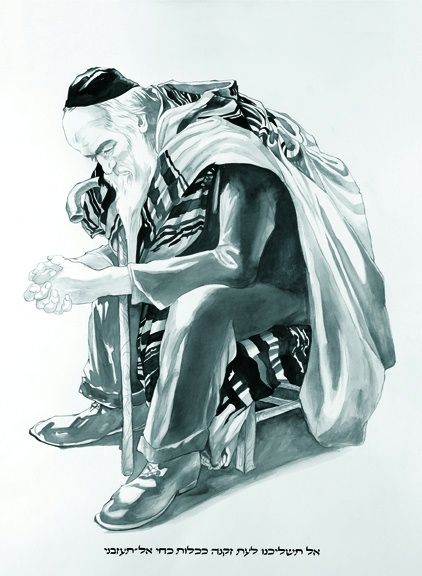
(I almost didn’t post the first picture that appears in today’s “meditation” because of its provocative elements, but of all the similar images I found, this one came closest to communicating what I wanted to say.)

In a comment on Gene Shlomovich’s recent blog post How Jesus may have viewed conversion to Judaism, I mentioned how I corrected one of my mistakes:

To be fair, many non-Jewish “Messianics” were taught for years or even decades that there was “One Law for the native-born and the alien” and that information is well ingrained into their psyche and identity. Now that “the movement” has evolved and more accurate information is available relative to how the Bible defines the roles of “Messianic” Gentiles and Jews, it is very hard for some to surrender a status or role that they’ve become quite used to.

I remember when FFOZ (First Fruits of Zion) first announced that they had been wrong in supporting the One Law position and that they were correcting their teachings and organizational stance. I felt angry and betrayed and shot off a very pointed comment or two on Facebook in response. It was like being given an important and valuable gift and becoming comfortable with it, then having it suddenly ripped away.

I suppose I could have become one of those angry “deniers” and continued to “demand my right” to “Torah obligation,” but I started to think. FFOZ had financially just shot themselves in the foot. A large number of their constituents simply abandoned them, abruptly and significantly reducing their income. Why would they do that when in any practical sense, even if privately they’d come to the conclusion that One Law was unsustainable Biblically and theologically, they should have publicly maintained their OL position in order to make sure they survived as a ministry? Their decision only made sense if moral and spiritual honesty were more important to them than an income.

I became curious and started investigating. At about the same time, I started looking at my wife’s pursuit of her Jewish identity as an individual and as a member of the Jewish community through different eyes. Long story short, I realized that I had been wrong in my One Law assumptions and shifted my perceptual and theological paradigm accordingly.

But to say that it was difficult is a gross understatement. A lot of people aren’t capable of that kind of change. I even recently wrote about how difficult it is to “share Abraham” so to speak, and accept that only certain blessings are passed down to the nations (Christians) through Israel. Exchanging self-entitlement for a more mature reality is very hard and not everyone is going to accept it.

Frankly, and not to necessarily contradict the Aish rabbi from whom I quoted above, I don’t see how some mistakes can be avoided. I mean, we all make mistakes. Some are actually part of the human developmental learning process. Take walking for example. When a small child is first learning how to stand and walk, the child falls a lot. Falling isn’t a mistake at this stage of development, it’s a requirement and it’s perfectly normal and expected. No small child has ever (to the best of my knowledge) spontaneously stood and walked with absolute precision on the very first try, and never fell back to the floor. Everybody falls the first time, or the first dozen times, or the first few hundred times.

I think trying to understand God and trying to understand who we are in God is like learning how to stand and walk. We get a lot of things wrong at first, but that’s to be expected. Just conceptualizing the existence of God is tremendously difficult, and integrating faith, trust, hope, and spirituality into a daily lifestyle can escape even some of the best of us. I would hardly expect anyone to become “good at it” right off the bat. In fact, most of us never get really “good at it.” We continue to struggle, to learn, and we periodically fall flat on our faces.

That’s how I’d characterize my own spiritual development, anyway. I suspect that if we were all honest with ourselves and everyone else, every person of faith would admit to the same thing. Only pride keeps us from doing so. We’re afraid of looking foolish. We’re afraid of what other people will say. We’re afraid of just letting go of all that and, like a little child, accepting what God has given us from His abundant store of gifts.

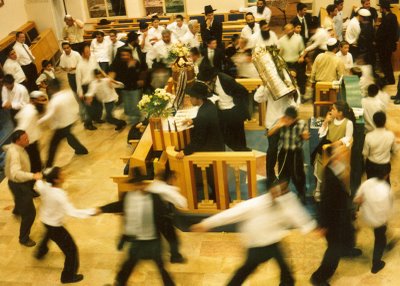
For seven days of Sukkot, Jews walk around in circles, carrying an assortment of green and yellow flora. Then, on Simchat Torah, they dance in circles carrying Hebrew scrolls, working up to a frenzy.

Did I say dance? Well, it’s more like marching, your hands over the next guy’s shoulders, singing and stomping as you march to . . . the same place you started from. Repeat until you plotz. (Yiddish: collapse)

Now for my confession…

When I was first invited, cajoled and nudniked to join the circular festivities, I was more than hesitant. I attempted to explain that I didn’t see the point of walking in such a way that you don’t get any further than where you started. Needless to say, the argument was ignored, and I was swept into the circle whether I liked it or not.

And I felt stupid. For about the first 40,000 circuits. After that, I forgot about myself and how I felt and what I was doing and why I was doing it and whether I was stupid and that I was there at all. And that’s when the circle became good. Very good.

It was good exactly due to that which I had subliminally feared. Because as I stand here, I am I. In the circle, that I dissolves into we. And in that very act of transcendence, that loss of self, there is unbounded joy.

-Rabbi Tzvi Freeman
“Why Jews Dance in Circles”
Commentary on Sukkot and Simchat Torah
Chabad.org

While being embarrassed and feeling foolish (and avoiding joy) aren’t exactly mistakes, these are experiences that, if we allow them to, will prevent us from correcting mistakes and lead us into a lifestyle based on error and fear. In fact, many people try so hard to avoid embarrassment, foolishness, and the tremendous effort that change requires once it’s discovered, that they live in self-denial, never even permitting themselves to realize that what they are living is a mistake. That is why so many people (and I know atheists must think this about religious people) can “stand their ground” and “stand up for their rights” with total conviction of purpose, and still be dead wrong.

But remember, even in the lesson we learned from the Aish Rabbi, it’s only a mitzvah if we realize we made a mistake and corrected it. And, remember as well that it would have been better to never have made the mistake in the first place.

We can’t avoid making a mistake. We fall so that we can learn to pick ourselves up. Although mistakes are regrettable, they are also part and parcel of the human experience. Falling down is an obvious mistake when our intention was to walk. Many human mistakes are far more subtle and even when we want to be honest, it can be difficult to see past our own assumptions, prejudices, and pride.

To conquer even our unintentional and unconscious errors, we must learn to question everything about ourselves. Why do I believe in such-and-thus? Is it because I grew up believing this? Did someone teach me this belief when I was cognitively or spiritually immature? Examining the same information now that I am more educated, more mature, and more stable, will I reach the same conclusions that I did before?

These are all very dangerous questions and they can make us feel extremely insecure in areas that are absolutely the foundation of our existence. You don’t have to question your faith in God, but you do have to question what that faith means and how it is to be expressed. While people can change, most people don’t once they arrive at a certain comfortable plateau. The trick is never to completely rest on that plateau. It’s not your destination. Keep climbing, even if you feel uncomfortable, even if you feel nervous or foolish. The truth is always one level higher than you’ve ascended so far.

Or like Rabbi Freeman, after dancing in pointless circles the first 40,000 times or so, eventually, you’ll see that pursuing the joy of God is more important than how you feel or what you look like to others. Fixing mistakes and repairing your life is a mitzvah. So is longing for God. The two go hand in hand.

Climb. Dance.


God Finds You

One who raises his voice when he davens is among those of diminished faith.

– Berachos 24b

Raising one’s voice in prayer is considered a demonstration of diminished faith in God. According to Rashi, the reason for this is that the person seems to be showing that he thinks that God will not listen to his prayers if they are spoken softly.

We should not interpret this statement literally. After all, only a fool would think that God only hears prayers at a certain audible level. This is not what the Gemara is discussing. Rather, the Gemara is referring to a person who davens regularly, but he feels that his prayers are not answered. There are two ways of reacting when this happens. One conclusion is to understanding that God, in fact, does respond to prayers, and that He cares about every person and every word directed towards Him. It is just that God has determined to not grant the request at this time, due to His system of perfect justice and due to His mercy.

The other conclusion a person might consider is that God is not listening to him. A person whose prayers are “denied” might feel abandoned, and therefore daven more intensively. A person might then hope that this, in and of itself, was the problem. The raising of one’s voice due to the feeling that God has been ignoring the prayers which were spoken softly is a function of a deficient understanding of God’s willingness to hear prayer.

The lesson of this Gemara is that we must strengthen our trust in God and in the knowledge that He cares about each of our prayers. God is continually monitoring every aspect of our willingness to call to Him, and although the answers to our prayers are not always discernible immediately, nevertheless, God responds in a manner that is always in our best interests. Any misunderstanding of this concept may lead to unnecessary hopelessness.

Daf Yomi Digest
Gemara Gem
“Davening in an audible tone”
Berachos 24

Faith and trust in God. I’ve said many times before, that it’s not easy. As we see in the example above, Judaism recognizes that the heart can grow faint and the will becomes weak when God seems to be silent. So too we Christians can feel that something is amiss with our prayers when God won’t turn to us and help us in our need and anguish. How many times have we felt abandoned and cried out, “Where is God?”

Is this all just a test, then? Is God being deliberately silent just to see how we’ll hold up under pressure. That seems kind of cruel, don’t you think? Is that all life is…a test?

This is why many people refuse to come to faith. It’s not because religion is “irrational” or “absolute” or “superstitious.” It’s because faith means you don’t have control of God.

That seems to also mean you don’t have control over your own life. When we say “God is in control,” we’re admitting that we aren’t. Depending on who you are and how to perceive the implications of that statement, it can be either comforting or horrifying. If you trust God implicitly, knowing that He loves you and desires only good for you, it is ultimately comforting to know that God is in control of the universe, rather than a bunch of capricious, double-minded, self-centered human beings. On the other hand, if self-determination and self-direction are the values you prize above all else, imagining yourself turning over everything to a distant, supernatural (and probably fictional) entity would feel like discovering that the pilot of the airplane you’re travelling in, 36,000 feet above the earth, is a chimpanzee.

You’d have absolutely no control over your fate and your doom would be completely assured, unless you could wrest the controls away from the simian and back into your own “competent” hands.

It is in the dark and empty watches of the night, when the voices are all stilled, and your only companion is your doubt, that who you really are in God is revealed. It is not actually a test anymore than any other challenge or frustrating experience is a test. It’s simply how life works. Some days are better than others and you feel the closeness of God as He seems to walk with you during every waking moment. Some nights are worse than others and it seems as if God is long gone from this mortal sphere, and you have been cruelly abandoned.

And even then, unless your faith and trust is totally exhausted and you walk away from God as you believe He has walked away from you, you still search the night for Him. You look for God in your dreams. You seek Him out in your fears. You hope He’ll appear with the dawn. You call out His name in a whisper.

If we were truly humble, we would not be forever searching higher paths on the mountaintops. We would look in the simple places, in the practical things that need to be done.

True, these are places in a world of falsehood. If the world only had a little more light, none of this would be necessary.

But the soul that knows its place knows that the great and lofty G‑d is not found at the summit of mountains, but in the simple act of lending a hand or a comforting word in a world of falsehood and delusions.

-Rabbi Tzvi Freeman
“The Path of the Humble”
Based on letters and talks of the Rebbe
Rabbi M. M. Schneerson
Chabad.org

And then you find Him when you are completely distracted by the needs of others. You find God in the simple acts of kindness you do every day. You discover your Maker in your gifts to the poor, or the smile on a grateful face. God finds you when you aren’t even looking for Him.


Questions That Would Cross a Rabbi’s Eyes

Hashem, your God, shall you follow and Him shall you fear; His commandments shall you observe and to His voice shall you hearken; Him shall you serve and to Him shall you cleave.

Deuteronomy 13:5 (Stone Edition Chumash)

Yeshua said to him, I am the way and the truth and the life. No one will come to the Father except through me.

John 14:6 (DHE Gospels)

The most important men in town will come to fawn on me
They will ask me to advise them,
Like a Solomon the Wise
“If you please, Reb Tevye?”
“Pardon me, Reb Tevye?”
Posing problems that would cross a rabbi’s eyes

from the song, “If I Were a Rich Man”
by Sheldon Hamick and Jerry Bock
Fiddler on the Roof (1971)

I ponder this mystery off and on but it’s a profound one, at least to me. The church often asks the question, “Were the Israelites saved?” Opinions vary. A very literalist interpretation of John 14:6 says, “no,” since Jesus wasn’t there at Sinai. But then I’ve heard that the salvation of Jesus spans across all time forward and back, so that anyone who has faith in God is saved by Jesus.

OK, wait. Isn’t that putting the cart before the horse?

And he trusted in Hashem, and He reckoned it to him as righteousness. –Genesis 15:6 (Stone Edition Chumash)

Abraham trusted in God and God alone and it was counted to him (by God) as righteousness. A Christian would say that Abraham’s faith in God saved him, just as our faith in Jesus saves us. See what I mean about “posing problems that would cross a rabbi’s eyes?” Are we talking about two paths of salvation, one through God and another through Jesus?

I don’t think that’s a sustainable viewpoint given the overarching message of the Bible to love and trust God and God only. On the other hand, if we invoke the deity of Jesus, then I suppose the problem is solved. If you have faith in Jesus then you have faith in God and vice versa. End of story.

Or is it?

For it is impossible for the blood of bulls and goats to take away sins. –Hebrews 10:4 (ESV)

So what exactly were the ancient Israelites doing, then? Why did God command them to perform animal sacrifices if they didn’t do any good?

Why do I need your numerous sacrifices? says Hashem. I am sated with elevation-offerings of rams and the fat of fatlings; the blood of bulls, sheep and goats I do not desire…Bring your worthless meal-offerings no longer, it is incense of abomination to Me. –Isaiah 1:11,13 (Stone Edition Tanakh)

Obviously that didn’t work. I mean, God doesn’t seem to want the sacrifices that He previously said He wanted. Seems kind of fickle of God, doesn’t it.

Except it’s impossible for God to be fickle or inconsistent. So what’s the answer?

What does God want and who does He want us to have faith and trust in? If no one comes to the Father except through the Son, why didn’t He teach the ancient Israelites to worship the future Jesus instead of the God of Heaven? Why didn’t God teach Abraham to have trust in Jesus instead of Him, thus counting trust in Jesus as righteousness? Why did God bother teaching the ancient Israelites the sacrificial system in the first place?

Maybe I’m being too literal. Maybe I’m not being “mystic” enough. But it does seem like a head scratcher.

I keep thinking I’m on the cusp of an answer but somehow it always eludes me. I keep thinking that the key is “faith and trust in God.” Of course the blood of bulls and goats doesn’t save. It never did. What saved was that the ancient Israelites trusted in God and agreed to do everything He told them to.

Moses came and summoned the elders of the people, and put before them all these words that Hashem had commanded him. The entire people responded together and said, “Everything that Hashem has spoken we shall do!” –Exodus 19:7-8 (Stone Edition Chumash)

Faith and trust, and then obedience. It’s not so much that what we do has the power to save, it’s that what we do is a reflection of our faith and trust. If God tells us to sacrifice animals at such-and-thus a place in such-and-thus a manner, the sacrifices aren’t as important as our obedience to Him. If we perform the same sort of sacrifice in the same place and in the same manner as before, but not because of faith and trust, the sacrifices are meaningless. It’s always about faith and trust. So that takes care of the salvation of the ancient Israelites and Abraham before them.

But how to we deal with Jesus and “no one comes to the Father except through me?” It would seem as if all one has to do is have faith and trust in God the Father to be saved. What does Jesus have to do with it?

OK, I know I said before that Jesus does matter. After all, neither we people among the nations nor our distant ancestors stood at Sinai with the Israelites (mixed multitude notwithstanding), and so we do not possess the ancient covenant relationship with God. It is completely understandable that we Gentiles cannot “come to the Father except through the Son.” But what about the Jews?

I’m not so sure I can answer that one. To say that they are “saved” through Sinai means that there is two salvational paths, one for the Jews (Moses) and one for the Gentiles (Jesus). To say that only Jesus saves deconstructs the Sinai covenant and renders Judaism invalid post-Jesus. To say that only Moses saves means we have to throw out the New Testament, and salvation for the Gentiles only comes from conversion to Judaism or obedience to the Noahide Laws.

Traditional Christians would say that salvation through Jesus replaced the Law of Moses and they solve the question that way. Traditional Jews would say that the New Testament is invalid and Gentiles must either convert to Judaism or become Noahides and they solve the question that way. There is a group who tries to split the difference and says that everyone must comply to the terms of both the Mosaic and Davidic covenants and essentially behave both like Jews and like Christians, but as you’ve seen on this and other blogs in the Messianic blogosphere, that becomes hopelessly confusing relative to retaining any sense of Jewish vs. non-Jewish identity.

So what is the answer? I don’t know. I know that’s rather disappointing, but I’ve said numerous times before that I’m not a Bible scholar or historian. I’m a reasonably intelligent human being (depending on the day of the week, how much sleep I’ve had, and whether or not my wife is upset with some dumb thing I did), but the niggling little details of how to interpret the scriptures and the nuances of theology, doctrine, dogma, and so on escapes me.

But does that mean it’s forbidden for “ordinary Christians” to ask questions and pose problems about our faith? Gee, I hope not.

So am I stuck? No. By faith, I worship the One God of Israel. I know that my salvation hinges upon the truth of the Jewish Messiah. He is the vine and I am the branch. I will follow him in search of my answers and believe that ultimately, all truth of God is in him and through him. How it all works behind the scenes, I don’t know. Maybe someone out there does. I know I’m asking for another “punishing” debate and people will question my convictions, my intelligence, and maybe even my sanity.

But I can’t stop asking questions just because people are going to give me a hard time about them.

In the end, there’s God. In the beginning, too.

A prayer of Moses, the man of God. O Lord, You have been our dwelling place throughout all generations. Before the mountains were born, and You brought forth the earth and the inhabited world, and from everlasting to everlasting, You are God. You bring man to the crushing point, and You say, “Return, O sons of men.” For a thousand years are in Your eyes like yesterday, which passed, and a watch in the night. You carry them away as a flood; they are like a sleep; in the morning, like grass it passes away. In the morning, it blossoms and passes away; in the evening, it is cut off and withers. For we perish from Your wrath, and from Your anger we are dismayed. You have placed our iniquities before You, [the sins of] our youth before the light of Your countenance. For all our days have passed away in Your anger; we have consumed our years as a murmur. The days of our years because of them are seventy years, and if with increase, eighty years; but their pride is toil and pain, for it passes quickly and we fly away. Who knows the might of Your wrath, and according to Your fear is Your anger. So teach the number of our days, so that we shall acquire a heart of wisdom. Return, O Lord, how long? And repent about Your servants. Satiate us in the morning with Your loving-kindness, and let us sing praises and rejoice with all our days. Cause us to rejoice according to the days that You afflicted us, the years that we saw evil. May Your works appear to Your servants, and Your beauty to their sons. And may the pleasantness of the Lord our God be upon us, and the work of our hands establish for us, and the work of our hands establish it. –Psalm 90

Just a small note: this is my 500th meditation if anyone is intereseted.

Learning to Live

I have been testing the waters, trying to get involved in Judaism. But I feel like I’m swimming in a vast ocean of unfamiliar concepts: Hebrew texts, legal nuances, culture, etc. I’m not sure any of this is for me!

The Aish Rabbi Replies:

There is a misconception that many people have about Judaism, what I call “the all or nothing” syndrome. With 613 mitzvot in the Torah, things can seem a bit overwhelming. People take a look at traditional Judaism with all these different commandments and say to themselves, there’s no way that I can be successful at living that type of lifestyle, so what’s the point of looking into it or getting involved? Where to start? What to focus on? How to make sense of it all?!

That’s not the Jewish way!

Imagine you bump into an old friend and he tells you how miserable he is. You ask him, what’s the matter? He says, I’m in the precious metals industry. My company just found a vein of gold in Brazil that’s going to be worth hundreds of millions of dollars.

You say, that’s fantastic. Your financial problems are solved. What’s the problem?

He says, you just don’t get it. Do you realize that this is just one vein of gold? It represents such a tiny fraction of all of the unmined gold in the world. What do I really have, compared with what’s out there?

You say, are you nuts? Who the heck cares about what you haven’t found yet? What you’ve got now is a gold mine!

That’s the Jewish approach. Any aspect that you learn about, or can incorporate into your life, is a gold mine. What does it matter what aspect of Judaism you’re not ready to take on? In Judaism, every mitzvah is of infinite value. Every mitzvah is more than any gold mine. Don’t worry about what you can’t do. Even if you never take on another mitzvah, you’ve still struck eternal gold.

The best advice: Relax.

“Judaism: All Or Nothing?”
from Ask the Rabbi
Aish.com

Performing mitzvot or “Torah commandments” as such isn’t really the focus of most Christians. And on top of that, what the Rabbi seems to be saying in the above-quoted passage appears to contradict this:

If you really fulfill the royal law according to the Scripture, “You shall love your neighbor as yourself,” you are doing well. But if you show partiality, you are committing sin and are convicted by the law as transgressors. For whoever keeps the whole law but fails in one point has become accountable for all of it. For he who said, “Do not commit adultery,” also said, “Do not murder.” If you do not commit adultery but do murder, you have become a transgressor of the law. –James 2:8-11 (ESV)

According to the traditional interpretation of this passage, to violate one commandment in the law is to violate them all. But since we are all human, sooner or later, we are all going to make a mistake. How could anyone obey all of the laws all of the time?

Christianity’s answer is to replace behavioral obedience to the law with the grace of Jesus Christ and thus, any of our mistakes are forgiven, as long as we repent, turn away from wrongdoing, and return to God.

Of course, if you keep reading James 2, you discover verses 14-17 in which he says that faith without works is dead, so it’s not a matter of doing away with the behaviors that are associated with a life of holiness.

So what is it? If we commit to the law but cannot keep all of it are we perpetually doomed to failure or are we commanded to perpetually try?

The Rabbi isn’t responding to a Christian’s question, though. There are scores of Jewish people who haven’t lived religious lives but who desire to come closer to God, especially in the month of Elul. But as the questioner admits, the number of mitzvot to learn is dizzying and the details associated with proper observance is beyond intimidating. How could anyone not only learn all of the commandments, but additionally, how modern halachah defines proper observance?

The Rabbi has a simple and surprising answer:

The misconception that Judaism is all-or-nothing includes the false idea that a person is either “observant,” or “non-observant.” But that’s not true. In fact, here’s a secret:

Nobody is observing all the mitzvot.

That’s because certain mitzvot only women usually do – like lighting Shabbat candles or going to the mikveh. Other mitzvot only men can fulfill – like Brit Milah. Others only apply to first-born children, such as the “fast of the first-born” on the day before Passover. And only a Kohen can fulfill the mitzvah of reciting the Priestly Blessing.

Actually, it’s not that surprising but then again, I don’t think it adequately answers the original question.

I have an answer of my own. Here’s a story.

Many years ago, I was at my local Reform shul. One of the Jewish members was telling his own story about observance. He had been an atheist for most of his life. He was also an educator and took annual trips to Israel for scholarly purposes. It was on one of those trips that he told a Rabbi that he wanted to live as a religious Jew. Just one problem. It was the same problem the questioner above has. There’s just so much to learn.

Here’s the Rabbi’s answer.

Pick just one mitzvot. It doesn’t matter which one. Let’s say it’s lighting the Shabbos candles. Get a siddur and learn the blessing. Every Erev Shabbat, say the blessing and light the candles. Do nothing else. Keep doing that on every Shabbat until you have learned the mitzvot well and are very comfortable performing it. Once you have achieved that level of competence, pick another mitzvot. It doesn’t matter which one. Learn to perform it until you are comfortable and competent at it. Continue adding mitzvot in this manner. It will take time, but as the months and years past, you will progressively learn to perform a great number of the mitzvot.

I reconstructed all that from memory, so I’m sure it’s not “word-for-word” accurate. But you get the idea.

But what does that have to do with James and with Christians. We don’t obey the mitzvot of Moses. We weren’t called to do so. After all, when Jesus gave his Jewish disciples the “great commission” to make disciples of the people of the nations, here’s what he said:

And Jesus came and said to them, “All authority in heaven and on earth has been given to me. Go therefore and make disciples of all nations, baptizing them in the name of the Father and of the Son and of the Holy Spirit, teaching them to observe all that I have commanded you. And behold, I am with you always, to the end of the age.” –Matthew 28:18-20 (ESV)

Path of TorahNotice what Jesus didn’t say. He didn’t say to teach the disciples from the nations “to observe all that Moses has commanded you.” If Jesus wanted to have the Gentile disciples observe the Torah in an identical manner and for an identical purpose as the Jewish disciples, his message would have been different. It would have been much easier for him to tell the Jewish disciples to convert all Gentiles everywhere into Jews.

Galatians is Paul’s great cautionary tale against Gentile disciples converting to Judaism as a means to be justified before God. He said it would make the bloody, sacrificial death of the Master a waste of time and effort if they did so (see Galatians 2:21).

Paul went on in chapter 3 of his letter to explain that it is by faith and not merely the mechanical observance to the law that we Gentiles received the Spirit. In fact, everyone, Jew and Gentile, received the Spirit by faith, not by the law.

At Sinai, the Israelites agreed to do all that God would tell them to do (at the point when they agreed, the specifics of the Torah had not yet been given). They accepted God’s rule by faith and subsequently, God, through Moses, gave the Israelites the Torah. By faith, we accept Jesus Christ as Lord and Savior and through him, we can come to God in a covenant relationship. But since we Gentiles among the body of believers were not at Sinai as were our Jewish brothers, what do we receive from God?

The Jews have the Spirit, just as we have, but they also have the Torah. Do we have the Torah?

Yes and no.

Naturally, this is just my opinion, but the “Torah” we have isn’t all that dissimilar from that of the Jews (and I know some Jewish and Christian readers may balk at this part). But consider the following.

And one of the scribes came up and heard them disputing with one another, and seeing that he answered them well, asked him, “Which commandment is the most important of all?” Jesus answered, “The most important is, ‘Hear, O Israel: The Lord our God, the Lord is one. And you shall love the Lord your God with all your heart and with all your soul and with all your mind and with all your strength.’ The second is this: ‘You shall love your neighbor as yourself.’ There is no other commandment greater than these.” And the scribe said to him, “You are right, Teacher. You have truly said that he is one, and there is no other besides him. And to love him with all the heart and with all the understanding and with all the strength, and to love one’s neighbor as oneself, is much more than all whole burnt offerings and sacrifices.” And when Jesus saw that he answered wisely, he said to him, “You are not far from the kingdom of God.” And after that no one dared to ask him any more questions. –Mark 12:28-34 (ESV)

I know I tend to revisit this particular scripture with an almost annoying frequency, but it is one of the core teachings of our Master. He emphasizes that we are to love God and love other human beings above all other considerations. The process by which we do so may vary from person to person, but Matthew 25:31-46 gives us a pretty good idea of what Jesus is looking for in how we follow him.

Within myself, I have long since resolved the meaning of what Jesus intended for the disciples of the nations to learn. That’s a personal resolution, and I don’t expect anyone else to particularly agree with my conclusions. On the other hand, we have just a ton of examples of obedience to God as chronicled in the Bible. If you were a new Christian, what would you tackle first? Feeding a hungry person? Going to church every Sunday morning? Praying every night? There’s a lot to consider.

On the other hand, maybe even for we Christians, it’s just as simple as picking one thing, practicing it over and over, and getting good at it. It doesn’t matter what it is. Let’s say it’s praying to God every night before going to bed. Once you’re good at that, you can pick something else. Let’s say it’s donating to a charity. How about collecting canned goods in your home and every month, taking your collection down to the local food bank. Seems simple enough.

There are so many people out there who seem to think that serving God and obeying the mitzvot is this long, complicated, list of actions and behaviors. Maybe it is for them. I know it seems that way when we look at observant Jews. But no one obeys God perfectly or completely. No one performs literally every act of obedience that they can. I’m not suggesting that we should be lazy or to neglect doing what God wants us to do, but we can also give ourselves some time to adjust our lives and learn to be better people, better servants, and better adopted sons and daughters of the Most High God.

For Jews, the month of Elul is a time to prepare for the High Holidays and particularly for the day of judgment. It’s a time of deep spiritual introspection, repentance, and study. Jews renew old friendships, repair broken relationships, and perform many acts of kindness and charity. Maybe it’s a good month for the rest of us, the Gentile disciples of the Jewish Messiah King, to reconsider our own lives, to see where we have gotten things right and where we’ve fallen down face first in the mud.

If your life of faith has become cumbersome, complicated, and even overwhelming, maybe it’s time to step back and see what’s really important to do, and what you could set aside. Just decide what God thinks is important, maybe volunteering to visit sick people in the hospital, for example. Then arrange to do that (or something like that). Keep performing that mitzvot regularly. Learn to get good at it. Love God. Serve His purposes. Help other people.

If you do that, the rest will probably take care of itself.

Learn to live.