Tag Archives: faith

Hope in Hopelessness

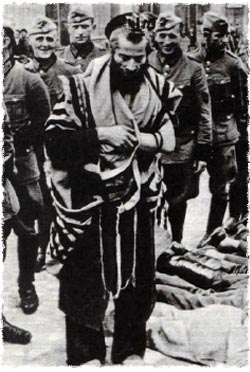
Last week at the Western Wall, I asked an elderly man to put on tefillin. He strongly refused.

I asked him, “When was the last time you put on tefillin?”

He smiled and proudly said, “72 years ago!” He held out his arm to show me the fading tattooed numbers. “1938,” he said. “It was the day of Kristallnacht. Do you know what Kristallnacht is?”

“Of course I do,” I told him.

“Two hundred and sixty-seven synagogues were burned down in one night. They burned down our synagogue, too. My tefillin were burnt up, and I have never put them on again,” he said.

“I have a friend who was in the camps, too,” I quickly said, “and he not only puts on tefillin today, but he even put them onto others inside the camp! Do you want to hear how he got tefillin into the camp?”

“Yes,” he said strongly. “How did he get them in there?”

-Gutman Locks
“Tefillin After 72 Years”
Stories of the Holocaust series
Chabad.org

I can’t even imagine what it would have been like to experience the horrors of the Holocaust. Like many Americans, I live a relatively comfortable life. I don’t really know what it’s like to go without adequate food, shelter, or clothing. I’ve been in the hospital before, but remain fairly healthy. I was once beaten by several men during a riot when I was 16 and spent some time recovering, but I was home and eventually after over a year, I began to let myself feel safe again. In short, I’ve faced a certain number of challenges over my lifetime, but none have been overly difficult.

I can’t even imagine what it would have been like to experience the horrors of the Holocaust.

I can’t even imagine what it would be like to have a wife who is struggling with cancer and who may die.

I can’t even imagine what it would be like to be the father of terminally ill child.

Frankly, I don’t want to imagine, let alone have to actually face such hideous tragedies in life. I don’t know how people do it and, I’m ashamed to say, I don’t even know how people of faith do it.

Where do you find hope in hopelessness? It’s one thing to say “I rely on my God for my strength,” and it’s another thing to actually live it out, one day at a time, one horrible, agonizing minute at a time. What can you do when someone delivers the terrible news and your courage melts like a plastic sandwich bag in the face of an inferno? What do you do when you’re a young, teenage boy and you and your mates are being herded into the gas chambers by the Nazis and you have only minutes to live?

“He began his story. The Nazis had come to the ghetto and grabbed 137 young boys. He told me that only five of them survived. Only five.

“He was thirteen and a half years old. He was wearing the high boots that his father had bought him, and when he saw them coming, he stuffed his tefillin into one boot and his prayerbook in the other.

“They pushed the boys into a cattle car and drove them to the death camp, not far from the ghetto. When the train stopped, they slid open the side of the cattle car and immediately began pushing them toward the open door of the gas chamber. The boys were frightened and cried out. They asked Laibel, ‘What should we do?’ He told them, ‘We’re going to stand in rows five across, and we’re going to march right into that gas chamber singing a song of faith, the “Ani Maamin.”’ And they did just that. They stood in rows five across, and started singing and marching right into the chamber.

“The guards became so confused that they did not know what to do. They screamed, ‘You can’t do that! No one has ever done such a thing before. Stop it! Stop it at once! Here! Go over there to the showers instead!’

“They pushed them over to the showers, and forced them to undress and throw their clothing into a pile in the middle of the floor. They made them empty their shoes, and the tefillin and prayerbook fell out onto the pile.

“After the shower, when they were dressed in camp clothes and were being pushed out, past the pile of their clothes, Laibel saw his tefillin and prayerbook lying there. He wanted so badly to run and pick them up, but terrifying guards were watching. He said to the boys, ‘I did something for you, so now you do something for me.’

“‘Whatever you want,’ they said. ‘You saved our lives.’

“He said, ‘When I give the signal, start a fight and scream out loud. Okay . . . now!’ The boys started to fight and scream. The guards ran over and tried to pull them apart, but they wouldn’t stop fighting. In the confusion, he ran over and grabbed his tefillin and prayerbook, and hid them under his arms.

Laibel not only managed to retrieve his tefillin but he wore them (clandestinely) in the camp and helped other Jews wear them, too. In the story commemorating his courage, we discover him as an old man today helping men wear tefillin at the Kotel.

And he looked me in the eye and said, ‘And I put tefillin on other men, too.’ I started to cry, and I kissed him on his yarmulke.

“The day after Laibel told me his story, there was a soldier at the Western Wall who wouldn’t put on tefillin. No matter what I said, he simply refused. Then I told him Laibel’s story, and he quickly said, ‘Okay, I’ll do it.’

“And you can do it, too,” I said to the elderly gentleman who hadn’t donned tefillin in 72 years, as I gently slid the tefillin I was holding onto his arm. He said the blessing and started to cry. We said the Shema, and he prayed for his family. He began to smile even while the tears were streaming down his face. A crowd gathered around and congratulated him on overcoming all those years of rejection.

You do not always succeed, but you always have to try.

If there has ever been a hopeless place on earth, it was in the Nazi death camps during the Holocaust. Even those who were not immediately killed expected to die a lingering and torturous death. Even those who survived and who were liberated didn’t expect to live any sort of “normal” Jewish life again. Who could after seeing what they saw and experiencing what they lived through? Even after more than seven decades, Holocaust survivors are suffering delayed post-traumatic stress disorder. The statement is so obvious, it’s almost laughable to report it in the media. Of course they’re suffering after seventy years? Who wouldn’t?

But after over seventy years, some have turned suffering and hopelessness into hope, not just for themselves but for each other. Laibel turns hopelessness into hope every time he helps another Jewish man don tefillin and pray at the Kotel. A Jewish man who hadn’t worn tefillin in seventy-two years because of the nightmare of Kristallnacht put on tefillin again because of Laibel’s inspiration, “said the blessing and started to cry.”

While most of us have never faced such horrendous, nightmarish, ghastly experiences as those of Holocaust survivors, as those who are battling desperately invasive cancer, as those who are anxiously trying to comfort a dying child, we still know the world is filled with hopelessness and despair. All of us face some sort of problem, some sort of challenge, something that makes us want to give up our fight to move forward or maybe even the fight to live.

I have no magic to give you. I have no secret formula with which you can overcome your hardships or worries or fears or tears. I can say “rely on God” but for even those men and women who do rely on Him with an almost superhuman faith and courage, the battle is hard and surrender to the darkness is a constant companion.

But amazingly there is still hope. Laibel must be well over eighty years old and for him, hope is helping just one more man put on tefillin, maybe for the first time in decades, and speak words of blessing to God. Hope is saying, “I love you” to a dying little boy. Hope is continuing to pray for your spouse, even though multiple organs are compromised by cancer and years of radiation and chemotherapy haven’t put the demon back in the bottle.

Hope is in the tears you cry. Hope is in your screams of anguish. Hope is being able to go on when life is impossible. Hope is a man learning how to pray again while crying after seventy-two years.

Hope is the faint light of a tiny candle holding the encroaching abyss at bay.

Hope is God.

 

The Best Within Us

If I speak in the tongues of men and of angels, but have not love, I am a noisy gong or a clanging cymbal. And if I have prophetic powers, and understand all mysteries and all knowledge, and if I have all faith, so as to remove mountains, but have not love, I am nothing. If I give away all I have, and if I deliver up my body to be burned, but have not love, I gain nothing.

Love is patient and kind; love does not envy or boast; it is not arrogant or rude. It does not insist on its own way; it is not irritable or resentful; it does not rejoice at wrongdoing, but rejoices with the truth. Love bears all things, believes all things, hopes all things, endures all things.

Love never ends. As for prophecies, they will pass away; as for tongues, they will cease; as for knowledge, it will pass away. For we know in part and we prophesy in part, but when the perfect comes, the partial will pass away. When I was a child, I spoke like a child, I thought like a child, I reasoned like a child. When I became a man, I gave up childish ways. For now we see in a mirror dimly, but then face to face. Now I know in part; then I shall know fully, even as I have been fully known.

So now faith, hope, and love abide, these three; but the greatest of these is love.

1 Corinthians 13:1-13 (ESV)

In spite of the fact that this passage from Paul’s letter to the Corinthian church has often been read as part of the vows at innumerable weddings, it has nothing to do with romantic love. It is Paul’s message about a much greater love and, in my opinion, a love that it much more difficult to express consistently in a life of faith. In fact, I think the kind of love Paul is describing has a lot more to do with what he had to say to the church in Rome.

Bless those who persecute you; bless and do not curse them. Rejoice with those who rejoice, weep with those who weep. Live in harmony with one another. Do not be haughty, but associate with the lowly.Never be wise in your own sight. Repay no one evil for evil, but give thought to do what is honorable in the sight of all. If possible, so far as it depends on you, live peaceably with all. Beloved, never avenge yourselves, but leave itto the wrath of God, for it is written, “Vengeance is mine, I will repay, says the Lord.” To the contrary, “if your enemy is hungry, feed him; if he is thirsty, give him something to drink; for by so doing you will heap burning coals on his head.” Do not be overcome by evil, but overcome evil with good. –Romans 12:14-21 (ESV)

Interestingly enough, the Talmud seems to echo the same lessons that Paul teaches:

“They said of Rabbi Yochanan ben Zakai that no man ever greeted him first, even idol worshippers in the market” [i.e., Rabbi Yochanan ben Zakai was the first to greet every person, even idol worshippers] (Berachot 17). At the same location the sage Abaye advocated soft speech and words of peace to everyone, especially including idol worshippers.

“[it is proper to] support the idol worshippers during the sabbatical year… and to inquire after their welfare [commentators: even on the days of the holidays of their idols, even if they do not keep the seven Noahide commandments] because of the ways of peace.” (Shevi’it 4,3)

The rabbis taught: ‘We support poor Gentiles with the poor people of Israel, and we visit sick Gentiles as well as the sick of Israel and we bury the dead of the Gentiles as well as the dead of Israel, because of the ways of peace.” (Gitin 61a)

I suppose I’m belaboring the point I was trying to make last Friday afternoon, but this blog isn’t about presenting topicial commentary or clever scholastic mysteries, it’s about me writing what’s on my mind, my heart, and my spirit as I approach each new day. The sorry state of love among the human race, including those who claim faith in God is still consuming me. What makes it worse is the lack of love among people of faith seems not to bother them (us) at all. And I have to share the name “Christian” with some of these folks. No wonder the atheists accuse us of hypocracy.

I just recently saw the film The Avengers (2012) for the first time. I know that’s a strange statement for me to make given the context of today’s “meditation,” but I do have a point. As well as being a top notch action film and a lot of fun to watch, there were a few good lessons to be found about love, honor, and sacrifice. Ironically, it took a completely secular film to talk about the qualities we Christians are supposed to possess by definition.

Of all the characters in the film, Captain America (played by Chris Evans) is the epitome of those qualities I just named. He is what we think of, in old fashioned terms, as “the greatest American hero.” He’s the ideal of what we used to believe were the finest qualities about our nation and our citizens. National cynicism has since destroyed those ideals but maybe not completely. The film has more than a few reminders for us that not only does the character Captain America have a much needed place in our world today, but the ideals Captain America represents are what we most long for in our lives.

Cap is sometimes juxtaposed in the film against the character of Tony Stark/Iron Man, a person who at once has everything and nothing. A man who has wealth, position, power, and glamour, but at the expense of the finer qualities of Captain America, such as love of humanity, purpose, conviction, honor, and the ability to sacrifice even his own life if it will save others. Stark is always looking for the loophole. Steve Rogers, Captain America’s other identity, always faces his challenges head on.

Toward the climax of the film (and I’m sorry if I’m giving too much away), the only way for Stark to save New York City from nuclear destruction is to carry a nuclear missile through a dimensional rift out of our world, in order to destroy the attacking army. This is supposed to be a one-way trip, but there are no other options and no loopholes. Captain America’s example throughout the movie finally made an impression on Iron Man so that what began beating in his chest was not the electronic perfection of the machine keeping him alive, but a real human heart of compassion, even for millions of people who he’ll never know.

As in most fantasies, Stark is saved at the last minute and rewarded for his willingness to sacrifice his life by survival and the opportunity to appear in more movies, but what about the reality of this lesson? What can we learn about love and even about “heaping burning coals on the head of those who hate us?”

Remember, this lesson comes to us courtesy of a secular and atheist entertainment industry. It is however, an industry that does, within the context of the film, allow Captain American to utter one single line of dialog confirming his faith in God, which I found just amazing. This lesson in love, honor, and sacrifice (as opposed to raw vengence and self-satisfaction) comes to us from people who, in all likelihood, have never met the God of the Bible and perhaps never will this side of the Messiah.

Where is our lesson? Where is the lesson of the church?

I don’t doubt that many Christians do live up to the ideals of our Master. Many believers do not just speak, but live out the example of Jesus Christ. Many extend themselves to feeding the hungry, providing clothing to those who need it, welcoming strangers into their homes, visiting the sick in the hospital, and even extending a smile and a hand of friendship to those who revile them, even if they are other Christians.

The sad and sorry part of our faith is that there are those among us who use Christ as a blunt instrument with which to beat their perceived enemies about the head and shoulders until they’re bloody and bruised. And then these Christians congratulate themselves for aptly employing Jesus as an object of vengence and an example of “tough love” which is neither particularly “tough” in the sense of true strength and honor, or at all loving in the way Paul described love to the Corinthians.

More’s the pity.

What is the defining quality of Christianity, judgment or love? They both exist within our theology. We know a time of judgment is coming and most Christians feel immune to it, imagining that only their enemies the atheists will face such a terrifying fate. And yet the Master tells us this is absolutely not true. Just who do you think Jesus is talking to in Matthew 25:34-46? Why would athests be expected to give water to the thirsty and clothe the naked in Christ’s name? And why would the Master say this?

“Not everyone who says to me, ‘Lord, Lord,’ will enter the kingdom of heaven, but the one who does the will of my Father who is in heaven. On that day many will say to me, ‘Lord, Lord, did we not prophesy in your name, and cast out demons in your name, and do many mighty works in your name?’ And then will I declare to them, ‘I never knew you; depart from me, you workers of lawlessness.’ –Matthew 7:21-23 (ESV)

In Romans 12:19, Paul quoted Leviticus 19:18 to remind us that vengence belongs to God, not men. The Master gave us all a new commandment to love each other as a way of showing the world around us that we belong to him (John 13:34-35). If I have to err in the expression of my faith, I prefer to err on the side of love and to leave (to the best of my limited abilities) the vengence to God. God’s vengence, when He chooses to express it, does not contain our human faults, hositilities, and insecurities, but only His justice, which is neither ours to take or to give.

If secular films such as The Avengers can be an inspiration for us to be better people, to be “heroic” in the love we can show others, why doesn’t the church show the world that Christ brings out the best within each of us? If you want to carry the Gospel message to a desperate and unbelieving world and show other Christians “how it’s done,” I can think of no better way to do it than to show love especially toward your “enemies” because of the ways of peace.

“The whole problem with the world is that fools and fanatics are always so certain of themselves, and wiser people so full of doubts.”

-Bertrand Russell


Planting Seeds of Light

“If you go in My statutes.” (Vayikra 26:3) Our Sages interpret the word “if” as a plea, (Avoda Zara 5a) in the sense of “if only you would go in My statutes.” G-d’s pleading (as it were) with Israel to keep the Torah, in itself aids man and gives him the ability to remain steadfast in his choice of the good. Moreover, “…you go in My statutes” – the soul then becomes a mehaleich, it progresses. (to higher levels of achievement. See Iyar 6.)

With the advent of Mashiach, there will be revealed the superior quality of the traits of simplicity and wholeheartedness found in the avoda of simple folk who daven and recite Tehillim with simple sincerity.

Hayom Yom
Iyar 24, 39th day of the omer
Compiled by the Lubavitcher Rebbe
Translated by Yitschak Meir Kagan
Chabad.org

“O Jerusalem, Jerusalem, the city that kills the prophets and stones those who are sent to it! How often would I have gathered your children together as a hen gathers her brood under her wings, and you were not willing! See, your house is left to you desolate. For I tell you, you will not see me again, until you say, ‘Blessed is he who comes in the name of the Lord.’”

Matthew 23:37-39 (ESV)

Given the state of the world today and particularly the state of the church, it’s not hard to imagine that God is pleading to us to return to Him, to turn our hearts back to the will and love of God. I’m not really writing this to condemn the church, nor am I absolving myself of any poor performance in the service of God. However, I am aware that there is great benefit is continually looking into the mirror and assessing the person we see to determine if we have fulfilled the commandments of our Master as a disciple should. Have we earned the Master’s praise when he says, Well done, good and faithful servant,” or do we deserve something else?

The passage I quoted from Matthew 23 is sometimes used by Christians to level specific criticism toward Jews (while conversely praising the church), but I think it can be applied to all of us. A few days ago in my “mediation” Burning the Plow, I pointed out a few things:

The transactions between Jesus and those he called to be his disciples seem to be functionally similar to the interaction between Elijah and Elisha. Jesus, the “ultimate covenental man” encounters various “material men” in the process of performing their usual routines and commands them to follow him. Those who hesitate or who desire to fulfill their material obligations first, he says are unfit for the Kingdom of God.

The level of commitment called for both by Elijah and by Jesus seems abrupt and absolute and anything less is considered a failure in terms of entering the Kingdom of God.

There are times in our lives when we pursue righteousness with extraordinary zeal and strive to fulfill the desires of God with all due diligence and even excellence. Those are the times when, like a long-distance runner who is approaching the finish line, we drive ourselves to perform one final sprint in order to reach our goal and perhaps pull away from a slightly slower competitor in the race.

There are other times, most times probably, when like that same long-distance runner, we allow fatigue to dictate our response to God and we merely plod along, laying one foot ahead of the other, managing to continue to move forward, but only as a matter of course. All we’re thinking about it making it through the next step, the next turn, the next day, and longing for a final rest. We aren’t really present with God or truly observing the steps of our Master, trying to imitate not only where he has placed his feet but what he was doing as he walked in holiness.

The beginning of one’s decline, G-d save us, is the lack of avoda in davening. Everything becomes dry and cold. Even a mitzva performed by habit (Compare Yeshayahu 29:13) becomes burdensome. Everything is rushed. One loses the sense of pleasure in Torah-study. The atmosphere itself become crass. Needless to say, one is totally incapable of influencing others.

Hayom Yom
Iyar 23, 38th day of the omer
Compiled by the Lubavitcher Rebbe
Translated by Yitschak Meir Kagan
Chabad.org

Dry spots in our journey of faith are probably inevitable given that we are frail and fallible human beings, but when we become aware of them, we don’t have to stay there. Sure, it’s more tolerable and maybe even more comfortable than the alternative, but it’s not desirable. When we hear God pleading to us and listen to the lament of our Master over us, we can reply with something else besides, “I’m tired” or “I’m doing the best that I can.” Perhaps what we need to do is to stop for a moment, catch our breath, and to see if we’re on the right path at all. Realize that we all get to a place in our faith when we force our effort after we’ve forgotten its purpose. We need to let ourselves be reminded of who God is and who we are in Him, and then let ourselves be refreshed by Him.

Just as a tiny seed awakens the infinite power of life hidden within the earth, so an act of caring and giving buried quietly in the ground can ignite an explosion of infinite light. Charged with that power, all the world is changed.

-Rabbi Tzvi Freeman
“Seeding Change”
Based on letters and talks of the Rebbe
Rabbi M. M. Schneerson
Chabad.org

We are the tiny seeds our Master planted, watered, and nurtured with his life and his spirit. When will we ignite in an explosion of infinite light and change the world?

The One Side of the Coin

As a matter of fact, at the level of his cosmic confrontation with God, man is faced with an exasperating paradox. On the one hand, he beholds God in every nook and corner of creation, in the flowering plant, in the rushing of the tide, and in the movement of his own muscle, as if God were at hand, close to and beside man, engaging him in a friendly dialogue. And yet the very moment man turns his face to God, he finds Him remote, un-approachable, enveloped in transcendence and mystery. Did not Isaiah behold God, exalted and enthroned above creation, and at the same time, the train of his skirts filling the Temple, the great universe, from the flying nebulae to one’s most intimate heartbeat? Did not the angels sing holy, holy, holy, transcendent, transcendent, transcendent, yet He is the Lord of hosts, who resides in every infinitesimal particle of creation and the whole universe is replete with His glory?

-Rabbi Joseph B. Soloveitchik
from Chapter VI of his book
The Lonely Man of Faith

Fusing the existential acuity of Kierkegaard with the wisdom of the Old Testament, Boston Orthodox rabbi Soloveitchik has produced a timeless spiritual guide for men and women of all religions. In this soaring, eloquent essay, first published in Tradition magazine in 1965, “The Rav,” as he is known to his followers worldwide, investigates the essential aloneness of the person of faith, whom he deems a misfit in our narcissistic, technologically oriented, utilitarian society. Using the story of Adam and Eve as a springboard, Soloveitchik explains prayer as “the harbinger of moral reformation” and probes the despair and exasperation of individuals who seek to redeem existence through direct knowledge of a God who seems remote and unapproachable. Although the faithful may become members of a “convenantal community,” their true home, he writes, is “the abode of loneliness” as they shuttle between the transcendent and the mundane. Sudden shafts of illumination confront the reader at every turn in this inspirational personal testament.

-from Publishers Weekly, 1992

Rabbi Soloveitchik uses the two descriptions of the creation of man from the first two chapters of Genesis to illustrate the two natures of humanity: the physical nature and the spiritual nature. I’m being very simplistic in this explanation, but as I read Soloveitchik, the basic conflict of any person of faith is in the dichotomy of the natural and supernatural human being. The first seeks significance and even triumph in domination over the created world, while the second sees transcendence beyond the world, to peek, as it were, under the hood, and to touch the very garment of the Creator.

Christianity’s response to this dilemma is to completely separate the physical and the spiritual, giving the latter ascendance and (ideally) priority over the former (it doesn’t often work out this way). This creates a barrier between the “two Adams” who, living in one flesh, travel in two apparently opposite directions. However, maybe Judaism has another approach:

Yula is an enlightened being. He spends his life in the wilderness, far from humanity, focusing his mind on the higher realms.

Harriet Goldberg is a schoolteacher. She spends her life cultivating small minds, hoping to give them a sense of wonder for the world they live in.

Who is closer to G-d?

That depends. Where is G-d?

If G‑d emanated a world spontaneously, dispassionately—just as the sun provides us light and warmth without any investment on its part—then G-d is found beyond this world, and Yula is closer.

But if G-d created a world deliberately, because that is what He desires and cares for, and so He invested Himself within that creation, so that His very essence and being can be found here, then Harriet is closer.

You choose.

-Rabbi Tzvi Freeman
“How to be Spiritual”
Based on letters and talks of the Rebbe
Rabbi M. M. Schneerson
Chabad.org

Then again, maybe not. But do we really have to make a choice between Yula and Harriet? Why must one be closer to God than the other? Isn’t there room in God’s throne room or His heart for both?

Rabbi Yosef Yitzchok of Lubavitch wrote:

When my grandmother, the Rebbetzin Rivkah, was eighteen years old she fell ill and the doctor ordered that she eat immediately upon waking. But grandmother, who did not wish to eat before prayer, would pray at an early hour and only afterwards eat her breakfast.

When her father-in-law, Rabbi Menachem Mendel of Lubavitch, heard of this, he said to her: “A Jew must be healthy and strong. Concerning the precepts of the Torah it is written “live in them”- one is to infuse life into the mitzvos; and in order to infuse life into the mitzvos, one must be fit and joyful.”

Concluded Rabbi Menachem Mendel: “Better to eat in order to pray, than to pray in order to eat.”

-Rabbi Yanki Tauber
Commentary on Torah Portion Acharei
Leviticus 21:1-24:23
Chabad.org

Here we see that the physical is ascendant over the spiritual, but only so the former can serve the latter’s purpose. However, Rabbi Freeman has another way of looking at the human condition:

There are crossroads where you choose not only your future, but your past as well.

Take one path, and your past becomes but a silly, useless dream that might as well never have happened.

Take another road, and your past becomes a magnificent frame for a glorious moment of life. The moment now. The moment for which your soul was formed.

—Padah B’shalom, 5738

Future and past, humanity and Divinity, secular and spiritual, each human being, perhaps even those who refuse to acknowledge the possibility of God, stands at the center of a room with two doors, each leading into two directions that are impossible to fuse into a single path.

But each of us is only a single being. While Rabbi Soloveitchik uses the two different descriptions of the creation of Adam to illustrate these separate paths, in fact, Adam was one man who was created into two worlds. He was commanded to dominate and rule over a physical Creation, but he was also directed to transcendently guard Creation for the sake of Heaven. When man fell, it did not destroy the “second Adam,” it just made it harder for the two paths to unite into a single journey.

Since the day when Adam and Eve were rejected by Eden, we have been trying to walk both east and west in search of God. Where might He be found; in the Heavens above, or in the earth below?

Ironically, we find Him at once in both, which is just plain confusing to most people. To solve the confusion, some men turn only to Heaven while others choose to observe Him only in how He manifests in nature. One extreme imprisons God in the realm of spirituality while the other traps Him on earth or worse, leads man to worship only the observable.

At the end of the book of Exodus, God dwelt among His people in the “form” of the Shekhinah, which indeed seemed to possess a heaviness and “substance” within the material world. But God did not cease to exist as the infinite and unknowable Ein Sof in His highest Heavens.

Is God found in the human heart and in the unattainable mystic domains beyond man’s ability to conceive? Most certainly. But where does that leave man? How can we find God when He exists in two impossibly incompatible realms?

I don’t know. I only know that the reason both “Adams” are lonely is not just because of their great difficulty in attaching to God, but because of the near impossibility in talking to each other. Two essences are trapped in one flesh, the first being completely at home there and the second being a complete foreigner.

But we can’t live, one without the other. The material man without the spiritual man, is just a machine who perceives only the world around him and is unable, by default, to understand anything else. God is lost to him or man himself becomes his own “god.” The spiritual man without the material man is at best, indifferent to the physical world and obsessed with ephemeral mysticism. At worst, he is just plain dead. In this extreme, if we refuse to eat and drink in order to “better” pray to God, we starve our bodies and deny our lives.

But God made us as both and for the length of our earthly existence, this is who we are. Man struggles to make his peace with God but in reality, we cannot be at peace with our Creator until we find peace within ourselves. The Adams must learn to live with each other and to appreciate and embrace both sets of priorities, not as incompatible opposites, but as two fused sides to a single coin.

God cannot be anything but the unique and radical One. We human beings, created in His image, are two, but as two we are incomplete. We must also be One, as He is One. That is the destination to which we are striving all our lives to attain.

Perhaps that’s the answer to how we must be holy as God is holy and how we must be perfect as our Father in Heaven is perfect. We must be One, as God is One.

In the end, the coin will only have one side.


The Chaotic Serene Garden

I have no problem-solving thoughts. I do not intend to suggest a new method of remedying the human situation which I am about to describe; neither do I believe that it can be remedied at all. The role of the man of faith, whose religious experience is fraught with inner conflicts and incongruities, who oscillates between ecstasy in God’s companionship and despair when he feels abandoned by God, and who is torn asunder by the heightened contrast between self-appreciation and abnegation, has been a difficult one since the times of Abraham and Moses. It would be presumptuous of me to attempt to convert the passional, antinomic faith-experience into a eudaemonic, harmonious one, while the Biblical knights of faith lived heroically with this very tragic and paradoxical experience.

All I want is to follow the advice given by Elihu, the son of Berachel of old, who said, “I will speak that I may find relief”; for there is a redemptive quality for an agitated mind in the spoken word, and a tormented soul finds peace in confessing.

-Joseph B. Soloveitchik
from the Foreword of his book
The Lonely Man of Faith

In many ways, reading the first part of Rabbi Soloveitchik’s book is like looking in a mirror. Well, not exactly. He was born over half a century before I was and after all, I’m not Jewish, let alone a Rabbi. Yet everything he says about his own experience and the experience of a man of faith completely reflects my own thoughts, feelings, and uneasy journey with God.

I’ve talked before about trying to find a storyteller who speaks in metaphors I can understand, and so far Rabbi Soloveitchik is one of those storytellers. I don’t think I’ll ever know why men like Rabbi Tzvi Freeman and even the Lubavitcher Rebbe, Rabbi Menachem Mendel Schneerson of righteous memory, use “my metaphors” so much more clearly than any Christian author I’ve ever read. It is true that Thomas Merton, a Trappist Monk, spoke very well and clearly to some parts of me in his book The Seven Storey Mountain, but that’s something of a rarity.

I’m not going to presume a Jewish soul, and in so many ways, I’m such a Goy (at least according to my Jewish wife), so I really don’t have an answer. But at least as far as my reading up to the end of Chapter 1 is concerned, Rabbi Soloveitchik is speaking in a language that could apply to people of many different faiths, not just to the Jew.

And he’s talking about exactly what I experience.

I have a confession to make. There were times when I thought I was going crazy. There were times when I thought I was just a bad Christian, a person with a bad or weak faith, someone who just didn’t “get” what it was to walk on a path that leads to God. And yet just look at how Rabbi Soloveitchik starts the first chapter of his book:

The nature of the dilemma can be stated in a three-word sentence. I am lonely. Let me emphasize, however, that by stating “I am lonely” I do not intend to convey to you that impression that I am alone. I, thank God, do enjoy the love and friendship of many. I meet people, talk, preach, argue, reason; I am surrounded by comrades and acquaintances. And yet, companionship and friendship do not alleviate the passional experience of loneliness which trails me constantly. I am lonely because at times I feel rejected and thrust away by everybody, not excluding my own intimate friends, and the words of the Psalmist, “My father and my mother have forsaken me,” ring quite often in my ears like the plaintive cooing of the turtledove. It is a strange, alas, absurd experience engendering sharp, enervating pain as well as stimulating, cathartic feeling. I despair because I am lonely and, hence feel frustrated. On the other hand, I also feel invigorated because this very experience of loneliness presses everything in me into the service of God.

While Rabbi Soloveitchik’s writing style is very different from mine, what he’s actually saying is just what I’ve been trying to say for a long as I have been blogging. Actually, it’s been a lot longer than that, but blogging has provided me with a unique outlet for my frustration and my need to “follow the advice given by Elihu, the son of Berachel of old” and to “speak that I may find relief.”

Joseph Ber Soloeitchik was born over a century ago, was an American Orthodox rabbi, Talmudist and modern Jewish philosopher, and a descendant of the Lithuanian Jewish Soloveitchik rabbinic dynasty. The words of his book first appeared in print over fifty years ago, when I was still in elementary school. He died at the age of 90 nearly twenty years ago and a continent away from where I was living at the moment his soul ascended to God. I don’t imagine that we would have had a lot in common had we ever met.

Except for how we experience our faith.

Maybe I’m not crazy after all. Maybe faith is designed to be lonely, inconsistent, and chaotic, like riding a roller coaster that alternately travels through a beautiful and serene Japanese garden and the fresh hell of a radioactive Chernobyl.

If I can take the beginning words of the Rav’s book at face value, I guess my journey of faith will never get any easier, and my only solace is in “confessing” my “tortured soul” (in my case, as a blogger on the web). And yet, it’s nice to find out that I’m not alone in feeling alone in my faith.

I’ll let you know how the rest of the book turns out.

How Have We Failed?

Teresa MacBain has a secret, one she’s terrified to reveal.

“I’m currently an active pastor and I’m also an atheist,” she says. “I live a double life. I feel pretty good on Monday, but by Thursday — when Sunday’s right around the corner — I start having stomachaches, headaches, just knowing that I got to stand up and say things that I no longer believe in and portray myself in a way that’s totally false.”

“On my way to church again. Another Sunday. Man, this is getting worse,” she tells her phone in one recording. “How did I get myself in this mess? Sometimes, I think to myself, if I could just go back a few years and not ask the questions and just be one of those sheep and blindly follow and not know the truth, it would be so much easier. I’d just keep my job. But I can’t do that. I know it’s a lie. I know it’s false.”

-by Barbara Bradley Hagerty
“From Minister to Atheist: A Story of Losing Faith”
NPR.org

Our teacher the Baal Shem Tov said: Every single thing one sees or hears is an instruction for his conduct in the service of G-d. This is the idea of avoda, service, to comprehend and discern in all things a way in which to serve G-d.

Hayom Yom: Iyar 9, 24th day of the omer
Compiled and arranged by the Lubavitcher Rebbe
Rabbi Menachem Mendel Schneerson, of righteous memory, in 5703 (1943)
from the talks and letters of the sixth Chabad Rebbe
Rabbi Yosef Yitzchak Schneersohn, of righteous memory

Yesterday I wrote When We’re Left Behind to describe my initial reactions to reading the news story I quoted above. After some thoughts and reflection, it hasn’t gotten much better. I still don’t like being called a “sheep,” “blind,” and thought of as not knowing the “truth.” MacBain’s story is supposed to be the first in a series of news articles on losing faith. I wonder if NPR would consider writing a series on the other side of the coin about people who have struggled, endured, and persevered over their crisis of faith.

Call me cynical, but I seriously doubt it.

The Baal Shem Tov considers everything we see and hear and probably every experience we have as a lesson in how we are to behave in the service of God. I guess that’s what I was trying to convey yesterday when I said we should love and not condemn people like Teresa MacBain. I admire her husband, who has managed to retain his faith in the face of his wife’s atheism. The NPR article spent almost no time exploring how all of this affects him. And I kind of know how he feels.

No, my wife isn’t an atheist, but she isn’t a Christian either. She’s Jewish, and I very much support her in her pursuit of her faith and her identity. But as time has passed, I have come to realize that we represent two different worlds. I used to think there was significant overlap between those two realms, but now I’m not so sure.

No, I’m sure. There’s not much overlap at all.

That brings up an interesting question, both for the MacBains and for me. How do you live with someone who is utterly different from you at the very foundation of your being?

OK, men and women are different, I get that. Every person who’s been married for more than a week or so realizes that living together as a married couple is a challenge. Every couple who has been together for five, ten, twenty, thirty years or more (our 30th wedding anniversary was just last month) knows just how much of a struggle it is at times to make the sorts of adjustments required between two people as they develop and (hopefully) grow.

One of the things I’ve noticed about most of the people of faith I associate with is that, if they’re married, their spouses have the same fundamental understanding of God and religion as they do. That is, if the husband’s a Christian, chances are, so is the wife, and vice versa. Teresa and Ray MacBain have just entered the dubious club of intermarried couples.

Welcome.

So what does Ray MacBain do now? Does he go to church and leave his wife at home every Sunday? Does he go to the same church were his wife was a minister? If so, how does he deal with the inevitable gossip and tongue-wagging over his Teresa’s decision to leave the faith and her “coming out” as an atheist?

I haven’t listened to the audio interview (like most people, I can read a great deal faster than people can talk). I have briefly scanned some of the comments under the NPR story and saw the typical war of words between self-righteous atheists and self-righteous Christians. Does bashing each other really help? If an atheist wants the freedom of choice, why can’t I have that same right as a person of faith?

Here’s one of the more illuminating comments I read:

It bothers me to no end to see the intolerance and arrogance of my atheist friends who look down upon the faithful as if they’re second class muggles… just as it bothers me to watch the intolerance of the “faithful” Christian towards other beliefs or non-beliefs.

What I see are the human flaws of conceit and arrogance – people who think they know what’s “right” or what’s “best” for others, and have no room in their worldview for people with different viewpoints.

I sympathize with Teresa’s plight – I struggle with my faith. It saddens me that people seem more concerned with sticking it to their fellow human being than trying to find the best path to walk for themselves.

Alas, “intolerance and arrogance” are very human traits and not limited just to the religious or the irreligious.

As annoying as it is to be called a “sheep,” I guess it shouldn’t really surprise me. There’s nothing about being an atheist or an agnostic that should cause me to expect them to be good, bad, or indifferent. There’s not inherit moral code to not believing in God, so when someone says they’re an atheist, there’s no way I can know what exactly they’re going to say or do.

However,  I do have some sort of idea of what to expect from someone who says they are a disciple of Jesus. We are expected to take the higher moral road just because of who we are. That’s why it’s especially disappointing to see Christians making snarky comments to atheists (and I’m not immune) in an NPR online news story. If your life is supposed to be an example of how you have been changed by God, how is acting like a regular, “run-of-the-mill” human being accomplishing that?

Is that “God thing” working for you yet?

That’s what I see coming out of this news story, out of the comments, and out of the buzz about Christians vs. Atheists on the web. It’s not my faith in God I’m worried about, it’s my faith in people. On somewhat rare occasion, I meet a Christian who really deserves to be called by the name of the Master. I meet a person who is truly helpful, compassionate, charitable, kind, and loving to everyone they meet, not just the people they know and like. What really scares me is that the sort of person I’m describing is rare in religious circles. It’s even more scary that they might be more common among the atheists.

I know Christians reading what I just wrote are saying, “It doesn’t matter if an atheist is nicer than a Christian. The atheists are still going to hell.” Oh. It doesn’t matter?

“When the Son of Man comes in his glory, and all the angels with him, then he will sit on his glorious throne. Before him will be gathered all the nations, and he will separate people one from another as a shepherd separates the sheep from the goats. And he will place the sheep on his right, but the goats on the left. Then the King will say to those on his right, ‘Come, you who are blessed by my Father, inherit the kingdom prepared for you from the foundation of the world. For I was hungry and you gave me food, I was thirsty and you gave me drink, I was a stranger and you welcomed me, I was naked and you clothed me, I was sick and you visited me, I was in prison and you came to me.’ Then the righteous will answer him, saying, ‘Lord, when did we see you hungry and feed you, or thirsty and give you drink? And when did we see you a stranger and welcome you, or naked and clothe you? And when did we see you sick or in prison and visit you?’ And the King will answer them, ‘Truly, I say to you, as you did it to one of the least of these my brothers, you did it to me.’

“Then he will say to those on his left, ‘Depart from me, you cursed, into the eternal fire prepared for the devil and his angels. For I was hungry and you gave me no food, I was thirsty and you gave me no drink, I was a stranger and you did not welcome me, naked and you did not clothe me, sick and in prison and you did not visit me.’ Then they also will answer, saying, ‘Lord, when did we see you hungry or thirsty or a stranger or naked or sick or in prison, and did not minister to you?’ Then he will answer them, saying, ‘Truly, I say to you, as you did not do it to one of the least of these, you did not do it to me.’ And these will go away into eternal punishment, but the righteous into eternal life.” –Matthew 25:31-46 (ESV)

Sure looks like it matters to me. More importantly, it sure looks like it matters to God.

I’m going to stop short of blaming “the church” for failing Teresa MacBain. We each negotiate our own relationship with God, so Teresa is just as responsible for her’s as I am for mine. However, if she had any lingering doubts about her decision, the various “bad attitude comments” from Christians in response to her “outing” herself probably sealed the deal.

Christians, Jews, Muslims, and most other religious people tend to be pretty judgmental, relative to the world around us. On the one hand, we do have a specific set or standards we feel we’re upholding, as opposed to an “anything goes” sort of world view. On the other hand, we tend to substitute judgment for compassion and “legalism” (yes, even Christians) for grace. Jesus was hammered verbally for hanging out with the low-lives of his day: prostitutes and tax-collectors (collaborators with the occupying Roman army). We’re kind of like the folks who judged Jesus. We judge and accuse and complain when a Christian hangs out with and is accepting of “low lives” such as gays, for example (a really big sin in the eyes of most Christians…much bigger than wife beating, bank robbery, and surfing porn on the web). We demand that Christians only hang out with other Christians and the split second someone tells us they have doubts about their faith, they are dead to us.

Man, do I make Christians sound bad. Almost like the way some atheists talk about us.

But if all of us were really practicing grace, and I think we can do this without compromising our principles and blending in to the moral structure of the secular world around us, I doubt if too many people would have a lot to complain about when Christianity was mentioned.

The church hasn’t failed Teresa MacBain, but a Christian fails every time he or she doesn’t show compassion for someone in pain, including someone who has struggled and even lost their faith. It is said the church is the only army that shoots its own wounded. I believe that. Teresa MacBain may never come back to faith in God and discipleship in Jesus, but if she wants to, and if she came to you about it, would you extend your hand in welcome or show her back out the door, not wanting to be tainted by a “low life?”

What are you supposed to learn from this experience about your conduct in the service of God today?