Tag Archives: faith

Walking in the Shadow of God

Our sages tell us that one who mourns the destruction of the Beis HaMikdash will see its comfort. The Maharal, zt”l, was asked why this should be so. “What difference does it make if one mourns the destruction or not? If one is present in the ultimate future isn’t it obvious that he will experience the nechamah?”

The Maharal explained the need to mourn to attain the nechamah. “Before something comes to a new level, it first must decompose. In the creation of the world, God first made tohu va’vohu; only then could the world come into being. When a seed is planted in the ground, it decomposes. Only then can a tree sprout. The same is true with the gestation of a man or an animal. The seed must decompose before the embryo begins to grow. The same is true regarding an egg, as we find in Temurah 31. First the egg must decompose; then it can become a chick. The reason for this phenomenon is that there must be a lack for more perfection to fill. If there is nothing missing, it is impossible to come to a new level. Similarly, one who does not mourn the destruction of the Beis HaMikdash feels complete. He has no space for the nechamah, since he never experienced the lack in the first place!”

The Shem MiShmuel, zt”l, learns a practical lesson from this same statement. “One who wishes to start again and that his earlier sins should not be considered should make himself like dirt. He must completely nullify all of his senses and desires to God. In this way, he will become a completely new creation. The proof to this is from the case of a ger. Although a ger comes from a distant spiritual place, he is like a newborn baby by making just such a new start. He immerses in a mikveh to symbolize this, and if he is male he does a bris. Why should a Jew who makes a new start be any less?”

Daf Yomi Digest
Stories Off the Daf
“The Destruction before the Renewal”
Termurah 31

Therefore remember that at one time you Gentiles in the flesh, called “the uncircumcision” by what is called the circumcision, which is made in the flesh by hands – remember that you were at that time separated from Christ, alienated from the commonwealth of Israel and strangers to the covenants of promise, having no hope and without God in the world. But now in Christ Jesus you who once were far off have been brought near by the blood of Christ.Ephesians 2:11-13 (ESV)

Maybe the story off the Daf and Paul’s message to the Ephesians aren’t telling the exact same story, but they seem to be related, at least to me. We have two groups, Jews who have been distant from God and who need to “make themselves like dirt” in order to “become a completely new creation”, and Gentiles who were once far off from God but who have been brought near “by the blood of Christ.” The Shem MiShmuel even invokes the imagery of the convert to Judaism, a Gentile who goes down into the mikvah a goy and who rises out of the water “like a newborn baby…making a new start.”

That’s not much different than what I was describing in my previous meditation. As a new creation, we stumble and fall a lot, trying to get used to the new person we are trying to become. Sometimes we fall back and have to relearn skills and sometimes we are trying to advance spiritually and come to a point where we feel like infants again, rather than mature in the faith. Amazingly, having once felt secure in our relationship with God, we might find that we are no longer sure who we are in Him and how we are to serve Him.

I know that description fits me pretty well these days.

Despite the fact that human beings have free will and angels do not, we can still learn a great deal from their behavior. Like the angels, it’s important to acknowledge that there is more than one way to serve God. Whether you are an introvert or extrovert, teacher or rabbi, businessman or stay-at-home mom, there is a place for all of us among the Jewish people. For example, each one of the Twelve Tribes of Israel carried out different tasks. Some engaged in commerce or working the fields, others in religious study, and yet others in military or temple service – and all were essential to the survival of the nation as a whole. Quite frankly, we’re not all supposed to be doing the same kind of work or serving God the exact same way.

The Chofetz Chaim was once approached by a successful businessman who decided to scale down his business so that he could dedicate himself to Torah study. The Chofetz Chaim explained why his decision was wrong by way of a parable. During wartime, if a soldier unilaterally decides to leave his current post to fight in a different capacity, he will be court-martialed. A soldier must obey orders and man the position to which he was assigned. The Chofetz Chaim went on to say that this businessman’s responsibility was to support Jewish institutions and the poor. If he decided to go through with ending his business success, he would be jeopardizing the position God gave him within the Jewish community.

We have to give fellow Jews the space to become the individuals God intended them to be. Otherwise, we will be contributing to unnecessary tension and divisiveness.

-Asher
“Living Like the Angels”
Lev Echad

Blog writer Asher is addressing a primarily Jewish audience and is encouraging them to try not to “turn everyone into replicas” of each other. As much as Judaism is a unique kahal, like Christianity or any other faith or people group, it is made up of individuals, each with a unique purpose in life and over time, that purpose can even change. Asher continues:

Remember, those differences ultimately constitute the entirety of our people. Our strength can be found via our uniqueness as individuals.

Assuming I can apply all that to me, what does it mean for my life as a Christian? Who am I and who does God intend me to be? One thing is for certain…I don’t seem to be like any other Christian I’ve ever met. On the other hand, I have things in common with everyone else in the church.

Yet in some sense, because I claim the name “Christian,” I, like all other believers, have a lot to make up for in how we have treated the Jewish people.

For the one whom You smote they persecuted and they tell about the pain of Your mortally wounded. Add iniquity to their iniquity, and let them not have access to Your righteousness. May they be erased from the Book of Life, and let them not be inscribed with the righteous. –Psalm 69:27-29 (Stone Edition Tanakh)

While David isn’t writing about Christians as such, he is writing about those who have persecuted Israel, and the church has done this in abundance. Only through making ourselves (myself) like dirt and in sincere repentance, can we have any hope, through Christ, of being written in the Book of Life with the righteous.

I bet, as a Christian, you never thought that part of professing your faith and repenting of your sins would be repenting of Christian mistreatment of the Jewish people. If you want to learn more about this, I encourage you to read a post written by my friend Gene Shlomovich called A story of one Christian’s after-death regret about Israel and Judaism. A sobering and mystic tale of just how much we need to turn our hearts.

For God shall save Zion and build the cities of Judah, and they shall settle there and possess it. The offspring of His servants shall inherit it, and those who love His Name shall dwell in it. –Psalm 69:36-37 (Stone Edition Tanakh)

Lest you be wise in your own sight, I do not want you to be unaware of this mystery, brothers: a partial hardening has come upon Israel, until the fullness of the Gentiles has come in. And in this way all Israel will be saved, as it is written,
“The Deliverer will come from Zion,
he will banish ungodliness from Jacob”;
“and this will be my covenant with them
when I take away their sins.” –Romans 11:25-27 (ESV)

The prophesies regarding Israel are clear but what if we who, even calling ourselves Christian, have disdained God’s chosen and holy ones? Can it be that without repentance of our sins against Israel, we will ultimately be rejected by her King?

“Not everyone who says to me, ‘Lord, Lord,’ will enter the kingdom of heaven, but the one who does the will of my Father who is in heaven. On that day many will say to me, ‘Lord, Lord, did we not prophesy in your name, and cast out demons in your name, and do many mighty works in your name?’ And then will I declare to them, ‘I never knew you; depart from me, you workers of lawlessness.’ –Matthew 7:21-23 (ESV)

I’m probably stretching the interpretation of this verse out of its context, but it does illustrate that many of those who feel secure in their salvation have already been lost, even as they call themselves “Christian.” If this is their fate, then what of mine?

O God, You know my folly, and my guilty acts are not hidden from You. Let those who wait for You not be shamed through me, O Lord Hashem/Elohim, Master of Legions; let those who seek You not be humiliated through me, O God of Israel. –Psalm 69:6-7 (Stone Edition Tanakh)

Let not my mistakes, my errors, my sins, prevent another from turning to God through Jesus Christ, or to taint the name and reputation of the Messiah. For I know that…

The peoples will acknowledge You, O God; the peoples will acknowledge You – all of them. Regimes will be glad and sing for joy, because You will judge the peoples fairly and guide with fairness the regimes of the earth, Selah. –Psalm 67:4-5 (Stone Edition Tanakh)

But in verse 8 of that Psalm, when David says, “May God bless us, and may all the ends of the earth fear Him,” will only Israel be blessed, or will “the peoples;” the nations of the earth, including we non-Jewish Christians, have a blessing too?

Do not cast me off in time of old age; when my strength fails, forsake me not. –Psalm 71:9 (Stone Edition Tanakh)

Our hope is in Jesus Christ but we must never forget that part of that hope is attached to Israel, and Jesus is her first born son and King. He would never betray his own and would never tolerate those who do. In Romans 11, Paul was very clear about how we “grafted in” branches can be easily detached from the root should be become arrogant and self-serving, and should we consider ourselves superior to the natural branches, who after all, have only been removed temporarily.

I’ve been trying to write about my own condition, but I keep coming back to the church; her flaws, her scars, and her needs. I keep wanting to write “I” but I continue to stray into writing “we”. I wonder if God is trying to tell me something. As much as I feel detached from wider Christianity, I cannot divorce it entirely, for the body of Gentile disciples in the Messiah is part of who I am. Yet, I am also this.

Yochanan answered and said to him, “Rabbi, we saw a man driving out demons in your name, but he does not follow us, so we stopped him, on account of the fact that he did not follow us.”

Yeshua said, “Do not stop him, because no one who does an act of power in my name can quickly speak evil of me. For whoever is not for our foes is for us. For all who let you drink a cup of water in my name, because you belong to the Mashiach, amen, I say to you, he will not lose his reward.” –Mark (Markos) 9:38-41 (DHE Gospels)

I’ve never read this statement of the Master before as one that would allow someone not directly attached to the larger body of Christ as still belonging to him, but maybe I can hope that it represents me. Unfortunately, I think the following is also speaking of me.

Yeshua answered and said, “Amen, I say to you that there is no one who has left behind his home or his brothers or his sisters or his father or his mother or his wife or his children or his fields for my sake and for the sake of the good news who will not receive now at this time, with all the persecutions, a hundred times as many houses and brothers and sisters and mothers and children and fields, and in the age to come, eternal life. However, many of the first will be last, and the last will be first.” –Mark (Markos) 10:29-31 (DHE Gospels)

As much of a reward as there is in following the Messiah as his disciple, it is still a bitter thing to be separated from those whom you love. One day, Jesus cursed a fig tree (Matthew 21:18-19, Mark 11:12-14) as a lesson in lacking faith. We see in both Matthew 21:20-22 and Mark 11:20-21 that the fig tree subsequently withered from its roots. Jesus commented on the withered tree and perhaps on many a withered soul thus:

Yeshua answered and said to them, “Let the faith of God be in you. For amen, I say to you, any one who says to this mountain, ‘Be lifted up and moved into the middle of the sea,’ and does not doubt in his heart, bu trather believes that what he says will be done, so it will be for him as he has said. Therefore I say to you, all that you aks in your prayer, believe that you have received it, and it will be so for you. And when you stand to pray, pardon everyone for what is in your heart against them, so that your Father who is in heaven will also forgive your transgressions. But as for you, if you do not pardon, neither will your Father who is in heaven forgive your transgressions.” –Mark (Markos) 11:22-26 (DHE Gospels)

So, to return to the beginning of this meditation, I have made myself like dirt and humble myself before God and man. I turn away from my sins and ask forgiveness from all I have offended. May God wash me and clean me whiter than snow (Psalm 51:7). Then though I may walk alone among humanity and even be set apart from family and the larger community of Christ because of my faith, I ask that I be allowed to humbly walk in the shadow of God. May I never desecrate what is holy, even if the holy one happens to be me.
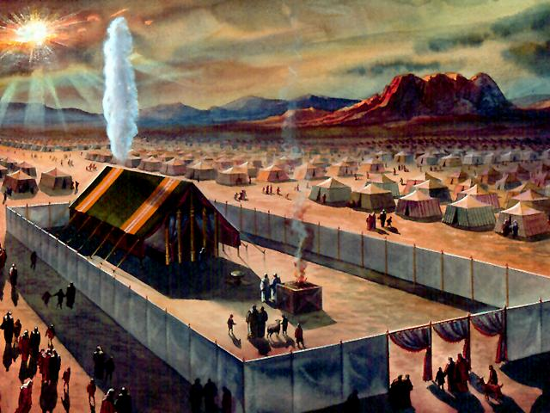
Building and Rebuilding the Tabernacle

Ever watch a child learning to walk? While strolling along confidently, albeit a bit wobbly, he’ll suddenly drop to the floor. With admirable persistence, he’ll usually pick himself right back up on his feet and continue on as if nothing had happened.

The Midrash (Tanchuma 11) says that throughout the seven inaugural days of the Holy Tabernacle, the portable dwelling place built for G-d’s Holy Presence, Moses would construct and disassemble it two or three times each day. The Tabernacle, of course, was a large and extremely heavy structure. Many of its parts were solid wood and gold, and it was tens of feet high. To build and dismantle the entire structure 14 times, or more, in one week must have been incredibly taxing to Moses! Why didn’t he just assemble it the first day, and then leave it standing until the next time G-d instructed the nation to travel?

There was a deeper meaning, however, to the construction of the Tabernacle, corresponding to the efforts of a person committed to spiritual growth. That person drafts a model of holiness, an ideal setting for rising above material and selfish pursuits, insuring the appropriate goals and safeguards are set. As he takes his first few steps of growth, he feels a sense of pride and serenity, assuring himself that he’s on the proper course. But soon, it all crumbles. The habits of the past return, and his best-laid plans for the future appear unattainable.

The continuous building and dismantling of the Tabernacle throughout the inauguration tells us that holy structures are designed to be built and rebuilt before they are completed. The nature of spiritual growth is to move forward and fall back, repeatedly, akin to the toddler’s efforts to walk. Although a toddler first falls immediately, after just a few steps, his strength, balance, and ability improve exponentially. Don’t be afraid when experiencing setbacks on the road to spiritual growth, because we are promised that the results will come — if we get right back up and keep trying!

-Rabbi Mordechai Dixler
Program Director, Project Genesis – Torah.org
“Pick Yourself Up, Brush Yourself Off”
Commentary on Torah Portion VayakhelPekudei
Based on Nesivos Shalom, Pikudei, 279
ProjectGenesis.org

In keeping with my previous blog posts based on Rabbi Tzvi Freeman’s A Multimedia Guide to Jewish Prayer series, I read the next installment in sequence, Climbing Jacob’s Ladder prior to writing this “morning meditation”. Unfortunately, the “Jacob’s Ladder” piece just didn’t inspire me as I had hoped. However, Rabbi Dixler’s commentary did.

Here I am, still sitting at the bottom of the dark, dusty abyss, looking at the ladder that has been placed before me by God, as an invitation to a dance, so to speak. As Rabbi Freeman commented in his Jacob’s Ladder article, What was that ladder? According to the Zohar, it’s the ladder of prayer. That’s what I thought when I wrote another of my morning mediations as well. But then how do I climb?

That reminds me of an old joke:

A tourist from an Iowa farm decides to visit New York City. He’s having fun seeing the sights, visiting the Statue of Liberty, stopping off at Times Square and such, but he’s bought a ticket for a Broadway play and it starts in an hour. Trouble is, he doesn’t know how to find where the play is going to be performed.

He stops a person who appears to be a local and asks, “How do I get to Broadway.”

The gruff New Yorker replies, “Practice.”

How do you climb the ladder of prayer? The answer is the same. Practice.

I know I’ve said something like this before but it can use repeating, which is also part of practicing.

Look at Rabbi Dixler’s story again. In a way, Moses needed the “practice” in putting up and taking down “holiness.” Chances are, the story isn’t literally true, but it is a metaphor that communicates something important to me. In fact, here’s the part that especially speaks to me.

There was a deeper meaning, however, to the construction of the Tabernacle, corresponding to the efforts of a person committed to spiritual growth. That person drafts a model of holiness, an ideal setting for rising above material and selfish pursuits, insuring the appropriate goals and safeguards are set. As he takes his first few steps of growth, he feels a sense of pride and serenity, assuring himself that he’s on the proper course. But soon, it all crumbles. The habits of the past return, and his best-laid plans for the future appear unattainable.

I have better days and worse days, probably just like everyone else. I have better days and worse days in relation to God, too. Sometimes reading the Bible is very uplifting and other times, the messages I read carry nothing but discouragement. The trick for me, in having fallen down again, is figuring out a way to keep discouragement from having the last word.

The nature of spiritual growth is to move forward and fall back, repeatedly, akin to the toddler’s efforts to walk. Although a toddler first falls immediately, after just a few steps, his strength, balance, and ability improve exponentially. Don’t be afraid when experiencing setbacks on the road to spiritual growth, because we are promised that the results will come — if we get right back up and keep trying!

Why does a toddler, who falls down more times than we can count, continue getting back up? Why does the child, who falls, and falls, and falls, keep trying to walk again? Why doesn’t he get to the point of saying, “I’ll never be able to walk,” and then just keep on crawling as a means of locomotion?

I don’t know.

I suppose there’s something built into every child, a sort of developmental “map,” that drives the boy or girl to keep on trying to walk, keep on building blocks, keep on learning their ABCs, keep on trying to read, to write, to count, to dress themselves, to reach a little higher, then a little higher, then a little higher…

You get the idea. If little kids gave up anytime something was difficult, they’d never develop, become bigger, more sophisticated kids, then teens, and finally adults. They’d always be stuck at being toddlers.

Somewhere along the line, we learn that it’s possible to give up. For most of us, that doesn’t prevent us from hitting all of the usual developmental milestones. Most of us keep on trying and today, we’re able to walk, talk, write, read, count, get dressed, feed ourselves, even drive, get a job, have friends, get married, and raise children of our own. But we also learn we can give up on things and sometimes we do. Some of us learn that we can have a relationship with God and other people give up without even trying, “reasoning” that God doesn’t exist.

I think we have a “developmental need” to seek out God, even as we have developmental needs to learn to walk, feed ourselves, and read. All of those developmental milestones I listed require enormous amounts of practice and the more we practice, the better we get at mastering those skills. The more you read (usually), the better reader you become. The same goes for driving a car, fixing a leaky faucet, or playing a musical instrument (it should be noted though, that some people can practice certain skills forever and still not get very good at them).

But while most of us won’t become world-famous classical guitarists, unless we have a significant disability, we will all learn how to walk, talk, read, count, eat, and get dressed, because (unlike playing a musical instrument or performing heart surgery) they are all basic human skills. But they still all take lots of practice. Is having a relationship with God a basic (rather than an advanced) human skill?

I think so. But it’s one that we are able to abandon even before we ever learn it. Even after learning the basic steps of that relationship, we can still lose skills through lack of practice or lack of confidence. We may at one point have climbed the ladder well and then later, for whatever reason, find we are even afraid of trying. Maybe we fell off the ladder and got hurt. Maybe we failed at some other related skill and we don’t have the nerve to face the ladder again.

So here I sit at the bottom of the well, looking at the first rung of the ladder. Perhaps I fell off the ladder or maybe I never started to climb in the first place. Regardless, here I am, like a toddler who tried to walk and landed on his butt. According to Rabbi Dixler, I need to stand and fall and stand and fall, like Moses building and unbuilding the Mishkan, hour after hour, day after day, until I can stand a little longer, walk a little further, and climb the first rung of the ladder.

Don’t be afraid when experiencing setbacks on the road to spiritual growth, because we are promised that the results will come.

PrayingThe mystical aspects of Jewish prayer are enormously complex and well beyond my limited comprehension and abilities. I’m still trying to climb onto the first rung of the ladder and not become discouraged when I fall back off. But just like a toddler learning how to walk, it’s not something someone else can teach me or even help me with. You can’t walk for someone else, they have to learn it on their own.

But after everything I just said about being able to pray and to forge a relationship with God being a “basic human skill” that anyone can learn, why do I still doubt that I’m ever going to be any good at it? Maybe I’ve just been “plain old me” for too long, sitting here staring at the ladder. It goes up awfully high…and you know what happened to Icarus.

Getting to where you need to be is an important step. But nothing is as important as getting out of where you’re at right now.

-Rabbi Tzvi Freeman
“Hit the Road”
Based on letters and talks of the Rebbe
Rabbi M. M. Schneerson
Chabad.org

He erected the Courtyard all around the Tabernacle and the Altar, and he emplaced the curtain of the gate of the Courtyard. So Moses completed the work.

The cloud covered the Tent of Meeting, and the glory of Hashem filled the Tabernacle. –Exodus 40:33-34 (Stone Edition Chumash)

May it ever be so for you…and for me.

My Thirsty Soul

alone-desertA psalm by David, when he was in the wilderness of Judah. O God: You are my God, I seek You. My soul thirsts for You, my flesh longs for You; in a parched and thirsty land with no water. Thus to have beheld You in the Sanctuary, to see Your might and Your glory. For Your kindness is better than life, my lips shall praise You. Thus shall I bless You all my life; in Your Name I shall lift my hands. It is as if my desire is sated with fat and abundance, when my mouth gives praise with joyous language. When I remember You upon my couch, in night watches I meditate upon You. For You have been a help for me; in the shelter of your wings I joyously sing. My soul cleaves after you; Your right arm has supported me. But they seek my soul for destruction; may they come to the depths of the earth. [The enemies] shall drag each one by the sword, the portion of foxes shall they be. The king shall rejoice in God; glorified will be everyone who swears by Him, when the mouth of the liars will be stopped.

Psalm 63 (Stone Edition Tanakh)

For G-d, the union He is seeking happens in three forms: through Torah, through a mitzvah, and through prayer. It’s much like a love affair.

When we perform a mitzvah, the One Above and the Shechinah (played by us) are united in a kinetic activity within the material world. Think of an embrace uniting two bodies.

When we study Torah, the words of the Shechinah (spoken through our lips) are the words of the One Above. Think of a kiss, uniting two mouths.

And when we pray to Him, the Shechinah and the One Above are in intimate union in the deepest recesses of the spirit, sharing their very souls with one another. Think of mental and soulful communion with another, uniting two spirits.

-Rabbi Tzvi Freeman
“Making Sense of It All”
From the “A Multimedia Guide to Jewish Prayer” series
Chabad.org

You’ll have to read the entire article by Rabbi Freeman to get all of the background associated with this message, but as I tried to explain in my previous entry in this series of “meditations,” a relationship with God through prayer has almost “romantic” implications in terms of the level of intimacy involved. When reading David’s psalm as I’ve quoted it above, I can certainly see how David describes his longing for God as a man longs for a lover who is far away.

And I realized something else:

When I remember You upon my couch, in night watches I meditate upon You.

This relationship isn’t necessarily forged by God but by David. David was consumed with God, day and night. He prayed to God, wrote and sang songs to God, told others of God’s glory, praised the might and splendor of God. As I read this Psalm this morning, I realized that, while reading it, I felt closer to God. I realized that God is accessible, as long as I remain accessible to Him. Strange as it may sound, I, a lowly mortal being, can either let God into my life, or shut Him out. Seems odd that a mere person can have such control over whether or not to have God present or absent, doesn’t it?

In the wider context of Rabbi Freeman’s commentary on prayer for today, he talks about God being both outside and above and within and below. He is both transcendent of the Universe and intimately involved in it. It is God’s desire not to be “just” the grand and overarching Sovereign of all existence, but to be completely interwoven within its very fabric, including within the fabric of each and every one of us. In some way, He already is, because we all are created in His fabulous image; we each contain his “breath” or Divine essence.

That aspect of G-d is what we call the Divine Presence — Shechinah in Hebrew. That’s a very important word when discussing prayer. The Shechinah is sometimes described as the feminine aspect of G-d, and all of tefillah is about the Shechinah bonding with the One Above, reuniting the last two letters of G-d’s name, vav and hei, with the first two letters.

There is no place where the Shechinah is not found, although there are places where the Shechinah shines with greater intensity than in others. There are places, we say, where the Shechinah must be — as a sort of self-imposed exile. And there are places where She is because that is where She wants to be. Obviously She is those places much more openly.

The pre-eminent manifestation of the Shechinah in this world is within the human consciousness. G-d made a being “in His image” —i.e. a self-conscious, ego-laden being — and breathed His own consciousness into it.

This reminds me of something I read on Derek Lemen’s blog this morning when he was trying to describe the “Mystic Messiah.”

But God is not only transcendent. He is also immanent, present, with us, in the song as well as being the singer. Even now he communes with us in the hills. All the more so he will commune with us in the world to come, when brokenness is healed…

So Messiah is the divine man, one like a man, a Son of Man, but not a mere man. He transcends humanity while also being human. Divinity took on humanity in what had to be an inevitable event. How could God, who made humanity in his image, not take up humanity himself to redeem humanity? The logic of a low view of Messiah is simply rationalism (making our intellect and sensory experience the end-all of knowledge) while the logic of a high view of Messiah is mysticism (an openness to the mystery that we intuit and experience in the world). I choose mysticism.

I suppose this is why I am attracted to Chassidism and Kabbalah to some degree, because it’s the only way I can begin to make sense of a “Divine” Messiah and Lord, both human and more than human. No, I don’t understand it all and frankly, I don’t believe anyone else really understands it all either (in spite of what others may say to the contrary).

But in reading about prayer and the Messiah and God and His “glory” (Shechinah), I see over and over again that God is trying very hard to reach out to us and to reach us as human beings.

In reading Rabbi Eli Touger’s commentary on this week’s Torah Portion, he speaks of something we tend to forget about the Jewish people:

The Hebrew language does not lack synonyms, and there are several other verbs which could have been chosen to begin the verse: (Exodus 35:1) “And Moshe gathered together the children of Israel.” The word employed, vayakhel, is significant, for it implies the fusion of the people into a kahal or communal entity, far more than a collection of individuals. (See Tzafnas Paneach, Klalei HaTorah VehaMitzvos, entry tzibbur.)

A group which gathers together can also move apart, and even while together, the union is not complete. A kahal, by contrast, represents an eternal (For “a collective can never die” [Temurah 15b].) entity that unites individuals in a new framework, highlighting the fundamental bond that joins them.

Extending the metaphor just a bit, we can say that God relates to His people Israel as if they were a single person…as if God were the bridegroom and Israel was his bride, adorned in holiness and loveliness. I’m not quite sure how to extend this into the realm of Christianity. Classic Judaism would say this is not only impossible, but on some level, offensive to Jews. However, if we consider that the “church” (which I have to believe includes we non-Jewish disciples of the Messiah) is “the bride of Christ,” then we too may be considered so incredibly loved by God that we have an intimate and precious relationship with Him.

Christians don’t have a “peoplehood” together in the same manner or fashion as the Jewish people, but we can still be adopted by God and united with Him through the blood, love, and grace of Jesus Christ. But in describing the “peoplehood” of the Jews and the unity of Christians under God, I am not denying that each of us as individuals also enjoy a love relationship with God. I’m not trying to be overly “mushy” or sentimental, and I think that the awesome majesty of God is often watered down by the church, who sees God as some sort of cuddly, cute, cosmic teddy bear. Nevertheless, I cannot deny that ever since the expulsion of Adam and Eve from Eden, God has been making efforts to reconnect and “rebond” with human beings; to restore to our world what was lost in antiquity.

While that level of closeness with God is yet to come, we can still…I can still enjoy a closeness and “personalness” with God, as long as we…as I make the effort to spend time with Him, pondering, searching, reading, studying, and praying.

Now pick up a Jewish prayer book — whichever version you want — and make a quick survey. What is the most common word in these prayers? No, it’s not G-d. Neither is it please. Or sorry. Look again: It’s You — with a capital Y. If your prayer book uses thou, I give you permission to change all such instances to You. Because all of Jewish prayer is about one thing alone: i commune with You.

If that is the only mental focus you have throughout your prayers, you’re doing fine. If it’s missing, the whole essence of prayer is missing. Prayer is a union of these two consciousnesses, that which you feel within you, and that which you feel transcends you.

Once that has occurred, once that union is made, everything is transformed. That is why, unlike studying Torah or performing mitzvahs, prayer has the power to actually change the material world — to heal the sick, to cause rain to fall, to alter the flow of commerce. It is because the union of prayer is so deep, so intimate, of such an essence-level, that it elicits radical, unprecedented change.

An Invitation From God?

We were created in G-d’s image. The image of His vision.

From a point before and beyond all things, G-d looked upon a moment in time to be, and saw there a soul, distant from Him in a turbulent world, yet yearning to return to Him and His oneness. And He saw the pleasure He would have from this union.

So He invested His infinite light into that finite image, and became one with that image, and in that image He created each one of us.

As for that moment He saw, that was the moment now.

-Rabbi Tzvi Freeman
“G-d’s Image”
Based on letters and talks of the Rebbe
Rabbi M. M. Schneerson
Chabad.org

G-d looked upon a moment in time to be, and saw there a soul, distant from Him in a turbulent world, yet yearning to return to Him and His oneness.

To employ a small joke, I resemble that remark. To be fair, a lot of other people within the community of faith also “resemble that remark,” whether they’re willing to admit it or not. In fact, there are times when I wonder how anyone can feel close to God because, after all, He is the Creator of the universe and the Master of all worlds. How can one, small, insignificant human being really matter to compared to all that?

When I look at your heavens, the work of your fingers,
the moon and the stars, which you have set in place,
what is man that you are mindful of him,
and the son of man that you care for him?
Yet you have made him a little lower than the heavenly beings
and crowned him with glory and honor. –Psalm 8:3-5 (ESV)

Are not two sparrows sold for a penny? And not one of them will fall to the ground apart from your Father. But even the hairs of your head are all numbered. Fear not, therefore; you are of more value than many sparrows. –Matthew 10:29-31 (SEV)

I know, I know. It’s hard to say I’m irrelevant to God in an absolute sense when we have these verses to turn to. The Bible contains all of these little bits and pieces suggesting that human beings have God’s attention but it is nevertheless possible to feel as if you are utterly alone.

Rabbi Freeman, in one of his commentaries on prayer called The View From Within, mentions this.

So here we are, at rock bottom, suffering from all our circumstances because we can’t figure out how on earth any of this could be good. We’re helpless – this is an inherent deficiency in our design and vantage point.

I’m taking this way out of context (the full article can be found at the link I posted above), but it does paint a good picture of where I am right now. Remember from yesterday’s morning meditation that I’m picturing myself as sitting at the bottom of a well. God has just lowered a ladder and it is implied that by praying, I can begin to climb. Today, Rabbi Freeman is saying that even what we pray for is a matter of perspective, as well as how we understand our life circumstances. To illustrate this point, he tells a story:

When the Baal Shem Tov was leader of the chassidim, whenever troubles befell them, he would pray and avert the harsh decrees from heaven. When the Baal Shem Tov passed on and his disciple, the great kabbalist, Rabbi Dov Ber, the Magid of Mezritch, took over the leadership, he would similarly avert these decrees. When the Magid passed on, the most difficult persecutions of their leadership and of their cause began.

The students of the Magid, all of them great, enlightened masters, beseeched him to respond to them from his place in the world beyond. They pleaded, “As long as you were here, you interceded successfully on our behalf. Certainly, from your place in the next world you have yet greater power to intercede!”

The Magid responded to his disciples, “When I was below, I saw these things as harsh and cruel. But from my station up here, I only see the good in all of this. As Rabbi Akiva taught, all that the All-Merciful does is for the good. How could I pray to avert something I see as true goodness?”

His disciples then asked, “If so, our master, what about us? Should we also desist from praying that these decrees be averted?”

“No,” the Magid responded. “Since in your world these appear to be evil, you must do everything in your power to avert them and alter the heavenly decree!”

-Rabbi S.Y. Zevin, Sipurei Chassidim

In real life, we hardly ever hear from people who have ascended into the Heavenly realm (if we do at all) and so we do not, in actuality, have any idea of their perspective. We remain locked into our own, like an ant trying to move a pebble in the dirt. We human beings can look down on that ant with a completely different viewpoint and realize a world the ant has no ability to imagine, let alone experience. But we are unable to impart to that ant how much more there is in the universe around it, even though we see a vast panorama beyond that one small ant pushing a pebble in the dirt.

This is how we are in comparison to God.

But we didn’t create the ant’s universe, nor did we create the ant. The vast majority of us don’t care all that much for ants, and if they get into our homes, we’ll exterminate them without hardly a thought about their deaths. This, we hope and pray, is not how God sees us, and in fact, we hope and pray that God sees us with love and compassion, rather than as insects infesting His world.

But all we have is an ant’s point of view. Unlike the ant, we have the imagination to envision something much more; something we cannot directly experience, but there’s a difference between imagination and knowledge. There’s even a difference between faith and belief and knowledge.

If I were to take Rabbi Freeman’s lesson at face value, I would have to accept that however I currently imagine my experience, it is not at all the same as seen from God’s perspective. What I experience as feelings of emptiness, He may see as something else entirely. But unlike the Magid to his students, God does not speak to we, His creations, to tell us that what we see as evil, God only sees as good.

Or does He?

So here we are, at rock bottom, suffering from all our circumstances because we can’t figure out how on earth any of this could be good. We’re helpless — this is an inherent deficiency in our design and vantage point. And the Mastermind of All Worlds turns to us from His penthouse panorama with banks of video monitors on every creature in the universe, and yells down into your pit, “So how’s the weather down there? Any complaints?”

And this is mitzvah of tefillah! To “petition for all your needs with requests and supplications” three times a day!

It must be, then—because this is the only way out of our conundrum—that for whatever reason (or just out of pure desire), the Creator of this reality is interested in the experience from within, and not just from above. And He wants to bring the two into perfect union.

Tefillah, then, means a union of two worlds, two perspectives, two forms of consciousness: The view from Above unites with the view from within. And we are the matchmakers.

This again, is an interpretation and an imagination as related by Rabbi Freeman’s commentary on prayer. He is telling us that prayer does matter because, in part, it is the joining of our experience with God’s experience and that God desires we share our experience with Him. Of course, Rabbi Freeman is saying all of this from a Jewish perspective and relating it to a Jewish audience, but given the comments on prayer I made yesterday, I don’t think it’s terribly unreasonable for me to apply his lesson to an individual Christian sitting at the bottom of the abyss.

But as I imagine prayer as the means by which I may start climbing out of the pit, Rabbi Freeman has other ideas.

This is vital for us to know before we go any further into the spiritual ascent of prayer, mystic union and higher consciousness: The goal is not a jailbreak out of the dungeon of material existence. The goal is a marriage of two worlds—ours and His. Heaven on earth. Tefillah is where the two kiss.

Sounds very “romantic,” but then in Judaism, God is called “the lover of our souls.” I don’t know if the exact same relationship can be said of God and me relative to Judaism, but perhaps filtered through John 3:16, it might apply because of the Messiah. Because of Jesus, God may also love the Christian soul.

So if prayer isn’t a ladder designed for the human to ascend out of the pit of the world and into the heavens, is it instead an invitation to dance? If so, I’ll have to learn to stand first, and then to walk. Right now, I’m like the wallflower at the high school prom, staring in disbelief at a hand being offered, beckoning me to rise. I hope this isn’t just wishful thinking. We’ll see.

The road

The road is long and often, we travel in the dark.

Expecting Something Wonderful

To help reduce this tension which seems to dominate our people everywhere, you can start by reducing your own pace. To do that you will need to slow down, quiet down. Do not fume. Do not fret. Practice being peaceful. Practice “the peace of God which passeth all understanding.” (Philippians 4:7) Then note the quiet power sense that wells up within you.

-Norman Vincent Peale
“Chapter 6: Stop Fuming and Fretting”
The Power of Positive Thinking

Up until Peale mentioned “quiet power sense,” he was actually saying just about the first thing that made any sort of sense to me in this entire book thus far.

Peace is a difficult concept to apply universally across a person’s life, mine or anyone else’s. We all want some sort of “peace” but we can’t be totally relaxed and at ease twenty-four hours a day. Frankly, there are times when we really need to be focused, or excited, or agitated, or even angry. But as I was reading this chapter over my lunch hour, I realized that I don’t allow myself a great deal of peace, even when I’m supposedly relaxing. More to the point, I don’t really allow myself the time and the luxury of being at peace in the presence of God.

However, as much as I can argue about the various circumstances in my life and the relative amount of control I do or don’t have over them, I do have some sort of control over finding the time and the place to be alone and uninterrupted with God so I can have a “peaceful” conversation with Him (I say this with the caveat that, living with other people doesn’t mean I can always guarantee I will be uninterrupted).

But I can try. I’ve said in previous blogs that I didn’t find Peale the sort of writer who matches my “style” or “metaphors,” but I’ve been trying to find ways of translating some of his more hokey stories and comments into a language I can relate to. He actually told a story (I don’t know if it’s about an actual, factual event or not) that I found brilliant.

Peale relates the tale of a baseball team who just couldn’t seem to do anything right. Although they were originally the favorites to carry the season, the team ended up losing 17 of their first 20 games. Naturally, team morale was at a low ebb and they weren’t expecting to score significantly and they absolutely didn’t expect to win any of their future games.

And they almost didn’t.

It so happened that a preacher named Schlater was popular in that neighborhood at that time. He claimed to be a faith healer and apparently was getting some astounding results. Throngs crowded to hear him and most everybody had confidence in him. Perhaps the fact that they did believe in his power enabled Schlater to achieve results.

O’Reilly (the team owner) asked each player to lend him his two best bats. Then he asked the members of the team to stay in the clubhouse until he returned. He put the bats in a wheelbarrow and went off with them. He was gone for an hour. He returned jubilantly to tell the players that Schlater, the preacher, had blessed the bats and that these bats now contained a power that could not be overcome. The players were astounded and delighted.

The next day they overwhelmed Dallas, getting 37 base hits and 20 runs. They hammered their way through the league to a championship, and Hugh Fullerton (a famous sports writer when Peale was a youth, according to the book) said that for years in the Southwest, a player would pay a large sum for a “Schlater bat.”

Actually, it’s O’Reilly who was brilliant for what he pulled off. Peale was only brilliant for relating the tale (unless he made the whole thing up, then Peale really was brilliant). The “faith healing powers” of Schlater were irrelevant. The team didn’t even have to meet him. All they knew is what O’Reilly told them…that Schlater blessed the bats with a special power. As long as the team believed the bats were powerful, then they would behave out of that belief. Nothing else had to change.

I know what you’re thinking and you’re right.

All I (or anyone) have to do is believe in my relationship with God and my own worth in God’s eyes and my own. Nothing else has to change in order for me to start rising up out of the bottom of the well. All I have to do is to believe that I don’t require a faith community in order to be free of the emotional requirement. The whole point of books like Peale’s is to convince their audience to believe in some sort of special power. That’s why Peale presents various passages from the Bible as he does. If his primary audience believes in Jesus or God, and they don’t mind taking Bible verses woefully out of context, then the book will have the desired effect.

Many years ago, I heard a teaching counselor use the phrase “the trickster healer.” It sounds a little suspicious, since you want people who are healers (doctors, psychologists, etc…) to be forthright and honest, but as we see in the story about O’Reilly and the “Schlater bats,” just telling someone what their problem is doesn’t always work. Sometimes you have to “convince” them in other ways that don’t require them to make a conscious, rational decision. Sometimes they just have to believe.

Unfortunately, knowing about the “trick” robs it of its power, so in being aware of the “trick” and writing about it, I can’t also “con” myself into believing in the personal equivalent of a “Schlater bat.”

But I can try to believe in God.

I realize that, based on most of what I’ve said so far, it is practically beside the point whether or not God even exists as long as I believe He exists. This is probably why Peale’s book works even with atheists if they choose to believe in some other internal or external source of “power” instead of God.

I am convinced of the existence of the God of the Bible, however the presence of God isn’t always enough. If God didn’t require my cooperation or involvement in solving my little dilemma, He could just invoke some supernatural power and *poof* my perspective would be different and my paradigm would be shifted. End of story.

But it doesn’t work that way.

Maybe God doesn’t answer the majority of prayers using supernatural means. Maybe, most of the time, He just allows our faith and our trust in Him do most of the work. I’ll talk more about my journey in prayer while sitting at the bottom of my well in tomorrow’s “morning meditation.” In the meantime, the first lesson I’ll need to continue to learn is to be at peace right where I am, expecting nothing, before I can learn to believe and then expect something.

Heywood Floyd: What? What’s going to happen?
Dave Bowman: Something wonderful.

-from the film 2010 (1984)

Trust

TrustFor the conductor, on Jeduthun, a song by David. For God alone my soul waits silently, from Him comes my salvation. He alone is my Rock and my Salvation; my Stronghold, I shall not falter greatly. Until when will you plot treacherously against a man? May you all be slain – like a leaning wail, a toppled fence. Only because of his loftiness have they plotted to topple [him], they delight in deceit; with his mouth each one blesses, but inwardly they curse, Selah! For God alone, waits silently, my soul, because my hope is from Him. He alone is my Rock and my Salvation; my Stronghold, I shall not falter. Upon God rests my salvation and my glory, the Rock of my strength, my refuge, is in God. Trust in Him at every moment, O people! Pour out your hearts before Him; God is a refuge for us, Selah! Common people are but vanity! Distinguished people are but a deceit! Were they to be lifted up on scales, together they would be lighter than vanity. Trust not in oppression, and in robbery place not vain hope; though wealth flourishes, set not your heart on it. One thing has God spoken, these two have I heard: that strength belongs to God; and Yours, O Lord, is kindness, for You repay each man according to his deeds.

Psalm 62 (Stone Edition Tanakh)

I’m continuing my pursuit of restructuring the meaning of storytellers so that I can better understand and incorporate the lessons of God into my life. I have previously written about my need to find my own metaphor in the multitude of spiritual, religious, and psychological messages available so that I can better focus on what is important in life, and minimize or disregard all of the other “bothersome” minutiae.

It isn’t easy.

Life, or rather my approach to it, is a decades-long habit and like all “bad habits,” it’s difficult to break. It’s like quitting smoking (which I did decades ago). I know it’s good to break a bad habit, but I have to give up its secondary benefits and focus on what I’ll gain, even while “mourning” what I’ll be losing which, if nothing else, is the familiar. However, quitting smoking is child’s play compared to what some people call “making a paradigm shift“. This is a fundamental changing of perspective on how to approach and respond to not only circumstances, but to all aspects of existence.

Like I said, it isn’t easy.

There are a lot of elements involved but the first one is trying to find a starting point. There are all kinds of places that you might think to begin a journey of self discovery and self change. In yesterday’s morning meditation, I focused on prayer. That’s a good place to start since, for me, any shifting in paradigm also involves a change in my relationship with God.

Look back at the psalm I quoted from at the beginning of today’s blog. Look at what David’s saying.

For God alone, waits silently, my soul, because my hope is from Him…Trust in Him at every moment.

It’s not only hope and trust that belong to God, but salvation, strength, and kindness are His and His alone. In fact, David goes so far as to say that for “God alone my soul waits silently.” He is not depending on anyone else but God for hope, trust, strength, kindness, and salvation. David proclaims that even “distinguished people,” if you put them all on a scale, would still be “lighter than vanity.” Part of what I get out of this, is that there is no one to depend upon except God. Each person waits alone for His response.

I want to take all that and reduce it down even further to a single element: trust.

Churches talk an awful lot about having faith in God or having faith in Jesus, but they don’t mention the word “trust” at all. What’s the difference? I found an excellent metaphor comparing faith and trust, and I encourage you to read my wee missive on the difference before continuing here. It’s easy to have faith that God exists. It’s not so easy to actually trust God with everything that’s important to you…especially your life.

I know this sounds terrible, but I don’t think I trust God very much. Yes, I acknowledge and have faith in His existence and sovereignty over the universe and everything in it, including me, but I don’t trust Him to keep me safe in an absolute sense. After all, bad things happen to people all the time. Even people who have an amazing faith and trust in God suffer horribly. People get all kinds of hideous cancers, get in car wrecks. lose loved ones tragically, have heart attacks and strokes, are in hurricanes, have their homes wiped out by tornadoes, have their emotions utterly shattered, are reduced to nothing anyone wants to get close to.

They trusted God to keep them safe and look what happened.

Actually, the record of the “saints” in the Bible, the record of the lives of the Prophets, show that holy people who had faith and trust often came to rather “difficult” ends and in fact, their lives might have been a great deal more peaceful if they hadn’t been such significant servants of God.

So if I do or don’t trust God to protect me, I’m still vulnerable to everything. Anything could happen at any time. Any disaster could strike. Any illness or accident could occur at any moment. No one is safe, whether you have faith in God or not.

I realize that God “never promised me a rose garden” and that God doesn’t owe me (or anyone) a “safe” life. I know that life involves taking risks. All that is very rational. So then, is faith and trust in God all about the “afterlife” and our lives in the here and now are identical to those of our secular counterparts? Are both the saint and the sinner equally libel to get mugged, raped, or murdered?

But is being safe the point? God does what He does. In Romans 9:15, Paul quotes God’s conversation with Moses when He said, “I will be gracious to whom I will be gracious, and will show mercy on whom I will show mercy.” (Exodus 33:19 ESV) God grants mercy to or withholds mercy from people in accordance to His will. That makes God rather unpredictable. So is the only thing I can trust the fact that I can’t trust anything? Depending on how you translate Job 13:15 it can read Though he slay me, I will hope in him,” or it can be understood as, “Behold, he will slay me; I have no hope.”

So whether you trust in God or don’t trust in God, God will still do what God will do, so what’s the point?

But all of these “holy guys” seemed to think there was a point and they faced all kinds of horribly difficult situations depending on God to either get them out of it, as David did, or continuing to cling to God even if God chose to kill them.

Shadrach, Meshach, and Abednego answered and said to the king, “O Nebuchadnezzar, we have no need to answer you in this matter. If this be so, our God whom we serve is able to deliver us from the burning fiery furnace, and he will deliver us out of your hand, O king. But if not, be it known to you, O king, that we will not serve your gods or worship the golden image that you have set up.” –Daniel 3:16-18 (ESV)

So how do you learn to trust God under these circumstances? If you are a child, you trust your parents, in part, because they keep you safe (I realize this is overly simplistic, since plenty of parents are untrustworthy for a lot of reasons, and plenty of children are hurt and even killed as a result). Children learn to trust their parents as their parents build a track record of keeping them safe and providing for their needs. Trust in any human relationship is based on experience. The longer we are in a relationship with a party who does not harm us physically or emotionally, and who provides for our needs, the more we tend to trust them and feel safe around them.

FallingBut how does that work in a relationship with God, who is so totally and completely alien to us and who, for any reason or for no reason at all (or for no reason we can understand), could allow us to be thrown under a bus (sometimes literally) at any moment and without warning?

It goes without saying that we cannot trust someone we don’t know, and therein lies the secret of learning to trust God. When someone says, “Trust me,” we have one of two reactions. Either we can say, “Ok, I’ll trust you,” or we can say, “Why should I?” In God’s case, trusting Him naturally follows when we understand why we should.

The main reason we should trust God is that He is worthy of our trust. Unlike men, He never lies and never fails to fulfill His promises. “God is not a man, that he should lie, nor a son of man, that he should change his mind. Does he speak and then not act? Does he promise and not fulfill?” (Numbers 23:19; Psalm 89:34). Unlike men, He has the power to bring to pass what He plans and purposes to do. Isaiah 14:24 tells us, “The LORD Almighty has sworn, ‘Surely, as I have planned, so it will be, and as I have purposed, so it will stand.’” Furthermore, His plans are perfect, holy, and righteous, and He works all things together for good for those who love Him and are called according to His holy purpose (Romans 8:28). If we endeavor to know God through His Word, we will see that He is worthy of our trust, and our trust in Him will grow day by day. To know Him is to trust Him.

-quoted from GotQuestions.org

That works if everyone who ever trusted God remained safe and nothing bad ever happened to them, but the person who answered this question never got around to explaining why people who trust God still end up hurt and dead. The quote does say this, however:

A third reason to trust God is that we really have no sensible alternative. Should we trust in ourselves or in others who are sinful, unpredictable, unreliable, have limited wisdom, and who frequently make bad choices and decisions swayed by emotion? Or do we trust in the all-wise, all-knowing, all-powerful, gracious, merciful, loving God who has nothing but good intentions for us?

So, this person says we should trust God simply because we have no choice. But that comes back to God doing things to us (or allowing things to happen to us) whether we trust in Him or not.

But the person I just quoted did make one good point. You can’t trust someone you don’t know.

That goes back to yesterday’s “morning meditation” about prayer. Without an ongoing, continual “dialog” with God, how can you know Him? That’s the same for any human relationship. If you don’t communicate in a meaningful and frequent manner, how can you get to know someone and then maintain a relationship?

You can’t.

So prayer is just as good a starting point as any.

The GotQuestions.org person describes God as “all-wise, all-knowing, all-powerful, gracious, merciful, loving” and a God who “has nothing but good intentions for us.” Sorry, but I’m having a difficult time reconciling that statement with the reality of the world in which I live; a world where six million Jews were murdered during the Holocaust, a world where Christians have historically been tortured and executed for their faith, a world where people living in terror pray to God for them to be delivered and instead, are left to die alone in agony.

I know, I sound grim.

The supreme irony is that, at least as far as the Biblical record is concerned, people continued to trust in God, no matter what. Shadrach, Meshach, and Abednego walked into Nebuchadnezzer’s fiery furnace, believing that God either would save them or wouldn’t, and subsequently the King saw four men walking around inside of the flames unhurt, including someone who had the appearance “like a son of the gods.”

Sometimes trust works.

I remember sitting in church when the Pastor would say stuff like, “surrender all of your cares to Jesus and just let them go.” I heard similarly phrased “flowery speeches” like this time and again in various Christian venues and never had any idea how to accomplish such a feat. How does one simply “let go” of problems, worries, cares, sorrows, and so on? What is the mechanism of release? How can you simply and suddenly “stop worrying?” Where does the “worry” go?

I now realize what was really being said is to “trust Jesus to take care of your worries.” Jesus himself said something similar.

“Therefore I tell you, do not be anxious about your life, what you will eat or what you will drink, nor about your body, what you will put on. Is not life more than food, and the body more than clothing? Look at the birds of the air: they neither sow nor reap nor gather into barns, and yet your heavenly Father feeds them. Are you not of more value than they? And which of you by being anxious can add a single hour to his span of life? And why are you anxious about clothing? Consider the lilies of the field, how they grow: they neither toil nor spin, yet I tell you, even Solomon in all his glory was not arrayed like one of these. But if God so clothes the grass of the field, which today is alive and tomorrow is thrown into the oven, will he not much more clothe you, O you of little faith? Therefore do not be anxious, saying, ‘What shall we eat?’ or ‘What shall we drink?’ or ‘What shall we wear?’ For the Gentiles seek after all these things, and your heavenly Father knows that you need them all. But seek first the kingdom of God and his righteousness, and all these things will be added to you. –Matthew 6:25-33 (ESV)

But verse 34 is the kicker:

“Therefore do not be anxious about tomorrow, for tomorrow will be anxious for itself. Sufficient for the day is its own trouble.

And yet people die of starvation and thirst everyday somewhere in the world. People of faith do go without adequate clothing or sustenance. We do whither away like grass before a raging fire, and no one walks among the living and the dead who looks like a “son of the gods.”

But we’re supposed to trust anyway…I’m supposed to trust anyway. Peale’s book has the reader recite and repeat the various “promises of God” to empower believers and keep them safe…engendering trust in God, and supposedly, in spite of the long and difficult world history of men and God, it works. Rabbi Tzvi Freeman wrote a multi-part series on Jewish Meditation and Prayer which more or less says the same thing, in spite of the long and torturous history of the Jewish people and God.

(I suppose I should mention at this point that multitudes of secular people have also gained great benefits from following the advice in Peale’s book, substituting “higher power” or even their actualized selves for specific references to God. It’s astonishing then, that these people learned to shift their paradigms and improve their lives, not by trusting in God or any external source, but by trusting themselves! Does this mean that who or what you trust is irrelevant as long as you trust something? If a religious person and a non-religious person achieve the same self-improvement goals using identical processes but different targets [God vs. the self], is that saying God is actually doesn’t matter as long as you trust something? I know, these are horrible questions.)

The only thing I can get out of this is that, like Job, I am compelled to trust God, though He may slay me, just because I have no choice. Or rather, I have a choice: maintain my faith in God and learn to trust Him, or surrender my faith and trust no one, least of all me. Since the latter choice results in only despair, the former choice is my only real choice. It’s like allowing someone to tie me up, hand and foot, blindfold me and gag me, stand me at the edge of a mile-deep cliff. Then they say to me that even if they push me over, I’ll still be safe. I wonder if that’s how Isaac felt at the Akedah?

In that situation, I can’t even scream in terror or beg to be released. My mouth is stuffed with cotton and my throat is full of sand. All I can do is hang on and trust…or continually, moment-by-moment, be terrified. Like the title to Harlan Ellison’s classic science fiction tale, I have no mouth, but I must scream.

What would you do?