Tag Archives: faith

Beyond Reason

Out of the darknessA mind directed entirely by its own reasoning will never be sure of anything.

As good as the mind is at finding solutions and answers, it is even better at finding questions and doubts.

The path of Torah is to ponder its truths, so that your mind and heart will resonate with those truths, until all your deeds are guided by a voice that has no second thoughts.

-Rabbi Tzvi Freeman
“Certainty”
Chabad.org

How many of us ever take the time to stop and think about our theology, our deeply cherished and hard fought over arguments? Recently a popular blogger I know expressed a concern about even entertaining opposing arguments lest one lose one’s faith as a result of sown doubts – to him it wasn’t a good idea to engage the opposition in a non-polemic way, that is in a way that actually allows that other peoples arguments may, by some odd chance, hold water. And then I came across the following poignant remark that puts all this into better focus.

Gene Shlomovich
Ever thought you may be wrong about your cherished theology?
Daily Minyan blog

Questioning your own faith is a horrible thing. I know. I’ve been there. I spent an entire year, actually two, questioning the assumptions of my faith in virtually every detail. Eventually, I came to a crisis and fortunately passed through it with my faith in God intact. I recall the day I discovered what this person has just mentioned at Christian Forums:

wow, I never considered that 2 Peter was not written by Peter. Some say it was, some say it wasn’t. Hmff. Is there like a guarunteed listing of who wrote what or who didn’t write what?

Actually, most New Testament scholars acknowledge that not all of the Gospels and Epistles were written by the people to whom they are attributed. I discovered this reading Bart D. Ehrman’s Jesus, Interrupted (a challenging book which I highly recommend). Once I got past this, and the fact that there actually are inconsistencies in the Bible (compare the different Gospel versions of the day Jesus died and then try to figure out which day it was…the accounts conflict), I recovered my balance a bit. Then I realized that I didn’t have to depend on the Bible reading like a history book or a court deposition in order to gain wisdom and understanding from the stories the Bible tells us.

Questioning our assumptions isn’t a disaster and in my case, it resulted not only in a “course correction”, but in a greater zeal in returning to the Bible and seeing God in the writings of the Jewish prophets, apostles, and sages. However, in Judaism, the Torah isn’t simply a document or a way to try to grasp the essence of God through study. It is so much more and to understand this, we must step outside of what we consider a “rational reality”, for God doesn’t manifest in only the material world:

The answer depends on insight into the nature of the Torah. The Torah is one with G-d, an expression of His essential will. Therefore, just as His will is above intellectual comprehension, so too is the Torah. Nevertheless, G-d gave the Torah to mortals, not because He desires their obedience, but because He is concerned for their welfare. He wants man to develop a connection with Him, and for that connection to be internalized within man’s understanding, so that G-dly wisdom becomes part of his makeup. And with that intent, He enclothed the Torah in an intellectual framework.

This intellectual dimension is, however, merely an extension of the Torah. The Torah’s essence remains transcendent G-dliness, and cannot be contained within any limits even the limits of intellect. To relate to this essence, man must approach the Torah with a commitment that transcends wisdom or logic.

-Rabbi Eli Touger
“Beyond the Ken of Knowledge”
Parshas Chukas; Numbers 19:1-25:9
Adapted from
Likkutei Sichos, Vol. XVIII, p. 229ff

Christianity doesn’t even imagine the Bible being more than the Bible; a book written under the Divine inspiration of the Holy Spirit and recorded by many different people across thousands of years. It’s hard for me to imagine that the church misses this, since it’s stated quite plainly here:

In the beginning was the Word, and the Word was with God, and the Word was God. He was with God in the beginning. Through him all things were made; without him nothing was made that has been made. In him was life, and that life was the light of all mankind. The light shines in the darkness, and the darkness has not overcome it. –John 1:1-5

Path of TorahCertainly “the Word” is not just “the word” printed on a page in a book and in fact, this particular Word “became flesh and made his dwelling among us” (John 1:14). Of the four Gospels, John’s is considered the most “mystic” and it reads more like a chasidic story, which was a large part of what attracted a young Chasidic Jew named Feivel Levertoff at the end of the 19th century, to become a Chasid (a “devoted disciple”) of the “Maggid of Nazeret”, Jesus of Nazareth.

There’s a special depth in how Jews look at the Torah and find not only information about God but actually find God inhabiting the pages that are not just pages. There, they also find devotion and longing for the coming of the Moshiach (Messiah):

Yad HaChazakah is a book of laws, not a history book. What difference does it make from the perspective of Jewish law how many Parah Adumos were offered in previous generations? Moreover, why does the Rambam go on to add a prayer for the coming of Moshiach?

With regard to the obligation to believe in the coming of Moshiach, the Rambam states: “Whoever does not believe in him, or does not await his coming, denies not only [the statements of] the other prophets, but also [those of] the Torah and of Moshe, our teacher.” In other words, mere belief in Moshiach’s coming does not suffice, we are also obligated to hope for and await his arrival.

Moreover, this anticipation is to be in accordance with our thrice-daily recitation of the Amidah prayers: “Speedily cause the scion of David Your servant to flourish. for we hope for Your salvation all day.”

-Based on the teachings of the Lubavitcher Rebbe, Rabbi Menachem M. Schneerson
A Commentary on Torah Portion Chukas

For those of us who have faith and trust in Jesus as the Moshiach, who came once and will come again, we should take even greater comfort and meaning in the insights the Rambam and Rabbi Schneerson share with us. If we depend on “knowing God” through a Bible that must be completely internally consistent and absolutely a record of historical fact, we will become confused and disappointed or we will be forced to “bend reality” and make the text to fit our needs and preconceptions. As Rabbi Freeman says, the purpose of Torah (and the Bible as a whole) is so that we can “ponder truths” (not facts), not the least of which is the truth of the Messiah in our lives, allowing God’s Word to become intertwined into the fabric of who we are and letting all our deeds become “guided by a voice that has no second thoughts”

Good Shabbos.
Arise

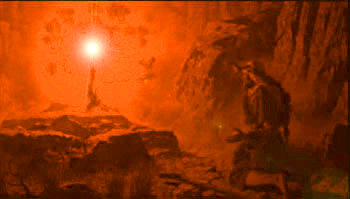
The burning bushNow Moses, tending the flock of his father-in-law Jethro, the priest of Midian, drove the flock into the wilderness, and came to Horeb, the mountain of God. An angel of the Lord appeared to him in a blazing fire out of a bush. He gazed, and there was a bush all aflame, yet the bush was not consumed. Moses said, “I must turn aside to look at this marvelous sight; why doesn’t the bush burn up?” When the Lord saw that he had turned aside to look, God called to him out of the bush: “Moses! Moses!” He answered, “Here I am.” And He said, “Do not come closer. Remove your sandals from your feet, for the place on which you stand is holy ground. I am,” He said, “the God of your father, the God of Abraham, the God of Isaac, and the God of Jacob.” And Moses hid his face, for he was afraid to look at God.Exodus 3:1-6 (JPS Tanakh)

A spark of G-d slumbers within, as a flame hushed within the embers.

Will she awaken from ideas? They are only more dreams to sleep by.

Will she awaken from deep thoughts? Their depth will not reach her.

She will awaken when she sees her Beloved, the Essence of All Things with which she is one.

And where will she see Him? Not in ideas, not in deep thoughts, but in a G-dly deed that she will do, in an act of infinite beauty.

Then her flame will burn bright.

-Rabbi Tzvi Freeman
“Waking Up G-d”
Chabad.org

Arise, shine, for your light has come, and the glory of the LORD rises upon you.Isaiah 60:1

In Christianity, faith is largely a matter of contemplation; the private and internal consideration of God and a person’s prayers in the name of Jesus. In Judaism, faith is not a matter of thought but of action. Yes, Judaism places a very high value on Torah study, but the study, in and of itself, isn’t meaningful unless put into action.

What was happening with Moses, the shepherd of his father-in-law’s flocks in Midian? Probably not much during those forty years. There’s no indication that he considered the plight of his parents, his brother, and sister, and the other Israelites in their Egyptian captivity. There is certainly nothing recorded in Exodus saying Moses was planning to do anything about the slavery of his people. Yet, as Rabbi Freemen tells us, there’s a fire sleeping inside.

In the case of Moses, the “fire” literally appeared before him and the voice of God called out, commanding Moses into action. What about the fire and voice inside of you…or me?

No matter how much you distrust your own sincerity or question your motives, there is no trace of doubt that at your core lives a G-dly soul, pure and sincere.

You provide the actions and the deed. She needs no more than a pinhole through which to break out and fill those deeds with Divine power.

-Rabbi Tzvi Freeman
“The Promise Inside”
Chabad.org

What good is it, my brothers and sisters, if someone claims to have faith but has no deeds? Can such faith save them? Suppose a brother or a sister is without clothes and daily food. If one of you says to them, “Go in peace; keep warm and well fed,” but does nothing about their physical needs, what good is it? In the same way, faith by itself, if it is not accompanied by action, is dead. –James 2:14-17

Both Rabbi Freeman and James, the brother of the Master, remind us that concealing our faith and devotion to God inside is not faith or devotion at all. The Master himself reminds us that hiding our faith from the world illuminates no one (Matthew 5:14-16), probably not even ourselves. Nothing about who we are as disciples of our Master and children of God matters unless we shine our light into the world and extend our faith into the realm of deeds and actions. We are known by our fruit, not by the root that no one can see.

Dawn“Light” can take many forms. We can donate to worthy causes, volunteer our time feeding the hungry, visit the sick in the hospital, sing inspirational songs, speak of the Bible to our children and our children’s children, even write blogs, articles, and books spreading the good news of the Christ and the glory of God. Light under a bowl does not pierce the darkness and salt that loses its flavor gets thrown away. Living a meaningful life means that you have to actively live in the world, letting the fire inside yield its heat and light to everyone around you.

By acknowledging that within your body is a G-dly soul, a soul that can give your life purpose and lift it above the mundane pursuits of everyday life, you begin to put the pieces of your fragmented life in order.

from Toward a Meaningful Life: The Wisdom of the Rebbe
by Simon Jacobson
based on the teachings of the Lubavitcher Rebbe, of righteous memory.

In a previous blog post, I quoted from a commentary on Menachos 89 which says:

Mishnah Berurah writes that according to Kabbalists the primary time for Torah study is from chatzos until the onset of the morning. Shulchan Aruch HaRav writes that at the very least one should arise before morning to learn for some period of time at the end of the night.

The intent of my “morning meditations” is to offer something for you and for me that we can contemplate and then put into action as we start our day. I sometimes write my meditations before going to bed and study them right when I wake up. In the summer, the light of dawn is only slowly changing the horizon from black to grey as my thoughts and my spirit take in the words of the Master, the prophets, the apostles, and the sages.

The Gemara cites the verse in Tehillim (134:1) that mentions those who stand in Hashem’s house at night and R’ Yochanan explains that the verse refers to Torah scholars who engage in Torah study at night and the verse considers it as if they were involved in service of the Beis HaMikdash. The Gemara then cites a verse from Divrei HaYamim (II 2:2-3) and R’ Yochanan explains that this verse also refers to Torah scholars who study the halachos of service of the Beis HaMikdash and the verse considers it as though the Beis HaMikdash was rebuilt in their days. Sefer HoEshkol cites Rav Hai Gaon who notes that the two teachings of R’ Yochanan are juxtaposed to one another to teach that Torah scholars are obligated to study Torah at night and specifically the topic of korbanos. The implication of this teaching is that one who engages in the study of korbanos at night is considered as though the Beis HaMikdash was rebuilt in his days and he offered korbanos there.

Daf Yomi Digest
Halacha Highlight
“Reading korbanos at night”
Menachos 110

By the time the sun is hot and bright in the morning sky, I pray that the fire of God is burning even brighter in your heart and in mine.

Wake up.

The Tefillin and the Shoemaker

Praying with TefillinAnd they (Korach and his following) converged upon Moses and Aaron and said to them: “Enough! Every one of the congregation is holy, and G-d is amongst them. Why do you raise yourself above the congregation of G-d?”Numbers 16:3

There are those who maintain that they have no need of a mentor to guide them through life. They claim, as did Korach, that each and every individual can forge his relationship with G-d unaided. They argue that since the Jewish faith rejects the concept of an intermediary between man and G-d, they have no use for a rebbe or master.

They fail to understand that the entire Jewish people are a single entity, that every individual soul is, in truth, but a limb or organ of the soul of Israel. Just as each limb and organ of the human body has its function at which it excels, so, too, every soul has its role and mission, as well as its limitations. The ‘loftiest’ of souls is dependent upon the ‘lowliest’ for the attainment of the single, unified goal. And were any limb to strike out on its own, detaching itself from the ‘head’ which provides the entire body with vitality and direction – the results are self-understood.

Said Rabbi Yosef Yitzchok of Lubavitch: “When an individual adapts the attitude that he can do it all on his own, he reminds me of the story told about the peasant and the tefillin. Once, a Jew noticed a pair of tefillin in the house of a gentile peasant. Upon seeing a holy object in such a place he began to inquire about the tefillin, wishing to purchase them from the goy. The peasant, who had looted the tefillin in a recent pogrom, grew agitated and defensive. “What do you mean, where did I get them?” he blurted out. “Why, I made them myself! I myself am a shoemaker!”

-Rabbi Yanki Tauber
Once Upon a Chasid
“Jack of all Trades”
Chabad.org commentary on Torah Portion Korach

Paul explained that he received the gospel through a revelation of Yeshua the Messiah (Jesus Christ). He claimed that the gospel message he preached to the Galatians was not man’s gospel. It was not the normal gospel message. He received a different gospel. This is an important point – a critical point – for understanding Paul. The message of the gospel that Paul proclaimed was not precisely the same message of the gospel that the rest of the apostolic community proclaimed. In other places, Paul specifically refers to this unique gospel as “my gospel” (see Romans 2:15-16, Romans 16:25, and 2 Timothy 2:8-9).

-D. Thomas Lancaster
The Holy Epistle to the Galatians
“Sermon Three: Paul’s Gospel (Galatians 1:11-24)”
pp 35-6

But even if we, or an angel from heaven, should preach to you a gospel contrary to what we have preached to you, he is to be accursed!Galatians 1:8 (NASB)

Reading Rabbi Tauber’s commentary on the previous week’s Torah Portion Korach, I saw an inevitable collision with the above-quoted portion of Lancaster’s “Galatians” book. Although Korach and his co-conspirators claimed authority because all of Israel was holy to God, while Paul claimed authority based on his personal revelation from Jesus (see Acts 9:1-19 and Acts 26:15-18), they both set themselves (apparently) in opposition to the established authority representing God, Moses in the case of Korach, and the Jerusalem Council, in the case of Paul.

We know that Korach, Dathan, Abiram, and the 250 who were with them came to a bad end (Numbers 16:28-35) and their story is sometimes told in congregations as a cautionary tale not to go against the established leadership, but what about Paul? Does Paul’s receiving a personal revelation and mission from Jesus exempt him from respecting and obeying properly established authority? Lancaster says, “no”:

Despite the dismissive air, Paul submitted to their authority. He had already conceded that, if they had rejected his gospel of Gentile inclusion, he would have been running his race in vain. They had the power to utterly discredit the gospel message he had been presenting. Therefore, he certainly did respect their authority. But he seems less than reverently respectful in Galatians 2:5.

-D. Thomas Lancaster
The Holy Epistle to the Galatians
“Sermon Seven: Remember the Pour (Galatians 2:6-10)”
pg 71

While Paul could be opinionated and “outspoken”, he nevertheless realized that he was a man under not only the Master’s authority, but under the authorities established by God in Jerusalem, which included James, Peter, and John. But he had to approach these “pillars”, present his position based on the Master’s revelation to him, and hope they’d see things his way. Fortunately for Paul (and the Gentiles), they did. Otherwise Christianity, as we understand it, probably wouldn’t exist today. In that case, any person not born a Jew who wanted to enter into a full covenant relationship with God would have to convert to Judaism (for the sake of this blog, I will define Gentile Noahides -in contrast to Christians – as meriting a place in the world to come but not enjoying a full covenant relationship with God on par with the Jews).

The example of Paul presents a problem, though. His experience was entirely subjective. No one else saw or heard the details of his visions and so no one could verify independently, that he was telling the truth. In theory, he could have made the whole thing up in order to further some personal agenda he had in relation to Gentiles becoming “Messianic” disciples. If we accept the Biblical record on faith as well as reason, we accept that his visions were real and his authority was real.

But what about “authorities” today?

Most mainstream churches and synagogues are lead by a Pastor or Rabbi (respectively) who has received the education required to be ordained by their branch of faith and they have been appointed to a specific congregation upon the approval of that congregation’s board of directors. The board, and its various committees, have the authority to set the specific duties of the clergy, approve and renew their contractual relationship, and even fire the clergyperson if necessary. While the Pastor or Rabbi is the “face” and “voice” of the congregation in many ways, he or she can hardly act with total autonomy or impunity and are held accountable to the standards and authority of the congregation and their overseeing denomination or sect.

Sadly, not all religious groups and leaders operate on this principle. Paul’s “example” of receiving a personal revelation can be and has been terribly misused and misappropriated by many so-called “leaders” and “prophets” to set themselves up as the sole and individual authority over their congregations. If anyone complains about the “leader” and his or her lack of accountability to others, Paul’s example is cited and then the dissenters are accused of being like Korach and his band (implying that the dissenters will suffer a similar fate if they don’t withdraw their objections).

I know such a ploy may sound improbable and even silly to some of you reading this blog post, but the power of cult leaders over large groups of “believers” can be formidable to those who have made a commitment and who believe their “leader” is the “real meal deal”; the one and only person anointed by God to spread a special “message” to the “remnant” of the faithful.

I’m sure you are thinking about some of the infamous and extreme examples of what I’m describing, such as Jim Jones, David Koresh, and Marshall Applewhite, but there are probably thousands of other religious groups out there that operate below our radar, so to speak. Certainly a number of groups loosely affiliated with the Messianic Jewish (MJ) movement, function under the sole authority of the “Rabbi” in charge, acknowledging only his (in the vast majority of these cases, the leader is male) “right” to make decisions and pronouncements for the congregation, based on the leader’s self-described “anointing” from God.

(I want to make it clear at this point, that there are many MJ congregations that do operate on a board of directors model and that do receive authority from a central, overseeing organization which does provide a series of checks and balances for congregational leadership – I’m not painting “Messianic Judaism” as such with a single, broad brush – however, because “the movement” is largely unregulated, some people -usually not Jewish- just put on a kippah and a tallit, declare themselves a “Messianic Rabbi”, and proceed to gather a “flock”. Then they go about sharpening whatever theological ax they have to grind, which much of the time, has only a faint resemblance to anything Jewish).

Everything I’ve said up to this point certainly could make you doubtful or concerned if you find yourself in a “one-man show” type of congregation or even one where you might suspect (correctly or not) that the the congregation’s board is pretty much “rubber-stamping” the clergy’s decisions. On the other hand, we are taught to respect authority:

Rabbi Ishmael would say: Be yielding to a leader, affable to the black-haired, and receive every man with joy. -Pirkei Avot 3:12

It’s confusing. However, anyone, leader or otherwise, should recall this:

Rabbi Akavia the son of Mahalalel would say: Reflect upon three things and you will not come to the hands of transgression. Know from where you came, where you are going, and before whom you are destined to give a judgment and accounting. -Pirkei Avot 3:1

There is a Heavenly authority who holds us all accountable for what we say and do. Examples like Paul’s vision are extremely rare. They were extremely rare in Paul’s day and perhaps they may not even occur in the common era. Judaism has a long tradition of centralized authority but generally, that authority is not held by a single individual. The great sages often disagreed and it was through those debates and dialogues that justice and mercy was distilled throughout the centuries and applied to the devout in response to the unique needs of their communities and the time in which they lived.

Some respond to religious leadership concerns by refusing to affiliate with any faith group, but we all come under some sort of authority, including our employers, and local and national governments. Meeting with our congregations is how we prevent ourselves from entering into individual error (though I’m hardly one to talk at this point):

Rabbi Shimon would say: Three who eat at one table and do not speak words of Torah, it is as if they have eaten from the slaughter of the dead, as is stated, “Indeed, all tables are filled with vomit and filth, devoid of the Omnipresent.” But three who eat at one table and speak words of Torah, it is as if they have eaten at G-d’s table, as is stated, “And he said to me: `This is the table that is before G-d.’ ”

Rabbi Chanina the son of Chachina’i would say: One who stays awake at night, or travels alone on the road, and turns his heart to idleness, has forfeited his life. -Pirkei Avot 3:3-4

We are charged to test the validity of a leader as the Bereans tested the validity of Paul’s teachings (see Acts 17:10-12). We also know that valid and righteous leaders are established by God for the good of the world:

It was for this reason that actual peace in the world was brought about through Aharon, who descended to all creatures and elevated them to Torah.

-From the teachings of the Lubavitcher Rebbe, Rabbi Menachem M. Schneerson
Based on Likkutei Sichos, Vol. VIII, pp. 103-107

The LORD gives strength to his people; the LORD blesses his people with peace. –Psalm 29:11

Faith and history have established the relative authority of Korach and Paul and God’s justice and mercy was enacted in both lives in accordance with the actions of these men. Our lives are the same. We serve the same God. We all benefit from His providence. We are all accountable to His justice and we all rely on His mercy. We should not take the Name of God or His authority lightly. In the end, God prevails:

If you play for your own glory and not God’s you have no place here. -a Maggid

Rabbi Akivah would say: Beloved is man, for he was created in the image [of G-d]; it is a sign of even greater love that it has been made known to him that he was created in the image, as it is says, `”For in the image of G-d, He made man.” -Pirkei Avot 3:14

A man’s soul is the light of God. –Proverbs 20:27

Waiting for the Dawn

Waiting for the dawn“Therefore I tell you, do not worry about your life, what you will eat or drink; or about your body, what you will wear. Is not life more than food, and the body more than clothes? Look at the birds of the air; they do not sow or reap or store away in barns, and yet your heavenly Father feeds them. Are you not much more valuable than they? Can any one of you by worrying add a single hour to your life? Matthew 6:25-27

Rav Yisrael Salanter, zt”l, provides an incisive explanation of a statement on today’s daf. “On Menachos 103 we find that the curse in the verse (Devarim 28:66) – ‘And you will not believe in your life’—refers to one who must purchase bread daily from a baker.

“On the surface this seems very difficult to understand. Surely during our sojourn in the desert when the manna came down each day we were not in this category. Yet wouldn’t a person who had children wonder about his livelihood for the next day, since he was relying on another miracle for his family’s food? How can we understand this? Is it plausible to say that God told us about a punishment which will happen in terrible times if it was a curse we suffered daily for forty years?”

Daf Yomi Digest
Stories off the Daf
“Daily Bread”
Menachos 103

Give us today our daily bread.Matthew 6:11

Despite the words quoted above, I still worry. Not all the time, but sometimes. To be fair, I don’t doubt that you worry, too.

Yesterday morning, I woke up with the realization that I now have no congregation with which to worship on Shabbat. For reasons too numerous to mention, I found it necessary to end my relationship with a congregation where I had fellowship and taught for many years (though I did mention something about it in the first post in this blog series). I do have a “plan” in mind for my future, but I am also acutely aware that my plans aren’t the deciding factor in what is going to actually happen:

And he told them this parable: “The ground of a certain rich man yielded an abundant harvest. He thought to himself, ‘What shall I do? I have no place to store my crops.’

“Then he said, ‘This is what I’ll do. I will tear down my barns and build bigger ones, and there I will store my surplus grain. And I’ll say to myself, “You have plenty of grain laid up for many years. Take life easy; eat, drink and be merry.”’

“But God said to him, ‘You fool! This very night your life will be demanded from you. Then who will get what you have prepared for yourself?’” –Luke 12:16-20

I find it somewhat ironic that after Jesus told this parable, he delivered a message to his audience saying not to worry (Luke 12:22-32, also related in Matthew 6:25-34). I suppose the irony goes away when you consider the overall message is that we should not trust in our own abilities and plans to take care of our needs but rather, we should rely on God. That said, I still invest in a 401K and other, similar plans with an eye on retiring someday.

For the past two years, and very specifically during the past year, I have been considering and pondering the decision I’ve just recently made. If you’ve been reading the other posts on this blog or any of my “essays” on my previous personal blog, you’ll realize that I don’t think “the church” would be a good fit for my worship and faith needs. My viewpoint on God, Jesus, the Bible, and Judaism is too out-of-step with Christianity’s perspective on such things. I don’t believe the Law is dead (for Jews, that is). I don’t believe God undid or took back all of the covenent promises He made to the Children of Israel and transferred them to “the church” (non-Jewish Christians). I certainly don’t believe that God now requires that all Jewish people who want to worship the Jewish Messiah and the God of Abraham, Isaac, and Jacob must renounce their religious, ethnic, and cultural Jewish heritage.

I’m an oddball.

But where does that leave me?

I have not be able to worship with my wife for many years due to the gulf that exists between her faith context and mine. Part of the reason I recently left my former congregation was in an effort to reduce that gulf and hopefully even to fully bridge the gap. While I’m not giving up my faith, I would be content to worship with her in the same “house of study” since after all, God is One.

But that’s not entirely up to me.

WorryingIn turning myself over to God’s mercy in part, I am also turning myself over to my wife’s. In the latter case, “mercy” is probably not the right word, but she will have to want to worship with me in the same way I desire to share worship and prayer with her.

If she makes the decision not to, or just never considers the possibility that we can share time in worship as a married couple, then I will remain a man adrift at sea without motive power or even a rudder by which to steer. I can hardly believe that God would allow this to continue perpetually, but I’ve been wrong before.

Should I be worried?

“The answer is that it all depends on one’s attitude. As our sages say, one who has sustenance for today yet worries about tomorrow is a person of little faith. For such a person, lacking food for the future is surely a terrible curse since he spends his time worrying. But for one who has faith, this is not a curse at all. Since he trusts in God he does not worry. Instead of being a curse, this situation will be a blessing since it forces him to turn his heart to God.” -Rav Yisrael Salanter

“And why do you worry about clothes? See how the flowers of the field grow. They do not labor or spin. Yet I tell you that not even Solomon in all his splendor was dressed like one of these. If that is how God clothes the grass of the field, which is here today and tomorrow is thrown into the fire, will he not much more clothe you – you of little faith? So do not worry, saying, ‘What shall we eat?’ or ‘What shall we drink?’ or ‘What shall we wear?’ For the pagans run after all these things, and your heavenly Father knows that you need them. But seek first his kingdom and his righteousness, and all these things will be given to you as well. Therefore do not worry about tomorrow, for tomorrow will worry about itself. Each day has enough trouble of its own. –Matthew 6:28-34

It’s easy to feel insignificant in God’s vast universe and to wonder how or even if God hears our prayers, but as Rav Salanter says, it all depends on one’s attitude and how we have prepared and nurtured faith and trust in our hearts.

That’s where I am right now. I’m looking down the road at a future, looking for a light in the darkness, turning my heart to God, and waiting for the dawn.

We are said to be studying Mussar when we delve into the descriptions of the human condition as they appear in the blueprint for the world, the Torah -Rabbi Ephraim Becker

The important thing is not to stop questioning. -Albert Einstein

How Can We Pray?

PrayerThe mind will always find the answer most convenient for the mind.

Even in its search for spiritual enlightenment, the mind will only rest where there is enough room to remain a mind. Therefore, on its own, the mind can never grasp G-d.

To reach G-d takes a sense that is beyond the need to exist; the essential knowledge of the inner soul. Only once the mind has drunk from that fountain can it be trusted to see beyond itself. Only then can it see the place where mind ceases to exist.

Rabbi Tzvi Freeman
“The Convenient Mind”
Chabad.org

You desire but do not have, so you kill. You covet but you cannot get what you want, so you quarrel and fight. You do not have because you do not ask God. When you ask, you do not receive, because you ask with wrong motives, that you may spend what you get on your pleasures.James 4:2-3

We struggle all our lives to find our connection to God. Both Rabbi Freeman and James, brother of the Master, illustrate how we can get in our own way and inhibit that connection. We “settle” for a connection that we can understand and that fits with our “worldview”. We pray, but only to satisfy our desires and lusts and not to do His will. What do we know about God’s will for prayer?

“This, then, is how you should pray:

“‘Our Father in heaven,
hallowed be your name,
your kingdom come,
your will be done,
on earth as it is in heaven.
Give us today our daily bread.
And forgive us our debts,
as we also have forgiven our debtors.
And lead us not into temptation,
but deliver us from the evil one.’” –Matthew 6:9-13

If prayer seems difficult, it is only because we pray with the wrong motives and the wrong expectations. We pray to serve ourselves and not God, yet Jesus made it clear that, from His grace and mercy, God would take care of our needs too, if only we would pray:

Very truly I tell you, whoever believes in me will do the works I have been doing, and they will do even greater things than these, because I am going to the Father. And I will do whatever you ask in my name, so that the Father may be glorified in the Son. You may ask me for anything in my name, and I will do it. –John 14:12-14

If we know that God will meet our needs in the name of the Son, what else prevents us from “talking” to God? Certainly not God Himself, as we discover in this teaching from Chabad.org.

Once upon a busy life–maybe even two, three times or more–some of us are struck with a sense of being so small within something much larger and wouldn’t it be good for the two of us to have a chat. In other words, we would like to speak with G-d.

It’s not as outlandish as it seems; people do it all the time. Most never stop to think what is really going on, for if they did, they wouldn’t be able to open their mouths. But it is so essential to human life, so we continue on nonetheless.

We call it prayer, and we believe the second party of this dialogue is just as eager to join–if not yet more eager than ourselves.

To this lesson, Rabbi Naftali Silberberg adds:

Prayer comes naturally when a person, G-d forbid, experiences hardships. But passionate prayer when all is (relatively) well is, in a certain sense, a far more meaningful experience. Because our conversations with G-d serve a dual purpose: they are an opportunity to beseech our Provider for health, prosperity and nachas from our children; but more importantly, they are also moments when we connect with our beloved Father in Heaven. Indeed, to a certain extent, the content of our prayers is less significant than the experience itself–an opportunity to connect with G-d.

You have His attention; speak as long as you wish! The great sage Rabbi Yochanan summed it up with these words: “If only a person could pray all day long!”

Praying with TefillinGod is listening to you. He is always listening to you, waiting for you to make the connection. All you have to do is start talking. It doesn’t matter who you are. It doesn’t matter what you’ve done. No quality you possess or lack will prevent God from hearing your prayers. Even if you’ve turned away from Him, you can always turn back to Him, as illustrated by how Rabbi Freeman answered this question:

Question: “I don’t feel that that I have any right to pray to G-d. I’m not religious at all. Over the years, I’ve committed many sins. Since I’ve turned against G-d and transgressed His commandments, how can I approach Him in prayer?”

Answer: “Each morning, when we wake up, we say in our prayers, ‘My G-d, the soul You gave me is pure…’

No matter what you do with your life, your soul remains pure. Even at the time you are committing the worst crime, your soul screams inside like a captive woman, remaining faithful to her Beloved Above.

And now you want to take away from her that last opportunity to scream out loud for help?”

If God only heard the prayers of the righteous, God would hear no prayers at all. You do not have to be righteous. You do not have to be perfect. You do not have to say “magic” words or pray by a formula. All you have to do is start talking. God is waiting…and listening.

Gardening

GardeningThat same day Jesus went out of the house and sat by the lake. Such large crowds gathered around him that he got into a boat and sat in it, while all the people stood on the shore. Then he told them many things in parables, saying: “A farmer went out to sow his seed. As he was scattering the seed, some fell along the path, and the birds came and ate it up. Some fell on rocky places, where it did not have much soil. It sprang up quickly, because the soil was shallow. But when the sun came up, the plants were scorched, and they withered because they had no root. Other seed fell among thorns, which grew up and choked the plants. Still other seed fell on good soil, where it produced a crop – a hundred, sixty or thirty times what was sown. Whoever has ears, let them hear.”Matthew 13:1-9

A creative mind is a fertile field. But that may simply mean that the weeds are taller and grow faster.

First, soften your mind’s soil, plough its furrows. Open it to the wisdom that rains down from the heavens; let the dew of Torah sink into your soul, the seeds laid by tzaddikim enter your heart. Learn to lie still as they awaken and take root. Quietly await the spring.

In the place of thorns and a tangle of weeds will grow a bountiful garden. Where once wild and brazen delusions sprang forth, a tightly focused beam of light will shine.

-Rabbi Tzvi Freeman
“The Field of Your Mind”
Chabad.org

The parable of the sower being related by Jesus is interpreted as the different reactions people have when hearing the “message of the kingdom” (see Matthew 13:18-23), but this story of the Master is more than a little related to Rabbi Freeman’s commentary about how to prepare our minds for Torah study and spiritual learning. You may think that because you read the Bible, go to Sunday school, go to a Talmud study, or frequent online religious forums, that you are “studying the Word” and are well prepared to receive it. However, that’s not always the case.

You’ve heard the expression, “you can lead a horse to water…” and it’s true. You can take a person who has certain attitudes about the Bible, Jesus, God, and so forth, and introduce them to your scripture, your church, your synagogue, or another favorite religious context, but that doesn’t mean they’ll receive it in the way you are hoping. It’s not just the material, it’s the person and how they see the situation. Here’s a perfect example:

Rabbi Eliezer Silver zt”l was a leader and activist who saved thousands of Jewish lives during the Holocaust. After the liberation of the Nazi death camps, he tried to revive the spirit of Judaism among the survivors.

One of his many activities was organizing prayer services. A certain refugee refused to participate, explaining that he’d been turned off to Judaism forever. He said that there had been a religious Jew in this refugee’s camp who had smuggled in a Siddur (prayer book), and he would charge people half their bread ration to use his Siddur for ten minutes. After witnessing such cruelty, the refugee refused to have anything to do with Siddurim, prayer services, or anything Jewish.

Rabbi Silver approached him with great compassion and understanding, but offered him a new perspective. “You only see the Jew who was so cruel,” he said. “What about the holy Jews who were willing to give up half their meager rations for just 10 minutes with a Siddur?”

No one can blame the refugee for his feelings. After living through his hellish experience, who could say they would react any differently? Nonetheless, says Rabbi Shimshon Pincus zt”l, two people can hear the same story and one notices the cruelty, while the other notices the holiness and dignity.

The Sages say that what the eye sees depends on what the heart feels (Talmud Avoda Zara 28b), and in this week’s Torah Portion (Num. 15:39) we’re told “Don’t stray after your heart and after your eyes.” Our eyes will only see negativity and impurity if our hearts have already been corrupted. If we make the effort to turn our hearts towards positivity, giving to others, appreciating, then the world will transform before our eyes into a panorama of pleasures and joy, the constant gifts that G-d wishes upon us.

Commentary on Torah Portion Shlach
by Rabbi Mordechai Dixler
Program Director, Project Genesis – Torah.org

WateringIn my previous morning meditation, I was pretty discouraged. It passed, but sometimes the enormity of a life of faith, continually reaching out to God, trying to understand even the most elementary lesson of holiness, and trying to share my (what I hope are) unique perspectives with other people, can be really wearing. Yet, as we just saw in the story related by Rabbi Dixler, even the most difficult and excruciating circumstances can be viewed in more than one way. Or, to quote Hindu Prince Gautama Siddharta (Buddha), “The mind is everything. What you think you become.”

Simply put, you are (I am) what you think about habitually. If you think life is terrible, it is, more or less regardless of circumstances. I’m sure you can create some extraordinary situation that would be perceived as horrible (such as living in the camps during the Holocaust) beyond any ability to endure, but even here, Rabbi Dixler points out there is a difference between seeing the selfishness of a man who would exploit his fellow Jew to feed his own stomach vs. the Jew who would give up even his last morsel of bread to pray from a Siddur for just ten minutes. If we want a relationship with God, we must work to prepare for it:

Here is Paul’s interpretation:

Finally, brothers and sisters, whatever is true, whatever is noble, whatever is right, whatever is pure, whatever is lovely, whatever is admirable – if anything is excellent or praiseworthy – think about such things. Whatever you have learned or received or heard from me, or seen in me – put it into practice. And the God of peace will be with you. –Philippians 4:8-9

This is why we must study the Bible and study it regularly. This is why we attend the house of prayer regularly and frequently. This is why we spend time in prayer daily and associate with our companions in faith at every opportunity. Although it is easy to feel alone and misunderstood in a world that, above all else, worships pleasures and morals built on shifting sands, we are never alone unless we want to be. It takes discipline to feel God’s presence. If we can say that God sets appointments each day for us to meet with Him, it is up to us to keep those appointments and to become accustomed to His voice.

For as he thinks within himself, so he is. –Proverbs 23:7

My sheep listen to my voice; I know them, and they follow me. –John 10:27

Take a moment or two to review the state of your mind and your “garden”. What can you do better to make it grow?

The Panoramic Garden

I had said in my panic, “I am cut off from before Your eyes!” But in truth, You heard the sound of my supplications when I cried to You. Love Hashem, all His devout ones! Hashem safeguards the faithful, but He repays the haughtiness on one who acts with arrogance. Be strong, and let your hearts take courage, all who wait longingly for Hashem. –Psalm 31:23-25

You are a shelter for me, from distress You preserve me; with glad song of rescue You envelop me, Selah! I will educate you and enlighten you in which path to go, I will advise you with [what] my eye [has seen]. –Psalm 32:7-8