Tag Archives: faith

Sermon Review of the Holy Epistle to the Hebrews: Full Assurance of Faith

“I’m not perfect, just forgiven.” “I’m not holier than thou, I’m just a sinner saved by grace.” Something has gone terribly wrong with our thinking if we believe that the only difference between a believer and a non-believer is that the believer is forgiven and assured of eternal life. That’s a useless, selfish, hypocritical religious idea which deserves a slap in the face. It’s not worthy of the name “Christian,” the name of Messiah, and it sullies the reputation of our holy Master. Hebrews 10:18-31 contains a stern warning and exhortation to the upward call of discipleship and the demands of new-covenant living.

-D. Thomas Lancaster
Sermon Thirty-Nine: Full Assurance of Faith
Originally presented on January 18, 2014
from the Holy Epistle to the Hebrews sermon series

This doesn’t have anything to do with the topic, but I listened to Lancaster’s sermon with my laptop in my sukkah a few afternoons ago. Yes, WiFi is great.

Lancaster started out by discussing a song by Paul Wilbur called I Enter the Holy of Holies. I liked a number of Wilbur’s songs but don’t have an opportunity to listen to them anymore. But this specific reference has less to do with worship music, and more to do with the topic of our study:

Therefore, brethren, since we have confidence to enter the holy place by the blood of Jesus…

Hebrews 10:19 (NASB)

But how can we, or anyone but the High Priest, enter the Holy of Holies? Even the High Priest enters the Most Holy Place only once a year on Yom Kippur. The song is nice. It’s inspiring. But it’s not meant to be a theological roadmap as such. Let’s see a little more context:

Therefore, brethren, since we have confidence to enter the holy place by the blood of Jesus, by a new and living way which He inaugurated for us through the veil, that is, His flesh, and since we have a great priest over the house of God, let us draw near with a sincere heart in full assurance of faith, having our hearts sprinkled clean from an evil conscience and our bodies washed with pure water.

Hebrews 10:19-22

And Jesus cried out again with a loud voice, and yielded up His spirit. And behold, the veil of the temple was torn in two from top to bottom; and the earth shook and the rocks were split.

Matthew 27:50-51

Lancaster says it’s important to realize that the writer of the Epistle to the Hebrews is speaking figuratively, not literally. These verses aren’t permission for just plain ol’ folks, Jews or otherwise, to go “tramping” through the Holy of Holies. Even Jesus couldn’t enter the Holy of Holies of the earthly Temple in Jerusalem (before or after his death and resurrection) because he is not an Aaronic priest.

TempleThese verses are to indicate that we have access to God through the Heavenly Temple and our Heavenly High Priest, who is indeed Yeshua. We can draw near by appealing to our High Priest, our mediator of the New Covenant.

The veil is symbolic of his flesh, as the verses above tell us. Also, to “draw near” is technical language for bringing a sacrifice. When a person, usually Jewish but Gentiles could do so as well, desired an encounter with God in the days of the Temple, they could bring a sacrifice, a korban, to the Temple and indeed, physically, literally, draw near to the Divine Presence.

The readers of this letter are, according to Lancaster, Greek-speaking Jews living in or near Jerusalem, disciples of Yeshua who have been denied access to the Temple. The Hebrews letter writer is trying to reassure them that if they cannot draw near to God in the earthly Temple, they can still do so through their faith in the Heavenly High Priest who presides over the Heavenly Temple.

But this has applications for us as well. After all, there is no Temple in Jerusalem today, so even if we desired with all our heart to draw near to the Divine Presence, it is impossible to do so.

But Lancaster says that we are designed to desire closeness with God. How can we do this? We have the blessings of the New Covenant, but the New Covenant promises have yet to arrive. How do we summon the future into the present?

Through the verses I quoted above. Through having “confidence to enter the holy place by the blood of Jesus…He inaugurated (the way) for us through the veil (which is) his flesh.” We have “hearts sprinkled clean from an evil conscience and our bodies (are) washed with pure water.”

The writer of Hebrews is speaking about all this in the present tense. We, and the letter’s original readers, are supposed to be transforming into “Kingdom people” right now. That’s how we “draw near”.

For I will take you from the nations, gather you from all the lands and bring you into your own land. Then I will sprinkle clean water on you, and you will be clean; I will cleanse you from all your filthiness and from all your idols. Moreover, I will give you a new heart and put a new spirit within you; and I will remove the heart of stone from your flesh and give you a heart of flesh. I will put My Spirit within you and cause you to walk in My statutes, and you will be careful to observe My ordinances.

Ezekiel 36:24-27

The writer of Hebrews could well have been thinking about Ezekiel 36 when he wrote about “hearts sprinkled clean” and “bodies watched with pure water” which is also part of the Yom Kippur service. But the exile hasn’t ended, the Jews have not be regathered, and no, we do not yet have a new heart and a new spirit. That’s for the future.

But as people of faith, we are responsible to live as if the New Covenant age is already here, even though our current world is still full of sin. We must live a transformed or at least a transforming life, rather than a life just like everybody else.

Lancaster calls us tokens of the future in the present world. We are ambassadors of the Messianic future, and that should show in our lives; we should live supernatural lives.

At the very top of this blog post, I inserted a quote that introduces today’s sermon. Lancaster considers it insulting that Christians cheapen themselves by saying they’re (we’re) just like everyone else, only forgiven, as if we live lives identical to our secular counterparts and the only distinction between them and us is that we are forgiven because we believe in Jesus.

synagogueSure, we’re not perfect, but we should be living lives Holy and specifically distinct from our secular neighbors. Just as the readers of this letter were tempted to waver and even to renounce their faith for the sake of possibly regaining access to the Jerusalem Temple (verse 23), believers today waver from their faith and live watered down lives rather than pursuing a closer encounter with God.

Next, Lancaster touched on a subject that has been on my mind lately.

… and let us consider how to stimulate one another to love and good deeds, not forsaking our own assembling together, as is the habit of some, but encouraging one another; and all the more as you see the day drawing near.

Hebrews 10:24-25

Why is the letter writer saying this? In Jerusalem, the faithful among the Jews met daily at the Temple for the prayers. As far as we know, they had no other meeting place, no “Messianic synagogue” as it were.

Why do we worship together? Is the letter writer even issuing a directive that we can generalize to us, to me today? People meet to sing, worship, pray, study, listen to sermons, but most or all of that could be done at home. Lancaster says the Hebrews letter specifies the more important reasons. To encourage one another in our faith and confession. To build each other up. To apply positive peer pressure to live more Godly lives. It’s sociology, not theology.

In my current situation, my most likely options for further fellowship are in the virtual, that is, the online realm, but I don’t know how well that works if verses 24 and 25 are the key reasons for congregational connectedness.

Then Lancaster gets very passionate:

For if we go on sinning willfully after receiving the knowledge of the truth, there no longer remains a sacrifice for sins, but a terrifying expectation of judgment and the fury of a fire which will consume the adversaries.

Hebrews 10:26-27

Lancaster calls these verses the “smack down” of this chapter. Once we become believers, there’s no turning back. Either we commit wholeheartedly to living a transformed life and continually becoming perfected in our faith, or we join the enemies of God in harsh judgment and its consequences.
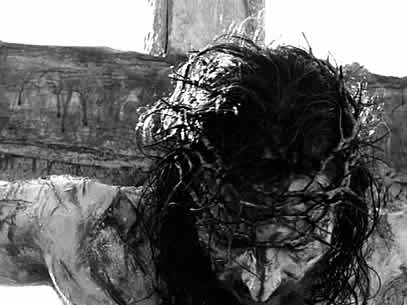
The Death of the MasterLancaster said that, “Messiah died to take away sin, not to excuse it.”

This reminded me of how even among different churches and synagogues, people are dancing on both sides of some serious social topics in an attempt to be people of faith and yet fit in with the rest of the world and what the world (though not necessarily God) thinks is important and right. If you are living a Holy life, your life should not be in synch with the popular and progressive imperatives of our secular society (and political affiliation is beside the point).

Sorry.

Now this is interesting:

Anyone who has set aside the Law of Moses dies without mercy on the testimony of two or three witnesses. How much severer punishment do you think he will deserve who has trampled under foot the Son of God, and has regarded as unclean the blood of the covenant by which he was sanctified, and has insulted the Spirit of grace? For we know Him who said, “Vengeance is Mine, I will repay.” And again, “The Lord will judge His people.” It is a terrifying thing to fall into the hands of the living God.

Hebrews 10:28-31

This is still in the present tense and remember the writer and readers of this letter are all Jewish. The letter writer is impressing upon his audience, using a lighter to heavier argument (we’ve seen this before), that if setting aside the Torah can result in a death sentence, how much more serious is it to trample underfoot the Son of God. Yes, it’s serious for a Jew to violate the Shabbat but it’s even more serious to consider the righteous and Holy sacrifice of Messiah as unclean and common.

This is a stern warning that even under extreme provocation, the consequences of abandoning faith in Messiah are terrifying.

You know that He appeared in order to take away sins; and in Him there is no sin. No one who abides in Him sins; no one who sins has seen Him or knows Him.

1 John 3:5-6

This makes it sound like we should never, ever sin, not even once after we become believers, but what the apostle is saying is that we should continually strive to become more spiritually perfected, not that we’ll ever be perfect this side of the resurrection, but that we shouldn’t just put up with a certain level of sinning in our lives as if it is inevitable.

Not that I have already obtained it or have already become perfect, but I press on so that I may lay hold of that for which also I was laid hold of by Christ Jesus. Brethren, I do not regard myself as having laid hold of it yet; but one thing I do: forgetting what lies behind and reaching forward to what lies ahead, I press on toward the goal for the prize of the upward call of God in Christ Jesus.

Philippians 3:12-14

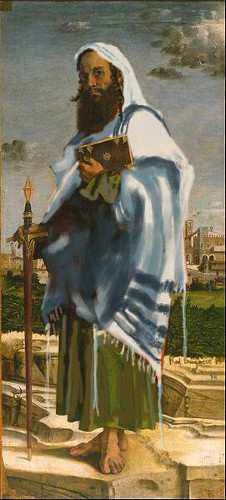
The Jewish PaulEven Paul said he hadn’t obtained perfection but it was a goal he always moved toward, he pressed on, even though he hadn’t yet put his hands on it. That’s what we’re supposed to do.

Let us therefore, as many as are perfect, have this attitude; and if in anything you have a different attitude, God will reveal that also to you; however, let us keep living by that same standard to which we have attained.

Philippians 3:15-16

For Lancaster, this is a key statement. We need to keep striving to live by the standard that we are pursuing, the standard of a Holy and righteous life, to live, not natural lives as the rest of the world does, but supernatural lives. This is how we draw nearer to God and draw the Messianic Age nearer to our present reality.

What Did I Learn?

When I was reading in Matthew 27 about the tearing of the veil, I noted the verses that immediately followed:

The tombs were opened, and many bodies of the holy ones who had fallen asleep were raised; and coming out of the tombs after His resurrection they entered the holy city and appeared to many.

Matthew 27:52-53

No other Gospel writer mentions this event, but for Matthew, who was writing to a Jewish audience just as the Hebrews writer was, one of the strongest promises of the New Covenant is the resurrection of the dead. The death of Jesus was immediately followed by the tearing of the veil and the resurrection of people who were recognizably Jewish tzaddikim must have been terrifically obvious signs of who and what Jesus was and is. Even a Roman centurion present picked up on it:

Now the centurion, and those who were with him keeping guard over Jesus, when they saw the earthquake and the things that were happening, became very frightened and said, “Truly this was the Son of God!”

Matthew 27:54

I had noted each of these events separately, but putting them together relative to the New Covenant gives them a lot more meaning than just a series of supernatural events related to the death of Jesus. This moment in time formally set into motion the beginning of the entry of the New Covenant into our world and these events were part of the evidence.

But that was almost two-thousand years ago and most people in the world today don’t even think of the Bible as evidence of anything real and applicable to their lives.

That’s why they have us.

Lancaster said that we have to make a difference and we do that by adhering to a standard set before us by God, a standard to live lives of Holiness and excellence, as if the New Covenant were already here, as if we had already been resurrected, as if our hearts of stone had already been replaced by hearts of flesh and we were filled with the Holy Spirit to such abundance that we all “know God” in a manner greater than all the prophets of old.

Imagining myself living a “supernatural life” isn’t always an easy thing for me. I can’t picture myself “checking my brain at the door,” so to speak, and just relying upon my feelings as the means by which I draw nearer to God. I know that isn’t what Lancaster (or those few others in my life who encourage me to also be more “supernatural”) is saying, but it feels like what he’s (they’re) saying.

with godI think what he’s actually saying is that we can live better lives behaviorally, and we can be better people than we think we are. If we tried to be better just by force of will, we might make some temporary achievements, but most of us would fall back into our usual flight patterns after a while. Our natural methods wouldn’t work out in the long run. Only the supernatural methods, by faith, by continually striving for an authentic encounter with God, will grant us access to transforming and perfecting our lives, little by little, bit by bit, until the evidence of God is undeniably visible in everything we do.

Then we will be the evidence that God is real and that His promises are true. They will happen because they’re happening now, through us.

Reflections on Romans 4

What then shall we say was gained by Abraham, our forefather according to the flesh?

Romans 4:1 (ESV)

Remember that in my reflection on Romans 3, Paul was toggling back and forth between Jewish obligation to the Law (Torah) and justification by faith, making sure that his audience, probably Jewish and Gentile believers in the synagogues in Rome (but talking about Gentile relationships with non-Jesus-believing Jews), understood the proper association, that Jews had many advantages including those Jews who had not yet come to faith in Messiah Yeshua, (Christ Jesus) but that only faith ultimately justifies one before the Almighty.

It must have been a struggle, especially for the Gentile Jesus-believers, to comprehend the relationship between faith and Torah observance. My reading of Romans tells me that these Gentiles might have been getting pretty arrogant, especially in relationship with the non-Jesus-believing Jews they encountered, because they had the Torah but not faith in Messiah. The Gentiles may have concluded that they were justified before God as were their Jewish Jesus-believing counterparts, but not the non-believing (in Jesus) Jews. After all, keeping the Law doesn’t justify.

Paul was trying to correct the error of the Gentiles’ thinking. Christians today tend to mess this up as well, but if we apply Paul to today’s Jewish communities, we see they too must have many advantages, and that God has not abandoned them or replaced them with the Church or even with the community of Jesus-believing Messianic Jews.

Chapter four sees Paul continuing to make his point and expand upon it.

What then shall we say that Abraham, our forefather according to the flesh, has found? For if Abraham was justified by works, he has something to boast about, but not before God. For what does the Scripture say? “Abraham believed God, and it was credited to him as righteousness.” Now to the one who works, his wage is not credited as a favor, but as what is due. But to the one who does not work, but believes in Him who justifies the ungodly, his faith is credited as righteousness…

Romans 4:1-5 (NASB)

Paul continues to state that Abraham wasn’t justified by what he did, by any works, including circumcision, he was justified by faith and his faith was credited to him as righteousness, even as faith is credited to his readers and to us as disciples of the Master.

But that didn’t mean Abraham wasn’t subject to behavioral expectations by God. That doesn’t mean he didn’t have to obey:

So Abram went forth as the Lord had spoken to him; and Lot went with him. Now Abram was seventy-five years old when he departed from Haran. Abram took Sarai his wife and Lot his nephew, and all their possessions which they had accumulated, and the persons which they had acquired in Haran, and they set out for the land of Canaan; thus they came to the land of Canaan.

Genesis 12:4-5 (NASB)

Now it came about after these things, that God tested Abraham, and said to him, “Abraham!” And he said, “Here I am.” He said, “Take now your son, your only son, whom you love, Isaac, and go to the land of Moriah, and offer him there as a burnt offering on one of the mountains of which I will tell you.” So Abraham rose early in the morning and saddled his donkey, and took two of his young men with him and Isaac his son; and he split wood for the burnt offering, and arose and went to the place of which God had told him. On the third day Abraham raised his eyes and saw the place from a distance. Abraham said to his young men, “Stay here with the donkey, and I and the lad will go over there; and we will worship and return to you.” Abraham took the wood of the burnt offering and laid it on Isaac his son, and he took in his hand the fire and the knife. So the two of them walked on together. Isaac spoke to Abraham his father and said, “My father!” And he said, “Here I am, my son.” And he said, “Behold, the fire and the wood, but where is the lamb for the burnt offering?” Abraham said, “God will provide for Himself the lamb for the burnt offering, my son.” So the two of them walked on together.

Genesis 22:1-8 (NASB)

Abraham was faithful to God and obeyed him, even at great personal cost. Picture what it must be like to, at the word of God, pack up your family and all your possessions and head out in a direction with no stated destination in sight.

The AkedahBut that pales in comparison to the commandment to take your son and serve him up on the altar like a lamb to slaughter. As a father and grandfather, I can only imagine how Abraham’s heart must have been in anguish at knowing not only that his son would die, but that he would have to bind him and kill him with a knife.

Midrash says that Abraham believed that God would allow the sacrifice of Isaac but that God would resurrect him. However, the Torah is silent about this area of Abraham’s thoughts, so we’ll never be sure this side of Messiah what Abraham did and didn’t believe.

We only know that out of faith in God, he obeyed. Thus we can’t say that faith replaces obedience, only that it precedes it. From this I extrapolate that Paul is saying once justified by faith, Jews are expected to continue to observe the mitzvot and that in fact, their observance will have more depth of meaning because of faith.

But there’s something else:

David also speaks of the blessing on the man to whom God credits righteousness apart from works:

“Blessed are those whose lawless deeds have been forgiven, And whose sins have been covered. “Blessed is the man whose sin the Lord will not take into account.”

Is this blessing then on the circumcised, or on the uncircumcised also? For we say, “Faith was credited to Abraham as righteousness.” How then was it credited? While he was circumcised, or uncircumcised? Not while circumcised, but while uncircumcised; and he received the sign of circumcision, a seal of the righteousness of the faith which he had while uncircumcised, so that he might be the father of all who believe without being circumcised, that righteousness might be credited to them, and the father of circumcision to those who not only are of the circumcision, but who also follow in the steps of the faith of our father Abraham which he had while uncircumcised.

Romans 4:6-12 (NASB)

In short, the forgiveness of sins is by faith, not by performance of the mitzvot, thus both Jews and Gentiles receive forgiveness by their faith and the Gentiles don’t have to be concerned that their sins will be counted against them if they don’t also observe the mitzvot in the manner of the Jews.

Remember I said that I thought the Gentiles were probably getting arrogant in their status of saved by faith apart from the Torah? It’s possible that the non-believing (in Jesus) Jews were “pushing back” with their advantage as Jews, having the Torah, the oracles of God, and maybe getting back at the Gentiles among them by pointing out what the Jews had that the Gentiles would never have.

If indeed there was a “war of egos” going on between the Jesus-believing Gentiles and the non-Jesus-believing Jews (with the Jesus believing Jews caught in the middle), then each party would be pressing their own perceived advantage against the other. Paul’s writing this letter to even things out. He’s saying that yes, non-Messianic Jews continue to have the advantages under the Abrahamic and Sinai covenants, but that under one of the blessings of Abraham, it is faith that removes sin for all, not Torah observance, so everyone who has faith will be saved.

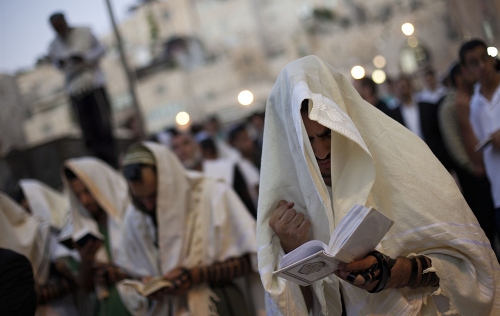
DaveningAlso remember that the non-believing (in Jesus) Jews weren’t faithless. They had faith, probably great faith, not in Jesus being Messiah but rather in Hashem, God of Creation, Master of Legions. Yes, faith in Messiah as the first fruits of the dead is the next logical, historical, and Biblical step in Jewish faith in God and the advancement of God’s plan to bring the New Covenant into the world, but non-believing (in Jesus) Jews were not totally abandoned by God, nor were they bereft of His compassion.

For the promise to Abraham or to his descendants that he would be heir of the world was not through the Law, but through the righteousness of faith. For if those who are of the Law are heirs, faith is made void and the promise is nullified; for the Law brings about wrath, but where there is no law, there also is no violation.

Romans 4:13-15 (NASB)

This sounds like one of those either/or statements about faith being good and the Law bringing wrath, but what about the Law brings wrath?

If someone depended on their behavior alone with no faith in God and with the absence of intent to serve God, the response would be wrath, for without faith, no one can be saved from the consequences of their sin and from God’s righteous judgment. Yes, the Jews had the promises and they were (and are) heirs to the Land of Israel, but if observance is what you believe justifies you before God, then “faith is null,” as Paul wrote. Of course, the other side of that wrath is a Jew who claims to have faith in God but who is not observant. The Torah is clear about the consequences of disobedience or abandoning God’s Law for a Jew. But what about Gentiles in Messiah?

We see that there are two standards of judging obedience. They may overlap, but they’re hardly identical. If the Gentile disciples of the Master were not expected to observe the Torah in the manner of the Jews as per the legal ruling of the Council of Apostles and Elders (see Acts 15), then those without the Law (Torah), that is, the Gentile disciples, are not under the wrath of the Law. They are not expected to obey thus if they fail to observe the mitzvot, there is no transgression.

But as I said above, the other wrinkle is that even if a Jew has great faith and is justified before God, if he or she does not observe the Torah commandments (the conditions of fulfilling the Sinai Covenant), imagining somehow that they are like the Gentiles (and I can imagine that a few Jews may have taken this as Paul’s meaning), then that Jewish person would be under condemnation. Abandoning the Torah is written all over the history of the Israelites.

But to the wicked God says,
“What right have you to tell of My statutes
And to take My covenant in your mouth?
“For you hate discipline,
And you cast My words behind you.”

Psalm 50:16-17 (NASB)

Just to show you that I’m not making up the idea that a Jew could misunderstand Paul’s intent in teaching Jewish Torah obligation and Gentile non-obligation…

And when they heard it they began glorifying God; and they said to him, “You see, brother, how many thousands there are among the Jews of those who have believed, and they are all zealous for the Law; and they have been told about you, that you are teaching all the Jews who are among the Gentiles to forsake Moses, telling them not to circumcise their children nor to walk according to the customs.

Acts 21:20-21 (NASB)

Apparently some Jewish people got the idea that because Paul was teaching the Gentiles that they did not have to observe the Torah commandments (Moses) and they didn’t have to circumcise their sons, that Paul was also teaching the Jews the diaspora the same thing. Maybe some Jews reading Paul’s letters or hearing him teach actually thought he was applying the same “freedom” he was preaching to the Gentiles to Jewish believers in Yeshua.

Here was James’ solution to the problem and his attempt to clarify what Paul was really doing:

Therefore do this that we tell you. We have four men who are under a vow; take them and purify yourself along with them, and pay their expenses so that they may shave their heads; and all will know that there is nothing to the things which they have been told about you, but that you yourself also walk orderly, keeping the Law. But concerning the Gentiles who have believed, we wrote, having decided that they should abstain from meat sacrificed to idols and from blood and from what is strangled and from fornication.”

Acts 21:23-25 (NASB)

The Jewish PaulPaul was to pay the expenses of four Jewish men under a vow (probably a Nazarite vow) in order to graphically illustrate that he continued to observe the mitzvot and that there was nothing to the erroneous rumors about him teaching “lawlessness” to diaspora Jews. Verse 25 presents the distinction for the Gentile believers, citing the Acts 15 letter, which limits the observance of the Messianic Goyim to a subset of the commandments.

Thus Paul was not teaching Jews that their level of observance was reduced to that of the Gentile disciples but rather, Paul remained a Torah-observant Jew teaching other Jews to keep to the commandments while at the same time, teaching the Gentile disciples a different or overlapping set of observances that were not nearly as strict or involved.

No wonder the Romans letter seems so difficult to follow. Paul was trying to explain circumstances that were (and are) very difficult to understand.

The common denominator for Jews and Gentiles in Messiah is faith. Faith justifies, makes one righteousness, and erases all guilt of sin (after repentance, of course), and only afterward are we to live a life of obedience by faith. Only then will God judge our hearts and hold us accountable to the level of our observance as specifically assigned to Jew or Gentile.

I know I’m going to get some “push back” for all that, but it’s the only way to explain what Paul is saying that makes any sort of sense to me.

For this reason it is by faith, in order that it may be in accordance with grace, so that the promise will be guaranteed to all the descendants, not only to those who are of the Law, but also to those who are of the faith of Abraham, who is the father of us all, (as it is written, “A father of many nations have I made you”) in the presence of Him whom he believed, even God, who gives life to the dead and calls into being that which does not exist. In hope against hope he believed, so that he might become a father of many nations according to that which had been spoken, “So shall your descendants be.”

Romans 4:16-18 (NASB)

Like I said, faith is the common denominator in accordance with grace. Abraham has two lines of descendants, those who are of the Law, that is, the Jewish people, and those who are of the faith of Abraham, that is, the Gentile believers. This isn’t to say that the Jews have only the Law and Gentiles are the ones with all the faith. Like I said, faith is the common link between Jews and Gentiles. But we Gentiles are joined to the covenant blessings by faith and we do not have the Law.

The Law, that is, the Torah, the conditions of the Sinai covenant between God and Israel, is particularly identifying of Jews. That’s why (in my opinion), Paul structured his sentence as he did. The Jews are the ones whose obligations to God are specifically defined in the Torah. The Gentiles, by contrast, are specifically identified, not by the Law obviously, but as children of Abraham by faith alone. The Gentile behavioral conditions are summarized in the Acts 15 letter. Remember, the Jews were also physically children of Abraham, so they had their link back to the Patriarch both by faith and by bloodline. Gentiles are Abraham’s children by faith alone. This is how Abraham would be the father of the Jews but also the “father of many nations.”

sarah and isaacThe final verses of this chapter pull Paul’s points together, citing Abraham’s faith in the promise of an offspring, even in the face of both his and Sarah’s great age, and repeating that Abraham’s faith was credited to him as righteousness. Paul then points all this back to Jesus, the keeper of the New Covenant promises, the seed of Abraham (Galatians 3:16; 3:29), the one God raised from the dead, the one who was delivered over to sinful men for the transgressions of the world, for the sake of the Jews but also the Gentiles, that through faith in him and the resurrection, we have the hope of living in the New Covenant age, in an age of peace and tranquility, in an age without strife or sin, with Messiah the King.

The Broken Saint

James, you are the most confusing person. I think sharing your confusing life on a blog is doing more harm than good. I’ve seen you change more directions than the wind and I’m convinced you still don’t know where you’re going. My advice, do what I did, shut down the blog until you can get a grip on your own life before sharing with others. Or, stick with things your 100% sure of and write on that. You have a wide reader base and writing articles for FFOZ has gained you even more. This is the kind of stuff that causes confusion and arguments in MJ and frankly it’s embarrassing. Based upon this article (and forgive me if I am wrong), I would say, make sure you don’t keep the Sabbath. Go out and mow the grass just to make sure you’re not resting on that day. Also, eat pork at least twice a week, preferably in public, so you’re not keeping kosher. Go to church, keep your mouth shut and be a good christian. I’ve cut down my visits to your blog to about once a week. Now, I think I’ll be un-bookmarking this site and I’d suggest the same for others as well. I’m a very nice, easy-going guy, but somethings just light my fire. Sorry you were the match, James. Much love, my brother. Just think about it.

-Keith
Comment on one of my blog posts

While I tried to take this comment in the spirit it was written, I have to admit, my first response was to want to “bite back” a little bit. I probably communicated some of that “sting” in my actual reply, which I regret, but my reaction must mean Keith has a valid point. After all, did I create this blog just to whine about what could be called first world problems in Christianity?

My reply (since I should be honest) to Keith was this:

I’m not “required reading,” Keith. People who think I don’t make sense (sometimes life and living don’t make sense and people experience dissonance and contradiction) and who are disturbed by that don’t have to read my blog. As of 2013, there were an estimated 152,000,000 blogs on the Internet. I’m only one of them.

It’s not my intention to do harm, it’s my intention to illustrate a real, lived experience as a person of faith. I’m not a textbook and I’m not the Bible. I don’t live a linear life and I’m not trying to say that I’ve got it all together. Clearly, I don’t.

However, I suspect most, real, live, human beings who are disciples of the Master (or anything else) don’t have life completely settled, either.

I appreciate that you are commenting for my sake, and maybe at some point, I’ll stop blogging, but when and if I do, that will be a decision I make in relation to my understanding of God and who I am in him.

Cheers, Keith.

Too snarky?

walkingI hope not. But I think I make a really valid point, too. Unlike most other, similar blogs, I didn’t create “Morning Meditations” to just be about my theological and doctrinal conclusions, but rather, about my theological and doctrinal journey.

A journey implies a changing landscape as one progresses in their travels. If I were to take a road trip from Boise to New York City, I’m sure the scenery, what I’d see and experience, would change, sometimes rather dramatically, as I was moving along down the road.

I believe that’s true of any journey in life, particularly one in the company of God and God’s (imperfect) people.

But I can see Keith’s point. I often toggle between some review or assessment of a theological “product,” such as a book, sermon series, lecture, article, whatever, and my personal reactions and responses to what it’s like being a “Messianic Gentile,” dealing with other people’s expectations, dealing with my own expectations, as well as just kvetching and complaining.

The downside to reading such a blog is that it can seem like I’m terribly inconsistent. The upside, or so I’ve been told, is that my writing can seem raw, authentic, real, and relatable by (many) others who are going through the same or similar experiences on the trail to “faithland”.

“You don’t need to be perfect to be impressive.”

-Anonymous

That isn’t a direct quote. I derived it from something I read in an article by Marc Chernoff called 12 Common Lies Mentally Strong People Don’t Believe which was posted on Facebook. I generally avoid inspirational blogs, stories, and speakers because the effect they create is like eating a spoonful of sugar. You get an immediate boost but soon afterward, there’s a profound let down as well as the realization that what you’ve eaten is nutritionally deficient. I looked up the “About” page for the article’s source, Marc and Angel Hack Life, and the youthful appearance of the authors made me question if they’ve experienced enough life to qualify them to suggest how to “hack” it to others, especially “old guys” like me.

But if nothing else, I found several other quotes and “quasi-quotes” that were useful and applicable to my current situation and perhaps a new project.

In order to avoid the confusion Keith speaks of, I’ve been toying with the idea of creating two “environments” in which to write, one for more uplifting commentaries, reviews, and the like, and the other being more gritty and human, a place specifically designed for me to be able to “let my hair down,” so to speak, “tell it like it is,” and yes, to kvetch.

Broken AngelI have a couple of options in mind. The first is administratively the easiest. I can just create an additional page to “Morning Meditations” (It would appear as another navigation tab across the top) called something like “The Broken Saint” and write separate content in that venue. The other would take a greater investment in work and a few extra bucks but be more creative. I could make a second blog, solely for the purpose of expressing my humanity as a person of faith, and actually call that blog something like “The Broken Saint” (I’ve yet to settle on a final title). I could place “buttons” on each blog, linking to the other, so readers could navigate easily between them if they desired.

It’s still the middle of the week as I write this but approaching Shabbat, so I’ll give myself the weekend (maybe) to mull things over. What do you think? Would you visit two related blogs, reading uplifting and informative commentaries on “Morning Mediations” and pursuing my personal humanity in living faith day-by-day on “The Broken Saint”?

“If religion is a crutch, who isn’t limping?”

-Anonymous

Sermon Review of the Holy Epistle to the Hebrews: Faith Toward God

Therefore leaving the elementary teaching about the Christ, let us press on to maturity, not laying again a foundation of repentance from dead works and of faith toward God, of instruction about washings and laying on of hands, and the resurrection of the dead and eternal judgment.

Hebrews 6:1-2 (NASB)

The second elementary teaching of the Messiah in Hebrews 6:12 is called “faith toward God,” but how is this distinct from other first-century sects of Judaism? Even the Sadducees believed in God. Find out how Yeshua transformed the faith of his followers, and get a fresh handle on what it means to “believe in Jesus” and to be “born again.”

-D. Thomas Lancaster
Sermon Twenty: Faith Toward God
Originally presented on June 15, 2013
from the Holy Epistle to the Hebrews sermon series

Apparently I was premature last week in writing No One Comes to the Father Except Through the Son, because Lancaster tells the same parable I referenced in that blog post in today’s sermon. I should have guessed when the chapter of Elementary Principles I quoted from was called “Faith Toward God”.

Fortunately, there are many other details revealed by Lancaster within the context of his “Faith Toward God” lecture. Here’s what I mean.

Remember, we’re studying the elementary principles of the faith, the very first things one must absolutely grasp as disciples of Jesus, the “milk,” the really simple stuff, the basic “food” you must consume and get used to before you’re ready for “meat.”

But doesn’t “faith toward God” seem a little too elemental? I mean saying “have faith in God” is like saying “God made the Earth” or “the Torah was given through Moses.” How did having faith in God distinguish the Jewish religious stream of “the Way” from all the other Judaisms of their day? All of the Judaisms, no matter how they otherwise differed, had faith in the existence of God.

In fact, the Way and the Pharisees had almost identical beliefs. They both believed in the resurrection, they both believed that God rewards good and punishes evil in this life and the life to come, they both believed that you had to repent to be forgiven of sins.

Apparently though, the Greek we translate as “faith in God” or “faith toward God” is better rendered “faith ON God” or “faith UPON God,” implying a sort of reliance.

Later in the epistle, the writer of Hebrews defines faith, which should help us solve our small mystery:

Now faith is the assurance of things hoped for, the conviction of things not seen. For by it the men of old gained approval.

Hebrews 11:1-2 (NASB)

faithYou probably have that one memorized. But although I’ve read it many times, the meaning of these two verses seems rather vague, or they did until I heard Lancaster’s explanation.

Here’s the key to understanding how a Messianic faith on God would be different from that of a Pharisaic faith or the faith of any other branch of first century Judaism:

And without faith it is impossible to please Him, for he who comes to God must believe that He is and that He is a rewarder of those who seek Him.

And all these, having gained approval through their faith, did not receive what was promised, because God had provided something better for us, so that apart from us they would not be made perfect.

Hebrews 11:6, 39-40 (NASB)

In case you’re still wondering what all that means, here’s Lancaster’s parable, which I referenced last week, to provide clarification:

Once, a man who had two daughters went off to war. Before he left, he promised to return to them, and he also promised them, “When I return, I will bring you each a fine string of pearls and a summer dress.” No one except the two girls knew about the promise. After many years, the man had not returned, and everyone presumed him dead. His daughters, however, continued to hope, believe, and wait. A decade passed, and they grew to become adult women, but neither of them forgot their father or his promises. Deep in their hearts, they continued to hope and to believe. One day a messenger came seeking the girls. Finding only one daughter, he told her, “I have news of your father. He is returning, and he sends you this gift.” The messenger presented her with a fine string of pearls.

Now both girls still believed in the promise of the father, but one had received a token of the promise, and the other had not. One had faith in the father’s promise on the basis of her hope and confidence in the father’s promise, but the other had faith in the father’s promise on the basis of the good news that she had already received and on the basis of the partial fulfillment of her father’s promise. She already had the pearls. She had no question in her mind that she would soon see her father face to face. Think of that girl’s confidence, certainty, and joy. She no longer had any doubt that her father was coming. She knew that he would bring the summer dress because she had already received the pearls.

-Lancaster,
“Chapter 4: Faith Toward God,” pg 56
Elementary Principles

prayingA Messianic faith upon God isn’t just believing in God’s existence and it isn’t just believing that somehow, someday, God will keep all of His promises, the promise to redeem all of Israel, to return all of the exiles to their Land, to elevate the nation of Israel above all the nations, that there will be a resurrection of the dead, that God will punish the evil and reward the righteous. It’s not just believing in all that. It’s knowing that there’s actual proof, evidence witnessed by the apostles that God was beginning to keep His promises starting in their day.

Remember, the writer of Hebrews said that Abraham, the patriarchs, and all of the Jewish people came before Yeshua (Jesus) also had great faith in God but “did not receive what was promised.”
But the apostles saw the resurrected Jesus as proof of the promise of the resurrection because he was the first fruits from the dead (1 Corinthians 15:20).

A Messianic faith includes believing not just that God exists but that He is just and that He keeps His promises and that He gave proof of this through the Messiah, through Jesus. The Messianic Jewish disciples did not just believe by faith that there would be a redemption, that the Kingdom of Heaven would come, and that King Messiah would ascend to the throne in Jerusalem, as the Pharisees did. They had direct evidence that the promises were starting to be fulfilled. The apostles were witnesses to this evidence and they passed their testimony to many others, both in the Land of Israel and beyond, both to the Jews but also to the Gentiles.

But blessed are your eyes, because they see; and your ears, because they hear. For truly I say to you that many prophets and righteous men desired to see what you see, and did not see it, and to hear what you hear, and did not hear it.

Matthew 13:16-17 (NASB)

That maps right back to Hebrews 11:39-40. Many great men and women of faith in the history of the Bible longed to see the beginning of the fulfillment of all of God’s promises to Israel but they died and did not see. Yet all those who lived in the time of Yeshua did see and not only did they believe, they believed by faith in the evidence and what they saw with their own eyes.

Paul, a bond-servant of Christ Jesus, called as an apostle, set apart for the gospel of God…

Romans 1:1 (NASB)

Paul, called as an apostle of Jesus Christ by the will of God, and Sosthenes our brother…

1 Corinthians 1:1 (NASB)

Paul, an apostle of Christ Jesus by the will of God…

Ephesians 1 (NASB)

I said last week that Jesus was the messenger bringing evidence as a gift that God would do all that He said He would do. The importance of this role of Jesus was (and is) incredible, and we see how the apostles, particularly Paul, responded by inexorably linking Jesus and God, for example, in each of the salutations of his letters.

For I am not ashamed of the gospel, for it is the power of God for salvation to everyone who believes, to the Jew first and also to the Greek. For in it the righteousness of God is revealed from faith to faith; as it is written, “But the righteous man shall live by faith.”

Romans 1:16-17 (NASB)

PrayerI’ve wondered what “faith to faith” meant, but in this case, it’s the distinction between one’s faith being through Messiah and any other faith in God, just like the difference between the two sisters in Lancaster’s parable. Faith in God, which is good and which the Jewish people have always had, when viewed and apprehended through the revelation of the Messiah and through his resurrection, becomes more than longing and is transformed into confidence and a lived hope. It’s not just “how long Moshiach, how long,” but “I have faith because I’ve seen.” The one sister in the parable held the pearls in her hands. She could see them, touch them, wear them, and she knew they came from her father and were evidence that he would return bearing his other gift. She knew that not only would he come bringing gifts for her but that he would return to both of his daughters and reward them both with his gifts, just as he promised.

Paul too desired this for both believing and unbelieving Jews.

For I could wish that I myself were accursed, separated from Christ for the sake of my brethren, my kinsmen according to the flesh, who are Israelites, to whom belongs the adoption as sons, and the glory and the covenants and the giving of the Law and the temple service and the promises, whose are the fathers, and from whom is the Christ according to the flesh, who is over all, God blessed forever. Amen.

Romans 9:3-5 (NASB)

Paul would have given up his “gift” to the other “sister” if only she would believe and have the confidence that Paul possessed in God, through Messiah, that all of the New Covenant promises would be fulfilled and were in the beginning process of being fulfilled, having believed from faith to faith.

It was this confidence, through Messiah, that was the only real difference between the Messianic believers and the Pharisees, and it should foreshadow the relationship between observant Messianic Jews and other observant Jews in the modern era. Grasping this Messianic faith and knowing by evidence that it is true is like being born again, like dying and being resurrected, like submerging below the waters of the mikvah and rising again into the air.

Now to Him who is able to establish you according to my gospel and the preaching of Jesus Christ, according to the revelation of the mystery which has been kept secret for long ages past, but now is manifested, and by the Scriptures of the prophets, according to the commandment of the eternal God, has been made known to all the nations, leading to obedience of faith…

Romans 16:25-26 (NASB)

“Obedience of faith.” This Messianic faith isn’t just belief, it’s a lifestyle based on the actual knowledge that God keeps His promises, that God is just, that God rewards the righteous and punishes the wicked, that God requires repentance for the forgiveness of sins, that God requires we turn from sin and back to Him, transforming and conforming our lives to the will of God by the power of the Holy Spirit and faith in the Gospel message of Jesus Christ, who is the “Gospel messenger” who delivered evidence that the promises are going to happen and are beginning to happen right now.

What Did I Learn?

This pretty much reinforces what I wrote about last week and further confirms why having faith in Yeshua as Messiah was and is the next logical step in the progression of a Jewish person’s (as well as a Gentile’s) devotion to the One God. If you do believe that Jesus is the Messiah and that his message is Good News to Israel and also to the Gentile nations, that he brought evidence as to his identity but more, that he brought evidence of God’s gifts through the revelation of his resurrection, then you have not just hope in the unseen, but a sure confidence in what has happened and in what has not yet happened but what will indeed occur. You have the pearls in your hands and believe, by faith, they came from the Father. You don’t just have to believe they will arrive someday by faith. You know they will because part of the promised gift is already with us.

MessiahIf you don’t accept what the messenger said was true and you do not believe the pearls came from your Father, you still have faith, as did the Pharisees, and as many observant and faithful Jews today have, that God will keep His promises, that a Messiah will ascend the throne, that the Temple will be rebuilt, that Israel will be elevated to the head of the nations, and that the exiles will be returned to their Land, but…

…but you have set aside God’s assurances. Even though you have faith and even though you believe very, very strongly that you are doing the right thing, you still are denying something precious that God gave to you. This is what broke Yeshua’s heart (Matthew 27:37-39) and Paul’s (Romans 9:3-5). This is what makes the difference. Denying Yeshua as the Messiah is denying that God gave evidence of His promises through His revelation.

For nearly two-thousand years, Gentile Christianity has been beating up the Jewish people, calling them vile and horrible names, persecuting them, torturing and maiming them, even killing them in the name of Jesus, all because the Jewish people continually refused to accept Jesus as the Messiah. But the “Messiah” that the Gentile Christians offered the Jews was not the Yeshua that the apostles knew. The Church, in splitting from the Jesus-believing Jewish ekkelsia in the early second century and later, rewrote the Gospels and reinterpreted the entire Bible to the point where Yeshua became “Jesus” and Messiah became “Christ”. All of the “good news” that would have been seen as good for the Jews now seemed like poison.

I mentioned last week that the Church is its own worst enemy, but it also has historically been the enemy of the Jews.

Messianic Judaism has come to take back their history, their Messiah, and their Bible and to say, “this belonged to us first.” Jews in Messiah have come to take back their faith toward God through the revelation of Yeshua and his resurrection. These Jews are not only like their distant ancestors, the readers of the Epistle to the Hebrews, but they are the first fruits of the Jewish Messianic Kingdom, the citizens of Israel, the subjects of the King. It is only through them that we Gentiles too may be saved, through the same faith they have, the faith toward God, the faith upon God, the faith Abraham had when he was called righteous (Genesis 15:6, Galatians 3:6).

“A brilliant mind without faith is like a beautiful face without eyes.”

-Shalom Cohen

May the hearts of all those who do not know Yeshua turn to God through Messiah’s revelation, first the Jew and also the Gentile, in the name of my Master and my King, I pray.

If You Had to Choose Between Jesus and Your Spouse…

If someone comes to me and does not hate his father and his mother and his wife and his children and his brothers and his sisters and even his own life, he is not worthy to be my disciple.

Luke 14:26 (DHE Gospels)

I know I’m quoting this verse out of context, but I find it hard to reconcile with the following.

Have you not read that from the beginning the Maker “created them male and female,” and it says, “Therefore a man shall leave his father and mother and cling to his wife, and the two will become one flesh”? If so, they are not two any longer, but one flesh. Thus, what God has joined, man must not divide.

Matthew 19:6 (DHE Gospels)

On the one hand, Jesus seems to value marriage quite highly (what God has joined) but on the other hand, we are to reject (hate) our family including our wives, presumably if our family opposes our becoming disciples of Jesus.

As an intermarried husband, this is particularly difficult for me, especially when I see my marriage through this scripture:

But to the rest I say, not the Lord, that if any brother has a wife who is an unbeliever, and she consents to live with him, he must not divorce her. And a woman who has an unbelieving husband, and he consents to live with her, she must not send her husband away. For the unbelieving husband is sanctified through his wife, and the unbelieving wife is sanctified through [h]her believing husband; for otherwise your children are unclean, but now they are holy. Yet if the unbelieving one leaves, let him leave; the brother or the sister is not under bondage in such cases, but God has called us to peace. For how do you know, O wife, whether you will save your husband? Or how do you know, O husband, whether you will save your wife?

1 Corinthians 7:12-16 (NASB)

Also, Ephesians 5:22-33 says many fine things about marriage and how a husband and wife are to love one another. How can God join us together, tell us how to love, say that it is acceptable for a believing spouse to be joined with an unbelieving spouse if both are willing, and then tell the husband he is not worthy of being a disciple is he does not hate his wife?

intermarriageThis is one of those “difficult sayings of Jesus” that isn’t easy to answer.

Messianic or “Jewish-friendly” Christian commentaries on such specific topics aren’t always readily available, but I did find a conventional Christian response by Pastor Mark Driscoll. I know nothing about him, but he did write something detailed on this particular verse.

Jesus’ call to discipleship can be difficult. Contrary to common practice today, Jesus was not in the business of getting anyone and everyone he could in the door of his discipleship program. Instead, he took painstaking measures to clarify the costs of following him. Those who heard him often abandoned their pursuit after hearing his messages (John 6:52–71). In keeping with this truth, Jesus’ requirements for discipleship set out in Luke 14:26 are hard for us to hear.

Thankfully, there is another sense for the word “hate,” as it pertains to this passage. When it’s used in the Old Testament, particularly in the Wisdom Literature, the word loses its psychological force (Michel, “μισεω,” in TDNT, 4:687.). Instead, it carries a sense of intensified choice. For instance, in Proverbs, the writer often instructs the reader to choose righteousness over evil, often worded in terms of love and hate. The call is to reject (= hate) evil and to embrace (= love) righteousness. In Jesus’ statement here in Luke 14:26, the same principle is at play.

-Driscoll, “Tough Text Tuesday – Luke 14:26”
pastormark.tv

That helps a little but not as much as you might think. Still, the suggestion of a choice between two paths reminded me somewhat of a Kal va-chomer or “lighter to heavier” argument. If I reword the passage from Luke 14, I could say, “If you love your wife whom God has joined with you, how much more should you love Messiah, who God brought for the sake of the world?”

I suppose that could be worded better, but you get the idea. No, I’m not rewriting the Bible, far be it from me to do so. But I am suggesting in my own wee commentary (call it a small midrash, for what it’s worth) that, even if my wife is an unbeliever, I don’t have to hate her so I can love Jesus. I can love my wife, and I can also apprehend the great requirement to love and be devoted to Messiah, Son of David, who is the living embodiment of God’s promises for atonement, redemption, salvation, and the resurrection. He is the hope, not just for me, but for everyone. He is the hope that someday my wife will be saved, so in a way, by choosing him, I am also choosing her, for if I should choose her by rejecting Jesus, then how do I know I’m not dooming us both? Loving Jesus then, is also loving my wife.

Sunday Sermon: Belief But No Spirit

It happened that while Apollos was at Corinth, Paul passed through the upper country and came to Ephesus, and found some disciples. He said to them, “Did you receive the Holy Spirit when you believed?” And they said to him, “No, we have not even heard whether there is a Holy Spirit.” And he said, “Into what then were you baptized?” And they said, “Into John’s baptism.” Paul said, “John baptized with the baptism of repentance, telling the people to believe in Him who was coming after him, that is, in Jesus.” When they heard this, they were baptized in the name of the Lord Jesus. And when Paul had laid his hands upon them, the Holy Spirit came on them, and they began speaking with tongues and prophesying. There were in all about twelve men.

And he entered the synagogue and continued speaking out boldly for three months, reasoning and persuading them about the kingdom of God. But when some were becoming hardened and disobedient, speaking evil of the Way before the people, he withdrew from them and took away the disciples, reasoning daily in the school of Tyrannus. This took place for two years, so that all who lived in Asia heard the word of the Lord, both Jews and Greeks.

Acts 19:1-10 (NASB)

I know I finished my review of MacArthur’s sermon series, but today (Sunday, February 9th as I write this), the Pastor at my church delivered a sermon based on Acts 19:1-22. As you’ll recall, MacArthur’s final sermon in his series was based on Acts 19:1-7 so there is the potential for overlap between MacArthur’s message and Pastor Randy’s preaching. In fact, there was sufficient overlap and parallel, that I felt compared to present my own interpretation today.

I can only read or listen to a recording of Pastor MacArthur, but with my own Pastor, I’m sitting in the pew, watching him, listening to him, and directly experiencing his message, particularly with the background of knowing something about him and how he thinks.

He opened with the Bonfire of the Vanities, which I’ll skip, and I just thought that was a novel by Tom Wolfe, one I haven’t gotten around to reading (Pastor mentioned that Wheaton College might need to burn a few things, but I had to look that up online to know what he was talking about).

Oh, to see why bonfires are relevent to this sermon, see Acts 19:18-20. I also mention those verses at the very end of this missive.

The “MacArthur connection” came in when Pastor backed up a bit into his sermon for last week and discussed Apollos.

Now a Jew named Apollos, an Alexandrian by birth, an eloquent man, came to Ephesus; and he was mighty in the Scriptures. This man had been instructed in the way of the Lord; and being fervent in spirit, he was speaking and teaching accurately the things concerning Jesus, being acquainted only with the baptism of John; and he began to speak out boldly in the synagogue. But when Priscilla and Aquila heard him, they took him aside and explained to him the way of God more accurately. And when he wanted to go across to Achaia, the brethren encouraged him and wrote to the disciples to welcome him; and when he had arrived, he greatly helped those who had believed through grace, for he powerfully refuted the Jews in public, demonstrating by the Scriptures that Jesus was the Christ.

Acts 19:24-28 (NASB)

You may want to refer to the relevant sections of MacArthur’s sermon to see how MacArthur’s and Pastor Randy’s messages interface. Just a suggestion.

Relative to both Apollos and the twelve disciples Paul encounters at the very beginning of Acts 19, Pastor Randy seems to split the state of being a “believer” with being a “Christian.” I tend to use the two terms interchangeably, but Pastor Randy drew a sharp distinction based on this:

You believe that God is one. You do well; the demons also believe, and shudder.

James 2:19 (NASB)

walking_on_waterApollos and the twelve disciples were taught the baptism of John (probably not by John himself) but, as MacArthur said in his sermon, didn’t have all of the details about who and what they were being baptized into. Frankly, I really can’t place any blame at the feet of Apollos and the other disciples since they didn’t have the Internet, email, text messaging, the telephone, or any other way to quickly disseminate a unified body of information in the then-civilized world of two-thousand years ago. Written letters were slow and when copied for re-delivery, may not have been copied precisely. I imagine there were a lot of folks with only bits and pieces of the teachings of Jesus who had to interact with other believers and teachers in order to get a better picture, but this would have taken a lot of time.

Both MacArthur and Pastor Randy said (and I like Pastor Randy’s delivery a lot better) that believing isn’t enough and that at this point and until they received the Holy Spirit, Apollos and the twelve weren’t Christians. In my previous review of MacArthur, I wondered how he arrived at that conclusion and Randy was able to fill in some blanks.

But this raised other problems. Like MacArthur, Pastor Randy said that a certain passage in this text has given rise to a misunderstanding.

He said to them, “Did you receive the Holy Spirit when you believed?” And they said to him, “No, we have not even heard whether there is a Holy Spirit.”

Acts 19:2 (NASB)

Depending on the translation, the question could be rendered (erroneously, according to Pastor Randy) “Having believed, did you then also receive the Holy Spirit?”

The idea is that coming to faith and believing in Christ automatically results in, as MacArthur states, a one-time, momentary miracle of receiving the Holy Spirit. Apparently (I’ve never heard this but there’s a lot I don’t know) in Pentecostalism, there’s the idea that one becomes a believer and then at a subsequent time, one receives the Holy Spirit. Randy and MacArthur both stress that coming to faith and receiving the Spirit is a simultaneous event. It’s not one and then the other.

Of course, that makes quoting James 2:19 in this context seem odd since James is saying that believing isn’t enough. Then again, James isn’t talking about believing and the Holy Spirit, but he’s “marrying” belief/faith and actions, leading a transformed life. Of course, Christianity teaches that you can’t live a transformed life without the indwelling of the Holy Spirit, so I suppose that’s implied.

I got to thinking about Calvinism, which both MacArthur and Pastor Randy support, the idea that only certain pre-selected individuals will ever come to faith in Messiah and that, regardless of how we evangelize the rest, they are not pre-determined to be among the elect, and therefore, they are automatically condemned to Hell before they were ever born.

arminianism-calvinism-debateAccording to Calvinists, you’ll never believe let alone receive the Holy Spirit if you are not among the pre-selected elect. The gospel message of Jesus Christ will just bounce off of you. However, if you are among the elect, you will take hold of the message of salvation and receive the Holy Spirit and become a Christian. Of course to be pre-selected also supposes that in your future at some point, you are destined to hear the message of the plan of salvation. I can’t imagine God selecting someone and then not providing the opportunity to hear about Jesus.

I also can’t imagine God selecting someone as a member of the elect and then them becoming a believer but not a Christian. But then Pastor Randy did challenge the congregation. He said that we can’t take for granted that we’re saved just because we answered some altar call once upon a time or raised our hand at a Bible camp at age 14 indicating that we believed. If we aren’t living a transformed life, we haven’t received the Spirit. We’re not really Christians.

But if belief and receiving the Spirit is a unified event and don’t take place separately, then how is it possible to be a believer and not receive the Spirit, thus becoming a Christian?

I’ll take it for granted that I missed something in Pastor Randy’s sermon, but it certainly seems based on my notes and my memory, that a contradiction exists within the body of his message.

Randy painted a picture of someone at Heaven’s Gates asking to be let in. A voice asks the person, “Why should I let you in?”

Randy said the only appropriate answer would be, “I have trusted Jesus Christ as my Lord and Savior.”

Before Randy answered his own question, the first response that came to me, imagining such an august and solemn query was, “I am not worthy to enter the Heavenly Courts and to approach the Throne of God.”

Well, I’m not. Who am I? Just a guy. Why would God allow me to enter into His presence. Not because of any answer I could possibly give Him. Only because He is good and gracious and merciful. Belief and faith isn’t a magic ticket that gets you a free ride on the bus to Heaven. If God weren’t merciful in the extreme, no amount of belief we could cognitively or emotionally generate, and no acts of righteousness, even out of that faith and devotion, could sway God this way or that.

Yes, I believe human beings have free will and we can choose or reject God, but it is God who chooses to accept or reject us as Sovereign King, and the King only accepts out of His gracious mercy through our woefully inadequate and imperfect faith.

Although, thankfully, Pastor Randy didn’t use terms such as “Pre-Cross” or “wrong side of the cross,” he did characterize Apollos and the twelve disciples as “Old Testament Saints” as opposed to Christians (he also used “mini-Pentecost,” which MacArthur mentioned as well and I have no idea what that’s supposed to mean). The difference is the arrival of Jesus and the key verse “…no one comes to the Father but through me” (John 14:6). Before Jesus, Jews came to faith in God the Father and in that faith by God’s grace, there was salvation. Then Jesus arrived and faith in God was no longer the key, but rather access to God required faith in Jesus. Did God change the rules?

I’m not even going to attempt to evaluate that one and the Jewish anti-missionaries have a field day with the dissonance suggested in this doctrine.

I won’t go into the rest of Pastor Randy’s sermon since at this point, the parallels to MacArthur end, but I do want to mention the “saving grace” of the service, so to speak (not that I had anything against the preaching, but it raised as many questions as answers). Today (as I write this) is part of a series of services at my church aimed at promoting and supporting Christian missionary work, so normal Sunday school classes were suspended. Instead, one big Sunday school class with guest speakers was to be conducted in the sanctuary.

So instead of the last hymn being sung, Pastor Dave went up to the pulpit and conducted a closing commentary and prayer based on this:

Many also of those who had believed kept coming, confessing and disclosing their practices. And many of those who practiced magic brought their books together and began burning them in the sight of everyone; and they counted up the price of them and found it fifty thousand pieces of silver. So the word of the Lord was growing mightily and prevailing.

Acts 19:18-20 (NASB)

burningPastor Dave invited us all to consider our lives, what we have in them that is displeasing to God, those practices, materials, and beliefs we need to confess and burn (literally or otherwise), all the “stuff” that separates us from a closer relationship with God, or even having any relationship at all.

Theology aside, Pentecostalism aside, transitions from Judaism to Jesus aside, this was probably the single most practical message based on these scriptures that I heard, the urging to leave our habits, our traditions, and our comfort zones and to honestly examine ourselves, and I hope (re)examine the scriptures, and re-evaluate who we are, what we’re doing, and what sanctifies and desecrates the Name of God.