Tag Archives: faith

What is Faith?

What is real? How do you define ‘real’? If you’re talking about what you can feel, what you can smell, what you can taste and see, then ‘real’ is simply electrical signals interpreted by your brain.

-Morpheus played by Laurence Fishburne
from The Matrix (1999)

I thought about this quote as I was driving home this evening (as I write this) and wondering what happened between Monday and now. On Monday evening and into Tuesday morning, and even as far as this morning, something carried over from a new or rejuvenated sense of faith and spirituality. Then, as I was driving home, it was like a balloon popped and I could feel myself sinking back into my previous template, which is at a depth where contact with God is like a faint echo struggling to make its way through the cold deeps of a twilight ocean.

What’s stronger, something new or something old? Answer: something old. Something new is exciting in the moment, but what’s old, like old habits, have a much greater and firmer foothold on your life or, in this case mine.

To paraphrase Morpheus, “What is faith? How do you define ‘faith’? If you’re talking about what you can feel emotionally, what you experience in response to stimulating books on faith, on hearing rousing music with impassioned lyrics, then ‘faith’ is simply electrical signals interpreted by your brain.”

That’s a horrible realization and it was even more horrible that such a thought reminded me John MacArthur speaks against a faith based on sensation and experience. Of course, he goes in the opposite direction and believes in a faith based almost exclusively on the intellect and his version of Bible study, making him not unlike some Rabbis in some traditional corners of Judaism.

You’re a great one for logic. I’m a great one for rushing in where angels fear to tread. We are both extremists. Reality has brought us somewhere in-between.

-Captain James Kirk (William Shatner)
from Star Trek VI: The Undiscovered Country (1991)

Apparently the 1990s were very good for movie quotes.

coastKirk and Spock seem to be polar opposites: an emotionalist always looking for his next adventure, and a logical rationalist, always seeking the calm of study, knowledge, and wisdom. But as Kirk pointed out, both of them are extremists. Reality (what is “real?”) is somewhere in the middle.

And so we arrive at attempting to define the essential elements of a life of faith. Certainly not just a stimulating book about a faithful man of God who could perform healing miracles, or music and lyrics that touch the emotions and hopefully the soul. Certainly not just the enthralling study of the Bible, of interesting commentaries, of Talmud and midrash.

Reality is somewhere in the middle because human beings are emotional and intellectual beings. Too much of either side of the equation leaves our faith woefully off-balance, and us teetering on the edge of plummeting into one abyss or another.

A little over two weeks ago, I wrote a blog post quoting First Fruits of Zion (FFOZ) Founder and President Boaz Michael saying that faith is a platform supported by three legs: the Spirit of the Lord, the Torah of Moses, and the Gospel of the Messianic Kingdom.

In 1 Corinthians 13:12-13, the apostle Paul speaks of another three “legs:” faith, hope, and love. It seems we are not complete as devotees of the God of Israel and disciples of Messiah unless we not only value multiple elements in a living faith, but we allow those elements to exist in balance relative to one another. Depending too much on any one “leg” for support, will likely find us about to fall in the opposite direction.

I’ve heard it said that it takes six-weeks to either make a new habit or break an old one. I’m sure that’s overly simplistic, but if you are trying to break an old, unwanted but familiar and relatively comfortable habit, six weeks can seem like a long time. After the initial excitement at any resolution, after a few days pass, the old and familiar assert their influence.

I suppose I could immerse myself in inspirational books and music, but that’s just swinging in another extreme direction and it won’t last. What I think will last is establishing a balance, realizing that there will be moments of disappointment and let down, moments when things will seem dry and uninteresting, and that those moments do not have to stand in the way of a new or renewed sense of the presence of God.

Some habits are good. Continuing to read and to study the Bible is good. Listening to faith-based music is good. Set times of prayer and “davening” from the Siddur is good. Reaching out to God, not only when He seems close, but when He seems far away is good.

Most people who are religious I think organize their activities into the holy and the secular. It’s holy to go to church and secular to go to work. It’s holy to sing a hymn and secular to sing a rock song from the ’60s. It’s holy to pray, and it’s secular to wish.

Leonard CohenThat’s the problem. From God’s point of view, we are all His creations and thus we all share some small part of the Divine. As people of faith, the awareness of that state should be present in us…in me. There really are no times or circumstances or tasks where God is not present. It’s just a matter of whether or not I chose to be aware of the presence during those times I deem “secular”

A momentary pause in the music doesn’t mean the song has ended. The end of a paragraph or chapter doesn’t mean the book is done. And the realization that I won’t always “feel” that God is near doesn’t mean God isn’t near. Faith is continuing to act faithfully even if the physical and spiritual world seems silent and empty.

Faith isn’t a feeling and it isn’t a thought. Faith is a habit or at least it’s supported by habits…praying, singing, reading the Bible, pondering God’s wondrous acts and wisdom, opening your cognition and emotions to God, even if He should choose not to fill them.

And even though it all went wrong
I’ll stand before the Lord of Song
With nothing on my tongue but Hallelujah!

-Leonard Cohen, “Hallelujah”

Faith is that moment when all is silent and void and yet there is still nothing on my tongue but Hallelujah.

Hallelujah!

Beloved of the soul, Compassionate Father, draw Your servant to Your Will; then Your servant will hurry like a hart to bow before Your majesty; to him Your friendship will be sweeter than the dripping of the honeycomb and any taste.

Majestic, Beautiful, Radiance of the universe, my soul pines for your love. Please, O God, heal her now by showing her the pleasantness of Your radiance; then she will be strengthened and healed, and eternal gladness will be hers.

Yedid Nefesh, as quoted from the Siddur

Recently, a friend of mine leant me his copy of a book called Smith Wigglesworth: Apostle of Faith, written by Stanley Howard Frodsham. It’s a short biography of an early Pentecostal evangelist and faith healer who operated in the early to mid-twentieth century.

In reading this book, you’d think that Wigglesworth was a walking, talking, healing vendor. It seems that whoever he encountered in any circumstance, even among crowds of thousands and tens of thousands, he could heal just about anyone of anything with a mere touch. Some of the stories are beyond fantastic, such as a man who had no feet being touched by Wigglesworth and then told to go to a shoe store and buy a pair of shoes. It wasn’t until this man put his stumps into a pair of shoes that his feet miraculously grew back in a few seconds.

I have to admit, while reading the book (I consumed most of it in a single setting), I wasn’t feeling too good and I was reflecting on my own various (though minor) physical discomforts, and wishing that one such person did exist who, through a mighty apprehension of faith, could heal any human deformity, discomfort, and disease.

But it wasn’t the “healing miracles” that impressed me. Assuming that his biographer was accurate and truthful. What I admired about Wigglesworth was his faith and dedication to God. According to the book, he wasn’t in it for the money and never amassed great wealth in the manner you see many televangelists do today. In fact, he tended to (but not always) shun the rich who wanted his healing and gravitate to the poor and the desperate. Of course, Wigglesworth grew up in poverty and hardship and it’s likely he identified with those he helped.

Supposedly, the only book he read was the Bible, which while laudable also seems extreme (as an avid reader, I rather believe that books are good, depending on the material). He also said that while feelings were unreliable, a simple believing faith in God and daily devotional reading of the Bible was necessary. Not exactly the picture you get of Pentecostals from some of their critics.

My friend leant me this book, which was a gift to him from one of his daughters, before he’d even read it himself, because of my recent blog post on healing faith. I think he’s trying to tell me that I’ve limited the “gifts of the spirit,” and if I’m to believe everything written about Wigglesworth, I must be doing so in the extreme.

white-pigeon-kotelBut as I continued reading, while I didn’t always subscribe to the various miraculous claims attributed to Wigglesworth, his love of God and unswerving faith and devotion to the Lord of Heaven did touch me. In the world of the blogosphere, it’s easy to get into your head and forget your soul, as if faith and a life dedicated to God were a mere intellectual exercise, an academic pursuit.

While men like John MacArthur may seek to purge any sort of emotional attachment one might have to God from the realm of the Christian faithful, I don’t think we can truly experience faith as an intellectual pursuit alone. I was reading my morning prayers, which today included Yedid Nefesh, and was particularly taken by the passion of this song. It speaks of a man who longs for God as a deer might pant for water, nearly dying of thirst, begging for even a drop of what returns life, not just to the body but to the soul.

How can someone turn to God, broken in spirit, humbled before Majesty, covered in iniquity, and not feel anything? How can we turn to God at all if we don’t believe He is the lover of our souls?

That’s what impressed me about Wigglesworth.

Although, I wouldn’t give Frodsham’s book as high praise as I find on Amazon, I can see what the other readers are attracted to. While it would be of great benefit today if such healing miracles were available to us through one faithful man of God, it’s not, in my opinion, Wigglesworth’s most defining characteristic, nor the focus of what we should desire.

In fact, I just read a story of a Jewish man who drew ever closer to God in faithfulness, even when he was not cured.

I said in my previous blog post that it is the healing of the sick and injured spirit we should seek above all else. The healing miracles of Jesus and the apostles were used to bring the sick of heart to faith by healing their bodies. Wigglesworth seemed to do something similar, but it is faith, belief, devotion, love and duty to God that is important…for Wigglesworth just didn’t have a believing faith, he acted for the benefit of countless others, that is the crux of who we are as disciples of the Master.

While I was reading, my wife was doing some paperwork and listening to an Israeli Jewish singer named Liel Kolet. Kolet was singing Leonard Cohen’s signature chart “Hallelujah”, which I found myself (softly) singing to myself as I was driving to do an errand later last evening. When I got back home after talking to God, I visited YouTube and listened to Kolet’s interpretation of the song, but found Cohen’s to have more heart. The words weren’t exactly what I was thinking about or feeling, but somewhere between the lyrics and the music, I found my faith rejuvenated.

I can thank Wigglesworth, Frodsham, Leonard Cohen, and especially my friend Tom for that.

I did my best, it wasn’t much
I couldn’t feel, so I tried to touch
I’ve told the truth, I didn’t come to fool you
And even though it all went wrong
I’ll stand before the Lord of Song
With nothing on my tongue but Hallelujah!

Hallelujah!

Searching for the Real Eloheinu Melech HaOlam

Nadia-Boliz-WeberNadia Bolz-Weber bounds into the University United Methodist Church sanctuary like a superhero from Planet Alternative Christian. Her 6-foot-1 frame is plastered with tattoos, her arms are sculpted by competitive weightlifting and, to show it all off, this pastor is wearing a tight tank top and jeans.

Looking out at the hundreds of people crowded into the pews to hear her present the gospel of Jesus Christ, she sees: Dockers and blazers. Sensible shoes. Grandmothers and soccer moms. Nary a facial piercing.

To Bolz-Weber’s bafflement, this is now her congregation: mainstream America.

-by Michelle Boorstein
“Bolz-Weber’s liberal, foulmouthed, articulation of Christianity speaks to fed-up believers” (November 3, 2013)
The Washington Post

I saw this on Facebook, opened the story, saw the photo of Nadia Bolz-Weber, realized this article was published at The Washington Post (only slightly less liberal than the New York Times and MSNBC.com), and I figured it was some sort of hyper-liberal take on a version of Christianity reformatted for progressive audiences.

Then I started reading and realized that, bumps and bruises included, I kind of liked Bolz-Weber.

Actually, I like her “process” and the people she represents, people who have struggled with the traditional church, people who are looking for something a little more authentic and “edgy.”

I’m not a social liberal. Far from it. I’m not impressed by tattoos and piercings just because someone thinks they’ll look more “relevant” if they decorate their body. If it was just a matter of this Pastor serving a counter-culture audience, I wouldn’t give her a second thought, but she’s attracting “mainstream America,” Mr. and Mrs. Button-down USA.

Why?

I sometimes think of what attracts non-Jewish people to Hebrew Roots or Messianic Judaism out of more traditional Christian venues. I wonder if it’s (more or less) the same things that are attracting “straights” to people like Bolz-Weber?

“You show us all your dirty laundry! It’s all out there!” the Rev. John Elford of the University United Methodist Church booms, as if he is introducing a rock star, leading the cheering crowd into an impassioned round of hymn-singing.

Bolz-Weber springs onstage to do a reading from her book, but first she addresses the language that’s about to be unleashed on the pulpit: “I don’t think church leaders should pretend to be something they’re not.”

The crowd erupts into applause.

I know this sort of thing would make a lot of more traditional Christians cringe. Lately, I’ve been talking about how the Church (which ranges from Fundamentalist Christian to Hebrew Roots) has been throwing stones at those in other denominations and others who have left the faith altogether.

I can only imagine that they would throw a few rocks at Bolz-Weber. I mean, if anybody is different, she’s different.

Bolz-Weber’s appeal is unquestionably part packaging: dramatic back story, cool appearance, super-entertaining delivery. She launched a successful church for disaffected young people and has headlined youth gatherings tens of thousands strong. For a part of American religion that’s been in a long, slow institutional decline, this gives her major credibility.

This one paragraph says a lot.

The packaging, cool appearance, dramatic back story and entertaining delivery I can live without. All of that is superficial and if that’s all you’re looking for, then your faith is as shallow as a mud puddle in your backyard after a ten second rain shower.
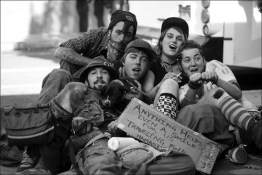
homeless-kids-in-oregonThe success with disaffected youth, on the other hand, earns Bolz-Weber some cred. The mainstream Church will never see these kids, they’ll never understand these kids, but it doesn’t mean God doesn’t love the goths, emos, and other youth out there who depressed, drunk, high, homeless, runaways, sexually active straight, gay, bi, and everything else that “white-bread, apple pie” teens in conservative churches would never ever dream of being, and who would cast the disaffected into the pit of hell before they even die.

The last part of the paragraph got my attention: “American religion that’s been in a long, slow institutional decline…”

That’s the part that made me think of Hebrew Roots and Messianic Judaism, among other things.

Don’t get me wrong. I’m not suggesting that the Church should be in the entertainment business just to attract people. Quite the opposite. I don’t think people want to be entertained. I think they want to be informed and more. I think people are searching for authenticity in their faith, I think they want to be challenged. I think they want to struggle to find answers rather than have them served up to them on the aging, traditionalist, fundamentalist, evangelical platter.

Fundamentalist Christianity celebrates the Reformation, which is interesting, because reformation suggests change, re-evaluation, and looking at the Bible, Messiah, and God in (you should pardon the pun) fundamentally new ways. This is opposed to the oldie but goody religion many churches present, that “old-time religion” and “if it was good enough for grandpa, it’s good enough for me” way of looking at Christianity.

Again, I’m not talking about entertainment, I’m talking about seriously challenging the old, traditional interpretations and assumptions about what the Bible is saying and who the Bible is talking to.

I think that’s what Bolz-Weber represents for some people. I think that’s what Hebrew Roots and Messianic Judaism represents for other people.

Her message: Forget what you’ve been told about the golden rule — God doesn’t love you more if you do good things, or if you believe certain things. God, she argues, offers you grace regardless of who you are or what you do.

I agree that God loves us no matter who we are and what we do, however, my opinion is that the offer of grace is contingent upon us being willing to accept the offer. I don’t agree that what we do is irrelevant, since much of the Bible speaks of disciple, obedience, observance, and so forth.

But Bolz-Weber is successful in communicating that you don’t have to wear a suit and tie, vote Republican, or listen to country music in order to be loved by God and in order to have a relationship with Him.

You can be different…really different, and still be a human being created in the image of God.

“This isn’t supposed to be the Elks Club with the Eucharist,” Bolz-Weber said in a taxi ride before her Austin talk. Religion should be “something that’s so devastatingly beautiful it can break your heart.”

aweExactly! Exactly!

So many religious groups are “the Elks Club with the Eucharist” or “the Elks Club with Oneg,” a social club where any true encounter with God takes a seat way in the back of the bus. An encounter with God is “something that’s so devastatingly beautiful it can break your heart.” I think “beauty” and “awe” and “astonishment” that God is who God is and that we can encounter Him in the midst of our worship has been left behind or worse, been denigrated as too “emotional.” No, emotion shouldn’t drive our worship, but we should still be open to a God who is more than just black ink on the white paper of our Bibles. God is real. God is holy. And He’s “something that’s so devastatingly beautiful it can break your heart.”

And God wants broken hearts and broken spirits.

For You do not delight in sacrifice, otherwise I would give it;
You are not pleased with burnt offering.
The sacrifices of God are a broken spirit;
A broken and a contrite heart, O God, You will not despise.

Psalm 51:16-17 (NASB)

The article continues:

Bolz-Weber says she abhors “spirituality,” which she sees as a limp kind of self-improvement plan. She prefers a cranky, troublemaking and real God who at times of loss and pain doesn’t have the answers either.

I think God does have all the answers (though He doesn’t always tell them to us), but I prefer “cranky, troublemaking and real” disciples of Messiah “who at times of loss and pain” don’t “have all the answers.” I don’t have all the answers and sometimes, I’m “cranky, troublemaking and real.”

“God isn’t feeling smug about the whole thing,” she writes about Jesus’s resurrection and the idea that the story is used as fodder for judgment. “God is not distant at the cross. . . . God is there in the messy mascara-streaked middle of it, feeling as [bad] as the rest of us.”

This very physical way of talking about God is thrilling to a lot of people who grew up in liberal Christianity.

I like how the God Bolz-Weber describes isn’t distant and unknowable, but close, passionate, caring, involved. Did God cry as Jesus bled on the cross? Did God weep and wail each time another group of Jewish women and children were herded into a Nazi gas chamber? Does He grieve every time we grieve, not because He can’t see beyond death, but because He knows we can’t see that far?

Therefore, when Mary came where Jesus was, she saw Him, and fell at His feet, saying to Him, “Lord, if You had been here, my brother would not have died.” When Jesus therefore saw her weeping, and the Jews who came with her also weeping, He was deeply moved in spirit and was troubled, and said, “Where have you laid him?” They said to Him, “Lord, come and see.” Jesus wept. So the Jews were saying, “See how He loved him!”

John 11:32-36 (NASB)

“Jesus wept.”

tearsI just wanted to make sure you caught that. He cared. It mattered to him that the sisters of Lazarus grieved, and hurt, and cried. Even though he knew Lazarus would be resurrected (to die again at some future date), he wasn’t callous about it. He didn’t treat Mary and Martha like spiritual morons because they couldn’t see what he could see…that the death of their brother was very temporary.

Grief is real. So Jesus wept. Jesus cared. Jesus loved. Jesus was real. Jesus is real.

Sometimes, that “realness” doesn’t translate very well into a Sunday morning service, at least for the Christians who seem to be leaving the church in droves.

To Carmen Retzlaff, a newly ordained Lutheran pastor who came with her husband to the Austin talk, Bolz-Weber is liberating — partly because she’s “unapologetic” about her faith. “She talks a lot about JEE-sus” — Retzlaff giggles here — “which hasn’t always been a place of comfort in an increasingly secular world. I really love that.”

Real faith. Real, raw, edgy, bleeding, living faith. Faith lived on the razor’s edge, sharp and dangerous. I think people want to feel alive, active, and interactive in church, rather than passive and accepting and maybe even a little sleepy.

Most churches are safe, but should God be safe? It’s not real faith if it doesn’t scare you, at least a little. You aren’t encountering God if He’s not scaring you, at least a little, if you’re not feeling mortal, vulnerable, small, frightened, needy, and inadequate.

Yet she never stopped believing in God. She dabbled for years with Wicca and experimented with every liberal faith group, from Unitarians to Quakers. She performed stand-up as a type of no-cost therapy.

It was going through anti-addiction recovery that finally soothed her anger. Her encounter with a tall, cute, Lutheran seminary student named Matthew Weber brought her back to church. They married in 1996 and have two children.

She first heard the call to pastor in a downtown Denver comedy club at which she and a bunch of her old runaround pals gathered in 2004 to eulogize a friend who had hanged himself. As the only religious member, she was asked to lead the service. Her vocation to her fellow outsiders was born.

I’ve recently, if tangentially, been involved in a conversation that resulted in a number of apostates being slammed against a metaphorical wall by those who see justice as their ultimate identity but who think of mercy as weakness and failure, but in reading this part of Bolz-Weber’s “testimony,” I can see just how far a person can run away from God and still come back. Sure, she’s come back with “baggage” but it was “baggage” that drove her out of the Church, too. If God weren’t a God of mercy, compassion, and second chances, none of us would survive. Heaven help us and save us from people who think they’re more righteous than God.

As far as content, theology, doctrine, and dogma goes, I doubt she and I would agree on many points, but it’s the process of her coming and going and coming back to God that she has in common with me and with a lot of believers, including many people in both the Hebrew Roots and Messianic Jewish movements. The only difference, at least on the surface, is that Bolz-Weber’s church attracts a far more diverse population:

These days, about 180 people show up each Sunday, an eclectic mix of homeless and corporate types, punk teens and suburban baby boomers sitting on stacking chairs in the rented hall.

Here’s where I think she’s spot on:

Bolz-Weber characterizes herself as having had “a heart transplant.” This is typical for someone who presents herself as the “anti-pastor”: cranky, intolerant, egotistical, but always open to Jesus making her better.

A heart transplant. Gee, where have I heard that before?

Moreover the LORD your God will circumcise your heart and the heart of your descendants, to love the LORD your God with all your heart and with all your soul, so that you may live.

Deuteronomy 30:6 (NASB)

She also said:

“Christianity is supposed to give me a mild sense of discomfort. I don’t get to be in control,” she said. “It’s always putting me into something new.”

I think one of the reasons people leave church is that it’s too comfortable, too familiar, too safe. There’s no challenge, no pizzazz, no process by which one grows and gets better, gets closer to God.

strugglingMost of the time, personal, emotional, spiritual change isn’t planned. Most of the time, it takes a crisis to set such change in motion; dramatic, violent motion. People don’t draw closer to God because they’re safe. They authentically experience closeness with God when they are scared, desperate, terrified, lost, heartbroken, shattered.

I’m not saying religion should be a mile-a-minute thrill ride, like at an amusement park, but it should be something you live with every day that’s a little bit “in your face,” some iron that’s sharpening your iron, challenging, disagreeing, confronting…you know, like God is, like how He told His prophets to be when Israel wasn’t toeing the line.

People are looking for something different, not for the sake of it being different, or entertaining, or amusing, but for the sake of it offering a more authentic encounter with God. We enjoy a pleasant sunset, but a violent thunderstorm scares us into drawing closer to God, just like small children snuggle in bed with their parents when the lightning flashes and the thunder booms.

It doesn’t have to be a “fire and brimstone” revival meeting. An encounter with God just has to help us get to a point where we know God really is real and He really is present, and He really cares and hurts with us when we care and hurt. We have to know that our God is a God who can care and hurt, who can show compassion for the most injured and disfigured among us.

We want God to make us feel uncomfortable and to help us be better today than we were yesterday. That’s what we’re looking for, not an old, static system where God is on His mountain and we are in our pews, but a God who is with us, a powerful, existing, active, interactive God, King of the Universe. Eloheinu Melech HaOlam.

We’re alive. We need to know that God is alive, too…and that He still cares.

The Challies Chronicles: John MacArthur and Joni Eareckson Tada

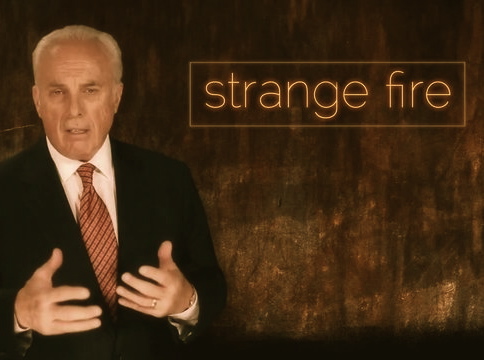
macarthur-strangefire-confJohn MacArthur opened the Strange Fire conference, and then, for the second session introduced Joni Eareckson Tada as a friend and former member of his church. She was at the conference to share her testimony of living as a quadriplegic who has prayed for, but not received, a miraculous healing. As MacArthur said in his closing comments, if anyone has the faith to be healed, it must be her. In a sweet and spontaneous moment, Joni called MacArthur to the stage and, hand-in-hand, the two sang a couple of stanzas of “O Worship the King” together. I have been to a lot of different conferences, but that will now rank as one of my all-time favorite moments.

-Pastor Tim Challies
“Strange Fire Conference: Joni Eareckson Tada,” October 16, 2013
Challies.com

This is the second part of my Challies Chronicles series, an analysis of Pastor John MacArthur’s Strange Fire conference as “live blogged” by Pastor Challies.

I’m also more or less “live blogging,” in that I’m writing as I’m reading, giving you my impressions as they occur. I want to be fair to MacArthur and I feel that, using Tim Challies as my source, someone who, as far as I know, should be sympathetic and supportive of MacArthur’s views, I am avoiding those bloggers and other pundits who tend to be “anti-MacArthur” to accomplish the purposes of this project.

All that said, being fair doesn’t mean I always have to agree with MacArthur or the other presenters at Strange Fire.

Joni Eareckson Tada

I assume that by having Ms. Tada present her testimony that MacArthur was attempting to refute faith healing in the present age. While I agree that there are just a boatload of charlatans out there who claim “the healing power of Jesus,” and who say they can cure anything from acne to brain tumors by the laying on of hands (and giving a bunch of money as a “love offering”), there seems to be more to Tada’s story:

Even today she often has well-meaning charismatics who come up to her and pray for her healing. Though she never says no, she does always ask them to pray for specific things and then highlights character issues. Will you pray for my bad attitude? Will you pray for my grumbling? She means to show them that she is far more concerned with indwelling, remaining sin than chronic pain and legs that do not work.

She went on to describe a trip to Jerusalem and going to the very place where Jesus had healed that paralyzed man so many years ago. And there, in a moment alone, she found herself praying to God to thank him for not healing her, because a “no” answer to her requests for physical healing had purged so much sin, selfishness, and bitterness. That “no” answer left her depending more on God’s grace, has given her greater compassion for others, has reduced complaining, has increased her faith, has given her greater hope of heaven, and has caused her to love the Lord so much more. She sees the joy of sharing in his suffering and would not trade it for any amount of walking.

What do we really want to be healed of, our physical problems or our spiritual problems? Do we need to be healed of cancer or given the “medical procedure” of a circumcised heart?

And they brought to Him a paralytic lying on a bed. Seeing their faith, Jesus said to the paralytic, “Take courage, son; your sins are forgiven.” And some of the scribes said to themselves, “This fellow blasphemes.” And Jesus knowing their thoughts said, “Why are you thinking evil in your hearts? Which is easier, to say, ‘Your sins are forgiven,’ or to say, ‘Get up, and walk’? But so that you may know that the Son of Man has authority on earth to forgive sins”—then He said to the paralytic, “Get up, pick up your bed and go home.” And he got up and went home. But when the crowds saw this, they were awestruck, and glorified God, who had given such authority to men.

Matthew 9:2-8 (NASB)

struggling_prayOnly God forgives sins and so I also believe only God can miraculously heal. Even if we say, as I can only believe MacArthur says, that the age of miraculous healing is done and that God does not heal anymore in a supernatural sense, I have a question. Why do we pray for people when they are hurt or sick?

Actually, I have no idea if MacArthur prays for the sick, although I certainly hope he visits them because I don’t think that type of kindness we see in the Bible was ended when New Testament canon closed.

I go to a fundamentalist Baptist church. I imagine MacArthur would be comfortable worshiping there. And yet, in the bulletin they pass out to me as I enter the doors of the church for services every Sunday morning, there is a multi-page paper containing many, many prayer requests.

At the top of the list, we are to pray for our President, our other Government representatives and so on. Then there’s a list of missionaries we should pray for. After that, there are multitudes of requests from people in the church about others in the church, family members, friends, and so on, most of whom suffer from terrible medical situations.

When I go to Sunday school after services, the teacher begins class by asking for prayer requests. Again, usually people’s medical problems are brought up, people facing surgery, people with chronic illnesses, people who are dying.

Why do we pray for them if we don’t, on some level, want God to heal them? Sure, sometimes we pray for someone’s salvation. Sometimes we pray for someone who is in a spiritual crisis of one kind or another, but most of the time, we pray for people who are sick.

I know from my own experience, that most if not all of the terminally ill people I have prayed for have died. I know that’s cruel to say, but that’s my experience. Why did I pray for them? What was the point?

I can see how the whole “faith healing” process has been hijacked and abused and I most certainly don’t advocate for frauds and hucksters who prey upon the illness and weakness of others for financial gain, but I do take exception to the idea that we aren’t supposed to pray for people who are hurt (and I’m not quite sure MacArthur would actually advocate that position). I also take exception to the idea that God can’t or won’t heal someone supernaturally.

I don’t say these healings occur regularly or we can predict when they will happen. If they happen at all, they probably do so infrequently and without any way to know when a person will or won’t be healed. And yet we hope. And yet we pray. And yet we rely on God to have mercy, and beg Him to heal, if not the loved one who we know is about to perish, but our grieving soul when we are left behind and alone.

Yes, as we read Matthew 9:2-8, above all, God desires to heal the soul, to forgive sin, to bring about redemption, to circumcise the heart of stone and give the sinner a heart of flesh.

None of that means we like to see our loved ones suffer physically. None of that means we aren’t compelled to pray for them, to ask and even to beg God to cure a four-year old little girl of leukemia or some other horrible, life-threatening ailment.

Then his servants said to him, “What is this thing that you have done? While the child was alive, you fasted and wept; but when the child died, you arose and ate food.” He said, “While the child was still alive, I fasted and wept; for I said, ‘Who knows, the Lord may be gracious to me, that the child may live.’ But now he has died; why should I fast? Can I bring him back again? I will go to him, but he will not return to me.”

2 Samuel 12:21-23 (NASB)

plead1It’s a terrible thing to think that God would cause a newborn baby to die because of the sins of his father. I’m not sure how else we can interpret the events about the child David and Bathsheba conceived together in the shadow of adultery and murder. But while the child was alive, David prayed and fasted and wept, but the child died anyway.

The Lord gave and the Lord has taken away, blessed by the name of the Lord.

Job 1:21

That has to be one of the most bitter prayers recorded in the Bible, and yet it is reflected in the grief of David and in the grief of anyone who has lost a loved one.

How can I not pray from the “brokenness” of my heart?

I think Ms Tada’s point was well made. I know that living with a long-term and severe medical problem can actually bring a person closer to God, can make the relationship stronger and more intimate. I’ve seen such a thing happen to a man I know. But it’s still a bittersweet thing. That doesn’t mean God doesn’t want to heal the injured or comfort the grieving. That doesn’t mean that sometimes, in accordance with His will, God doesn’t provide us with what we need, and even what we ask for out of His abundant grace, power, compassion, and pity.

I don’t know what MacArthur was trying to accomplish by presenting Ms. Tada on stage at his conference. What he accomplished, at least for me, is to remind me of how fragile life is and how we all rely on God to help us when our problems are so much bigger than we are. If MacArthur meant to indict the Pentecostal church for false advertising, I missed that part of the message.

The Failing Light

Candle in ObsidianIn some naïve areas of Christian consensus people imagine that Jews obey Torah because they believe that this will save them. However, a simple conversation with the average religious Jew, or reading in books by religious Jews will demonstrate this to be a fantasy. And which of us has not heard the proposition that Judaism is a religion of law and Christianity a religion of grace, with Judaism being pictured as Mount Sinai covered in thunderbolts, and Christianity, the grace of Jesus dying on the cross. People forget, or never seem to get, that it was on that very same Mount Sinai that God revealed himself as “the LORD, the LORD, merciful and abounding in steadfast love and faithfulness.”

-Rabbi Dr. Stuart Dauermann
“The Foundational Reason Jews, Including Messianic Jews, Should Obey Torah”
Interfaithfulness.org

There are times when I think I’m going crazy. No, not hallucinating, voice-hearing, I-need-my-meds crazy, but when the world of Messiah that I see being constructed around me is roundly and soundly contradicted in every detail by people I respect and admire, I feel crazy.

I had the “crazy” experience last night in my weekly meeting with my Pastor. I had several weeks to “get my ducks in a row,” so to speak, to present my side of the story about why Jews remain obligated to Torah, but there’s a difference between walking into your Pastor’s office with half a dozen books in hand plus a bunch of notes, and being a Pastor who has decades of experience interpreting scripture, a Master’s degree in the subject, and someone in a Doctoral program in religious studies.

I’d need about twenty years to catch up and he’d always have the same amount of time to stay ahead of me.

I used to be amazed that I seemed to be able to “hold my own” in our little debates, but last night was proof positive that I’ve definitely been “fighting out of my weight class” all along.

As a “Messianic apologist,” I’m terrible.

But when I read commentaries such as Dr. Dauermann’s or many of the resources produced by First Fruits of Zion (FFOZ), what they say seems to make so much sense, and they don’t require “retrofitting” the Tanakh (Old Testament) with later interpretations to make the Messianic prophesies work alongside what the Apostolic Scriptures say about Yeshua (Jesus).

They answered and said to Him, “Abraham is our father.” Yeshua said to them, “If you are Abraham’s children, do the deeds of Abraham.”

John 8:39

Deeds are a natural response to faith. In fact, one can’t exist without the other. Messiah’s brother knew this all too well.

What use is it, my brethren, if someone says he has faith but he has no works? Can that faith save him? If a brother or sister is without clothing and in need of daily food, and one of you says to them, “Go in peace, be warmed and be filled,” and yet you do not give them what is necessary for their body, what use is that? Even so faith, if it has no works, is dead, being by itself.

But someone may well say, “You have faith and I have works; show me your faith without the works, and I will show you my faith by my works.” You believe that God is one. You do well; the demons also believe, and shudder. But are you willing to recognize, you foolish fellow, that faith without works is useless? Was not Abraham our father justified by works when he offered up Isaac his son on the altar? You see that faith was working with his works, and as a result of the works, faith was perfected; and the Scripture was fulfilled which says, “And Abraham believed God, and it was reckoned to him as righteousness,” and he was called the friend of God. You see that a man is justified by works and not by faith alone. In the same way, was not Rahab the harlot also justified by works when she received the messengers and sent them out by another way? For just as the body without the spirit is dead, so also faith without works is dead.

James 2:14-26 (NASB)

abraham-covenant-starsI see a completely clear line leading from Abraham to his physical son, the only son he had that was promised the inheritance, his son Isaac, and that line extends to Isaac’s son Jacob (but not Esau), and then to Jacob’s offspring, whose descendants are the twelve tribes of Israel, with that line extending out of Egypt, to Sinai, to the Torah, to the Mountain of God, to the Land of Israel, to the Messianic promises, to Messiah.

Unfortunately, I can’t verbally articulate that line and all of its details, at least not convincingly. Sure, I can write and write and write, but as you can see, over a thousand blog posts later, I’m still writing, I’m still exploring. I’m still trying to understand.

But I still can’t explain why it seems so simple and so reasonable and so Biblical that Jewish people, past, present, and future, and yes, Jewish people in Messiah, are obligated to observe the mitzvot, not as a condition of salvation, but because of the continual stream of ratified covenants God made with Israel and only Israel (name a covenant God made that wasn’t with Israel) and as a definition of the relationship Jewish people have with each other, with the Land of Israel, and with God.

The LORD appeared to Isaac just as He had appeared to Abraham. He told him, “I will establish the oath which I swore to your father Abraham” (Genesis 26:3). He restated the promise to multiply his descendants, to give them the land and to bless all nations through them “because Abraham obeyed Me and kept My charge, My commandments, My statutes and My laws” (Genesis 26:5). Isaac was inheriting the Abrahamic blessing because Abraham had merited God’s favor.

How did Abraham keep God’s charge, commandments, statutes and laws? The commandments of God’s Torah—His divine law—had not been given yet. Did Abraham know all the laws of the Torah given through Moses at Mount Sinai? If not, how could he be said to have kept them?

Rashi claims that this means Abraham kept the entire Torah and the oral traditional law of Judaism. That seems like a stretch, but what does it really mean? What laws did Abraham keep?

-from “Abraham’s Torah”
Commentary on Torah Portion Toldot
FFOZ.org

The Torah and the Prophets never really talk about salvation the way the New Testament does, so it’s hard to make comparisons. People like Abraham, Jacob, Moses, and Joshua didn’t seem to worry or fret over their own salvation or the personal salvation of others. They worried about listening to God, and obeying God, and encouraging others to obey God, lest they become disobedient and as a consequence, die physically (their ultimate spiritual fate was never discussed).

So how can I compare the importance of obedience as we see in the case of Abraham above, when we have to deal with Paul?

But now apart from the Law the righteousness of God has been manifested, being witnessed by the Law and the Prophets, even the righteousness of God through faith in Jesus Christ for all those who believe; for there is no distinction; for all have sinned and fall short of the glory of God, being justified as a gift by His grace through the redemption which is in Christ Jesus; whom God displayed publicly as a propitiation in His blood through faith. This was to demonstrate His righteousness, because in the forbearance of God He passed over the sins previously committed; for the demonstration, I say, of His righteousness at the present time, so that He would be just and the justifier of the one who has faith in Jesus.

Where then is boasting? It is excluded. By what kind of law? Of works? No, but by a law of faith. For we maintain that a man is justified by faith apart from works of the Law. Or is God the God of Jews only? Is He not the God of Gentiles also? Yes, of Gentiles also, since indeed God who will justify the circumcised by faith and the uncircumcised through faith is one.

Romans 3:21-30 (NASB)

practicing_faithFaith has to be the common currency for salvation, otherwise non-Jews could never be justified before God without converting to Judaism and observing the entire Torah. Faith was counted to Abraham as righteousness, and so it is with us, but then why does God commend Abraham, not for his faith, but for obeying God and keeping his “commandments, statutes, and laws?” (Genesis 26:5). In fact, in verse 3 of the same chapter, God says that it’s because of Abraham’s obedience that he re-established this promise with Isaac to multiply Abraham’s descendants, to give those descendants the Land of Israel, and “bless all nations through them.” It’s because of Abraham’s faith and obedience to God’s commandments, statues, and laws that we, the people of the nations, are blessed through Abraham’s seed, that is, Messiah.

I don’t want to quote from too much of Dr. Dauermann’s article, but commenting on the siege of Jerusalem by Babylon recorded in Jeremiah 35, he says:

What point is the Holy One Blessed be He making here? Just this: that the Jewish people have failed to show to Him the honor and respect due him. While the Rechabites show honor to their father Jonadab by obeying his rulings, the people of Israel dishonor God by not obeying his Torah.

And THAT is the reason we as a people, and as a movement, should be far more concerned with Torah living—because we honor God when we do so, and we dishonor him when we do not.

This very closely mirrors something the Master said to his disciples and his critics among the Jewish people:

Whoever then annuls one of the least of these commandments, and teaches others to do the same, shall be called least in the kingdom of heaven; but whoever keeps and teaches them, he shall be called great in the kingdom of heaven.

Matthew 5:19 (NASB)

Jewish people, and especially Jewish teachers, who annul (fail to obey or disregard) the least of the commandments of God (Torah), will be called the least in the Kingdom of Heaven, the Messianic Age. But those who keep and teach the commandments, statutes, and laws of the Torah will be called great in the Kingdom of Heaven. A Jew annulling the Torah is dishonoring God and as a result, will be least, but a Jew who keeps the Law and teaches other Jews to do so, is honoring God and as a result, will be great.

If this makes so much sense to me, why can’t I communicate that convincingly to someone else? Really, I’m not making all this up, it’s in the Bible. If the primary matrix with which you interact with God is your intellect, and your primary tool for doing so is the Bible, shouldn’t you at least consider the possibility that this explanation has merit, even if it conflicts with your current tradition of Biblical interpretation?

Sigh.

smallI’m ranting. It’s been a frustrating week. I have to keep reminding myself that no matter what happens to me, if I get tossed out on my ear into the street tomorrow, it won’t affect God or His promises to Jewish Israel in the slightest. The fate of the world doesn’t rest on my shoulders.

So why am I here? Why do I matter? Do I matter?

In principle, the Bible seems to say so, but in the face of an infinite God, I always feel so terribly small and insignificant.

After reading some commentaries written by Christian blogger Tim Challies about MacArthur’s Strange Fire conference, I posted this on Facebook and Google+:

I was just thinking of MacArthur and his “Strange Fire” conference again (reading a Fundamentalist blogger my Pastor recommended). It occurred to me that MacArthur would no doubt view the Messianic movement as “strange fire” as well. I got to thinking that if MacArthur were aware of my existence, he might “come after” me, too. Then I realized I’m just small potatoes and I would be totally beneath his notice. I also realized in the same moment that I am never beneath God’s notice. What an odd situation. I can be too small to be noticed by a big-time famous Christian Pastor but I’m never too small to escape the notice of God.

In the 1994 film True Lies, starring Arnold Schwarzenegger and Jamie Lee Curtis, the character Simon, played by Bill Paxton, delivers this line when he erroneously thinks he’s going to be killed by Schwarzenegger’s character:

Oh God, no, please don’t kill me. I’m not a spy. I’m nothing. I’m navel lint!

Compared to all the Christian Pastors, and Christian bloggers, and Christian theological instructors, a guy like me “on the ground,” just praying, and studying, and worshiping day by day is pretty much “navel lint.” Compared to an infinite and cosmic God, I absolutely am “navel lint,” and actually, far, far less.

So why am I here? Why do I matter? Do I matter?

Why do I feel like God expects something out of me and that I have some sort of job to do…and if I fail, it won’t be a good thing…it will matter if I fail?

There are two ways of spreading light: to be the candle or the mirror that reflects it.

-Edith Wharton, American writer

I don’t know what’s going to happen. I know that Israel was called to be a light to the nations by God (Israel 42:6). I know that Jesus, as Messiah, the firstborn son of Israel said he was the light of the world (nations) (John 8:12), and he said that his disciples (presumably including all future disciples such as me) are the light of the world (nations) (Matthew 5:14). If all that is true and it filters down to the level of the individual, that is to say, me, then I’m supposed to be a light to the world around me.

As Edith Wharton rather aptly states, I can be a candle or a mirror. I guess either will do. The worst thing that can happen is that I can go dark, either because I’ve been blown out or I’ve been shattered into tiny pieces.

walking-into-churchFortunately, Messiah’s light can never go out, and his light isn’t dependent on me. In the parable of the ten virgins (Matthew 25:1-12), five let their lamps go out, so I guess it’s not impossible for my light to fail as well, at least while it’s in my charge.

But if I have failed, then what use am I? Of the billions of “second chances” God has already given me, does He have one more, or is it all over?

I don’t know. I guess all I can do is keep showing up until I find out one way or another.

Without Faith and Grace

leaving_edenJudaism and Christianity parted company over how to read these few spare chapters in universal history. For the Church, the Garden of Eden became the soil for the doctrine of original sin. In their waywardness, Adam and Eve, and all their descendants, fell hostage to the domain of the devil. The narrative bespoke the immutably depraved condition of human nature. To know the Torah was not sufficient to do it. In the words of Paul, “In my inmost self I delight in the law of God, but I perceive that there is in my bodily members a different law, fighting against the law that my reason approves and making me a prisoner under the law that is in my members, the law of sin.” (Romans 7:22-23) Not human willpower then but divine grace alone in the person of God’s own Son who had died on the cross could hope to break this vicious cycle of human malice.

-Ismar Schorsch
“Teshuvah in Place of Original Sin,” pp 34-35 (October 16, 1999)
Commentary on Torah Portion Noah
from the book Canon Without Closure: Torah Commentaries

I know we’ve already read Torah portion Noah this year, but as I’ve been working through the commentaries in Schorsch’s book each week, I’ve been taking notes of the more compelling articles. For each Torah Portion, there is a small but powerful collection of Schorsch’s writings which he composed over a number of different years. Going over this collection is like opening his mind and listening to Schorsch musing on how he encountered each Parashat across each annual reading cycle over time.

I’m also grateful that this book includes his thoughts on Christianity and comparisons to Judaism, not because I’m trying to “shoot down” Christianity (or necessarily Judaism), but it’s helpful to have an intelligent mind discuss my faith from the “outside.” Like my conversations with my Pastor, it hones my ability to look at my own beliefs, especially when they’re challenged, and discover if I truly know and can explain why I have the faith I possess in Jesus as Messiah.

It’s a steep learning curve sometimes and I can hardly claim to have all of my ducks in a row, so to speak. However, I can say that the ducks are lining up in a somewhat more orderly fashion than they have in past years.

Original sin vs. the Jewish understanding of “the Fall” makes for interesting reading. Judaism in all its different modern streams, is not going to consider the need for a spiritual savior (though Moshiach is considered the redeemer of national Israel in Jewish thought, generally speaking). The Torah is accepted as sufficient, and always has been, to negotiate the Jewish relationship with a perfect God.

That’s hard for me to believe since no man can obey the commandments perfectly, and the Tanakh is a blatant record of that fact. The New Covenant promised in Jeremiah 31 starting in verse 27 promises that the covenant once written on stone tablets and scrolls made of animal skin will, in future times, be written on the heart, thus the “disconnect” between the desire for Holiness in man and the imperfection of living out that Holiness will cease to exist. Man and God will have a far more intimate relationship in those days than we enjoy in the present, or at any point in the past.

Gateway to EdenBut for Christianity, Jesus is the arbiter of that covenant, the gatekeeper, the doorway, and only by a profession of faith in him and the resultant transformed life, can man access the New Covenant of God. After that perfect writing of the Torah on a circumcised and human heart of flesh, can man perform the mitzvot with complete fidelity and with true justice and righteousness. Prior to that event, Christian or Jew, no man obeys God in the manner God desires, or for that manner, even in the manner we ourselves would wish.

In my own approach to a closer walk with God, I find myself slowly moving in a direction, but then, the tether that binds me to the habits of the past snaps me back like a rubber band that has been stretched just a little too far…and it stings.

It is not until we come to the late and marginal Book of Jonah that we first confront in full view the idea of teshuvah, repentance, as efficacious. Nor is it an accident that we read all of it in the synagogue on Yom Kippur afternoon, for Jonah encapsulates the essence of the day: that atonement, resolve, and initiative can get us beyond the impediments of our past and ourselves.

-Schorsch, pg 35

For all of the prophets of Israel we see in the Tanakh (Old Testament) who implored that nation of God to abandon her sin (which she regularly failed to do), only the Gentile city of Nineveh heeded a reluctant prophet and turned away God’s “evil decree.” It wasn’t permanent, of course, and later down history’s road, Nineveh sinned and fell, but consider how many times (if you can) that Israel too listened to the words of the prophets and averted disaster.

“Jerusalem, Jerusalem, who kills the prophets and stones those who are sent to her! How often I wanted to gather your children together, the way a hen gathers her chicks under her wings, and you were unwilling. Behold, your house is being left to you desolate! For I say to you, from now on you will not see Me until you say, ‘Blessed is He who comes in the name of the Lord!’”

Matthew 23:37-39 (NASB)

The Master’s commentary on the matter is plain and dismaying. And yet, I heard one person tell me that if Israel had turned away from their sins and returned to Torah and God in the days that Jesus walked the earth, the Messianic Age would have come and flourished even in that very instant.

The world is waiting for Israel’s national repentance, without it, Messiah will not come and both Israel and the nations continue to suffer from our own folly.

Schorsch would say that the story of Jonah and Nineveh tells us that human beings can, in and of ourselves, hear the warnings of God, repent in sincerity, and the result is that God’s promise of destruction will be averted. But without Messiah, how were Nineveh’s sins forgiven? They certainly weren’t Israelites. History doesn’t record that they sent representatives to Jerusalem to offer the appropriate sacrifices for guilt and sin (and we know that the sacrifices of Gentiles were accepted in the Temple, even in the days of Jesus).

Jonah's KikayonOnly God’s grace can explain why Nineveh survived when they repented. God is an “either-or” engine or sorts. “Either you repent and I will spare you, or you keep sinning and I will destroy you.”

This may also explain why, when they were faithful, when they did obey God, when they did perform the mitzvot, however imperfectly, and offered the required sacrifices, that is required by God, in the Temple in atonement for that imperfection, God chose to respond to sacrifices and the blood of goats and bulls, by sparing Israel, forgiving the apple of His eye, cherishing His often wayward bride.

On the basis of this small book, the Rabbis softened their understanding of the divine-human relationship with a large dose of compassion. God stood ready to forgive and humans had the capacity to grow. Thus Rabbi Eliezer ben Hyrcanus in the early second century proclaimed:

“Repent one day before your death.” When his students asked him how one might know that day, he replied: “Then repent today for you might die tomorrow.” (Avot DeRabbi Natan, ed. Schechter, page 62)

In other words, each and every day, and not just Yom Kippur, was suitable for repairing one’s ties to God.

-Schorsch, pp 35-36

Such is true of the Christian as well, and more so, since we do not have a traditional day in our religious calendar set aside specifically for repentance and “repairing one’s ties to God.” If anything, we are rather casual about the whole affair, for we are taught that once we were saved at some altar call or camp meeting, our place in Heaven is assured. We can never again fall from God’s hand.

My sheep hear My voice, and I know them, and they follow Me; and I give eternal life to them, and they will never perish; and no one will snatch them out of My hand. My Father, who has given them to Me, is greater than all; and no one is able to snatch them out of the Father’s hand. I and the Father are one.”

John 10:27-30 (NASB)

That’s quite a promise, but I still say we should not rest on our laurels so comfortably, for the Master also said this:

“Then they will deliver you to tribulation, and will kill you, and you will be hated by all nations because of My name. At that time many will fall away and will betray one another and hate one another. Many false prophets will arise and will mislead many. Because lawlessness is increased, most people’s love will grow cold. But the one who endures to the end, he will be saved.

Matthew 24:9-13 (NASB)

FallingTo “fall away” means we must have some place to fall from, in this case, from our faith in God (and I didn’t fail to notice that those “falling away” did so during the great tribulation). This does not seem to be the illusion of faith or describing those people who are not among the elect (for the Calvinists among you), but those who were in the Father’s hand at one point, who will fall away because lawlessness increased, their love grew cold, and they listened to false prophets.

We must always be alert and cautious. Like Nineveh, when we see the warning signs and hear the voice of God calling to us to beware lest we perish, we should respond immediately and “don sackcloth and ashes,” so to speak, declare a time of fasting and mourning, even if it is only with our own individual soul, and turn back to God, rather than risk falling from His hand down to the depths of despair.

In short, the rabbinic concept of teshuvah rested on deeds rather than on faith, on the discipline of Torah rather than on divine grace. Its implicit optimism about the correctability of human nature tempered the near fatalism that darkened the original meaning of Genesis.

-Schorsch, pg 36

I couldn’t disagree more.

First of all, Nineveh was redeemed for a specific time, but we have no indication whatsoever that it never returned to sin (and knowing the nature of human beings, I believe it must have returned to that dark place) and was forever redeemed as a city before God. Repentance, teshuvah, is not a single act that once accomplished, is accomplished forever. We have Christ’s warning that we can fall away. True, no one can snatch us out of the Father’s hands, but that doesn’t mean we can’t “bail out” on our own accord. We cannot be dragged unwillingly from the presence of God, but we can wantonly walk out of our own free will, thumbing our nose at the Divine in a suicidal gesture right before our final exit.

Schorsch says that human beings have pull themselves up by their own bootstraps and effectively refrain from sin, but again, the Tanakh is the witness against him (and against us all). Also, if the Covenant of Moses was sufficient forever in an unratified form, why does God promise a New Covenant, with the Torah not written externally, but inscribed internally across the fabric of our hearts (and please keep in mind that the content of the previous covenant remains unchanged, only the “material” upon which it is written does)?

I don’t know if I completely buy the classic Christian interpretation of the events in Eden, but I do believe that no amount of human effort, all by itself, will ever pay the debt we owe to God for our willful rebellion. From Adam in the beginning and down across each generation, we have failed God, and laughed at God, and denied God again and again. Even the best among us falls short, as Paul said (referencing Psalms 14 and 53), there is no one righteous, not even one of us…ever (Romans 3:10-12), apart from the Master himself.

dust-and-ashesWith much respect to Schorsch and his commentaries, which I enjoy very much, we cannot possibly walk the walk without both faith of the heart, and the grace of a most merciful God. Without both faith and grace, our repentance would be a faint and temporary glimmer in the dark, and we would all meet the ultimate fate of historical Nineveh well passed Jonah’s intervention, and the fate of all the “great cities” that have risen and crumbled to dust across the vast corridors of time.

Divine grace is certainly necessary, and no human being can even come close to “meeting God halfway,” so to speak. But we are still required to change directions, to face away from our sin and to turn toward God. Once that’s accomplished, often with God’s insistent “prodding,” then and only then do we have life, and the will to live it in obedience.