Tag Archives: FFOZ

FFOZ TV Review: Fringes of the Garment

FFOZ TV Episode 22Episode 22: In the gospel story of the woman with the hemorrhage of blood, she is healed by touching the fringe of Jesus’ cloak. By touching Jesus’ fringe, the woman was acting upon the prophetic nature of an important biblical commandment. Episode twenty-two will introduce the commandment in Numbers for Jewish men to put fringes on the corners of their garments to remind them of God’s instructions. Viewers will then see how this all ties into the prophetic words of Zechariah about ten men from the nations grabbing a hold of the fringe of a Jew.

-from the Introduction to FFOZ TV: The Promise of What is to Come
Episode 22: Fringes of the Garment (click this link to watch video, not the image above)

The Lesson: The Mystery of Fringes of the Garment

This is a particular mystery I originally thought I had a pretty good handle on and one that traditional Christians would generally find missing in their educational database. What First Fruits of Zion teachers Toby Janicki and Aaron Eby presented was at least a little different from I expected. Parts of the lesson were considerably different.

But first things first.

Today’s “Biblical mystery” originates in the following text:

And behold, a woman who had suffered from a discharge of blood for twelve years came up behind him and touched the fringe of his garment, for she said to herself, “If I only touch his garment, I will be made well.” Jesus turned, and seeing her he said, “Take heart, daughter; your faith has made you well.” And instantly the woman was made well.

Matthew 9:20-22 (ESV)

Toby used the English Standard Version of the Bible for his reading. While I tend to prefer the New American Standard Version, after comparing the two translations of this scripture side-by-side, I understood why he made the selection he did (besides the fact that FFOZ defaults to the ESV translation as a matter of course). I also realized why Toby didn’t use the Delitzsch Hebrew Gospels for the reading, since it would have given away too much too fast.

Why did the woman with the “discharge of blood” seek healing specifically by touching “the fringe of his (Jesus’) garment?” What made her think that would stop years of bleeding? Was it just some sort of anomalous or random choice on her part? As it turns out, she wasn’t the only one to believe that touching “fringes” would produce a healing result:

And wherever he came, in villages, cities, or countryside, they laid the sick in the marketplaces and implored him that they might touch even the fringe of his garment. And as many as touched it were made well.

Mark 6:56 (ESV)

As it turns out, a lot of Jewish people believed that touching the fringe of Jesus’ garment would heal them. I’d completely missed this on my numerous read-throughs of the Bible and am grateful to Toby for pointing this out.

But most Christians wouldn’t understand the significance of the “fringes” of the clothing of a Jewish man in the late Second Temple era (or today, for that matter). “Fringes” makes it sound like people were touching a hem or edge of whatever Jesus was wearing. Why would that heal?

This is where even a little understanding of the Law of Moses comes in handy.

Speak to the Children of Israel and say to them that they shall make themselves tzitzis on the corners of their garments, throughout their generations. And they shall place upon the tzitzis of each corner a threat of turquoise wool. It shall constitute tzitzis for you, that you may see it and remember all the commandments of Hashem and perform them; and not explore after your heart and after your eyes after which you stray. So that you may remember and perform all My commandments and be holy to your God.

Numbers 15:38-40 (Stone Edition Tanakh)

Toby JanickiWhile Toby continued to use the ESV translation, I’m using a much more Jewish source for this scripture. The original Hebrew word for what we read translated in the New Testament as “fringes” is “tzitzit” (“tzitzis” in the Ashkenazi pronunciation). When we get to Aaron Eby’s portion of the program, we’ll learn what tzitzit are, but at this point in the show, Toby tells us that these “fringes” were a response to the commandment in Numbers 15 and that being on a Jewish man’s garment did two things:

  1. The fringes served as a reminder to the Jewish wearer of all of the commandments of God.
  2. The fringes served as a reminder to anyone seeing the wearer that this person was a Jew who was obedience to the God of Israel, since no other people were given the commandment of tzitzit or the Torah of Moses.

And lest you think that the fringes on Jesus’ garments weren’t really tzitzit because that commandment wasn’t being observed by Jewish men in that age, consider this:

For they widen their tefillin and lengthen their tzitziyot.

Matthew 23:5 (DHE Gospels)

“Tzitziyot” is the plural of “tzitzit” in Hebrew, and here we see Jesus criticizing some of the Pharisees for dramatically displaying the length of their fringes as well as the straps of their tefillin or phylacteries (the wearing of tzitzit and tefillin is still practiced by observant Jewish men today).

This brings us to our first clue in solving today’s Biblical mystery:

Clue 1: Jesus had fringes on the corners of his garment in obedience to the Numbers 15 commandment.

Now the scene shifts to Aaron Eby in Israel for a brief Hebrew language lesson on the Hebrew words for “fringe” and “corner.”

Aaron EbyAs I mentioned above, the word translated as “fringe” or “tassel” in some English Bibles is actually the Hebrew word “tzitzit” (plural: “tzitziyot”, although as Aaron says, English speakers use “tzitzit” often for both singular and plural).

The Hebrew word for “corner” in the context of a garment, is “kanaf.” Tzitzit are cords of wool (usually). The string of blue colored thread (sometimes translated as “turquoise”) was made from a very specific process that is thought by most observant Jews to be lost (which is why most tzitzit today are completely white), although some Jewish people think it has recently been rediscovered.

In ancient times, a man’s garment would be like a sort of “poncho” and had four actual corners on the bottom. On each corner, tzitzit would be tied. Today, men’s garments lack this structure, so most Jewish men wear what Christians call a “prayer shawl” and what Jews call a Tallit Gadol (large tallit). Most, if not all, observant Orthodox Jews will wear an undergarment throughout the day called a Tallit Katan (small tallit) in addition to donning a Tallit Gadol during worship and prayer in order to be obedient to the Numbers 15 commandment and for the same reasons I listed above.

Aaron said that according to Deuteronomy 22:12, the tzitzit must be on the corners of the garment. No other location on a Jewish man’s clothing is in obedience to the commandment of God. Thus, some non-Jewish men in certain areas of the Hebrew or Jewish Roots movement who choose to tie tzitzit on their belt loops are actually in scriptural error (not to mention that the commandment was specifically given to the Israelites and their modern-day descendants, the Jewish people).

What was more interesting to me was Aaron’s explanation of the word “Kanaf.” It can mean both “corner” as in the corner of a man’s garment, or “wings”.

He said, “Who are you?” And she answered, “I am Ruth, your servant. Spread your wings over your servant, for you are a redeemer.”

Ruth 3:9 (ESV)

Since Boaz didn’t likely have actual bird’s wings, Ruth was more likely asking (assuming she was being literal) that Boaz spread some portion of his cloak over her, protecting her from sight (though it could also be understood in a more general sense as a request for protection since she referred to him as “redeemer”).

Aaron said that Kanaf could be understood not only as the corner of a cloak or other garment, but specifically the attachment point of the tzitzit and the garment’s corner. This leads to the idiomatic meaning of “touching the corner” (kanaf) as “touching the tzitzit,” which is probably what the woman in Matthew 9:20-22 was actually doing.

Back in the studio, Toby provides the next clue:

Clue 2: Fringes are called tzitzit and the Hebrew word for corner is kanaf.

But we still have our mystery. Why would anyone believe that touching the tzitzit on Jesus’ garment would cause healing to occur?

But for you who fear my name, the sun of righteousness shall rise with healing in its wings.

Malachi 4:2 (ESV)

MessiahThat’s “sun” s-u-n, not “son” s-o-n, and yet this prophesy about the coming Messianic age is really discussing the Messiah. There are other portions of scripture that refer to the Messiah with the term “Sun” including Revelation 1:16, and Malachi specifically states that Messiah shall rise with healing in its (his) wings.”

Toby concludes that when the woman with the issue of blood and all the others touched the Master’s tzitzit and expected to be healed, they were considering the prophesy of Malachi 4:2 and displaying their faith in Jesus as Messiah. When Jesus told the woman who had moments before stopped bleeding, that her faith had healed her, in this interpretation, he wasn’t referring to her faith in God as such, but her specific faith in him, in Jesus as the Messiah.

Toby went on to reference another important Messianic scripture:

Many peoples and strong nations shall come to seek the Lord of hosts in Jerusalem and to entreat the favor of the Lord. Thus says the Lord of hosts: In those days ten men from the nations of every tongue shall take hold of the robe of a Jew, saying, ‘Let us go with you, for we have heard that God is with you.’”

Zechariah 8:22-23 (ESV)

Toby should have made this part of a fourth clue, since it doesn’t directly reference the theme of the other three (and I don’t mind departing from the format of three clues per mystery from time to time), and it says something very important. In fact, in order to teach this part of the lesson, Toby twice had to say that it was a specific belief and teaching of the First Fruits of Zion ministry, so a viewpoint that might not be found in general Christian doctrine or even in other expressions of Messianic Judaism.

Toby said that the ten men of the nations specifically represented believers from all the (non-Jewish) nations of the earth, “the Church,” (this point is important and I’ll explain it further in a minute), grasping (metaphorically) the tzitzit, not just of any Jewish man, but of one specific Jewish man, Messiah. The number of men is also significant since, in Judaism, ten men (almost always ten Jewish men) form a minyan or a quorum. A minyan must be present for any group to engage in davening during the set times of prayer or for the ark to be opened and the Torah to be carried out for reading during a Shabbat service.

Here, Toby tells us that this is a prophesy and a sign of Christian belief and faith in the God of Israel and a desire to become a part of the Messianic Kingdom.

What Did I Learn?

Actually, I learned the most from Toby’s “fourth clue.” I had always understood the passage from Zechariah as a prophesy that the people of the nations (not necessarily Christians, but unbelievers who were coming to faith) would turn to Jewish people for an understanding of God and to come to faith in the Messianic Age, going up to Jerusalem to pay homage to King Messiah, to Jesus. The scripture specifically mentions “ten men from the nations,” which indicates only Gentiles and no Jews, but Toby said that the prophesy references “the Church” turning to the Jewish Messiah.

moshe_tzitzitMy Pastor defines “the Church” as the Gentile and Jewish people who have come to faith in Jesus, so logically, Toby can’t be correct in equating “the Church” with only Gentile Christians, that is, unless he is saying that he (and First Fruits of Zion) defines the Church as only Gentile Christians, and Jews in Messiah, Messianic Jews, as another entity, more a Judaism than a Christianity.

I know that Messianic Judaism does typically support distinctions between Jews and Gentiles in the Body of Messiah, but the Body must still be unified in Messiah. Toby’s brief statement is pregnant with implications, and some of them rather daunting, that FFOZ may consider Messianic Judaism as completely detached from Gentile Christianity.

I find this difficult to believe, since I’ve heard FFOZ President and Founder Boaz Michael speak at length about the Jewish and Gentile unity in the Body of Messiah, and maybe I’m reading far more into Toby’s statement than I should. Maybe he misspoke himself when he said “the Church” and he meant “Gentile Christians.” I don’t know. I know that whenever I post a link to one of my FFOZ TV reviews on Facebook, Toby “likes” it, but I don’t know if he ever reads my reviews. If he does, I would hope he’d chime in on some social networking venue and correct any misunderstanding I may have about what he was teaching.

One way I could interpret this part of his teaching is that Toby was trying to say that by having ten men from the nations (Gentile Christians) grasping the tzitzit of Messiah, we Christians would be making a fundamental paradigm shift from traditional Church theology and doctrine, to one more in line with a Messianic Jewish perspective, looking through a Jewish lens in order to read the Bible and to see Messiah for who he really is: the Jewish Messiah King.

Although I rarely mention it in my reviews, during each episode of this series, there is a segment promoting First Fruits of Zion’s FFOZ Friends program, a series of support channels anyone can sign up for to provide a specific level of contribution to the ministry in exchange for access to hardcopy and online learning resources.

This time, I listened to this part of the program with rapt attention, especially the words (I’m paraphrasing):

Teachings that have been lost since the time of the apostles.

That’s part of how FFOZ promotes its educational materials and its general understanding and perspective on the Bible. That connects back to what I said above about Zechariah 8 and the sign that in the Messianic Era, Christianity would experience a significant shift in perspective from its current theological and doctrinal positions to one more aligned with Messianic Judaism.

If all this is true, then FFOZ is gently trying to promote the beginnings of such a shift in the Church now through its FFOZ TV: The Promise of What is to Come television program. I know from my own experiences in my local church, that such an effort is easier said than done and truly may require the Messiah’s second coming to accomplish.

prophetic_return1One thing Toby might have missed in his Malachi reference is that the “healing” we’ll experience as “the Church” in the Messianic Age may be the nearly two-thousand years of enmity and schism between Christianity and Judaism. I think Toby was a little quick to jump from the single verse in Malachi 4:2 and assign it a specific meaning in the late Second Temple period, since it seems to mean so much more. I know that prophesy can be applied to more than one event, but the link from Malachi to Matthew and Mark was pretty abrupt and I would have preferred a longer trail and more explanation supporting that link.

I take more from Toby’s “fourth clue” that someday, “the Church,” or rather, the Gentiles therein (and the “gentilized” Hebrew Christians who are missing out on the blessings of Torah observance), will have their eyes opened and realize that their faith in Jesus is actually the devotion of the people of the nations to the God of Israel and the Jewish King who will one day rule forever in Jerusalem. We will gather on that day, we, the people of the nations who are called by His Name, alongside God’s treasured and splendorous people, the Jewish people, bend our knee to the King, and worship Israel’s God in spirit and in truth.
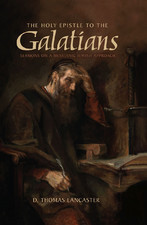
Lancaster’s “Galatians” Book Revisited and Reviewed

galatians-book-lancasterChristians often wonder if the Old Testament saints are “saved.” Have you ever heard that question? It’s problematic. Like most of these questions, the person asking it usually does not know what he means by it. What the person probably thinks he means is this: “Did Noah, Abraham, Isaac, Jacob, David, and Isaiah, and others go to heaven when they died?” What they are trying to ask is this: “Did the divine souls of the men of faith who lived prior to the atoning death of the Messiah find repose in paradise while they await resurrection? Will those men and women who did not confess the name of Yeshua attain the resurrection?”

-D. Thomas Lancaster
“Sermon Thirteen: Abraham’s Gospel (Galatians 3:8-9),” pg 131
The Holy Epistle to the Galatians

As many of you know, I previously started going through this book with My Pastor on Wednesday nights starting many months ago, debating our different viewpoints on Lancaster’s take on one of Paul’s most well-known epistles. This is the letter that Christianity most often uses to prove that Paul preached against the Law of Moses for both Jews and Gentiles. Unfortunately, that take on Paul, especially relative to his behavior in the latter chapters of Acts, makes him seem like a liar and a hypocrite. Interestingly enough, most Christians and most Jews believe that Paul really was a traitor to Judaism, the Temple, and the Torah, and that he took the teachings of Jesus and morphed them into a brand-new religion: Christianity.

If he had done that, then how can we possibly trust the teachings of such a disreputable fellow? Most of our New Testament would be a fabric of lies and half-truths, not the inspired Word of God. Christianity would be a farce. But nearly twenty centuries of post Biblical Christian doctrine have spun this interpretation so that Paul comes out smelling like a rose. Not so the Jewish people and Judaism, however, who for that same amount of time, have played the villain in the tale of the rise of the Gentile Church.

What Lancaster is attempting to do with this landmark book from First Fruits of Zion (FFOZ), based on his original sermon series, is to recast Paul in the role of the apostle to the Gentiles who remained zealous for the Torah, zealous for the Temple, even as he was zealous for the Messiah. Paul is not the liar and hypocrite but the misunderstood hero of the early Messianic movement, trying by long distance correspondence, to hold together a fragile string of communities of Messiah-faith scattered across the diaspora.

I wrote my original review of Lancaster’s book back in 2011 when the book was published, and since then, I wrote a short series of commentaries based on my conversations on Lancaster with my Pastor, but I haven’t completely read through the book again before now.

A number of weeks ago, my Pastor and I agreed to pursue other topics in our discussions, having hit a rather firm impasse on whether or not Jewish Torah observance was intended to continue on this side of the cross (you can surely guess my position in this matter). He subsequently said he’d be willing to continue our discussions on Lancaster, but I’m convinced at this point that each of us are well entrenched in our perspectives to the point where the conversation would only serve to frustrate both of us. I want my time with my Pastor to be productive, illuminating, and in service to God, not a once-a-week head-banging-against-brick-wall session.

Having made that decision, I decided to pick up in the book where Pastor and I had left off and go through it again. I’m not going to rehash all of the content but I want to post a few highlights that probably didn’t occur to me before.

Actually, a few months back, after reading A Torah-Positive Summary of Sha’ul’s Letter to the Galatians written by Ariel Berkowitz and published at MessianicPublications.com (I don’t agree with their general premise on Gentiles and the Torah, but I found the Berkowitz paper worthwhile), I revisited relevant sections of Lancaster’s book and “re-reviewed” them in comparison to Berkowitz.

BerkowitzMy comparison of Berkowitz and Lancaster on the “Torah-Positive Paul” is chronicled in Nitzvaim-Vayelech: The Torah of Paul. Commentary on Paul’s Hagar and Sarah midrash (Galatians 4:21-31) can be found in Paul’s Hagar and Sarah Midrash. My last contrasting of Berkowitz and Lancaster on the matter of circumcision and uncircumcision (Galatians 5:1-6) can be read in Abraham, Paul, Circumcision, and Galatians. I also wrote a separate commentary on the same subject in If Paul Had Circumcised Gentiles.

Now that I’ve covered all that territory, what is there left to talk about?

But that theory does not seem credible. To be fair, God must have done so for all his people for all of the years up until the death and resurrection of Yeshua. And if that is the case, why did he stop doing so in the generation of Messiah? When did he stop doing so? Another way of putting this: “In the Old Testament times, God had some different means of bringing people to salvation, and it worked up until the death of Messiah, at which point people now need to believe in Yeshua. If so, that makes the “good news” actually “bad news” because, prior to the coming of Messiah, Jews received a special revelation from God, but now God has cancelled that program and that is why Jewish people are not believers in Yeshua. That’s a bad deal for Jews.

-Lancaster, pg 132

In order for the traditional Christian view of salvation to be correct, God had to change the rules, rather dramatically too, and cause the course of Biblical history and His own plan to “jump the tracks,” so to speak, and take an entirely different direction. For thousands of years, Jewish faith and devotion to Hashem, God of Heaven, Savior of Israel, and walking in obedience to His statues, was sufficient to ensure God’s continued love and a place in the World to Come for all faithful Jews. Now, something has changed and the focus of faith has shifted from God (the Father) to Jesus (the Son).

And the Scripture, foreseeing that God would justify the Gentiles by faith, preached the gospel beforehand to Abraham, saying, “In you shall all nations be blessed.”

Galatians 3:8

Lancaster supports the idea of progressive revelation, the idea that more and more information is revealed to humanity by God as time goes on. Abraham didn’t know as much as Jacob, Jacob didn’t know as much as Joseph, Joseph didn’t know as much as Moses, and so on. Put that way, I can see the point, but that continual process of God’s revelation to people can’t result in God saying something later that directly (or even indirectly) contradicts what He said earlier. If God said that the Sabbath is an eternal covenant between God and the Children of Israel, and a sign forever, then no later revelation can turn what God said was “eternal” and “forever” into “temporary” with an expiration date stamped on it in invisible ink.

hagar_and_sarahI think we can find the clue to answering the dilemma of whether or not ancient Israel was “saved” in Paul’s Hagar and Sarah midrash. The later covenant cannot take the place of the earlier covenant, and so it is between the Abrahamic promise and Sinai. Faith was always the “mechanism” by which Israel, and later the rest of us, was saved, not obedience to the Torah mitzvot.

But why the shift from God (the Father) to Jesus (the Son)? Jesus only said “No one comes to the Father except through me,” (John 14:6) not “You must come to me and not the Father.” Galatians 3:8 is the link between faith and Messiah, the blessing to the nations, and ultimately, the fulfillment of Israel’s national as well as personal redemption. Devotion to Messiah King is the “doorway” by which we are all ushered into the presence of God, always by faith, not who we are or what we do.

This is actually the whole point of Paul’s letter to the Galatians. No one is justified by their ethnicity or their behavior, but by faith in God by the “merit” of Messiah Yeshua. Faith is the ultimate common denominator between all human beings, Jews and Gentiles alike.

So if the Jewish people were always saved by a faith like Abraham’s, then so too are the Gentiles by being grafted into the Abrahamic (but not Mosaic) blessings of the “good news” as we see in the aforementioned Galatians 3:8. Everything else promised to Abraham by God flows through the descendents of Abraham through Isaac and Jacob, and ultimately Israel’s children, the twelve tribes, on down through the Jewish people, but faith is the one promise we can all apprehend. Lancaster calls it “Abraham’s Gospel” since after all “gospel” just means “good news” and is an Old Testament concept, not a New Testament invention.

Abraham may not have fully understood all of the implications of his seed being a blessing to all nations, but nothing God promised Abraham had to be contradicted or nullified by later revelations. This is why, if Paul and Galatians seem to contradict earlier promises and prophecies of God, then the fault can’t be Paul or the Bible or God, but our incorrect interpretations, which have historically been driven by anti-Semitic and supersessionistic teachings of the Church designed to separate Christianity and Judaism since the earliest days of the Gentile Church. Even when many Christians are no longer seeing themselves as replacements of the Jewish people in God’s covenant promises, the foundation of those ancient anti-Jewish doctrines still color our perceptions.

That’s why it’s important for us to read men like Lancaster and to take the “risk” of adjusting or even changing the lens by which we view the apostle Paul.

Paul knew that the ignorant and unstable would twist his words to their own destruction. He knew that some would take his declarations about Gentiles “not under the law” as a license for sin. Therefore, he warned his readers, “Do not be deceived: God is not mocked, for whatever one sows, that will he also reap” (Galatians 6:7).

-Lancaster
“Sermon Twenty-Five: Torah of Messiah,” pg 266

I chose to read that statement differently than Lancaster (and Paul) intended. I don’t think you have to be ignorant and unstable to misunderstand Paul. I think you can even be intelligent, well-educated, and well-meaning, and still let historically established religious tradition color Paul’s writing. It’s probably impossible to read the Bible without having some sort of interpretive filter between you and the text. That’s just as true with the perspectives of the various “flavors” of Messianic Judaism as it is for the different branches of Hebrew Roots and all the different denominations of the Christian Church. The trick is to find a perspective that brings you the closest to the original intent of the writer and how the intended audience would have heard those words. That’s why I think a Jewish or Hebraic perspective is necessary for us to understand Jewish and Hebraic writers, writings, and audiences.

I know my opinion on Galatians is in the minority, but I think Christianity and Judaism have both gotten Paul all wrong for nearly two-thousand years. I think Lancaster and this book is one effort to try to correct centuries of error.

D. Thomas LancasterIn re-reading D. Thomas Lancaster’s The Holy Epistle to the Galatians, I find it more illuminating than my first pass-through, probably because I’ve continued to study and learn over the past two years, and my discussions with my Pastor have forced me to hone my interpretive skills. I don’t think the book is perfect and in fact, there are a number of points Lancaster makes I don’t agree with (cheeky of me, I know). I think the letter still works if it is addressed to both Jews and Gentiles in the faith communities in Galatia. I think his explanation, as you can read elsewhere, on the Hagar and Sarah metaphor was overly complicated and addressed a different audience than Lancaster surmises.

But, in the majority of his general perspective, I agree with Lancaster. Paul was not nullifying the Torah of Moses. He was explaining to the Gentile believers that conversion to Judaism and full Torah obedience was not a requirement for salvation. He was also explaining to people born Jewish and to righteous converts that neither being ethnically Jewish or being a convert conveyed salvation. Taking on the full yoke of Torah as a Jew does not justify anyone before God. You can’t do enough for God to buy your way into reconciliation. Only faith like Abraham’s does that.

Jews should remain Jews and observe the Torah, for no later covenant, as Paul stated, invalidates the earlier ones. Sinai did not undo Abraham, and the New Covenant, for a Jew, does not undo Sinai. Jewish observance of Sinai is in effect because a Newer Covenant cannot take the place of an older one, it can only ratify it. That’s why we Gentiles don’t have to convert to Judaism and observe the Torah: because Sinai’s Torah did not undo Abraham’s faith. And the New Covenant, in spite of how it is seen in the Church, is generally a repetition of all the previous covenants with some portions being amplified.

After two years, I continue to recommend Lancaster’s Galatians book which is available in hardcopy from First Fruits of Zion and in hardcopy or kindle versions from Amazon (and by the way, the reviews for this book at Amazon are excellent).

FFOZ TV Review: Foretaste of the Kingdom

FFOZ TV episode 21Episode 21: The Apostle Paul calls the Sabbath a “shadow of things to come.” Most people usually think of it as a shadow of things from the past. However, viewers will learn in episode twenty-one that the Sabbath is a foreshadow of things still yet to come. Jesus and the Sabbath both provide rest and the Sabbath rest is a taste of the final rest we will have in the Messianic Era when Messiah returns to set up his kingdom. Thus for those who still observe the Sabbath today, it is a promise of what is to come, the Messianic Age.

-from the Introduction to FFOZ TV: The Promise of What is to Come
Episode 21: Foretaste of the Kingdom (click this link to watch video, not the image above)

The Lesson: The Mystery of the Sabbath Rest

First Fruits of Zion (FFOZ) teacher and author Toby Janicki starts out the exploration of this mystery with what most of us consider to be a familiar lesson from Jesus:

Turn to me, all who labor and are burdened, and I will cause you to rest. Accept upon yourself my yoke and learn from me, for I am humble and lowly in spirit, and you will find a resting place for your souls. For my yoke is pleasant and my burden light.

Matthew 11:28-29 (DHE Gospels)

There’s a lot we think we know about this teaching. We think we know that Jesus wants us to believe in him so that becoming a Christian will provide our souls rest. We think he means that his yoke, his grace, is a pleasant and light “burden” when compared to the Law of Moses. We think that Jesus is always humble and lowly rather than being like the vengeful God of the Old Testament.

But we’re probably not correct, at least not entirely. One of the points Toby made (and he’s made it before, is that when we use improper Biblical exegesis, we often come up with incorrect theology. That statement most likely won’t make some Christian readers happy since once taught, the traditional theology is the Church is set in stone. But sometimes examining a familiar view from an unfamiliar perspective yields new insights.

So too with this continuation of the investigation of the Sabbath, which was begun in the previous episode which I reviewed last week.

So if what we typically understand about the “rest” being described by Jesus isn’t correct, then, from a Messianic Jewish perspective, what is it?

So there remains a Sabbath rest for the people of God. For the one who has entered His rest has himself also rested from his works, as God did from His. Therefore let us be diligent to enter that rest, so that no one will fall, through following the same example of disobedience.

Hebrews 4:9-11 (NASB)

Toby says that there’s a link between Matthew 11:28-29 and Hebrews 4:9-11. They both talk about a “rest,” though in the case of the writer of Hebrews, it’s specifically a Shabbat rest. Toby leads his audience through a small Bible study on Hebrews 4:

Therefore, let us fear if, while a promise remains of entering His rest, any one of you may seem to have come short of it. For indeed we have had good news preached to us, just as they also; but the word they heard did not profit them, because it was not united by faith in those who heard.

Hebrews 4:1-2 (NASB)

Toby JanickiAccording to Toby, the writer of the book of Hebrews is referring to that first generation of Israelites who left Egypt and died in the wilderness.

They too had a rest they could have entered, the rest of the Promised Land, Israel. But they did not due to lack of faith. Toby next presents verses 3 and 4 as connecting this rest to the Sabbath:

For we who have believed enter that rest, just as He has said,

“As I swore in My wrath,
They shall not enter My rest,”

although His works were finished from the foundation of the world. For He has said somewhere concerning the seventh day: “And God rested on the seventh day from all His works”

The writer of Hebrews is actually quoting Exodus 20:11 which is the commandment of observing the Sabbath. But verses 9 through 11 are not specifically referring to the seventh day Sabbath or the rest represented by entering the Land of Israel. Verse 9 says “there remains a Sabbath rest for the people of God.” What rest is that?

According to Toby, these passages are sometimes used by Christians to “prove” that Jesus is our spiritual rest so we don’t need to observe an actual, physical day of rest, neither Gentile Christians nor any Jewish person. But the writer of Hebrews is clearly referring to something in the future, not something that’s already happened. If Hebrews 4 links back to the “rest” which Jesus was teaching about in Matthew 11, then we have reached our first clue.

Clue 1: The rest that Jesus offers us is something that is in the future.

Verses 10 and 11 in Hebrews 4 is a warning not to be disobedient to God as were the first generation of Israelites who disobeyed by refusing to enter the Land of Promise. Obedience of the people of God is required for them…for us to be able to enter into that future rest of Jesus. But again, what rest is that? To us, this represents a Biblical mystery, but to the original audience listening to Jesus or the original Jewish readers of Matthew’s gospel, it was probably self-evident. How would they have understood the word “rest,” which in Hebrew is “Menuchah?”

To answer that question, the scene shifts to FFOZ teacher and translator Aaron Eby in Israel. Aaron first reads from a portion of the Siddur (Jewish prayer-book) which describes the Shabbat as a rest of “love, willingness, truth, faith, peace, tranquility, stillness, trust,” and “a complete rest in which you find favor.”

Clearly, the concept of Shabbat is more than just relaxing in front of the tube or playing a few rounds of golf.

ffoz_tv21_aaronRest is used in a somewhat different context in the Bible. Aaron quoted from Deuteronomy 12:19 referring to Israel, 1 Chronicles 22:9 which refers to Solomon as “a man of rest” and a King who will reign over a nation experiencing rest, peace, and quiet, and 1 Kings 8:56 which is part of Solomon’s dedication of the Temple. These images represent the age of Messianic redemption and the Temple is a portrait of the fulfillment of all the Messianic promises. Aaron also links this to the poetic language of the Rabbis who consider the weekly Shabbat to be a tiny fraction of what will be experienced in the age to come…a forestate of the Kingdom of God.

Back in the studio with Toby, we receive the next clue:

Clue 2: The Sabbath rest is a foretaste of the rest in the Messianic Era.

I can certainly see why the seventh-day Sabbath rest is considered a blessing of both physical and spiritual rest for observant Jews. Not only is it a day to rest in the holiness and peace of God in our age, but it is a miniature representation of the full and complete rest that will be experienced when Messiah reigns in Jerusalem and over all the world, an age of total, worldwide peace.

But in traditional Christian interpretation, we encounter a problem:

Therefore no one is to act as your judge in regard to food or drink or in respect to a festival or a new moon or a Sabbath day—things which are a mere shadow of what is to come; but the substance belongs to Christ.

Colossians 2:16-17 (NASB)

I mentioned these verses among others in my review last week as the “Christian defense” against acknowledging an ongoing Shabbat observance or any such keeping of a Sabbath in the future. When I typically hear language like “type and shadow” in a Christian context, it usually means that such “shadows” came to point us to Jesus, but now that he’s come, the shadows are no longer necessary. However, that interpretation is filtered through a great deal of Protestant tradition and ignores what Paul is actually saying.

Paul said that the Sabbath is a “mere shadow of what is to come,” not what has already come. If, at his first coming, Jesus “fulfilled” the requirement of the Shabbat, then why does Paul refer to the future?

Also, and I’d like to thank Toby for bringing this up, let’s talk about this “shadow” thing. Again, the typical Church teaching on a “shadow” is that it’s basically something of limited usefulness and utility, and was only a poor imitation of something that the Jewish people had to make do with until Christ. Once Christ came, the shadows were eliminated by the “light of the world” and what was temporary then passed away.

Shabbat candlesWhat is a shadow? In a common context, it’s just an area where light is being blocked by an object in between a light source and whatever the light happens to be shining at. A shadow generally renders the shape of the object blocking the light. If Jesus is the “substance” or body of the shadow, then, to extend the metaphor, the Sabbath is “Jesus-shaped.”

If we put all this together, then the Sabbath day is a “shape” or “outline” of something with more substance that will occur in the future and has something to do with the “body” of Messiah. Since that future event has yet to occur, we still exist in the shadow or rather, the seventh-day Shabbat still has purpose and meaning as an image of something even greater and more peaceful to come. Jesus has not replaced the Sabbath and perhaps he never will. In the future, he will fill to complete fullness what we only have a taste of in the current age.

Toby related a number of Talmudic references I’ll pass over (please view the actual episode to get those details) but concludes, using Rabbinic and poetic language, that such concepts link both to 2 Peter 3:8 and Revelation 20:1-6 in describing the thousand-year Messianic reign of Jesus. This is the third and final clue:

Clue 3: The Sabbath foreshadows the coming thousand-year reign of the Kingdom of Heaven.

The rest Jesus was talking about is the Messianic Era, and all who are devoted disciples of Messiah and worshipers of the God of Israel will enter that promised rest when Messiah returns to take up his throne. But we must remain faithful to the end in order to enter that rest.

What Did I Learn?

Something rather poignant. There are a couple of sequences in every episode of the FFOZ TV show that describe the learning materials and other products available through First Fruits of Zion. One of the things this show is supposed to inspire is a desire in the viewers to want to learn more, which can be accomplished through the many fine resources provided by FFOZ.

But in one of these sequences, the voice over said that a “prophetic restoration is sweeping through the Christian world.” I don’t see anything like that “sweeping” through my little corner of the Christian world. I’m glad it’s happening to someone somewhere.

I was also reminded of last Erev Shabbat. My wife made several loaves of Challah and she once again brought out the Shabbos candles…but she was late. My little reminder in Google calendar said that candle lighting began at 4:56 p.m. and at that time, the candles still hadn’t been ignited. I casually mentioned this to her and received a surprisingly sharp rebuke in return. Why should I, a Gentile Christian (she didn’t actually call me that), be keeping track of when Shabbat candle lighting is? She had abruptly (and not for the first time) put up a “Keep Out” sign over the entryway to Shabbat in our home.

She subsequently lit the candles but did not invite me to be present.

“Do not think that I came to bring peace on the earth; I did not come to bring peace, but a sword. For I came to set a man against his father, and a daughter against her mother, and a daughter-in-law against her mother-in-law; and a man’s enemies will be the members of his household.”

Matthew 10:34-36 (NASB)

But a husband against a wife, Master?

“So they are no longer two, but one flesh. What therefore God has joined together, let no man separate.”

Matthew 19:6 (NASB)

I should say that in every other area, the missus and I get along and address a wide range of concerns and shared experiences. It’s just this one place, this religious place, where we are segregated and our worlds keep us apart. I know that, for a variety of reasons, she has good cause to be defensive, but I can’t say that it doesn’t still sting a bit for me to be relegated to one world where our faith is concerned, while my wife inhabits another.

Boaz in ChinaSo it is for many other Christians and Jews in the present age, when many Jewish people see Shabbat as a blessing exclusively for the Jews and to be jealously guarded against outsiders (even if they’re in the same home), and most Christians have no desire to participate in a “shadow” that has long since been replaced by Jesus on the cross.

An “exploration of the Christian faith from a Jewish perspective,” Boaz Michael said at the end of the episode. It’s what I’ve recently dedicated myself to, but it seems a journey I am destined to take alone, and a territory I’m trespassing in as an uninvited foreigner.

If I am to believe prophesy, then I am assured that one day, I will become a welcome stranger in that strange land, but in the current age, the citizens of that country, at least the “citizen” I am closest to, does not permit my entry, nor do my own “countrymen,” the people of the Church, believe my travel plans are valid. I can only trust that one day my determination will be justified. Otherwise, I must accept that my role is to escort the Jewish exiles back to their Land and their heritage, to the foot of the Throne of Messiah, and then I must turn around as the celebration begins, and retreat to where my Master would have me go.

FFOZ TV Review: What Day is the Sabbath?

FFOZ TV episode 20Episode 20: It is often thought that somewhere in the New Testament the Sabbath was changed from Saturday to Sunday. But did the unchangeable God really change the day of rest? In episode twenty viewers will learn that not only has the Sabbath day not changed but Jesus himself was faithful to keep it and taught about it. The Sabbath is an eternal covenantal sign between Israel and God. Thus, while Gentiles are not required to keep it, they are welcomed to do so throughout the Scriptures.

-from the Introduction to FFOZ TV: The Promise of What is to Come
Episode 20: What Day is the Sabbath? (click this link to watch video, not the image above)

The Lesson: The Mystery of the Sabbath

I thought this episode would just be a “rehash” of material I already knew about the Sabbath. To some degree it was, but First Fruits of Zion (FFOZ) teachers Toby Janicki and Aaron Eby managed to flesh out the meaning of the Shabbat for the nation of Israel and to some degree, Christianity as well. Since this show primarily is addressed to traditional Gentile believers, no doubt some of the material came as a bit of a surprise.

Toby starts out relating his Sunday school experience as a child when he was required to memorize the Ten Commandments. This, of course, includes the fourth commandment to observe the Sabbath. Many Christians believe that the Ten Commandments are still in effect for the Church, but either disregard the Sabbath entirely, or believe it was changed from Saturday to Sunday, and that all of the Torah restrictions involving work on the (Sunday) Sabbath were eliminated by Jesus.

Toby asks the questions, “Why don’t Christians keep the Sabbath,” “Was the Sabbath changed from Saturday to Sunday,” and “Is the Sabbath even valid anymore?”

And he said to them, “Shabbat was given for the sake of man, and not man for the sake of the Shabbat. Therefore, the son of man is master even of the Shabbat.”

Mark 2:27-28 (DHE Gospels)

According to Toby, Christians typically use these verses to support the position that Jesus teaches man no longer has to keep the Sabbath since “Shabbat was given for the sake of man.” But Jesus also said that he didn’t come to abolish the Torah, which by definition, would have to include the Torah commandments related to the Sabbath:

Do not imagine that I have come to violate the Torah or the words of the prophets. I have not come to violate but to fulfill. For, amen, I say to you, until heaven and earth pass away, not one yod or one thorn will pass away from the Torah until all has been established.

Matthew 5:17-18 (DHE Gospels)

If you haven’t done so already, or you just don’t believe Jesus didn’t cancel the Torah, please view the FFOZ TV episode The Torah is Not Canceled, which I reviewed several weeks ago. It provides necessary background for what Toby and Aaron are teaching in the current episode of this series.

To understand how Jesus approached the Sabbath, we have to understand the larger context of what he means by “the Shabbat being made for man rather than man for the Shabbat.”

And it happened that He was passing through the grainfields on the Sabbath, and His disciples began to make their way along while picking the heads of grain. The Pharisees were saying to Him, “Look, why are they doing what is not lawful on the Sabbath?” And He said to them, “Have you never read what David did when he was in need and he and his companions became hungry; how he entered the house of God in the time of Abiathar the high priest, and ate the consecrated bread, which is not lawful for anyone to eat except the priests, and he also gave it to those who were with him?” Jesus said to them, “The Sabbath was made for man, and not man for the Sabbath. So the Son of Man is Lord even of the Sabbath.”

Mark 2:23-28 (NASB)

Toby JanickiToby brings up an important point that Jesus is debating with the Pharisees about what is and is not permitted to do on the Sabbath, not whether or not the Sabbath remains valid. Neither side in this argument is invalidating the Sabbath, merely dialoguing about what constitutes “work” on this holy day. Rabbis have been having similar debates for hundreds and even thousands of years. The Talmud is replete with Rabbinic discussions and disagreements over what is permitted to do on Shabbat and a wide variety of other matters related to the Torah mitzvot. The discussion recorded in Mark 2:23-28 is no different, and yet Christianity, not seeing this transaction from a Jewish perspective, universally fails to comprehend its meaning.

In the specific example above, Jesus is citing a portion of the Bible when David and his men ate bread permitted only to the Levitical priests. They did so because they were starving and had no where else to turn for food. Jesus is saying that the Shabbat is a gift, not a straitjacket, and the specifics of performing a type of work that is normally forbidden on Shabbat must not overrule the higher principle of preserving human life, well-being, and dignity.

Jesus had a number of similar debates with the Pharisees on this topic, including whether it was permitted to heal a non-life threatening disability on Shabbat (Matthew 12:9-14).

For more context on the debates Jesus had with the Pharisees on the Shabbat, see my review of D. Thomas Lancaster’s book The Sabbath Breaker: Jesus of Nazareth and The Gospels’ Sabbath Conflicts, also published by First Fruits of Zion.

At this point in his presentation, Toby said something I didn’t expect. We generally consider the phrase “Son of Man” as Jesus used it, to refer to himself, the Messiah, however, Toby applied it differently in the context of Mark 2:23-28. He suggested that “Son of Man” is an equivalent term for all humankind. Thus, he presents the words of Jesus as saying that the Sabbath was created as a gift for all people and that all people everywhere are “Lord of the Sabbath.”

For me, this creates certain problems, since, as I said before, the “Son of Man” is generally considered as a title for Messiah, and Toby’s interpretation seems to create a separate meaning for only this situation. It also may contradict what he establishes later in this episode, since if the Sabbath is created for everyone, Jew and non-Jew, and we are all “lords” of the Sabbath, what does that mean for Gentile Shabbat observance today?

More on that in a bit.

Toby drew a parallel between the Master’s words above and an ancient Jewish commentary on the book of Exodus called Mechilta, and quotes part of it which states:

Shabbat is delivered to you, not you to the Shabbat.

This echos the meaning of the Master that man is not to surrender himself to the Shabbat but quite the opposite. If the laws of the Sabbath were entirely rigid and immutable, they might require that observant people be subject to hardship and even death in obedience of such laws. Even the most stringent Jewish interpretation of the laws of Shabbat allow for lifesaving efforts to be expended on Shabbat, but what about people who are suffering but who will live for another day? What if the dilemma isn’t life and death, but life and dignity?

I’ve come the long way around to the first clue in solving our mystery, but it has finally arrived:

Clue 1: Jesus argued about what things were permissible to do on the Sabbath.

And this, as I previously pointed out, is a debate that has been taking place in Judaism for a very long time.

The scene shifts to Aaron Eby in Israel for a word study on the Hebrew word “Shabbat.”

Aaron starts by quoting Exodus 20:8-9, 11 which I render from the Stone Edition of the Tanakh:

Remember the Sabbath day to sanctify it. Six days shall you work and accomplish all your work…for in six days Hashem made the earth, the sea and all that is in them, and He rested on the seventh day. Therefore, Hashem blessed the Sabbath day and sanctified it.

Aaron EbyAaron points out that the Sabbath has a universal application and far pre-dates the giving of the commandments of the Sabbath at Sinai.

The literal meaning of the word “Shabbat” is “resting” and “stopping” and implies an “active” form of “resting” and “refraining,” not just kicking back and relaxing. To me, this speaks of a specificity of types of activity and inactivity, a mindfulness that Shabbat is not just relaxing in front of the T.V., but directing mind, spirit, and heart away from our immediate human activities and toward God.

Aaron cites something I consider very important in the following:

The Children of Israel shall observe the Sabbath, to make the Sabbath an eternal covenant for their generations. Between Me and the Children of Israel it is a sign forever that in a six-day period Hashem made heaven and earth, and on the seventh day He rested and was refreshed. (emph. mine)

Exodus 31:16-17 (Stone Edition Tanakh)

There are two exceptionally important points to get from this. When Israel or any individual Jewish person keeps the Shabbat, they:

  1. Testify to the eternal covenant between God and all Jewish people, the nation of Israel.
  2. Testify to God’s sovereignty as Creator of the Universe.

In the quote from Exodus 31:16-17, I emphasized words that testify to the eternal nature of the Shabbat as a covenant sign between God and the Jewish people. This also, by implication, testifies to the eternal nature of the Mosaic covenant with the Jewish people, and the Torah as the conditions of that covenant. When Christians say that the Shabbat no longer applies to the Jewish people (or anyone else) and especially that the Torah is now irrelevant to the Jewish people, I want to scream, “What part of eternal don’t you understand?”

But I digress.

Formally, in Judaism, a “day” lasts from sundown to sundown, not from sunrise to sunrise or midnight to midnight. That means that the seventh day Shabbat begins at sundown on Friday and ends at sundown on Saturday (in Rabbinic custom, the Shabbat actually begins slightly before sundown on Friday and ends about 45 minutes after sundown on Saturday as a “hedge,” to avoid “cutting it too close,” so to speak, in beginning and ending Shabbat observance).

Aaron also pointed out that generally, Jewish (and Christian) authorities all agree on which day is the “seventh day,” and that Biblically, it can’t be just any day at all.

I wish Aaron or Toby had addressed the following, though:

One person regards one day above another, another regards every day alike. Each person must be fully convinced in his own mind. He who observes the day, observes it for the Lord…

Romans 14:5-6 (NASB)

Therefore no one is to act as your judge in regard to food or drink or in respect to a festival or a new moon or a Sabbath day—things which are a mere shadow of what is to come; but the substance belongs to Christ. Let no one keep defrauding you of your prize by delighting in self-abasement and the worship of the angels, taking his stand on visions he has seen, inflated without cause by his fleshly mind, and not holding fast to the head, from whom the entire body, being supplied and held together by the joints and ligaments, grows with a growth which is from God.

Colossians 2:16-19 (NASB)

Mark NanosIn Paul’s letter to the Romans addressing “the weak and the strong” (which I’m about to get to in the Mark Nanos book The Mystery of Romans), most people take from these words to mean that one day is as good as another as far as observing a “Sabbath” is concerned, and that believers need not be concerned about strictly observing a Saturday Shabbat. The scripture from Colossians tells a similar tale in the eyes of the Church, and yet both of these interpretations directly contradict earlier scriptures. Since as believers, we cannot understand that the Bible is internally contradictory, we must conclude then that our interpretations are flawed. How can Jewish Shabbat observance be eternal and yet Paul say that it simply doesn’t matter because of Jesus? Jesus himself affirmed the Shabbat, not eliminated it.

Aaron’s segment of this program has him also affirming the current requirement for Israel to observe the Shabbat, but he also asks the question, “What does the Shabbat mean to Gentile believers?”

Back in the studio with Toby, we find our second clue:

Clue 2: Sabbath is from sunset Friday until sunset Saturday.

Two or three clues really don’t do it for the mystery of Shabbat in my opinion. This particular television episode brought up a dense set of meanings for me.

While earlier portions of the episode spoke of the “universality” of the Shabbat as a testimony of all mankind that God is the sovereign Creator, Toby shifts into the specifics of Shabbat and Judaism. While we see the sanctity of the Shabbat being set in place in Genesis 2, Toby points out that the specific commandments of Shabbat observance were not given in any recorded fashion to Adam and his sons or to Noah and his sons. It is only after God redeems the Children of Israel from Egypt and they are standing “as one man” at Sinai before Hashem their God, that Shabbat is formally established and its observance defined in Torah. It is also given as a specific sign of the Mosaic covenant between God and Israel, only Israel, forever. No other people group or nation has ever received this sign obligation to God.

Hashem said to Moses, saying: “Now you speak to the Children of Israel, saying: ‘However, you must observe my Sabbaths, for it is a sign between Me and you for your generations, to know that I am Hashem, Who makes you holy.'”

Exodus 31:12-13 (Stone Edition Tanakh)

Toby doesn’t mention this, but the above verses establish that not only is the Saturday Sabbath considered an eternal sign of the covenant between God and Israel, but so are all of the “Sabbaths,” that is, all of the moadim, God’s appointed times, the festivals identified and defined in Torah, such as Passover, Shavuot, Sukkot, Rosh Hashanah, and Yom Kippur. Each and every one of these Sabbaths must be observed by all of Israel for all time; for after all, that’s what “eternal” means.

I’ve heard it said in the Church that Jews should observe the moadim as “national holidays” the way Americans “observe” the Fourth of July or Thanksgiving. I consider that not only misleading and Biblically inaccurate, but potentially demeaning. It reduces the eternal covenant signs between God and Israel to how Americans “observe” barbecues, fireworks, eating turkey, and watching football. The very best you can say about American national holidays is that they represent who we are and how we relate to our history as Americans, a relationship between citizens and our country. The moadim, the weekly Sabbath, Passover, Shavuot, Sukkot, and the other special Sabbaths are far, far more than that, and indeed, define the relationship between Israel and her citizens, the Jewish people, and the God of Everything!

That’s somewhat more significant than mere American “national holidays,” wouldn’t you say?

This is another long way around to reaching the third and final clue in solving today’s mystery:

Clue 3: The Bible requires only the Jewish people to keep the Sabbath.

That’s going to make some people I know, non-Jewish people, very unhappy, but hold on there. Toby goes on to say that there’s nothing stopping any non-Jewish believer from also observing the Shabbat in some manner. We may not be commanded to do so, but we might as well “get used to it,” for someday, all of humanity will indeed observe the seventh day Shabbat.

And the foreigners who join themselves to Hashem to serve Him and to love the Name of Hashem to become servants unto Him, all who guard the Sabbath against desecration, and grasp My covenant tightly — I will bring them to My holy mountain, and I will gladden them in My house of prayer; their elevation-offerings and their feast-offerings will find favor on My Altar, for my House will be called a house of prayer for all peoples.

Isaiah 56:6-7 (Stone Edition Tanakh)

It shall be that at every New Moon and on every Sabbath all mankind will come to prostrate themselves before Me, says Hashem.

Isaiah 66:23 (Stone Edition Tanakh)

Boaz MichaelIf I’m reading this right (and I think I am), then not only will everyone observe a weekly Sabbath, the seventh day Sabbath, in the Messianic Age, but we will observe the New Moons and all of the Sabbaths and Festivals of God, all of the moadim listed in the Torah.

I don’t know how any later or subsequent revelation in the Apostolic scriptures (New Testament) can alter or undo the meaning of this text.

What Did I Learn?

I learned some things about the Sabbath, but I learned more about myself. I learned that I want to scream when I hear good, intelligent, and passionate Christians, men and women who I deeply respect, saying things about the Bible that seem completely contrary to the Bible. To my way of thinking, Toby and Aaron provided their audience with an air-tight case that Sabbath keeping is completely Jewish and remains an obligation for the Jewish people as a response to their covenant obligations to God. To deny this is (forgive me) to deny the evidence of the Bible. Toby and Aaron “quoted chapter and verse,” so to speak, illustrating the path from Genesis, to Sinai, to the present age, and into the Messianic Era, that the seventh day Sabbath is an eternal sign of the (eternal) covenant between God and Israel.

I also learned to “tighten up” the scriptures defining when all of humanity, in addition to Israel, will be obligated to observe the Shabbat, which is in the Messianic Era. There is no current obligation for Christians, or anyone else who isn’t Jewish, to observe Shabbat, but there will be in the future age when Messiah returns and establishes his Kingdom of peace over all the Earth. While Gentiles don’t have to observe Shabbat now, we can choose to, in some fashion, to honor God as Creator and to summon for ourselves a taste of the future Messianic Kingdom.

I found myself thinking of my Jewish wife and children. None of them observe the Shabbat in any real sense. For awhile, when our daughter was in Israel, my wife was lighting the Shabbos candles, but she stopped soon after our daughter returned. It breaks my heart, but I have to remind myself that some traditional Jews believe that in the age right before the coming of Messiah…

There is a tradition that people will begin to despise the values of their religion in the generations preceding the coming of the Messiah. Since in a period of such accelerated change, parents and children will grow up in literally different worlds, and traditions handed down from father to son will be among the major casualties.

Our sages thus teach us that neither parents nor the aged will be respected, the old will have to seek favors from the young, and a man’s household will be become his enemies. Insolence will increase, people will no longer have respect, and none will offer correction. Religious studies will be despised and used by non-believers to strengthen their own claims; the government will become godless, academies places of immorality, and the pious denigrated…

Perhaps it is darkest before the dawn.

At the very end of the episode, as always, FFOZ Founder and President Boaz Michael appeared on camera to summarize this episode and to mention that next week’s show will continue to discuss the Shabbat. He also said, and this is very important to me, that studying the Bible, all of it, from a Jewish cultural, national, historical, ethnic, and traditional perspective “makes our Bibles consistent and upholds the Biblical truth that God doesn’t change.”

At the beginning of some of these shows, Toby refers to himself as “a Gentile who studies Messianic Judaism.” I’m a Gentile Christian who studies Messianic Judaism but who also attends a Christian church and, as part of that experience, studies Christianity from a fundamentalist and Reformed theology perspective.

So far, after a year of being back in church, the Messianic learning framework still makes a great deal more sense to me as a Biblical guide to Biblical truth than the platform used by fundamentalists. And this should be strange, since being a fundamentalist Christian simply means adhering to the core fundamentals of faith in Jesus Christ.

ShabbatBut maybe that’s the problem. Those fundamentals are based on (please pardon me again) a “fundamental” set of assumptions and traditional interpretations of what the Bible is saying. While those fundamentals attempt to take into account, not only the meaning of the Bible in its original languages, but the cultural and historic context of the Biblical authors and their audiences, they just do not escape the filter of two-thousand years of Christian interpretive history as well as Christian/Jewish enmity, all of which, after Christianity broke from its Jewish origins, must by definition, deny the Torah and deny continuing Jewish obligation to the Torah, including the seventh day Sabbath, as an eternal sign of the covenant between Jewish Israel and God.

How long will I be able to straddle the line with each foot planted on opposite sides of the street? You’ll find out in tomorrow’s “morning meditation.”

FFOZ TV Review: Speaking in Parables

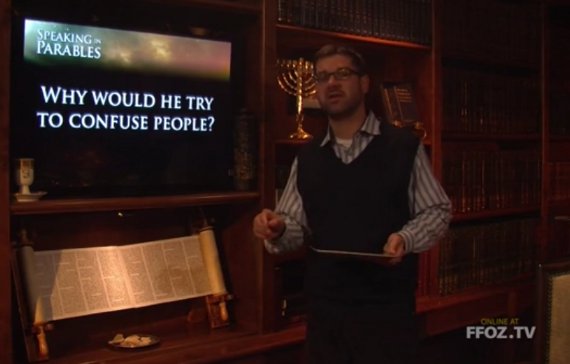
ffoz_tv18_mainEpisode 18: It may be surprising to many Christians that the use of parables was not unique to Jesus but was rather a Jewish literary art form that had been developed over centuries. Viewers will learn in episode eighteen that Jesus used parables not as riddles but stories to help clarify his points. Jesus’ parables attempted to make it easier for his listeners to grasp his words. Like the other rabbis of his day, Messiah used parables to serve as simple explanations and illustrations to help us understand his message about the kingdom.

-from the Introduction to FFOZ TV: The Promise of What is to Come
Episode 18: Speaking in Parables

The Lesson: The Mystery of Speaking in Parables

This is another First Fruits of Zion (FFOZ) perspective on a common “attribute” of Jesus, in this case, how he taught using parables, that for me, revealed more about how Christians think than about the topic itself. I always assumed that the parables of Jesus were metaphors designed to communicate complex concepts and ideas in a simple manner. This is probably because in my previous career as a psychotherapist, using metaphors was a common method I employed to accomplish the same thing.

But apparently, it’s generally understood in the Church that Jesus used parables to confuse his listeners and to hide the truth from the Jewish people. He spoke in riddles in order to prevent the Jews from repenting and returning to God, which, if repentance had occurred, would have resulted in Israel entering the Messianic Age.

According to FFOZ teacher and author Toby Janicki, it’s easy to understand why modern Christians might get that idea:

His disciples approached him and said, “Why is it that you speak to them in parables?” He answered them and said, “Because to you it is given to know the secrets of the kingdom of Heaven, but to them it is not given. For to one who has, it will surely be given, and he will have extra, but for one who does not have, even what he does have will be taken away from him. That is why I speak to them in parables. For in their seeing they will not see, and in their hearing they will not hear, nor do they even understand.

In them is fulfilled the prophecy of Yeshayah that says,

‘Listen well, but you will not understand. Look closely, but you will not know. Fatten the heart of this nation, and make its ears heavy and seal its eyes, so that it will not see with its eyes or hear with its ears or understand with its heart or repent and be healed’.”

Matthew 13:10-15 (DHE Gospels)

ffoz_tv18tobyThis seems to be another case of misunderstanding what appears to be a plain message because we are not approaching the words of the Master using a historical, cultural, and Rabbinic Jewish lens. Toby used to introduce himself in earlier episodes by saying he is a Gentile who is practicing Messianic Judaism, but in the past few episodes, he has described himself as a Gentile who studies Messianic Judaism. I’m becoming increasingly convinced that such a framework is truly required by Gentile Christians if we’re ever to get past our own cultural and historic misconceptions of the Gospels and hear and understand what Jesus is actually saying to his original audience and to us. Maybe we could use a few parables to get that message through our own “thick skulls.”

Toby said the way to understand Matthew 13:10-15 is to go to the section of the Book of Isaiah from which Jesus was quoting:

He said, “Go and say to this people, ‘Surely you will hear, but you do not comprehend; and surely you see, but you fail to know. This people is fattening its heart, hardening its ears, and sealing its eyes, lest it see with its eyes, hear with its ears, and understand with its heart, so that it will repent and be healed’.”

Isaiah 6:9-10 (Stone Edition Tanakh)

Toby told his audience that the conjunction “but” as in “but you do not understand” would better be rendered as “and”. If we substituted the word “and” for “but” in the scripture from Isaiah 6, it would read more like God telling Isaiah that He wants the prophet to relate a message of repentance, but that the people are not going to listen to him.

Otherwise, it looks like God is saying, through Isaiah, that He wants the people to repent, but He also is making it impossible for them to hear the message and obey. Sort of a cosmic “bait and switch,” with God playing the role of the infinite trickster in relation to Israel. This is very reminiscent of how some Christians say God only gave the Torah (Law) to Israel to prove to them that it was impossible to obey, setting them up to understand why they needed grace and Jesus Christ in order to be saved; setting them up to realize that the Torah was never, ever meant to be a permanent lifestyle for the Jewish people, even though the Torah, Prophets, and Writings are replete with messages indicating that both the Torah and the Jewish people would forever exist before God.

Jesus quoted Isaiah 6:9-10 in order to explain that he was like Isaiah, a prophet preaching repentance to an Israel that was already spiritually blind and deaf, unable to see or hear or understand in order to repent and be healed (although in a Jewish context, being healed wasn’t just individual salvation, but the healing and restoration of the entire nation of Israel).

We have arrived at the first clue:

Clue 1: Jesus did not use parables to blind eyes or deafen ears.

ffoz_tv18_aaronIn fact, the opposite seems true. Jesus knew his audience was already spiritually blind and deaf, and maybe he thought using simple parables instead of complex theological arguments would make the message of repentance and restoration easier to understand.

But what exactly is a parable and who typically uses it as a teaching method? For the answer to that question, the scene shifts to Israel and FFOZ teacher and translator Aaron Eby.

Aaron said that parables were used long before Jesus as a common teaching tool by prophets and even by other Rabbis who were contemporaries of the Master. Aaron quotes Ezekiel 17:12 and the parable of the eagle that plucks off a treetop (watch the episode to hear Aaron’s explanation of the parable) to make his point.

Aaron related that the word for parable in Hebrew is mashal, and that the Sages often used a mashal to explain something that was highly conceptual and difficult to understand. Aaron, like Toby, told his listeners that a mashal was designed to make something easier to understand, not take a plain idea and turn it into a riddle. In fact, in the day of Jesus, it was completely normal and expected for a Rabbi to teach using parables, so the disciples and followers of Christ expected it.

We return to Toby in the studio and come to the second clue:

Clue 2: Parables were a common teaching device used to simplify complex concepts.

Toby takes us to another Gospel scripture to further explain why Jesus taught in parables:

With many parables like these, he spoke to them the word according to what they were able to hear. Other than with a parable, he did not speak to them. But when his disciples were with him and no one else was with him, he would explain everything to them.

Mark 4:33-34 (DHE Gospels)

This still seems like Jesus is using parables to obscure the truth but explaining everything to his disciples privately, however Toby said we need to consider another perspective. One that, once I heard it, I realized I’d been taught before.

The Rabbis of that time taught using a dual teaching method. They taught the common people, the simple farmers and shepherds, using parables in order to make difficult theological issues better understood. However to the disciples who continually studied under their Rabbinic Master, the teacher would relate these same concepts in a more formal and legal manner, since they were better equipped, being the Master’s students, to understand in greater depth.

Clue 3: Jesus taught the common people as they were able to hear him.

Remember that Mark describes Christ’s use of parables as, “he spoke to them the word according to what they were able to hear.” He used parables because that’s what the people were able to hear. They wouldn’t have understood a more detailed and technical explanation in the same way the disciples understood.

What Did I Learn?

ffoz_tv18_dhe_markosI had a basic understanding that parables were metaphors in the purpose of their use, but this episode presented parables and their nature in greater detail than I had access to previously. It’s also another example (for me) that God does not desire to hide information, to trick people, to be an agent of confusion, but rather, He wants us to understand, to trust, to believe, and to realize that a Sovereign God is a just and honest God. Sovereignty doesn’t mean God will pull a “bait and switch” just because He’s entitled to as Creator of the Universe.

I also saw again how in lacking a proper Jewish contextual, legal, historical, and cultural framework when we read the Apostolic Scriptures or any other part of the Bible, we will misunderstand, sometimes tremendously misunderstand, who Yeshua is, what he taught, and why he taught it. The Messianic “good news” will be tinted an alien shade of “Gentile,” resulting in a “Goyim-friendly” New Testament that is required to remove continual Jewish Torah covenant obligation so that it can be replaced with something newer and “better.”

As I said before, when Toby introduced himself as a Gentile who studies Messianic Judaism, it revealed something about me and how I approach my faith. I really do believe and accept the FFOZ premise that Messianic Judaism is a method by which non-Jewish believers can and must study in order to comprehend God, the Messiah, the Bible, our Jewish companions in the faith (and outside the faith), and ourselves better. Otherwise, we’re missing out on a great deal of understanding and truth.

I don’t think anyone intended this part of the episode to be adapted in this way, but I wonder if when Jesus (and Isaiah before him) said that “this nation, and make its ears heavy and seal its eyes, so that it will not see with its eyes or hear with its ears or understand with its heart or repent and be healed,” they realized these words could possibly be applied to much of the Christian church today?

Oh, one more thing. The top image on each of these FFOZ TV reviews is just a screenshot, not an embedded link to the video. The link to the video is just under the italicized introduction to the review as the title of episode, such as in today’s case, Episode 18: Speaking in Parables.

The Jewish People are Us — not Them: Commentary on Dauermann in Messiah Journal 114

stuart_dauermannSecond, I will briefly outline the biblical concept of Achdut Yisra’el — the unity of the Jewish people — and explain theologically why the Jewish people are “us,” not “them.” Third, I will seek to establish the connection between Achdut Yisra’el and Ahavat Yisra’el — love for one’s fellow Jew.

-Stuart Dauermann, PhD
“The Jewish People are Us — not Them,” pg 55
Messiah Journal Issue 114/Fall 2013

I previously said this was one of the Messiah Journal (MJ) articles I wanted to address in more detail and I’ve finally been able to delve into it.

I won’t dissect the entire write up, but there was a section that especially got my attention: A Biblical and Theological Basis for the Jewish People Being “Us,” not “Them”. Critics of Messianic Judaism in general and what Haim Ben Haim called Postmissionary Messianic Judaism (PMJ) in his article (referencing Mark Kinzer’s book, Postmissionary Messianic Judaism: Redefining Christian Engagement with the Jewish People) in particular say, that Messianic Jews put their ethnicity above the Bible, the Messiah, and God. They say that Messianic Judaism places Jewish tradition and commentary above the authority of the inspired Word of God, and that the Bible is less important to them than the Mishnah.

So naturally, I was curious as to how Dr. Dauermann was going to present the Biblical basis for Messianic Jews being part and parcel of the larger Jewish world and of Israel. However, to comprehend this, we have to back up a bit in Dauermann’s article to understand more about where he’s coming from.

On page 57 of his rather ample essay, Dauermann quotes Tsvi Sadan’s paper “Keruv as Guiding Principle for Proclamation of the Good News,” presented at the Borough Park Symposium, East Elmhurst, NY, 8-10 October 2007:

I started to see the world as divided into two groups of people: the good guys — the “believers” — and the bad guys — the “non-believers.” Among the “bad guys” were, of course, the Catholics and … Protestant denominations that did not cater to my newly acquired Evangelical mindset. In this tightly knit scheme I viewed the “non-believing” Jews in the same way I viewed any other infidel, be they Muslims, Presbyterians, or Buddhists.

Dauermann comments on Sadan’s statement, also on page 57:

How tragic and shameful that a Sabra like Tsvi came to view his fellow Israeli Jews as “other,” believing that only a very narrow band of Christians, defined in a sectarian manner, deserved the status of “us.”

I read a terrible irony in Dr. Dauermann’s words because there are so many Gentile Christians in the world (including, strangely enough, those in the Hebrew Roots and Messianic Jewish movements) who look at non-believing Jews not only as “other,” but as “bad guys,” quite the contrary to what God said to Abraham:

And I will bless those who bless you, and the one who curses you I will curse.

Genesis 12:3

The term “am echad” appears four times in the Tanach, providing a cluster of insights foundational to our concept of Achdut Yisra’el.

-Dauermann, pg 57

Unity of the Jewish people. The first time in the Tanakh we see “am echad,” according to Dauermann, was in reference to the people building the Tower of Babel. In Genesis 34:16, we see the term in reference to the people of Shechem having their men circumcised and becoming “one people” with Jacob’s family.

It is crucial to see here that brit milah is not simply a covenant with HaShem. It also makes us am echad with all others in that covenant. We tend to miss this in Scripture, even though it is there. Conditioned by post-Enlightenment presuppositions, we miss the horizontal nature of the covenant that binds us together as one people…

-ibid, pg 58

Dauermann is establishing linkage that should be obvious but isn’t, relative to Yeshua-faith. Jewish people are the only population born into a covenant relationship with God and with each other. Regardless of the circumstances and beliefs of any individual Jewish person, that person can never become “unJewish,” and can never surrender their connection to other Jewish people and to God, even if they sincerely want to. And yet, for nearly two-thousand years, the Christian Church has demanded that Jewish believers in Jesus do just that if they want to join the community of faith. If God were capable of being confused, I could imagine Him being confused by watching Jewish people claim a covenant connection with him through Christ while disengaging themselves from the Mosaic covenant and from almost all there Jewish communities on earth. Paul didn’t have to do that. Why should any other believing Jew?

In this section of his argument for the Messianic Jewish people considering larger Judaism as “us,” Dauermann provides a handy bullet point list illustrating “am echad:”

  • A family
  • In covenant with God
  • In covenant with each other
  • Sharing a unique body of laws, and thus strengthened by common obedience
  • Sharing a common language, and thus strengthened by good communication
  • Sharing a homeland where they either live, or from which they are dispersed
  • Empowered by unity, weakened by division

rashiI’d have to say this is “am echad” in its ideal sense. Although the covenant blessings and responsibilities in the first two points exist, not all Jewish people, Messianic or otherwise, acknowledge these relationships. That certainly would affect the third bullet point as well. Not all Jews share Hebrew (or Yiddish) as a common language, but I will admit that when a Jew beings to engage the larger community, language is one of the first things they address. I know I’ve seen The Joys of Yiddish sitting by my wife’s chair in the living room from time to time.

The homeland exists, but many Jewish people are quite comfortable in the diaspora and both they and the Land of Israel itself will remain in exile until Messiah comes and brings all of his people, the Jewish people, back to their home.

And yes, Jewish people everywhere are weakened when lack of unity exists.

Rashi infers that at Sinai, Israel was “ke’ish echad blev echad/like one person with one heart.” By this comment, he bears witness to the centrality of unity as a core value of Jewish community, and furthermore, that this unity arises from our covenantal relationship with HaShem and therefore with each other. The ideal of Jewish life is that all Jews should live “ke’ish echad blev echad.”

-ibid, 58-9

The connection of the Jewish people to each other is tied to the connection the Jewish people have with God. The two relationships are inseparable and, if you are born Jewish, inescapable.

And He said to him, “‘You shall love the Lord your God with all your heart, and with all your soul, and with all your mind.’ This is the great and foremost commandment. The second is like it, ‘You shall love your neighbor as yourself.’ On these two commandments depend the whole Law and the Prophets.”

Matthew 22:37-40 (NASB)

The Master makes a parallel statement using the same linkage. One does not love God without loving his fellow, which in the case of the Jewish community, is your fellow Jew, “Ahavat Yisra’el.”

Adonai said, “Should I hide from Avraham what I am about to do, inasmuch as Avraham is sure to become a great and strong nation, and all the nations of the earth will be blessed by him? For I have made myself known to him, so that he will give orders to his children and to his household after him to keep the way of Adonai and to do what is right and just, so that Adonai may bring about for Avraham what he has promised him.” (emph. added)

Genesis 18:17-19 (CJB)

Dauermann inserted this quote into his article to establish another, very vital point to his argument.

Here already, in Genesis, Torah theologizes that this “am echad” will be characterized by obedience to the body of law. Furthermore, in chapter 26, HaShem tells Yitzchak (Isaac) that he will multiply his descendants and give all these lands to those descendants “because Avraham heeded what I said and did what I told him to do: he followed my mitzvot, my regulations and teachings” (Genesis 26:5 CJB). Here again we see, even in a foreshadowing of that other basis of Achdut Yisra’el, the covenant with our people at Sinai.

-Dauermann, pg 59

I know you might be thinking that Dauermann is stretching his point, since the Torah had yet to be given, but he continues:

In parashat Nitzavim (Deuteronomy 29:9-30:20), HaShem confirms the Mosaic (or Sinaitic) Covenant, stating, “But I am not making this covenant and this oath only with you. Rather, I am making it both with him who is standing here with us today before Adonai our God and also with him who is not here with us today.” (Deuteronomy 29:14-15 [13-14], CJB).

-ibid

Torah at SinaiNot only covenant belonging and covenant relationship, but covenant obedience are the “common currency” among the Jewish people, at least in the idealized expression of God’s intent for Israel.

I’ve said before that it was always God’s intent to carry the covenant forward, not just in the immediate sense of Sinai, but extending into future history, across all of the unborn generations of Jewish people down the timeline, everywhere, including every Jewish person alive today.

Dauermann continues with this thought invoking Jewish tradition which says, “All Israel is responsible for one another” — kol Yisra’el averim zeh bazeh. He goes on to say:

Because we have been brought into covenant with God, we are therefore inescapably in covenant with one another, and as such, we are each and all responsible for one another. For this reason, even if for no others, the Jewish people are “us,” and not — no, never — “them.”

-ibid

I know what you’re thinking. Well, no I don’t, but I can imagine. I can imagine someone reading this will say that they’ve read stories of terrific conflicts between secular Jews and the Ultra-Orthodox in Israel and elsewhere. Dauermann spends some time going into this, addressing even the worst of these conflicts as “family fights.” Sometimes families fight terribly, even to the point of violence, but they are still family.

But the one thing that can separate Jewish people the most is faith in Jesus:

Tsvi Sadan as well as the Hashivenu leadership group and many others have been conditioned to think of our fellow Jews as strangers, and “them,” as no longer fully our brothers and sisters. Messianic Jews are conditioned to think of other Jews as simply “unsaved Jews” who remain familiar strangers to us unless and until they accept Christ.

-ibid, pg 60

At this point, although the overriding emphasis of Dauermann’s article was on Jewish interrelationships, being Messianic notwithstanding, I started to wonder how all of this would affect the bond between Messianic Jew and believing Gentile, the bond we should also share as disciples of Moshiach and co-participants in the blessings (and there’s always the competing dynamic created between focus on Judaism and Jewish belonging vs. focus on Messiah as the very core of Jewish and Gentile faith).

Dauermann continued in his article discussing how the Jews in the Messianic community needed to return to being “ke-ish echad blev echad” — one person with one heart — with the larger Jewish community. He cited Jeremiah 32:39 in describing how God would give Israel “one heart,” and Ezekiel 36:26 in saying God would put a new spirit within Israel and give them a “heart of flesh.” Even Acts 4:32 speaks of the Jewish believers having “one heart and soul.”

Dauermann built up such a strong interconnection between and within the Jewish community, across all belief systems and lifestyles, that even I started stumbling over the following:

Therefore remember that formerly you, the Gentiles in the flesh, who are called “Uncircumcision” by the so-called “Circumcision,” which is performed in the flesh by human hands—remember that you were at that time separate from Christ, excluded from the commonwealth of Israel, and strangers to the covenants of promise, having no hope and without God in the world. But now in Christ Jesus you who formerly were far off have been brought near by the blood of Christ. For He Himself is our peace, who made both groups into one and broke down the barrier of the dividing wall, by abolishing in His flesh the enmity, which is the Law of commandments contained in ordinances, so that in Himself He might make the two into one new man, thus establishing peace, and might reconcile them both in one body to God through the cross, by it having put to death the enmity.

Ephesians 2:11-16 (NASB)

The linkage goes both directions. Yes, I believe that Jews in Messiah are still Jews, not just in terms of a string of DNA, but in terms of covenant connectedness to God and to all other Jewish people, but that doesn’t mean the body of Messiah, which contains both Jews and Gentiles, is so much chopped liver. Dauermann’s article doesn’t bring this issue up at all, probably because it is out of the scope of his topic, but ultimately, you can’t establish Jewish “Us-ness” between Messianic and all other Jews without also explaining how the body of Messiah is supposed to work.

That, I suppose, is yet to come.

At this point, although Dauermann is still writing within the “Biblical” section of his article, he seems to depart from it quite a bit, although I can see his point:

Often such a cry for being “biblical and nothing but biblical” is code language for eagerness to reject tradition. But every community has its traditions, even those that imagine themselves to be based on nothing but the Bible. And the traditions of men are not wrong except when they are used to displace or annul the commandments of God. Yeshua himself urged keeping of Jewish traditions when he urged the scribes and Pharisees as a class to remember the centrality of justice, mercy, and faith without neglecting their extra-biblical traditions (tithing mint, dill, and cumin, something never commanded in the Torah) (from Matthew 23:23).

-ibid, pp 61-2

jewish-traditionI know what my Pastor would say, but I have to agree with Dauermann. Even in Fundamentalist Christianity, there are many traditions, including those that say there are no traditions, and those that say Biblical interpretation is based on the Bible alone without an intervening historical and traditional lens being employed.

Still the path will feel “dangerous” for a lot of Christians who have had it drilled into their heads that Jewish traditions, the “traditions of men,” are bad, bad, bad.

The last, or almost the last, Biblical reference Dauermann makes is this:

“Do not think that I came to abolish the Law or the Prophets; I did not come to abolish but to fulfill. For truly I say to you, until heaven and earth pass away, not the smallest letter or stroke shall pass from the Law until all is accomplished. Whoever then annuls one of the least of these commandments, and teaches others to do the same, shall be called least in the kingdom of heaven; but whoever keeps and teaches them, he shall be called great in the kingdom of heaven.

Matthew 5:17-19 (NASB)

This is Dauermann telling us that even Messiah did not call for an end to the Torah until heaven and earth pass away. I know that many Christians, including my Pastor still can’t accept this, so I’ll point all interested parties to the First Fruits of Zion television program and specifically to the episode The Torah is Not Canceled, rather than try to include all of the article’s supporting points here.

The very last point Dauermann made was this:

If someone says, “I love God,” and hates his brother, he is a liar; for the one who does not love his brother whom he has seen, cannot love God whom he has not seen.

1 John 4:20 (NASB)

In context, a Jewish believer cannot say he loves God if he hates his fellow (non-believing) Jew. This, of course, takes us back all the way to the Torah again:

…you shall love your neighbor as yourself; I am the Lord.

Leviticus 19:18 (NASB)

Was Dr. Dauermann successful in establishing that the Jewish community is to be considered as “Us” among Messianic Jews and not “Them” as a founded in the Bible? I’m not sure. I can see the trail of Dauermann’s logic, but it doesn’t lead just through the Bible. There’s a realm you enter that encompasses all things Jewish and Judaism that leaves the existence of tangible things and becomes spiritual and metaphysical. I can’t go very far into that realm because I’m not Jewish, but even I, a Goy, can see the shimmering threads of covenant and community linking one Jew to another. Some Jews may choose to disregard those threads, but they exist anyway, even if only in the will of God rather than the vision of men.

Fundamentalists are uncomfortable with spirituality except on its most surface levels, but where, after all, does God exist? Where, after all, does “the Church” expect to be “raptured?” How can fundamentalist Christianity deny something upon which they depend so much, even if only in a dim, Messianic future.

Being Jewish (I can only imagine) is a lived, experiential existence. Certainly Jews all over the world don’t experience the same Jewish life, but that’s why it will be necessary for Messiah to gather in all the exiles, physical, emotional, intellectual, and spiritual, of Israel, give them one heart and one spirit, and remind them of who they are. Scripture even says that one of the jobs of the Gentile nations will be to convey and escort the exiled Jews back to Israel.

There’s something in Dr. Dauermann’s article that serves as a reminder for the Messianic Jewish community, to remember who they are, to remember that they are first and foremost Jews. They chose the path of Messiah, but they are still Jews and the path of Messiah is a Jewish path. Messianic Jews are just as much a Jewish people as those who have not (as yet) seen that Yeshua is indeed the Son of David and the firstborn of Israel.

But once a Jewish Messianic comes to this realization, how does he relate to Gentile believers, or does he? This is a question that remains. Maybe it’s important for modern Messianic Jews to re-capture what Paul experienced in his journey within and between Jewish and Gentile worlds. Paul was a zealous Jew, “circumcised the eighth day, of the nation of Israel, of the tribe of Benjamin, a Hebrew of Hebrews; as to the Law, a Pharisee; as to zeal, a persecutor of the church; as to the righteousness which is in the Law, found blameless” (Philippians 3:5-6).

And on his path, whether among his fellow Jews or among the Goyim, the central focus of Paul’s entire life and ministry was not on either tradition or lifestyle, but above all else, on Messiah…on Yeshua.

Once modern Messianic Jews within a Postmissionary Messianic Jewish (PMJ) framework arrive at where Paul was, maybe how Paul managed to also negotiate the world of Gentile believers while fully retaining his identity as a Jew and as Israel will become apparent.