Tag Archives: Genesis

The Tent of God

Downtown Dewey Square is crammed with tents and tarps of Occupy Boston protesters, but organizers made sure from the start of this weeks-old encampment that there was room for the holy.

No shoes are allowed in the “Sacred Space” tent here, but you can bring just about any faith or spiritual tradition.

A day’s schedule finds people balancing their chakras, a “compassion meditation” and a discussion of a biblical passage in Luke. Inside, a Buddha statue sits near a picture of Jesus, while a hand-lettered sign in the corner points toward Mecca.

“Religion claims its place in Occupy Wall Street”
-by Jay Lindsay
found at news.yahoo.com

We tend to think of religious and secular activities as isolated from one another. Secular people rally around “separation of church and state” (though that’s not exactly what the Constitution says) while at least some Christians say that the United States was founded as a Christian nation (which isn’t really true, either). However, there is a distinct impression of polarity between what some might think of as “faith vs. facts”. Reality isn’t quite so clear cut, though.

For instance, a number of weeks ago, I came across an article at Network World called Science and religion can and do mix, mostly. The takeaway blurb says:

Rice study shows only 15% of scientists at major US research universities see religion and science as always in conflict.

That’s not the impression you get from the news media, at least when religion and science come up in the same story. There’s a tendency to believe that people of faith and people of science are mortal enemies. One avenue of evidence many atheists use against religious people is that the various sciences “prove” or at least support, an origin of the universe and of the earth that does not match up with how Genesis describes those events in the Bible. Science is also used in some manner or fashion, to support natural rather than supernatural processes for the creation and development of life, and of course, there’s no direct, scientific observation that supports the existence of God.

Rabbi Abraham Joshua Heschel in his book God in Search of Man : A Philosophy of Judaism said that science was not an adequate tool for determining the existence of God, since science, as a method of examination, can only investigate those things that are available for examination within the scope of our universe. God is “extra-universal”, so to speak, and escapes all methods of man trying to capture God and put Him under the microscope.

That probably sounds like a convenient excuse to some, but I’m not going to present a detailed defense for God’s existence against the various scientific disciples. They operate on completely different playing fields. To be fair to the Biblical rendition of the Creation event in Genesis though, I don’t believe it was written as a “cookbook” on how God created the universe, nor do I believe it can be understood outside of a deeply mystic frame of reference. I’m not the only one with this viewpoint. For instance, Rabbi Joshua Brumbach on his blog Yinon, recently replied to a commenter:

I don’t believe the intention of Genesis is meant to be a scientific account, but rather a theological one. As such, I am not necessarily a literal 6 days person. IMHO, like you, I don’t think the Biblical text and Science are in conflict with each other.

There’s no real reason to say that the “big bang” theory, which is accepted by the vast majority of the scientific community as the most likely explanation for the origin of the universe, should be at odds with the acceptance of the Genesis story in the Bible. And while the scientific understanding of the big bang event has evolved over time, it still has some uncertainty attached to it as reported by Space.com:

“The problem is, there’s no reason whatsoever to believe general relativity in that regime,” said Sean Carroll, a theoretical physicist at Caltech. “It’s going to be wrong, because it doesn’t take into account quantum mechanics. And quantum mechanics is certainly going to be important once you get to that place in the history of the universe.”

So the very beginning of the universe remains pretty murky. Scientists think they can pick the story up at about 10 to the minus 36 seconds — one trillionth of a trillionth of a trillionth of a second — after the Big Bang.

So in the time that existed just prior to “one trillionth of a trillionth of a trillionth of a second” before the big bang, could the hand of God have been at work? I believe so, but then, that’s an opinion based on faith. To say that God absolutely could not have been involved requires as much faith, if only because there’s no way to be so definite on that point without invoking faith, either in God or in God not existing.

So we find God in odd places, places we wouldn’t expect to find Him, such as at an Occupy Wall Street demonstration in Boston. Of course:

The tent is one way protesters here and in other cities have taken pains to include a spiritual component in their occupations. Still, Occupy Wall Street is not a religious movement, and signs of spiritually aren’t evident at all protest sites.

So we discover God, or our faith in Him at least, is involved in human affairs because God is involved in us. If the world was not created for the sake of humanity, would the universe exist? That’s like the old “if a tree fell in the forest and there was no one to hear it, would it make a sound” question, and as there are no observers at either event (except God), we have no way of knowing for sure.
To fly in the face of science, God is not a God of facts, but a God of experiencing. We know He is real because we experience Him in ways that defy logic, science, and traditional observation. We believe He has inserted Himself into the lives of human beings and into the course of history, but it still requires faith to see His face shining and His hands working at places like Eden, Sinai, and Jerusalem. Although God is omnipresent, He is most likely found in the places where we carry Him. His being can and has and does manifest anywhere, but He is most often seen, and heard and felt where the people of God are. We are His emissaries to those who have no other method of experiencing Him. The people of God allow the invisible God to be seen by the righteous and the unrighteous alike.

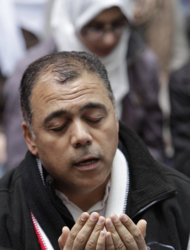
Right now, in downtown Boston, He is sitting in a small tent along with a statue of Buddha, a picture of Jesus, and a hand-lettered sign pointing to Mecca. He was carried there along with those objects and He would be there, even if those other objects didn’t exist. For the method of transport for God into that small tent in Boston, and in all the other places we find God, wasn’t by hands, but by the container of faith He has helped us build within ourselves. And we people of faith, though hardly 99% of the population, are not always who you would expect us to be or where you would expect to find us.

Addendum October 30, 2011: Christians are supporting the “Occupy London” protests. Read about it at guardian.co.uk.


Living in the Echo of Genesis

And Hashem God made for Adam and his wife garments of skin, and He clothed them.Genesis 3:21 (Stone Edition Tanakh)

Not only did God Himself make them comfortable garments, He Himself clothed them to show that He sill loved them, despite their sin. -R’Bachya

If Judaism had relied exclusively on the human resources for the good, on man’s ability to fulfill what God demands, on man’s power to achieve redemption, why did it insist upon the promise of messianic redemption? Indeed, messianism implies that any course of living, even the supreme human efforts, must fail in redeeming the world. It implies that history for all its relevance is not sufficient to itself.

There are two problems: the particular sins, the examples of breaking the law, and the general and radical problem of “the evil drive” in man. The law deals with the first problem: obedience to the law prevents evil deeds. Yet, the problem of the evil drive is not solved by observance. The prophets answer was eschatological…”Behold, days are coming, says the Lord, and I will form a covenant with the house of Israel…not like the covenant that I formed with their forefathers…I will place My law in their midst and I will inscribe it upon their hearts” (Jeremiah 31:30-33). “And I will give you a new heart, and a new spirit will I put within you, and I will take away the heart of stone out of your flesh, and I will give you a heart of flesh. And I will put My spirit within you and bring it about that you will walk in My statutes and you will keep My ordinances” (Ezekiel 36:26-27).

-Abraham Joshua Heschel
God in Search of Man : A Philosophy of Judaism (p. 379)

Creation, existence, devotion, obedience, sin, failure, humiliating shame, but still love.

The story of Genesis is the story of humanity. We are born into the universe and spend our lives trying to understand who we are and why we exist, and then we attempt to live up to what we believe is the purpose of our lives. Those us who have an awareness of God and a faith in our Creator strive to connect to the object of our faith and to join with Him in creating acts of holiness in the world around us.

I acknowledge You, for I am awesomely, wondrously fashioned; wondrous are Your works, and my soul knows it well. My frame was not hidden from You; that which I was made in concealment, which I was knit together in the lowest parts of the earth. –Psalm 139:14-15 (Stone Edition Tanakh)

But we fail, not all the time, but often. How like Adam and Eve we sometimes feel shame and stand naked and exposed in our transgressions against Him.

But love and the struggle to continue in the face of our failures for the sake of Heaven is also the story of Genesis.

Man’s ability to transcend the self, to rise above all natural ties and bonds, presupposes further that every man lives in a realm governed by law and necessity as well as in a realm of creative possibilities. It presupposes his belonging to a dimension that is higher in nature, society, and the self, and accepts the reality of such a dimension beyond the natural order. Freedom does not mean the right to live as we please. It means the power to live spiritually, to rise to a higher level of existence…Freedom is an act of self-engagement of the spirit, a spiritual event. -Heschel p. 411

It is for freedom that Christ has set us free. Stand firm, then, and do not let yourselves be burdened again by a yoke of slavery. –Galatians 5:1

The irony in Paul’s words is in how the church has misunderstood them to believe that the Torah was slavery and that grace and “lawlessness” was the only freedom. In fact, we are declared free the first moment we touch the hem of the garment of God and acknowledge that we are not chained to the laws of an earthly existence. In the spiritual person’s freedom, we escape the shackles that secular man rattles proudly in our faces as evidence of his emancipation from “religion”.

Religion becomes sinful when it begins to advocate the segregation of God, to forget that the true sanctuary has no walls. -Heschel p. 414

The mysterious forbidden fruit and the deceit of the serpent are failure, sin, and slavery, but God’s love for us and our bond with Him are our continued freedom. For Christians and Jews and Muslims and all the other traditions struggling to understand the nature of man and God, even “religion” can become a barrier when it becomes an idol in our lives and a greater force than God Himself. For Jews, Heschel (p. 415) says something even more startling.

Even the laws of the Torah are not absolutes.

Only God is absolute and the Torah, the mitzvah, the prayers, all of them exist as the interface by which we connect with God to perform His will, but like the stars in Heaven and the great seas, they are creations, not the Creator.

The ultimate concept in Greek philosophy is the idea of cosmos, of order; the first teaching in the Bible is the idea of creation. Translated into eternal principles, cosmos means fate, while creation means freedom…The essential meaning of creation is, as Maimonidies explained, the idea that the universe did not come about by necessity but as a result of freedom. -Heschel pp.411-12

Under heavenChristianity, in depending on the Greek philosophy imposed on church’s understanding of the New Testament due the original language of the text, accidently or perhaps deliberately filters out the Jewish meaning of the teachings and wonder of Jesus Christ. As the Apostle Paul said in Galatians 5, we are not possessed by God nor owned by the Master, though our Master he is, but we are free of the weight of human frailty and sin. We are free to allow ourselves to be clothed in not only righteousness but in the performance of the mitzvah, joining as humble partners with God in the task of repairing the world and preparing the way for the coming of the Messiah.

The next day the great crowd that had come for the festival heard that Jesus was on his way to Jerusalem. They took palm branches and went out to meet him, shouting,
“Hosanna!”
“Blessed is he who comes in the name of the Lord!”
“Blessed is the king of Israel!” –John 12:12

As the people in Jerusalem spread palm branches in the road, paving the way for the entry of Christ, so by our faith and our deeds do we pave the road for his return, in triumph, glory, and splendor, for as sin has made man a slave on earth, the King of Kings will break our bonds and we shall be free under his reign and under God.

Hashem, what is man that You recognize him; the son of frail human that You reckon with him? –Psalm 144:3 (Stone Edition Tanakh)

For God so loved the world that he gave his one and only Son, that whoever believes in him shall not perish but have eternal life. –John 3:16

We must continue to ask: what is man that God should care for him? And we must continue to remember that it is precisely God’s care for man that constitutes the greatness of man. To be is to stand for, and what man stands for is the great mystery of being His partner. God is in need of man. -Heschel p. 413

After the failure at Eden, we continue to ask ourselves why God loves us. We try and comprehend beyond our own small ability to reason, that God’s love is boundless and timeless and does not depend on our ability to adequately love Him, for we have no such power. In our weakness, He is strong and gives us strength to love an unknowable God. However, we must grasp onto that strength, lest we fail and fall away.

Man’s survival depends on the conviction that there is something that is worth the price of living. -Heschel p. 422

This is especially true of the Jewish people, but it is no less true for the rest of us.

In trying to understand Jewish existence a Jewish philosopher must look for agreement with the men of Sinai as well as the people of Auschwitz. -Heschel p. 421

We must cling to our God as tightly as possible for only in that attachment may we remain nourished in His love and find our way along the path. Only with God can we survive the failure of humanity and achieve the glory for which we were truly created, both for the Jew and the Gentile.

Israel is the tree, we are the leaves. It is the clinging to the stem that keeps us alive. -Heschel p.424

I am the vine; you are the branches. If a man remains in me and I in him, he will bear much fruit; apart from me you can do nothing. –John 15:5

If some of the branches have been broken off, and you, though a wild olive shoot, have been grafted in among the others and now share in the nourishing sap from the olive root, do not consider yourself to be superior to those other branches. If you do, consider this: You do not support the root, but the root supports you. You will say then, “Branches were broken off so that I could be grafted in.” Granted. But they were broken off because of unbelief, and you stand by faith. Do not be arrogant, but tremble. For if God did not spare the natural branches, he will not spare you either.

Consider therefore the kindness and sternness of God: sternness to those who fell, but kindness to you, provided that you continue in his kindness. Otherwise, you also will be cut off. –Romans 11:17-22

ForgivenessThe antidote to the cruelty of this broken world is kindness and love, not just to those who are kind and loving to us, but to everyone, because God loves everyone, the sinner and the saint alike, with equal passion and devotion, for we are all devoted sons and daughters but we are also prodigals and wayward.

We cannot hate what God loves. Rabbi Aaron the Great used to say: “I wish I could love the greatest saint as the Lord loves the greatest rascal.” -Heschel p. 424

Both Christians and Jews await the return of the Messiah and the hope of the world to come, though each tradition denies the validity of the other’s interpretation. God is God and He is One, in spite of how we misunderstand and misconstrue. A Christian waits for the end of Revelation and a Jew waits for this and remembers.

We remember the beginning and believe in the end. We live between two historic poles; Sinai and the Kingdom of God. -Heschel p. 426

A person of faith is caught between two realities; the one we live in now and the one we hope for, when God will reign and tears and dread are banished forever. We cannot ignore one for the other. We cannot live in the present without the hope of the future, but we cannot look at the end of the tale without realizing that it will never occur unless we work with God here and now to bring the Moshiach. We live in the echo of Genesis while awaiting the sound of the final Shofar of Messiah. In between, we have palm branches to gather in order to prepare his way.

Genesis: Rerolling the Torah Scroll

IRolling the Torah Scrollf G-d is “perfect,” as Judaism says, what prompted Him to create the universe? What void was He seeking to fill?

The answer provided in Jewish Mysticism is that G-d desired marriage. Marriage necessitates the existence of someone distinct from yourself with whom to share your life, a union of husband and wife. G-d chose humanity as His bride. According to the Kabbalah, the High Holiday season is the annual experience of the cosmic matrimony between G-d and humanity.

-Rabbi Yosef Y. Jacobson
“Souls in the Rain”
Commentary on Sukkot and Simchat Torah
Chabad.org

It is impossible to decide whether in Judaism supremacy belongs to halacha or to agada, to the lawgiver or to the Psalmist. The Rabbis may have sensed the problem. Rab said: The world was created for the sake of David, so that he might sing hymns and psalms to God. Samuel said: The world was created for the sake of Moses, so that he might receive the Torah (Sanhedrin 98b). (p.340)

-Abraham Joshua Heschel
God in Search of Man : A Philosophy of Judaism

Genesis. The very familiar and very confusing Biblical rendition of God’s creation of the universe, our planet, and man and woman. Why did He create all of this and us? In a previous blog post, I took a rather dim view of creation, given how things have turned out so far, and if I were standing at some sort of cosmic reset point, where God were about to create time and space all over again for the first time, I might say to Him, “Do you really want to do this? You know how it turns out.”

Indeed, we do know. God gives man and woman exactly one thing to do and they blow it. Put another way, long before God gives Moses the Torah, with its 613 mitzvot for the Children of Israel, He gave only one to Adam. If a mitzvah contained the same intrinsic meaning for man in the first days of the Garden as it does for a Jew today, then this one task, to refrain from partaking of the fruit of the tree of the knowledge of good and evil, was not simply a matter of obeying (or disobeying) God, but something that Adam and Eve actively participated in with God as part of a cooperative effort. God, speaking from a Jewish perspective, is just as “bound” to the mitzvot as man.

Heschel (p. 361) illustrates the importance of a mitzvot to a Jew this way:

Just as salvation is the central concept in Christian piety, so does mitsvah serve as a focus fo Jewish religious consciousness.

That sentence, more than any other in Heschel’s book, should send shivers down a Christian’s spine. Any believer knows just how much they value their salvation through the blood of Jesus Christ. But Christian, whether you understand it or not, a mitzvah to a Jew is every bit as important to him as your salvation is to you. The difference is that, once you accept Jesus as Lord and Savior, your job is done. Accepting salvation upon yourself is a passive act. God does it all by grace. By contrast, a Jew is always in motion with the mitzvot, acting upon the world and working with God to make it a better place. It’s not as if failing a mitzvah puts the Jew’s soul at risk or that grace isn’t in operation every single moment (to put it in Christian terms), but performing the mitzvah is the active ingredient in any Jew’s faith and life.

In fact, it is said “Without mitsvot one is naked” (Genesis Rabba 3,7). It is thought that one does not perform a mitzvah so much as one “acquires” it. A Jew might say “Adorn thyself with mitsvot before Him” (Sanhedrin 17a) as if the mitzvot were clothing. That is how Heschel (pp. 362-3) can come to this statement:

The supreme dignity of mitsvah is of such spiritual power that it gained a position of primacy over its antonym, namely, sin or averah. Even the sin of Adam was described as loss of mitsvah. After the forbidden fruit, we are told, their eyes were unclosed and “they knew that they were naked” (Genesis 3:7). “One mitsvah was entrusted to them, and they had stripped themselves of it.” (Genesis Rabba 19,17).

Knowing all of this, why did God create the world? Why did he create man? For marriage? For the supreme union between man and God? My, how we made a mess of things early on in the relationship and continue to do so. As Rabbi Yonah writes on the Jewlicious blog:

Jewish tradition teaches that God created the world to infuse it with goodness. However, this stands in contrast to the world we see. Even with the rose-colored glasses of privilege and faith in humankind, we have to admit that the world is full of misery and suffering. Finding God in this mess becomes difficult, if not impossible, for many of us.

failurePerhaps this terrible condition of the world is the only environment where humanity could exist for any length of time. We were going to fall. It was a matter of God deciding whether or not we should be given life, not whether we would fail in that life or not. Perhaps God’s boundless love would never have been understood or appreciated unless we were still loved by Him after we completely failed.

As we learned recently from Yom Kippur, God made time in such a way that it can be rolled back to the beginning. All wrongs can be made right. All hurts can be healed. We can be as we were “in the beginning”. The intensity and whirlwind of activities that mark the Days of Awe are about to collapse in on themselves and suddenly, time will be rolled back to Genesis even as Torah scrolls are rolled back to the beginning.

I haven’t experienced the joyous highs that most people have who celebrate this time of year, but my experience is unique and my situation has a limited context. Although I am a Christian, I am not a typical cog in that machine, nor do I fit into the Jewish world because of my faith. I have read through many Torah cycles, but this year, going back to the beginning is like making a fresh descent into the abyss of man’s failure without being able to see his future.

How did Abraham arrive at his certainty that there is a God who is concerned with the world? Said Rabbi Isaac: Abraham may be “compared to a man who was traveling from place to place when he saw a palace in flames. Is it possible that there is no one who cares for the palace? he wondered. Until the owner of the palace looked at him and said, ‘I am the owner of the palace.’ Similarly, Abraham our father wondered, ‘Is it conceivable that the world is without a guide?’ The Holy One, blessed be He, looked out and said, ‘I am the Guide, the Sovereign of the world.’ ” (Genesis Rabba 39) The world is in flames, consumed by evil. Is it possible that there is no one who cares? -Heschel p.367

There’s a well-known idiom in Hebrew that says, “Yeridah Letzorech Aliyah” meaning “descent for the sake of ascent”. I am descending into Genesis and will once again watch man fail God. Each day that I live, I live the life of a man who has failed God. But as the days and weeks progress and the Torah scroll is rolled further into Genesis, I pray that this will also be an ascent for the sake of my descent. Man has failed God and yet is still loved by God. However tenuous it may seem to me just now, that means there must be hope.

As a father has compassion on his children,
so the LORD has compassion on those who fear him;
for he knows how we are formed,
he remembers that we are dust. –Psalm 103:13-14

Good Shabbos.

Falling

FallingIt does seem frightfully unfair that one man’s single transgression should consign all humanity to death. But it is equally unfair that one man’s righteousness also offers all of humanity the reward of righteousness: “the right to the tree of life.” (Revelation 22:14)

From: “The Life-giving Spirit”
Parasha B’reisheet commentary
First Fruits of Zion (FFOZ)

After man ate from the Tree of Knowledge, however, he acquired the intimate knowledge of and desire for evil. The evil inclination was no longer an external force, represented by the Serpent. It was within. Our physical flesh was now a confused mixture of good and evil. Death was introduced into the world: human flesh, separated from the spirit, was a creature of the finite, physical realm — one which must ultimately decay and die. Man would now face a much greater challenge than before. He would no longer battle a Serpent from without. He would have to battle his own sluggish yet desirous flesh within.

Rabbi Dovid Rosenfeld
The Primordial Sin, Part II
Pirkei Avos Chapter 6, Mishna 5(b)
Torah.org

This coming Saturday, we begin a completely new Torah cycle with Parasha B’reisheet and once again, we start by reading the first chapters of Genesis. Adam is coming, and I’m a little nervous. I know this may seem strange, since we are in the middle of Sukkot, a time of great joy, but it’s as if I am sitting in my sukkah, somehow looking at Creation from several moments before God said “Let there be light” (Genesis 1:3). Yet in that point of suspended time, I know everything that is going to happen after God speaks these words. It’s as if God has not yet created the universe and some part of me wants to stop Him. How can He create the Earth, Adam, Eve, the tree of the knowledge of good and evil, even the serpent, knowing what I know; knowing about the fall? How can He create the universe knowing about all of the pain, anguish, and suffering that is going to happen as a result?

What?

Do you doubt that God knew about what would happen once He started everything in motion? Don’t you realize that to be God, He must have known that Adam would disobey, give into temptation, and lead all of humanity down a dark and sinister road to the abyss?

God must have known, but He created us anyway. Still, waiting for next Shabbat to come is like waiting for it happen all over again, from moments before God brought all into being with His powerful Word, to forming the first man out of clay, breathing life into Him, splitting the man and making woman, placing them in the Garden, and then…and then…

I often despair at the state of the world. All I have to do is go online and start reading the news. I recently read a story on CNN about a toddler in China who was the victim of a hit-and-run accident. As bad as this is, what makes the story all the more horrible is that she was hit twice by two separate vehicles and neither driver stopped. Worse, numerous pedestrians walked right past her and did nothing. Finally, a “58-year-old scavenger named Chen Xianmei” stopped and pulled her out of the street. The CNN story states that the “grainy footage of the accidents went viral on Chinese Internet within minutes of posting”, and only then did anyone express “outrage”.

According to Rabbi Rosenfeld, as a result of what Christians call “the fall”, humanity is now is a state of confusion, trying desperately to tell the difference between good and evil and to understand what we are supposed to be doing about it. The Prophet Isaiah, in warning Israel, could also have been warning us:

Woe to those who call evil good
and good evil,
who put darkness for light
and light for darkness,
who put bitter for sweet
and sweet for bitter. –Isaiah 5:20

God holds the worldIt seems as if everything that God tells us is evil and wrong is touted by the world around us as right, positive, and desirable. In that sense, I feel very much a stranger in a strange land, an alien among humanity, a pariah standing against everything the world says is the right thing to do and being called cruel and bigoted because of it.

That’s why I want to stop God from creating the world. Because it will just start all over again and we’ll end up right back here, facing the same day, the same problems, the same moral confusion where right and wrong are literally turned inside out.

Do not repay anyone evil for evil. Be careful to do what is right in the eyes of everyone. If it is possible, as far as it depends on you, live at peace with everyone. Do not take revenge, my dear friends, but leave room for God’s wrath, for it is written: “It is mine to avenge; I will repay,” says the Lord. On the contrary:

“If your enemy is hungry, feed him;
if he is thirsty, give him something to drink.
In doing this, you will heap burning coals on his head.”

Do not be overcome by evil, but overcome evil with good. –Romans 12:17-21

…so Christ also, having been offered once to bear the sins of many, will appear a second time for salvation without reference to sin, to those who eagerly await Him. –Hebrews 9:28

I know, I know…he’s coming, too. Jesus, I mean.

The world is broken but not beyond repair. The principle of Tikkun Olam tells us that we are junior partners with God in the act of repairing the world. Of course, we all await the Messiah to come back and bring the job to its finale, restoring us to who and what we were before the serpent entered the Garden and in fact, restoring the Garden itself. I know. We will once again walk with God as Adam did and “each man will sit under his vine and under his fig tree, and none will make him afraid” (Micah 4:4).

Sukkah in the rainI just wish we didn’t have to fall in the first place, because it’s so hard to get back up.

Maybe that’s why Sukkot is happening right now. In an imperfect world, where our shelters don’t have solid walls and the roof leaks, we are like people living in a sukkah depending on God to keep us fed, warm, dry, and safe.

Adam is coming and he’s about to fall. But Jesus is coming to help pick him back up. I’m trembling in fear as it’s about to happen all over again. I’m watching, I’m waiting. I’m praying.

Having discovered all your faults, you are depressed.

Imagine you have just found a doctor with a diagnosis that explains all your afflictions over the past many years. And he’s written a prescription directing you on a sure path to good health.

Shouldn’t you jump with joy and relief?

-Rabbi Tzvi Freeman
“Joyful Prognostics”
Based on letters and talks of the Rebbe
Rabbi M. M. Schneerson
Chabad.org

A few months back, I wrote a three-part series on the lessons we are about to learn once more in Genesis. This might be a good time to read them again: Part I: Overcoming Evil, Part II: The Primordial Serpent, and Part III: Healing the Wounded.

Struggling in the Dark

Woman in the darkDepression is not a sin, but it can take you to places lower than any sin.
-Chassidic saying

That is why, every mitzvah must be done with joy, every prayer with song and every word of Torah studied with enthusiasm – not just because without that joyful enthusiasm, you are simply not there within that mitzvah, but because without joy, the Jew lives in a precarious state. “Because you didn’t serve G-d your G-d with joy and a good heart…and so you will serve your enemies.” Meaning: When a Jew acts as a Jew but with a heavy heart, he is fair game for the enemy within – the urges and passions of his animal soul.

-Rabbi Tzvi Freeman
“Why Did G-d Give Me Depression?”
Chabad.org

And the Lord said to Cain, “Why are you distressed, And why is your face fallen? Surely, if you do right, there is uplift. But if you do not do right Sin couches at the door; Its urge is toward you, Yet you can be its master.”Genesis 4:6-7

Cain and Abel, the sons of Adam and Eve, each brought offerings to God. God “paid heed” to Abel’s offering but not to Cain’s. Cain’s “face fell” (he became discouraged or depressed) and subsequent to God’s “pep talk”, in a fit of rage and jealousy, Cain murdered his brother. Yet had Cain already “killed” Abel while God was still talking to him?

“You have heard that it was said to the people long ago, ‘You shall not murder, and anyone who murders will be subject to judgment.’ But I tell you that anyone who is angry with a brother or sister will be subject to judgment. Again, anyone who says to a brother or sister, ‘Raca,’ is answerable to the court. And anyone who says, ‘You fool!’ will be in danger of the fire of hell. –Matthew 5:21-22

Ironically, Jesus says something immediately after these verses that directly applies to Cain and Abel, and perhaps to us as well.

“Therefore, if you are offering your gift at the altar and there remember that your brother or sister has something against you, leave your gift there in front of the altar. First go and be reconciled to them; then come and offer your gift. –Matthew 5:23-24

Depression, discouragement, and anger get in the way of drawing close to God. Certainly Cain’s feelings for Abel and his disappointment at Abel’s gift being accepted while Cain’s was not, inhibited Cain’s relationship with God, yet God cared enough about Cain, not to chastise him for his feelings, but to try and encourage him. God didn’t berate Cain for bringing an inferior gift but supported his efforts to do better in the future.

But was Cain’s gift inferior? All we know is “Cain brought an offering to the Lord from the fruit of the soil; and Abel, for his part, brought the choicest of the firstlings of his flock” (Genesis 4:3-4). We assume that Cain’s offering was not the “choicest” of his “fruit of the soil” but what if it was? What if Cain had problems before even bringing his offering? After all, it’s hard to believe that a single incident was enough to drive Cain to murder, something that had never happened before in the history of humanity. Maybe Cain already had “something against” his brother, whatever that might have been. Maybe Cain believed that Abel was generally better or was seemingly more accepted as a son by their parents and as a person by God.

If Cain had been nursing a grudge for sometime against Abel and was nurturing a slow-burning depression and resentment, his “rejected” offering may have simply been the final catalyst that fanned these smoldering embers into a blazing conflagration resulting in a passionate, violent murder.

In Rabbi Freeman’s commentary, he says:

When a person is happy, he’s healthy. True happiness is when every faculty, every sense, every neuron and every muscle is in tune and functioning harmoniously. When happy, a person can fulfill his purpose in life, all of him, all of his purpose. Which is why depression is so despicable. Because depression is a surrender of purpose, of meaning.

Walking in darknessThus being depressed draws us away from the very reason God created us in the first place. A depressed person cannot fulfill the purpose for which God created him or her. The person becomes like Rabbi Yehuda Loewe’s Golum, “an unfinished person – one with all the right aptitudes not yet in the right places…a hunk of clay or otherwise shapeless substance”. We’ve already learned that “every mitzvah must be done with joy, every prayer with song and every word of Torah studied with enthusiasm” and maybe that was Cain’s big mistake. Maybe his offering was indeed the very best his garden had to offer, but he didn’t bring it with the boundless joy that Abel brought his offering.

Maybe that’s the mistake you make sometimes. Maybe that’s the mistake I make sometimes…trying to serve God without joy, song, and enthusiasm. Without joy, even the holiest of actions is performed by an empty heart.

But what is there to do? Rabbi Freeman responds:

Depression argues that you’re a worthless, hopeless scum in whom nobody would ever take interest. So agree with it. Tell it back, “You’re absolutely right. I’m even less than that. I was created with a purpose that I have not lived up to. I’ve messed up again and again. And yet, nevertheless, I have a G-d who has put up with me despite all my failures, who continues to ask me to be His agent in His world, eagerly awaiting my mitzvahs, looking forward to me sharing my concerns with Him three times a day. My purpose still lies before me, and whatever of it I can fulfill, even for a moment, is worth more than all the pleasures of the Garden of Eden.”

The Rabbi admits that he “ripped off” his answer from Chapter 31 of The Tanya (an early work of Chasidic philosophy), but is that really sound advice? The Tanya (and Rabbi Freeman) suggests “reasoning” with depression, but depression is hardly a rational state of mind. It’s a heaviness of spirit that seems to weigh down every human thought and action that tries to oppose it. Is the secret to overcoming depression just admitting that God still waits for you, even when you feel like doing nothing?

There must be something to it. Before psychiatrists and anti-depressant medications, some of the greatest men known to us and to God suffered similar feelings, as Rabbi Freeman recounts:

Looking at it that way, it makes sense that the greatest men and women of history, including our own giants, were people who suffered dark moods to the extreme. Moses cries out to G-d, “I can’t deal with these people any longer! If this is the way You treat me, if I have found favor in Your eyes, please kill me so that I don’t have to see my own tragedy.” King David cries, “I am a worm and not a man; a reproach of man, despised by peoples. All who see me will mock me; they will open their lips, they will shake their head.” The question arises: Without that capacity for inner suffering, would these men have been as great as they were?

And yet it was not their suffering that made them great, but the vital energy that burst out of that darkness.

Miriam, the sister of Moses and Aaron, has a name based on the Hebrew root word “merirut” meaning “bitterness”. “She was bitter about exile, slavery, oppression and she refused to surrender to it. She fought it, defying Pharaohs decrees and encouraging others to do the same.” Midrash considers Miriam’s Song to be one of the “ten preeminent songs in the history of Israel — ten occasions on which our experience of redemption found expression in melody and verse” (Exodus 15:1-21).

Is there a beautiful song in this world with not a tinge of bitterness? Is there a story that uplifts the soul without first striking its darker chords? Is there an act of love that does not contain sorrow, a magnificent scene that does not harbor strokes of blackness?

The Tanya, that classic work of Chassidic thought that I’m always encouraging people to study, describes the joy of breaking out of that tunnel as the joy of returning home. You were lost, forsaken, alienated from your true self, and now rediscover that place where you belong. The child who never leaves home can hardly celebrate being where you’ve always been. You, who have tasted the other side of life, you now know the true meaning of the word “home.”

My brilliant light of selfCain had a choice. If Cain had listened to God and relied upon God to lift up his downcast spirit, he could have risen above his depression and experienced the joy of conquering what separated him from his brother and from God. Jesus tells a parable about two brothers who also chose different paths, but this tale has a different outcome.

“Not long after that, the younger son got together all he had, set off for a distant country and there squandered his wealth in wild living. After he had spent everything, there was a severe famine in that whole country, and he began to be in need. So he went and hired himself out to a citizen of that country, who sent him to his fields to feed pigs. He longed to fill his stomach with the pods that the pigs were eating, but no one gave him anything.

“When he came to his senses, he said, ‘How many of my father’s hired servants have food to spare, and here I am starving to death! I will set out and go back to my father and say to him: Father, I have sinned against heaven and against you. I am no longer worthy to be called your son; make me like one of your hired servants.’ So he got up and went to his father. –Luke 15:13-20

The full narrative is found in Luke 15:11-32, but you’re probably already aware how the story turns out. Instead of completely surrendering to his depression, the son who had fallen away, humbles himself, for after all, he has nothing left to lose, and returns to his father and his brother. While his brother ironically objects, the son’s father rejoices that his son, once dead, is now alive again, and celebrates with great feasting and merriment.

Sometimes, the greatest height of joy cannot be reached without descending onto an equal depth of sorrow and darkness. Every descent is for the sake of an ascent and the purpose of every darkness is so we can fill it with light. While we might not be able to reason our way out of depression in the short run, God, like the prodigal son’s father, is always waiting for us. Even in our depths He is encouraging us, even as he encouraged Cain. Like Cain and like Miriam, we have a choice to either surrender completely to our darkness, or to rise above it in joyous song. In following Miriam’s path “one day you will turn to look back, and discover depression itself has been transformed and all you are left with is a celebration of life.”

The road

The road is long and often, we travel in the dark.