Tag Archives: God

Schrödinger’s Free Will and God’s Sovereignty

quantum-mechanics-weirdAnyone who ventures more than ankle deep into the weirdness of quantum mechanics quickly realizes that reality is not what we once thought it was. From the time it was introduced, its most respected scientists have groped for new understandings of the nature of reality, often turning to mysticism and religion for answers.

Max Planck, who planted the first seed of the quantum model, was convinced by his studies that “There is no matter as such…the mind is the matrix of all matter.” Erwin Schrodinger, who established the basis of the wave mechanics behind QM, theorized that individual consciousness is only a manifestation of a unitary consciousness pervading the universe. Wolfang Pauli, another of QM’s most significant pioneers, turned to Carl Jung for clues of the mysteries with which he was dealing, writing essays about “the mystic experience of one-ness.”

In case you were hoping for a consensus, Nick Herbert (“Quantum Reality,” Random House, 1985, Chapter One) counts no less than eight diverse versions of reality generated by quantum physicists, several of them quite mystical, all of them—including the most pragmatic and most realist—exceptionally weird.

The real problem is that all of them seem to work.

-Rabbi Tzvi Freeman
“Quantum Reality and Ancient Wisdom”
Originally written for a symposium on the works of the Rebbe, Rabbi Menachem M. Schneerson, held at Brandeis University in the summer of 2000.
Chabad.org

I know that Quantum Mechanics (QM) and mysticism tend to turn people off, especially when you try to put them together, but for the way my mind works, this actually makes a lot of sense. I recently read John A. Sanford’s book Mystical Christianity: A Psychological Commentary on the Gospel of John, which applied Jungian psychology heavily to the symbolism in John’s gospel. While I thought Sanford’s attempt to do so was anachronistic, reading how QM pioneer Wolfang Pauli consulted Carl Jung in attempting to understand the “weirdness” of what Pauli was addressing makes me realize something else was going on.

I’m not going to attempt the creation of some grand literary treatment of mysticism and QM, but I do want to revisit an old mystery and attempt to use aspects of QM, not necessarily as a solution, but as a proposal.

I’ve written a number of blog posts on the Calvinism vs Arminianism debate, thanks to my discussions with my Pastor. This includes The Bible as a Quantum Cookbook, which tries to put QM, Calvin, Schrödinger’s cat, and Talmud in the same hypothetical room together.

But I’ve wanted to write this sequel for a few weeks now and the opportunity presented itself.

I’m not the first to have this idea, though. There’s even a comment on a blog post providing a parody on TULIP that is relevant:

In a quantum universe i don’t see why one can’t be 100% Calvinist and 100% Arminian. Even closer to home, I don’t see why one can’t be both a post- and a pre-millenarian. OK, I’ll confess I don’t know anything about physics or even whether Schrodinger’s cat is alive or dead. But I do know that human language is not adequate to frame propositional statements about eternal realities. This isn’t relativism…things which occured in time (and in the scripural account of time) like the resurection are subject to the law of non-contradition. It either happened or it didn’t. But we can’t be led into bad metaphysics by the soterological speculations of the 16th and 17th centuries…Calvin and Arminius respectively.

-Mark Sunwall

So what have I got?
Schrodingers_catProbably nothing new, except that I have the need to write this if, for no other reason, than to get a few things out of my head and into the blogosphere.

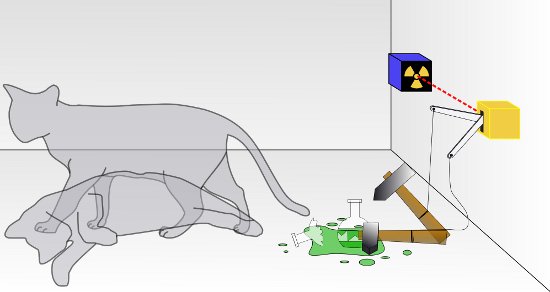
You can find out pretty much anything you want to know about Schrödinger’s cat at Wikipedia, but in short, Schrödinger’s cat is a thought experiment, sometimes described as a paradox, devised by Austrian physicist Erwin Schrödinger in 1935. That means no actual cat was killed or allowed to live simultaneously or in separate states as a result.

Schrödinger’s cat: a cat, a flask of poison, and a radioactive source are placed in a sealed box. If an internal monitor detects radioactivity (i.e. a single atom decaying), the flask is shattered, releasing the poison that kills the cat. The Copenhagen interpretation of quantum mechanics implies that after a while, the cat is simultaneously alive and dead. Yet, when one looks in the box, one sees the cat either alive or dead, not both alive and dead. This poses the question of when exactly quantum superposition ends and reality collapses into one possibility or the other.

What does that have to do with the Calvinism and Arminianism debate? As you probably already know, the debate centers around whether man has free will to choose salvation or if God’s sovereignty forces us to have no choice. Can man participate with God in his salvation or must God unilaterally choose for man?

When you come to a fork in the road, take it.

-Yogi Berra

If I apply Schrödinger’s thought experiment to the conflict, I come up with a resounding “I don’t know.” It’s the difference between Classical and Quantum physics.

For the Jew with traditional leanings, this could be welcome news. The old determinist view of reality accepted by Newtonian mechanics was certainly at odds with the classic Jewish worldview. Could QM allow once again for a world of divine providence, miracles and free choice, a world in which the creatures interact with their creator? Could it perhaps even provide us a better understanding of that legacy perspective?

-Rabbi Freeman

The heavens are telling of the glory of God; And their expanse is declaring the work of His hands. Day to day pours forth speech, And night to night reveals knowledge. There is no speech, nor are there words; Their voice is not heard. Their line has gone out through all the earth, And their utterances to the end of the world. In them He has placed a tent for the sun, Which is as a bridegroom coming out of his chamber; It rejoices as a strong man to run his course. Its rising is from one end of the heavens, And its circuit to the other end of them; And there is nothing hidden from its heat.

Psalm 19:1-6 (NASB)

Under heavenAccording to David, there is no inconsistency with our observation of the universe around us and our understanding of God. God made the universe and everything in it to point to the knowledge of Him. In other words, God doesn’t play “hide the ball” with the universe. What you see is what you get. Paul said the same thing in Romans 1:20, which is why no one has any excuse for a lack of knowledge of a Creative God.

But if Classical Mechanics doesn’t map to the Jewish view of the universe, is Judaism wrong or were the classical physicists? Again, that’s too big a question for me to answer, but I’m liking QM more and more all the time.

OK, no one really thinks that if you actually tried Schrödinger’s thought experiment with a real cat (which would be cruel) that you’d end up with a cat that is dead and alive at the same time. At the macro level, the cat would either be dead or alive. But Copenhagen interpretation of quantum mechanics works pretty well, at least in theory, at the subatomic level. What does it do when you enter into the realm of the supernatural and the mystical?

Chassidic thought doesn’t have a problem with incorporating mysticism into its internal map of how man journeys with God, but that’s not going to satisfy the either/or literalist. The problem is, the either/or literalist is probably going to have trouble with the uncertainty of existence proposed by QM and thus the latest models for how we think things work in the universe around us.

And if you think QM is strange and even bizarre, imagine how things would look to you if you could actually experience God the way Ezekiel did, the way Paul did, or the way John did in each of their mystic experiences as recorded in the Bible. Those events make the puzzle of Schrödinger’s cat seem as simple as riding a bicycle.

Need one remind our orthodox Jewish scientists, who still feel embarrassed about some old-fashioned Torah truths, in the face of scientific hypotheses, that Heisenberg’s principle of indeterminacy has finally done away with the traditional scientific notion that cause and effect are mechanically linked, so that it is quite unscientific to hold that one event is an inevitable consequence of another, but only most probable? Most scientists have accepted this principle of uncertainty (enunciated by Werner Heisenberg in 1927) as being intrinsic to the whole universe. The 19th century dogmatic, mechanistic, and deterministic attitude of science is gone. The modern scientist no longer expects to find Truth in science. The current and universally accepted view of science itself is that science must reconcile itself to the idea that whatever progress it makes, it will always deal with probabilities; not with certainties or absolutes.

-Rabbi Freeman quoting the Rebbe, Rabbi Menachem M. Schneerson

I’m sure this or any other part of Rabbi Freeman’s article won’t convince anyone who thinks in either/or terms to entertain the idea that, from a human being’s point of view, man has total free will and God is totally sovereign at the same time, and yet that’s the only reasonable answer that I can see. Until we actually look in the box, the cat is both dead and alive. Until we can acquire God’s point of view of the free will/sovereignty process, we have total free will and God is totally sovereign at the same time.

The thing is, Schrödinger can look inside the box anytime he likes and that sets the status of the cat on one side or the other: it’s either dead or alive once the box is opened. People can’t access God’s point of view directly. When we “lift the lid of the box,” we are opening the Bible. But the Bible is God’s viewpoint turned into human language. In the moment of “translation” from God’s thoughts to text on paper, we lose a great deal of meaning. We shift from perfection to sufficiency. We open the Bible and the cat is either dead or alive. But the state of the cat depends on which part of the Bible we’re reading.
Torah at SinaiHuman free will or a totally sovereign God? Somehow the answer is both. But if QM experts are weirded out by their own work, how much more should we be weirded out by the universe that God created us to live in?

If you absolutely have to come down on one side or the other of this debate, go right ahead. That means you are picking and choosing those parts of the Bible that either support man’s free will or that support God’s absolute sovereignty. That means you are dragging God and the Bible down into the mud with you. OK, Deuteronomy 30:11-14 says that the Torah is in the mud with us, so to speak, but I believe God, through Moses, was telling the Children of Israel that observing the mitzvot wasn’t an impossible task, not limiting the nature and character of the Word of God itself.

I think the Bible acts as sort of a “translation” of the Divine thought of God as filtered through the personalities and lives of the human writers. By definition, God and human beings had to enter into a partnership to create the Bible. Sure, God could have written it all by Himself without any human involvement, but he chose to let us participate. Does that make God any less sovereign and His Word any less perfect because people were also involved in the Bible’s creation?

The Copenhagen interpretation of quantum mechanics implies (if I may take some liberties) that Calvinism and Arminianism are simultaneously correct and incorrect. Yet, when one “looks in the box,” so to speak, it seems to be one or the other. Only God knows what’s going on in the box without lifting the lid.

The Christian faith is kaleidoscopic, and most of us are color-blind.

-N.T. Wright
from his Forward to the book
The King Jesus Gospel by Scot McKnight

Healing the Gaps in the Wall

destruction_of_the_templeThe next Sabbath nearly the whole city assembled to hear the word of the Lord. But when the Jews saw the crowds, they were filled with jealousy and began contradicting the things spoken by Paul, and were blaspheming. Paul and Barnabas spoke out boldly and said, “It was necessary that the word of God be spoken to you first; since you repudiate it and judge yourselves unworthy of eternal life, behold, we are turning to the Gentiles.

But the Jews incited the devout women of prominence and the leading men of the city, and instigated a persecution against Paul and Barnabas, and drove them out of their district. But they shook off the dust of their feet in protest against them and went to Iconium.

Acts 13:44-46, 50-51

Are believers who live under the law generally joyful people?

Instead of God’s truth, with what did Satan fill the hearts of those who believed that justification before God could only come through keeping the law of Moses? Do you think that they were sensing a loss of influence and control?

-Questions in the Bible Study Class notes from last Sunday

Last Sunday at church, Pastor Randy preached from Acts 13:42-52. I was impressed that Pastor was able to give a sermon on such a potentially inflammatory set of verses in a way that expressed great sensitivity for the Jewish people, and correctly identified (in my opinion) the source of the “irritation” expressed by some of the Jewish leadership in the Pisidian Antioch synagogue upon witnessing vast crowds of pagan, idol-worshiping Gentiles flood into shul to hear Paul speak.

My Sunday School class discusses Pastor’s sermon after services (the church offers multiple classes on Sunday on a variety of subjects, but I chose this one since for me, the highlight of going to church is the sermon), and in going over my study notes the day before, I knew there could potentially be some problems. I wasn’t looking forward to class and once it started, I didn’t know exactly what I was going to say.

Fortunately, although the notes could have been worded a bit better, the attitudes expressed didn’t reflect any negative attitudes toward “the Jews” …

… exactly

No, no one spoke against the Jewish people, but the language of Christians talking about “the Jews” has been crafted over many centuries and there seemed to be an echo of that language in my study notes. If I hadn’t known better, I probably would have been concerned a time or two in class.

Actually, I did become concerned, since the teacher inserted the assumption that part of the reason “the Jews” in Antioch became upset, was because Paul was teaching that the grace of Christ replaces a life “under the Law” for Jewish believers.

As the time to go to class approached, I was still uncertain how or if I was going to respond to this assumption, but when the moment arrived and I heard “the Law” being (apparently) dissed, I asked to read from Psalm 19. I had the ESV Bible with me, but below, I’m quoting from the Stone Edition Tanakh (note that the verse numbers are slightly different between the Christian and the Jewish Bible):

The Torah of Hashem is perfect, restoring the soul; the testimony of Hashem is trustworthy, making the simple one wise, the orders of Hashem are upright, gladdening the heart; the command of Hashem is clear, enlightening the eyes.

Psalm 19:8-9 (Stone Edition Tanakh)

Does that sound like the Psalmist thought the Torah was a burden? That’s the question I asked the class. Pastor, in his sermon, bent over backwards to illustrate that saying “the Jews” in this context, would be highly insulting and would not accurately reflect what was happening in the Antioch synagogue. Not literally every Jewish person turned against Paul and Barnabas and no, Paul did not permanently turn away from bringing the good news of Messiah to Jewish people and take it only to the Gentiles from that moment on. And there’s nothing in the text of Acts 13 that tells us Paul spoke against the Torah.

It’s sections of scripture like this one that have been used by the church to berate, denigrate, harass, and persecute the Jewish people for centuries. Although I didn’t get any push back at all in class as I made my points, I had to be sure that the people I’ve been studying with for over half a year weren’t misunderstanding this portion of Acts 13 based on long-standing Christian tradition (yes, Christians can interpret scripture based on tradition, too).

I don’t believe they were, but it was one of those moments in church that helps me realize we have a long way to go in healing the rift between traditional Christianity and the Jewish people.

I probably wouldn’t have written about this at all except when I got home from church, I went online and read the following:

We are now entering the Three Weeks, the time between the 17th of Tamuz (observed Tuesday, June 25th) and the 9th of Av (starting Monday day night, July 15th). This is a period when many tragedies happened to the Jewish people. Why do we mourn the loss of the Temple after so many years? What did and does it mean to us?

The 17th of Tamuz is a fast day. The fast begins approximately an hour before sunrise and continuing until about an hour after sunset. The purpose of the fast is to awaken our hearts to repentance through recalling our forefathers’ misdeeds which led to tragedies and our repetition of those mistakes. The fasting is a preparation for repentance — to break the body’s dominance over a person’s spiritual side. One should engage in self-examination and undertake to correct mistakes in his relationship with God, his fellow man and with himself.

-Rabbi Kalman Packouz
“Shabbat Shalom Weekly”
Commentary for Torah Portion Pinchas (Numbers 25:10-30:1)
Aish.com

yom-kippur-kotelYou might think I’m being overly sensitive about all this. I suppose some of the people in Sunday School class might think that of me. I couldn’t see all the faces around the room as I was speaking, so I can’t gauge how each person was responding. I can only tell you that no one disagreed with me out loud, and in fact, a few people spoke up in support of my statements.

Rabbi Packouz, while reminding me of the terrible tragedies and losses that have befallen the Jewish people and how Israel is once again entering a time of national mourning, also helped me realize that for every descent, there is an ascent, and every wound offers an opportunity for healing.

The story is told of Napoleon walking through the streets of Paris one Tisha B’av (the 9th day of the Hebrew month of Av, a day of fasting and mourning for the destruction of the two Temples). As his entourage passed a synagogue he heard wailing and crying coming from within; he sent an aide to inquire as to what had happened. The aide returned and told Napoleon that the Jews were in mourning over the loss of their Temple. Napoleon was indignant! “Why wasn’t I informed? When did this happen? Which Temple?” The aide responded, “They lost their Temple in Jerusalem on this date 1700 years ago.” Napoleon stood in silence and then said, “Certainly a people which has mourned the loss of their Temple for so long will survive to see it rebuilt!”

If we know our history and understand it, then we can put our life in perspective. We can understand ourselves, our people, our goals, our values. We will know the direction of our lives, what we want to accomplish with our lives and what we are willing to bear in order to fulfill our destiny. Friedrich Nietzsche put it well, “If you have a ‘why’ to live for, you can bear with any ‘how’.”

Sara Debbie Gutfreund also wrote about the 17th of Tammuz but from a much more personal perspective.

A few years ago my grandfather passed away right before the 17th of Tammuz. On the fast day I was helping my mother as she sat shiva and an old family friend offered me a drink.

“No thanks, I’m fasting.” I said.

“What are you fasting for?” he asked. So I explained that it was the 17th of Tammuz, and we were mourning the day that the walls of Jerusalem were breached before the Second Temple was destroyed.

“I never heard of this fast day. But you know what’s even sadder? Last year my wife and I visited Israel for the first time. We went on a tour of the Old City and the tour guide points out the Temple Mount. And all we could see was this huge mosque and then the tour guide points out the Western Wall. And I couldn’t believe it. That’s it? That’s all that’s left of the Temple? One wall? So I think I know why there’s a fast. There’s so little we have left.”

-from “Filling the Crevices of the Wall”
Aish.com

So where is the uplifting part of the story. I promise you that there is one.

Last night, my son, who is named after my grandfather, was standing with me on the deck.

“Why is the world so big?” he asked me as we gazed up at the towering trees and the endless stretch of star-studded sky.

“I don’t know,” I answered. “Maybe because we need room to grow.”

And as the fireflies began to light up the dark corners of the yard, I thought that it must be true. The darkness is here for us to create light. The brokenness is here for us to learn how to make ourselves whole. And the Western Wall – all that’s left – is so much more than just a remnant of our past. It’s there to remind us to rebuild. It’s there to hold our crumpled notes and dreams. It’s a gift. Like the gap between the waves that pulled me in and brought me back to shore. Like the saltwater that poured down my face and the sand that blurred my eyes. Like the silence that gives us a chance to find our own words. Like the hugeness of the world that makes room for us to grow. Like the man who put down his drink and said. “I think I know why there’s a fast.” There’s a gap. In our hearts. In the crevices of the Wall.

But the gap is the gift. And all that’s left is the extraordinary opportunity to fill it.

I amazes me that a people and a nation who have suffered so much can continue to bounce back and not only to survive, but to live, and grow, and embrace the God of Jacob wholeheartedly. As Napoleon was supposed to have said, “Certainly a people which has mourned the loss of their Temple for so long will survive to see it rebuilt!” Nietzsche’s statement “If you have a ‘why’ to live for, you can bear with any ‘how'” is well and appropriately applied to the history of the Jewish people. The Kotel or what some people refer to as “the Wailing Wall,” is all that there is left of the Temple at present and in the crevices, people insert written prayers to God. The Jewish people fill the gaps in their existence with their faith that one day, God will answer their prayers and send His Messiah to restore them as a people in their Land, to redeem Israel, to raise her up, to give her a King who will bring peace to all the world.

temple-prayersThe gap between Christianity and Judaism gives me the opportunity to help fill it with who I am as a believer and what the Jewish Messiah King means to me. I can fill the gap as a Christian man who has been married to a Jewish wife for over three decades, who has raised three Jewish children, and who is sensitive to what Christians have traditionally said and believed about the Jewish people based on some misunderstood portions of the scriptures.

Not something to dread, but an opportunity to help educate and to introduce a balance (though it probably wasn’t needed much in this case).

But like many Jewish people are doing right now, part of me grieves the losses, even as I know there are gains. It’s going to get worse for our world before it gets better. There will be battles. There will be heartache. There will be a need for courage.

We will need to fill the gaps that God has left us because that is helping to repair the world, tikkun olam. That is part of bringing the return of the Messiah. Part of the gospel message is the promise of personal salvation for anyone who believes. But the especially good news for the Jewish people is that when Messiah returns, he will redeem and restore national Israel, rebuild the walls of David’s fallen sukkah, and bring peace between the Jewish people and the people of the nations who are called by his name.

And beyond what Rabbi Packouz and Ms. Gutfreund reminded me of, I remembered Boaz Michael’s message in his book Tent of David. It is true that, as my friend Tom once said, I’m ultimately seeking not Christianity or Judaism, but an encounter with God by returning to church, but I am also seeking the vision of Boaz Michael in healing the “crevices in the wall” between what Christianity has largely become, and what Messiah truly wants us to be.

The Purpose of Torah in New Testament Judaism, Part 3

world-to-comeRabbi Simeon said: If a man looks upon the Torah as merely a book presenting narratives and everyday matters, alas for him! Such a torah, one treating with everyday concerns, and indeed a more excellent one, we too, even we, could compile. More than that, in the possession of the rulers of the world there are books of even greater merit, and these we could emulate if we wished to compile some such torah. But the Torah, in all of its worlds, holds supernal truths and sublime secrets…

Thus the tales related in the Torah are simply her outer garments, and woe to the man who regards that outer garb as the Torah itself, for such a man will be deprived of portion in the next world.

-Zohar, III.152 as quoted in
The Garments of Torah by Michael Fishbane
Chapter 3: The Garments of Torah – Or, to What May Scripture be Compared?, pg 34

(If you haven’t done so already, please read Part 1 and Part 2 of this series.)

I mentioned previously that there is a strong temptation to take the Torah into mystical and spiritual realms since it seems that’s where it comes from. I also previously mentioned that Pastor Randy believes there is a pure and perfect Word of God that exists in the Heavenly Court and that the Bible we possess in our world, while it contains the Word of God, is not, in fact, the Word of God (ProclaimLiberty commented that indeed this isn’t a correct way to look at the Torah, though). As the Zohar states, we may consider our Bible to be merely a garment, an outer covering, but not the essence of its Holy contents.

Fishbane, in Chapter 3, compares and contrasts Torah as mystic vs. mundane, if I can apply such a word to Torah. This is his response to the current trend in Bible studies to address and consider the Biblical texts from a purely literary perspective. This is the sort of viewpoint we find in Richard Elliott Friedman’s book Who Wrote the Bible?.

Friedman carefully sifts through clues available in the text of the Hebrew Bible and those provided by biblical archaeology searching for the writer(s) of, primarily, the Pentateuch. He does so with clarity and engaging style, turning a potentially dry scholarly inquiry into a lively detective story. The reader is guided through the historical circumstances that occasioned the writing of the sources underlying the Five Books of Moses and the combining of these diverse sources into the final literary product. According to Friedman, the most controversial part of his case is the identification of the writer and date of the Priestly source. This book is neither comprehensive nor unduly complex, making it a good introductory text for beginners and nonspecialists. Recommended for all academic libraries. –Craig W. Beard, Harding Univ. Lib., Searcy, Ark.

Copyright 1987 Reed Business Information, Inc. –This text refers to an out of print or unavailable edition of this title.

-as quoted from Amazon.com

Many modern Bible scholars are in love with the “JPED” theory of Old Testament (Tanakh) authorship, but in this approach, said-scholars all but remove God from the equation and reduce the Bible to a book written for political, religious, and personal motivations, rather than to impart the history and message of God’s interaction with human beings.

However, mysticism is an equally difficult realm in which to thrust the Bible as it far exceeds mere “inspired Word of God” and goes into structures of comprehension that are supposed to transport us into the upper chambers of the Almighty. I personally know some people in the Hebrew Roots movement who immediately become offended and incensed at the mere mention of the “K-word” (Kabbalah) and the quote from the Zohar above is not likely to earn me any points with them.

I’ve admitted before that I’m not mystic. I appreciate and enjoy some of the Jewish mystic writings as metaphors for certain spiritual truths, but I don’t take them as literal experiences. In fact, in an effort to understand something of the Christian mystical perspective, I recently read John A. Sanford’s book Mystical Christianity: A Psychological Commentary on the Gospel of John, however Sanford’s attempt to analyze this gospel from the perspective of Carl Jung and Jungian psychology seemed anachronistic and distracting rather than spiritually revealing.

I do agree though, that if we look at the Bible just as a book, even a Holy and inspired book, and see only the nuts and bolts narrations, our understanding of the message God is trying to deliver to humanity will be extremely limited. The problem is, digging any deeper than the literal meaning of the text presents the danger of getting lost in either mystical byways or just our own imaginations.

I started writing this series as an effort to explain what “keeping the Torah” means to the Jewish disciples of Yeshua (Jesus) but the “question behind the question” is “What is Torah?” That’s an amazingly difficult question to answer.

But if we lack wisdom by considering a mitzvah as just a text on paper narrative (the commandment to visit the sick) or as a simple behavioral act (visiting a sick friend in the hospital), do we gain wisdom and insight and the deeper meaning of Torah by considering the study and performance of a mitzvah as a transcendent act that intimately connects us to God?

“Such a man,” says another Zoharic text (II.99a-b). “is…a ‘bridegroom of the Torah’ in the strictest sense…to whom she (divinity as beckoning Bride) discloses all her secrets, concealing nothing.”

-Fishbane, pg 35

transcendent-shechinahHere, I see a poetic image of the Torah in her “garments,” chaste before her bridegroom, and approaching the act of intimacy, she sheds her clothing, revealing herself to her beloved and finally, she holds back no secrets from the spirit of her cherished one. Fishbane, in discussing the bride, presents both the narrative or legal form of the Torah, the bride in her garments, and the expression of divinity, the inward truth of God, the veiled body of the bride in the process of disrobing as the groom not merely studies Torah but occupies himself (“osek”) fully in Torah:

Said Rabbi Joshua the son of Levi: Every day, an echo resounds from Mount Horeb, proclaiming and saying: “Woe is to the creatures who insult the Torah.” For one who does not occupy himself in Torah is considered an outcast, as is stated “A golden nose-ring in the snout of a swine, a beautiful woman bereft of reason.” And it says: “And the tablets are the work of G-d, and the writing is G-d’s writing, engraved on the tablets” ; read not “engraved” (charut) but “liberty” (chairut)—for there is no free individual, except for he who occupies himself with the study of Torah. And whoever occupies himself with the study of Torah is elevated, as is stated, “And from the gift to Nahaliel, and from Nahaliel to The Heights.”

-Pirkei Avot (Ethics of Our Fathers) 6:2

As Fishbane progresses in his writing, he temporarily sets aside the mysticism of Torah to “put matters in a fuller historical and hermeneutic perspective.” (pg 36) Fishbane characterizes the Torah being viewed in ancient Israel as “the divine voice” spoken directly or indirectly through a number of “filters” (Prophets or more indirect signs and wonders). God’s revelations are expressed in the text as legal and ethical teachings presented across an epic narrative of the history of Israel and her relationship with God.

However, if the text is treated too much like “text,” there is a danger of swinging the pendulum too far in the other direction and stripping the Torah of its divine origins and worse, reducing it to a set of anachronistic tribal laws that do not “travel well” going forward in time.

Of considerable importance in the sanctification of Scripture is that the prestigious literary canon of divine teachings had become a “closed literary corpus” – one culturally reopened only through human textual exegesis.

-Fishbane, pg 37

This leads us to Fishbane’s commentary on the early Pharisees and their comprehension of the “paradoxical and dialectical” nature of the scriptures. According to Fishbane, their resolution to the ambiguities presented in the Bible and in an effort to prevent Torah from becoming a “dead letter,” was to search the text “in every possible way for every possible prolongation of the original divine teachings in new times,” thus making “the old written Torah (into) a ‘living Torah.'”

So we stand between preserving the divinity of scripture as a romanticized mystical text and hermeneutically extending the Torah in order to adapt its divine truths to a constantly changing environment.

I can imagine that neither perspective will be particularly appealing to most readers.

I once criticized John MacArthur because I mistakenly believed he said that, in defining “Biblical sufficiency,” the Bible was literally the only book anyone would ever need to understand any topic.

I’ve since learned that “sola scriptura” doesn’t quite work that way, though I’m still not a big fan of this method of considering the Bible. Fishbane however, explains that Rabbinic commentary takes the idea of “the Bible contains all there is” to a level that would make even MacArthur balk.

…the early Pharisees revealed unexpected possibilities in the original divine communication. It was gradually claimed that “all is in it” (Mishna Abot v.25) – or better, that all could be recovered from it if one but had the appropriate hermeneutic key.

-ibid, pg 38

heurmenutic-keyIn considering my commentary on Boaz Michael’s teaching “Moses in Matthew,” I can only believe that under the inspiration of the Holy Spirit, the apostle Matthew “had the appropriate hermeneutic key” in extracting and applying portions of the Torah, Prophets, and Writings to the life of Messiah in ways that had not originally been presupposed (Hosea 11:1 to Matthew 2:15 for instance). However, unless we assume that the Pharisees and the later Rabbinic Sages also had access to the same influences of the Spirit, can we believe that their “hermeneutic key” is just as “appropriate” as Matthew’s, and that it unlocked the same doors?

I previously wrote a multi-part commentary based on the paper “Matthew 23:2-4: Does Jesus Recognize the Authority of the Pharisees and Does He Endorse their Halakhah?” written by Noel Rabbinowitz for the Journal of the Evangelical Society (PDF). In his paper, Rabbinowitz concluded that not only did Jesus recognize the halachah of the Pharisees but he acknowledged that they had the authority to establish valid halachah in Israel!

This may be a bit of a stretch for most of you reading this, but if we allow Matthew 23:2-4 to act as a bridge between the inspired authority of the gospel and other New Testament writers and the subsequent Rabbinic authorities in Judaism, we may somewhat reasonably conclude that halachah established after the New Testament canon was closed was still tacitly approved from Heaven.

This interpretation has tons and tons of problems (Rabbi Carl Kinbar posted a wonderfully insightful comment on this matter), not the least of which are the pronouncements of the Rabbis which are in direct opposition to Jesus and faith in him as Messiah, however dismissing this perspective out of hand denies not only the stated word of Messiah in the Bible, but the opportunity to view post-exile Judaism as possessing leaders who indeed did speak to and hear from God (which is historically what Christianity has done in the development of supersessionism for the past nearly twenty centuries).

Returning to Fishbane and connecting him (temporarily) with Matthew, I believe that Matthew “encoded” certain information in his gospel that could only be decoded or unpackaged by an audience with the “appropriate hermeneutic key,” one that provided the traditional associations and interpretations to older sections of the Holy text. In addressing scripture, the Pharisees and the Jewish sages who followed them attempted to continue to unlock the pages of the scriptures using (inspired?) hermeneutic keys and amazingly, Fishbane acknowledges that Christianity has done the same thing.

Surely you will have caught here more than a faint Jewish echo of the well-known “interpretatio Christiana,” by means of which Virgil and other pagans were accommodated by the Church Fathers into the normative Christian fold insofar as their writings were shown to “anticipate” the real good news — albeit through a glass darkly.

-ibid, 39

OK, so it doesn’t sound like that much of a compliment, but it does compare the interpretative activities and methods of the Pharisees to the early church fathers conferring, if only by inference, the authority to said-church fathers to develop valid Biblical interpretations. Of course, I have to deliver the same caveat for some of their hermeneutic gymnastics (especially those that discount Israel and denigrate the Jews) as I do certain conclusions, rulings, and pronouncements by the Rabbinic sages that discount the Messiahship of Yeshua.

So where does all this leave us?

…and thus to regard the uniqueness of Scripture as its capacity to teach simultaneously at various cognitive levels; the esoteric tradition of Judaism was concerned to encounter the presence of God, and thus to see the special sanctity and uniqueness of Scripture in its being at once a hieroglyph of the divine Logos and divine Reality itself. God is not merely present in Scripture through a kind of verbal displacement. God and Scripture are, in fact, one mysterious and inseparable Truth.

-ibid, pg 42

simhat-torahWhat is Torah and how is it applied in the lives of New Testament Jews, both in the first century CE and today? The answer seems to travel in different directions. Torah is a bride and the Jewish people are the bridegrooms, and at the intimate urgings and involvement of the bridegroom, the bride begins to doff her garments and reveal her deeper mysteries and truths. Torah is a multi-layered, encapsulated, encoded set of pronouncements that at once present the details of moral, ethical, and legal standards and that, properly read, reveal the divine meaning lurking behind the words on the page, allowing the performance of each mitzvah not simply to be a “good deed” but an act of loving intimacy and devotion of the Jewish people to God.

Mystic or hermeneutic pathways both leading to the same goal: the desire to draw nearer to the Creator.

In this, I don’t mean to say that only Jews desire intimacy with God or that Christians cannot deeply occupy themselves in Torah and benefit from the experience, but the focus of this series has to do with the purpose of Torah in the lives of the Jewish disciples of Messiah. Thus, my focus must be on Torah as applied specifically to Jewish people.

Part 4 of this series should return to this topic and confront something a little less “mystical.”

Balak: Disciples of Abraham and Bilaam

Moses at NeboThis week’s portion is one of the most fascinating psychologically-revealing portions in the whole Torah! Bilaam, a non-Jewish prophet, was granted a level of prophecy close to Moshe’s level of prophecy. The Almighty gave Bilaam these powers so that the nations of the world could not say at some point in the future, “If we had a prophet like Moshe, we too would have accepted the Torah and would have lived according to it.” Bilaam is an intriguing character — honor-driven, arrogant and self-serving. Unfortunately, not too unique amongst mankind.

-Rabbi Kalman Packouz
“Shabbat Shalom Weekly”
Commentary on Torah Portion Balak
Aish.com

Interesting commentary, but don’t the Gentiles also have a prophet in Jesus Christ? Well, not exactly. Not as a “stand-alone” Gentile prophet. However the Jews have a greater prophet than Moses, and therein lies a tale:

The Lord your God will raise up for you a prophet like me from among your own people; you shall heed such a prophet.

Deuteronomy 18:15 (NRSV)

Repent therefore, and turn to God so that your sins may be wiped out, so that times of refreshing may come from the presence of the Lord, and that he may send the Messiah appointed for you, that is, Jesus, who must remain in heaven until the time of universal restoration that God announced long ago through his holy prophets. Moses said, ‘The Lord your God will raise up for you from your own people a prophet like me. You must listen to whatever he tells you.’

Acts 3:19-22

Moses announced that a prophet like him would arise in later days and Peter announced that Yeshua (Jesus) was that prophet. That is good news, very good news for the Jewish people, but what about the Gentiles? Don’t we still have the right to say that if we had a prophet like Moses, we too would have repented? How can you compare Bilaam to Moses? Rabbi Packouz characterizes Bilaam as “arrogant and self-serving” while we know that Moses was the most humble of all men (Numbers 12:3).

The Talmud gives the characteristics of the disciples of Abraham: a benevolent eye, a humble spirit and a meek soul. The traits of the disciples of Bilaam are: an evil eye, an arrogant spirit and a greedy soul.

Pirkei Avot (Ethics of the Fathers) 5:2
from Rabbi Abraham J. Twerski’s Dvar Torah on Balak

If Jesus was the prophet and Messiah for the Jewish people only, then we Gentiles have no hope. The best we can aspire to is being God-fearing Gentiles or Noahides, non-Jewish people who adhere to the seven laws of Noah as codified by Orthodox Judaism.

But what more can we say for ourselves?

Is this blessedness only for the circumcised, or also for the uncircumcised? We have been saying that Abraham’s faith was credited to him as righteousness. Under what circumstances was it credited? Was it after he was circumcised, or before? It was not after, but before! And he received circumcision as a sign, a seal of the righteousness that he had by faith while he was still uncircumcised. So then, he is the father of all who believe but have not been circumcised, in order that righteousness might be credited to them. And he is then also the father of the circumcised who not only are circumcised but who also follow in the footsteps of the faith that our father Abraham had before he was circumcised.

Romans 4:9-12

Apostle-PaulSo Abraham was the father of the circumcised and the uncircumcised, the Jews and the Gentiles, and all through faith, not works. Does this not make us sons of Abraham even as the Jews are his sons? Do we also not have faith, though we are not Jewish?

Go therefore and make disciples of all nations, baptizing them in the name of the Father and of the Son and of the Holy Spirit, and teaching them to obey everything that I have commanded you.

Matthew 28:19-20

But the Lord said to him, “Go, for he is an instrument whom I have chosen to bring my name before Gentiles and kings and before the people of Israel; I myself will show him how much he must suffer for the sake of my name.” So Ananias went and entered the house. He laid his hands on Saul and said, “Brother Saul, the Lord Jesus, who appeared to you on your way here, has sent me so that you may regain your sight and be filled with the Holy Spirit.”

Acts 9:15-17

It seems fairly straightforward then, that the “prophet greater than Moses,” the Jewish Messiah King is also the prophet to the Gentiles, specifically assigning Saul (Paul) to take the good news which is good news to the Jews, and declare it also good news to the Gentiles.

Yes, there were prophets among the Gentiles, and depending on how you view Abraham pre-circumcision, you may think of him as a Gentile, but we are sons of Abraham by adoption and disciples of Messiah, the great Jewish tzaddik and prophet and Moshiach, not of such men like Bilaam…that is unless we choose such a path, Heaven forbid.

Even Bilaam could not disobey the word of God by speaking ill of Israel, but his heart was not pure and where is “magic” failed, his evil schemes succeeded. But he spoke with God. Balak talked and God answered him. How can such a thing be?

“Bilaam spoke up and said, ‘Whatever God puts in my mouth, that I must take heed to speak” (Numbers 23:12). Are these not the words of a tzaddik (a righteous person)? Anyone hearing Bilaam might conclude that he is a very God-fearing person.

-Rabbi Twerski

The Almighty allowed Bilaam to go to Balak (cautioning him to only say what God told him). The Almighty gives every person free-will and allows us to go in the direction that we choose. Three times Bilaam tried to curse us and three times the Almighty placed blessings in his mouth. Balak was furious! So, Bilaam gave him advice with hopes of collecting his fee — “If you want to destroy the Jewish people, entice the men with Moabite women and tell the women not to submit until the men bow down to an idol.” Balak followed the advice and consequently the Almighty brought a plague against the Jewish people because the men fell for Bilaam’s plot.

-Rabbi Packouz

Though a prophet, Bilaam was wholly evil and disobeyed God whenever the Almighty would permit such a thing. Although Moses was not a perfect man, he was dedicated to preserving the Children of Israel and obeying God in guiding them through the wilderness for forty years and making sure they arrived at the Jordan and the threshold of the promise.

ancient_jerusalemWhat can we learn from all this? The important lesson is that we Gentiles, those of the nations who are called by His Name, have no entry into the Kingdom of Heaven or relationship with the God of Israel without Israel, her promises and her prophets and especially the prophet, the Holy One, the Tzaddik, Yeshua (Jesus), the Messiah. There is no “Gentilized” allegory or process that paints us into God’s picture. We enter the Kingdom through Israel or we enter it not at all.

To say that we accept Jesus while disdaining Israel makes us disciples of Bilaam and not Moshiach.

And I will bless those who bless you, And the one who curses you I will curse. And in you all the families of the earth will be blessed.

Genesis 12:3

If we curse Israel, even as we bless Jesus, we are also cursed. Maybe those Christians who curse Israel are among the following:

“Not everyone who says to me, ‘Lord, Lord,’ will enter the kingdom of heaven, but only the one who does the will of my Father in heaven. On that day many will say to me, ‘Lord, Lord, did we not prophesy in your name, and cast out demons in your name, and do many deeds of power in your name?’ Then I will declare to them, ‘I never knew you; go away from me, you evildoers.”

Matthew 7:21-23

Good Shabbos.

96 days.

Learning God

davening_morningIn the early period of his leadership the Alter Rebbe taught: “The footsteps of man are directed by G-d.”(Tehillim 37:23) When a Jew comes to a particular place it is for an (inner Divine) intent and purpose – to perform a mitzva, whether a mitzva between man and G-d or a mitzva between man and his fellow-man. A Jew is G-d’s messenger.

Wherever a messenger (shaliach) may be, he represents the power of the meshalei’ach, the one who sent him. The superior quality that souls possess, higher than the angels (who are also “messengers”), is that souls are messengers by virtue of Torah.

“Today’s Day”
Tuesday, Tamuz 10, 5703
Compiled by the Lubavitcher Rebbe; Translated by Yitschak Meir Kagan
Chabad.org

If you know something worthwhile, share it. By reaching others, you will reach yourself.

Whatever you learn – from books, lectures, or life experience – do so with the goal of sharing with others. If it was fascinating, how did it change you? What did it teach you about living? And how can you transfer that insight to others?

-Rabbi Noah Weinberg
“Way #46: Learn In Order To Teach”s
Aish.com

Sharing life experiences? Rabbi Weinberg is talking my language.

The past two “morning meditations” were my commentary on a teaching given by First Fruits of Zion (FFOZ) President and Founder Boaz Michael called Moses in Matthew. One of the essential points I tried to get across is that not all of the information “encoded” in the gospels (or the rest of the Bible for that matter) can be accessed and understood apart from a Jewish context. That context includes not only understanding the original languages and the cultural and historical framework of the time in which the Bible writers were operating, but the philosophical, religious, and midrashic material that would have been in the minds of those writers and their immediate audiences.

While the Bible is truly the inspired word of God, the Bible writers most likely had no idea that what they penned would be translated into hundreds of languages and consumed by nations and cultures all over the planet, two-thousand or more years into the future. In their intent, they were writing to people like them, people they knew or knew about, a specific and contemporary  readership.

Localization, when applied to language, is the process of writing a document in one language with the specific purpose that it be (more or less) easily translated into other languages. That requires the original document be written as “generically” as possible, employing no slang, idiom, or other language forms that are difficult to translate literally into other languages.

But one of the things we know or should know, is that the Bible writers used a lot of word play, symbolism, imagery, idiom, slang, and nicknames that were extremely specific to not only the original languages but to the time and culture in which these writers were living. To make matters worse, the Greek of the New Testament can seem extremely awkward at communicating thoughts and ideas that the Hebrew thinking/speaking writers were attempting to communicate.

My Pastor, who is fluent in Hebrew, agrees that some of the New Testament phrases written in Greek are worded in a very difficult manner, but they become much clearer when “retro-translated” into Hebrew (which is one of the reasons why the Delitzsch Hebrew Gospels are extremely helpful).

man_risingThe quote from “Today’s Day” at the top of this blog post says in part that “A Jew is G-d’s messenger. Wherever a messenger (shaliach) may be, he represents the power of the meshalei’ach, the one who sent him.” That’s quite true but as disciples of the Jewish Messiah, even we Gentiles are messengers of God and we also represent the one who sent us.

Rabbi Weinberg says that the purpose of learning is to teach, not that we must all take on the role of a formal teacher, but any time we communicate something we have learned to another, we are teaching them what we learned. That’s what I’m doing with this blog.

The interesting thing is that, based on everything I’ve written over the past several days (and long before that), as Christians, we can’t really learn the Bible beyond a certain point until we learn to read it “Jewishly.” Therefore, we can’t really teach what we’ve learned about the Bible beyond a particular limit until we’ve learned to teach it “Jewishly.”

This isn’t to say that we Gentile Christians will ever learn to conceptualize the world in the same way as someone who was born into a Jewish home, raised and educated within a fully cultural and religious Jewish context, and as someone who lives a life that is halachically Jewish. I live with a Jewish wife and have three Jewish children and I don’t come anywhere near understanding my world from the Jewish perspective, let alone writing from that perspective.

But hopefully I’ve learned enough to add a bit of an “accent” to my language…to communicate from a different perspective, presenting my understanding of the Bible (limited though it may be) in a way that appears new or at least different from what most Christians teach and comprehend.

According to Rabbi Weinberg, you don’t have to be perfect to teach. That’s a lesson I know all too well:

The best teachers make mistakes; more at the beginning, less later on. It’s like riding a bike or driving a car – the more you do it, the easier it becomes. Nobody ever became a great teacher without flopping a few times.

The first time, you’ll probably be laughed at. But don’t be discouraged. (Be glad they didn’t curse you!) Try again. The second time they’ll argue with you. That’s a good sign already; you’ve got them engaged. The third time they’ll thank you. That makes all the previous efforts worth it.

The same way a budding artist needs to study under the masters, a teacher needs to study the methods of great educators. If you have a favorite teacher (or journalist, actor, etc.) be conscious of their techniques for communicating the message.

But don’t wait until you’re perfect – because that’s a long way off! Just get started and teach as best you can. It will do wonders to help clarify your own viewpoint.

Of course, no one will ever become a perfect teacher and some people are more naturally gifted in that role than others. One of the reasons I write is to clarify what I’m learning within myself. Sometimes presenting that to others helps me learn as well. If the Jewish people were called to be a light to the nations, then Messiah has taught us that we need to be a light, too. We are learning things from our Master that are well worth sharing, but as he said, a light cannot shine if it is hidden under a basket.

GardeningLearning and teaching is a living, organic process. We know we’re alive when we are interacting, not only with other human beings, but with God. We are fulfilling the purpose of our existence. We are exercising the reason for our design.

We don’t have to be perfect and we don’t even always have to be all that good. We do have to do, though. If we are sincere, and motivated, and acting in His Name, we will move forward, we will learn, we will teach, and with the help of God, a few people will actually understand, then learn, and then teach too.

People think that to attain truth you have to pulverize boulders, move mountains and turn the world upside-down. It’s not so. Truth is found in the little things.

On the other hand, to move a mountain takes some dynamite and a few bulldozers. To do one of those little things can take a lifetime of working on yourself.

You do what you can: Learn and meditate and pray and improve yourself in the ways you know how—and He will help that what you do will be with Truth.

-Rabbi Tzvi Freeman
“Small Truths”
Based on letters and talks of the Rebbe, Rabbi M. M. Schneerson
Chabad.org

“I long to accomplish a great and noble task, but it is my chief duty to accomplish small tasks as if they were great and noble.”

-Helen Keller, American writer and political activist

The Master said (Luke 21:15), “…for I will give you words and a wisdom that none of your opponents will be able to withstand or contradict.” While that may not always seem true given the amount of ridicule believers receive from various members of our society, we are not abandoned and alone, either. Learn and keep on learning, but information kept to yourself only helps you. You are only serving God when you share it and Him.

Blogging from the Ashes

drowning-in-ashesI am but dust and ashes.

Genesis 18:27

As far as my blog is concerned, I need to have things settled and digested in my own mind, before I impose them on others! I am not saying that this is what you do, as I view your blog more of an exploration of the spiritual and perhaps encouragement for fellow “travelers”, instead of a place for doctrinal pronouncements and apologetics.

-from a private email conversation

Ironically, this is almost exactly what Pastor Randy said to me about the difference in how we write during our most recent Wednesday night conversation. In talking to him and recalling my previous conversation with Rabbi Carl Kinbar about how and why I blog, I realized just how different I am from most people who write on the web, or even just most people who write.

If you’ve read the last few blog posts I’ve published, then you know that I’m backing away from the idea that anything I write, say, or do is any sort of rip-roaring big deal. I keep catching myself in mistakes. No, that’s not right. Other people keep catching me in mistakes. Yeah, yeah, I know. It’s arrogant to think you’ll never make a mistake, but it’s still no great honor, either.

I like the idea of being an explorer and I tend to think of myself and this blog in that light, but lately, I’ve been feeling like less like an explorer and more like a rat in a maze…and I keep finding all the dead ends instead of the cheese.

But in talking to Pastor Randy and turning everything over in my mind, I realized that my purpose in writing this blog isn’t to get things right all the time or to strive to conquer other people’s differing opinions of me and what I think about. Sure, I try to do that sometimes, and that’s when I start getting discouraged.

But while others may only publish their words in print (or electrons) once they’ve fully digested a topic and have come to what they believe is a rock-solid conclusion, that’s not what I’m trying to do. If that were my purpose, it would take me a lot longer to come up with even a single blog post, and these would become weekly or even monthly meditations, not every morning missives.

I’ve said before that as of 2011, there were an estimated 181 million blogs on the web. That makes any one blog (and blogger) seem pretty insignificant by comparison. Whenever I think about “winning,” I start feeling pretty insignificant as well, not just in terms of the blogging population on the Internet, but as far as people, friends, family, and God goes too.

dark_tunnelI’ve thought about quitting. I’ve thought about throwing in the towel because I can’t come up with “perfect” ideas or “perfect” ways to describe them in my blog. I’ve thought about quitting because people can shoot holes in everything I say or do all day long.

Then I realized that of course people can shoot holes in my thoughts. I’m not arriving at conclusions, at least not very many of them. As you read my blog posts, it’s important that you understand how they come into being. How do I write a blog post?

I start with a quote or an idea that has spawned some sort of interest in me. I have an amorphous thought of how I want to pursue my inspiration, but I don’t really have an endpoint in mind. That’s right, even as I’m keyboarding this, I really don’t know how it will end, which is why some of my posts are from 1000 to 1500 words long, and others exceed 3000 words. No outline, no pre-conceived structure, no bullet points or notes (well, sometimes I use notes) to guide me.

What you are reading is my mind in operation moment by moment, or at least as fast as I can type.

I don’t know anyone else who blogs like this. I explained to Pastor Randy that, based on the feedback I get, what I do is appreciated, at least by some folks, because lots and lots of people are processing the same sort of questions I am. It’s just not visible because no one blogs about “half-baked” thoughts. No one likes to serve up raw food unless its sushi, which is the finished product. The way I write is like watching someone trying to develop a recipe for something they’re going to cook in the near future, but you only later get to see some of the cooking and you may never taste what finally comes out of the oven.

I think that’s called “living.” We do it day by day and each day is a little different. God may never change, but our experiences with Him do, because if we’re growing spiritually, we change. Even if there are areas where I’m not changing, what’s reflected in my blog posts are the continuing struggle and engagement with that “stuck” place in my life. I think lots of people have a stuck place in their lives, too. I know a few people who have a hard time letting go.

Yesterday (as I write this), I felt pretty insignificant, very small, especially without purpose. But in talking to Pastor, I came to rediscover that I have a unique perspective or at least a unique way of expressing it. The point of my writing is not to sell you on my perspectives as being “right.” I’m not giving you answers. I haven’t come to many conclusions. I’m not some self-appointed guru out to sell you some form of enlightenment based on my “specialness” as teacher, or leader, or scholar, or any of that.

Well over three-hundred years ago, French mathematician and philosopher René Descartes famously said “cogito ergo sum” or “I think, therefore, I am.” In my case, it’s “I think/feel/experience/live, therefore I write.” That’s really the whole of it. What you see (read) is what you get.

If I had to know every thing and be right all the time, I’d be horribly trapped in a steel box, shackled in chains, imprisoned in my own need to have a carefully designed system that explained everything I write about. But writing as I do, just because I am, just because I live, is very liberating.

soaring_hawk

Being transparent is like flying, soaring up through the clouds. Like a phoenix at the keyboard, I’m blogging from the ashes and rising into the sky.

Yet those who wait for the LORD Will gain new strength; They will mount up with wings like eagles.

Isaiah 40:31 (NASB)

Thanks, God. I needed the lift.