Tag Archives: God

Experiencing Prayer

Rabbi DovBer, the Maggid of Mezeritch, used to pray at great length. Sometimes his prayers would take hours. Near Mezeritch there lived a learned man who, like the Maggid, also used to pray according to the kavanot (mystical intentions) taught by the holy Ari (Rabbi Yitzchak Luria) of Safed, but whose prayers did not take so long. When he heard about how much time the Maggid spent, he was perplexed, and wanted to know the reason. He decided to ask the Maggid himself.

Once a year this learned man, who also happened to be quite wealthy, would travel to the great fair in Leipzig. There he would invest some of his capital in merchandise, which he would then sell in his hometown upon his return at a good profit. He was able to live off the proceeds from these transactions for the rest of the year, while he devoted his time to Torah study and prayer. On his next such business trip, he made a point to pass through Mezeritch and stop there.

Witnessing for himself the Maggid’s lengthy prayers, he was amazed. At his first opportunity to speak privately to the Maggid, the wealthy scholar said, “I also pray according to the special mystical intentions taught by the holy Ari, yet I don’t find the necessity to extend my prayers for so long.”

Instead of answering directly, the Maggid expressed interest in how his guest made a living. The man explained how it was enough for him to travel once a year to Leipzig to invest in merchandise, which he then sold for a good profit in the area where he lived.

“But how do you know that you have made a profit?” inquired the Maggid.

“Simple. I enter all my capital expenditures and traveling expenses in my ledger, and subtract their sum from the total amount of income from sales. The remainder is my profit,” replied the merchant, wondering why the rebbe was so interested in the details of his business.

“But why,” the Maggid asked innocently, “do you waste all that time and money traveling to Leipzig and back? Why don’t you just write all the credit and debit figures down in your ledger and calculate your profits that way, without fuss?”

“Ha, ha, ha!” laughed the merchant. “Is it possible to think that from writing numbers can come a profit without bothering to do anything else? Ha, ha, ha. Of course, you have to travel and buy and sell before the profit can be real, not just theoretical.”

“Well,” said the Maggid, “the kavanot are like merchandise: if they are not fully possessed in your mind and heart as if you were ‘there,’ it is like writing profit figures on a piece of paper without doing the business work. On the other hand, if you are firmly attached ‘there,’ you can then acquire some excellent ‘merchandise’ and make a handsome profit with the kavanot.

“But that,” concluded the Maggid to his astonished visitor, “requires extended time and investment in prayer.”

Translated/retold from Reshimas Devarim, vol. 4.
“The Prayer Business”
-Rabbi Yerachmiel Tilles
Chabad.org

Man should ponder thoughtfully how great are the kindnesses of the Creator: Such a puny insignificant being, Man, can bring great delight to the “Greatest of all great”‘ of Whom it is written, “There is no delving into His greatness.” (Psalm 145:1) Man ought therefore always be inspired, and perform his avoda with an eager heart and spirit.

“Today’s Day”
Sunday, Kislev 8, 5704
Compiled by the Lubavitcher Rebbe
Translated by Yitschak Meir Kagan
Chabad.org

I’m not really a “mystic” sort of guy. I enjoy reading (I don’t seriously study mysticism) mystic commentaries and texts because I find they work wonderfully as metaphors of moral and spiritual concepts and ideas. Mysticism is a very good way to tell stories about people and God, which is why I’m fond of the writings of the Chassidim and Chabad.

So try not to take the commentary about prayer I quoted above as if I think this is a literal truth, although for some, I imagine it is. I latched onto it mainly because it makes me think about prayer and what it’s supposed to mean. Hopefully, it’ll make you think more about prayer, too.

DaveningIn yesterday’s morning meditation, I spoke a bit about my use of the Modeh Ani and Bedtime Shema blessings in my own life. Prayer is difficult for me, at least lengthy prayer, because I find that so many random thoughts and emotions creep in when I’m trying to talk (and listen) to God. Since the Modeh Ani is fairly short and I recite it from memory, there isn’t time for anything else to interfere, and since I recite the ending portion of the Bedtime Shema from my siddur, the fact that I’m reading from text helps focus my thoughts and my intention.

I actually have been thinking more about prayer since I read a friend’s commentary on his own experiences recently:

Early this morning before my flight had left the gate, I was quietly (and discreetly) praying Birchot Hashachar (morning blessings) from my pocket siddur when suddenly the woman sitting next to me asked me, “What language is that?” “Hebrew,” I replied. “Oh, I thought it was Greek,” she said.

“Well, I actually know that, too,” I said, which then led into an extensive conversation that unfortunately I was too tired to engage in and, B”H, managed to escape shortly after takeoff by falling asleep for the duration of the flight. (A window seat and foam earplugs are always my best friends on a flight.) Then after landing, I went to the airport chapel to pray Shacharit. I must have prayed Shacharit there countless times while travelling, and I usually have the chapel all to myself. Sometimes other people enter the chapel for some quiet moments while I’m there and they see me wearing my tallit and tefillin, which I can only imagine how that might look to them if they’re unfamiliar with Judaism. Usually they only stay for 30 seconds—one minute at most—and then they promptly leave. (I can always sense their feelings of uncomfortability and awkwardness.)

However, this morning while I was donning my tefillin, a clean cut, black gentleman dressed in a suit and tie entered the chapel and sat down a few seats behind me. I politely said “Good morning” to him, then began quietly praying Pesukei d’Zimra and continued with my usual morning prayer routine as quietly and discreetly as possible. Amazingly, however, he actually stayed. A few minutes later, when I was between the Shma and Amidah, he began walking toward the exit, but then quickly turned around, boldly approached me, and asked me forthright, “Do you believe in Jesus Christ?” I was a bit taken aback by his question and it took me a few seconds to process it. “Yes, I do,” I responded, although somewhat apprehensively. “Oh, praise the L-RD,” he said, and reached out to shake my hand. “Something in my heart told me to ask you that. I’ve heard of you guys. Yeshua Ha-ma-shee-ah?” “Yeshua Hamashiach,” I affirmed. And then he suddenly walked out with this big smile on his face while I was left there wondering what that was all about.

Depending on who you are and how and where you pray, you aren’t always praying alone and your prayer life may have some sort of impact on others. Of course, even when I prayed with a siddur, I rarely prayed in public (unless it was at a worship service where everyone was using a siddur), so I never had these sorts of encounters. But in reading the comments of my friend about his own experiences, I was reminded of the beauty of the Jewish prayers and how the early Jewish believers gathered daily to recite the prayers at Solomon’s colonnade at the Temple in Jerusalem.

I’ve probably mentioned this before, but last spring, when I was attending the First Fruits of Zion Shavuot Conference at Beth Immanuel Shabbath Fellowship in Hudson, Wisconsin, I had a wonderful experience. One morning, I arrived at the congregation early and was sitting in the main sanctuary waiting for services to begin. In the distance, I heard men davening Shacharit in Hebrew. I followed the sound into the library and discovered the men were praying together in an upper room. Not wishing to disturb them (and my Hebrew is more than abysmal), I chose to stand underneath the room and just listen.

If you’ve ever heard men praying the Hebrew prayers before, you know it is a beautiful sound and even without understanding all of the words (I’ve been around the prayers enough to be able to generally follow them), I felt myself transported in a sense, lifted up into the spirit of the prayer, and found myself drawing closer to God.
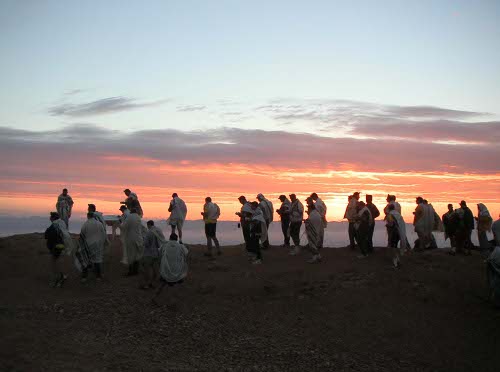
I don’t think you have to pray in Hebrew to draw closer to God, but there’s something about a minyan davening (not that I can qualify to pray with a minyan) that brings me into communion with God in a way I’ve never found when praying or singing hymns in a church.

Be that as it may, we are each responsible for our own prayer life and thus our relationship with God. And yet for me, prayer is one of the most difficult parts of my relationship with God. I receive great joy in reading the Bible and various commentaries and studies, but spending time alone with God is so difficult, again because my brain keeps getting in the way. I think that’s why I like praying with a siddur because it helps me focus my intention upon God and praising His Name. Praying “alone,” that is, without a siddur, allows the noise and static of my own thoughts to completely take over, and I find myself drowning in the sound that my brain generates rather than rising above my own existence and approaching the Creator.

When I go to church, we pray, but it somehow isn’t the same. When I go to Sunday school, we pray, but it’s not like we’re praying together. This too I think is one of the “weaknesses” of Protestantism.

I don’t really have an answer to my conundrum, but I think Rabbi DovBer has an answer that works, at least for some Jewish people (or people of faith), in that you have to invest in your prayers rather than just use praying as a “remote control” method of communication. Prayer requires time, discipline, and an investment of purpose. I haven’t attempted such a thing for a very long time. For me, Modeh Ani and the Bedtime Shema are a beginning, but unlike my friend, I haven’t extended myself to pray at set times, and particularly wouldn’t do so if I was in a public place such as an airport (and I didn’t even know airports had chapels).

Is my experience common or am I an oddball in his area of faith as well? What are your experiences like? Is anyone willing to share?


Blessings at Night and Morning

A song of ascents. Praiseworthy is each person who fears HASHEM, who walks in His paths. When you eat the labor of your hands, you are praiseworthy, and it is well with you. Your wife shall be like a fruitful vine in the inner chambers of your home; your children shall be like olive shoots surrounding your table. Behold! For so is blessed the man who fears HASHEM. May HASHEM bless you from Zion, and may you gaze upon the goodness of Jerusalem, all the days of your life. And may you see children born to children, peace upon Israel.

Tremble and sin not. Reflect in your hearts while on your beds, and be utterly silent. Selah.

Master of the universe. Who reigned before any form was created,
At the time when His will brought all into being —
then as “King” was His Name proclaimed.
After all has ceased to be, He, the Awesome One, will reign alone.
It is He Who was, He Who is, and He Who shall remain, in splendor.
He is One — there is no second to compare to Him, to declare as His equal.
Without beginning, without conclusion — His is the power and dominion.
He is my God, my living Redeemer, Rock of my pain in time of distress.
He is my banner, a refuge for me, the portion in my cup on the day I call.
Into His hand I shall entrust my spirit when I go to sleep — and I shall awaken!
With my spirit shall my body remain. HASHEM is with me, I shall not fear.

-Portion of the Bedtime Shema

My father said that the reciting of sh’ma before retiring at night (p. 118-124) is, in miniature form, like the Confession before death. But then one leaves the marketplace permanently, and the commerce of “Today to perform them” is finished. With the Bedside Sh’ma every night, however, one is still in the middle of the “market” and can still accomplish and achieve.

“Today’s Day”
Friday, Kislev 6, 5704
Compiled by the Lubavitcher Rebbe
Translated by Yitschak Meir Kagan
Chabad.org

It is said in Jewish wisdom that one should repent one day before his death. But how can you know when the day of your death will come? You can’t. Therefore repent every day as if it is your last day of life.

I sometimes have bouts of insomnia for a variety of reasons. As I write this though, I slept very well last night. In fact, I recall that I was engaged in a rather compelling dream when the alarm went off, jarring me into consciousness.

But the night before, just prior to retiring, I recited the portion of the Bedtime Shema I quoted above. I can’t necessarily credit the Bedtime Shema with my restful sleep, but I suppose it didn’t hurt. On the other hand, you’d think, given recent events, that I’d have a lot on my mind.

And so I do, but that apparently didn’t disturb my sleep.

I also recite the Modeh Ani when I wake up in the morning. Even if I do not offer God any other prayers during the day, considering Him, even for a few moments as I end my day and again as I start the next one acts like “bookends,” with God on either side of my waking experience and me existing in the middle.

But what about the middle? That’s where we spend our lives or at least the conscious portion of them. It’s where we “feel” we’re alive, it’s where we are aware of being alive. What do we do with that time?

Lots of things. Many of us have jobs where we do our work and earn our pay. Sometimes our thoughts turn to God, but most of the time we are too distracted with our work to consciously consider Him. While a tzaddik, a righteous person, is constantly aware of God, most of us aren’t. Most of us struggle to remind ourselves of God, except at certain times such as when we need God or during a scheduled time of prayer or worship.

Fortunately, God doesn’t need anything to remind Him of us. One of the blessings He gave the Jewish people, and I wish Christianity would adopt such a practice, are set times for prayer. Muslims also have set times to turn away from their common activities and to turn toward God. We in the church tend to just “wing it,” which isn’t necessarily bad, because we should all be free to pray at any moment, but it isn’t necessarily good because we typically ignore God until something comes along to remind us of Him.

Imagine if we handled our human relationships that way. Imagine that we ignored our spouse, our children, our parents, until some external factor came along to remind us of their existence and that we needed something from them. I guess some of us do handle our human relationships that way. More’s the pity. But then, what is the state of those relationships? If you ignore someone long enough, they will eventually ignore you, too.

Pain, loneliness, fear, anxiety, the spectre of death all remind us of God and how much we need Him. While we shouldn’t wait for those reminders, being human, we often do. The troubles in our lives act as God’s messengers, coming to us and telling us we shouldn’t wait too much longer. Why wait for pain or fear to tell you that God is waiting for you?

And may Heaven help us all if even then, we still ignore God.

And if not now, then when? (Ethics of the Fathers 1:14).

Hillel’s famous statement is a bit enigmatic. The simple answer is, “Later.” Why can’t we take care of whatever it is some other time? Granted that procrastination is not a virtue, why does Hillel imply that if not now, then it will never be?

The Rabbi of Gur explained that if I do something later, it may indeed get done, but I will have missed the current “now.” The present “now” has but a momentary existence, and whether used or not, it will never return. Later will be a different “now.”

King Solomon dedicates seven famous verses of Ecclesiastes to his principle that everything has its specific time. His point comes across clearly: I can put off doing a good deed for someone until tomorrow, but will that deed, done exactly as I would have done it today, carry the same impact?

The wisdom that I learn at this moment belongs to this moment. The good deed that I do at this moment belongs to this moment. Of course I can do them later, but they will belong to the later moments. What I can do that belongs to this moment is only that which I do now.

Today I shall…

try to value each moment. I must realize that my mission is not only to get something done, but to get things done in their proper time, and the proper time may be now.

-Rabbi Abraham J. Twerski
“Growing Each Day, Kislev 14”
Aish.com

When I go to sleep — and I shall awaken! With my spirit shall my body remain. HASHEM is with me, I shall not fear.

God allows us to awaken at the proper time, feeds us when we are hungry, gives us rest when we are tired. He is waiting for us now to do something. Tomorrow is too late.

Past and Future Holy

There is a graphic example of this at the beginning of the book of Job. In a series of blows, Job loses everything: his flocks, his herds, his children. Yet his faith remains intact. Satan then proposes subjecting Job to an even greater trial, covering his body with sores (Job 1-2). The logic of this seems absurd. How can a skin disease be a greater trial of faith than losing your children? It isn’t. But what the book is saying is that when your body is afflicted, it can be hard, even impossible, to focus on spirituality. This has nothing to do with ultimate truth and everything to do with the human mind. As Maimonides said, you cannot give your mind to meditating on truth when you are hungry or thirsty, homeless or sick (Guide for the Perplexed 3:27).

-Chief Rabbi Lord Sacks
“Eternity and Mortality”
Commentary on Torah Portion Emor (Leviticus 21-24)
Aish.com

Once I would have believed that but now I’m not so sure. I think that when you are sick, you can and in fact, you must consider, ponder, and meditate upon the Spirit and the ultimate truth, because in the process of dying, you are preparing to meet that truth.

Let me explain.

Last night, as you read this, I renewed my relationship with an old friend. I don’t have his permission to discuss the details here, so I must be deliberately vague. But he’s sick. He’s quite ill. We haven’t spoken in several years, even though he lives very close to me. When I heard that he was ill, I asked a mutual friend if he would like to visit this person with me. Our mutual friend lives in another state but was in town visiting relatives.

So for several hours on Sunday afternoon and going into Sunday night, our mutual friend, me, my friend who is ill and his wife sat in their living room and visited. We talked about many things including what we have been doing with our lives, where we’re living and working, and what else we’ve been doing, and movies we’ve seen, and trivia and science and families.

And we talked about doctors and illness and exams and families and trying to make plans when you know the future won’t be traveling as far ahead of you as you once thought it might.

Have you ever wondered about how God works? I don’t know either, but occasionally, God lets you see how He plays “connect the dots.”

My daughter “coincidentally” ran into the ill gentleman’s wife and one of his daughters in the same store in two separate events on the same day. That’s when my daughter found out that my friend was ill. Then my daughter told my wife. Then my wife and daughter told me. Then my wife said that maybe some other old friends and I should visit this friend. So I contacted a couple of old friends. Only one replied and he lives in another state. But the other state friend was coming into town to spend Thanksgiving with is family who lives locally, so I asked him to let me know when we could get together.

And so he called me on Sunday in the early afternoon and we made plans.

And we got together and drove over to our friend’s place.

And that’s when we got to talking about all kinds of things, especially the stuff no one likes to talk about but that will happen to each and every one of us.

I wonder if that’s why we don’t talk about getting sick and about dying?

Because it will happen to every one of us.

Whether we want it to or not.

Whether we’re rich or poor or black or white or any other color or where we live or anything else about us.

And whether or not we believe in God, we’re all still going to die.

And then we’ll know.

I can’t say this from personal experience (yet), but when you know you’re going to die, not in some distant, hypothetical future, but in a more or less predictable time frame, and you have a relationship with God, assuming the relationship with God survives the terminal news, you start thinking about Him a lot.

I wonder if He starts thinking about you more, too?

That’s probably a stupid question since God is infinite and so are His thoughts, but as I was sitting there talking and listening, I was thinking about God and I was wondering if He was thinking a lot more about my friend, too.

I hope so.

PrayerI know that I want and probably need a lot of attention from God. Just read my blog for a few days and you’ll figure out why. But I’m not so self-absorbed that I don’t realize there are a lot of other people who need God’s attention much more than I do. I know God’s resources are limitless, but if they weren’t and if each of us only got so much from God, then I’d ask God to take some of mine and give it to my friend. He needs more attention right now. So does his wife. So does the rest of his family.

I don’t have a lot to give that’s really valuable in a practical sense. I’m not a good handyman. I’m a lousy plumber and a worse carpenter. I barely know a car’s battery from its distributor cap, and electrical wiring is a complete mystery.

But I do have time. And I do have attention. And I can listen. I can talk, too. I can even read out loud.

And I can pray. I can visit. I can have a discussion with another person. So I have a few things to give.

I’ve been pondering about church and church attendance and community and having conversations with like-minded Christians.

Have you ever wondered about how God works? I don’t know either, but maybe He works just like He worked on Sunday afternoon, re-creating an old friendship and building a new one.

Good morning God. I gratefully thank you, living and existing King, for returning my soul to me with compassion. Abundant is your faithfulness. Thank you for making all things holy, including this past Sunday afternoon and past and future friendships.

The holy is the point at which heaven and earth meet, where, by intense focus and a complete absence of earthly concerns, we open up space and time to the sensed presence of God who is beyond space and time. It is an intimation of eternity in the midst of life, allowing us at our holiest moments to feel part of something that does not die. The holy is the space within which we redeem our existence from mere contingency and know that we are held within the “everlasting arms” (Deut. 33: 27) of God.

42 Days: Processing Sunday

The voice of God is in the force.

Psalms 29:4

The Midrash on this verse comments, “It does not say that `the voice of God is in His force,’ but in the force; it `is in the force of every individual.’ `’ What God demands of every individual never exceeds the capacities He gave that person. Similarly, the Midrash notes that when the first of the Ten Commandments states: I am Hashem, your God, it uses the singular possessive form, because every Israelite felt that God was addressing him or her individually.

The stresses of life may be extremely trying, and the burden some people must carry may appear to be excessive. Yet, we must never despair. Rather, we must believe that regardless of how great our burdens may be, we have the strength to bear it. This faith should give us the courage to struggle with and master our struggle.

Sometimes circumstances become so taxing that we believe we are at our breaking point. This is when a righteous person will be sustained by the faith that although his or her burden may be heavy, it is never too heavy.

Today I shall…

try to remember that God has given me enough strength to withstand the stresses to which I am subject.

-Rabbi Abraham J. Twerski
“Growing Each Day, Kislev 4”
Aish.com

OK, so a relatively gentle dressing down by a Sunday school teacher isn’t the end of the world, nor does it require a tremendous about of strength to “endure.” Still in reading Rabbi Twerski’s commentary and in recalling my own experiences on Sunday, I can’t be sure anymore that anything in the Bible before about Acts 10 (this may be a slight exaggeration, since I think there are a few parts of the Old Testament that actually mentions the nations) can or should be applied to anyone who isn’t Jewish (i.e, “me”). Even thereafter in the New Testament, there are a series of “trap doors” as to who is being addressed, and the intended audience of the writer makes a great deal of difference in determining who can use the message.

For instance:

I must share this: I thought Matt. 24:45-51 was just about how we live our lives and how we can die any second. But after reading places like Malachi, it dawned on me that (while it may in fact be true secondarily that it is about our faith duties), the Master might be talking about the Levi in the Temple in terms of servants and vineyards and stewardship, etc. When you take the universality out of it, suddenly it makes sense why early Messianic Jews sacrificed if or if not the Shekhinah were there. And that absence of Shekhinah or Temple does not invalidate sacrifice; the Master is simply on a walkabout.

I didn’t see that one coming, either.

The venerable sage Yoda once told a talented but stubborn pupil, “You must unlearn what you have learned.”

I thought what I have learned in the past ten years or so was actually going to be helpful and useful when I went back to church. Now I realize it’s just getting in the way. Or maybe I should just keep my big mouth shut, but I’m discovering that’s easier said than done.

But if my past experience can’t be my teacher, is this all I’ve got left?

The greatest teacher in the world is known as: “Trial and error.” This has given more people more wisdom than any other teacher possibly could. “There is no greater wise person than someone with experience.”

What does it mean to have experience? It means that one has learned from trial and error. If everyone would get it right the first time, experience would not be needed.

Having the courage to try — even though you might make a mistake — enables you to learn from trial and error. This is a valuable reframe.

Instead of becoming overly frustrated or discouraged when you make a mistake, realize that you are now becoming wiser.

-Rabbi Zelig Pliskin
“Daily Lift #642, Learn from Trial and Error”
Aish.com

Wiser, huh? That’s like learning the layout of your brand new house by going in blindfolded and walking around, bumping into walls and furniture until you have everything, including the bruises, committed to memory.

If “unlearning” and “relearning” by trial and error (I think I know the “error” part fairly well) is going to be my primary method of “learning church,” then it’s going to continue to be very uncomfortable. It wasn’t that long ago that I said getting a few metaphorical bruises in church wasn’t the worst thing that can happen, and that’s still correct.

It just isn’t all that much fun, either.

I’m writing this on Sunday and still trying to process Sunday. If it seems like I’m repeating myself, that’s just me trying to find my way out of this loop of thought. I think I’ve said this before, but I didn’t realize how far it extended. I used to think that the entire Bible had something to say to just about anyone. Now I’m really realizing huge chunks of it probably don’t speak to me at all. Scripture then, is like a vast field full of treasure, but only certain bits and pieces can be utilized by me. The rest is intended for others and perhaps, even the parts that are meant for me, only tell me how I am to serve those others.

The lesson I learned at Sunday school may be more pointed than I first realized. Not only do I take the seat furthest from the head of the table so that the groom (Messiah) may have the best seat, but it is only for the purpose of serving the groom and his guests (the Jewish people) that I have been invited to the wedding feast at all.

Humbling to be sure. It is clear that I have much to learn…and unlearn. Dust and ashes indeed.

43 Days: Dust and Ashes in My Own Universe

I am but dust and ashes.

Genesis 18:27

Everyone must say, “The world was created for my sake.”

-Sanhedrin 37a

Rabbi Bunim of Pshis’cha said that everyone should have two pockets; one to contain, “I am but dust and ashes,” and the other to contain, “The world was created for my sake.” At certain times, we must reach into one pocket; at other times, into the other. The secret of correct living comes from knowing when to reach into which.

Humility is the finest of all virtues and is the source of all admirable character traits. Yet, if a person considers himself to be utterly insignificant, he may not care about his actions. He may think, “What is so important about what I do? It makes no difference, so long as I do not harm anyone.” Such feelings of insignificance can cause immoral behavior.

When a person does not feel that his actions are significant, he either allows impulses to dominate his behavior or slouches into inactivity. At such a time, he must reach into the pocket of personal grandeur and read: “I am specially created by God. He has a mission for me, that only I can achieve. Since this is a Divine mission, the entire universe was created solely to enable me to accomplish this particular assignment.”

When presidents and premiers delegate missions to their officials, those officials feel a profound sense of responsibility to carry out the mission in the best possible manner. How much more so when we are commissioned by God!

Today I shall…

keep in mind both the humbleness and the grandeur of the human being.

-Rabbi Abraham J. Twerski
“Growing Each Day, Kislev 1”
Aish.com

I guess that answer a query I made recently.

Is it arrogant and self-centered to believe that God has a plan for my one, small, individual life? After all, there are billions of people who live on Earth today. Untold trillions and trillions of human beings have been born, lived, and died all throughout the history of the human race. Only a tiny, tiny fraction of them have been mentioned in the Bible (or any other holy book), and of those people, we sometimes don’t know which ones we can take as literally being real humans who lived real lives, vs. some unknown scribe somewhere writing an allegory about someone named “Job” to make a moral point.

Not only is it incorrect to consider ourselves to be insignificant as individuals, it could actually be sinful. Faith and trust in God includes the belief that we are not only significant, but possibly very important since we have been commissioned to perform deeds in the plan of God.

There’s a certain amount of “mysticism” in the statement, “[s]ince this is a Divine mission, the entire universe was created solely to enable me to accomplish this particular assignment.” At least from a human point of view, it is extraordinarily unlikely that the entire universe was created just for me to do whatever God put me here to do. I suppose if we start winding down the road of some serious metaphysics, it might be seen otherwise, but I don’t think my brain can bend in that direction.

So here we are (I am) performing a balancing act, again. Running on the edge of a razor blade, trying to keep my balance and avoid being sliced to ribbons (by concepts, consciousness, or other people). Is that too dramatic? Maybe not, if I’m trying to assess and moderate equal portions of humility and being an agent on a “Divine mission.”

But that may explain our different experiences when at times, nothing seems to go right, and at others, when nothing seems to go wrong. Paul’s infamous “thorn” in his side (2 Corinthians 12:7) was what balanced him out and we know that he really did have a Divine mission (see Acts 9). We have the Bible to tell us all about the details Paul’s mission and for a Christian, it’s almost “old news.” However, for the rest of us, our particular “mission” can seem like something of a mystery.

Oh, it gets worse.

How many Christians “feel” as if they have a mission. A lot of the time, it’s to go into the ministry. We Christians sometimes get this weird idea that only Ministers can minister. But what do we do that doesn’t minister if we’re doing God’s will?

Well, right now I know why I’m doing this. I’m doing this because enough people have told me it matters to them that I do this. If that’s also the voice of God, I’m fine with that, too.

That’s how I summed up my response to the question I asked myself the other day: “Why am I doing this?”

I suppose I could just need constant reassurance that I’m doing the right thing, but that’s no way to run a “ministry” let alone a life. There will always be times when there will be no reassurance, when it seems as if the whole world is against your (and my) Christian faith, and you (I) have to depend on whatever internal moral compass God has provided to continue the journey so that we are (I am) walking in the right direction.

Not that the right direction is always easy.

In 2008, Rabbi Gavriel and Rivkah Holtzberg were among 200 people killed when terrorists attacked Mumbai, India. The Holtzbergs selflessly ran the Chabad house, a beacon of hope and kindness in a city filled with poverty and despair.

Day in Jewish History: Kislev 1
Aish.com

Most of us won’t have to face death in the service of God. Most of us won’t have to face the death of loved ones in the service of God. Most of us won’t have to raise grandchildren because our children died in the service of God.

But it does give you pause. I mean, there’s no promise intrinsic to our faith and trust that limits how much God will ask of you (or me). Especially in the western nations, people of faith aren’t used to working really, really hard in the service of God, at least not most of the time. Sure, we may go on the occasional mission trip to a “third world country” and for a week or two, live in conditions that are a far cry from our comfortable homes in our middle-class suburbs.

But as you may have noticed recently, just being a Jew and living in or visiting Israel can be very dangerous. One of the horrible ironies of this latest terrorist attack was this:

The names of the three people who were killed Thursday by a rocket attack in Kiryat Malachi have been published, and one of whom, it was just discovered, was an emissary of Chabad involved in outreach in India, and was in Israel on a short visit in order to give birth and pay respects to the Chabad victims of the Mumbai terror attack in 2008.

Mirah (nee Cohen) Scharf, the 26-year-old victim of today’s attack, was a “shlucha (female emissary)” to New Dehli, India, visiting Israel for the memorial service of Gabi and Rivka Holtzberg, the Chabad emissaries who were victims of the Mumbai terror attack. The Hebrew anniversary of their brutal murder is today.

-Annie Lubin
“Mirah Scharf, Killed by Missile, Laid to Rest”
IsraelNationalNews.com

God, please be merciful to the injured and dying of your people Israel. Be merciful to those who live in harm’s way. Be merciful to the children who wake up every morning wondering if today they will be killed, and go to sleep each night fearing that they will be murdered in their sleep.

There were periods of time when R. Yekusiel Liepler, a chassid of the Alter Rebbe, davened Shacharit, Mincha and Maariv one right after the other; there was no time for intervals.

“Today’s Day”
Sunday, Kislev 1, Rosh Chodesh, 5704
Compiled by the Lubavitcher Rebbe
Translated by Yitschak Meir Kagan
Chabad.org

Compared to that, the uncertainty in attending a local church and sometimes being criticized for it doesn’t seem so intimidating.

Blessings upon Israel and her people, the children of Abraham, and of Issac, and of Jacob.

If I forget you, O Jerusalem, let my right hand forget its skill. Let my tongue adhere to my palate, if I fail to elevate Jerusalem above my foremost joy.

Psalm 137:5-6 (Stone Edition Tanakh)

46 Days: Why Am I Doing This?

Well I’m no anti-church MG, and I am sure that’s what some people need; the addicted, desperate, people who just need a simple message and don’t want to trudge through miles of learning. I just don’t feel that I can identify with church very well anymore, learning aside. In fact, I never did in retrospect. It was only leaving church that made me realize how little I related to it all my life. A fish does not know it’s wet, I reckon.

I went back a few times to appease family on some occasions. Meh. Nice messages here and there and very nice people, but it still felt like it did years ago. It’s a very nice suit that does not fit me.

-A comment from a blog

While on vacation recently my Mom requested I go to church with her, since she visits synagogue with me when she visits it was only appropriate. Although I was not at home, there was still a message, it was positive, and I learned from it.

The church is not some area of non-intellectual ramblings. There is great scholarly work going on in the church and we would all do well to pay attention. It saddens me that so many in the Messianic movement are so elitist.

-A comment from Facebook

The concept of Divine Providence is this: Not only are all particular movements of the various creatures directed by Providence, and not only is that Providence itself the life-force and maintained existence of every creature – but even more, the particular movement of any creature is in general terms related to the grand design of Creation… The aggregate of all individual acts brings to completion G-d’s grand design in the mystery of all Creation.

Ponder this: If the swaying of a blade of grass is brought about by Divine Providence and is crucial to the fulfillment of the purpose of Creation, how much more so with regard to mankind in general, and Israel (the people close to him) (Tehillim 148:14; Siddur p. 36) in particular!

“Today’s Day”
Friday, Cheshvan 28, 5704
Compiled by the Lubavitcher Rebbe
Translated by Yitschak Meir Kagan
Chabad.org

I guess when you post your life in various online venues, anyone who can respond, will respond with their opinion on what you should do with your life, and what is wrong with the choices you’ve made thus far…regardless of which choices you’ve actually made. It’s as if I posted on Facebook, “I voted for Obama,” then everyone who is against Obama would tell me why that was a bad move…or if I posted “I voted for Romney,” then everyone who was against Romney would tell me why I am so foolish.

Oh, and then there’s God. I have no idea what God thinks of politics, but perhaps it’s not so arrogant and self-centered of me to imagine He thinks something about my decision to go back to church. I’m hoping that He thinks it was the right decision and moreover, I’m hoping that my decision is actually part of God’s plan for my life.

Is it arrogant and self-centered to believe that God has a plan for my one, small, individual life? After all, there are billions of people who live on Earth today. Untold trillions and trillions of human beings have been born, lived, and died all throughout the history of the human race. Only a tiny, tiny fraction of them have been mentioned in the Bible (or any other holy book), and of those people, we sometimes don’t know which ones we can take as literally being real humans who lived real lives, vs. some unknown scribe somewhere writing an allegory about someone named “Job” to make a moral point.

But if I didn’t believe that God has some sort of desire for my life and that being born wasn’t just a random event where genetic material from my parents got together as an act of chance, then it wouldn’t matter if I went to church or not, whether I read the Bible or not, and it wouldn’t matter whether I really did anything at all or not. God would paint the world with broad brush strokes effecting His will in the grand scheme, and the little swirls and blots made on the canvas by the microscopic, individual hairs in the brush would have absolutely no significance at all.

And yet, we microscopic, individual brush hairs that make our microscopic, individual brush strokes go to great lengths to try to convince one another that our theological or philosophical points of view are not only significant, but damn well important and even vital, not just to you and me, but to the ultimate destiny of the world and mankind.

Today, as I write this, Derek Leman has published a blog post called Not a Good Idea to Nullify the Jewish People. I happen to agree that we shouldn’t nullify (or murder or exterminate) the Jewish people too, but there are a lot of other folks, from Hamas terrorists to their American and European supporters, who disagree with me. It seems like most human beings find their significance in the destruction or marginalization of others. It’s probably always been that way.

Yesterday (again, as I write this), Leman published Encouragement for the Future of MJ, and I had this to say in response:

As far as Christians, the church, and reconciliation, you probably don’t want me to repeat myself here. Anything I have to say on the topic is currently being said on my own blog, particularly in the “Days” series. I guess you could call me a “Philo-Judaic Christian” (it still doesn’t sound right) who’s gone back to church, ultimately fulfilling the desires of Mark Kinzer and the other Jewish supporters of strict bilateral ecclesiology as well as the imperatives outlined in Boaz Michael’s soon to be published book Tent of David.

Kinzer and Boaz aside, the real reason I “went back to church” is because I think it makes my wife happy and I think that’s where God wants me to be right now. I have no idea what He’s up to, quite frankly, but I guess I’ll find out.

I’d like to think that I’m living a life in response to God, but I also can’t really help responding to other people. I must admit that a number of my decisions about how I express my faith are driven by being intermarried and my wife’s Jewish identity (but as Rabbi Kalman Packouz at Aish.com reminded me again this morning, my being intermarried is universally another bad thing about me from a Jewish point of view).

46 days. I’ve got 46 days. I know, the time limit is arbitrary. I set it because setting some future date that must arrive before making a decision prevents me from “pulling the plug” impulsively in an annoyed response to someone’s criticism. Setting it in the foreseeable future gives me time, but not an endless amount of time, to ponder, explore, and investigate the options that exist for me, but then demands that I finally choose one of those options.

46 days. The safest option is to wait for January 1, 2013, lock out comments on this blog (I still couldn’t bear to destroy it), remove the bookmarked links from my web browsers leading here, and then never come back. The safest option would be to delete my Facebook and twitter accounts, delete most of the extraneous blogs I sometimes use that most of you don’t know even exist, remove my presence from any other online venue I absolutely don’t need to be a part of, and then do whatever I feel I need to do outside of most people’s awareness and scrutiny. The only influences would be me, my family, and God (even though none of those influences are very clear regarding their intent).

I know a lot of you religious folks say stuff like, “Don’t listen to people, listen only to God,” but in real life, it’s not as easy as all that. I still live in a world of people and believe me, there are days when a nice, little cottage, isolated in a wooded area somewhere sounds amazingly appealing. No phone. No Internet. Just some books to read and a wood fireplace for atmosphere and warmth.

And God would still be there.

Where shall I go from your Spirit?
Or where shall I flee from your presence?
If I ascend to heaven, you are there!
If I make my bed in Sheol, you are there!
If I take the wings of the morning
and dwell in the uttermost parts of the sea,
even there your hand shall lead me,
and your right hand shall hold me.
If I say, “Surely the darkness shall cover me,
and the light about me be night,”
even the darkness is not dark to you;
the night is bright as the day,
for darkness is as light with you.

Psalm 139:7-12 (ESV)

Running out of timeOf course, as I’ve also been reminded, not everything Jewish people wrote to other Jewish people can apply to a non-Jewish person, even one who is in a covenant relationship with God through the Jewish Messiah (and plenty of folks have opinions about that, too).

Fortunately, there are also messages like this one:

Please don’t give up, because there is no place else to go in our area. I don’t know where my own journey will take me either, right now I don’t see it headed back to any church. I am watching what you do and how you handle the hurdles thrown in front of you.

I cropped out the rest of the email to preserve the privacy of the sender, but it was a nice message to read this morning.

46 days. I know, “Thou shalt not tempt the Lord thy God.” That’s how I remember Matthew 4:7 from childhood.

46 days. For better or for worse (or for both), other people are watching me. I don’t know why exactly, except that what I’m going through must be like what a lot of people are facing. They just don’t talk about it. I talk about it. I talk about it a ridiculous amount. Why am I doing this? I don’t always know.

Well, right now I know why I’m doing this. I’m doing this because enough people have told me it matters to them that I do this. If that’s also the voice of God, I’m fine with that, too.