Tag Archives: God

Vayigash: Descent and Ascent

Judah approaches Joseph to plead for the release of Benjamin, offering himself as a slave to the Egyptian ruler in Benjamin’s stead. Upon witnessing his brothers’ loyalty to one another, Joseph reveals his identity to them. “I am Joseph,” he declares. “Is my father still alive?”

The brothers are overcome by shame and remorse, but Joseph comforts them. “It was not you who sent me here,” he says to them, “but G-d. It has all been ordained from Above to save us, and the entire region, from famine.”

The brothers rush back to Canaan with the news. Jacob comes to Egypt with his sons and their families—seventy souls in all—and is reunited with his beloved son after 22 years. On his way to Egypt he receives the divine promise: “Fear not to go down to Egypt; for I will there make of you a great nation. I will go down with you into Egypt, and I will also surely bring you up again.”

Joseph gathers the wealth of Egypt by selling food and seed during the famine. Pharaoh gives Jacob’s family the fertile county of Goshen to settle, and the children of Israel prosper in their Egyptian exile.

Parashah in a Nutshell
Commentary on Torah Portion Vayigash
Chabad.org

Most of the time, when we study this Torah portion, we focus on the positive events that are depicted, such as Joseph finally revealing his identity to his brothers, the forgiveness and grace he shows them, in spite of their past cruelty to him, and especially the long-awaited reunion of Joseph with his grieving father Jacob. The Children of Israel are conducted to Goshen in Egypt and given the fat of the land, prosperity, and safety.

But what about all of the suffering?

As joyous as the reunion between Joseph and Jacob is (Genesis 46:28-30), there were the decades of grieving and terrible sorrow that Jacob suffered. He believed all this time that Joseph, his most beloved and cherished son, was dead. Once made Viceroy of Egypt, at any time, Joseph could have ordered that a message be sent to his father to comfort and reassure him. But no message was sent. Jacob remained in anguish, even as Joseph ruled.

While God reassured Jacob that He will go down into Egypt with him (Genesis 46:1-4) and we read that Israel is given “the choicest part of the land of Egypt” (Genesis 47:11), what about the harsh and horrible centuries to come, after the death of Joseph, when a “new king arose over Egypt who did not know Joseph” (Exodus 1:8) and Pharaoh oppressed Israel with burdensome labor and slavery (Exodus 1:13-14)? What about the murder of all of the male Israelite newborns (Exodus 1:22)? What of the cries of their mothers?

There is a saying in Kabbalistic circles that “for every descent there is an ascent.” We can certainly apply this to every time we have experienced disappointment and even tragedy that ultimately has resulted in a great benefit to us. The first thing that I think of is the “descent” the disciples of Jesus felt at his crucifixion and how all hope was lost to them (Luke 24:11). Even though Jesus had told them that he would be “handed over” and killed (Matthew 26:2, Mark 10:33, Luke 24:7), their faith melted like a snow cone in an Arizona heat wave. There are times in all our lives when only the barest shred of faith separates us from abject despair and the longing for death.

In 1798, Rabbi Schneur Zalman of Liadi was imprisoned by the czarist government on charges fabricated against him and the chasssidic movement.

When he was brought before his interrogators, the first question they asked him was: “Are you of Rabbi Israel Baal Shem Tov’s people?” Rabbi Schneur Zalman later related that he knew that if answered “no” he would be immediately released; nevertheless, he refused to disassociate himself from the Baal Shem Tov.

His 52 days of imprisonement in the Peter-Paul fortress in Petersburg were the most agonizing days of his life. He was forced to explain the basic tenents of Judaism and chassidism to the coarse Cossack minds of his questioners. He wept when he was asked “What is a Jew?”, “What is G-d?”, “What is the relationship of a Jew to G-d? Of G-d to a Jew?” – to hear these questions issuing from their vulgar mouths tore his heart to shreds.

One question in particular caused him great pain. It was Rabbi Schneur Zalman’s custom to interject the expression “af” in his prayers, as did the Baal Shem Tov. His enemies misconstrued this to mean that he was beseeching the Almighty to pour His wrath (‘af’ in Hebrew) upon the czar and his government. To explain to the Russian officials the Baal Shem Tov’s customs and his lofty reflections during prayer was torture to Rabbi Schneur Zalman’s soul.

Here too, Rabbi Schneur Zalman could have satisfied their queries with all sorts of answers. But his connection with the Baal Shem Tov, whom he called his ‘grandfather in spirit’, was so dear to him, that he refused to disclaim it in even the slightest detail, even if only for appearances sake.

-Rabbi Yanki Tauber
“Inseparable Souls”
Once Upon a Chassid
Chabad.org

This Chassidic tale illustrates the faith of a holy man but it also addresses his descent and his non-apparent ascent. While Rabbi Zalman was released after 52 days, Rabbi Tauber does not reveal the ultimate fate of this tzaddik. We can infer however that he was not elevated to a high ranking position in Czarist Russia as Joseph was in Egypt. Though he was finally freed from incarceration, where was his ascent?

During his journey to Egypt, Yaakov had a vision in which G-d reassured him: (Genesis 46:3-4) “Do not fear to descend to Egypt,” and promised “I will descend to Egypt with you and I will surely have you ascend.” Although Yaakov realized what he could achieve in Egypt, he was reluctant to descend there. For prosperity in exile even prosperity that is used to create a model of spiritually oriented existence is not the goal of a Jew’s life.

A Jew’s true life is in Eretz Yisrael and more particularly, Eretz Yisrael as it will exist in the Era of the Redemption. This is the promise Yaakov received from G-d that his descendants would be redeemed from Egypt and live in Eretz Yisrael together with Mashiach.

Why then did Yaakov descend to Egypt? Because he appreciated that the Redemption must be brought about by the Divine service of man. The establishment of a spiritually oriented society amidst material prosperity provides man with a foretaste of the Redemption, and prepares the world for the time when redemption will become manifest. Yaakov’s life in Egypt was dedicated to this purpose.

The theme of redemption is underscored by the Haftorah, which speaks about the ultimate union of Yosef and Yehudah: (Ezekiel 37:21-22) “I will take the children of Israel from among the nations… and bring them to their own land. I will make them one nation in the land…. No longer will they be two nations, no longer divided into two kingdoms.” And it promises: “And My servant David will be their prince forever,” for it is in the Era of the Redemption that the selfless striving for unity will receive the prominence it deserves.

-Rabbi Eli Touger
“Inspiring Change”
In the Garden of Torah
Commentary on Torah Portion Vayigash
Chabad.org

The ascent for Rabbi Zalman and indeed the ascent for Joseph and Jacob and for the grieving and heartbroken Apostles and for us is the same. To one day live in peace under the wings of the Maschiach; the Messiah. We Christians have that promise as well through faith in him who is our light. Though we descend with no ascent in sight, perhaps no ascent even within our mortal lifespan, we will ultimately dwell with our King and our Lord and eat at the feast of Abraham, Isaac, and Jacob (Matthew 8:11).

He shall judge between many peoples,
and shall decide for strong nations far away;
and they shall beat their swords into plowshares,
and their spears into pruning hooks;
nation shall not lift up sword against nation,
neither shall they learn war anymore;
but they shall sit every man under his vine and under his fig tree,
and no one shall make them afraid,
for the mouth of the LORD of hosts has spoken. –Micah 4:3-4

Amen and Good Shabbos.

Splinters in the Soul

That same night he arose, and taking his two wives, his two maidservants, and his eleven children, he crossed the ford of the Jabbok. After taking them across the stream, he sent across all his possessions. Jacob was left alone. And a man wrestled with him until the break of dawn. When he saw that he had not prevailed against him, he wrenched Jacob’s hip at its socket, so that the socket of his hip was strained as he wrestled with him. Then he said, “Let me go, for dawn is breaking.” But he answered, “I will not let you go, unless you bless me.” Said the other, “What is your name?” He replied, “Jacob.” Said he, “Your name shall no longer be Jacob, but Israel, for you have striven with beings divine and human, and have prevailed.”Genesis 32:23-29 (JPS Tanakh)

I wrote The Difference Between Night and Day as today’s “morning meditation” but I’m really dissatisfied with it. It’s too long, too unfocused, and just doesn’t say what I want it to say. In fact, I didn’t really know what I wanted to say until I started reading Rabbi Daniel Gordis’ book God Was Not in the Fire this morning. Then in finishing up the first chapter, I read this:

The Jewish tradition recognizes that to be a human being is to perpetually ask questions, to wonder without ever fully satisfying our wondering. Frustrating though many of our deepest and most personal questions are, we cannot put them aside, no matter how hard we try. Judaism teaches, in fact, that we ought to not even try. Jewish tradition suggests that to be human is to wonder and to ask, to dream and to cry. To be human means resigning ourselves to the inevitability of not completely understanding the world in which we live, but at the same time committing ourselves to persisting in trying. Judaism does not demand that we have the answers; instead, it validates our struggles and encourages us never to give up.

Rabbi Gordis is defining not only Judaism but admittedly, humanity. Ironically, this isn’t how I experience Christianity. Christianity is the arrival at the answer that Jesus Christ ends all of our struggles of faith. In becoming “saved”, we are supposed to lay our burden down at the base of the cross and let Jesus pick it up for us. There is no weight upon our shoulders (supposedly) as believers and the church is the answer to everything.

I’ve never found that particularly satisfying. The church might say the reason Rabbi Gordis defines Judaism as he does is because Jews are without Jesus and without Jesus, they will always be missing something. However, I believe that even with faith in Christ, the church engages in a type of denial of experience and pretends that struggles of faith never happen to the “true believer”. If a Christian ever is tempted to “wrestle with God”, it is because our faith is weak and we have not taken our sorrows to the cross and “bathed them in prayer”.

And yet my entire existence as a person of faith is completely captured by Rabbi Gordis’ description, as the proverbial fly in amber (and this isn’t the first time I’ve used Jacob’s wrestling match to illustrate my thoughts). He continues:

Rather, being a Jew is about struggling to understand our place in the world, working to become more fulfilled human beings, and recognizing throughout that the process may be more important than the final product.

I suppose another way of saying that is the old traveling adage, “getting there is half the fun.” Actually, it’s like getting there is the whole point. Arriving will take care of itself. Even Paul, near the end of his life, said:

For I am already being poured out like a drink offering, and the time for my departure is near. I have fought the good fight, I have finished the race, I have kept the faith. –1 Timothy 4:6-7

He goes on to speak of the “crown of righteousness” that is awaiting him, but the whole point of his life wasn’t the final reward, but the race he ran against history and religion to carve an indelible notch in the substance of time that would allow the commandment of the Master to make the nations into disciples (Matthew 28:18-20) to be fulfilled. Although Paul’s struggle ended in Rome and he is now at peace, he paved the way for the endless struggles of countless generations of the peoples of the world to become reconciled to the God of Abraham, Isaac, Jacob, and Moses.

Anyone who has an encounter with God in any fashion carries on that struggle today as we wrestle with God to try and understand who we are, why we are the way we are, and what we can do about it. The minute you arrive at a final conclusion and say, “this is it” and put down the burden, you have lost something. Sure, you may have established your relationship with God through Jesus Christ, go to church on Sunday, and celebrate Christmas and Easter, but you more than likely have a stale and lifeless existence. It’s like getting married, settling down into a pattern of life, and then completely ignoring your spouse, except for the niceities of asking for the salt across the dinner table or what movie you should see together on Saturday night.

If Christianity could more fit the description of Judaism offered by Rabbi Gordis, would that constitute “revival?” Rabbi Gordis in his book, attempts to re-energize “spiritual Judaism” but I read it as re-energizing “spiritual humanity”.

We are all struggling to find God and for those of us who believe we have had that encounter, we must never stop struggling. It’s the “wrestling match” that defines us, not who happened to win the match on any given day.

The Difference Between Night and Day

In creating the whole of existence, G-d made forces that reveal Him and forces that oppose Him –He made light and He made darkness. One who does good brings in more light. One who fails, feeds the darkness.

But the one who fails and then returns transcends that entire scheme. He reaches out directly to the Essential Creator. Beyond darkness and light.

And so, his darkness becomes light.

-Rabbi Tzvi Freeman
“Returning Light”
Based on letters and talks of the Rebbe
Rabbi M. M. Schneerson
Chabad.org

How do you tell the difference between night and day? In a literal sense, all you have to do is look outside to see if it is light or dark. You can also check any of the devices that tell us what time it is on a 24-hour clock, usually available through the Internet, so that you know not only whether it is day or night, but the precise time as well.

How do you tell the difference between fact and fiction? Well, we know that the things we see on TV shows and movies such as Star Trek are pretty much fiction. No one can really visit other planets, “beam” to destination from tens of thousands of miles away, or diagnose complex medical ailments with a wave of a “tricorder”. We do know that we can only barely visit the moon, which we haven’t done in manned-exploration in decades, launch rockets to an orbiting space station on a semi-regular basis, and that while modern medical technology can diagnose many illnesses, much of what people suffer from remains a mystery.

How do you tell the difference between truth and falsehood? I don’t mean whether or not a used car salesman is trying to cheat you by lying about the condition of a car you are thinking of purchasing, but what about God’s truth? How do you know what is true about God and what is not? You may think you know the answer to that question in some canned way (“the truth is in the Bible”) but it’s not that easy.

Yesterday, Messianic blogger Derek Leman published a missive called Mainstream vs. Crackpot Scholarship, and I enthusiastically congratulate him on this effort. In virtually every established religious tradition, there is solid, well-researched information that acts as the basis for the beliefs and faith of the adherents of said-religious traditions. There is also a bunch of “junk scholarship” which is based on bad interpretation of holy writings, wishful thinking, and outright lies. Before continuing here, please visit Derek’s blog via the link above and see what he has to say in detail.

Learning in the “information age” has become exponentially confusing. Anyone can create a website, blog, or YouTube video in minutes spouting off their particular brand of theology, philosophy, or teaching on “truth”. The proponents of “black helicopters” are no longer confined to “fringie” TV or radio broadcasts. Now they are available via Google and for the many who lack formal training in Biblical scholarship, it can be very difficult to separate the wheat from the chaff.

How does one tell the difference between junk and quality teaching? Besides consulting reliable sources, which Derek has offered to provide, you might want to start by examining your “wishful thinking”. We all have a “theological ax to grind” so to speak. We all have our sacred cows that we are unwilling to slaughter on the altar of established Biblical reality. There are things that we don’t want to give up in our belief system, not necessarily because they are solid religious truth, but because they make us feel better and they sound just so “cool”.

However “cool” is not necessarily “truth”.

In an absolute sense, we search for truth all of our lives. This isn’t just a statement applied to religious people but to all people. We want to find the meaning and purpose of our lives so that we have some sort of context for our existence and our actions. We want a direction. We want a moral and ethical compass. Where do we find it? Some find their reality in secular humanism and the established scientific facts (and I remind you that facts and truth are not the same thing). Some find it among the plethora of religious disciples that exist in the world today. Some find it in sex, drugs, booze, entertainment venues, or whatever distractions and pleasures we find in the society around us. In the latter case, they don’t concern themselves with a “truth” outside of their personal existence, they just hide in a cocoon of unreality and hope for the best.

Some, as Derek pointed out, seek their truth in the fantastic, the amazing, the “gee whiz” junk scholarship that exists at the far edges of more legitimate religions, as if a faith in the One, Supreme, Creative, God were not “fantastic” enough for their imaginations.

What are we looking for? Truth? Not exactly.

We’re looking for a truth that fits who we think we are. We want a truth that we can easily accept without having to turn ourselves inside out and anguish over having possibly been wrong about our existence and about God for all of our lives up to this point. We want a truth that we have control over. To do that, we have to take truth away from God.

OK, to be fair, there is no one person or one denomination or sect that can say they have absolute ownership of total and untainted truth from God. There are plenty of traditions that make this claim, but none of those claims can be established without question. Within Judaism and within Christianity, there are many different traditions and ways to understand truth but they are not truth in and of themselves. We cannot access “pure truth” from God. Perhaps no person has, not even Abraham or Moses, though they certainly came closer than we have today. I would say that Jesus knew that truth first hand, but the Messiah is unique and though we Christians aspire to be like him, we can only travel up the path but not fully achieve the destination, at least not this side of paradise.

Some people just settle for less and after a time, they pretend that they have discovered what they want. Then they truly believe the illusion is real. Here’s what I mean.

The Midrash Tanchuma in Shemini tells a very striking story about how overindulgence in wine can warp one’s understanding: “When a drunk is inebriated he sits joyfully as though in Gan Eden. There was a pious man whose father drank publicly, much to the humiliation of his son. The pious man said, ‘Father, I will purchase fine wine and bring it to your house if you will only stop frequenting taverns. When you go to such places you shame me and yourself.’ Each day he would bring his father spirits to drink in the morning and the evening. When his father would pass out, the son would place him in bed to sleep it off.

‘One rainy day, as the upstanding man walked through the market on his way to shul, he noticed a drunk lying in the middle of the marketplace. Water was streaming over him as children hit him and threw dirt in his face and stuffed it in his mouth. The son thought, ‘I will bring my father here. Seeing the shame of this drunk will finally cure him of his obsession to drink wine.’ When his elderly father witnessed this spectacle, he bent down to the drunk and whispered in his ear. His son was horrified to over hear his father ask, ‘Tell me, my friend. In which pub did you procure such potent liquor?’ The mortified son cried, ‘Father is that what I brought you here for? Do you not see the incredible embarrassment this man suffers because of his habit?’

“The elderly father replied, ‘My son, I have no pleasure in life besides drinking. This is my Gan Eden!’”

Mishnah Berura Yomi Digest
Stories to Share
“The Drunkenness of Lot”
Siman 128 Seif 37-38

I know a secular person could read what I’ve written so far and say to me that by accepting my religious convictions as truth, I have given up and am pretending that my “fiction” is real. I don’t blame that secular individual, because what any person who has faith and trust in God believes certainly seems fictional to one who is not so oriented. Paul even spoke to this person.

The natural person does not accept the things of the Spirit of God, for they are folly to him, and he is not able to understand them because they are spiritually discerned. –1 Corinthians 2:14 (ESV)

Unfortunately, a person that subscribes to what I consider beliefs based on junk scholarship may also say that the “spirit” revealed these “truths” to him. Some months ago, I wrote a blog post called The Irrelevant Drunkard which addressed many of the issues I bring up today. In that “meditation”, I urged my readers not to judge other variants of our faith too harshly, for how indeed to we know in absolute terms that they are always wrong and we are always right? How do we know that there is only one way to pray and it is the way that we pray? How do we know that there is only one way to conduct a worship service and it is the way we conduct a worship service? How do we know that we have our facts and particularly our truth lined up with God and that only we have the inside scoop to those facts and that truth?

We don’t. But we have a place to start.

We have a way to tell the difference between night and day, but to use it, we have to do something we don’t want to do. We have to temporarily suspend our beliefs and our assumptions, then access established and reliable sources of information about our faith. That means, no matter how attractive and fanciful a source may seem, we have to discard it, if it is on the list marked “junk scholarship”. I said before that no person or tradition has unfettered and unfiltered access to God’s truth and the same goes for God’s Bible. It is interpreted. In Judaism, it is impossible to understand the Bible apart from established tradition. You don’t just get to shoot from the hip and call it “spiritual exegesis”.

When you pray to God for wisdom and truth, try very hard not to imagine how God will answer that prayer. In fact, expect God to answer you in a way that you totally didn’t anticipate. If God responds to you in exactly the manner in which you envisioned, perhaps it’s not the Spirit of God speaking but the “spirit” of your own wants, needs, and desires. God rarely gives us what we want in exactly the way we want it, only speaking to confirm that our human imagination was “right” all along.

What is the difference between day and night? In a way, we spend all of our time looking out the window, going outside, moistening our finger and testing the wind, just to try to find out. There is truth. God is truth. I believe that. I trust that very much. But it is not something that once established, can be safely locked inside a drawer in a cabinet after being filed under “T” for truth. It is something that we examine and pour over every minute of every day, like trying to decipher a code written by men separated from us by thousands of miles and tens of centuries. It’s like attempting to loosen an infinite knot looped and tied within the fabric of an endless and inscrutable reality.

Rabbi Jerome Epstein once wrote:

As a Jew, I believe that the coming of the Messiah does not depend on my belief that he will come, nor does it rest solely in God’s hands. I believe it remains our task to bring the Messiah — that he will arrive only when we are in a state of readiness to bring him, to welcome him, to appreciate him. Salvation must be earned. And thus it is what we do, as Jews, that will determine the time of the Messianic arrival.

Rabbi Epstein’s belief is based partly on the fact that he is a Jew. It’s not as if all Jews believe as he does, but he allows his Jewish identity to define his truth. It is not the same truth as other Jews have and certainly not the same truth people who are not Jewish have. A Christian would not typically accept this truth because the Rabbi says that “salvation must be earned” which goes against the church’s belief that salvation through Jesus Christ is a free gift, as if our relationship with God were a completely passive experience for us.

Truth is something of an active choice. I believe there is an absolute truth in God, but no man can access it. We use our religion and our holy books as a kind of “interface” to allow us access to God, but that interface is somewhat symbolic. It’s like the operating system on your computer provides a “graphical user interface” that allows you come control over the hardware and software of your machine, but not direct and complete access. There are interfaces that are better than others. There are interfaces where the code is better written and that perform better and with fewer errors. Like the wise consumer looking for the best computer with the most useful interface, we go shopping. Pursuing the truth is the same. Even once we have “purchased”, we continue to explore our device by accessing and exploring the interface. We discover errors in the user’s manual on occasion. We locate a bug or two. Most of all, if we’re honest, we differentiate between a bug in the program and our own misunderstanding. We admit that how we thought the interface would work wasn’t actually how is actually supposed to work, according to the manufacturer.

The problem isn’t with the interfaces or the truths or the Bibles or the religions, the problem is with our choices; which ones we make and why we make them. The problem is that, having once made a choice, we stop checking in on the purchase. We stop making sure we understand how it works and what our part is in investigating new “truths” about the interface and what lies beneath. We cannot settle. We cannot arrive at the belief that lying drunk in a gutter is Gan Eden. We have to keep searching for God everyday along our path and we have to choose reliable markers on that path rather than fog and illusion. We have not yet arrived at total truth and we will never arrive until the say of the blowing of the great Shofar that announces the Messiah’s return.

But we have a traveling companion along the path and he urges us everyday to be honest with ourselves. The path to truth begins with sometimes brutal honesty, not in satisfying our dreams and wants. God is truth. We just have to want to listen to Him more than we listen to ourselves.

Then our eyes will be able to see when it is day and when it is night, at least as through a mirror dimly (1 Corinthians 13:12).

Replay: Getting in the Wheelbarrow

I first published the blog post “Getting in the Wheelbarrow” last spring on my now defunct Searching for the Light on the Path blogspot. Given the set of challenges I’ve been facing lately, it seemed like a good time to pass this message along again.

There are two words often lumped together and commonly perceived as synonymous, when in reality they are not.

The two are Faith and Trust. In Hebrew, emunah and bitachon. One way of explaining the difference between these words is that the former is the belief that G-d exists. The latter is the knowledge thereof, or, more accurately, the result of that knowledge, in mind, heart, and deed.

Rabbeinu Bechaya (in his book Kad Hakemach) puts it this way: “Anyone who trusts has faith, but not anyone with faith trusts.”

-Mendel Kalmenson
“The Real Answer to the Question, Who Moved My Cheese?”
Chabad.org

This could be a useful answer to a lot of people’s difficulties in their relationship with God. It could be a useful answer to your relationship difficulties with God. It could be a useful answer to my relationship difficulties with God. We tend to think of having faith in God and trusting God as the same thing, but they’re not. Because they’re not, we’re expecting certain things to happen in our lives that aren’t going to happen. It’s like being married. If we believe in our spouse but don’t trust him or her, what kind of a marriage is that? Is it even a relationship at all?

Here’s another example from the same source:

This point can be further illustrated by a parable:

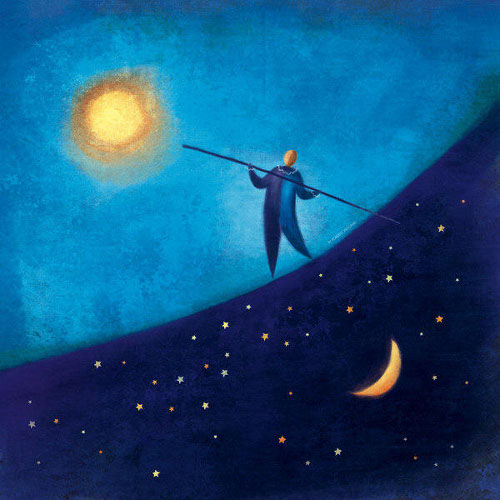
Long before the entertainment industry boomed, tightrope walking was a common form of amusement and recreation.

Once, a world-famous master of the sport visited a particular region. Word spread quickly, and many people turned up for the show. All was quiet as the master nimbly climbed the tree from which he would begin his dangerous trek.

But just before beginning his routine he called out: “Who here believes I can make it across safely?”

The crowd roared their affirmation. Again he asked the question and was greeted by the same response.

He then pulled out a wheelbarrow from between the branches and asked, less boisterously, “Which of you is willing to get inside the wheelbarrow as I cross?”

You could hear a pin drop.

Faith is the roaring response of the crowd; trust is climbing into the wheelbarrow.

It’s easy to have faith in God but not to trust Him. It’s easy to say “God exists and I believe in Him” as long as we don’t have to become personally involved in performing the weightier matters of Torah. We can have an incredible faith that the tightrope walker will make it to the other end of the rope as long as we don’t have to climb into his wheelbarrow.

What good is it, my brothers and sisters, if someone claims to have faith but has no deeds? Can such faith save them? Suppose a brother or a sister is without clothes and daily food. If one of you says to them, “Go in peace; keep warm and well fed,” but does nothing about their physical needs, what good is it? In the same way, faith by itself, if it is not accompanied by action, is dead.

But someone will say, “You have faith; I have deeds.”

Show me your faith without deeds, and I will show you my faith by my deeds. You believe that there is one God. Good! Even the demons believe that – and shudder.

You foolish person, do you want evidence that faith without deeds is useless? Was not our father Abraham considered righteous for what he did when he offered his son Isaac on the altar? You see that his faith and his actions were working together, and his faith was made complete by what he did. And the scripture was fulfilled that says, “Abraham believed God, and it was credited to him as righteousness,” and he was called God’s friend. You see that a person is considered righteous by what they do and not by faith alone.-James 2:14-24

When James (Ya’akov) says “that a person is considered righteous by what they do”, he’s talking about trust or bitachon. Our problem, is that we “think” about God, and we “feel” all warm and fuzzy about Jesus, but we don’t “do” anything about changing our lives to conform to our thinking and feeling. Here’s another example:

Maimonides is one in a long line of Jewish commentators who have proposed rationalistic interpretations of Scripture. Thus, words denoting place, sight, hearing, or position (of God) are interpreted as mental properties or dispositions. In our own vocabulary, it could be said that Maimonides has attempted to demythologize biblical narrative.

-from Maimonides: A Guide for Today’s Perplexed
by Kenneth Seeskin

Maimonides tends to see Biblical interpretation as either literal or allegorical and his strength as a theologian, philosopher, and sage is in his rational approach to the Tanakh (Jewish Bible). However there is a significant gap in his vision. We can also interpret the Bible and God through a mystic and experiential lens. The mystic seeks to encounter God in an extra-natural realm; meeting Him outside the boundaries of our physical universe, but we can also experience God in our day-to-day life by experiencing ourselves. We can “do” God and not just “think” or “feel” God. We can be the answer to prayer. We can have and live out faith and trust.

We can get in the wheelbarrow.

The Unburied Light

You can blunder around in the dark, carefully avoiding every pit. You can grope through the murky haze for the exit, stumbling and falling in the mud, then struggling back to your feet to try again.

Or you can turn on the light. There is a switch to the inner light buried without a doubt inside your heart. Even if it is ever so small, that is not important. Even a tiny flame can push away the darkness of an enormous cavern.

-Rabbi Tzvi Freeman
“Stop Groping”
Based on letters and talks of the Rebbe
Rabbi M. M. Schneerson
Chabad.org

This teaching seems fairly appropriate as we approach the close of Chanakuh. The lights and brightness of the menorah increase each night, declaring the glory of the miracles of God with greater illumination. This light also is a reminder to us that our “inner light” must glow and continue to shine brighter, declaring the glory of God and the message of salvation through His Son, Jesus Christ, our Lord. While it is easy to light the candles each night or the lights on a tree for those of you who have just finished your Christmas celebration, the light inside can be more stubborn to kindle. How many of us, as Rabbi Freeman says, “grope through the murky haze…stumbling and falling in the mud” when we could instead be lighting up our world?

This coming week, we study Torah Portion Vayigash where we find Joseph at last, revealing himself to his brothers.

Joseph could no longer control himself before all his attendants, and he cried out, “Have everyone withdraw from me!” So there was no one else about when Joseph made himself known to his brothers. His sobs were so loud that the Egyptians could hear, and so the news reached Pharaoh’s palace.

Joseph said to his brothers, “I am Joseph. Is my father still well?” But his brothers could not answer him, so dumfounded were they on account of him.

Then Joseph said to his brothers, “Come forward to me.” And when they came forward, he said, “I am your brother Joseph, he whom you sold into Egypt. Now do not be distressed or reproach Yourselves because you sold me hither; it was to save life that God sent me ahead of you. It is now two years that there has been famine in the land, and there are still five years to come in which there shall be no yield from tilling. God has sent me ahead of you to ensure Your survival on earth, and to save your lives in an extraordinary deliverance. So, it was not you who sent me here, but God; and He has made me a father to Pharaoh, lord of all his household, and ruler over the whole land of Egypt. –Genesis 45:1-8 (JPS Tanakh)

To insert my own metaphor, it’s as if Joseph turned on a switch and shown a light upon himself that revealed his true identity to his brothers when before, they had all been in the dark. Joseph did something else though. He also revealed the light of his character in reassuring his brothers that he bore them no ill will and that their acts of evil against him resulted in God doing immeasurable good. Joseph reveals this light again after the death of Jacob.

When Joseph’s brothers saw that their father was dead, they said, “What if Joseph still bears a grudge against us and pays us back for all the wrong that we did him!” So they sent this message to Joseph, “Before his death your father left this instruction: So shall you say to Joseph, ‘Forgive, I urge you, the offense and guilt of your brothers who treated you so harshly.’ Therefore, please forgive the offense of the servants of the God of your father.” And Joseph was in tears as they spoke to him.

His brothers went to him themselves, flung themselves before him, and said, “We are prepared to be your slaves.” But Joseph said to them, “Have no fear! Am I a substitute for God? Besides, although you intended me harm, God intended it for good, so as to bring about the present result — the survival of many people. And so, fear not. I will sustain you and your children.” Thus he reassured them, speaking kindly to them. –Genesis 50:18-21 (JPS Tanakh)

If Jacob was the last barrier between Joseph’s revenge and his brothers, certainly it was removed upon the death of their father and Joseph was free to lay the entire weight of his awesome authority upon those who had caused him so much harm. Yet it was not Jacob but God who illuminated Joseph’s life and from that light came grace and mercy, not condemnation and death.

How much like the light of the Messiah this is and this light is within each of us who call ourselves disciples of the Master. We know or we should learn, that shining this light upon others inspires them to in turn, become that light, just as the Messiah’s light has inspired us.

Rav Aharon of Belz once hired a certain workman to do some repairs in his home. While the man was busy at his job, the rebbe overheard others in the room say in an undertone, “This Jew works on Shabbos!”

The Belzer Rebbe immediately retorted, “Impossible! And if he did work on Shabbos, it must have been because he thought it was Friday!” He then turned to the workman who had heard the whole exchange and said, “Isn’t that right? You got confused and thought that it was Friday?”

The worker remained silent.

The rebbe again said softly, “You must have mixed up the date and thought it was Friday, correct?”

But the worker still wouldn’t answer. For the third time, the rebbe pleaded, “Didn’t you really believe it was Friday and not the holy Shabbos?”

At the rebbe’s final, exquisitely gentle insistence, the Jewish laborer mouthed, “Yes,” and then burst into tears. The man became a shomer Shabbos from that moment.

Similarly, Rav Shach was once in a taxi with Rav Shraga Grossbard. When Rav Shraga asked the driver if he was a shomer Shabbos, Rav Shach immediately cut him off.

“How can you ask a Jew if he is shomer Shabbos? Of course he is shomer Shabbos!” he exclaimed.

Some time later, Rav Grossbard was in the same taxi and the driver recognized him. The man turned toward the rav and said, “Don’t you remember me? The day that I heard the rav say I must be shomer Shabbos, I became one!”

Mishna Berura Yomi Digest
Stories to Share
“Turning a Blind Eye”
Siman 128 Seif 30-33

That we, as believers, should have an unshakable faith in God is a foregone conclusion, but here we see that in having faith in other people, though they may not deserve it, will yield wonderful rewards, not the least of which will be to turn their hearts to God. We cannot do this by condemning or ridiculing others but in treating even a person who is immersed in wrong doing as if they were already walking in the footsteps of God.

Forgetting God

Praying with tefillinChumros are not a simple matter at all. Rav Pinchas of Koretz, zt”l, points out that a person can easily get so wrapped up in chumros that he forgets about Hashem. His hyper-focus on the minutiae makes him forget the goal.

As the Sichos HaRan, zt”l, pointed out two hundred years ago, there are those who spend inordinate amounts of time in the bathroom to ensure that they are clean for davening. Meanwhile, they are obsessively pursuing a goal that wastes a great deal of time and risk missing the zeman tefilah. Is this to the purpose when the only halachic requirement is that one check himself for a short time in the bathroom to ensure basic cleanliness before prayer?

Although chumros can propel someone on a high spiritual level even higher, they can be counterproductive for someone not really on the level. The entire idea of “levels” can be confusing, though, since sometimes a person chooses the path of chumrah not from genuine piety, but because he wants others to see him as such.

The Chazon Ish, zt”l, was known for his chumros, yet he did not advocate taking on extra chumros unless one is on the level. Interestingly, he once illustrated this rather common imbalance of priorities with a statement on today’s daf. “How can one who is not holding by them assume extra chumros? This can be compared to the statement in the Mishnah in Bechoros 40. There we find that having one eye bigger than the other is a halachic blemish. Similarly, one who acts like someone of great spiritual stature in certain regards but is not in others has a skewed view of reality. It would be better if he were to act in accordance with his real level!”

Daf Yomi Digest
Stories Off the Daf
“Balanced Vision”
Bechoros 40

This sort of behavior may be difficult for many Christians to understand. I believe that the Catholic church has a tradition of taking on greater acts of penance to draw closer to Christ, but I don’t believe this is something common among mainstream Protestants except perhaps for fasting and offering additional prayers. However, as noted above, we can become so involved in our “religious practices” that we can forget all about actually serving God. This is a case when our actions take on a life of their own and become divorced from the underlying motivation. It would be as if you took it upon yourself to give to the needy, but your acts of charity became the driving force of your life, along with the thanks and praise of men, rather than the God who commands you to have compassion for the poor.

Of course, regardless of motivation or even if you consider God at all, the poor are fed and cared for by your charity, so it’s not a complete loss. But let’s look at something else for a moment that also isn’t clearly understood by many Christians.

The Lord spoke to Moses, saying: Speak to the Israelites and say to them: If anyone, man or woman, explicitly utters a nazirite’s vow, to set himself apart for the Lord, he shall abstain from wine and any other intoxicant; he shall not drink vinegar of wine or of any other intoxicant, neither shall he drink anything in which grapes have been steeped, nor eat grapes fresh or dried. Throughout his term as nazirite, he may not eat anything that is obtained from the grapevine, even seeds or skin.

Throughout the term of his vow as nazirite, no razor shall touch his head; it shall remain consecrated until the completion of his term as nazirite of the Lord, the hair of his head being left to grow untrimmed. Throughout the term that he has set apart for the Lord, he shall not go in where there is a dead person. Even if his father or mother, or his brother or sister should die, he must not defile himself for them, since hair set apart for his God is upon his head: throughout his term as nazirite he is consecrated to the Lord. –Numbers 6:1-8 (JPS Tanakh)

This is the beginning of the conditions for an Israelite who has taken a Nazarite vow, the purpose of which was to bring the person closer to God. It’s an interesting condition at the end of the vow (which could last for several months) that the Nazir would bring a sin offering. One interpretation of this is that, since God had provided sufficient means in the Torah for any Jew to draw near to Him, there was an actual component of “sin” in becoming a Nazir, as if God’s Torah wasn’t good enough. And yet the Torah itself provides the conditions by which one may become a Nazir. Further, we know that both the Prophet Samuel and Samson the Judge were life-long Nazirs. We also know that the Apostle Paul took upon himself a Nazarite vow (Acts 18:18) and paid the price at the end of the Nazarite vows for four other Jews (Acts 21:20-26).

Today, it’s impossible for a Jew to take a Nazarite vow because there currently is no Temple in Jerusalem and no active Levitical priesthood. We see that taking such a vow has many benefits and perhaps a few liabilities, but one of the dangers of such a vow is that the conditions of the vow may become more important than God Himself. Again, Christianity doesn’t understand this, but maybe we can understand something else.

I remember being in Christian Bible studies. At some point during some of these studies at church, the teacher would ask the class to all close our eyes and to offer up prayers for one reason or another. Knowing that you’re going to speak your prayer to God out loud in front of a bunch of other Christians creates a strange situation. At least for me, I considered what sort of prayer would sound acceptable or even meritorious to the people around me. It was very hard to actually talk to God without worrying what my fellow believers might think. I can promise you that my public prayers were somewhat different and perhaps really different when spoken aloud in front of witnesses than they would have been if it were just God and me.

There are non-Jews who choose to take some of the Jewish mitzvot upon themselves and even a little halachah as they understand it. I’ve known many of these people and while most of them are sincere in their motivations and have hearts sincerely turned toward God, some of them have become diverted by their practice and have all but lost sight of why they are performing the various commandments. I’ve heard such people argue about the proper way to tie tzitzit, whether or not a blue cord should be included, the pronunciation of some of the Hebrew prayers, whether or not a minyan can include women, and on and on and on. The irony mixed in with this tragedy, is that these people who are so consumed with obeying what they see as their obligations to God, have no true understanding of how and why Jews perform these mitzvot. Further, they reject the Jewish traditions associated with the mitzvot and substitute their individual interpretations for the commandments. Somewhere in the shuffle, God becomes forgotten.

The Mishna Berura Yomi Digest for Siman 128 Seif 24 explains that drawing near to God doesn’t have to be all that complicated and that God desires both the scholar and the “simple” man of the earth to have the opportunity to come closer. Judaism provides a solution that might seem unusual to the Christian.

On today’s amud we find that even those simple people who are not present during birchas kohanim are also included in the blessing. Perhaps one of the most important contributions of the Baal Shem Tov was to build up the downtrodden masses. The simple folk who couldn’t learn much are also an integral part of the chosen people. They, too, have a spiritual mission here on earth.

During one of the many times that Rav Meir Arak, zt”l, met with the Imrei Emes, zt”l, of Gur, he asked the rebbe a question that was troubling him. “I do not understand why our sages draw a distinction between the wine libations and other sacrifices. Regarding other sacrifices our sages teach that anyone who learns the laws of the sin or guilt offering is considered to have brought that sacrifice. Clearly the same is true regarding other sacrifices. And presumably, this is also the case regarding one who learns the laws of the libations.

“Strangely, when the sages mention a person who wishes to bring nesachim they do not recommend studying the halachos.

“Instead, they say that one who wishes to pour libations on the altar should fill the throats of Torah scholars with wine. Why is this second point necessary?”

The Imrei Emes replied in an inspiring manner. “Telling people that learning the laws of sacrifices is likened to bringing a sacrifice is only helpful to those who can learn. What about the simple folk who are unable to delve into the complexities of kodshim? It was for them that our sages said that one who supports Torah scholars by providing them with wine is considered to have poured libations on the altar. Doesn’t a simple person also need a way to draw near to Hashem while there is no beis hamikdash?”

Again, the solution presented here probably seems unnecessarily complicated to most Christians, but in a religious world that’s driven by tradition and specific acts crafted to comply with what is believed to be the desires of God, this process works quite well. A man who is no scholar and whose Hebrew is just so-so can still fulfill the mitzvot equivalent to offering the sacrifices and learned study of Torah. Please keep in mind though that any religious activity that involves a sufficient amount of complexity can, if allowed to do so, become more important than the reason for performing it. The solution for the church is to do away with this danger by doing away with the Law. No Torah, no halachah, no complexity equals just you and God, right?

Maybe. Maybe not. It all goes too far in the opposite direction if you believe God does not expect you to change anything in what you do and how you do it in daily and religious living. On the other hand, with the Law completely absent, Christians have found other ways to stray.

I’ve seen Christians focused intently on pleasing God who completely lost their path and who became enamoured with things such as how to teach the best Bible study, how to offer the best public prayers, how to dress with just the right amount of modesty for church services, and just how often to invite the Pastor over for dinner. The activities themselves aren’t bad, but when they take the place of a simple desire to connect to God through behavior, then these acts become almost meaningless. If God is not there in what you do, what’s the point?

The Mishna Berura Yomi Digest for Siman 128 Seif 26-29 provides a different point of view of drawing nearer to God, this time, not from the perspective of the less learned Jew, but from the position of exalted Torah scholars.

We find on today’s daf that sometimes it is preferable to refrain even from saying pesukim.

When the Imrei Emes of Ger, zt”l, returned from his first voyage to Eretz Yisroel, the Rav of Kalish, zt”l, tried to elicit some details about his journey. The Imrei Emes, however, did not seem to be willing to engage in conversation.

“Nu?” prodded the Kalisher Rav. “How does the rebbe feel after his visit to the holy land? Don’t chazal say that even the air of Eretz Yisroel makes one wise?”

The Imrei Emes nodded. “Yes, it’s true,” he answered. “And chazal also said: the protective fence for wisdom is…silence!”

This can also mean that silence is sometimes the best defense, because with it, one can avoid an argument altogether.

A delegation of sefardic rabbis once came to visit the Maharil Diskin, zt”l, the illustrious Rav of Brisk.

As soon as they arrived, the group of sages began to weave a number of intricate arguments about certain Torah subjects, while the Maharil simply sat quietly and did not participate.

Eventually they tired of this, and decided to take their leave. As they left, the members of the delegation shook their heads in dismay and lamented to one another, “What a pity—to see such a great scholar who has gotten old and forgotten his learning!”

What the group didn’t realize was that the gaon of Brisk was just as much a master of silence as he was a master of Torah!

Maybe your religious study and practice is devoted solely to the glory of God or maybe you have accidentally strayed into an area where you glorify yourself above your Master. It’s all too easy to wander away from the true path in the face of fulfilling the minutiae of the various commandments and obligations you believe are important to you. However, if you realize one day in the middle of your prayers, or while reading a Bible commentary, or in the process of delivering a devastating retort to someone’s argument on religious blog comment, that what you are doing is more important to you than to God, please stop. This is like driving your car down the freeway at 80 mph and suddenly realizing you’ve forgotten how to operate a motor vehicle. Under such circumstances, the safest thing to do is to slow down, pull over, come to a stop, and exit the vehicle.

Then wait for help, because you really need it.

It’s like a man who wakes up one morning and discovers that he’s forgotten how to read. He feels fine otherwise, but books, magazines, and newspapers now contain only these cryptic markings that yesterday were words, sentences, and paragraphs. What can be done? In this person’s case, he can go back to the basics of learning his ABCs, then learning to read from a simple primer, and then working up from there. What do we do when our religion has become more important than God? We can stop our religious practice temporarily, return to a simple reading of the Bible and extemporaneous prayer, and learn to love God all over again. I’ve heard many Christians in public prayer saying, “We give you all the glory, Jesus.” I don’t doubt that most of these people are sincere, but if they were to stop suddenly and listen to their own voice, would any of them realize that they were giving more glory to how they sounded in front of a group?

Take time occasionally to unplug from the way you try to connect to God and just connect to God.

If you play for your own glory and not for God’s you have no place here. -A Maggid