Tag Archives: God

Vayeira: Healing by the Trees of Mamre

terebintheThe Lord appeared to him by the terebinths of Mamre; he was sitting at the entrance of the tent as the day grew hot.Genesis 18:1 (JPS Tanakh)

When Rabbi Sholem Dov Ber, the fifth of the Lubavitcher Rebbeim, was a young child, he was taken to his grandfather the Tzemach Tzedek for a birthday blessing. When he entered his grandfather’s room, he began to cry.

After calming him, his grandfather asked him the reason for his tears. The child replied: “In cheder, we learned that G-d revealed Himself to Avraham. Why doesn’t He reveal Himself to me?”

The Tzemach Tzedek replied: “When a Jew who is 99 years old recognizes that he must circumcise himself, he deserves that G-d reveal Himself to him.”

-Rabbi Eli Touger
“Seeing Truth: The Nature of the Revelation to Avraham”
Adapted from Likkutei Sic hos, Vol. X, p. 49ff;
Sichos Shabbos Parshas Vayeira 5749, 5750, 5751, 5752
Chabad.org

We have a tremendous need to hear from God. On Facebook, my friends Joe and Heidi Hendricks often express their love of God, their enormous faith, and their need to hear from God, as they describe the battle with cancer they must both endure. Recently Joe wrote:

Cancer crazy thinking..

Maybe if I make the coffee a little stronger, Heidi’s white blood cell counts will be better today at SCCA. Maybe if I get her to laugh harder the scan won’t show any new tumors. Maybe if I workout a little longer I can force her cancer away.

Then I think.. No, that’s crazy thinking – we’re doing OK, we’re doing the best we can, shut up and let God & the medical team handle it.

Peace.

In the face of the battles we wage in the world round us and sometimes within our own bodies, we don’t just want to hear from God, we need to hear from God. As a child, Rabbi Sholem Dov Ber needed to hear from God. At some point, we all do. Rabbi Touger continues to comment on this.

The desire for a direct bond with G-d is a fundamental element of every person’s makeup. When the Rebbe Rashab came to his grandfather for a birthday blessing, he merely expressed this longing.

The moral of the story is universal. Within every one of us there is a simple, childlike dimension that yearns to cleave to G-d. Without ceasing to function as mature individuals, each of us can share an all-encompassing relationship with G-d.

The above is particularly relevant in the present age, brief moments before Mashiach’s coming. For the essence of the Era of the Redemption will be the direct revelation of G-d; “Your Master will conceal Himself no longer, and your eyes will perceive your Master.” As we stand on the threshold of this era, the inner thirst can be felt more powerfully.

Moreover, the potential exists to experience a foretaste of the Redemption in the present age. We can develop an awareness of G-d and recognize Him as an actual force pervading every aspect of our lives.

teaching-childrenAlthough Rabbi Touger doesn’t say so explicitly, there seems to be some sort of connection between our need to have a connection with God as a childlike quality and the nearness of the Messiah as redeemer. Certainly, the Master expressed the same thing “in a nutshell”.

But Jesus said, “Let the children alone, and do not hinder them from coming to Me; for the kingdom of heaven belongs to such as these.” –Matthew 19:14 (NASB)

Rabbi Touger quotes Amos 8:11 when he says:

“Days are coming…, [when people will be] hungry, but not for bread; thirsty, but not for water, but to hear the word of G-d.” Only at times, as in the story of the Rebbe Rashab, is this thirst consciously expressed. In most instances, a person will be unaware of his own thirst. Nevertheless, when we emulate Avraham’s example and extend ourselves to others, we will discover an eager readiness to respond that reflects their inner need.

We are all hungry for the “bread” of God.

Jesus answered, “It is written: ‘Man does not live on bread alone, but on every word that comes from the mouth of God.'” –Matthew 4:4

Blessed are those who hunger and thirst for righteousness, for they will be filled. –Matthew 5:6

According to the midrash for Torah Portion Vayeira, when Abraham was “sitting at the entrance of the tent” in the heat of the day, he was waiting for something. He probably didn’t know the three “travelers” were going to appear when they did, but Rabbinic commentary says he was waiting to perform deeds of kindness to bring others closer to God. In response, God showed Abraham kindness, fed him with “the bread of life” (John 6:35), and drew nearer to Abraham than He had before. It is also believed that God, in appearing to Abraham three days after the prophet’s circumcision, lived out the commandment to visit the sick and that He healed Abraham.

May God draw nearer to all of us, may He feed us, and may He heal us.

But he was pierced for our transgressions,
he was crushed for our iniquities;
the punishment that brought us peace was on him,
and by his wounds we are healed. –Isaiah 53:5

As we learned before, “Your Master will conceal Himself no longer, and your eyes will perceive your Master.” We also have a lesson for this.

The throne of God and of the Lamb will be in the city, and his servants will serve him.  They will see his face, and his name will be on their foreheads. –Revelation 22:3-4

Good Shabbos.

oto ha’ish

tallit-prayerHowever, in the last few generations, changes took place among some Christian groups. There are those among them who no longer believe they must humiliate the Jews, and some even believe that Israel remains the Chosen People, whose purpose is to bring the Redemption.

However, they still embrace a form of idolatry, believing that ‘oto ha’ish’ [Jesus] is son of a deity and the messiah who will be resurrected to redeem the world. At the same time, they point out that he is Jewish.

The question arises: Should this position cause a complete rift between us? Every time we meet Christian supporters of Israel, must we denounce their belief in ‘oto ha’ish’?

-Rabbi Eliezer Melamed
“Judaism: The Relation of Jews to non-Jews”
Arutz Sheva News Agency

The Jerusalem Talmud may provide us with a solution. The Jerusalem Talmud’s version of the Four Sons adjusts the text to read “if that man were here, he would not be redeemed.” “oto haish,” literally “that man” is often used in the Talmud to refer to the founder of Christianity.The Wicked Son believes that redemption is to be found in Oso Ha’ish. The Talmud is completely rejecting this tenet of early Christianity, and pulling the rug out from under the Wicked Son telling him he is relying on the future redemption of someone who himself would not have been redeemed.

-Josh Waxman
“Does Oto Haish in the Haggadah (according to Yerushalmi) refer to Jesus?”
parasha.blogspot.com

While Josh Waxman asks this question at or around Passover in 2009, Rabbi Melamed answers it in the Fall of 2011 by referring to Jesus as “that man”. Doesn’t sound like much of a compliment, does it? This isn’t the first time I’ve heard a Jewish Rabbi refer to Jesus using the circumlocution to avoid having to say or write out his name.

Both Rabbi Melamed and Mr. Waxman (and I apologize to Mr. Waxman if he is a Rabbi or has some other title, but I can’t determine this from the content on his blog) are going through some effort to avoid denigrating the followers of Jesus but they aren’t entirely successful. Waxman continues in his blog post saying:

We don’t really care about Jesus that much. He is tangential to Jewish history, even as he is central to another religion. There is no reason to bring him in here. While it may be true that “”The yerushalmi was redacted in 425 CE and witnessed the Roman Empire’s adoption of Christianity and the widespread proselytization to Christianity,” which would make them care more, that does not mean we should read it into every source. And anyway, this particular source in Yerushalmi is Rabbi Chiyya, redactor of braytot, who passed away in 230 CE, much earlier than the Roman Empire’s adoption of Christianity.

For his part, Rabbi Melamed states:

Rabbi Kook also wrote a letter of congratulation (Igrot, Part 2, pg.198) to a Torah scholar who compiled a booklet called ‘Israel’s Faith’ in order to explain the Jewish religion in Japanese, however, he pointed out that the author had erred by expressing disrespect for ‘oto ha’ish’ and Mohammed. “It is impossible to offer supreme, religious content to this nation with insulting expressions concerning the founders of [other] religions, whoever they are. We must only speak about the holy and supreme advantage of God’s Torah, and negation will come by itself.”

Of course there is a certain amount of “negation” of the believers in Jesus, even as there is the suggestion that disrespect for the author of Christian faith is unacceptable. It’s important for Christianity to try to put these statements within a certain perspective. For Rabbi Melamed, the perspective is this.

In the past, except for a small minority of righteous Gentiles, the attitude of Christians towards Jews was negative. They based their beliefs on the humiliation of the Jews, which they believed proved that the Christians were intended to replace Israel as the Chosen People.

replacement-theologyPastor Barry Horner wrote his book Future Israel: Why Christian Anti-Judaism Must Be Challenged chronicling how Christian supersessionism has been extremely damaging to the Jewish people over the last 1,900 years of church history and why it continues to be a destructive theology in the world today. Both Mr. Waxman and Rabbi Melamed are living examples of the results of Christian replacement theology and antisemitism, not only historically, but as a matter of “current affairs”. Last Thursday at the G20 summit at Cannes, French President Nicolas Sarkozy had this to say to U.S. President Obama as reported at Haaretz.com:

The French president, unaware last Thursday that a mike in the meeting room at the G20 summit at Cannes was on, was heard calling Netanyahu “a liar” in what he thought was a private exchange with U.S. President Barack Obama. “I cannot bear Netanyahu, he’s a liar,” Sarkozy told Obama, who was also unaware that the mike had been turned on and was being monitored by reporters via the headsets used for simultaneous translations.

Obama didn’t exactly defend Netanyahu, either.

“You’re fed up with him, but I have to deal with him even more often than you,” Obama replied, according to wire service reports.

While Sarkozy’s and Obama’s comments can’t be directly attributed to Christian supersessionism, they are certainly prime examples of how even national European and American leaders view Israel and speak of the Jewish nation (or at least its Prime Minister) when they think no one can hear.

How are we, as Christians, to receive all this? It’s not easy. There’s a tendency to get a little defensive when someone holds the Savior in such disdain that they must refer to him as “that man”, but on the other hand, how many Jews have been persecuted, tortured, and murdered in the name of Jesus? True, modern Christians aren’t directly responsible for those events, but in continuing to support any form of replacement theology, we support an environment that is latently or overtly hostile to Jews and one that supports the French and American presidents speaking poorly of the Israeli Prime Minister, essentially behind his back and behind the backs of their citizens.

If the leaders of the world and the body of Christ fail to amend their behavior and learn to truly support the Jewish nation and her people, what does democracy, liberty, and Christianity mean at this point? How can we show that, for the sake of “that man”, we love Israel if we continue to marginalize the Jewish people?

It does sting hearing Jesus referred to as “oto ha’ish”. As much as I want to be persevering and “noble” about it, I find it difficult to have others disregard my faith, my King, and me personally in absolute terms, as if I as an individual am responsible for the persecution of the Jewish people. It makes me wonder what Jews who know I’m a Christian may think of me or say about me when I’m not listening. I wonder if I’m judged as lesser or unworthy or unrighteous, not because of anything I’ve done, but simply because of who I am. But then again, Christians have been treating Jews in exactly that way for almost 2,000 years. Maybe it’s time we Christians discovered how it feels.

First Steps on a Somewhat Familiar Path

How do we maintain a balance between the values of centralized authority and personal autonomy in halachik decision making, particularly for status issues that relate to the global Jewish community such as conversion policies and standards? How do we provide and promote a ‘big tent’ philosophy welcoming Rabbis who share different approaches and philosophies while at the same time maintain boundaries of acceptable halachik and hashkafic (ideological) ideas and behavior? How should the agenda of the Jewish community be set and how should we leverage our limited resources? How can we collaborate and create synergy with leadership of the greater Jewish community without compromising or diluting authentic and authoritative Torah positions and messages?

-Rabbi Efrem Goldberg
04 November 2011
“Let’s be like Avraham and Sarah and change the world one person at a time”
brsonline.org

Interesting questions and probably, in some sense, not limited to the world of Modern Orthodox Judaism. When I was reading Rabbi Goldberg’s article, I couldn’t help but think of those congregations of Jews who are asking similar questions within the context and fellowship of worshiping Jesus or Yeshua, recognizing him as the Messiah who has come and will come again. While mainstream Judaism has definite beliefs regarding Jews who acknowledge Jesus in this light, the questions regarding identity and the desire to “collaborate and create synergy with leadership of the greater Jewish community without compromising or diluting authentic and authoritative Torah positions and messages” is very much the same.

These questions are frequently debated in the blogosphere at places such as Yinon Blog, Messianic Jewish Musings, Kineti L’Tziyon, and Daily Minyan, just to name a few. These can be questions that are very difficult for Christians to understand. This is not to say that individual Christian churches and denominations do not struggle with matters of theology and identity in relation to the larger Body of Christ, but that the nature and substance of that struggle is markedly different.

Both mainstream Judaism and mainstream Christianity have a difficult time looking at Jews who accept Jesus as the Messiah as truly Jewish. I know. It’s strange. But as I’ve pointed out in some of my previous blog posts such as The Tannaitic Rabbi, not only does Jesus definitely fit the model of a late Second Temple period itinerant Rabbi, but he is virtually impossible to understand when removed from his ancient Jewish context. In that, those Jews who see him from that perspective, recognize him as Rabbi, Prophet, and Messiah. This would not be very likely (or even possible), should these Jewish believers follow the pattern desired by the church of coming to faith in Jesus, converting to Christianity, and leaving all traces of their Jewish lifestyle, heritage, and identity behind. I could even argue that a Jew must continue being Jewish as a believer in the Jewish Messiah if they are to be true to their faith. In other words, Jews who are “Messianic” must be “Messianic Jews”, and continue to live an ethnically and religiously authentic Jewish lifestyles if they are to be able to grasp the Messiah as the Messiah and not “the Christ”.

In his blog post, Rabbi Goldberg continues:

As we dialogued and debated questions like these and others, I couldn’t help but think about an important statistic that weighs heavily on me. In a world of billions of people, there are only 15 million Jews. Of them, only a small fraction are Orthodox and within Orthodoxy, only a small fraction define themselves as Modern Orthodox.

tallit-prayerIf advancing the goals of Modern Orthodox Judaism in light of its modest Jewish population seems a challenging task to Rabbi Goldberg, how much more of a challenge is establishing and advancing Messianic Judaism, particularly with limited understanding and support from both larger Judaism and larger Christianity? As Rabbi Joshua Brumbach, Senior Rabbi at Ahavat Zion Messianic Synagogue in Beverly Hills, CA recently wrote, there is a rich history of Jews within the last 150 years, particularly noteworthy Rabbis, who all came to faith in the “Tannaitic Rabbi of Nateret” and who continued to live Jewish lives, worship in Jewish synagogues, and in many cases, continued to serve as Rabbis, within their Jewish communities. The Messianic community strives to progress and expand the work of these courageous pioneers in the 21st century. Interestingly enough, Rabbi Goldberg in his encouraging statement regarding Modern Orthodox Judaism, also can be said to map out the territory for the Messianic community of Jews.

If this goal seems unachievable and out of reach, I encourage you to look no further than this week’s parsha and our great patriarch Avraham Avinu and his partner Sarah. They lived in a world saturated with paganism, corruption and selfishness and yet had the courage to articulate and spread the revolutionary message of ethical monotheism. They lived in a world with no mass media, email, social networking, youtube videos, microphones, billboards or newspapers and yet, look at the result of their efforts. Billions of people across the globe believe in one God and the Jewish values of justice, charity and ethical living. Avraham and Sarah likely never dreamt they would earn international fame and acclaim for their efforts. They simply believed they had a magnificent treasure and wanted to share it with others one at a time.

Let’s be like Avraham and Sarah and change the world one person at a time beginning with inspiring ourselves, our family members and those around us.

How are we to understand worshiping Jesus as the ancient Jewish expression of Rabbi and Messiah within the context of modern Jewish worship and halacha? How can the first century Jewish Messiah be seen through the lens of Torah, Talmud, and perhaps even Kabbalah? The answers to these questions are struggling to be born and to take their first breath in the world. They take their first steps, even on a somewhat familiar path, as all new things do, one at a time. The rest of us may not understand, but we can still be there to support and encourage and to hope.

The Hungry Gentile

leket-projectThe Gemara relates that Levi had planted grain and there were no poor people to come and collect the leket. He consulted with R’ Sheishes as to what should be done and R’ Sheishes told him that if there are no poor people who will come to collect the leket he may keep it for himself. Rambam rules in accordance with this position and writes that if there are no poor people he may take the grain for himself and is not obligated to give the monetary value of the leket to the poor. Tur writes that if there are no poor people who live in the vicinity one is not obligated to leave leket in his field. Nowadays, the custom is that people do not leave the gifts for the poor in their fields since the majority of the poor people are gentile and if the gifts were left in the fields gentiles would came and take them.

Daf Yomi Digest
Halacha Highlight
“Gifts to the poor”
Chullin 134

“Then the righteous will answer him, ‘Lord, when did we see you hungry and feed you, or thirsty and give you something to drink? When did we see you a stranger and invite you in, or needing clothes and clothe you? When did we see you sick or in prison and go to visit you?’

“The King will reply, ‘Truly I tell you, whatever you did for one of the least of these brothers and sisters of mine, you did for me.’-Matthew 25:37-40

What a minute. We read in the commentary on the daf that the commandment for a Jewish farmer to leave an unreaped corner of his field for the poor (based on Leviticus 19:9) seems only to apply to the Jewish poor. If there are no poor Jews in the area but only poor Gentiles, the farmer is under no obligation to provide for them. Can that be right? It seems a little harsh. Are we to infer that when Jesus teaches his Jewish disciples about feeding the poor in Matthew 25 that he only means Jewish poor? That’s not the way most Christians would interpret the message and that’s not how Christian charities work in general.

I have great admiration and respect for the Jewish sages and do my best, within my limited skill set, to study their teachings, but this one is a little hard to swallow, assuming I’m reading it right. The Talmud doesn’t universally have such an uncaring attitude toward non-Jews, and quite some time ago, I recorded some of the portions of the Talmud that relate to Gentiles in the blog post, What the Talmud Says About Gentiles, Revisited. Here are a couple of comments regarding how Jews are to treat the poor among the Gentiles:

“[it is proper to] support the idol worshippers during the sabbatical year… and to inquire after their welfare [commentators: even on the days of the holidays of their idols, even if they do not keep the seven Noahide commandments] because of the ways of peace.” (Shevi’it 4,3)

The rabbis taught: ‘We support poor Gentiles with the poor people of Israel, and we visit sick Gentiles as well as the sick of Israel and we bury the dead of the Gentiles as well as the dead of Israel, because of the ways of peace.” (Gitin 61a)

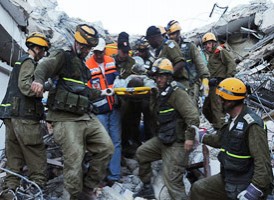
earthquake-aid-assistanceIn recent years, Muslim Turkey, once an ally of Israel, has become increasingly hostile toward the Jewish nation, supposedly over how Israel is “mistreating” the people in Gaza. However, after the most recent earthquake in Turkey, Israel unreservedly offered aid to Turkey and after initial refusals, Turkey accepted.

We know from the Lord’s Prayer (Matthew 6:9-13) that Jesus directed his disciples to pray, “And forgive us our debts as we also have forgiven our debtors”, which seems to say that how we treat others is the way God will treat us. This also reflects a modern Jewish teaching.

How you treat others is how G-d treats you. How you forgive them is how He forgives you. How you see them is how He sees you.

When you show empathy for the plight of another human being, G-d takes empathy in your plight.

When others slight you and you ignore the call to vengeance that burns inside, G-d erases all memory of your failures toward Him. When you see the image of G-d in another human being, then the image of G-d becomes revealed within you.

-Rabbi Tzvi Freeman
“The Image”
Based on letters and talks of the Rebbe
Rabbi M. M. Schneerson
Chabad.org

I suppose I’m in no position to disagree with the rulings of the sages, but I’m going to disagree with this one anyway. If the farmer would have left unharvested corners in his field for the poor, they are the poor, regardless if they are the Jews of his community or Gentiles living nearby. I can see that the commandment is meant to apply to the Jews primarily so that if there are Jewish poor, the remains in the field should be for them. However, even if we can’t extend the obligation to feeding poor Gentiles, assuming no Jewish poor are around, I think compassion should tell the farmer that a hungry Gentile was also created in the image of God.

The Master’s Rebuke

peters-denialThe Ahavas Chaim of Viznitz, zt”l, was a huge scholar with profound yir’as shamayim, like all of those who received semichah from the Maharsham, zt”l, one of the undisputed gedolim of his generation.

The rebbe did not flatter anyone. He was always careful to rebuke the Chasidim when they acted inappropriately. For example, as is well known, it is the custom for a rebbe to distribute shiyarim during the tisch. Many Chasidim would push their fellow and grab whatever they could get as if it was a matter of life and death. In Viznitz, the rebbe would often rebuke them for this. “How can you grab shirayim? Don’t you know that the modest kohanim would not grab a portion of the show breads? Clearly, one should not push and grab even in holy matters. Instead of shoving one’s fellows, he should relax and take shiyarim only if he can do so without pushing his friend.”

Daf Yomi Digest
Stories Off the Daf
“Proper Rebuke”
Chullin 133

A man in the crowd answered, “Teacher, I brought you my son, who is possessed by a spirit that has robbed him of speech. Whenever it seizes him, it throws him to the ground. He foams at the mouth, gnashes his teeth and becomes rigid. I asked your disciples to drive out the spirit, but they could not.” “You unbelieving generation,” Jesus replied, “how long shall I stay with you? How long shall I put up with you?Mark 9:17-19

We see that Jesus and the Ahavas Chaim of Viznitz have something in common. They both find it necessary to rebuke their disciples when they display inappropriate or even faithless behavior. Both Masters seem to be a little harsh, but perhaps that’s because there’s so much at stake. If the ordinary Jew is commanded to rebuke a fellow Jew who is sinning or about to sin (based on Leviticus 19:17), how much more so should a Teacher be obligated to rebuke his disciples?

In Judaism (and I’ve said this before) the commandment to rebuke the sinner is compared to saving someone’s life. If a Jew sees a fellow Jew moving away from God by entering into sin and does nothing, it’s like being a lifeguard, seeing a person drowning in the ocean, and not lifting a finger to save him. If one regular person has that level of responsibility toward another, then a Teacher and Rabbi must have a tremendous responsibility to guide his disciples into a proper way of relating to other people and to God. To fail to do so, from his exalted position as Rabbi and tzaddik, would be not only failing his students, but failing God.

However, if you’ve ever been rebuked by an angry, yelling teacher, boss, or parent, you know it doesn’t feel good. Not only that, but you know that being yelled at might not result in you correcting your behavior. If you are even the slightest bit rebellious, your response on the surface might be to appear to be obedience, but inside, your opposition might continue to grow, leading your closer to sin rather than returning you to God.

The story from the daf continues, showing us a different path.

But there is another—often more effective—way to deal with those who are wayward. When Rav Dovid Tzvi Shneiblag, zt”l, was confronted with a student who did not comport himself properly, he would call the student in and open a meseches Chulin to a different statement on today’s daf. He would begin to read in a very emotional tone, . As he did so he shed copious tears. “Rav Yehudah says, ‘One who teaches an improper student falls into Gehinom…Teaching an improper student is like throwing a stone to Merucules…’ ”

As he read, crying, the student could not help but feel moved, until he also cried. The rav would gently explain that certain actions were not befitting for a ben Torah and the young man would tearfully agree to change. Many students later recounted that it was this short time with the rav which galvanized them to make a complete change of direction.”

I don’t believe we have any specific example of Jesus using such a method of “rebuke” when addressing his disciples, but I do not doubt there was a time when the disciples did shed tears and likely did recall everything that Jesus was trying to teach them. Sadly, it was when they thought it was too late that they came to this realization. Peter is an especially poignant example.

While Peter was below in the courtyard, one of the servant girls of the high priest came by. When she saw Peter warming himself, she looked closely at him. “You also were with that Nazarene, Jesus,” she said.

But he denied it. “I don’t know or understand what you’re talking about,” he said, and went out into the entryway.

When the servant girl saw him there, she said again to those standing around, “This fellow is one of them.” Again he denied it.

After a little while, those standing near said to Peter, “Surely you are one of them, for you are a Galilean.”

He began to call down curses, and he swore to them, “I don’t know this man you’re talking about.”

Immediately the rooster crowed the second time. Then Peter remembered the word Jesus had spoken to him: “Before the rooster crows twice you will disown me three times.” And he broke down and wept. –Mark 14:66-72

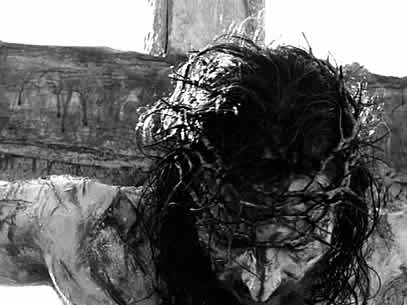
The Death of the MasterAfter all of his protests to the contrary, Peter utterly failed his Master. His tears at that moment were bitter but they must have been much worse once Jesus was dead and the disciples went into hiding. Small wonder that, when at the first of the week, Miriam of Magdalah told the disciples that the tomb was empty, Peter ran all the way to see for himself (John 20:1-4). Hope beyond possibility had given him a second chance. But the agony of his failure and even the tears were not over yet.

When they had finished eating, Jesus said to Simon Peter, “Simon son of John, do you love me more than these?” “Yes, Lord,” he said, “you know that I love you.”

Jesus said, “Feed my lambs.”

Again Jesus said, “Simon son of John, do you love me?”

He answered, “Yes, Lord, you know that I love you.”

Jesus said, “Take care of my sheep.”

The third time he said to him, “Simon son of John, do you love me?”

Peter was hurt because Jesus asked him the third time, “Do you love me?” He said, “Lord, you know all things; you know that I love you.”

Jesus said, “Feed my sheep. –John 21:15-17

Peter denied Jesus three times. After the resurrection, Jesus asks Peter three times if he really loves him. Peter would have to be sure of this, for the days were coming when the Master would not be with him, and Peter would have to carry his faith without doubt.

Tears can be more difficult than a loud, angry rebuke, but they can also be the instrument by which we feel the sorrow, rather than angry rebellion, that will inspire us to repent, to turn to God, and to really go in the other direction, walking away from the person opposing God we once were, and to the man or woman of God we were created to be.

Arguing with God

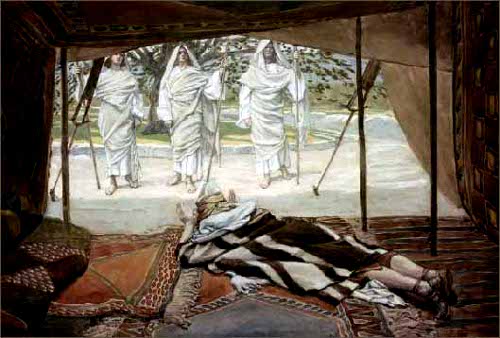
abrahams visitorsWhen G-d told Noah to build an ark before the world would be destroyed, Noah built an ark.

But when G-d told Abraham He was about to destroy the cities of Sodom and Gomorrah—cities corrupt and evil to the core—Abraham argued. He said, “Perhaps there are righteous people there! Will the Judge of All the Earth not do justice?”

Abraham felt a sense of ownership for the world in which he lived. If there was something wrong, it needed to be changed. Even if it had been decreed by the will of G-d.

-Rabbi Tzvi Freeman
“Noah and Abraham”
Based on letters and talks of the Rebbe
Rabbi M. M. Schneerson
Chabad.org

I have to admit, I was a little disturbed by how Rabbi Freeman illustrates the difference between Noah and Abraham. It makes it seem like Abraham cared more for the world he lived in than Noah. Of course both Jewish and Christian commenators generally agree that it took Noah about 120 years to build the ark and that, during that period of time, Noah was trying to convince the people around him to repent of their wickedness (he wasn’t successful). So it’s not as if God told Noah that he was going to drown everyone and Noah immediately blew off humanity, only caring that he and his family would be saved.

Still, we have a tendency, no matter how much we are otherwise instructed (Matthew 7:1-6), to judge others. Once we become aware that a person has sinned, especially a type of sin we are personally offended by (maybe because it’s a type of sin we are particularly tempted by), we cut them loose from our “this person can be saved” list and let them sail away into the spiritual darkness.

No wonder the church is called the only army that shoots its own wounded.

OK, I’m probably being unfair to the church and I’m sure that there are many, many forgiving and compassionate Christians who have great love for even the most immoral of human beings. Apparently, the Rabbis teach the lesson of compassion and love for the sinner as well.

It is human nature to believe in one’s potential to destroy, but not his ability to repair. This is especially true regarding a person who transgressed a sin which is punishable by kareis (being cut off from his people). Naturally, the sinner figures that it no longer matters what he does since he has completely severed his soul from its source. The Ohr HaChaim, zt”l, explains that the error of this attitude from a verse brought on today’s daf. “Even a person who transgressed a sin punishable by kareis must never give up. This is the deeper meaning of the verse regarding leaving pe’ah in the corner of one’s field. ‘— When you reap the harvest of your land.’ This can also be understood to refer to one who violated a sin for which the punishment is kareis. Although he has uprooted his soul from its source, this does not mean that he has uprooted his soul completely. The verse continues: ‘— you shall not reap the entire corner of your field.’ Do not continue ripping out your neshama’s connection to God by transgressing further. Even one who has violated a sin punishable by kareis has only uprooted the connection forged by acting—or refraining to act—in a certain manner which caused the cut off. But his soul is definitely still connected.

“This is clear from the Arizal’s teaching about holiness. He explains that the nature of holiness is to leave an eternal trace wherever it was. We see that every mitzvah acts to strengthen one’s bond to God, regardless of his negative behavior. The Gemara explicitly writes that teshuvah helps even for kareis—or worse. This is why teshuvha reaches the throne of glory. One who does teshuvah renews the connection of his neshmaha which was hewn out from beneath the throne of glory.”

Daf Yomi Digest
Stories Off the Daf
“Not Excised Completely”
Chullin 131

PleadExcept for the sentence of death, there was no worse consequence for a sin than to be cut off from your people (“kareis,” see examples in Genesis 17:14, Exodus 12:15, and Leviticus 23:29). There is debate on exactly what was supposed to happen if someone were worthy of kareis, but it is often thought to be some form of exile of the person from the community of Israel. It’s easy to read into this consequence a state of complete hopelessness and despair. If you are cut off from your people and from your God, what else is there? You have no place to go and there is no way back. Why continue living?

But the commentary on Chullin 131 doesn’t say there’s no hope. It does say that the person involved is in an extremely difficult and dire situation, but the “Gemara explicitly writes that teshuvah helps even for kareis—or worse. This is why teshuva reaches the throne of glory.” Even in the aftermath of the worst of all possible sins and failures, you are uprooted, but never completely cut off from God. Forgiveness is still possible. You can still turn back to Him.

The people in Noah’s time were given 120 years, as Noah built the ark, to become aware of the fatal judgment that was heading their way. They had time. They could have repented. They still chose not to. Abraham saw that God was going to destroy Sodom very soon and pleaded for whoever remained in there and who might repent and be saved (Genesis 18:16-33). In the following chapter of Genesis, you see the level of sin and depravity the inhabitants of Sodom exercised and it’s easy to imagine that the “outcry against Sodom and Gomorrah is so great and their sin so grievous” (Genesis 18:20) that they deserved complete and absolute destruction. Yet, Abraham still argued with God.

That’s a rather novel concept for a Christian. We’re generally told that God is always right and we should never argue. This has gotten us through plenty of moral puzzles in the Bible, such as those times when God has ordered the Children of Israel to completely destroy an entire people group, down to the last man, woman, child, and farm animal, because their sin was so great. But not only does Abraham question God’s judgment (very politely, though), but so does Moses, when God wants to destroy the Israelites (Exodus 32:9-10). When Jacob wrestled with the angel and won (Genesis 32:22-32), an interpretation of the event is that he was having a “moral struggle” with God. These are pictures that support humanity interacting with God on the plane of righteousness, questioning God and thereby struggling, not with God’s perfect righteous judgement, but with our own understanding of right and wrong.

Notice that in none of these examples is Abraham, Jacob, or Moses chastised or punished by God for their “effrontery” toward Him. I don’t think this means we can be casual in our relationship with God, but I do think we’re expected to be more than passive spectators in history and in life. If we can be considered “junior partners” with God in repairing the world, can we also not be involved, to some small degree, in the struggle to determine right and wrong and how justice shall be acted out in the world around us?

As people of faith, our sense of right and wrong is shaped by the Bible and how we understand its message. If some part of the Bible seems to be immoral by modern Christian or Jewish standards (or modern societal standards), what are we to do? Are we to blindly accept that the Bible is a static document with only one, static interpretation across time? Maybe we are expected to do what Jacob did and to “wrestle” with God and the text, struggling to take the underlying principles of what we are being taught and somehow apply them to a world that is far, far apart from the world in which the Bible was written.

ForgivenessThe more we develop as religious people, the more we must realize that we don’t have all the answers. The Bible doesn’t provide canned and complete responses for every possible moral and practical question. Like Abraham, we sometimes have to stand up and ask God if He really means something the way it’s written in the Bible or if there is some other alternate available. This is a very uncomfortable thing to do because we have to question matters of right and wrong in the world around us and in ourselves, rather than be satisfied that we’re right and “the other guy” is a hopeless sinner.

The next time you think the Bible is telling you to judge someone and that they deserve to be cut off from all civilized humanity or even to die for something they’ve done, or because of the person they are, it might be one of those times when you should be arguing with God (or perhaps yourself). That soul you are so willing to cut off may not be entirely uprooted from God and instead of casting it away, you may want to consider trying to replant it in more fertile soil.

For God loved the world with an abundant love, to the extent that he gave his only son so that all who believe in him will not perish, but will rather live eternal life. –John 3:16 (DHE Gospels)