Tag Archives: hebrews

Sermon Review of the Holy Epistle to the Hebrews: Radiance of Glory

A quick immersion into the Christology of the apostles and the writer of the book of Hebrews based on Hebrews 1:2-3: “… His Son, whom he appointed the heir of all things, through whom also he created the world. He is the radiance of the glory of God and the exact imprint of his nature.”

What role in the creation of all things did the Son play? From where did the apostles derive their high view of Messiah in His divinity?

-D. Thomas Lancaster
Sermon Five: Radiance of Glory
Originally presented on January 26, 2013
from the Holy Epistle to the Hebrews sermon series

Lancaster starts his message by taking his audience through a brief summary of last week’s sermon focusing on his conclusions. Those conclusions are going to be important in just a few moments, and again at the end of this review.

This week, the topic is Christology or the study of Christ and particularly his Divine nature. This is something not really (or at all) studied in the Church because it’s pretty much assumed (God the Father, God the Son, God the Holy Spirit, three in one). People pray directly to Jesus, people interchange the Father and the Son, even in song lyrics with statements like, “thank you God for dying on the cross for me.” I personally have always been bothered by how most Christians treat the three persons of the Trinity (and remember, the word “Trinity” never shows up in the Bible) as if they’re interchangeable units, like spark plugs or kitchen knives. One’s just as good as the other, one’s exactly the same as the other.

Lots and lots of what Lancaster calls “Father-Son confusion.”

Lancaster manages to compress a lot of complex concepts into his almost forty-four minute sermon which is reflective of how densely packed he says is Hebrews 1:1-4:

God, after He spoke long ago to the fathers in the prophets in many portions and in many ways, in these last days has spoken to us in His Son, whom He appointed heir of all things, through whom also He made the world. And He is the radiance of His glory and the exact representation of His nature, and upholds all things by the word of His power. When He had made purification of sins, He sat down at the right hand of the Majesty on high, having become as much better than the angels, as He has inherited a more excellent name than they.

Remember from last week, Lancaster said the first few sentences in Hebrews 1 were the premise of the writer of Hebrews, and now that writer has to spend the rest of the chapter and into Chapter 2 to support this thesis, that Messiah is higher and more exalted than Abraham, Moses, the Prophets, and even the Angels.

The question of Christology is summarized by Lancaster in a question asked of him by one of his sons:

“How can Jesus be God if he’s the Son of God?”

Oh, is that all?

Lancaster spends the rest of his sermon trying to answer this question and with the goal of being able to read Hebrews, as well as the rest of the apostolic scriptures, with the same understanding as the apostles and early disciples. This has the benefit, from my point of view, of not having to wade through nearly two-thousand years of subsequent anti-Jewish, anti-Judaism, anti-Torah, and anti-Temple theology and doctrine that was spawned from the early centuries of Church history by the so-called “Church fathers” and certainly cemented in place five-hundred years or so ago by the authors of the Reformation (who are by and large the authors of the Christianity we have today).

…in these last days has spoken to us in His Son, whom He appointed heir of all things…

Hebrews 1:2 (NASB)

When all things are subjected to Him, then the Son Himself also will be subjected to the One who subjected all things to Him, so that God may be all in all.

1 Corinthians 15:28 (NASB)

Here’s where we start getting into “deep stuff” about Messiah. We’re talking about Fathers and Sons and Sons as heirs and all that’s supposed to mean. We’re also starting to decouple our brains from the literal meaning of these ideas because the world of mysticism speaks in metaphor and in symbols. Literal access to scripture is no help in comprehending the Divine nature of Messiah. To do that, we have to travel much more dangerous roads.

In the beginning God created the heavens and the earth.

Genesis 1:1 (NASB)

In the beginning was the Word, and the Word was with God, and the Word was God. He was in the beginning with God. All things came into being through Him, and apart from Him nothing came into being that has come into being.

John 1:1-3 (NASB)

CreationPrepositions play a part in Lancaster’s narrative as he tries to weave together the role of Father and Son in Creation. Was the world created “through,” “by,” “in” the Word, the Son, the Word made flesh? Not very much help, according to Lancaster. It doesn’t sound very Jewish.

Next he takes us into a Rabbinic argument (words are flying past much too quickly for me to pick up all of the references) where the sages are debating on what basis did God create the world.

Was it for the sake of Abraham? No? For the sake of David? For the sake of Moses? No? How about for the sake of Messiah? Saying the world was created for the sake of someone is another way of saying that such a person is highly exalted. For the sake of Messiah was the world created. Don’t worry if these abstract mystical concepts are beginning to give you a headache. They affect me the same way.

Plunging deeper into the wine dark waters of mysticism, the sages teach that God created the world through the agency of wisdom, as if wisdom was a separate being from God, an agent where God was the owner of the plan but giving the plans to wisdom, she (yes, wisdom is a “she”) executed those plans by being the agency of creation.

Proverbs 3:19 and 8:22-23 give us a portrait of wisdom as creator but let’s not be too literal. We are talking about God’s wisdom, and here’s the important part when considering Messiah…wisdom is an attribute which does not encompass the totality of God’s transcendent being, but neither is wisdom not God.

This is wisdom “talking:”

The Lord possessed me at the beginning of His way, before His works of old.

Proverbs 8:22 (NASB)

Lancaster links various texts such as the one above with the Targums in terms of “Beresheet” or “In the Beginning,” the creation narrative and the agency of creation. Is it IN the beginning or BY the beginning or something else? Some examples are:

From the beginning with wisdom God created and perfected the heavens and the earth.

Or how about…

In wisdom the Lord created the heavens and the earth.

According to Lancaster, THIS is how the apostles learned the Torah, not how we are taught the Bible in the Church today, and it explains John’s highly mystical introduction to his gospel, “In the beginning was the Word, and the Word was with God, and…”

…but to those who are the called, both Jews and Greeks, Christ the power of God and the wisdom of God.

1 Corinthians 1:24 (NASB)

…but we speak God’s wisdom in a mystery, the hidden wisdom which God predestined before the ages to our glory…

1 Corinthians 2:7 (NASB)

Tree of LifeI realize there’s a lot of connections happening here and again, it’s important to look at all this in a somewhat fluid manner, not trying to understand a literal reality here, since we have definitely crossed over, not really into the Twilight Zone, but into a metaphysical realm where mere human beings, even being apostles, are trying to relate in human language, explaining their Christology to us across the long march of post-apostolic history.

Lancaster takes this even further and references something called “The Wisdom of Solomon” contained in a book called the Catholic Published Bible. “The Wisdom of Solomon” was supposedly written by King Solomon and existed about a century before the earthly ministry of the Master, thus we know the apostles would have had access to this material. I won’t go into everything Lancaster cited, but he did produce a nice, numbered list of attributes of wisdom we can make use of:

  1. Wisdom is the worker of all things.
  2. Wisdom passes through all things holding everything together.
  3. Wisdom is the breath of the power of God.
  4. Wisdom is the expression of God’s Glory.
  5. Wisdom is the brightness of everlasting light.
  6. Wisdom is the image of God’s goodness.
  7. Wisdom makes all things new.

And now back to the text for today:

He is the radiance of His glory and the exact representation of His nature, and upholds all things by the word of His power.

Hebrews 1:3 (NASB)

From Lancaster’s perspective, it’s as if the writer of the book of Hebrews is stating that what was said of wisdom is true of the Son — the Divine wisdom is within him.

And if that isn’t enough, how about Paul’s Christology?

He is the image of the invisible God, the firstborn of all creation. For by Him all things were created, both in the heavens and on earth, visible and invisible, whether thrones or dominions or rulers or authorities—all things have been created through Him and for Him. He is before all things, and in Him all things hold together.

Colossians 1:15-16 (NASB)

Hopefully you are starting to see the connections. Anti-missionaries jump on the word “image” in terms of the Torah prohibition to not worship an “image,” but again, we’re not talking about a stone statue or a painting and the word “image” isn’t quite literal. Adam was created IN the image of God but the Divine Messiah is THE image of the invisible God. Take the mystic concept of the image of the Heavenly Adam, the Divine Messiah, the agency of creation, God’s powerful Word, and unite it with the earthly Adam, human nature, human beings and we have the person of Messiah, Yeshua of Nazareth.

Lancaster quoted someone saying of a Maggid (I didn’t catch the specific reference because I can’t write that fast) that he taught Hassidism as if it were Mussar, that is, he taught mysticism as if it had life applications. Often teachings such as these, while intellectually fascinating (for me, anyway), don’t really do much to change our day-to-day lives, but Lancaster said something that impacted mine. It’s what I learned for today.

Caveat

Before I go on, I must respond to what should be a natural objection of most Christians (and I’ve mentioned this before). Lancaster is crafting the apostolic Jewish understanding of scriptures in general and Hebrews in specific based on Talmud and various mystic writings in Judaism that were authored (for the most part) after the apostolic era, sometimes many centuries after. Is it valid for Lancaster to construct an ancient Jewish perspective of Hebrews and the related Biblical texts based on subsequent Jewish perspectives? That’s the $64,000 question. I think (but this is an assumption on my part), that Lancaster believes the concepts and ideas contained in these later writings, existed in oral form or in some earlier but now lost documents during or before the apostolic era, and thus are valid material to project into an apostolic Jewish framework. If that assumption is wrong, then it’s quite possible some or all of the elements of Lancaster’s premise and thus his conclusions are wrong. But, on the other hand, Christianity bases it’s interpretations of the Biblical texts entirely on material, commentary, and tradition created after the close of Biblical canon, by many hundreds if not thousands of years, so we might as well say that Christian Biblical understanding is just as “anachronistic” as Lancaster’s “Messianic” perspective. Lancaster’s assumptions at least have the benefit of possibly really existing during the time of the apostles. I don’t have the same confidence in the Gentile Church Fathers, those involved with the various Church Councils, the Reformationists of five centuries ago, and the Fundamentalists of a century ago to be able to represent the thoughts, comprehension, and intent of the original apostolic writers of what we now call the New Testament. Now on with the show.

What Did I Learn?

waking-up-happyLancaster said that the only practical application some of these lessons seem to have is only relevant to hating on people who don’t have the same interpretation as we do.

That immediately reminded me of this incident and all of the other similar situations I’ve managed to get myself into. I didn’t create this blog with the idea of tilting at windmills or “going after” people who disagreed with me. I didn’t even create this blog with the idea of having to defend myself from the attacks of people who don’t agree with me. Nevertheless, reading back over the last several blog posts, I seem to be repeatedly taking the adversarial role. It’s a role that’s very seductive and also very undesirable.

Lancaster said that it’s the job of every disciple to internalize the teachings of his or her Master, to eat of the bread, so to speak, and drink of the Spiritual water, to incorporate our Master’s lessons into our very flesh and blood and being. Then, if we consider ourselves a Tabernacle, we bring the Divine wisdom into ourselves and into our families, and into our communities, and finally into the world, which is the lived expression of praying “Thy Kingdom Come!”

Pay attention. To what? The teachings of our Master? Why? Lest we drift away from him.

Sermon Review of the Holy Epistle to the Hebrews: Sundry Times and Divers Manners

Our fourth teaching on the book of Hebrews considers the first two verses of the epistle:

“God, who at sundry times and in divers manners spake in time past unto the fathers by the prophets, hath in these last days spoken unto us by his Son.” (Hebrews 1:1-2)

How does Yeshua and the message of Messiah stack up against the patriarchs and the prophets?

The thesis statement behind the book of Hebrews with reference to Yalkut Shimoni and Midrash Tanchuma on Isaiah 52:13.

-D. Thomas Lancaster
Sermon Four: Sundry Times and Divers Manners
Originally presented on January 19, 2013
from the Holy Epistle to the Hebrews sermon series

After my significant goof up in my review of last week’s session, I’m a little hesitant to write another review, but hopefully, I’ll be more mindful of my notes if not my memory.

Today’s the day. It’s the day Lancaster actually starts delving into the book of Hebrews, well the first couple of verses in the first chapter, anyway. However, there’s a lot to cover in this thirty-five minute sermon. Let’s get going.

The first thing a traditional Christian Bible student should know is that Lancaster thinks the Book of Hebrews reads like Midrash Rabbah, other Talmudic portions, and even the Zohar. That’s because the sermon/letter seems so Jewish. That isn’t going to make a lot of Christians happy because they (we) have been taught some pretty negative things about Talmud and especially about Zohar (most Christians have probably heard of the Talmud but how many teachers and Pastors even breathe the word “Zohar”?).

Lancaster says he feels pretty comfortable with Talmudic literature, at least in English, but he rather feels sorry for the innocent and unsuspecting Christian Bible student who stumbles into Hebrews without that background. The implication is that without familiarity with Rabbinic commentary, most Christians are going to come away from Hebrews with an inaccurate interpretation of what the anonymous author was trying to say.

Lancaster says the experience of an uninitiated Christian facing Talmudic writings encounters the intellectual and perhaps spiritual equivalent of stepping on a rake. I assume he means the “business end” of the rake and not the handle.

God, after He spoke long ago to the fathers in the prophets in many portions and in many ways, in these last days has spoken to us in His Son, whom He appointed heir of all things, through whom also He made the world.

Hebrews 1:1-2 (NASB)

What does this mean?

It’s actually pretty straightforward. In ancient days, God spoke to “the fathers in the prophets”. Who are they? Prophets include Abraham, Isaac, Jacob, and especially Moses. They also include anyone of the Judges as well as prophets like Samuel, Isaiah, Ezekiel, Jeremiah, and any of the so-called “minor prophets” who, in Hebrew Bibles, are called the “later prophets.” No prophet of God is “minor.”

We also see prophetic words from God in the writings such as the Psalms and Proverbs, so God spoke to all of the writers of all of the books of what Christians refer to as the “Old Testament” and what Jews call the Tanakh (Torah or Law, Nevu’im or Prophets, and Ketuvim or Writings).

We call all of this put together the “Old Testament,” but for Jews in the Apostolic Era, it was just The Testament or The Scriptures.

Verse one testifies that God inspired all of the writers of all of those writings speaking through them and to them. These were the men of God of the past and God spoke to ALL of them. Thus, what they wrote is ALL the Word of God. God spoke in many diverse ways to the prophets:

He said, “Hear now My words: If there is a prophet among you, I, the Lord, shall make Myself known to him in a vision. I shall speak with him in a dream.

“Not so, with My servant Moses, He is faithful in all My household; With him I speak mouth to mouth…”

Numbers 12:6-8 (NASB)

God spoke through the other prophets in many and different ways but only with Moses did God speak “face-to-face” (lit. mouth-to-mouth). The message of the prophets was to all of Israel and ultimately, to all the world.

However in the last days, God spoke through His Son.

What last days? While the apostles and early disciples may have thought they were living in the last days, they must have been wrong, because almost two-thousand years have passed and the “days” haven’t ended yet.

But were they wrong? They were living in the last days of the Apostolic Era. They were living in the last days of the Holy Temple. They were living in the last days of Jerusalem, the last days before the Jewish people would be exiled from their Land to wander the diaspora for nearly twenty desperate centuries.

Thy Kingdom ComeThe First Fruits of Zion (FFOZ) television show A Promise of What is to Come produced a number of episodes describing how the coming of the Messianic Kingdom was upon us and that time wasn’t the relevant factor in summoning the Kingdom. Episodes such as Seek First the Kingdom, Thy Kingdom Come, and Keys to the Kingdom all speak of this.

Lancaster characterized the imminent coming of the Kingdom as a clock that is stuck at one minute to midnight, sort of how the Doomsday Clock is used to show the imminence of Nuclear War.

The men and women of the Apostolic Era were living in the “end times” no more or less than we. The stage has been set, the actors have taken their places, now all that is left is for the curtain to go up, the house lights to go down, and for the play to begin. However, the audience and the actors haven’t been told exactly when the curtain will rise and to a large degree it is they who will determine the moment, not the director.

Truly I say to you, this generation will not pass away until all things take place.

Luke 21:32 (NASB)

But this interpretation makes me consider that “this generation” isn’t meant to be taken literally.

…in these last days has spoken to us in His Son.

Hebrews 1:2 (NASB)

This speaks more than I could have possibly known before hearing this sermon.

Lancaster invoked my English 101 class which I took the first time I attended university. In an English Composition class, you’re taught to begin a paper with a thesis statement, a declaration of the topic and purpose of the paper, then you spend the rest of the time writing documentation supporting your thesis.

That’s how Hebrews begins.

Lancaster took a moment to explain that the New Testament is NOT just commentary on the Torah, which may come as a surprise to some Messianic Jewish and Hebrew Roots people who have been taught to focus on the Torah and almost nothing else.

The thesis of the writer of Hebrews is that in ancient days, God spoke through and to the Prophets of old and what they spoke and wrote was and is the Word of God. But in the End Times, God spoke through his Son, Moshiach, and what Moshiach spoke is recorded in the Gospels.

We take all this for granted as Christians in the twenty-first century. After all, we have our Bibles, they include the Old Testament and the New Testament, and the New Testament includes the Gospels, so of course what Jesus said was and is the Word of God, but that was a revolutionary concept in the early 60s CE. The Jewish believers as well as all other Jewish people understood that the Hebrew Scriptures were the Word of God, but could Jesus of Nazareth also speak God’s Word (not to mention his apostles, but we won’t address that today)?

Was/is Jesus greater than the Prophets? The answer is of course, “yes,” but what did the original readers of Hebrews believe? Was Jesus greater and better than angels (see Hebrews 1:4)?

The writer of Hebrews had to establish this as his thesis and then spend the rest of the sermon/letter defending and supporting that thesis.

Behold, My servant will prosper, He will be high and lifted up and greatly exalted.

Isaiah 52:13 (NASB)

Delitzsch BibleThis is the beginning of the Song of the Exalted Servant. Traditional, normative Judaism considers the Exalted or Suffering Servant to be the people and nation of Israel, while Christians believe it is Messiah, it’s Jesus.

Lancaster began to establish that the Servant must be Messiah based on a variety of Jewish sources, such as Targum Jonathan and too many others for me to write down and thus record here. He mentioned again that the Zohar is one of those sources, but it should be noted that most if not all of the supportive Jewish writings were authored well after the Apostolic Era.

Lancaster wants to show his audience that his interpretation is correct but that it must be understood and supported by Jewish sources. The question, and it’s an important one, is if the audience of the sermon/letter to the Hebrews would have understood this document through the Jewish documentation and commentary they had access to in or around the year 62 CE.

The most reliable estimates regarding the Zohar say it was written in about the 12th century and the Talmud wasn’t authored for centuries after the apostles died. We can accept some of Lancaster’s argument if we believe the information later recorded in Rabbinic writings already existed, probably in oral form, during Apostolic days. But for many Christians, that’s quite a leap.

What Lancaster is trying to establish is that the writer of Hebrews was declaring, and again, this would be controversial and even revolutionary in the mid-first century, that Yeshua of Nazareth was not only equal to the Prophets and Judges and even Angels, but that he was superior to them all as Messiah and as the Son of God. The audience of Hebrews was to understand that the words of Jesus were indeed also the Word of God, which Christians accept today without question but the original readers of Hebrews still needed to comprehend.

And He is the radiance of His glory and the exact representation of His nature, and upholds all things by the word of His power. When He had made purification of sins, He sat down at the right hand of the Majesty on high…

Hebrews 1:3 (NASB)

For He has been counted worthy of more glory than Moses, by just so much as the builder of the house has more honor than the house.

Hebrews 3:3 (NASB)

Jesus is worthy. He sits at the right hand of the Father. He is the radiance of God’s glory, an exact representation of God’s nature. Messiah upholds all things by his word, which is the Word of God because Messiah is greater, more glorious, more worthy than any of the prophets, including Moses and even more so than the Angels.

Now here’s the important part for today.

For this reason we must pay much closer attention to what we have heard, so that we do not drift away from it.

Hebrews 2:1 (NASB)

Read the entire first chapter of Hebrews and then read the first verse of the second chapter. What were the readers of this sermon/letter (and what are we) supposed to pay much closer attention to?” The Word of God as spoken by Messiah. Why? So they wouldn’t drift away.

life_of_pi_by_megatruh-d5noigdRemember, that according to previous sermons, the writer of the Book of Hebrews was deeply concerned that his audience, because they were denied access to the Temple in Jerusalem, were tempted to “drift away” from their faith in Messiah, all for love of and devotion to Temple worship.

Christians believe that Hebrews was a warning to Jews not to abandon Jesus and “backslide” into Jewish practices including the Temple sacrifices, but according to Lancaster, it was a warning to not forget priorities.

Lancaster used a number of metaphors to get his point across but I’ll choose just one. How many couples do you know have gotten a divorce? Maybe you are divorced. Maybe you have friends who are, or maybe your parents are.

Sometimes, when describing the process that lead up to divorcing, men and women will say that they drifted away from each other over time. This rather contradicts a sudden trauma such as being abruptly denied access to Temple worship and suggests a gradual cooling of faith.

Faith and devotion to the Master are there, but for a variety of reasons, they can begin to become less important over weeks, months, and even years. Christians are taught in Church that only one thing matters: Jesus. It’s pretty easy to lock onto Jesus and not let go because he is all anyone ever talks about.

But the Messianic Jewish and Hebrew Roots movement are sometimes so devoted to Torah, to Talmud, to Shabbat, to a thousand other things, that Jesus gets lost in the shuffle. I think that’s why some Gentile Messianic believers convert to normative Judaism, usually Orthodox, because the things of Judaism become more attractive and they slowly drift away from Yeshua.

Hebrew Roots people accuse Messianic Jewish adherents of promoting this kind of apostasy all the time, but here we have D. Thomas Lancaster, no small voice in the realm of Messianic Jewish teachings and writings, offering the same cautionary tale based on the warning of whoever wrote the Book of Hebrews.

What Did I Learn?

I’ve been bending my brain around what Lancaster has been teaching and filtering it through some of the comments of people who have been reading my reviews.

broken-crossCould the Book of Hebrews been written after the Temple’s destruction and the writer was trying to encourage his Jewish readers that the quintessential Temple continued to exist in Heaven with Messiah as its Kohen Gadol?

Regardless of differences in interpretation, the main point of Lancaster’s sermon was what hit home the most, especially in the face of recent failures and my continued struggle with the rigidity of certain Christians and their commentaries.

For this reason we must pay much closer attention to what we have heard, so that we do not drift away from it. For if the word spoken through angels proved unalterable, and every transgression and disobedience received a just penalty, how will we escape if we neglect so great a salvation?

Hebrews 2:1-3 (NASB)

We must…I must pay attention to what I have heard so that I do not drift way from it, for if the Word spoken by angels at Sinai to Moses, the Torah, proved unalterable, how can I escape if I neglect so great a salvation as the Word uttered by the Master?

Sermon Review of the Holy Epistle to the Hebrews: A Word of Exhortation

Pray for us, for we are sure that we have a good conscience, desiring to conduct ourselves honorably in all things. And I urge you all the more to do this, so that I may be restored to you the sooner.

Hebrews 13:18-19 (NASB)

Sermon Two: A Word of Exhortation
from the Holy Epistle to the Hebrews sermon series

In this second sermon on the Epistle to the Hebrews, Beth Immanuel Sabbath Fellowship teacher D. Thomas Lancaster thrusts his audience into a Biblical mystery and casts us all in the role of detectives who are trying to solve that mystery. What is the mystery? We have to answer a series of questions. We should attempt to answer these questions each time we study and analyze any book of the Bible.

The questions are:

  • What
  • When
  • Who
  • To Whom
  • Why

In other words, when considering any book of the Bible, we must try to discover what sort of literary genre it is, when was it written, by whom was it written, to whom was it written, and why was it written.

Lancaster prefaces his attempt to address this mystery by saying that some of his audience, the congregation at Beth Immanuel, might find this presentation long, tedious, and boring. Not the best way to introduce a topic and certainly he was risking alienating his audience. On the other hand, before you paint a masterpiece or write a classic symphony, you must learn the very basics of art or music. So too with Biblical studies.

What, When, Who, To Whom, and Why.

First off, while the Book of Hebrews is assumed to be an epistle, the title “The Epistle to the Hebrews” is traditional and probably wasn’t the original title of the document, if it had a title at all. It doesn’t come with a superscription, that is, it doesn’t say, from so and so to the community of such and thus at this place or that, the way most of Paul’s letters began. Also, according to Lancaster, it doesn’t even sound like an epistle until you get to chapters 12 and 13, especially chapter 13, part of which I quoted above.

What?

If it doesn’t read like a letter until nearly the very end of the document, then what else could it be?

But I urge you, brethren, bear with this word of exhortation, for I have written to you briefly. Take notice that our brother Timothy has been released, with whom, if he comes soon, I will see you. Greet all of your leaders and all the saints. Those from Italy greet you. (emph. mine)

Hebrews 13:22-24 (NASB)

The words I put in bold in the above-quoted scripture are the answer, but what exactly is a “word of exhortation?” What sort of literary genre is that?

But going on from Perga, they arrived at Pisidian Antioch, and on the Sabbath day they went into the synagogue and sat down. After the reading of the Law and the Prophets the synagogue officials sent to them, saying, “Brethren, if you have any word of exhortation for the people, say it.” (emph. mine)

Acts 13:14-15 (NASB)

Papyrus FragmentIn Acts 13, we see a traditional example of a Sabbath service in a synagogue in the diaspora (and probably in Israel) in the first century. Prayer services were conducted on every day of the week, but on Shabbat, there was also a Torah service which added a reading from the Torah, a reading from the Prophets (haftarah), and finally a sermon or drasha (Rabbinic commentary) on the Torah reading. When Paul stood up (v 16) and began to speak, he was starting to deliver his sermon, his drasha, his discourse, his teaching on Yeshua the Messiah based on the Torah portion that had just been read.

According to Lancaster, that’s how the vast majority of the Book of Hebrews reads. It’s not a classic epistle, it’s a sermon, probably delivered by the author, perhaps to whatever synagogue community to which the author belonged, or maybe a sermon the writer wanted to deliver to the intended recipients of this document, and then transcribed into a letter and sent to the remotely located recipients who were most likely very far away from where the author and his community were located.

I should say at this point that Lancaster told his own audience that we can’t really answer any of the “What, When, Who, To Whom, and Why” questions very well, and each opinion Lancaster offers resides firmly in the realm of educated guesses. Please keep in mind that neither Lancaster or I are saying that any suggestions offered in his sermon or in this blog post are definite facts. They aren’t. But they are attempts to address the mystery with some sort of credible hypothesis.

So, the suggested answer to “What is it” is, “a Drasha or Sermon”. The “word of exhortation” is a sermon.

When?

Does it matter? Yes. Imagine, as Lancaster suggested, you were reading Abraham Lincoln’s Gettysburg Address, but you thought it was delivered by an American President in 1963 rather than 1863. It would sure give a different meaning to what “four score and seven years ago” meant and thus change much or all of the meaning of this address.

The same is true of any Biblical document including Hebrews. Lancaster offered various proofs establishing that Hebrews must have been written earlier than the year 95 CE, and probably before 70 CE.

For every high priest is appointed to offer both gifts and sacrifices; so it is necessary that this high priest also have something to offer. Now if He were on earth, He would not be a priest at all, since there are those who offer the gifts according to the Law; who serve a copy and shadow of the heavenly things, just as Moses was warned by God when he was about to erect the tabernacle; for, “See,” He says, “that you make all things according to the pattern which was shown you on the mountain.”

Hebrews 8:3-5 (NASB)

Notice that the references to the high priest, the sacrifices, and the Temple are in the present tense (in Greek as well as in this English translation). Although there are detractors, Lancaster believes this is firm evidence that the Temple had to still exist when the letter, uh…sermon was written. He further places it in the mid-60s, maybe before 64 CE but not too much earlier, however you’ll have to listen to the recording to get the details.

Who?

Who wrote the letter, uh…sermon to the Hebrews? No one knows. It’s a mystery. The letter/sermon has no superscription (if it’s a sermon and not a letter, this is probably why it’s absent). The author is anonymous. Not that the intended audience thought the author was anonymous. They probably knew who wrote this missive.

Pray for us, for we are sure that we have a good conscience, desiring to conduct ourselves honorably in all things.

Hebrews 13:18 (NASB)

If the author said “Pray for us,” that likely indicates that the audience knew who to pray for and who “us” included.

D. Thomas LancasterI won’t go into the details about Lancaster’s proofs, but he’s really sure it couldn’t have been Paul. The style and theology are wrong and the Greek is a lot better than Paul’s. In fact, it shows no signs of having originally been written in Hebrew or Aramaic, and looks like it was written by a native Greek-speaker and probably to native-Greek speakers (more on that last part in a minute). The bottom line though, in Lancaster’s opinion, is that it wasn’t written by Paul or any of the apostles, but probably by someone close to Paul, someone who probably knew how Paul thought, perhaps someone close to other apostles, like the “number one disciple” to an apostle, like the role Peter fulfilled for Jesus or the role Timothy fulfilled for Paul.

But we just don’t know who wrote Hebrews. Please listen to the recording though to hear some of Lancaster’s rather intriguing suggestions for authors and the evidence that exists supporting each possible writer.

To Whom?

Who was the intended audience? Not us, that’s for sure. In fact, as Lancaster says, not one word in the Bible was written primarily for any person, Christian or Jew, in the 21st century. That doesn’t mean the Bible doesn’t apply to us, but a lot of believers read the Bible as if it were written directly to them (us). It wasn’t, and that makes a great deal of difference when we try to understand the Bible, including Hebrews.

The language and the contents provide the answer, or at least a good guess as to the answer.

The language was written (in all likelihood) by a native Greek speaker since the Greek is so much better than Paul’s. That indicates it must have been written to native Greek speakers. On the surface, that would seem to say that the audience was in the diaspora, but the sermon reads more like a Rabbinic commentary with lots of references to the Temple, to the sacrifices, and to the Torah, so it seems reasonable that the audience should be Jewish (to the Hebrews). But the present-tense references to the sacrifices present a problem.

Some people think the author was in Jerusalem or Judea and writing to Jews in the diaspora, perhaps in Rome, but Lancaster’s theory is that the intended audience was a group of Greek-speaking Jews in Jerusalem or Judea. The references to the Temple would have made much more sense to an audience who had direct and frequent access to the Temple and the sacrifices.

But was there a large group of Greek-speaking Jews in or around Jerusalem when Hebrews was written?

Now at this time while the disciples were increasing in number, a complaint arose on the part of the Hellenistic Jews against the native Hebrews, because their widows were being overlooked in the daily serving of food. So the twelve summoned the congregation of the disciples and said, “It is not desirable for us to neglect the word of God in order to serve tables. Therefore, brethren, select from among you seven men of good reputation, full of the Spirit and of wisdom, whom we may put in charge of this task. But we will devote ourselves to prayer and to the ministry of the word.” The statement found approval with the whole congregation; and they chose Stephen, a man full of faith and of the Holy Spirit, and Philip, Prochorus, Nicanor, Timon, Parmenas and Nicolas, a proselyte from Antioch. And these they brought before the apostles; and after praying, they laid their hands on them.

Acts 6:1-6 (NASB)

Apostle Paul preachingThere could be a problem with Lancaster’s theory here. After the stoning of the Greek-speaking Jew Stephen (Acts 7:54-60), there was a great persecution of the believing Jewish community in Jerusalem and except for the apostles, the Messianic Jews were “scattered throughout the regions of Judea and Samaria” (Acts 8:1-3) so the question here is, did the “synagogue of the Freemen” (for the Greek-speaking Jews in Jerusalem) exist when this sermon/letter was written?

As far as I’m aware, no one knows. Perhaps after the “heat” died down, a number of Hellenistic Jews returned to Jerusalem. The text above also says that the persecuted Hellenistic Jews were “scattered” to Judea, so if they remained in that area, Lancaster’s theory still makes sense.

Why?

According to Lancaster, the contents of Hebrews also answers this question. The letter is full of exhortations, that is, words of encouragement.

“Let love of the brethren continue. Do not neglect to show hospitality to strangers, for by this some have entertained angels without knowing it,” (Hebrews 13:1) “Remember those who led you, who spoke the word of God to you; and considering the result of their conduct, imitate their faith,” (v. 7), “Do not be carried away by varied and strange teachings; for it is good for the heart to be strengthened by grace, not by foods, through which those who were so occupied were not benefited.” (v. 9)

According to Lancaster, he believes that the author wrote this sermon/letter to encourage and support a group of Greek-speaking Jewish believers who were in dire danger of apostasy; of falling away from faith in Yeshua of Nazareth as the Messiah, and abandoning the specific stream of Jewish faith once known as “the Way”.

Lancaster concluded his lengthy sermon (just over forty-four minutes) with some interesting applications.

The first is that, even though he dates the letter/sermon at about 64 C.E, before the Jewish revolt against Rome, before the destruction of the Temple, and before the horrible exile from Israel and into the diaspora, the letter functions very much as a warning and a lesson of how Jewish believers were to continue to survive as Jewish believers in exile, without the Temple, the sacrifices, the priesthood, and without Jerusalem.

“Before the Holy One, Blessed be He, inflicts the wound, He prepares the remedy.”

A quick Google search didn’t render the source for that piece of Rabbinic commentary, but it is a principle, says Lancaster, that applies to Hebrews. Even though the original audience and probably the author, could not have known what was coming in the next few years, Hebrews, nevertheless, speaks to the believing Jewish population about how to survive faithfully in exile. Hebrews is the remedy for all future generations of Jews in the galut and across the long centuries, even into the present age.

The other issue Lancaster came up with is the danger of apostasy right here and now. I know there’s been a lot of concern about apostasy in my little corner of the blogosphere recently. Certainly, there have been believing Jews and Gentiles who have abandoned Yeshua-faith for more “normative” Judaism. But according to Lancaster, the anti-missionaries aren’t the “boogeyman” we should be afraid of.

It’s apostasy into secularism, into agnosticism, into materialism, modernism, hedonism, and “me-ism” that’s the real danger.

You must not turn aside, for then you would go after futile things which can not profit or deliver, because they are futile.

1 Samuel 12:21 (NASB)

The Prophet said this in response to the Israelites’ request for a human King, rather than serve Hashem as their King, and even as he called this “evil,” Samuel granted their wish, only to adjure them to continue to “serve the Lord with all your heart.” (v. 20)

Biblical history tells us that Israel’s first King, Saul, did not obey and neither did generations of Israelites, and yet God has always kept a remnant for Himself. (see 1 Kings 19:18)

What Did I Learn?

Everything. To be more precise, I have never taken up a serious study of Hebrews before, so I really didn’t have a context in which to approach it. The text, as Christian tradition renders it, is very anti-Jewish people/Judaism, anti-Torah, anti-Temple, and probably anti-Israel. As I said in my previous review, the Book of Hebrews, along with Galatians, is among the weapons in the Church’s arsenal to be used to destroy any suggestion or hint that anything “Jewish” survived the first century and continued into the historic progression of Christianity after the leveling of the Holy Temple and the razing of Jerusalem.

It is such Christian traditions that allow men like John MacArthur to say that Jesus “obliterated the sacrificial system because He brought an end to Judaism with all its ceremonies, all its rituals, all its sacrifices, all of its external trappings, the Temple, the Holy of Holies, all of it.”

conference2I personally believe nothing could be further from the truth, and I also believe that in order to make such an offensive and outrageous statement, Christian scholars, theologians, clergy, and laity have to not just tweak Biblical interpretation, but fold, spindle, and mutilate the original meaning of many portions of the Bible, deforming the intent of the Biblical authors (both the human ones and the Holy Spirit) in order to make a Jewish square peg fit with exceptional discomfort into a Gentile Christian round hole.

Every time I read, watch, or listen to a modern Messianic commentary on books like Galatians or Hebrews, I realize those writings don’t belong in a Christian “weapons depot” to be used against the Jewish people, Judaism, and a Jewish-oriented faith in Moshiach, but rather, they are to be an encouragement to Jewish and Gentile believers that the Gospel message is indeed first to the Jews as good news, and thereafter good news also to the Gentiles of the nations who are called by His Name.

Right now, based on this sermon of Lancaster’s, I have a working theory with which to approach the Book of Hebrews that doesn’t drive me crazy. Lancaster said the next sermon will go into more detail about the “Why” of this letter/sermon. I’m looking forward to hearing this lesson and reviewing it.

Sermon Review of the Holy Epistle to the Hebrews: Fire on the Mountain

On the third day when it was morning, there was thunder and lightning and a heavy cloud on the mountain, and the sound of the shofar was very powerful, and the entire people that was in the camp shuddered. Moses brought the people forth from the camp toward God, and they stood at the bottom of the mountain. All of Mount Sinai was smoking because HASHEM had descended upon it in the fire; its smoke ascended like the smoke of a furnace, and the entire mountain shuddered exceedingly. The sound of the shofar grew continually much stronger; Moses would speak and God would respond to him with a voice.

Exodus 19:16-19 (Stone Edition Chumash)

Sermon One: Fire on the Mountain
from the Holy Epistle to the Hebrews sermon series

I’ve wanted to review D. Thomas Lancaster’s lecture series on Hebrews for a while now, and since I have just finished my reviews of the First Fruits of Zion (FFOZ) television series A Promise of What is to Come, I thought Hebrews, a particularly troublesome epistle for me, would be a worthy project.

Two interesting things happened to encourage me to start this project. The first was the sermon at church Sunday before last. The guest speaker (Pastor is out of town for a few weeks) taught on Hebrews 1:1-3. I took copious notes and disagreed with about half of what the person was saying. I almost wrote a blog post about it, but decided that I didn’t need to blog about every single experience I have, and certainly not about every single sermon I have issues with.

The next interesting thing was going over last week’s Torah reading, which was Torah Portion Yitro (Exodus 18:1-20:23), a part of which I quoted from above because it factors in to Lancaster’s first lesson on Hebrews.

Lancaster begins his first sermon, “Fire on the Mountain” in the Holy Epistle to the Hebrews series by announcing that the traditional Torah readings of the Book of Genesis had just ended (as he made the recording) and the Torah reading cycle was entering the Book of Exodus. Lancaster then briefly summarized the first twenty chapters or so of Exodus for his congregation and I began to think I’d clicked on the wrong audio file in attempting to access the start of his Hebrews sermons.

But there’s a connection between Exodus and Hebrews.

For you have not come to a mountain that can be touched and to a blazing fire, and to darkness and gloom and whirlwind, and to the blast of a trumpet and the sound of words which sound was such that those who heard begged that no further word be spoken to them. For they could not bear the command, “If even a beast touches the mountain, it will be stoned.” And so terrible was the sight, that Moses said, “I am full of fear and trembling.” But you have come to Mount Zion and to the city of the living God, the heavenly Jerusalem, and to myriads of angels, to the general assembly and church of the firstborn who are enrolled in heaven, and to God, the Judge of all, and to the spirits of the righteous made perfect, and to Jesus, the mediator of a new covenant, and to the sprinkled blood, which speaks better than the blood of Abel.

Hebrews 12:18-24 (NASB)

Lancaster takes his audience through a short and somewhat loose history of the introduction of the Epistle to the Hebrews and its canonization. The Eastern Church adopted the anonymously written letter almost immediately upon receiving it, but the Western (Roman) Church took its sweet time, not canonizing the epistle until the Fourth Century…three hundred years after it arrived on the scene.

Mount SinaiThe letter was so “Jewish,” so “Rabbinic” that a lot of people didn’t know what to make of it. It came with the title “To the Hebrews,” but what does that mean exactly? It could have been added later and may only reflect the opinion of some translator or interpreter as to the intended audience.

Lancaster then compared his experience with Hebrews to his experience with Paul’s Epistle to the Galatians, since both Galatians and Hebrews are typically used by the Church as “proof texts” that the Law is dead and has been replaced by grace. In other words, those two letters are the biggest guns in the traditional Church arsenal used to shoot down Judaism and replace it with Christianity.

To illustrate this, Lancaster described some of his personal history, especially related to Galatians, starting with being a “Pastor’s kid” attending Sunday school classes taught by his oldest brother David. Lancaster thought he knew Galatians pretty well growing up, but about twenty years ago, when attending a congregation that he called back then “the Messianic Jewish heresy,” he was prompted to re-read Galatians and all of his beliefs about what Paul was saying in that letter suddenly weren’t quite so clear.

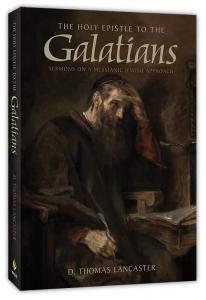
I won’t go through the entire story, which culminated with yet another sermon series of Lancaster’s that eventually became the book The Holy Epistle to the Galatians, but twenty years ago, so disturbed by how the “Messianic Jewish heresy” was describing the continuance of Torah rather than its abrupt death at the hands of Paul, Lancaster called his brother David to get some guidance. Guidance arrived but not in the form Lancaster was expecting. Lancaster quotes his brother as saying about the continuation of the authority of Torah:

Maybe it’s not what we always teach, but that’s the way it’s supposed to be.

But what’s all that got to do with the Book of Hebrews?

Lancaster set the stage for the further study of the epistle (or any Biblical document, really), but that’s not the emphasis of this thirty minute teaching. The emphasis in the first sermon was on the Kal Va-chomer argument or a comparison of two items from the “lighter” or somewhat less significant, to the “heavier” or more significant.

Jesus used this particular method on more than one occasion:

Or what man is there among you who, when his son asks for a loaf, will give him a stone? Or if he asks for a fish, he will not give him a snake, will he? If you then, being evil, know how to give good gifts to your children, how much more will your Father who is in heaven give what is good to those who ask Him! (emph. mine)

Matthew 7:9-11 (NASB)

Galatians by D.T. LancasterLancaster gave a few other examples, both from the Gospel and Talmud of such an argument, including the Parable of the Widow and the Unjust Judge (Luke 18:1-8), which only implies the Kal Va-chomer argument (and seeing that the argument can be implicit rather than explicit is important because a reading of Hebrews 12:18-24 also indicates the Kal Va-chomer argument is somewhat implicit), but the point is that such an argument is not alien to Judaism in general and the teachings of the Master (and apostles) in particular.

Notice something important, though. Lancaster says that in the latter situation in the above example, the generosity of our (good and perfect) Father in heaven, when compared to the earlier situation, generosity of earthly (evil) fathers, the latter does not undo the former. That is, the fact that God is good, perfect, and generous does not invalidate, replace, or cancel the generosity or the status of our human fathers.

Another point to pay attention to is that the first situation, the generosity of imperfect but giving earthly fathers, must be true and have value in order for the second situation, the generosity of the good and perfect Father in Heaven, to be even more true.

Now let’s revisit Hebrews 12:18-24 which compares Mount Sinai and the Torah to Mount Zion and the Messiah. Paraphrasing, and these are my words trying to capture Lancaster’s message:

If you thought it was incredible, awesome, terrifying, and the greatest revelation of God to humanity when God appeared to the ancient Israelites and gave them the Torah at Sinai, how much more so will it be incredible, awesome, terrifying, and an even greater revelation of God to humanity when you confront Mount Zion, the city of the living God, the heavenly Jerusalem, and His myriads of angels?

But the latter doesn’t invalidate the authority, truth, and value of the former, it is just bigger, badder, has more authority, is more true, and has more value.

If the latter invalidated the former, the Kal Va-chomer argument would fall apart and neither situation could be true.

One verse later, the anonymous writer of the letter to the Hebrews uses the same method again:

See to it that you do not refuse Him who is speaking. For if those did not escape when they refused him who warned them on earth, much less will we escape who turn away from Him who warns from heaven.

Hebrews 12:25 (NASB)

If those who received the Torah at Sinai couldn’t escape the consequences of ignoring God, how much less will you escape the consequences of “Him who warns from heaven.”

Lancaster offered other examples of these arguments as presented by Jesus, but I think you get the point. Lancaster is saying that, like the traditional, majority Christian interpretation of Galatians, we have it all wrong about how we understand Hebrews. It took a rather pointed and shocking revelation from his brother David for Lancaster to decide to re-evaluate Galatians from a fresh perspective, setting aside Christian tradition, and interpreting the letter from its original, first century Jewish viewpoint.

Setting aside the traditional Christian interpretation and taking a fresh look at old epistles is one point that Mark Nanos makes about the Galatians letter in his book The Irony of Galatians: Paul’s Letter in First-Century Context. This is the point that Lancaster is making about how we should treat the book of Hebrews, too. It’s the focus of this lecture series, which I imagine will actually start at Chapter 1, verse 1 in the next recording. I’m looking forward to it.

What Did I Learn?

d_thomas_lancasterI learned to shift my perspective when looking at the book of Hebrews, at least Hebrews 12:18-25. As I mentioned above, Hebrews has been a big problem for me. I had been so exposed to the traditional Christian interpretation of this letter, that I couldn’t see any way around its anti-Jewish, anti-Judaism, anti-Torah message, which stood in such opposition to everything else I understand in the Bible. Now Lancaster has given me a basic tool with which to shift that understanding, a new lens with which to look at the text.

The website of Beth Immanuel Sabbath Fellowship, the congregation where Lancaster teaches, contains all of the audio recordings of the Holy Epistle to the Hebrews series (thirty-seven as I write this). Believe it or not, I only listed the highlights of Lancaster’s first sermon. You can listen to “Fire on the Mountain” and the other recordings of his Hebrews teachings on that page at your convenience.

I’ll review the second sermon, “A Word of Exhortation” next week.

Whatever Happened to the Mixed Multitude?

Mount SinaiThe first prerequisite for receiving Torah is unity of the Jewish people. On the first day of Sivan, the Jews arrived at the mountain. The verse (Exodus 19:2) uses an unusual conjugation to describe their encampment. Rather than the plural form, here the entire camp is described in the singular. This emphasizes the need for unity at the giving of the Torah. (Rashi, Exodus 19:2)

-Rabbi Zave Rudman
“Chumash Themes #12: The Ten Commandments”
Aish.com

(Ex. 12:38), a class who accompanied the Israelites as they journeyed from Rameses to Succoth, the first stage of the Exodus. These were probably miscellaneous hangers-on to the Hebrews, whether Egyptians of the lower orders, or the remains of the Hyksos (see EGYPT ØT0001137; MOSES ØT0002602), as some think. The same thing happened on the return of the Jews from Babylon (Neh. 13:3), a “mixed multitude” accompanied them so far.

“Mixed multitude” definition
dictionary.reference.com

I don’t know what brought this to mind today, but the “mixed multitude” popped into my head. Probably because comments on several of my blog posts recently have mentioned conversion to Judaism, and that is the commonly held fate in religious Jewish opinion of this group of non-Jews who left Egypt with the Children of Israel (and possibly a similar group returned to Israel with the Hebrews at the end of the Babylonian exile).

But what happened to them? Where did they go?

I’ve been lamenting with Derek Leman lately over the loss of my “innocence” about the Bible. If scholars like Friedman are right, then the entire question may be moot because the Israelites and a group of Gentile “hangers on” may or may not have accompanied them on an exodus that may or may not be partly or completely fiction.

But setting that aside for the moment and assuming the events and people groups being described have some sort of basis in reality, I’ll go ahead and ask the question: what the heck happened to the “mixed multitude?”

The answer depends on your theology. I say that because how we interpret what the Bible is telling us is firmly rooted in what we believe about our religion.

Let’s look at Rabbi Rudman’s statement above. According to Jewish tradition, the group who accepted the Torah at Sinai were basically considered a single person; totally unified. But if that includes Hebrews and Gentiles, then their identities became fused into a single entity with no ability to differentiate. That can’t be literally true, because post-Sinai, individuals were identified as non-Jews.

Now an Israelite woman’s son, whose father was an Egyptian, went out among the people of Israel. And the Israelite woman’s son and a man of Israel fought in the camp, and the Israelite woman’s son blasphemed the Name, and cursed.

Leviticus 24:10-11 (ESV)

So national identity wasn’t obliterated after Sinai and it was recognized that the individual involved had an Israelite mother and an Egyptian father.

So were Hebrews and Gentiles fused in some other way? Midrash aside, is this even remotely likely?

Let’s take a look at some opinions:

In Exod 12:38, we read that when the Israelites left Egypt, a mixed multitude (עֵרֶב רַב) went up with them. Therefore, the question arises: Who were the mixed multitude? Interestingly, the word עֵרֶב is also attested to at the time of Nehemiah. In Neh 13:3 the term עֵרֶב is linked to Nehemiah’s reforms against intermarriages. In other texts, such as Jer 25:20; 50:37 and Ezek 30:5, the term עֵרֶב has the meaning “to take on a pledge” or “to give in pledge exchange.” In those instances, the term עֵרֶב appears in the context of war and those slain by the sword; thus, the term refers to mercenaries. A clue to the identity of the mixed multitude can also be found in Exod 13:18, where the text describes the Israelites at the time of the Exodus as חֲמֻשִׁים, a term which can have military implications. The existence of mercenaries in the ancient world is well known. They were part of David’s army and accepted as part of the Israelite nation. In this paper, we will show that the term עֵרֶב רַב in Exod 12:38 refers to mercenaries who intermarried with the Israelites and left armed with them at the time of the Exodus from Egypt.

-Shaul Bar
“Who Were The ‘Mixed Multitude’?”
Hebrew Studies (taken from the Abstract)
Vol. 49, (2008), pp. 27-39
Published by National Association of Professors in Hebrew (NAPH)
Article Stable URL: http://www.jstor.org/stable/27913875

many peopleThat defines the “mixed multitude” as an extremely specific group of people, in this case, mercenaries. But that might not be to everyone’s taste.

In typical fulfilment of the promise in Genesis 12:3, and no doubt induced by the signs and wonders of the Lord in Egypt to seek their good among the Israelites, a great crowd of mixed people (רב ערב) attached themselves to them, whom Israel could not shake off, although they afterwards became a snare to them (Numbers 11:4). ערב: lit., a mixture, ἐπίμικτος sc., λαός (lxx), a swarm of foreigners; called אספסף in Numbers 11:4, a medley, or crowd of people of different nations. According to Deuteronomy 29:10, they seem to have occupied a very low position among the Israelites, and to have furnished the nation of God with hewers of wood and drawers of water. – On Exodus 12:29, see Exodus 12:34.

Keil and Delitzsch Bible Commentary
referencing Exodus 12:38

That expands the identity of the “mixed multitude” from a single profession but still leaves us with a low view of this group of Gentiles who, according to this interpretation, would be nothing but trouble for the Israelites and ultimately provide the tribes with a “worker class” to perform menial labor.

Barnes’ Notes for the same verse say that they were “Probably remains of the old Semitic population, whether first brought into the district by the Hyksos or not is uncertain. As natural objects of suspicion and dislike to the Egyptians who had lately become masters of the country, they would be anxious to escape, the more especially after the calamities which preceded the Exodus.” Gill’s Exposition of the Entire Bible tells us “Some of these were Egyptians, and some of other nations that had resided in Egypt, and who, on various accounts, might choose to go along with the children of Israel; some through intermarriages with them, being loath to part with their relations, see Leviticus 20:10, others on account of religion, being proselytes of righteousness, and others through worldly interest, the land of Egypt being by the plagues a most desolate place; and such wonders being wrought for the children of Israel, they saw they were a people that were the favourites of heaven, and judged it safest and best and most for their interest to keep with them…”

We can’t be sure who this group of people were, but most (but not all) opinions I’ve found seem to believe they were the dregs of society, refugees who had no better place to go and nothing better to do. An uncertain future with the fleeing Israelites was better than remaining in slavery and suffering in Egypt.

Was this “rabble” raised up spiritually with the Hebrews at Sinai and became one with the covenant people of God?

We read famously in Exodus 12:38 about a mixed multitude which left Egypt with Israel. This probably reflects the idea that non-Israelite peoples left Egypt with Israel (other ideas have been suggested, but I am reading it this way). Many in the Gentile Back-to-Torah movements today (Hebrew Roots, One Law, Two House) refer often to this passage as a paradigm for their own relationship to the Jewish people. The assumption is: when Torah was given there were Gentiles present, they were included within the Torah commandments as non-Israelites, and this is a parallel to Gentile in our time who are in Messiah and who thus feel they too have been commanded to keep Torah. I wish to show in this article, referring to another aspect of the Jewish halakhah (rules of practice) for conversion, that the mixed multitude cannot be used in this manner. This mixed multitude should be regarded as joining Israel (going through conversion).

-Derek Leman
“Conversion 2: The Mixed Multitude”
Messianic Jewish Musings

mountain-morningThis is really the crux of my curiosity about this group, since they are often used, in certain minority Christian circles, as the justification for “Gentile/Christian obligation to Torah.” Leman’s opinion should be obvious to those who know his work or the general opinion of Messianic Judaism (as opposed to the various Hebrew Roots groups), so I don’t think you’ll have to guess about his conclusions.

I don’t believe the mixed multitude converted as such during the days of Moses, since the Children of Israel were tribal-based and one doesn’t convert to a tribe. Even after the Babylonian exile (see Cohen), the Israelites returned to their land as clan-based groups and as yet did not have a well-defined (or defined at all) concept of conversion (Conversion is a recognized process by the time we reach the Second Temple period). The closest I think we can come is that anyone who wanted to stay with the Israelites had to live like the Israelites, but they were still not members of a tribe or later, a clan. They were a group of “gerim” who lived alongside the Israelites but who didn’t become Israelites.

Leman continues:

So, let’s consider the mixed multitude which left Egypt with Israel. What happened to them? We do not hear about their continuing existence as a group of people. They did not remain Gentiles within Israel. They became Israelites (like Caleb did). They were absorbed into the people of Israel (exactly like modern converts are absorbed into the people of Israel). And they submitted to the same covenant ceremony as the Israelites (and as converts do today).

I suppose to a degree it seems as if I’m disagreeing with Leman, since he says the “mixed multitude” did, in a sense, convert and disappear into the tribes. Yes, they disappeared, but having no tribal identity, how did they manage it? Assuming the Gentiles living among Israel intermarried with various members of the tribes, their children, and grandchildren, and later descendants would have taken on tribal identity and then the Gentiles would have vanished. Presumably if a later group of Gentiles left Babylon with the Jewish clans, they too would have intermarried (or been subsequently evicted, see Ezra 10) and then their descendants would have adopted clan identification and their history as Gentiles would have been lost to history and time.

Can we use their example, Gentiles living alongside Jews and performing the same mitzvot, as a model for Christianity and Christian obligation to Torah today? I seriously doubt it. The social and organizational conditions that required the mixed multitude to take on a status very similar to widows and orphans who had to tribal inheritance to lands in Israel no longer exists. Jews have long since ceased to be a tribal people and Judaism no longer recognizes that process as a valid method of accepting non-Jews within their community. Instead, a formal conversion process is now in place.

Also, what about Jesus?

Oh yeah, remember him?

Yes, that was a tad snarky, but to deny that Jesus gives all people among the nations a covenant relationship with God (the process is complicated and frankly, not well-defined theologically), is to deny Jesus entirely.

The story of the mixed multitude, in any meaningful theological sense, is no longer relevant. This process is one that passed away because it is no longer necessary. That’s not the same as saying that Jewish obligation to the mitzvot has passed away, nor is it a supersessionistic pronouncement. The Messianic reality of Jesus just makes the status of the ancient gerim completely anachronistic for the modern Christian, and it has been so for at least 2,000 years, and probably for a good deal longer.

moshiach-ben-yosefI know I’ve been writing a lot about all this lately, and I will continue to do so (at least for tomorrow and the next day), but in elevating the status of the ancient ger as a role model and template for the modern Christian is to say we must strip ourselves of the blood of Jesus, so to speak, and undo everything that he has done for us. In his letter to the Galatians, Paul strongly discouraged the Gentile believers from converting formally to Judaism as a means of attaining righteousness before God. It was completely unnecessary for that purpose.

Look: I, Paul, say to you that if you accept circumcision, Christ will be of no advantage to you. I testify again to every man who accepts circumcision that he is obligated to keep the whole law. You are severed from Christ, you who would be justified by the law; you have fallen away from grace. For through the Spirit, by faith, we ourselves eagerly wait for the hope of righteousness. For in Christ Jesus neither circumcision nor uncircumcision counts for anything, but only faith working through love.

Galatians 5:2-6 (ESV)

This is not to say that conversion to Judaism was forbidden in Paul’s eyes and it’s likely that some believers did convert. But in those days, there was no dissonance between being Jewish (born or converted) and discipleship under Yeshua (Jesus) as Messiah. Today, it’s problematic, since virtually any legitimate conversion process to Judaism requires the individual involved to renounce all other religious allegiances (specifically Christianity).

In many of my other blog posts, I say that remaining Gentile Christians and being drawn to the Torah is not a problem. We can indeed go beyond our obligations and voluntarily take on many of the mitzvot. It doesn’t make us Jews. It doesn’t make us Israelites. It makes us Christians who have solidarity with the Jewish people and who, alongside them, strive to encourage and support the return of the Jews to the Torah, to the Land, and to summon the Moshiach, may he come soon and in our days.

As for the mixed multitude…I hate to say it, but they’re old news. That dinosaurs once existed and were a necessary presence in their time and place doesn’t mean that they have relevancy in our modern world. A lot has changed since then.

Final note: This is my 700th blog post for Morning Meditations. If God is willing, they will continue for another 700 and beyond.

The Jesus Covenant, Part 4: Is There a New Covenant Connection?

My point is not to try and change the nomenclature of Jews, Christians, and everyone regarding the names of parts of the Bible. My point is to argue against a shallow equation of a collection of books with something the prophets of Israel promised. In the new covenant, human hearts will be circumcised (Deut 30:6), replaced from their stony nature with a softer one (Ezek 36:26), the spirit of people will be filled with the divine Spirit (Ezek 36:27), all people will know God (Jer 31:34), the commandments will be followed (Ezek 36:27), the commandments will be written on human hearts (Jer 31:33), Israel will be restored in the land (Jer 31:33; Ezek 36:28), and there will be forgiveness of sins (Ezek 36:25, 29; Jer 31:34).

-Derek Leman
“The New Testament is not the New Covenant”
Messianic Jewish Musings

As I mentioned in Part 3 of this series, I seem to be stuck. More specifically, I said:

But can the prophesies we read in Isaiah, Micah, and Zechariah be reasonably connected to the New Covenant from Jeremiah and Ezekiel and more importantly, can all this then be attached to what we read in the Gospels and Epistles. Can we attach these prophesies to the blessings of the New Covenant, and can they then be logically joined with the coming of the Jewish Messiah and his command to make disciples of all nations? (see Matthew 28:18-20)

Since writing Part 3, I’ve been searching for clues in an effort to solve this mystery (no mean feat for someone who isn’t a theologian). I didn’t intend to immediately return to Derek Leman as my source, but he did come up in a Google search. Since he first suggested to me that the New Covenant has blessings for the nations (something that is not apparent in the text of Jeremiah 31 or Ezekiel 36), then perhaps something he wrote could show me what I’m missing.

Let’s start with what I already quoted from Leman:

In the new covenant, human hearts will be circumcised (Deut 30:6), replaced from their stony nature with a softer one (Ezek 36:26), the spirit of people will be filled with the divine Spirit (Ezek 36:27), all people will know God (Jer 31:34), the commandments will be followed (Ezek 36:27), the commandments will be written on human hearts (Jer 31:33)

Leman specifically states “human hearts” and “all people”, rather than referring specifically to the Jewish people. He does say that ” Israel will be restored in the land (Jer 31:33; Ezek 36:28),” but for the most part, he seems to be discussing humanity in general and not the Jewish people specifically as the only people bound by the New Covenant.

A quick reading of Deut. 30:6 and its surrounding text reveals that God, through Moses, is addressing the Children of Israel and not people in general. Since we know from Part 1 of this series that there are no blessings in the Mosaic covenant (as defined in the Torah) that can be applied to the nations, and that the only people of this covenant are the Jewish people, we cannot reasonably apply this promise to any other people, including Christianity.

Ezekiel 36:23 (ESV) does say, “And I will vindicate the holiness of my great name, which has been profaned among the nations, and which you have profaned among them. And the nations will know that I am the Lord, declares the Lord God, when through you I vindicate my holiness before their eyes,” implying that the nations (the rest of us) will be impacted in some manner by the New Covenant, but only because we will see how God “vindicates the holiness of His Great Name” by taking the Jewish people “from the nations and gather(ing) them from all the countries and bring them into their own land.” That seems to put the context of his references to vv 26-27 squarely among the Jewish people with no involvement of anyone non-Jewish except as witnesses.

So, where’s the connection between the New Covenant and Christianity or even just the non-Jewish people?

We find the new covenant in two primary places. Jeremiah 31 and the Last Supper.

Really? That means we have to find someway of connecting Jeremiah 31 and “the Last Supper.” Is that possible?

As Jesus said, “This is my blood of the covenant which is poured out for many” (Mark 14:24) and “This cup that is poured out for you is the new covenant in my blood” (Luke 22:20).

OK, let’s take a look at those verses.

And as they were eating, he took bread, and after blessing it broke it and gave it to them, and said, “Take; this is my body.” And he took a cup, and when he had given thanks he gave it to them, and they all drank of it. And he said to them, “This is my blood of the (some manuscripts insert “new”) covenant, which is poured out for many. –Mark 14:22-24 (ESV)

And he took bread, and when he had given thanks, he broke it and gave it to them, saying, “This is my body, which is given for you. Do this in remembrance of me.” And likewise the cup after they had eaten, saying, “This cup that is poured out for you is the new covenant in my blood.(Some manuscripts omit, in whole or in part, verses 19b-20 [which is given… in my blood]) –Luke 22:19-20 (ESV)

This could present a problem since only some manuscripts of Mark 14 insert “new” as in “new covenant,” and some manuscripts of Luke 22 completely omit the text where Jesus refers to his blood as being poured out as the “new covenant.” So in Mark, the best we could say with some assurance is that his blood being poured out is a sign of some sort of covenant, but are we sure it ties back to older covenants and specifically the New Covenant of Jeremiah 31 as Leman suggests? Heck, Luke 22 may not refer to any covenant, new or otherwise, as relating to his blood or anything else.

Not only do we have the problem of finding a way to directly connect any sort of blessings of the New Covenant as recorded in Jer. 31 and Ezek. 36 to Christ’s statements in Mark 14 and Luke 22 about his blood and the New Covenant, we aren’t really sure if Jesus meant that his blood was specifically a sign of the New Covenant or any covenant at all because of variances in the manuscripts.

Setting all that aside for the moment, let’s look at the final relevant quote from Leman’s article:

As Jesus said, “This is my blood of the covenant which is poured out for many” (Mark 14:24) and “This cup that is poured out for you is the new covenant in my blood” (Luke 22:20). He meant that his death (the cup poured out) would inaugurate (but not complete) the new covenant. He meant that the beginning of the new covenant promises would arrive in his death. He meant that the new covenant was now and not yet. He meant the kingdom was now but that we would wait for it. He meant that light had dawned but day was not fully arrived. He did not mean, “from now on all that is old is obsolete.” He meant what was promised long ago is moving forward.

Leman states with some confidence that the death of Jesus began but did not complete the New Covenant. It started the ball rolling, so to speak, but that “ball” would not get to where it’s going until his return (“Truly, I say to you, I will not drink again of the fruit of the vine until that day when I drink it new in the kingdom of God.”Mark 14:25 (ESV)).

In his last statement, Leman is apparently referring to Hebrews 8:13 (ESV):

In speaking of a new covenant, he makes the first one obsolete. And what is becoming obsolete and growing old is ready to vanish away.

In verses 8-12 of this chapter of Hebrews, the author was apparently quoting from Jeremiah 31:31-34, so this is the first indication of a direct connection between the New Covenant of Jeremiah and something to do with Jesus Christ. Unfortunately, this part of Hebrews is also used by many in Christianity to say that the New Covenant (Christ’s grace) has replaced the Law of Moses:

But as it is, Christ (Greek: “he”) has obtained a ministry that is as much more excellent than the old as the covenant he mediates is better, since it is enacted on better promises. For if that first covenant had been faultless, there would have been no occasion to look for a second. –Hebrews 8:6-7 (ESV)

Of course, if we apply what we know about the New Covenant affirming and expanding upon the older covenants, specifically the Abrahamic and Mosaic, then nothing has been replaced at all. Leman’s interpretation of what we just read in Hebrews is, “He did not mean, ‘from now on all that is old is obsolete.’ He meant what was promised long ago is moving forward,” changing the standard interpretation of this set of verses to mean that the conditions of the New Covenant, affirming and expanding upon the older covenants, is proceeding forward in history as we approach the point when the Messiah will return.

I have to remind myself that Leman’s intent in writing this blog post was not to draw a map between the New Covenant described in Jer. 31 and Ezek 36, to Jesus, the Last Supper, and Hebrews, as much as he was trying to explain that the New Testament (Gospels, Epistles, Apocrypha) writings were not directly equivalent to the New Covenant. That is, the NT writings are not the text that defines the New Covenant nor does this entire section of the (Christian) Bible directly connect back to the aforementioned sections of the Old Testament or Tanakh (Jewish Bible) used to define the New Covenant.

One of the interesting things about Leman’s blog post is that I responded more than once in the comments section, yet at the time (just a few months ago), I didn’t make the connection to the “covenant dilemma” that I am now undergoing. However, there are a couple of comments (not mine) that add just slightly to this investigation.

Samuel: Great post. I find it odd that Christians spend so much time talking about the “New Covenant” when the “New Covenant” in the Old Testament is inseparably bound to Israel coming into her fullness and possessing the land and not God throwing away a broken “Old Covenant” so He could create a new one. Somehow when people preach on the “New Covenant” they never include the Biblical context where the land of Israel and the Messianic kingdom in Jerusalem are the primary features of the New Covenant.

I wonder theologically how we ever created a “New Covenant” when the the (sic) Scripture is very straightforward about it being the fulfillment of the covenant made with Abraham and Israel.

Derek: Thanks for commenting. I think the answer has to be the use of New Covenant language by Jesus at the Last Supper (see Luke’s version). And then it comes up in Hebrews. In my upcoming book, Yeshua Our Atonement, I explain in some depth the argument being made in Hebrews.

I wonder if this means that I’ll have to wait until Derek’s latest book is published and then buy a copy to get some answers to my questions?

So what do we have so far? Based on what I just wrote as well as Part 3, maybe not as much as I’d like. No matter where I look, at best, I can only find what amounts to hints that the New Covenant of Jer. 36 and Ezek 31 has any sort of blessings attached to them that could possibly be associated with Jesus, the Last Supper, and the coming of the next age (Mark 14, Luke 22, Hebrews 8). We know from various prophesies (Isaiah 56:1-8, Micah 4:1-5, Zechariah 8:20-23, among others) that the nations will also reap blessings and benefits from God in the Messianic age, but trying to draw an “A connects to B connects to C” map of how all this works with the New Covenant and Christ’s “Last Supper” statements remains maddeningly elusive. As far as the Old Testament is concerned, I’m convinced the New Covenant applies uniquely and exclusively to the Jewish people, but the prophesies of how the nations will benefit in the Messianic age could just as easily apply to Noahides as they could to Christians.

So far, either my investigation on the New Covenant has going completely bust, or I’ve discovered some tantalizing but inconclusive threads that are trying to pull things together, but in a wholly mysterious way.

I’ll say again that I am no expert in this field of study. I don’t even know what books to read to find what I’m looking for. I’m not a theologian, Bible scholar, or some other type of religious “big wig” who sees all and knows all regarding the arcane secrets of the Bible. I suppose someone with degrees and qualifications could some along and explain all this to me in spiritual and mystic terms, saying, “This means this and that means that, and if you take the numerical value of the Hebrew letters in Jeremiah 31, divide by zero, turn around three times and wave a Bible over your head, then the New Covenant means what Christianity or Derek Leman says it means.”

So far, my request for assistance from Part 3 has fallen on deaf ears, at least as far as I can tell from the lack of responses.

Either there is a yet undiscovered (by me) means of reasonably and rationally connecting the New Covenant we see in the Old Testament to the relevant sections of the New Testament, or the very, very best I can say is that only the blessings for the nations we find in the Abrahamic covenant attach the Christian to God.

But is the Abrahamic covenant enough?

I don’t know what comes next, but I hope for my sake and perhaps yours that I can find a way to write a Part 5 of The Jesus Covenant.