
 As always, as an interfaith community, our aim is not to meld, mash-up, mix, water-down or confuse our two religions. Instead, we strive to celebrate each holiday, whether Jewish or Christian, with full respect and all the trimmings. So how and why are these celebrations different from those you would find in any church or synagogue? Often, we begin and end a celebration by reciting our interfaith responsive reading, which is not a statement of creed, but a recognition that some of us are Jews, some of us are Christians, some of us have interfaith identities, and we are all equal members of this community. For me, simply knowing that we are an interfaith community changes my perception of any event: ancient rituals, songs and prayers, shimmer with the newness of radical inclusivity.
-Susan Katz Miller
“Lessons and Carols: Interfaith Community”
On Being Both
It’s Sunday morning as I write this and I’m avoiding church until January. Why? Because of Christmas.
Wait! Let me explain.
While Susan Katz Miller belongs to a community that can honor the different religious observances of its members, I’ve been attending a more traditional Baptist church. I remember hearing about how some of the church members participated in an anti-abortion rally at a new Planned Parenthood building some months back. Among the protesters were people from local Mormon and Catholic churches. My Pastor spoke of the event, but I don’t recall if it was from the pulpit or in a personal conversation with me. He said that a Catholic Priest was one of the speakers at the event and the Priest addressed the group with words something like, “We are all believers” or “We are all Christians.”
The point my Pastor had to make, representing the general perspective of our church, is that, because of the significant theological differences involved, he doesn’t consider Catholics and Mormons as “fellow believers” but rather, as those who are outside the Christian “camp.” Sure, they all came together at the event because of a common purpose, but the barriers constructed between those different faith communities, as far as he was concerned, were firm and inviolate.
I don’t say this to speak poorly about my Pastor or the church I attend. I consider him and the people I worship with to be truly devoted to God and desiring to serve Him in all that they do. However, there are distinct boundaries that contain the church and one may cross those barriers only at their own risk.
Almost a month ago, I called myself a Christian who studies Messianic Judaism. What that means in a nutshell, is that I am a non-Jewish believer in Jesus as the Jewish Messiah, and that I choose to study the Bible within a framework that takes into account the Jewish environment, perspectives, customs, and culture in which the Bible was authored, using that as a lens in filtering my view of Jesus.
As you might imagine, that somewhat crosses one or more of the barriers that contains my church’s theology and doctrine. My periodic meetings and conversations with my Pastor attest to the differences between us, and we’ve been honest that we are both trying to convince the other of our individual points of view.
I must say, I’m learning a lot, not only about church history and the development of fundamentalism in Christianity, but about my own opinions and where they come from. You never learn more about what you believe and why than when you are required to defend it.
 Pastor and his wife are spending the rest of the month (or most of it) in Florida to celebrate Christmas with his family. It will certainly be warmer than the December I’ve been experiencing here in Idaho. But that leaves behind Christmas at the church and today (as I write this) there won’t even be Sunday School.
There will be the Children’s Christmas Pageant. The kids have been practicing for about a month and I’m sure they’re looking forward to their big moment.
But that was several days ago as you read this, even though as I am writing, it is still before dawn on Sunday morning.
My family and I left Christmas behind about ten years or so ago and we’ve never looked back. That’s pretty much a given for my wife and kids since they’re Jewish. My married son’s wife is very much into Christmas and while my son doesn’t resist her efforts to put up a tree, lights, and decorations, he doesn’t participate either. The rest of my family just tries to ignore the season, although one of my sister-in-laws has been sending email Christmas cards of a humorous nature to the missus.
I quoted Miller’s blog post because it is a portrait of not blending together different faith traditions into a mixing bowl, but rather, interfaith families choosing to honor each other’s traditions and celebrations without having to surrender anything about their own.
Another member of our community confessed to me this week that he had bought his wife a Christmas present for the first time, after decades of marriage. A most loving and supportive husband, as a Jew he just had not been able to transcend the bitter history of religious conflict and wrap his head around the idea of a Christmas gift. He credited our interfaith community with his shift in thinking, and his ability to finally arrive, bearing a gift from afar.
I never said it was easy, but apparently, it’s possible. It requires a certain amount of willingness and a great deal of courage to overcome the fears and inhibitions of a lifetime. I don’t have a community like that either in my family or corporately, and even if I had access to a corporate community, attendance would conflict with my home life. I’m not even sure how my family tolerates my attending an “ordinary” church.
I’ve chosen a path that I believe is right and that I believe is right for me. In doing so, I have to walk away from all other paths. I suppose, from an outside observer’s point of view, it must look like I’m trying to walk both sides of the street, Christianity and Judaism. This actually isn’t the case. My wife and any Jewish person I’ve ever encountered, consider me a Christian, and so I am. A Christian is simply a person (typically non-Jewish) who has faith that the Jesus Christ of the Bible is the promised Savior and Messiah and the one who will return as the King of Israel and the world.
The only difference, and it’s a big one, is that my perspective of how I perceive God, Messiah, the Bible, and everything all that means, is substantially different from most of the traditional Church (big “C”). Most religious communities permit little or no permeability of their distinctive boundaries and barriers that contain who they are and keep out everyone else. The price of admission is to adopt the theologies, doctrines, and dogmas within their specific container and disavow everything else.
But my container is somewhat unique. Oh sure, a lot of other people occupy my container (more or less) but my container is virtual. It exists “in the cloud,” so to speak. The people who share a large portion of my understanding exist all over the world, but few, if any, are right here in “River City.” And as I said, even if we did get together, it would violate certain family requirements for me to participate in any significant or regular way.
Blogging is about as close as it gets and even that’s dicey sometimes.
One of the requirements contained within the church I attend is Christmas. It’s the day the vast majority of Christians choose to honor the birth of Jesus, and a great deal of custom, tradition, and fanfare surround not only that day, but the entire month in which it occurs.
But it’s not “me.” I don’t resonate with Christmas as a Christian. Watching everyone at church get really excited about Christmas (my Pastor was listening to Christmas music in his office even before Thanksgiving) just accentuates my sense of alienation, my “not-belongingness.”
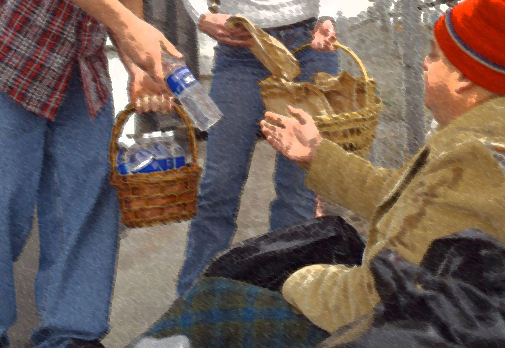 I don’t disdain those who choose to celebrate Christmas. In fact, some Christians use this time of year to exceptionally demonstrate their desire to serve God by behaving more “Christ-like” in giving to charity and showing kindness to others. If Christmas is their inspiration for doing good, who am I to argue?
Unlike Miller, I’m not “both,” I’m just “me,” whatever “me” is. Actually, I’m getting a better and clearer picture of what “me” is all the time. The mist is dissipating and the sun is beginning to shine on the path I have selected from all of the paths I’ve considered.
It’s just a path that doesn’t hold very many fellow travelers. And almost none of them celebrate Christmas. I’ll see what church is like after the lights and decorations have come down next month.
Addendum: I just wanted to add that some traditional Christians also don’t celebrate Christmas for a variety of reasons, I for one am not avoiding it out of some sense of paganoia (a term coined by First Fruits of Zion teacher and author Toby Janicki) or the irrational fear that celebrating Christmas automatically makes you an idol worshiper. It’s a matter of personal conviction and taking on board a more Judaic view of the Messiah. It’s as simple as that.










 Morning Meditations