Tag Archives: intermarried

Shopping for a Christian Church

Likewise, Gentile Christians are in brotherhood with Jewish Christians, reckoned as spiritually circumcised in heart (Rom 2:26) and thus joined to Abraham through faith (Gal 3:29). Here then is racial diversity within spiritual unity, in the same way as a Christian man and wife are diverse in their spiritual unity (Gal 3:28). This same diversity in unity is strongly intimated in Rom 15:8-9 since “Christ has become a servant of the circumcised on behalf of the truth of God, to confirm the promises to the fathers, and so that Gentiles may glorify God for His mercy” because of their inclusion as Gentiles with the fathers.

-Pastor Barry E. Horner
“Chapter 10: Israel and a Romans 11 Synthesis” (pg 278)
Future Israel: Why Christian Anti-Judaism Must Be Challenged

Hoch also quoted A.T. Hanson on this issue. While explaining that the prevailing interpretation of Phil 3:3 identifies the “we” as all true Christians, Hanson nevertheless declared that this understanding…

…seems quite foreign to Paul’s thought and means actually reading into Philippians ideas which seem to have originated at the time of the Reformation…The Philippians, being Gentiles, would have no reason to boast in the flesh anyway. Paul goes on to describe what he means by this phrase in the ensuing verses: it is plain that he means boasting of the national and spiritual privileges peculiar to the Jews. This the Philippians could not do…It is simpler to take “we” here as “we believing Jews”, or even “we, Paul and Timothy”, in whose name the letter is written. We know that Timothy was circumcised. So there is no good reason for maintaining that the use of “the circumcision” here suggests that Paul could apply the name Israel to Gentiles.

-A.T. Hanson, The Pioneer Ministry (London: SCM, 1961), 35
as quoted in Horner, pg 277

There’s really a lot going on in this chapter of Horner’s book, but space won’t allow me to insert all of the relevant quotes. If I tried, I might as well just copy and paste the chapter in verbatim. Actually, I’m not just writing another anti-supersessionism rant. I have a different, but related purpose for this “extra meditation” today.

I don’t agree with everything each of these gentlemen says in their respective books, but they are still refreshing to me. I tend to read mostly Jewish commentaries, but I’ve been reading Horner as part of my research into superessionism relative to my ongoing series on that topic in FFOZ’s Messiah Journal. What’s really exciting is that I’m reading the works of Christian authors and Pastors who actually agree that the church has not replaced the Jews in the covenant promises. I know they’re out there somewhere. Now if only I could find them.

Let me explain.

Not long ago, I discovered that “plan A” wasn’t going to work. Plan A was my separating from active participation in Messianic Jewish worship (One Law, anyway) for the purpose (well, it’s one of the reasons) of joining my wife in classes and services at our local Reform and Chabad synagogues. It took awhile, but I eventually discovered that it wasn’t just my former association with Messianic Judaism that made my wife hesitant to include me in that part of her life. It is my active and continuing faith as a Christian.

That’s not something I’m going to walk away from, even for the slim chance that my wife would feel more comfortable including me in her Jewish communities (and I don’t think it would do any good anyway). So plan A is shot to heck. Now I can either exist in isolation as a person of faith, or I can attempt to find some sort of community in which to participate as a Christian. But that presents a problem.

I previously wrote at length regarding all the roadblocks that stand in the way of my attending a church. On the other hand, there must be some churches that aren’t dripping with supersessionist rhetoric, aren’t there? I decided to look for one by querying a Christian Discussion Group several days ago. As the saying goes, except for one person trying to convince me that the church has replaced the Jews, the silence has been deafening (a second, more helpful person, responded while I was composing this blog).

But then, you have these Christian authors that make such encouraging statements. I mean, do these guys worship in heavily anti-Jewish churches and just keep their mouths shut, or are there actual havens of sanity and brotherhood under the sign of the cross? You couldn’t prove the latter by me, but since I’m facing a move to “plan B” now, I need to start somewhere.

I haven’t the faintest idea how to “shop” for a church.

I’ve occasionally talked to people who have been around churches for decades and can go into a church and assess its theology and how it operates almost immediately. They tell me what they see and hear that convinces them that the church is this and that, but I haven’t the faintest idea what they’re talking about. I went to a Lutheran church as a kid and then, decades later, I “came to the Lord” (I hate to say it, but “Christianese” still makes me crazy) in a Nazarene church (which ultimately turned out to be a bad experience, with a few bright spots mixed in), but that’s it. I don’t know from larger “organized Christianity”. The church, as in “all churches everywhere,” is a mystery to me. Actually, given my general outlook, the idea of “church shopping” makes me nervous.

But I’m getting a little tired of only being able to talk about what I think, feel, and believe in a virtual environment. It would be nice to occasionally address human beings face to face. However, I don’t want to get into a verbal “knock down-drag out” in a church because I don’t comfortably blend in to the homogenous Christian scenery, relative to Judaism. If I encounter a supersessionist attitude or worse, an anti-Semitic one, I’m liable to take it personally since my wife and kids are Jewish.

Does anyone have any ideas as to how to proceed? I’m not necessarily in a rush, and in fact, I’d like to plot, plan, and scheme, so to speak, about my next move. I have to admit, the thought of walking into a church again is intimidating. I call myself a Christian but socially, (which is a lot of what going to church is about) I’m anything but.

If you aren’t a regular visitor on this blog, you’ll need to get some idea of who I am and where I’m coming from. Since I more or less wear my heart on my sleeve when I write, just read four or five of my blog posts (the most recent, or pick some at random), and you’ll get a pretty good idea about how I see things.

Oh, I live near Boise, Idaho if that helps any.

Thanks.

Shattered Fragments

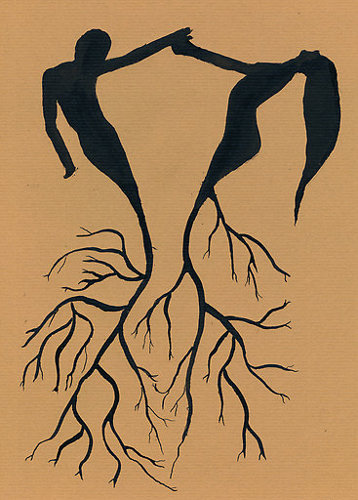
Descending SoulsWhen G-d sends the souls forth into the world, they include a male and female joined together…When they descend to the world…they are separated from each other. Sometimes one soul precedes the other in descending and entering a body of a human being. When their time to be married arrives, G-d, Who knows these souls, joins them as they were before [they descended to this world]…When they are joined together, they become one body and one soul.Zohar 1:91b

Some Pharisees came to him to test him. They asked, “Is it lawful for a man to divorce his wife for any and every reason?” “Haven’t you read,” he replied, “that at the beginning the Creator ‘made them male and female,’ and said, ‘For this reason a man will leave his father and mother and be united to his wife, and the two will become one flesh’? So they are no longer two, but one flesh. Therefore what God has joined together, let no one separate.”Matthew 19:4-6

This is a continuation of my commentary on the JLI course Toward the Meaning of Life. See The Prophet and the Shade Plant for the previous commentary and links to earlier lessons.

As Christians, we are generally taught that we have no pre-existence prior to conception and birth. Somehow, our individual souls are all part of that process and we exist in isolation within the womb, physically and spiritually. We do not realize the joining of two souls as one until marriage so that we become “one flesh” (Genesis 2:24), but Kabbalah suggests another interpretation. We also see this viewpoint in the Chasidic writings as related by Rabbi Tzvi Freeman’s rendition of the Rebbe’s teaching on man and woman:

It is a mistake to consider man and woman two separate beings. They are no more than two halves of a single form, two converse hemispheres that fit tightly together to make a perfect whole. They are heaven and earth encapsulated in flesh and blood.

It is only that on its way to enter this world, this sphere was shattered apart. What was once the infinity of a perfect globe became two finite surfaces. What was once a duet of sublime harmony became two bizarre solos of unfinished motions, of unresolved discord.

So much so, that each one hears in itself only half a melody, and so too it hears in the other. Each sees the other and says, “That is broken.” Feigning wholeness, the two halves wander aimlessly in space alone.

Until each fragment allows itself to surrender, to admit that it too is broken. Only then can it search for the warmth it is missing. For the depth of its own self that was ripped away. For the harmony that will make sense of its song.

And in perfect union, two finite beings find in one another infinite beauty.

While there is a beauty in this interpretation; a poetic and romantic image that calls to anyone who has found their “soulmate” in their spouse or who is ernestly seeking their bashert, couldn’t all this just be considered some non-Biblical fantasy? After all, Adam, a man, was created first and then Eve was created from his rib. This is how we understand it in Christianity. They are two separate beings who were joined together by God spiritually. The only “unity” they shared originally is that Eve was made out of one of Adam’s body parts.

But is that how it really was? Genesis 2:18 says, “And the Lord God said, it is not good for the man (ha-adam) to be alone; I will make a fitting helper for him.” Let’s have closer look at some of the Hebrew words and concepts. Rabbi Pinchas Stolper in his article, “The Man-Woman Dynamic of Ha-Adam: A Jewish Paradigm of Marriage provides some important insights into Genesis that we miss when we read the English text:

Who is ha-adam? It is neither man (ish) nor the first man (adam). To identify ha-adam, we turn to Genesis 1:27. “And God created ha-adam in His image, in the image of God He created him (oto); make and female, He created them (otam).” The first part of the verse clearly indicates that ha-adam is a single being. The second half indicates that this single being, at the conclusion of the creation process, becomes “otam (them),” two individuals.

The key to decoding this mystery is to be found in Rashi, the Biblical commentator par excellence, who generally anchors the Biblical text in its plain meaning. Rashi explains: “They were created shenai partzufim [of two faces, androgynous] in the original creation; and only later did God divide them.” In other words, ha-adam, the first human being is a unique creation; both male and female simultaneously (see Ketuvot 8a).

This is an amazing revelation of the first human beings and has startling implications on what it is to be created in the “image of God” (since God is without gender) and on Paul’s teaching, “neither male nor female” (Galatians 3:28), but can we accept the interpretation of a 12th century Jewish sage over the actual Biblical text? If ha-adam was not the actual first “man” in Creation, where did the separate entities of Adam and Eve come from? Rabbi Stolper provides an answer:

Later, the Torah records that “the Lord God put ha-adam into a tardema (deep sleep) and took one of his tzela’ot.” Rashi indicates that “tzela’otav” does not mean “one of his ribs” but, “one of his sides,” as it is taught, “the side of the Tabernacle.” This follows the meaning of the Talmud “that they were created with two faces.” Ha-adam was originally a unified individual with two “sides,” two faces, two aspects, two sexes, subsequently divided into two.

A footnote on this commentary states:

Rabbi Samson Raphael Hirsch, notes (Genesis 2:21) that “tzela does not occur elsewhere in the Tanakh (OT) as a ‘rib’, but always as a ‘side,’ which is also why tzalua means to be inclined towards one side, to limp.”

One SoulBased on the actual Hebrew of the Genesis creation story, the common interpretation of Eve being “Adam’s rib” doesn’t hold an ounce of water. Man and woman were originally united as a single, unified entity that God deliberately separated into different and equal parts designed to perform different functions in the created world. However, like any single thing that is put into two parts, neither one is complete until they are joined back together. In fact, the Hebrew for “cling to” that we find in Genesis 2:24 is the Hebrew word “vedavak” which carries the sense that a man must “leave his father and his mother, and shall glue himself to his wife: and they shall be one flesh.”

But why didn’t God just let ha-adam stay as a single entity? I’m sure most married couples, who have had their fair share of marital disagreements must be asking the same question. You’d think that having an “unsplit” ha-adam would have avoided thousands of years of stormy marital discord and the proverbial “battle of the sexes”.

Interestingly enough, in Genesis 2:18, when God says, “It is not good (lo tov) for man to be alone (levado)”, the implication of the Hebrew is that “it is not yet good”. The ultimate “good” could not be achieved unless their were two of them. Animals were already created “male and female” without going through the “splitting” process described for ha-adam and thus only human beings are able to be joined together as a spiritual “one”. No other living beings in creation are capable of this level of total unity of essense, and it requires that the two must specifically be “male” and “female”, man and woman.

But that doesn’t answer the question.

Rabbi Stolper’s article quotes Rabbi Shlomo Wolbe and Rabbi Yeruchem Lovivitz on the matter and the answer in part states:

“It is clearly demonstrated to you that the Lord alone, levado, is God; there is none beside Him.” God is on the level of levado (citing Deut. 4:35).

Only God is One, a unique and radical unity (Deuteronomy 6:4) and there is no other “oneness” like God. In the Garden, part of the serpent’s temptation of Eve was that “when you eat of it, your eyes will be opened, and you will be like God…” (Genesis 3:5). This was the only sin possible for Adam and Eve to commit in Eden; to attempt to be like God. We are meant to be much more than the other creatures of Creation, but we were created to be “a little lower than the angels” (Psalm 8:5; Hebrews 2:7). Only God is One, levado; alone. Humans are unique in creation but we are still meant to be two, man and woman, and to become “one flesh”.

There’s an obvious problem with the Chasidic interpretation of God always joining the “split souls” of man and woman together again in marriage when you consider Jewish/Gentile intermarried couples such as me and my wife. When asked “Can a Jewish woman’s berheret (soul-mate) be a non-Jew”, Rabbi Shraga Simmons
replies in part:

The Talmud says that 40 days before the formation of a fetus, it is decreed in heaven which boy will marry which girl. Since God has forbidden a Jew from marrying a non- Jew (Deut. 7:3), it is obvious that the beshert is a Jew. There is of course the possibility that one’s beshert will be a convert, though this again would only apply to someone who converted in accordance with God’s laws.

Yet here we are, man and woman, married to each other, presumably by God’s decree and (though Rabbi Simmons wouldn’t consider this a factor) commanded by Jesus that “what God has joined together, let no one separate.”

I don’t know how it works or how it’s supposed to work. I only know that things are what they are and that God is here with us, helping us to try to do our best, just the way He made us, to repair our little bit of the broken world and prepare for the coming of the Moshiach. Our two halves don’t always make an agreeable whole and like any married person, I sometimes wonder why. The only answer I can find is in how Rabbi Freeman interprets the Rebbe on the topic of getting along:

When we can’t get along with someone, we like to blame it on that person’s faults: stupidity, incompetence, outrageous actions, aggression or some other evil.

The real reason is none of these. It is that the world is broken, and we are the shattered fragments.

And all that stops us from coming back together is that we each imagine ourselves to be whole.

We are shattered fragments trying to become whole again. We contain Divine sparks within us that are constantly striving to break free and return to the One Source of all things. We are prisoners, imaging ourselves as individuals sitting isolated in a jail cell of our own making, but we’re sitting on the keys.

The next part of this series, and a continuation of the discussion about marriage, is in the “morning meditation” Who Are We to God?.

Will My Grandchildren Be Jewish?

Jewish GrandchildrenYou could call this “extra” meditation a “Part 2” of my earlier blog post What God Has Joined Together. Part of the “mission” of my blog is to document the life of an intermarried couple and what that means. Here we go.

Based on current intermarriage rates and the average number of children per family, the chances of young, contemporary Jews having Jewish grandchildren and great-grandchildren, with the exception of the Orthodox, are increasingly remote.

From “Will Your Grandchildren be Jewish”
Aish.com (PDF/graphic)

Based upon the data and the various population studies that are now available, it appears that an extraordinary disintegration of the American Jewish community is in process. There was a time when every Jew could take it for granted that he or she would have Jewish grandchildren with whom to share Seders, Sabbath and other Jewish moments. However, the clear data indicates that this expectation is no longer well founded. Indeed, our studies show that within a short period of time the entire complexion of the American Jewish community will be altered inexorably.

From “Will Your Grandchildren be Jewish?”
VirtualJerusalem.com

Will my grandchildren be Jewish? Probably not. Let me explain, but I have to go back a little bit.

My wife is Jewish and I’m not. She’s Jewish because her mother was Jewish (both of my wife’s parents passed away many years ago). My wife’s father wasn’t Jewish and my wife wasn’t raised in a religiously or culturally Jewish home. She only realized that she was Jewish by halachah (because her Mom is Jewish) when she was a young adult. Even then, she waited decades until she fought to enter into a culturally and religiously Jewish world, and that’s where she is today.

My wife has two brothers and two sisters. None of them acknowledge being Jewish. One brother and one sister are actively Christian and her Christian brother even denies the possibility that his mother was Jewish, saying there’s no proof (we have tons of proof, including the documentation of many maternal relatives buried in Jewish cemeteries). Out of five children of a Jewish woman, my wife is the only one living a Jewish life today. Sad but typical. My wife beat the odds but she had to work really hard to do it.

We have three children. All self-identify as Jews, at least marginally. I say “marginally” because they don’t really involve themselves in Judaism on a cultural or religious level. My daughter is the one who has come closest to embracing her Judaism. She sometimes goes to Chabad functions with my wife. When she was an exchange student in Japan for a year during high school, my daughter made the effort (and it was significant) to attend the synagogue in Tokyo on a few occasions (my daughter lived about 50 miles away). My daughter has tutored Hebrew to some of the kids at our local Reform shul.

My sons acknowledge that they’re Jewish but that’s about it. I think David has a basic faith in Jesus but he doesn’t lead any sort of religious lifestyle. Michael doesn’t have a Jewish lifestyle as far as I can tell.

Only David is married and he’s married to a (wonderful) non-Jewish girl. They have one son, my grandson, the apple of my eye. And my grandson is not Jewish.

Michael will probably marry someday, but he’s not currently dating and the chances of him marrying a Jewish woman isn’t very good. My daughter Jamie says she wants to marry someday, but doesn’t want to have any children (even through adoption).

No, my grandchildren will not be Jewish.

Things seem grim for the Jews in America but I’m going to try to inject something upbeat.

Julie Wiener writes a series of articles for The Jewish Week magazine called In the Mix. Julie is intermarried to a “Righteous Gentile husband” and they have two daughters (and because Julie is Jewish, so are her kids…I don’t know if Julie’s parents are intermarried). According to an article she wrote last June, intermarried Jews are breeding like crazy.

Depending on your point of view, that’s either good or bad. Depending on who you are, intermarried couples (like Natalie Portman and her partner Benjamin Millepied) can raise their children Jewish or (like Anthony Weiner and his Muslim wife, Huma Abedin) not. Not that it’s up to the Mom exclusively what cultural and religious identity the children will have. Julie published a more recent article called Battle Hymn of the Gentile Mom describing how the non-Jewish wives of Jewish husbands commit to raising their children Jewish. There’s even this quote:

Also of interest in JTA is an article about a recent study of Chicago’s Jewish population, which finds that while intermarriage (and the Jewish population) has increased, the percentage of intermarried families raising Jewish children has also increased…

I can read all the articles and research studies I want, but all I really have to do to see where the children and grandchildren of intermarried couples end up is to look at my own family. We never chose to embrace Judaism in the home until fairly late in life when the kids were almost grown. I often wonder what would have happened if we could have made the decision earlier. A futile waste of time, I know.

God has never permitted the Jewish people to vanish from the face of the Earth and I don’t believe He ever will. When the Messiah comes, there will be Jews here. But it will be a miracle from God. It seems like people aren’t helping with the process all that much.