Tag Archives: Jesus

Va’etchanan: Blessing God in Sorrow

Moses at NeboAnd you shall love the Lord your G-d. with all your ‘me’od’Deuteronomy 6:5

The word me’od has many meanings. It serves as the etymological root for ‘measure’ (midah), ‘thank’ ( modeh), and ‘very much’ ( me’od). Using all three meanings in its interpretation of the above verse, the Talmud states:

“A person is obligated to bless G-d for the bad just as he blesses Him for the good, as it is written: ‘And you shall love the Lord your G-d. with all your me’od’ – for every measure which He measures out to you, thank Him very, very much.” -The Talmud, Brachos 54a

The name of this week’s Torah Portion, Va’etchanan means “and he pleaded”, referring to Moshe’s (Moses’) pleading with God to allow him to live and to lead the Children of Israel into the Land of Canaan, even after God had decreed that Moses should die. We learn from the Mishnah on Va’etchanan, that we should bless God for everything that happens in our lives, the good and bad alike. As we see in the following example, that’s not an easy thing to even consider, let alone perform:

A man once came to Rabbi Israel Baal Shem Tov with a question: “The Talmud tells us that one is to ‘bless G-d for the bad just as he blesses Him for the good.’ How is this humanly possible? Had our sages said that one must accept without complaint or bitterness whatever is ordained from Heaven – this I can understand. I can even accept that, ultimately, everything is for the good, and that we are to bless and thank G-d also for the seemingly negative developments in our lives. But how can a human being possibly react to what he experiences as bad in exactly the same way he responds to the perceptibly good? How can a person be as grateful for his troubles as he is for his joys?”

-Rabbi Yanki Tauber
“A Matter of Perspective”
Chabad.org

It’s easy to imagine being the man who is trying to get a seemingly impossible answer from the Baal Shem Tov. Whenever good happens in our lives, if we have any sense of God in our lives at all, we thank Him with all our heart and being for His goodness and His providence. When tragedy and disaster strike on the other hand, blessing God becomes much more difficult. Most of us do not respond like Job, apparently, not even Moses.

I pleaded with the Lord at that time, saying, “O Lord God, You who let Your servant see the first works of Your greatness and Your mighty hand, You whose powerful deeds no god in heaven or on earth can equal! Let me, I pray, cross over and see the good land on the other side of the Jordan, that good hill country, and the Lebanon.” But the Lord was wrathful with me on your account and would not listen to me. The Lord said to me, “Enough! Never speak to Me of this matter again! Go up to the summit of Pisgah and gaze about, to the west, the north, the south, and the east. Look at it well, for you shall not go across yonder Jordan. Give Joshua his instructions, and imbue him with strength and courage, for he shall go across at the head of this people, and he shall allot to them the land that you may only see.” –Deuteronomy 3:23-28

When we pour out our heart to God, it would seem almost cruel for God to respond in this manner. Why does He treat His faithful servant Moses this way? Why is a rebuke God’s response to this type of prayer? The following is how the Rambam describes prayer, but it seems to contradict what happened between Moses and God:

The obligation [this] commandment entails is to offer supplication and prayer every day; to praise the Holy One, blessed be He, and afterwards to petition for all one’s needs with requests and supplications, and then to give praise and thanks to G-d for the goodness that He has bestowed.

The fundamental dimension of prayer is to ask G-d for our needs. The praise and thanksgiving which precede and follow these requests is merely a supplementary element of the mitzvah. A person must realize that G-d is the true source for all sustenance and blessing, and approach Him with heartfelt requests.

Often, however, we do not content ourselves with asking for our needs. We desire bounty far beyond both our needs and our deserts. We request a boon that reflects G-d’s boundless generosity. For every Jew is as dear to G-d as is an only child born to parents in their old age. And because of that inner closeness, He grants us favors that surpass our needs and our worth.

As quoted from
“Vaes’chanan: To Plead with God”
-Rabbi Eli Touger
Adapted from
Likkutei Sichos, Vol. XXII, pgs. 115-117;
Vol. XXIV, p. 28ff

SorrowHowever, Rabbi Touger goes on to say that pleading “is one of the ten terms used for prayer” and that “Moshe [approached G-d] in a tone of supplication, [asking] for a free gift” demonstrating that “no created being can make demands from its Creator”. It’s one thing to pour out your heart to God with your needs and your troubles, but no man is entitled to anything from God that God Himself does not will.

I don’t say this to be unkind to Moses. Certainly he was the greatest of all the Prophets, a man who spoke to God “face-to-face”, so to speak” and the most humble of men. However, he was a man and like all men, was less than perfect in the eyes of God, as we see in the incident at Meribah (Numbers 20:1-13).

But even then, it is not so wrong for Moses or for any of us to beg that God turn aside His wrath when we pray:

There is a difference of opinion among our Sages (Rosh HaShanah 17b) as to whether prayer can have an effect after a negative decree has been issued from Above, or only beforehand. The Midrash follows the view that prayer can avert a harsh decree even after it has been issued. Therefore Moshe was able to approach G-d through one of the accepted forms of prayer.

-from Rabbi Touger’s commentary

No, for all his humanity and doubtless, all his frustration, Moses prayed the way any of us would pray, that God would relent and spare him what he no doubt saw as the most anguished of consequences. In the end, did Moses bless God for not being allowed into the Land? For most of his address to the Children of Israel, Moses pleads with them, he warns them, he begs them not to disobey God. Only minutes from death, he continues to do what he has done for the past 40 years, protect the people from their own folly, from their own sin, from their own desire for destruction, with every bit of his effort. Deuteronomy 33 is his blessing to Israel and in the following and final chapter of the Torah, Moses quietly obeys, passing the mantle of leadership on to Joshua.

Then Moses climbed Mount Nebo from the plains of Moab to the top of Pisgah, across from Jericho. There the LORD showed him the whole land—from Gilead to Dan, all of Naphtali, the territory of Ephraim and Manasseh, all the land of Judah as far as the Mediterranean Sea, the Negev and the whole region from the Valley of Jericho, the City of Palms, as far as Zoar. Then the LORD said to him, “This is the land I promised on oath to Abraham, Isaac and Jacob when I said, ‘I will give it to your descendants.’ I have let you see it with your eyes, but you will not cross over into it.”

And Moses the servant of the LORD died there in Moab, as the LORD had said. –Deuteronomy 34:1-5

How very much like the one who came after him, how like the death of “The Prophet”.

He was oppressed and He was afflicted, Yet He did not open His mouth; Like a lamb that is led to slaughter, And like a sheep that is silent before its shearers, So He did not open His mouth. –Isaiah 53:7

“How can I,” he said, “unless someone explains it to me?” So he invited Philip to come up and sit with him.

This is the passage of Scripture the eunuch was reading:

“He was led like a sheep to the slaughter,
and as a lamb before its shearer is silent,
so he did not open his mouth.
In his humiliation he was deprived of justice.
Who can speak of his descendants?
For his life was taken from the earth.”

The eunuch asked Philip, “Tell me, please, who is the prophet talking about, himself or someone else?” Then Philip began with that very passage of Scripture and told him the good news about Jesus. –Acts 8:31-35

We can hardly blame Moses for his plea to God. We certainly don’t blame Jesus:

Going a little farther, he fell to the ground and prayed that if possible the hour might pass from him. “Abba, Father,” he said, “everything is possible for you. Take this cup from me. Yet not what I will, but what you will.” –Mark 14:35-36

Praising GodBut Jesus did not stop at pleading with God but rather bowed to His will in all things, even suffering and death.

But what about those of us who are less than Prophets; we “ordinary people”. What about the man and his question of the Baal Shem Tov?

In this matter, the Baal Shem Tov sent the man to his disciple, Reb Zusha of Anipoli for the answer to the man’s question. Here’s the remainder of Rabbi Tauber’s narrative and the lesson we can take from Va’etchanan:

Reb Zusha received his guest warmly, and invited him to make himself at home. The visitor decided to observe Reb Zusha’s conduct before posing his question and before long concluded that his host truly exemplified the talmudic dictum which so puzzled him. He couldn’t think of anyone who suffered more hardship in his life than did Reb Zusha. A frightful pauper, there was never enough to eat in Reb Zusha’s home, and his family was beset with all sorts of afflictions and illnesses. Yet the man was forever good-humored and cheerful, and constantly expressing his gratitude to the Almighty for all His kindness.

But what was is his secret? How does he do it? The visitor finally decided to pose his question.

So one day, he said to his host: “I wish to ask you something. In fact, this is the purpose of my visit to you – our Rebbe advised me that you can provide me with the answer.”

“What is your question?” asked Reb Zusha.

The visitor repeated what he had asked of the Baal Shem Tov. “You know,” said Reb Zusha, “come to think of it, you raise a good point. But why did the Rebbe send you to me? How would I know? He should have sent you to someone who has experienced suffering…”

The disciple of the Baal Shem Tov, many centuries later, demonstrated the lessons learned by the disciple of Jesus of Nazereth:

I am not saying this because I am in need, for I have learned to be content whatever the circumstances. I know what it is to be in need, and I know what it is to have plenty. I have learned the secret of being content in any and every situation, whether well fed or hungry, whether living in plenty or in want. I can do all this through him who gives me strength. –Philippians 4:11-13

In all of our circumstances God is there. He is the source of everything both good and bad. We can hardly fail to acknowledge Him, both in our utmost joy and in abject and bitter sorrow. Yet Rabbi Tzvi Freeman records the wisdom of the Rebbe, Rabbi M.M. Schneerson as perhaps the best way to look at how we may bless God no matter what is happening to us as he says in Open Eyes:

After 33 centuries, all that’s needed has been done. The table is set, the feast of Moshiach is being served with the Ancient Wine, the Leviathan and the Wild Ox—and we are sitting at it.

All that’s left is to open our eyes and see.

Regardless of our happiness or pain, let us strive to bless the Lord that we may one day take our places “at the feast with Abraham, Isaac and Jacob in the kingdom of heaven” (Matthew 8:11).

Good Shabbos.
Words and Drawn Swords

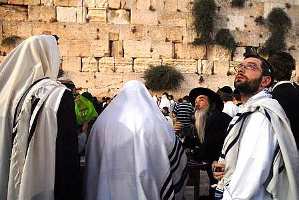
Tisha b'Av at the Kotel 2007Israeli Prime Minister Benjamin Netanyahu told President Barack Obama he’s willing to make some compromises to achieve peace in his nation, but that returning to Israel’s 1967 borders is not an option.

Netanyahu met with Obama in Washington, D.C., Friday, on the heels of the president’s public call to return Israel to the borders the state held before the 1967 Six Day War, as a concession for peace with the Palestinians.

CBN News Story
“Netanyahu Tells Obama 1967 Borders ‘Indefensible’
by Jennifer Wishon

My companion attacks his friends;
he violates his covenant.
His talk is smooth as butter,
yet war is in his heart;
his words are more soothing than oil,
yet they are drawn swords.
Psalm 55:20-21

On Tisha B’Av, five national calamities occurred:

  • During the time of Moses, Jews in the desert accepted the slanderous report of the 10 Spies, and the decree was issued forbidding them from entering the Land of Israel. (1312 BCE)
  • The First Temple was destroyed by the Babylonians, led by Nebuchadnezzar. 100,000 Jews were slaughtered and millions more exiled. (586 BCE)
  • The Second Temple was destroyed by the Romans, led by Titus. Some two million Jews died, and another one million were exiled. (70 CE)
  • The Bar Kochba revolt was crushed by Roman Emperor Hadrian. The city of Betar — the Jews’ last stand against the Romans — was captured and liquidated. Over 100,000 Jews were slaughtered. (135 CE)
  • The Temple area and its surroundings were plowed under by the Roman general Turnus Rufus. Jerusalem was rebuilt as a pagan city — renamed Aelia Capitolina — and access was forbidden to Jews.

-Rabbi Shraga Simmons
“Overview and laws of the Jewish national day of mourning”
Aish.com

I sometimes wonder what keeps the Jewish people going. I know, the “politically correct” answer is “God”, but think about it. You are Israel. You are surrounded by nations who have wanted to completely destroy you since the day you arrived in the modern world. Within your ancient and historic borders is a people group who demands that you give up more and more of your land and if you don’t, they’ll keep on killing your citizens. Even your biggest “ally”, the United States, for decades has continued to demand that you “give up land for peace”, even when you’ve already shown (think Gaza) that doing so only results in more terrorism; the opposite of peace.

Not only does the world hate Israel, the world hates Jews. Anti-Semitism is on the rise in Sweden, Anti-Semitism is on the rise in Canada, Anti-Semitism is on the rise all over the world.

If you’re a Jew, you’re not really safe anywhere. Sooner or later, someone is going to turn on you.

Why go on?

You can sort of see why assimilation has always been a forbidden but attractive alternative for Jews in the diaspora. Tisha b’Av is a reminder of just how much the world hates the Jews and how many times throughout history, everyone else has tried to kill the Jews; to wipe them out of existence.

Why go on? Why not either give in and let the world have their way, or assimilate and quietly disappear into the pages of history, as so many other ancient people groups have done (ever hear of a Canaanite, a Hittite, or an Edomite anymore)?

Why go on?

In the times of the First Temple lived very lofty souls. It was their thirst for spiritual ecstasy that led them to worship foreign gods.

Thousands of years later, the holy Ari taught, in the 500 years of forced conversions from the Crusades until the Spanish Expulsion, these souls returned so they could be repaired.

Many of the martyrs of that time were men of reason—and for a philosopher to give his life for the sanctity of G–d’s name is a very great test. Many did, and so they were healed.

When the Ari came, however, he revealed the secret wisdom and repaired the world so that all souls were healed and no repairs were left to be made. It follows that all the suffering of the Jewish people since the Ari are neither punishment nor repair. If so, what are they?

We do not know.

One thing we do know: That we do not know.

-Rabbi Tzvi Freeman
Based on letters and talks of the Rebbe, Rabbi M. M. Schneerson
“Beyond Punishment and Repair”
Chabad.org

Were you hoping for something more uplifting? So was I.

I’m not Jewish, so I lack any real understanding to be able to answer the question. The Hamasonly thing I know is that the Jews have endured and they continue to endure. Is it God’s will that the Jews should continue to exist and that they should also continue to suffer?

“I know, I know. We are Your chosen people. But, once in a while, can’t You choose someone else?” -Teyve from the film Fiddler on the Roof (1971)

There are times when individuals get so discouraged they want to give up. Some quit their jobs, some get divorced, some simply withdraw into themselves and we call that depression, and some do the ultimate “quitting” by committing suicide. In these cases, the people involved feel trapped and alone and hopeless. Whether it’s true or not, they feel like everyone is against them and that there’s no where to turn. They feel out of control of their environment and their lives and they want to make the pain stop.

They’re willing to do anything to make the pain stop because life doesn’t make any sense.

I know you’re reading this a day later, but I’m writing this on Tisha b’Av. I know that hope is supposed to be mixed in with mourning and loss, but mourning and loss are a vital and inescapable element on the 9th of Av. The hunger of fasting is a reminder of how empty the world is of justice and mercy:

“Blessed are the poor in spirit,
for theirs is the kingdom of heaven.
Blessed are those who mourn,
for they will be comforted.
Blessed are the meek,
for they will inherit the earth.
Blessed are those who hunger and thirst for righteousness,
for they will be filled.” –Matthew 5:3-6

Tisha b'Av at the Kotel 2011The Master might as well have been talking about Tisha b’Av…or about life.

Maybe the only answer is the one provided by the Rebbe as interpreted by Rabbi Freeman at Chabad.org:

We are imprisoned because we have exiled our G-d.

As long as we search for G-d by abandoning the world He has made, we can never truly find Him.

As long as we believe there is a place to escape, we cannot be liberated.

The ultimate liberation will be when we open our eyes
to see that everything is here, now.

If the Jews are in exile, if the Jews suffer and mourn, God suffers and mourns with them. They aren’t alone. Even in torment, they are never alone. However, based on the words of Jesus quoted above, does that also apply to the rest of us? In mourning, where is our promised comforter? In sorrow, where is our peace?

Remember my affliction and my wandering, the wormwood and bitterness.
Surely my soul remembers
And is bowed down within me.
Therefore I have hope.
The LORD’S lovingkindnesses indeed never cease,
For His compassions never fail.
They are new every morning;
Great is Your faithfulness.
“The LORD is my portion,” says my soul,
“Therefore I have hope in Him.”
The LORD is good to those who wait for Him,
To the person who seeks Him.
It is good that he waits silently
For the salvation of the LORD. –Lamentations 3:19-26 (NASB)

As it is said, every descent is for the sake of an ascent, and so we have this Kabbalistic interpretation of Tisha b’Av from Rabbi Yitzchak Ginsburgh:

The Seer of Lublin passed away, at the age of 70, on the 9th of Av 5575 (1815), a day of national mourning, but also, according to the sages, the birthday of the Mashiach. Long before his passing he hinted to his followers that he would pass away on the 9th of Av.

The passing of the Seer of Lublin joins together with the “passing” of the Divine Presence from the Holy Temple in Jerusalem on the 9th of Av (the day of the destruction of the Temple – only its physical body “died” but its soul ascended to heaven) to arouse God to bring the Mashiach (who will permeate reality with Divine revelation, bringing redemption, peace and goodness to all) – now!

Hope and Ashes

MourningI remember with perfect clarity the sensation of waking up on the morning of March 9, 1990. In those first few fuzzy moments of consciousness, I oriented myself to where I was — in the spare bedroom of my parents’ New Jersey apartment, and what day it was — two days after my father’s death. As soon as I realized that I had woken up into a world without my father, my heart plunged into a fathomless grief, like waking up into a nightmare that will never end.

The world without my father was not simply the same world minus one; it was a totally different world. This altered, diminished world lacked the stability and goodness that was my father. This world wobbled on its axis; its gravitational pull was heavier.

The ninth day of the Hebrew month of Av — called Tisha B’Av — is to the Jewish people what March 9 was to me. We misrepresent the tragedy of the day by describing it as the destruction of the two Holy Temples, as if the catastrophe is the loss of a building. The American people do not mourn on 9/11 because of the destruction of the Twin Towers; they mourn the thousands of lives lost in the conflagration. Contrast a person who mourns the absence of the majestic towers to the New York skyline with a person who mourns the loss of his/her parents caught on the 98th floor.

Tisha B’Av is more like a death than a destruction, because on that day the world changed irrevocably.

Sara Yoheved Rigler
“Waking Up to a World Without God’s Presence”
Aish.com.

When Jonah’s warning reached the king of Nineveh, he rose from his throne, took off his royal robes, covered himself with sackcloth and sat down in the dust. This is the proclamation he issued in Nineveh:

“By the decree of the king and his nobles:

Do not let people or animals, herds or flocks, taste anything; do not let them eat or drink. But let people and animals be covered with sackcloth. Let everyone call urgently on God. Let them give up their evil ways and their violence. Who knows? God may yet relent and with compassion turn from his fierce anger so that we will not perish.”

When God saw what they did and how they turned from their evil ways, he relented and did not bring on them the destruction he had threatened.Jonah 3:6-10

Sara Yoheved Rigler characterizes the mourning of Tisha b’Av not for the lengthy series of hardships that have been inflicted on the Jewish people and not even for the loss of the First and Second Temples, but for the loss of God in the world. She describes how her son was born into a world without her father, his grandfather, and that he “will never know how the room lit up when my father entered, how secure and supported dozens of people felt because of the bedrock that was my father”.

For the past 2,000 years, Jews have been born into a world without the Holy Temple in Jerusalem, City of David:

In the same way, we who were born into a world without the Divine Presence have never experienced the spiritual luminosity that radiated through the aperture of the Holy Temple. We live in a dimmer, coarser world, where physical reality seems like ultimate truth while spiritual reality seems like a vague phantasm. We navigate in the nightmare without even knowing we’re in it.

It is true that the world is not without God. God is manifest in our world all of the time through the acts of His people, through His answers to prayer, and through His providence in the lives of each and every human being on Earth. Yet, as Rigler points out, the Divine Presence, the unique projection of the infinite God into a finite world through the “humbling” of His essence has not existed in our mortal realm for 20 centuries.

If you’re Christian, I know what you’re thinking. What about Jesus? True. We could say that Jesus was a manifestation of the infinitely Divine in finite moral form. He was the Word made flesh and the Divine Presence in the shape of a man (I say was because he is also our High Priest in the Heavenly Court and he sits at the right hand of the infinite, unknowable, all powerful Ayn Sof; who Christians call “God the Father”).

Candle burning outYet, in the same way that Rigler mourns in a world without the Divine Presence, we Christians can and probably should mourn being born into a world without a living Jesus walking among us. True, God is only a prayer away and He is with us even when we are too weak or ashamed to pray, but something…someone is gone. The world is created but it is damaged. There are pieces missing. We live in a house with walls and part of the roof “deconstructed”. It’s like being born into a world without a loving grandfather…like Sara’s son. It’s also like this:

“And I will pour out on the house of David and the inhabitants of Jerusalem a spirit of grace and supplication. They will look on me, the one they have pierced, and they will mourn for him as one mourns for an only child, and grieve bitterly for him as one grieves for a firstborn son. On that day the weeping in Jerusalem will be as great as the weeping of Hadad Rimmon in the plain of Megiddo. The land will mourn, each clan by itself, with their wives by themselves: the clan of the house of David and their wives, the clan of the house of Nathan and their wives, the clan of the house of Levi and their wives, the clan of Shimei and their wives, and all the rest of the clans and their wives. –Zechariah 12:10-14

Some Christians view this verse as the means to accuse the Jews of “murdering Jesus” and that someday “they’ll be sorry”, but in truth, Jesus died for the sins of all of us. The collective church never really mourns the loss (except perhaps when watching the 2004 film The Passion of the Christ) but only celebrates the resurrection joy on Easter. Where is our sorrow over being the cause of his suffering and death? In claiming the resurrection and everlasting life for our own, where is the agony and sorrow over needing to be saved by his death because of our willful sins?

We were born into a world without the Divine Presence among us because of what we did wrong. Something absolutely perfect is missing from the world, and this side of paradise, we will never fully experience it. Paul said that “we see through a glass, darkly” (1 Corinthians 13:12 KJV) and thus, we were born into the world half-blind, only barely able to see the image of the perfect God in the reflection of the Master. Sin distances us from God and the One who man once walked with in the Garden, though still with us, seems so very distant.

I recently read a story on the Arutz Sheva news website about a group of Christian churches that will, on August 13 and 14, read portions of the Torah in solidarity with the Jews and with Israel. We can fast and mourn with the Jews on Tisha b’Av for this reason as well.

From sundown last night until sundown tonight, Jews all over the world mourn destruction but hope for redemption. As Christians, we know our redemption is in Jesus Christ, and yet he has not returned. There are many who still don’t know him. We who are saved often take that status for granted and continue to sin. We have much to grieve over.

Today, we can fast, dining on ashes, and still hope for the coming of God’s glory back into the world. Sara Yoheved Rigler says something very important in her article:

In one essential way Tisha B’Av differs from death: the catastrophe is reversible. As Rabbi Avraham Isaac Kook declared: “The Temple was destroyed because of causeless hatred [among Jews]; it can be rebuilt only by causeless love.”

It can sometimes be difficult to rise Phoenix-like to embrace a life of “causeless love” from the ashes of grief, sorrow, failure, and “wanton hate” (as expounded upon so well at the Lev Echad blog). Rabbi Tzvi Freeman says the following based on the wisdom of the Rebbe, Rabbi M. M. Schneerson:

Your soul is in captivity when you know what is right and you allow the world to stop you.

Captivity begins by believing that you are small and the world is big. Once you believe that, next you are likely to believe it will step on you, and your fear it.

And then you come to obey it, then to run after it. And then you are it’s slave, thirsting for water for the soul but not even able to remember where to look for it.

To fear the world is to deny the Oneness of the Creator.

Don’t take the world and its darkness so seriously – it is not as real as it feigns to be. The only thing real about it is its purpose of being – that you should purify it.

I struggle to see the hope beyond the loss and yet, today especially, I sit in the darkness and mourn in ashes.

The road

The road is long and often, we travel in the dark.

A Time to Dance

MourningIt used to be that the soul fought with the body, until one conquered the other with force. Then the Baal Shem Tov came and taught a new path: The body, too, could come to appreciate those things the soul desires.

In the place of self-torture and fasting, the Baal Shem Tov showed his students the way of meditation and joy. Every need of the body, he taught, could provide a channel to carry the soul.

Rabbi Tzvi Freeman
Based on letters and talks of the Rebbe, Rabbi M. M. Schneerson
“Working With the Body”
Chabad.org

They said to him, “John’s disciples often fast and pray, and so do the disciples of the Pharisees, but yours go on eating and drinking.” Jesus answered, “Can you make the friends of the bridegroom fast while he is with them? But the time will come when the bridegroom will be taken from them; in those days they will fast.”Luke 5:33-35

Judaism and Christianity in general see the connection between the soul and the body differently. In Christianity, the “desires of the flesh” are seen as always in opposition to the desires of the spirit (“the spirit is willing, but the flesh is weak” from Matthew 26:41). In order for a person to become closer to God, they must deny anything to do with the physical world and strive for the intangible realm of spiritual things. However for Jews, it’s a bit different.

There’s not much of a history of asceticism among Jews the way we see among the Christian saints (there are exceptions). The world was created by God which includes the pleasures of the world. This isn’t to say that a person is permitted to do anything he or she desires, but those things that Christians blush at enjoying, even within proper confines such as sex between a married couple, aren’t considered shameful, as long as such desires are disciplined and only are expressed as God wills. In fact, within Jewish thought, it is believed that for every sinful impulse, God created an acceptable moral equivalent.

I suppose this is an odd topic to bring up, since the fast of Tisha b’Av begins today at sundown. This is the culmination of the Three Weeks of Mourning between the 17th of Tammuz and the Tisha b’Av commemorating the times of great suffering the Jewish people have endured throughout history. Yet God intends for us to mourn, not as a lifestyle, but only in its proper time and season:

There is a time for everything,
and a season for every activity under the heavens:
a time to be born and a time to die,
a time to plant and a time to uproot,
a time to kill and a time to heal,
a time to tear down and a time to build,
a time to weep and a time to laugh,
a time to mourn and a time to dance… –Ecclesiastes 3:1-4

The words of Jesus as recorded by Luke echo this quite strongly. We live in a broken world but we were given life, not only to serve God’s purpose, but to appreciate. Pleasurable things aren’t to be avoided, only enjoyed within the type of lifestyle we were provided by God. For the past three weeks, Jews all over the world have mourned. Tonight, many will fast and weep. Maybe even a few Christians will fast in solidarity with their Jewish brothers and sisters, and in acknowledgement of the fact that God mourns too over the suffering of His people.

Simchat TorahWhile the world has trouble and there is a time to fast, to repent, to cry, and to grieve, there are also times to celebrate, to dance, to laugh, to sing, and to praise God for life and the fact that He wants us to live it.

While we may long for Heaven or the life of the world to come, God did not intend for us to ignore where we are at and what we are doing right now. Rabbi Freeman expresses the Rebbe’s wisdom on the matter this way:

There is no moment more vital than the one right now. There is no space more crucial than the one in which you stand.

For this is the moment and this is the place from which Moshiach may come.

Tonight and tomorrow, we fast and pray and mourn. The day after, we may sing and laugh. God gave us life. God is good. There is a time to mourn and a time to dance.

Clap your hands, all you nations;
shout to God with cries of joy.
For the LORD Most High is awesome,
the great King over all the earth. –Psalm 47:1-2 (NIV)

In fact, we mourn and fast today because, for every descent, there is an ascent.

It is obvious that when Moshiach comes there will be no need to commemorate the Temple’s destruction and thus no reason to perpetuate these fasts. But why will they be celebrated as “holy days and days of rejoicing”?

The answer is that the four fasts are not just commemorations of tragic dates in Jewish history, but contain a hidden good of such magnitude that we will only be able to discern it when Moshiach comes. In fact, the fasts represent four stages in the progression toward Moshiach. We would never be able to attain the revelation of Moshiach were it not for the destruction and the exile. The entire exile may therefore be termed a “descent for the purpose of ascent.”

-from Merkos on Campus

Less than a week after Tisha b’Av, there is a day of dancing, quoting from Jewish Virtual Library:

“There were no better days for the people of Israel than the Fifteenth of Av and Yom Kippur, since on these days the daughters of Jerusalem go out dressed in white and dance in the vineyards. What they were saying: Young man, consider who you choose (to be your wife).” (Taanit 4:8).

L’Chaim! To life!

Healing the Wounded

Snake swallowing tailWhen the Egyptians realized that they were being attacked by supernatural forces at the Red Sea, they said, “I must flee from the presence of Israel, for G-d [Havayah] is fighting for them against Egypt.” (Ex. 14:25)

As you know, Pharaoh derived sustenance entirely from immature divine consciousness [mochin d’katnut], which is alluded to by the word “End”.

The words usually translated as “Red Sea” [in Hebrew, “Yam Suf”] really mean “Reed Sea”, and can also be read as if they were vocalized “Yam Sof”, meaning “Sea of the End”. The “end” is the final sefira, malchut, which descends into the lower worlds, i.e. the lower levels of divine consciousness. Relative to its native environment, these lower levels of consciousness are “immature” or “constricted”.

This is the significance of [the fact that] the snake puts its tail in its mouth.

Pharaoh personified the Primordial Snake.

From the teachings of Rabbi Yitzchak Luria
adapted by Rabbi Moshe Yaakov Wisnefsky
“The Snake at the Sea’s End”
Chabad.org

This is Part 3 in a 3-part series. Before reading this, see Part 1: Overcoming Evil and Part 2: The Primordial Serpent.

The surprise appearance of Pharaoh, King of Egypt (yes, “that” Pharaoh, King of Egypt…the one that gave Moses so much trouble) in the role of the primordial serpent may take you a little off guard, but from the perspective of Kabbalah, many things look different. In Judaism, the serpent is less a specific being or entity (i.e. Satan) and more a representation of an idea or a force, in this case, the personification of the evil inclination. In this sense, you could have many evil people across history personifying the snake. Hitler could be a personification of the ancient serpent of Eden.

But there’s more:

This being the case, Pharaoh was both a head and a tail, in the idiom of the verse, “G-d will cut off from Israel both the head and the tail…on one day.”(Isaiah 9:14)

Pharaoh, here signifying the evil inclination in general, acts as the tail, the lowest consciousness of the Jew, and as the head, i.e. the tail elevated to and usurping the role of the head, proper divine consciousness.

This also alludes to the [Primordial] Snake. Originally, he was the tail and Adam was the head, but [because of the Primordial Sin] this was inverted and the snake became the head and Adam the tail.

Adam here personifies the Good Inclination, or divine consciousness. Sin consists of reversing the hierarchy between divine and material consciousness.

This is the mystical meaning of the verse “He will hit you on the head and you will bite him in the heel” (Gen. 3:15).

Man hits the snake on the head because the snake has usurped man’s role as the leader; the snake bites the heel because by sinning man has become the heel/tail instead of the head.

This is very interesting when your deconstruct the role of snake as Pharaoh back to the original appearance of the serpent in the Garden, and then re-visit the relationship between the snake and Adam (which I suppose we could project back up to the relationship between Pharaoh and Moses).

Adam is the heel (or tail) rather than the head because by sinning, he exchanged roles with the serpent. Instead of man ruling over Creation, now evil rules and man struggles to allow good to ascend while evil inhibits his efforts. The snake bites the heel but the heel will crush the snake.

In Christian thought, the heel of man is symbolized by Jesus crushing the evil of Satan, and Rabbi Wisnefsky, when recounting the wisdom of the Rebbe in his article Transforming the Primordial Snake, presents an interesting interpretation that seems to apply:

Since the snakes were deadly, anyone who had been bitten was for all intents and purposes already dead. Healing the bitten person was thus tantamount to resurrecting him.

Now, in order to resurrect a dead person, it is not enough to simply infuse his body with life, because the body has already lost its capacity to support life. First, the dead body had to be made capable once more of living. This can be done only by a force that transcends the laws of nature, including the dichotomy of life and death. Infusing this transcendent force into the dead body restores its capacity to support life, after which the person’s soul can re-enter it and he can live again.

This is why G-d also commanded Moses to heal the people using a snake. By using the image of the deadly, Primordial Snake to restore life, G-d indicated to them that resurrection requires eliciting a level of divinity that transcends the dichotomy of life and death. When people saw the snake, they understood that in order to elicit this transcendent divinity and be healed, they had to transform their own, inner “snake” – their evil inclination – into a force of good.

What was that? Resurrect the dead?

River of LifeLet’s weave Rabbi Wisnefsky’s commentary into more familiar language. When man fell in the Garden, he was “bitten” by a “poisonous” snake and that “poison”, the evil within us, has continued to sicken humanity down through the ages. Christianity considers a sinner as “spiritually dead”, unable to perceive God let alone to attempt to perform His will.

Jesus, by his death and resurrection, provides the means by which mankind can be healed of our poison and by which we can be brought back from the dead. The commentary above talks about the restoration of the soul and the resurrection of the body, both of which we see in the promise of Jesus Christ. The last paragraph of the Rabbi’s missive illustrates that we must see and be aware of our evil inclination, how it serves as the barrier preventing us from a holy life, and also shows us how we can conqueror that nature and bend it to our will and God’s will (Romans 8:37).

I’m sure that Rabbi Wisnefsky would say that I’m playing fast and loose with his interpretation of the Rebbe’s teachings, but there seems to be more than a casual similarity between the Rebbe’s lesson and what we know of the role of the Messiah relative to the subjugation of evil. Jesus came during the Second Temple period to provide for the repairing of our damaged souls, to reconcile us with God, and to prepare the way to eternal life. When he returns, he will finish the job and completely heal us and the world of the evil that plagues us and restore us to the state which we enjoyed with God in Eden.

All Israel has a share in the World to Come, as is stated: “And your people are all righteous; they shall inherit the land forever. They are the shoot of My planting, the work of My hands, in which I take pride.” –Sanhedrin, 11:1

Then the angel showed me the river of the water of life, as clear as crystal, flowing from the throne of God and of the Lamb down the middle of the great street of the city. On each side of the river stood the tree of life, bearing twelve crops of fruit, yielding its fruit every month. And the leaves of the tree are for the healing of the nations. No longer will there be any curse. The throne of God and of the Lamb will be in the city, and his servants will serve him. They will see his face, and his name will be on their foreheads. There will be no more night. They will not need the light of a lamp or the light of the sun, for the Lord God will give them light. And they will reign for ever and ever. –Revelation 22:1-5

We’re not there yet. We’re still in “exile”. However, God is here with us.

Perhaps, for you, this exile is not so bad. And you feel you are doing whatever you can about it, anyway.

But it is not just you. Abraham, Isaac and Jacob and all their children through all the generations, as well as all the heavenly hosts,
the entire Creation—all is unfulfilled, in exile and imprisoned.

Even the Creator, blessed be He, locks Himself into prison along with His Creation.

Until you get us out of here.

Rabbi Tzvi Freeman
Based on letters and talks of the Rebbe, Rabbi M. M. Schneerson
“Pity on the Cosmos”
Chabad.org

Overcoming Evil

Primordial SnakeThe vilna gaon, rabbi Eliyahu Kramer of Vilna, 1720-1797, one of the most influential Rabbinic figures since the Middle Ages, wrote on this topic in Even Shelaima. In commenting about how it was possible for Adam and Eve to sin if the evil inclination hadn’t fully be incorporated within humankind, he insists that indeed they did have an evil inclination. However, since they were fashioned from the “Hand of God,” their God-consciousness was so strong that it was axiomatic they would do the correct thing. As long as their inner-voice and spiritual essence radiated, it subdued any outside influences that may challenge this level of connection.

The primordial snake turned out to be just the agent to stimulate the notion of rebellion, ignite a spark of doubt in the divine command to refrain from eating of the Tree of Knowledge, and from the moment they imbibed in that forbidden fruit, their “eyes were opened.” From now on the possibility for allowing external stimuli to penetrate their inner-core of the soul’s sanctity and disturb their cleaving to God was activated. Humankind is constantly being tested with how much light their souls (inner essence) can muster to dispel the darkness associated with the myriad temptations of the world, which every moment attempts to suppress the sublime luster of that soul.

-Rav Aaron Perry
found at VirtualJerusalem.com

Despite everything, I believe that people are really good at heart.Anne Frank

Although I didn’t intend it this way, this “morning meditation” is Part 1 in a 3-Part series. See the bottom of this article for information on Part 2.

Given Anne Frank’s brief and tragic life, I’ve always wondered how she could say that. Living in the shadow of Nazi oppression and the horror of the Holocaust, I would imagine she’d see people as anything except “good at heart”.

Christianity teaches that created man was initially good and obedient to God but, thanks to the temptation of the serpent and Eve and Adam subsequently giving in to temptation, the fundamental nature of all human beings throughout time became evil. In other words, all people are inherently evil beings and only through the saving grace of Jesus Christ can we overcome our evil nature (“more than conquerors” as in Romans 8:37) and do good. According to the church, Anne Frank is wrong.

Actually, looking at the bloody and cruel history of humanity, it is easy to agree with Christianity’s viewpoint of man’s grim nature, and to conclude that Ms. Frank was a good but rather naive person. Yet Judaism has a very different take on the “primordial sin” of Adam and Eve.

Depending on who you talk to, Judaism believes that man was essentially operating under a “good inclination” (that’s just like it sounds, man was inclined to do good which in this case means obeying God) internally. Evil existed in the world in the form of the serpent (and at no time in this early Genesis narrative is the serpent equated with Satan) but as an external influence. According to this view, man had an internally good nature but could be impacted by external evil forces.

Rabbi Perry gives us a slightly different view of this, saying that man possessed an internal good and evil inclination. Referencing the Vilna Gaon, he states that, “…indeed they did have an evil inclination. However, since they were fashioned from the “Hand of God,” their God-consciousness was so strong that it was axiomatic they would do the correct thing. As long as their inner-voice and spiritual essence radiated, it subdued any outside influences that may challenge this level of connection.”

In other words, it was possible, but highly unlikely for man to give in to his evil inclination, because his “God-consciousness” overwhelmed the evil within him and generally dampened external evil influences. Once man sinned against God, the barriers inhibiting man from sinning were breached and now, humanity struggles between the two internalized inclinations for good and evil.

BurningDoes that mean, from a Jewish point of view, that Anne Frank is right? Are we really “good at heart” but with our goodness inhibited by our inclination for evil? If so, why is human history so dismal and corrupt? Why don’t we see a more “balanced” expression of human motivations, illustrating whole people groups who were essentially good and righteous vs. others who were dark and monstrous?

I’ve already addressed the issue of the “primordial sin” once before in my blog post Gateway to Eden and suggested that the way we can return to intimacy with God, at least to some degree and for a brief time, was to embrace Shabbat keeping. However, I didn’t try to directly confront the nature of humanity, although I did find this helpful quote:

After man ate from the Tree of Knowledge, however, he acquired the intimate knowledge of and desire for evil. The evil inclination was no longer an external force, represented by the Serpent. It was within. Our physical flesh was now a confused mixture of good and evil. Death was introduced into the world: human flesh, separated from the spirit, was a creature of the finite, physical realm — one which must ultimately decay and die. Man would now face a much greater challenge than before. He would no longer battle a Serpent from without. He would have to battle his own sluggish yet desirous flesh within.

Rabbi Dovid Rosenfeld
The Primordial Sin, Part II
Pirkei Avos Chapter 6, Mishna 5(b)
Torah.org

There is a drive among people, particularly people of faith, to rise above the mud and slime of thousands of years of war, crime, and misery, and to reach out for the heavens and the Throne of God. The Divine spark within us seeks out its Source and cannot be buried, no matter how depraved a people we become. God once chose to destroy all but a tiny handful of human beings and flooded the Earth because we had become so totally immersed in evil, but every time we see a rainbow, we can recall the promise that God will not repeat this action.

God gave the Children of Israel the Torah to establish a nation of mercy and justice and with the intent of sending the Torah from Zion and into the nations. God sent his “only begotten Son” so that everyone could be saved and none should perish for lacking the ability to have a relationship with the Creator.

We’ve previously encountered the question of how man could do evil if he was essentially good. Now we must ask ourselves, if man is essentially evil, why would he even desire to do good? Why would man seek God? For it seems “…man is born for trouble, As sparks fly upward” (Job 5:7 NASB).

Bending the verse just a little bit, I rather prefer, “For man is born to trouble but our sparks fly upward.” None of the translations available present the verse in such a way, but I think my version paints a truer picture of humanity…we battle between the inclinations of good and evil within us, but always present is the image of God in which we were created, and the slender, illuminated thread that inexorably attaches us to Him and leads us upward and back toward home.

All we have to do is resist the evil and seek the good within ourselves.

Do not repay anyone evil for evil. Be careful to do what is right in the eyes of everyone. If it is possible, as far as it depends on you, live at peace with everyone. Do not take revenge, my dear friends, but leave room for God’s wrath, for it is written: “It is mine to avenge; I will repay,” says the Lord. On the contrary:

“If your enemy is hungry, feed him;
if he is thirsty, give him something to drink.
In doing this, you will heap burning coals on his head.”

Do not be overcome by evil, but overcome evil with good. –Romans 12:17-21 (Deut. 32:35 Prov. 25:21-22)

It is not so much that we need to be taken out of exile. It is that the exile must be taken out of us.

-Rabbi Tzvi Freeman
“Inner Exile”
Based on letters and talks of the Rebbe, Rabbi M. M. Schneerson
Chabad.org

We are in the last nine days of the three weeks of mourning between 17 Tammuz and 9 Av, which commemorates the destruction of the First and Second Temples. It is believed that the Second Temple was destroyed and the Jewish people were sent into a 2,000 year exile due to their display of “wanton hatred” among each other. Right now, Jews all over the world are observing a period of intense mourning and prayer as they seek to put aside the desires of the evil inclination and turn to the God of their Fathers.

May we all pray for the courage and strength to do the same.

Part 2 of this series will be published in tomorrow’s morning meditation: The Primordial Serpent.