Tag Archives: Jesus

What is it to be in a Community of Faith?

Being ignored is very dismissive and disrespectful, especially if you claim to have a relationship. I think all of us desire to be understood and that our contributions are useful, not just feigned interest when your real intent is to build a relationship only for the purpose of setting the other person straight. Yes, the Christian need to maintain a semblance of agreement and avoid conflict and the hashing things out that might be useful is discomforting, but that is the way it is.

-chaya1957
from a comment on What I Learned in Church Today: Anti-Gentilism and Crypto-Supersessionism

This speaks to the theme I was discussing on that particular blog post as well as on Old Wine Made New, which is a continuation of my exploration of my role in the church and more fundamentally, who am I?

As much as I’d like to think that I’ve backed off of being arrogant or even disingenuous in my rationale for returning to church, I don’t think I’ve progressed very far. In reading Chaya’s comment though, I realized (or was reminded) that in my case, there are three possible motivations for being in church (although they can certainly overlap):

  1. Seeking community with fellow believers.
  2. Seeking an encounter with God.
  3. Seeking to share my unique perspectives with other believers.

Number three is the one I tend to lead with and the one that has gotten me in plenty of trouble. It’s this part of what I refer to as the Tent of David process that is the most difficult to implement. Actually, the toughest part is to find the right balance between competing priorities in being at church, and I think the balancing point is in a different place for each person.

As I’ve learned before, it’s important to establish yourself as a member of the community, otherwise, no one will take you seriously. I’ve been “standoffish” as far as becoming a community member goes, especially if it requires formally joining the local church. I realize that Pastor Randy has privately taken me through the curriculum he presents in his “new member” classes. Needless to say, I don’t agree with not of the “particulars” of the Baptist or Fundamentalist Church, so I could hardly become a member in good faith.

But being a committed member of the community is a basic requirement that must be fulfilled prior to offering anything in the way of a perspective on a theology or doctrine that differs from the Evangelical Christian norm. Certainly a Messianic Jewish viewpoint on theology and doctrine can be considered quite outside the traditional Christian norm.

But then, I’ve been cheating myself, since one of my major issues, at least within my own mind and heart, is how I lack “like-minded community” in my little corner of Southwestern Idaho. By not joining community, I’ve been denying myself community and thus remaining isolated, at least in terms of face-to-face transactions from fellow believers. Sure, I can show up at church, participate in the worship services, and go to Sunday school afterward, but that’s not community, it’s attendance.

I go out of a sense of obligation, out of a sense that this church is where God wants me to be for some reason, as if I may still have a purpose there, but then, I can’t tell what that purpose might be. For about the first year give or take a month or two, I thought I had a purpose. I spent a lot of face time with the head Pastor and I thought we were building a dialog that could result in at least the introduction of some material from a Messianic point of view.

But it didn’t work out that way. Periodically, someone will pull me aside to ask a few questions or complement me on my participation in Sunday school, but that’s pretty hit and miss.

All of these musings are against the backdrop of First Fruits of Zion’s (FFOZ) Annual Shavuot Conference at Beth Immanuel Sabbath Fellowship in Hudson, Wisconsin which, as you read this, has just ended. While I’ve struggled with my participation at the conference in the past, in my heart, Beth Immanuel or some place like it is more who I am than a Fundamentalist or Evangelical Christian church.

This isn’t to say that going to church for a Christian is bad, it just isn’t really “me.” And even then, if being a square peg in a church of round holes had some purpose or meaning, then being different would be OK, especially if, among all the differences, I could find a common “meeting place” with the other people in the church community.

Sometimes I feel like the character “Uncle Martin” in the old TV show My Favorite Martian (1963-1966). I look like everyone else, but the internal differences are remarkable.

I recently read an article at the Rosh Pina Project called The mature Messianic Jewish believer is also a disciple. Writer Dror discussed the variability of Jews in the Messianic Jewish movement who nevertheless, should be considered part of the community. The issue revolved around Jewish Torah observance:

There is a school of thought within Messianic Judaism that teaches that Messianic Jews can only truly be “Messianic” if they are also Torah observant. A sharp divide is made between Messianic Jews who do keep Torah, and those who don’t – with those who don’t even compared to Bin Laden!

Rebbe
Rabbi M.M Schneerson, the Rebbe

I’ve been reading Sue Fishkoff’s book The Rebbe’s Army, which is about the history, development, and activities of the Chabad in connecting with largely secular Jewish people and bringing them closer to the Torah through performance of mitzvot and association in Jewish community. Regardless of what you may think of the Chabad and what they do, they have a single-mindedness of purpose and are remarkably inclusive of Jewish people, regardless of background or knowledge.

Messianic Judaism struggles with this issue because, in my opinion, at the same time it is attempting to present Yeshua as the Messiah to non-Jesus believing Jews, it is also trying to establish itself as a Judaism, observant in the mitzvot, knowledgable in Talmud, and everything that every other religious, ethnic, and cultural Judaism is.

I can understand why Messianic Jews want to be taken seriously as a “Judaism”, alongside the other accepted Jewish religious movements. Some Messianic Jews seek to shore up the boundaries of Messianic Judaism by explicitly stating that practitioners must keep Torah. They go too far. People can get carried away with an idealistic vision of a religion accepted even by the Orthodox world, and end up using harsh language against secular Messianic Jews.

Yet only perhaps 13% of Jews worldwide could really be described as Torah-observant, which leaves the 87% of non-observant Jews whom Yeshua still loves. I would imagine that at least 87% of Messianic Jews are not Torah-observant, and it would be weird to have a Messianic Judaism that pretends this huge non-observant majority does not exist or is somehow worth dismissing.

This struggle isn’t my struggle to the degree that I’m not Jewish and have no meaningful input in the Jewish world, Messianic or otherwise, but it does define a parallel issue among the Gentiles involved in the Messianic Jewish movement (who are the majority of members in the movement, at least in western nations).

While many aspects of Torah are found in messianic Judaism as a unique expression of our Jewish faith in the Messiah, we do not believe that the Gentile church, or Gentile Christians universally, are called to the same expression as us. In fact, it is the unity of Jew and Gentile in Messiah, in spite of our cultural diversity, which glorifies God in the body of the Lord, via the one new man. (Eph. 2:15). In our view, therefore, it is wrong to admonish Gentile believers universally to think that they need to observe the Torah. It is clear, furthermore, that the Apostles dealt with this precise question of Gentile Torah observance and answered it on point in Acts 15. All of this will be discussed further in this paper.

-from “One Law, Two Sticks, A Critical Look at the Hebrew Roots Movement,” pg 4
A position paper of the International Alliance of Messianic Congregations and Synagogues (IAMCS) Steering Committee, January 15, 2014

The reception of such a statement among non-Jews involved in some aspect of the Hebrew Roots movement is generally not accepted very well and is often understood as the Torah being completely applied only to the Jewish people and having no relevancy for non-Jewish disciples of Yeshua (Jesus) at all. This is a basic misunderstanding as the above-quoted paper states:

At times, this can be rather ambiguous, as the term “Torah” (law), of course, has different meanings depending on context….

Generically, the term “Torah” is often thought of as a set of laws providing a moral code for right living. Although there are such commandments in the Torah, the moral law is a very limited part of Torah, and is not a good basis for understanding what Torah is. While the Torah does contain certain moral laws given to Israel, it was not in fact, given in order to be the ultimate moral statement and standard of God to humanity for ethics and basic right v. wrong living. The Torah does not purport to be such a statement. While there clearly are universal moral laws in the Torah, there are many aspects of the Torah that have nothing to do with morality, and which therefore are not intended to be universal. For example, the commandment to Israel to wear tzitzit (Num. 15:38), or to be circumcised (Lev. 12:3).

The Torah does not approach being an exhaustive, all-encompassing, moral code. In fact, Paul’s assertion in Romans 2:14 states:

“Indeed, when Gentiles, who do not have the law, do by nature things required by the law, they are a law for themselves, even though they do not have the law.”

-ibid, pg 5

In fact, much of the Torah applies to all of humanity but the Torah uniquely applies to the Jewish people, the descendants of the ancient Israelites who received the Torah from God through Moses as Sinai as the conditions of the Mosaic Covenant between God and Israel.

God gave the law at Sinai, creating a unique nation. There are things given in the Torah which are unique to Israel. Above all, the actual revelation at Sinai was not the law, but rather, the lawgiver. In fact, God not only gave the law at Sinai, but God revealed Himself unto the people Israel. (See Ex. 19 and 20). The Jews from the most ancient times have understood this.

-ibid, pg 6

Mount SinaiA Gentile believer’s obligation to the Torah is more involved and complicated than it would seem on the surface, especially when accessing an Evangelical Christian (low) view of “the Law”. Nevertheless, no one is trying to minimize or marginalize the Gentile participants in Messianic Judaism or those who have discovered the “Hebrew Roots” of the Christian faith.

But what does this have to do with my sense of Christian community or lack thereof? Plenty. Actually, it has more to do with my sense of community within the Messianic Jewish movement, even though that community is remote.

In reading Fishkoff’s book about the Chabad, I came across a bit of dialog attributed to an older Jewish gentleman, a businessman, who had become involved in Chabad activities and who had been encouraged to perform some of the mitzvot, including laying Tefillin. He found it compelling to increase his observance, at least to some degree, but he admitted, “I still work on Shabbos.”

I’ve read in any number of Jewish sources, that Judaism relative to the mitzvot is not an absolute. In Christianity, we are taught that Judaism is an “all or nothing” religion. Either you perform all of the mitzvot and perform them perfectly, or you are condemned by God. It’s the rationalization for us to say that Jews cannot keep the Law perfectly (who could?) and therefore, they need to abandon the Law entirely and accept the free gift of grace and salvation from Jesus Christ.

But that’s not how observant Jews see themselves, and certainly not within the Chabad framework. In fact, Jews who have grown up in other branches of Orthodox Judaism complain, according to Fishkoff, that Chabad services are too elementary and that the Chabad siddur (prayer book) is laced with English translations of the Hebrew and Hebrew transliterations for Jews unfamiliar with Jewish worship. That’s great if you’ve been a secular Jew all of your life and are uninitiated in the synagogue service, but if you have been raised an Orthodox Jew, it’s bound to be slow and frustrating.

But all of these people along the scale of observance and familiarity with Torah and Talmud are Jewish and all of them are universally in covenant with God. That needs to be understood by the rest of us (Gentile Christianity). The expectation is to strive to be better without necessarily ever becoming perfect. In Judaism, God is a gracious and forgiving God, not a harsh taskmaster.

Evangelical Christianity, for its part, is also lenient relative to any expectation of “performance” by its constituency, but there are expectations nonetheless, though they tend to center around things like church activities, tithing and other giving activities, church and classroom attendance, and so on. Ironically, Evangelicals, at least some of them, perform more “Torah” than you might imagine, such as visiting the sick, giving to charity, donating food items to the hungry and those organizations that feed them, praying for the well-being of others, both in the church and beyond, and so on.

churchBut what about me? That is, what about the “Messianic Gentile” or one who self-identifies as such? I work on Shabbos, not at my job, but I typically do my lawn work. I try to spend as much of Saturday as possible reading the Bible and studying, but my wife, who is in fact Jewish, does work on Saturday. So does my Jewish daughter. And I’m likely to have some sort of “honey do” list to complete on Saturdays.

My wife will light the Shabbos candles for Erev Shabbat but typically she doesn’t invite me to be a part of the event. We eat “Leviticus 11 kosher” or as the local Chabad Rabbi calls it, “kosher-style,” but we’ve never kashered our kitchen. My wife doesn’t always fast for Yom Kippur. She rarely attends Shabbat services.

Neither one of us lead what you might call an “observant” lifestyle. Now how that works in my wife’s Jewish experience is between her and God and I will not question how she chooses to live out a Jewish life.

But identifying as a “Messianic Gentile,” what does Messianic Judaism expect of me? Some have said that Gentiles are “invited” to extend their observance beyond the minimum required by the Acts 15 ruling, but depending on who you talk to, some people in Messianic Judaism (more of the Gentiles than the Jews) are a little stiff about what you do and don’t do.

It gets even worse in some (but not all) Hebrew Roots communities to the point of “legalism,” and as we saw from the Rosa Pina Project quote above, if you’re a Messianic Jew and you aren’t scrupulous in your observance, you can be open for some harsh criticism.

I say all this to illustrate the challenges in establishing and maintaining community, regardless of what that religious community might be. While I find that I missed attending this year’s Shavuot Conference at Beth Immanuel, some part of being there is intimidating. I worry about fitting in sort of the way I worry about fitting in at church. The theology and doctrine taught at Beth Immanuel is more in line with my personal beliefs, but what about my practice? And at church, although my practice isn’t much of an issue, what about my theology and doctrine?

A believer is someone who believes Yeshua is the Messiah.

A disciple is someone who believes Yeshua is the Messiah, and is making a serious attempt (although it will be weak and flawed in many ways) to conform his life to the ways and teachings of Yeshua. As well as his behaviour and attitudes changing, his conceptualising of faith will change and he will begin to understand concepts which were initially tricky, like Yeshua died in our place, Yeshua is divine, and we need to work on our hearts to produce spiritual fruit.

See the difference?

Mature disciples who meet regularly with other disciples will strengthen their faith, and may or may not choose to observe Torah in order to supplement and enhance this spiritual journey. Yet at its core, this is a personal choice.

-Rosh Pina Project

Regardless of who you are, Jew or Gentile, as a believer in and disciple of Yeshua (Jesus), it ultimately is less about what you do as who you are in relationship to God through Messiah. The relationship, the walk, the interaction, is where it all starts. Performance of the mitzvot, however you want to define that, is the outgrowth, the expression, the fruit of that relationship in faith, but how many of the mitzvot you perform and how well you perform them doesn’t define you as a disciple, since each person negotiates his or her relationship with God.

I’m convinced that people of faith are far more judgmental of other people of faith than is God.

But that doesn’t solve the problem of community, it only gives us the means to dodge the judgmentalism of other people in our community (or sometimes outside of it).

I suppose part of my issue of community within the church is my own judgmentalism, how I view Christian viewpoints on Israel and Judaism and why they don’t conform to my own. As I’ve said several times before, it is arrogant presumption to believe Evangelical Christians would have any desire whatsoever for some outsider to breeze into their church and tell them what’s what. How dare I judge their theology and doctrine and yet bristle when they judge mine?

coastI feel caught in the middle, between my struggles with Christian theology and Messianic practice. But those are community issues. The real issue is whether or not I’m a believer or a disciple. If the former, then it’s all about what I know about God and if the latter, then my heartfelt desire should be to know God. If I am truly seeking to know God, then everything should flow out of that pursuit and whatever community of faith I find myself in should judge me, for good or for ill, on that basis.

In turn, I should judge myself on what my goals really are. They should never be about changing anyone’s mind for only God does that. If I am a disciple, my single goal should be to draw nearer to God through Messiah Yeshua (Christ Jesus). From that, everything else will come.

Sermon Review of the Holy Epistle to the Hebrews: Faith Toward God

Therefore leaving the elementary teaching about the Christ, let us press on to maturity, not laying again a foundation of repentance from dead works and of faith toward God, of instruction about washings and laying on of hands, and the resurrection of the dead and eternal judgment.

Hebrews 6:1-2 (NASB)

The second elementary teaching of the Messiah in Hebrews 6:12 is called “faith toward God,” but how is this distinct from other first-century sects of Judaism? Even the Sadducees believed in God. Find out how Yeshua transformed the faith of his followers, and get a fresh handle on what it means to “believe in Jesus” and to be “born again.”

-D. Thomas Lancaster
Sermon Twenty: Faith Toward God
Originally presented on June 15, 2013
from the Holy Epistle to the Hebrews sermon series

Apparently I was premature last week in writing No One Comes to the Father Except Through the Son, because Lancaster tells the same parable I referenced in that blog post in today’s sermon. I should have guessed when the chapter of Elementary Principles I quoted from was called “Faith Toward God”.

Fortunately, there are many other details revealed by Lancaster within the context of his “Faith Toward God” lecture. Here’s what I mean.

Remember, we’re studying the elementary principles of the faith, the very first things one must absolutely grasp as disciples of Jesus, the “milk,” the really simple stuff, the basic “food” you must consume and get used to before you’re ready for “meat.”

But doesn’t “faith toward God” seem a little too elemental? I mean saying “have faith in God” is like saying “God made the Earth” or “the Torah was given through Moses.” How did having faith in God distinguish the Jewish religious stream of “the Way” from all the other Judaisms of their day? All of the Judaisms, no matter how they otherwise differed, had faith in the existence of God.

In fact, the Way and the Pharisees had almost identical beliefs. They both believed in the resurrection, they both believed that God rewards good and punishes evil in this life and the life to come, they both believed that you had to repent to be forgiven of sins.

Apparently though, the Greek we translate as “faith in God” or “faith toward God” is better rendered “faith ON God” or “faith UPON God,” implying a sort of reliance.

Later in the epistle, the writer of Hebrews defines faith, which should help us solve our small mystery:

Now faith is the assurance of things hoped for, the conviction of things not seen. For by it the men of old gained approval.

Hebrews 11:1-2 (NASB)

faithYou probably have that one memorized. But although I’ve read it many times, the meaning of these two verses seems rather vague, or they did until I heard Lancaster’s explanation.

Here’s the key to understanding how a Messianic faith on God would be different from that of a Pharisaic faith or the faith of any other branch of first century Judaism:

And without faith it is impossible to please Him, for he who comes to God must believe that He is and that He is a rewarder of those who seek Him.

And all these, having gained approval through their faith, did not receive what was promised, because God had provided something better for us, so that apart from us they would not be made perfect.

Hebrews 11:6, 39-40 (NASB)

In case you’re still wondering what all that means, here’s Lancaster’s parable, which I referenced last week, to provide clarification:

Once, a man who had two daughters went off to war. Before he left, he promised to return to them, and he also promised them, “When I return, I will bring you each a fine string of pearls and a summer dress.” No one except the two girls knew about the promise. After many years, the man had not returned, and everyone presumed him dead. His daughters, however, continued to hope, believe, and wait. A decade passed, and they grew to become adult women, but neither of them forgot their father or his promises. Deep in their hearts, they continued to hope and to believe. One day a messenger came seeking the girls. Finding only one daughter, he told her, “I have news of your father. He is returning, and he sends you this gift.” The messenger presented her with a fine string of pearls.

Now both girls still believed in the promise of the father, but one had received a token of the promise, and the other had not. One had faith in the father’s promise on the basis of her hope and confidence in the father’s promise, but the other had faith in the father’s promise on the basis of the good news that she had already received and on the basis of the partial fulfillment of her father’s promise. She already had the pearls. She had no question in her mind that she would soon see her father face to face. Think of that girl’s confidence, certainty, and joy. She no longer had any doubt that her father was coming. She knew that he would bring the summer dress because she had already received the pearls.

-Lancaster,
“Chapter 4: Faith Toward God,” pg 56
Elementary Principles

prayingA Messianic faith upon God isn’t just believing in God’s existence and it isn’t just believing that somehow, someday, God will keep all of His promises, the promise to redeem all of Israel, to return all of the exiles to their Land, to elevate the nation of Israel above all the nations, that there will be a resurrection of the dead, that God will punish the evil and reward the righteous. It’s not just believing in all that. It’s knowing that there’s actual proof, evidence witnessed by the apostles that God was beginning to keep His promises starting in their day.

Remember, the writer of Hebrews said that Abraham, the patriarchs, and all of the Jewish people came before Yeshua (Jesus) also had great faith in God but “did not receive what was promised.”
But the apostles saw the resurrected Jesus as proof of the promise of the resurrection because he was the first fruits from the dead (1 Corinthians 15:20).

A Messianic faith includes believing not just that God exists but that He is just and that He keeps His promises and that He gave proof of this through the Messiah, through Jesus. The Messianic Jewish disciples did not just believe by faith that there would be a redemption, that the Kingdom of Heaven would come, and that King Messiah would ascend to the throne in Jerusalem, as the Pharisees did. They had direct evidence that the promises were starting to be fulfilled. The apostles were witnesses to this evidence and they passed their testimony to many others, both in the Land of Israel and beyond, both to the Jews but also to the Gentiles.

But blessed are your eyes, because they see; and your ears, because they hear. For truly I say to you that many prophets and righteous men desired to see what you see, and did not see it, and to hear what you hear, and did not hear it.

Matthew 13:16-17 (NASB)

That maps right back to Hebrews 11:39-40. Many great men and women of faith in the history of the Bible longed to see the beginning of the fulfillment of all of God’s promises to Israel but they died and did not see. Yet all those who lived in the time of Yeshua did see and not only did they believe, they believed by faith in the evidence and what they saw with their own eyes.

Paul, a bond-servant of Christ Jesus, called as an apostle, set apart for the gospel of God…

Romans 1:1 (NASB)

Paul, called as an apostle of Jesus Christ by the will of God, and Sosthenes our brother…

1 Corinthians 1:1 (NASB)

Paul, an apostle of Christ Jesus by the will of God…

Ephesians 1 (NASB)

I said last week that Jesus was the messenger bringing evidence as a gift that God would do all that He said He would do. The importance of this role of Jesus was (and is) incredible, and we see how the apostles, particularly Paul, responded by inexorably linking Jesus and God, for example, in each of the salutations of his letters.

For I am not ashamed of the gospel, for it is the power of God for salvation to everyone who believes, to the Jew first and also to the Greek. For in it the righteousness of God is revealed from faith to faith; as it is written, “But the righteous man shall live by faith.”

Romans 1:16-17 (NASB)

PrayerI’ve wondered what “faith to faith” meant, but in this case, it’s the distinction between one’s faith being through Messiah and any other faith in God, just like the difference between the two sisters in Lancaster’s parable. Faith in God, which is good and which the Jewish people have always had, when viewed and apprehended through the revelation of the Messiah and through his resurrection, becomes more than longing and is transformed into confidence and a lived hope. It’s not just “how long Moshiach, how long,” but “I have faith because I’ve seen.” The one sister in the parable held the pearls in her hands. She could see them, touch them, wear them, and she knew they came from her father and were evidence that he would return bearing his other gift. She knew that not only would he come bringing gifts for her but that he would return to both of his daughters and reward them both with his gifts, just as he promised.

Paul too desired this for both believing and unbelieving Jews.

For I could wish that I myself were accursed, separated from Christ for the sake of my brethren, my kinsmen according to the flesh, who are Israelites, to whom belongs the adoption as sons, and the glory and the covenants and the giving of the Law and the temple service and the promises, whose are the fathers, and from whom is the Christ according to the flesh, who is over all, God blessed forever. Amen.

Romans 9:3-5 (NASB)

Paul would have given up his “gift” to the other “sister” if only she would believe and have the confidence that Paul possessed in God, through Messiah, that all of the New Covenant promises would be fulfilled and were in the beginning process of being fulfilled, having believed from faith to faith.

It was this confidence, through Messiah, that was the only real difference between the Messianic believers and the Pharisees, and it should foreshadow the relationship between observant Messianic Jews and other observant Jews in the modern era. Grasping this Messianic faith and knowing by evidence that it is true is like being born again, like dying and being resurrected, like submerging below the waters of the mikvah and rising again into the air.

Now to Him who is able to establish you according to my gospel and the preaching of Jesus Christ, according to the revelation of the mystery which has been kept secret for long ages past, but now is manifested, and by the Scriptures of the prophets, according to the commandment of the eternal God, has been made known to all the nations, leading to obedience of faith…

Romans 16:25-26 (NASB)

“Obedience of faith.” This Messianic faith isn’t just belief, it’s a lifestyle based on the actual knowledge that God keeps His promises, that God is just, that God rewards the righteous and punishes the wicked, that God requires repentance for the forgiveness of sins, that God requires we turn from sin and back to Him, transforming and conforming our lives to the will of God by the power of the Holy Spirit and faith in the Gospel message of Jesus Christ, who is the “Gospel messenger” who delivered evidence that the promises are going to happen and are beginning to happen right now.

What Did I Learn?

This pretty much reinforces what I wrote about last week and further confirms why having faith in Yeshua as Messiah was and is the next logical step in the progression of a Jewish person’s (as well as a Gentile’s) devotion to the One God. If you do believe that Jesus is the Messiah and that his message is Good News to Israel and also to the Gentile nations, that he brought evidence as to his identity but more, that he brought evidence of God’s gifts through the revelation of his resurrection, then you have not just hope in the unseen, but a sure confidence in what has happened and in what has not yet happened but what will indeed occur. You have the pearls in your hands and believe, by faith, they came from the Father. You don’t just have to believe they will arrive someday by faith. You know they will because part of the promised gift is already with us.

MessiahIf you don’t accept what the messenger said was true and you do not believe the pearls came from your Father, you still have faith, as did the Pharisees, and as many observant and faithful Jews today have, that God will keep His promises, that a Messiah will ascend the throne, that the Temple will be rebuilt, that Israel will be elevated to the head of the nations, and that the exiles will be returned to their Land, but…

…but you have set aside God’s assurances. Even though you have faith and even though you believe very, very strongly that you are doing the right thing, you still are denying something precious that God gave to you. This is what broke Yeshua’s heart (Matthew 27:37-39) and Paul’s (Romans 9:3-5). This is what makes the difference. Denying Yeshua as the Messiah is denying that God gave evidence of His promises through His revelation.

For nearly two-thousand years, Gentile Christianity has been beating up the Jewish people, calling them vile and horrible names, persecuting them, torturing and maiming them, even killing them in the name of Jesus, all because the Jewish people continually refused to accept Jesus as the Messiah. But the “Messiah” that the Gentile Christians offered the Jews was not the Yeshua that the apostles knew. The Church, in splitting from the Jesus-believing Jewish ekkelsia in the early second century and later, rewrote the Gospels and reinterpreted the entire Bible to the point where Yeshua became “Jesus” and Messiah became “Christ”. All of the “good news” that would have been seen as good for the Jews now seemed like poison.

I mentioned last week that the Church is its own worst enemy, but it also has historically been the enemy of the Jews.

Messianic Judaism has come to take back their history, their Messiah, and their Bible and to say, “this belonged to us first.” Jews in Messiah have come to take back their faith toward God through the revelation of Yeshua and his resurrection. These Jews are not only like their distant ancestors, the readers of the Epistle to the Hebrews, but they are the first fruits of the Jewish Messianic Kingdom, the citizens of Israel, the subjects of the King. It is only through them that we Gentiles too may be saved, through the same faith they have, the faith toward God, the faith upon God, the faith Abraham had when he was called righteous (Genesis 15:6, Galatians 3:6).

“A brilliant mind without faith is like a beautiful face without eyes.”

-Shalom Cohen

May the hearts of all those who do not know Yeshua turn to God through Messiah’s revelation, first the Jew and also the Gentile, in the name of my Master and my King, I pray.

Old Wine Made New

He told them this parable: “No one tears a piece out of a new garment to patch an old one. Otherwise, they will have torn the new garment, and the patch from the new will not match the old. And no one pours new wine into old wineskins. Otherwise, the new wine will burst the skins; the wine will run out and the wineskins will be ruined. No, new wine must be poured into new wineskins. And no one after drinking old wine wants the new, for they say, ‘The old is better.’”

Luke 5:36:39 (NIV)

I normally don’t use the NIV translation, but it more accurately translates Yeshua’s (Jesus’) last word as “better” rather than “good” or “fine”.

Let me explain.

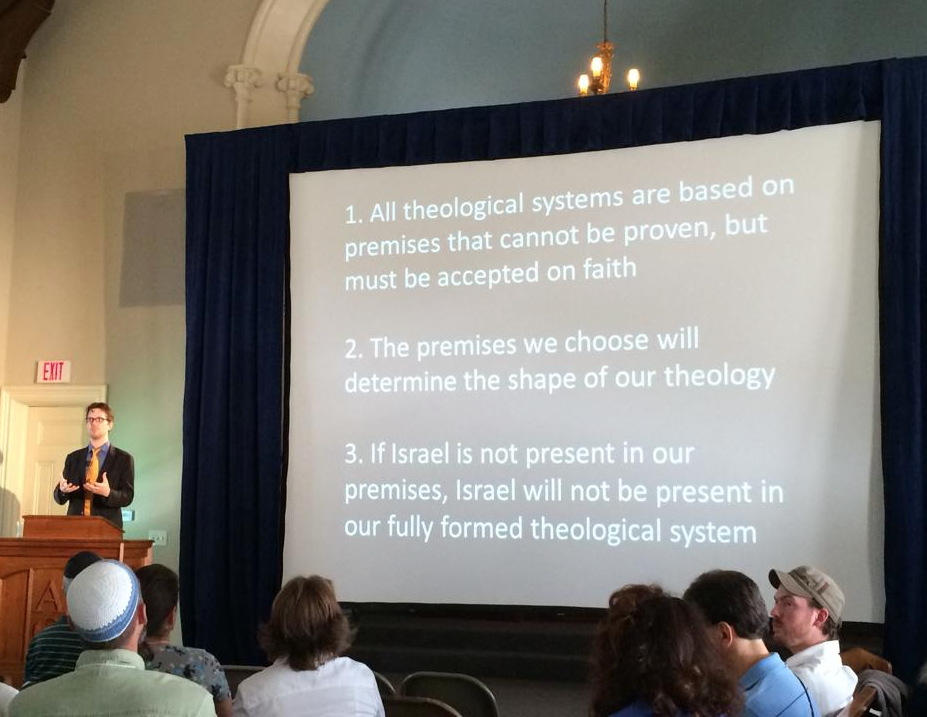
I wasn’t going to write another blog post so soon, but two things happened. The first is that I saw yet another photo posted on Facebook of a presentation, in this case, by Jacob Fronczak, at the First Fruits of Zion (FFOZ) 2014 Shavuot Conference at Beth Immanuel Sabbath Fellowship in Hudson, WI (the photo is posted below), and the second was a comment made by Steve Petersen on a prior blog post:

New wine = new teachings
Old wineskins = disciples who can’t embrace new teaching.

He also provided a link to an article written by D. Thomas Lancaster called New Wine and Old Wineskins: The Parable of Luke 5:36-39 Re-examined.

According to Lancaster, the “wineskin” parable is typically interpreted by the Church as old wine/wineskin being the old, outmoded Law, and new wine/wineskin being the new teaching of salvation by the grace of Christ.

Just as the new wine would burst the old skins and be spilled, so too the New Covenant Gospel of the Church Kingdom would be wasted if it was poured into the Old Covenant, Mosaic, legalistic religion of Judaism. In almost unanimous consent interpreters and commentators have agreed that the old wine, old wineskins and the old coat are all symbols of Judaism and Law whereas the new wine and the new coat are symbols of Christianity and Grace.

The problem, and maybe you spotted it, comes in with the last sentence: “The old is better.” If the Old is the Law and Jesus was teaching that the New, that is grace replacing the Law, is better, how can he possibly say that the old is better?

That is, unless the traditional Christian interpretation has problems.

The answer lies in interpreting Yeshua’s words through the lens of other, similar Rabbinic teachings of that era rather than filtering them through modern Christian doctrine. I won’t go into all the details. I’ve provided the link to Lancaster’s original article. It’s not long and you can read it for yourself.

I want to point out something else, something that’s directly related to my experience at church last Sunday.

Jacob Fronczak, a church Pastor and contributor to First Fruits of Zion, particularly in recent issues of Messiah Journal, is one of the presenters at this year’s Shavuot Conference. I saw his photo next to a projection of a PowerPoint slide. The slide displayed numbered list:

  1. All theological systems are based on premises that cannot be proved, but must be accepted on faith.
  2. The premises we choose will determine the shape of our theology.
  3. If Israel is not present in our premises, Israel will not be present in our fully formed theological system.

Beyond what I can read on the screen, I have no idea what Jacob is teaching, nor will I until FFOZ publishes his presentation in a text or audio format. However, I’d like to take his list and add a little something to it. Especially relative to point three, I’d like to say that it is how Israel is presented in our premises, assuming it’s present at all, that will shape our theological system.

ffoz1Many churches, including the one I attend, believe that Israel and the Jewish people have eschatological significance, that is, they have an existence and purpose in the end times. On the other hand, it is “the Church” as a unique and even supernatural entity that has primacy and is ultimately ascendant (as Israel is presumed to be based on the Hebrew Scriptures and New Covenant language contained therein). So Israel can be present in our premises but cast in a role that renders it secondary to the Church and ultimately, totally subjugated by said-Church (which includes Jews who have converted to Christianity).

Lancaster’s article speaks also to my experience in class last Sunday at church. Here’s his interpretation of the Luke 5:36:39 parable:

No one takes a lesson meant for a new student and tries to teach it to an old (already educated) student. If he does, he will fail to teach the new student, and the lesson meant for the new student will be rejected by the old student.

No one teaches new Torah-teaching to old (previously educated) students. If he does, the new teaching will be rejected, the student will be lost. No. Instead new Torah-teaching must be taught to new students. And no one after receiving old teaching (previous education) wants the new, for he says, “The old teaching is better.”

I’m not sure what to do with this. People, once educated in a particular system, rarely step outside that system or accept new information that apparently contradicts that system, even if the new interpretation objectively makes more sense and is more consistent with the source document (in this case, the Bible) than their current system.

No one likes change. I know I don’t. I’m a real creature of habit. I love my routine. It bugs me when my schedule is thrown off, even a little.

On the other hand, I love learning new things. And over time, I’ve learned many new things and have slowly allowed my perspective on theology and doctrine to change as new information became available and, after I thoroughly assessed it, determined that this “new wine” did indeed belong in my “old wineskin” (go figure). I guess to a limited degree, this old leopard can take on a few new spots.

walking-into-churchBut that means certain things relative to being at church and being in Sunday school. It means that I was right (or rather, my wife was) in saying that I have nothing to offer anyone at church. This assumes that everyone is there at church because they want to be there and that they agree with everything (or most everything) being taught. Even if there are minor disagreements with particular points, there is still more agreement between all the people within that system than there would be with just about anything I had to say from my “alien” viewpoint.

So, for them, “the old is better.” Who wants the new wine I’ve tried to peddle in their midst? I was right to keep quiet in Sunday school, even when I heard Jewish people and Israel being momentarily “dissed”.

On the other hand (like Tevye, I find there’s almost always an “other hand”), people have periodically approached me and said that they liked some point I made or found something I said interesting or enlightening. I assume that everyone in Sunday school and in church all universally agree with each other and unless they say otherwise, there’s no way to know for sure. I can speak up from time to time and hope I get lucky (or perhaps hope that the Holy Spirit will render someone’s heart a little more open to my opinions), or keep quiet, respecting the majority (including the church leadership since several members of the Board of Elders go to the same class) and withhold anything that might be elucidating to the possible minority who could be open to hearing it.

On that day, when two, poorly educated fishermen stood before the Sanhedrin, they demonstrated the full caliber of their education under Yeshua and vindicated his choice of disciples. New garments, new wineskins and new students.

Lancaster’s interpretation of Yeshua’s parable has limits. It assumes that only new (uneducated) students would accept the Master’s teachings, but we know he attracted the attention of “old wineskins” such as Nicodemus (John 3:1-21) and Joseph of Arimathea (John 19:38). Who knows how many other “old” and well-educated disciples Yeshua attracted, either during his “earthly ministry” or later, during the time of the apostles?

I think an old dog can learn new tricks, it’s just not as easy as when you were (I was) a new dog.

Everyone listening to Jacob Fronczak and the other presenters at the Shavuot conference wants to be there. They bought tickets to attend the event, arranged to travel there, arranged for lodgings, and so on. They went through no small effort to make their way to Hudson and to find themselves sitting in the pews of this beautiful synagogue setting. So each and every person there is open to what is being taught.

And like I said, although it’s not quite the same effort to attend my local church, all of the people present are there willingly, and they all are open to learning what is being taught, even if they don’t agree one-hundred percent of the time.

But they didn’t sign up to listen to me spout off about new wine. That’s not my job and no one asked me to take it onboard. Maybe there are some old wineskins that might want a little new wine, but I can hardly tell who they are and what they might be open to.

On the other hand, my blog is open to the world or at least anyone with Internet access. I can only assume that each person who visits, if they stay long enough to read, is doing so willingly, even if they disagree with some of the things I say. My “wine” is welcome for the most part within their “wineskins.” At least I don’t have worry that there’ll be some outcry to ban me from the web.

wineThe Internet isn’t “community” though sometimes we fall into the illusion that it is. Facebook, twitter, and blogging aside, you don’t really form a community in virtual reality. I know the difference between Facebook “friends” and face-to-face friends.

But sometimes the Internet is all you’ve got, especially if “face-to-face” are old wineskins and all you’ve got to offer is new wine.

But my new wine has the flavor of the centrality of Israel, the primacy of the Jewish people in past and future prophesy, with the capstone being Messiah, Son of David, Son of God. My wine doesn’t spill all over the pages of the Torah, blotting out major sections, shuffling about the letters and words, and making them appear as if God said one thing but really meant another.

In a very real way, my “new wine” is actually old, really old. In fact, I’m banking that it’s at least as old as what the apostles, and even the Master taught. That means the old really is better, for the old is God who makes a covenant and never breaks it, who embraces Israel and never releases her, who presents the Torah through Moses and never changes a word or a letter as long as Heaven and Earth continue to exist.

In my bottle of old wine, Messiah brings a Gospel message that really is good news to the Jewish people and that supports and upholds the dignity and preservation of national Israel. It’s also good news for the Gentiles as long as we realize that salvation comes from the Jews (John 4:22).

It’s amazing what a single photograph and a few sentences of text will inspire. A toast to old wine made new again.

Chag Shavuot Sameach!

Book Review: Divine Messiah

“We don’t need a Messiah actually,” she argued. I’ve had this conversation a number of times and on this occasion we were relaxing over coffee. “Everything you say Jesus does we say God does. God is our savior and the whole Messiah thing is not what you make it to be. God redeems, heals, raises the dead, is the king, brings the age to come, restores Israel, and gives knowledge in the future time to the Gentiles.”

-Derek Leman
“Chapter One: Seated at the Right Hand,” (loc 23)
Divine Messiah (Kindle Edition)

Note: Lacking page numbers, I’ll use the “location” (loc) notation in Kindle to describe approximately where in the book each quote is to be found. Also, be prepared. This is pretty long.

Most of my regular readers know or at least are aware of Derek Leman, who he is, what he believes, and what he teaches, but for those of you who surfed in to read yet another book review, on his author’s page at Amazon.com Derek says:

I am a rabbi, writer, and speaker focused on the Jewish context of faith in Jesus (Yeshua), on making the Hebrew Bible (Old Testament) simple, and on the intersection of Judaism and Christianity. Linda and I have eight children who fill our lives with fun and friendship. We are a homeschooling family dedicated personally to the value of a faith-filled home. My special interests include the Hebrew Bible, the Gospels, the life and teachings of Yeshua, theology, Second Temple Jewish history, Abraham Joshua Heschel, the early midrashim of the land of Israel, mussar, mysticism, the Hebrew language, Isaiah, the works of J.R.R. Tolkien and C.S. Lewis, science fiction, fantasy, Star Trek, and beer. Not necessarily in that order.

He has been heavily marketing his Divine Messiah eBook on his blog for months, the most recent effort (as I write this) being Preview: Divine Messiah.

In this short book (the print length is only 98 pages, so hardly the length of a chapter or two in most larger texts) which I downloaded onto my Kindle Fire for a nominal cost, Derek proposes to do what I would consider the impossible: to describe, from a Messianic Jewish point of view, the “mechanics” of Yeshua (Jesus) being co-equal to God the Father.

My personal opinion is that the Deity and Divinity of Yeshua remains a profound mystery that defies analysis and that can only be reasonably discussed in the realm of mysticism (I refer the reader to Messianic Luminary Paul Philip Levertoff’s classic Love and the Messianic Age along with its accompanying textual commentary, both published by First Fruits of Zion, for insights into Jewish mysticism within the Messianic perspective).

The purpose of my current review is to determine if Derek reasonably makes his case that Jesus Christ, that is Yeshua HaMashiach, is indeed God as God the Father is God, that he is worthy of worship and devotion as God, and that the early Messianic Jewish and Gentile disciples worshiped Jesus as God beginning in the early to mid-first century CE.

I will mention as a caveat that there is no one “Messianic Jewish perspective” on anything. Derek represents primarily his own point of view although I can only imagine he draws heavily from his affiliation with the scholarly and authoritative body Messianic Jewish Rabbinical Council. He also draws a great deal from the work of Dr. Larry Hurtado, “New Testament scholar, historian of early Christianity and Emeritus Professor of New Testament Language, Literature and Theology at the University of Edinburgh, Scotland.” I should say that I am also a “fan” of Dr. Hurtado’s work and have received a number of personal insights from his recent and classical writings.

Derek wrote his book in six chapters and I’ll structure my review likewise, followed by a conclusions section.

Chapter One: Seated at the Right Hand

Derek starts out with the issue of what Yeshua brings to the table as Divine Messiah. Referencing the dialog I quoted above from his first chapter, traditional Jewish thought has no need for a Messiah who is also God. The God of the Hebrew scriptures is the God of Israel, the God who was, who is, and who forever shall be. Who is this “figure” who supposedly sits at God’s “right hand?”

Derek Leman
Derek Leman

The first chapter lays out all the questions. “Is Yeshua really needed, given that God is already in charge?” How can Messiah, a man, a human being, say that he is God? “Doesn’t God say, ‘I am not a man’?” And if Yeshua isn’t Divine, is “he nothing more than a doorway to the future world we will enjoy?” (a question that I recently explored)

Larry Hurtado, in a recent blog post, brings forth questions about what Jesus did or didn’t believe about himself and how his disciples and apostles perceived him, both before his crucifixion and after his resurrection. Derek seems to understand that Jesus knew exactly who he was and is by quoting the following:

But He kept silent and did not answer. Again the high priest was questioning Him, and saying to Him, “Are You the Christ, the Son of the Blessed One?” And Jesus said, “I am; and you shall see the Son of Man sitting at the right hand of Power, and coming with the clouds of heaven.”

Mark 14:61-62 (NASB)

Derek then proceeds to a number of texts in the Hebrew Bible, principally Daniel 7, also referencing Talmudic scholar Daniel Boyarin’s commentary on the same scripture in his book The Jewish Gospels: The Story of the Jewish Christ, as well as historical notes from other noteworthy Jewish sources such as Rabbi Akiva, Don Issac Abravanel, and of course, the apostle Paul, in order to build a case for how Jewish thought at different points in history, considered God and his “chief agents” as well as how these agents were similar to and different from Yeshua.

Derek’s conclusion here is that no other figure of honor or representing God was treated in the same manner as Jesus:

They saw the Glory of God reflected in the face of Yeshua the Messiah. They saw Yeshua enthroned at God’s right hand and heavenly beings prostrate before both of them. They saw something new, far beyond the other kinds of divine agents in the Hebrew Bible and in Jewish literature of various types.

-Leman, loc 150

While this may seem apparent to most Christians, we don’t often attempt to struggle with comprehending the following:

The belief in Yeshua as Divine Messiah is, in the words of Larry Hurtado “a mutation or variant form of exclusivist monotheism.”

-ibid, loc 161

Chapter Two: God’s Nature in the Hebrew Bible

Having set the stage, Derek next takes a look at the traditional Jewish view of God in the Tanakh (Old Testament), although it should be noted that there is no single, overarching Jewish “opinion” on the nature of God.

The Hebrew Bible is not the record of a God who can be fathomed. His appearance to people is always a surprise. He can appear in ways deceptively small, a bush in the desert. He reveals himself as eternal, with foreknowledge and an unchanging nature, yet acting in human history, regretting things, and at least in appearance moving with events as a participant in them.

-ibid, loc 201

Additionally, and this seems to be the capstone of the chapter:

Monotheism may not be as simple as it seems.

-ibid, loc 210

Standing before GodAs you might expect, the Hebrew Bible declares God a complete and indivisible unity without differentiation. Derek proposes however, based on the Hebrew Scriptures that “God’s nature is differentiated in the Bible (in that) he is at the same time in more than one place and fulfilling multiple roles.” (loc 245)

One vital piece of information Derek confirms is:

The Divine Messiah realization was not disclosed in the Hebrew Bible, but only afterward.

-ibid, loc 257

This may be rather shocking to most Evangelical Christians who cite various proof texts from the Old Testament which they believe establishes Jesus as Messiah as well as Jesus as God. And yet, a careful reading of the Torah, Prophets, and Writings does not lead us to obviously conclude that the Messiah must be God. Apart from the aforementioned Daniel 7, we don’t have any evidence that the Bible presupposed Messiah as God prior to the New Testament.

However, God does appear “differentiated” relative to the various manifestations we see described, such as “Spirit,” “Glory,” and other “forms,” and it’s Derek’s contention that “the Spirit of God” describes something personal about God as opposed to poetic language or even a circumlocution for God’s power such as “the Hand of God.”

God’s Spirit does things requiring active verbs. God’s Spirit was brooding.

-ibid, loc 290

Also…

God does not directly enter the world but sends aspects of his being which are mysteriously undefined.

-ibid, loc 323

Humanity can hardly grasp even imagining the totality of an infinite God. We can’t even grasp the vastness of God’s creation, the universe which is inconceivably large and yet which must be finite. So then, God in all His infinity does not intersect with our universe but rather “aspects” of God that can be witnessed and can interact with our environment and with ourselves. Hence the various “forms” of God we see evidenced in the writings of the Tanakh.

At one point, I believe Derek gets a little premature in saying:

God is not a man, but he is not averse to appearing as one.

-ibid, loc 356

It can be argued that none of the “man-like” supernatural figures appearing in the Tanakh, including Jacob’s “wrestling partner” (Genesis 32:24-32) are not God but angelic representatives or agents, so we may never see God incarnated as a man in the Hebrew texts. Exactly who or what walked with Adam in the Garden (Genesis 3:8), I have no idea, but God did not have to appear human.

Derek does follow-up by stating:

…it should be clear by now that the appearances of God are extraordinarily incomprehensible.

-ibid, loc 411

Throne of GodThe one appearance that is most challenging is the “enigmatic person” who appears with the “Ancient of Days” in Daniel 7 (it always comes back to Daniel 7 it seems) including the mention of a figure “like the son of man” (Daniel 7:13). Derek argues against the modern Jewish interpretation of the “son of man” as national or corporate Israel and gives evidence for a specific individual who is both martyr and ruler, this being “one more example of a seeming paradox.” (in Judaism, paradox and dynamic tension between apparently opposing ideas is sometimes embraced rather than avoided as Christianity does)

Derek even suggests that Trinitarianism (God, Messiah, and Spirit) is supported in the Hebrew Bible, but is far less specific than Christianity’s view of the nature of God.

Chapter Three: Jewish Precursors, Parallels, and Providence

Derek continues to address the nature of God starting out with the two views: God as Force vs. God as Distant. God as Force is seen as the prime actor within our universe but not transcending our universe…personal, active, but wholly embedded in Creation. God as Distant is ultimately transcendent and who set all into motion but then ignores the universe as we might ignore a clock once we set it to the correct time. God is impersonal, the subject of philosophical study, but supremely unapproachable and incomprehensible.

And yet the God of the Bible is both, although His transcendent qualities are obviously more difficult to document. His interaction with our world, as mentioned above, is not through direct contact but accomplished by aspects or agents, and although angelic beings and unique individuals such as Enoch were highly elevated and exalted, “Judaism was not going so far as to say that God became an actual human…” (loc 563)

And again, as mentioned before, Derek tells his audience:

Let me be clear from the beginning (note: though we’re about a third of the way through his book at this point) there was not in normative Judaism the idea exactly like the “binitarian monotheism” of the early Jewish believers.

-ibid, loc 574

Caveat stated, moving forward in history into the time of the New Testament, Derek offers a tour of the “chief agent figures in second temple Judaism.”  He explains how the various streams of normative Judaism of that era were reacting to Gentile influences by creating a number of supernatural “divine agents”. Moving still forward in time, Derek then comments on “Rabbinic thought after the first century.”

Did the rabbis have any comparable inspiration to offer regarding God being present in the world of their time? They certainly did and with great beauty they talked about the Word (Memra, Dibbur, Davar), the Shechinah (Presence), and the Spirit. What they did not do — though some have misinterpreted their words as if the divinity of Yeshua is paralleled in rabbinic sayings about Messiah or the Word — is describe any separate entity equal to God.

-ibid, loc 705

Christianity as well as Messianic Judaism, has been accused repeatedly by more normative branches of modern Judaism as well as “anti-missionary” organizations, of deliberately (or sometimes just naively) misusing rabbinic literature as evidence of “Jewish” support for Yeshua as Messiah as well as a “Divine Messiah”. I appreciate Derek’s integrity here in refuting this practice, and twisting the teachings of the rabbinic sages to say what the authors never intended merely cheapens our efforts to be a witness of Yeshua as Messiah.

That said, I do think it’s true that the later rabbis may have interpreted sections of the Bible to deliberately create distance between Jewish and Christian perspectives.

…that in early rabbinic works references to the Holy Spirit were restrained. The Shechinah was used instead, so as not to seem in agreement with Christians…

-ibid, loc 751

Larry Hurtado
Larry Hurtado

Derek returns to the first century Biblical narrative and particularly to Paul and how his letters seem to manage the “Divine Messiah realization.” Agreeing with Hurtado, Derek proposes an early worship of Messiah as God but does say that such a “realization was thought blasphemy when it first appeared” as implied in the story of Paul.

Again citing Hurtado, Derek states that Paul actually inherited the concept of “Messiah as Divine” from the earlier Judean Yeshua-believers, rather than, as many critics claim, “reinventing” Yeshua the itinerant rabbi from the Galilee as a Deity.

Chapter Four: The Early Believers’ Devotion to the Divine Messiah

In the early half of the first century, it happened so suddenly that there are no records of the way the innovation came about. The early community of Yeshua-followers started believing and practicing something beyond any previous concept.

-ibid, loc 860

Hurtado’s 2005 book How on Earth Did Jesus Become God: Historical Questions about Earliest Devotion to Jesus covers this territory more thoroughly and is the source of much of Derek’s material. Interestingly enough, Derek also leverages Bart Ehrman’s newly published book How Jesus Became God: The Exaltation of a Jewish Preacher from Galilee. I say “interestingly” because Ehrman is both a New Testament scholar and an agnostic, and because Hurtado recently reviewed the same book by Ehrman, providing additional dimension to Derek’s research.

Key support for Derek’s assertion of a Divine Messiah who was worshipped early in the existence of the Yeshua-believing Jewish/Gentile ekklesia is a comparison between Isaiah 45 and the “hymn” of Philippians 2 as well as the “Shema” of 1 Corinthians 8. He also comments on the arguments of Chris Tilling regarding the Corinthian letter and what Tilling calls “relational monotheism.”

In other words, Paul is willing to see Yeshua in the Shema, regards Yeshua as worthy of equal relational faith as God, and sees the one God as the Father and the one Lord as Yeshua.

-ibid, loc 967

I have to admit at this point, it’s difficult for me to sort out how “God is One” and yet to have God the Father and Jesus the Lord so differentiated and yet both being God. I think this is what happens by necessity when anyone actually attempts to analyze or map out the “nuts and bolts” of trinitarian thought.

Derek calls one of the sections of this chapter “Careful but Confusing Language about Yeshua,” which says mouthfuls. Some of the doubt critics of Christianity have regarding the Deity of Jesus is that the Bible never comes out and says “Jesus is God.” It certainly would be helpful for those of us who don’t always want to be reading the Bible as a puzzle or a mystery story to be solved, if the New Testament writers would have been more explicit.

But they said “Yeshua is Lord” not “Yeshua is God,” so we’re left with something to interpret rather than a plain, peshat statement.

Derek again emphasizes that no other Biblical figure save God was accorded such devotion and worship, as evidenced by the early hymns about Jesus, prayer to God “through” Jesus, calling upon the name of Jesus, confessing Jesus, and so on.

They went on stoning Stephen as he called on the Lord and said, “Lord Jesus, receive my spirit!”

Acts 7:59 (NASB)

Even Derek admits that this verse may not be sufficient to support the idea that the early disciples prayed directly to Jesus (bypassing God the Father altogether), but then he goes on to present a larger body of evidence.

D. Thomas Lancaster
D. Thomas Lancaster

In one of my reviews (I don’t recall which one) of D. Thomas Lancaster’s The Holy Epistle to the Hebrews sermon series, I mention that Lancaster says Yeshua’s statement in Mark 14:64 (which I mentioned above) is what got him killed. Derek mentions this again as the foundation of how later opponents to the concept of a Divine Messiah saw the actual worship of Yeshua as Lord (God) as blasphemy, leading to persecution of the Jewish Jesus-believing ekklesia by other branches of first century Judaism.

And yet, referencing Hurtado and Tilling, Derek believes the evidence of Yeshua-worshiping Jewish and Gentile believers is painted all over the New Testament writings.

Some have complained that Hurtado’s evidence that the early believers regarded Yeshua as divine is sparse, based on too few examples and that there is inadequate information about the causes of the new belief. Tilling says language about God-like relational aspects of Messiah with believers nullifies this objection.

-ibid, loc 1185

Further, according to Derek, Paul most often refers to “the Lord” when addressing Yeshua but in referencing God, he uses  “Father” or “Abba,” apprehending both as God but differentiated with different titles.

One traditional criticism, both in ancient and modern times, from normative Judaism is that “Christian devotion to Jesus is idolatry.” If you literally worship a common human being as a “god” then you do have problems, but all of Derek’s narrative has been illustrating that not only is Yeshua unique among humans and agents of God, but that he is specifically and uniquely an object of worship equal to God but not representing a separate “power” from God (no “two powers in Heaven”).

He presents his evidence (though exclusively from the New Testament) that worship of Jesus is directly opposed to worshiping idols or pagan (false) gods, and how worship activities such as “the cup of Yeshua” or “the Lord’s supper” were considered “as being as sacred as the Israelite sacrificial meals.” Of course, from a normative Jewish point of view, if you discount the New Testament as an authoritative source, this doesn’t behave much like evidence.

In the end, Derek’s concluding paragraph to this epic chapter addresses our confusion and our need for faith through the Spirit:

It is by the Spirit that we can say, “Yeshua is Lord.” In other words, there is a mystical communication to the soul which cannot be put into words.

-ibid, loc 1298

Chapter Five: Being Followers of a Divine Messiah

The last two chapters of the book are relatively brief and seem to be Derek’s summing up of what all this is supposed to mean to us today.

Fire on a mountain is one thing. A divine man is quite something else.

-ibid, loc 1336

That’s rather an understatement given the task of communicating a Divine Messiah to a disbelieving world or even those who doubt within the body of faith today, or as Derek also puts it, “Welcome to the mysteries of life and teaching of Yeshua.”

god-is-oneWe can’t just study the Bible and expect to learn and grow. “Knowing is experiential as well as intellectual.” Being a disciple of a living and Divine Master is just as much a matter of doing as thinking or feeling. We “behave” in our lives and toward Jesus as teacher, prophet, master and yes, God as Derek would have us believe and do. And yet he says again, “The nature of Messiah, a mystery we only begin to perceive…” (loc 1356) We learn, we know, we believe, and it is all still a profound mystery, which by its very definition, makes writing a book about said-mystery problematic at best and impossible at worst.

And yet, we have Yeshua himself speaking of returning in power and glory and:

“For whoever is ashamed of Me and My words in this adulterous and sinful generation, the Son of Man will also be ashamed of him when He comes in the glory of His Father with the holy angels.”

Mark 8:38 (NASB)

We have consequences for not having faith in the Divine Messiah when he returns.

Chapter Six: The Case in Short

This is Derek’s final conclusions of his evidentiary arguments for the Divine Messiah, the unsolvable mystery that has many clues. The clues are listed in bullet points within these last few (virtual) pages. His final words are:

The Messianic Jewish belief about God and Messiah is that God has taken an unprecedented new step in lifting up to himself all humanity. This idea is based on a real historical phenomenon that requires some sort of explanation. People could obviously quibble with us about this or that point. But the case has its own internal consistency and a compelling persuasiveness worth considering.

-Leman, loc 1559

Conclusion

Given the open ended nature of Turning Torah how is one to know which meaning is the right one? This is an excellent question, but not a Jewish one. For us there is no one right reading of Torah. There is only the next reading. Of course different Jews will have their preferences, claiming one reading to be superior to others, but this is personal bias rather than a system of right and wrong readings built into the process of Torah Turning.

-Rabbi Rami Shapiro
“Arguing for the Sake of Heaven”
Patheos.com

In reading Rabbi Shapiro’s commentary, I thought of my own Why No One Comes to the Father Except Through the Son. The Torah, and by extension, the entire Bible, from a Jewish perspective, is not a fixed, inflexible, immutable document. According to R. Shapiro, “there is no one right reading of the Torah. There is only the next reading.”

And so it goes with how we read the story of Yeshua in the Gospels and other Apostolic Writings.

Christian literature is replete with apologetics in support of Jesus as Deity, as co-equal with God the Father and God the Spirit. It’s not as if what Derek Leman wrote was the first ever attempt at revealing Lord Jesus to the believing masses.

What was unique, at least relatively so, was making this effort from a Messianic Jewish perspective. I liken it to D. Thomas Lancaster’s presentation of the New Covenant and his interpretation of The Epistle to the Hebrews. This has long since been considered as “Christian” material, completely disconnected from any association with Judaism, reconsidered and reinterpreted from a Messianic Jewish framework.

If you weren’t convinced of a Divine Messiah before this, chances are you won’t be convinced by this book. However, if you are a Jew or Gentile worshiping and studying within a Messianic Jewish context, either individually or in community, I think Derek may have given more than a few of you something new to think about by writing this book.

Remember though that while I (and many others) consider Messianic Judaism to be a Judaism (and not a Christianity as such), it is hardly universally accepted as a Judaism, either by the Church or by the other branches of Judaism as Rabbi Shapiro aptly points out.

There is one limit, however, that is imposed from the outside: arguing for the sake of heaven cannot lead you out of the community. This is a sociological argument imposed by most rabbis. If, for example, a someone turns Torah and finds in God’s use of the plural “us” in “Let us create humanity in our image after our likeness” (Genesis 1:26) proof of the Christian Trinity of Father, Son, and Holy Spirit, almost every rabbi would disavow such a reading. But there is no reason to do so other than the fact that it leads one out of Judaism and into Christianity.

The good Reform Rabbi’s commentary is written to address how Torah can be interpreted and reinterpreted to respond to the needs and even the desires of changing societal imperatives, and can accept many new things that would have been ignored or even shunned by the Rabbis of old, but the hard limit is an interpretation that takes the Jew outside of Jewish community so that even a religious and social liberal opinion as what R. Shapiro seems to represent draws an uncrossable line at a “Divine Messiah.”

praying-at-the-kotelThis is the bitter pill Messianic Judaism swallows in its desire to consider the other Judaisms us, not them. Here is where Derek Leman and the other Jews in Messiah walk a difficult line, embracing a vision of Messiah that has long been associated with Christianity while attempting to refactor it through the lens of Hebrew thinking, scripture, and commentary as wholly Jewish.

Repeatedly, Derek said that the evidence indicates Yeshua-worship in the first century CE was an entirely new and unanticipated concept and activity for any branch of Judaism. The Jewish disciples must have been startled at the sudden inception of a Divine Messiah. They scarcely could have believed in a Messiah that could actually be God. It must have been far easier for the Greeks to adopt this notion, and no wonder so many Jews could not accept it.

Christianity has long assumed that the Jewish “offense of the cross” was Jesus as God, but my studies have often shown me that it was Gentile inclusion in the ekklesia as equal co-participants that was the main reason so many other Jewish sects rejected “the Way.” Could another reason for the early rift between the Jesus-believing Jews and all of their brethren also have been the unprecedented worship of the God-Messiah?

Read Derek’s book and see where his arguments take you.

Why No One Comes to the Father Except Through the Son

It is true that we do believe the same things about the same God and read the same Scriptures as those Jews who do not believe in Jesus as the Messiah. In Messianic Judaism, we are even part of the same religion. Despite all that common ground, there is one great difference between us. The difference is not in what we believe about God but how we believe about God.

Devout Jewish people who do not believe in Jesus as the Messiah believe the same things about God that we believe, but they do not do so in the light of the revelation, teaching, death, and resurrection of Jesus. They believe outside the light of that transforming, from-faith-for-faith experience that Paul spoke of when he said, “I am not ashamed of the gospel, for it is the power of God for salvation to everyone who believes, to the Jew first and also to the Greek” (Romans 1:16).

-D. Thomas Lancaster
“Chapter 4: Faith Toward God,” pp 55-6
Elementary Principles: Six Foundational Principles of Ancient Jewish Christianity

I read this book not long ago but decided not to review it since it leverages material from Lancaster’s Holy Epistle to the Hebrews sermon series, including portions I haven’t listened to yet. I’ll probably intermix my comments on certain parts of the book in various blog posts as I come across the corresponding material in the audio series.

Except for this part. This part is special because it answers a question that has been bugging me for a long time, a question I haven’t been able to adequately answer until recently. I mentioned this question just the other day.

Prior to the birth, life, death, resurrection, and ascension of Jesus, the Torah laid out exactly what a Jew had to do to worship and relate to God within the context of the Sinai covenant. Yes, there were the sacrifices and the Temple rituals including the moadim (the appointed times or festivals), but Jews also had (and have) a day-by-day relationship and interaction with the God of Israel. Jews pray directly to Hashem. We see this all over the Bible and we see it in the modern lives of observant Jews.

And yet Christianity is telling Jewish people (and everyone else) that you can’t worship God directly anymore. It’s not possible. It’s not effective. You have to worship God by worshiping Jesus.

I am the way and the truth and the life. No one will come to the Father except by me.

John 14:6 (DHE Gospels)

That seems quite plain…and final. I have heard an interpretation that likens Yeshua (Jesus) to a door and once we enter through the doorway, we encounter the reason we entered the ekklesia of the Way, we encounter God the Father, the God of Israel.

But in many churches, this verse is used to make it seem as if Jesus replaced God the Father, as if God the Father retired and is sunning Himself on a beach in Florida while Jesus the Son is running the family business, and in a very different way than “Dad” ever did. But if God is unchanging across time and if Jesus doesn’t do anything except what he sees the Father doing (John 5:19, 30), then how can there be a discontinuity between Son and Father, between Messiah and God?

How can the Son replace the Father as the object of worship for the Covenant community, for Jews who are born into the Covenant and for Gentiles who are grafted in?

What did Jesus change when he inaugurated the New Covenant era at his death and resurrection? What does he bring to the table? How does he fit in to the plan of God as the New Covenant is beginning to unfold?

I know how the Church would answer, but the answer is full of supersessionism and replacement theology. Jesus came to replace the “ceremonial portions” of the Law (Torah). He came to replace behavioral obedience with grace and mercy. He came to release the Jews (and arguably, everyone else) from the Law so they could be free in his grace. For Jews, instead of going to the Judges and the Priests and the Temple and the Torah to get to God, you go through Jesus. He is now the gatekeeper, he holds all the keys, he guards all the doors. The Torah (or major sections of it including just about everything that defines a Jew as a Jew) has gone “bye-bye” and Jesus is large and in charge and is here to stay.

Except that makes absolutely no sense.

two sistersFirst of all, I previously said that there is abundant evidence that in ancient and modern Judaism, living a life of obedience to God’s mitzvot is a joy, not a horrible burden. Further, the Torah is a tree of life for all who cling to her. What could Jesus possibly add to all that to become such a game changer and yet still not violate all of the Torah and the Prophets, including the actual New Covenant language found principally in Jeremiah 31 and Ezekiel 36?

That’s where Lancaster’s commentary I quoted above comes in. In order to explain his point, he tells a parable. I’m going to include it here in its entirety because I think it clears things up a lot.

Remember, this is a parable, a metaphorical story:

Once, a man who had two daughters went off to war. Before he left, he promised to return to them, and he also promised them, “When I return, I will bring you each a fine string of pearls and a summer dress.” No one except the two girls knew about the promise. After many years, the man had not returned, and everyone presumed him dead. His daughters, however, continued to hope, believe, and wait. A decade passed, and they grew to become adult women, but neither of them forgot their father or his promises. Deep in their hearts, they continued to hope and to believe. One day a messenger came seeking the girls. Finding only one daughter, he told her, “I have news of your father. He is returning, and he sends you this gift.” The messenger presented her with a fine string of pearls.

Now both girls still believed in the promise of the father, but one had received a token of the promise, and the other had not. One had faith in the father’s promise on the basis of her hope and confidence in the father’s promise, but the other had faith in the father’s promise on the basis of the good news that she had already received and on the basis of the partial fulfillment of her father’s promise. She already had the pearls. She had no question in her mind that she would soon see her father face to face. Think of that girl’s confidence, certainty, and joy. She no longer had any doubt that her father was coming. She knew that he would bring the summer dress because she had already received the pearls.

-Lancaster, pg 56

The Father made a promise to the nation of Israel and to all Jewish people everywhere that He will return the exiles to their Land, defeat all of Israel’s enemies, and not just restore national Israel’s fortunes but elevate her to the head of all the nations of the Earth. Also is the promise of the resurrection of the dead and eternal life for the covenant people, as well as having the Torah written on human hearts rather than stone or paper so that human beings with the full indwelling of the Spirit will naturally obey all of God’s commandments, the conditions of the Sinai and New Covenants, the Torah. All of Israel’s sins will be forgiven. The world will be made completely peaceful, all people will be safe and secure, and a King from the line of Judah and the house of David will sit on the Throne in Jerusalem forever.

And Jewish people have been waiting ever since but so far, those promises haven’t been fulfilled…any of them…

…or have they?

Talmud Study by LamplightIt should be obvious that the two daughters are two branches of Judaism. The metaphor actually doesn’t work completely because the two daughters must initially be all Jewish people. Then one daughter received the gift sent by her father and believed a messenger. The messenger is Jesus. He is from the Father, from God. He brings a gift, something to confirm that God will fulfill His promises in due time. The messenger does not come to fulfill all the promises but in fulfilling some of them, he brings a guarantee that they will all ultimately come to pass.

But what promises did Jesus fulfill? Did he rebuild the Temple? Did he return all of the Jewish exiles to their land? Did he place Israel as the head of all nations? Is he sitting on the Throne in Jerusalem reigning with justice and peace?

No. He didn’t do any of those things…yet.

How do we know he’ll do any of them at all? Because he brought a gift. Actually, more than one.

He said to her, “Your sins are forgiven you.” Those reclining with him began to say in their hearts, “Who is this who even forgives sins?” He said to the woman, “Your faith has saved you. Go in shalom.”

Luke 7:48-50 (DHE Gospels)

Why do you seek the living one among the dead? He is not here; for he has risen. Remember what he had spoken to you while he was still in the Galil, saying, “For the son of man must be handed over to sinful men and be crucified, but on the third day he will surely rise.”

Luke 24:5-6 (DHE Gospels)

When the day of Pentecost had come, they were all together in one place. And suddenly there came from heaven a noise like a violent rushing wind, and it filled the whole house where they were sitting. And there appeared to them tongues of fire distributing themselves, and they rested on each one of them. And they were all filled with the Holy Spirit and began to speak with other tongues, as the Spirit was giving them utterance.

Acts 2:1-4 (NASB)

While Peter was still speaking these words, the Holy Spirit fell upon all those who were listening to the message. All the circumcised believers who came with Peter were amazed, because the gift of the Holy Spirit had been poured out on the Gentiles also. For they were hearing them speaking with tongues and exalting God. Then Peter answered, “Surely no one can refuse the water for these to be baptized who have received the Holy Spirit just as we did, can he?”

Acts 10:44-47 (NASB)

And that’s not even the entire list. Jesus the messenger from Heaven, brought several “gifts” with him, a sort of down-payment on the promises of God, an illustration and evidence that God will someday do all that He promised. Here’s what Messiah demonstrated:

  • The forgiveness of sins through faith.
  • The resurrection from the dead.
  • The giving of the Holy Spirit.

These weren’t the “full meal deal,” so to speak, but only an appetizer. Jesus forgave the sins of those who had faith as an illustration of how someday all of Israel’s sins will be forgiven. Jesus died and was resurrected as a confirmation that someday there will be a general resurrection of the dead (see Matthew 27:52-53). The Holy Spirit was given first to the Jews who believed, and then later to believing Gentiles also, to show that one day the Spirit will be poured out on all flesh (Joel 2:28).

In Him also we have obtained an inheritance, having been predestined according to His purpose who works all things after the counsel of His will, to the end that we who were the first to hope in Christ would be to the praise of His glory. In Him, you also, after listening to the message of truth, the gospel of your salvation—having also believed, you were sealed in Him with the Holy Spirit of promise, who is given as a pledge of our inheritance, with a view to the redemption of God’s own possession, to the praise of His glory.

Ephesians 1:10-14 (NASB)

Jesus, the messenger, comes as a pledge of our full inheritance as believers, first to the Jew but also to the Gentile, that God will redeem His own and fulfill His Word.

a woman of valorThe metaphor Lancaster used, as I mentioned, doesn’t exactly fit. One daughter has to choose to believe in the messenger, that he really is from their father, and that the gift he brings is genuine and can be accepted by faith as from their father as a promise that he will come and bring his other gift.

One daughter would choose to believe the evidence of the gift and the other wouldn’t. In Lancaster’s parable, this draws a distinction between Jesus-believing Jews and all other Jews, but we can also apply it (since the rest of the world has the potential to be grafted in) to believing and unbelieving Gentiles.

Based on everything I’ve just said, Jesus is now cast in an almost completely different role. Instead of being a replacement for the old, worn out, obsolete Law, he’s the bringer of “better promises” (Hebrews 8:6), not that the previous promises were bad, but as good as things were, God has something even better in mind, something that builds on what happened and what was given before rather than replacing it. It’s as if God is saying, “If you think the Torah is the Tree of Life, you haven’t seen anything yet. Don’t believe me? Here’s a small sample of what is to come.”

Jesus has been called the capstone (Matthew 21:42), the one key object in the structure that completes it and holds it all together. Without that stone, not only would the whole structure remain incomplete, it might actually fall apart.

So, in his first coming as Yeshua ben Yosef, Messiah came as the messenger from Heaven bringing gifts as a guarantee that all God had promised would be fulfilled. And he did this without replacing anything at all. In fact, if he had replaced anything previously promised or established by God, then Jesus would have failed in his mission to bring the Good News to Israel. When properly interpreted and understood, the teachings of Jesus and those of the apostles, including Paul, show us that Jesus brought exceedingly Good News to Israel and also to the Gentiles, that God intends to do great good to Israel and as one of the results of His actions, even the Gentiles will receive blessings.

Unfortunately, when the Gentiles split off from the Jesus-believing Jewish ekklesia to form their (our) own religion called “Christianity,” they “reinterpreted” the ancient Holy Scriptures as well as the teachings of Jesus and the apostles to make it seem as if the Good News was only good for Gentiles. The Christian “good news” was only good for Jews who were willing to give up the original promises of God (and give up being Jewish), for Jesus brought those “new” promises, according to the Christian Church, to replace the old.

That’s when the craziness, the bizarre disconnect occurred between different parts of the inspired, “God-breathed” Word of scripture (2 Timothy 3:16-17). That’s when the two sisters drifted apart, but the hope and the promise is that someday their father will return to reunite them as a family.

Have I proved my case? Will non-believing Jews read this and be convinced?

Probably not.

First of all, my commentary on the role of Jesus and all that he did is hardly comprehensive. A detailed and scholarly analysis would certainly reveal much, much more. No doubt there will be people who will never be convinced and who would even be insulted at my efforts (not that it is my intension to insult anyone).

But I’m trying to show both Jews and Christians that the way they are looking at the Bible and looking at Jesus isn’t really how the Good News was originally presented. The original Jewish Good News didn’t require an evangelical approach that says Jews are “cursed” or that they’re “hypocrites”. Sadly, the Christian Church is its own worst enemy, not even by intent, but by continuing to accept a flawed interpretation of the Gospel that was forged with the early “Church Fathers” and cemented by the men of the Reformation.

The Jewish PaulWithout a strong and sustained effort by mainstream Christianity to set aside their traditions and to look at the Bible, and particularly Jesus and Paul, with fresh eyes that take into account that Israel is the entire focus of God’s Good News and blessings, we Christians will continue to be a curse upon Israel and the Jewish people, and as a result, only a fraction of Gentile believers, a remnant so to speak, will continue to bless Israel, to elevate Israel, and to await the return of the messenger who will be King.

What curses await all those others who perpetually, even without meaning to or desiring to, set aside the centrality of Israel and the place of honor at God’s table for the inheritors of Sinai, the Jews?

Not everyone who says to me, “My master! My master!” will enter the kingdom of Heaven, but rather the one who does the will of my father who is in heaven. It will be on that day many will say to me, “My master, my master, did we not prophesy in your name and in your name drive out demons and in your name do many wonders?” Then I will answer them, saying, “I have never known you. Depart from me, workers of evil.”

Matthew 7:21-23 (DHE Gospels)

I beg those Christians reading this to take my message seriously, because this isn’t just me popping off and being difficult to live with, this is your life and your relationship with God.

A person should always be flexible like a reed, and not rigid like a cedar.

-Taanis 20a

Yesterday was the newest holiday on Israel’s calendar, Jerusalem Day or Yom Yerushalayim. Jerusalem is where the Temple was and will be again. Jerusalem is where he was condemned to die. Jerusalem is where he will one day return as triumphant King and be enthroned in the Kingdom of Heaven.

The ekklesia, the body of his devout ones, who believed the promises, who held tightly to the gifts in faith, who realized that Jesus was and is a vital messenger in the plan of God for Israel and for the nations, will be there celebrating with joy. But part of the foretaste, the sample that Jesus brought is that we can experience a little joy right now.

Many who observe a proper Shabbat have joy in the day of rest as a preview of the future perpetual peace on the Earth. Shavuot is less than a week away and for those who choose to observe the festival in some manner, that too is joy, for we celebrate the giving of the Torah and also of the Spirit. Even now, there are Jews and Gentiles who call themselves Messianic and who share a common vision of who we are and what the future holds.

In the Messianic Kingdom, there will be Israel and the nations, the Jewish people and also the Gentiles who are called by His Name. We will be many peoples but we will have one King and one God. Jesus came first to bring the Good News that God’s promises will be fulfilled and he brought gifts as proof. By faith, we continue to believe in the message and the messenger. By faith, we continue to wait. By faith we experience joy.

Someday all of the promises will be fulfilled and we will have joy in His Presence forever.

“Joy is the simplest form of gratitude.”

-Karl Barth, Swiss theologian

Be grateful. Be joyful. We have received the Good News. The King is coming.

Next week’s review of D. Thomas Lancaster’s Holy Epistle to the Hebrews sermon Faith Toward God will speak more on this topic.

Sermon Review of the Holy Epistle to the Hebrews: Repentance from Dead Works, Part 1

What are the basic teachings of Messiah mentioned in Hebrews 6:1-3? Discover the meaning of “repentance from dead works” in this eighteenth installment of sermons on the epistle to the Hebrews.

-D. Thomas Lancaster
Sermon Eighteen: Repentance from Dead Works, Part 1
Originally presented on June 1, 2013
from the Holy Epistle to the Hebrews sermon series

Therefore let us leave the elementary doctrine of Christ and go on to maturity, not laying again a foundation of repentance from dead works and of faith toward God, and of instruction about washings, the laying on of hands, the resurrection of the dead, and eternal judgment. And this we will do if God permits.

Hebrews 6:1-3

I recently finished reading Lancaster’s book Elementary Principles: Six Foundational Principles of Ancient Jewish Christianity (It’s also available free through a special offer through June 3rd), so I’m getting this material both in the audio recordings from last year’s sermon series and in writing. In fact, yesterday, I read all of the material in the book that I listened to this morning (as I write this), so it’s all been reenforced.

But maybe you haven’t heard the audio or read the book, so I’ll be glad to review this for you.

Jesus spoke to them again in parables, saying, “The kingdom of heaven may be compared to a king who gave a wedding feast for his son. And he sent out his slaves to call those who had been invited to the wedding feast, and they were unwilling to come. Again he sent out other slaves saying, ‘Tell those who have been invited, “Behold, I have prepared my dinner; my oxen and my fattened livestock are all butchered and everything is ready; come to the wedding feast.”’ But they paid no attention and went their way, one to his own farm, another to his business, and the rest seized his slaves and mistreated them and killed them. But the king was enraged, and he sent his armies and destroyed those murderers and set their city on fire. Then he said to his slaves, ‘The wedding is ready, but those who were invited were not worthy. Go therefore to the main highways, and as many as you find there, invite to the wedding feast.’ Those slaves went out into the streets and gathered together all they found, both evil and good; and the wedding hall was filled with dinner guests.

“But when the king came in to look over the dinner guests, he saw a man there who was not dressed in wedding clothes, and he said to him, ‘Friend, how did you come in here without wedding clothes?’ And the man was speechless. Then the king said to the servants, ‘Bind him hand and foot, and throw him into the outer darkness; in that place there will be weeping and gnashing of teeth.’ For many are called, but few are chosen.”

Matthew 22:1-14 (NASB)

I’ve never understood what the wedding clothes this fellow lacked had to do with anything, so I was glad yesterday (more than a week ago as you read this) when Lancaster answered that for me.

But first things first.

Lancaster says this parable of the Master is pretty easy to understand (except for the clothes part). A father is holding a wedding feast for his son and invites many guests from all walks of life. In the parable, the father is God and the son is Messiah. The banquet is the Kingdom of God, the Messianic Age. But the wedding clothes?

We’ll get to that.

Lancaster paused to do a brief summary of last week’s sermon about the rather anemic gospel preached by much of the Evangelical church and how what Lancaster preached last week would require a major paradigm shift for most Christians (Lancaster referred to himself as a “recovering Evangelical”).

Although the Church typically preaches salvation through grace, often they miss the very first elementary principle in the Gospel: repent!

The first elementary principle cited in Hebrews 6 is to repent from “dead works.” What are “dead works?”

From an Evangelical point of view, that’s easy. Dead works are works of the Torah. Easy answer and dead wrong, based on a two-thousand year old mistake made by the ancient “Church Fathers” which, according to New Testament scholar Magnus Zetterholm, may not have been a mistake at all but a set of deliberate acts designed to separate Gentile Jesus-belief from its Jewish counterpart and create a wholly new and separate religion called “Christianity.”

TorahSo it stands to reason if the basic foundation upon which our Christian theology and doctrine rests is an effort to make a faith stripped of its Jewish origins and original meaning, then we’ve probably got it all wrong.

So what is Messianic Judaism’s answer for “dead works?” After all, the Jewish writer of the Hebrews epistle addressing Hellenistic Jews in and around Jerusalem who were in danger of apostasy and falling away from faith in the Jewish Messiah could hardly be expected to increase their faith by being told to repent of observing the mitzvot of God, could they? Would that have made any sense at all? Did Jesus replace the Torah of Moses with a truncated gospel of “believe in me and when you die, you’ll go to Heaven?”

So if dead works aren’t works of the Law, what are they?

Sin.

For the wages of sin is death…

Romans 6:23 (NASB)

Repent, not from works of Torah, but from works of sin because they lead to death. It was the Master’s central message.

From that time Jesus began to preach and say, “Repent, for the kingdom of heaven is at hand.”

Matthew 4:17 (NASB)

In Christianity, we are taught that we will die, not because of our own sins, but because of Adam’s. If we do nothing at all and never come to faith in Christ, we will die, be condemned by Jesus at the final judgment, and go to Hell forever.

Lancaster says in Judaism, there is a close association between human mortality and sin as well, but not Adam’s sin.

“Fathers shall not be put to death for their sons, nor shall sons be put to death for their fathers; everyone shall be put to death for his own sin.”

Deuteronomy 24:16 (NASB)

Lancaster also uses Numbers 27:3, Ezekiel 18:20, Romans 5:12, and Romans 6:16 to expand on this point. We are all, each and every one of us, responsible for our sins, and the Law of sin is death. The only thing this has to do with the Torah is how we define sin.

Everyone who practices sin also practices lawlessness; and sin is lawlessness.

1 John 3:4 (NASB)

So according to John, the law (Torah) isn’t bad at all, and in fact, those who disobey the Torah practice lawlessness, which is the same thing as sin. Violation of Torah or lawlessness equals sin. Conversely, observance of the Torah mitzvot, as they apply to us (and they apply differently for Jews and Gentiles in Messiah), equals obedience to God.

How the Torah does and doesn’t apply to different groups is beyond the scope of this discussion, but know, as I’ve just said, that lawlessness or disobedience to God’s covenant conditions is equal to sin and we are required to repent from lawlessness (sin) as the absolute first step in responding to the true Gospel message. “Repenting” from the Torah, that is, forsaking observance of the commandments (as Evangelical Christians believe Hebrews 6:1 should be interpreted), for a Jew, believer or otherwise, constituted sin in the days of the apostles, just as it constitutes sin for Jewish people today.

I found it interesting, in mentioning his childhood and being raised in an Evangelical Christian home, that some of the “sins” Lancaster was taught to avoid were smoking cigarettes, drinking alcohol, dancing (presumably with girls), and going to the movies.

You can’t find any of those actions prohibited in the Bible.

But…

D. Thomas Lancaster
D. Thomas Lancaster

…but Lancaster, though he made fun of these prohibitions as a teen, sees them now as “fences.” Christians often criticize Rabbinic Judaism for putting “fences around the Torah,” which means taking the basic prohibitions we find in the Bible and adding more prohibitions around them. For instance, Biblically, Shabbat begins at sundown on Friday night, but Rabbinically, it begins a certain number of minutes before sundown. Why? Because if people are taught it starts sooner, they won’t be tempted to “push the limit,” so to speak, trying to get one more thing done before the sun goes down, and thus avoid accidentally continuing to work when Shabbat actually arrives.

So smoking, drinking, dancing, and movies aren’t inherently sinful, but Lancaster can see, especially for young people, how each of these activities could potentially lead to actual sins. It’s an interesting principle to me, mainly because we see Christianity of a generation ago behaving just like Judaism.

Today, we often see almost no difference between the behavior of a Christian and a secular person. We go to the same movies, engage in the same recreation, do the same things pretty much, and except for going to Church on Sunday and maybe a Bible study on Wednesday, most Christians are exactly the same as most other people.

But aren’t we saved by grace? Who cares what we do? We aren’t saved by what we do, only by what we believe. Is that what the Bible says?

Now the deeds of the flesh are evident, which are: immorality, impurity, sensuality, idolatry, sorcery, enmities, strife, jealousy, outbursts of anger, disputes, dissensions, factions, envying, drunkenness, carousing, and things like these, of which I forewarn you, just as I have forewarned you, that those who practice such things will not inherit the kingdom of God. But the fruit of the Spirit is love, joy, peace, patience, kindness, goodness, faithfulness, gentleness, self-control; against such things there is no law. Now those who belong to Christ Jesus have crucified the flesh with its passions and desires.

Galatians 5:19-24 (NASB)

But immorality or any impurity or greed must not even be named among you, as is proper among saints; and there must be no filthiness and silly talk, or coarse jesting, which are not fitting, but rather giving of thanks. For this you know with certainty, that no immoral or impure person or covetous man, who is an idolater, has an inheritance in the kingdom of Christ and God.

Ephesians 5:3-5 (NASB)

Don’t worry. Lancaster isn’t saying that we save ourselves by what we do, but look at this. Paul isn’t saying “just believe and you’ll be righteousness.” Oh no. He’s saying if you do these things you’ll be considered righteousness. If you don’t, you have no inheritance in the Kingdom of God.

It all sounds so legalistic. But that’s what Jesus taught.

So what must we do to be saved? Repent. Without repentance, we have no part of Jesus or the Messianic Kingdom.

No one who abides in Him sins; no one who sins has seen Him or knows Him.

1 John 3:6 (NASB)

Derek Leman
Derek Leman

Our righteousness isn’t “filthy rags” at least the way we have typically been taught. You might want to read Derek Leman’s commentary on the matter.

OK, repentance isn’t exactly an unknown process for many Christians and I bet a lot of believers repented of their sins when they came to faith. But for some people, that was a long time ago. If you repented once in 1976 or in 1998, what does that mean? Have you sinned lately? For some people, they repent only once a year, on Easter or Yom Kippur. Have you sinned recently?

And He was saying to them all, “If anyone wishes to come after Me, he must deny himself, and take up his cross daily and follow Me. (emph. mine)

Luke 9:23 (NASB)

Lancaster mentioned the example of Rabbi Levi Yitzchak in his audio sermon, but I’m going to take the quote from the Elementary Principles book to make sure I don’t leave out anything:

The famous Rabbi Levi Yitzchak of Berditchev used to repent every night before saying his evening prayers (Maariv). Every evening, the rabbi of Berditchev examined his heart, what he had done on that day, and repented over every flaw he discovered. For each sin that he discovered, he said, “Levi Yitzchak will not do this again.” Then he chided himself, “Levi Yitzchak said exactly the same thing yesterday!” And he added, “Ah, but yesterday, Levi Yitzchak did not speak the truth. Today, he does speak the truth.”

-Lancaster, pg 41

Many Christians have been taught a false gospel, one that says they only have to believe and they will be saved. Evangelical Christianity is good about teaching us what to believe but not what to do. The Church has experienced a significant and even (eternal) life-threatening mission drift, failing to make the much-needed course corrections for the past twenty centuries since we were first set upon this journey as the body of Messiah by the Jewish apostles and disciples of our Master.

I’ve written a great deal about repentance lately, and I don’t think enough can be said on this. Neither does Lancaster, even though repentance should be a pretty elementary teaching of the Church. It was in the Messianic synagogue in the mid-first century, but much of that Jewish doctrine has been lost.

The path of repentance leads to joy. “I tell you, there will be more joy in heaven over one sinner who repents than over ninety-nine righteous persons who need no repentance” (Luke 15:7). The rabbis said, “Better is one hour of repentance and good deeds in this world than the whole life of the world to come.” In his book Love and the Messianic Age, Messianic Jewish pioneer Paul Levertoff says, “The sinner, in whose soul the light of the divine fire has been quenched, is greater, when he repents, than the righteous who have no need for repentance.” The place of the penitent sinner is even greater than that of the righteous person who does not need to repent, because the sinner throws himself entirely into the arms of God.

-ibid, pg 45

Now what about those wedding clothes?

“Let us rejoice and be glad and give the glory to Him, for the marriage of the Lamb has come and His bride has made herself ready.” It was given to her to clothe herself in fine linen, bright and clean; for the fine linen is the righteous acts of the saints. Then he said to me, “Write, ‘Blessed are those who are invited to the marriage supper of the Lamb.’”

Revelation 19:7-9 (NASB)

The brideThe wedding clothes are the righteous deeds of the saints, the tzadikim. One who enters the banquet without wedding clothes can be compared to one who attempts to enter the Kingdom of God without repenting of sin, turning to God, and doing good in his life.

“Not everyone who says to Me, ‘Lord, Lord,’ will enter the kingdom of heaven, but he who does the will of My Father who is in heaven will enter. Many will say to Me on that day, ‘Lord, Lord, did we not prophesy in Your name, and in Your name cast out demons, and in Your name perform many miracles?’ And then I will declare to them, ‘I never knew you; depart from Me, you who practice lawlessness.’”

Matthew 7:21-23 (NASB)

The words of the Master recorded by Matthew make so much more sense when put in their proper context, don’t you think?

Repentance and salvation cannot be separated. One does not receive salvation unless they repent and repent often.

Some think life is all about doing good and keeping away from evil.

To them, struggle has no purpose of its own—to have struggled is to have failed. Success, they imagine, is a sweet candy with no trace of bitterness.

They are wrong, tragically wrong. Struggle is an opportunity to reach the ultimate, when darkness itself becomes light. In the midst of struggle, an inner light is awakened. Light profound enough to overwhelm the darkness, encasing it and winning it over.

But if darkness never fights back, how will it ever be conquered?

-Rabbi Tzvi Freeman

Although this is the end of the chapter in Lancaster’s book, in the sermon series, Lancaster isn’t finished with the topic of “repenting from dead works.” He presents the second part next week…and so will I.

What Did I Learn?

I learned about wedding clothes and the close connection between sin, repentance, forgiveness, a life dedicated to God, and the joy, not only of someday entering the Kingdom, but of (in some ways) entering the Kingdom right now.

It’s easy to forget to repent. I know that sounds strange. Maybe that admission on my part makes me sound like a terrible person. Maybe all of you reading this, like Rabbi Levi Yitzchak, repent daily and on a regular evening schedule. Frankly, by the time I’m ready to end the day, my brain and attention span isn’t worth much. Some nights, I can barely recite the last few paragraphs of the Bedtime Shema.

But as you know if you’ve been reading this blog regularly, repentance is something I’ve been focusing on a great deal, not only in my writing but in my life. I can’t say that I’m really good at it. For some things, even approaching the idea of repenting feels threatening and scary. I don’t know what I’m afraid of exactly. Who’d be afraid of getting closer to God? But we’re all afraid of change, even if the change is beneficial.

What I learned, though, is that I won’t get into the banquet without dressing for the occasion, none of us will. That’s more than just saying “I’m sorry” to God. That’s more than just changing my mind about something. Repentance is a dedicated and detailed process that like any skill (yes, I think it’s a learned skill), takes practice, practice, practice.

hopeBut then, so does establishing and maintaining any relationship, especially as a bride to the groom, especially in the intimacy of a child to a Father.

I fall down and go ker-splat dozens of times a day. Thank God at the end of each day (or several times a day), I can turn back to my Father and turn my heart inside out, spilling all the regret, anguish, pain, and sorrow at His feet and in my own way say, “James will not do this again,” but “James said exactly the same thing yesterday! Ah, but yesterday, James did not speak the truth. Today, he does speak the truth.”

Today, let me repent and let me speak the truth, and let me continue to speak the truth as the day ends and the shadows gather. For in repentance, the shadows are swept away and in joy, there is light.