Tag Archives: Jesus

Paul the Christian Pharisee

paul-the-phariseeNow when Paul perceived that one part were Sadducees and the other Pharisees, he cried out in the council, “Brothers, I am a Pharisee, a son of Pharisees.

Acts 23:6

Paul used the present tense, “I am a Pharisee,” not “I was a Pharisee.” Christian commentaries are uncomfortable with the statement, and they usually try to dodge the implications by explaining that he used to be a Pharisee prior to becoming a Christian.

Did Paul perjure himself before the Sanhedrin (a grave sin) by saying, “I am a Pharisee” instead of saying, “I was a Pharisee”? If so, none of his accusers had the wherewithal to challenge him on it. If he was no longer a Pharisee at the time of the trial, his testimony would be easy enough to discredit.

-D. Thomas Lancaster
Torah Club, Volume 6: Chronicles of the Apostles
from First Fruits of Zion (FFOZ)
Torah Portion Tazria (pg 711), Commentary on Acts 23:1-24:27

I suppose you could say this is a continuation of my previous “meditation,” Paul the Apostle, Liar, and Hypocrite and earlier commentaries. As I continue to read through Lancaster’s “Chronicles of the Apostles” Torah Club study, I continue to follow Paul through his various “legal problems” and his journey that will eventually lead to Rome, Caesar, and death. I also continue to watch as Paul repeatedly defends himself against the charges brought against him by the Jewish authorities of the Sanhedrin. From Paul’s point of view, he did nothing wrong to the Jewish people, to the Torah, to the Temple, or even to Rome.

Paul argued in his defense, “Neither against the law of the Jews, nor against the temple, nor against Caesar have I committed any offense.”

Acts 25:8

In verse 7 of the same chapter, Luke records that “…the Jews who had come down from Jerusalem stood around him, bringing many serious charges against him that they could not prove.”

As we’ve seen in earlier chapters of Acts and in my earlier commentaries on those chapters (thanks to Lancaster and the Torah Club), there simply was no evidence to support the wild accusations that had been made against Paul. He should have been set free, and except for various political reasons, finally including Paul’s appeal to Caesar and Rome, he never was.

Not only do I want to pursue the scriptures and commentaries that support Paul’s innocence, but I want to continue to illustrate how Paul never imagined that being an apostle of Jesus required in any sense, surrendering observance of the Torah mitzvot and the lifestyle of a Jewish Pharisee, nor did he expect this of other believing Jews.

All believers could claim to adhere to Pharisaic doctrine, but not all of them could claim to actually be Pharisees. Paul concluded his testimony with the declaration, “Brethren, I am a Pharisee, a son of Pharisees; I am on trial for the hope and resurrection of the dead!” (Acts 23:6).

-Lancaster, ibid

That statement might come as a shock to you if you’ve been taught that all Pharisees were horrible, legalistic monsters and hypocrites. After all, Jesus had some pretty rough things to say to the Pharisees.

“Woe to you, scribes and Pharisees, hypocrites! For you are like whitewashed tombs, which outwardly appear beautiful, but within are full of dead people’s bones and all uncleanness. So you also outwardly appear righteous to others, but within you are full of hypocrisy and lawlessness.

Matthew 23:27-28

On the other hand, Jesus also said this:

The scribes and the Pharisees sit on Moses’ seat, so do and observe whatever they tell you, but not the works they do.

Matthew 23:2-3

Do what they say but not what they do. What do they say?

And when he had said this, a dissension arose between the Pharisees and the Sadducees, and the assembly was divided. For the Sadducees say that there is no resurrection, nor angel, nor spirit, but the Pharisees acknowledge them all.

Acts 23:7-8

For Paul, the Pharisaic belief in the resurrection of the dead and a life in the world to come was lived out by his faith in Yeshua (Jesus) as the risen Messiah King.

That is why his faith was “counted to him as righteousness.” But the words “it was counted to him” were not written for his sake alone, but for ours also. It will be counted to us who believe in him who raised from the dead Jesus our Lord, who was delivered up for our trespasses and raised for our justification.

Romans 4:22-25

The doctrine of “the Way” was generally Pharisaic and in believing in the resurrection, so is modern Christianity.

I know, that’s probably a stretch for most of you, but if you follow the logic of Paul’s defense as recorded by Luke, it is very compelling. Lancaster comments further on this point.

The teaching and beliefs of Yeshua, Paul, and all the apostles echo the theology of the Pharisees. A Pharisee could become a disciple of Yeshua and still be a Pharisee…

-Lancaster, pg 713

Not so the Sadducees or any other branch of Judaism that did not believe in resurrection.

Even though the Master sometimes disagreed with the specific priorities of the oral law, He and the apostles practiced and transmitted Pharisaic, rabbinic tradition and interpretation. Their teachings and methods of biblical exegesis mirror those of the Pharisees. The Sadducees, on the other hand, were the first-century equivalents of Karaite Jews and sola-scriptura Protestants. They rejected most Jewish tradition, oral law, and rabbinic exegesis.

-ibid
paul-in-chainsFrom a modern Christian’s point of view, we almost want to make the Sadducees the heroes of the story because they rejected Jewish oral law and traditions, and Jesus heavily criticized the Pharisees for some of their traditions. But while many of the Pharisees far exceeded the Torah’s intent by creating enormous burdens from their rulings that weighed heavily on the Jewish people, Jesus did not criticize their core teachings. Being a Pharisee wasn’t the problem. Being a hypocrite and a liar was. Paul was the former but never the latter.

But Paul had a “confession” to make.

But this I confess to you, that according to the Way, which they call a sect, I worship the God of our fathers, believing everything laid down by the Law and written in the Prophets, having a hope in God, which these men themselves accept, that there will be a resurrection of both the just and the unjust. So I always take pains to have a clear conscience toward both God and man.

Acts 24:14-16

Paul admitted to the charge of belonging “to the sect of the Nazarenes,” but he rejected any implication that the teachings of the Way deviated from normative Jewish expression. To Paul, faith in Yeshua was not simply one more sect of Judaism, it was “the Way of the LORD,” a spiritual restoration and redemption of all Israel that transcended sectarian divides. He admitted to “believing everything that is in accordance with the Torah and that is written in the Prophets.” He declared his hope in God, a hope which his accusers also cherished.

-Lancaster, pg 723

There’s one sentence in my last quote from Lancaster that I hope you caught. Here is is again:

To Paul, faith in Yeshua was not simply one more sect of Judaism, it was “the Way of the LORD,” a spiritual restoration and redemption of all Israel that transcended sectarian divides.

This is as true today as it was the moment Paul said it. Faith in Yeshua the Messianic King is not just a way for the world to be saved (which, of course, is no small thing) but it is the way to spiritual restoration and redemption of all Israel. That is the critical piece of knowledge both Jews and Christians must understand. Jesus doesn’t stand in opposition to the Jewish people, he stands for their redemption as a people and their restoration as a nation.

The good news of forgiveness from sins, salvation, and a life in the world to come is what we focus on as Christians, but most of the time, we miss why Jesus is uniquely special to the Jewish people. He doesn’t just save the individual Jewish soul as he does the individual Gentile soul, he saves Israel, he restores their nation to the head of all nations, he gathers his people back to him and to their Land, and he is their King, the King of the Jews, even as he is also the King of the World.

Paul, the “Christian” Pharisee knew all that, and the evidence of his innocence is also a shining lamp for every Jew and Gentile who turns away from darkness and to the light. To turn toward the light, we Gentiles must surrender a life of disobedience and learn to love, listen, and obey God. For a Jew to turn toward the light of the world in Messiah, they also must learn to obey, but Torah observance for the Jew is part of that obedience. We in the church are obedient, not only when we refrain from sin, but when we act to encourage our Jewish brothers and sisters in the faith to continue to live wholly Jewish lives in accordance with the commandments.

Paul lived his life enthusiastically as a disciple of Jesus Christ…and as a Pharisee.

162 days.

The Broken Soreg

0 RBut now in Christ Jesus you who once were far off have been brought near by the blood of Christ. For he himself is our peace, who has made us both one and has broken down in his flesh the dividing wall of hostility by abolishing the law of commandments expressed in ordinances, that he might create in himself one new man in place of the two, so making peace, and might reconcile us both to God in one body through the cross, thereby killing the hostility.

Ephesians 2:13-16

Paul states that the Messiah abolished the “enmity” between Jew and Gentile. This is not the same as saying he abolished the Torah. Instead, the Messiah abolishes the requirement for Gentile believers to undertake circumcision and the covenant signs of Israel (the Law of commandments contained in ordinances) before they may be regarded as one body with the Jewish people.

-D. Thomas Lancaster
Commentary on Acts 21:15-22:30 (pg 689)
First Fruits of Zion’s Torah Club
Volume 6: Chronicles of the Apostles
Reading for Torah Portion Shemini (“Eighth”)

I’m sure most Christians will find Lancaster’s interpretation of Ephesians 2 to be very creative but not very convincing. The traditional Christian interpretation is that Jesus took down the wall by abolishing the Torah. Jews and Gentiles are identical in Christ and there are no distinctions based on Jewish observance of the Torah of Moses.

I’ve looked into Ephesians 2 before, but at the behest of someone who had the exact opposite opinion of this scripture. He said:

Ephesians 2 establishes gentiles as now part of the covenants, which I wonder how you deal with such, as I have never seen you address Ephesians.

This interpretation is probably just as startling to most Christians as Lancaster’s, since it declares that all believers, Jewish and Gentile alike, are obligated to the full observance of the Torah. In discussing the Hebrew Roots interpretation of Acts 15, Lancaster has this to say:

Hebrew Roots teachers often claim that the apostles only gave the four essentials to Gentile believers as a starting point. After that, the Gentiles were expected to learn the rest of the Torah in the synagogue every week. Eventually, they would be responsible for keeping all the laws of the Torah in the same manner as their Jewish brothers and sisters.

Acts 21:25 indicates that the apostles understood their ruling differently…Instead, the apostles viewed the four essentials as a standard for the God-fearing Gentile believers. They did not require a gradual process by which the Gentiles adopted the rest of the commandments.

-Lancaster, pg 686

I covered Acts 15 and its implications in much more detail in my multi-part Return to Jerusalem series so I’m not going to revisit that material here. I just wanted to briefly provide the different interpretations that could be applied to Ephesians 2 and where Lancaster stands on the matter of Jews vs. Gentiles and Torah observance.

But what about this “dividing wall of hostility” Paul mentions? I’m about to suggest something a little radical.

In the course of his massive remodeling of the Jerusalem Temple, Herod the Great extended the Temple Mount platform significantly by constructing a retaining wall and adding fill. A balustrade made of stone lattice work (soreg) marked off the original holy precinct. The balustrade functioned as a perimeter fence that kept Gentiles from straying into the sanctified area. The Mishnah reports the lattice work wall stood ten handbreadths (three feet) high. Josephus recalled it as slightly taller at three cubits (five feet) height. The people referred to the courtyard outside of the barrier as the Court of the Gentiles because Gentiles were allowed to congregate and worship in that courtyard, but they could not draw nearer than the balustrade. The Levitical guard posted plaques on the balustrade forbidding Gentiles from trespassing beyond that point.

-Lancaster, pg 688

middle-wall-partitionTo the best of my knowledge, there is nothing in the written Torah that mandates such a wall or a “Court of the Gentiles” on the Temple grounds, however especially during the days of Jesus and afterward, until the destruction of the Temple, there was much existing halachah that kept Jews and Gentiles apart. We see evidence of such in the vision Peter had in Acts 10 when Jesus makes clear to Peter that the halachah requiring that a Jew never enter a Gentile’s home was incorrect. God did not make the Gentiles an “unclean” people.

But the voice answered a second time from heaven, ‘What God has made clean, do not call common.’ This happened three times, and all was drawn up again into heaven. And behold, at that very moment three men arrived at the house in which we were, sent to me from Caesarea. And the Spirit told me to go with them, making no distinction.

Acts 11:9-12

Could Paul be using the idea of the soreg metaphorically in Ephesians 2?

I told you it was a radical idea. I’m not saying that this is even a valid interpretation of the text, but it is an interesting idea. In order for Paul’s mission to the Gentiles to be successful, one of the things that had to be broken down was Jewish hostility toward Gentiles. In the diaspora, by necessity, Jews had to interact, at least to a degree, with Gentiles, but in Israel and especially in Jerusalem, this was not the case (with the exception of forcibly having to “interact” with the Roman military occupation).

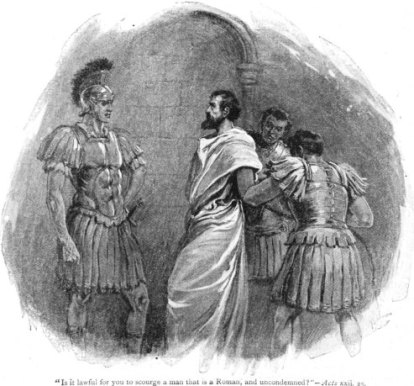
We see recorded in Acts 21:37-22:21, Paul apparently successfully defending himself against his Jewish accusers after the near riot he endured at the Temple when he was falsely accused of speaking against the Jewish people, the Torah, the Temple, and bringing a non-Jew past the Court of the Gentiles and into the Temple (Acts 21:28-29). It’s only when he mentioned the Gentiles, did his Jewish listeners go quite berserk:

And he said to me, ‘Go, for I will send you far away to the Gentiles.’” Up to this word they listened to him. Then they raised their voices and said, “Away with such a fellow from the earth! For he should not be allowed to live.” And as they were shouting and throwing off their cloaks and flinging dust into the air, the tribune ordered him to be brought into the barracks, saying that he should be examined by flogging, to find out why they were shouting against him like this.

Acts 22:21-24

I’d certainly call that a “wall of hostility.”

So one interpretation of having “broken down in his flesh the dividing wall of hostility by abolishing the law of commandments expressed in ordinances” is doing away with all Jewish Torah observance, which was apparently what was causing the separation and bad feelings between Jewish and Gentile believers. Except the Torah doesn’t say that. First century Jewish halachah said that and the lesson Peter learned was that such separation was incorrect halachah.

Another interpretation is that the wall being broken down was the wall that kept Gentiles out of membership in national Israel, and once broken down by their being “grafted in” (Romans 11:11-24), Gentiles gained full covenant relationship with God and Israel by essentially becoming Israel and thus, required to observe all of the Torah mitzvot. The only thing they didn’t have to do was convert to Judaism, but otherwise, they certainly looked like converts. That makes even less sense if the wall was broken down by “abolishing the law of commandments expressed in ordinances.” Nothing is abolished, the Gentiles are just added into the “law of commandments expressed in ordinances.”

Lancaster suggests that what Jesus broke down in his flesh when he was executed was how Gentiles were prevented from covenant relationship with God and the Jewish people without converting to Judaism. The legal requirement for conversion was the law that was abolished. This makes a bit more sense because it is through Messiah that we among the nations can become disciples and we are not required to convert to Judaism. But then, where does all the hostility come from that was preventing Gentiles from entering into covenant?

If what went away was a faulty interpretation and application of Torah that promoted an extreme hostility of Jews against Gentiles (which is not too hard to understand given that the Jewish nation was at that time being occupied by a harsh and cruel Gentile imperial army), Ephesians 2, especially when compared to Acts 10, begins to make more sense.

I’m sure my amateur interpretation can be criticized on a number of levels and again, I’m not saying that my little theory has much, if any, weight of evidence to support it, but I want you to think about it. I want you to consider the possibilities, especially in light of how Jewish audiences took less exception to the message of Jesus as the Messiah, and much more exception to the idea that such a message required doing away with the Torah, the Temple, and including unconverted Gentiles as equal covenant members.

infinite_pathsPaul was fighting an uphill battle and he was never entirely successful during his lifetime. In fact, after his death, the hostility between Jews and Gentiles continued to grow until Christianity was no longer a branch of religious Judaism, but instead, represented an entirely new theological discipline…one that was actually opposed to Judaism.

To the degree that Judaism and Christianity are still separate religions, with neither one wanting to have anything to do with the other for the most part (there are noteworthy exceptions), that wall of hostility still exists today. Part of why I write this blog is to offer avenues at, if not deconstructing the wall, punching a few holes in the “soreg” so we can see each other more clearly and even have a bit of a conversation.

When the Messiah returns, I believe he will finish what Paul started. I believe he will finish removing the wall we continually rebuild. I believe he will show us how to live with each other in peace. And Jews will remain a distinct people and nation as Jews. And Gentile believers will remain distinct from the rest of the world as non-Jewish disciples of the Master. And the different parts will truly act as one within a single body.

Paul the Apostle, Liar, and Hypocrite

Apostle-Paul-PreachesFor though I am free from all, I have made myself a servant to all, that I might win more of them. To the Jews I became as a Jew, in order to win Jews. To those under the law I became as one under the law (though not being myself under the law) that I might win those under the law. To those outside the law I became as one outside the law (not being outside the law of God but under the law of Christ) that I might win those outside the law. To the weak I became weak, that I might win the weak. I have become all things to all people, that by all means I might save some. I do it all for the sake of the gospel, that I may share with them in its blessings.

1 Corinthians 9:19-23

What then is to be done? They will certainly hear that you have come. Do therefore what we tell you. We have four men who are under a vow; take these men and purify yourself along with them and pay their expenses, so that they may shave their heads. Thus all will know that there is nothing in what they have been told about you, but that you yourself also live in observance of the law.

Acts 21:22-24

In one of the conversations I’ve had with Pastor Randy at my church, we discussed the activities of Paul as recorded by Luke in Acts 21. Included in some of the questions Pastor brought up was whether or not Paul was being disingenuous by offering to pay the vow price for four men at the Temple to avoid criticism from other Jews (see the quote from Acts 21 above) and that Paul had replaced this devotion for the Torah and for the Temple with faith in Jesus Christ. Interestingly enough, according to D. Thomas Lancaster in his commentary on Acts 21:15-22:30 (see First Fruits of Zion’s Torah Club Volume 6 Chronicles of the Apostles reading for Torah Portion Shemini [“Eighth”] for details), this is exactly what most Christian commentators believe.

Paul’s participation in the sacrificial services proved to the Jerusalem believers that he was not an apostate. Ironically, many Christian interpreters would consider participation in the Temple sacrifice as apostasy from Christ. They excuse Paul’s backsliding into Judaism on the basis that he was pressured into the ceremony by James and the elders. Moreover, Paul himself said, “I have become all things to all men so that I may by all means save some” (1 Corinthians 9:22).

-Lancaster, pg 684

The quote above from 1 Corinthians 9 seems particularly damning, but I want to mention something else first. In order to believe the traditional Christian interpretation of Paul’s participation in the Temple sacrifice, we have to believe that Paul is a terrible liar and hypocrite and we have to believe that James and the Council of Apostles of Christ not only condoned his dishonesty, but actively encouraged him in it.

If these are the sorts of people responsible for writing much of our New Testament, what does that say about the foundations of the Christian faith? Did God really entrust the establishment and dissemination of the Gospel of Jesus to not only flawed human beings (and all the writers of the Bible were imperfect), but deliberately dishonest, hypocritical liars? Do the ends justify the means? Should we emulate the apostles by also lying in order to win a few souls for Christ?

Assuming he’s not also lying in the following quotes, Paul defends himself before his Jewish accusers and the Romans:

Paul argued in his defense, “Neither against the law of the Jews, nor against the temple, nor against Caesar have I committed any offense.”

Acts 25:8

After three days he called together the local leaders of the Jews, and when they had gathered, he said to them, “Brothers, though I had done nothing against our people or the customs of our fathers, yet I was delivered as a prisoner from Jerusalem into the hands of the Romans.

Acts 28:17

But then what are we to make of Paul’s own words to the church in Corinth in his first letter to them? What is Paul saying?

whispererAccording to Lancaster’s commentary (pp 684-6), Paul was saying that he was merely crafting his message for different audiences, not that he was changing his overall behavior, especially in relation to Torah observance. When Paul said “to the Jews I became as a Jew,” it could hardly mean he “became a Jew” since he was already Jewish by birth (although some modern Jews believe Paul was born a Gentile and converted to Judaism). Lancaster states that in Paul saying this, he “only means that, when among Jewish people, he employed that common ground to his advantage” since he “shared with them a common cultural and historical heritage.”

I don’t have a problem believing this. My wife sometimes tells me that Jews today have a particular way of thinking and conceptualizing their world and that communication between Jews takes on a different “flavor” than between a Jew and a Gentile. It is likely that Paul would have presented his language and message within a heavily Jewish ethnic, cultural, national, and religious framework when sharing the good news of Messiah to an exclusively Jewish audience.

But what about when Paul said, “To those under the law I became as one under the law (though not being myself under the law) that I might win those under the law”? First of all, he already said he “became a Jew” so why add the redundancy (supposedly) of saying that he “became as one under the law?” Isn’t he saying the same thing twice and worse, isn’t he saying that he acted like someone under the law but actually wasn’t under the law? Isn’t that clearly being a hypocrite?

Lancaster answers those questions by saying that those “under the law” were not born-Jews but Gentile converts to Judaism or proselytes. That answers the question of why he wasn’t “under the law” if it means he’s not a convert to Judaism (a Gentile proselyte who chose place himself under Torah observance by converting). That seems a little weak, even to me, and I wish Lancaster had cited some sources to back up his claim. Apparently, this is his personal opinion but it does tend to solve why Paul engaged in “redundant language.”

On the other hand, he could have been referring to God-fearing Gentiles who were not proselytes (or who were considering conversion but had not yet made a commitment) but who voluntarily chose Torah observance. We see an example of such a person in Izates bar Monobaz who was a disciple of a Jewish merchant named Ananias and who, because of his royal position, was discouraged by Ananias from converting to Judaism. Izates vowed to observe all of the Torah mitzvot as the Jews do and later on, converted to Judaism, as did his mother Helena of Adiabene.

I also have to wonder about Cornelius, the Roman Centurion, who Peter encountered in Acts 10. In verses 3 and 30, Cornelius is seen or relates that he was praying at the ninth hour, or about 3 p.m. which is the set time for the mincha prayers in Judaism. Although the text doesn’t make it explicit, Peter and his Jewish companions stayed a number of days in the Roman’s household (see verse 48) and so they all must have eaten meals together. Unless you believe (and I don’t) that Peter’s vision (see verses 9-33) convinced him and his Jewish companions to permanently forego kosher foods, then, since there was a synagogue and thus a Jewish population in the largely Gentile community of Caesarea, it is likely that kosher food was available.

Just how many of the laws of Torah did Cornelius adhere to in his life as a God-fearer? We can’t possibly know, but it’s at least compelling to consider the idea that he may have kept a good many of them, as his position in the Roman military allowed.

under-law-torahI’m not saying any of my suggestions are fact, but it’s another way to look at Paul’s statement about “those under the law.”

Returning to Paul’s “those under the law” statement, Paul says he is not like them “under the law” but becomes like them. If Lancaster is right and they are converts, then of course, Paul doesn’t become a convert to Judaism and thus his statement is accurate. He can communicate to them in a way that they would understand in crafting his message specifically for converts (or Torah keeping God-fearers), though.

And what of “those outside the law” (1 Corinthians 9:21)? Lancaster defines them as Gentile God-fearers who do not live by the standards of Torah. If Paul becomes like them though, doesn’t that mean he puts away his Torah observance and eats ham sandwiches and shrimp scampi right alongside them at the lunch counter? Again, Lancaster refutes this and says that, “is not to say he ate forbidden foods or unclean meats, but wherever he had room to budge, he did so.” Lancaster goes on to say (pg 685):

Paul explained that he himself is not “outside of the law,” that is to say that he was not a Gentile God-fearer. Instead, he was under the “Torah of Messiah.” He remained legally Jewish in Messiah, but he bent where he could bend and flexed what he could flex in order to win those who were not Jewish.

Again, that seems a little thin, and again, Lancaster appears to be relying on his own interpretation and does not cite other authorities to back up his claim.

Traditional Christianity would probably jump all over these verses to illustrate that Paul was a behavioral chameleon and that Torah observance meant absolutely nothing to him unless he was talking to fellow Jews. Otherwise, he was under the “law of Christ,” which is to say “grace,” rather than the “Torah of Moses” or the traditional observances of the non-believing Jews.

Is there any other way to understand all this, particularly Paul’s behavior with Gentiles?

The only other way I can think of, and I’m no expert, is to say that Paul, like any good communicator, was able to craft the same message differently for different audiences. I’m a professional writer and that’s exactly what I do when constructing technical information about a software product for technical vs. lay audiences. The Gospels are largely thought to relate more or less the same information to different audiences, with Matthew written to Jews and Luke written to Greeks.

Even in ancient days, Jewish and Greek thought and conceptualization of ideas and actions was fundamentally different, and information about the same events and thoughts had to be constructed in different ways.

That’s how I would read Paul’s “chameleon” statements.

But that’s just me.

However, I also know this about Paul:

But I have made no use of any of these rights, nor am I writing these things to secure any such provision. For I would rather die than have anyone deprive me of my ground for boasting. For if I preach the gospel, that gives me no ground for boasting. For necessity is laid upon me. Woe to me if I do not preach the gospel!

1 Corinthians 9:15-16

I believe Paul. I believe he’d rather die than compromise his principles. I believe that he was devoted to the Messiah and to the truth of the Gospel. In fact, Paul ultimately did die for his faith, as did Peter, and the other apostles except arguably John. Like the other apostles, Jesus hand-picked Paul for his task and added to that, he did so as a supernatural event, well after Christ’s ascension to glory at the right hand of the Father. If God knows all things, it would be unlikely that such a man as Paul would have been selected if it was known that he was going to fail spectacularly as a liar and a hypocrite.

AbrahamYes, all men of God have failed. Abraham failed. Jacob failed. Moses failed. David failed. But not one of them failed in their mission for God. They failed in many human ways, but each successfully carried out the work that God gave them to do. Abraham failed when he lied about calling Sarah is sister (although arguably as his cousin, she could be called his “sister”), but he succeeded in having overwhelming faith in God and in the binding of Isaac. Jacob failed in his many acts of deceit, but he succeeded in fathering and raising the beginnings of the twelve tribes. Moses failed by desecrating God in front of the people when he struck the rock twice, which cost him his entry into Israel, but he succeeded in leading the Jewish nation in the wilderness for forty years as a shepherd leads and protects his flock. David failed with Bathsheba, but succeeded in conquering the Land and vanquishing Israel’s foes as her King.

Paul no doubt failed in many human ways too, but he succeeded in integrity, honesty, and courage, even in the face of death, many times defying opponents for the sake of his gospel and promoting Gentile inclusion in the Way of the Messiah.

If Paul was a liar and a hypocrite, then he only claimed to be serving Jesus. He couldn’t have been a real apostle and disciple. No one behaves so badly and yet serves a God of truth and justice.

“Not everyone who says to me, ‘Lord, Lord,’ will enter the kingdom of heaven, but the one who does the will of my Father who is in heaven. On that day many will say to me, ‘Lord, Lord, did we not prophesy in your name, and cast out demons in your name, and do many mighty works in your name?’ And then will I declare to them, ‘I never knew you; depart from me, you workers of lawlessness.’

Matthew 7:21-23

If Paul is the man who most Christian commentators (and most Jewish ones as well) believe him to be, then he was a “worker of lawlessness” literally, and a liar, and a hypocrite. If he was all of those things, then his epistles are a sham and we cannot trust them or their writer. If we can’t trust Paul, then most of the New Testament is unreliable. If that’s true, we Christians are in a horrible bind and we have to believe the modern Jews in saying that Paul took the basic teachings of Jesus and perverted them into an anti-Judaic religion, preaching hate of Jews, of the Temple, of the Torah, and of Israel.

That’s not the Paul I know. I’m sorry if you believe otherwise.

The Transcendent Path

Tree of LifeIf you find yourself affixed to a single path to truth—the path of prayer and praise, or the path of kindness and love,or the path of wisdom and meditation,or any other path of a singular mode—you are on the wrong path. Truth is not at the end of a path. Truth transcends all paths. Choose a path. But when you must, take the opposite path as well.

-Rabbi Tzvi Freeman
“Two at Once”
Based on letters and talks of the Rebbe, Rabbi M. M. Schneerson
Chabad.org

As human beings, we have a tendency to compartmentalize and specialize our lives. This comes as no surprise to me, since organization of the different elements of life into “categories” is how we understand ourselves. We have an order and a set of habits to what we do. We also have an awareness of what we’re good at and what we aren’t; a set of “gifts” to which we lean upon and if we are kind, offer to others. Organizing our lives by categorization is necessary so we can conceptualize events, circumstances, and objects and make sense of the world around us.

But it can also be a limitation if we believe we are only defined be these categories. Saying, “I’m only good at this, so I won’t try that,” may rob someone who needs you to do “that” for them rather than “this.”

I’m as guilty of this sort of thinking and behaving as anyone. I’m a writer, both professionally and “for fun.” I find that I can clarify my own thinking and understand better what some people are saying to me if I write about those experiences. My Wednesday night meetings with Pastor Randy are a perfect example. He might say a few sentences to me on Wednesday that will fuel my blog posts for an entire week, because I use writing to continually process what he has been teaching.

But I cannot allow writing to be the totality of my identity and my activity. Someone who needs me to give them a lift to a doctor’s appointment because their car broke down won’t be helped if I only write about their need. I should offer them a ride to and from the appointment in my car. I should do something that I’m not accustomed to considering as an “expertise” of mine in order to meet another human being’s need.

Earlier today, I was writing about giving chesed to the stranger, showing someone who needs you a kindness, not because they are your friend or neighbor, but just because they need you.

In the world of “religious blogging,” most of us have a tendency to write about what we’re interested in, and again, I’m no exception. We often write about the theological or doctrinal specifics with which we identify. Jews write about Judaism and Christians write about Christianity. Nothing strange about that. Even within a particular religious structure, we tend to write about those areas of which we are particularly fond or in which we are interested.

I’ve written lately on Divine Election because I was processing that information. For another person, that might be a rather meaningless topic. I’ve read blogs recently about the Leviticus 11 kosher laws, Bibles limited to the New Testament and the Psalms, Shomer Negiah, Good Friday, and other religious subjects. Nothing wrong with writing about any of those religious topics…

…unless they limit what else we should be doing.

We tend to choose a path and then walk it, but then we only walk that path and no other. According to what Rabbi Freeman said above, that’s not the right path. If we are on the path of prayer and praising God but a homeless person on the street needs us to give them something to eat, then we are on the wrong path, at least for that moment. If we are busy donating our time at a shelter or food kitchen, but God needs us to read and meditate upon His Word, then we are on the wrong path, at least for that moment.

The individual’s avoda must be commensurate with his character and innate qualities. There may be one who can drill pearls or polish gems but works at baking bread (the analogy in the realm of avoda may be easily understood). Though baking bread is a most necessary craft and occupation, this person is considered to have committed a “sin.”

“Today’s Day”
Friday, Nissan 25, 10t day of the omer, 5703
Compiled by the Lubavitcher Rebbe
Translated by Yitschak Meir Kagan
Chabad.org

white-pigeon-kotelAvoda is a Hebrew word that is commonly translated as “work,” but among the Chassidim, it “generally refers to Divine service (or worship). For example, it’s part of the Divine service to serve God with joy.” Is who we are as servants of God limited to our theology or our religious identity, or is there something that transcends all that information, and unites us as living, human creations of the Most High God?

We often drone on and on and on about our insights into the Bible, our own theological pet peeves, or about how people with different theological pet peeves annoy us and are guilty of “false teaching,” but do we take the time to transcend our categories, our pigeon-holed lives, and realize that truth is much, much larger than the box we’ve put ourselves in?

And if your brother is not close to you and you do not know him.

Deuteronomy 22:2

Perhaps the reason that other people are not close to you is because you do not know them.

The Chassidic master of Apt said: “As a young man, I was determined to change the world. As I matured, I narrowed my goals to changing my community. Still later, I decided to change only my family. Now I realize that it is all I can do to change myself.”

Some things in the world are givens, and others are modifiable. The only thing we can really modify is ourselves. All other people are givens. Unfortunately, many people assume the reverse to be true. They accept themselves as givens and expect everyone else to change to accommodate them.

(There is one limited exception. When our children are small, we can teach and guide them. When they mature, however, we can no longer mold them.)

Trying to change others is both futile and frustrating. Furthermore, we cannot see other people the way they truly are, as long as we are preoccupied with trying to change them to the way we would like them to be.

The people we should know the most intimately are those who are closest to us. Yet it is precisely these people whom we wish to mold into the image we have developed for them. As long as this attitude prevails, we cannot see them for what they are. How ironic and tragic that those we care for the most may be those we know the least!

Today I shall…

…try to focus any desires to change on myself and let other people determine for themselves who and what they wish to be.

-Rabbi Abraham J. Twerski
“Growing Each Day, Nissan 20”
Aish.com

light-of-the-worldTo extend Rabbi Twerski’s metaphor, we can only change the world by changing ourselves. We can only serve God and change the world, by accepting that others will always be different from us and then realize that’s not always a bad thing. We, in the end, are only responsible for who we are. God will not judge us on what other people have done but only on what we have done with our lives. If we have treated others kindly, our theology, doctrine, dogma, or any of the other boxes and pigeon holes we’ve used to categorize and identify ourselves in this world will be worth less than who we are in Christ.

If anyone else thinks he has reason for confidence in the flesh, I have more: circumcised on the eighth day, of the people of Israel, of the tribe of Benjamin, a Hebrew of Hebrews; as to the law, a Pharisee; as to zeal, a persecutor of the church; as to righteousness under the law, blameless. But whatever gain I had, I counted as loss for the sake of Christ. Indeed, I count everything as loss because of the surpassing worth of knowing Christ Jesus my Lord. For his sake I have suffered the loss of all things and count them as rubbish, in order that I may gain Christ.

Philippians 3:4-8

Paul isn’t saying that his being Jewish is literally worthless, and I’m not suggesting that how we study and understand the Word of God is meaningless, either. What I am saying is that, like Paul, there is something much, much greater. The Master taught us that loving God to our fullest extent and loving other human beings as ourselves are the essence of everything in the Bible. He also taught that we would be known as his disciples specifically by our love of one another, a love that goes so far that we would be willing to give up our lives for another if required.

If anything can be said to transcend all of our paths, our categories, our religious posturing, it is love…even love for the unlovable and the unlikable ..especially love for those who otherwise make us feel hurt and angry and aggravated. If we can authentically show them love, then we are better than all of the sermons and blog posts about theology that we could ever produce. Then, we are written in His Book of Life because we have loved.

“When I was young, I admired clever people. Now that I am old, I admire kind people.”

-Abraham Joshua Heschel

We must be more.

Shemini: Chesed to the Stranger

acts-of-kindnessThe following you shall abominate among the birds — they shall not be eaten, they are an abomination: the eagle, the vulture, and the black vulture; the stork; herons of every variety; the hoopoe, and the bat.

Leviticus 11:13,19 (JPS Tanakh)

The Talmud (Chulin 63a) states that the Hebrew name for the white stork is chasida, because it acts with kindness, chesed, towards its friends.

The Ramban, Moshe Nachmanides, a great Torah scholar, writes that the birds enumerated in this portion are forbidden for consumption because of their cruelty. Why, then, should the stork be considered “detestable” and an “abomination”? It should be permissible since it does kindness!

The Chidushai Ha-Rim answers: The stork does favors only for its friends. Since it doesn’t do chesed for strangers, it is considered not kosher. Chesed, kindness, must be done for everyone, not only one’s friends!

-Rabbi Kalman Packouz
“Shabbat Shalom Weekly”
Commentary on Torah Portion Shemini
Aish.com

It seems strange that we could learn lessons about treating others with charity and lovingkindness from the Laws of Kashrut, but the esteemed sages have illustrated this passage thus. Perhaps you would like something more familiar.

Love your fellow as yourself: I am the Lord.

Leviticus 19:18 (JPS Tanakh)

And a second is like it: You shall love your neighbor as yourself.

Matthew 22:39

But as the famous question goes, who is our neighbor?

The Torah teaches us, “Love your fellow human being as yourself” (Leviticus 19:18). It is often translated as “Love your neighbor as yourself.” However, Rabbi Mordechai Gifter taught that while the words “neighbor” and “fellow human being” are often used synonymously, in everyday speech the word “neighbor” is used to denote someone living or located nearby, while the obligation of this commandment includes a complete stranger who lives far away.

The general rule for this commandment is that anything you would want others to do for you, you should do for others (Rambam, Hilchos Aivel 14:1). The great Hillel once taught a convert, “That which is hateful to you, do not do unto others. That is the basis of the Torah.” (Shabbos 31a). The Baal Shem Tov used to say, “Love your fellow man as yourself — though you have many faults, nevertheless, you still love yourself. That is how you should feel toward your friend. Despite his faults, love him.”

-Rabbi Packouz

Not just your neighbor who is close to you, and not just your fellow who is like you, but even people who are far away and who you do not know…even people you may not like.

“You have heard that it was said, ‘You shall love your neighbor and hate your enemy.’ But I say to you, Love your enemies and pray for those who persecute you, so that you may be sons of your Father who is in heaven. For he makes his sun rise on the evil and on the good, and sends rain on the just and on the unjust. For if you love those who love you, what reward do you have? Do not even the tax collectors do the same? And if you greet only your brothers, what more are you doing than others? Do not even the Gentiles do the same? You therefore must be perfect, as your heavenly Father is perfect.

Matthew 5:43-48

What is Chesed? What is truly giving kindness if not showing love and concern for another human being, even when they’re a stranger, or even when there has been bitterness and enmity between you?

One thing I can attest for is his integrity. He was one of the few who called me after my last surgery to find how I am despite our bitter feud. None of you did. Give the guy a break, we must not take love out of the equation.

Chesed is calling up a sick person and showing compassion, even though at all other times you bitterly argue with that person. Chesed is a love note placed in a bottle and tossed into the sea for anyone who may need love to find, no matter how far away they may be. Chesed is a can of soup donated to a food bank for any hungry person to eat. Chesed is smiling at a stranger you pass on the street.

More about chesed on The Transcendent Path.

Good Shabbos.

Lancaster’s Galatians: Sermon Four, Wind and Sail

wind-sky-spirit-ruachAll Scripture is breathed out by God and profitable for teaching, for reproof, for correction, and for training in righteousness…

2 Timothy 3:16 (ESV)

Is given by inspiration of God – All this is expressed in the original by one word – Θεόπνευστος Theopneustos. This word occurs nowhere else in the New Testament. It properly means, God-inspired – from Θεός Theos, “God,” and πνέω pneō, “to breathe, to breathe out.” The idea of “breathing upon, or breathing into the soul,” is that which the word naturally conveys. Thus, God breathed into the nostrils of Adam the breath of life Genesis 2:7, and thus the Saviour breathed on his disciples, and said, “receive ye the Holy Ghost;” John 20:22. The idea seems to have been, that the life was in the breath, and that an intelligent spirit was communicated with the breath. The expression was used among the Greeks, and a similar one was employed by the Romans. Plutarch ed. R. 9:p. 583. 9. τοὺς ὀνείρους τοὺς θεοπνεύστους tous oneirous tous theopneustous. Phocylid. 121. τῆς δὲ θεοπνεύστου σοφίης λόγος ἐστὶν ἄριστος tēs de theopnoustou sophiēs logos estin aristos.

Barnes’ Notes on the Bible for
2 Timothy 3:16

You may be wondering how this connects to my ongoing discussion with Pastor Randy about D. Thomas Lancaster’s book The Holy Epistle to the Galatians. The answer is, “not much.” Frankly, we started our discussion last night with trying to clarify his thoughts on Divine Election (Pastor has a paper he wants to loan me that describes all of the various positions), but then moved to how we can understand the Bible (Pastor has some reservations relative to how Lancaster derives certain conclusions in his book from the Galatians text). We addressed Sermon Four of the book eventually, but it didn’t occupy the significant portion of our time together, nor was it the most compelling topic upon which we touched.

Going back to “God-breathed,” Pastor said that the Greek word used has the implication of wind filling a sail and pushing the boat along (Correction, according to Pastor Randy’s comment below, “the phrase about ‘the wind filling a sail’ has to do with the II Peter 1:21 passage and the meaning of men being ‘carried along by the Holy Spirit’.” See the following quote). He told me he believes that as God gave His inspiration to the human writers of the Bible, the authors did not say anything, at least as originally given in their manuscripts, that contradicted what God intended.

And we have the prophetic word more fully confirmed, to which you will do well to pay attention as to a lamp shining in a dark place, until the day dawns and the morning star rises in your hearts, knowing this first of all, that no prophecy of Scripture comes from someone’s own interpretation. For no prophecy was ever produced by the will of man, but men spoke from God as they were carried along by the Holy Spirit.

2 Peter 1:19-21 (ESV)

People, that is, prophets and those people who have written the Word of God we have in our Bible, did not hear something from God and then interpret what it meant through their own intellect and emotions. God used their personalities, their vocabulary, their style of writing, their perceptions to craft His message, but the message was and is His message, not the prophets’, and the message “carried them along” as it was first given and recorded in the original documents, and the message was and is exactly what God meant to say and meant to carry us along as well.

But then we have a problem.

We don’t have the original documents…any of them.

Also, Bible reading and translation is an enormously complex task.

According to Pastor Randy, and I agree with him, we have to start with what the text literally says. We also have to apply the immediate context of the scripture, not taking it out and making it stand on its own. Beyond that, we have to consider the history, the culture, and the circumstances in which the scripture was written. On top of that, we have to connect the scripture to the larger context of the entire Bible, including other times when similar circumstances were mentioned and similar or identical wording was used. If, for instance, in describing the two greatest commandments (see Matthew 22:37-40), Jesus references Deuteronomy 6:5 and Leviticus 19:18, in understanding the Matthew 22 passage, we must also take into consideration the context, history, culture, and circumstances in which Deuteronomy 6 and Leviticus 19 take place, including the author and his personality, vocabulary, style of writing, and personal experiences. We cannot separate what Jesus was trying to say from what Moses was trying to say, however Jesus and all that was in play when he was talking may modify the original meaning, giving it a somewhat different shape, color, and texture.

paul-editedOh, and let’s not forget the intended audience. Moses may not have been aware that what he was writing was ultimately intended for the entire world, but we realize that God has a greater scope. Jesus may well have understood that his words would eventually be consumed by all of humanity across time, but his immediate audience, like Moses’ was the Jewish people or more specifically in Jesus’ case, the Pharisee he was addressing at that particular moment.

We must take all that into consideration when reading the Bible and seriously attempting to understand its message.

And we must constantly remind ourselves that it is all God-breathed.

Pastor Randy and I spent most of our time together exploring how to understand the Bible, with the promises and pitfalls built into such an effort. We discussed how we don’t necessarily have to “reinvent the wheel,” since many people have read and observed the literal meaning of the text from a variety of perspectives, and it would be irresponsible of us to disregard their work and rely only on our own. Pastor described how he approaches understanding texts looking at those who came before him. He reads a variety of expert analyses and takes into consideration what the scholars they did and didn’t take into consideration.

For instance, a particular writer may have a good grasp of the original language but not sufficiently address the history involved, or another writer may have a good handle on the historical context, but not the cultural context. Pastor said he looks at the various scholarly opinions in that manner and ultimately settles on which one he…wait for it…

…which one he likes best.

What?

Pastor Randy is a literalist, an educator, a scholar, a linguist, and is very serious about pursuing as accurate an understanding of the Bible as he can achieve, but after much discussion we agreed that even under the best of circumstances and intentions, there will always be this little, fuzzy, grey, area in the middle of our understanding where we fill in the blanks with our own personalities.

Geordi La Forge (played by Levar Burton): I don’t know, Data, my gut tells me we ought to be listening to what this guy’s trying to tell us.
Data (played by Brent Spiner): Your gut?
Geordi: It’s just a… a feeling, you know, an instinct. Intuition.
Data: But those qualities would interfere with rational judgment, would they not?
Geordi: You’re right, sometimes they do.
Data: Then… why not rely strictly on the facts?
Geordi: Because you just can’t rely on the plain and simple facts. Sometimes they lie.

-from the Star Trek: the Next Generation Episode
The Defector (original air date 30 Dec. 1989)

In the scene from which I just quoted, Data concludes that in any meaningful analysis, the observer must fill in whatever blanks there are in the facts and other available information with their personality. In Data’s case, he was in a bind because effectively, he had no personality. All he had were the facts. By the way, it turns out Geordi’s “gut” was wrong. The defector in question had been fed disinformation by his superiors to mislead the Enterprise and ultimately to provoke a war. Fortunately, Picard’s “gut” proved to be more accurate and the ruse was exposed.

All this doesn’t mean that we can never understand the Bible or that we should always equivocate on its meaning, but we should be a little less than one-hundred percent certain that we always know what everything in the Bible means all of the time.

It also means that when we realize we’ve made a mistake based on subsequent study and analysis, we should admit it.

Pastor Randy says that’s one thing he admires about Boaz Michael, President and Founder of First Fruits of Zion (FFOZ). When Boaz and the organization came to the conclusion, several years ago, that they had made a significant error in understanding what the Bible said in relation to Jewish and Gentile covenant responsibilities to God, after much prayer and soul-searching, he announced that FFOZ was making a major shift in its theological and doctrinal position. Boaz knew it would cost FFOZ much of its income and might even result in the organization collapsing completely. Thank Hashem that the latter did not occur, but many sacrifices had to be made. Sadly, to this day, Boaz and his group continue to be severely criticized and harangued by their detractors as a consequence.

That’s the price of integrity and following God where He calls you to go. That’s also part of the ongoing struggle of understanding God through His Word and maturing as people of Spirit and of faith.

ancient-sail-boatI tried to get Pastor Randy to say that you can have a room full of people with equal intelligence, equal qualifications, all people of good character, and they could still disagree with each other on what parts of the Bible mean, but he wouldn’t go for it. He said that we’re all human and we’re all capable, not just of making mistakes, but of following our own human desires. We all can and do sin.

Does that mean there is only one right person (or close-knit group of people) who understands the Bible correctly and it is because he or she is the best person morally and ethically that their understanding is right? Does that mean all of this person’s critics are liars and haters who purposely want to bring the “right” person down in order to elevate their own agendas?

I don’t think it’s that simple. I think that you can gather a group of people together who are of good will and intent who will disagree. Sure, some of the people in that room will be liars and haters, but they should be easily spotted by their lack of integrity and good character (their fruits) in how they treat others and how they walk with God. Even the best of us can allow our personal, pet theories and biases affect our judgment. We all want to be right and to be admired and respected.

But at the end of the day, the best of us (and I’m hardly saying I’m among the best) will put all that aside, suck it up, and make the hard call, even if it costs them, because that’s just what God’s true servants do. Once we realize that the evidence is solid about some piece of scripture, even if it’s not what we want it to mean, we’ll go forward and accept it and embrace it, because that’s part of who we are if we are disciples of our Master. We’ll also continue to study, to learn, and to mature, because God continually breathes in us.

For a ninety minute conversation, last night’s talk with Pastor Randy inspired a lot in me that I could write about…and maybe I will, but I won’t try to cram it all into a single “meditation” today.

But I do want to be a sail. And I do want to be available to the wind. And I do want to let my sail conform to the wind, to the shape it causes me to manifest, to the direction it drives me, toward the destination to which it guides me.

I don’t know yet what distant and alien shore God has planned for my future, but I can feel His hand on me. Do I have the integrity and courage to let Him take me where He wants me to go? I hope so. I pray to possess those qualities that I may serve Him…even in something as “simple” as reading the Bible.

Pastor will be out of the country for the rest of April so naturally, we won’t be meeting each Wednesday evening for the next several weeks. We’ll revisit Lancaster’s Galatians next month and reformulate our study plan for the book…I promise.

In the meantime, I’ll try to continue writing in the spirit of what my Pastor, and ultimately God, provokes in my mind and heart, and move forward with integrity and purpose. Unfurling my sail and setting my course for uncharted seas as the wind sends me forth.