Tag Archives: Jesus

On Choosing God

TrustNegate your own will in favor of God’s will.

-Ethics of the Fathers 2:4

If I surrender my will and turn my life over completely to the will of God, do I not thereby abrogate my power of free choice?

Certainly not. Take the example of a child who receives money for his birthday. An immature child may run off to the toy store or candy store and spend the money on everything his heart desires. He may indeed have several moments of merriment (although a stomach ache from indulging too heavily in confections is a possibility). Without doubt, however, after a short period of time those moments of enjoyment will be nothing but a memory, with the candy long since consumed and the broken toys lying on the junk heap.

A wiser child would give the money to a parent and ask that it be put into some type of savings account where it can increase in value and be available in the future for things of real importance.

Did the second child abrogate his prerogative of free choice by allowing the parent to decide how to invest the money? Of course not. In fact, this was a choice, and a wise choice as well as a free choice.

We can choose to follow our own whims or we can choose to adopt the will of an omniscient Father. We are wise when we make the second choice.

Today I shall…

…turn my will over to God, and seek to do only that which is His will for me.

-Rabbi Abraham J. Twerski
“Growing Each Day, Nisan 23”
Aish.com

How much is this like the choice Jesus made on that last night?

saying, “Father, if you are willing, remove this cup from me. Nevertheless, not my will, but yours, be done.”

Luke 22:42

Last week, I started talking about free will and Divine Election and how that describes the nature of man and our relationship with God. I still don’t think that we are wind up toy soldiers, pre-programmed by God in all our responses, including the most important response, accepting or rejecting the Almighty.

I don’t think this issue comes up for Jewish people, but then, all Jews are born into a covenant relationship with God just by virtue of being Jewish. Still, the recognition and acceptance of Messiah is a vital task that remains hidden from most Jews, largely due to how Gentile Christianity has “morphed” the Jewish Messiah into a Goyishe King. Still, many Jews see God, not as a harsh overseer with a whip controlling the gates of life and death, but as a teacher, gently but firmly guiding us in the lessons of life as we walk the path with our companion.

That very day two of them were going to a village named Emmaus, about seven miles from Jerusalem, and they were talking with each other about all these things that had happened. While they were talking and discussing together, Jesus himself drew near and went with them. But their eyes were kept from recognizing him. And he said to them, “What is this conversation that you are holding with each other as you walk?” And they stood still, looking sad. Then one of them, named Cleopas, answered him, “Are you the only visitor to Jerusalem who does not know the things that have happened there in these days?” And he said to them, “What things?” And they said to him, “Concerning Jesus of Nazareth, a man who was a prophet mighty in deed and word before God and all the people, and how our chief priests and rulers delivered him up to be condemned to death, and crucified him. But we had hoped that he was the one to redeem Israel. Yes, and besides all this, it is now the third day since these things happened. Moreover, some women of our company amazed us. They were at the tomb early in the morning, and when they did not find his body, they came back saying that they had even seen a vision of angels, who said that he was alive. Some of those who were with us went to the tomb and found it just as the women had said, but him they did not see.” And he said to them, “O foolish ones, and slow of heart to believe all that the prophets have spoken! Was it not necessary that the Christ should suffer these things and enter into his glory?” And beginning with Moses and all the Prophets, he interpreted to them in all the Scriptures the things concerning himself.

Luke 23:13-27

Imagine having this conversation with the Master along the road, but imagine it being a picture of your entire life.
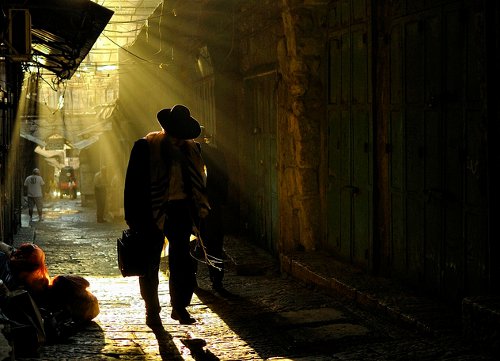
Jewish in JerusalemRabbi Twerski paints for us an image of giving our lives over to God by conscious choice. Even if a Jew is born into covenant, he or she can still completely reject God, and many Jews have done so. The majority of the Jewish population of Israel is secular, so even in the Holy Land, which contains Jerusalem and the Holy Temple Mount, most of the Jewish inhabitants choose not to connect to God.

Both Easter and the Week of Unleavened Bread are now done. Religious Jews continue to Count the Omer, but Christians just “coast” into April and for most of the church, Pentecost (Shavuot) is hardly a little blip on our radar. This is why it is so important for those few of us who are conscious of the season to remind everyone else.

The presence of Mashiach is revealed on Acharon Shel Pesach, and this revelation has relevance to all Israel: Pesach is medaleg, “skipping over” (rather than orderly progress), and leil shimurim, the “protected night.” In general the mood of Pesach is one of liberty. Then Pesach ends, and we find ourselves tumbling headlong into the outside world. This is where Mashiach’s revealed presence comes into play – imbuing us with a powerful resoluteness that enables us to maintain ourselves in the world.

“Today’s Day”
Wednesday, Nissan 23, Issru chag, 8th day of the omer, 5703
Compiled by the Lubavitcher Rebbe
Translated by Yitschak Meir Kagan
Chabad.org

After the week of Matzot, we see that beyond the Omer count, some Chassidic Jews carry forward the revealed presence of the Mashiach into the outside world with them. How much more should we, who know for certain that Messiah is revealed in Jesus Christ, should carry him forward into the world with us?

Any Jew alive on the face of this planet today is a walking miracle. Our mere existence today is wondrous, plucked from the fire at the last moment again and again, with no natural explanation that will suffice.

Each of us alive today is a child of martyrs and miracles.

-Rabbi Tzvi Freeman
“Walking Miracle”
Based on letters and talks of the Rebbe
Rabbi M. M. Schneerson
Chabad.org

I can only imagine that just seeing a Jew walking the streets of the old city in Jerusalem, buying falafel for lunch, davening at the Kotel, must all be miraculous. Who would have thought such a thing possible a scant six decades before? Yes, of course it is a miracle of God that there are any Jewish people left alive today in our world and that they live in a Jewish nation.

But it is also a miracle that there are any Christians, for who of his own free will and in his nature of sin, would choose the Almighty, to come to Him through His Son, unless the Spirit of God were not whispering in our ear, urging us, pleading with us, exploring our heart?

And once Moshiach Rabbeinu has opened our eyes to God, and our minds and hearts to the scriptures, and we choose Him, and we learn of Him and who we are as His sons and servants, what would we not do, from the wisest among us to the most simple, to serve Him who is the author of our story and the lover of our soul?

Choose Love. Choose God. Choose Life.
Dogma on a Leash

dogma-on-a-leashChristian theology is the enterprise which seeks to construct a coherent system of Christian belief and practice. This is based primarily upon the texts of the Old Testament and the New Testament as well as the historic traditions of Christians. Christian theologians use biblical exegesis, rational analysis, and argument to clarify, examine, understand, explicate, critique, defend or promote Christianity. Theology might be undertaken to help the theologian better understand Christian tenets, make comparisons between Christianity and other traditions, defend Christianity against objections and criticism, facilitate reforms in the Christian church, assist in the propagation of Christianity, draw on the resources of the Christian tradition to address some present situation or need, or for a variety of other reasons.

“Christian theology”
Wikipedia

Your pastor Randy seems to be a Calvinist. Calvinism is one of the most disturbing (and erroneous) christian theologies that I’ve come across.

I extensively addressed the issue of Calvinism on my old blog site and I found that no other topic inspired so many hostile comments:

In your article you write:

“Think about it. It’s all Adam’s and Eve’s fault. They are the only ones who ever had a choice. According to ‘Divine Election,’ “

However the Calvinist view isn’t even as “fair” as that. According to Calvin:

“God not only foresaw that Adam would fall, but also ordained that he should….I confess it is a horrible decree; yet no one can deny but God foreknew Adam’s fall, and therefore foreknew it, because he had ordained it so by his own decree” (Cal. Inst., b. 3, c. 23, sec. 7).

-Onesimus, from comments he made on the blog post
Lancaster’s Galatians: Sermon Three, Paul’s Gospel, and the Unfair Election

I had a kind of revelation this morning (as I write this) while driving to work. Christians have a strong tendency to be critical of the “man-made rulings” of the Jewish sages and rabbis that are binding to various branches of Judaism. Particularly in Orthodox Judaism, Christians see the rabbinic rulings overriding the word of God and elevating the sages to a higher standing than God’s written word.

But I think Christians do exactly the same thing. Consider the words of Onesimus I quoted above. There are all manner of Christian “sages,” such as John Calvin, who issue proclamations that are considered binding by their followers.

I’m really ignorant of all the different doctrines, creeds, and dogmas running around out there, so it’s difficult for me to compare them, let alone claim a specific path for my very own. Trying to look up a comparative list of Christian doctrines is difficult, and the best I could do was About.com. In comparing, for example, Calvinism and Arminianism relative to Divine Election, I found this:

  • Calvinism – Before the foundation of the world, God unconditionally chose some to be saved. Election has nothing to do with man’s future response.
  • Arminianism – Election is based on God’s foreknowledge of those who would believe in him through faith. In other words, God elected those who would choose him of their own free will. Conditional election is based on man’s response.

These are both perfectly acceptable Christian doctrines, but they contradict each other. They are also binding doctrines in terms of the individuals and churches who follow them. How is that different from Jews who choose to follow the dictates of Reform Judaism, vs. those who adhere to Orthodox Judaism or even the Chabad?

The first Big Issue is this: If I’m going to switch my focus to the New Testament, should I continue following all the rules of the Hebrew Bible? In other words, should I keep my beard and fringes? Or should I break out the Gillette Mach3 and order shrimp fajitas?

After asking this question to pretty much every Christian expert I meet, I’ve come to this definitive conclusion: I don’t know.

You can find a small group – a very small group – of Christians who say that every single Old Testament rule should still be followed by everyone. The ultralegalist camp.

On the other end of the spectrum are those Christians who say that Jesus overrode all rules in the Old Testament. He created a new covenant. His death was the ultimate sacrifice, so there’s no need for animal sacrifice – or, for that matter, any other Old Testament laws. Even the famous Ten Commandments are rendered unnecessary by Jesus.

-A.J. Jacobs
“Month Nine: May”, pp 254-5
The Year of Living Biblically: One Man’s Humble Quest to Follow the Bible as Literally as Possible

AJ-Jacobs-bibleI just finished this book, which Pastor Randy lent me, and Jacobs illustrates quite graphically how the Bible, and particularly Christianity, seems so strange when looked at from a complete outsider’s point of view. He had some familiarity with religious Judaism since he’s a secular liberal Jewish person and has religious relatives.

However, in his inventory of the different “Christianities” he was able to contact, he showed his readers quite dramatically how hard it would be to choose one particular path and call it the “right” one. He contacted a number of Christian scholars and pastors to act as advisors, and visited such diverse groups as Answers in Genesis, Jerry Falwell’s MegaChurch, a Gay men’s Christian Bible Study in New York, and a group of “snake handlers” in Tennessee. It doesn’t get more “mixed bag” than this.

Day 292. I’ve got a decent biblical library going now. Perhaps a hundred books or so. And I’ve divided them into sections: Moderate Jewish. Fundamentalist Jewish. Moderate Christian. Fundamentalist Christian. Atheist. Agnostic. Religious Cookbooks.

I’ve tried to keep the conservative books on the right side and the liberal ones on the left. When I started my year, I thought that nothing would go to the right of my Falwell collection. But of course, I was wrong…

-Jacobs, pg 292

Of course, Jacobs was trying to live the Bible as literally as possible, so he skewed his sampling of Judaism and Christianity to those branches that express themselves in a more literal and often, fundamentalist manner. But even restricting himself to those particular “Christianities,” it was still confusing.

There’s a phrase called “Cafeteria Christianity.” It’s a derisive term used by fundamentalist Christians to describe moderate Christians. The idea is that the moderates pick and choose the parts of the Bible they want to follow. They take a nice helping of mercy and compassion. But the ban on homosexuality? They leave that on the countertop.

Fundamentalist Jews don’t use the phrase “Cafeteria Judaism,” but they have the same critique. You must follow all of the Torah, not just the parts that are palatable.

The point is, the religious moderates are inconsistent. They’re just making the Bible conform to their own values.

The year showed me beyond a doubt that everyone practices cafeteria religion. It’s not just the moderates. Fundamentalists do it too. They can’t heap everything on their plate. Otherwise, they’d kick women out of church for saying hello (“the women should keep silence in the churches. For they are not permitted to speak…” -1 Corinthians 14:34) and boot out men for talking about the “Tennessee Titans” (“make no mention of the names of other gods…” -Exodus 23:13).

-Jacobs, pp 327-8

There’s nothing like having an outsider sincerely look at your faith to give you (or me, in this case) fresh perspective.

In reading Jacobs’ book or reviewing the websites I’ve mentioned so far, I wasn’t really satisfied that I got a good look at the different “Christianities” so I kept searching and found a chart of the differences between denominations at religionfacts.com.

It’s too long to quote from in any meaningful fashion, but if you take a look that page, you’ll see how many different ways there are to apply the different Christianities to different doctrines and topics (Trinity, Nature of Christ, Holy Spirit, Original Sin, Free Will, and on and on and on).

So when Pastor presents his point of view and backs it up with scripture, it’s not the only valid Christian point of view. If I disagree with him or even if I am aghast at something he says, it doesn’t automatically mean I have to agree with him, even if I can’t immediately come up with Bible verses that state another perspective.

I remember being told (in a seminary class) that we must choose between Armenian or Calvinist theology. I found it strange to be forced into an either/or position like that.

-Ruth on Facebook

If I were to run all this past the Apostle Paul, what would he say? Would any of this even make sense to him? Would he advise me to take a Calvinist or Armenian approach, or would he think both were equally dodgy? I don’t know. I have said that I think religion evolves over time to meet the needs of each generation, but there’s a difference between adaptation to adjust to new technologies or social situations, and totally new ways of understanding the basic nature a completely unchanging God.

rabbinThe following story is said of Moses (see Menachot 29b.) that when he was about to receive the Torah from God, he saw God attaching crowns to the letters. Moses asked why God was doing this and God answered, “There is a man who will live many generations after you and his name is Akiva, son of Yosef. He will examine every single spike of every letter and draw from them piles upon piles of halachot.”

To help Moses understand, God allowed Moses to visit a class of Rabbi Akiva. As Moses listened to the esteemed Rabbi’s teaching, he couldn’t follow any of it and “became weak with despair.” At the end of the Rabbi’s explanation, a student asked him, “Where do you learn this from,” and the Rabbi replied, “This is an oral tradition passed down from Moses.”

“By those words, Moses was set at ease.”

(see Is It Really the Torah, Or Is It Just the Rabbis for more)

This is midrash and I don’t believe God literally sent Moses forward in time to visit Rabbi Akiva in the early First Century of the common era (but what do I know?), but this tale is meant to illustrate how there can be new interpretations of our original Biblical data designed to illuminate subsequent generations. There are no doubt many matters in Judaism that Moses could not anticipate, so he wouldn’t have looked at the Torah in those ways.

No doubt, there are many issues in modern Christianity that would have escaped Paul, so he wouldn’t have written any of his letters addressing them.

Still, how far afield can Christian doctrine go before it completely escapes the bounds of the intent of the writers of the Bible and more than that, the intent of God? Does God require that we choose between Armenian or Calvinist theology or can we be servants of the Most High and disciples of our Master without doing so?

Is that like asking if a religious Jew can be a good Jew and not choose between the halachot specific to a particular branch of Judaism? If it is, then Christianity is doing almost exactly what Judaism is doing. The only substantial difference, is for Christianity the required responses are largely conceptual (what you believe), and for Judaism the required responses are largely behavioral (what you do).

Maybe we Christians should cut religious Jews some slack or stop being so dogmatic with our doctines…or both.

He Will Come

LionIn that day, the stock of Jesse that has remained standing shall become a standard to peoples — Nations shall seek his counsel and his abode shall be honored.

In that day, My Lord will apply His hand again to redeeming the other part of His people from Assyria — as also from Egypt, Pathros, Nubia, Elam, Shinar, Hamath, and the coastlands.

He will hold up a signal to the nations and assemble the banished of Israel, and gather the dispersed of Judah from the four corners of the earth.

Isaiah 11:10-12 (JPS Tanakh)

This passage from Isaiah is part of the readings for the last day of Pesach (Passover) which ends at sundown today (Tuesday). For any Christian, the imagery is immediately recognizable as describing Christ, and for a religious Jew, the Messiah is surely appearing here. We see part of the Messianic prophesy and what the King will do upon his return, such as bringing the scattered of Israel back to their nation from the four corners of the earth. He will also be a standard and a banner attracting we from the nations to seek his counsel and to honor his abode, which is the rebuilt Temple in Holy Jerusalem.

The last day of Pesach sends a message of hope to both the Jewish people and all human beings on earth that the Messiah will gather us all to him and he will be our King. Revelation 2:27 speaks of Messiah “ruling with a rod of iron,” which doesn’t sound pleasant, but it shows that King Messiah will have dominion and authority over everything and everyone. The Bible speaks at length about the Messiah and his rule.

It shall come to pass in the latter days
that the mountain of the house of the Lord
shall be established as the highest of the mountains,
and it shall be lifted up above the hills;
and peoples shall flow to it,
and many nations shall come, and say:
“Come, let us go up to the mountain of the Lord,
to the house of the God of Jacob,
that he may teach us his ways
and that we may walk in his paths.”
For out of Zion shall go forth the law,
and the word of the Lord from Jerusalem.

Micah 4:1-2

For the children of Israel shall dwell many days without king or prince, without sacrifice or pillar, without ephod or household gods. Afterward the children of Israel shall return and seek the Lord their God, and David their king, and they shall come in fear to the Lord and to his goodness in the latter days.

Hosea 3:4-5

While we in the church firmly understand and believe in the Christ, the Moshiach, in the person of Jesus; that he walked the earth once before and will dwell among us again, this has yet to be discovered by many, both Gentile and Jewish. But is can be discovered, just by watching Jesus and listening to him. Even a simple fisherman saw this.

When Jesus came to the region of Caesarea Philippi, he asked his disciples, “Who do people say the Son of Man is?”

They replied, “Some say John the Baptist; others say Elijah; and still others, Jeremiah or one of the prophets.”

“But what about you?” he asked. “Who do you say I am?”

Simon Peter answered, “You are the Messiah, the Son of the living God.”

Matthew 16:13-16

Who is Moshiach?Religious Jews all over the world desperately await Messiah, crying out to him, “How long?” In case you haven’t noticed, the world is a mess and particularly for the Jewish people, and particularly for the Jewish nation Israel, these are very hazardous times. Of course, times are always hazardous for the Jews and for Israel. It seems to be built into the very fabric of their existence that the world will always be against them. That is why it is so important for we Christians to support and uplift them. Many promises have been made about what Messiah will do for his people Israel and if the church isn’t standing for Messiah and for his nation and people Israel, then we stand against them; against Christ, very much at our own peril.

In writing about Moshiach (Messiah), the Rambam states in his Code of Law, Yad HaChazakah : “Whoever does not believe in him or does not await his coming, denies not only [the statements of] the other prophets, but also [those of] the Torah and of Moshe, our teacher, for the Torah attests to his coming, stating: ‘And the L-rd your G-d will bring back your captivity and have compassion upon you.’

-Based on the teachings of the Lubavitcher Rebbe
Rabbi Menachem M. Schneerson for Torah Portion Balak
“The Prophecies of Bilam”
Chabad.org

In honoring the week of Unleavened Bread by eating only matzoh and reading the daily readings for this season, we temporarily draw closer to Messiah and draw him closer to us. The church also celebrates Resurrection Day bringing glory to the risen King and looking to the hope of his return, even as the Jewish people look to his coming.

Our only hope is in continuing to believe that he will come, even as it says in the twelfth of Rambam’s Thirteen Principles of Faith:

I believe with complete faith in the coming of the Messiah. And even though he may delay, nevertheless, every day I anticipate that he will come.

A couple of years ago at this season, I wrote a blog post called Why Don’t Christians Count the Omer? It’s a serious question, since Jews and Christians both share Shavuot, though we in the church call it Pentecost. There’s another reason I ask the question, though. Jews and Christians also share the same desire and the same hope for Messiah, though we understand his specific identity differently. The person is the same person (most Jews will disagree with me, of course) and the hope is the same hope. Given that, why don’t we bind our anticipation together?

Could the Messiah return on Shavuot/Pentecost? There’s no way to know for sure. If he does, then counting the Omer is sort of like a “countdown” for Messiah’s appearance as we anticipate his “coming with the clouds of heaven” (Mark 14:62).

waiting-for-mannaA blogger who has asked to remain anonymous speaks of the Christian appropriation of Judaism and particularly the co-opting of the Seder for the Communion story, but while I share her desire to protect Judaism from Christian misuse, I can’t help but see the parallels. I can’t help but see my Christ and my King in the classic Jewish and Christian texts. The Messiah is there, and for those who believe, we are all waiting for him.

His “face” has been very visible and clear to me this week and I wonder, shouldn’t all Christians be celebrating Pesach, not to steal from the Jews, but to come along side them, joining our hope with theirs? Shouldn’t we also be counting the Omer, not to appear more “Jewish” but to long for the Messiah we see in the ancient Holy texts of Israel?

A bottom line requisite to bring about redemption is to eagerly “await” the Messiah with a genuine burning desire. Whether he comes in our time or, God forbid, not, we are both held accountable and credited for the quest. Nothing stands in the path of willing. We must will, long, yearn, desire, quest, beseech and pray. But as to the actualization of that long awaited promise, we must defer to the unfathomable wisdom of the Almighty.

-Rebbetzin Feige Twerski
“Bringing the Messiah”
Aish.com

Rebbetzin Twerski concludes her article by inspiring her readers to be mindful of their actions, always behaving in a manner that pursues Messiah rather than material things, to pray for others, for an end to misery in the world, and an end to the pain of God, who some Jews believe suffers right along with His Creation. And she tells us to hope, yearn, anticipate and have faith.

As it is said, “I believe with complete faith in the coming of the Messiah. And even though he may delay, nevertheless, every day I anticipate that he will come.”

Being Filled

jewish-temple-messiahWe celebrated Easter this year with our community of Christian and Jewish interfaith families. Our minister started off by pointing out that Easter is not in the Bible, and that our holiday traditions make reference to ancient goddesses, and the fertility rites of spring. She then gathered the children together and talked to them about the Buddhist metaphor of a cup of tea representing the comforting memories of life after the tea bag (or body) is gone. She’s not your typical minister.

Next, our rabbi gave an adult sermon about the themes of intimacy, transcendence and unity in the story of the resurrection of Jesus. Somehow, the idea of life beyond death, of renewal and regeneration, seemed completely universal to me as he spoke. As a Jew, I do not feel I need to believe in a messiah or a personal savior in order to celebrate these Easter messages. Our rabbi spent his career at Georgetown, knows his gospels, and has been called a “closet Catholic” by Catholic friends. And yet, he’s an erudite, dedicated and deeply spiritual Jew. He’s not your typical rabbi.

After our Easter morning with Christians and Jews, I made a quick change out of my pastel dress and Easter bonnet and into a bold print Senegalese outfit, in order to join a community of Catholics and Muslims for our second Easter event of the day, a gathering of the local Catholic Senegalese association. We had the great fortune to be invited to this event by two Senegalese-American friends, one Catholic and one Muslim, who are cousins from an interfaith family, and who know that my husband and I crave Senegalese food and company ever since our years in Dakar. Intermarriage between Muslims and Catholics is not uncommon in Senegal. In fact, both of the Muslim Presidents of Senegal I interviewed as a journalist (Abdou Diouf and Abdoulaye Wade) had Catholic wives.

-Susan Katz Miller
from “My Easter with Christians, Jews and Muslims”
On Being Both

There is even a Chassidic custom, instituted by the Baal Shem Tov and further developed by the Rebbes of Chabad, to conduct a “mirror-seder” in the closing hours of the last day of Passover, complete with matzah and four cups of wine. These are hours, say the Chassidic masters, when time relinquishes its last hold upon our lives; when the future, too, can be remembered, and the Era of Moshiach tasted and digested as the Exodus is on the seder night.

-Rabbi Yanki Tauber
“The Third Seder”
Chabad.org

Ever since Easter Sunday services and particularly this morning, I’ve been feeling a profound sense of disconnection or maybe it’s just disappointment. I don’t know what it is, but I don’t like it.

I don’t know what I expected out of Easter or Resurrection Day, but whatever it was, I didn’t get it. Then I read Susan Katz Miller’s article, which I partially quoted from above, and I was captivated by the variety and “differentness” of her intermarriage, multicultural celebration of the resurrection. I’m sure a staunch Christian would be set back on his/her heels by even reading of, let alone participating in, such a “mash-up” of different religious practices and calling it “Easter,” but then I can see the meaning infused in this series of events, meant to speak to people from different religious backgrounds and to bring them all together in the service of the King.

I’m not setting aside the idea that God is an objective God and that His understanding of Himself is the understanding of God, but human beings are highly variable. Even within this thing we call “Christianity,” there are hundreds or perhaps even thousands of different and distinct expressions, theologies, doctrines, and dogmas. That’s why we have such a tough time getting along with each other.

meal-of-moshiachAnd yet, Katz Miller deftly merges these different traditions together within the span of a short blog post, and makes them live together, if not seamlessly, then at least in a complementary manner. I mean, how many different ways and different cultural and religious contexts can be applied to the resurrection and still have a proper celebration? Easter is a tradition, not a mitzvah (at least not one explicitly expressed in scripture), so how far can it be extended beyond Christian choirs, ham dinners, cries of “He has risen,” and still remain “kosher?”

In the seventeenth century the founder of the Chassidic movement, Rabbi Israel ben Eliezer (the Baal Shem Tov) instituted a new custom for the last day of Passover. He called it the Meal of Messiah (Seudat Mashiach,סעודת משיח ). It consisted of a special, additional meal on the afternoon of the last day of Passover, paralleling the traditional third meal of Shabbat. The Baal Shem Tov emphasized that the main component of the meal was matzah. After all, it was the last meal on the last day of Chag HaMatzot, the feast of Unleavened Bread. A few generations later, the Rebbe Rashab (1860-1920) added the custom of four cups of wine, mirroring the seder of the first night. Some Chassidic Jews still celebrate this special Messiah seder on the last day of the festival. They gather together to end the festival with matzah, four cups of wine, and a special focus on the Messiah.

The entire theme of the meal focuses on the coming of Messiah and the final redemption. The meal is festive in spirit. Everyone wishes one another “L’chayim! (to life!)” while discussing their insights into Messiah and their dreams and hopes for the Messianic Era. The meal concludes with fervent singing and dancing in joyous elation over the promise of the Messianic redemption.

What is the connection between the last day of Passover and the coming of Messiah? The Tzemach Tzedek writes:

The last day of Pesach is the conclusion of that which began on the first night of Pesach. The first night of Pesach is our festival commemorating our redemption from Egypt by the Holy One, Blessed be He. It was the first redemption, carried out through Moshe Rabbeinu, who was the first redeemer; it was the beginning. The last day of Pesach is our festival commemorating the final redemption, when the Holy One, Blessed be He, will redeem us from the last exile through our righteous Moshiach, who is the final redeemer. The first day of Pesach is Moshe Rabbeinu’s festival; the last day of Pesach is Moshiach’s festival.

One is incomplete without the other: the first redemption is connected to the last. The sages say, “In Nisan they were redeemed and in Nisan they will be redeemed in the time to come.” In fact the prophet Jeremiah tells us that the second exodus will be so great that it will overshadow the first.

-Boaz Michael
“What is the Meal of Messiah? Part 2 of 3”
First Fruits of Zion (FFOZ)

I suppose there is a limit to how much diversity we can cram into Easter, and certainly the Baal Shem Tov’s creation of this meal probably exceeds the comfort zone of even the most liberal church, but if we consider the themes being introduced and recall that the Messiah is irrefutably, irreducibly Jewish, then we must allow the celebration of the resurrection of King Messiah to also be cast in a Jewish mold and produced as a Jewish rite and tradition.

And yet, as I said above, the Messiah also transcends Judaism and extends himself to all of the people groups and nations of the world.

“Thus it is written, that the Christ should suffer and on the third day rise from the dead, and that repentance and forgiveness of sins should be proclaimed in his name to all nations, beginning from Jerusalem.”

Luke 24:46-47

multicultural-celebrationWhat is Easter like for the Christians in Egypt, for the Christians in China, for the Christians in Norway, for the Christians in New Zealand? How many different peoples have how many different traditions to commemorate the risen King and the resurrected Jesus? What do they look like? What foods are eaten? What prayers are said? What songs are sung?

I imagine if you could gather representatives of the faith from each nation and province from the four corners of the earth, and have them join together to celebrate Resurrection Day, you’d get a set of observances something like what we see on Susan Katz Miller’s blog. Add the Meal of the Messiah on the last day of Matzot and it would be complete.

The Messiah is the hope of the Jewish nation and the King of the House of David, but although he first and foremost came for the lost sheep of Israel, we also see that he came for humanity. God so loved the world that He gave His only and unique son so that none should be lost but all who choose to come to faith should be saved.

What am I looking for? In my small corner of the world, perhaps it cannot be found. But if I can transcend my world, what I want to discover is this:

Some Chassidic sources say that participation in the Meal of Messiah causes the person to carry the light of Messiah within him throughout the rest of the year and thus it infuses every action of his day. It foreshadows the Messianic Era when all mankind will be saturated with Godliness. Through this feast, the Chassid hopes that he has connected with the very soul of Messiah.

Boaz Michael’s words express my desire for what I think we are all looking for…hope. Hope in the future, hope that there is a future, hope that our lives have meaning beyond the day-to-day routine and rut of existence, hope that there is a God and that He loves us, hope that we are more than we think we are, and that we can do more than the world around thinks we’re capable of.

Rabbi Tauber says of Passover:

The “first days” with its seders and its reliving of history, and the “final days” with its messianic themes — days that herald the divine goodness and perfection which, the prophets promise us, is the end-goal of creation and the fulfillment of our present-day lives.

What I was looking for, and what I’m still looking for is the encounter with the infinite, and to be filled full of the promises of the prophets, and the final promise, the Messiah, the end-goal of creation.

Someday, we are told that we will sit at the banquet table of Abraham, Isaac, and Jacob, each of us from the north, south, east, and west who proclaims Messiah, and we will eat of that meal

Jesus said to them, “I am the bread of life; whoever comes to me shall not hunger, and whoever believes in me shall never thirst.

John 6:35

…and be filled.

“He is Risen” Day

he-is-risenBut on the first day of the week, at early dawn, they went to the tomb, taking the spices they had prepared. And they found the stone rolled away from the tomb, but when they went in they did not find the body of the Lord Jesus. While they were perplexed about this, behold, two men stood by them in dazzling apparel. And as they were frightened and bowed their faces to the ground, the men said to them, “Why do you seek the living among the dead? He is not here, but has risen. Remember how he told you, while he was still in Galilee, that the Son of Man must be delivered into the hands of sinful men and be crucified and on the third day rise.” And they remembered his words, and returning from the tomb they told all these things to the eleven and to all the rest. Now it was Mary Magdalene and Joanna and Mary the mother of James and the other women with them who told these things to the apostles, but these words seemed to them an idle tale, and they did not believe them. But Peter rose and ran to the tomb; stooping and looking in, he saw the linen cloths by themselves; and he went home marveling at what had happened.

Luke 24:1-12

I learned something new on Sunday morning. I learned that on Easter, when a Christian greets you by saying “He is risen,” the proper response is He is risen, indeed.” Seriously, I’d never heard that before Pastor Randy greeted me that way right before “sunrise services” (I say that in quotes because sunrise yesterday was at 7:27 a.m. and our “sunrise services” were scheduled to kick off at 8:30 a.m.).

I also remembered something that I had completely forgotten. Easter is usually the service which requires a multimedia program for the main event. But I didn’t remember that until the program actually started.

I did remember that church is usually packed on Easter and tried to arrive early, but the real crowds didn’t show up by 8:30 (though there was a respectable attendance). By the middle of the main service (or around 10:30 or so), people were still coming in and it was practically standing room only.

Or almost.

But the thing that struck me most of all was my lack of emotional attachment to Easter. Everyone was fairly gushing with joy and happiness over Easter and while I think it is important to commemorate the resurrection of the Master, I just didn’t “feel” it, at least not with an intense power surge.

I dunno…maybe there’s something wrong with me. As an emotional experience, it felt pretty much like any other Sunday at church. I had some friendly conversations with folks. I enjoyed Pastor Randy’s teachings. I was OK with the music and the Easter program.

But it wasn’t like the day was incredibly, amazingly, profoundly, special. I’m sure that after it was all over (around 11:30), families went home for a big Easter Sunday feast, but because I’m the lone Christian in my house, I went home and helped my wife pull weeds and water the new plants.

I don’t know how it happened, but I’m more attached to Passover than I am Easter. It’s probably through sheer repetition. Even when I first became a believer, I only attended a church for a few years before becoming “Messianic.” I’ve probably been to a lot more Seders than I have Easter Sunday sunrise services. In fact, this was the first early morning service I’ve ever attended for “Resurrection Day.”

Actually, besides Pastor Randy’s teaching on Luke 24, I’d have to say that the early morning outdoor service was my favorite part. I learned that even when the high for the day is projected to be about 70 degrees F, it’s still quite cold outside at 8:30 in the morning. I’m glad I wore a sweater, but people brought blankets, and when I first sat down, that chair seat was freezing!

Boise-SunriseThe outdoor service was simple.

Someone reads a section of Luke spanning chapters 22 through 24 and we sing a little bit. Back and forth, back and forth. Three stanzas and five readers. Sing a stanza, a reader reads. I like having the Bible read to me. It sort of reminds me of a Torah service when readers are each called up for an aliyah.

Other than that, I especially liked when, during the main service, Pastor explained what “TaNaKh” meant, including that “Law” is a poor translation of the word “Torah,” and that “Torah” comes from a Hebrew root word related to “teaching.” I did a silent little happy dance inside when he was sharing that from the pulpit.

I almost felt him chiding me when he was talking about how we need to study the scriptures, and especially on “things to come.” We had the identical conversation last Wednesday. I told him I tended to steer clear of studies and commentaries about “the end times” because I’ve encountered too many people who are just “conspiracy theory crazy” about “the end times.” He said to everyone else on Sunday what he more or less said to me last Wednesday. I doubt he was trying to “zing” me, but maybe my response to him resulted in the topic being included in his sermon.

I learned the theological use for the words “inspiration” and “illumination.” Apparently inspiration is directly related to this:

All Scripture is breathed out by God and profitable for teaching, for reproof, for correction, and for training in righteousness…

2 Timothy 3:16

“Inspiration” really means “expiration” (actually, “exhalation”) or breathing out, so imagine God exhaling and His Word leaves His lips and enters the ears of man. Pastor Randy said that each word of the Bible was written exactly as God intended it to be written and thus is perfect. I tend to think of the Bible more like a partnership between God and human beings so that something supernatural is experienced by the writer, but the vocabulary, style, syntax, and everything else about the written scriptures has the “thumbprint” of the human author. That’s why we see such variability between accounts of the same event in different Gospels, for instance.

“Illumination” is just what it sounds like, light or enlightening.

And beginning with Moses and all the Prophets, he interpreted to them in all the Scriptures the things concerning himself…They said to each other, “Did not our hearts burn within us while he talked to us on the road, while he opened to us the Scriptures?”

Luke 24:27, 32

Then he opened their minds to understand the Scriptures…

Luke 24:45

light-in-my-handsDuring his sermon, Pastor Randy said almost exactly what I often think about. He said that he would love to be able to watch and listen as Jesus opened the minds of the apostles and explained scripture. From my point of view, I would be ecstatic if Messiah would open up my rusty mind and interpret the scriptures with absolute fidelity for me.

I’ve said before that I believe one of the roles of the returned Messiah is that he will be a great teacher (the greatest) and teach what the Bible means in absolutely correct and perfectly enlightening terms to all of us.

Please, illuminate me.

But that, among many other things, is yet to come.

I wish I could get all worked up about Jesus being risen. But in my mind, he was risen a thousand years ago, he was risen the day before yesterday, and he’ll still be risen the day after tomorrow. I know Easter (interestingly, Pastor Randy referred to the day as “Resurrection Day” or “the Lord’s Day,” but he didn’t say “Easter” once…he did mention the Didache, which surprised me, since FFOZ articles refer to it with some regularity) is the Christian equivalent to Passover; a sort of “retelling” of the greatest event in the history of the church.

But like I said, I didn’t feel it. Easter Sunday didn’t resonate within me. I went to have fellowship and to worship, but the fact that it was Easter didn’t set off any bells and whistles. I wonder if it ever will?

He explained those statements, saying that it was energetically imperative for human beings to realize that the only thing that matters is their encounter with infinity.

-Carlos Castaneda
from The Author’s Commentaries on the Occasion of the Thirtieth Year of Publication of The Teachings of Don Juan: A Yaqui Way of Knowledge, pg xiii

Maybe I’m just bad at Christian traditions and culture. Or maybe I missed out on a special encounter with infinity; with the infinite One.

The Interwoven Passover Seder

hagadaLeader: God is my strength and my song, and God has become my triumph.

Group: And we will praise our God forever.

Leader: The stone which the builders rejected has become the chief cornerstone.

A Passover Haggadah

The stone that the builders rejected has become the cornerstone.

Psalm 118:22

Jesus said to them, “Have you never read in the Scriptures: ‘The stone that the builders rejected has become the cornerstone…'”

Matthew 21:42

That kind of caught me by surprise Monday night.

But let me start at the beginning.

I went through the Haggadah several times to make sure I was familiar with the reading, using little sticky arrows to point to places I needed to skip or pay close attention to (especially where to break for the meal). Last year, I tried reading the Haggadah cold with no preparation at all and became quickly lost (where’s the part I’m supposed to read when it’s not Shabbat?). There are all kinds of songs in the Haggadah I’m not familiar with so where do I read and where do I skip and when I skip, what page do I skip to?

My son, who I commute to and from work with, had an appointment after work on Monday he forgot about, so we had to detour from the plan of getting home in plenty of time to help prepare the meal to getting home with not a lot of time to spare.

Fortunately, my other son has the week off and had spent most of the day with my wife helping her out, so when I got home, everything was under control. All I had to do was cook the chicken and pick up my daughter from work. The only hiccup I introduced was I had taken a copy of the Haggadah to work to go over it one more time before the Seder. When I showed up with it at home that evening, the missus got that “Ah ha! That’s where the other one went” look on her face, but after that, all was well.

By 7:20 that night, everything was in order. Tons and tons of food had been prepared. The formal dining room table was set. Everyone was present. We were ready.

My four-year old grandson was very patient with us. I was wondering how he’d tolerate sitting at the table for long periods of time while we were reciting from the Haggadah. Fortunately, long road trips in the van have helped him to know when and how to sit still.

And he likes matzah.

We praise You, God, Sovereign of Existence! You have called us for service from among the peoples, and have hallowed our lives with commandments. In love You have given us [Sabbaths for rest,] festivals for rejoicing, seasons for celebration,, this Festival of Matzot, the time of our freedom, a commemoration of the Exodus from Egypt. Praised are You, Lord our God, Who have us this joyful heritage and Who sanctifies [the Sabbath,] Israel, and the festivals.

-from the Haggadah

“You have called us for service from among the peoples…hallowed our lives with commandments…You have given us…the time of our freedom…Who gave us this joyful heritage and Who sanctifies [the Sabbath,] Israel…”

Remember, the family Goy is the leader of the Seder in my home and I’m the one reading all of this. I couldn’t figure out any way to read from the Haggadah and not imply that somehow I thought all this applied to me and that I was claiming to be Israel (though I’ve been acquainted with just a few Christians who call themselves “Israelites” and claim pretty much everything that’s Jewish without so much as a by your leave).

But it was more my issue than anyone else’s. I don’t think my wife or children expected me to change the text just to accommodate my “Gentile-ness.” It was really the only thing left that was bugging me about our intermarried Seder.

I decided to let it slide.

(I should say that I was feeling kind of guilty in blogging and even visiting the Internet on Tuesday morning, but I saw a significant number of Jewish believers already posting blogs and comments on Facebook, so apparently, I’m not a horrible person…in their eyes at least…for doing what I’m doing now…I guess it’s up to God to decide how He wants to respond to our online “work.”)

Then I read the quote in the Haggadah from Psalm 118 that is echoed in Matthew 21, Ephesians 2:20, and 1 Peter 2:7. I know the Haggadah wasn’t referencing any of the New Testament quotes, but remember, I said that I intended to allow the Seder to have a double meaning for me, not just addressing the traditional Passover for the Israelites, but the Messianic application as well:

And when the hour came, he reclined at table, and the apostles with him. And he said to them, “I have earnestly desired to eat this Passover with you before I suffer. For I tell you I will not eat it until it is fulfilled in the kingdom of God.” And he took a cup, and when he had given thanks he said, “Take this, and divide it among yourselves. For I tell you that from now on I will not drink of the fruit of the vine until the kingdom of God comes.” And he took bread, and when he had given thanks, he broke it and gave it to them, saying, “This is my body, which is given for you. Do this in remembrance of me.” And likewise the cup after they had eaten, saying, “This cup that is poured out for you is the new covenant in my blood.”

Luke 22:14-20

candleI admit, I didn’t have a spiritual power surge during the Seder but I had fun. I had fun in the sense of satisfaction at watching my family gather and celebrate the Seder together. I had fun watching my grandson trying to understand why Bubbe was taking him to the front door to see if someone named “Elijah” was there. I had fun watching him really, really, enjoy matzoh ball soup.

I had a feeling of warmth, like the lighting of the candles at the beginning of the reading.

I was glad to be there and participating in the “reminder” to my wife, my sons, and my daughter, that they are Jewish and that who they are and where they come from has a meaning that is unlike any other people and meaning that has ever existed or will ever exist. Even in Christianity, we are not born into a covenant. We cannot consider ourselves as having stood at the foot of Mt. Sinai to receive the Torah (although it wouldn’t hurt for us to picture ourselves standing at the foot of the cross and watching Jesus slowly die for our sins).

I did have a “light to the world” moment earlier on Monday morning at work, though. The person who sits right behind me is a very kind and gentle Catholic man. Another of the people who arrives as early to work as the two of us is a Christian woman. The subject of our conversation turned to Passover and within a few minutes, I realized that I had a captive audience, and I was explaining not only the traditional meaning of the Passover, but how I see it as a Christian, juxtaposing it against Easter.

As I’m writing this, I’m watching the “patterns” of Passover, at least in my life, weave in and out of my family, my friends, my understanding of God, taking on different colors and textures as Passover crosses from one of my worlds to the next. Passover is what it means to me as a tradition for my family. Passover is what it means to me as a Christian who acknowledges that my Lord and Savior is the Jewish Messiah King. Passover is what it means to me when, as a Christian, I share my understanding of its observance with others around me.

And in some way that is highly untraditional in the Christian and Jewish worlds, Passover is one of the bridges that crosses the gap between me and God.

So when packing my lunch this morning, among other food items, I inserted the obligatory pieces of matzah. They act, not only as nourishment, but as conversation pieces with my co-workers. They also act as reminders of the body of Christ, which was broken for me and which symbolize the Covenant that attaches me to God; a Covenant that extends directly back to Abraham.

My faith in celebrating Passover as a Christian in a Jewish family has been restored, blissfully and peacefully. Would that the upcoming Easter Sunday observance of the resurrected Messiah be as meaningful.

But that is yet to come.