Tag Archives: Jesus

Vayeishev: If I Were a Rich Man

If I were rich, I’d have the time that I lack
To sit in the synagogue and pray,
And maybe have a seat by the Eastern wall,
And I’d discuss the learned books with the holy men Seven hours every day–
That would be the sweetest thing of all…
Oy!

from If I Were a Rich man
written by Sheldon Harnick and Jerry Bock
for the musical Fiddler on the Roof

Now Jacob was settled in the land where his father had sojourned, the land of Canaan.Genesis 37:1

Rabbi Eli Touger’s commentary on Torah Portion Vayeishev says in part, that Jacob desired to live in prosperity, as do all righteous men, but was unable to (according to Rashi) because of his distress over the disappearance and apparent death of his son Joseph. I’ve written previously about the fallacy of “prosperity theology” in the church, so can we conclude (assuming Rashi is correct) that Jacob’s desire to live in prosperity is a problem for me? Rabbi Touger quotes Rashi’s response to this question.

Yaakov desired to dwell in prosperity, but the distress of Yosef’s [disappearance] beset him. The righteous desire to dwell in prosperity, but the Holy One, blessed be He, says: “Is not what is prepared for them in the World to Come enough for the righteous? Must they also desire prosperity in this world?”

Rashi’s statement is problematic, for a casual reading gives the impression that G-d does not approve of the righteous wanting prosperity. On the other hand, the fact that “the righteous” follow this path of conduct indicates that the desire for prosperity is a positive trait and not a character flaw. (Rashi’s apparent source is Bereishis Rabbah 84:3)

This difficulty can be resolved by focusing on the fact that Rashi speaks about a desire for prosperity expressed by the righteous. Why only the righteous? Everyone wants to enjoy an abundance of good without strife, contention, or difficulty.

On the surface, this interpretation seems to support the prosperity theology position that the righteous “should” want to have wealth and comfort in the present world as well as rewards in the world to come. But it’s amazing to me that Rashi, a French medieval Talmudic sage, should agree with a modern Christian doctrine. Is God so simple that he rewards the righteous with material wealth and punishes the less worthy with poverty and hardship? The history of both righteous Christians and Jews would seem to deny this, since many faithful men and women have suffered great difficulties and even died penniless for the sake of God.

And what does “Fiddler on the Roof” have to do with anything?

When a person is beset… with sickness, war, and hunger, he cannot occupy himself neither with wisdom nor with mitzvos. For this reason, all Israel and [in particular,] their prophets and sages have desired the Era of the Mashiach. (Mishneh Torah, Hilchos Teshuvah 9:2)

The Sages and the prophets did not yearn for the Era of the Mashiach so that [the Jewish people] would rule the world… nor to eat, drink, and celebrate. Rather, their aspiration was to be free [to involve themselves] in the Torah and its wisdom, without anyone oppressing or disturbing them. (Ibid., Hilchos Melachim 12:4.)

That sounds like Tevye’s wish as well. But as noble as this wish appears, it has a serious flaw. The righteous receive their reward in the Kingdom of Heaven (Matthew 6:20) and not on Earth (at least not always) and in fact, the Master said that:

“So when you give to the needy, do not announce it with trumpets, as the hypocrites do in the synagogues and on the streets, to be honored by others. Truly I tell you, they have received their reward in full. But when you give to the needy, do not let your left hand know what your right hand is doing, so that your giving may be in secret. Then your Father, who sees what is done in secret, will reward you. –Matthew 6:2-4

The Master is saying a couple of things. The first is that if we have the means, we should use them to benefit the poor. Nowhere does he say that our primary duty is to be occupied in study but rather the mitzvot related to helping the needy. He also says that if we receive our reward here in the form of wealth and prestige (maybe wealth, if used in secret to help others and not just to make ourselves look good is OK), it is in full and there may be no additional reward (which isn’t the same as salvation) in Heaven. Interestingly enough, his point finds its parallel in Rabbi Touger’s teaching:

Nevertheless, a distinction must be made. The World to Come represents G-d’s reward to man just recompense for man’s Divine service. This is a departure from the pattern of our present existence, of which it is said, “Today to perform them (the mitzvos); tomorrow to receive their reward.”

So was Jacob’s desire, as interpreted by Rashi, in vain? I still think the answer is still in Tevye’s song.

The righteous, by contrast, are not concerned with reward. On the contrary, to refer to the passage cited above, they long to involve themselves in the Torah and its mitzvos. Their aspiration is only that they be freed from external difficulties. They want to grow in understanding and personal development. Why must they be confronted with challenges from the outside? Let all their efforts be devoted to the internal challenges of spiritual growth.
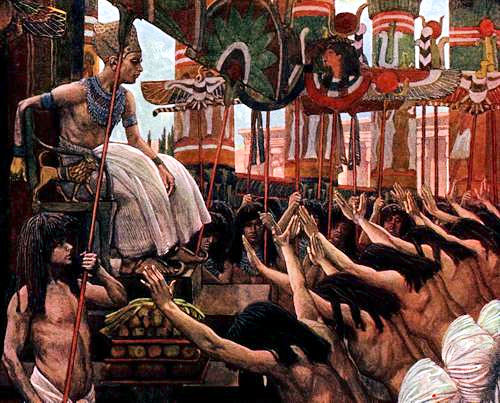
I can’t say if this truly speaks to Jacob’s desire, but what we see here is that a righteous person, when desiring prosperity, isn’t thinking of reward in the conventional sense. They are thinking probably what you and I have considered at one point or another. If we could be freed from the constraints of a “normal” life of work and problems, we could spend more time serving God and ministering to people, even devoting our great material possessions to the well being of those around us. I think that would work for a truly righteous person, such as Joseph, who used the exalted position given to him by Pharaoh, King of Egypt (and ultimately God), to save his family and the world. For the rest of us though, we would be enormously tempted to use our wealth and “free time” for less than noble pursuits.

My opinion is that the toil and hardship of day-to-day life, though it limits the amount of time and energy we have to pray, to perform mitzvot (acts of kindness and righteousness), and to honor God, also focuses those few hours we do have through a lens whereby we can see God and do His will more effectively, without the temptations material prosperity brings. I tend to think that the truly righteous can manage extreme poverty and extreme wealth with equal grace as Paul said he had learned to do (Philippians 4:12-13).

Please understand that I’m not making a simple statement that the very rich and the very poor are always righteous. We know that wealth and poverty visit the just and the unjust alike. We know that God grants us what He chooses to grant us and doesn’t owe us an explanation for how things work out in our lives. Our circumstances aren’t a particularly accurate barometer of our state of holiness and relationship with the Almighty. But it is one type of challenge we may face as part of His plan for our lives.

In addition to our material state of being, we can also experience spiritual prosperity or poverty. Since God’s gifts are endless in this arena, I have to believe that we have the majority of control in this area of our existence. This has nothing to do with dollar signs or a “feeling” of peace inside, and everything to do with a burning desire to draw closer to Him and to do His will. The pursuit of “spiritual reward” is also fraught with problems because we poor, dumb, human beings have a tendency to get our priorities and desires mixed up with His. I can’t count the number of times I’ve heard Christians report that they prayed about a certain decision they had to make and then “felt a peace” about the decision they wanted to make anyway. Was that drawing closer to God or using God as an excuse to fulfill their personal wants rather than God’s requirements?

When Christians say that Jesus freed them from the Leviticus 11 food laws, I sometimes want to ask them, if God came to them right now and really told them to give up their ham sandwiches, and they really, really knew it was from God, would they give up the pork, or find an excuse not to? I use this as an example and not to say that I think the Torah kosher laws necessarily apply to the Gentile, but it’s a good illustration. In keeping with my theme for the past week or so, I might ask Gentile Messianics if God told them to be forgiving and tolerant of Christians who put up Christmas trees instead of reviling them and “standing their ground” against paganism, would they be truly forgiving and tolerant, or would they argue with God that the Christmas tree people deserved to be condemned?

I have to say at this point, that I am somewhat heartened how some of the detractors of Christmas on Boaz Michael’s Facebook page seem to be softening their approach and being clear that they are not actually attacking Christians. I’m also thankful to Jacob Fronczak for posting the very well researched article The Syncretism Boogeyman on his blog, which provides excellent information on the history of cultic practices in ancient times, including during the time of Moses. I’m stepping off my soapbox now. Back to the topic at hand.
Wayward SonFrom my own personal experiences (humble though they may be), I’ve become convinced that when God actually speaks to me (rather than the voice of my own desires and ego in my head), He surprises me and frankly, asks me to say and do things that aren’t naturally easy for me. He asks me to take on duties I don’t feel comfortable with and requires that I surrender behaviors and even thoughts with which I am very at ease. That’s the nature of God, to push us forward, to urge us to move further on and in directions we would never consider on our own.

So be careful in the sorts of rewards you ask from God and in what role you seek to play in His service. He just may give you a type of reward and prosperity you don’t expect and require that you actually rise to the challenge. How many years was Joseph a slave and prisoner in Egypt before he became all but a king? How many years did Jacob live in grief and abject sorrow, though materially wealthy, before he was comforted by his son in Egypt?

Good Shabbos.

Invitation to a Point of Peace

From the time you begin to breathe, a war rages within.

From the time you attain citizenship of this world, you must struggle with your own frailties to stand upright, as a human being was meant to stand.

From the time you yearn to reach higher, you must engage the animal that comes dressed within this meat and bones, to carry it up with you. You must play its own game on its own turf, speak to it in its own language, meditate upon those matters that can inspire it, bear with it until you can bring it to the side of peace.

You must descend to a place of chaos and madness to redeem yourself from there.

And so this battle plays out not only in the spiritual arena of meditation and prayer, but also in the very human world of eating your meal, of raising a family, of worldly pursuits, infiltrating that world so as to conquer it, to rip away its veil and reveal the G-dly sparks it contains, as Jacob dressed in the clothes of Esau, wrestling with his angel on the cold, sodden earth of a night to which he does not belong.

Yet at all times and in every situation you retain access to a point of perfect oneness within, a place where there is no opposition to fight, no choices that could be made, no existence at all, nothing other than “the Creator of all things to whom I am bound as one.”

It is not the battle that defines you, nor the role in which you must invest yourself, nor the opponent with whom you fight. You are none of these. You are that point of peace within.

And so, even your battle is in peace.

—based on the Rebbe’s discourse on the verse “He has rescued my soul in peace,” 5739

-Rabbi Tzvi Freeman
“War and Peace”
Based on letters and talks of the Rebbe
Rabbi M. M. Schneerson
Chabad.org

The struggle with chaos and madness is very much how I see “the human condition” and particularly my own role in humanity, both in the world outside and the one inside of me. Over the past several days, I’ve engaged in a series of “battles” in this “meditation” venue with the various “religious wars” that spike during the month of December. It’s not pleasant to confront other people who have the same basic viewpoint on life and God as you do and to realize that you and they are still light years apart. It’s also dismaying to see people who claim to be speaking for God or at least of God, and to read words, not of encouragement, but of disdain and criticism disguised as “truth”.

But let me change the subject.

Some part of me likes science, particularly astronomy and physics. Alas, I don’t have a brain that likes math, and so a career in these fields was never an option for me, but I still like following news on these subjects. You probably have heard of the Large Hadron Collider (LHC) and particularly of its use in the recent search for the Higgs Boson particle (sometimes referred to as the “God” particle) which current science says must exist in order for anything to have mass. I found the following quote from the New Scientist article very interesting.

If our ideas about the Higgs boson turn out to be correct, then everything we see is a kind of window dressing based on an underlying fabric of reality in which we shouldn’t exist. The particles that make us up – which bind together to form protons, neutrons, nuclei and ultimately atoms – have mass. Without the Higgs, these particles would be massless, like photons.

Let’s take a closer look at part of that quote:

…then everything we see is a kind of window dressing based on an underlying fabric of reality in which we shouldn’t exist.

A reality in which we shouldn’t exist. Interesting. Now take a moment to notice your physical existence. Look in the mirror. Yep, you’re still there. Snap your fingers. Do a few jumping jacks. Still feel like you exist? Good. But if we discover that Higgs isn’t real, then we shouldn’t exist at all, at least if how we currently conceptualize the universe is in any way accurate.

Go back and revisit the quote from Rabbi Freeman and then re-read the New Scientist quote again. Existence, both physically and spiritually seems so complicated, confusing, and messy. There are all of these details we keep running up against that don’t quite fit together in our puzzle when we try to build what we think Creation looks and acts like. It’s like the Biosphere2 experiment in Arizona where people tried to create a completely self-contained biosphere, isolated from our actual environment, that would be totally self-sustaining. In essense, we tried to build a little Earth inside of a bubble that would work just like the big Earth that God created.

God holds the worldIt failed miserably. In fact, back in the early 1990s, Bioshpere2 was involved in a huge scandal where the project managers secretly bled out CO2 from inside the dome because the “natural processes” inside weren’t getting rid of the stuff (kind of like how climate scientists today describe the global warming process). We just don’t know enough about how Earth’s biosphere works to be able to recreate it in an enclosed environment. We just don’t know enough about long-term weather and climate patterns and systems to be able to accurately predict whether or not it will rain next week or next month or next year, let alone how to make effective and beneficial changes in Earth’s climate over the next several decades. We don’t know why things have mass and what really happened in the first few thousandths of a millisecond after the Big Bang when physics were really haywire.

I’m not saying we shouldn’t pursue the answers. God gave us a universe that runs by a system of rules and laws (which we don’t always understand) and I think that system is observable and understandable in the long haul, at least for the most part.

But…

What if we allow ourselves to turn all that stuff off just once and awhile. I think it’s why God sanctified the Seventh Day back in Genesis 2 and I think it’s why the Jewish people (and arguably the rest of the world) should observe the Shabbat. It’s a time when we can turn it all off, all the machines, all of the head-scratching puzzles, all of the mysteries and mazes, and just accept God’s invitation to join Him and to be at a point of peace.

The friendly looking guy offering his hand to you in the photo at the top of today’s “meditation” is a friend of mine who, in spite of the amazing challenges he and his wife face, continues to pursue God’s peace. His name is Joe Hendricks and both he and his wife Heidi are actively undergoing cancer treatment. God has given both of them the personalities and the spirits to be encouraging and to approach life with a zeal for living when people like you or I would want to just hide under our beds and curl up into a ball. Peace isn’t just emotional state.

I am not saying this because I am in need, for I have learned to be content whatever the circumstances. I know what it is to be in need, and I know what it is to have plenty. I have learned the secret of being content in any and every situation, whether well fed or hungry, whether living in plenty or in want. I can do all this through him who gives me strength. –Philippians 4:11-13

Peace is a way of life, like pursuing the Spirit, like pursuing God. We find what we look for and we are looking all our lives.

To our God and Father be glory for ever and ever. Amen. –Philippians 4:20

nightsky1

Out of Balance

In her book Kitchen Table Wisdom, Rachel Naomi Remen recalls the healing work she did with a Holocaust survivor, whose response to the enormity of the spiritual pain he lived with was to close off feelings toward people and to be “cautious with this heart.” Dr. Remen relates that he joined her on retreat after he was diagnosed with cancer. Initially he was belligerent to strangers, but through inner stillness exercises and introspection he had a transformational experience. One day, while meditating, he sensed a deep pinkish light emanating from his chest. He felt enclosed by a beautiful rose. Troubled by the experience, he took a walk on the beach and began a silent dialogue with G-d. He asked the Creator whether it is all right to love strangers. G-d’s answer jolted him: “You make strangers, I don’t.” In that instant, the Holocaust survivor’s feelings of interpersonal distance began to melt. Strangers were no longer strangers. It was all right to love a stranger.

-Rabbi Laibl Wolf
“Tif’eret: Growing a Wise Heart” (pp 154-156)
Practical Kabbalah: A Guide to Jewish Wisdom for Everyday Life

I’ve been feeling off balance lately. Most of it has to do with how I choose to react to what I see, hear, and read about in the world around me, both in real life, and via the Internet. I’m not encouraged by what I see, but if you’ve been reading my “meditations” for the past week or so, you already know that. I found I needed to write this “extra meditation” to try and re-establish a bit of balance and to reduce my desire to wad up the whole world of religion like a piece of tissue paper contaminated with dripping bile, and toss it in the nearest toilet.

For Christians, this is a time of year (ideally) when they re-attach to the true meaning of loving and giving, by expressing the will of God with their lives in the community around them. If God was willing to send His “only begotten son” to suffer and die for us so that we could be reconciled to the Father, then why shouldn’t a Christian “pass it on”, so to speak, and offer grace, kindness, and mercy to the next fellow, regardless of who they happen to be? After all, Jesus died for us while we were still enemies of God (Romans 5;10). Must we only show goodness to those people who look, act, and believe like we do? Why even “tax collectors” and “pagans” do that (Matthew 5:42-48). Nevertheless, the religious community, or some portions of it, confirm the belief in the secular world that we are all bigoted haters and want to force the whole world to be exactly like we are.

“The truth, the whole truth, and nothing but the truth, so help me, God.”

That’s part of the oath people used to take when swearing to tell the truth in court. They don’t make you say it anymore because someone was offended with God and we wouldn’t want to God to offend someone, would we (this is sarcasm)?

On the other hand, we shouldn’t go out of our way to be so dedicated to what we think of as “truth” that we automatically condemn, revile, disdain, and hate those people who apparently (perhaps by putting up a Christmas tree) don’t have “the truth”. After all, they must be evil and wrong and we have to stop them by telling them how lousy their cherished faith is, don’t we (that’s more sarcasm)?

OK, I’m still out of balance. Quickly, someone toss me one of those poles used by tightrope walkers, or better yet, another story from Rabbi Laibl’s book (pg 147):

Once upon a time a king had two close friends who rebelled against his kingdom. The king seemed to have no choice but to execute the law – the death penalty. But he could not bring himself to kill his friends. Instead, he erected a tightrope over the courtyard at a precarious height. Each prisoner was allowed to walk across the tightrope to freedom. The chances were slim, yet miraculously the first prisoner succeeded. The second prisoner called out to his friend for advice, and the freed man obliged. He called back, “Whenever I felt myself beginning to list to one side I didn’t wait until my weight was there but immediately compensated.

This Hassidic tale invokes many portions of the Bible, including how God sent His Son so that we might all have a chance to conquer the death penalty by “walking the straight and narrow”. Notice though, that in order to navigate the rope, you couldn’t be an extremist. If you went too far to the left or to the right, you would be killed. In fact, when you even thought you were starting to slip to one side, to survive, you had to immediately shift your weight in the opposite direction.

Also, notice that the freed man went out of his way to help his friend rather than taking his salvation and running away. Notice that even though the king (God) had every right to execute the rebels, because they were his friends and he had compassion, he tempered his justice with mercy. Justice was not thrown away, but he gave the rebels a chance, probably more of one than they deserved. Justice was balanced with mercy and grace.

We don’t do balance (or mercy and grace) very well in religion and yet, it’s all over our history. Moses Maimonidies (Rambam), as quoted in Rabbi Laibl’s book (pg 146) “counseled his disciples to take the middle path.” I know I talked on this exact same topic last week, but plenty of people still aren’t getting it (especially the majority who don’t read my blog, though they may not agree with me, even if they chose to read these “meditations”). It is one thing to say that you disagree with someone based on your convictions and your understanding of the Bible, but it’s another to condemn them and to believe God will destroy them. Some compare a Christian who celebrates Christmas to a husband to cheats on his wife (and there are plenty of marital metaphors in the Bible), but that metaphor breaks down at some point. A husband and wife are both human; both equals, while God is not human and we can not aspire to ever be His equal. A husband may come close to really understanding everything his wife is about, but we have absolutely no clue exactly what God is all about.

In the end, even if God chooses to condemn others and even if we were “right”, should we have treated those others negatively and with such extremist attitudes and even pride, or should we have balanced our approach to them as God did for us, tempering justice with mercy? Many religious people want to dump the justice onto others but covet the mercy all for themselves, not passing it along. Doing this, are we really God’s children?

Something New

When Reuben returned to the pit and saw that Joseph was not in the pit, he rent his clothes. Returning to his brothers, he said, “The boy is gone! Now, what am I to do?” Then they took Joseph’s tunic, slaughtered a kid, and dipped the tunic in the blood. They had the ornamented tunic taken to their father, and they said, “We found this. Please examine it; is it your son’s tunic or not?” He recognized it, and said, “My son’s tunic! A savage beast devoured him! Joseph was torn by a beast!” Jacob rent his clothes, put sackcloth on his loins, and observed mourning for his son many days. ALL his sons and daughters sought to comfort him; but he refused to be comforted, saying, “No, I will go down mourning to, my son in Sheol.” Thus his father bewailed him. The Midianites, meanwhile, sold him in Egypt to Potiphar, a courtier of Pharaoh and his chief steward.Genesis 37:29-36 (JPS Tanakh)

Beginnings are hard. For good reason. If they were easy, we would prowl into each new venture like a snug fat cat.

When you begin pent up in an iron cage, a tiger comes out. A tiger that breaks through the door of its cage and pounces with a vengeance.

Bless those cages, those impossible brick walls, those rivers of fire that lie at the outset of each worthwhile journey. Without them we would be only as powerful as we appear.

-Rabbi Tzvi Freeman
“Release”
Based on letters and talks of the Rebbe
Rabbi M. M. Schneerson
Chabad.org

As we see in the example from this week’s Torah Portion Vayeishev, making a new beginning, even in something that will ultimately turn out to be very worthwhile, can be very hard. Of course, when Joseph was stripped and thrown into a pit by his brothers, then kidnapped and sold into slavery, he hardly thought this was a good “new beginning”. In fact, it was the lowest point of his life up until then. He had no idea of the grandeur he would eventually attain as Viceroy in Egypt and savior of the civilized world.

I can hardly compare myself to Joseph, but I know what it’s like to make a new beginning. We all do, really. Anyone who has gotten married, who has had a child, who has moved to a new city, who has taken a new job knows what it is like to make a new beginning. Even when what you are achieving is ultimately good and desirable, it can still be difficult and stressful. Change always is.

I also know what it’s like to make a new beginning spiritually. I’ve done this more than once. Of course there was the moment when I came to faith in Jesus. I like to “joke” that almost immediately afterward, my life fell apart. I went through some very difficult times after coming to faith which is the exact opposite of what I’d expected, but then, God had to step in and help me make some significant changes once I declared my faith and was baptized. He’s still doing that work and sometimes, it really hurts.

During the past couple of years, I put myself through another significant spiritual change. For a year, starting in the summer of 2010, I started challenging all of my long-held religious assumptions, began studying new materials, and ultimately, at the end of that year, took my religious worship life in a very different direction. It wasn’t easy. I had to leave a congregation where I had been a trusted leader and teacher and where I had many friends (they’re still my friends) because of the new convictions at which I had arrived. I started a journey that still has no definitive destination and where I encounter uncertainty often. I believe this is the right thing to do for me, but doing the right thing is often disturbing and disconcerting.

Sometimes, even when you know that a new beginning is required, you don’t know what to do first. In fact, right after I had come to faith, the first question I asked my Pastor was, “What do I do now?”

Today’s daf discusses teaching Torah. Rav Moshe Shapira, shlit”a, explains that today’s world of kiruv is a new chapter that needs to be understood in its own context. For example, although the Shulchan Aruch writes that a rebbe must instill fear in his students—for this purpose he may not eat with them or be overly familiar with them—today is very different. When dealing with young people who need to be drawn closer, following such halachos will only cause an unhealthy distance between student and rebbe.

Another example of a complex kiruv issue was faced by a certain maggid who would travel around Eretz Yisrael encouraging our estranged brothers to draw closer to God. He wondered what to do with those who are distant but could be persuaded to take on some new religious practice. Most would only be willing to take on a single mitzvah, and pushing for more would only serve to destroy any willingness to advance. The question was: which mitzvah comes first?

When he brought this question to Rav Yosef Shalom Eliyashev, shlit”a, he replied concisely. “It doesn’t matter too much what they start with. But try to find a d’oraisa mitzvah that you think will make the greatest impact on them. Speak and encourage them to take on this mitzvah.”

The heads of Hidabrut, the famous Belzer kiruv organization in Eretz Yisrael, also had a kiruv conundrum. When a person is at the point where he will either take on wearing a kippah or tzitzis, which is more important?

Rav Eliyashev’s response will surprise many. “It is better to convince him to begin wearing a kippah. Although tzitzis is obviously a Torah commandment, wearing a yarmulke is superior since a man who wears a yarmulke feels especially Jewish since he publicly associates himself with religious Jews.”

Daf Yomi Digest
Stories Off the Daf
“New Students”
Bechoros 29

Truth be told, one of the reasons why some Christians are attracted to the “Messianic” movement is that worship and faith is demonstrated in so many physical ways. The wearing of a yarmulke and tzitzit is very compelling and even a little addictive. I tend to believe that non-Jews in the movement go through a set of developmental steps, not all of them beneficial, but all of them seem to be necessary. One of the first steps is to become enamored with all the “Jewish stuff”. Sometimes the “stuff” is so seductive, that the non-Jewish participants never get past the “physicality” of their worship and dig into the spiritual context and meaning. They also get “sucked into” the idea that their “stuff”, because much of it can be found in Bible commandments, is better than the “Christian stuff” (and Christians don’t have nearly as much symbolic physical paraphernalia so they don’t seem as “cool”). Fortunately most people get past this stage. Some sadly, don’t.

However, if you’re immature in your faith, often the very first step onto a path of maturity is a material object, such as giving a child their very first Bible or cross necklace. The object takes on a transitional value, if seen and used properly, to escort the newly spiritual person into a faith that doesn’t require material objects to validate their relationship with God.

For an observant Jew, a siddur, talit gadol, kippah, and tefillin all are a part of daily prayer and worship and only under unusual circumstances will a Jew pray without obeying the mitzvot attached to these holy artifacts. But for a Christian and especially for the Gentiles in the Messianic movement, sometimes it’s helpful to put all of the “stuff” away, go off someplace where you can be alone, and just let it be you and God.

Try something uncomfortable and new. See how it works out. When Joseph did it (although it wasn’t his idea), it turned out pretty well. But it wasn’t easy and it wasn’t quick.

Fragmentation Dilemma

At first all existed as a single whole in a single thought. Then it fell below, shattering into tiny fragments and fragments of fragments. Now Man picks up the pieces and says, “This seems to belong to this, and this relates to that,” until he reaches back to the whole as it was in primal thought.

It is not the cause and why of things that we find. Things are the way they are because that is how their Maker decided they should be. That is beyond the domain of intelligence. The beauty of intelligence is that it finds the harmony and elegance of the whole as it was originally conceived.

-Rabbi Tzvi Freeman
“Re-piecing”
Based on letters and talks of the Rebbe
Rabbi M. M. Schneerson
Chabad.org

I really thought I’d write just one blog post about Christmas and the anxiety it produces in the Christian, Jewish, and Messianic communities, and then I’d be done and move on. Wrong. The giant panic attack over “Christmasphobia” seems to be (you should pardon the expression) snowballing in the religious blogosphere and social media space, and I can’t leave it alone. There are so many “teachers” and “experts” who keep hammering on the points of “I’m right and you’re wrong” and “Christmas is evil!” that it makes me wonder if the community of faith is about serving God and other people or about establishing the “rightness” of various individuals and sub-groups in our little corner of the religious world.

I suppose I’m not immune since I still feel the need to blog about all this, and I hope I’m communicating, not the need to be “right”, but the message of tolerance and understanding. I know that there is an absolute God who has absolute standards in the Heavenly realm, but if you’ve been a human being and religious for more than just a few days, you should know that trying to distill an absolute right and wrong in every single matter of living existence is no easy task. In fact, it’s probably not even possible.

Look at what Rabbi Freeman might be saying. Here’s my picture.

It’s as if we all woke up one morning to find ourselves in a fog-enshrouded field. We aren’t quite sure who we are, who all these other people are around us, and what we’re doing here. We notice tons and tons of very small fragments of “something” lying all over the field and we realize that we can figure out who we are and learn to understand each other if we just start to pick up the pieces and put them back together again. This is an enormous effort and requires that everybody work together. As our pieces begin to take some sort of form, we start arguing over how the pieces are supposed to fit and what shape they’re supposed to build. Depending on the person or group of people doing the building, the pieces all fit together differently and take on many different shapes. There are pieces and shapes that are impossible to make, which defines “wrong”, but we are all surprised that there is more than one way to make a “right”.

Derek Leman recently wrote A Sermon on Belief and Intelligence which illustrates as much as anything how faith and human intelligence must go hand-in-hand. To quote from the blog post, “Unexamined faith is cowardness” and “intelligence alone can’t explain the mystery.” Since human faith and human intelligence are not the same universally across all people groups or across all individual human beings, we end up with a high degree of variability in how we use faith and intelligence to “understand” God and “understand” the Bible (and I’m not even including any other faith groups outside of Christianity, Judaism, and their variants). Given all that, it is the height of arrogance to say that any one tradition is the one right tradition (I know, I keep hammering on this point in blog after blog, but it’s important and almost nobody “gets it”).

Within you as an individual and within your particular religious group (and I suppose even secular humanism qualifies as a “religious group”), you settle on standards and principles and things you “know” are right and wrong, but try to realize that other groups have their standards and principles, too. Even when we depend upon the same Bible or, to return to my metaphor, we are working with the same pieces, we use our traditions to fit the pieces together differently and to create a shape that’s different from the shapes of other groups, even when we’re using almost exactly the same pieces (i.e. Bible).

I like one of Julie Wiener’s quotes from her In the Mix article on Christmas especially well and as far as I’m concerned, she has more credentials as a Jewish woman in an interfaith marriage to make such a commentary than most of the “pundits” in the religious blogosphere who are using their points to stick it to their brothers and sisters in faith.

A few years ago, the sight of my offspring engaging in tree trimming might have made me squeamish, but this year, while we don’t (and won’t) have our own tree, I’m on a bit of a crusade, so to speak, against Christmasphobia. By which I mean the attitude many Jews (even some intermarried ones) have that Christmas and all its trappings must be avoided at all costs lest we assimilate into nothingness — and that we must be offended when clueless but well intentioned Christians wish us a merry Christmas or offer us gifts wrapped in red and green.
Like intermarriage itself, the presence or absence of a Christmas tree in one’s home is often used as a shorthand pulse check of Jewish identity — and both are rather flawed, simplistic measurement devices.
The fact is that many interfaith families, and in-married families with Christian relatives, do live full Jewish lives yet also partake in Christmas celebrations.

Although Judaism obviously struggles with the “Christmas dilemma”, that struggle doesn’t come in the form of a vicious attack on those people who put together the pieces of their puzzle into the shape of a Christmas tree. We universally fail to work together as people to put the pieces together into their original, single, unified shape. As human beings, this seems to be an insurmountable goal. But while we work in our own groups to build our own shapes and see how the pieces fit together for us, let us also fail to criticize, attack, revile, and humiliate the other groups simply because they use their own tradition to put their pieces together differently than we do.

He has told you, O man, what is good; And what does the LORD require of you But to do justice, to love kindness, And to walk humbly with your God? –Micah 6:8 (NASB)

Only God can put together the pieces back into the original, perfect whole. The Messiah will come again to show us that pattern. For now, we are here and we have been given the job to do justice as we understand it, to love kindness as we have been shown it, and to walk with God along the path we see before us. How we do this will be different, depending on the path we walk. Why is that so hard to understand?

The New Testament is Not in Heaven

It is taught: On that day R. Eliezer brought forward every imaginable argument, but the Sages did not accept any of them. Finally he said to them: “If the Halakhah (religious law) is in accordance with me, let this carob tree prove it!” Sure enough the carob tree immediately uprooted itself and moved one hundred cubits, and some say 400 cubits, from its place. “No proof can be brought from a carob tree,” they retorted.

And again he said to them “If the Halakhah agrees with me, let the channel of water prove it!” Sure enough, the channel of water flowed backward. “No proof can be brought from a channel of water,” they rejoined.

Again he urged, “If the Halakhah agrees with me, let the walls of the house of study prove it!” Sure enough, the walls tilted as if to fall. But R. Joshua, rebuked the walls, saying, “When disciples of the wise are engaged in a halakhic dispute, what right have you to interfere?” Hence in deference to R. Joshua they did not fall and in deference to R. Eliezer they did not resume their upright position; they are still standing aslant.

Again R. Eliezer then said to the Sages, “If the Halakhah agrees with me, let it be proved from heaven.” Sure enough, a divine voice cried out, “Why do you dispute with R. Eliezer, with whom the Halakhah always agrees?” R. Joshua stood up and protested: “The Torah is not in heaven!” (Deut. 30:12). We pay no attention to a divine voice because long ago at Mount Sinai You wrote in your Torah at Mount Sinai, `After the majority must one incline’. (Ex. 23:2)”

R. Nathan met [the prophet] Elijah and asked him, “What did the Holy One do at that moment?” Elijah: “He laughed [with joy], saying, ‘My children have defeated Me, My children have defeated Me.'”

Baba Tetzia 59b as quoted at jhom.com

If you’re not an observant Jew or otherwise don’t have the benefit of a classic Jewish religious education, the comments I’ve just quoted may seem completely alien to you. If you are a Christian and understand the implications of what is being said, you are probably offended right now. Why would you be offended? Because this teaching from the Talmud justifies the Rabbinic authority to interpret Torah. “The Torah is not in Heaven” means that the Torah was revealed but not interpreted by the Prophets or even by God and His miracles, but by learned study, decision-making, and legal rulings.

Within this context, that seems to mean that man’s word trumps God’s authority. What a shocking thing to say, but it explains much about Judaism and why the Jewish understanding of God and the Bible is fundamentally different than Christianity.

Is this just some colossal conceit on the part of Judaism to dare override the word of God and to impose man’s wisdom and authority over the Creator? From a superficial point of view, I’m sure it seems that way. And yet, though Christianity, including many factions of the “Messianic” movement, believe they are following the pure and uninfluenced “Word of God” and the teachings of Jesus Christ by shunning Talmudic principals, in fact, the vast majority of what Christians consider God’s unalterable truth was established by the so-called “church Fathers” in the first three centuries of the Common Era. Unfortunately, this coincides with the rejection of Jewish leadership from the early church and the ghastly birth of supersessionist theology, with the non-Jewish believers commandeering all of God’s covenant promises to the Jewish people for the church alone.

If God spoke from heaven (Bat Kol) to the Christian church, explained to us that our treatment of the Jewish people has been terribly wrong during the past 2,000 years, and demanded that we make immediate reparations to His chosen people, would not the church respond with its own version of “the New Testament is not in Heaven?” Would we not say that, according to our own interpretation of the Bible and the rulings of our “judges and fathers” that how we Christians have persecuted and maligned the Jews throughout the history of the church has been correct? Would we attempt to “defeat” God in that manner? In fact, that’s exactly what Christianity has done.

In this instance, I’m not so much arguing for Rabbinic authority as against Christian hypocracy. We Christians say that the Jews have no right or authority to interpret God’s Torah as they do and yet the church does exactly the same thing. We just dress it up differently and pretend we’re obeying the Word of God rather than our own willful judgments. We quote scripture to back up our claims, all the while knowing that even the Adversary has done this to justify his causes (see Matthew 4:1-11).

An anonymous person on Judah Himango’s blog was deriding the celebration of Christmas by believers recently and said the following:

It’s not about what I think or you think as mush [sic] as it is about what YHWH’s word says and what Yeshua did. Yeshua is the Living Word, it is in His Way we want to follow…

The fallacy expressed here is that the commenter believes he or she doesn’t interpret the Bible but literally follows its instructions. I’ve already written my Christmas blog (OK, I wrote it twice), so I’m not going to debate that whole thing again, but I want to make the point that we all interpret the Bible and that (in my humble opinion) no one has the inside track and the complete lock on what the Bible does and doesn’t say to Judaism, Christianity, and mankind. We’re all dancing madly on the head of a pin trying not to fall off or get skewered. We read the Bible, we study, we pray, we go to classes, we search the Internet, we attempt to glean wisdom and understanding, but in the end, even within the church, we are hopelessly fragmented about the overarching message of the scriptures. We Christians don’t even realize that, when we incorporated the Jewish Tanakh into our Holy Book as the “Old Testament”, we accepted the placement of sentences, capitalization, punctuation, and for the most part, organization of chapters and verses, and all of that was not determined in the original scrolls but by Jewish Rabbinic tradition!

At some point, just because we don’t want to go insane or leave our faith in disgust and dispair, we make a decision based on tradition, what our family did, what our family didn’t do, or the passion we see in a particular branch of one religion or another, and we say to ourselves, “this is it!” We say, “this is what God wants me to do!” Of course, that’s what everyone tells themselves when they make a spiritual decision, regardless of what denomination of Christianity they settle into, or into what branch of Judaism they subscribe.

I remember reading somewhere that when the Third Temple (see the Book of Ezekiel) is built, God will build it Himself and then deliver it to the Temple Mount in Jerusalem from Heaven (not unlike Revelation 21:1-3)…all except the doors. I read somewhere that in ancient times, hanging the doors on a structure was a legal act and determined ownership of the place. Hanging the doors was usually the last act in construction and even if a person built an entire house by himself, if someone came in the night and hung the doors, that person owned the house, not the builder.

I can’t remember where I read all this but bear with me. This is important.

When God delivers the New Temple from Heaven (I know this is midrash and events may not actually happen this way, but let’s go with it for now), it will be complete, except the doors will be missing. Why will the doors be missing? Because God will require man to hang the doors. Man must take ownership of his relationship with God and his duties to God as expressed in the Temple. If humanity, with the Jewish people administering Temple worship “as in days of old and as in former years” (Malachi 3:4) don’t take ownership of their relationship with God, then we have no relationship with God. We’re just wind-up toy soldiers playing a part in some lifeless version of The Nutcracker Suite (which by the way, my wife and daughter saw again just the other night and adored); robots acting out the will of God but taking no “partnership” role in that will.

I’m not talking about rebelling against God or attempting to override His authority or sovereign will, but behaving as participating junior members of Creation with God. I’ve mentioned the principle of tikkun olam (repairing the world) many times before and in order to fulfill this mandate, we have to take an active role with God in this work. To do that, we must take a form of ownership over our role as agents of God and over our understanding of His Word to us. That means taking the risk of being wrong, but doing our best anyway, to understand the infinite and unique One God, and to proceed with faith and courage.

If we are honest with ourselves and God, we should have already admitted that we’ve gotten something wrong and misunderstood God’s intent in many areas of our lives. That shouldn’t stop us from doing our best to live as holy people, but it should stop us from judging others. It should also absolutely stop us from believing that our particular brand of religion has it right while everyone else has it wrong.

It is said that God has two attributes: the attribute of Justice and the attribute of Mercy. If God created the world with more Justice than Mercy, no one would survive since no one is righteous (Romans 3:10). If God created the world with more Mercy than Justice, then we would all literally get away with murder and there would be no Judge. If He created the world with absolutely equal parts, we would all have only one chance to “get it right” the first time and then no more. God’s solution was to create the world with just a tiny bit more Mercy than Justice and that’s the world we live in today (though we’ve managed to break it since Creation). There will be a final judgment in the end, but God also allows us to make foolish mistakes, as a patient father allows a small child to stumble while trying to walk. He doesn’t expect perfection and knows we are far from capable of achieving His perfect expectations, but He does desire that we struggle with the questions about our relationship with the Divine that are always on the verge of driving us mad.

But if He is so merciful to us, why do we dare judge our fellows so harshly against our own limited and miserly standards (and make no mistake, when we judge others by our interpretation of the Bible, we are almost always using our standards and not God’s)? Have we not heard that He will forgive our transgressions in the same manner as we have forgiven those who have transgressed against us (Matthew 6:12)? Do we not believe that if God were to judge us the way we judge others, we would all be lost forever? Have we not asked ourselves “when the Son of Man returns will he find faith (Luke 18:8)?”

And yet some of us choose to employ the celebration of Christmas by others as a iron rod to beat our fellow brothers and sisters in Christ into a bloody pulp. Even if God were to judge those who adhere to the celebration of the birth of the Savior as “wrong”, it is His right to do so, not ours. Even if God were to judge those Jews who adhere to the rulings of the Rabbnic sages as “wrong”, it is His right to do so, not ours. If God has truly ruled that the Torah (and the New Testament) is not in Heaven, but was given to man to administer, then what we loose here on Earth is also loosed in Heaven (Matthew 18:18). In this, we are doing our imperfect best to join with God in being good stewards of Creation by influencing, with God, both Heaven and Earth.

If you get nothing else from this morning’s meditation, please, please take a pair of tweezers, go to your bathroom mirror, and practice pulling that huge piece of lumber out of your eye, before attempting to perform major optical surgery to remove the virtually microscopic speck in your neighbor’s eye.