
 Christian fundamentalists, who belong in the center field of Biblical theology, find themselves grouped by the media in the same category as militant political extremists, fascists, snake handlers, and Islamic fundamentalists. It’s about time somebody called foul!
The term “fundamentalism,” as Bible-believing Christians use it, identifies a system of beliefs that are foundational, or fundamental, to the Christian faith. Coined at the turn of the twentieth century, in an era of emerging, aggressive theological error, the term still stands as a watershed between truth and apostasy.
-from the pamphlet
“Fundamentally Sound: Understanding Our Faith”
Regular Baptist Press: Building Lives by the Book
(Note: I just want to point out that when you do a Google image search on “Christian fundamentalism” or “Christian fundamentalists,” the results are never pretty).
A Challies Chronicles Interlude
I’ve been trying not to mention my Pastor and my church to any extent in my blog posts to avoid even the hint that I am being critical of either, but there’s no other way to write this “meditation.” Pastor brought to my attention that I might not quite understand the term “fundamentalism” and have even been using it in a pejorative manner. He also explained some differences relative to how Reformed theology is understood.
In an effort to be fair, and to cement this in my memory, I decided to construct a little summary of “what is Christian fundamentalism.” I won’t go into the history (though I took copious notes of Pastor’s discussion), however, after a series of annual conferences held by leading Christian thinkers from America and Canada starting in 1890 and extending to 1930, the “Fundamentals of the Faith” were established, recorded, and published. The first five were fully agreed upon and the sixth was debated and later added. Here’s the list as we have it today:
- The Inspiration and Authority of Scripture: God authored the entire Bible — every word of it and every part of it (2 Tim. 3:16). The Bible is God’s Truth (John 17:17). It is without error!
- The Deity of Jesus Christ: He is fully God as well as fully man. He has always existed as God, and He always will be God (John 1:1; 20:31; 1 Tim. 3:16).
- Christ’s Virgin Birth and Miracles: Jesus was born of the virgin Mary (Isa. 7:14; Matt. 1:18-25) and was sinless (Hebrews 4:15; 1 Peter 2:22). He performed miracles to authenticate His credentials as Israel’s Messiah (John 20:30, 31).
- Christ’s Blood Atonement for Sin: Jesus shed His blood as the payment for our sins. Without the shedding of His blood, there would be no remission of sin (Romans 3:24-26; Col. 1:13, 14; Heb. 9:14-28; Rev. 1:5).
- Christ’s Bodily Resurrection: Jesus arose bodily from the grave, triumphing over death and assuring believers of their future resurrection (Luke 24:1-12, 34-38; 1 Cor.15:1-20).
- Christ’s Personal Return: Jesus assured His disciples that He will come again (John 14:1-3). Angels announced His return (Acts 1:1), and the apostles taught that He will return (1 Thess. 4:13-17; Titus 2:13; 2 Peter 3:1-10; 1 John 3:2).
This describes the core beliefs of fundamentalist Christianity and as far as I can tell, these six points are generally accepted by most if not all Christians. In fact, if you dispute any one of these points, according to a fundamentalist point of view, you can’t really be called a Christian.
It’s funny how much the topic of apostasy has come up in the Christian, Hebrew Roots, and Messianic Jewish areas of the blogosphere lately.
I don’t doubt that many of you out there will have something to say about this list. I copied it word for word from the aforementioned pamphlet, so as far as it goes, I’m just transmitting information, not engaging in editorial commentary (that comes later).
 It all sounds so simple on the surface, but even accepting those six points, there’s still room for a huge amount of variability beneath the overall Christian “umbrella.” As I mentioned to my Pastor last Wednesday, everyone who claims Yeshua-faith as well as religious Jews who deny Yeshua (Jesus) was/is the Messiah all state that scripture supports their positions. Even when considering the rules of Biblical interpretation, there is always the filter of interpretive tradition each religious stream in Christianity and Judaism utilizes to color understanding and meaning. No one has pure, unbiased access to the Bible.
We are all on a journey attempting to discover truth, attempting to achieve ever higher fidelity to the original, that is, the truth of God, and yet we all fall short. This isn’t to say we should all give up, and it isn’t to say that we can’t come closer to truth as we continue our efforts, but achieving the mind of God is like traveling at the speed of light. To do so would require the expenditure of infinite energy and would result in us laboring under infinite mass.
In other words, no matter how hard we try, and what technologies we use, pushing an object in space faster and faster and faster will get us (marginally) closer and closer to the light speed limit, but we will not only fail to ever achieve it, we will probably fall significantly short of our target.
But that doesn’t mean we will ever stop trying, and in fact, NASA continues to look into developing warp drive.
People of faith continue to strive to break the bonds of our humanity in an effort to touch the Divine. The moral equivalent of developing “warp drive.”
My Pastor suggested that it might be helpful for me to listen to some sermons and to gain some actual experience and perspective on Christian thought and Christian leaders. We discussed John MacArthur, R.C. Sproul, Steven J. Cole, and Chuck Swindoll.
I didn’t tell Pastor this (but since he reads my blog posts, he’s about to find out), but I gave up listening to sermons on Christian radio well over a decade ago. Even as a “young Christian,” I found some of the sermons too elementary, some too confusing, and most too critical of Judaism and Israel to be of much help. Sooner or later, the speaker would say something that would make my blood boil, and my commute home from work would be shot as would my mood when I got home.
I listen to the 1960s “oldies” station now and am much happier on my drives.
I’m a guy sitting on a fence. I go to a Christian church, but I think like a “Messianic” (however you want to define the term). More to the point, I think and enjoy Biblical lessons that focus on understanding scripture from the Judaic thought process, linguistic, social, ethnic, and yes, Rabbinic context of the times when those scriptures were authored, and from the viewpoint of the intended Jewish (in most cases) audience.
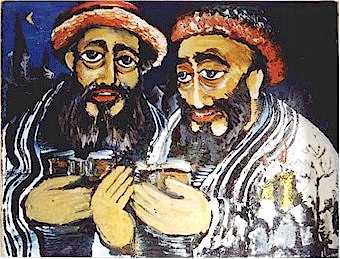 Knowing the original languages isn’t enough, because how we interpret what was actually being said has been stripped of most of its contextual meaning. From a Messianic viewpoint, you can’t read the teachings of Jesus without, in some cases, summoning up Hillel and Shammai, who taught a generation before Christ. They were Jewish teachers, Jesus was a Jewish teacher. In many ways, Jesus had a lot more in common with Hillel and Shammai than he has with MacArthur, Sproul, Cole, and Swindoll. I’m not trying to be mean or insulting. It’s a statement of fact. Jesus wouldn’t call himself a “Christian.” He wouldn’t say that the Law was “nailed to the cross.” He wouldn’t disdain the Shabbat, New Moons, or other Biblical festivals.
To understand Jesus, or Paul, or Peter, or James, it makes more sense to seek out sources closer to them, not only historically and linguistically, but culturally, ethnically, ethically, as well as in terms of what Jewish traditions and interpretative methods were in play in that place at that time.
I’m not sure how men like MacArthur or even the very user-friendly Chuck Swindoll would approach such a context. I don’t want to be unfair, but I do want to be realistic.
This all goes back to Boaz Michael’s book Tent of David and my recent review of who I am and what I mean within the cultural and theological context of Christianity as an institution.
So far, I see one of three outcomes of my “church experience:”
- I stay at church and “assimilate,” becoming a “regular Christian” and abandoning any mental, emotional, theological linkage with Messianic Judaism, Hebrew Roots, and any “Judaic” viewpoint on the Bible.
- I stay at church but maintain my current perspective, even expanding it though self-study and contact (real or virtual) with others who share my basic viewpoint, generally being a curiosity, a pain in the neck, or ideally, a refreshing conveyer of the Messianic perspective within the church environment.
- I give up on Christianity as an institution entirely, leave church, and pursue a life of faith as an independent “free-agent.”
As the end of my first year in church approaches (or has it arrived by now?), I feel like I’m crossing some sort of milestone or threshold. A year in church as resulted in me learning more about the history and institution of Christianity, but it hasn’t diminished the perspective I possessed when I went back to church a year ago. If anything, having to debate my perspective has driven me to do even more reading and studying, strengthening my belief in a Jewish Yeshua and the continuance of Jewish Torah observance for all Jews of faith, including Jews in the body of Messiah.
Every time I enter into such a brain bending set of debates and discussions, I have to get away for a while afterward and be alone with God. God may not be entirely knowable, but He isn’t confusing, either. He is a listener. He doesn’t have much to say most of the time when I pray, but it’s good to be able to tell Him how crazy religion makes me sometimes.
 I’m glad He’s there. I’m glad I can remember that regardless of all the religious preachers and pastors and rabbis and sages rolling around human history and the current theological landscape, there is an eternal God who is the point of everything everyone is trying to do. In the end, it doesn’t matter who wins the arguments. In the end, God reigns supreme. In the end, God will stop listening and start talking. Then, if we are wise even to the slightest degree, we will stop talking and listen.
It’s in moments like these that I continue to pursue God, moments when it is dark and quiet, and the only sound is the passage of my voice to the Heavens. God listens. Being with Him is very peaceful and comforting. The chaos of human religion seems miles away.
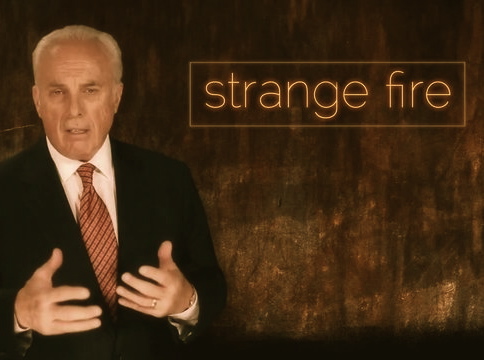
I’ll return to my review of the Strange Fire conference soon.
In the meantime, tomorrow’s latest review of an episode of First Fruits of Zion’s television series and Wednesday’s follow up on that content continues the discussion of who I am as a believer. I said above that I was sitting on a fence. Wednesday, you will see me hopping off and I will show you on which side of the fence I land.






 Morning Meditations