Tag Archives: Judaism

Arise

The burning bushNow Moses, tending the flock of his father-in-law Jethro, the priest of Midian, drove the flock into the wilderness, and came to Horeb, the mountain of God. An angel of the Lord appeared to him in a blazing fire out of a bush. He gazed, and there was a bush all aflame, yet the bush was not consumed. Moses said, “I must turn aside to look at this marvelous sight; why doesn’t the bush burn up?” When the Lord saw that he had turned aside to look, God called to him out of the bush: “Moses! Moses!” He answered, “Here I am.” And He said, “Do not come closer. Remove your sandals from your feet, for the place on which you stand is holy ground. I am,” He said, “the God of your father, the God of Abraham, the God of Isaac, and the God of Jacob.” And Moses hid his face, for he was afraid to look at God.Exodus 3:1-6 (JPS Tanakh)

A spark of G-d slumbers within, as a flame hushed within the embers.

Will she awaken from ideas? They are only more dreams to sleep by.

Will she awaken from deep thoughts? Their depth will not reach her.

She will awaken when she sees her Beloved, the Essence of All Things with which she is one.

And where will she see Him? Not in ideas, not in deep thoughts, but in a G-dly deed that she will do, in an act of infinite beauty.

Then her flame will burn bright.

-Rabbi Tzvi Freeman
“Waking Up G-d”
Chabad.org

Arise, shine, for your light has come, and the glory of the LORD rises upon you.Isaiah 60:1

In Christianity, faith is largely a matter of contemplation; the private and internal consideration of God and a person’s prayers in the name of Jesus. In Judaism, faith is not a matter of thought but of action. Yes, Judaism places a very high value on Torah study, but the study, in and of itself, isn’t meaningful unless put into action.

What was happening with Moses, the shepherd of his father-in-law’s flocks in Midian? Probably not much during those forty years. There’s no indication that he considered the plight of his parents, his brother, and sister, and the other Israelites in their Egyptian captivity. There is certainly nothing recorded in Exodus saying Moses was planning to do anything about the slavery of his people. Yet, as Rabbi Freemen tells us, there’s a fire sleeping inside.

In the case of Moses, the “fire” literally appeared before him and the voice of God called out, commanding Moses into action. What about the fire and voice inside of you…or me?

No matter how much you distrust your own sincerity or question your motives, there is no trace of doubt that at your core lives a G-dly soul, pure and sincere.

You provide the actions and the deed. She needs no more than a pinhole through which to break out and fill those deeds with Divine power.

-Rabbi Tzvi Freeman
“The Promise Inside”
Chabad.org

What good is it, my brothers and sisters, if someone claims to have faith but has no deeds? Can such faith save them? Suppose a brother or a sister is without clothes and daily food. If one of you says to them, “Go in peace; keep warm and well fed,” but does nothing about their physical needs, what good is it? In the same way, faith by itself, if it is not accompanied by action, is dead. –James 2:14-17

Both Rabbi Freeman and James, the brother of the Master, remind us that concealing our faith and devotion to God inside is not faith or devotion at all. The Master himself reminds us that hiding our faith from the world illuminates no one (Matthew 5:14-16), probably not even ourselves. Nothing about who we are as disciples of our Master and children of God matters unless we shine our light into the world and extend our faith into the realm of deeds and actions. We are known by our fruit, not by the root that no one can see.

Dawn“Light” can take many forms. We can donate to worthy causes, volunteer our time feeding the hungry, visit the sick in the hospital, sing inspirational songs, speak of the Bible to our children and our children’s children, even write blogs, articles, and books spreading the good news of the Christ and the glory of God. Light under a bowl does not pierce the darkness and salt that loses its flavor gets thrown away. Living a meaningful life means that you have to actively live in the world, letting the fire inside yield its heat and light to everyone around you.

By acknowledging that within your body is a G-dly soul, a soul that can give your life purpose and lift it above the mundane pursuits of everyday life, you begin to put the pieces of your fragmented life in order.

from Toward a Meaningful Life: The Wisdom of the Rebbe
by Simon Jacobson
based on the teachings of the Lubavitcher Rebbe, of righteous memory.

In a previous blog post, I quoted from a commentary on Menachos 89 which says:

Mishnah Berurah writes that according to Kabbalists the primary time for Torah study is from chatzos until the onset of the morning. Shulchan Aruch HaRav writes that at the very least one should arise before morning to learn for some period of time at the end of the night.

The intent of my “morning meditations” is to offer something for you and for me that we can contemplate and then put into action as we start our day. I sometimes write my meditations before going to bed and study them right when I wake up. In the summer, the light of dawn is only slowly changing the horizon from black to grey as my thoughts and my spirit take in the words of the Master, the prophets, the apostles, and the sages.

The Gemara cites the verse in Tehillim (134:1) that mentions those who stand in Hashem’s house at night and R’ Yochanan explains that the verse refers to Torah scholars who engage in Torah study at night and the verse considers it as if they were involved in service of the Beis HaMikdash. The Gemara then cites a verse from Divrei HaYamim (II 2:2-3) and R’ Yochanan explains that this verse also refers to Torah scholars who study the halachos of service of the Beis HaMikdash and the verse considers it as though the Beis HaMikdash was rebuilt in their days. Sefer HoEshkol cites Rav Hai Gaon who notes that the two teachings of R’ Yochanan are juxtaposed to one another to teach that Torah scholars are obligated to study Torah at night and specifically the topic of korbanos. The implication of this teaching is that one who engages in the study of korbanos at night is considered as though the Beis HaMikdash was rebuilt in his days and he offered korbanos there.

Daf Yomi Digest
Halacha Highlight
“Reading korbanos at night”
Menachos 110

By the time the sun is hot and bright in the morning sky, I pray that the fire of God is burning even brighter in your heart and in mine.

Wake up.
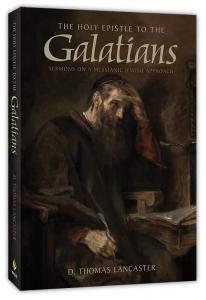
Book Review: The Holy Epistle to the Galatians

Galatians by D.T. LancasterThe passage contrasts two types of proselytes: the legal proselyte and the spiritual proselyte. The one becomes part of Abraham’s family by conventional conversion, the other through faith in Messiah, the promised seed of Abraham, in whom all nations find blessing. The passage does not contrast the Old Testament against the New Testament or the Old Covenant with the New Covenant. It does not equate Judaism and Torah with slavery, nor does it pit Christians against Jews.

It means that if you are a Jewish believer , you should be proud of being Jewish because you are a child of Abraham, legally, physically, and spiritually. It means that if you are a Gentile believer, you, too, are part of the people, a spiritual son of Abraham, and that is remarkable – miraculous even. You are a child of the promise that God made to Abraham so long ago.

-D. Thomas Lancaster
The Holy Epistle to the Galatians
“Sermon Twenty-Two: Sarah, Hagar, Isaac, and Ishmael (Galatians 4:21-31)”
pp 227-8

This is just a sample of how Lancaster’s view of Paul’s epistle to the Galatians presents a fresh and startlingly different understanding of the apostle’s message to the Gentile believers. This book takes Paul’s letter, virtually line-by-line, and re-interprets it from what most Christians would see as a radically different perspective. The book’s subtitle, “Sermons on a Messianic Jewish Approach” reveals the specific lens by which Lancaster views the letter and the stance from which he presents his argument: that Paul was supporting the unique covenant identity for the Jewish believer and at the same time, was instructing the non-Jewish disciples that they could have the same access to God, though the Messiah, without converting to Judaism.

But let me back up a minute.

Lancaster’s book is based on a series of 26 lectures or sermons he delivered in 2008 to Beth Immanuel, his community of faith, in Hudson, Wisconsin. It’s not unusual for Lancaster, a long-time contributor of books and other educational text to First Fruits of Zion (FFOZ), to “mine” his previous works for the sake of a new publication (for instance, Toby Janicki’s book Tefillin used some of Lancaster’s previous writing as a basis). Since each chapter represents one sermon in a series, I got an “episodic” feel as I moved from chapter to chapter, particularly in the first part of the book. I was also pleased that Lancaster’s ability to create the illusion that the reader is in the situation being described, was present in his current book. As I read through the chapters, I felt as if I were listening to Paul in one of the churches of Galatia, struggling with the issues he was trying to communicate, and experiencing the conflict between his teaching and the “influencers”.

As I mentioned before, this isn’t your typical Christian commentary on the Book of Galatians. Lancaster, using his knowledge of the Greek language, history, and accessing authoritative scholarly sources, “refactors” Paul’s letter into an almost completely different form, reflecting the Messianic Jewish viewpoint on Paul in general as well as FFOZ’s perspective in particular. There were a number of times when Lancaster would present the traditional Christian interpretation of a set of verses and then say something like, “this interpretation isn’t acceptable in Messianic Judaism”. I kind of wish he didn’t say it that way.

Sure, the focus of this book is to illustrate how Messianic Judaism views Paul’s letter in a dramatically different way, through its own “looking glass”, in order to understand his message in a way that makes more sense to both Jewish and non-Jewish disciples of the Jewish Messiah, but unfortunately, it could also be seen by a Christian reader as Lancaster just making the text say what he wants it to say to match his theology. The real value that I find in this book, (and many of FFOZ’s other materials) is in how it peels away almost twenty centuries of unchanging, set-in-stone, Christian theology and lets the reader see credible (and even very likely) alternatives to what Paul could have been saying. Questioning assumptions and courageously challenging dogma is not a property exclusively possessed by Messianic Judaism, Christianity, or any other religious movement. These qualities should be used by all people of honesty and faith when reading and studying our holy writings. These qualities should transcend denomination, movement, and sect, and be embraced by anyone who truly is a disciple of the Master and who seeks the truth of God and human existence.

The revelations Lancaster presents are too numerous to mention in this simple review (and I don’t want to give away too many “surprises”), but in reading this book, you will be introduced to a Paul and a Galatians letter that are completely new to you. This book offers a way of looking at Galatians, not as Paul’s anti-Jewish, anti-Torah rant, but as his answer to a complex dilemma facing the non-Jewish believers in the various churches in Galatia: does a “goy” have to convert to Judaism in order to be “saved”? The 21st century church would say emphatically “no” and in fact, would present the counter-argument that a Jewish believer would have to abandon Judaism and convert to Gentile Christianity in order to be a disciple of the Jewish Messiah. Conversely, Paul, at least as Lancaster understands him, would be appalled to hear that his letter had been so misappropriated by the modern church.

The book isn’t perfect. In general (and I agree with him), Lancaster uses various portions of Galatians to support his argument that Jewish believers (and non-Messianic Jews for that matter) were expected to obey the commands of God that He gave to the Children of Israel through Moses at Sinai, while at the same time, saying that the standard of non-Jewish “Torah” obedience to God was different…not non-existent, just different (see Galatians 5:13-26 for Paul’s interpretation of Gentile “Torah”). Unfortunately, there are any number of points in the book that, taken out of context, could be used to support the “One Law” argument (the position that states when a Gentile is “grafted in” to the Jewish root, they take on obligations to God absolutely identical to Jewish obligations). Other parts of the book make Lancaster’s position clearer, but I tended to stumble a few times when I encountered these ambiguous paragraphs.

Laying TefillinTo be fair, Lancaster is providing a detailed, in-depth analysis to a very difficult and wholly misunderstood piece of writing. Paul wasn’t easy to understand and trying to get into his head and into the culture and language in which he lived in the 1st century of the common era, let alone write an entire book about it, is a major undertaking. While I think the book succeeds overall, the reader is going to have to exercise a certain amount of patience and not jump to conclusions. Getting the entire message of Galatians means reading all of Lancaster’s book (I had to take copious notes) before coming to any sort of conclusion. Bringing an open mind as well as a notepad is also essential.

I don’t doubt that many of the people who read this book will either try to ignore it or start an argument about what it says. Lancaster completely disassembles the traditional Christian understanding of the letter and rebuilds it an atom at a time. That doesn’t make for comfortable reading if you’ve been taught for most of your life that the Torah is slavery for the Jews and grace is freedom for the Christians. For the One Law supporters in MJ, the book will also challenge many of their assumptions and at a few points, Lancaster even directly confronts the OL assumptions. Lancaster makes it clear in many of his comments that Paul never intended for the Gentile disciples to take on the entire “yoke of Torah” and that the “Torah” for the Gentiles was the “Torah of the Messiah”.

If you consider all that “the bad news”, I’ve also got “the good news”. The good news is that, if you set aside your preconceptions of what you think Galatians says, and by inference, many of the assumptions you have about what it means to be a Christian or to be “Messianic”, you’ll be able to read Lancaster’s book as an adventure in learning and an exploration of what it must have been like to be among the first Gentiles, having recently come out of pagan idolatry, entering a world and a relationship with God that had only previously been accessible to the Jewish people.

Who is Paul? Where did he get his “gospel”? Who did he see as his Master, Jesus or the Jerusalem Council? Who were the “influencers” who were disturbing the Gentile believers in Galatia? How did Paul see his fellow Jews and Jewish converts? What was Paul’s unique solution to the puzzle of integrating the people of the nations into the community of faith in the God of Israel?

The answers to those questions can be found in D. Thomas Lancaster’s new book, The Holy Epistle to the Galatians. Click the link to find out more. You may not believe it now, but there are answers in this book that you need to hear.

Besides the review you’ve just read, I’ve commented on different portions of Lancaster’s book in other recent blogs. They include Building Fellowship, Knowing, Intermediaries, and The Tefillin and the Shoemaker. These blog posts include mentions of Lancaster’s book within the context of other topics and resources, but taken together, I think this material provides a rich understanding of not only what the book says, but how it applies to a life of faith and to the wider contexts of Christianity and Judaism.

Enjoy.

The Tefillin and the Shoemaker

Praying with TefillinAnd they (Korach and his following) converged upon Moses and Aaron and said to them: “Enough! Every one of the congregation is holy, and G-d is amongst them. Why do you raise yourself above the congregation of G-d?”Numbers 16:3

There are those who maintain that they have no need of a mentor to guide them through life. They claim, as did Korach, that each and every individual can forge his relationship with G-d unaided. They argue that since the Jewish faith rejects the concept of an intermediary between man and G-d, they have no use for a rebbe or master.

They fail to understand that the entire Jewish people are a single entity, that every individual soul is, in truth, but a limb or organ of the soul of Israel. Just as each limb and organ of the human body has its function at which it excels, so, too, every soul has its role and mission, as well as its limitations. The ‘loftiest’ of souls is dependent upon the ‘lowliest’ for the attainment of the single, unified goal. And were any limb to strike out on its own, detaching itself from the ‘head’ which provides the entire body with vitality and direction – the results are self-understood.

Said Rabbi Yosef Yitzchok of Lubavitch: “When an individual adapts the attitude that he can do it all on his own, he reminds me of the story told about the peasant and the tefillin. Once, a Jew noticed a pair of tefillin in the house of a gentile peasant. Upon seeing a holy object in such a place he began to inquire about the tefillin, wishing to purchase them from the goy. The peasant, who had looted the tefillin in a recent pogrom, grew agitated and defensive. “What do you mean, where did I get them?” he blurted out. “Why, I made them myself! I myself am a shoemaker!”

-Rabbi Yanki Tauber
Once Upon a Chasid
“Jack of all Trades”
Chabad.org commentary on Torah Portion Korach

Paul explained that he received the gospel through a revelation of Yeshua the Messiah (Jesus Christ). He claimed that the gospel message he preached to the Galatians was not man’s gospel. It was not the normal gospel message. He received a different gospel. This is an important point – a critical point – for understanding Paul. The message of the gospel that Paul proclaimed was not precisely the same message of the gospel that the rest of the apostolic community proclaimed. In other places, Paul specifically refers to this unique gospel as “my gospel” (see Romans 2:15-16, Romans 16:25, and 2 Timothy 2:8-9).

-D. Thomas Lancaster
The Holy Epistle to the Galatians
“Sermon Three: Paul’s Gospel (Galatians 1:11-24)”
pp 35-6

But even if we, or an angel from heaven, should preach to you a gospel contrary to what we have preached to you, he is to be accursed!Galatians 1:8 (NASB)

Reading Rabbi Tauber’s commentary on the previous week’s Torah Portion Korach, I saw an inevitable collision with the above-quoted portion of Lancaster’s “Galatians” book. Although Korach and his co-conspirators claimed authority because all of Israel was holy to God, while Paul claimed authority based on his personal revelation from Jesus (see Acts 9:1-19 and Acts 26:15-18), they both set themselves (apparently) in opposition to the established authority representing God, Moses in the case of Korach, and the Jerusalem Council, in the case of Paul.

We know that Korach, Dathan, Abiram, and the 250 who were with them came to a bad end (Numbers 16:28-35) and their story is sometimes told in congregations as a cautionary tale not to go against the established leadership, but what about Paul? Does Paul’s receiving a personal revelation and mission from Jesus exempt him from respecting and obeying properly established authority? Lancaster says, “no”:

Despite the dismissive air, Paul submitted to their authority. He had already conceded that, if they had rejected his gospel of Gentile inclusion, he would have been running his race in vain. They had the power to utterly discredit the gospel message he had been presenting. Therefore, he certainly did respect their authority. But he seems less than reverently respectful in Galatians 2:5.

-D. Thomas Lancaster
The Holy Epistle to the Galatians
“Sermon Seven: Remember the Pour (Galatians 2:6-10)”
pg 71

While Paul could be opinionated and “outspoken”, he nevertheless realized that he was a man under not only the Master’s authority, but under the authorities established by God in Jerusalem, which included James, Peter, and John. But he had to approach these “pillars”, present his position based on the Master’s revelation to him, and hope they’d see things his way. Fortunately for Paul (and the Gentiles), they did. Otherwise Christianity, as we understand it, probably wouldn’t exist today. In that case, any person not born a Jew who wanted to enter into a full covenant relationship with God would have to convert to Judaism (for the sake of this blog, I will define Gentile Noahides -in contrast to Christians – as meriting a place in the world to come but not enjoying a full covenant relationship with God on par with the Jews).

The example of Paul presents a problem, though. His experience was entirely subjective. No one else saw or heard the details of his visions and so no one could verify independently, that he was telling the truth. In theory, he could have made the whole thing up in order to further some personal agenda he had in relation to Gentiles becoming “Messianic” disciples. If we accept the Biblical record on faith as well as reason, we accept that his visions were real and his authority was real.

But what about “authorities” today?

Most mainstream churches and synagogues are lead by a Pastor or Rabbi (respectively) who has received the education required to be ordained by their branch of faith and they have been appointed to a specific congregation upon the approval of that congregation’s board of directors. The board, and its various committees, have the authority to set the specific duties of the clergy, approve and renew their contractual relationship, and even fire the clergyperson if necessary. While the Pastor or Rabbi is the “face” and “voice” of the congregation in many ways, he or she can hardly act with total autonomy or impunity and are held accountable to the standards and authority of the congregation and their overseeing denomination or sect.

Sadly, not all religious groups and leaders operate on this principle. Paul’s “example” of receiving a personal revelation can be and has been terribly misused and misappropriated by many so-called “leaders” and “prophets” to set themselves up as the sole and individual authority over their congregations. If anyone complains about the “leader” and his or her lack of accountability to others, Paul’s example is cited and then the dissenters are accused of being like Korach and his band (implying that the dissenters will suffer a similar fate if they don’t withdraw their objections).

I know such a ploy may sound improbable and even silly to some of you reading this blog post, but the power of cult leaders over large groups of “believers” can be formidable to those who have made a commitment and who believe their “leader” is the “real meal deal”; the one and only person anointed by God to spread a special “message” to the “remnant” of the faithful.

I’m sure you are thinking about some of the infamous and extreme examples of what I’m describing, such as Jim Jones, David Koresh, and Marshall Applewhite, but there are probably thousands of other religious groups out there that operate below our radar, so to speak. Certainly a number of groups loosely affiliated with the Messianic Jewish (MJ) movement, function under the sole authority of the “Rabbi” in charge, acknowledging only his (in the vast majority of these cases, the leader is male) “right” to make decisions and pronouncements for the congregation, based on the leader’s self-described “anointing” from God.

(I want to make it clear at this point, that there are many MJ congregations that do operate on a board of directors model and that do receive authority from a central, overseeing organization which does provide a series of checks and balances for congregational leadership – I’m not painting “Messianic Judaism” as such with a single, broad brush – however, because “the movement” is largely unregulated, some people -usually not Jewish- just put on a kippah and a tallit, declare themselves a “Messianic Rabbi”, and proceed to gather a “flock”. Then they go about sharpening whatever theological ax they have to grind, which much of the time, has only a faint resemblance to anything Jewish).

Everything I’ve said up to this point certainly could make you doubtful or concerned if you find yourself in a “one-man show” type of congregation or even one where you might suspect (correctly or not) that the the congregation’s board is pretty much “rubber-stamping” the clergy’s decisions. On the other hand, we are taught to respect authority:

Rabbi Ishmael would say: Be yielding to a leader, affable to the black-haired, and receive every man with joy. -Pirkei Avot 3:12

It’s confusing. However, anyone, leader or otherwise, should recall this:

Rabbi Akavia the son of Mahalalel would say: Reflect upon three things and you will not come to the hands of transgression. Know from where you came, where you are going, and before whom you are destined to give a judgment and accounting. -Pirkei Avot 3:1

There is a Heavenly authority who holds us all accountable for what we say and do. Examples like Paul’s vision are extremely rare. They were extremely rare in Paul’s day and perhaps they may not even occur in the common era. Judaism has a long tradition of centralized authority but generally, that authority is not held by a single individual. The great sages often disagreed and it was through those debates and dialogues that justice and mercy was distilled throughout the centuries and applied to the devout in response to the unique needs of their communities and the time in which they lived.

Some respond to religious leadership concerns by refusing to affiliate with any faith group, but we all come under some sort of authority, including our employers, and local and national governments. Meeting with our congregations is how we prevent ourselves from entering into individual error (though I’m hardly one to talk at this point):

Rabbi Shimon would say: Three who eat at one table and do not speak words of Torah, it is as if they have eaten from the slaughter of the dead, as is stated, “Indeed, all tables are filled with vomit and filth, devoid of the Omnipresent.” But three who eat at one table and speak words of Torah, it is as if they have eaten at G-d’s table, as is stated, “And he said to me: `This is the table that is before G-d.’ ”

Rabbi Chanina the son of Chachina’i would say: One who stays awake at night, or travels alone on the road, and turns his heart to idleness, has forfeited his life. -Pirkei Avot 3:3-4

We are charged to test the validity of a leader as the Bereans tested the validity of Paul’s teachings (see Acts 17:10-12). We also know that valid and righteous leaders are established by God for the good of the world:

It was for this reason that actual peace in the world was brought about through Aharon, who descended to all creatures and elevated them to Torah.

-From the teachings of the Lubavitcher Rebbe, Rabbi Menachem M. Schneerson
Based on Likkutei Sichos, Vol. VIII, pp. 103-107

The LORD gives strength to his people; the LORD blesses his people with peace. –Psalm 29:11

Faith and history have established the relative authority of Korach and Paul and God’s justice and mercy was enacted in both lives in accordance with the actions of these men. Our lives are the same. We serve the same God. We all benefit from His providence. We are all accountable to His justice and we all rely on His mercy. We should not take the Name of God or His authority lightly. In the end, God prevails:

If you play for your own glory and not God’s you have no place here. -a Maggid

Rabbi Akivah would say: Beloved is man, for he was created in the image [of G-d]; it is a sign of even greater love that it has been made known to him that he was created in the image, as it is says, `”For in the image of G-d, He made man.” -Pirkei Avot 3:14

A man’s soul is the light of God. –Proverbs 20:27

Intermediaries

The Torah at SinaiAny belief that an intermediary between man and God could be used, whether necessary or even optional, has traditionally been considered heretical. Maimonides writes “God is the only one we may serve and praise….We may not act in this way toward anything beneath God, whether it be an angel, a star, or one of the elements…..There are no intermediaries between us and God. All our prayers should be directed towards God; nothing else should even be considered.”

-from Jewish Principles of Faith (Wikipedia)

It is a positive precept to pray every day to the blessed God for Scripture says, “and Him shall you serve” (D’varim 6:13); and through the Oral Tradition our Sages of blessed memory learned (Talmud Bavli, Ta’anith 2a) that this service means prayer. For Scripture states, “and to serve Him with all your heart” (D’varim 11:13): What is service with the heart? – prayer.

-from The Concise Book of Mitzvoth
Compiled by The Chafetz Chayim

I’m continuing to read D. Thomas Lancaster’s book The Holy Epistle to the Galatians and this part of his commentary about Galatians 3:17-20 struck me as interesting:

Paul said angels put the Torah in place by an intermediary, which is Moses. The martyr Stephen made a similar statement in Acts 7:33 where he spoke of “the law delivered by angels”.

As we see in the previous quotes, one of the principle beliefs in Judaism is that there is no intermediary between a Jew and His God (I recall hearing my Jewish host at a Passover seder declare this in a toast over twenty years ago). Yet clearly, Moses was an intermediary. For that matter, so was Aaron and every High Priest after him, who entered the most Holy Place once a year on Yom Kippur to offer atonement for the nation of Israel.

Christians like to say, at the death of Jesus, when the parokhet (veil) was ripped top to bottom, exposing the most Holy Place (Matthew 27:51; Mark 15:18), that we were given direct access to God through prayer and are now able to “boldly approach the Throne of God” without an intermediary. And yet, both Hebrews 5:1-10 and Hebrews 7 describe Jesus as our High Priest in the Heavenly Court, interceding on behalf of humanity. Paul even said that:

In the same way, the Spirit helps us in our weakness. We do not know what we ought to pray for, but the Spirit himself intercedes for us with groans that words cannot express. –Romans 8:26

I know Jews don’t pray to Moses or Aaron, but at least during the time of the Tabernacle and Temple, Jews did go through the priesthood to offer korban to God. And do all Christians pray to God or, believing in the Trinity, do some pray directly to Christ?

If God is One and key parts of theology say there is no intermediary between man and God, regardless if you are a Jew or a Christian, then how can we reconcile all of these intermediaries?

Drawing Near

Kohen GadolThe name of this week’s Torah reading, Korach, provokes an obvious question: It is written: “The name of the wicked shall rot,” and on this basis, our Sages state that a person should not be named after a wicked man. Why then is an entire Torah reading named Korach? For with this title, Korach’s identity is perpetuated forever, since the Torah is eternal.

Among the explanations given is that Korach’s desire was, in essence, positive. Korach wanted to be a High Priest, to experience the absolute closeness with G-d that results from entry into the Holy of Holies. Indeed, when Moshe responded to Korach, he did not tell him this objective was unworthy. On the contrary, as Rashi relates, Moshe said he shared the same desire; he also wanted to be a High Priest.

Moreover, at Mount Sinai, G-d told the Jewish people that they are “a kingdom of priests,” and our Rabbis interpret this to refer to the level attained by a High Priest.

Rabbi Eli Touger
In the Garden of Torah
“Korach’s Positive Import”
Chabad.org

A third gentile wanted to convert so he could become the High Priest, and wear the Priestly garments. Shammai said no, but Hillel accepted him. After studying, he realized that even David, the King of Israel, did not qualify as a cohen, not being a descendant of Aaron…Hillel’s welcoming personality complements his saying: “Love people and bring them close to Torah.” (Avoth 1).

from -Hillel, Shammai and the Three Converts
Saratogachabad.com
citing Shabbos 31

“My job is not to distance anyone, but to draw them closer. If a person needs to be rebuked, let someone else take care of that.”

-from a letter of the Rebbe
quoted by Rabbi Tzvi Freeman
“Bringing Closer”
Chabad.org

I write a lot about praying, about reading Talmud, Chasidic stories, the Bible; and I write a lot about living out the life that God gave us, not just praying, reading, and studying. But what’s the point? Why do we do this? Why do I do this?

Why did the convert in the story about Hillel want to be a High Priest?

The motives are all the same. We want to draw closer to God. Even Korach, the subject of this week’s Torah Portion is said to have had good motives, though a bad way of expressing them. We all want to draw closer to God.

But what does that mean? I’m not sure anyone really knows.

What would we do if we were really close to God? You probably think you know the answer. You probably think it would the the most wonderful, peaceful, loving experience of your entire life. But do you know what you’re really asking for?

When the people saw the thunder and lightning and heard the trumpet and saw the mountain in smoke, they trembled with fear. They stayed at a distance and said to Moses, “Speak to us yourself and we will listen. But do not have God speak to us or we will die.” Moses said to the people, “Do not be afraid. God has come to test you, so that the fear of God will be with you to keep you from sinning.” –Exodus 20:18-20

When I saw him, I fell at his feet as though dead. Then he placed his right hand on me and said: “Do not be afraid. I am the First and the Last. I am the Living One; I was dead, and now look, I am alive for ever and ever! And I hold the keys of death and Hades. –Revelation 1:17-18

Do not be afraid? Are you crazy? who wouldn’t be afraid?

Sure, Abraham spoke with God “face-to-face” and Moses talked with God at the top of Mt. Sinai for forty days and forty nights, but that was Abraham and Moses. The Bible doesn’t relate tales of every one who encounters God having a perfectly comfortable and casual conversation and in fact, in the two scriptures from which I just quoted, we see that the more typical response of a meeting with the Divine was to expect to die in the next second or two. Why do we want to get closer to God?

We think we want to get closer to God when we imagine God is some sort of “cosmic teddy bear” who is all comfy and cozy and we can sit on His lap like kids telling Santa Claus what we want for Christmas. But it doesn’t work that way as we’ve seen in abundant measure. So why do we want to grow closer to God, abandoning all common sense and reason, desiring to have such an intimate and terrifying experience?

In Jewish mysticism, it’s believed that we contain a spark of the Divine; something of God, within each of us. That spark is always striving to return to the source. It’s like trying to hold a beach ball underwater in a swimming pool; the more you try to drive it downward, the more it pushes back toward the surface. The more darkness we pour into our being, the more sorrow and sin we find in the world, the more the Holy fire within us seeks out the conflagration of God.

From this life and light proceeds the divine “spark” which is hidden in every soul. Not all men succeed in rising to this close union with God at prayer, because this spark is imprisoned in them. “Yea, even the Shechinah herself is imprisoned in us, for the spark is the Shechinah in our souls.

-Paul Philip Levertoff
Love and the Messianic Age

Ezekiel's VisionIn yesterday’s morning meditation, I said that meeting God requires our “time, effort, and an unquenchable need to learn“. It’s that unquenchable, insatiable, unstoppable drive; like a spark seeking the fire, that pushes us forward, over the edge of the abyss, sometimes without our conscious will, pressing us across the threshold from our familiar world into the Presence of the Throne of God. This is what drives mystics to leave the universe and seek higher Heavens in vision and in spirit. This is what we see in the Merkabah or the Ezekiel’s chariot event and this is what John experienced in the vision he recorded in Revelation. Daniel’s visions all but drove him insane.

Most of us won’t have such intense encounters with God, but we seek something of Him nonetheless. It’s why we pray. It’s way we read the Bible. It’s why we study Talmud and Kabbalah. It’s why, night after night, we seek Him in our dreams and day after day, we call to Him to be with us along our way.

You shall teach them diligently to your children and you shall speak of them, while you sit in your home, while you walk on the way, when you retire, and when you arise. –Deuteronomy 6:7

This small portion of the Shema is part of what Jesus taught as one of the two greatest commandments; the commandments that are the “containers” for all of the Torah and the Prophets. Perhaps this is a clue telling us how we draw closer to God.

We know that Korach’s intentions were good, but intentions are not nearly as meaningful as the actions we take. His actions ultimately cost the lives of over 14,000 people. And while the actions of the convert who approached Hillel with the desire to become High Priest didn’t result in tragedy, he still was given the opportunity to learn a hard lesson in what it means to draw nearer to God.

Interestingly, the letter from the Rebbe quoted by Rabbi Freeman seems to speak somewhat of Hillel who, unlike his contemporary Shammai, did not rebuke the foolishness of the three converts but rather, welcomed them and gave them the time and the room to discover their mistakes. We make our own mistakes in trying to draw nearer to God. A lot of the errors we make have to do with arrogant presumption and the idea that the life, death, and life of Jesus Christ turned God the Father from a horrible, vengeful creature into everybody’s favorite uncle. Fortunately, God, like Hillel, gives us time and room to discover our errors.

It’s in our sincere attempts to encounter God that we actually discover when we’re walking the wrong path. Like Moses who saw only God’s “back” but not His “face”, when we’re ready, we realize just how vast and overwhelming even a momentary glimpse of God’s awesome glory is when it breaks into our world. However, to meet with God, we must make our humble efforts to seek Him out, in the pages of the Bible, in the halls of study, in the realms of prayer…and then we must wait.

From a mystic perspective, it is explained that Korach’s desires reflected the spiritual heights to be reached in the Era of the Redemption…The rewards of that age cannot, however, be attained prematurely, but only as a result of our Divine service. It is only through our selfless devotion to the Torah of Moshe and the directives of “the extension of Moshe in every generation” the Torah leaders of our people that we can elevate ourselves and the world to the point that “the world will be filled with the knowledge of G-d.”

-Rabbi Touger

Good Shabbos.

Knowing

ReachingNo longer will they teach their neighbor, or say to one another, ‘Know the LORD,’
because they will all know me, from the least of them to the greatest,”
declares the LORD. “For I will forgive their wickedness and will remember their sins no more.” –Jeremiah 31:34

If you really know me, you will know my Father as well. From now on, you do know him and have seen him.” –John 14:7

Just as wisdom is not something you can touch with your hands,
so G-dliness is not something you can grasp with your mind.
The mind cannot experience G-d.
G-d is not an idea.
G-d is real.
G-d is better found in inspired deeds than in inspiring thoughts.

Rabbi Tzvi Freeman
“Mental Limits”
Chabad.org

How do we “know” God? A Christian might answer that we know the Father through the revelation of His Son, and Jesus said this about himself. Yet, there’s a danger in “anthropomorphizing” the infinite, ever-present, all-powerful, ultimately creative God of the Cosmos, and reducing Him to an old man with long white hair, a bushy beard, and a comfortable lap. It’s like taking God and turning Him into your kindly grandfather who used to give you little treats when you were a child and let you stay up past your bedtime.

This isn’t to say I dispute the words of the Master, I only understand them as illustrating both what we can know about God from Jesus when he walked among men, and what we can’t know. We can’t know the infinite, but we can know how our lives intersect with the Holy through the teachings and example of the Master. Our duty then, is to spend the rest of our lives living out that understanding with “inspired deeds”, as Rabbi Freeman says, as our understanding grows and as it sometimes twists, bends, and warps.

Excuse me, what did I just say?

Isn’t God eternal? Isn’t God’s truth unchangeable? Well, “yes” and “no”.

OK, in an absolute sense, yes, God is God and God is unchangeable. Nothing we can do can alter the nature, character, and qualities of the Creator of the Universe (not that we can perceive the vast, vast majority of those qualities). But while God may be unchanging, human beings change all the time. What we understand changes all the time. If not, if we couldn’t go beyond the Sun circling the Earth and the Moon being made of green cheese, then modern Astronomy would be a lost cause.

I know, it’s not a surprise to understand that as children grow and as people age, they learn new information to replace old data, but it’s also true (at least potentially) of humanity over time. Believe it or not, at one point in history, things like microwave ovens, DVDs, iPads, and the Internet didn’t exist. Even bound books haven’t been available forever (never mind eBooks on Kindle). Gutenberg didn’t invent the printing press until around 1440 and the vacuum tube, which was used in early 20th century technologies such as radios, the first generation commercial computers, and televisions, first saw the light of day in 1904.

Why am I telling you all this? Because what we understand about a concept or a technology may be one thing at a certain point in time but later on, we may amend or change what we believe to accommodate new information, discoveries, and inventions.

This is also true of the Bible and thus what we know about God.

I’m currently reading the book The Holy Epistle to the Galatians by D. Thomas Lancaster. This isn’t another typical Christian commentary on what most believers consider Paul’s “anti-Torah”, “anti-Judaism” rant. Rather, it’s a fresh perspective on how to understand Paul as a Jewish man, declared the “Apostle to the Gentiles” by Jesus in a vision, and who through that incredible and unprecedented role, had to make some hard decisions about how to bring non-Jewish God-fearers and former pagans into the community of faith. One principle decision was the controversial choice of not demanding Gentile believers convert to Judaism in order to become disciples of the Jewish Messiah.

Much of what Lancaster states in his book (and I haven’t finished reading it yet) won’t be universally accepted by the church and perhaps just a decade or two ago, such a book might not have been published. However, it’s important to understand there’s a difference between God’s eternal, unchangeable knowledge and how human beings acquire new data and adjust our understanding based on that information.

About a month ago, I reviewed a scholarly article called Isaiah’s Exalted Servant in the Great Isaiah Scroll written by Steven P. Lancaster (D. T. Lancaster’s brother) and James M. Monson. Based on new information acquired through a study of the Dead Sea Scrolls, how we understand the prophet Isaiah’s description of the Messiah has been significantly changed (and please feel free to read that review by clicking on the link I just provided…it’s fascinating stuff). The information Lancaster and Monson provide in their conclusions almost literally re-writes the “suffering servant” Messiah to “the appointed one”. Who could have known about this, even five years ago?

AnointingI’m not trying to undo the ties of Christian faith and the scriptures upon which that faith is based, but I would like to suggest that those ties can be untangled. We labor, without realizing it, under the yoke of centuries-old assumptions, bad translations, and misinformation founded on prejudice. Some of that misinformation, as recently presented by Derek Leman on his blog, is how the church declares rather boldly, that a Jewish person who has come to faith in the Jewish Messiah, must surrender their entire Jewish identity. Galatians, and other sections of the New Testament, seem to give this impression, but we can also be courageous enough to go back to our time-honored texts and read them with a fresh eye, consider them in the original Greek language and “refactor” them in the Jewish/Hebraic mindset of the people who wrote them. We can challenge what we think we know and see if our knowledge stands up to the test.

I’ll leave you with a tangible example of how knowledge changing over time affects not only our day-to-day life, but how we comprehend God, our duties to Him, and our obligations to each other:

The Chazon Ish, zt”l, explains, “Rashi records when he is unsure, to teach that admission of uncertainty is also Torah. One should always be clear of what he knows and what he does not know.”

Rav Yosef Yitzchak Lerner, shlita, contacted Rav Shlomo Zalman Auerbach, zt”l, regarding a correction the latter had added to the “Lev Avraham.” In this work, Professor Avraham Avraham, shlita, brought the opinion of Rav Avraham ben HaRambam, zt”l, and Rav Sherirah Gaon, zt”l, as conclusive. Both luminaries hold that Chazal’s teachings regarding medicine are not Torah; they merely reflect medicine as understood in their time. If contemporary science disagrees the halacha follows the medical experts. Rav Shlomo Zalman maintained that since other authorities disagree, this opinion should be prefixed with “some say.”

Daf Yomi Digest
Stories off the Daf
“Admitted Ignorance”
Menachos 105

Some of the rulings of the honored sages were based on the best medical knowledge available to them in their day, but as we see, modern medicine has rendered many of their judgments out-of-date. Being open to new information about the Bible and how to read it, can help us understand that some traditional Christian interpretations of the Bible need to be updated as well. I read and review articles like Isaiah’s Exalted Servant in the Great Isaiah Scroll and books such as Lancaster’s Galatians for exactly that reason. Knowledge and faith is a garden which yields only the fruits of our labors. Like prayer, meeting God and understanding more about Him requires our time, effort, and an unquenchable need to learn.

Rabbi Chalafta the son of Dosa of the village of Chanania would say: Ten who sit together and occupy themselves with Torah, the Divine Presence rests amongst them –Pirkei Avot 3:6

“Again, truly I tell you that if two of you on earth agree about anything they ask for, it will be done for them by my Father in heaven. For where two or three gather in my name, there am I with them.” –Matthew 18:19-20