Tag Archives: Judaism

Sermon Review of the Holy Epistle to the Hebrews: Single Sacrifice for Sin

Hebrews 10:10-18 presents the death of Yeshua of Nazareth as the “single sacrifice for sin,” but does that make Yeshua a sin offering like those once offered in the Temple? In what sense is Yeshua a sacrifice? How can he be a sacrifice when his death does not accord with the Levitical laws for the sacrificial services whatsoever? This teaching, based upon the final chapter of D. Thomas Lancaster’s booklet What about the Sacrifices? answers the difficult question of how the death of the Messiah provides atonement for sin.

-D. Thomas Lancaster
Sermon Thirty-Eight: Single Sacrifice for Sin
Originally presented on January 11, 2014
from the Holy Epistle to the Hebrews sermon series

By this will we have been sanctified through the offering of the body of Jesus Christ once for all.

Every priest stands daily ministering and offering time after time the same sacrifices, which can never take away sins; but He, having offered one sacrifice for sins for all time, sat down at the right hand of God, waiting from that time onward until His enemies be made a footstool for His feet. For by one offering He has perfected for all time those who are sanctified. And the Holy Spirit also testifies to us; for after saying,

“This is the covenant that I will make with them
After those days, says the Lord:
I will put My laws upon their heart,
And on their mind I will write them,”

He then says,

“And their sins and their lawless deeds
I will remember no more.”

Now where there is forgiveness of these things, there is no longer any offering for sin.

Hebrews 10:10-18 (NASB)

In today’s sermon, Lancaster continues to build on the points he made in previous weeks, including last week’s sermon in which he strongly differentiated between the nature, character, and purpose of the Temple sacrifices and the Levitical priesthood, and the purpose of Jesus as the single and final sacrifice for sin in the Heavenly Temple.

Now he specifically takes on a really big issue that even many Christians struggle with: just how does the sacrifice of Jesus on the cross take away sins and why doesn’t that mean God approves of human sacrifice?

LambThe “official” answer of the Church is that the sin and guilt sacrifices as well as the annual Yom Kippur sacrifices of the Temple took away the sins of the people of Israel, sacrifice by bloody sacrifice, year by year until Jesus was crucified, taking our sins away forever. Then the Temple system was rendered meaningless, having been replaced once and for all (Hebrews 9:27-28, 10:12) by the blood of Jesus, for as John the Baptist said (John 1:29), “Behold, the Lamb of God who takes away the sin of the world!”

But we have some problems with this theological theory. The Torah is very specific about what qualifies as a sacrifice according to God. Lancaster laid out a very convincing list:

Condition 1: An acceptable sacrifice must be an unblemished, undamaged, uninjured kosher animal, and usually a specific animal or set of animals relative to the particular sacrifice. Jesus wasn’t an animal of any kind, he was a man, and he certainly wasn’t unblemished or uninjured, having been whipped and bloodied before ever being nailed to the cross.

Condition 2: Any sacrifice must be made in the Temple, according to the Torah. Jesus was executed outside the walls of Jerusalem, not in the Temple.

Condition 3: The blood of the sacrifice must be splashed on the altar. This did not happen with the blood of Jesus.

Condition 4: The sacrifice must be performed by Levitical priests. Jesus was killed by people who weren’t even Jewish, the Romans.

Condition 5: The sacrifice must be slaughtered in a highly specific manner, with the throat cut by a very sharp knife. The animal must be bled out and suffer no pain whatsoever. If it suffers, it is disqualified as a sacrifice. Jesus certainly did suffer and suffer greatly, and no knife came anywhere near his throat.

Condition 6: God forbids human sacrifice and finds it repugnant.

All this means that Jesus absolutely, positively could not be a literal sacrifice for the atonement for sin and guilt.

Lancaster brought up the obvious objection of the Akedah or the Binding of Isaac (Genesis 22:1-19) but the flaw here is that God did not allow Abraham to actually kill Isaac. It was a test, not a human sacrifice.

This is the problem with Christianity reading from the Gospels and Epistles backward into the Torah, the Prophets, and the Writings. If you start with a New Testament mental and interpretive template, it forces standard Christian doctrine into the Old Testament text. Unfortunately, this results in erroneous conclusions based on Christian tradition.

So if the blood of goats and sheep never, ever took away sins in the first place, and Jesus can’t in any sense be considered an acceptable sacrifice, how does his death take away sin? Are the anti-missionaries and apostates right? Is Christianity a crock?

First of all, the writer of the Book of Hebrews says that the death of Jesus takes away sins once and for all in his single sacrifice:

By this will we have been sanctified through the offering of the body of Jesus Christ once for all.

Hebrews 10:10

After that single act, Jesus waited and still waits.

Every priest stands daily ministering and offering time after time the same sacrifices, which can never take away sins; but He, having offered one sacrifice for sins for all time, sat down at the right hand of God, waiting from that time onward until His enemies be made a footstool for His feet.

Hebrews 10:11-13

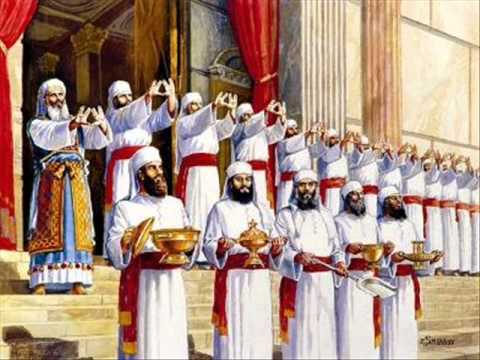
LevitesOn Earth, the Levites had to daily minister in the Temple, but the Temple sacrifices in Jerusalem were never designed to take away sins, but instead, to cleanse the bodies of those desiring to draw near to the Divine Presence physically (Hebrews 9:13). The sacrifice of Jesus was qualitatively different in that it enables people to draw near to God spiritually (Hebrews 9:14). But now that the single sacrifice of Jesus has been made, he need offer no other sacrifices in the Heavenly realm, but waits seated at the right hand of the Father for the final battle to begin, when his and Israel’s enemies will be laid at his feet.

Verses 14-18 cite the New Covenant, specifically how God will write His Torah on the hearts and minds of the people of Israel and he will cleanse them of sin forevermore. In fact, verse 12 says for all time,” which Lancaster interprets as from the beginning of human history and the sin of Adam and Havah (Eve) to the end. So the blood and death of Jesus cleanses you and me of our sins two-thousand years after he was slain, and cleanses Abraham of his sins two-thousand years before the crucifixion, even though Jesus was executed at a single point in time, the early First Century CE. I’ll get back to this in a bit.

But first, we have to solve the mystery of how Jesus can be an effective sacrifice to atone for sin for all time and yet not be a literal Temple sacrifice. I mean, when John the Baptist called Jesus “the Lamb of God” do you really think John believed Jesus was a four-footed animal who grew wool and went “baa”? Of course not. John wasn’t being literal, the was being “literary”

The hearers and readers of the teachings of the Bible, that is, the ancient Jewish people, received these teachings within a certain conceptual context. They understood the Hebraic metaphors, symbolism, and wordplay being employed by the Prophets and the Sages of each time period in which the Biblical text was authored. As Christians almost twenty centuries later, we can make the mistake of either allegorizing the Bible, rendering God’s promises to Israel as “really meaning” promises to “the Church,” or we can be overly literal and attempt to directly compare the sacrifice of a sheep on the altar in the Temple in Jerusalem on Passover with the execution of a late Second Temple itinerant Rabbi, and one who ultimately was proven to be Moshiach, by a bunch of Roman soldiers at the command of the local Roman governor.

So if Jesus wasn’t a literal sacrifice, and comparing him to a lamb and the spilling of his blood to the splashing of the blood of lambs on the altar is metaphor, how does his sacrifice work?

self sacrificeThe answer isn’t very obvious in the Bible, which tends to throw a lot of people, but it has to do with God’s quality of absolute justice and something called “measure for measure.” That is, the righteous are rewarded and the wicked are punished.

Period.

Problem is, we see very little of that kind of simple justice in the real world:

Righteous are You, O LORD, that I would plead my case with You; Indeed I would discuss matters of justice with You: Why has the way of the wicked prospered? Why are all those who deal in treachery at ease?

Jeremiah 12:1

Good question.

According to Lancaster, the Pharisees answered Jeremiah’s (and our) question this way:

  1. Death is not the end. If it were, then our world, and God, is unjust.
  2. Justice is delivered in the resurrection when the righteous and the wicked are judged before God, with the righteous being rewarded and the wicked being condemned.

The righteous may suffer in this world, and even suffer horribly, but they will be rewarded in the Messianic Kingdom and the life in the world to come.

…strengthening the souls of the disciples, encouraging them to continue in the faith, and saying, “Through many tribulations we must enter the kingdom of God.”

Acts 14:22

Of course, even the best among us isn’t completely sinless. Even Lancaster admitted to having committed acts of which he is still ashamed and probably will be for the rest of his life. It can be said that we suffer in this world, at least in part, as a consequence of our own imperfections and our own sins, and thus, when we die, it can be said that our death is just because we have sinned. Even Paul said “the wages of sin is death” (Romans 6:23).

But what if a totally and completely sinless person should die unjustly? If he’s not suffering and dying in his own sins, when why is he suffering and dying at all?

Another explanation of AND THOU SHALT MAKE THE BOARDS FOR THE TABERNACLE. Why does it say FOR THE TABERNACLE? Should it not rather have said ‘ into a tabernacle ?  R. Hoshaya said: Because the sanctuary stands as a pledge, so that if the enemies of Israel became deserving of destruction, it would be forfeit as a pledge. Moses said to God: Will not the time come when Israel shall have neither Tabernacle nor Temple? What will happen with them then? ‘ The divine reply was: ‘ I will then take one of their righteous men and retain him as a pledge on their behalf, in order that I may pardon all their sins. Thus too it says, And He hath slain all that were pleasant to the eye (Lam. II, 4).

-Exodus Rabbah 35:4

This Talmudic text points back to Isaiah 53 and the suffering servant, and specifically verse 11 which states:

As a result of the anguish of His soul,
He will see it and be satisfied;
By His knowledge the Righteous One,
My Servant, will justify the many,
As He will bear their iniquities. (emph. mine)
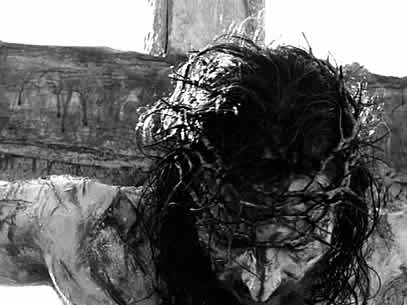
The Death of the MasterAlthough the traditional Jewish interpretation of these verses render the suffering servant as Israel, I have to agree with the Christian view in this case, and say that the Prophet is writing about Messiah, who as an individual person and who was completely without sin, suffered and died to justify the many.

The concept of the Suffering Tzaddik is known in Rabbinic literature and Lancaster even delivered a sermon on the topic. Although I haven’t listened to that sermon, I wrote a commentary of my own on the same subject several years back. Here’s part of one of the texts I quoted:

“… suffering and pain may be imposed on a tzaddik as an atonement for his entire generation. This tzaddik must then accept this suffering with love for the benefit of his generation, just as he accepts the suffering imposed upon him for his own sake. In doing so, he benefits his generation by atoning for it, and at the same time is himself elevated to a very great degree … In addition, there is a special, higher type of suffering that comes to a tzaddik who is even greater and more highly perfected than the ones discussed above. This suffering comes to provide the help necessary to bring about the chain of events leading to the ultimate perfection of mankind as a whole.”

Derech Hashem (The Way of God)
Rabbi Moshe Chaim Luzzatto
As translated and annotated by Aryeh Kaplan
Feldheim Publishers
Jerusalem, 1997, p. 122.
Quoted from Yashanet.com

To extend the thought, if a tzaddik or righteous one among the sages may die and atone for the sins of his generation, how much more so can death of the great tzaddik, the most righteous one, who was completely without sin, take away the sins of all peoples in all generations across the vast span of time.

Thus, the death of Jesus is effective to take away the sins of the world, but not because it was based on the sacrificial system that took place in the Temple as commanded by the Torah of Moses. It was effective based on God’s justice and the principle of “measure for measure.” If the completely sinless Jesus died an unjust death, to balance justice, since he did not die for his own sins, in the merit of his death, his blood atones for the sins, not just of many in a single generation, but of all people across all generations.

This also means that any comparison or “competition” between the sacrifice of Jesus and the sacrificial system of the Temple is like comparing apples and airplanes. The one has nothing to do with the other. The writer of the Epistle to the Hebrews was employing metaphor so he could get his point across, not saying Jesus was a literal lamb, or a literal sin offering. This is like saying Jesus is a Priest of the Order of Melchizedek. Jesus didn’t really establish and belong to this “order” of priests (and he certainly wasn’t literally Melchizedek). The Hebrews writer was using metaphorical language to say how Jesus could be High Priest in the Heavenly Court, even though he can’t and won’t qualify to be a Priest of any kind in the Earthly Temple (including the future Temple) in Jerusalem.

What Did I Learn?

The biggest thing for me was nailing down the “time span” within which the sacrifice of Jesus atoned for sins. Lancaster says that metaphysically, it covered all sins across human history, from Adam and Eve in the Garden, to the very end of the age including our age and beyond.

…“for I will forgive their iniquity, and their sin I will remember no more.”

Jeremiah 31:34

For I do not want you, brethren, to be uninformed of this mystery—so that you will not be wise in your own estimation—that a partial hardening has happened to Israel until the fullness of the Gentiles has come in; and so all Israel will be saved; just as it is written,

“The Deliverer will come from Zion,
He will remove ungodliness from Jacob.”

“This is My covenant with them,
When I take away their sins.”

Romans 11:25-27

King DavidThis seems to answer the question, “are the Old Testament Jews saved?” The answer is “yes” if they sincerely repented of their sins. Like David’s lament in Psalm 51, it wasn’t the sacrifices of bulls, goats, and sheep that atoned for his willful sin with Bathsheva, it was repentance and a broken heart.

Lancaster didn’t address this, but it brings up the question of a Jewish person and if he/she must believe in Jesus in order to be saved. A Christian would say “yes,” and further, a Christian (at least some of them) would say that only Jews who believed in Jesus after the crucifixion were saved, since no one comes to the Father except through the Son (John 14:6). However, if that is literally true, than all of the Jewish people who were born, lived, and died before Jesus (and the rest of humanity as well) were automatically condemned to eternal damnation.

But that violates the language of the New Covenant promises as well as Romans 11 and Hebrews 10. While I don’t understand it completely, the Jewish people, not just in the age when Jesus returns, but across time, will “mourn for him as one mourns for an only son” (Zechariah 12:10).

These conclusions won’t sit well with most Christians (and most Jews, since Lancaster will be accused of playing “fast and loose” with the Talmudic texts), especially the Bible literalists, but they have the benefit of making the older scriptures harmonize rather than drastically conflict with the Apostolic Scriptures. If we are to consider the Bible as a single, unified document describing God’s overarching redemptive plan for Israel, and through her, for the rest of the world, then we can’t have that plan jarringly switch tracks somewhere between the end of the Gospels and the beginning of Luke’s Acts of the Apostles.

If the Bible doesn’t appear to have a seemless flow that preserves God’s promises and integrity, and avoids making Him a liar by pulling the biggest “bait and switch” with Israel the world has ever seen, then the problem isn’t with the Bible, it’s with how the Bible is interpreted.

“And their sins and their lawless deeds
I will remember no more.”

Now where there is forgiveness of these things, there is no longer any offering for sin.

Hebrews 10:17-18

Restoration
Photo: First Fruits of Zion

The consequence of the New Covenant promises to Israel is just that. On the merit of the death of the great tzaddik Yeshua who is the mediator of that covenant, God remembers the sins of Israel no more and writes His Torah within them so they will never sin again (but see last week’s review for why sin offerings will continue, even in the absence of people sinning). From that time on, with all sins forgiven, there will no longer be any offering for sin, for there will be no need for Israel to make sin offerings. They have drawn near to their God in Spirit and in truth.

May it be so for all of us who believe and make teshuvah before Hashem by the merit of Moshiach.

Tonight begins the festival of Sukkot. Chag Sameach Sukkot.

Mission to Rescue the Jewish Scriptures: The Story of the Kidnapped New Testament

He who reads through translation looks through a blurred pane, not experiencing the full flavor and the soul’s yearnings.

Chaim Nachman Bialik, “Nation & Language Part 1”
from the Translator’s Preface, p.xxvi
written by Rabbi Kadish Goldberg in
Rabbi Moshe Avigdor Amiel’s English translation of
Jews, Judaism & Genesis: Living in His Image According to the Torah

Sabrina Allen, who was abducted in 2002 at age 4 by her mother in a custody battle, has been found in a secret rescue mission near Mexico City and returned to the United States, the private investigator involved in the search said Wednesday.

Sabrina, now 17, was rescued in an operation conducted by the Mexican Federal Authority, FBI and U.S. Marshals in Estafeta Tlaxcala, about 60 miles southeast of Mexico City, according to Philip Klein, with KIC Investigations.

Klein told USA TODAY that Sabrina and her alleged abductor, Dara Llorens, were flown back to the U.S. on Tuesday night, arriving in Houston.

-Doug Stanglin – 1:27 p.m. EDT October 1, 2014
“Texas girl, missing for 12 years, rescued in Mexico”
USA Today

I insist on using evidence that is verifiable in cultural and documented substantiation to elucidate the information provided somewhat cursorily in the apostolic writings which themselves reflect earlier Jewish writing that begins in the Tenakh and continues with the apocryphal writings — and they are consistent even with later Jewish literature and archeological evidence discovered in such finds as the Dead Sea Scrolls (representing a variety of ancient Jewish literatures).

To put it another way, the apostolic writings are Jewish literature, and we’re taking them back from the non-Jews who have oh-so-lovingly preserved them and distorted their meaning by wrenching them out of their native context and reading them as if they were written in an antiseptic cultural vacuum — or worse: as if they were written in a pagan cultural milieu.

-ProclaimLiberty
from a comment on my blog post
The High Holy Days for the Rest of Us

When I was catching up on the numerous comments on my various blog posts, reading PL’s words, I immediately thought of the news story I’d read just a few minutes earlier about the rescue of Sabrina Allen.

Sabrina was (allegedly) kidnapped by her non-custodial mother at the end of a six-month period of court-supervised visitation in 2002. For the past twelve years, Sabrina had been living with her mother in a town sixty miles southeast of Mexico City.

I have a background in Social Work and Child Protection, and given that, I was imagining what this child had been through and now, at age 17, what she is facing. Probably most people reading the news story about her rescue breathed a sigh of relief and thought that she’s going to be OK now that she’s being returned to Dad.

Sabrina Allen
Sabrina Allen (Photo: Center for Exploited and Missing Children)

Problem is, she hasn’t seen Dad in twelve years and her entire world is built around Mom and living with her in Mexico. There’s a good chance that Mom told Sabrina a whole bunch of bad things about Dad, so this teenage girl may not be at all happy to see him. I’m betting she runs away the first chance she gets since right now, she’s feeling like a foreigner in an alien land, surrounded by a bunch of strangers.

Now imagine this.

Thirty-five hundred years or so ago, God gathered His people Israel to Him at Mt. Sinai. Through the prophet Moses, He gave Israel the Torah, the Holy Word of God, and commanded them to obey His Word as their part of the covenant He made with them.

Then, for the next fifteen-hundred years, more or less, Israel made a concerted effort to do just that, with the results being a sort of spiritual and experiential roller coaster ride, with some generations being obedient and some generations rebelling, suffering, and going into exile.

Now we arrive at the late-Second Temple period. A man named Yeshua was born, lived, taught Torah wisely, some thought he was Messiah, was betrayed and executed by the Romans, was believed by many to have been resurrected, and then witnesses said he ascended into Heaven with the promise of returning “at the end of the age.”

Through his apostles, many more disciples were drawn to his teachings, and particularly through one late arriving apostle named Paul, many non-Jews were brought into discipleship while not having to undergo the proselyte rite and take up the same obligations that were the conditions of the Sinai Covenant, since only Jews belong to that covenant.

The Gentile disciples, as part of their introduction and integration into “the Way” were taught the Jewish scriptures and received the teachings of their Master as well as other teachers through various means, including letters.

It must have been a challenge for these non-Jewish peoples representing many languages and cultures, to fully grasp the complex and nuanced meaning of thousands of years of Jewish holy literature, since the Jewish people teach, live, and think much differently than the world around them. Nevertheless, if a Gentile really wanted to be a disciple of the Jewish Messiah King, he had to take every opportunity to learn from  his/her Jewish teachers and fellow disciples to grasp a completely different cultural and educational matrix in order to fulfill his/her role to Israel and to God as a “crowning jewel of the nations” in fulfillment of the New Covenant prophecies.

kidnappingBut then, much like the Mother and Father of Sabrina Allen, the “couple” violently split, and the “non-custodial parent,” that is, the Gentiles, “kidnapped” the “child” the Jewish scriptures, took them to an “alien” place and changed their appearance (Sabrina’s Mom escaped detection in part, because she dyed Sabrina’s hair, making her look differently), so that they no longer resembled Jewish holy literature at all, but rather, took on the “mask” of the newly invented Gentile religion “Christianity.”

I know that all sounds harsh and highly critical of the early history of the Church, but in the Second and Third Centuries CE, that’s how it would have looked, especially to the remaining Gentile disciples of the Master who, right before their very eyes, saw the Word of God, which they cherished and were zealous for, transformed so that it would provide a completely alien understanding of what God wants and the nature and purposes of Yeshua…uh, excuse me, “Jesus Christ”.

The “child” is illegally spirited away from the “custodial parent” and taken to a foreign land, vanishing from sight for the next twelve years, or more accurately put, the next nearly two-thousand years. To be fair, the “child” has been seen innumerable times by Jewish people since then, but her “appearance” was so drastically altered, that she not only was completely unrecognizable by the custodial parent (the Jewish people), but she looked like a terrible enemy and a horrible threat to Jewish survival. The “parent” rejects and even shuns the child and the non-custodial parent, tries to pass off someone who looks like an obvious impostor as the Father’s child for the purposes (often unwittingly) of inducing the Father to accept someone who couldn’t possibly be his Jewish offspring.

Then, in more recent times, the child’s disguise is penetrated and a rescue mission planned. But at this point, there is so much confusion about who is who, that even taking back what was once theirs, the Jewish people, redeeming the Jewish Apostolic Scriptures and bringing them back home, draw great ire, not only from the non-custodial (Gentile) parent, but from most other Jews as well. How dare these few “Messianic Jews” bring a dangerous impostor into the fold and call her one of their own? It’s ridiculous. It’s heresy. What Jew could possibly love a Bible that has been used for centuries to justify murdering and maiming Jews, and incinerating Torah scrolls, volumes of Talmud, and synagogues.

But there’s a “father” out there who has finally, after so very long, recognized his only “daughter” underneath the cheap makeup that tried to turn a Jewish “child” into a “Goyishe” traitor. He loves her. He know she belongs with her “sisters” (the rest of the Jewish scriptures) and in a Jewish “home”. But even in successfully pulling her back from exile, the “father” is so alone, for most other Jews will not accept him as long as he claims these foreign books as his lost child.

The non-custodial parent (the Gentile Christians) for her/their part, demand that if the Jewish father really accepts the “alien” as his own, he should not attempt to change her back to her original (Jewish) form, but instead, the father must change to become, like his once kidnapped daughter, an “alien.”

No dice.

So not only is the “father” isolated from other Jews, he is cast out by the Gentiles as well. He is in-between and nowhere. All he wants to do is go home and take his rescued “daughter” with him.

sefer torahBut all “children” come from God, as did the Torah, the Prophets, and the Writings (which were distorted by the non-custodial parent along with the youngest “daughter,” the Apostolic Scriptures), and so too the kidnapped child who has now been brought back. God will find a way for everyone to see who this “little girl” really is and to bring her back into the “family” (the Bible) so that all of the “children” are unified with each other and look like one.

I know I’ve confused the imagery and the comparisons are less then perfect. It’s probably been difficult to follow this metaphorical essay and keep everything straight, but this is how I see the Apostolic Scriptures and how they are being reclaimed by Jews in Messiah (as opposed to Hebrew Christians). It’s not that Christians must convince Jews to accept the New Testament which looks and speaks with a foreign accent, it is we Gentile Christians who must get it through our heads that we have misappropriated Jewish holy books, changing their “face” in the process, so that they no longer look Jewish or speak to Jewish people. We have to give them back, not that they don’t mean something to us, for they mean everything to us, but we must let them be Jewish, to speak with a Jewish voice, to have the face of the Jewish authors and readers and students, just as in days of old.

Only then will they speak the truth to both Jewish and Gentile ears and only then will we see the face of the Jewish King in her pages.

Addendum: In case you’re interested, here’s an updated news story about how Sabrina is doing so far.

Does God Forgive Jewish Sins on Yom Kippur?

The Torah establishes no explicit association between Rosh Hashanah and Yom Kippur. The former is briefly described as “a day of blowing the horn” (Num. 29:1), while Yom Kippur is more elaborately defined as “a day of atonement, to make atonement for you before the Lord…and ye shall afflict your souls” (Lev. 23:28; 32).

-Max Arzt
“The Fundamental Concepts in the Yom Kippur Liturgy: An Introduction,” p.191
Justice and Mercy: Commentary on the Liturgy of the New Year and the Day of Atonement

Note: I wrote this blog post a number of days before listening to and reviewing yesterday’s Holy Epistle to the Hebrews sermon by D. Thomas Lancaster, which also addresses issues related to Yom Kippur and atonement.

I know I’ve asked a strange question in the title of this blog post from a Christian’s point of view. The Church teaches that sins are not forgiven unless we confess Jesus Christ as Lord and Savior over our lives and convert to Christianity. It doesn’t matter if you’re Jewish or any other sort of person. There is one standard of righteousness and one path to salvation, and that is through Jesus.

Jesus said to him, “I am the way, and the truth, and the life; no one comes to the Father but through Me.”

-John 14:6 (NASB)

Of course the Master also taught:

“No one can come to Me unless the Father who sent Me draws him; and I will raise him up on the last day.”

John 6:44

Effectively, this is saying that to come to faith in Messiah is impossible unless God draws that person to such faith, so the ultimate onus is upon God for our salvation, or so it would seem. I think a Calvinist would see it that way, interpreting the verse further to mean that God only draws certain people to Jesus and not others. However, it could also mean that God extends a universal invitation to such faith but that invitation does not automatically override human free will, thus some accept while others reject.

But that doesn’t answer the question I asked in the title of this blog post.

Who, O God, is like You. Who pardons iniquity and overlooks transgression for the remnant of His heritage? Who has not retained His wrath eternally, for He desires kindness! He will again be merciful to us; He will suppress our iniquities. And cast into the depths of the sea all their sins. Grant truth to Jacob, kindness to Abraham, as You swore to our forefathers from ancient times.

Micah 7:18-20 (Stone Edition Chumash)
from the Haftarah Portion of Torah Reading Haazinu
when Haazinu falls between Rosh Hashanah and Yom Kippur

This week’s Shabbat, coming as it does between Rosh Hashanah and Yom Kippur, bears the name Shabbat Shuvah, “the Sabbath of Returning.” The name derives from the opening words of the haftarah, “Return, O Israel, to the Lord your God…Say unto Him: give all guilt and accept what is good…Never again will we call our handiwork our god.” (Hosea 14:3-4) The passages from the prophets Hosea, Joel, and Micah, which are joined to make up our haftarah, breathe a worldview far less deterministic than the one that animates Ha’azinu. Without the possibility of righting our wrongs, who needs prophets? Their very mission is predicated on the promise of a second chance, if merited…

…By rejecting fatalism of any sort, Judaism gives us a measure of control over our lives. As we reach for self-improvement and not perfection during the High Holy Days, we find ourselves buoyed both by the prayers that envelop us and by the community that surrounds us. Our struggle ended, we leave the synagogue at peace, cleansed and transformed to start living afresh.

-Ismar Schorsch
“Teshuvah Makes Life Bearable,” pp.632-3
Commentary on Torah Portion Haazinu
Canon Without Closure: Torah Commentaries

yom kippurFar from what most Christians think about Yom Kippur, it is not a time of great tragedy among Jewish synagogues world-wide, but rather, a time of hope, when people can take hold of their responsibility to repent in the presence of God, and feel assured that they don’t have to be perfect in order for their sins to be atoned for, but rather dedicated to increased spiritual development, to owning up to their commitment to be better in the future than they have been in the past.

But does God honor that commitment year by year on Yom Kippur? Even if we believe that ultimate atonement and redemption is an effect of the New Covenant, since my understanding of the Sinai Covenant is that it was not designed to permanently redeem from sin, by faith in the accomplished work of the New Covenant mediator, Messiah, what about in the meantime? I firmly believe we continue to live in Old (Sinai) Covenant times, since the New Covenant only enters our world in full upon Messiah’s return and at the resurrection. Thus even though we are taught we must behave as if the New Covenant is completely present, even though it isn’t, then the Old Covenant for the Jewish people, even as many of us long for the New Covenant to be completed, remains fully applicable upon them, for if the New Covenant is not yet totally present, then the Old Covenant, by definition, must remain.

All that being true, and I believe it is, then it is not a vain thing for Jews, Messianic and otherwise, all over the world, to continue to uphold their covenant responsibilities to God under the Sinai Covenant.

For if it [the Torah] is not an empty thing. And if it is, the emptiness lies in you, because you have simply not exerted yourselves in the study of Torah.

-Yerushalmi Peah 1:1

To be counted as a Jew, one ought to have a link of some sort with the canon on which our covenant with God rests. it is a relationship, a measure of engagement that expresses membership. As long as the Torah draws us to explore its sacred contents, the possibility of God entering our lives still exists. A closed book signals the end of the relationship. That is why the Torah is chanted publicly in the synagogue each week, and when at Simhat Torah we have finished the final parasha, we hurry right back to the beginning without a break.

-Ismar Schorsch
“Survival Through Study,” p.635
Commentary on Torah Portion Haazinu
Canon Without Closure: Torah Commentaries

You might say to yourself that without the Temple, the Priesthood, the Sanhedrin, and the other institutions that makes Torah observance possible, including the commandments surrounding Rosh Hashanah and Yom Kippur, that there can be no atonement of sins for anyone, including the Jewish people, without faith in Christ. That would mean, for the past two-thousand years, all Jews who have not set aside their Jewish heritage and the Sinai Covenant along with it, and converted to Christianity (either voluntarily or by force), have died in their sins and are destined to burn for all eternity in Hell, regardless of their utter devotion to the God of their Fathers and their faithful attendance to the mitzvot as commanded by the Torah of Moses.

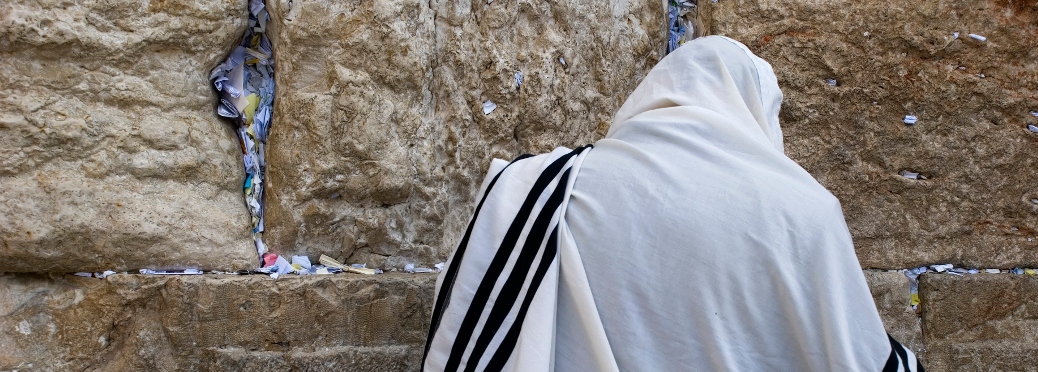
tallit-prayerYou see, from the point of view of these Jews, they don’t believe that God abrogated the promises of the past as found in the Torah and the Prophets, and replaced them with a Goyishe King who is to be worshiped and which for all the world feels like pagan idolatry and quite possibly polytheism.

Not that we Christians see it that way, but for the vast, vast majority of Church history, that’s exactly how we’ve been “selling” Christianity to the world, including and especially the Jewish world.

But without the Temple, how can Jews atone for sin? We forget that this isn’t the first time in Jewish history that there has been no Temple. Did God forsake the Jewish people and not forgive sin when they entered the Babylonian exile? Did the Prophets and the righteous among their generations, remain in their sins and die in iniquity? What of Daniel, Ezra, Nehemiah, and the others among the righteous of Israel? Did the lack of a Temple and the absence of a Messiah result in their damnation?

If not, then why do we automatically throw all of the Jewish people who have lived and died as faithful to Hashem, the God of their Fathers, under the proverbial bus now?

Oh, because in the meantime, Jesus was born, lived, died, was resurrected, and ascended. Something new indeed has been added. But maybe not to the result you’ve been taught to believe.

With the destruction of the Second Temple, its awesome Yom Kippur ritual became a liturgical memory preserved by the synagogue. The theme of owning up to our misdeeds remained central to the tenor of the day as shaped by the synagogue, but it now fell upon Jews to confess their sins themselves. The synagogue eliminated the priestly intermediary.

-Ismar Schorsch
“Assuming Responsibility for Our Actions,” p.670
Commentary on Yom Kippur
Canon Without Closure: Torah Commentaries

How heartbroken God must be when He encounters this realization among His people Israel, and that, for a time, the majority of the Jewish people will miss the message provided by the writer of the Holy Epistle to the Hebrews that even if they are (temporarily) without a Temple in Jerusalem and thus without an Aaronic priesthood, they still have access to the Heavenly Temple and a higher intermediary in Moshiach. But the day will come indeed when God will fulfill His promises and all Israel will be saved (Jeremiah 31:34; Romans 11:26-27).

What is striking about the confessions of Yom Kippur is that they are all formulated in the plural. By reciting them in unison as a faith community, we are spared individual humiliation. Yet for each of us, the words are highly personalized. In our private space, we confess to God alone. And what of the sins we did not commit? We assume a share of guilt, “for all Jews are responsible for each other.”

-Ismar Schorsch
“Assuming Responsibility for Our Actions,” p.671
Commentary on Yom Kippur
Canon Without Closure: Torah Commentaries

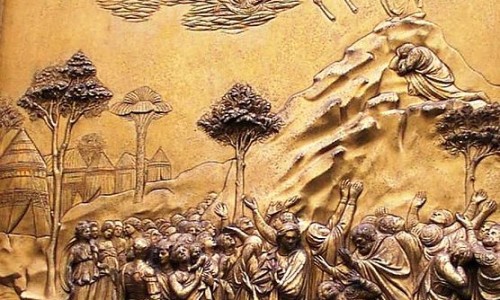
The Torah at SinaiAt Sinai, all of Israel answered God as one man (Exodus 19:8) that they would do everything God commanded in His Torah as their responsibility for upholding their covenant relationship with God. God (or Moses) didn’t approach each individual present at the foot of the mountain and ask for their personal acceptance or rejection of the covenant. God has always treated Israel as one, both in the blessings and the curses, regardless of the relative merits of each individual.

Thus if Israel, as a whole, the good and the bad among them, were all exiled, so will they all be redeemed, restored, and gathered back to their Land and their relationship to the Almighty.

How this will happen, I don’t know. I only know that if God doesn’t do it, then He violates His New Covenant promises to Israel that all of their sins will be forgiven.

But then there’s this:

Here, the efficacy of Yom Kippur is limited. Without seeking forgiveness from those we have hurt and without public confession, Yom Kippur offers us little relief or comfort. The ritual of fasting and praying on its own is not sufficient to remove the stain.

-Ismar Schorsch
“Assuming Responsibility for Our Actions,” p.672
Commentary on Yom Kippur
Canon Without Closure: Torah Commentaries

Here we see there are individual variables involved, and that man’s free will does play a part in God’s redemption of Israel. Specific Jewish people are indeed responsible. In this rendition, they are responsible to appeal both to God and to their fellow human beings who they have injured, perhaps, at least from my point of view, in response to the Master’s understanding of the essential essence of Torah:

“Teacher, which is the great commandment in the Law?” And He said to him, “‘You shall love the Lord your God with all your heart, and with all your soul, and with all your mind.’ This is the great and foremost commandment. The second is like it, ‘You shall love your neighbor as yourself.’ On these two commandments depend the whole Law and the Prophets.”

Matthew 22:36-40 (NASB)

And keeping the individual Jew among all Israel in mind:

Who, O God, is like You. Who pardons iniquity and overlooks transgression for the remnant of His heritage?

Micah 7:18 (Stone Edition Chumash)

How are we to resolve the apparent conflict between the language of Jeremiah 31:34 and Romans 11:26-27 which promises salvation for corporate Israel and the “remnant” spoken of in Micah 7:18?

I don’t know. One theory is that after the great wars, all of the unbelieving Jews will be killed and all of the Jewish survivors will be believers. That doesn’t sound quite right to me although I guess it fits the criteria. Another theory is that upon Messiah’s return, all of Israel living at that time will see him and acknowledge him and in that confession, will be saved. But that doesn’t address all of the Jewish souls who lived and died before the advent of Messiah, nor the Jews who have not accepted the revelation of his identity from that advent until now.

But I’m just guessing, of course. All I know for sure is that based on the aforementioned scriptures, God promised that Israel will be saved in the last days so I know He will do it, even if I don’t know how.

But what about the annual event of Yom Kippur? Are Jewish sins of the past year atoned for on that date without faith in Messiah? Isn’t faith in God (the Father) enough?

Yom Kippur prayers
Yom Kippur Prayers

I can’t see from God’s point of view and the Bible doesn’t specifically address this circumstance, but not being God, I’m willing to be compassionate with merely a human heart and believe that yes, God hears the prayers of the Jewish people, all Jewish people when they pray, when they repent, when they seek the forgiveness of those they have wronged in sincerity, even if some of what they may believe isn’t correct, even if they have not yet come to the realization of the revelation of the identity of Messiah, that God does not callously discard their prayers of repentance and that He does forgive provisionally and annually in the spirit of His future ultimate and eternal forgiveness under the New Covenant promises.

No, I can’t prove that, I can only believe by faith that God will and has continued to keep His promises that He has made in the Bible, that Israel will always be a nation, His nation, and will always be before Him as His special and beloved people.

Thus says the Lord,

“If the heavens above can be measured
And the foundations of the earth searched out below,
Then I will also cast off all the offspring of Israel
For all that they have done,” declares the Lord.

Jeremiah 31:37 (NASB)

Behold, I will gather them out of all the lands to which I have driven them in My anger, in My wrath and in great indignation; and I will bring them back to this place and make them dwell in safety. They shall be My people, and I will be their God; and I will give them one heart and one way, that they may fear Me always, for their own good and for the good of their children after them. I will make an everlasting covenant with them that I will not turn away from them, to do them good; and I will put the fear of Me in their hearts so that they will not turn away from Me. I will rejoice over them to do them good and will faithfully plant them in this land with all My heart and with all My soul.

Jeremiah 32:37-41 (NASB)

The word of the Lord came to Jeremiah, saying, “Thus says the Lord, ‘If you can break My covenant for the day and My covenant for the night, so that day and night will not be at their appointed time, then My covenant may also be broken with David My servant so that he will not have a son to reign on his throne, and with the Levitical priests, My ministers. As the host of heaven cannot be counted and the sand of the sea cannot be measured, so I will multiply the descendants of David My servant and the Levites who minister to Me.’”

Jeremiah 33:19-22 (NASB)

jewish-temple-messiahThus, on the basis of these “better promises,” I choose to believe that God still hears the voices of all of the Jewish people everywhere, as they pray, as they make teshuvah, as they call upon the Name of the Lord their God who made those promises. I choose to believe that their sins are forgiven for another year with the realization that a final judgment is yet to come. But even in that final judgment, God will still keep His Word that He gave in the Torah and the Prophets, and save Israel from her sins through the New Covenant He will make with them through its mediator Messiah, may he come soon and in our day.

If you want to believe I’m wrong, I understand. All I can do now is proceed with hope, for if God breaks His Word and His Covenants with Israel, then the rest of us are also utterly forsaken, and all humankind will perish forever.

One last question. If it is true that God forgives observant Jews of their sins on Yom Kippur based on the promises of the Sinai Covenant as the currently existing agreement between the Jewish people and God, will God forgive those Jews who we call “Hebrew Christians” who are in our churches and who have been taught to forsake the Sinai Covenant and set aside the Torah of Moses?

For another take on Yom Kippur, read the brief article Judgement Day presented by First Fruits of Zion.

The Tradition of Rosh Hashanah

And all believe that He is the faithful God.

-from the Machzor

This ninth-century, twofold alphabetical acrostic has been ascribed to Yohanan ha-Cohen, but M. Zulay says that Yannai (ca.550 C.E.) may have been it’s author. Declaring that God holds in His hand the scales of justice, the piyyut affirms that He is merciful even as He fathoms our secret devisings.

-Max Arzt
Chapter 2: “The New Year (Rosh Hashanah), pp 175-6
Justice and Mercy: Commentary on the Liturgy of the New Year and the Day of Atonement

This morning (as I write this), I listened to part of an audio teaching by Aaron Eby called “The Shofar and the Signs of the Times: A Lesson for Rosh Hashanah” as I commuted to work. Since I can’t take notes and drive at the same time (my wife says that men can’t multitask), I can’t reference large portions of the content, but one thing Aaron said has stayed with me. He said that the Bible teaches us almost nothing about how to celebrate or commemorate Rosh Hashanah, which is more accurately called “Yom Teruah” (which literally means in Hebrew “Day of Loud Noise”). Almost everything we know about celebrating Rosh Hashanah was developed much later by the various Rabbinic sages across Jewish history.

I find this rather telling and even amusing in a way, since most Christians (including Hebrew Roots Christians) tend to believe the Talmud or Oral Traditions are wholly manufactured by people and have nothing to do with the Bible. But while traditional (church going) Christians are highly unlikely to have anything to do with Jewish observance, including the commemoration of Rosh Hashanah, Hebrew Roots devotees this year almost certainly marked the occasion through a form of observance that attempted to mirror that of religious Jews in the synagogue.

The “disconnect” in the behavior of the latter group is that they not only tend to dismiss Rabbinic authority in establishing binding methods of worship, but they rather avidly declare that Hebrew Roots believers follow only the written Torah and not the Oral Law.

And yet, the Rosh Hashanah services many of them attended a few days ago were largely established, not in Biblical times (and remember, the Bible contains few if any instructions on how to commemorate Rosh Hashanah), but by the later Rabbinic Sages.

I’m not trying to start another in a long, long series of arguments relative to Messianic Judaism and Hebrew Roots, but I do want to point out something that I think we all need to “get”.

But the very notion that the whole people [who received the Torah at Mt. Sinai] was the vehicle of divine revelation saved Judaism from an arid, literal biblicism. It gave rise to the belief that the “oral law” is the authentic and living interpretation of the “written law,” so that Revelation came to be regarded as a continuing process. The Rabbis seem to have grasped intuitively an idea akin to the modern concept of historical evolution, when they asserted that at Sinai both the oral and the written laws were revealed.

-ibid, p. 186

Further…

What was implicit in the rabbinic expansion of the concept of revelation must become an explicit principle in our day, when Jewish tradition faces the challenge of new ideas and of discoveries of major proportions. As a viable religion, Judaism must continue to be a vehicle of God’s continuous Revelation to His people, for the voice that Israel heard at Sinai “did not cease” (Onkelos on Deut., 5:19).

-ibid, pp. 186-7

Torah at SinaiOK, that’s not going to sit well with a lot of people. These statements presuppose that either a written Torah was given to the Israelites at Sinai along with an oral set of instructions on how to interpret the written texts, or that God gave an ongoing authority to the Jewish teachers of each generation to make binding interpretations of how to operationalize the written Torah and apply that to the Jewish people. The problem is that for most of Israel’s history, there has been no one apparent standard of interpretation. In the time of the Apostle Paul, for example, there were numerous streams of Judaism in existence, most of which contracted one another.

But perceiving that one group were Sadducees and the other Pharisees, Paul began crying out in the Council, “Brethren, I am a Pharisee, a son of Pharisees; I am on trial for the hope and resurrection of the dead!” As he said this, there occurred a dissension between the Pharisees and Sadducees, and the assembly was divided. For the Sadducees say that there is no resurrection, nor an angel, nor a spirit, but the Pharisees acknowledge them all.

Acts 23:6-8 (NASB)

But then how can Jewish Rabbis and scholars say they have God-given authority to make binding halachah for the Jewish people when not only more than one standard exists, but these different standards are at odds with each other?

An even bolder extension of the idea of Revelation is implied in the statement that where scholars offer two mutually contradictory opinions on a legal problem or on the interpretation of a biblical verse, both opinions are considered to be “the words of the living God,” since both are equally the result of a reverent search for an understanding of the Torah (Erub. 13b).

-Artz, p. 186

Talmud Study by LamplightI have a tough time wrapping my brain around that one, but it does seem to be accepted in Judaism that the various sages and teachers for each community or stream of Judaism have the right to establish binding standards for their own groups.

This point is disputed, not only in traditional and Hebrew Roots Christianity, but in Messianic Judaism. In the comments section of this blog post which I quoted in part in the body of this article, such a debate between two Jewish men in Messiah is demonstrated.

Carl Kinbar said:

I would like to contend these thoughts, at least in the absolute way you have expressed them. You’ve drawn this from the story of Achnai’s Oven, in which God does miracles to support the opinion of Rabbi Eliezar over the opinion of the majority of rabbis. But they reject not only God’s miracles but his also voice, which declares “the halakhah is according to Rabbi Eliezer. The majority “defeated” Rabbi Eliezer and God by pointing out that the Torah is not in heaven but on earth. God’s opinion doesn’t matter. Then God laughs in delight that “my sons have defeated me.”

So, as a Jew, I can imagine myself standing before the majority of rabbis as a believer in Messiah Yeshua. God says, “Carl is right–Yeshua is the Messiah.” But the majority refuses to accept God’s voice and declares me a min (heretic). God then laughs, “My children have defeated me again!” God is pleased with them and displeased with me for rejecting the majority, even though he knows full well that Yeshua is his Messiah.

The identity of Messiah is just the beginning of areas in which the majority would overrule God. They do not recognize the Brit Hadashah and they do not recognize the joyous obligation of Jewish believers in Yeshua to love all our fellow Yeshua believers as Messiah has loved us. Should Jews accept the traditional majority in these matters, too?

Hopefully, one day I will find an opening to express the depth and beauty of my relationship with Torah and rabbinic tradition. For now, I just want to say that accepting the majority’s right to interpret and apply Torah is not absolute and God does not laugh when his voice is ignored.

ProclaimLiberty said:

I understand your contention and I share in your frustration with the unpleasant reality that the leaders of the Jewish people actually have the authority to be WRONG. However, for good or for ill, this is an irrevocable gift of authority, which only increases the responsibility borne by these authorities. I do not say that HaShem holds them guiltless for any divergence from His Torah in applying or interpreting the Torah. The episode of Aknai’s oven only underscores the degree of this awesome legal responsibility. It then becomes our responsibilty as Rav Yeshua’s hasidim to work toward opening the eyes of current authorities to the finer distinctions between the negative elements that previously were inveighed against with some statements, and the positive aspects of ourselves and Rav Yeshua’s approach to Torah.

Chazal reiterates some of Rav Yeshua’s Matt.23 criticism of the Pharisees (or a recognizably faulty subset of them), for example, illustrating that corrections and improvements are possible. I believe that the power lies within us (b’ezrat HaShem) to demonstrate that the modern MJ community is not defined by the characteristics that impelled earlier generations of rabbis to present a rejectionistic front. However, there is still much improvement required of the modern MJ community in the aggregate to support such a demonstration. Thus we should not wish for miraculous signs or voices from heaven to justify us in our appeal to these authorities. Rather, the miraculous signs should be evident in improving our behavior and our demeanor on earth as a community and as individuals, that we should be seen as walking examples of Torah whose positive contribution to the Jewish enterprise cannot be denied as sectarian or separatist.

debateI can’t pretend to have the ability to resolve this apparent dissonance within Messianic Judaism specifically and within larger religious Judaism as a whole, but as I said more recently, an adaptive dynamic to the interpretation of Torah for Jewish communities existing in different geolocations and across time is one of the requirements for the continuation of Judaism and the existence of the Jewish people. Without the ability of different streams of Judaism to be able to continually interpret their own scriptures, there either would be no Judaism at all or one that existed as a complete anachronism within the modern landscape, totally incapable of managing even the simplest elements of 21st Century life.

Interestingly enough, Christianity (and probably any other current religion with ancient origins based on ancient texts) engages in a similar dynamic. Imagine transporting a church leader or elder from some popular Christian community of five-hundred years ago into even the most conservative, Fundamentalist church in modern times. Would this person, even if they shared a common language with the modern believers he was placed among, understand what was going on around him? How would he view the modern attire being worn, especially of the women in the chapel? What would be his feelings about the music, about youth groups, about Sunday school, about all of those early 16th Century Christian practices and traditions he holds dear and true and Biblical that are likely not to be evident at all in any 21st Century church?

Christianity is as adaptive as Judaism. It has to be. If it wasn’t, if it took some ancient standard of practice and behavior and suspended it like a fly in amber, forever isolated, immobile, and ageless, its members most likely couldn’t manage modern life outside the church’s walls at all. The Church, as it were, operates with a sort of historically developmental “oral law” just as Judaism does. Only the “clothing” that process is dressed up in is different.

The Jewish people today could hardly be expected to know how to commemorate Rosh Hashanah and many other events and practices without its history of adaptive interpretation of the mitzvot. Whether an objectively existing Oral Law was given to Moses by God at Sinai, or whether it just became an accepted standard in Judaism that the Rabbis would be considered as having authority assigned them by God to make binding rulings, the effect is the same. Judaism has continued to exist for the past two-thousand years after the destruction of the Temple, the razing of Jerusalem, and the scattering of the Jewish people to the four corners of the Earth, because the Jewish people have allowed themselves the ability to progressively interpret Biblical canon as historic and geographic conditions have changed.

The secret to Rosh Hashanah isn’t in the Bible, it’s in Talmud.

Torah and the Gentile Believer

It is prohibited for a gentile to study Torah, and if he does so, he is [deserving of death] (see Sanhedrin 59a). A Jew is not allowed to teach him Torah, so as not to be the vehicle by which the gentile sins. What, then, is being added to this ruling in our Gemara from the verse in Tehillim?

According to ” ז ט we can say that the study of Torah which is prohibited for a gentile is the in-depth and careful study of its profundities. This includes the intricate aspects of Torah taught by Moshe to the Jewish people. However, the study of a simple listing of guidelines of Jewish law and general halachos would not cause a gentile to be liable for death. A Jew is, therefore, not in violation of עור לפני for exposing a gentile to such information. Our Gemara teaches that this is still prohibited, nevertheless, based upon the verse in Tehillim.

“Teaching Torah to a gentile”
from “Distinctive Insight” for Ghagiga 13
Daf Yomi Digest for September 21, 2014
Published by the Chicago Center for Torah and Chesed

Disclaimer: I suspect I may be misunderstanding the above-quoted text and it’s source. If anyone can offer clarification, I’d appreciate it. I can only base the following on my current understanding.

I suppose I take it for granted that I can read and study my Bible. I also take it for granted that all of the contents of the Bible, including the Apostolic Scriptures, are Jewish books, written by Jewish authors for Jewish readers. It was only with the advent of the New Covenant era which has yet to actually arrive, that large numbers of Gentiles were taught the Jewish scriptures as part of the grafted-in population of non-Jews into the First Century C.E. Jewish religious stream originally known as “the Way”.

Of course the prohibition cited in the above-quoted text didn’t exist at that time, at least not in a formal or written manner (and probably not at all as far as I know) and in fact, we see there was some expectation that the Gentile disciples of the Master were expected to learn and study Torah under the authority of Jewish teachers:

For Moses from ancient generations has in every city those who preach him, since he is read in the synagogues every Sabbath.”

Acts 15:21 (NASB)

I interpret this rather cryptic verse to mean that the Gentiles, though by legal decision (Acts 15) obligated to observe only a subset of the full yoke of Torah incumbent on a Jewish disciple, were nevertheless to hear Torah read in the synagogue on Shabbat and most likely to learn and study Torah with their Jewish teachers and mentors. Such an informational background would be absolutely necessary if the Gentiles, especially those recently having been pagans (as opposed to the God-fearing Gentiles who regularly attended shul) were to make any sense at all of the teachings of the Master and to comprehend how the New Covenant blessings allow for the redemption of the people of the nations through God’s redemption of all of Israel.

But of course something happened between then and now. Gentile Christianity was formed out of the bosom of the early Jewish Messianic movement and proceeded, due to many events and circumstances, to remove itself from having anything to do with Judaism. I’ve said before that the actions and mistakes made by the first Gentile Christians in the Second and Third Centuries have been carried down in some manner or fashion into the current Church such that “studying Torah” is not on any believer’s radar (although there are exceptions which I will address presently).

No doubt a great deal of apprehension and even fear among Jewish people has been inspired by the decidedly nasty behavior of the Church toward the Synagogue over the long centuries, and has only been softened quite recently due to Hitler’s Holocaust.

About 350 years ago, someone asked Rav Avraham Amigo, zt”l, an interesting question. “A notzri who is connected to the authorities has been buying our books in an effort to complete a library of all the basic Torah texts. He has also offered to pay a certain Jew to teach him Torah. It is not clear whether this is preparatory to conversion or because he is seeking a way to undermine the Jewish community. Is it permissible to teach him or sell him seforim?”

The Gadol responded, “It is prohibited to teach him, as we find in the Gemara in Chagiga 13a. However, if there is a potential threat to Jewish life involved, it is definitely permitted to teach him, as we learn from the Gemara in Bava Kama 38b. If it does not appear that there is an element of danger in this case, I forbid teaching him or selling him books. Whether he truly intends to convert is difficult to ascertain because he could endanger himself by showing an interest in Judaism as the citizen of a Catholic country. In any case, the Gemara in Gittin 85a states that conversion is not likely, and we also find many references in Shas that prove that heretics often try to capitalize on whatever little learning they do have to defame the sages and undermine the Jewish community.”

The Rav continued, “In any event, we must guard against the possibility that he will travel where he is unknown and get the confidence of a Jew on the road. The Jew will trust him because he is learned. Once he wins his confidence he may very well kill him. This is the logic of the Gemara in Menachos 43a regarding the prohibition to sell a non-Jew techeiles. If he was wearing techeiles, he could easily fool a Jew on the road and kill him for his possessions!”

“The Torah of the Jewish People”
from “Stories off the Daf” for Chagiga 13
Daf Yomi Digest

PogromWhen I first read this story I thought it seemed ridiculous that homicide would be the only or primary motivation of a Gentile to desire Jewish learning. But apparently the fear originated somewhere and resulted in essentially blocking off any non-Jews from more than a superficial level of Torah study unless that Gentile person’s intent was to convert to Judaism.

This doesn’t seem very applicable today, though. I can go online and order any Jewish book that’s available for purchase from any number of Jewish or non-Jewish sellers. I can even order all manner of Judaica online including tefillin and a tallit and no one is going to require that I prove that I’m Jewish (which I’m not). Of course, accessing a knowledgable and authentic Torah scholar from which to learn and study might be a bit of a chore, especially within Orthodox Judaism, but on the other hand, I could take online classes through organizations such as the Messianic Jewish Theological Institute, and as far as I know, there’s no restriction on any class based solely on being Jewish or Gentile.

I really doubt there’s much of a chance that someone like me studying Torah, in whatever manner I’m able, will result in any physical (or any other kind of) harm coming to a Jewish person.

But notice something else.

“If he was wearing techeiles, he could easily fool a Jew on the road and kill him for his possessions!”

This statement assumes that the hypothetical homicidal Gentile being discussed not only appeared learned in Torah but that, based on a different Gemara, he could be mistaken for a Jew because he was wearing “techeiles” (which is the blue coloring originally commanded [Numbers 15:37-41] that Bnei Yisrael wear as a thread among the tzitzit on the four corners of their clothing). I have to assume that “techeiles” is another way of saying tzitzit in this instance, thus it is not only forbidden to teach a Gentile Torah but to sell him tzitzit (in modern times, probably a tallit with the tzitzit attached) as well for the sake of Jewish safety.

While in the modern era, it seems highly improbable that a Gentile would study Torah and wear tzitzit for the express purpose of waylaying and murdering a Jew for his possessions, that fear originated somewhere at some time in the past and I don’t doubt that such an apprehension “echoes” across the corridors of history and into the present day.

Ten years ago, I was sitting in our local Conservative/Reform synagogue on Shabbat. Mel Gibson’s film Passion of the Christ (2004) was about to be released in theaters across the U.S., and in the discussion was a very real fear of the consequences. Historically, after every passion play, there is a pogrom, and although our little corner of Idaho generally doesn’t see a great deal of anti-Semitism, a shared cultural and genetic fear rapidly filled the room.

While at least locally, nothing happened and the film came and went, that fear comes from somewhere and it persists.

Ever since there have been Jews or Israelites or Hebrews, the rest of the world has been trying to kill them. Two-thousand years ago, the Apostle Paul was actively recruiting Gentiles to enter into and participate in Jewish communal and religious space as co-equals and participants in the benefits of the New Covenant blessings, however, he received a great deal of pushback from Jewish communities and community leaders, even to the point of Paul suffering injury and risking death.

And yet, there were synagogues from Syrian Antioch to Rome where Jews and Gentiles co-mingled in relative peace, studying, worshiping, and associating together, and at least for at time, it seemed to work out.

But not in the long run.

The history would take too long to relate, but the net result is that Jews learned to distrust the Gentile Christians along with all of the other Gentiles in the diaspora, and Gentile Christians for their (our) part, learned to distrust Jewish people.

Hence rulings were issued such as it being forbidden to sell Jewish books and to teach Torah to a Gentile, and the seemingly irrational fear that a Gentile would leverage Jewish learning and a Jewish appearance to do harm to a Jew.

But now we have something interesting going on.

synagogueA significant minority population of Gentile Christians are experiencing a renewed interest in Judaism, specifically Messianic Judaism. On the surface, the Messianic Jewish movement seems to be an attempt to do what Paul was trying to do; to bring Gentiles into Jewish community for the mutual study of Torah and the mutual worship of God through faith in the work of Messiah Yeshua (Christ Jesus).

But that’s not exactly what’s happening. In the days of Paul, the Way was one of many Judaisms in ancient Judea and the diaspora nations, and if Gentiles wanted to join, they had to accept Jewish authority in the synagogue. Gentiles, by definition, were the learners since all knowledge of Messiah was Jewish knowledge. Gentiles were present in Jewish community by the invitation of the Jewish community, and that community defined Gentile legal status and all of the requirements for Gentile entry and participation.

Modern Messianic Judaism, given the past two-thousand years, is not an attempt to re-create the “churches” of Paul. Gentiles have plenty of Christian Churches and a long and rich tradition to draw from. Jewish people discovering the revelation of the identity of Messiah are attempting to maintain Jewish space and community and to carve out a niche for themselves in larger Jewry, one that allows for a fully experienced and realized Jewish lifestyle that acknowledges Messiah as mediator of the New Covenant God (Hebrews 9:15) made with the House of Israel and the House of Judah (Jeremiah 31:31).

And as I said above, a significant portion of Gentiles are leaving churches and are fascinated with a wholly culturally and religious Jewish take on who Jesus is and what it really means to be a disciple of the King of the Jews.

Do you see how confusing this could get (and has gotten)? Jews who don’t want to convert to Christianity and abandon what it is to be a Jew are attempting to develop Jewish communities for Jews in Messiah, but the Gentiles are knocking at the door asking (and sometimes demanding) to be let in and to study Torah. At some visceral level, I can see the old fears kicking in among the Messianic Jews. Can they be a Jewish community if Gentiles are present? What other motivation could some of these Gentiles have for wanting entry?

Even if those fears don’t appear rational to the rest of us, it’s possible the fear, or at least some degree of apprehension, is still there and feels very real.

I don’t know any of this as absolute fact, but I find myself wondering if Jewish opposition to Gentile participation in the larger body of the mitzvot up to and including donning a tallit, laying tefillin, davening with a siddur, and the rest of those behaviors that make a person look “Jewish” (whether they are or not), might have something to do with the same spirit that inspired Chagiga 13?

I don’t know. But if there’s even a hint of that historical fear incorporated in the desire for modern Messianic Jews to have exclusively Jewish community, then we “Messianic Gentiles” might want to take another look at what we’re doing and why we’re doing it.

I’m not saying it should be forbidden for Gentiles to study Torah. Far from it. I’m not saying that all Gentiles should be forbidden from having community with Messianic Jews. Far from it. I’m just saying that we should wait for an invitation to enter someone else’s house.

And He began speaking a parable to the invited guests when He noticed how they had been picking out the places of honor at the table, saying to them, “When you are invited by someone to a wedding feast, do not take the place of honor, for someone more distinguished than you may have been invited by him, and he who invited you both will come and say to you, ‘Give your place to this man,’ and then in disgrace you proceed to occupy the last place. But when you are invited, go and recline at the last place, so that when the one who has invited you comes, he may say to you, ‘Friend, move up higher’; then you will have honor in the sight of all who are at the table with you. For everyone who exalts himself will be humbled, and he who humbles himself will be exalted.”

Luke 14:7-11

yom kippurYou’re probably reading this “meditation” in the “space” between Rosh Hashanah and Yom Kippur, that very critical ten day period in Judaism when many observant Jews are attempting to shift the scales of God’s justice toward mercy. It’s also the time when the new year is unfolded before us all shiny, new, and full of potential. After Yom Kippur is Sukkot, then Shmini Atzeret, Simchat Torah, and a new Torah cycle begins on October 18th.

There have been a number of changes in my life that occurred rather abruptly and I’m looking forward to pursuing my studies with renewed zeal and anticipation. Who I study with and how we pursue the Bible and the presence of God, I don’t know yet (as I write this). As with the other changes I’ve experienced like this one, I’ll wait and see what God has in mind.

Secular sources view history in perspectives of their own, predicated on economic, social, and political principals. By contrast, the Torah directs us to view history as the unfolding of the Divine Plan. History is the metamorphosis of man through the stages of destruction and redemption, continuing towards his final redemption in the days of Moshiach. And all such events, the redemptions and destructions, are perceived as fundamental testimony to the presence of the Almighty in this world, and are understood as experiential units in hashgachah pratis, the active force of the Hand of the Almighty. (Rabbi Mordechai Gifter; “Torah Perspectives,” pp.103-4)

-Rabbi Zelig Pliskin
from his commentary on Torah Portion Ha’azinu, pp.466-7
Growth Through Torah

Addendum: Having written all this, I find that Rabbi Dr. Stuart Dauermann’s FAQ called Responding to Some Questions About Messianic Jews and Torah does an excellent job of addressing matters of Torah for the Messianic Jew. I highly recommend it.

What I Learned from Moses This Week: The Torah is for Future Generations

The hidden [sins] are for Hashem, our God, but the revealed [sins] are for us and our children forever, to carry out all the words of this Torah.

Deuteronomy 29:28 (Stone Edition Chumash)

Then Hashem, your God, will bring back your captivity and have mercy on you, and He will gather you in and from all the peoples to which Hashem, your God, has scattered you. If your dispersed will be at the ends of heaven, from there Hashem, your God, will gather you in from there He will take you. Hashem, your God, will bring you to the Land that your forefathers possessed and you shall possess it; He will do good to you and make you more numerous than your forefathers. Hashem your God, will circumcise your heart and the heart of your offspring, to love Hashem, your God, with all your heart and with all your soul, that you may live.

Deuteronomy 30:3-6 (Stone Edition Chumash)

As I was reading and studying last week’s Torah portions (Nitzavim-Vayelech), I was reminded of recent events and felt challenged to reaffirm or refute my belief in the continuation of the Torah mitzvot as obligatory for Jewish people, both as the conditions of the current Sinai Covenant, as well as the emerging New Covenant.

The above-quoted verses are very revealing. Moses is speaking to assembled Israel for the last time. He will die very soon now, and Joshua will succeed him as leader and prophet for the people and take them across the Jordan to possess the Land of Promise. In many ways, he knows that one of the few things standing between his precious people and their downfall into idolatry and abandoning God, is devotion to the Torah as a way of life.

But as the first words I quoted from Deuteronomy 29 testify, God’s intent for the “words of…Torah” in Israelite lives is that it be carried out “forever.” Then later, in the following chapter, Moses says something I consider astonishing, because I tend to never think of him as a prophet who foretold of the New Covenant:

“Behold, days are coming,” declares the Lord, “when I will make a new covenant with the house of Israel and with the house of Judah, not like the covenant which I made with their fathers in the day I took them by the hand to bring them out of the land of Egypt, My covenant which they broke, although I was a husband to them,” declares the Lord. “But this is the covenant which I will make with the house of Israel after those days,” declares the Lord, “I will put My law within them and on their heart I will write it; and I will be their God, and they shall be My people. They will not teach again, each man his neighbor and each man his brother, saying, ‘Know the Lord,’ for they will all know Me, from the least of them to the greatest of them,” declares the Lord, “for I will forgive their iniquity, and their sin I will remember no more.”

Jeremiah 31:31-34 (NASB)

For I will take you from the nations, gather you from all the lands and bring you into your own land. Then I will sprinkle clean water on you, and you will be clean; I will cleanse you from all your filthiness and from all your idols. Moreover, I will give you a new heart and put a new spirit within you; and I will remove the heart of stone from your flesh and give you a heart of flesh. I will put My Spirit within you and cause you to walk in My statutes, and you will be careful to observe My ordinances. You will live in the land that I gave to your forefathers; so you will be My people, and I will be your God. Moreover, I will save you from all your uncleanness; and I will call for the grain and multiply it, and I will not bring a famine on you. I will multiply the fruit of the tree and the produce of the field, so that you will not receive again the disgrace of famine among the nations. Then you will remember your evil ways and your deeds that were not good, and you will loathe yourselves in your own sight for your iniquities and your abominations. I am not doing this for your sake,” declares the Lord God, “let it be known to you. Be ashamed and confounded for your ways, O house of Israel!”

Ezekiel 36:24-32 (NASB)

Moses at NeboMoses was a prophet foretelling what Jeremiah and Ezekiel also related, God’s ultimate plan of redemption for Israel, a plan which always included, not the “fulfillment” of the Torah through Jesus as in “the end,” but the continuation of Torah observance, only by having it written on the heart and through the Spirit, so that obedience to God would become natural and woven into the very fabric of human nature.

Messiah Yeshua (Christ Jesus) as the mediator of the New Covenant also affirmed this:

“Teacher, which is the great commandment in the Law?” And He said to him, “‘You shall love the Lord your God with all your heart, and with all your soul, and with all your mind.’ This is the great and foremost commandment. The second is like it, ‘You shall love your neighbor as yourself.’ On these two commandments depend the whole Law and the Prophets.”

Matthew 22:36-40 (NASB)

Rather than replacing the many Torah mitzvot, Messiah as teacher and prophet, said that the heart and soul of Jewish observance and obedience to God was at the intent of the person, not out of rote habit or behavior. All of the commandments are dependent on loving God and loving your fellow human being. Without love of either, the actions themselves are nothing, but the Master did not nullify these commandments, rather, he confirmed that only by loving God and people did they have any meaning. That love for God and people are the two “containers” that hold the dear mitzvot of Moses in the Jewish mind, heart, and spirit, rather than just characters and words on a scroll.

Not with you alone do I seal this covenant and this imprecation, but with whoever is here, standing with us today before Hashem, our God, and with whoever is not here with us today.

Deuteronomy 29:13-14 (Stone Edition Chumash)

The commentary on verse 14 in my Chumash is most revealing:

The covenant was binding even on unborn generations who were not present to enter into it, because parents and children are like trees and their branches. Just as the potential of all branches is contained in the parent tree, so future generations are contained, as it were, in the parents who will give birth to them, and are bound by the parental covenant. Alternately, all Jewish souls were present at this covenant, just as they were at Sinai when the Torah was given. Only the bodies were not yet born (R’ Bachya). According to Gur Aryeh, future generations were bound because of the principle that an inferior court cannot overrule a court greater than itself (Megillah 2a). So, too, the court of Moses and the nation entered into a covenant that no later generation can annul.

-Stone Edition Chumash commentary on Deuteronomy 29:14, p.1087

Although many Christians and not a few Hebrew Roots Gentiles take a dim view of Rabbinic commentary (or sometimes any human commentary), we see Jewish understanding reads this verse as intending the Sinai Covenant and its conditions, the Torah mitzvot, be binding not only on the generation that stood at Sinai, and not only on the generation that stood at the eastern bank of the Jordan hearing Moshe’s words, but on all subsequent generations of Israelites and their descendants, the Jewish people, in perpetuity.

To the degree that we see Yeshua affirming the Torah and we see the Apostle to the Gentiles Paul upholding and affirming the Torah, the Temple, and the Traditions (at his many trials in the latter portions of the Book of Acts including Acts 28:17), there is nothing from the transmitters of the New Covenant that contradicts the promises of God through Moses and the Prophets.

Hashem will make you abundant in all your handiwork — in the fruit of your womb, the fruit of your animals, and the fruit of your Land — for good, when Hashem will return to rejoice over you for good, as He rejoiced over your forefathers, when you listen to the voice of Hashem, your God, to observe His commandments and His decrees, that are written in this Book of the Torah, when you shall return to Hashem, your God, with all your heart and all your soul.

Deuteronomy 30:9-10 (Stone Edition Chumash)

JerusalemThis sounds a great deal like what we read in the quote from Ezekiel 36:24-32 above. Different prophets but the same God and His unchanging intent and plan for Israel.

The Torah is in the New Covenant future for all generations of Jews. It could be said that the Jewish people are the only ones born into covenant with God whether they want to be or not. The exception is that all of mankind is also in covenant based on God’s promises to Noah in Genesis 9, but the covenant God made with Israel is unique, multilayered, and multidimensional. It is also everlasting.

But before faith came, we were kept in custody under the law, being shut up to the faith which was later to be revealed. Therefore the Law has become our tutor to lead us to Christ, so that we may be justified by faith. But now that faith has come, we are no longer under a tutor. For you are all sons of God through faith in Christ Jesus.

Galatians 3:23-26 (NASB)

For Christ is the end of the law for righteousness to everyone who believes.

Romans 10:4 (NASB)

I previously addressed what it is to be the “end of the law for righteousness” relative to the meaning of the Greek word “Telos” in my recent reflection on Romans 10, so I won’t go over old material again. I understand that this verse along with what Paul wrote in the above-referenced section of his epistle to the Galatians (see the link at the bottom of this blog post for more about how we misread Galatians) makes it seem as if the Torah was only applicable and efficacious until the life, death, resurrection, and ascension of Jesus, but if that is true, then Paul is in direct contradiction with Moses and the Prophets, and I find that difficult (actually impossible) to believe.

If the Torah was intended to be observed “forever” by the Jews both under the Sinai and New Covenants, how could Jesus be its termination (and replacement)?

For this commandment that I command you today — it is not hidden from you and it is not distant. It is not in heaven, [for you] to say, “Who can ascend to heaven for us and take it for us, so that we can listen to it and perform it?” Nor is it across the sea, [for you] to say, “Who can cross to the other side of the sea for us and take it for us, so that we can listen to it and perform it?” Rather, the matter is very near to you — in you mouth and in your heart — to perform it.

Deuteronomy 30:11-14 (Stone Edition Chumash)

I’ve already mentioned my reflection on Romans 10 in which I saw a comparison between the above-quoted verses from Deuteronomy 30 and Paul’s commentary on Torah as applied to the Messiah. I believe that instead of Jesus replacing the Torah, he clarifies and amplifies its meaning, much as the Master’s own commentary on Torah did in Matthew 22, such that, like Rabbi Lichtenstein whom I mention in my other blog post, the broadest and even the most hidden meanings of Torah become apparent to the Jewish Messianic disciple living a life devoted to the Master and performing the mitzvot with love.

Verses 15-20 of Deuteronomy 30 urge the Israelites to “choose life.” Moses links the eventual redemption of all Israel, which occurs under the New Covenant, with the Torah being forever observed. Observance of the mitzvot is what it is for a Jew to listen to and obey the voice of God and this is a perpetual commandment.

The covenant with God that Israel entered into at the end of Moses’s life on the eastern banks of the Jordan was to be truly lasting, binding on the living who were present as well as on the unborn for generations to come. To span such diversity and longevity the covenant had to be endowed with both firmness and fluidity, stasis and growth, unchanging texts and ever new interpretations. The Torah would abound with polarities in balance: law and prophecy, halakhah and aggadah, a written foundation and an unwritten superstructure. Like any living organism, it needed to exhibit the dual capacity to preserve and accommodate, to reject and absorb, to turn inward and open outward.

-Ismar Schorsch
from “A Fossilized Chief Rabbinate,” pp. 626-27
Commentary on Nitzavim-Vayelekh
Canon Without Closure: Torah Commentaries

Talmud StudyAs I’ve mentioned already, Rabbinic commentary and authority to make binding halachah upon Jewish populations has always been at least uncomfortable if not downright offensive to Christians, and the Church has a long history of expressing that discomfort in rather dramatic and even violent ways. While we don’t burn volumes of Talmud anymore (hopefully), we do dismiss the Jewish right to view the Bible in a manner that upholds not only the continuation of the Jewish people, but of Judaism as a lived reality for all of Israel. Sadly, in doing so, we not only attempt to deny the Jewish people’s unique relationship with God but their very means of survival.

Interestingly, the penultimate mitzvah of the Torah is to assemble the nation of Israel once every seven years at the central sanctuary on Sukkot for a public reading of Deuteronomy. (Deuteronomy 31:19). That kernel would eventually germinate into our practice of weekly readings in the synagogue that cover the entire Torah in sequence in the course of a single year. Liturgy came to the aid of public instruction. Only an informed laity could make Judaism a lived reality. The advent of cantillation heightened the impact of the ritual, saving Hebrew from the fate of hieroglyphics.

Nothing is more important for the contemporary synagogue than to recapture the beauty and power of the Torah reading as a collective experience of revelation and an individual opportunity to internalize it.

-Ismar Schorsch
from “The Torah’s Final Mitzvah: To Internalize It,” pp. 630
Commentary on Nitzavim-Vayelekh
Canon Without Closure: Torah Commentaries

How the various Judaisms in our world conduct their affairs often appears confusing, conflicting, and baffling to those of us on the outside looking in. And as commentary in last year’s review of Torah Portion Pinchas attests, even two Jewish men in Messiah, both devoted to the mitzvot, have difficulty agreeing on what the authority of the Rabbis means, if anything at all, to modern Messianic Judaism. And yet it is the public reading of Torah in the synagogue on every Shabbat that recalls the commandment to publicly read Deuteronomy before all Israel on Sukkot as fulfillment of God’s desire that His Jewish people not only hear and obey, but internalize Torah as perhaps a foretaste of the days in which it will be written on the heart, truly internalized forever (and recall that Zechariah 14:16-19 predicts that representatives of the Gentile nations who attacked Israel and were defeated by her will also be obligated to observe Sukkot in Jerusalem, so we’ll be there, too).

In all their troubles, He was troubled, and an angel from before Him saved them; with His love with His compassion He redeemed them; He lifted them up and bore them all the days of the world.

Isaiah 63:9 (Stone Edition Tanakh)

This is from last week’s Haftarah portion and is Isaiah’s commentary on how God will be with Israel and lift them up “all the days of the world,” which seems to mean as long as the Earth endures.

Let’s compare Isaiah to the following:

Do not imagine that I have come to violate the Torah or the words of the prophets. I have not come to violate but to fulfill. For, amen, I say to you, until heaven and earth pass away, not one yod or one thorn will pass away from the Torah until all has been established. Therefore the man who violates one of these small mitzvot and teaches sons of men to do like him will be called small in the kingdom of Heaven, but whoever does and teaches them will be called great in the kingdom of Heaven.

Matthew 5:17-19 (DHE Gospels)

moshiach-ben-yosefFor all of those in Christianity who call for the end of Torah at the beginning of the risen Messiah, I still cannot comprehend how they get past the very words of the one in which we all place our hope. Jesus says pointblank that he has not come to abolish the Torah and that it will endure absolutely unchanged, just as it was given at Sinai, as long as the present Heaven and Earth remain. We know they remain until after the coming Messianic Age, and Heaven and Earth pass away only when we finally enter into eternity and the perpetual Gan Eden (Garden of Eden).

“Alas, you who lack knowledge and whose hearts are too heavy to believe all that the prophets have spoken! Did not the Mashiach have to bear all these things and be brought into his glory.”

Then he began with Mosheh and all of the Prophets and explained to them all of the Scriptures that spoke about him.

Then their eyes were opened and they recognized him, but he turned aside and passed from their eyes! They said to one another, “Were our hearts not burning within us as he spoke to us on the road and interpreted the Scriptures?”

Luke 24:25-26, 31-32 (DHE Gospels)

I have longed to be one of the Master’s companions on that walk, to hear exactly what he said and to capture his precise explanation and proofs of the revelation of the identity of Messiah just as he spoke them. Alas, I will have to wait until the resurrection to comprehend through the Spirit all these things.

But as I was reading of this journey, I was struck by something he said, something I hadn’t noticed before.

Alas, you who lack knowledge and whose hearts are too heavy to believe all that the prophets have spoken!

Now compare the Master’s words to this:

Brethren, my heart’s desire and my prayer to God for them is for their salvation. For I testify about them that they have a zeal for God, but not in accordance with knowledge.

Romans 10:1-2 (NASB)

Both the Master’s traveling companions and the Jewish people who are the object of Paul’s statement are accused of lacking knowledge. I think it is the same sort of knowledge being spoken of in both circumstances, knowledge of the revelation of Messiah from the Torah and the Prophets. In the former case, the Master provided that knowledge himself such that it caused the hearts of his listeners to “burn within them”. The latter group, Paul lamented over, that their zeal for God and the Torah erroneously resulted, through lack of that knowledge, in them mistakenly constructing a righteousness of their own bereft of faith, as if the mere doing of Torah without sincere love of God and man would be enough to justify anyone before the living God.

About Change

A person who lives with this attitude will not be thrown by difficult life situations. He views everything that happens to him in his life as a means of perfecting his character.

-Rabbi Zelig Pliskin
Commentary on Nitzavim, p. 453
Growth Through Torah

My studies which indeed reaffirm the Jewish covenant obligation to observe the mitzvot have not come without a cost. The cost was exacted by my own ego and presumptuous arrogance in publicly refuting the teachings of the Pastor I’ve spoken of before. I realize that as a United States citizen, the government cannot infringe upon my rights to free speech, nevertheless, I have a duty and responsibility to tame my tongue (and my fingers upon the keyboard) which I admit that I did not do, more to my shame.

About treating others with respect

Someone once came to the Chazon Ish’s house full of complaints and spoke to him with great insolence. Although that person spoke roughly, the Chazon Ish replied with complete serenity and extreme gentleness. In a very quiet manner he made a rebuttal to the person’s complaints. A Torah scholar who was standing nearby was greatly bothered by the disrespectful manner of the person. He was surprised, however, that when the person left the room, the Chazon Ish said to himself with pain and in a worried tone, “I am afraid that perhaps I didn’t speak to this person in a gentle enough manner.” (P’air Hador, vol.3, p.49)

The greater your awareness of our obligation to show respect to others, the more elevated will be your behavior.

-Rabbi Zelig Pliskin
Commentary on Nitzavim, p. 454
Growth Through Torah

HumbleIf I choose to adopt a fundamentally “Jewish” perspective on the Bible, including Jewish values and ethics, that should include a fundamental respect for all human beings. I admit, that’s not always easy for me to do, and the requirement to love other people (see Matthew 22:36-40) is sometimes drowned out by my “right” to express my opinion. But I cannot allow my so-called “rights” to overrule the directives and will of God. If I am a disciple and I call the Master “Lord,” then it is God who must come first, and I should be silent.

I’ll write more on this last point tomorrow, but in the meantime, you can read more about the specific issues of Torah as Paul understood them (and expressed them in his epistle to the Galatians) in last year’s commentary in the double-Torah Portion Nitzvaim-Vayelech.