Tag Archives: Judaism

Chukat: Walking Into Darkness

extinguished_candle

“I don’t get no respect.”

-Rodney Dangerfield

“Rebbe!” the man cried. “Nobody gives me respect! Everybody steps all over me and my opinions!”

—“And who told you to fill the entire space with yourself, so that wherever anyone steps, they step on you?”

-Rabbi Tzvi Freeman
“Smaller”
Based on letters and talks of the Rebbe, Rabbi M. M. Schneerson
Chabad.org

The Torah states:

“And Moshe and Aharon gathered the Assembly (the whole of the Jewish people) before the rock and he (Moshe) said to them, ‘Hear now, you rebels.’ ” (Numbers 20:10).

Was Moshe correct to call them rebels?

Dvar Torah for Chukat
based on Love Your Neighbor by Rabbi Zelig Pliskin
quoted by Rabbi Kalman Packouz
Aish.com

I don’t think most of us could blame Moses for losing his temper every once in a while. After all, for almost forty years, he’s had to put up with millions of grumpy, ungrateful, temperamental, and complaining people. He’s worried about getting them to where God wants them to go. He’s worried that they’ll complain again resulting in a plague that will kill tens of thousands of them. He’s worried that some upstart will challenge his and Aaron’s authority. And as we see in this week’s Torah portion, he’s got to watch his brother and sister die.

It’s not easy being Moses. No wonder he also gets grumpy from time to time. No wonder he called the Israelites “rebels,” whether they deserved it on that occasion or not. He’s not getting a lot of respect, given that he’s the greatest prophet ever to arise out of Israel.

And we know that based on the incident recorded in Numbers 20, he loses the right to enter the Land alongside Israel, his brothers, his children. But what did he do that was so wrong?

The Dvar Torah quoted by Rabbi Packouz continues:

The Midrash tells us that whoever serves as a leader of the Jewish people must be very careful how he addresses them. According to one opinion — because Moshe said, “Hear now, you rebels,” he was told, “Therefore, you shall not bring the assembly into the Land which I have given them” (Bamidbar 20:12).

The prophet Yeshayahu (Isaiah) said to the Almighty, “I am a man of unclean lips, and I dwell in the midst of a people of unclean lips” (Isaiah 6:5). For this statement he was severely punished.

The prophet Eliyahu (Elijah) said to the Almighty, “I have been very zealous for the Lord God of hosts; for the Children of Israel have forsaken Your covenant” (1 Kings 18:10). He was severely punished for his statement.

Rabbi Avuhu and Rabbi Shimon ben Lakish were traveling to a certain town. Rabbi Avuhu asked Rabbi Shimon ben Lakish, “Why should we go to a place of blasphemers?” Upon hearing this, Rabbi Shimon ben Lakish strongly reprimanded Rabbi Avuhu and told him, “God does not want us to speak evil about the Jewish people.” (Yalkut Shimoni 764)

Moses-Mount-NeboIf you are a Christian, you may be asking yourself what makes the Jewish people so special that they shouldn’t be criticized? After all, God criticized the Israelites on more than one occasion up to and including circumstances that led to the death of thousands. Is this midrash even valid? Why should we pay attention?

Let’s expand the viewpoint a bit. God entrusted Moses with a great responsibility: to lead the Children of Israel to the Promised Land and, failing that, to lead them in the desert for four decades, teaching them God’s commandments and ordinances and preparing the next generation to enter into and conquer the Land.

You can’t do that without respect but more importantly, you can’t do that unless you love and respect those you are leading. This lesson is easily applied to anyone in leadership. It can be applied to a Pastor, a Priest, a boss, a parent, a teacher, a writer, anyone who has an audience that depends on the “leader” for guidance in some fashion. That usually means all of us at one point or another in our lives.

Not many of you should become teachers, my brothers and sisters, for you know that we who teach will be judged with greater strictness. For all of us make many mistakes. Anyone who makes no mistakes in speaking is perfect, able to keep the whole body in check with a bridle.

James 3:1-2 (NRSV)

I don’t know anyone who is perfect in speech, least of all me.

One of the reasons I stopped teaching at my former congregation and subsequently resigned from leadership was because of this verse. I felt that I was not aptly qualified for the position (though no one seemed to complain). I am not formally trained in theology and my conclusions can certainly be wrong. As a blogger exploring my own personal and spiritual “space,” I’m not actually a teacher and all I’m doing really is just chronicling my daily exploration into my relationship with God.

But it’s not as simple as that. If anyone reads what I write and accepts what I write, I have a responsibility to that person. If they can find fault in what I am presenting, I need to look at that comment, take it seriously, and if I see that they are correct, make a correction within me, and then reflect it back out on my blog.

Rabbi Pliskin, as quoted by Rabbi Packouz, shows us several examples of why midrash believes the crime of Moses against the Children of Israel was speaking evil against the Jewish people. He failed to show love and respect to those who God loves and respects. Moses had been called the most humble man in the world (Numbers 12:3) and I believe that is a qualification that great leaders should possess.

It’s kind of hard to find humility on the Internet and particularly in the blogosphere. It’s difficult to always suppress “ego” on the web.

I suppose I could go into specifics about who said what about whom, but what would be the point? Every time I allow myself to enter into one of those conversations, the only one who gets “beaten up” is me, and I did it to myself. No, that’s not quite true. Anyone who is associated with me, even by the thinnest of threads, is also hurt by my behavior. Although it’s not my intent, those who are considered my “friends” or “allies” are dragged down into the mud hole that I created simply because I didn’t ignore temptation. In that way, I continue to provide a disservice to the Messiah and continue to create distance between me and those I care about. My words and opinions are my own. I’m not anyone’s puppet. But I’ll never convince some people of that, so the damage is done anyway.
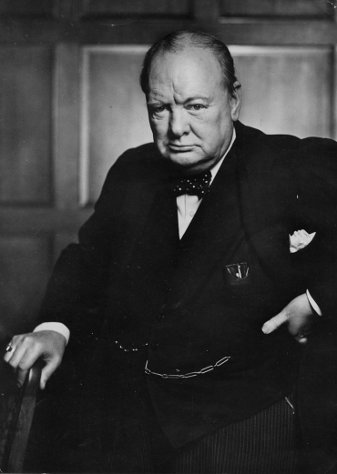
Winston_Churchill_1941But who cares about all the mud slinging on the Internet? What does it matter if one person has an opinion and I have another? Sadly, a good many people. Winston Churchill once said, “A lie gets halfway around the world before the truth has a chance to get its pants on.” Churchill also said “The British nation is unique in this respect: they are the only people who like to be told how bad things are, who like to be told the worst.”

While criticism doesn’t have to be a lie, for some reason lies, criticisms, and gossip seem to travel farther and faster than truths and complements. I disagree with Churchill that only the British people like to hear bad news, I think most people like to hear bad news, at least if it’s about someone else. Just hop on the Internet and go to several of the major news sites. What sort of news dominates the headlines? Bad news. Why not good news? Good news doesn’t sell, but a good scandal, disaster, or crime story will attract readers in droves.

How many people comment on a good, wholesome, inspirational blog post vs. one that is filled with criticism, controversy, and hostility? A “mean-spirited” blog post is like a big car crash. It’s horrible to look at but it draws people in herds.

Is that what I’m supposed to be “selling” on my blog as a disciple of the Jewish Messiah…bad news? Am I supposed to contribute gossip and “tell tales out of school,” even tangentially when I comment on another’s blog?

The words of a talebearer are as wounds, and they go down into the innermost parts of the belly.

Proverbs 26:22 (KJV)

For every species of beast and bird, of reptile and sea creature, can be tamed and has been tamed by the human species, but no one can tame the tongue—a restless evil, full of deadly poison.

James 3:7-8 (NRSV)

If you can’t say something nice… don’t say nothing at all.

-Thumper, quoting his father
Bambi (1942)

As believers, we have to be particularly mindful of what we’re saying and why. This is especially true of me since I am acutely aware of my own failures because of participating in areas on the web that have done harm to others. By my participation, I’m part of creating that harm. Why am I doing this? Am I seeking my own gratification at the expense of another human being? That’s not my intent and in fact, that’s exactly what I am trying to speak against.

Among Rabbi Pliskin’s numerous and highly useful quotes, there is this:

If your mind is focused on an insignificant incident, it can destroy your happiness if you allow it to. To feel happy, your mind has to be free of pains and misfortunes.

Learn to differentiate between productive thinking about problems as a means of solving them, and counterproductive dwelling on misfortunes which gains nothing positive and destroys your quality of life.

praying-aloneVery often people who appear very angry, or self-righteous, or abusive are actually very hurt. The problem is, it is very difficult to get past “angry” in order to help “hurt.” The first best way we can help someone like that is to find a way to reach the “hurt” part of them and help them learn to heal. I’d like to do that but my efforts almost always backfire so I guess I should stop.

As writers, we have a teaching function, whether we want it or not. Therefore, if the role is upon us, we should carefully choose our topics and our words so that we can be as encouraging and as uplifting as possible while still getting our point across. We should also question the motivation for making our points and verify that we are not deliberately trying to hurt someone else because we believe they hurt us (whether they actually did or not).

The audience or consumers of blogs should also be mindful of the function of writers and teachers as well as our limitations and faults and keep in mind that just because we put something on the Internet doesn’t mean it’s right. It may not be right in terms of being factual and it may not being right in terms of moral correctness (even if it is factual).

Moses may well have been factual when he called the Children of Israel “rebels,” but at least according to midrash, he was absolutely wrong morally in doing so.

Blowing out someone else’s candle won’t make yours shine any brighter.

-Anonymous

In fact, if you have to blow out someone else’s candle for the sake of your own, chances are you are walking in darkness anyway. The sun is setting and it’s getting harder to see. It would be comforting to see the lights of the Shabbos candles as I walk into darkness, but as a writer, disciple, and just one lone human being, I have miles to go before I have any hope of illumination.

Good Shabbos.

103 days…or 32 days. Still making up my mind.

Fish Out Of Water

FishOutofWaterA true master of life never leaves this world—he transcends it, but he is still within it.

He is still there to assist those who are bonded with him with blessing and advice, just as before, and even more so.

Even those who did not know him in his corporeal lifetime can still create with him an essential bond.

The only difference is in us: Now we must work harder to connect.

-Rabbi Tzvi Freeman
“Connecting”
Based on letters and talks of the Rebbe, Rabbi M. M. Schneerson
Chabad.org

“The Son of David will not come till a fish is sought for an invalid and cannot be found.”

-Talmud, Sanhedrin 98a

The Son of David is a diminutive reference to the Messiah, who will be a descendent of the royal house of David, King of Israel. The diminutive reference is strange in itself, but even more strange is the contention that the coming of the Messiah is dependent on an invalid in search of an unfound fish. What did Rabbi Menachem Mendel see in this passage that could reflect on his present situation?

-Rabbi Eli Rubin
“Lisbon 1941: The Messiah, the Invalid, and the Fish:
The private journal of the Lubavitcher Rebbe reveals a dual vision for the future of humanity”
Chabad.org

My wife sent me the email version of Rabbi Rubin’s article about the Rebbe, the Messiah, the Invalid, and the Fish and I still can’t figure out why. Maybe she just thought I’d find it intellectually stimulating or maybe she was sending me a message about my faith in Jesus as Messiah.

I do find it stimulating, which is why I’m writing about it, but more than that, I think the Rebbe’s message about Messiah tells us something about ourselves.

But I’ll get to that in a moment. One of the things I found in the article and learned at some previous point in time is that at least within some streams of Judaism, there is no single scenario that is thought to bring the Messiah. As far as what the Rebbe was teaching he said that there were two different generations that could possibly see the Messiah come: one that was entirely worthy or one that was entirely unworthy.

Seems contradictory and unnecessarily complicated from a Christian point of view. We tend to think that the Messiah will come when he comes. It’s up to God, not us. We can’t do anything about it and we certainly can’t be “worthy” of his coming.

…as it is written:

“There is no one who is righteous, not even one; there is no one who has understanding, there is no one who seeks God.”

Romans 3:10-11 (NRSV)

But then, as my wife has told me before, Christians and Jews think in fundamentally different ways. As I previously said, in certain areas of Judaism, it is thought that people have the ability to change the timing of Messiah’s arrival based on our collective behavior. That then lends itself to multiple circumstances by which Messiah could appear (or “return” from the Christian perspective):

Rabbi Menachem Mendel offers two explanations of the earlier passage, corresponding to these alternative scenarios. In the first, the redemption is well deserved due to the lofty station at which society has arrived; in the second, redemption is bestowed because the alternative is utter deterioration.

This brings us back to our invalid: The diminutive designation “Son of David” indicates that the redeemer is worthy of his messianic status only due to his lineage. Likewise, the generation to be redeemed is also deficient, suffering from the spiritual maladies of sin and moral degeneration.

At a time when the world was ailing, and the Holocaust was already underway, Rabbi Menachem Mendel confronted the paradoxical possibility of evil in the presence of G‑d. The cause of such spiritual illness, he wrote, is human forgetfulness. We can do evil only if we forget that we are in the presence of G‑d.

lisbon-to-new-yorkThe Rebbe’s commentary didn’t come out of a vacuum. The backdrop for all this was the Holocaust, World War Two, when the Rebbe and his wife were trying to leave Lisbon for the United States to escape Nazis in 1941. The time when the world went mad or as mad as anyone thought we could get up to that point.

“We can do evil only if we forget that we are in the presence of G‑d.”

Well, yes and no.

“Yes,” in the sense that when we believe we are doing “evil” or anything wrong, we cannot simultaneously be acutely conscious of the fact that God is watching over our shoulder, so to speak. It would be like a man cheating on his wife while his wife was in the same room. If we choose to sin, we must temporarily pretend that God isn’t watching in order not to be immediately seized with horrible guilt (of course if we are wired correctly in a moral and spiritual sense, we should experience guilt anyway, even without a direct awareness of the presence of God).

But it is also “no” in the sense that we do “evil” and do not recognize what we are doing is evil. People who operate within the bounds of what you might call “self-righteousness” are quite guilty of this and also quite unaware of their guilt. In fact, they might feel completely justified and even believe that God approves of their evil acts, calling their evil “good.”

Woe to those who call evil good, and good evil; Who substitute darkness for light and light for darkness; Who substitute bitter for sweet and sweet for bitter!

Isaiah 5:20

For the time is coming when people will not put up with sound doctrine, but having itching ears, they will accumulate for themselves teachers to suit their own desires, and will turn away from listening to the truth and wander away to myths.

2 Timothy 4:3-4

The Westboro Baptist Church is the most extreme example I can think of within “Christianity,” though I don’t count them as disciples of Christ. They perform heinous acts against grieving families of American military personnel who have died in the service of our country and believe it is somehow all for the glory of Jesus.

Of course, most believers commit such “evil” in far less spectacular ways but they are no more conscious of their wrongdoing than the aforementioned Westboro folks. Confront them if you will, but they’ll turn every argument you make against you (and that’s happened to me more than once) as if you, in attempting to uphold the Biblical principles of forgiveness, kindness, and compassion are making terrible Biblical errors and their own fire-breathing doctrine is the only way to please God.

That makes the following statement all the more ironic.

This is where the Talmudic fish comes in. Fish are a metaphor for the knowledge that we are ever submerged in the presence of G‑d. Just as a fish cannot live out of water, so the spiritual health of humanity can be preserved only if we are consciously aware of G‑d’s all-encompassing presence. It is at a moment that G‑d’s presence is utterly hidden—when no fish can be found for the invalid—that the redemption must arrive.

Ironic and true.

We live in a world where no fish can be found, when it seems as if the presence of God has completely left our world. Good literally is being called evil and evil is literally being called good in terms of the various social priorities and journalistic pronouncements we find daily in the popular media.

I keep expecting Jesus to come around the corner at any second, given what the Rebbe has said.

“Just as a fish cannot live out of water, so the spiritual health of humanity can be preserved only if we are consciously aware of G‑d’s all-encompassing presence.”

We are one sick and dying fish.

Rabbi Menachem Mendel’s second interpretation lays out the flip side of this vision. So long as the hand of G‑d has not yet been forced, and the redemption has not yet arrived, the burden of responsibility still lies on the shoulders of humanity. We can repair the world, so we must repair the world, ultimately bringing it to an era that is “entirely worthy” and ripe for redemption. In an era of human perfection, man will strive to lose all sense of ego, desiring to become utterly submerged within the divine self.

But maybe not completely dead (though I wouldn’t say we can possibly be “worthy”).

feeding_the_hungryAt least from a Jewish point of view, we can do something to help. Maybe we can’t actually summon the Messiah, which is what a Christian believes, but we can still be more “Messiah-like.” Some Christians used to wear those “WWJD” or “What Would Jesus Do” bracelets, but we can go one better and just do what Jesus would do in the world. What did he teach? Is the answer going to come as a big surprise?

Feed the hungry, visit the sick, comfort the grieving, help anyone hurting in whatever way they need help. Change someone’s flat tire. Volunteer to take “meals on wheels” to the elderly and the infirm. Pick a need and fulfill it. I don’t care which one. Just quit being a “sick fish” by going out of your way to hurt other people because that is your special or only way of “serving” God.

According to the Rebbe’s metaphor, the fish is “sick” for the love of God but as immersed as the fish is, the fish and the water aren’t ever going to be the same thing:

Similarly, the worthy invalid is “sick” with love for G‑d, desiring utter submergence but unable to cross the infinite divide separating man from G‑d.

The best we can do, and that’s only by the grace of God, is to imitate our Master in how we do good to others. Maybe that will bring the Messiah back sooner and maybe it won’t but it sure couldn’t hurt. In fact, it probably will do some good, if not in a cosmic sense, then at least in a down-to-earth human sense.

Four decades later, Rabbi Menachem Mendel delivered a public talk in which he explained that at every moment we face two very different visions of the future. On the one hand, we anticipate the imminent revelation of a new era of eternal good; on the other hand, we invest long-term commitment and energy into a more gradual transformational process, changing the world from the bottom up.

I don’t believe the world and the people in it are anywhere near “the imminent revelation of a new era of eternal good.” Looking at the news headlines for five minutes will tell you that humanity is no better now than at any time in the past, and some might argue that we’re getting worse all the time. That leaves the Rebbe’s “Plan B:” investing in a long-term commitment to gradually transform the world from the bottom up, one act of kindness at a time.

Multiple sources have been attributed to the famous quote, “If you’re not part of the solution, then you’re part of the problem.” Whoever first said it knew what they were talking about. Sitting on your bottom and doing nothing isn’t actively “evil” but it does nothing to produce “good.”

“All that is necessary for the triumph of evil is that good men do nothing.”

-Edmund Burke

That’s pretty much it. How many “good men” did nothing while six-million Jews died? How many good men have done nothing while countless men, women, and children starved, or died in wars, or died in riots, or died due to political indifference to human rights?

Doing nothing won’t keep you safe and doing evil in the name of good is just as bad or worse.

If we are truly connected to God and truly love Him, then we have no choice but to also love human beings. God loves human beings…all of us, regardless of race, creed, color, nationality, language, and (gasp) religion. Like it or not, God loves the Muslim, the Taoist, the Buddhist, as well as God loves the Christian and the Jew. God loves us even though we screw up pretty much all the time, even the best of us.

If we restrict our love, then we are hardly being “Christ-like” and thus we’ve already tainted our response to God and our ability to do good in the world.

“For if you love those who love you, what reward do you have? Do not even the tax collectors do the same?”

Matthew 5:46

rocket-scienceThis isn’t rocket science. This isn’t esoteric and arcane knowledge hidden within the murky depths of some obscure part of the Bible. This is the “easy stuff.” Well, it’s easy in that it’s pretty easy to comprehend. Obviously given the state of certain areas of the religious blogosphere and various believing congregations, home groups, and families scattered across the landscape, it’s not really that easy to do, otherwise there’d be a power surge of constantly doing good in the world.

Take a look at the last time you talked to another person. Was it in kindness, indifference, or anger? If you’re a blogger (or you comment on blogs), what was the last topic you wrote or commented on? Were you encouraging and supportive? Were you insulting and accusatory? Given everything I’ve written so far, you should be able to quickly figure out if you’re doing the will of the Master in the world or the opposite.

Do not bring us into the power of error, nor the power of transgression and sin, nor into the power of challenge, nor into the power of scorn. Let not the Evil Inclination dominate us. Distance us from an evil person and an evil companion. Attach us to the Good Inclination and to good deeds and compel our Evil Inclination to be subservient to You. Grant us today and every day grace, kindness, and mercy in Your eyes and in the eyes of all who see us.

-from the Siddur

You’re either a fish in the water immersed into the reality of God or you’re a fish out of water (Marco Polo). If you’re out, then you’re dying and you don’t even know it. You think you’re in a vast ocean when in fact, your tiny little puddle is evaporating like a raindrop in the Arizona desert sun in August. You don’t have much time.

I don’t believe people will ever be “worthy” enough for the age of Messiah to come. I think our world and the people in it will continue to degrade until he either comes or we destroy ourselves, eating each other alive. But those of us who are disciples of the Master can continue to strive to be a little more like him every day. In that way, maybe he will find at least a few people who have faith when he finally returns, may it be soon and in our day.


The Bible as a Quantum Cookbook

Talmud StudyWhen I was young, my father, a rabbi, would roll up his sleeves in front of an open Talmud and spend four or five hours putting different postulates and corollaries together as though he were building a road in ancient Rome. It wasn’t easy, but he was determined. He would concentrate unrelentingly on the words and sentences until he fashioned a pshat – a line of reasoning – to make things work. Lazy thinking was as far from him as Queens was from the Pacific.

He was the whole world to me, and I yearned to know what he knew, to be like him. But he and I were too different; we still are. My father is thoroughly God-centered and deeply committed to mastery of religious texts. He is a man of principles, scholarship, organization, planning, and goals. I, on the other hand, am both less scholarly and less organized along rational principles. I cannot be like my father, as much as I may have awkwardly, painfully tried.

-Dr. Simon Yisrael Feuerman
“My Father and the Talmud”
Aish.com

While Rabbi Shkop was spending his final years directing a Talmudic academy in Grodno, Belarus, a tight-knit community of theoretical physicists not so far away was discussing a strikingly similar problem. Instead of a married woman, however, the subject was a cat.

It was the summer of 1935, and Erwin Schrödinger’s thoughts were preoccupied with the fate of a small cat that had somehow been trapped in a metal box with a glass bottle of cyanide. A small hammer hung precariously over the bottle, attached to a kind of Geiger counter, on top of which sat a substance containing a single atom of some radioactive material (my guess would be nitrogen-13). The cat was certainly in danger. As soon as the atom would decay, the Geiger device would drop the hammer so as to smash the bottle, releasing the cyanide and killing the cat.

-Rabbi Tzvi Freeman
“Quantum Talmud: How Deep Can Talmud Go?”
Chabad.org

I recently suggested in Part 1, Part 2 and Part 3 of my discussion on Arminianism and Calvinism, as well as in a blog post about the potential for unknown qualities of the Bible, that the Word of God may have more to it than meets the eye.

I know “Talmud” exceeds the definition of “Torah” or “Bible” for most Christians by quite a bit, but I’ve been having a small discussion with someone named “ProclaimLiberty” on Sunday’s and Monday’s “meditations,” and they seem related to how we perceive the Jewish authority relative to the Bible (and Jewish authority as it exists after the Biblical canon closed) as well as the nature of the Bible and the supernatural itself.

While the quote from Dr. Feuerman’s article illustrates a simple desire to gain a traditional Jewish understanding of Talmud and thus Jewish thought (though like Feuerman, it may always be beyond me), Rabbi Freeman’s article (which is exceptionally lengthy) manages to compare the dynamics of Talmud study with Quantum Physics. I never thought of those two processes being related in any way, but Rabbi Freeman makes a compelling if complicated case.

But what does that have to do with anything, especially a Christian’s understanding of the Bible?

Well, the Pentacostal and Charismatic movements re-introduced the notion that revelation did not necessarily cease 19 centuries ago. Of course, that notion also has been abused terribly to justify everything from charlatanism to insanity. Re-introducing the notion of messianic Judaism also was difficult 4 decades ago, and it is still resisted in some quarters. It could be viewed also as having been already abused in some measure.

Thus I understand very well your sense of the difficulty about re-introducing a notion of the continuity (more than merely a restoration) of Jewish authority. It has been hard enough to convey the idea that Jewish believers are entitled to be something more than or different from merely some ethnic expression of Christianity. But this suggestion derived from Matt.23:3a undermines a fundamental viewpoint underlying the Nicene Council and the creeds it developed. It opens a door to a very scary world in which large segments of Christian doctrine could need to be re-invented. Furthermore, it threatens to unleash another wave of Christian guilt over its historical treatment of Jews. On the other hand, theologians love that sort of challenge; and if Christianity hasn’t learned how to request and accept forgiveness, something truly is fundamentally wrong (though there may be some need to learn a bit more about how repentance and atonement work).

-ProclaimLiberty’s comment on my blog
June 10, 2:45 am

phariseesI invite you to read the entire exchange of comments to get the full flavor of what was discussed, but PL brings to the table the compelling suggestion that Jews didn’t lose the authority provided by God to issue binding halakhic rulings after the Biblical canon was closed sometime in the early centuries of the Common Era.

Christians are almost universally going to reject that idea, but it’s at the heart of Jewish religious observance and Talmudic study within Messianic Judaism (as well as the other streams of Judaism today) and is based, interestingly enough, on a Biblical principle found in Matthew 23:3 (though I’ve yet to hear a Christian interpret that verse in such a fashion).

(PL isn’t the first Jewish commentator to bring up this interpretation of Matthew 23:3. For more details, please read Matthew 23:2-4: Does Jesus Recognize the Authority of the Pharisees and Does He Endorse Their Halakhah? (PDF) by Noel S. Rabbinowitz.)

This may mean that, for the Jewish people in general and for Jewish Messianics in particular, Rabbinic authority to make binding rulings over specific Jewish communities under God’s directives continued in some fashion after the Jewish/Gentile Christian split and continued across time and into the present. Of course, such a suggestion isn’t without problems as PL addresses in the same comment:

Of course, even if the notion of Jewish authority continuity were wholeheartedly adopted, there would still be a lot of analytical work to do examining how it might apply to non-Jews, and in what measure. Along with that analysis is one that would examine how a number of statements in Jewish literature were developed. For example, some statements were polemical responses in defense of Judaism under the pressure of Christian assault. While we don’t throw away such opinions in Judaism, we do at times limit their applicability and effectivity to specific circumstances, even when they were responsible for accepted elements of halakhah.

The “analytical work” involved to “examine how a number of statements in Jewish literature were developed” and the application of some of the more difficult Talmudic statements to Messianic Judaism (let alone non-Jews involved in the Messianic movement) has yet to be done, at least to any significant extent (to the best of my knowledge), but I believe a whole world of study would open up to Christians if we could just see the Bible from the perspective PL seems to represent.

PL was less than impressed by what he calls “esoteric mystical perception” as he commented in our conversation in my other meditation, but then, he’s had some rather unique experiences in that area as well.

However, I still maintain that the Bible is more than the sum of its parts and, as Rabbi Tzvi Freeman has remarked, (and I paraphrase) the Torah is not a book about what God thinks about so much as an illustration about how God thinks.

Reading Rabbi Freeman’s commentary on Talmud study and Quantum Physics, I’m convinced I’d never make a good student of either discipline. I must however, admire a mind that can grasp even the very basics of both.

Today’s “meditation” probably seems a little “over the top,” even for me, but since reading Rabbi Freeman’s article on Talmud and Quantum Physics last week, I’ve been periodically considering the implications if any portion of what he presents can be said to be relevant to non-Jews outside the stream of Jewish thought.

Back when I was an undergraduate for the first time in the early 1970s, I took a few astronomy classes. I might have considered making a career out of it if I could have handled the math. However, among the things I learned in my beginning astronomy class, I learned that we can consider light as both as a wave and a particle. Depending on how we consider light in terms of the math involved and under direct observation, it can behave either as one or the other. Depending on the circumstances of human investigation, we treat light either one way or the other.

In quantum physics, a particle has a potential for a number of locations in space until we observe that particle, then it appears in a single location only, and from that location, we can trace it back to where it must have been.

But why does its location only become fixed when we observe it? What is happening to the particle when we don’t observe it?

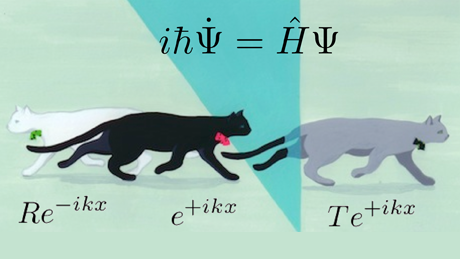
quantum-physics-catAs I asked before, what does any of this have to do with the Bible?

The Bible isn’t a particle (or a wave) of light. It exists in the “macro” world and just like Schrödinger’s hypothetical cat (no, he never put a real cat in danger…it was a thought experiment), we can’t actually apply what we know about subatomic particles to objects like cats and Bibles in our world.

Unless you consider the study of the Bible (like Talmud study) to be somewhat “transcendent” of the world we live in.

I admit that his all requires more mental gymnastics than I am capable of, just like a career in astronomy (I probably would have specialized in cosmology or the study of the origins of the universe, but I wouldn’t have ruled out planetary astronomy), but just like astronomy, I find the more esoteric aspects of the Bible to continue to be compelling in my present-day life.

All this complexity of thought (some of you may see this as unnecessarily complex) comes down to something very simple and something I’ve said before. I think it’s possible for the Word of God to contain far more than we imagine. I think that if we treat the Bible as far more than just a book full of ancient writings, it will “behave” in that manner.

Oh sure, I know this could easily lead to people projecting their (our) desires and imaginations onto the text, reading what we want to read in-between the lines, but what if God Himself put something in-between the lines for us to find? What if it takes someone with the mind and imagination of a Talmud scholar or Quantum physicist to find the place in-between the lines (and that someone would not be me)?

What if that “something” holds the answer to questions like the Calvinism-Arminianism debate or at least provides us with a perspective that throws said-debate clear out of the fifth floor window, defenestrating the very idea that human beings can turn the Bible into a “cookbook” containing Calvin’s and Arminius’s separate “recipes” for salvation?

Food for thought.

As They Were Ministering To The Lord

prayingWhile they were worshiping the Lord and fasting, the Holy Spirit said, “Set apart for me Barnabas and Saul for the work to which I have called them.”

Acts 13:2 (NRSV)

Last Sunday, I was wondering how Pastor Randy was going to preach for an entire hour on just three verses from the Bible. He told me there was a lot packed in those three verses (Acts 13:1-3) and he was right. However, his explanation of the Greek word translated as “worshiping” in the above quoted verse was especially interesting.

According to TheFreeDictionary.com, the word “leitourgia” (which is rendered as “worshiping” above) is related to the English word “liturgy:”

  1. A prescribed form or set of forms for public religious worship.
  2. often Liturgy Christianity The sacrament of the Eucharist.

[Late Latin ltrgia, from Greek leitourgi, public service, from leitourgos, public servant, from earlier litourgos : liton, town hall (from los, dialectal variant of los, people) + ergon, work; see werg- in Indo-European roots.]

That’s a lot to pack into the word “worshiping” and reading that verse in English totally obscures the meaning of what’s being said. It might have made more sense to translate the word as “ministered” (which the King James Version actually does) in order to render the meaning more accurately.

According to Pastor Randy, the sense of the word can refer to the duty of the Levitical Priests in the Temple in Jerusalem and as the dictionary definition states above, addresses the discharge of a public office.

But what was that about liturgy again?

Pastor Randy didn’t touch on this, but what may also have been communicated by Luke when he used the word “leitourgia” was that the worshiping of God was being performed using liturgical prayer, or more specifically, a Jewish prayer service.

This isn’t beyond the realm of possibility if we consider that the “church” in Syrian Antioch was actually a synagogue servicing believing Jews and Gentiles. What other model for worship of the Jewish Messiah would they have?

The other day I wrote a blog post citing New Testament scholars Larry Hurtado and Paul Trebilco on the topic of “Early Christian Identity.” That source, along with many others I’ve quoted from over the many months I’ve been writing this blog, continued to confirm that the early Jewish believers in the Jewish Messiah unquestionably identified themselves as Jews worshiping (ministering, praying liturgically, providing a service to God) within a wholly Jewish context.

The Huffington Post recently published an article called The Apostle Paul Lived and Died as a Dedicated Jew written by psychologist, college professor, and journalist Bernard Starr, who expands greatly on this topic in his book Jesus Uncensored: Restoring the Authentic Jew

PaulMost Christians and Jews don’t have a problem with the idea that Jesus was a Jew and lived a completely Jewish lifestyle, but when Paul comes up in conversation, most folks aren’t really sure who he was or what he was up to. Actually, I’m being generous. Most Christians and Jews actually believe Paul took the Jewish teachings of Jesus and made up a new religion called “Christianity.”

In the article I mentioned above, Starr writes:

It’s widely acknowledged that Jesus was a thoroughly practicing Jew throughout his life. Anglican Priest Bruce Chilton expressed that conclusion explicitly and concisely in his book “Rabbi Jesus”: “It became clear to me that everything Jesus did was as a Jew, for Jews, and about Jews.”

But what about Paul, the Apostle to the Gentiles? It’s generally accepted that Paul was the true founder of a new religion called Christianity. Biblical scholar Gerd Ludemann, author of several books about Jesus and Paul including “Paul: Founder of Christianity,” affirms that “Without Paul there would be no church and no Christianity.” Ludemann adds, “He’s the most decisive person that shaped Christianity as it developed. Without Paul we would have had reformed Judaism … but no Christianity.”

Paul converted Jews and then Gentiles to Jewish Christianity, basing these conversions on his belief in the teachings, resurrection and divinity of Jesus. But powerful evidence within “Acts of the Apostles,” the book of the New Testament that chronicles Paul’s mission, reveals that Paul, like Jesus, remained a dedicated Jew until his execution. In fact, if Paul had simply stated that he was no longer a Jew but the leader of a new religion, he would not have been imprisoned or executed.

Actually, that last part is probably not true. It was a crime in the Roman empire to promote an illegal religion. If Paul was spreading the “good news” about a form of Judaism, as attorney and Bible scholar John Mauck asserts in his book Paul on Trial: The Book of Acts as a Defense of Christianity, then he was innocent of the charge of “atheism”. If, on the other hand, he really had “converted” from Judaism to Christianity and was promoting a brand new religion to Jews and Gentiles, he was guilty and would have deserved to be sentenced to a harsh punishment by the Roman court up to and including death, according to Roman law.

However, both Starr and Mauck emphasize the same thing: That Paul, as the Apostle to the Gentiles, lived a lifestyle completely consistent with that of an observant Jew and even died as a Jew. He didn’t “convert” in the sense that he left Judaism for a new religious form. He did “convert” in the sense that he recognized that Yeshua (Jesus) was indeed the prophesied Messiah, and from that Jewish platform and the mission given to him by Messiah in visions, he proceeded with unabashed courage to take the Gospel of Messiah “first to the Jews and also to the Gentiles,” in order to fulfill the command Jesus uttered in Matthew 28:19-20:

Go therefore and make disciples of all nations, baptizing them in the name of the Father and of the Son and of the Holy Spirit, and teaching them to obey everything that I have commanded you. And remember, I am with you always, to the end of the age.”

Paul didn’t create a new religion and he didn’t abandon being Jewish or “morph” the Jewish “Way” into something alien to the Jewish disciples.

According to Starr:

Still, Paul said nothing about a new religion. On the contrary, he presented himself to the Roman Jewish community as a loyal Jew who was being persecuted for his revisionist views. Since the Romans had no quarrel with him, as a Roman citizen, and with the Sanhedrin a continent away, there would be no viable case against Paul — if he had denounced his affiliation to Judaism and declared a new religion. At this point in his life, facing trial and execution for blasphemy against Judaism, didn’t Paul have every reason to sever his tie to Judaism? The Sanhedrin, representing traditional Judaism, sent a clear message by their action against Paul: “We will not accept your beliefs and teachings about Jesus.” Despite this definitive rejection, Paul didn’t choose the obvious way out of the clutches of the Sanhedrin: declaration of a new religion. This strategy never even showed up for discussion. Paul chose to go to his death as a Jew. Why?

Paul’s vision was to make his brand of Judaism — with the recognition of Jesus as the Jewish Messiah — a world religion easily accessible to everyone. He never surrendered that passion. But after his death the accelerating conversion of Gentiles to a movement that began as Jewish Christianity became increasingly distanced from Judaism — and a new religion was launched.

derek-lemanLast week, Derek Leman published a blog post called Jewish “Unbelief,” Romans 11, Isaiah in which he supported (rightly in my opinion) the position that “Jewish unbelief” in Jesus as Messiah was a temporary state and initiated by God for the sake of the Gentiles. God never intended to abandon His people Israel and in the end, “all of Israel will be saved.”

Derek is supporting the same points I am; that the Jewish believers remained Jewish and maintained normative Jewish religious practices as disciples of Messiah. He also soundly (again) refutes traditional replacement theology (supersessionism). The Gentile Christians did not replace the Jews in the covenant promises and God’s love for Israel and His devotion to them has never wavered.

I was so impressed with this particular blog post of Derek’s that I sent the link to Pastor Randy last Wednesday morning. During my Wednesday evening conversation with Pastor, I found that he had printed the blog post. He agreed with everything Derek wrote up until this point:

  • Unbelief in Torah and Yeshua.
  • Unbelief in Yeshua; belief in Torah.
  • Unbelief in Torah; belief in Yeshua.
  • Belief in both Torah and Yeshua.

The core of the disagreement is the word “Torah.” He and I still haven’t settled upon a mutual definition of the word (it’s not all that easy to define) and our conversations about Torah tend to get a little “slippery” in how we apply it in the days of Paul vs. modern times. Pastor isn’t convinced that Jesus ever intended for the Jewish disciples to conform to the Torah mitzvot much beyond the lifetime of Paul and certainly not after the New Testament canon was closed.

But what about the Torah in the days of Paul?

You see, brother, how many thousands of believers there are among the Jews, and they are all zealous for the law.

Acts 21:20 (NRSV)

I quote from this verse fairly often. Thousands of Jewish believers all zealous for the Torah. I think Pastor can accept this because, after all, it’s right there in scripture.

So Paul lived and died fully and completely as an observant Jew and, based on what I read in the New Testament record as well as what I’ve written, including my conclusions on Acts 15 taken from Mauck’s Paul on Trial book, Paul never taught the Jewish believers to set aside Torah, nor did he teach the Gentile believers they had to keep Torah in an identical manner to the Jews.

The part I emphasized is important to note (especially for my critics) since I don’t say that Torah doesn’t apply to Gentile believers at all. In fact, we see that Christians are often better at performing some of the weightier matters of the Torah than much of Messianic Judaism and (as far as I can tell since they don’t blog, write, or teach about this aspect of Torah), just about all of the Hebrew Roots movement.

praying_jewWhat can we say then? Paul was born, lived, and died a Jew. Even after his encounter with the Messiah and being commissioned as an Apostle to the Gentiles, he remained completely Jewish, taught other Jewish believers to maintain the Torah mitzvot, and defended himself by stating that he never committed the crimes against the Jewish people and against the Temple of which he was accused. He was a Pharisee of Pharisees.

And, to return to the beginning of this missive, just before he and Barnabas were sent out by the congregation at Syrian Antioch on what has been called “Paul’s first missionary journey,” he and the other Messianic Jews and Gentiles were “praying, prophesying, teaching, fasting, working, and ministering/worshiping/praying liturgically in the manner of the Jews” together.

At the end of his article, Starr tells us:

Nevertheless, an understanding of the deep connection to Judaism held by the founders of Christianity should highlight the common ground of Judaism and Christianity and pave the way to reconciliation between the two faiths.

I’m convinced that in the coming days of the Messiah, he will teach us that there is only one faith; faith in the God of Israel. Right now, two peoples are contained in two separate religious expressions: Judaism and Christianity. One day, Moshiach will reconcile us as two peoples, Israel and the people of the nations called by His Name, occupying a single body: the body of Messiah.

May he come soon and in our day.

The Tzemach Tzedek once told his son, my grandfather, an incident in his experience, and concluded: For helping someone in his livelihood, even to earn just 70 kopeks (a small, low-value Russian coin) on a calf, all the gates to the Heavenly Chambers are open for him.

Years later my grandfather told this to my father and added: One should really know the route to the Heavenly Chambers, but actually it is not crucial. You only need the main thing – to help another wholeheartedly, with sensitivity, to take pleasure in doing a kindness to another.

“Today’s Day”
Thursday, Sivan 28, 5708
Compiled by the Lubavitcher Rebbe; Translated by Yitschak Meir Kagan
Chabad.org

108 days.

Who is Righteous?

goodly-tents-of-jacobHow goodly are your tents, O Jacob, your dwelling places O Israel. As for me, through Your abundant kindness, I will enter Your House. I will prostrate myself toward Your Holy Sanctuary in awe of You. O HASHEM, I love the house where you dwell and the place where your glory resides. I will prostrate myself and bow, I will kneel before HASHEM my Maker. As for me, may my prayer to You HASHEM come at an opportune time; O God, in Your abundant kindness, answer me with the truth of Your salvation.

“Mah Tovu (How Good)”
-from the Siddur

This is the beginning of the Shacharit or morning prayers, said by Jewish people around the world at the beginning of each day.

I have a sad confession to make. I don’t pray in the morning very often. The first hour or so after I get up is dedicated to a cup of coffee, a glass of water, and slowly waking up in front of my computer. Oh sure, I recite the Modeh Ani upon awakening, but that takes only a few seconds and I’m still in bed when I make the blessing.

However, this morning my son wasn’t feeling well and frankly, neither was I, so we decided to skip the 5 a.m. visit to the gym. I could have noodled around on the web or even read a book, but I decided to pray.

I began with extemporaneous prayer and my mind scattered all over the place. I kept trying to focus it back, but that would last only a few seconds. I can certainly see the benefits of hitbodeut since it actually encourages “talking” to God as one talks passionately to a close companion, but for that, I’d need to be completely alone (I don’t want to wake my wife and daughter).

Then I remembered my siddur. I opened it up to the Shacharis/Morning Services section and began to read. And I began to pray.

I know that I previously expressed some hesitation and even trepidation at attending the recent First Fruits of Zion Shavuot Conference. I wondered if I really belonged in a “Jewish” worship context anymore (or if I ever did). I wondered why it didn’t feel like “home” anymore.

But praying, even somewhat briefly, with the siddur this morning did feel like home. I limited my prayers, trying to avoid those that overtly identified the person praying as Jewish, but I feel as if the pattern and rhythm of the siddur is almost calling to me.

After Mah Tovu, I prayed Adon Olam (all this is in English and I’m softly reciting, not singing), skipped the blessings of the Torah, and continued with the liturgy up to the Akeidah portion.

It’s not very long, actually.

But why don’t I do this every morning? I can’t say I don’t have the time, because I can find the time.

Then I was reminded of something else that happened at the conference.

I won’t go into too many details, but one person giving a presentation referenced another individual present and called him a tzadik. This was because the person being referenced is scrupulous in all the prayers, rituals, and traditions of observant Judaism. He refrains from all inappropriate forms of work on the Shabbat and festivals, observes each time of prayer, davening in Hebrew, and otherwise is diligently mindful of his duty to Hashem…

…even though he’s not Jewish.

That last part’s important because it brings up the question of whether or not observing Jewish religious practices makes a non-Jew more holy, more righteous, more “tzadik-like.” Particularly as a non-Jewish person involved in the Messianic Jewish movement, however tangentially, do the Jews and Gentiles in that movement consider me a failure for not following Jewish religious observances?

After a wave of guilt passed over me, I realized that some of the most righteous men I know are Christians who probably don’t pray one word in Hebrew. I’ve come to develop a great admiration particularly for a few of the men at the church I attend. I’ve learned some things about one specific individual that he’d never tell me himself, but that are completely consistent with how I experience him.

israel_prayingIf he were Jewish, I’d probably call him a tzadik. But what makes him such isn’t his “Jewish” observance, because as far as I know, he has none. What makes him such is that he is devoted to God in all of his ways, not only in prayer and worship, but in everything that he does.

How a life of righteousness looks, at least superficially, may be different depending on whether or not you’re a Christian or a Jew, but at the core, living a life that is pleasing to God should be the same regardless of who you are.

Jews pray and Christians pray. I remember my Pastor said that there were times in Israel when he was traveling with Jewish men. They would daven shacharit in a minyan and he would sit off to one side and silently pray, not intruding on them, but observing the holy time nonetheless. They all honored God and each other with their prayers and their devotion.

Jews give to charity and Christians give to charity. Jews visit the sick and Christians visit the sick. Jews feed the hungry and Christians feed the hungry. Jews gather together regularly to worship God and Christians gather together regularly to worship God.

Do you see what I’m getting at?

A “tzadik” isn’t just a Jewish righteous person, it’s any righteous person. Granted, the term itself is Jewish, but the concept behind it can be applied to any individual who seeks the will of God and then does the will of God.

I guess a Christian would use the word “saint” but I’m not quite sure it is an equivalent term exactly.

But the words used matter less than the life that’s lived. While in the example I cited above from the conference, one person acknowledged that another was a tzadik, but the recognition matters less than the life that’s lived, even if it is lived in obscurity so that no one knows.

But God knows.

God knows everything about the righteous and the unrighteous.

…as it is written:

“There is no one who is righteous, not even one; there is no one who has understanding, there is no one who seeks God.”

Romans 3:10-11 (NRSV)

There is no one who is righteous just because of who he is or what he does. Paul goes on in the same chapter to say that we are only righteous by faith. It is by faith that we seek God at all. It is by faith that we pray.

Rabbi Abraham J. Twerski writes an online “column” for Aish.com called Growing Each Day in which he begins with a quote from the Bible, Talmud, the Siddur, or some similar text. He then writes a brief commentary and finishes by applying the principle to his own life (and by inference, his readers are invited to apply it to their lives in order to “grow each day.”

Adapting his model to today’s “extra meditation:”

Today I shall…

…seek God each morning by turning to Him in prayer, so that my life will begin to conform to His will.

Good Shabbos.

110 days.

Acting for the Messiah

acts_isaac_maryThe Torah of Moses and the instructions of our Master Yeshua instruct us to open our hands to the poor and not hold back from providing for the needy. As disciples of the Master, it is our duty to fulfill these obligations to the best of our ability and to meet the need where it is greatest. Tororo, Uganda, like many other locations around the world, is subject to harsh poverty, low quality of life, and often a dangerous environment to live in, especially for the young.

-from the A.C.T.S. for Messiah website.

I know I said I wasn’t going to discuss the First Fruits of Zion Shavuot Conference anymore, but there is one important aspect I forgot to mention. During the conference, there were two meals not covered by the conference registration. They were fundraisers for a missionary effort called A.C.T.S. for Messiah, which according to their About page:

…is a non-profit organization dedicated to helping the orphaned, widows, poor and needy in Africa. This Messianic Jewish mission is based in the East African nation of Uganda where Emily Dwyer brings the Gospel of Yeshua to remote villages, teaches discipleship, feeds the hungry and cares for a group of orphaned children. Our ministry is based in the village of Tororo, Uganda.

One thing I know about the Christian church is that they’re very good at sending compassionate missions outside of their own walls, to destinations ranging from different cities in the U.S., to the towns, villages and refuge camps where ever they are found across far-flung corners of the Earth. Messianic Judaism and Hebrew Roots, not so much. Traditionally, Messianic Judaism and Hebrew Roots have focused their attention and resources on establishing their movements and the primacy of the Torah. But Messianic Judaism, thanks in part to the aforementioned Shavuot Conference, First Fruits of Zion (FFOZ) as an educational ministry, and other Messianic organizations, that viewpoint is becoming more balanced, resting upon (if I can “borrow” from the conference again) Torah, the Good News of Messiah, and the Holy Spirit.

I first encountered A.C.T.S. (the acronym means “Action, Compassion, Teaching and Service”) during last year’s conference. Fortunately this year, they accepted credit cards as well as cash, so I didn’t have to depend on the kindness of strangers (I don’t like traveling with cash) when I wanted to participate.

I’m incredibly pleased to see Messianic Judaism embrace this long-established function of the church in extending itself to uphold this principle of Torah and ancient Judaism. I think it means the movement is maturing beyond its “start-up” stage and is becoming a more holistically functioning expression of the Messiah’s love in the world.

And while you may think that such compassion is primarily Christian/Messianic, I just want to remind you that modern Judaism is an abundant source of love for others.

Dr. Rick Hodes concluded his May 19, 2013 commencement address at Brandeis University this way (the link above leads to the entire content of the article which includes many examples of Jewish compassion to the disadvantaged, the sick, and the dying):

You now start a lifelong link with a great name – Brandeis. What can we learn from Louis Brandeis? He was described as “the disturbing element in any gentleman’s club,” he owned a canoe, not a yacht, he angered clients by trying to be fair to both sides; the judge who succeeded him, called him “a militant crusader for social justice… dangerous because he was incorruptible.” Live up to his legacy.

Spread kindness. You are here because a lot of people helped you along the way. Maybe it was your 10th-grade math teacher who gave you a second chance, maybe it was someone who inspired you in a summer job.

This week, buy beautiful cards and send out four or five, to people who’ve helped you. Let them know you’ve just graduated from Brandeis and they were important to you. They’re going to feel great, and they’ll do it again for others.

Remember this: Run to do good. Create a momentum in the right direction. Get your hands dirty. Wear out your shoes. Don’t try to get too comfortable, please!

Now I imagine the start of a horse race and the bell rings. But you don’t need to race against each other. Whatever horse you choose, and whatever path you follow, I wish you great success and great happiness.

I wish you a lot more than luck, and may God bless you all.

syrian-refugeesThe Pastor of my church was raised by missionary parents and he became a missionary himself. The church I attend aggressively supports multiple missionary efforts around the globe. Many people who attend the church volunteer their time to travel to other countries to pray, encourage, support, build, teach, and do whatever else it takes to feed the hungry, heal the sick and injured, and show the love of Jesus Christ to whoever they may encounter.

A video news story was shown at the beginning of last Sunday’s worship service at my church (found online at CBN.com). It was a Skype interview of a missionary in Syria whose group is providing shelter, food, and support to anyone in need, Christian, Muslim, or anyone else. My words fail dismally to describe what this almost four-minute long video illustrates (I’ve posted the video from YouTube at the bottom of this blog post). The devastation of life is just ghastly, but one courageous group of Christians work to help just because God so loved the world, not just the Christian world, not just the white world, not just the American world, but every man, woman, and child who were created in the image of God.

In other words, everyone.

Part of why I’m writing this is to show that Messianic Judaism is indeed following the will of the Master and the teachings of the Torah, as is much of the traditional Christian church. Another part of why I’m writing this is to ask you to care. Yes, some of you really do care. Some of you give generously, work endlessly, pray fervently for those in need. But more of you…of us need to do the same. Love and worship is more than just showing up to the church on time for Sunday services and going to Sunday school afterwards, strolling through the Bible while drinking coffee and munching on muffins.

Love and caring means giving of whatever you have to give and sharing whatever God has given you to share.

Oh people, look around you
The signs are everywhere
You’ve left it for somebody other than you
To be the one to care
You’re lost inside your houses
There’s no time to find you now
Your walls are burning and your towers are turning
I’m going to leave you here and try to get down to the sea somehow

-Jackson Browne
Rock Me On The Water (1972)

Feed the hungry, take care of the widow and orphan, provide medical care for the sick, make a difference.

Act now.

111 days.