Tag Archives: Judaism

What Are We Looking For From God?

I recently blogged about a Christian turned Noahide who I accidentally discovered on the blogspot The Torah Way. In describing this person’s “journey” away from faith in Jesus (Rav Yeshua) to a traditional Noahide or “Righteous Gentile” viewpoint and praxis, I neglected to examine what they wrote on their other blog Cozy Kitchen Chats believing it was more or less a collection of recipes and other food related articles.

As it turns out, this is an older blog and contains a lot more detail about this woman’s (one of the things I discovered) spiritual travels.

I’m not trying to pick on her or demean her in any way. I do, however, find that what she’s been through over the past several years is illuminating, because she comes from a place that should be familiar to many of my readers.

Let’s go to the beginning, the very first blog post from July 17, 2014:

To formally introduce you to my Cozy Kitchen, I absolutely need to share with the you the Foundation of my world, Jesus Christ, the Son of God, my soon coming KING. I had always been brought up in the church, although I had bounced around from church to church seeking and hungering for something deeper. I tried small town churches, large Mega churches, Pentecostal churches, Baptist churches, even Catholic churches. Each had amazing truths and amazing people, but nothing felt comfortable to me. My heart was always drawn to the Church described in the Book of Acts.

This is a person devoted to Jesus as Savior and King in search of a church that reflects the Biblical “prototype” church, the ideal church where one can draw close to the Spirit of Jesus. Apparently, she couldn’t find it.

All I know is that I personally needed to walk away from everything I knew about the modern day church. I spent two years aggressively seeking God to show me the Truth, regardless what it may cost me, I wanted to know that I know Him and that I am following Him wholeheartedly. I read everything I could about the religions most commonly found in the United States. I set aside all that I knew, wiped away all the prejudice that I held and explored each asking the Holy Spirit to show me the Truth.

This part is funny in an ironic way, given where she’ll end up.

…at first I honestly didn’t like the Jesus I was learning about. Oh, I loved how others in the Bible would describe Him, but when I read His words, I thought they were harsh, aggressive and difficult to understand. I really liked Paul much more than Jesus, Paul’s teaching were soft and easy, Salvation by Grace alone, no actions or responsibility, once saved, always saved. Paul was much more appealing.

MessiahShe goes on to say that in order to learn more from Jesus, she set aside Paul’s writings so she could sit at the feet of her Master. That’s how she started out her blog.

I am here exclusively to show the Love of God to you and to serve you and others in anyway I can. Opening up my Cozy Kitchen Chats with you, I will share with you the Gospel of Jesus, how to have a thriving Christian home, how to serve your community and how to make YOUR own Cozy Kitchen your personal mission field.

But less than three months later:

I know this is topic that can really set some “believers” off balance, since there has always been a belief that the Torah or the Life Teaching and Instruction of God, given to Moses was done away with at the resurrection of Yeshua (Christ)

Nowhere in the Prophets nor in the instruction that was given to Moses was it ever mentioned that the Law would be done away with. During Yeshua’s time on earth, He never mentioned that the Law or the Word would be dismissed. He actual said the following.

First, she described a general dissatisfaction with all of the churches and Christian denominations she experienced and was determined to study the Bible at the feet of Jesus and gain wisdom from the Holy Spirit alone.

Then she discovered the Torah, started calling Jesus “Yeshua,” and described her understanding in terms more familiar with someone who was just introduced to either the Messianic Jewish or Hebrew Roots movements.

Based on a link she posted, her source material came, at least in part, from 119 Ministries (as of this writing, there’s a JavaScript pop-up that asks if you’re new and you have the option to click “Yes” or “No”. However, the box doesn’t go away when you click either button, so website content is blocked unless you edit the URL to go to the home page — Addendum: This problem has apparently been fixed, although the site still has connection difficulties).

Subsequently, she started writing about kosher foods, her opinion of the Christian Church and of Pastors continued to decline, she became focused on Sacred Name theology, and she decided that Christmas was pagan, thanks to 119 Ministries, and stopped celebrating it.

I don’t know if she actually started donning tzitzit, but it looks like she wanted to. Shabbat became important to her.
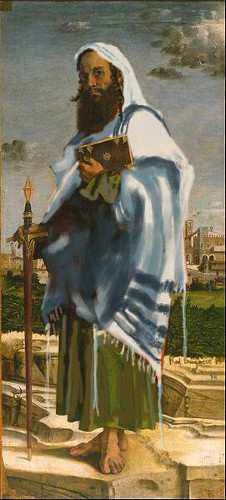
The Jewish PaulA really critical point though, is that her attitude about the Apostle Paul (Rav Shaul) changed remarkably. Remember, at the very beginning, she loved Paul’s teachings, but thought Jesus was too harsh and aggressive.

Don’t allow the mindless teaching of man separate you from the TRUTH. The Pharisees over taught the law with man made regulations to overwhelm man so he would not honor it, then the new Pharisees (Paulines, followers of Paul’s teaching rather than Jesus’) discounted the Sabbath with man made doctrines so men would not follow it. Seek God’s instruction to find the Truth.

Here, she’s reversed her original position and now sees the teachings of Paul in opposition to those of Jesus. Ironically (again), she denigrates the “man-made laws “of the “new Pharisees” and believes only in seeking God’s instructions of truth in Jesus. I say ironically because when she became a Noahide, she had to accept the validity of the teachings of the Rabbinic sages and their authoritative interpretations of Torah, which most Christians call “man-made laws”.

And most Christians consider the Sages to be something like “the new Pharisees”.

Here’s a little more:

A husband that truly LOVES his wife will catch on. Believers that are TRULY following, TRULY LOVING Him, TRULY READING Him will catch on. They will start to step away from Paul’s teaching or rather “un-teaching” and will seek to find out what the WILL of the Father is and what is meant by the “Word of God.” it’s an exciting time! An Awakening!

I’m emphasizing this because abandoning Paul is usually a major step in leaving Christianity, Hebrew Roots, and Messianic Judaism for a non-Jewish believer, since so much of our understanding of how to apply Torah to the Gentile and to live a life as devoted disciples of Rav Yeshua, depends on what he wrote.

She found this to be the best teaching on Paul she ever heard. I had a difficult time following the link and managed to navigate to the 119 Ministries video teachings page and found the correct video by searching for the lesson’s title: “The Deuteronomy 13 Test.”

I thought I should investigate what she was listening to in order to discover what was influencing her thinking and beliefs. The textual introduction to the “Deuteronomy 13 Test” states:

Have you ever considered why the Jews reject the Jewish Messiah, our Lord and Savior…What if it was because many today misunderstand Paul…Millions of Jews reject the Christian presentation of Jesus and Paul, alarmingly, because the Word of God says to. Sadly, if the misunderstanding continues, Jews are forever prevented from not only not knowing their Jewish Savior, but also from experiencing the blessings of the New Covenant. This teaching exposes the gap in the misunderstanding, and takes a first step into building a bridge…

119 video
Screen Capture: 119 Ministries

The video (about 41 minutes long) wasn’t exactly what I expected. It seemed, at the beginning, to be both very pro-Jesus and pro-Paul. The video instructor said that although Jesus and Paul didn’t teach against the Torah of Moses, but they did teach against the Oral Traditions, what is known today, according to this “teacher,” as the Talmud.

This instructor’s first mistake was defining the traditions and praxis of the Pharisees in the late second Temple period as the Talmud, which would not actually exist for centuries (Mishnah c. 200 CE, Gemara c. 500 CE)

This is very much an anti-Judaism (including Messianic Judaism) lesson. I needed to understand a little more about 119 Ministries itself. According to their site’s About page:

Our purpose is to seek and bring the truth to all nations, unlearn false doctrines and traditions of men, and to equip the body to live and practice the Word as God originally intended.

We find that continuously examining the Scriptures (in the same Hebraic first century context and perspective in which they were written and understood) reveals to His people much more understanding, as opposed to the more common Greek mindset that is a couple thousand years removed.

Sounds pretty much the same as when a Fundamentalist church says their doctrine is the only “sound doctrine.”

It’s difficult to tell if 119 Ministries is specifically “One Law” or “Two House,” but their Faith Statement says in part:

Another purpose of Yeshua was to begin calling back the scattered 10 tribes of Israel that were divorced, scattered, and became Gentiles.

This at least suggests a Two House theology, although it’s hardly conclusive.

Frankly, in listening to the above-mentioned anti-Judaism video teaching, it’s amazing that this woman finally became a Noahide, since as far as I can tell from her blogspot, 119 Ministries was her primary and possibly her only source of information relative to Hebrew Roots.

Listening to the 119 teacher was hard for me since his lesson was not only almost totally opposed to my personal beliefs, but it was thinly disguised anti-Jewish rhetoric which not-so-subtly was also a presentation of supersessionism, misappropriating the Torah from the Jewish people and denying observant Jews the right to establish their own interpretation of Torah.
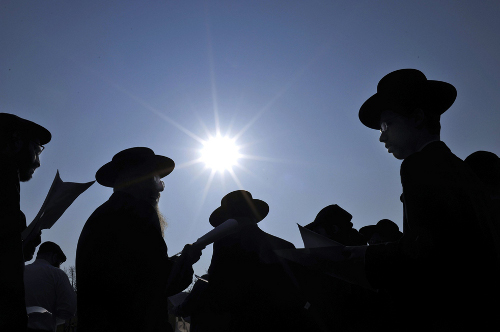
Orthodox JewsAbout halfway through the video, the teacher started hammering away against modern observant Jews. To be fair, he seemed just as prejudiced against normative Christianity.

The 119 Ministries video teacher says he wants to bring Jewish people to faith in Yeshua, but his attitude toward observant Jews is so poor that I can’t imagine any Jewish person wanting to listen to this fellow. In this, his concept of Jewish people who “reject Jesus” is pretty much that of normative Christianity, at least in its worst expression.

This teacher is a great example of how a person who continually quotes from the Bible (and he did so, scripture after scripture) can still grossly misrepresent the intent of Hashem, Rav Yeshua, and Rav Shaul (In doing some subsequent research, I discovered that the people behind 119 Ministries are well-meaning and kind, but I still have to disagree with almost all of their conclusions).

Toward the end of the video, the teacher cited Romans 11, Ephesians 2 and Numbers 15:15-16 as “proof” that the Law of Moses was meant to be observed by, not just the Children of Israel and their descendants, but by all humanity, so he tips his hand, so to speak, and reveals that his ministry supports One Law. He does it however, in a really easily refuted way, so I readily set it aside.

(I found this half-hour long YouTube video of an interview with the two guys who founded and operate 119 Ministries, Steve and John. They seem like really nice guys. If you want to get to know who they are and why they started their organization, click the link).

The bulk of this blog’s content was written between July and December of 2014. The last blog post of 2014 was published on December 15th. The next missive, the last one here, was from January 24, 2016, and is simply a link to her article Leaving Christianity at The Torah Way.

There’s a gap of over a year where something must have happened, where her fascination with 119 Ministries and what they teach must have waned in the extreme. She would never have become a Noahide if she was listening to their anti-Judaism, anti-Jewish people diatribes.

interfaithI wonder if she and her family (she’s married with two children) went through something like this:

Jewish Values vs. Other Faiths

I am struggling with the sense that on one hand I want to instill Jewish beliefs in my children, but on the other hand I feel this would be diminishing the value of other faiths. I feel that love, harmony and happiness are the most important values, and that we need to be accepting of everyone’s beliefs. People are different, so isn’t truth relative for each individual?

The Aish Rabbi Replies:

This is an important question, one that I think goes to the heart of today’s society.

If you think about it, you’ll realize that “truth” cannot simply be everything that everyone wants.

from the “Ask the Rabbi” column
Aish.com

I think this blog writer held on to the love and truth of Torah she discovered early on, but for some reason, everything else had to give way. Maybe she finally figured out that the video teachings she was consuming ultimately didn’t hold water and actually disrespected the Jewish people who are the sole human objects of the Sinai Covenant.

I don’t know. She took the path of many Christians who become disillusioned with the Church and find Hebrew Roots as an alternative. Eventually, it becomes too difficult to balance love of Torah but not of Judaism and Jews, as well as seeing Yeshua and Shaul being depicted as somehow against their own people.

Granted, a life either in Hebrew Roots or Messianic Judaism isn’t easy. If you’re a believing Gentile, being a Christian is the path of least resistance, and if you are an observant Jew, then Orthodox Judaism is probably a more understandable option.

But if you’re a Gentile who comes to doubt first Paul and finally Yeshua, and who believes normative, observant Judaism to be true, what do you do?

Jewish ConversionYou either convert to Judaism or become a Noahide.

I don’t know if these individuals finally end their search for truth (or TRUTH as the subject of today’s “meditation” likes to write it). We all want to know who we are from Hashem’s perspective, and what His purpose is for our lives. We all want the easy, pre-programmed answer, where we don’t have to think, we don’t have to doubt, and we don’t have to be anxious.

We all want to settle down and relax, secure in the knowledge that we are finally “right” about everything and we have nothing else left to search out and study, and no other questions to ask that we might not find ready-made answers for.

Good luck with that.

Not to say that there aren’t plenty people in houses of worship all around the world who don’t feel settled and secure and who have stopped asking all but the most elementary of questions. But I think that a sense of insecurity, at least a little bit, is built into our relationship with God.

If we finally come to the point where we have no more questions, then we are saying that there’s a limit to God and His relationship with us.

I can accept a person who goes through a developmental process in their faith, exploring and seeking to understand what the Bible is really saying. I’ve gone through that process and am still progressing along that path. I probably never will arrive at a “settled” place, though there are a few things I accept in my understanding now.

But there’s a difference between that and moving around from one faith discipline to another seeking a “TRUTH” that answers “everything”. A human being’s relationship with Hashem is more “edgy” than that. Just look at anyone in the Bible who was close to God. Abraham wasn’t settled and comfortable, neither was Moses. None of the Prophets had peaceful lives. Paul certainly didn’t. If anything, when Rav Shaul was introduced to Yeshua, his life became remarkably “unpeaceful”.

Why should our lives be any different?

A final word. Paul’s life was unsettled and violent and yet in his relationship with Messiah, he said he found “the peace of God, which surpasses all comprehension” and that guards “your hearts and your minds in Christ Jesus” ( Philippians 4:7 NASB).

peaceThere’s a peace that goes beyond our day-to-day lives, and even beyond our occasional crisis of faith as we continue to study the Bible. There’s a peace we only find if we lay aside our doubts and turn to Him in trust, knowing He desires that we draw close to Him. All the religious pundits in the churches, synagogues, on streaming video, and in the blogosphere don’t hold a candle to authentic trust in Hashem and the peace that He brings to our troubled souls.

I hope the anonymous woman whose journey I’ve attempted to chronicle finds peace in God.

But I also hope she never stops asking questions.

Why Do All These Gentiles Want To Go To Synagogue?

Lately, I’ve been making a few comparisons between that group of people referred to as Messianic Gentiles or who I sometimes call Talmidei Yeshua and non-Jews called Noahides, a group that Orthodox Judaism believes to be “righteous Gentiles” based on their adherence to the Seven Laws of Noah (see Genesis 9 for the original source material).

I got an email notification recently from a blog called Cozy Kitchen Chats stating that they had “reblogged” Where Are All The Gentiles Who Are Drawn To The Torah. I always feel honored when another blogger feels my content is worthy of posting on their blogspot, so I went to take a look…

…only to find that not only did the reblog not exist, but that it pointed to a different blog altogether: The Torah Way.

Now I was really curious, but the blog’s About page and the associated profile yielded no useful information.

I did find one blog post that seemed illuminating: Leaving Christianity. My guess is that this blog author reblogged my content without having read it thoroughly and thought it was a pro-Noahide commentary. Once he/she discovered more about me, he/she deleted it and moved on.

This person’s “story” seems similar to the other formerly-Christian Noahides I’ve referenced in other blog posts. They read the Bible, compare it to traditional Christian doctrine, and find a massive disconnect between the promises Hashem made to Israel in the Tanakh (Torah, Nevi’im [Prophets], Ketuvim [Writings]) or what Christians call the “Old Testament,” and what seems to be presented in the Apostolic Scriptures (“New Testament”).

As I’ve said before, people like me attribute the disconnect to a horribly inaccurate interpretation of the Apostolic Scriptures originally crafted by the early “Church Fathers” (and later, expanded upon by other Christian movements including the Reformation) in order to totally remove anything Messianic and Jewish about Rav Yeshua (Jesus) from devotion to him, creating a completely new Gentile-driven religion called “Christianity”.

Noahides, on the other hand, believe that the disconnect is because there is absolutely no validity in any of the content of the “New Testament,” no validity to the belief that Yeshua will return as King Messiah, and that non-Jews have no access to the blessings of the New Covenant (Jeremiah 31, Ezekiel 36) whatsoever (which is easy to understand since only the House of Judah and the House of Israel are named participants in the covenant).

leaving churchFrom that point of view, the only “in” for non-Jews with Hashem is through the Noahide Covenant (which is actually made with all living things, not just all human beings).

The unknown author’s blog post begins:

Leaving Christianity was extremely easy, yet most difficult at the same time. It was easy when I would weigh everything upon the Word of My Creator as I used Deuteronomy Chapter 13 as a balance in the scale of TRUTH. Difficult only in losing the community and camaraderie Christianity brings.

As I studied what is properly known as the Torah, (that which is called in vulgarity the “old” Testament). I fell in deep love and fascination with the God of Creation, the God of Sinai, the God of Abraham, Isaac and Jacob.

There are a number of things here that parallel the history and attitudes of the “Judaicly-aware” folks of which I am one.

The non-Jewish Christian reads the Torah and discovers TRUTH that is not taught in the Church, and in fact, a truth that seems in direct contradiction to what is taught in the Church.

The non-Jewish Christian experiences an attitude of “vulgarity” or some other negative attribution toward the Torah expressed in the Church.

The non-Jewish Christian “falls in love” with the beauty of the Torah, the Prophets, and the Writings that is unique and precious.

The non-Jewish Christian feels driven to leave the Church and find a “home” elsewhere; some community of Gentiles who can live by more Torah-driven values, at least as much as portions of Torah apply to non-Jews.

However…

This is a lonely place to be, not a believer in Christianity, and not a “Jew” by any known bloodline. What does a believer, devotee and seeker of the God of Israel become? We don’t believe the Seed of Jacob will be replaced with another people, We don’t believe that God’s beautifully designed Laws and Standards are done away with, nor do we believe we are to pretend to be Jewish, yet to quote Rabbi David Katz, we long to be “Jew-ISH.”

This is very close to what New Testament scholar Mark D. Nanos refers to as Acting Jewishly But Not Jewish.

Nanos attributed this quality to the First Century C.E. non-Jewish disciples of Rav Yeshua, particularly those who were taught by Rav Shaul (the Apostle Paul).

Glasses on Open BibleIt’s funny how, no matter to what degree our individual conclusions differ from one another, when we discover this discrepancy between Christian doctrine and the actual Biblical text, we pour mind, body, and soul into study to discover the “truth,” trusting only in the Spirit of God to lead us to that “truth.”

Therefore, when I would try to calibrate the teaching of Paul to this Master Being’s Commands, Decrees and Standards it was clear to see to whom my loyalty would reside and to Whom I would choose to entrust my very soul. I applied myself to deep study of the Actual Scripture, turning off Television, Cable and Facebook, unplugging from everything and asked from a sincere heart for this God, this Creator to open my eyes to His Truth, no one else’s, to not allow me to go astray, or be misled. I put my faith in Him alone and held strong to the words of Solomon, “Trust in the LORD with all thine heart; and lean not unto thine own understanding. In all thy ways acknowledge Him, and He shall direct thy paths. Be not wise in thine own eyes: fear the LORD, and depart from evil.”

But although the process of “leaving Christianity” for a Talmid Yeshua and a Noahide may have some similarities, the results are quite different.

I have to remind myself that one Jewish person taught me that Noahides, along with national Israel and we non-Jews in Messiah, may all have some status before Hashem. After all, Isaiah 56 doesn’t map out exactly how a “foreigner” is to attach himself (or herself) to the Lord (Isaiah 56:3, 6-8).

I admit, this area of thinking is more than a little fuzzy, but I learned some time ago, that the Bible operates at a large number and wide variety of levels, and some of the information encoded within is very tough to reach. I’m convinced that there is data in the Bible that, once our Rav returns and interprets it for us, we will be amazed that we missed it so completely.

But back to the musings of this anonymous Noahide:

I found Laws, Commands and Standards that seem so perfect, so regal, so wise that I envy these special children, these special People that have been chosen to follow them. Yes, I envy these standards. Saddened to think I wasn’t chosen or found special enough to be asked to live by such self-discipline and refined practices.

reading torahAnother strong parallel. A Gentile who longs to observe the mitzvot in the manner of a Jew and who realizes that the mitzvot, for the most part, don’t apply to us (though some non-Jews in the Hebrew Roots movement will strongly disagree).

But to continue quoting:

We, as a small family realized, we are not Jewish, we are not to replace the amazing Jewish People. We do believe that Their God is the ONLY GOD, We believe that His Ways are Rich, Rewarding and Righteous. Even though we as gentiles are not commanded to follow His Laws given to the Children of Jacob, we can clearly see the blessings, health and provision that almost immediately follow implementing them brings.

This is pretty much identical to the thoughts and feelings of a lot of non-Jews who, in some manner or fashion, have become associated with Messianic Judaism.

But this final quote is unique to those non-Jews who feel in order to leave normative Christianity, either for the Messianic Jewish/Hebrew Roots movements or into Noahidism, have to denigrate their former association with the Church:

We have found that seeking His Kingdom, His Will, His Truth, His Words have elevated us way beyond the falsehood Christianity (AKA Baal worship or idolatry).

Yikes. I suppose this person has disconnected not only from Christianity, but from those people in his/her former church who really did live a life of holiness, feeding the hungry, visiting the sick, and paying homage to the God of Abraham, Isaac, and Jacob.

Sometimes going through a “divorce” is painful and that pain can turn into a terrible anger.

This writer says to the blog’s audience, “…you are NOT alone. I will soon post information on resources that are available.”

I’ve taken a look at this blog and there are only two subsequent write-ups present (as of this writing), neither offering further resources for the Noahide or potential Noahide.

This blog writer is correct in saying that the journey of a non-Jew circling the peripheral boundary of Judaism is lonely. We don’t quite fit into anyone’s definition of anything. We do what we do because only the centrality of Israel in God’s overarching plan of redemption makes any sort of sense once taking a holistic view of the Bible.

This is what has resulted in me giving up the identity crisis and concentrating on the core values of what defines a person of God. I don’t have to be concerned about how to enter community, Jewish or otherwise, if my primary connection to my faith is through Hashem.

Man aloneBut as I mentioned here, even Noahides are sometimes (often?) turned away from Orthodox synagogues and Chabad Houses when they show up wanting to learn Torah.

The difficulty of non-Jews gaining access to Jewish teaching, wisdom, and knowledge goes all the way back to Shaul’s/Paul’s Gentile communities in the diaspora. No one in Judaism, regardless of the “flavor,” knows what to do with us, largely because we don’t fit into  any “Jewish-friendly” template within Jewish community.

Well, that’s not entirely true:

Carolyn is Baptist. She always will be. And she comes to my synagogue regularly.

By regularly, I mean she comes to everything. Friday night services, Saturday morning Torah study, holiday celebrations, Adult Ed. Everything. Although she brings her Bible and her faith in Jesus along with her to every synagogue function, she doesn’t come to evangelize. And she’s not interested in converting to Judaism. She’s just interested in what Judaism has to offer.

-Rabbi Rachael Bergman
“Who are the Jewcurious?”
MyJewishLearning.com

This Jewish website is very liberal and so is Rabbi Bergman. I’ve mentioned her before, and she seems incredibly open to non-Jews and even Christians associating with her synagogue, probably because more Gentiles than Jews are attending the classes she teaches:

In my small, coastal Georgia community, 90 percent of the participants in the classes I teach are non-Jewish, whether it is a class in Hebrew, Kabbalah, or Judaism 101. Last fall I taught a class on Israel and had just over 100 attendees every week for six weeks. I took a survey of the 90 or so non-Jewish participants. Each person identified with a particular Christian faith group so there were no “nones.” The majority are currently affiliated with a church which means very few “nons.” This tells me it’s not only unaffiliated seekers who are Jewcurious, it is also the church-going, faithful filling the pews.

synagogueIt seems that there are a lot of non-Jews interested and even fascinated with Judaism. These aren’t just Noahides or people like me, but Christians who have no intention of leaving their churches. Some of the Christians, such as the aforementioned “Carolyn,” attend synagogue on Shabbat and church on Sunday, and in fact, she attends every function the synagogue offers.

Other non-Jews like Carolyn come to synagogue regularly. Some are looking to be closer to Jesus, some come to enhance their understanding and connection to their own faith, and some just come to understand themselves. Something about Judaism provides an access point to spirituality and meaning. Regardless, Carolyn and her cohort take what Judaism has to offer on Friday night and Saturday morning to one of the many churches down the street on Sunday.

A lot of non-Jews are interested in Judaism and believe that in some way, Jewish teaching is meaningful to them, even though they have no intention of actually converting to Judaism.

I don’t know what it means. Maybe this has always been a trend but isn’t often noticed, or maybe (and I think I’ve said this before) God is preparing His remnant from among the nations for Moshiach’s return and the unfolding of his Kingdom here in our world. Maybe it’s important for representatives of the nations, including those who are church-attending Christians, to begin to understand that King Messiah and Israel will be ruling the nations of the earth, not the Church.

The day is coming. We must be ready…no matter who we are.

Where Are All The Gentiles Who Are Drawn To The Torah?

A man with a brambly salt-and-pepper beard, a kippah on his head, and circular glasses balanced on his nose stood behind a podium, lecturing on the parasha, the weekly Torah reading, in a southern twang. He was not a rabbi. He wasn’t even Jewish.

In front of him, an audience of about 20 sat in rows, listening attentively. Some wore head wraps and dresses suitable for a wedding, and others looked like they came in off the street. One man boasted neck tattoos and a gauge earring.

I was the only Jew in the room, but everyone else was here to study Torah. I was here to study them.

-Ilana E. Strauss
“The Gentiles Who Act Like Jews”
Tablet Magazine

Given the nature of this blogspot’s audience, many of you may believe that this article is about non-Jews who practice their faith within the context of Messianic Judaism or the Hebrew Roots movement.

Not so.

They call themselves Righteous Noahides: non-Jews who believe in Orthodox Judaism. According to Jewish theology, there are laws that Jews must obey, the 613 mitzvot, but then there are seven laws for children of Noah—everyone else in the world. They are: Do not deny God; do not blaspheme; do not murder; do not engage in incest, adultery, pederasty, or bestiality; do not steal; do not eat of a live animal; and establish courts.

The group I visited, called Netiv, is a bustling 40-person community located in Humble, Texas—in the United States, Texas is the center of Noahide life. Some members travel over two hours each way, two or three times a week, for classes. They obey the Noahide laws, but they also take the concept further, endeavoring to obey other mitzvot and learn more from Judaism.

If this were a visual, I’d have just done a double-take. A group of forty people, all non-Jews, identifying as Noahides, meeting together regularly and studying the Torah…in Texas?

Up until now, I thought that any Noahide would be found within the context of a Jewish synagogue. Of course, Humble, Texas isn’t a very big place and the closest Orthodox Jew is probably 30 miles away in Houston.

And in reading the (rather lengthy) article, I was astonished to discover that the state of Texas is something of a hot bed for Noahide gatherings. Of all the places, why Texas?

But this movement isn’t limited to the U.S.

Noahidism now encompasses communities around the world, especially in Great Britain, the Philippines, Latin America, Nigeria, Russia, and the United States. According to Rabbi Michael Schulman, who runs Noahide website AskNoah.org, the Philippines may have the most developed community, with well over 1,000 adults and their children living in a collection of agricultural towns. They run Hebrew schools, community meetings, and even a national summit.

The RebbeHow did all this come to be?

But about 40 years ago, Chabad grand Rabbi Menachem Mendel Schneerson launched a global “Noahide Campaign,” writing and speaking about the need for Righteous Noahide communities, believing Noahide laws would bring about peace and understanding and would hasten the coming of the Messiah. Some non-Jews listened. For example, in 1987, President Reagan signed a proclamation glorifying “the historical tradition of ethical values and principles, which have been the bedrock of society from the dawn of civilization when they were known as the Seven Noahide Laws, transmitted through God to Moses on Mount Sinai.”

Here’s something that shouldn’t surprise you too much.

Bryant didn’t always teach Torah; he was a Pentecostal chaplain in the Army during the first Gulf War. He started a small study group in his house that got so large that it moved to a church. Around that time, Bryant began finding inconsistencies in Christian scripture, so he started digging into historical records.

The typical story goes like this: A person starts out Christian. (I’ve yet to meet someone who came to Noahidism from anything else. Bryant said one Muslim girl used to stop by, but her family found out and put a stop to it.) These seekers then find inconsistencies between the scripture and the priest’s or minister’s teachings. They start asking questions their religious leaders can’t answer to their satisfaction, questions like: “Why don’t we keep the Sabbath?” “Why do babies need to be baptized?” “If the Bible says God is one, why do we have a Trinity?”

And so on.

That’s very similar to what draws most of us non-Jews to either Messianic Judaism or Hebrew Roots. The only real difference is that these “inconsistencies” taught in normative Christianity are seen by Noahides as a problem with the beliefs spawned by the Apostolic Scriptures (New Testament) rather than a problem with how those scriptures are interpreted by the Church.

In other words (in my opinion), these Noahides have thrown out the baby with the bath water. They have certain issues with Christian doctrine and have determined that not only the doctrine, but the general theology behind it, is totally false and that only normative (in this case, Orthodox) Judaism is a valid expression of the worship of Hashem.

But it’s fascinating the similarities between these Noahides and that group I’ve come to call Talmidei Yeshua.

They obey the Noahide laws, but they also take the concept further, endeavoring to obey other mitzvot and learn more from Judaism.

And…

Some rabbis emphasize that Noahides should not perform any mitzvot designated specifically for Jews; they point to interpretations of Genesis 8:22 that argue it is forbidden for non-Jews to keep Shabbat.

Arilio Navarro understands these concerns, but he doesn’t abide by them.

“There are a lot of blessings that come with Shabbat, and I don’t want to leave them on the table,” he said. “I spent most of my life doing that; I don’t want to do that anymore. I have a Jewish soul.”

All the rabbis and Noahides I talked to agreed that Noahides don’t have an obligation to keep more than the seven laws. But the sort of people who go on a spiritual quest that leads them out of Christianity aren’t the sort who are typically satisfied with that. They want to do more.

Path of TorahLook at the last two sentences:

But the sort of people who go on a spiritual quest that leads them out of Christianity aren’t the sort who are typically satisfied with that. They want to do more.

That describes the drive in many non-Jews in both Messianic Jewish and Hebrew Roots contexts in terms of their preferred praxis. Even those Gentiles who understand and embrace the “bilateral” relationship between Jewish and Gentile disciples of Rav Yeshua tend to take on board more than the seven laws of Noah, and even more than what’s implied in the Acts 15 “Jerusalem letter.”

We all came from a church experience.

We all came to understand that Christian doctrine seemed less than satisfactory in explaining what we were reading in the Bible, particularly about Jews, Judaism, and the Torah.

We all started looking for someone or some group who/that could teach us a more Bible-consistent, Jewish-positive, Israel central interpretation of the Tanakh (Old Testament) and the Apostolic Scriptures.

But there’s one more thing.

And when Noahides show up at Chabad houses or synagogues, saying they want to learn Torah, they’re frequently turned away at the door.

“What about being a light to the nations?” asked Bryant, the Netiv leader. “Where else are they going to learn Torah? At church?”

One thing about Noahides: They really, really want to be accepted by Jews.

If, 40 years ago, Chabad grand Rabbi Menachem Mendel Schneerson launched a global “Noahide Campaign,” it is baffling that Chabad houses would turn away the very Noahides that campaign created.

And it’s true, all of us, whether Noahide, Talmid Yeshua, or Hebrew Roots follower, in some manner or fashion want to be accepted by the Jews associated with our respective movements.

“Rod” Reuven Dovid Bryant
“Rod” Reuven Dovid Bryant, Netiv.net

If you visit the Netiv.net About page, you’ll find:

Currently meeting in Humble Texas, Allen Texas, Fayetteville Arkansas, Central Texas, Calgary Alberta, Canada, soon to be Kingsland Texas, and Nashville Tennessee. Netiv Center for Study of Torah was originally established to serve the greater North Houston area in 2010. It began with a hand full of individuals seeking the treasures of Torah knowledge, who are not connected to Jewish community. Rabbinical adviser Abraham Ben Yaakov graciously guides our communities spiritual learning. The center host [sic] people from all over the greater Houston area for weekly classes and lectures. Check out our photo stream on Facebook.

All people benefit from Torah study. The center is designed specifically for those desiring to study but have limited knowledge of the first books of the Bible. Netiv is an education center for Torah study, providing the student with Torah knowledge from it original sources. The classes are geared toward a non-jewish or non-religious jewish audience. Because we believe in the concept of Universal Torah for all peoples, this community is open to all. We welcome all to participate in the study of the Torah. If you are interested in joining our community we would love to have you visit. The environment is casual and full of joy. Join us in the study of the Word of G-d.

Wow! A Universal Torah? There are no end of surprising parallels between these Noahides and some Gentile folks in either Messianic Judaism and Hebrew Roots. The desire to go “above and beyond” what is required of non-Jews by Hashem runs deep within those of us who are attracted to a more “Judaic” viewpoint and interpretation of the Bible, and particularly the Torah.

I didn’t find a nice, concise definition for “Universal Torah,” but I think the bio on that site for Rabbi Chaim Richman may be illuminating.

Rabbi Chaim Richman is the director of the international department of the Temple Institute in Jerusalem, Israel. He is an internationally respected and sought after lecturer and teacher on the projects and research of the Institute, as well as the Torah and the Temple as it relates to both Jews and non-Jews. His programs feature his vast Torah knowledge and draw from the diverse resources of the Temple Institute.

The phrase, “…as well as the Torah and the Temple as it relates to both Jews and non-Jews” seems to be the nexus of interest for all of the Gentile groups who are drawn to Judaism. For Jews, their relationship to the Torah and the Temple is well-defined, but for the rest of us, not so much.

JerusalemOh we think it is, but without a thorough understanding of the relevant material from a Judaic point of view that addresses specific Gentile involvement in Torah and Temple, we are often lost and left to our own efforts to create that understanding.

I sort of see the appeal of certain groups (I found the link to this article in a closed Facebook group for “Messianic Gentiles”) to derive some of their identity from Noahides because there is obviously a lot more material available serving them than there seems to be for us.

No, I’m hardly disdaining those fine individuals and organizations who are providing educational materials for we so-called Talmidei Yeshua, but these Noahides and their Jewish advisors have perspectives on the intersection between Judaism and the Goyim that I haven’t typically found in my own experience and from my usual information sources.

For any non-Jew who is attracted to Jewish praxis as a way of drawing closer to Hashem, we have a few options. I’ve mentioned most of them.

Join a Hebrew Roots group.

Join a Messianic Jewish group.

Join a group of Noahides.

Convert to Judaism.

The article mentions that a number of Netiv attendees would like to convert, but there’s no Orthodox Jewish community nearby to support such a thing. My wife, who is associated with both the local Chabad house and our Conservative/Reform shul here in town says the Chabad Rabbi won’t perform a conversion, first of all because there’s no local Beit Din, but also because there isn’t an Orthodox Jewish community to support a convert.

The Rabbi at the other synagogue has performed both Reform and Conservative conversions, but if like the Noahides I’ve cited from the Tablet article, you are specifically attracted to Orthodox Judaism, that’s not an option, either in Boise, Idaho or in Humble, Texas.

Oh, becoming a Noahide or converting to Judaism both require denying Yeshua (Jesus) as our Rav, Messiah, and King. For most of us, that’s a deal breaker, but obviously, for these Noahides, they were willing to exchange a Christian faith for a “Jewish” one, at least “Jewish” as it applies to Righteous Gentiles.

I’ve previously mentioned that the advantage for Talmidei Yeshua is that we are more than Noahides. Through Hashem’s mercy and grace, and through Rav Yeshua who is the mediator of the New Covenant, we are allowed to have access to many of the New Covenant blessings, the dwelling of the Holy Spirit within us, resurrection in the life to come, and in the Messianic Kingdom, an apprehension of Hashem equal to or greater than the Prophets of old.

Yes, I understand Noahides merit a place in the world to come, at least as understood by the Talmud and the Sages, but I don’t believe that encompasses the other blessings Yeshua-disciples experience:

The Noahide laws, which are derived from passages in the Torah, were enumerated in the Talmud. In the Middle Ages, Maimonides urged their observance on non-Jews, writing, “Anyone who accepts upon himself and carefully observes the Seven Commandments is of the Righteous of the Nations of the World and has a portion in the World to Come.”

leaving churchBut after the Rambam’s proclamation, non-Jewish participation in any sort of Noahide movement was minimal to non-existent, at least up until about 40 years ago or so. Now it seems to be booming, but unless you have your finger on that particular pulse, you’d never know it (I didn’t).

Is the church bleeding members like a ripped artery, and are they flowing into some expression of Jewish theology and praxis more so than at any other time in the past twenty centuries? If so, there must be a reason. Maybe Hashem really is preparing His remnant of the people of the nations for the coming/return of Moshiach.

The Meaning of Life for the Rest of Us

A few days ago, I published a blog post based on an article written by the late Rabbi Noah Weinberg. Since then, for some reason, I can’t get him off my mind, even though I know nothing about him.

So I decided to use Google to find out more about Rabbi Yisrael Noah Weinberg. I received an Amazon gift card recently and it’s been burning a hole in my pocket. I could use some new books.

Although R. Weinberg was not a prolific author of books, he did produce a lot of other material. The Meaning of Life got my attention.

Live For What You Are Willing To Die For

I once met a man who lived by this principle.

“Zev” lived in Israel when the British were still in power. He was a member of a Jewish underground movement which aimed to rout out the British by force.

During the four years that Zev was in the Jewish underground, he was completely cut off from his friends and family – forced to work as an itinerant laborer, with no place to call home. Every day he walked the streets, keeping a steady watch because the British were constantly stopping people and searching them. Any Jew found carrying a gun was guilty of a capital crime.

One day, the British made a sudden sweep, and Zev was arrested. The British realized he was from the Jewish underground and tortured him to obtain other names. Zev lost a leg from the maltreatment.

In 1948, when the British retreated, Zev was released. He went on to get married, build a business, and raise a large family.

He says:
“Looking back over my whole life, unquestionably the best period was being a member of the Jewish underground. True, much of it was a miserable existence. But every moment I was completely alive. I was living for something that I was willing to die for.”

1389.4 Holocaust AThat seems pretty extreme, but then again, I’ve never lived what you’d call an “extreme” sort of life, certainly not one where my health, safety, and very life were constantly at risk.

But then again, R. Weinberg also wrote:

Over the past 2,000 years in the Diaspora, Jews have had many opportunities to display their courage to stand up for Jewish beliefs.

I’m not Jewish. I don’t live in Israel. There’s very little to threaten my life here in my little corner of Idaho, so I’m not continually being challenged with what I’m willing to die for.

Of course Christians all over the world are being persecuted for their faith, so you don’t have to be a Jew to know what you’d die for.

And as Naomi Ragen recently wrote, the majority of liberal Jews in the U.S. are more concerned about the latest liberal causes than they are about the well-being of the state of Israel or how Israeli Jews are living in constant mortal danger from Arab terrorists (not to mention harassment from the governments and news media of the west).

We live in relative comfort here in the U.S., so we have to work harder to get to a state where we know what we’re living for. Yes, many an American Christian says that they’re “living for Christ,” but how far would that living (or dying) go if they were abruptly imprisoned for their faith in a Muslim country?

Many of you may know that a number of political prisoners were recently released by Iran, including Pastor Saeed Abedini whose family lives here in Idaho.

Pastor Abedini was in prison for three-and-a-half years, and although he suffered greatly in Iranian hands, his difficulties, now that he’s free, are far from over. The various news outlets don’t tell the whole story (and rightly so), but it seems the Pastor’s marriage and family relations are under considerable strain.

I gather from some of the stories I’ve read that Pastor Saeed is far from a perfect person, let alone a perfect Christian Pastor, but he has suffered for his faith and he could have died for it. I can only hope and pray that now that he knows what he’s willing to die for, he also knows what (and who) he’s willing to live for.

Rabbi Weinberg
Rabbi Noah Weinberg

But what about you and me?

The other day, I felt that another of Rabbi Weinberg’s articles could be adapted for service by Christians or those rarefied individuals I sometimes call Talmidei Yeshua. Is there something about dying and living for our faith we can learn from R. Weinberg as well?

Comfort is very nice, but it is not meaningful. An idiot is more than capable of leading a comfortable life. He doesn’t suffer much, he enjoys ice cream, insults fly right over his head, he always puts on a smile… The world is b-e-a-u-t-i-f-u-l.

But he doesn’t experience anything beyond his ice cream. He lacks the capacity to appreciate higher pleasures beyond the physical – relationships, meaning, and spirituality.

Living only for material pleasure and comfort is not really living. We also need to understand the deeper existential meaning of life. Sooner or later, every human being is faced with the cold, hard reality: “What’s my life all about?”

You might tend to see “comfort” and “pleasure” as being the same thing, but not so, says R. Weinberg. From a traditional observant Jew’s point of view, performing the mitzvot (commandments) is a pleasure given to them by God.

A fundamental of Judaism is that there is nothing a human being can do for God. God has no needs. Yet at the same time He gives us everything – air, water, food, sun. And He gave us the Torah as instructions for deriving maximum pleasure from this world.

In the Shema, the Jewish pledge of allegiance, we are commanded to love God B’chol Nafshecha – “with all your soul.” You have to be willing to sacrifice your life rather than deny God.

If mitzvot are for our pleasure… how does this give us pleasure?!

This is the pleasure of clarity and commitment. If you can perceive something as so important that you will sacrifice your own life for it, then your life has weight and purpose and direction. Because until you know what you are willing to die for, you have not yet begun to live.

charity-tzedakahWhat is so important about you being a Christian (or a Talmid Yeshua or whatever you call yourself)? If your pleasure is all about Sunday (or Saturday) services, “fellowshipping” with your congregational friends, maybe taking a class on Wednesday nights, and otherwise living an ordinary human life, you may be confusing your comforts with your pleasures.

If performing the mitzvot, charitable acts, acts of kindness and compassion, praying individually or with a group, living a lifestyle morning, noon, and evening when you are constantly blessing God for everything from your food to your spouse to your home and even your sleep, is considered pleasurable for an observant Jewish person, why isn’t this considered pleasurable for the rest of us?

I know I’m probably being unfair. After all, there are lots of Christians who do all of that (but not in the manner of a Jewish person, kosher, Shabbat, davening with a minyan and such). who give glory to God, and who are sources of much charity and kindness to their family, friends, and even strangers.

Unless you live in a war zone or some other place where you are in danger just by being who you are, you may not always be confronted by what you’d live and die for.

God has done everything for us and yet there is nothing we can do for Him. But there is something we can do for ourselves that will benefit others around us. We can take our “pleasures,” if you will, in doing justice, loving kindness, and walking humbly with our God (Micah 6:8).

R. Weinberg wrote this article for a Jewish audience to describe why the self-sacrifice of the Jewish people is of a higher status than other people or groups who have also been willing to die for a cause:

Throughout the ages, the destiny and mission of the Jewish nation has been to teach monotheism. Jews are dying not for their own sake, but for the sake of humanity. By transmitting the message of monotheism and Love Your Neighbor, we continue to be a “Light unto the Nations” and thereby preserve the hope of world peace.

But isn’t that our mission too?

“You are the light of the world. A city set on a hill cannot be hidden; nor does anyone light a lamp and put it under a basket, but on the lampstand, and it gives light to all who are in the house. Let your light shine before men in such a way that they may see your good works, and glorify your Father who is in heaven.”

Matthew 5:14-16 (NASB)

MessiahGranted, Rav Yeshua (Jesus) was also addressing a Jewish audience, so we can’t automatically assume his commandment can be expanded to the Gentile Talmidim who would one day desire to walk in his footsteps. After all, being a light to the world is a Jewish mission, so maybe the impetus remains with the Jewish people and we non-Jewish disciples are meant to be mere “consumers” of that light.

I don’t believe that’s true, though.

The short definition of a disciple (as opposed to a follower) is to imitate your Master, your Rav in every detail of living. This doesn’t mean that we non-Jews are supposed to play “dress up” and start wearing kippot and tallit gadolim (yarmulkes and prayer shawls). It does mean we are to imitate our Rav in the weightier matters of his teachings: justice and mercy and faithfulness (Matthew 23:23).

That’s what it is to be a light. If we profess a faith and then live that out in our daily lives, then we know what we are living for and what we are willing to die for.

How To Choose Life Over Death

The other day I read an article written by Rabbi Noah Weinberg of blessed memory called “Free Will – Our Greatest Power” originally published over 15 years ago at Aish.com. I only casually mentioned it on this blog post, and thought Rabbi Weinberg’s understanding of free will was worth sharing more in detail.

“How precious is man, created in the image of God.”

Talmud – Avot 3:18

What does it mean to be created in the image of God?

Unlike other creations, the human being has free will. Within this divine spark lies our potential to shape and change the world.

Proper use of free will beautifies and perfects. Misuse of free will plunders and destroys.

It is a uniquely human endeavor to learn how to use free will properly.

-Rabbi Weinberg

I know that R. Weinberg was writing for a Jewish publication, envisioning a primarily Jewish readership, and probably not considering non-Jewish readers at all, but it does say man (humanity) was created in God’s image, not just the Jewish people and not just Israel, so this should apply to the rest of us too, right?

Actually, according to the article, God did us two favors, not just one. He gave us free will and He told us what He did. That is, we are aware we have free will and can exercise it.

This is somewhat different from what you’ll hear in certain Christian circles, especially those that favor Calvinism (for the record, I don’t subscribe to either Calvinism or Arminianism, because I think this false dichotomy was constructed by people who didn’t interpret the Bible very well). Supposedly we have no free will or only a very limited form of it, because we cannot have consciously chosen God. Only God can choose us. If we had free will, say the Calvinists, it would undermine God’s total sovereignty over the entire universe.

Baloney.

So let’s cut to the chase. What is free will? R. Weinberg tells us:

It is a sweltering summer day. You trudge past the ice cream parlor. Wow – 10 new flavors! Special of the day! Frozen yogurt, too! You go inside and proclaim: “I’ll have double-fudge chocolate, please.”

Is picking chocolate over the vast array of other flavors a “free will choice?” No. It is simply the exercise of a preference, just as a cow chooses to eat hay instead of grass.

“Free will” refers to the type of decision which is uniquely human: a moral choice.

But don’t mistakenly think that morality is the choice between “good and evil.” Everyone chooses to be “good” – even the most evil, immoral people. Hitler rationalized that the Jews were the enemies of the world, so in his mind he justified that as doing “good.”

Rather, free will is the choice between life and death. As the Torah says: “I have put before you, life and death… Choose life so that you may live.” (Deut. 30:19)

Now before we go crazy making all kinds of assumptions, let’s take a look at Deuteronomy 30:19 in context.

“See, I have set before you today life and prosperity, and death and adversity; in that I command you today to love the Lord your God, to walk in His ways and to keep His commandments and His statutes and His judgments, that you may live and multiply, and that the Lord your God may bless you in the land where you are entering to possess it. But if your heart turns away and you will not obey, but are drawn away and worship other gods and serve them, I declare to you today that you shall surely perish. You will not prolong your days in the land where you are crossing the Jordan to enter and possess it. I call heaven and earth to witness against you today, that I have set before you life and death, the blessing and the curse. So choose life in order that you may live, you and your descendants, by loving the Lord your God, by obeying His voice, and by holding fast to Him; for this is your life and the length of your days, that you may live in the land which the Lord swore to your fathers, to Abraham, Isaac, and Jacob, to give them.”

Deuteronomy 30:15-20 (NASB)

So who’s speaking? Moses. Who’s he addressing? The Children of Israel. Is anyone else there? Arguably, there’s a mixed multitude of non-Israelites, Egyptians and people from other nations who left Egypt with Moses and the Children of Israel.

So, to whom do these verses apply? In their original context, they apply only to the people present and their descendants, but let’s drill down into that a little bit.

Some would argue that because of the (supposed) presence of a “mixed multitude” who had attached themselves to Israel, that the words of Moses, along with the Torah of Moses, is as appropriately accessed by the non-Jew as the Jew, particularly the non-Jew who is a disciple of Rav Yeshua (Jesus), that very specific population I sometimes call Talmidei Yeshua.

But is this so?

Probably not. Here’s why.

Whatever happened to the mixed multitude? If you clicked the link I posted above and read the blog post, you have your answer. It was always understood that the non-Israelites would fully assimilate into Israel by the third generation. The words of Moses applied to these non-Israelites because they had made a multi-generational commitment to attach to Israel and for their grandchildren and great-grandchildren to intermarry and become part of the tribes.

In other words, there were no Gentiles who intended for their descendants to remain Gentiles, though attached to Israel in some matter, resident aliens perhaps, who bore the same covenant obligations to Hashem as did the Children of Israel.

However, when Rav Weinberg cites Deut. 30:19 as the definition of free will, the choice between life and death, does that apply, not only to Jews, and not only to Christians, but to all human beings across time?

Everyone who has ever been born, lived, and died will one day stand before God to be judged. Both Christians and Jews believe this. So it would seem that all of us, each and every one, must have free will because we were all created in the image of God and because, based on the fact that we will one day be judged, we all have the ability to consciously choose between life and death.

Yes, the situation we see in Deut. 30 is a specific case and it attached highly specific covenant responsibilities onto Israel (or rather it re-states those commitments as they were originally given at Sinai), but in a much broader sense, Israel and the nations choose between life and death all the time.

Does anyone really choose death over life?!

We all want to be great. But achieving our goals takes a lot of effort. So we get distracted and take the easy route instead. The escape route.

I agree. No one would deliberately, meaningfully choose death instead of life. Rav Weinberg says that even Hitler believed in his own twisted mind that he was doing good and choosing life. He just (grossly) misunderstood what good and life happen to be.

So how do we choose death? Hint: we do it all the time, most of us, anyway.

It’s Sunday afternoon. You’re bored. You grab the remote and slump down into the couch. You could be using your time to learn and grow. But instead you choose the easier option of painlessly passing the afternoon… escaping into the world of TV.

Each day we are confronted with many escape routes. Daydreaming, drugs, checking our email for the seventh time this hour…

Killing time is suicide on the installment plan. And suicide is the most drastic and final form of escape.

Basically, any decision that takes us away from God and puts our personal desires ahead of Him is a form of choosing death, and as R. Weinberg put it, every time we choose death, we’re committing suicide an inch at a time.

Whenever we consider our pain or our desires or our cravings first and then act upon them, we are choosing death.

So just how does one live a life that is flawlessly pious? I mean, it sounds really difficult, and probably pretty boring, right?

R. Weinberg believed he had the answers in five stages.

Stage One: Self-Awareness

You aren’t going to be able to correctly choose life over death unless you start becoming aware of the decisions you’re making and why you’re making them. Choosing to watch a football game over studying the Bible isn’t an accident. It’s a decision. Start monitoring each decision you make. Start watching yourself exercise free will.

Stage Two: Be Your Own Person

What does that mean? I’m “me,” right? Well, maybe. R. Weinberg wrote:

Don’t accept society’s beliefs as your own unless you’ve thought them through and agree with them. Live for yourself, not for society.

Oh man, I could really go off here. I recently quoted Israeli writer Naomi Ragen when she said:

I suddenly remembered something my Harvard-educated son recently told me: “Many American Jews will blindly follow any agenda created by the Liberal establishment because it makes them feel virtuous and like part of the in-crowd.”

Also, in the past several months, the news and social media have been highlighting groups of college and university students who are apparently “majoring in the minors” by complaining about everything from the potential for offensive Halloween costumes to culturally insensitive food on campus.

As Dr. Everett Piper, President of Oklahoma Wesleyan University quipped, This is not a day care, it’s a university.

I know I’m hammering away pretty hard on political and social liberals, and especially very young ones, but I must admit that putting your own wants first isn’t just a liberal trait. It’s a human trait, and one we are all very capable of exercising, every single one of us.

I don’t object to someone being liberal, or conservative, or Christian, or an atheist, or any other alignment or orientation. I object to people selecting an orientation or alignment without thinking it through and making a conscious and informed decision.

So many people simply follow the herd because it’s the path of least resistance (and because they think it makes them virtuous, part of the in-crowd, and “cool”). I think that’s what R. Weinberg is talking about.

Check your assumptions and make sure that they are really yours and not someone else’s. Don’t be a puppet of society.

Stage Three: Distinguish Between Body and Soul

Weinberg calls this a “raging battle”:

BODY: Gravitates toward transitory comforts and sensual pleasures. Desires to quit, to dream, to drown in passions, to procrastinate. Says: “Give me some food, warmth, a pillow – and let me take life easy.” Looks for the escape of sleep… slipping away into death

SOUL: Seeks understanding, meaning, productivity, accomplishment, permanence, greatness. Confronts challenges. Embraces reality and truth.

Which plays out as:

Soul: “Let’s set some goals.”
Body: “Leave me alone, I’d rather sleep.”
Soul: “Come on, let’s be great!”
Body: “Relax, what’s the big deal if we wait til tomorrow?”

Do you ever feel like this? I do all the time. One example is when I realize I have to get up by 4 a.m. to make it to the gym when it opens at five so I can work out. This is the only time during the weekday I can do this, and I think particularly because it’s winter and cold and dark, I don’t want to do it.

I make myself but it’s never easy. Once I get to the gym and get moving, I’m OK, but that five or ten minutes when I first wake up, I’m arguing with myself about getting up vs. staying in bed and taking a “rest day”.

That plays into the next level.

Stage Four: Identify With Your Soul

This is sort of like saying I’m a soul that has a body rather than a body that has a soul. Instead of saying, “I’m hungry,” realize the soul means “My body needs food.” I know. It’s not that easy. That’s why using your free will to choose life takes discipline and practice, like learning to play a musical instrument (although this also takes innate talent) or working out at a gym.

In his article, R. Weinberg outlines specific strategies for how to train yourself to favor the viewpoint of the soul over the body and thus to more consistently choose life over death.

However, the final battle isn’t between your body and your soul.

Level Five: Make Your Will God’s Will

Weinberg wraps up his missive by stating:

The highest stage of free will is not when you ask yourself, “What does my soul want?” It’s when you ask yourself, “What does God want?” When that is your prime interest, you will have achieved the highest form of living. You are using your free will to merge with the most meaningful and powerful force in the universe: the transcendental.

Free will is the choice between life and death. Attach yourself to God and you will be attached to eternity – the ultimate form of life itself.

Make your will His will. If you do, you’ll be a little less than God Himself. Partners in changing the world.

The final battle is won (or continually being won) when you choose God’s will over your own day after day. As Weinberg said, it’s the highest form of exercising free will and choosing life. You are consciously, deliberately choosing God and life in abundance.

Once you embrace and fully integrate God’s will into your own, any concerns about life being difficult and boring seem rather silly.

Yes, and I will rejoice, for I know that this will turn out for my deliverance through your prayers and the provision of the Spirit of Jesus Christ, according to my earnest expectation and hope, that I will not be put to shame in anything, but that with all boldness, Christ will even now, as always, be exalted in my body, whether by life or by death.

For to me, to live is Christ and to die is gain.

Philippians 1:18-21

Non-Jews have no covenant standing before God, except perhaps the covenant God made with Moses. However, through the mediator of the New Covenant, through Rav Yeshua and through God’s infinite mercy and grace, we have been permitted to partake in the blessings of the New Covenant, even though only Judah and Israel are named participants.

Hence our devotion to our Rav.

Every Jewish person is born into a covenant relationship with God whether they want to be or not. Yet they all still have to make a conscious decision to choose life or death. No one else has ever been born into such a relationship with God, and yet we are still given the option to choose life over death by choosing to make God’s will our will.

It is said that no one comes to the Father except through the Son (which takes a bit of explaining which is why I’m linking to another blog post), and if we believe that, particularly as non-Jews, then choosing to become disciples of Rav Yeshua, whether you call that being a Christian or a Talmid Yeshua, is making that choice.

Every morning when we wake up, that choice is before us. “So choose life in order that you may live.”

When you awake in the morning, learn something to inspire you and mediate upon it, then plunge forward full of light with which to illuminate the darkness.

-Rabbi Tzvi Freeman

The Spiritual Responsibility of the Church to Israel

In a closed Facebook group, someone mentioned recently that the Noahide Siddur completely omits the Mussaf, probably because the wording is so closely associated with the exclusive relationship of the Jewish people to Hashem and the avodah of the Temple.

And while I’ve said in the past that Gentile Talmidei Yeshua are not Noahides (though I have been since corrected that a better title would be “more than a noahide”), this does bring up a boundary line between non-Jewish disciples of Rav Yeshua and the Jewish disciples (and Jewish people in general). There are just some things we can’t claim to share with Israel because they are the exclusive property of Israel.

Very recently, I wrote a blog post about a Christian’s duty to support and defend Israel and the Jewish people, even from the “war” being waged against them by our nation’s current administration.

It’s not always easy to do.

No, we’re not Israel. We’re not Jewish. But we still have a duty.

But what is the duty we Christians and/or Talmidei Yeshua have relative to the Jewish nation and her people?

The Jewish people are considered as one “organism.” What happens to one limb affects the entire body.

Every Jew recognizes that all the Jewish People are bound together. When there’s a terrorist attack in Israel, we all feel it. The Talmud says “Kol Yisrael areivim zeh la-zeh” – Every Jew is responsible one for another.

The story is told of the religious man who died and went to heaven. There, he appeared before the Heavenly Tribunal to hear a listing of his good deeds and bad. The man was quite satisfied to hear of all his mitzvahs. But he was shocked to have included amongst his transgressions the prohibition of eating pork.

“What?!” the man protested, “but I never once ate pork!”

“True,” spoke the Tribunal, “but for 20 years you lived next door to a man who ate pork, and you never made an effort to discuss it with him. For that, you are responsible.”

from the article “Responsible One for Another”
posted in the “Ask the Rabbi” column at
Aish.com

OK, that’s the responsibility of one Jew for another, but what about the rest of us?

“Then the King will say to those on His right, ‘Come, you who are blessed of My Father, inherit the kingdom prepared for you from the foundation of the world. For I was hungry, and you gave Me something to eat; I was thirsty, and you gave Me something to drink; I was a stranger, and you invited Me in; naked, and you clothed Me; I was sick, and you visited Me; I was in prison, and you came to Me.’ Then the righteous will answer Him, ‘Lord, when did we see You hungry, and feed You, or thirsty, and give You something to drink? And when did we see You a stranger, and invite You in, or naked, and clothe You? When did we see You sick, or in prison, and come to You?’ The King will answer and say to them, ‘Truly I say to you, to the extent that you did it to one of these brothers of Mine, even the least of them, you did it to Me.’”

Matthew 25:34-40 (NASB)

MessiahI once knew a Christian who had a unique interpretation of these verses. While on the surface, it seems as if the disciples of Yeshua (Jesus) are commanded to provide assistance for people who are hungry, thirsty, without clothing, or who are otherwise in distress or disadvantaged, this older Christian gentlemen (and one of the most steadfast doers of what Jesus commanded that I ever met) said he believed that we merit the reward spoken of by our Rav (he didn’t word it this way, of course) when we provide this sort of care specifically to the Jewish people, not just to people in general.

I’m not sure that’s likely, considering that Yeshua’s audience consisted of Jewish people and that Matthew’s Gospel is widely considered to have been written specifically to Jews, but on the other hand, it makes a sort of sense.

The Rav himself said that “salvation comes from the Jews” (John 4:22), and if Israel can be said, particularly through our Rav, to be a light to the nations (Isaiah 49:6), then we owe that light a great debt.

The Apostle Paul (Rav Shaul) believed that there were many advantages to being a Jew, as he chronicled in his Epistle to the Romans (Romans 3:1-2). Paul also commended the largely non-Jewish communities (“churches” if you will) in the diaspora for donating charity (tzedakah) to the Holy Ones in Jerusalem (see 1 Corinthians 16 and 2 Corinthians 8 for examples), as if the Gentiles owed it to the impoverished Jews in the Holy City.

Of course, there are other reasons we owe the Jewish people a debt:

On this day in 1601, Hebrew books that had been confiscated by Church authorities were burned in Rome. This was an unfortunate theme throughout the Middle Ages: In 1592, Pope Clement VIII had condemned the Talmud and other Hebrew writings as “obscene,” “blasphemous” and “abominable” — and ordered them all seized and burned. Centuries earlier, Pope Gregory IX persuaded French King Louis IX to burn some 10,000 copies of the Talmud (24 wagon loads) in Paris. As late as 1553, Cardinal Peter Caraffa (the future Pope Paul IV) ordered copies of the Talmud burned in the Papal States and across Italy. Yet despite all attempts to extinguish our faith, the light of Torah shines brightly till today.

from “This Day in Jewish History”
for Shevat 11
Aish.com

OK, you might say that you’re not Catholic or that this happened a long time ago and we don’t do this to Jewish people anymore, but the inherit memory of the Jewish people and the history of the Church’s “relationship” with the Jews is very long lived.

And sadly, even to this day, we can often find the spirit of Haman in the Church.

It’s so easy to wallow in the mud, to get tangled up in Israel’s final redemption and the current political landscape. It’s easy for non-Jews in Yeshua to experience jealousy over the advantage of the Jews (Romans 3:1-2), which I suppose is why Christianity developed the doctrine of supersessionism (or cryptosupersessionism as the case may be).

Rabbi Noah Weinberg of blessed memory wrote an article over 15 years ago called Free Will – Our Greatest Power. It’s somewhat lengthy, but here’s a summary of his five main points:

  • Level One: Don’t be a sleepwalker. Make decisions actively.
  • Level Two: Don’t be a puppet of society’s goals, or a slave to your old decisions.
  • Level Three: Be aware of the conflict between the cravings of your body and the aspirations of your soul.
  • Level Four: Identify with your soul, not your body.
  • Level Five: Make your will God’s will.
Rabbi Weinberg
Rabbi Noah Weinberg

If you read the entire missive, you’ll see that having free will and making Hashem’s will our will results in an intersection between the mundane and the Divine. We learn to see past the physical reality of our world and the things (and people and nations) we often fight against, and perceive them (things, people, nations) through a spiritual lens.

By the way, this isn’t an either-or affair:

Given that we live in a physical world, much of the goal of Judaism is to infuse the physicality with holiness. We say a blessing before eating our special kosher food, we have a framework for sanctifying our marital relations, etc.

from the article “What is Holiness?”
posted in the “Ask the Rabbi” column
Aish.com

In the western mindset, we tend to think of things in binary terms. Something is either this or that, we turn left or right, we can choose this one or that one. But that mindset, including within the Christian Church, is based on ancient Greek philosophy.

Judaism and Hebrew thought is much more comfortable with dynamic contradictions in which seeming opposites can live together, if not at peace, then at least under a flag of truce.

Observant Jews don’t choose between the material and spiritual worlds, they infuse the physical with the spiritual. In my own dim little way, I can see Israel as both the present political reality and the Holy Nation of God given to the Jewish people as their perpetual heritage.

I think if we choose to put on that pair of lenses and see the many aspects of our world, and particularly Israel and the Jewish people, the way God sees them, we would have no doubt in our minds (or hearts) at all that we should be doing all we can to assist an Israel under siege, or at the very least, not to get in Israel’s way.

I said that the physical and the spiritual can co-exist in dynamic tension, but looking at Level Four of Rav Weinberg’s summary, it seems like that co-existence isn’t exactly 50/50. If we can perfect our vision, it means being biased somewhat toward the spiritual side of our sight. In this context, that means seeing more of Israel’s spiritual reality than her current physical and political reality. It means seeing Israel more as what she’ll be when her full redemption arrives.

For when Israel’s redemption arrives, ours will arrive with him.

If your bread fell out of heaven, you might be afraid to make a diet of it. Sure, it’s convenient, but most people would rather sink their teeth into a steak, or at least a potato—something that feels like a part of their world.

That’s also the way many people feel about any topic that touches on the spiritual. It is the unknowableness of it—that you can’t grasp it in your hand or tally it up with your assets—that causes people to shun it, to run from it, to even deny it exists.

These people are running from who they are. Far more than we are a body with a bank account, we are spiritual beings. Without nourishment for our souls, we are plagued by insatiable cravings—like a body lacking essential nutrients.

For the human being, inner peace is achieved by first surrendering to the unknown.

-Rabbi Tzvi Freeman
“Grasping Bread from Heaven”
Chabad.org

If we don’t feed ourselves with “bread from Heaven,” not only will our spiritual self be starved, we won’t be able to recognize what is truly, spiritually real, and then act upon it in the present world.