Tag Archives: Judaism

46 Days: Why Am I Doing This?

Well I’m no anti-church MG, and I am sure that’s what some people need; the addicted, desperate, people who just need a simple message and don’t want to trudge through miles of learning. I just don’t feel that I can identify with church very well anymore, learning aside. In fact, I never did in retrospect. It was only leaving church that made me realize how little I related to it all my life. A fish does not know it’s wet, I reckon.

I went back a few times to appease family on some occasions. Meh. Nice messages here and there and very nice people, but it still felt like it did years ago. It’s a very nice suit that does not fit me.

-A comment from a blog

While on vacation recently my Mom requested I go to church with her, since she visits synagogue with me when she visits it was only appropriate. Although I was not at home, there was still a message, it was positive, and I learned from it.

The church is not some area of non-intellectual ramblings. There is great scholarly work going on in the church and we would all do well to pay attention. It saddens me that so many in the Messianic movement are so elitist.

-A comment from Facebook

The concept of Divine Providence is this: Not only are all particular movements of the various creatures directed by Providence, and not only is that Providence itself the life-force and maintained existence of every creature – but even more, the particular movement of any creature is in general terms related to the grand design of Creation… The aggregate of all individual acts brings to completion G-d’s grand design in the mystery of all Creation.

Ponder this: If the swaying of a blade of grass is brought about by Divine Providence and is crucial to the fulfillment of the purpose of Creation, how much more so with regard to mankind in general, and Israel (the people close to him) (Tehillim 148:14; Siddur p. 36) in particular!

“Today’s Day”
Friday, Cheshvan 28, 5704
Compiled by the Lubavitcher Rebbe
Translated by Yitschak Meir Kagan
Chabad.org

I guess when you post your life in various online venues, anyone who can respond, will respond with their opinion on what you should do with your life, and what is wrong with the choices you’ve made thus far…regardless of which choices you’ve actually made. It’s as if I posted on Facebook, “I voted for Obama,” then everyone who is against Obama would tell me why that was a bad move…or if I posted “I voted for Romney,” then everyone who was against Romney would tell me why I am so foolish.

Oh, and then there’s God. I have no idea what God thinks of politics, but perhaps it’s not so arrogant and self-centered of me to imagine He thinks something about my decision to go back to church. I’m hoping that He thinks it was the right decision and moreover, I’m hoping that my decision is actually part of God’s plan for my life.

Is it arrogant and self-centered to believe that God has a plan for my one, small, individual life? After all, there are billions of people who live on Earth today. Untold trillions and trillions of human beings have been born, lived, and died all throughout the history of the human race. Only a tiny, tiny fraction of them have been mentioned in the Bible (or any other holy book), and of those people, we sometimes don’t know which ones we can take as literally being real humans who lived real lives, vs. some unknown scribe somewhere writing an allegory about someone named “Job” to make a moral point.

But if I didn’t believe that God has some sort of desire for my life and that being born wasn’t just a random event where genetic material from my parents got together as an act of chance, then it wouldn’t matter if I went to church or not, whether I read the Bible or not, and it wouldn’t matter whether I really did anything at all or not. God would paint the world with broad brush strokes effecting His will in the grand scheme, and the little swirls and blots made on the canvas by the microscopic, individual hairs in the brush would have absolutely no significance at all.

And yet, we microscopic, individual brush hairs that make our microscopic, individual brush strokes go to great lengths to try to convince one another that our theological or philosophical points of view are not only significant, but damn well important and even vital, not just to you and me, but to the ultimate destiny of the world and mankind.

Today, as I write this, Derek Leman has published a blog post called Not a Good Idea to Nullify the Jewish People. I happen to agree that we shouldn’t nullify (or murder or exterminate) the Jewish people too, but there are a lot of other folks, from Hamas terrorists to their American and European supporters, who disagree with me. It seems like most human beings find their significance in the destruction or marginalization of others. It’s probably always been that way.

Yesterday (again, as I write this), Leman published Encouragement for the Future of MJ, and I had this to say in response:

As far as Christians, the church, and reconciliation, you probably don’t want me to repeat myself here. Anything I have to say on the topic is currently being said on my own blog, particularly in the “Days” series. I guess you could call me a “Philo-Judaic Christian” (it still doesn’t sound right) who’s gone back to church, ultimately fulfilling the desires of Mark Kinzer and the other Jewish supporters of strict bilateral ecclesiology as well as the imperatives outlined in Boaz Michael’s soon to be published book Tent of David.

Kinzer and Boaz aside, the real reason I “went back to church” is because I think it makes my wife happy and I think that’s where God wants me to be right now. I have no idea what He’s up to, quite frankly, but I guess I’ll find out.

I’d like to think that I’m living a life in response to God, but I also can’t really help responding to other people. I must admit that a number of my decisions about how I express my faith are driven by being intermarried and my wife’s Jewish identity (but as Rabbi Kalman Packouz at Aish.com reminded me again this morning, my being intermarried is universally another bad thing about me from a Jewish point of view).

46 days. I’ve got 46 days. I know, the time limit is arbitrary. I set it because setting some future date that must arrive before making a decision prevents me from “pulling the plug” impulsively in an annoyed response to someone’s criticism. Setting it in the foreseeable future gives me time, but not an endless amount of time, to ponder, explore, and investigate the options that exist for me, but then demands that I finally choose one of those options.

46 days. The safest option is to wait for January 1, 2013, lock out comments on this blog (I still couldn’t bear to destroy it), remove the bookmarked links from my web browsers leading here, and then never come back. The safest option would be to delete my Facebook and twitter accounts, delete most of the extraneous blogs I sometimes use that most of you don’t know even exist, remove my presence from any other online venue I absolutely don’t need to be a part of, and then do whatever I feel I need to do outside of most people’s awareness and scrutiny. The only influences would be me, my family, and God (even though none of those influences are very clear regarding their intent).

I know a lot of you religious folks say stuff like, “Don’t listen to people, listen only to God,” but in real life, it’s not as easy as all that. I still live in a world of people and believe me, there are days when a nice, little cottage, isolated in a wooded area somewhere sounds amazingly appealing. No phone. No Internet. Just some books to read and a wood fireplace for atmosphere and warmth.

And God would still be there.

Where shall I go from your Spirit?
Or where shall I flee from your presence?
If I ascend to heaven, you are there!
If I make my bed in Sheol, you are there!
If I take the wings of the morning
and dwell in the uttermost parts of the sea,
even there your hand shall lead me,
and your right hand shall hold me.
If I say, “Surely the darkness shall cover me,
and the light about me be night,”
even the darkness is not dark to you;
the night is bright as the day,
for darkness is as light with you.

Psalm 139:7-12 (ESV)

Running out of timeOf course, as I’ve also been reminded, not everything Jewish people wrote to other Jewish people can apply to a non-Jewish person, even one who is in a covenant relationship with God through the Jewish Messiah (and plenty of folks have opinions about that, too).

Fortunately, there are also messages like this one:

Please don’t give up, because there is no place else to go in our area. I don’t know where my own journey will take me either, right now I don’t see it headed back to any church. I am watching what you do and how you handle the hurdles thrown in front of you.

I cropped out the rest of the email to preserve the privacy of the sender, but it was a nice message to read this morning.

46 days. I know, “Thou shalt not tempt the Lord thy God.” That’s how I remember Matthew 4:7 from childhood.

46 days. For better or for worse (or for both), other people are watching me. I don’t know why exactly, except that what I’m going through must be like what a lot of people are facing. They just don’t talk about it. I talk about it. I talk about it a ridiculous amount. Why am I doing this? I don’t always know.

Well, right now I know why I’m doing this. I’m doing this because enough people have told me it matters to them that I do this. If that’s also the voice of God, I’m fine with that, too.

50 Days: Lessons in Acts and Patience

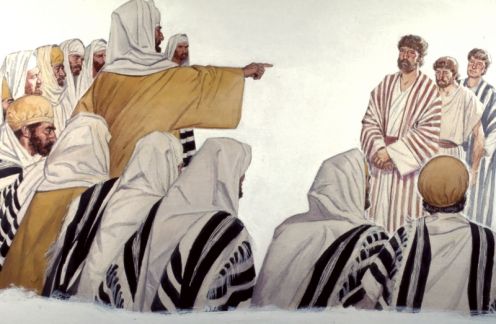
Then some of those who belonged to the synagogue of the Freedmen (as it was called), and of the Cyrenians, and of the Alexandrians, and of those from Cilicia and Asia, rose up and disputed with Stephen. But they could not withstand the wisdom and the Spirit with which he was speaking. Then they secretly instigated men who said, “We have heard him speak blasphemous words against Moses and God.” And they stirred up the people and the elders and the scribes, and they came upon him and seized him and brought him before the council, and they set up false witnesses who said, “This man never ceases to speak words against this holy place and the law, for we have heard him say that this Jesus of Nazareth will destroy this place and will change the customs that Moses delivered to us.”

And the high priest said, “Are these things so?”

Acts 6:9-14, 7:1 (ESV)

When Caiaphas asked Stephen “Are these charges true,” he in effect asked, “Are you and your sect speaking against Moses, against the Torah, and against the Temple?

The charges were serious, and the trial had ramifications for the entire Yeshua (Jesus) sect (of Judaism). As a community leader over the assembly of Yeshua’s disciples, Stephen represented the beliefs of the whole community. If the court found him guilty of blasphemy or apostasy, they might turn against the whole sect.

Torah Club, Volume 6: Chronicles of the Apostles
from First Fruits of Zion (FFOZ)
Torah Portion Toldot (“Generations”) (pp 141, 143)
Commentary on Acts 7:1-60

Last Sunday, at the local church I attend, Pastor Randy’s sermon, as he covers the book of Acts, was specifically on Acts 7:1-19. Since the portion of Acts covered by Volume 6 of the Torah club for this coming week’s Torah reading is Acts 7, I thought it would be a good opportunity to compare what is being taught about Stephen and his defense to the Sanhedrin in my church vs. FFOZ’s viewpoint on the same event to see the similarities and differences. I didn’t get what I was looking for. Here’s why as outlined in the printed conclusions of the Pastor’s sermon last week:

Conclusion: Stephen’s sermon helps us to remember…

  1. The sovereign activity of God in choosing people, places, and timing in all things.
  2. The sovereign, abundant grace of God toward rebellious sinners always.
  3. The danger of hardening our hearts against God’s grace.
  4. The error of going through outward motions where our hearts are far from God.

While D. Thomas Lancaster in his Torah club study and Pastor Randy in his sermon series are covering identical material from Acts, the purpose and focus in each of their teachings are not at all the same. Lancaster is addressing the issue of whether or not the charges against Stephen were true; was he really speaking against Moses, the Torah, and the Temple as he had been accused of? Pastor Randy, on the other hand, was using Stephen’s “sermon” (it was actually a legal defense and not a “sermon” as we understand the term in the church) as an illustration of God’s grace and mercy to sinners who repent and turn back to God.

Kind of like trying to compare apples and oranges.

Maybe that’s a good thing, because the Sunday school class I go to after services addresses (though tangentially) the content of the lesson from the Pastor. What if the Sunday school teacher asked if the charges against Stephen were true and I answered based on Lancaster?

Of course, the allegations were not true, but was there any basis at all to the charges?

Stephen presented a pro-Temple, pro-Torah apologetic which, in essence, affirmed his orthodoxy within normative Judaism. He cited the biblically based origin for the authority of Moses and the Torah, and he told the story of the origin of the Temple. He went on to make a case for Yeshua, declaring Him to be the “prophet like Moses” who, like Moses himself, suffered His people’s rejection. In the same way, he drew in the Temple theme as he pointed out that Israel’s historical compromises with paganism contrasted against the sanctity of the true Temple. By the end of his defense, he turned the tables around. The accused became the accuser. He claimed that just as the nation of Israel historically rejected Moses, broke the Torah, and compromised with idolatry, the Jewish leadership had committed a similar crime by rejecting the appointed Messiah. (Lancaster, pg 143)

Notice that Lancaster says that Stephen accused the “Jewish leadership” of rejecting the appointed Messiah, not the “Jewish people.” Since thousands upon thousands of Jews in Jerusalem had accepted Jesus as the Messiah in the weeks and months following Pentecost, it would be very difficult to say that the Jews en masse had rejected Jesus.

Lancaster says that the charges against Stephen were absolutely false, but we tend to hear a different message in Christianity (although no such message was presented in last week’s sermon at my church):

Commentators regard it…as an ironic twist that the so-called “false charges” were actually true. For example, F.F. Bruce (from Bruce’s book, “The Book of Acts,” 1988, pg 126) says, “They are called ‘false witnesses’ because, although their reports had a basis of truth, anyone who testifies against a spokesman of God is ipso facto a false witness.” Numerous Christian commentaries insist that, contrary to what Luke tells us, the witnesses were not really false nor were their allegations really lies. From a traditional Christian point of view, Stephen must have taught against the Temple with its obsolete sacrifices, against the Torah with its cancelled ceremonial laws, and against the customs, i.e., the traditions of men. (Lancaster, pg 142)

Remember that I said not too long ago, quoting Pastor Jacob Fronczak’s article, The Five Solas: Sola Scriptura:

Even with the Masoretic traditions, though, many English readings of the Scripture can be divined from a single Hebrew text. Translation committees have to pick one. Many times readings are chosen to emphasize some Messianic prophecy which appears to point to Jesus Christ, while a Jewish translation committee might choose a different readings for the exact opposite reason. Both readings might be technically correct. However doctrinal presuppositions dictate which reading is chosen. In effect, then, when Christians have only an English Bible and no other tools, they are completely unable to interact with the Scripture – the original Greek and Hebrew texts. They are completely dependent on the work of the translator.

If our doctrinal presuppositions dictate how a passage in scripture is rendered from its original language into English (or any other modern language), the same can be true for how we interpret scripture. Even reading the ESV Bible’s translation of Acts 7:1-60, there’s nothing in the plain meaning of the text that indicates Stephen must have been speaking against Moses, the Torah, and the Temple. In fact, the vast majority of his defense reads like a simple history lesson, compressing the relevant sections of the Tanakh (Old Testament) into a few paragraphs. Stephen doesn’t appear to be denigrating the Jewish Torah and traditions but rather defending them. He only accuses the Sanhedrin of going against the Torah and teachings of Moses, in violation of what Jesus himself taught and defended.

You can see why I might be a little hesitant to speak up in Sunday school later today as I did last week.

It’s another Sunday (as you read this) and church services start at 9:30 this morning. I’ll be there again, and I’ll go to Sunday school again, and I don’t really know what I’m going to say or do. Hopefully, nothing stupid, but there are no guarantees. I’ve said and done stupid things before, even when I knew better. Telling what I understand to be “the truth” is not always defensible if I know in advance that the result will be upsetting or harmful to others. Even if I chose to speak, I would have to do so in a way that was not accusatory or offensive to others.

There is a major difference between being critical, and having a positive influence on others by saying things with compassion and true caring. When you sound critical, the person on the receiving end is likely to deny your words, which will be perceived as an attack. And then you won’t accomplish anything.

-Rabbi Zelig Pliskin
“Daily Lift #634, Correct Without Being Critical”
Aish.com

So far, the only person at church who even knows this blog exists is Pastor Randy, and I don’t even know if he has visited here since our first meeting last week. Since it’s not likely anyone else at church knows I write these “morning meditations,” I’m more at liberty to express my thoughts and opinions here than I should be when in Sunday school.

Of course, this is only the second Sunday I will be back in church. I really need to learn to be more patient and not “shoot off my big mouth” just because the Sunday school teacher asks a question and no one answers. Silence isn’t always in invitation for me to “make noise” nor is it a reason to think that I can “correct” anyone else in their beliefs.

Maybe I should be paying more attention to what the Bible is telling me about what I need to do to make me a better person than what I think it says about making others better.


Learning the Traditions of Our Fathers

Talmudic Rabbis“We keep the customs of our forefathers.”

Shabbos 35b

The Gemara here notes that we keep the customs of our forefathers, even when the rationale behind the custom no longer applies. One such custom is the recitation of Kedushah in U’va LeTzion. Why do we repeat Kedushah if it has already been recited during Birkas Kri’as Shema and Chazaras HaShatz?

The origin of this recitation is recorded in Shibolei HaLeket (ch. 44). There was a time when the gentiles banned the Jews from reciting Kedushah and would send a representative to sit in shul through Chazaras HaShatz to guarantee that it was not recited. Once Chazaras HaShatz was completed, the representative felt confident that his job was finished and he would leave. Only later, when the gentiles left, were the Jews able to say Kedushah. They therefore inserted Kedushah into U’va Letzion, in Hebrew and Aramiac, to replace the two times they were not able to say Kedushah, in Birkas Kri’as Shema and Chazaras HaShatz. Although we are now able to say Kedushah without fear of being harmed by gentiles, we continue to recite Kedushah in U’va Letzion based upon the principle of “Minhag Avoseinu Biyadeinu” — “The custom of our forefathers remains in our hands.”

Daf Yomi Digest
Stories Off the Daf
“Keeping the customs of our fathers”
Commentary on Shabbos 35b

All denominations or sects of Christianity of which I’m aware have a problem with the relationship between religious Judaism and its traditions and customs. As we see from a Christian point of view, the function of traditions in Judaism seems to exceed what we would consider practical utility and common sense. Certainly all cultures and groups engage in various traditions and as such, there’s no problem in this, but why participate in a custom or tradition that has outlived its usefulness and may well (though not in this case) contradict the Word of God?

Christianity, and particularly the Protestant church, sees itself as relying solely on the Word of God as we have it in the Bible without the “traditions of men” getting in the way (Sola scriptura), while we tend to see Judaism as relying primarily on their traditions (which we see growing and growing, even when some of them have outlived their original purpose) as equal or even superior in authority to what God has said to Israel. But does that really reflect the reality of what we do (and you probably know where I’m going with this)?

To define sola scriptura without academic terminology might sound something like this: The Bible is the only authority in the believer’s life; it is never wrong about anything; it touches on every aspect of life; it needs no outside help to be correctly interpreted; it never disagrees with itself; it can be understood by anyone of average intelligence; and it applies to everyone in every situation.

I only use the example of translations to illustrate the fact that in a very practical sense, the Scriptures in their original languages are, for most Christians, not enough – tools such as translations, concordances, the Masoretic vowel points, and commentaries are required in order to understand the text. Of course, the goal is to understand the original text, which in itself is not an objection to the doctrine of sola scriptura – until one realizes that every translation, every commentary, and even the textual tradition itself are all based on traditions along with the divine written revelation. It is simply impossible to get away from these traditions and study the Bible in isolation.

-Jacob Fronczak
“The Five Solas: Sola Scriptura”
Messiah Journal, Issue 111 (pp 47, 52)

If you read my recent blog post, Chayei Sarah: Oil for the Lamp, you recognize the quotes from Pastor Fronczak. You also remember the meaning behind those words: that Catholic and Protestant Christianity does not understand what the Bible is saying apart from our own traditions. That is to say, no one of us has raw, unfiltered, unmediated, uncommentaried access to anything the Bible is telling us. We all read the Bible while wearing the moral and intellectual equivalent of “rose-colored glasses.”

Not only do we find that we must accept the wisdom of the “traditions of the Christian elders,” but we must also accept the wisdom of the “traditions of the Jewish elders.” Why?

Consider the Old Testament. About two-thirds of the Christian Bible is made up of the Old Testament. Who wrote the Old Testament? Jews (It’s important to realize that Jews also wrote the New Testament, but that’s a discussion for another time).

The organization of books, chapters, verses, and insertion of vowels and punctuation all come from Jewish sources, and have been altered very little if at all by Christian translators in most cases. Without realizing it, the vast majority of Christians, when reading nearly any part of the Old Testament, are tacitly accepting Jewish tradition in how it is translated and presented to us.

Right now, you might be saying, “So what. I still believe the Bible is the highest written authority and no Rabbi, Pastor, or scholar is going to have an opinion or judgment that overrides scripture.” Well, that’s not exactly true.

Translating dead languages (ancient Hebrew, Aramaic, and Greek are all dead languages and only somewhat associated with the modern-day “living” counterparts) into the land of the living so that English speakers (for example) can read the Bible is no small thing and it’s hardly an exact science. The art of Biblical analysis and translation is highly specialized and it’s not a matter of simply saying, Word A in Hebrew means word B in English.

Even with the Masoretic traditions, though, many English readings of the Scripture can be divined from a single Hebrew text. Translation committees have to pick one. Many times readings are chosen to emphasize some Messianic prophecy which appears to point to Jesus Christ, while a Jewish translation committee might choose a different readings for the exact opposite reason. Both readings might be technically correct. However doctrinal presuppositions dictate which reading is chosen. In effect, then, when Christians have only an English Bible and no other tools, they are completely unable to interact with the Scripture – the original Greek and Hebrew texts. They are completely dependent on the work of the translator.

-Fronczak (pg 52)

Let’s go through that again. Two separate translations of the Hebrew (or Greek) text can both be technically correct, but actually render opposite meanings, depending on the doctrinal presuppositions of the translation committees involved.

I’d love to just copy and paste the entire text of Fronczak’s article into this blog post because I think every Christian (and Jew) should read it, but that’s highly impractical. You’ll just have to purchase a copy of Messiah Journal to read all of his write up (and even if you disagree with Fronczak, you’ll still have to read the complete content in order to craft a rebuttal that contains any validity at all).

But beyond apparently trying to shoot down the doctrine of sola scriptura, why am I bothering to write this and why should you care?

The vast majority of Christians do not interact with the rabbinic tradition at all. As a consequence, it is poorly understood and even attacked. Modern Jews have not forgotten the Christians who burned copies of the Talmud in Europe. Even many in the Hebrew roots movement disparage the teachings of the rabbis and ancient sages, without realizing that in many ways, we rely on these very teachings in order to interpret the Bible.

First Fruits of Zion has been vehemently attacked for this very reason – we rely on rabbinic traditions and other extra-biblical literature to illuminate and explain the text of the Scripture. Like any reputable translation committee or research institution would do, we consider a lot of evidence before coming to a conclusion on what a Bible passage means. Unfortunately, people who do not understand the importance and usefulness of this literature continue to disparage the ministry of First Fruits of Zion, even though they, as explained above, are equally reliant on traditions and extra-biblical evidence for their own interpretations of the Scripture. The continuing attacks on traditional Jewish literature such as the Talmud and Zohar betray anti-Judaic and perhaps even an anti-Semitic spirit on the part of many of our detractors.

-Fronczak (pg 53)

The focus of my point for this blog post and for the existence of my blog in general, overlaps Fronczak’s and First Fruits of Zion’s (FFOZ’s) message, but my overall scope is beyond the confines of Messianic Judaism and Hebrew Roots (and all of the variants those two groups contain). This is a message that should concern every Christian and every church, regardless of denomination or affiliation. We all share a common Bible (relative to translation), a common Jesus, and a common God. The origin of the core faith in Christ of the church can be traced directly back to ancient Israel and the Second Temple period, and the origin of everything Jesus taught as we have it recorded in the New Testament, every bit of it, travels deeply back into the Old Testament, to David, to Moses, to Jacob, Issac, and Abraham, and indeed, back to before Adam and the creation of the world by God. Not one word of what Jesus said wasn’t Jewish, nor was any of it disconnected from the Jewish reality of the Bible.

Add to that the fact that we in the church rely just as much on our traditions (and some Jewish traditions) to understand all of what God is saying, and we have a very poor case for tearing apart Jewish reliance upon tradition to understand themselves and God.

It is really, really important to view the struggle of Christianity trying to comprehend Judaism as not a specialized or niche perspective or movement. It’s not just for those few people who are affiliated with those entities we call “Messianic Judaism” or “Hebrew Roots.” This is the struggle, the mission, the challenge for everyone who calls themselves a Christian.

If the church has any hope of understanding itself, it (we) must come to terms with not only where we came from, but the people and nation God granted the ability to give us life in Him, the Jews. We cannot afford to keep living in an isolated silo pretending that those connections are forever severed or relating to our “Jewish roots” as if the last 2,000 years of Jewish and Christian history, culture, custom, and tradition simply never happened.

Not long ago, I wrote another blog post called Intersection. There are a small group of Christians and Jews who are approaching a point of intersection where we going to realize we are, in some mysterious or even mystic way, interdependent on one another for the sake of the Kingdom of Heaven (which has nothing to do with “going to Heaven” and everything to do with enacting and progressing God’s plan for humanity on Earth). What may now appear as minority religious groups, variant Christian and Jewish sects, and even (Heaven forbid) cults, may well actually be part of the resurgence, the restoration, and the re-establishment of God’s intentions and design for His people Israel and the other nations of the Earth.

I believe when those Jewish and Christian people arrive at the intersection, this will happen.

“Thus says the Lord of hosts: Peoples shall yet come, even the inhabitants of many cities. The inhabitants of one city shall go to another, saying, ‘Let us go at once to entreat the favor of the Lord and to seek the Lord of hosts; I myself am going.’ Many peoples and strong nations shall come to seek the Lord of hosts in Jerusalem and to entreat the favor of the Lord. Thus says the Lord of hosts: In those days ten men from the nations of every tongue shall take hold of the robe of a Jew, saying, ‘Let us go with you, for we have heard that God is with you.’”

Zechariah 8:20-23

No, I don’t believe Christians will be turned into Jews or Jews will be turned into Christians (and a Jew being Messianic is not the same as being “Christian” as we comprehend the concepts and lifestyles), but we will all flow to “the mountain of the house of the Lord” and the people of many nations will say, “Come, let us go up to the mountain of the Lord, to the house of the God of Jacob, that he may teach us his ways and that we may walk in his paths.” (see Micah 4:1-2)

Many Christians, including those in the Hebrew Roots movement, are fond of quoting from Ephesians 2 (particularly verse 15) and saying that differences and distinctions between Jews and Christians were all obliterated (along with the Torah, Talmud, shabbat, Passover, and anything even remotely referring to a Jewish identity and life) in Christ, “nailed to the cross,” so to speak.

And yet the unity that we see described in Zechariah 8 and Micah 4 requires no melding into uniformity between Gentile and Jew in order to achieve the prophesied unity between Israel and the nations. What is required is a sense of humility and recognition, the humility to “take hold” of the tzitzit on the tallit of a Jew, and to ask him to guide us to the mountain of the house of the Lord, the holy Temple in Jerusalem (which apparently will exist again) so that even we non-Jewish disciples of the Jewish Messiah King may be taught his ways and walk in his paths. (Zechariah 8:23 “says take hold of the robe of a Jew.” Is that any Jew or only one, the firstborn son of Israel…Moshiach?)

We’re all doing our best right now to do that; to walk in his paths. But we can do better. We must do better. Let us hurry to the intersection and meet together, Christian and Jew, we who share the Messiah and honor the One God. Time is short. There’s a lot of work to be done, starting with learning how to listen to one another, and comprehend the wisdom of the customs of our fathers, both the Jewish and Christian fathers.

Intersection

Due to the sin of murder the Beis HaMikdash was destroyed.

Shabbos 33a

Maharal points out that man is distinct and loftier than all other creations. Only man is infused with a heavenly spirit from above. Similarly, the Beis HaMikdash is on a separate plateau in function and purpose above all other places on Earth.

Furthermore, man himself functions as a type of Beis HaMikdash, in that he carries the shechinah with him, and he serves as a vehicle from which kedushah emanates and spreads throughout the world.

This is the underlying principle which our Gemara is presenting. The taking of human life, aside from the tragic aspect of the personal loss, also represents a destruction of a human Beis HaMikdash. A person, while he lives, has the ability to accomplish worlds of achievement in the realm of kedushah and in the service of Hashem. With the loss of this life, this person’s contribution to the world in this regard has been ended.

Daf Yomi Digest
Gemara Gem
“The holy human”
Commentary on Shabbos 33a

This is a rather remarkable Jewish commentary from a Christian point of view. We Christians tend to believe that only we possess the “indwelling of the Holy Spirit” as a consequence of our faith in Jesus Christ. We tend to believe that no other people group or religious tradition, especially Judaism, has this concept, let alone possesses this reality.

But what if we’re wrong?

Here we see that the Jewish sage writing this believes that “only man is infused with a heavenly spirit from above.” And just as Christians believe that each of us is a Temple housing the Spirit of God, (see 1 Corinthians 6:19 and 1 Peter 2:5) the Rabbinic commentator states, “man himself functions as a type of Beis HaMikdash, in that he carries the shechinah with him, and he serves as a vehicle.”

For those among you who may not know, the Beis HaMikdash can refer to the Temple in Jerusalem (which currently doesn’t exist) or the Heavenly Temple.  In the days of Solomon,  the Temple housed the shechinah or the Divine Presence, which Christian Bibles call “the glory of God” (this is also true of the Tabernacle in the days of Moses). While we can’t make a direct comparison between the shechinah and the Holy Spirit, we see that both Christian and Jewish concepts of how God “indwells” the faithful are all but identical.

Imagine that.

But why do I say such a thing and why should you care?

Shmuel only crossed a river on a bridge together with a gentile. He said that misfortune would not occur to two nations simultaneously.

Shabbos 32a

Shmuel crossed the river only on a ferry boat upon which gentiles were riding with him. He determined that the Destroyer cannot punish Jew and gentile together, so he would be safe and secure that the boat would not capsize.

-Daf Yomi Digest commentary

This is a less than complimentary Jewish commentary about we Gentiles, since it implies God will not visit a tragedy upon the Jew that is going to occur to the non-Jew for the sake of the holiness of the Jewish people. It elevates the Jewish people above the other peoples of the earth in a spiritual way due to the perception of a Jew’s higher awareness of God. Actually, the commentary may well be true of many non-Jewish nations and people who neither fear Hashem nor honor the God of Israel.

But what about Christians? Can’t we be said to have an awareness of God through our devotion to Jesus, the Jewish Messiah? I would say “yes,” but we must remember that said-awareness and devotion originated with the Jewish people, and did not spring forth fully grown among the Gentiles, independent of Israel.

Many Christians reading this may get the wrong idea about what I’m trying to say. Some may even feel threatened, as if I’m subordinating Christianity to Judaism in a manner that makes we non-Jewish believers into “second-class citizens” in the Kingdom of God.

I’m not saying that at all.

But I do want to say that the church has a tendency to reverse causality. We often view Jesus as wholly owned and operated by Gentile Christianity and completely divorced from (if he was ever “married” to) Judaism in any way or form. That’s pretty tough to do since Jesus was born to a Jewish mother, was circumcised on the eighth day, was raised as a Jew, was granted the power of the Spirit as the Jewish Messiah, walked like a Jew, talked like a Jew, only had Jewish disciples, ordered his Jewish disciples to only minister to the “lost sheep of Israel” in only Jewish communities, barely spoke to a Gentile, and after death and resurrection, promised to return to establish Jewish self-rule of Israel and over the nations.

Tsvi Sadan, who authored what I consider a landmark book, The Concealed Light: Names of Messiah in Jewish Sources, wrote an article recently published in Messiah Journal, issue 111 called “You Have Not Obeyed Me in Proclaiming Liberty.” It’s a unique article in that it takes to task the missionary efforts of the church to convert Jews to Christianity. But Sadan is a “Jewish believer.” More accurately, he’s a “Messianic Jew” living in Israel, and that makes all the difference in the world.

What I have described up to this point means that much of what calls itself Messianic Judaism is in fact an exotic Christian sect. One can argue until blue in the face that the Israeli Supreme Court was wrong when in 1989 it ruled that Messianic Jews are people who belong to “another religion.”

I imagine that there are more than a few Christians reading this who are quite puzzled. After all, isn’t Messianic Judaism just another form of Christianity? What’s wrong with Jews converting to Christianity? Jesus is “Jewish,” isn’t he?

Of course, when most Christians say that “Jesus is Jewish,” it’s like how they view the occasional Jewish Christian in their church…someone who is Jewish in name only and who, in terms of any identity markers, has surrendered cultural, ethnic, experiential, and halalaic Judaism for a completely Gentile Christian identity and lifestyle. This is what I mean by reversing causality. In the early days of the ministries of Peter and Paul, masses of non-Jewish people came to be reconciled with the God of Israel through the Jewish Messiah, embracing religious practices and concepts that were completely Jewish and totally foreign to them. Today, we in the church expect Jews to abandon all of their Judaism and to worship a Lord and Savior who, from our point of view, is totally foreign to Jews.

But Sadan has more to say:

Yet the judges were no fools. Long ago the Jewish people reached a firm decision to reject the kind of good news described above. The refused the gospel which in the name of Jesus called them to convert to another religion. They refused the gospel which in the name of Jesus called them to break their unique covenant with God. They refused the gospel which forced them to identify with the culture of their oppressors. They refused the gospel which called them to compromise Jewish monotheism and reject the Talmud, their tradition, and their cherished customs.

That’s got to be a tough paragraph for most Christians to read and accept, but remember that I’m pulling it out of the context of the entire article. Sadan is criticising what I call “reversing causality.” Why should Jews have to stop being Jewish and join “another religion” (other than Judaism) in order to become disciples of the Jewish Messiah and to worship the God of Israel; a God they have been worshiping since the days of Abraham, Isaac, Jacob, and Moses?

You’ll have to pick up a copy of Messiah Journal (and I highly encourage you to do so) and read Sadan’s entire write-up in order to fully comprehend where he’s coming from, but he does have a “happy ending” for how Jews can be authentically approached in order to be brought near to Moshiach and to return to the Torah.

For the sake of we Christian readers, he does quote from New Testament scholar Scot McKnight’s little-known book A New Vision for Israel (1999) in order to substantiate Sadan’s viewpoint from a Christian perspective.

The most important context in which modern interpreters should situate Jesus is that of ancient Jewish nationalism and Jesus’ conviction that Israel had to repent to avoid national disaster. Jesus’ hope was not so much the “Church” as the restoration of the twelve tribes…the fulfillment of the promises of Moses to national Israel, and the hope of God’s kingdom. (pg 10)

Definitely a book I need to read.

I don’t blame you if you think I’ve gone off the deep end or have lost my mind as a Christian. It’s taken me a very long time to see from this particular vantage point and it may take “the church” just as long or longer to reach the same spot. But I believe we’re all getting there. I know several Christian pastors who share my vision about the relationship between Jews and Christians. I believe that God is involved and guiding us along a series of paths on journeys that will finally intersect.

Jews and Christians have interactive purposes in relation to each other whereby, as children of God, we are interdependent. The Jewish role is to return to the Torah and to embrace the holiness of God and we in the church are responsible for standing alongside the Jew and supporting that…not “mission” but “keruv,” bringing Jews near “to God and to one another, first and foremost through familiarity with their own religion and tradition…the Jewish people, as taught be Jesus, cannot comprehend his message apart from Moses (John 5:46)…Keruv is all about reassuring the Jewish people that Jesus came to reinforce the hope for Jews as a people under a unique covenant.”

For hundreds of years, perhaps since the beginning of Creation, a piece of the world has been waiting for your soul to purify and repair it.

And your soul, from the time it was first emanated and conceived, waited above to descend to this world and carry out that mission.

And your footsteps were guided to reach that place.

And you are there now.

-Rabbi Tzvi Freeman
“Now”
Based on letters and talks of the Rebbe
Rabbi M. M. Schneerson
Chabad.org

The Christian “mission” isn’t just to “get saved” and then wait for the “bus to Heaven.” Although vitally important, it isn’t just spreading the Gospel of Jesus Christ to an unbelieving world, to give everyone, everywhere hope that God loves them and will never forsake them, even in the darkest nights of our souls. The Christian mission is also one of “keruv,” of bringing Jews to the Messiah in a way that is Jewish and in a way that would be completely recognizable to the apostles as they began their message to the Jewish people after the events recorded in Acts 2.

Keruv is probably not a task for all Christians. It’s probably not a task for me, at least not in a direct sense. But we can all participate by recognizing our role and the role of Israel and by welcoming and espousing the unique purpose, identity, and lives of Jewish Israel under their King and ours, Yeshua HaMashiach..Jesus the Christ.

For nearly twenty centuries, the people who Jesus drew to him, either directly or through the apostles, the Jewish people and the people of the nations, were first torn apart through much strife, and then continued to drift away from each other, one treating the other as strangers and aliens. While we may not experience it overtly today, the church and the synagogue in relation to each other are so wounded and isolated. Only by each one finding our true and unique purposes and roles in the kingdom of God can we both be healed, can we both be granted the gift of transmuting grief into joy, can we both have our loneliness be turned into joy and fellowship.

57 Days: The Lord has Promised Good to Me

Peace of mind is essential for obtaining many virtues. Its absence leads to all types of shortcomings. When you have peace of mind, you can use your mind constructively. Lack of peace of mind breeds anger and resentment.

The quality of one’s prayers and blessings is dependent on the mastery of one’s thoughts. Above all else, one’s ability to study Torah properly is based on having peace of mind.

-Rabbi Zelig Pliskin
“Daily Lift #628, Peace of Mind is Essential for Growth”
Aish.com

Every Sunday, my daughter has to be at work at 5 a.m. That means I need to wake up at four and get ready to drive her so she can be at work on time. After that, when I get back home, I can get in bed again if I want to.

And that’s just what I did. But church services start at 9:30, so I set the alarm for 6:30. Makes sense to me. Gives me time to wake up leisurely, read, study, check my blog, have breakfast, and figure out if I have any semi-dress clothes that will fit. Haven’t had to “dress up” in quite a while, but fortunately I know how to use an iron and I don’t clean up half bad.

Both my wife and daughter were already at work when I was ready to leave for church, so there was no one around to wish me luck.

Made it there about ten to fifteen minutes early, which is early enough (I figured) to find a parking spot, but not too early that I’d have to conspicuously hang around a bunch of people I don’t know. Found the men’s bathroom, which is an important task in attending any public social event. About four people greeted me and shook my hand before I even got to the entrance of the sanctuary. Saw Pastor Randy who also cleans up pretty good. He was encouraging as was everyone else I met. He sent around the teacher for the class my son and daughter-in-law attends at the church. B.J. just wanted to say “hi” because he knew I was David’s Dad.

Because I told Pastor Randy that my wife is Jewish, other people seemed to know. One woman introduced herself (I didn’t hear her name because of all the background noise hundreds of people make when they’re talking all at once) and told me she was a Jewish believer. More than a few people, including the Jewish woman, said they hoped my wife would come to church with me soon.

Which is kind of what I was dreading, and that will sound odd to most Christians, but let me explain.

My wife wouldn’t receive the kindness of Christian contact and an invitation to come to church as a particularly positive thing. While she’s been to church in the past, her Jewish identity as it currently exists, does not accommodate going to church or attending Christian functions, even though she also doesn’t attend many Jewish functions. I just hope no one tries to contact her independently (I haven’t written my address and phone number down on anything at church, but I’m not that hard to find, either). I tried to explain this to Pastor Randy yesterday, but I’m not sure how he received it.

OK, one issue to be concerned about, but hopefully I’m making it a bigger deal than it really is.

Everyone was very friendly. Lot’s of handshakes and “glad your here.” I know that the “corporate greet your neighbors” handshaking is a normal thing in churches, but I’m still shy enough for it to make me a tad nervous.

The order of service and music was about what I expected. In fact, I was surprised that I remembered the tunes so readily. Nothing mysterious or too difficult. Words were on the screen at the front of the sanctuary.

One Pastor read the text from Acts 7 and then Pastor Randy gave the lesson from that chapter (they’re going through the book of Acts right now, pretty much dissecting it, but the series is slightly ahead of where I am in my Torah Club study on Acts, so I couldn’t leverage Lancaster while listening to the sermon). The bulletin contained a sheet for taking notes about Stephen’s defense to the Sanhedrin, which I used. I was interested in how Pastor Randy would frame Stephen relative not just to the Sanhedrin, but to the rest of the Jewish people, and the nation of Israel as a whole.

He very much acknowledged that Stephen was a Jew, just as his “fathers and brothers” were (Acts 7:2). I won’t go through my notes on what Pastor preached about, but it didn’t reflect the traditional Christian view of Stephen rejecting the Temple, Law, or the customs of the Jewish people in favor of the grace of Jesus Christ. Stephen was portrayed as “convicting” the Sanhedrin of going against the Torah of Moses and being faithless to God, which is more consistent with how I’d read these verses. The sermon was worded to be more accessible to a Christian audience and there were a few times that I thought the message might have been “toned down” a bit for the sake of the people listening (but I can’t be really sure, of course).

The Pastor made good use of his knowledge of Biblical Hebrew and Greek, gently suggesting that the NIV translation may not be entirely accurate. He spent a lot of time on the Abrahamic covenant, a favorite topic of mine lately. He also backtracked into Acts 6 and illuminated “trust and obey” to all of us. How do we know we trust God? How do we know our faith is genuine? Because if it is, we obey God. But what do we obey?

This is the $64,000 question from my point of view, since traditional Christianity usually says that works is dead and all we have to do is believe, while in Judaism, performing the mitzvot has center stage in a Jew’s life. The answer from the Pastor was, “good works.” Our faith is genuine if it produces “good fruit” (he didn’t actually say “good fruit,” but I thought I’d insert it here).

Pastor leveraged the Akediah (he didn’t say “Akediah,” but with his knowledge of Hebrew and having lived fifteen years in Israel, he must have been thinking it) to show us how faith, trust, and obedience are married concepts for someone who is truly righteous (he might have said, “for a tzaddik”). In going back to the original command God gave Abraham to leave Haran (Genesis 12:1), Pastor took the principle of obedience a step further in telling a story about some early Christian missionaries in India.

These missionaries were continually debating how they were to start out on their task, anticipating what might happen if they took this step or that. Finally, one of the missionaries said something like the following:

A Christian doesn’t have the right to demand to know where he is going. He must walk by faith.

Given everything I’ve been going through in anticipating “church,” he might as well have been talking to me.

Even as I wrote down the quote, I couldn’t help but marvel at how much of last week’s Torah portion had been inserted into Pastor’s message on Acts 7. He also included portions of Genesis 45 and Genesis 50, as he followed Stephen’s defense, which included references to the Patriarchs and the people of Israel.

Overall, the message was not only one of hope for Christians, that God is faithful and gracious even while we may have troubles in our lives, but that God has always been faithful and gracious to Israel and the Jewish people, even in the midst of their trials and suffering. God remains the constant for both Christians and Jews, and Abraham is the father for both the Christians and the Jews (and Pastor was careful to say that the Abrahamic covenant does not make the Christian “Jewish”).

After the sermon and closing song and prayers ended, it was time for Sunday school. I had chosen a particular class to attend, and Pastor Randy let Charlie, the teacher, know I was coming. Several handshakes later (I don’t mean to belittle this and actually, everyone was very friendly, but it will take me awhile to get used to so much human attention compressed into such a small space and time), I found where I could get a cup of coffee before class. The coffee ran out just as I was about to get a cup, so I didn’t have that delay before finding my classroom.

Consequently, I was the first to arrive. People trickled in and introduced themselves. The teacher and class members were mostly my age or older (I think one couple was a bit younger).  The first person to come in after me was an older gentleman named Dick. We got to talking and at one point he said something like, “It can be hard to find a church that gives you what you need,” and went on to say how fortunate they were to have a Pastor who preached the whole Word, including the Old Testament. He pretty much summed things up for me.

Class wasn’t as organized as I would have expected. I was glad it wasn’t heavily scripted, because that tends to stifle individual or creative response, but I saw that people struggled to respond when Charlie threw a question out among us.

I really, really had intended to be quiet, and just to listen and observe. That didn’t last very long and all of my old “reflexes” in addressing classroom questions and answers, built up over the years in my previous congregational experience, immediately took over.

In fact, I realized at one point, that instead of answering a question, I expanded on it and turned the question back to the rest of the class.

Oops.

I tried to tone it down after that, but I may have come close to crossing the line when I suggested that no matter how much God has chastised Israel, He has always brought them back, and will continue to fulfill His promises to them by bringing them back (not by restoring only a tiny remnant, but by redeeming Israel) to Him.

After class was over, I apologized to the everyone and particularly to Charlie for my being such a chatterbox. Not many of the other class members talked much, although during one of my monologues, I entered a dialog with one of the other fellows. Everyone was gracious about it and I hope I didn’t offend anyone. I didn’t think I’d get this “interactive” for weeks, but the wheels kept spinning in my head and once I opened my mouth, words started zipping out.

I was kind of interesting that all of the other students there were married couples except for one woman whose husband was on some sort of business trip in Turkey. I can see it’s going to be awkward to be going “stag” to church every Sunday.

Oh, both in the service and during Sunday school, I liked how the Jews weren’t blamed for rejecting Jesus or being bad examples, and in fact, the teachings emphasized how we Christians were expected to live up to the teachings of our Master.

At one point, Charlie, in discussing how Jesus dealt with faith or its lack as recorded in Mark 9 and 10, said, “If Jesus attended this church, what issues would he have to address here?” A little later he asked, “What would Jesus have to say to me” (about my failings)?

The experience wasn’t perfect, but then I expected that I’d feel out of place in an unfamiliar social environment. It was very “Christian” in all the ways I thought it would be, except that Judaism was treated much better relative to the Jewish Messiah and the Gentile disciples than I had imagined. The music lacked a certain punch, but that’s not really an issue for me compared to the other matters I’ve discussed, although they did introduce a bit of an “experiment” by having band sing “Amazing Grace” to the tune of The House of the Rising Sun (originally recorded by the Animals in 1964). It totally rocked.

Yes, I’ll go back next week for a variety of reasons, not the least of which is that I’m curious as to how far I can enter Christian fellowship and how much I will be able to integrate and still keep the core of who I am as one of the world’s most unusual Christians. At this point, my only real reservation, as I said before, is how far some of the folks in the church will try to press me to bring my wife to services. I don’t think that part would go over well at all.

Guess I’ll see how it all works out week by week, day by day, by God’s grace.

The Lord has promised good to me…
His word my hope secures.
He will my shield and portion be…
as long as life endures.

-John Newton (1725-1807)
Amazing Grace


61 Days: Stars

I the Preacher have been king over Israel in Jerusalem. And I applied my heart to seek and to search out by wisdom all that is done under heaven. It is an unhappy business that God has given to the children of man to be busy with. I have seen everything that is done under the sun, and behold, all is vanity and a striving after wind.

What is crooked cannot be made straight,and what is lacking cannot be counted.

I said in my heart, “I have acquired great wisdom, surpassing all who were over Jerusalem before me, and my heart has had great experience of wisdom and knowledge.” And I applied my heart to know wisdom and to know madness and folly. I perceived that this also is but a striving after wind.

For in much wisdom is much vexation, and he who increases knowledge increases sorrow.

Ecclesiastes 1:12-18 (ESV)

The Voyager 1 spacecraft’s 35th anniversary is proving to be unexpectedly exciting, as scientists gathered this week to examine new hints that the spacecraft is on the verge of leaving our solar system.

Voyager 1 is now more than 11 billion miles away from Earth. It blasted off in September 1977, on a mission to Jupiter and Saturn. But it also carried a Golden Record filled with music and the sounds of our planet, in case it encountered intelligent life as it moved out toward the stars.

Scientists have been eagerly waiting for Voyager 1 to become the first human-made object to leave the solar system. And in recent weeks, the spacecraft has sent back intriguing signs that it might be getting close, to the delight of researchers who have been working on it for decades.

-Nell Greenfieldboyce
“After 35 Years, Voyager Nears Edge of Solar System” (Sept. 5, 2012)
NPR.org

Most weekday mornings, I get up early enough to leave home by five, pick up my son who lives nearby, and then go to the gym to workout together. This time of year especially, it’s still dark when I open the garage door. Usually, I step outside for a minute and look up at the sky. The front of my house faces south, so if the sky is clear, I can see a fair number of stars, including the constellation Orion.

I don’t know why I look for it, except I can remember different times in my life, different “eras” in decades gone by, when I would look up at the night sky and recognize that constellation. I suppose it gives me some sense of continuity across my personal history.

It also reminds me of how incredibly small I am.

I intellectually understand how far away the planets and stars are, (I once, very briefly, considered a career in Astronomy) from millions of miles to untold light years, but to actually, experientially grasp the distances, even for a moment, is a staggering feat. I know we have robots on the surface of Mars, and Mars is relatively close to Earth, but if I had to walk such a distance; if I have to travel across the emptiness of interplanetary space, how lonely and isolated I would feel. Imagine yourself somehow traveling with Voyager 1 as it prepares to exit the official confines of our solar system and, setting aside the fiction of Star Trek or Star Wars for a moment, try to comprehend just how far away you would be from everything you know and love…

…except God.

I was thinking all these thoughts this morning as I lay awake in bed around 3 o’clock. I don’t know what brought it to mind. I had a bit of a headache, which is unusual for me, particularly in the morning. Perhaps it was something I had dreamed that disturbed me in some way.

My blog and blog comments periodically come to the attention of a few Internet trolls and, in their self-importance, they find it necessary to be disagreeable (only excusing their rudeness and hostility by calling it “debating” or even some form of “loving”). It’s certainly unsettling to be treated badly by those who also claim the cause of Christ (such as being openly maligned by name on their blogs without so much as a “by your leave”) and I won’t pretend it doesn’t bother me, but then, I stop and realize that it doesn’t really matter.

Oh, of course people matter. I don’t want to suggest that I don’t care about others and their well-being, but what I realize is that there are a few unhappy, or grumpy, or insecure people out there who have to try to suck joy out of the lives of others in a quixotic quest for significance in the blogosphere. It’s their behavior that inspired my Days series where I have been examining the idea of abandoning this blog and perhaps all Internet social media by the end of the calendar year.

So far (and I haven’t made a final decision yet), I’m deciding against giving up. First of all, my trollish critics are few in number, even though they can occasionally make a loud “noise” (like a noisy gong or a clanging cymbal). Secondly, far more people have been encouraging of me, both publicly and “backchannel,” than these two or three “curmudgeons” have been discouraging of me (though they aren’t curmudgeons in terms of years, merely in attitude).

I had thought about making this particular “meditation” today’s morning meditation, but passed it off as random thoughts of the night, deciding that Re-entry was a more worthy topic. But since the trolls have been active today, I decided I’d write this to clear my head of them and to realize that, in our human smallness, what happens from day-to-day in a small collection of blogs among a minority expression of Christianity doesn’t really matter. It’s certainly not worth my peace of mind.

As I said, I’m currently leaning toward continuing this “morning meditation” blog past January 1st, but I also think I’ll institute a tighter set of controls for comments. There haven’t been any really rude comments here for a while, but I anticipate they may return. In the past, in the interests of being fair, I’ve allowed a significant amount of abuse (in the guise of “debate” or being “loving”) in the comments people have posted on my blog, but that is likely to change. Free speech doesn’t mean “free to abuse” and a blog owner is more of a “benign dictator” than a moderator of democratic speech.

No, I won’t immediately flip over into draconian mode and if I think someone has crossed the line, I’ll serve fair warning first, but beyond that, I feel perfectly content to remove specific comments if they cross the line I set for proper decorum. And on occasion, I will close comments on a specific blog post if things get too heated (I’ve done both in the past). Repeat offenders who are not willing to “take a hint,” or those to engage in severe personal attacks or who use obscenities will be immediately banned.

Consider this my version of putting a wall around the roof of my home so that the safety of my “guests,” (and my own safety) who I consider anyone visiting my blog, (and most visitors don’t post comments) can be ensured.

But as I also said, I haven’t made up my mind yet. I can still pull the plug on life support and consign “morning meditations” to a peaceful, dignified demise. Better that than allowing the trolls to abuse what started out as such a peaceful and uplifting vision to begin each day.

When you awake in the morning, learn something to inspire you and meditate upon it, then plunge forward full of light with which to illuminate the darkness.

There are those who insist in living in darkness and they are not satisfied unless they pull others down into their realm with them. I prefer to soar and glide in the heights, letting the light illuminate my mind, my emotions, and my spirit, like the light of the sun gracefully reflects off of the wings of a dove.

The best response to harsh people is how Buddha responded; with a smile, accepting what was good and uplifting around him and not accepting anything else. I can’t even aspire to be Buddha, let alone Jesus, but I am supposed to emulate my Master so far as it depends on me by “living peaceably with all men.” (Romans 12:18)

Infinite darknessAngry and dissatisfied people are not helpful and are not healthy, for themselves or anyone exposed to them, even over the Internet. To repeat a lesson I continually need to learn…

Today I shall…

…try to improve my response to other people so that I only accept and give gifts of kindness, and not of anger.

Everything that we fuss and feud and argue about won’t really matter in the end. Jesus isn’t going to judge us on who won this blogosphere argument or that, no matter how important we may think they are at the time. They don’t really matter. They aren’t significant. Most of what we do isn’t significant. Staring up at the stars at five o’ clock on a clear autumn morning in Idaho, I realize that against all that vastness, against the stars, the space between me and them, and whatever is beyond, I’m not significant at all…

…except to God.

O Lord, our Lord,
how majestic is your name in all the earth!
You have set your glory above the heavens.
Out of the mouth of babies and infants,
you have established strength because of your foes,
to still the enemy and the avenger.
When I look at your heavens, the work of your fingers,
the moon and the stars, which you have set in place,
what is man that you are mindful of him,
and the son of man that you care for him?
Yet you have made him a little lower than the heavenly beings
and crowned him with glory and honor.
You have given him dominion over the works of your hands;
you have put all things under his feet,
all sheep and oxen,
and also the beasts of the field,
the birds of the heavens, and the fish of the sea,
whatever passes along the paths of the seas.
O Lord, our Lord,
how majestic is your name in all the earth!

Psalm 8 (ESV)