Tag Archives: Kabbalah

Vayigash: Descent and Ascent

Judah approaches Joseph to plead for the release of Benjamin, offering himself as a slave to the Egyptian ruler in Benjamin’s stead. Upon witnessing his brothers’ loyalty to one another, Joseph reveals his identity to them. “I am Joseph,” he declares. “Is my father still alive?”

The brothers are overcome by shame and remorse, but Joseph comforts them. “It was not you who sent me here,” he says to them, “but G-d. It has all been ordained from Above to save us, and the entire region, from famine.”

The brothers rush back to Canaan with the news. Jacob comes to Egypt with his sons and their families—seventy souls in all—and is reunited with his beloved son after 22 years. On his way to Egypt he receives the divine promise: “Fear not to go down to Egypt; for I will there make of you a great nation. I will go down with you into Egypt, and I will also surely bring you up again.”

Joseph gathers the wealth of Egypt by selling food and seed during the famine. Pharaoh gives Jacob’s family the fertile county of Goshen to settle, and the children of Israel prosper in their Egyptian exile.

Parashah in a Nutshell
Commentary on Torah Portion Vayigash
Chabad.org

Most of the time, when we study this Torah portion, we focus on the positive events that are depicted, such as Joseph finally revealing his identity to his brothers, the forgiveness and grace he shows them, in spite of their past cruelty to him, and especially the long-awaited reunion of Joseph with his grieving father Jacob. The Children of Israel are conducted to Goshen in Egypt and given the fat of the land, prosperity, and safety.

But what about all of the suffering?

As joyous as the reunion between Joseph and Jacob is (Genesis 46:28-30), there were the decades of grieving and terrible sorrow that Jacob suffered. He believed all this time that Joseph, his most beloved and cherished son, was dead. Once made Viceroy of Egypt, at any time, Joseph could have ordered that a message be sent to his father to comfort and reassure him. But no message was sent. Jacob remained in anguish, even as Joseph ruled.

While God reassured Jacob that He will go down into Egypt with him (Genesis 46:1-4) and we read that Israel is given “the choicest part of the land of Egypt” (Genesis 47:11), what about the harsh and horrible centuries to come, after the death of Joseph, when a “new king arose over Egypt who did not know Joseph” (Exodus 1:8) and Pharaoh oppressed Israel with burdensome labor and slavery (Exodus 1:13-14)? What about the murder of all of the male Israelite newborns (Exodus 1:22)? What of the cries of their mothers?

There is a saying in Kabbalistic circles that “for every descent there is an ascent.” We can certainly apply this to every time we have experienced disappointment and even tragedy that ultimately has resulted in a great benefit to us. The first thing that I think of is the “descent” the disciples of Jesus felt at his crucifixion and how all hope was lost to them (Luke 24:11). Even though Jesus had told them that he would be “handed over” and killed (Matthew 26:2, Mark 10:33, Luke 24:7), their faith melted like a snow cone in an Arizona heat wave. There are times in all our lives when only the barest shred of faith separates us from abject despair and the longing for death.

In 1798, Rabbi Schneur Zalman of Liadi was imprisoned by the czarist government on charges fabricated against him and the chasssidic movement.

When he was brought before his interrogators, the first question they asked him was: “Are you of Rabbi Israel Baal Shem Tov’s people?” Rabbi Schneur Zalman later related that he knew that if answered “no” he would be immediately released; nevertheless, he refused to disassociate himself from the Baal Shem Tov.

His 52 days of imprisonement in the Peter-Paul fortress in Petersburg were the most agonizing days of his life. He was forced to explain the basic tenents of Judaism and chassidism to the coarse Cossack minds of his questioners. He wept when he was asked “What is a Jew?”, “What is G-d?”, “What is the relationship of a Jew to G-d? Of G-d to a Jew?” – to hear these questions issuing from their vulgar mouths tore his heart to shreds.

One question in particular caused him great pain. It was Rabbi Schneur Zalman’s custom to interject the expression “af” in his prayers, as did the Baal Shem Tov. His enemies misconstrued this to mean that he was beseeching the Almighty to pour His wrath (‘af’ in Hebrew) upon the czar and his government. To explain to the Russian officials the Baal Shem Tov’s customs and his lofty reflections during prayer was torture to Rabbi Schneur Zalman’s soul.

Here too, Rabbi Schneur Zalman could have satisfied their queries with all sorts of answers. But his connection with the Baal Shem Tov, whom he called his ‘grandfather in spirit’, was so dear to him, that he refused to disclaim it in even the slightest detail, even if only for appearances sake.

-Rabbi Yanki Tauber
“Inseparable Souls”
Once Upon a Chassid
Chabad.org

This Chassidic tale illustrates the faith of a holy man but it also addresses his descent and his non-apparent ascent. While Rabbi Zalman was released after 52 days, Rabbi Tauber does not reveal the ultimate fate of this tzaddik. We can infer however that he was not elevated to a high ranking position in Czarist Russia as Joseph was in Egypt. Though he was finally freed from incarceration, where was his ascent?

During his journey to Egypt, Yaakov had a vision in which G-d reassured him: (Genesis 46:3-4) “Do not fear to descend to Egypt,” and promised “I will descend to Egypt with you and I will surely have you ascend.” Although Yaakov realized what he could achieve in Egypt, he was reluctant to descend there. For prosperity in exile even prosperity that is used to create a model of spiritually oriented existence is not the goal of a Jew’s life.

A Jew’s true life is in Eretz Yisrael and more particularly, Eretz Yisrael as it will exist in the Era of the Redemption. This is the promise Yaakov received from G-d that his descendants would be redeemed from Egypt and live in Eretz Yisrael together with Mashiach.

Why then did Yaakov descend to Egypt? Because he appreciated that the Redemption must be brought about by the Divine service of man. The establishment of a spiritually oriented society amidst material prosperity provides man with a foretaste of the Redemption, and prepares the world for the time when redemption will become manifest. Yaakov’s life in Egypt was dedicated to this purpose.

The theme of redemption is underscored by the Haftorah, which speaks about the ultimate union of Yosef and Yehudah: (Ezekiel 37:21-22) “I will take the children of Israel from among the nations… and bring them to their own land. I will make them one nation in the land…. No longer will they be two nations, no longer divided into two kingdoms.” And it promises: “And My servant David will be their prince forever,” for it is in the Era of the Redemption that the selfless striving for unity will receive the prominence it deserves.

-Rabbi Eli Touger
“Inspiring Change”
In the Garden of Torah
Commentary on Torah Portion Vayigash
Chabad.org

The ascent for Rabbi Zalman and indeed the ascent for Joseph and Jacob and for the grieving and heartbroken Apostles and for us is the same. To one day live in peace under the wings of the Maschiach; the Messiah. We Christians have that promise as well through faith in him who is our light. Though we descend with no ascent in sight, perhaps no ascent even within our mortal lifespan, we will ultimately dwell with our King and our Lord and eat at the feast of Abraham, Isaac, and Jacob (Matthew 8:11).

He shall judge between many peoples,
and shall decide for strong nations far away;
and they shall beat their swords into plowshares,
and their spears into pruning hooks;
nation shall not lift up sword against nation,
neither shall they learn war anymore;
but they shall sit every man under his vine and under his fig tree,
and no one shall make them afraid,
for the mouth of the LORD of hosts has spoken. –Micah 4:3-4

Amen and Good Shabbos.
Considering Replies

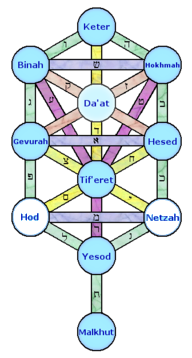
Hod is the counterpoint to Netzach. While Netzach strives to connect, Hod ensures that the power and energy in that striving is appropriate and acceptable. As we said earlier, it makes no sense to impress a student if the information is just too much to assimilate. Hod assembles the information to match the capacity of the receiver.

Hod tempers the force of Netzach, which, unchecked, can create distance rather than closeness. We have all experienced the colleague who is so effusive about his proposal that people simply stop listening. We have seen good ideas go ignored because an empathetic heart did not balance the Netzach exuberance. Empathy lies at the core of a caring relationship.

-Rabbi Laibl Wolf
“Hod: Creating Empathy” (pg 181)
Practical Kabbalah: A Guide to Jewish Wisdom for Everyday Life

If you’ve been reading my blog for the past week or so, you’ll know that I’ve been participating in an ongoing dialogue on the issue of Christmas trees and pagan practices in a number of online venues including Boaz Michael’s Facebook page, Jacob Fronczak’s Hope Abbey blog, and Judah Himango’s blog Kineti L’Tziyon. While the content on the blog pages themselves is reasonable (regardless of whether or not you or I may agree with that content), some of the comments made in response were not. I felt they represented an attack on Christianity or at least on those Christians who choose to put a Christmas tree in their homes, decorate it with tinsel, ornaments, and lights, and put gifts under it.

But I did’t write this “extra meditation” to talk about that again. I’m pretty much “talked out” as far as “Christmasphobia” is concerned and would just end up repeating myself if I tried to blog on it one more time. Instead, I’m here to talk about the communication dynamics I saw in those conversations and more in general, how methods of communication sell or sink our message as believers.

Most of the people who regularly read this blog probably aren’t interested in Kabbalah and some of you may be strongly opposed to its study, but in reading Rabbi Wolf’s discussion of Hod and Netzach, I recognized some of the common issues we all have when we want to get out point across.

Christians generally believe we have received a mandate from Jesus in what is called “the Great Commission.”

And you, go to all the nations. Make disciples; immerse them for the name of the Father, and the Son, and the Holy Spirit, and teach them to keep all that I have commanded you. And see, I am with you all the days until the end of the age. Amen. –Matthew 28:19-20 (DHE Gospels)

For nearly 2,000 years, Christians have, in one form or another, been attempting to tell the world about the Good News of Jesus Christ and the promise of salvation. We haven’t always done a good job at it, though. I’d say the various Crusades, Inquisitions, and Pogroms the church has lead can be described as a dismal failure of our evangelical directive. Even today, many non-believers cringe when a Christian asks them questions such as, “If you were to die tonight, do you know where your soul would go?” We are often depicted as judgmental, rigid, sexist, backward, superstitious “Bible-thumpers” and that description isn’t always particularly inaccurate.

It’s not so much the message we are trying to deliver that communicates such a dismal picture of the church, but how that message is transmitted. Christians really can be judgmental, inflexible, and insensitive to the needs of others, particularly of how people need to hear what we have to say (whether they choose to agree with us or not). We’ve gotten to the point where some folks want to run away when they think we’re about to try to convert them.

If you re-read the quotes I presented above, I’m sure you can immediately recognize that when we people of faith get such responses, we are likely leading with Netzach at the expense of Hod. This can especially be a problem with “text-only” communications on the Internet, such as in Facebook and blog comments, because most of what we use to communicate (body language, vocal tone and inflection) is completely absent. All we have is plain text and without anything to modify it, what we think we’re saying clearly can be terribly misunderstood. A message we think we’ve said with warmth and compassion can come across at hostile and uncaring. When confronted with such a message, it’s very easy to get worked up and fire back a response that is actually angry. The web conversation goes downhill from there, and I’m as guilty of such a transgression as anyone else.

Modeh AniWhat’s missing is illustrated by Rabbi Wolf in how he explains the Modeh Ani blessing which is recited by every observant Jew at the very moment when they realize they’re awake each morning.

The Kabbalah explains that this morning affirmation, known as Modeh Ani, provides the space to enter into the magical moments characterized by the transition from the unconsciousness of sleep into the light of day. The term Modah Ani is enunciated first thing in the morning. It means “I accept,” “I surrender,” or “I acknowledge,” or “I bow in front of you.” It is linked etymologically to the word for “thank you” in Hebrew (Todah)…

When we say “thank you” we are withdrawing and creating a comfort zone for another person. We touch their essence and draw it toward us. “Thank you” is a verbalization of the Hod flow. That is why it is so important to teach youngsters to say “thank you,” even if the deeper import is not yet fully understood. It trains children to express humility and an acknowledgment of others.

People who show humility invite more relationships into their lives.

-Rabbi Wolf (pp 185-7)

Putting Kabbalah and even the Modeh Ani aside, pay attention to the key phrase in Rabbi Wolf’s narrative: “we are withdrawing and creating a comfort zone for another person.” If we want someone else to hear us, regardless of our message, we must create a “comfort zone” for them, not for us. Yet we often do the exact opposite, creating a comfort zone for us and putting the listener on the defensive. This is especially easy to do on the Internet, even if it’s not our intent, because most of the elements of complete communication are not available. On top of that, we sometimes “pull rank” by explaining our abundant qualifications to be able to transmit our message. I don’t mind learned people and even “experts” in a particular field who have something to say, but a person who repeatedly has to outline their “quals” while making their point is an immediate turn off to me. The more you have to tell people, “I’m important and a big deal”, the more most people (me included) will believe that you’re not.

In one of the conversations I mentioned, one fellow responded like this:

I am a Hebrew. I am a Messianic Jew. A Kohen Levi. I am not one of the lost 12 tribes, nor do I believe in it.
My credentials…

I have no doubt all that is true for this person and you might say something like, “What’s wrong with what he said if it’s true? Is there a problem telling the truth?”

My answer: yes and no.

I don’t know how many conversations, both online and in person, I’ve been involved in (and where I was being put on the defensive) where the person talking to me responded to my resistence by saying, “well, it’s the truth!” Truth though it may be, if you can’t tell me the truth in a way that doesn’t drag me or other people through the mud (whether you really are or it just sounds that way), am I likely to listen? I’m not saying that you will or won’t convince me of your point of view, but there’s more than one way to present it. If you shove pure “Netzach” in my face while “Hod” has been left ten miles behind in the conversation, doesn’t this create a problem? It doesn’t matter what your family or cultural lineage is, how learned you are, how many languages you speak, and how much of a “Torah expert” you happen to be, if your message is delivered with all the tact of a barbarian horde riding madly across the seven hills of Rome, bent on the destruction, mayhem, and looting. No, I’m not saying that your intent is bad, just your delivery (OK, for some people, the intent is bad too, but it’s almost impossible to separate intent from inadequate communication over the web).

You Christians trying to fulfill your responsibility to share the Gospel with unbelievers, you are no different. Zeal is one thing and frankly, it is very important, but if you don’t create a space in the relationship where the person you’re talking to can feel comfortable, or at least a space where they don’t feel like they’re about to be spiritually jumped on and beaten up, you won’t “win a soul for Christ” (and I really hate the implications of that statement) or even convince the other person that you’re a half-way nice human being.

Being too empathetic makes you look wishy-washy and your message becomes completely ineffective. Being too zealous makes you look like a judgmental crusader out to bash someone’s head in with a Bible and your message becomes immediately disgarded by your audience.

Remember what I said a few days ago about being out of balance?

I’m not trying to bash anyone reading this or anyone who posted a comment in Facebook or on the blogs I mentioned. I’m imploring you to please, please look at the state of your intent and the balance of your Netzach and Hod. It doesn’t matter if you don’t use those terms. I doesn’t matter if you’ve never heard of Kabbalah or don’t like what you’ve heard about it. Take the labels off everything I’ve said and look at the dynamics of communication under the hood. That’s what matters. It matters a lot because we’re supposed to be God’s representatives in the here and now. I’ve already mentioned how it really matters what we “loose on earth” because it is also “loosed in heaven” (Matthew 18:18). Being careless about what we say and how we say it when presenting ourselves as people of faith, can elicit not only a poor response in the immediate circumstance, but create a long-term and even potentially eternal problem in the much larger spiritual realm.

One of the exercises Rabbi Wolf suggests in his book to help people develop Hod, is to participate in conversations where you wait three to five seconds to respond after your conversational partner says something. The exercise directs you to use the time to consider what to say and how to say it. Use the time to consider the impact of your response on your partner. What would happen if we did that all of the time? What would happen if we cared enough about other people to create a comfort zone for them in our conversations, if we listened to what they had to say, and if we stopped and considered their feelings and understanding before launching into our reply?

This probably isn’t true, but imagine this is the reason why God rarely answers our prayers immediately. Maybe He’s waiting until we are in our comfort zone with Him. Maybe He’s considerate enough to carefully craft His reply to us so it will be the most useful reply possible. Maybe God loves us that much. Imagine if we loved each other that much.

Out of Balance

In her book Kitchen Table Wisdom, Rachel Naomi Remen recalls the healing work she did with a Holocaust survivor, whose response to the enormity of the spiritual pain he lived with was to close off feelings toward people and to be “cautious with this heart.” Dr. Remen relates that he joined her on retreat after he was diagnosed with cancer. Initially he was belligerent to strangers, but through inner stillness exercises and introspection he had a transformational experience. One day, while meditating, he sensed a deep pinkish light emanating from his chest. He felt enclosed by a beautiful rose. Troubled by the experience, he took a walk on the beach and began a silent dialogue with G-d. He asked the Creator whether it is all right to love strangers. G-d’s answer jolted him: “You make strangers, I don’t.” In that instant, the Holocaust survivor’s feelings of interpersonal distance began to melt. Strangers were no longer strangers. It was all right to love a stranger.

-Rabbi Laibl Wolf
“Tif’eret: Growing a Wise Heart” (pp 154-156)
Practical Kabbalah: A Guide to Jewish Wisdom for Everyday Life

I’ve been feeling off balance lately. Most of it has to do with how I choose to react to what I see, hear, and read about in the world around me, both in real life, and via the Internet. I’m not encouraged by what I see, but if you’ve been reading my “meditations” for the past week or so, you already know that. I found I needed to write this “extra meditation” to try and re-establish a bit of balance and to reduce my desire to wad up the whole world of religion like a piece of tissue paper contaminated with dripping bile, and toss it in the nearest toilet.

For Christians, this is a time of year (ideally) when they re-attach to the true meaning of loving and giving, by expressing the will of God with their lives in the community around them. If God was willing to send His “only begotten son” to suffer and die for us so that we could be reconciled to the Father, then why shouldn’t a Christian “pass it on”, so to speak, and offer grace, kindness, and mercy to the next fellow, regardless of who they happen to be? After all, Jesus died for us while we were still enemies of God (Romans 5;10). Must we only show goodness to those people who look, act, and believe like we do? Why even “tax collectors” and “pagans” do that (Matthew 5:42-48). Nevertheless, the religious community, or some portions of it, confirm the belief in the secular world that we are all bigoted haters and want to force the whole world to be exactly like we are.

“The truth, the whole truth, and nothing but the truth, so help me, God.”

That’s part of the oath people used to take when swearing to tell the truth in court. They don’t make you say it anymore because someone was offended with God and we wouldn’t want to God to offend someone, would we (this is sarcasm)?

On the other hand, we shouldn’t go out of our way to be so dedicated to what we think of as “truth” that we automatically condemn, revile, disdain, and hate those people who apparently (perhaps by putting up a Christmas tree) don’t have “the truth”. After all, they must be evil and wrong and we have to stop them by telling them how lousy their cherished faith is, don’t we (that’s more sarcasm)?

OK, I’m still out of balance. Quickly, someone toss me one of those poles used by tightrope walkers, or better yet, another story from Rabbi Laibl’s book (pg 147):

Once upon a time a king had two close friends who rebelled against his kingdom. The king seemed to have no choice but to execute the law – the death penalty. But he could not bring himself to kill his friends. Instead, he erected a tightrope over the courtyard at a precarious height. Each prisoner was allowed to walk across the tightrope to freedom. The chances were slim, yet miraculously the first prisoner succeeded. The second prisoner called out to his friend for advice, and the freed man obliged. He called back, “Whenever I felt myself beginning to list to one side I didn’t wait until my weight was there but immediately compensated.

This Hassidic tale invokes many portions of the Bible, including how God sent His Son so that we might all have a chance to conquer the death penalty by “walking the straight and narrow”. Notice though, that in order to navigate the rope, you couldn’t be an extremist. If you went too far to the left or to the right, you would be killed. In fact, when you even thought you were starting to slip to one side, to survive, you had to immediately shift your weight in the opposite direction.

Also, notice that the freed man went out of his way to help his friend rather than taking his salvation and running away. Notice that even though the king (God) had every right to execute the rebels, because they were his friends and he had compassion, he tempered his justice with mercy. Justice was not thrown away, but he gave the rebels a chance, probably more of one than they deserved. Justice was balanced with mercy and grace.

We don’t do balance (or mercy and grace) very well in religion and yet, it’s all over our history. Moses Maimonidies (Rambam), as quoted in Rabbi Laibl’s book (pg 146) “counseled his disciples to take the middle path.” I know I talked on this exact same topic last week, but plenty of people still aren’t getting it (especially the majority who don’t read my blog, though they may not agree with me, even if they chose to read these “meditations”). It is one thing to say that you disagree with someone based on your convictions and your understanding of the Bible, but it’s another to condemn them and to believe God will destroy them. Some compare a Christian who celebrates Christmas to a husband to cheats on his wife (and there are plenty of marital metaphors in the Bible), but that metaphor breaks down at some point. A husband and wife are both human; both equals, while God is not human and we can not aspire to ever be His equal. A husband may come close to really understanding everything his wife is about, but we have absolutely no clue exactly what God is all about.

In the end, even if God chooses to condemn others and even if we were “right”, should we have treated those others negatively and with such extremist attitudes and even pride, or should we have balanced our approach to them as God did for us, tempering justice with mercy? Many religious people want to dump the justice onto others but covet the mercy all for themselves, not passing it along. Doing this, are we really God’s children?

Kabbalah Christmas

Hessed is the emotion of giving and sharing. When we reach out to a person in need, we are drawing on our Hessed flow. It is the basic cosmic flow with which creation is imbued. Indeed, we can say that the Sefira of Hessed is at the heart of humanity’s desire to make a meaning contribution to the world.

-Rabbi Laibl Wolf
“Hessed: Unlocking the Flow of Love” (pg. 120)
Practical Kabbalah: A Guide to Jewish Wisdom for Everyday Life

Does a kosher Christmas tree really exist? Well, not exactly but a new trend is taking place across the globe of topping off Christmas trees with a Magen David (“star of David”). As oxymoronic as that sounds, thousands have been sold in the US, Canada, the UK, Austria, Ireland, Australia and Mexico.

Not surprisingly, the holiday season can be a difficult time for interfaith families made up of Jews and Christians. The excessive commercial marketing of Christmas often makes Jews feel left out. Enter Morri Chowaki. He is a Jewish man who is married to a woman whose mother is Jewish and father is Greek Orthodox.

-Tobi Janicki
“A Kosher Christmas Tree?”
First Fruits of Zion blog.

No, I haven’t lost my mind (at least I don’t think I have). I know there’s no such thing as a “Kabbalah Christmas,” but I thought it would be a great title for this morning’s meditation, hopefully the title will attract a little attention and maybe even inspire a few folks to stick around and read today’s missive (please feel free to comment, too).

I never thought I’d write about Christmas. My family hasn’t celebrated this holiday in a religious or even a secular manner for well over a decade. But in reading about Hessed and Gevurah (more on that in a minute) in Rabbi Wolf’s book and then reading Toby’s write-up about Christmas at the FFOZ blog, inspiration took hold of me. After all, when we think of Hessed (sometimes spelled, “Chesed”), we think of acts of kindness and charity, which are certainly consistent with the highest ideals of Christmas. But there’s an important flip side.

Strength takes on many forms. Some of us are physically strong, or our strength may lie in our willpower. We may be strong-minded, or we may allow our feelings to flow strongly. Perhaps we have strong convictions. Our faith may be unshakable. The Kabbalah tells us that each of these forms of strength is connected by a common flow – the flow of Gevurah. (pg 132)

Our natural tendency is to be Hessed oriented, but sometimes it is necessary to be highly focused, single-minded, and self-contained to achieve a specific goal. At such times, the balance must weigh heavily in favor of Gevurah rather than Hessed. (pg 135)

Rabbi Wolf speaks of Hessed and Gevurah as being in balance for a spiritually healthy person, with each of these natures coming to the forefront as the circumstances require. Hessed allows us to give to others in need without being overly concerned with our own desires while Gevurah keeps us from giving our rent money to charity. Each, as an apparent opposite of the other, has its place, but neither one should exist without the other. If they are out of balance, we could ignore the needs of our family to give to the poor or horde our very last dollar without considering the starving widow and orphan in the slightest. There are blessings involved in meeting our personal and family responsibilities and in acts of loving kindness to the stranger. Life is a study of duality and balance.

Toby’s article speaks in part about intermarried couples and how Jewish and Christian spouses might try to “manage” Christmas between them. In my household, that isn’t one of our “dualities”, but for many couples it certainly is. Even for someone like me there is a sort of “dual-mindedness” about this time of year. My family and I originally gave up Christmas because of its “pagan” origins. I’ve long since left that particular “boogey man” behind, but I left Christmas behind, too. I don’t find the Messiah and Savior “living” anywhere near December 25th and I see him much more clearly through the “lens” of Sukkot and Pesach (Passover). Yet I self-identify as a Christian, which drives other Christians nuts.

Christian blogger Antwuan Malone asked me:

So, you mentioned “the thought of facing the requirement of celebrating Christmas within church context”. What do you mean?

I’m curious why you don’t celebrate Christmas in any form.

You can click the link I provided above to read my answer, but the wording of his question tells me that even when Christians struggle with managing Christmas in their lives, they still can’t understand why another Christian would choose not to celebrate Christmas in any way at all.

I suppose it’s because I have no emotional ties to Christmas. Although I enjoyed Christmas for the loot I raked in as a child, I don’t recall any warm, fond memories of Christmas time that overcome me with nostalgic bliss. As an adult, I wasn’t a traditional Christian long enough to form any meaningful emotional and spiritual connections before I turned onto the Messianic path. Now that I’m a Christian again (sounds strange, I know), I have nothing to “fall back on” in terms of a nostalgia for Christmas. It just doesn’t “feel” like the birth of Christ or any other high point on my religious calendar. I suppose, put in “Kabbalah” terms, my Hessed is coming up rather dry and my Gevurah is restricting my response.

It’s my Gevurah that also looks at the power surge of emotions and expectations of Christians at this time of year and wonders why I must feel joyful and cheerful and happy. Even the secular world thinks of Christmas as “the most wonderful time of the year.” If I have anything “against” Christmas at all anymore, it’s that expectation that I should feel something and that I must be channeling Ebenezer Scrooge if I don’t.

I’d be a lot more comfortable enjoying my freedom from holiday stress and shopping anxiety if there wasn’t this latent desire in the world around me to drag me into a set of emotions I just can’t relate to.

Usually around this time of year, I’ll hear of some news story where a person loads up the parking meters downtown with quarters so no one will get a parking ticket, or someone will take $500.00 and pay for gas for customers at their local gas station while the money lasts (both of these stories are true, by the way). I can’t complain about Christmas spirit like this except to say I wish Christians would behave with such Hessed the year round.

I’m looking forward to having a few days off toward the end of this month, eating Chinese food (a tradition in my house on December 25th), warming myself in front of the fireplace, sipping a glass of wine, and reading a good book (on Kabbalah, perhaps). The few strings of Christmas that are still tenuously attached to my life will tug at me and I’ll notice the slight pull, but I’ll continue to balance the wants and needs of this time of year in the secular and Christian world, against the feeling of lightness I’ve come to enjoy at not being a enthralled to the heavy demands of the yuletide season.

For many, December 25th is the day when the King of King and the Lord of Lords was born, and that peace on Earth and good will towards others can be celebrated in anticipation of the return of Christ and the peace he will bring. I can’t deny that specialness to those who feel it nor would I ever attempt to speak against the kindness others express toward their fellows during this holiday. I only ask that you don’t expect me to feel what you might be feeling. I do not disdain Christmas for being pagan nor enrapture myself with Carols and Nativity scenes. I look forward only to a quiet sort of peace which is not Christmas for me, but rather the ability to let Christmas pass by me like a momentary breeze on its way to January.

Addendum: For more on this topic, go to Christmas Trees and Panic Attacks and The New Testament is Not in Heaven.

Wisdom’s Mystery

The author of the Likutei Yehudah, zt”l, recounted an inspiring Torah he heard from his grandfather, the illustrious Chidushei Harim, zt”l, “Every person has something special which finds favor in God’s eyes. In the merit of this singular aspect we are afforded life and vitality from the Source of all life. But what we naturally believe gives God pleasure is often not the correct attribute. With our limited understanding, how can we possibly know what is truly important on high?

Daf Yomi Digest
Stories Off the Daf
“The Importance of Appreciation”
Bechoros 21

The mind that demands all things enter its realm will contain nothing. The mind that allows for knowledge beyond mind will contain everything.

Every theory has a premise, every explanation an assumption. Every wise person prefaces his pursuit of wisdom by acknowledging, “This I will not be able to explain. This will remain in wonder.”

-Rabbi Tzvi Freeman
“Conquest Through Surrender”
Based on letters and talks of the Rebbe
Rabbi M. M. Schneerson
Chabad.org

We strive to know God for in knowing God, we also know ourselves. To look into the mirror and to see our reflection as God sees us is beautiful and startling. A word of caution though: it is also dismaying, because as accomplished and learned as we may believe we are, in fact, we are “but dust and ashes.” (Genesis 18:27). We know nothing. Realizing this puts us one step closer to the truth about ourselves and about us in God but there is another truth that we find in both the Daf for Bechoros 21 and in Rabbi Freeman’s teaching. We find that we do not even know what truth is important and what knowledge to pursue. What we consider vital in our lives may, from a Heavenly perspective, be trivial, ridiculous, or even completely forbidden for us.

The Chofetz Chaim, zt”l, found his son, Reb Leib, zt”l, learning Moreh Nevuchim a number of times, and on each occasion he reprimanded him. When the Chofetz Chaim eventually took the sefer away, Reb Leib protested. “But I don’t understand what the problem is! Don’t chazal tell us that Avraham Avinu came to belief in God through philosophical speculation?”

The Chofetz Chaim replied, “You cannot use Avraham Avinu as proof since he lived in a generation of idolaters and had to find his own way to true emunah. Rambam wrote his book for those already influenced by the non-Jewish philosophers. This is the reason for the name of the work, the Moreh Nevuchim—it is a guide for those who are already confused!”

Daf Yomi Digest
Stories Off the Daf
“One Type Finds its Match”
Bechoros 22

Here we discover that some sources of learned wisdom do not apply to everyone who wishes to gain knowledge of God. The experiences of Abraham for example, aren’t always appropriate for all other people because the circumstances are different. As Derek Leman points out on his blog:

The Torah contains a mixed set of laws dealing with different spheres of life. Some Torah laws were not perfect, they were accommodations to the broken world in which God called Israel…

Torah is interpreted in Judaism differently for the needs of each generation and even within a single generation, it is interpreted differently depending on the Jewish individual, their class, their responsibilities, and even where in the world they live. When applied outside of the Jewish context, Torah wisdom is substantially more difficult to comprehend and sometimes impossible to apply.

There is knowledge and then there is wisdom. Studying will provide knowledge and knowledge, in and of itself, isn’t always “good” or “bad”, but sometimes it is “relevant” and “irrelevant”. Wisdom tells us how or if that knowledge can be applied to us. The “path of wonder the Torah takes to come into our world” is not a path that Christians can readily follow and even if somehow we can, it’s not a path we are always called to walk. As Rabbi Freeman points out, “Every wise person prefaces his pursuit of wisdom by acknowledging, ‘This I will not be able to explain. This will remain in wonder.'” Since I seem to exist in a dual world, my “wisdom” is challenged daily in my attempt to know what is knowledge I can achieve and apply to my life, and what will always remain shrouded in mystery behind the veil of wonder. Whatever God does grant that I understand, arrives through that part of me that is open to Him.

Bet is the second letter of the Hebrew alphabet. It’s literal meaning in Hebrew is “house.” It is the feminine aspect, as compared to aleph, which is male. Bet is the first letter of the first word in the Torah – Bereshit. (In the beginning…) Notice the shape, which is like a house. Meditate on its meaning. Imagine the world is a house.

Hebrew FireNotice that one side is open to G-d, and the remaining three are closed. In the same way, knowledge of the beginning is closed to us – it is unknowable. Bet is the second letter, corresponding to the second day of creation, when G-d divided the waters into two realms. Think about the two realms of consciousness – higher and lower.

-Rabbi Laibl Wolf
“Meditation on the Letter Bet” (pg 97)
Practical Kabbalah: A Guide to Jewish Wisdom for Everyday Life

As human beings, we are encompassed by our mortal lives with only limited access to the infinite. Depending on who we are within the human realm and who we perceive ourselves to be, we limit ourselves even more. God provided a window in our otherwise closed and locked house through which we can see Him. Whatever He wants us to see is waiting for us when we are ready to look outside. The rest is in the mystery of the Ein Sof.

The Empty Room

The author of the Likutei Yehudah, zt”l, recounted an inspiring Torah he heard from his grandfather, the illustrious Chidushei Harim, zt”l, “Every person has something special which finds favor in God’s eyes. In the merit of this singular aspect we are afforded life and vitality from the Source of all life. But what we naturally believe gives God pleasure is often not the correct attribute. With our limited understanding, how can we possibly know what is truly important on high?

“Tzaddikim expand on their positive attributes by working to give God pleasure in their every endeavor. In this manner they are compared to fertile ground which harbors growth. But the actions of the wicked are compared to barren land. Since they only obey their base nature, their actions do not bear positive fruit. Like desolate land, the deeds of the wicked are inconsequential on high.

“This is the meaning of the Midrash on the verse, ‘Whoever offers a todah offering honors Me.’ …This teaches that one who brings a todah sacrifice honors God both in this world and the next.

“The special aspect of a todah offering is that one must bring forty breads along with it, unlike other sacrifices. Ten of the breads brought are chametz, which alludes to the negative aspects of a person. Nevertheless, the majority of these breads are matzah. The forty breads correspond to the forty days of formation of the human fetus. This teaches that feeling and expressing appreciation to God—for both the good and the bad—is the main way to rectify every Jew.”

Daf Yomi Digest
Stories Off the Daf
“The Importance of Appreciation”
Bechoros 21

When I read this “story off the Daf”, I immediately thought of Jesus and his parable of the sower (see Mark 4:1-20) when contrasting “they are compared to fertile ground which harbors growth” to “like seed sown on good soil, hear the word, accept it, and produce a crop”, but I wonder if the similarity is only superficial? Chidushei Harim is describing relative impact of the deeds of the righteous and the wicked in the Heavenly realm, while Jesus is specifically discussing how different people receive the Word and respond in both the short and long run. I suppose you can say there’s a relationship, but if it even exists, it’s extremely tenuous. Also, the Daf is specifically directed to Jewish people, while the teachings of Jesus can be applied to both Jewish and Gentile disciples (even though at the time he was delivering his parable, Jesus was speaking to an exclusively Jewish audience).

Yesterday’s “meditation” was called Living Out Loud which is (I hope) an encouragement to persevere in the faith against the pressures of a secular world that seems to want us to completely disappear. Today’s “mediation” is the “anti” of yesterday’s.

Let me explain.

It occurs to me that part of what allows us as people of faith to carry on and to stand firmly on the foundation of our principles against the adversity of the world around us is that we are not alone. We always have a safe haven to return to for support and encouragement, be it our church, our synagogue, or some group of like-minded folks who hold the same religious values as we do. It’s a lot harder to face the world around us and express who we are and what we believe if we have to always do it alone. Even with a supportive community, it’s still possible to feel isolated most of the time.

I’m over six months into my “experiment” and I find myself in a rather odd developmental circumstance. I realized that as I was driving to the gym on Sunday morning, I was eying the parking lot of a church I pass along the way and wondering what it would be like to turn in and spend Sunday morning worshiping. I was really surprised at this. Part of the reason I left my previous congregation was to make myself available, should my wife decide to invite me to share her faith life. Carrying the mantle “Messianic” isn’t exactly compatible with entering a traditional Jewish synagogue. But, if I were to even occasionally worship at a church, how damaging would that be to my goal of sharing a faith life with my family?

I have to admit, my wife hasn’t been to shul or participated in any classes or activities at our local synagogues in quite some time. She’s been pretty busy with other pursuits and probably won’t have space in her schedule until after the (Christian/secular) holidays. Still, after six months, I’m beginning to wonder if my goal to share a life of faith with her is even remotely realistic. I don’t think it was a mistake to leave my former congregation because, as supportive and warm as that environment was, it also limited me in terms or other, more personal options. Still, perhaps my journey will lead me in a direction that will never again include a sense of community. How much “spiritual horsepower” do I have in me and how long will it take for my supply to run empty?

I can do all things through Him who strengthens me. –Philippians 4:13

Yeah, I’ve heard that before, but I’m not Paul, not by a long shot. Sure, he faced extraordinary hardships and trials with little or no help and managed to endure to the end of his days, but how many of us could do the same? I know I couldn’t. I have a tough enough time with the challenges operating within the confines of my very ordinary life and frankly, I can feel myself running down. I keep thinking about where I could go to recharge my batteries. No options present themselves as viable. I doubt my wife would object if I chose to visit a church, but there are just tons of problems involved in even a semi-formal re-entry into Christianity, not the least of which would be the upcoming Christmas holidays. Also, getting back to my original issue, one of the goals of my experiment was to be able to worship with my wife. Going to any faith community is hollow if I have to go alone. Going to a church or other house of worship by myself means admitting that I’ll never share a faith life with my wife. Is that what’s going to happen?

I keep turning the options over and over in my mind but nothing new comes up. No fresh path presents itself. The soil is shallow, the land is desolate, there are thorns growing everywhere. I am maintaining my faith, but almost everywhere I go (virtually), it is thrown back in my face. The world has no desire to hear truth. It only wants to hear the socially and politically correct “doctrine” of the “church of secular humanism”, and the message that human beings continually evolve on their own, to become more progressively perfect.

Today’s Daf says that each “person has something special which finds favor in God’s eyes”, but I find myself wondering what that is for me. I am beginning to see why some religious hermits find the idea of living in a cave or in some other isolated area appealing.

But being in isolation doesn’t serve God.

God never said that a life of faith would be comfortable or even safe. I’m not being persecuted, and my life and safety isn’t at risk, but I am a “stranger in a strange land”, sometimes even in my own home. I’m certainly an oddball everywhere else I go, including in all of my online “personas”. Yesterday, I talked about living a life of faith “out loud” and today I’m wondering if in my own case, it is even worth it? Maybe I should spend more time in quiet and solitary study and prayer and less time shooting off my big mouth on the Internet and in real life.

But when you experience that which you do not yet understand, there is surprise and there is wonder. For that moment, you are swept away and lifted out of your little world. You taste firsthand that, yes, there is truly a reality that exists beyond my own mind and heart.

This is the path of wonder the Torah takes to come into our world. It is a path that takes an open mind, one ready for truths beyond itself. As the people declared at Sinai, “We will do, and then we will understand.”

-Rabbi Tzvi Freeman
“Experience First”
Based on letters and talks of the Rebbe
Rabbi M. M. Schneerson
Chabad.org

“We will do, and then we will understand” sounds like a call to continue a life of faith without having to know the “why” of it. But when Rabbi Freeman says, “This is the path of wonder the Torah takes to come into our world”, he isn’t saying anything that can be applied to a Gentile who, by definition, has no part in the Torah. In confronting my Jewish studies and trying to express who I am and what I believe, I find myself in a room with four blank walls but no door, alone in muffled silence, crying out in a voice that is speaking in vain.

The Ba’al Shem Tov once told his disciples a story about a beautiful bird that flew into the king’s garden and perched on the high branch of a tree. Every day the bird sang its song, and the melody so captivated the king that he vowed to capture it and bring it inside the castle to sing for him alone. The king drew his servants together and instructed them to create a human ladder via which he would reach the treetop. They did as he ordered, and all went well, until he reached out to snatch the bird. At that moment, the man at the bottom became tired and moved away. The human ladder collapsed.

What does this story tell us? On one level it is a parable that might point to the folly of trying to capture for one man’s personal pleasure the bounty that was meant for us all to enjoy. But we are told that the Ba’al Shem Tov had a deeper lesson in mind. He wanted us to understand that G-d’s love can descend to earth only when we support each other – the strong helping the weak and the weak aspiring to strength. When even one person gives in to weakness – to greed or cruelty – the entire structure collapses. Thus the universe is dependent upon each of our efforts.

-Rabbi Laibl Wolf
“The Ten Sefirot” (pp 51-2)
Practical Kabbalah: A Guide to Jewish Wisdom for Everyday Life

I’m writing this on Monday for the “meditation” on Tuesday, so maybe I’ll wake up tomorrow morning feeling differently. Maybe not. On the other hand, I’d hate to think that by walking away from hope, I’ll cause someone else to fall. Or is that arrogant presumption on my part?